Exodus 18:7

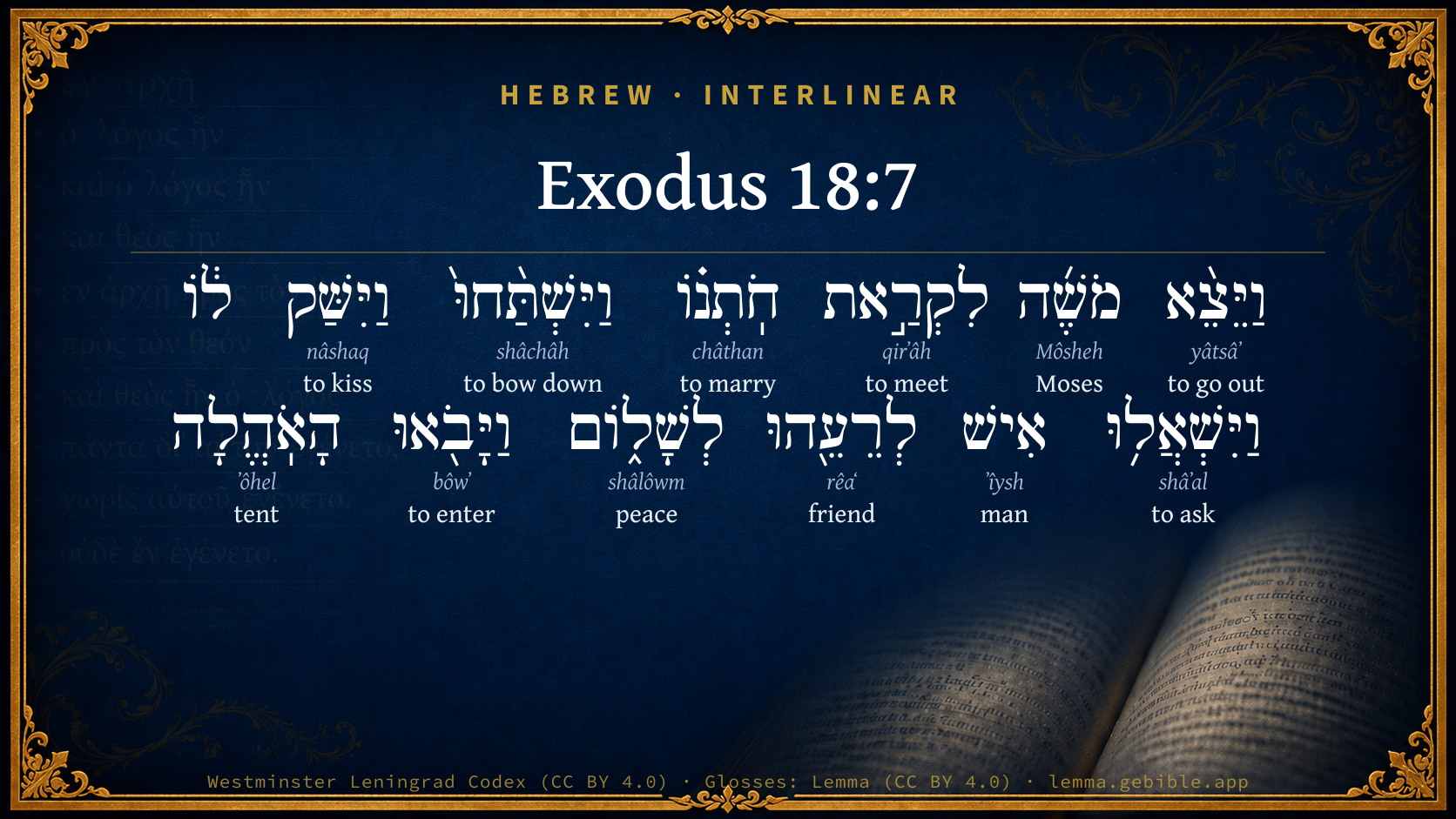
Hebrew (Westminster Leningrad Codex) Exodus 18:7 appears in the Hebrew Old Testament. The text above is from the Westminster Leningrad Codex. Each word links to its Strong’s number, a concise gloss, and parsing drawn from the Open Scriptures Hebrew Bible morphology. Click any word for its full Brown-Driver-Briggs (BDB) entry.
Download image
Cite this verse

Exodus 18:7 (World English Bible). Public Domain. Lemma interlinear Bible study tool, https://lemma.gebible.app/v/exodus/18/7.

Show BibTeX & RIS
BibTeX
RIS
English Translation
Moses went out to meet his father-in-law, and bowed and kissed him. They asked each other of their welfare, and they came into the tent.
World English Bible · Public Domain
Download a study sheet

One document with this verse’s original text, its word-by-word gloss line, the meaning frame, cross-references with their text, attributed commentary, and full source and license credits — printable, and it pastes into notes with its structure intact.

This verse Autodidact and up

Study sheet (.html) Plain text (.txt)

A passage Seminary Student

Up to 50 verses in one chapter. A passage sheet keeps up to 6 commentary sources and 12 cross-references per verse, in the order this page ranks them, and says so on the sheet whenever that leaves anything out. Ask for a single verse and you get the Autodidact verse sheet above.

Everything on this page stays free to read, with no account — the sheet is a download of what is already on screen, not access to it.

Want to remove ads? Support Godless Engineer
Compare translations 3

The same verse in 3 English versions, stacked beneath the original-language interlinear above. Click any original word for its lexicon entry.

Each is an independent rendering of the whole verse — the interlinear is not word-aligned to these translations.

Highlighted words mark where these versions differ — a whole-verse word diff, not a word-by-word alignment.

  • World English Bible Public Domain
    Moses went out to meet his father-in-law, and bowed and kissed him. They asked each other of their welfare, and they came into the tent.
  • King James Version Public Domain
    And Moses went out to meet his father in law, and did obeisance, and kissed him; and they asked each other of their welfare; and they came into the tent.
  • unfoldingWord Literal Text CC BY-SA 4.0
    And Moses went out to meet his father-in-law, and he bowed down and kissed him. And they asked, each man his friend, of their welfare, and they went into the tent.

unfoldingWord Literal Text — © unfoldingWord, licensed CC BY-SA 4.0. Word-aligned USFM3 via Door43 (git.door43.org/unfoldingWord/en_ult).

Versions to compare (up to 4)

3 of 4 selected

Show all 18 translations

Every available English version of this verse, each an independent rendering of the whole verse.

  • World English Bible Public Domain
    Moses went out to meet his father-in-law, and bowed and kissed him. They asked each other of their welfare, and they came into the tent.
  • Berean Standard Bible Public Domain
    So Moses went out to meet his father-in-law and bowed down and kissed him. They greeted each other and went into the tent.
  • Majority Standard Bible Public Domain
    So Moses went out to meet his father-in-law and bowed down and kissed him. They greeted each other and went into the tent.
  • King James Version Public Domain
    And Moses went out to meet his father in law, and did obeisance, and kissed him; and they asked each other of their welfare; and they came into the tent.
  • American Standard Version (1901) Public Domain
    And Moses went out to meet his father-in-law, and did obeisance, and kissed him: and they asked each other of their welfare; and they came into the tent.
  • Revised Version (1885) Public Domain
    And Moses went out to meet his father in law, and did obeisance, and kissed him; and they asked each other of their welfare; and they came into the tent.
  • Geneva Bible (1599) Public Domain
    And Moses went out to meete his father in law, and did obeisance and kissed him, and eche asked other of his welfare: and they came into the tent.
  • Douay-Rheims (1899) Public Domain
    And he went out to meet his kinsman, and worshipped and kissed him: and they saluted one another with words of peace. And when he was come into the tent,
  • Young's Literal Translation Public Domain
    And Moses goeth out to meet his father-in-law, and boweth himself, and kisseth him, and they ask one at another of welfare, and come into the tent;
  • Literal Standard Version CC BY-SA 4.0
    And Moses goes out to meet his father-in-law, and bows himself, and kisses him, and they ask of one another of welfare, and come into the tent;
  • Unlocked Literal Bible CC BY-SA 4.0
    Moses went out to meet his father-in-law, bowed down, and kissed him. They asked about each other's welfare and then went into the tent.
  • unfoldingWord Literal Text CC BY-SA 4.0
    And Moses went out to meet his father-in-law, and he bowed down and kissed him. And they asked, each man his friend, of their welfare, and they went into the tent.
  • Darby Bible Public Domain
    And Moses went out to meet his father-in-law, and did obeisance, and kissed him; and they asked each other [after] their welfare, and went into the tent.
  • World Messianic Bible Public Domain
    Moses went out to meet his father-in-law, and bowed and kissed him. They asked each other of their welfare, and they came into the tent.
  • Webster's Bible Public Domain
    And Moses went out to meet his father-in-law, and did obeisance, and kissed him: and they asked each other of their welfare: and they came into the tent.
  • Free Bible Version CC BY-SA 4.0
    Moses went out to meet his father-in-law and bowed down and kissed him. They asked each other how they were and then went into the tent.
  • Bible in Basic English Public Domain
    And Moses went out to his father-in-law, and went down on his face before him and gave him a kiss; and they said to one another, Are you well? and they came into the tent.
  • JPS Tanakh (1917) Public Domain
    And Moses went out to meet his father-in-law, and bowed down and kissed him; and they asked each other of their welfare; and they came into the tent.

Literal Standard Version (2020), Covenant Press — licensed CC BY-SA 4.0. Text via the HelloAO Bible API (eBible.org). Unlocked Literal Bible (unfoldingWord) — licensed CC BY-SA 4.0. Text via the HelloAO Bible API (eBible.org). unfoldingWord Literal Text — © unfoldingWord, licensed CC BY-SA 4.0. Word-aligned USFM3 via Door43 (git.door43.org/unfoldingWord/en_ult). Free Bible Version, Dr. Jonathan Gallagher — licensed CC BY-SA 4.0. Text via the HelloAO Bible API (eBible.org).

Word by word

More ways to search: Search by grammar → Find every occurrence → Compare this word →

Practice this passage: Drill this verse → Learn its vocabulary →

חֹֽתְנ֗וֹ
châthan
H2859
“marrying · him”
Verb, Qal, Participle Active, Masculine, Singular, Construct + Suffix, Personal, 3rd Person, Masculine, Singular
Part of Speech
Verb
Stem
Qal
Form
Participle Active
Gender
Masculine
Number
Singular
State
Construct
Full BDB Definition

Origin: a primitive root

TWOT: 781b

to become a son-in-law, make oneself a daughter's husband - (Qal) wife's father, wife's mother, father-in-law, mother-in-law (participle) - (Hithpael) to make oneself a daughter's husband
  1. וַיֵּצֵ֨א yâtsâʼ H3318 “and · to go out” Conjunction + Verb, Qal, Sequential Imperfect, 3rd Person, Masculine, Singular
  2. מֹשֶׁ֜ה Môsheh H4872 “Moses” Noun, Proper
  3. לִקְרַ֣את qirʼâh H7125 “to meet” Preposition + Verb, Qal, Infinitive Construct
  4. וַיִּשְׁתַּ֨חוּ֙ shâchâh H7812 “and · to bow down” Conjunction + Verb, Hithpael, Sequential Imperfect, 3rd Person, Masculine, Singular
  5. וַיִּשַּׁק nâshaq H5401 “and · to kiss” Conjunction + Verb, Qal, Sequential Imperfect, 3rd Person, Masculine, Singular
  6. וַיִּשְׁאֲל֥וּ shâʼal H7592 “and · to ask” Conjunction + Verb, Qal, Sequential Imperfect, 3rd Person, Masculine, Plural
  7. אִישׁ ʼîysh H376 “man” Noun, Common, Masculine, Singular, Absolute
  8. לְרֵעֵ֖הוּ rêaʻ H7453 “to/for · friend · his” Preposition + Noun, Common, Masculine, Singular, Construct + Suffix, Personal, 3rd Person, Masculine, Singular
  9. לְשָׁל֑וֹם shâlôwm H7965 “to/for · peace” Preposition + Noun, Common, Masculine, Singular, Absolute
  10. וַיָּבֹ֖אוּ bôwʼ H935 “and · to enter” Conjunction + Verb, Qal, Sequential Imperfect, 3rd Person, Masculine, Plural
  11. הָאֹֽהֱלָה ʼôhel H168 “the · tent · toward” Particle, Definite Article + Noun, Common, Masculine, Singular, Absolute + Suffix, Demonstrative

About this verse

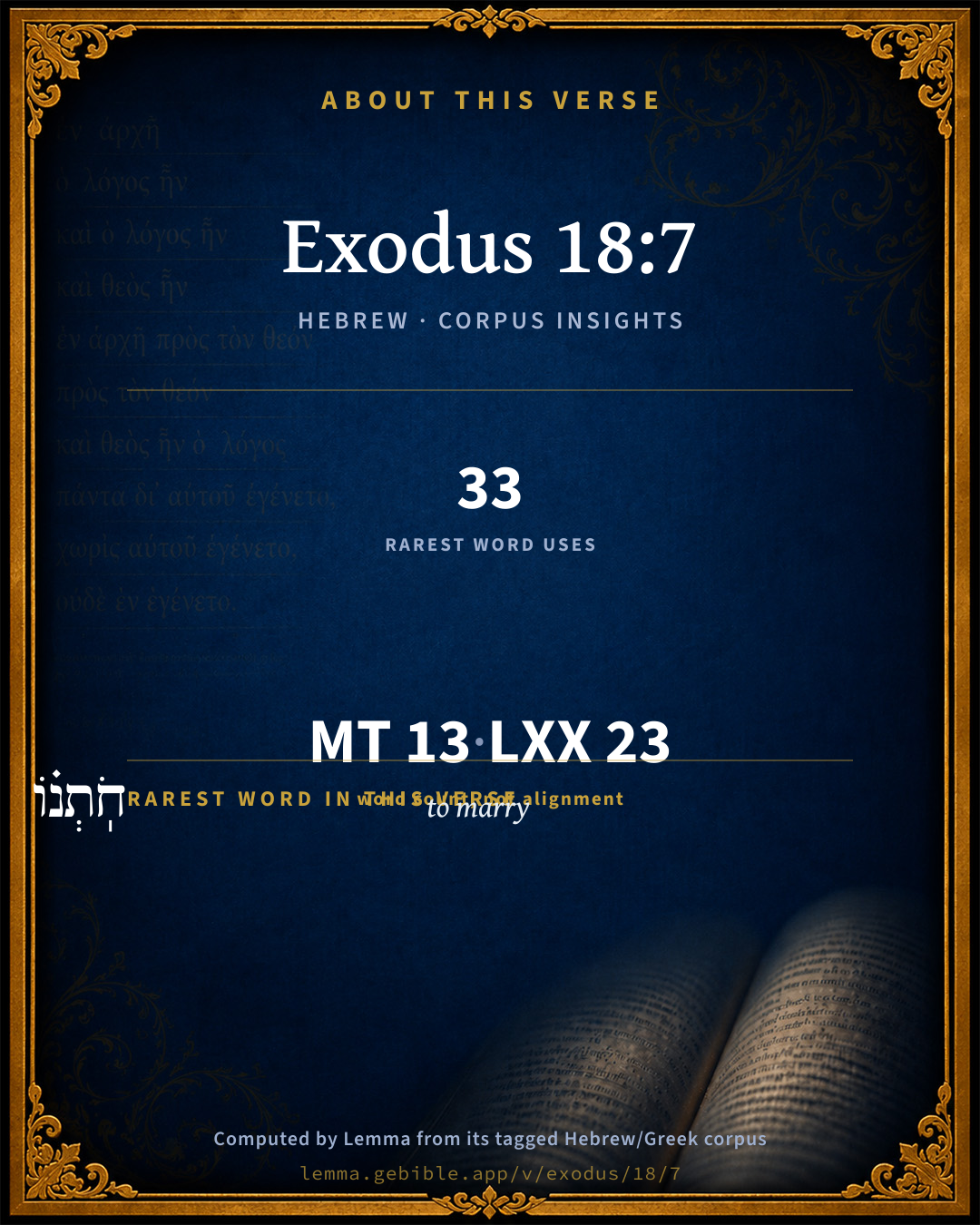
These counts appear in no published source. They are computed here, from the morphology-tagged text and Lemma’s own curated glosses. What Lemma adds →

13
words
12
distinct lemmas
Pentateuch
section

Shared distinctive vocabulary

חֹֽתְנ֗וֹ to marry H2859 occurs in 32 verses of the Hebrew Bible. Also found in:

Grammatical profile

  • 7 verbs
  • 5 nouns
  • 1 preposition

Verb forms

  • וַיֵּצֵ֨א Qal · Sequential Imperfect
  • לִקְרַ֣את Qal · Infinitive Construct
  • חֹֽתְנ֗וֹ Qal · Participle Active
  • וַיִּשְׁתַּ֨חוּ֙ Hithpael · Sequential Imperfect
  • וַיִּשַּׁק Qal · Sequential Imperfect
  • וַיִּשְׁאֲל֥וּ Qal · Sequential Imperfect
  • וַיָּבֹ֖אוּ Qal · Sequential Imperfect

Hebrew & Septuagint length

In English translation the verse runs 25 words from the Hebrew and 27 from the Septuagint (LXX English) — closely comparable.

A rough comparison of the two English renderings, which tokenize alike — not a word-level alignment.

Word counts can differ between the Hebrew and the Greek without any difference in meaning — e.g. the Hebrew direct-object marker אֵת has no separate Greek word, and Greek often adds the article ὁ.

In the original languages it is 13 Hebrew tokens and 23 Greek tokens — but the two are counted differently (Hebrew bundles its prefixes and suffixes into one token; the Greek is in lemma form), so that isn’t a like-for-like length.

Cross-references

17

Topical passages linked to Exodus 18:7 in the Treasury of Scripture Knowledge — connected by theme and wording, ordered by reader-vote popularity; previews shown in the World English Bible.

  • Genesis 29:13 It happened, when Laban heard the news of Jacob, his sister's son, that he ran to meet Jacob, and embraced him, and kissed him, and brought him to his house. Jacob told Laban all these things.
  • Genesis 14:17 The king of Sodom went out to meet him, after his return from the slaughter of Chedorlaomer and the kings who were with him, at the valley of Shaveh (the same is the King's Valley).
  • Genesis 18:2 He lifted up his eyes and looked, and saw that three men stood opposite him. When he saw them, he ran to meet them from the tent door, and bowed himself to the earth,
  • Genesis 19:1 The two angels came to Sodom at evening. Lot sat in the gate of Sodom. Lot saw them, and rose up to meet them. He bowed himself with his face to the earth,
  • 2 Samuel 11:7 When Uriah was come to him, David asked of him how Joab did, and how the people fared, and how the war prospered.
  • 1 Kings 2:19 Bathsheba therefore went to king Solomon, to speak to him for Adonijah. The king rose up to meet her, and bowed himself to her, and sat down on his throne, and caused a throne to be set for the king's mother; and she sat on his right hand.
  • Genesis 31:28 and didn't allow me to kiss my sons and my daughters? Now have you done foolishly.
  • Genesis 33:3–7 He himself passed over in front of them, and bowed himself to the ground seven times, until he came near to his brother.
  • Genesis 43:27–28 He asked them of their welfare, and said, "Is your father well, the old man of whom you spoke? Is he yet alive?"
  • Genesis 45:15 He kissed all his brothers, and wept on them. After that his brothers talked with him.
  • Genesis 46:29 Joseph made ready his chariot, and went up to meet Israel, his father, in Goshen. He presented himself to him, and fell on his neck, and wept on his neck a good while.
  • Numbers 22:36 When Balak heard that Balaam was come, he went out to meet him to the City of Moab, which is on the border of the Arnon, which is in the utmost part of the border.
  • Judges 11:34 Jephthah came to Mizpah to his house; and, behold, his daughter came out to meet him with tambourines and with dances: and she was his only child; besides her he had neither son nor daughter.
  • Psalms 2:12 Kiss the son, lest he be angry, and you perish in the way, For his wrath will soon be kindled. Blessed are all those who take refuge in him.
  • Luke 7:45 You gave me no kiss, but she, since the time I came in, has not ceased to kiss my feet.
  • Acts 20:37 They all wept a lot, and fell on Paul's neck and kissed him,
  • Acts 28:15 From there the brothers, when they heard of us, came to meet us as far as The Market of Appius and The Three Taverns. When Paul saw them, he thanked God, and took courage.

Cross-references courtesy of OpenBible.info (CC BY 4.0).

Hebrew and Greek witnesses Masoretic Hebrew ↔ Greek Septuagint

The same verse in the two great witnesses to the Old Testament, shown verse-for-verse.

These are two independent witnesses, not word-aligned to each other, and the Septuagint is shown in lemma (dictionary) form.

Hebrew Exodus 18:7 Masoretic · Westminster Leningrad Codex

וַיֵּצֵ֨א מֹשֶׁ֜ה לִקְרַ֣את חֹֽתְנ֗וֹ וַיִּשְׁתַּ֨חוּ֙ וַיִּשַּׁק ל֔וֹ וַיִּשְׁאֲל֥וּ אִישׁ לְרֵעֵ֖הוּ לְשָׁל֑וֹם וַיָּבֹ֖אוּ הָאֹֽהֱלָה

Moses went out to meet his father-in-law, and bowed and kissed him. They asked each other of their welfare, and they came into the tent.

World English Bible · Public Domain

Greek LXX Exodus 18:7 Septuagint · lemma form

ἐκἔρχομαι δέ μωυσῆς εἰς συνάντησις ὁ γαμβρός αὐτός καί προςκυνέω αὐτός καί φιλέω αὐτός καί ἀσπάζομαι ἀλλήλω καί εἰςἄγω αὐτός εἰς ὁ σκηνή

And Moses went forth to meet his father-in-law, and did him reverence, and kissed him, and they embraced each other, and he brought them into the tent.

LXX2012 (modern English Septuagint) · Public Domain

Hebrew: Westminster Leningrad Codex (CC BY 4.0). Greek: Septuagint (public domain); English from LXX2012 (modern English Septuagint) (Public Domain). How the Septuagint differs from the Hebrew →

Targum (Aramaic paraphrase)

2

The Targum is the ancient Jewish Aramaic paraphrase of the Hebrew Scriptures — an interpretive translation, not the Hebrew text itself. Onkelos (literal) and Pseudo-Jonathan (expansive) render the Torah, and Jonathan the Prophets. Coverage is partial: where no permissively-licensed English translation exists for a verse, only the Aramaic is shown. This is verse-level text, not a word-by-word alignment to the Hebrew.

  1. Targum Onkelos Torah (Genesis–Deuteronomy)
    וּנְפַק משֶׁה לְקַדָמוּת חֲמוּהִי וּסְגִיד וּנְשִׁיק לֵהּ וּשְׁאִילוּ גְבַר לְחַבְרֵהּ לִשְׁלָם וְעַלוּ לְמַשְׁכְּנָא:

    (no public-domain English translation for this verse)

    Targum Onkelos — Aramaic: “Onkelos Genesis” (public domain); “Onkelos Exodus” (public domain); “Onkelos Leviticus” (public domain); “Onkelos Numbers” (public domain); “Onkelos Deuteronomy” (public domain). English: “Sefaria Community Translation” (CC0 1.0 (public-domain dedication)); “J.W. Etheridge. The Targums of Onkelos and Jonathan Ben Uzziel on the Pentateuch. London: Longmans, Green, 1862” (public domain). Text via Sefaria.

  2. Targum Pseudo-Jonathan Torah (Genesis–Deuteronomy)
    וּנְפַק משֶׁה מִתְּחוֹת עֲנָנָא יְקָרָא לִקְדָמוּת חָמוֹי וּסְגִיד וּנְשֵׁיק לֵיהּ וְגַיְירֵיהּ וְשַׁיְילוּ גְּבַר לְחַבְרֵיהּ לִשְׁלָם וְאָתוּ לְמַשְׁכַּן בֵּית אוּלְפָנָא

    And Mosheh came forth from under the cloud of glory to meet his father-in-law, and did obeisance, and kissed him and made him a proselyte; and they asked of each other's welfare, and came to the tabernacle, the house of instruction.

    Targum Pseudo-Jonathan — Aramaic: “Targum Jonathan on Genesis” (public domain); “Targum Jonathan on Exodus” (public domain); “Targum Jonathan on Leviticus” (public domain); “Targum Jonathan on Numbers” (public domain); “Targum Jonathan on Deuteronomy” (public domain). English: “The Targum of Jonathan ben Uzziel, trans. J. W. Etheridge, London, 1862” (public domain). Text via Sefaria.

Commentary

Notes on Exodus 18:7 from classic Christian and Jewish commentators (each source and its license shown beneath its notes). The classic Christian expositions comment on the surrounding passage and are grouped to its opening verse, so a note may address several verses; the Jewish commentaries on the Tanakh (Rashi and others) are per-verse, so they appear only where the commentator wrote on this verse.

Lemma curates 59 commentaries, every one of them public domain or Creative Commons licensed, each selected and text-cleaned for this edition rather than reprinted as found. About our sources →

Matthew Henry's Commentary

Observe here, I. The kind greeting that took place between Moses and his father-in-law, Exo 18:7. Though Moses was a prophet of the Lord, a great prophet, and king in Jeshurun, yet he showed a very humble respect to his father-in-law. However God in his providence is pleased to advance us, we must make conscience of giving honour to whom honour is due, and never look with disdain upon our poor relations. Those that stand high in the favour of God are not thereby discharged from the duty they owe to men, nor will that justify them in a stately haughty carriage. Moses went out to meet Jethro, did homage to him, and kissed him. Religion does not destroy good manners. They asked each other of their welfare. Even the kind How-do-you-do's that pass between them are taken notice of, as the expressions and improvements of mutual love and friendship.

II. The narrative that Moses gave his father-in-law of the great things God had done for Israel, Exo 18:8. This was one thing Jethro came for, to know more fully and particularly what he had heard the general report of. Note, Conversation concerning God's wondrous works is profitable conversation; it is good, and to the use of edifying, Psa 105:2. Compare Psa 145:11, Psa 145:12. Asking and telling news, and discoursing of it, are not only an allowable entertainment of conversation, but are capable of being tuned to a very good account, by taking notice of God's providence, and the operations and tendencies of that providence, in all occurrences.

III. The impressions this narrative made upon Jethro. 1. He congratulated God's Israel: Jethro rejoiced, Exo 18:9. He not only rejoiced in the honour done to his son-in-law, but in all the goodness done to Israel, Exo 18:9. Note, Public blessings are the joy of public spirits. While the Israelites were themselves murmuring, notwithstanding all God's goodness to them, here was a Midianite rejoicing. This was not the only time that the faith of the Gentiles shamed the unbelief of the Jews; see Mat 8:10. Standers-by were more affected with the favours God had shown to Israel than those were that received them. 2. He gave the glory to Israel's God (Exo 18:10): "Blessed be Jehovah" (for by that name he is now known), "who hath delivered you, Moses and Aaron, out of the hand of Pharaoh, so that though he designed your death he could not effect it, and by your ministry has delivered the people." Note, Whatever we have the joy of God must have the praise of. 3. His faith was hereby confirmed, and he took this occasion to make a solemn profession of it: Now know I that Jehovah is greater than all gods, Exo 18:11. Observe, (1.) The matter of his faith: that the God of Israel is greater than all pretenders, all false and counterfeit-deities, that usurp divine honours; he silences them, subdues them, and is too hard for them all, and therefore is himself the only living and true God. He is also higher than all princes and potentates (who are called gods), and has both an incontestable authority over them and an irresistible power to control and over-rule them; he manages them all as he pleases, and gets honour upon them, how great soever they are. (2.) The confirmation and improvement of his faith: Now know I; he knew it before, but now he knew it better; his faith great up to a full assurance, upon this fresh evidence. Those obstinately shut their eyes against the clearest light who do not know that the Lord is greater than all gods. (3.) The ground and reason upon which he built it: For wherein they dealt proudly, the magicians, and the idols which the Egyptians worshipped, or Pharaoh and his grandees (they both opposed God and set up in competition with him), he was above them. The magicians were baffled, the idols shaken, Pharaoh humbled, his powers broken, and, in spite of all their confederacies, God's Israel was rescued out of their hands. Note, Sooner or later, God will show himself above those that by their proud dealings contest with him. He that exalts himself against God shall be abased.

IV. The expressions of their joy and thankfulness. They had communion with each other both in a feast and in a sacrifice, Exo 18:12. Jethro, being hearty in Israel's interests, was cheerfully admitted though a Midianite, into fellowship with Moses and the elders of Israel, forasmuch as he also was a son of Abraham, though of a younger house. 1. They joined in a sacrifice of thanksgiving: Jethro took burnt offerings for God, and probably offered them himself, for he was a priest in Midian, and a worshipper of the true God, and the priesthood was not yet settled in Israel. Note, Mutual friendship is sanctified by joint-worship. It is a very good thing for relations and friends, when they come together, to join in the spiritual sacrifice of prayer and praise, as those that meet in Christ the centre of unity. 2. They joined in a feast of rejoicing, a feast upon the sacrifice. Moses, upon this occasion, invited his relations and friends to an entertainment in his own tent, a laudable usage among friends, and which Christ himself, not only warranted, but recommended, by his acceptance of such invitations. This was a temperate feast: They did eat bread; this bread, we may suppose, was manna. Jethro must see and taste that bread from heaven, and, though a Gentile, is as welcome to it as any Israelite; the Gentiles still are so to Christ the bread of life. It was a feast kept after a godly sort: They did eat bread before God, soberly, thankfully, in the fear of God; and their table-talk was such as became saints. Thus we must eat and drink to the glory of God, behaving ourselves at our tables as those who believe that God's eye is upon us.

Matthew Henry's Commentary on the Whole Bible (1708–1710) — public domain (CC PDM 1.0). Text via the HelloAO Bible API.

Trapp's Complete Commentary

John Trapp

Exo 18:7 And Moses went out to meet his father in law, and did obeisance, and kissed him; and they asked each other of [their] welfare; and they came into the tent.

Ver. 7. And did obeisance.] Sir Thomas More, Lord Chancellor, would, in Westminster Hall, beg his father’s blessing on his knees.

John Trapp, A Commentary or Exposition upon All the Books of the Old and New Testament (1647–1656) — public domain. Text from a community e-Sword module.

The Biblical Illustrator

Joseph S. Exell

Exo_18:7

They asked each other of their welfare.

Friends meeting after separation

I. This world is not a scene adapted or intended to afford the pleasure and benefit of friendship entire. Men cannot collect and keep around them an assemblage of congenial spirits, to constitute, as it were, a bright social fire, ever glowing, ever burning, amidst the winter of this world. They cannot surround themselves with the selectest portion of humanity, so as to keep out of sight and interference the general character of human nature. They are left to be pressed upon by an intimate perception of what a depraved and unhappy world it is. And so they feel themselves strangers and pilgrims upon earth.

II. It is contrary to the design of God that the more excellent of this worlds inhabitants should form together little close assemblages and bands, within exclusive circles, detached as much as possible from the general multitude. On the contrary, it is appointed that they should be scattered and diffused hither and thither, to be useful and exemplary in a great number of situations; that there should be no large space without some of them. Thus it is a world that dissociates friends. Nevertheless, friends do sometimes meet; and then it is quite natural to do as Moses and Jethro did--ask each other of their welfare.

III. In the meeting of genuine friends, after considerable absence, these feelings will be present.

1. Kind affection.

2. Inquiry.

3. Reflective comparison.

4. Gratitude to God for watching over them both.

5. Faithful admonition and serious anticipation. (J. Foster.)

Family reunions

I. As to the salutations at meeting.

1. Courteousness. This excludes--

(1) Excessive familiarity;

(2) Rudeness;

(3) Pride.

2. A hearty welcome.

II. As to the subjects of conversation.

1. On public affairs.

2. On social matters.

3. With recognition of God.

4. Fit for mutual response (Exo_18:10-11).

III. As to the mode of festivity.

1. That such festivity may not be confined to the family.

2. That it may be preceded by an act of worship.

3. That it should be with consciousness of the Divine presence.

To eat as before God, will make us--

(1) Happy and helpful;

(2) Temperate;

(3) Regardful of the soul s progress. (D. G. Watt, M. A.)

Lessons

1. It is not unbeseeming the highest places or persons in kingdom or Church of Christ to give due respect to relations.

2. Grace doth not unteach men manners and civil carriage respectively unto men.

3. Natural affection and expressions of it to friends beseemeth Gods servants.

4. It is a natural duty for relations to inquire of and wish each others peace.

5. Conduct to a tent for rest is suitable for travellers that visit their relations (Exo_18:7). (G. Hughes, B. D.)

Religious intercourse between parents and children

One Sunday night I said, Ah! you mothers will say that your children are all in bed; never mind, go upstairs and wake them, and talk to them about their souls. A mother (this I know to be true) went home, and her little girl was in bed and asleep. She woke her and said, Jane, I have not spoken to you, dear child, about your soul. The pastor has been exhorting us to-night, and saying that even if you were asleep you should be wakened. Then said Jane, Mother, I have often wondered that you did not speak to me about Christ, but I have known Him these two years. The mother stood convicted. She brought her daughter round on Monday and said, Let this dear girl be baptized and lore the church. I said to her, Why did you not tell your mother? Well, said she, you know, mother never seemed to come up to the subject; she never gave me a chance. Then the mother said, Quite right; I have not been to my children what I ought to have been; but, please God, there shall never be another child of mine that shall steal a march on her mother, and find Christ without her mother knowing it. God graciously rebuked that mother. (C. H. Spurgeon.)

Religious conversation

Among the means to be used in times of religious interest we may mention conversation. Many neglect it, but none can deny its power for good. Says Dr. Archibald Alexander, in his book on Religious Experience: Religious conversation, in which Christians freely tell of the dealings of God with their souls, has been often a powerful means of quickening the sluggish soul and communicating comfort. It is, in many cases, a great consolation to the desponding believer to know that his case is not entirely singular; and if a traveller can meet with one who has been over the difficult parts of the road before him, he may surely derive from his experience some salutary counsel and warning. The Scriptures are favourable to such communications. Come and hear, says David, all ye that fear God, and I will declare what He hath done for my soul. Dr. Watts thought so much of the talent for parlour teaching, that he declared that the man who had it could do more good than the minister by his public discourses. Said one who was under sentence of death: When the minister spoke to me he seemed like one who was standing far above me; but when Alexander, that good man that everybody knows is the holiest man in the place, came in, he stood like one at my side, and when he classed himself with me, and said, Sinners like me and you, I could stand it no longer. Saurin, the great French preacher, said, in his sermon on Christian conversation: Are we returning from a sermon? Why not entertain one another with the subjects we have been hearing? Why not endeavour to imprint on one anothers memories the truths that have been proved, and to impress upon one anothers hearts such precepts as have been enforced? Have we been visiting a dying person? Why not make such reflections as naturally occur on such occasions the matter of our conversations? Why not embrace such a fair opportunity of speaking on the vanity of life, the uncertainty of worldly enjoyments, and the happiness of a pious departure to rest? Have you been reading a good book? Why not converse with our companions on the information we have derived from it?

The Biblical Illustrator, edited by Joseph S. Exell (c. 1880s–1900s) — public domain. Text from a community e-Sword module.

Tyndale Open Study Notes

Tyndale Open Resources

18:7 bowed low and kissed him. They asked about each other’s welfare: These were all typical customs of greeting in that society.

Tyndale Open Study Notes — © Tyndale Open Resources, licensed CC BY-SA 4.0. Text via the HelloAO Bible API.

Geneva Bible (1599)

Geneva Bible translators

Hebrew, of peace.

Geneva Bible (1599) marginal notes — public domain. Text via Bolls.life.

Jamieson, Fausset & Brown

Robert Jamieson, A. R. Fausset & David Brown

Moses went out to meet his father-in-law, &c.--Their salutations would be marked by all the warm and social greetings of Oriental friends (see on Exo 4:27) --the one going out to "meet" the other, the "obeisance," the "kiss" on each side of the head, the silent entrance into the tent for consultation; and their conversation ran in the strain that might have been expected of two pious men, rehearsing and listening to a narrative of the wonderful works and providence of God.

Jamieson, Fausset & Brown — Commentary Critical and Explanatory on the Whole Bible (1871) — public domain (CC PDM 1.0). Text via the HelloAO Bible API.

Adam Clarke's Commentary

Verse 7. And did obeisance] וישתחו vaiyishtachu, he bowed himself down, (See Clarke on Ge 17:3; and "Ex 4:31";) this was the general token of respect. And kissed him; the token of friendship. And they asked each other of their welfare; literally, and they inquired, each man of his neighbour, concerning peace or prosperity; the proof of affectionate intercourse. These three things constitute good breeding and politeness, accompanied with sincerity.

And they came into the tent.] Some think that the tabernacle is meant, which it is likely had been erected before this time; See Clarke on Ex 18:5. Moses might have thought proper to take his relative first to the house of God, before he brought him to his own tent.

Adam Clarke's Commentary on the Bible (1810–1826) — public domain. Text from a community e-Sword/MySword module.

Ellicott's Commentary for English Readers

(7) Moses went out . . . And did obeisance.—Oriental etiquette required the going forth to meet an honoured guest (Gen_18:2; Gen_19:1, &c). The obeisance was wholly voluntary, and marks the humility of Moses, who, now that he was the prince of his nation, might well have required Jethro to bow down to him.

And kissed him.—Kissing is a common form of salutation in the East, even between persons who are in no way related. Herodotus says of the Persians: “When they meet each other in the streets, you may know if the persons meeting are of equal rank by the following token: if they are, instead of speaking they kiss each other on the lips. In the case where one is a little inferior to the other, the kiss is given on the cheek” (Book i. 134). (Comp. 2Sa_15:5; 2Sa_19:39; 2Sa_20:9; Mat_26:48-49; Act_20:37, &c.; and for the continuance of the custom to the present day, see the collection of instances given in the article Kiss, in Smith’s Dictionary of the Bible, vol. ii., p. 46.)

They asked each other of their welfare.—Heb., wished peace to each other—exchanged, that is, the customary salutation, “Peace be with you.”

A Bible Commentary for English Readers, edited by Charles John Ellicott (1878–1897) — public domain. Text from a community e-Sword module.

The Cambridge Bible for Schools and Colleges

gen. ed. J. J. S. Perowne

7. Moses receives his father-in-law with the usual Oriental etiquette.

did obeisance] lit. bowed himself down, in Eastern fashion: cf. Gen_23:7; Gen_23:12; Gen_33:3; Gen_33:6-7; Gen_42:6, &c.

The Cambridge Bible for Schools and Colleges (gen. ed. J. J. S. Perowne; Cambridge University Press, 1878–1918) — public domain. Text from a community e-Sword module.

John Gill's Exposition

And Moses went out to meet his father in law,.... Out of the camp, at least out of his tent: the Targum of Jonathan says, from under the cloud of glory; how far he went is not certain, nor material to know: this was an instance of his great humility and modesty, and was doing Jethro a great deal of honour; that one who was in such great dignity, at the head of such a vast body of people, and superior to him both in natural and spiritual abilities, yet condescended to go forth in person to meet him, when he might have sent a guard of his men to escort him to his camp, which would have been honour sufficient; and it is not said he went out to meet his wife and children; for Aben Ezra says it was not usual for honourable men so to do:

and did obeisance: to Jethro, bowed unto him and worshipped him in a civil way, after the manner of the eastern nations, who used to make very low bows to whom they paid civil respect:

and kissed him; not to make him a proselyte, as the above Targum, nor in token of subjection, but of affection and friendship; it being usual for relations and friends to kiss each other at meeting or parting:

and they asked each other of their welfare; or "peace" (n); of their prosperity and happiness, temporal and spiritual, of their peace, inward and outward, and of the bodily health of them and their families:

and they came into the tent; the Targum of Jonathan says,"into the tabernacle of the house of doctrine,''or school room; which is not likely, since Jethro was a man well instructed in divine things, and needed not to be put to school; and if he did, it can hardly be thought that as soon as Moses met him he should set about the instruction of him; but into his tent where he dwelt; that, as Aben Ezra says, which was the known tent of Moses, though it is not expressly said his tent.

(n) "ad pacem", Montanus; "de pace", Munster, Fagius, Drusius, Piscator; so Ainsworth.

John Gill's Exposition of the Whole Bible (1746–1763) — public domain (CC PDM 1.0). Text via the HelloAO Bible API.

Albert Barnes' Notes on the Bible

Asked each other of their welfare - Addressed each other with the customary salutation, “Peace be unto you.”

Albert Barnes' Notes on the Bible (1834–1885) — public domain. Text from a community e-Sword/MySword module.

Haydock's Catholic Bible Commentary

Worshipped, bending to the ground, according to the custom of the country. (Haydock) --- Tent of the Lord, if it were then erected, and afterwards into that of Moses. (Calmet)

George Leo Haydock (1774–1849), Haydock's Catholic Family Bible and Commentary, 1859 edition — public domain. Excludes Psalms (Douay-Rheims chapter numbering differs from Protestant) and Deuterocanonical books (Catholic canon only).

Matthew Poole's English Annotations

Of their welfare, Heb. of their peace, i.e. prosperity and all happiness, which also they wished one to the other, as this phrase implies. See 1Sa 10:4; Psa 122:6.

Matthew Poole's English Annotations on the Holy Bible (1683–1685) — public domain. Text from a community e-Sword/MySword module.

Whedon's Commentary on the Bible

Daniel D. Whedon

7. Did obeisance — This brief but vivid description is true to the warmth and emotion of genuine Oriental greeting. The interest of the occasion was greatly enhanced by the reunion of Moses and his wife and children and the wondrous events that had taken place since they were last together.

Daniel D. Whedon (gen. ed.), Commentary on the Old and New Testaments (1874–1909) — public domain. Text from a community e-Sword module.

The Pulpit Commentary

Moses went out to meet his father-in-law. Oriental ideas of politeness require such a movement in case of an honoured or even of a welcome visitor. (see Gen_18:2 Gen_19:1 Gen_32:6 Gen_33:1; Luk_15:20; etc.) It was evidently the intention of Moses to receive Jethro with all possible marks of honour and respect. He not only went out to meet him, but did obeisance to him, as to a superior. They asked each other of their welfare. Rather "exchanged salutations;" addressed each other mutually with the customary phrase "Peace he unto you." Came into the tenti.e. , went together into the tent of Moses, which had been already glanced at in the word "encamped" (verse 5).

The Pulpit Commentary (1880–1919), ed. H.D.M. Spence-Jones & Joseph S. Exell — public domain. Text from a community e-Sword module.

unfoldingWord translationNotes

Door43 World Missions Community

bowed down, and kissed him

These symbolic acts were the normal way that people showed great respect and devotion in that culture. (See: Symbolic Action)

for Israel's sake

The word "Israel" represents the Israelite people. AT: "in order to help the Israelite people" (See: Metonymy)

all the hardships that had come to them

Moses writes of hardships happening to them as if hardships had come to them. AT: "all the hardships that had happened to them" or "all the hardships they had experienced" (See: Metaphor)

translationWords

Moses

bow

kiss

tent

Yahweh

Pharaoh

unfoldingWord translationNotes — © Distant Shores Media and the Door43 World Missions Community, licensed CC BY-SA 4.0. Source: git.door43.org/Door43/en_tn.

Rashi

Rabbi Shlomo Yitzchaki (Rashi)

ויצא משה AND MOSES WENT OUT — Great honour, indeed, did Jethro receive at that moment, for as soon as Moses went out to Jethro, Aaron, Nadab and Abihu went out, and who was it that saw these go out and would not himself go out? (Midrash Tanchuma, Vayigash 7)

וישתחו וישק לו AND HE PROSTRATED HIMSELF AND KISSED HIM — From the wording of this statement I do not know who prostrated himself to whom! But when it states in the next words: איש לרעהו, “a man to his fellow”, it becomes quite evident; for which of the two is called by the appellation איש, “man”? — This was Moses, as it is said, (Numbers 12:3) “And the man, Moses”. (Thus it was the man (איש) Moses, who bowed down to his fellow (Mekhilta).

Rashi on the Tanakh — English translations: “The Judaica Press complete Tanach with Rashi, translated by A. J. Rosenberg” (CC BY 4.0); “Pentateuch with Rashi's commentary by M. Rosenbaum and A.M. Silbermann, 1929-1934” (public domain); “The Metsudah Tanach series, Lakewood, N.J” (CC BY 4.0); and “The Book of Joshua, Metsudah Publications, 1997” (CC BY 4.0). Text via Sefaria.

Sforno

Rabbi Ovadia Sforno

Moshe went out. Moshe did not consider it beneath his dignity to go out to meet the man who had given him refuge in his time of trouble. Similarly, Ester behaved respectfully towards Mordechai and Yoseif towards his brothers even after they attained positions of royalty. This is in contrast with the chief butler who forgot Yoseif as soon as he was restored to his position.

Sforno on the Tanakh — English translation: “Yalkut, Sifsei Chachomim Chumash, Metsudah Publications, 2009” (CC BY 4.0). Text via Sefaria.

Lesson kit

Teaching starters — assembled from the data on this page, not authored interpretation. Every prompt links to the verse data it draws on. Edit before teaching.

Exodus, in the Pentateuch, opens this verse with 13 words (12 distinct Hebrew lemmas). Its most distinctive word is châthan (“to marry”). A historical commentator’s framing appears above. Read the whole chapter for the surrounding context.

Discussion questions

  1. What does “to marry” (châthan) contribute to the verse as a whole?
  2. Genesis 34:9 shares the word «to marry» with this verse. How do the two illuminate each other?
  3. These translations render this verse differently; the difference is in the English rendering, not the original. What questions does that raise?
  4. The verb «וַיֵּצֵ֨א» is Qal Sequential Imperfect. How does its form color the action?
  5. Reading how Matthew Henry's Commentary and Trapp's Complete Commentary read this verse, where do the two commentators agree and where do they part?

Things to notice

Reading settings

Reading text

Shown beneath each verse's original-language words.

Old Testament
Old Testament edition

Read the OT as the Masoretic Hebrew (MT) or the Greek Septuagint (LXX).

English shown for the Greek Septuagint (in the Hebrew ↔ Greek comparison).

Comparing translations? Open the Compare panel on any verse page to stack up to four side by side.