
Genesis 29:32

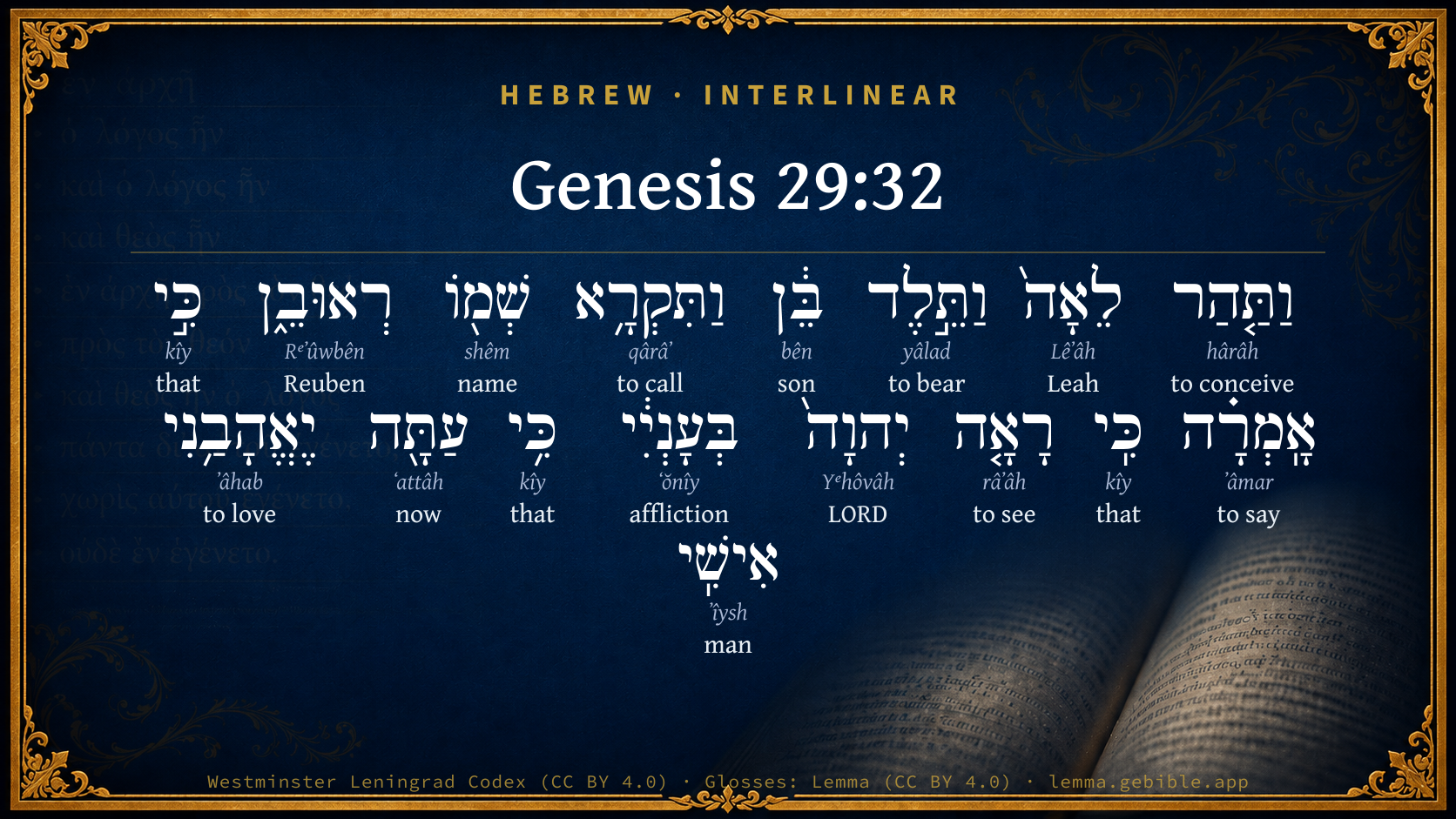
Hebrew (Westminster Leningrad Codex) Genesis 29:32 appears in the Hebrew Old Testament. The text above is from the Westminster Leningrad Codex. Each word links to its Strong’s number, a concise gloss, and parsing drawn from the Open Scriptures Hebrew Bible morphology. Click any word for its full Brown-Driver-Briggs (BDB) entry.
Download image
Cite this verse

Genesis 29:32 (World English Bible). Public Domain. Lemma interlinear Bible study tool, https://lemma.gebible.app/v/genesis/29/32.

Show BibTeX & RIS
BibTeX
RIS
English Translation
Leah conceived, and bore a son, and she named him Reuben. For she said, "Because Yahweh has looked at my affliction. For now my husband will love me."
World English Bible · Public Domain
Highlights
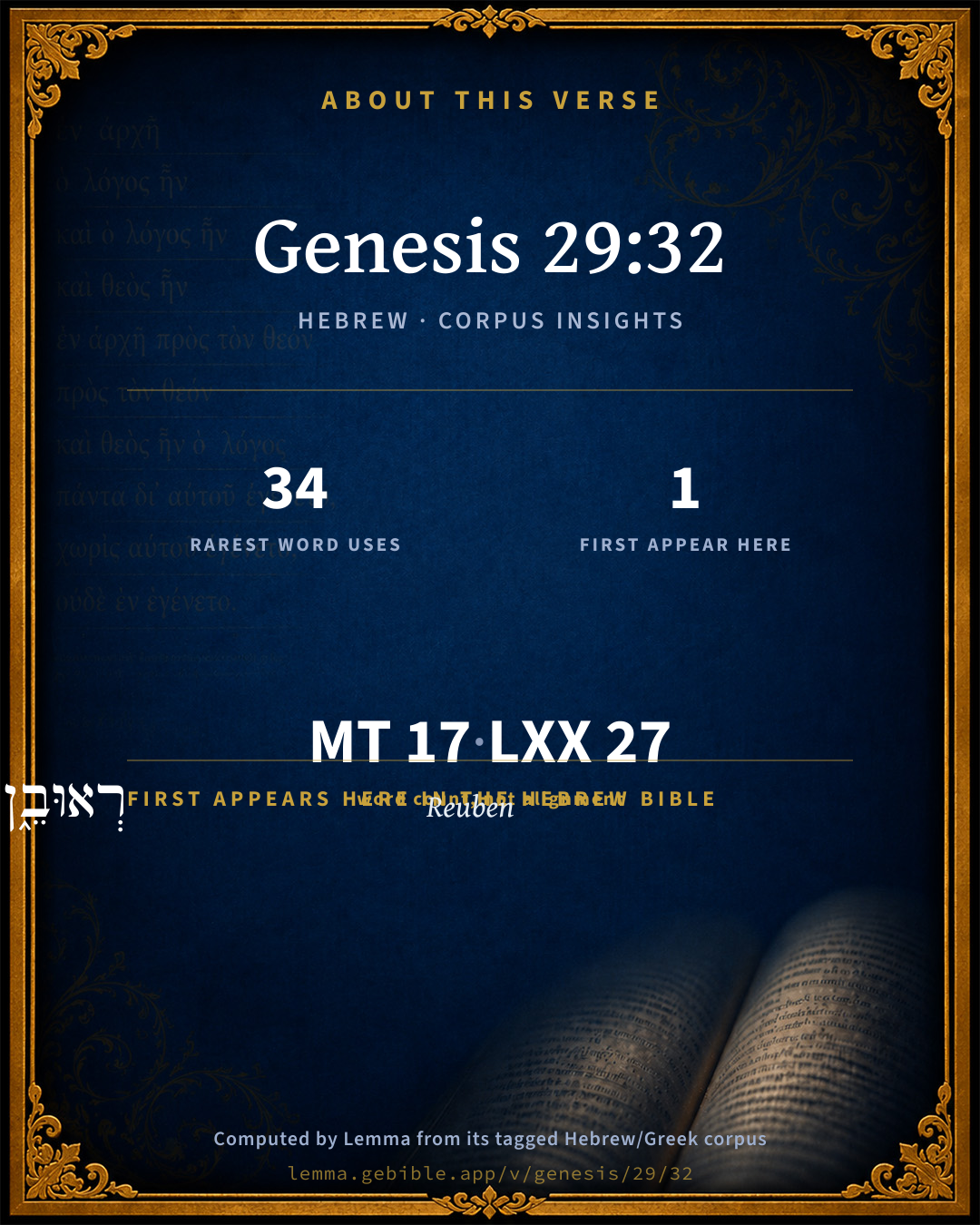
  • 1 first appearance in the Hebrew Bible
Full analysis ↓
Download a study sheet

One document with this verse’s original text, its word-by-word gloss line, the meaning frame, cross-references with their text, attributed commentary, and full source and license credits — printable, and it pastes into notes with its structure intact.

This verse Autodidact and up

Study sheet (.html) Plain text (.txt)

A passage Seminary Student

Up to 50 verses in one chapter. A passage sheet keeps up to 6 commentary sources and 12 cross-references per verse, in the order this page ranks them, and says so on the sheet whenever that leaves anything out. Ask for a single verse and you get the Autodidact verse sheet above.

Everything on this page stays free to read, with no account — the sheet is a download of what is already on screen, not access to it.

Want to remove ads? Support Godless Engineer
Compare translations 3

The same verse in 3 English versions, stacked beneath the original-language interlinear above. Click any original word for its lexicon entry.

Each is an independent rendering of the whole verse — the interlinear is not word-aligned to these translations.

Highlighted words mark where these versions differ — a whole-verse word diff, not a word-by-word alignment.

  • World English Bible Public Domain
    Leah conceived, and bore a son, and she named him Reuben. For she said, "Because Yahweh has looked at my affliction. For now my husband will love me."
  • King James Version Public Domain
    And Leah conceived, and bare a son, and she called his name Reuben: for she said, Surely the LORD hath looked upon my affliction; now therefore my husband will love me.
  • unfoldingWord Literal Text CC BY-SA 4.0
    Then Leah conceived and bore a son, and she called his name Reuben, because she said, “Because Yahweh has looked on my misery, surely now my husband will love me.”

unfoldingWord Literal Text — © unfoldingWord, licensed CC BY-SA 4.0. Word-aligned USFM3 via Door43 (git.door43.org/unfoldingWord/en_ult).

Versions to compare (up to 4)

3 of 4 selected

Show all 18 translations

Every available English version of this verse, each an independent rendering of the whole verse.

  • World English Bible Public Domain
    Leah conceived, and bore a son, and she named him Reuben. For she said, "Because Yahweh has looked at my affliction. For now my husband will love me."
  • Berean Standard Bible Public Domain
    And Leah conceived and gave birth to a son, and she named him Reuben, for she said, “The LORD has seen my affliction. Surely my husband will love me now.”
  • Majority Standard Bible Public Domain
    And Leah conceived and gave birth to a son, and she named him Reuben, for she said, “The LORD has seen my affliction. Surely my husband will love me now.”
  • King James Version Public Domain
    And Leah conceived, and bare a son, and she called his name Reuben: for she said, Surely the LORD hath looked upon my affliction; now therefore my husband will love me.
  • American Standard Version (1901) Public Domain
    And Leah conceived, and bare a son, and she called his name Reuben. For she said, Because Jehovah hath looked upon my affliction. For now my husband will love me.
  • Revised Version (1885) Public Domain
    And Leah conceived, and bare a son, and she called his name Reuben: for she said, Because the LORD hath looked upon my affliction; for now my husband will love me.
  • Geneva Bible (1599) Public Domain
    And Leah conceiued and bare a sonne, and she called his name Reuben: for she said, Because the Lord hath looked vpon my tribulation, now therefore mine husband will loue me.
  • Douay-Rheims (1899) Public Domain
    And she conceived and bore a son, and called his name Ruben, saying: The Lord saw my affliction: now my husband will love me.
  • Young's Literal Translation Public Domain
    and Leah conceiveth, and beareth a son, and calleth his name Reuben, for she said, `Because Jehovah hath looked on mine affliction; because now doth my husband love me.'
  • Literal Standard Version CC BY-SA 4.0
    and Leah conceives, and bears a son, and calls his name Reuben, for she said, “Because YHWH has looked on my affliction; because now does my husband love me.”
  • Unlocked Literal Bible CC BY-SA 4.0
    Leah conceived and bore a son, and she called his name Reuben. For she said, “Because Yahweh has looked upon my affliction; surely now my husband will love me.”
  • unfoldingWord Literal Text CC BY-SA 4.0
    Then Leah conceived and bore a son, and she called his name Reuben, because she said, “Because Yahweh has looked on my misery, surely now my husband will love me.”
  • Darby Bible Public Domain
    And Leah conceived, and bore a son, and called his name Reuben; for she said, Because Jehovah has looked upon my affliction; for now my husband will love me.
  • World Messianic Bible Public Domain
    Leah conceived, and bore a son, and she named him Reuben. For she said, “Because the LORD has looked at my affliction; for now my husband will love me.”
  • Webster's Bible Public Domain
    And Leah conceived, and bore a son, and she called his name Reuben: for she said, Surely the LORD hath looked upon my affliction; now therefore my husband will love me.
  • Free Bible Version CC BY-SA 4.0
    Leah became pregnant, and had a son she named Reuben, for she said, “The Lord saw how much I was suffering and now my husband will love me!”
  • Bible in Basic English Public Domain
    And Leah was with child, and gave birth to a son to whom she gave the name Reuben: for she said, The Lord has seen my sorrow; now my husband will have love for me.
  • JPS Tanakh (1917) Public Domain
    And Leah conceived, and bore a son, and she called his name Reuben; for she said: 'Because the LORD hath looked upon my affliction; for now my husband will love me.'

Literal Standard Version (2020), Covenant Press — licensed CC BY-SA 4.0. Text via the HelloAO Bible API (eBible.org). Unlocked Literal Bible (unfoldingWord) — licensed CC BY-SA 4.0. Text via the HelloAO Bible API (eBible.org). unfoldingWord Literal Text — © unfoldingWord, licensed CC BY-SA 4.0. Word-aligned USFM3 via Door43 (git.door43.org/unfoldingWord/en_ult). Free Bible Version, Dr. Jonathan Gallagher — licensed CC BY-SA 4.0. Text via the HelloAO Bible API (eBible.org).

Word by word

More ways to search: Search by grammar → Find every occurrence → Compare this word →

Practice this passage: Drill this verse → Learn its vocabulary →

לֵאָה֙
Lêʼâh
H3812
“Leah”
Noun, Proper
Part of Speech
Noun
Type
Proper
Full BDB Definition

Origin: from H3811

TWOT: None

Leah = "weary" - daughter of Laban, first wife of Jacob, and mother of Reuben, Simeon, Levi, Judah, Issachar, Zebulun, and Dinah
  1. וַתַּ֤הַר hârâh H2029 “and · to conceive” Conjunction + Verb, Qal, Sequential Imperfect, 3rd Person, Feminine, Singular
  2. וַתֵּ֣לֶד yâlad H3205 “and · to bear” Conjunction + Verb, Qal, Sequential Imperfect, 3rd Person, Feminine, Singular
  3. בֵּ֔ן bên H1121 “son” Noun, Common, Masculine, Singular, Absolute
  4. וַתִּקְרָ֥א qârâʼ H7121 “and · to call” Conjunction + Verb, Qal, Sequential Imperfect, 3rd Person, Feminine, Singular
  5. שְׁמ֖וֹ shêm H8034 “name · his” Noun, Common, Masculine, Singular, Construct + Suffix, Personal, 3rd Person, Masculine, Singular
  6. רְאוּבֵ֑ן Rᵉʼûwbên H7205 “Reuben” Noun, Proper
  7. כִּ֣י kîy H3588 “that” Conjunction
  8. אָֽמְרָ֗ה ʼâmar H559 “to say” Verb, Qal, Perfect, 3rd Person, Feminine, Singular
  9. כִּֽי kîy H3588 “that” Conjunction
  10. רָאָ֤ה râʼâh H7200 “to see” Verb, Qal, Perfect, 3rd Person, Masculine, Singular
  11. יְהוָה֙ Yᵉhôvâh H3068 “LORD” Noun, Proper
  12. בְּעָנְיִ֔י ʻŏnîy H6040 “in/at · affliction · my” Preposition + Noun, Common, Masculine, Singular, Construct + Suffix, Personal, 1st Person, Common, Singular
  13. כִּ֥י kîy H3588 “that” Conjunction
  14. עַתָּ֖ה ʻattâh H6258 “now” Adverb
  15. יֶאֱהָבַ֥נִי ʼâhab H157 “to love · me” Verb, Qal, Imperfect, 3rd Person, Masculine, Singular + Suffix, Personal, 1st Person, Common, Singular
  16. אִישִֽׁי ʼîysh H376 “man · my” Noun, Common, Masculine, Singular, Construct + Suffix, Personal, 1st Person, Common, Singular

About this verse

These counts appear in no published source. They are computed here, from the morphology-tagged text and Lemma’s own curated glosses. What Lemma adds →

17
words
15
distinct lemmas
Pentateuch
section

First appearance in Scripture

This word makes its first canonical appearance in the Hebrew Bible here:

  • רְאוּבֵ֑ן Reuben H7205

Shared distinctive vocabulary

לֵאָה֙ Leah H3812 occurs in 32 verses of the Hebrew Bible. Also found in:

Grammatical profile

  • 6 verbs
  • 7 nouns
  • 3 conjunctions
  • 1 adverb

Verb forms

  • וַתַּ֤הַר Qal · Sequential Imperfect
  • וַתֵּ֣לֶד Qal · Sequential Imperfect
  • וַתִּקְרָ֥א Qal · Sequential Imperfect
  • אָֽמְרָ֗ה Qal · Perfect
  • רָאָ֤ה Qal · Perfect
  • יֶאֱהָבַ֥נִי Qal · Imperfect

Repetition

A word recurs within this verse — often emphatic in Hebrew:

  • כִּ֣י that H3588 ×3

Hebrew & Septuagint length

In English translation the verse runs 28 words from the Hebrew and 37 from the Septuagint (LXX English) — closely comparable.

A rough comparison of the two English renderings, which tokenize alike — not a word-level alignment.

Word counts can differ between the Hebrew and the Greek without any difference in meaning — e.g. the Hebrew direct-object marker אֵת has no separate Greek word, and Greek often adds the article ὁ.

In the original languages it is 17 Hebrew tokens and 27 Greek tokens — but the two are counted differently (Hebrew bundles its prefixes and suffixes into one token; the Greek is in lemma form), so that isn’t a like-for-like length.

Cross-references

19

Topical passages linked to Genesis 29:32 in the Treasury of Scripture Knowledge — connected by theme and wording, ordered by reader-vote popularity; previews shown in the World English Bible.

  • Deuteronomy 26:7 and we cried to Yahweh, the God of our fathers, and Yahweh heard our voice, and saw our affliction, and our toil, and our oppression;
  • Exodus 3:7 Yahweh said, "I have surely seen the affliction of my people who are in Egypt, and have heard their cry because of their taskmasters, for I know their sorrows.
  • Exodus 4:31 The people believed, and when they heard that Yahweh had visited the children of Israel, and that he had seen their affliction, then they bowed their heads and worshiped.
  • Genesis 31:42 Unless the God of my father, the God of Abraham, and the fear of Isaac, had been with me, surely now you would have sent me away empty. God has seen my affliction and the labor of my hands, and rebuked you last night."
  • Genesis 37:21–22 Reuben heard it, and delivered him out of their hand, and said, "Let's not take his life."
  • Genesis 42:22 Reuben answered them, saying, "Didn't I tell you, saying, 'Don't sin against the child,' and you wouldn't listen? Therefore also, behold, his blood is required."
  • Genesis 42:27 As one of them opened his sack to give his donkey food in the lodging-place, he saw his money. Behold, it was in the mouth of his sack.
  • Genesis 46:8–9 These are the names of the children of Israel, who came into Egypt, Jacob and his sons: Reuben, Jacob's firstborn.
  • Genesis 49:3–4 "Reuben, you are my firstborn, my might, and the beginning of my strength; The pre-eminence of dignity, and the pre-eminence of power.
  • 1 Samuel 1:11 She vowed a vow, and said, Yahweh of hosts, if you will indeed look on the affliction of your handmaid, and remember me, and not forget your handmaid, but will give to your handmaid a man-child, then I will give him to Yahweh all the days of his life, and there shall no razor come on his head.
  • 1 Samuel 1:20 It happened, when the time was come about, that Hannah conceived, and bore a son; and she named him Samuel, [saying], Because I have asked him of Yahweh.
  • 2 Samuel 16:12 It may be that Yahweh will look on the wrong done to me, and that Yahweh will requite me good for [his] cursing of me this day.
  • Psalms 25:18 Consider my affliction and my travail. Forgive all my sins.
  • Psalms 106:44 Nevertheless he regarded their distress, When he heard their cry.
  • Luke 1:25 "Thus has the Lord done to me in the days in which he looked at me, to take away my reproach among men."
  • Genesis 16:11 The angel of Yahweh said to her, "Behold, you are with child, and will bear a son. You shall call his name Ishmael, because Yahweh has heard your affliction.
  • 1 Chronicles 5:1 The sons of Reuben the firstborn of Israel (for he was the firstborn; but, because he defiled his father's couch, his birthright was given to the sons of Joseph the son of Israel; and the genealogy is not to be reckoned after the birthright.
  • Genesis 35:22 It happened, while Israel lived in that land, that Reuben went and lay with Bilhah, his father's concubine, and Israel heard of it. Now the sons of Jacob were twelve.
  • Genesis 37:29 Reuben returned to the pit; and saw that Joseph wasn't in the pit; and he tore his clothes.

Cross-references courtesy of OpenBible.info (CC BY 4.0).

Hebrew and Greek witnesses Masoretic Hebrew ↔ Greek Septuagint

The same verse in the two great witnesses to the Old Testament, shown verse-for-verse.

These are two independent witnesses, not word-aligned to each other, and the Septuagint is shown in lemma (dictionary) form.

Hebrew Genesis 29:32 Masoretic · Westminster Leningrad Codex

וַתַּ֤הַר לֵאָה֙ וַתֵּ֣לֶד בֵּ֔ן וַתִּקְרָ֥א שְׁמ֖וֹ רְאוּבֵ֑ן כִּ֣י אָֽמְרָ֗ה כִּֽי רָאָ֤ה יְהוָה֙ בְּעָנְיִ֔י כִּ֥י עַתָּ֖ה יֶאֱהָבַ֥נִי אִישִֽׁי

Leah conceived, and bore a son, and she named him Reuben. For she said, "Because Yahweh has looked at my affliction. For now my husband will love me."

World English Bible · Public Domain

Greek LXX Genesis 29:32 Septuagint · lemma form

καί συνλαμβάνω λεια καί τίκτω υἱός ὁ ἰακώβ καλέω δέ ὁ ὄνομα αὐτός ρουβην λέγω διότι ὁράω ἐγώ κύριος ὁ ταπείνωσις νῦν ἐγώ ἀγαπάω ὁ ἀνήρ ἐγώ

And Lea conceived and bore a son to Jacob; and she called his name, Ruben; saying, Because the Lord has looked on my humiliation, and has given me a son, now then my husband will love me.

LXX2012 (modern English Septuagint) · Public Domain

On this verse, The Cambridge Bible for Schools and Colleges discusses the Septuagint’s reading. Read the note in Commentary ↓

Hebrew: Westminster Leningrad Codex (CC BY 4.0). Greek: Septuagint (public domain); English from LXX2012 (modern English Septuagint) (Public Domain). How the Septuagint differs from the Hebrew →

Targum (Aramaic paraphrase)

2

The Targum is the ancient Jewish Aramaic paraphrase of the Hebrew Scriptures — an interpretive translation, not the Hebrew text itself. Onkelos (literal) and Pseudo-Jonathan (expansive) render the Torah, and Jonathan the Prophets. Coverage is partial: where no permissively-licensed English translation exists for a verse, only the Aramaic is shown. This is verse-level text, not a word-by-word alignment to the Hebrew.

  1. Targum Onkelos Torah (Genesis–Deuteronomy)
    וְעַדִּיאַת לֵּאָה וִילִידַת בָּר וּקְרַת שְׁמֵהּ רְאוּבֵן אֲרֵי אֲמֶרֶת אֲרֵי גְלִי קֳדָם יְיָ עֻלְבּוֹנִי אֲרֵי כְעַן יְרַחֲמִנַנִי בַעֲלִי

    (no public-domain English translation for this verse)

    Targum Onkelos — Aramaic: “Onkelos Genesis” (public domain); “Onkelos Exodus” (public domain); “Onkelos Leviticus” (public domain); “Onkelos Numbers” (public domain); “Onkelos Deuteronomy” (public domain). English: “Sefaria Community Translation” (CC0 1.0 (public-domain dedication)); “J.W. Etheridge. The Targums of Onkelos and Jonathan Ben Uzziel on the Pentateuch. London: Longmans, Green, 1862” (public domain). Text via Sefaria.

  2. Targum Pseudo-Jonathan Torah (Genesis–Deuteronomy)
    וְאִתְעֲבָּרַת לֵאָה וִילֵידַת בַּר וּקְרַת יַת שְׁמֵיהּ רְאוּבֵן אֲרוּם גְלֵי קֳדָם יְיָ עוּלְבָּנִי אֲרוּם כְּדוּן יְרַחֲמִינַנִי בַּעֲלִי וְהֵיכְמָא דְאִתְגְלֵי קֳדָם יְיָ עוּלְבָּנִי הֵיכְדֵין יֶהֱוֵי גְלֵי קֳדָמוֹי עוּלְבַּנְהוֹן דְבָנַי כַּד יְהוֹן מִשְׁתַּעְבְּדִין בְּאַרְעָא דְמִצְרָאֵי

    And Leah conceived and bare a son, and called his name Reuben: for she said, My affliction was manifest before the Lord, therefore now will my husband love me; for my affliction hath been manifested before the Lord as will be the affliction of my children before the Lord when they shall be enslaved in the land of the Mizraee.

    Targum Pseudo-Jonathan — Aramaic: “Targum Jonathan on Genesis” (public domain); “Targum Jonathan on Exodus” (public domain); “Targum Jonathan on Leviticus” (public domain); “Targum Jonathan on Numbers” (public domain); “Targum Jonathan on Deuteronomy” (public domain). English: “The Targum of Jonathan ben Uzziel, trans. J. W. Etheridge, London, 1862” (public domain). Text via Sefaria.

Commentary

Notes on Genesis 29:32 from classic Christian and Jewish commentators (each source and its license shown beneath its notes). The classic Christian expositions comment on the surrounding passage and are grouped to its opening verse, so a note may address several verses; the Jewish commentaries on the Tanakh (Rashi and others) are per-verse, so they appear only where the commentator wrote on this verse.

Lemma curates 59 commentaries, every one of them public domain or Creative Commons licensed, each selected and text-cleaned for this edition rather than reprinted as found. About our sources →

Trapp's Complete Commentary

John Trapp

Gen 29:32 And Leah conceived, and bare a son, and she called his name Reuben: for she said, Surely the LORD hath looked upon my affliction; now therefore my husband will love me.

Ver. 32. Therefore my husband will love me.] This was her greatest care (and is every good wife’s) - to "please her husband," {1Co 7:14} and to win his love.

John Trapp, A Commentary or Exposition upon All the Books of the Old and New Testament (1647–1656) — public domain. Text from a community e-Sword module.

Joseph Benson's Commentary

Gen 29:32. She appears very ambitious of her husband’s love; she reckoned the went of it her affliction, not upbraiding him with it as his fault, nor reproaching him for it; but laying it to heart as her grief, which she had reason to bear, because she was consenting to the fraud by which she became his wife. She called her firstborn Reuben, see a son, with this pleasant thought, Now will my husband love me. And her third son Levi, joined, with this expectation, Now will my husband be joined unto me. The Lord hath heard (that is, taken notice of it) that I was hated, he hath therefore given me this son. Her fourth she called Judah, praise, saying, Now will I praise the Lord. And this was he of whom, as concerning the flesh, Christ came. Whatever is the matter of our rejoicing, ought to be the matter of our thanksgiving. And all our praises must centre in Christ, both as the matter of them, and as the Mediator of them. He descended from him whose name was Praise, for he is our praise. Is Christ formed in my heart? Now will I praise the Lord.

Joseph Benson's Commentary on the Old and New Testaments (1811–1818) — public domain. Text from a community e-Sword module.

Tyndale Open Study Notes

Tyndale Open Resources

29:32 Reuben (Hebrew re’uben) sounds like the Hebrew for “He has seen my misery” (ra‘ah be‘onyi). His birth gave Leah consolation from God and hope for Jacob’s love. Jacob seems not to have seen her misery, but God did (cp. 16:14; 24:62; 25:11). The name was a reminder of God’s intervention.

Tyndale Open Study Notes — © Tyndale Open Resources, licensed CC BY-SA 4.0. Text via the HelloAO Bible API.

Geneva Bible (1599)

Geneva Bible translators

Hereby appeareth, that she had recourse to God in her affliction.

For children are a great cause of mutual love between man and wife.

Geneva Bible (1599) marginal notes — public domain. Text via Bolls.life.

Jamieson, Fausset & Brown

Robert Jamieson, A. R. Fausset & David Brown

son . . . his name Reuben--Names were also significant; and those which Leah gave to her sons were expressive of her varying feelings of thankfulness or joy, or allusive to circumstances in the history of the family. There was piety and wisdom in attaching a signification to names, as it tended to keep the bearer in remembrance of his duty and the claims of God.

Next: Genesis Chapter 30

Jamieson, Fausset & Brown — Commentary Critical and Explanatory on the Whole Bible (1871) — public domain (CC PDM 1.0). Text via the HelloAO Bible API.

Adam Clarke's Commentary

Verse 32. She called his name Reuben] ראובן reuben, literally, see ye or behold a son; for Jehovah hath looked upon, raah, beheld, my affliction; behold then the consequence, I have got a son!

Adam Clarke's Commentary on the Bible (1810–1826) — public domain. Text from a community e-Sword/MySword module.

John Calvin's Commentaries

32. She called his name Reuben. Moses relates that Leah was not ungrateful to God. And truly, I do not doubt, that the benefits of God were then commonly more appreciated than they are now. For a profane stupor so occupies the mind of nearly all men, that, like cattle, they swallow up whatever benefits God, in his kindness, bestows upon them. Further, Leah not only acknowledges God as the author of her fruitfulness; but also assigns as a reason, that her affliction had been looked upon by the Lord, and a son had been given her who should draw the affection of her husband to herself. Whence it appears probable, that when she saw herself despised, she had recourse to prayer, in order that she might receive more succor from heaven. For thanksgiving is a proof that persons have previously exercised themselves in prayer; since they who hope for nothing from God do, by their indolence, bury in oblivion all the favors he has conferred upon them. Therefore, Leah inscribed on the person of her son a memorial whereby she might stir herself up to offer praise to God. This passage also teaches, that they who are unjustly despised by men are regarded by the Lord. Hence it affords a singularly profitable consolation to the faithful; who, as experience shows, are for the most part despised in the world. Whenever, therefore, they are treated harshly and contumeliously by men, let them take refuge in this thought, that God will be the more propitious to them. Leah followed the same course in reference to her second son; for she gave him a name which is derived from “hearing,” to recall to her memory that her sighs had been heard by the Lord. Whence we conjecture (as I have just before said) that when affliction was pressing upon her, she cast her griefs into the bosom of God. Her third son she names from “joining;” as if she would say, now a new link is interposed, so that she should be more loved by her husband. In her fourth son, she again declares her piety towards God, for she gives to him the name of “praise,” as having been granted to her by the special kindness of God. She had, indeed, previously given thanks to the Lord; but whereas more abundant material for praise is supplied, she acknowledges not once only, nor by one single method, but frequently, that she has been assisted by the favor of God.

John Calvin's Commentaries (1540-1563) — public domain. Text from the Calvin Translation Society English edition (1840s-50s) via the Christian Classics Ethereal Library (ccel.org). Calvin's coverage is partial (roughly two-thirds of the Bible); uncommented books and verses are honest gaps, never fabricated. The 19th-century editor's footnotes and remarks are omitted so the notes are faithfully Calvin's own voice.

Ellicott's Commentary for English Readers

(32-35) She called his name Reuben.—There is something very touching in the history of these four births. When the first child is born, Leah joyfully calls him “Reuben,” that is, See, a son! and fondly hopes that now she is a mother her husband will love her. And the mention of her “affliction” shows that, while she loved Jacob tenderly, he was to her more than unloving. Her second son she calls” Simeon,” that is hearing, and, disappointed in her first hope, regards the child as a gift of Jehovah to compensate her for the lack of the affection for which she so longed. Her third son she calls “Levi,” that is, joined, still hoping that as in her tent alone there were children to play around the father, he would be more united to her. But her hope remains unfulfilled. And when her fourth son is born, she calls him “Judah,” that is, praise. Throughout, in the midst of her melancholy, there is a tone of fervent piety, and that not merely to God, but to the covenant Jehovah. And now slowly she parts with her hope of human affection, and finds comfort in Jehovah alone. This time, she says, I will praise Jehovah. And it was this son of the despised one, whose birth called forth from her this hymn of simple thanksgiving, who was fore-ordained to be the ancestor of the promised seed.

A Bible Commentary for English Readers, edited by Charles John Ellicott (1878–1897) — public domain. Text from a community e-Sword module.

The Cambridge Bible for Schools and Colleges

gen. ed. J. J. S. Perowne

32. Reuben] The name is evidently here assumed to consist of two words, re’û = “behold ye,” ben = “a son.”

hath … affliction] Heb. râ’ah be‘onyi. The sound of these two words forms some kind of a play on the name Reuben, and represents a popular and unscientific etymology. In some MSS. of LXX and the Syriac, and in Josephus, the name appears as “Reubel,” which has been compared with the Arabic Ri’bal, meaning “a lion”; or it may be compounded with the name of the god Bel or Baal. The tribe Reuben settled between the Jabbok and the Arnon. See Jdg_5:15-16.

“My affliction.” LXX τὴν ταπείνωσιν = “low estate”; cf. 1Sa_1:11; Luk_1:48.

The Cambridge Bible for Schools and Colleges (gen. ed. J. J. S. Perowne; Cambridge University Press, 1878–1918) — public domain. Text from a community e-Sword module.

John Gill's Exposition

And she conceived again, and bare a son,.... As soon as she well could. The Jews (x) have a notion, that Leah brought forth her sons at seven months' end:

and said, because the Lord hath heard that I was hated; or less loved than her sister:

he hath therefore given me this son also; to comfort her under the trial and exercise, and engage her husband's love the more unto her:

and she called his name Simeon: which signifies "hearing", and answers to the reason of her having him as she concluded.

(x) Pirke Eliezer, c. 36.

John Gill's Exposition of the Whole Bible (1746–1763) — public domain (CC PDM 1.0). Text via the HelloAO Bible API.

Haydock's Catholic Bible Commentary

Ruben. "See the son, or the son of vision;" alluding perhaps, distantly, to ver. 24, He saw Lia. (Haydock)

George Leo Haydock (1774–1849), Haydock's Catholic Family Bible and Commentary, 1859 edition — public domain. Excludes Psalms (Douay-Rheims chapter numbering differs from Protestant) and Deuterocanonical books (Catholic canon only).

Matthew Poole's English Annotations

The Lord hath looked upon my affliction with an eye of pity and kindness, as that general phrase is oft understood.

Matthew Poole's English Annotations on the Holy Bible (1683–1685) — public domain. Text from a community e-Sword/MySword module.

Whedon's Commentary on the Bible

Daniel D. Whedon

32. Reuben — Which means, see ye a son.

Looked upon — Rather, Jehovah looked in my affliction; that is, in my sorrow arising from love withheld, Jehovah looked; therefore will I name my first born Look ye — a son! Fondly she hopes now for more of her husband’s love.

Daniel D. Whedon (gen. ed.), Commentary on the Old and New Testaments (1874–1909) — public domain. Text from a community e-Sword module.

The Pulpit Commentary

And Leah conceived, and bare a son, and she called his name Reuben (literally, reuben, Behold a Son! an expression of joyful surprise at the Divine compassion): for she said, Surely the Lord hath looked upon my affliction. Though not directly contained in the term Reuben, the sense of these words is implied (Kalisch). As Leah"s child was an intimation that she had been an object of Jehovah"s compassion, so did she expect it to be a means of drawing towards herself Jacob s affection. Now therefore (literally, for now) my husband will love me. She was confident in the first flush of maternal joy that Jacob"s heart would turn towards her; she believed that God had sent her child to effect this conversion of her husband"s affections; and she regarded the birth of Reuben as a signal proof of the Divine pity.

The Pulpit Commentary (1880–1919), ed. H.D.M. Spence-Jones & Joseph S. Exell — public domain. Text from a community e-Sword module.

John Wesley's Explanatory Notes

She appears very ambitious of her husband's love; she reckoned the want of it her affliction, not upbraiding him with it as his fault, nor reproaching him for it; but laying it to heart as her grief, which she had reason to bear, because she was consenting to the fraud by which she became his wife. She called her first-born Reuben, see a son, with this pleasant thought, Now will my husband love me. And her third son Levi, joined, with this expectation, Now will my husband be joined unto me. The Lord hath heard, that is, taken notice of it, that I was hated, he hath therefore given me this son. Her fourth she called Judah, praise, saying, Now will I praise the Lord. And this was he, of whom, as concerning the flesh Christ came. Whatever is the matter of our rejoicing, ought to be the matter of our thanksgiving. And all our praises must center in Christ, both as the matter of them, and as the Mediator of them. He descended from him whose name was praise, for he is our praise. Is Christ formed in my heart? Now will I praise the Lord.

John Wesley, Explanatory Notes Upon the Whole Bible (1754–1765) — public domain. Text via the GEBible commentary corpus.

Rashi

Rabbi Shlomo Yitzchaki (Rashi)

ותקרא שמו ראובן AND SHE CALLED HIS NAME REUBEN — Our Rabbis explained it thus: she said, “See (ראו) the difference between (בין) my son and my father-in-law’s son who himself sold the birthright to Jacob and yet wished to kill him afterwards. This (my son) did not sell it (his birthright) to Joseph (it must be remembered that Joseph being the founder of two tribes was regarded as the first-born of Jacob’s sons since the eldest son took a double portion in the father’s property), yet he did not raise any protest to him being regarded as the first-born and not only did he not raise a protest but he even wished to take him out of the pit and so rescue him from death (Berakhot 7b).

Rashi on the Tanakh — English translations: “The Judaica Press complete Tanach with Rashi, translated by A. J. Rosenberg” (CC BY 4.0); “Pentateuch with Rashi's commentary by M. Rosenbaum and A.M. Silbermann, 1929-1934” (public domain); “The Metsudah Tanach series, Lakewood, N.J” (CC BY 4.0); and “The Book of Joshua, Metsudah Publications, 1997” (CC BY 4.0). Text via Sefaria.

Radak

Rabbi David Kimhi (Radak)

ותהר..יאהבני, just as much as he loves my sister. The vowel patach under the letter ב substitutes for the vowel tzeyreh.

Radak on the Tanakh — English translations: “Sefaria Community Translation” (CC0 1.0 (public-domain dedication)); “Eliyahu Munk, HaChut Hameshulash” (CC BY 4.0); “Rabbi Mike Feuer, Jerusalem Anthology” (CC BY 4.0); and “R. David Kimhi on the first book of Psalms, Translated by R.G. Finch, London, 1919” (public domain). Text via Sefaria.

Lesson kit

Teaching starters — assembled from the data on this page, not authored interpretation. Every prompt links to the verse data it draws on. Edit before teaching.

Genesis, in the Pentateuch, opens this verse with 17 words (15 distinct Hebrew lemmas). Its most distinctive word is Lêʼâh (“Leah”). A historical commentator’s framing appears above. Read the whole chapter for the surrounding context.

Discussion questions

  1. The word Lêʼâh carries the sense “Leah.” How does it shape the verse?
  2. The word “Reuben” first appears here in Scripture. What is being introduced at this debut?
  3. Genesis 29:16 shares the word «Leah» with this verse. How do the two illuminate each other?
  4. “that” occurs 3× in this one verse. What is the effect of the repetition?
  5. The translations on this page render this verse differently — a whole-verse word diff, not a word-by-word alignment. What might account for the different wordings?
  6. The verb «וַתַּ֤הַר» is Qal Sequential Imperfect. How does its form color the action?
  7. Reading how Trapp's Complete Commentary and Joseph Benson's Commentary read this verse, where do the two commentators agree and where do they part?

Things to notice

Reading settings

Reading text

Shown beneath each verse's original-language words.

Old Testament
Old Testament edition

Read the OT as the Masoretic Hebrew (MT) or the Greek Septuagint (LXX).

English shown for the Greek Septuagint (in the Hebrew ↔ Greek comparison).

Comparing translations? Open the Compare panel on any verse page to stack up to four side by side.