
Deuteronomy 22:24

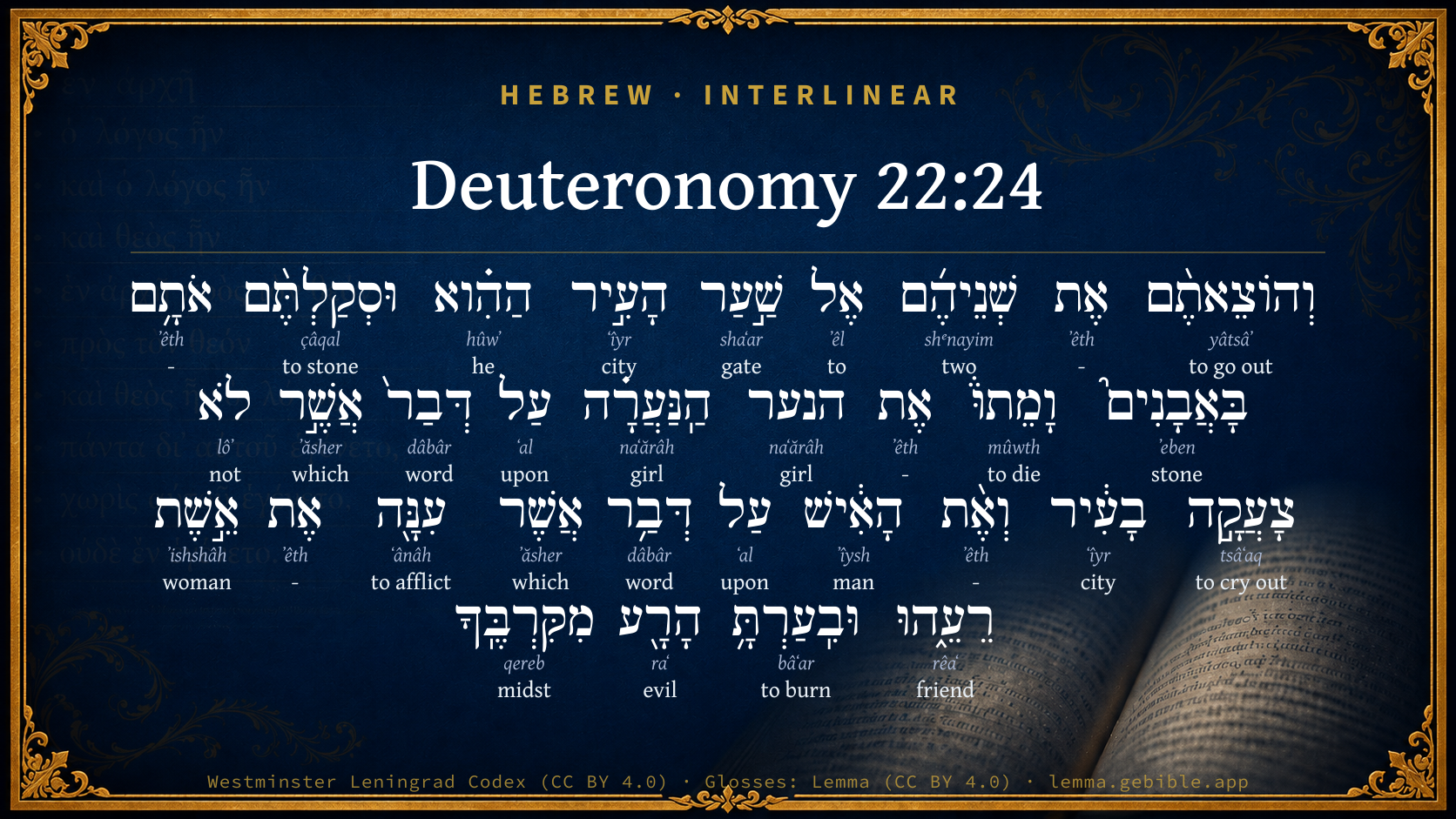
Hebrew (Westminster Leningrad Codex) Deuteronomy 22:24 appears in the Hebrew Old Testament. The text above is from the Westminster Leningrad Codex. Each word links to its Strong’s number, a concise gloss, and parsing drawn from the Open Scriptures Hebrew Bible morphology. Click any word for its full Brown-Driver-Briggs (BDB) entry.
Download image
Cite this verse

Deuteronomy 22:24 (World English Bible). Public Domain. Lemma interlinear Bible study tool, https://lemma.gebible.app/v/deuteronomy/22/24.

Show BibTeX & RIS
BibTeX
RIS
English Translation
then you shall bring them both out to the gate of that city, and you shall stone them to death with stones; the lady, because she didn't cry, being in the city; and the man, because he has humbled his neighbor's wife: so you shall put away the evil from the midst of you.
World English Bible · Public Domain
Download a study sheet

One document with this verse’s original text, its word-by-word gloss line, the meaning frame, cross-references with their text, attributed commentary, and full source and license credits — printable, and it pastes into notes with its structure intact.

This verse Autodidact and up

Study sheet (.html) Plain text (.txt)

A passage Seminary Student

Up to 50 verses in one chapter. A passage sheet keeps up to 6 commentary sources and 12 cross-references per verse, in the order this page ranks them, and says so on the sheet whenever that leaves anything out. Ask for a single verse and you get the Autodidact verse sheet above.

Everything on this page stays free to read, with no account — the sheet is a download of what is already on screen, not access to it.

Want to remove ads? Support Godless Engineer
Compare translations 3

The same verse in 3 English versions, stacked beneath the original-language interlinear above. Click any original word for its lexicon entry.

Each is an independent rendering of the whole verse — the interlinear is not word-aligned to these translations.

Highlighted words mark where these versions differ — a whole-verse word diff, not a word-by-word alignment.

  • World English Bible Public Domain
    then you shall bring them both out to the gate of that city, and you shall stone them to death with stones; the lady, because she didn't cry, being in the city; and the man, because he has humbled his neighbor's wife: so you shall put away the evil from the midst of you.
  • King James Version Public Domain
    Then ye shall bring them both out unto the gate of that city, and ye shall stone them with stones that they die; the damsel, because she cried not, being in the city; and the man, because he hath humbled his neighbor's wife: so thou shalt put away evil from among you.
  • unfoldingWord Literal Text CC BY-SA 4.0
    then you shall take both of them to the gate of that city, and stone them with stones, and they shall die—the girl, on account of the matter that she did not cry out in the city, and the man, on account of the matter that he humiliated the wife of his neighbor—and you shall remove the evil from among you.

unfoldingWord Literal Text — © unfoldingWord, licensed CC BY-SA 4.0. Word-aligned USFM3 via Door43 (git.door43.org/unfoldingWord/en_ult).

Versions to compare (up to 4)

3 of 4 selected

Show all 18 translations

Every available English version of this verse, each an independent rendering of the whole verse.

  • World English Bible Public Domain
    then you shall bring them both out to the gate of that city, and you shall stone them to death with stones; the lady, because she didn't cry, being in the city; and the man, because he has humbled his neighbor's wife: so you shall put away the evil from the midst of you.
  • Berean Standard Bible Public Domain
    you must take both of them out to the gate of that city and stone them to death—the young woman because she did not cry out in the city, and the man because he has violated his neighbor’s wife. So you must purge the evil from among you.
  • Majority Standard Bible Public Domain
    you must take both of them out to the gate of that city and stone them to death—the young woman because she did not cry out in the city, and the man because he has violated his neighbor’s wife. So you must purge the evil from among you.
  • King James Version Public Domain
    Then ye shall bring them both out unto the gate of that city, and ye shall stone them with stones that they die; the damsel, because she cried not, being in the city; and the man, because he hath humbled his neighbor's wife: so thou shalt put away evil from among you.
  • American Standard Version (1901) Public Domain
    then ye shall bring them both out unto the gate of that city, and ye shall stone them to death with stones; the damsel, because she cried not, being in the city; and the man, because he hath humbled his neighbor's wife: so thou shalt put away the evil from the midst of thee.
  • Revised Version (1885) Public Domain
    then ye shall bring them both out unto the gate of that city, and ye shall stone them with stones that they die; the damsel, because she cried not, being in the city; and the man, because he hath humbled his neighbour’s wife: so thou shalt put away the evil from the midst of thee.
  • Geneva Bible (1599) Public Domain
    Then shall yee bring them both out vnto the gates of the same citie, and shall stone them with stones to death: the mayde because she cried not, being in the citie, and the man, because he hath humbled his neighbours wife: so thou shalt put away euill from among you.
  • Douay-Rheims (1899) Public Domain
    Thou shalt bring them both out to the gate of that city, and they shall be stoned: the damsel, because she cried not out, being in the city: the man, because he hath humbled his neighbour's wife. And thou shalt take away the evil from the midst of thee.
  • Young's Literal Translation Public Domain
    then ye have brought them both out unto the gate of that city, and stoned them with stones, and they have died: -- the damsel, because that she hath not cried, `being' in a city; and the man, because that he hath humbled his neighbour's wife; and thou hast put away the evil thing out of thy midst.
  • Literal Standard Version CC BY-SA 4.0
    then you have brought them both out to the gate of that city, and stoned them with stones, and they have died: the girl, because that she has not cried in a city; and the man, because that he has humbled his neighbor’s wife; and you have put away evil out of your midst.
  • Unlocked Literal Bible CC BY-SA 4.0
    take both of them to the city gate, and stone them to death. You must stone the girl, because she did not cry out, even though she was in the city. You must stone the man, because he violated his neighbor's wife; and you will remove the evil from among you.
  • unfoldingWord Literal Text CC BY-SA 4.0
    then you shall take both of them to the gate of that city, and stone them with stones, and they shall die—the girl, on account of the matter that she did not cry out in the city, and the man, on account of the matter that he humiliated the wife of his neighbor—and you shall remove the evil from among you.
  • Darby Bible Public Domain
    then ye shall bring them both out unto the gate of that city, and stone them with stones that they die; the damsel, because she cried not, [being] in the city, and the man, because he hath humbled his neighbour's wife; and thou shalt put evil away from thy midst.
  • World Messianic Bible Public Domain
    then you shall bring them both out to the gate of that city, and you shall stone them to death with stones; the lady, because she didn’t cry, being in the city; and the man, because he has humbled his neighbor’s wife. So you shall remove the evil from among you.
  • Webster's Bible Public Domain
    Then ye shall bring them both out to the gate of that city, and ye shall stone them with stones that they may die; the damsel, because she cried not, being in the city; and the man, because he hath humbled his neighbor's wife: so thou shalt remove evil from among you.
  • Free Bible Version CC BY-SA 4.0
    then you must take both of them to the town gate and stone them to death. The young woman is guilty because she did not cry out for help in the town, and the man is guilty because he has brought shame on someone else's fiancée. You must eliminate the evil from among you.
  • Bible in Basic English Public Domain
    Then you are to take the two of them to the doorway of the town, and have them stoned to death; the young virgin, because she gave no cry for help, though it was in the town, and the man, because he has put shame on his neighbour's wife: so you are to put away evil from among you.
  • JPS Tanakh (1917) Public Domain
    then ye shall bring them both out unto the gate of that city, and ye shall stone them with stones that they die: the damsel, because she cried not, being in the city; and the man, because he hath humbled his neighbour's wife; so thou shalt put away the evil from the midst of thee.

Literal Standard Version (2020), Covenant Press — licensed CC BY-SA 4.0. Text via the HelloAO Bible API (eBible.org). Unlocked Literal Bible (unfoldingWord) — licensed CC BY-SA 4.0. Text via the HelloAO Bible API (eBible.org). unfoldingWord Literal Text — © unfoldingWord, licensed CC BY-SA 4.0. Word-aligned USFM3 via Door43 (git.door43.org/unfoldingWord/en_ult). Free Bible Version, Dr. Jonathan Gallagher — licensed CC BY-SA 4.0. Text via the HelloAO Bible API (eBible.org).

Word by word

More ways to search: Search by grammar → Find every occurrence → Compare this word →

Practice this passage: Drill this verse → Learn its vocabulary →

וּסְקַלְתֶּ֨ם
çâqal
H5619
“and · to stone”
Conjunction + Verb, Qal, Sequential Perfect, 2nd Person, Masculine, Plural
Part of Speech
Conjunction + Verb
Stem
Qal
Form
Sequential Perfect
Person
2nd Person
Gender
Masculine
Number
Plural
Full BDB Definition

Origin: a primitive root

TWOT: 1541

to stone (to death), put to death by stoning - (Qal) to pelt with stones, stone to death - (Niphal) to be stoned to death - (Piel) - to stone, pelt with stones - to free from stones (of vineyard, highway) - (Pual) to be stoned to death
  1. וְהוֹצֵאתֶ֨ם yâtsâʼ H3318 “and · to go out” Conjunction + Verb, Hiphil, Sequential Perfect, 2nd Person, Masculine, Plural
  2. אֶת ʼêth H853 “-” Particle, Direct Object
  3. שְׁנֵיהֶ֜ם shᵉnayim H8147 “two · their” Adjective, Cardinal number, Masculine, Dual, Construct + Suffix, Personal, 3rd Person, Masculine, Plural
  4. אֶל ʼêl H413 “to” Preposition
  5. שַׁ֣עַר shaʻar H8179 “gate of” Noun, Common, Masculine, Singular, Construct
  6. הָעִ֣יר ʻîyr H5892 “the · city” Particle, Definite Article + Noun, Common, Feminine, Singular, Absolute
  7. הַהִ֗וא hûwʼ H1931 “the · he” Particle, Definite Article + Pronoun, Personal, 3rd Person, Feminine, Singular
  8. אֹתָ֥ם ʼêth H853 “- · them” Particle, Direct Object + Suffix, Personal, 3rd Person, Masculine, Plural
  9. בָּאֲבָנִים֮ ʼeben H68 “in/at the · stones” Preposition, Determined + Noun, Common, Feminine, Plural, Absolute
  10. וָמֵתוּ֒ mûwth H4191 “and · to die” Conjunction + Verb, Qal, Sequential Perfect, 3rd Person, Common, Plural
  11. אֶת ʼêth H853 “-” Particle, Direct Object
  12. הנער naʻărâh H5291 “the · girl” Particle, Definite Article + Noun, Common, Feminine, Singular, Absolute
  13. הַֽנַּעֲרָ֗ה naʻărâh H5291 “the · girl” Particle, Definite Article + Noun, Common, Feminine, Singular, Absolute
  14. עַל ʻal H5921 “upon” Preposition
  15. דְּבַר֙ dâbâr H1697 “word of” Noun, Common, Masculine, Singular, Construct
  16. אֲשֶׁ֣ר ʼăsher H834 “which” Particle, Relative
  17. לֹא lôʼ H3808 “not” Particle, Negative
  18. צָעֲקָ֣ה tsâʻaq H6817 “to cry out” Verb, Qal, Perfect, 3rd Person, Feminine, Singular
  19. בָעִ֔יר ʻîyr H5892 “in/at the · city” Preposition, Determined + Noun, Common, Feminine, Singular, Absolute
  20. וְאֶ֨ת ʼêth H853 “and · -” Conjunction + Particle, Direct Object
  21. הָאִ֔ישׁ ʼîysh H376 “the · man” Particle, Definite Article + Noun, Common, Masculine, Singular, Absolute
  22. עַל ʻal H5921 “upon” Preposition
  23. דְּבַ֥ר dâbâr H1697 “word of” Noun, Common, Masculine, Singular, Construct
  24. אֲשֶׁר ʼăsher H834 “which” Particle, Relative
  25. עִנָּ֖ה ʻânâh H6031 “to afflict” Verb, Piel, Perfect, 3rd Person, Masculine, Singular
  26. אֶת ʼêth H853 “-” Particle, Direct Object
  27. אֵ֣שֶׁת ʼishshâh H802 “woman of” Noun, Common, Feminine, Singular, Construct
  28. רֵעֵ֑הוּ rêaʻ H7453 “friend · his” Noun, Common, Masculine, Singular, Construct + Suffix, Personal, 3rd Person, Masculine, Singular
  29. וּבִֽעַרְתָּ֥ bâʻar H1197 “and · to burn” Conjunction + Verb, Piel, Sequential Perfect, 2nd Person, Masculine, Singular
  30. הָרָ֖ע raʻ H7451 “the · evil” Particle, Definite Article + Adjective, Adjective, Masculine, Singular, Absolute
  31. מִקִּרְבֶּֽךָ qereb H7130 “from · midst · your” Preposition + Noun, Common, Masculine, Singular, Construct + Suffix, Personal, 2nd Person, Masculine, Singular

About this verse

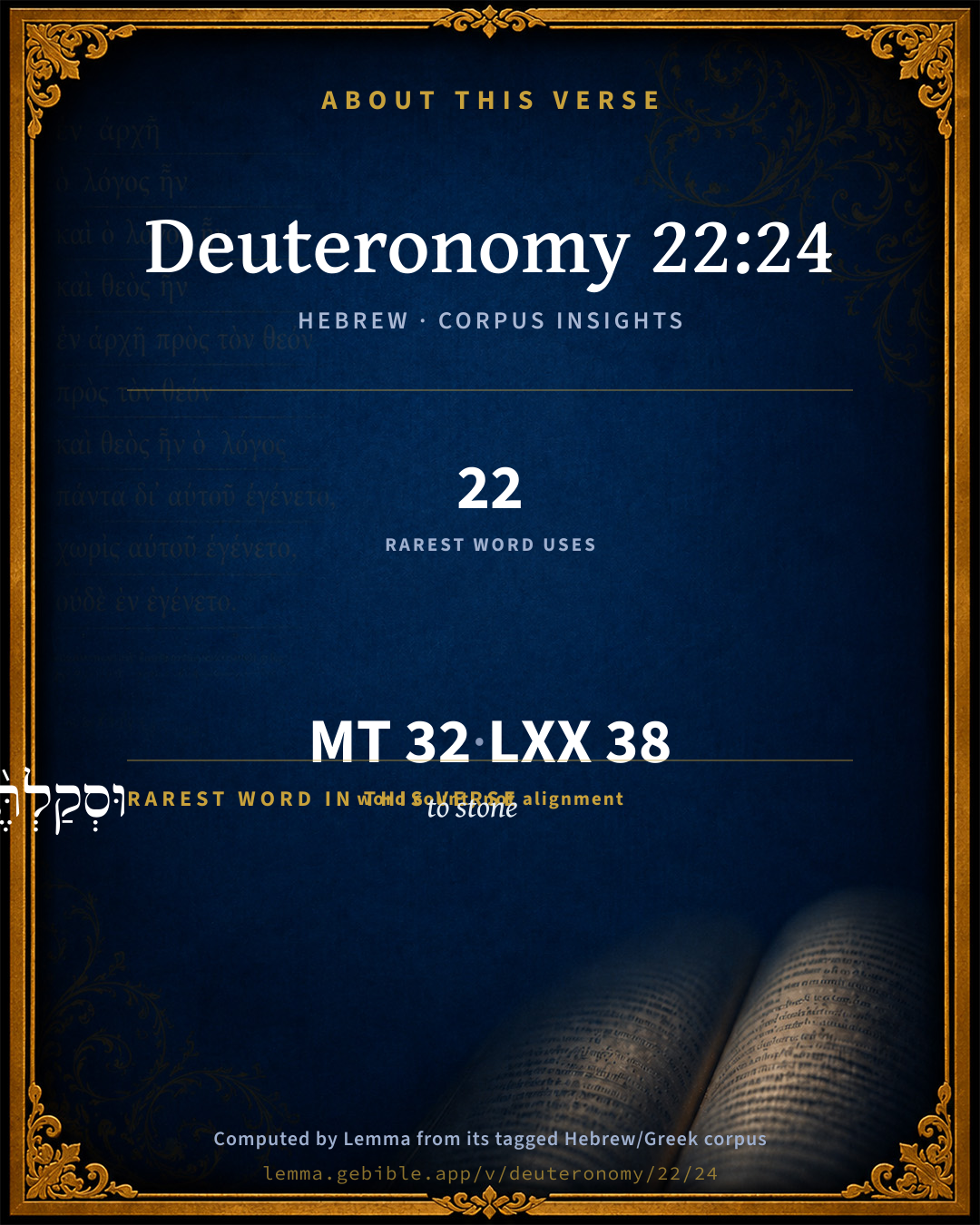
These counts appear in no published source. They are computed here, from the morphology-tagged text and Lemma’s own curated glosses. What Lemma adds →

32
words
23
distinct lemmas
Pentateuch
section

Notable vocabulary

The rarest word here is וּסְקַלְתֶּ֨ם to stone H5619 — appearing just 22 times in the whole Hebrew Bible.

Shared distinctive vocabulary

וּסְקַלְתֶּ֨ם to stone H5619 occurs in 20 verses of the Hebrew Bible. Also found in:

Grammatical profile

  • 6 verbs
  • 12 nouns
  • 2 adjectives
  • 1 pronoun
  • 3 prepositions
  • 8 particles

Verb forms

  • וְהוֹצֵאתֶ֨ם Hiphil · Sequential Perfect
  • וּסְקַלְתֶּ֨ם Qal · Sequential Perfect
  • וָמֵתוּ֒ Qal · Sequential Perfect
  • צָעֲקָ֣ה Qal · Perfect
  • עִנָּ֖ה Piel · Perfect
  • וּבִֽעַרְתָּ֥ Piel · Sequential Perfect

Repetition

Words recur within this verse — often emphatic in Hebrew:

  • הָעִ֣יר city H5892 ×2
  • הנער girl H5291 ×2
  • עַל upon H5921 ×2
  • דְּבַר֙ word H1697 ×2
  • אֲשֶׁ֣ר which H834 ×2

Hebrew & Septuagint length

In English translation the verse runs 54 words from the Hebrew and 50 from the Septuagint (LXX English) — closely comparable.

A rough comparison of the two English renderings, which tokenize alike — not a word-level alignment.

Word counts can differ between the Hebrew and the Greek without any difference in meaning — e.g. the Hebrew direct-object marker אֵת has no separate Greek word, and Greek often adds the article ὁ.

In the original languages it is 32 Hebrew tokens and 38 Greek tokens — but the two are counted differently (Hebrew bundles its prefixes and suffixes into one token; the Greek is in lemma form), so that isn’t a like-for-like length.

Cross-references

8

Topical passages linked to Deuteronomy 22:24 in the Treasury of Scripture Knowledge — connected by theme and wording, ordered by reader-vote popularity; previews shown in the World English Bible.

  • Deuteronomy 21:14 It shall be, if you have no delight in her, then you shall let her go where she will; but you shall not sell her at all for money, you shall not deal with her as a slave, because you have humbled her.
  • Deuteronomy 22:21–22 then they shall bring out the young lady to the door of her father's house, and the men of her city shall stone her to death with stones, because she has done folly in Israel, to play the prostitute in her father's house: so shall you put away the evil from the midst of you.
  • 1 Corinthians 5:13 But those who are outside, God judges. "Put away the wicked man from among yourselves."
  • Genesis 29:21 Jacob said to Laban, "Give me my wife, for my days are fulfilled, that I may go in to her."
  • Deuteronomy 13:5 That prophet, or that dreamer of dreams, shall be put to death, because he has spoken rebellion against Yahweh your God, who brought you out of the land of Egypt, and redeemed you out of the house of bondage, to draw you aside out of the way which Yahweh your God commanded you to walk in. So shall you put away the evil from the midst of you.
  • Matthew 1:20 But when he thought about these things, behold, an angel of the Lord appeared to him in a dream, saying, "Joseph, son of David, don't be afraid to take to yourself Mary, your wife, for that which is conceived in her is of the Holy Spirit.
  • Matthew 1:24 Joseph arose from his sleep, and did as the angel of the Lord commanded him, and took his wife to himself;
  • 1 Corinthians 5:2 You are puffed up, and didn't rather mourn, that he who had done this deed might be removed from among you.

Cross-references courtesy of OpenBible.info (CC BY 4.0).

Hebrew and Greek witnesses Masoretic Hebrew ↔ Greek Septuagint

The same verse in the two great witnesses to the Old Testament, shown verse-for-verse.

These are two independent witnesses, not word-aligned to each other, and the Septuagint is shown in lemma (dictionary) form.

Hebrew Deuteronomy 22:24 Masoretic · Westminster Leningrad Codex

וְהוֹצֵאתֶ֨ם אֶת שְׁנֵיהֶ֜ם אֶל שַׁ֣עַר הָעִ֣יר הַהִ֗וא וּסְקַלְתֶּ֨ם אֹתָ֥ם בָּאֲבָנִים֮ וָמֵתוּ֒ אֶת הנער הַֽנַּעֲרָ֗ה עַל דְּבַר֙ אֲשֶׁ֣ר לֹא צָעֲקָ֣ה בָעִ֔יר וְאֶ֨ת הָאִ֔ישׁ עַל דְּבַ֥ר אֲשֶׁר עִנָּ֖ה אֶת אֵ֣שֶׁת רֵעֵ֑הוּ וּבִֽעַרְתָּ֥ הָרָ֖ע מִקִּרְבֶּֽךָ

then you shall bring them both out to the gate of that city, and you shall stone them to death with stones; the lady, because she didn't cry, being in the city; and the man, because he has humbled his neighbor's wife: so you shall put away the evil from the midst of you.

World English Bible · Public Domain

Greek LXX Deuteronomy 22:24 Septuagint · lemma form

ἐκἄγω ἀμφότεροι ἐπί ὁ πύλη ὁ πόλις αὐτός καί λιθοβολέω ἐν λίθος καί ἀποθνήσκω ὁ νεᾶνις ὅτι οὐ βοάω ἐν ὁ πόλις καί ὁ ἄνθρωπος ὅτι ταπεινόω ὁ γυνή ὁ πλησίον καί ἐκαἴρω ὁ πονηρός ἐκ σύ αὐτός

you⌃ shall bring them both out to the gate of their city, and they shall be stoned with stones, and they shall die; the damsel, because she cried not in the city; and the man, because he humbled his neighbor's spouse: so shall you remove the evil one from yourselves.

LXX2012 (modern English Septuagint) · Public Domain

Hebrew: Westminster Leningrad Codex (CC BY 4.0). Greek: Septuagint (public domain); English from LXX2012 (modern English Septuagint) (Public Domain). How the Septuagint differs from the Hebrew →

Targum (Aramaic paraphrase)

2

The Targum is the ancient Jewish Aramaic paraphrase of the Hebrew Scriptures — an interpretive translation, not the Hebrew text itself. Onkelos (literal) and Pseudo-Jonathan (expansive) render the Torah, and Jonathan the Prophets. Coverage is partial: where no permissively-licensed English translation exists for a verse, only the Aramaic is shown. This is verse-level text, not a word-by-word alignment to the Hebrew.

  1. Targum Onkelos Torah (Genesis–Deuteronomy)
    וְתַפְּקוּן יָת תַּרְוֵיהוֹן לִתְרַע קַרְתָּא הַהִיא וְתִרְגְמוּן יָתְהוֹן בְּאַבְנַיָא וִימוּתוּן יָת עוּלֶמְתָּא עַל עֵסַק דִי לָא צְוָחַת בְּקַרְתָּא וְיָת גַבְרָא עַל עֵסַק דְעַנִי יָת אִתַּת חַבְרֵהּ וּתְפַלֵי עָבֵד דְבִּישׁ מִבֵּינָךְ

    (no public-domain English translation for this verse)

    Targum Onkelos — Aramaic: “Onkelos Genesis” (public domain); “Onkelos Exodus” (public domain); “Onkelos Leviticus” (public domain); “Onkelos Numbers” (public domain); “Onkelos Deuteronomy” (public domain). English: “Sefaria Community Translation” (CC0 1.0 (public-domain dedication)); “J.W. Etheridge. The Targums of Onkelos and Jonathan Ben Uzziel on the Pentateuch. London: Longmans, Green, 1862” (public domain). Text via Sefaria.

  2. Targum Pseudo-Jonathan Torah (Genesis–Deuteronomy)
    וְתַפְקוּן יַת תְּרֵיהוֹן לִתְרַע בֵּי דִינָא דִּבְקַרְתָּא הַהִיא וּתְאַטְלוּן יַתְהוֹן בְּאַבְנַיָא וִימוּתוּן יַת עוּלֵימְתָּא מִן בִּגְלַל דְּלָא פָגְנַת בְּקַרְתָּא וְיַת גַּבְרָא מִן בִּגְלַל דְּשַׁמֵּשׁ עִם אִתַּת חַבְרֵיהּ וּתְפַלּוּן עֲבִיד דְּבִישׁ מִבֵּינֵיכוֹן

    they shall bring forth both of them to the door of the beth din of that city, and stone them with stones that they die; the damsel because she did not cry out in the city, and the man because he lay with his neighbour’s wife; and you shall put away the evil doer from among you.

    Targum Pseudo-Jonathan — Aramaic: “Targum Jonathan on Genesis” (public domain); “Targum Jonathan on Exodus” (public domain); “Targum Jonathan on Leviticus” (public domain); “Targum Jonathan on Numbers” (public domain); “Targum Jonathan on Deuteronomy” (public domain). English: “The Targum of Jonathan ben Uzziel, trans. J. W. Etheridge, London, 1862” (public domain). Text via Sefaria.

Commentary

Notes on Deuteronomy 22:24 from classic Christian and Jewish commentators (each source and its license shown beneath its notes). The classic Christian expositions comment on the surrounding passage and are grouped to its opening verse, so a note may address several verses; the Jewish commentaries on the Tanakh (Rashi and others) are per-verse, so they appear only where the commentator wrote on this verse.

Lemma curates 59 commentaries, every one of them public domain or Creative Commons licensed, each selected and text-cleaned for this edition rather than reprinted as found. About our sources →

Trapp's Complete Commentary

John Trapp

Deu 22:24 Then ye shall bring them both out unto the gate of that city, and ye shall stone them with stones that they die; the damsel, because she cried not, [being] in the city; and the man, because he hath humbled his neighbour’s wife: so thou shalt put away evil from among you.

Ver. 24. Humbled his neighbour’s wife.] So called, because betrothed, Quia nuptias facit consensus, non concubitus, as the lawyers determine it.

John Trapp, A Commentary or Exposition upon All the Books of the Old and New Testament (1647–1656) — public domain. Text from a community e-Sword module.

Joseph Benson's Commentary

Deu 22:24-27. She cried not — And therefore is justly presumed to have consented to it. As when a man riseth against his neighbour, even so is this matter — Not an act of choice, but of force and constraint. The damsel cried — Which is in that case to be presumed; charity obliging us to believe the best, till the contrary be manifest.

Joseph Benson's Commentary on the Old and New Testaments (1811–1818) — public domain. Text from a community e-Sword module.

Tyndale Open Study Notes

Tyndale Open Resources

22:24 Because betrothal was tantamount to marriage in the Old Testament, another man’s wife in this passage technically refers to a fiancée.

Tyndale Open Study Notes — © Tyndale Open Resources, licensed CC BY-SA 4.0. Text via the HelloAO Bible API.

Geneva Bible (1599)

Geneva Bible translators

Or, defiled.

Geneva Bible (1599) marginal notes — public domain. Text via Bolls.life.

The Cambridge Bible for Schools and Colleges

gen. ed. J. J. S. Perowne

24. bring them both out unto the gate of that city, etc.] see on Deu_13:10 (11), Deu_17:5.

because, etc.] This construction is found in D only here and Deu_23:5. Humbled, Deu_22:29 and Deu_21:14.

The Cambridge Bible for Schools and Colleges (gen. ed. J. J. S. Perowne; Cambridge University Press, 1878–1918) — public domain. Text from a community e-Sword module.

John Gill's Exposition

But if a man find a betrothed damsel in the field,.... Alone, and where she might cry out, and none hear, nor were any to help her:

and a man force her, and lie with her; or "take fast and strong hold on her" (b); so that she is not able to get out of his hands, and make her escape, he being stronger than she, and so commits a rape upon her:

then the man only that lay with her shall die; he being guilty of adultery, in lying with a woman espoused to another man, but not she, because she consented not to it.

(b) "et apprehenderit (in) eam", Pagninus, Montanus; "et apprehendens eam", Piscator.

John Gill's Exposition of the Whole Bible (1746–1763) — public domain (CC PDM 1.0). Text via the HelloAO Bible API.

Haydock's Catholic Bible Commentary

Wife. After the woman was espoused, (ver. 23,) she was called a wife, and punished accordingly, if she proved unfaithful.

George Leo Haydock (1774–1849), Haydock's Catholic Family Bible and Commentary, 1859 edition — public domain. Excludes Psalms (Douay-Rheims chapter numbering differs from Protestant) and Deuterocanonical books (Catholic canon only).

Matthew Poole's English Annotations

Because she cried not; and therefore is justly presumed to have consented to it.

Matthew Poole's English Annotations on the Holy Bible (1683–1685) — public domain. Text from a community e-Sword/MySword module.

John Wesley's Explanatory Notes

She cried not - And therefore is justly presumed to have consented to it.

John Wesley, Explanatory Notes Upon the Whole Bible (1754–1765) — public domain. Text via the GEBible commentary corpus.

Lesson kit

Teaching starters — assembled from the data on this page, not authored interpretation. Every prompt links to the verse data it draws on. Edit before teaching.

Deuteronomy, in the Pentateuch, opens this verse with 32 words (23 distinct Hebrew lemmas). Its most distinctive word is çâqal (“to stone”). A historical commentator’s framing appears above. Read the whole chapter for the surrounding context.

Discussion questions

  1. The word çâqal carries the sense “to stone.” How does it shape the verse?
  2. How does Exodus 8:26, which shares the word «to stone», read alongside this verse?
  3. What does the repetition of “city” (2× in this one verse) do in this verse?
  4. These translations render this verse differently; the difference is in the English rendering, not the original. What questions does that raise?
  5. «וְהוֹצֵאתֶ֨ם» is a Hiphil Sequential Perfect verb. How does that grammatical form shape the action described?
  6. Compare how Trapp's Complete Commentary and Joseph Benson's Commentary read this verse. Where do they agree or differ?

Things to notice

Reading settings

Reading text

Shown beneath each verse's original-language words.

Old Testament
Old Testament edition

Read the OT as the Masoretic Hebrew (MT) or the Greek Septuagint (LXX).

English shown for the Greek Septuagint (in the Hebrew ↔ Greek comparison).

Comparing translations? Open the Compare panel on any verse page to stack up to four side by side.