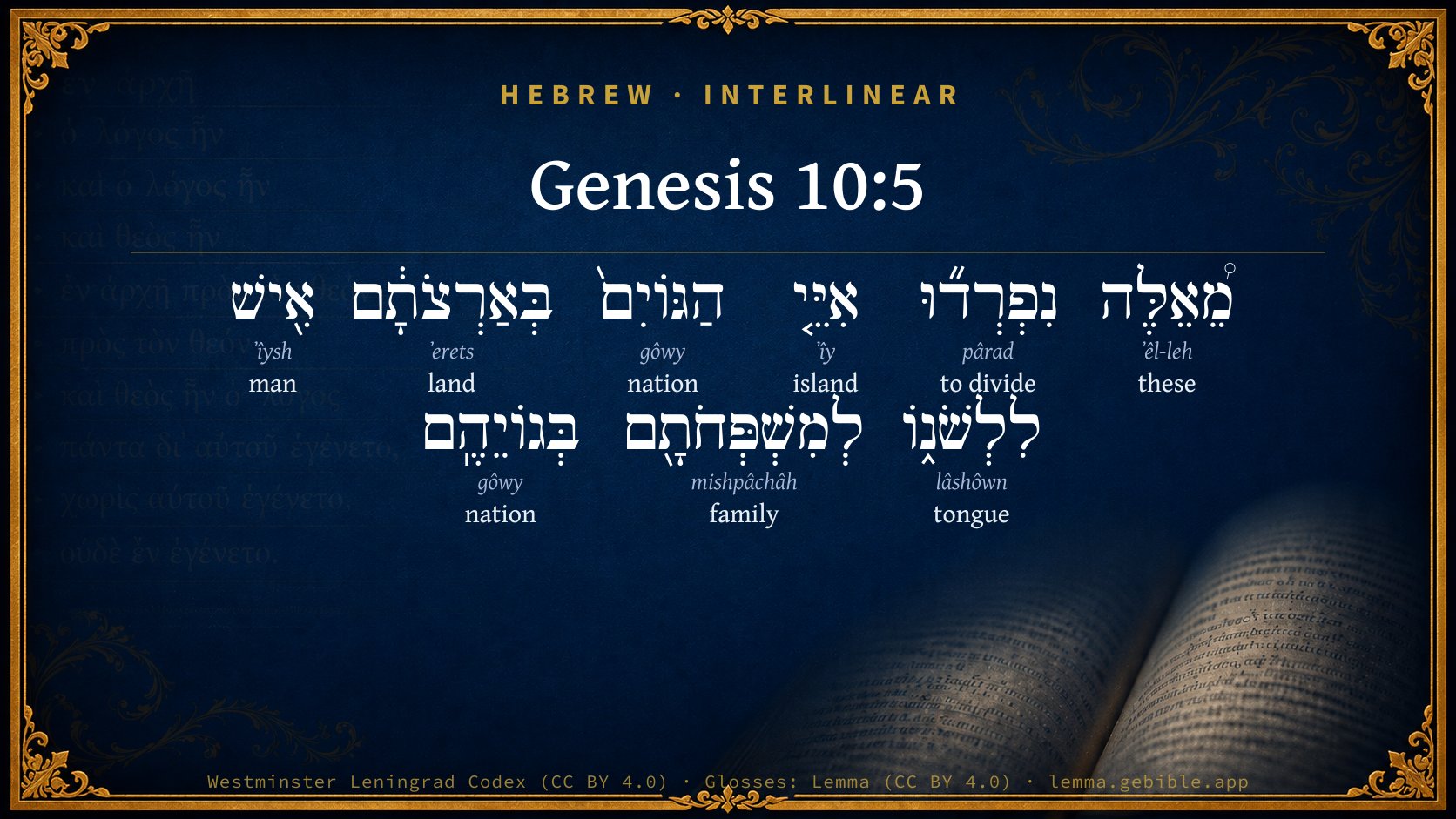
Genesis 10:5

Hebrew (Westminster Leningrad Codex) Genesis 10:5 appears in the Hebrew Old Testament. The text above is from the Westminster Leningrad Codex. Each word links to its Strong’s number, a concise gloss, and parsing drawn from the Open Scriptures Hebrew Bible morphology. Click any word for its full Brown-Driver-Briggs (BDB) entry.
Download image
Cite this verse

Genesis 10:5 (World English Bible). Public Domain. Lemma interlinear Bible study tool, https://lemma.gebible.app/v/genesis/10/5.

Show BibTeX & RIS
BibTeX
RIS
English Translation
Of these were the isles of the nations divided in their lands, everyone after his language, after their families, in their nations.
World English Bible · Public Domain
Highlights
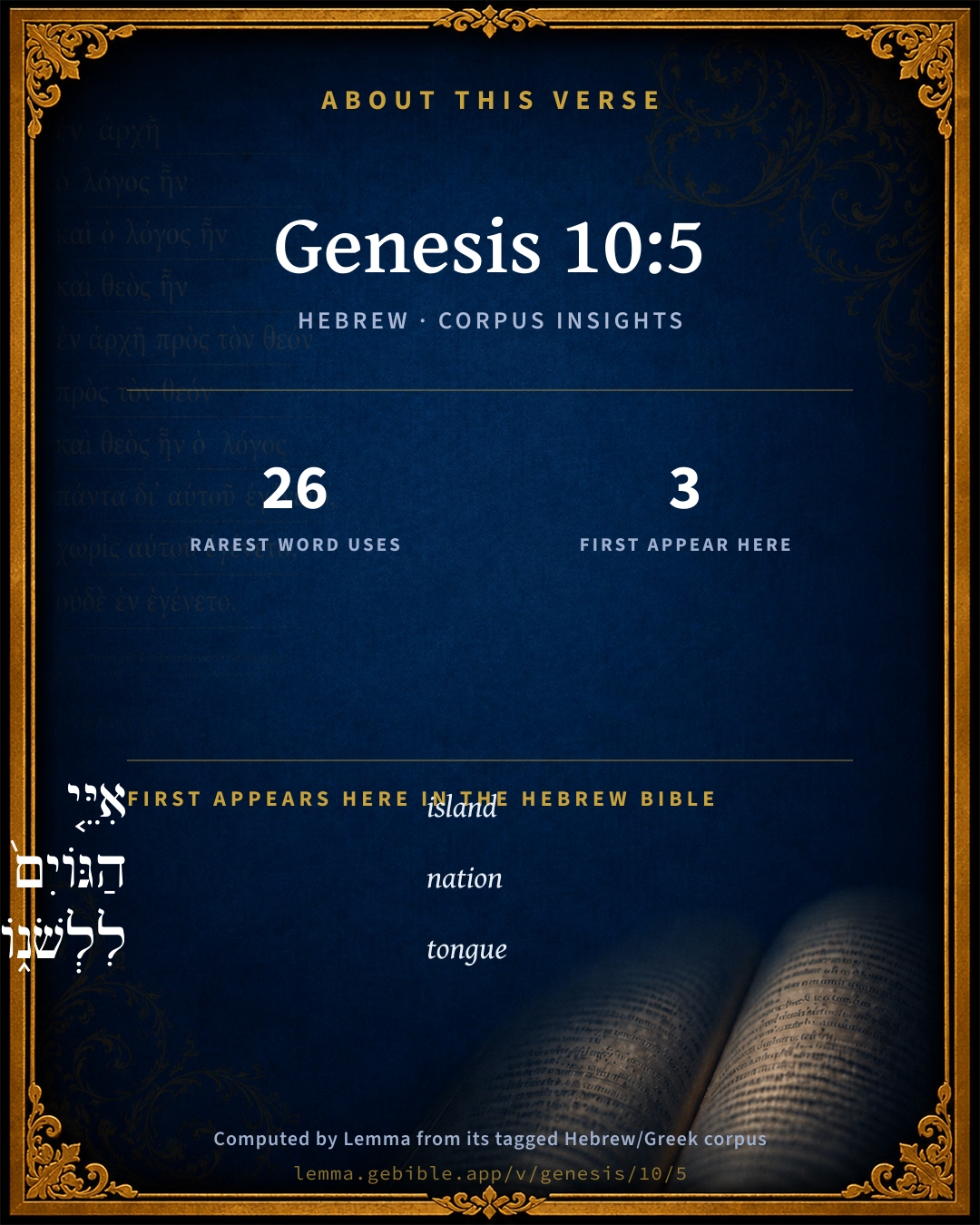
  • 3 first appearances in the Hebrew Bible
Full analysis ↓
Download a study sheet

One document with this verse’s original text, its word-by-word gloss line, the meaning frame, cross-references with their text, attributed commentary, and full source and license credits — printable, and it pastes into notes with its structure intact.

This verse Autodidact and up

Study sheet (.html) Plain text (.txt)

A passage Seminary Student

Up to 50 verses in one chapter. A passage sheet keeps up to 6 commentary sources and 12 cross-references per verse, in the order this page ranks them, and says so on the sheet whenever that leaves anything out. Ask for a single verse and you get the Autodidact verse sheet above.

Everything on this page stays free to read, with no account — the sheet is a download of what is already on screen, not access to it.

Want to remove ads? Support Godless Engineer
Compare translations 3

The same verse in 3 English versions, stacked beneath the original-language interlinear above. Click any original word for its lexicon entry.

Each is an independent rendering of the whole verse — the interlinear is not word-aligned to these translations.

Highlighted words mark where these versions differ — a whole-verse word diff, not a word-by-word alignment.

  • World English Bible Public Domain
    Of these were the isles of the nations divided in their lands, everyone after his language, after their families, in their nations.
  • King James Version Public Domain
    By these were the isles of the Gentiles divided in their lands; every one after his tongue, after their families, in their nations.
  • unfoldingWord Literal Text CC BY-SA 4.0
    From those the coastland peoples spread out into their lands, each with its own language, according to their clans, in their nations. Ham’s Descendants

unfoldingWord Literal Text — © unfoldingWord, licensed CC BY-SA 4.0. Word-aligned USFM3 via Door43 (git.door43.org/unfoldingWord/en_ult).

Versions to compare (up to 4)

3 of 4 selected

Show all 18 translations

Every available English version of this verse, each an independent rendering of the whole verse.

  • World English Bible Public Domain
    Of these were the isles of the nations divided in their lands, everyone after his language, after their families, in their nations.
  • Berean Standard Bible Public Domain
    From these, the maritime peoples separated into their territories, according to their languages, by clans within their nations.
  • Majority Standard Bible Public Domain
    From these, the maritime peoples separated into their territories, according to their languages, by clans within their nations.
  • King James Version Public Domain
    By these were the isles of the Gentiles divided in their lands; every one after his tongue, after their families, in their nations.
  • American Standard Version (1901) Public Domain
    Of these were the isles of the nations divided in their lands, every one after his tongue, after their families, in their nations.
  • Revised Version (1885) Public Domain
    Of these were the isles of the nations divided in their lands, every one after his tongue; after their families, in their nations.
  • Geneva Bible (1599) Public Domain
    Of these were the yles of the Gentiles deuided in their landes, euery man after his tongue, and after their families in their nations.
  • Douay-Rheims (1899) Public Domain
    By these were divided the islands of the Gentiles in their lands, every one according to his tongue and their families in their nations.
  • Young's Literal Translation Public Domain
    By these have the isles of the nations been parted in their lands, each by his tongue, by their families, in their nations.
  • Literal Standard Version CC BY-SA 4.0
    By these the islands of the nations have been parted in their lands, each by his tongue, by their families, in their nations.
  • Unlocked Literal Bible CC BY-SA 4.0
    From these the coastland peoples separated and went into their lands, every one with its own language, according to their clans, by their nations.
  • unfoldingWord Literal Text CC BY-SA 4.0
    From those the coastland peoples spread out into their lands, each with its own language, according to their clans, in their nations. Ham’s Descendants
  • Darby Bible Public Domain
    From these came the distribution of the isles of the nations, according to their lands, every one after his tongue, after their families, in their nations.
  • World Messianic Bible Public Domain
    Of these were the islands of the nations divided in their lands, everyone after his language, after their families, in their nations.
  • Webster's Bible Public Domain
    By these were the isles of the Gentiles divided in their lands; every one after his tongue, after their families, in their nations.
  • Free Bible Version CC BY-SA 4.0
    The descendants of these ancestors spread throughout the coastal areas, each group having their own language, with their families developing into different nations.
  • Bible in Basic English Public Domain
    From these came the nations of the sea-lands, with their different families and languages.
  • JPS Tanakh (1917) Public Domain
    Of these were the isles of the nations divided in their lands, every one after his tongue, after their families, in their nations.

Literal Standard Version (2020), Covenant Press — licensed CC BY-SA 4.0. Text via the HelloAO Bible API (eBible.org). Unlocked Literal Bible (unfoldingWord) — licensed CC BY-SA 4.0. Text via the HelloAO Bible API (eBible.org). unfoldingWord Literal Text — © unfoldingWord, licensed CC BY-SA 4.0. Word-aligned USFM3 via Door43 (git.door43.org/unfoldingWord/en_ult). Free Bible Version, Dr. Jonathan Gallagher — licensed CC BY-SA 4.0. Text via the HelloAO Bible API (eBible.org).

Word by word

More ways to search: Search by grammar → Find every occurrence → Compare this word →

Practice this passage: Drill this verse → Learn its vocabulary →

נִפְרְד֞וּ
pârad
H6504
“to divide”
Verb, Niphal, Perfect, 3rd Person, Common, Plural
Part of Speech
Verb
Stem
Niphal
Form
Perfect
Person
3rd Person
Gender
Common
Number
Plural
Full BDB Definition

Origin: a primitive root

TWOT: 1806

to separate, divide - (Qal) to divide - (Niphal) - to divide, separate - to be divided, be separated - (Piel) to be separated - (Pual) to be divided - (Hiphil) - to divide, separate - to make a division, make a separation - (Hithpael) to be divided, be separated, get separated
  1. מֵ֠אֵלֶּה ʼêl-leh H428 “from · these” Preposition + Pronoun, Demonstrative, Common, Plural
  2. אִיֵּ֤י ʼîy H339 “islands of” Noun, Common, Masculine, Plural, Construct
  3. הַגּוֹיִם֙ gôwy H1471 “the · nations” Particle, Definite Article + Noun, Common, Masculine, Plural, Absolute
  4. בְּאַרְצֹתָ֔ם ʼerets H776 “in/at · lands · their” Preposition + Noun, Common, Both, Plural, Construct + Suffix, Personal, 3rd Person, Masculine, Plural
  5. אִ֖ישׁ ʼîysh H376 “man” Noun, Common, Masculine, Singular, Absolute
  6. לִלְשֹׁנ֑וֹ lâshôwn H3956 “to/for · tongue · his” Preposition + Noun, Common, Both, Singular, Construct + Suffix, Personal, 3rd Person, Masculine, Singular
  7. לְמִשְׁפְּחֹתָ֖ם mishpâchâh H4940 “to/for · families · their” Preposition + Noun, Common, Feminine, Plural, Construct + Suffix, Personal, 3rd Person, Masculine, Plural
  8. בְּגוֹיֵהֶֽם gôwy H1471 “in/at · nations · their” Preposition + Noun, Common, Masculine, Plural, Construct + Suffix, Personal, 3rd Person, Masculine, Plural

About this verse

These counts appear in no published source. They are computed here, from the morphology-tagged text and Lemma’s own curated glosses. What Lemma adds →

9
words
8
distinct lemmas
Pentateuch
section

First appearance in Scripture

These words make their first canonical appearance in the Hebrew Bible here:

  • אִיֵּ֤י island H339
  • הַגּוֹיִם֙ nation H1471
  • לִלְשֹׁנ֑וֹ tongue H3956

Shared distinctive vocabulary

נִפְרְד֞וּ to divide H6504 occurs in 26 verses of the Hebrew Bible. Also found in:

Grammatical profile

  • 1 verb
  • 7 nouns
  • 1 pronoun

Verb forms

  • נִפְרְד֞וּ Niphal · Perfect

Repetition

A word recurs within this verse — often emphatic in Hebrew:

  • הַגּוֹיִם֙ nation H1471 ×2

Hebrew & Septuagint length

In English translation the verse runs 22 words from the Hebrew and 24 from the Septuagint (LXX English) — closely comparable.

A rough comparison of the two English renderings, which tokenize alike — not a word-level alignment.

Word counts can differ between the Hebrew and the Greek without any difference in meaning — e.g. the Hebrew direct-object marker אֵת has no separate Greek word, and Greek often adds the article ὁ.

Cross-references

16

Topical passages linked to Genesis 10:5 in the Treasury of Scripture Knowledge — connected by theme and wording, ordered by reader-vote popularity; previews shown in the World English Bible.

  • Zephaniah 2:11 Yahweh will be awesome to them, for he will famish all the gods of the land. Men will worship him, everyone from his place, even all the shores of the nations.
  • Isaiah 42:4 He will not fail nor be discouraged, until he have set justice in the earth; and the isles shall wait for his law.
  • Jeremiah 2:10 For pass over to the isles of Kittim, and see; and send to Kedar, and consider diligently; and see if there has been such a thing.
  • Genesis 10:20 These are the sons of Ham, after their families, after their languages, in their lands, in their nations.
  • Jeremiah 25:22 and all the kings of Tyre, and all the kings of Sidon, and the kings of the isle which is beyond the sea;
  • Genesis 10:25 To Eber were born two sons. The name of the one was Peleg, for in his days was the earth divided. His brother's name was Joktan.
  • Genesis 11:1–9 The whole earth was of one language and of one speech.
  • Psalms 72:10 The kings of Tarshish and of the isles will bring tribute. The kings of Sheba and Seba shall offer gifts.
  • Isaiah 24:15 Therefore glorify Yahweh in the east, even the name of Yahweh, the God of Israel, in the isles of the sea!
  • Isaiah 40:15 Behold, the nations are as a drop of a bucket, and are accounted as the small dust of the balance: Behold, he takes up the isles as a very little thing.
  • Isaiah 41:5 The isles have seen, and fear; the ends of the earth tremble; they draw near, and come.
  • Isaiah 42:10 Sing to Yahweh a new song, and his praise from the end of the earth; you who go down to the sea, and all that is therein, the isles, and the inhabitants of it.
  • Isaiah 49:1 Listen, isles, to me; and listen, you peoples, from far: Yahweh has called me from the womb; from the bowels of my mother has he made mention of my name:
  • Isaiah 51:5 My righteousness is near, my salvation is gone forth, and my arms shall judge the peoples; the isles shall wait for me, and on my arm shall they trust.
  • Isaiah 59:18 According to their deeds, accordingly he will repay, wrath to his adversaries, recompense to his enemies; to the islands he will repay recompense.
  • Isaiah 60:9 Surely the isles shall wait for me, and the ships of Tarshish first, to bring your sons from far, their silver and their gold with them, for the name of Yahweh your God, and for the Holy One of Israel, because he has glorified you.

Cross-references courtesy of OpenBible.info (CC BY 4.0).

Hebrew and Greek witnesses Masoretic Hebrew ↔ Greek Septuagint

The same verse in the two great witnesses to the Old Testament, shown verse-for-verse.

These are two independent witnesses, not word-aligned to each other, and the Septuagint is shown in lemma (dictionary) form.

Hebrew Genesis 10:5 Masoretic · Westminster Leningrad Codex

מֵ֠אֵלֶּה נִפְרְד֞וּ אִיֵּ֤י הַגּוֹיִם֙ בְּאַרְצֹתָ֔ם אִ֖ישׁ לִלְשֹׁנ֑וֹ לְמִשְׁפְּחֹתָ֖ם בְּגוֹיֵהֶֽם

Of these were the isles of the nations divided in their lands, everyone after his language, after their families, in their nations.

World English Bible · Public Domain

Greek LXX Genesis 10:5 Septuagint · lemma form

ἐκ οὗτος ἀποὁρίζω νήσος ὁ ἔθνος ἐν ὁ γῆ αὐτός ἕκαστος κατά γλῶσσα ἐν ὁ φυλή αὐτός καί ἐν ὁ ἔθνος αὐτός

From these were the islands of the Gentiles divided in their land, each according to his tongue, in their tribes and in their nations.

LXX2012 (modern English Septuagint) · Public Domain

On this verse, The Pulpit Commentary discusses the Septuagint’s reading. Read the note in Commentary ↓

Hebrew: Westminster Leningrad Codex (CC BY 4.0). Greek: Septuagint (public domain); English from LXX2012 (modern English Septuagint) (Public Domain). How the Septuagint differs from the Hebrew →

Targum (Aramaic paraphrase)

2

The Targum is the ancient Jewish Aramaic paraphrase of the Hebrew Scriptures — an interpretive translation, not the Hebrew text itself. Onkelos (literal) and Pseudo-Jonathan (expansive) render the Torah, and Jonathan the Prophets. Coverage is partial: where no permissively-licensed English translation exists for a verse, only the Aramaic is shown. This is verse-level text, not a word-by-word alignment to the Hebrew.

  1. Targum Onkelos Torah (Genesis–Deuteronomy)
    מֵאִלֵּין אִתַּפְרָשׁוּ נַגְוַת עַמְמַיָּא בְּאַרְעֲהוֹן גְּבַר לְלִישָׁנֵהּ לְזַרְעֲיָתְהוֹן בְּעַמְמֵיהוֹן

    From these were the isles (nagvath) of the peoples divided in their lands, each according to his language, according to their families in their nations.

    Targum Onkelos — Aramaic: “Onkelos Genesis” (public domain); “Onkelos Exodus” (public domain); “Onkelos Leviticus” (public domain); “Onkelos Numbers” (public domain); “Onkelos Deuteronomy” (public domain). English: “Sefaria Community Translation” (CC0 1.0 (public-domain dedication)); “J.W. Etheridge. The Targums of Onkelos and Jonathan Ben Uzziel on the Pentateuch. London: Longmans, Green, 1862” (public domain). Text via Sefaria.

  2. Targum Pseudo-Jonathan Torah (Genesis–Deuteronomy)
    מֵאִילֵן אִתְפַּרְשׁוּ גְנִיסֵי נַגְוַות עַמְמַיָא כָל חַד לְלִישְׁנֵיהּ לְיִחוּסֵיהוֹם בְּעַמְמֵיהוֹם

    From these were distributed the tribes of the islands of the Gentiles, every one according to his language, to his kindred in their nations.

    Targum Pseudo-Jonathan — Aramaic: “Targum Jonathan on Genesis” (public domain); “Targum Jonathan on Exodus” (public domain); “Targum Jonathan on Leviticus” (public domain); “Targum Jonathan on Numbers” (public domain); “Targum Jonathan on Deuteronomy” (public domain). English: “The Targum of Jonathan ben Uzziel, trans. J. W. Etheridge, London, 1862” (public domain). Text via Sefaria.

Commentary

Notes on Genesis 10:5 from classic Christian and Jewish commentators (each source and its license shown beneath its notes). The classic Christian expositions comment on the surrounding passage and are grouped to its opening verse, so a note may address several verses; the Jewish commentaries on the Tanakh (Rashi and others) are per-verse, so they appear only where the commentator wrote on this verse.

Lemma curates 59 commentaries, every one of them public domain or Creative Commons licensed, each selected and text-cleaned for this edition rather than reprinted as found. About our sources →

Trapp's Complete Commentary

John Trapp

Gen 10:5 By these were the isles of the Gentiles divided in their lands; every one after his tongue, after their families, in their nations.

Ver. 5. By these were the isles of the Gentiles.] That is, the countries of Europe and Asia the Less, inhabited by Japheth’s posterity. Europe hath its name, in Greek, {a} from the latitude and large surface of it, which answers well to the name of Japheth (signifying enlargement), who, together with his offspring, was, by God’s appointment, to rule there far and wide toward the west and north. Asia hath its name from two Hebrew words that signify the fire of the Lord, {b} which, in Persia and other parts thereof, they superstitiously deified. Asia the Less, was so called first by Attalus, king of Pergamus, who, being the last of that name and race, made the Romans his heirs by will. They turned his country into a province, and called it Asia, by the name of the continent - as devouring, doubtless in hope, that whole part of the world by this small beginning. Hence, likely, came that first distinction of the Lesser Asia.

{a} Eυρωπη, ex ευρεια et ωψ quasi dilatatio .

{b} אשׁיה Ignis Domini Q. Curtius saith of Darius, that he called upon the sacred and eternal fire.

John Trapp, A Commentary or Exposition upon All the Books of the Old and New Testament (1647–1656) — public domain. Text from a community e-Sword module.

Joseph Benson's Commentary

Gen 10:5. The posterity of Japheth were allotted to the isles of the Gentiles, which were solemnly by lot, after a survey, divided among them, and probably this island of ours among the rest. All places beyond the sea from Judea, are called isles. Jer 25:22; and this directs us to understand that promise, Isa 42:4, The isles shall wait for his law, of the conversion of the Gentiles to the faith of Christ.

Joseph Benson's Commentary on the Old and New Testaments (1811–1818) — public domain. Text from a community e-Sword module.

Tyndale Open Study Notes

Tyndale Open Resources

10:5 seafaring peoples . . . various lands: They settled around the Mediterranean and on various islands. • language: This occurred after the Tower of Babel episode (11:1-9; see study note on 10:1–11:9).

Tyndale Open Study Notes — © Tyndale Open Resources, licensed CC BY-SA 4.0. Text via the HelloAO Bible API.

Geneva Bible (1599)

Geneva Bible translators

The Jews so call all countries which are separated from them by sea, as Greece, Italy, etc, which were given to the children of Japheth, of whom came the Gentiles.

Geneva Bible (1599) marginal notes — public domain. Text via Bolls.life.

Jamieson, Fausset & Brown

Robert Jamieson, A. R. Fausset & David Brown

the isles of the Gentiles--a phrase by which the Hebrews described all countries which were accessible by sea (Isa 11:11; Isa 20:6; Jer 25:22). Such in relation to them were the countries of Europe, the peninsula of Lesser Asia, and the region lying on the east of the Euxine. Accordingly, it was in these quarters the early descendants of Japheth had their settlements.

Jamieson, Fausset & Brown — Commentary Critical and Explanatory on the Whole Bible (1871) — public domain (CC PDM 1.0). Text via the HelloAO Bible API.

Adam Clarke's Commentary

Verse 5. Isles of the Gentiles] EUROPE, of which this is allowed to be a general epithet. Calmet supposes that it comprehends all those countries to which the Hebrews were obliged to go by sea, such as Spain, Gaul, Italy, Greece, and Asia Minor.

Every one after his tongue] This refers to the time posterior to the confusion of tongues and dispersion from Babel.

Adam Clarke's Commentary on the Bible (1810–1826) — public domain. Text from a community e-Sword/MySword module.

Ellicott's Commentary for English Readers

(5) Isles of the Gentiles.—The word rendered “isles” means any maritime region. As there were no Gentiles at this time, the phrase should be translated “the coast-lands of the nations.”

A Bible Commentary for English Readers, edited by Charles John Ellicott (1878–1897) — public domain. Text from a community e-Sword module.

The Cambridge Bible for Schools and Colleges

gen. ed. J. J. S. Perowne

5. Of these, &c.] It is probable that the text in this verse has suffered. As in Gen_10:20 we find “these are the sons of Ham” and in Gen_10:31 “these are the sons of Shem,” so we should expect in this verse “these are the sons of Japheth.” We should, therefore, probably put a full stop after the word “divided,” and insert: “These are the sons of Japheth.” This will improve the sense; for (1) the words “of these” cannot refer generally to the contents of Gen_10:2-3, but only to the contents of Gen_10:4; (2) while the expression “the isles were divided in their lands” is intolerably harsh. “Of these” should be taken to refer to “the sons of Javan” only. From them the Greek settlements branched off in all directions among the islands and the coastlands, i.e. “the isles of the nations.” After this piece of information the genealogist summarizes the foregoing list, “These are the sons of Japheth in their lands, every one after his tongue,” &c.

isles] Better, as R.V. marg., coastlands. Cf. Isa_11:11; Jer_2:10; Eze_27:6.

The Cambridge Bible for Schools and Colleges (gen. ed. J. J. S. Perowne; Cambridge University Press, 1878–1918) — public domain. Text from a community e-Sword module.

John Gill's Exposition

By these were the isles of the Gentiles divided in their lands,.... That is, by those sons of Japheth before mentioned; and by "isles" are meant, not countries surrounded with water, for the isles in this sense would not have been sufficient for the posterity of Japheth; nor can it be thought they would leave the continent, where there was room enough for them, and go into islands; and besides must have found it difficult to get there, when shipping and navigation were little known: but it is usual with the Hebrews, of whom Moses, the writer of this history, was, to call all places beyond the Mediterranean sea, or whatsoever they went to by sea, or that were upon the sea coasts, islands, as Greece, Italy, &c. Moreover, the word sometimes signifies countries, as it does in Job 22:30 and so should be rendered here, as it is by some (y), "the countries of the Gentiles"; so called, because in the times of Moses, and at the writing of this history, those countries were inhabited by Heathens and idolaters, strangers to the true religion: and this division was not made at random, and at the pleasure of a rude company of men, but in an orderly regular manner, with the consent, and by the advice and direction of the principal men of those times; and especially it was directed by the wise providence of the most High, who divided to the nations their inheritance, and set the bounds of the people, Deu 32:8.

everyone after his tongue, after their families, in their nations; this shows, that what is said concerning the division of countries to the sons of Japheth is by way of anticipation; and that, though thus related, was not done till after the confusion of languages, since the partition was made according to the different languages of men; those that were of the same language went and dwelt together, the several nations of them, and the several families in those nations; by which it appears that this was done by consultation, with great care and wisdom, ranging the people according to their tongues; of which nations were formed, and with them were taken the several families they consisted of.

(y) "regiones gentium", Junius & Tremellius, Piscator, Patrick.

John Gill's Exposition of the Whole Bible (1746–1763) — public domain (CC PDM 1.0). Text via the HelloAO Bible API.

Haydock's Catholic Bible Commentary

The islands. So the Hebrews called all the remote countries, to which they went by ships to Judea, as Greece, Italy, Spain, &c., (Challoner) whether they were surrounded with water or not. (Jeremias xxv. 22.) (Menochius)

George Leo Haydock (1774–1849), Haydock's Catholic Family Bible and Commentary, 1859 edition — public domain. Excludes Psalms (Douay-Rheims chapter numbering differs from Protestant) and Deuterocanonical books (Catholic canon only).

Matthew Poole's English Annotations

The isles of the Gentiles; not isles properly so called; for why should they, having their choice, forsake the continent for islands, and thereby cut off themselves from their brethren? And where had they ships to transport them? But the word isles here and elsewhere signifies all those countries that had the sea between them and Judea, as it doth Isa 11:10-11; 40:15; Jer 2:10; 25:22; Eze 27:3; Zep 2:11. And isles are here put for the inhabitants, as the words earth and land are commonly used. This division of the world among them being a work of great weight, was doubtless managed with great care and consultation, and the advice of their heads and governors, and above all by the wise and special providence of God, which at this time did particularly determine the bounds of their several habitations, as it is recorded Act 17:26.

Every one after his tongue, i.e. according to their several languages, into which they were divided at Babel. By which it appears that this division, though mentioned before, was not executed till after the confusion of languages at Babel.

After their families. Here observe the wise and gracious providence of God mixed with this judgment, that God distributed the languages according to the difference of families and nations, that each several nation, and all the families or branches of that nation, should have one and the same language; whereby both union and love were preserved among themselves, and the several nations were distinguished one from another, which was very fit and necessary for many reasons as that the church of God, which was confined to the Hebrew nation, might neither be mixed with nor infected by the idolatrous nations; and that it might be evident to the world, that the Messias was born of the seed of Abraham according to God’s promise, &c.

Matthew Poole's English Annotations on the Holy Bible (1683–1685) — public domain. Text from a community e-Sword/MySword module.

Whedon's Commentary on the Bible

Daniel D. Whedon

5. By these were the isles of the Gentiles divided — Rather, from these [Japhethites] have the [dwellers on the] islands of the [Gentile] nations divided themselves in their lands. “Islands,” in the Old Testament, means the isles, coasts, and peninsulas of the Mediterranean. The writer knew only of the “enlargement” of Japheth over the Mediterranean coasts and isles, but modern linguistic and monumental research shows that these ancient Hebrew names outline those vast pre-historic migrations of the Japhetic race from the great plateau of Iran eastward into Asia, westward and north-westward into Asia Minor and Europe, the traces of which may be found to-day from the Indian peninsulas to the Atlantic, and from the Mediterranean to the frozen ocean.

After his tongue… their families… nations — The peoples called Turanian (a linguistic, rather than an ethnic, name) were on the ground at the dawn of tradition itself, and their origin is yet obscure; successive families of the Indo-European (Aryan) race swept eastward and westward, wave after wave, each to a great degree obliterating the traces of its predecessor, yet, as Rawlinson expresses it, leaving detached fragments of the superseded race in holes and corners, as the Turanian Laps and Fins are left in their remote peninsulas — as the Keltic Welsh and Scotch are left in their highlands, mountains, and islands — scattered patches of peoples who once thinly covered the continent.

Daniel D. Whedon (gen. ed.), Commentary on the Old and New Testaments (1874–1909) — public domain. Text from a community e-Sword module.

The Pulpit Commentary

By these were the isles of the Gentiles. Sea-washed coasts as well as islands proper (cf. Isa_42:4 with Mat_12:21) Gen_20:6) styles Canaan an isle (cf. Peloponnesus). The expression signifies maritime countries. Divided in their lands; every one after his tongue. Indicating a time posterior to the building of Babel. (Gen_11:1) After their families jEn taiv fulaiv aujtwn (LXX); in their tribes or clans, a lesser subdivision than the next. In their nations. The division here exhibited is fourfold:

(1) geographical,

(2) dialectical,

(3) tribal, and

(4) national

The first defines the territory occupied, and the second the language spoken by the Japhethites; the third their immediate descent, and the rough the national group to which they severally belonged.

The Pulpit Commentary (1880–1919), ed. H.D.M. Spence-Jones & Joseph S. Exell — public domain. Text from a community e-Sword module.

John Wesley's Explanatory Notes

The posterity of Japheth were allotted to the isles of the Gentiles, which were solemnly, by lot, after a survey, divided among them, and probably this island of ours among the rest. All places beyond the sea, from Judea, are called isles, Jer. xxv, 22, and this directs us to understand that promise, Isaiah xlii, 4, the isles shall wait for his law, of the conversion of the Gentiles to the faith of Christ.

John Wesley, Explanatory Notes Upon the Whole Bible (1754–1765) — public domain. Text via the GEBible commentary corpus.

Scofield Reference Notes

C. I. Scofield

isles

Lit. coasts. Settlement would naturally follow the coasts first.

The Scofield Reference Bible (1917 edition), notes by C. I. Scofield — public domain. Text from a community e-Sword module.

Ramban (Nachmanides)

Rabbi Moshe ben Nachman (Ramban / Nachmanides)

FROM THERE WERE PARTED THE INHABITANTS OF THE MARITIME SETTLEMENT OF THE NATIONS IN THEIR LANDS. The meaning of this is that the children of Japheth are those who dwell on the isles of the sea, and they are separated, each one of his sons residing singly on another isle, and their countries are far from each other. This was indeed the blessing of their father Noah, who said, May G-d enlarge Japheth, meaning that they be numerous in the expanses of the earth. The sons of Ham, however, are all near one another as they dwell on the continents. Therefore Scripture said, And the boundary of the Canaanite was from Sidon…in their lands and in their nations. The same is true of the sons of Shem.Now Scripture narrates all this in order to inform us of Abraham’s lineage from Shem, and Ham’s descendants are mentioned to inform us of those nations whose lands Abraham was favored with on account of the sin of their fathers. Therefore it tells also of Japheth and of the dispersion in order to inform us of the cause of the difference in languages and the scattering of the nations to the ends of the earth in a short period of time after the first man. Moreover, this narration serves to let us know the kindness of G-d and His keeping the covenant He made with Noah that he would not destroy them.The Rabbi, Note 139. said in Moreh Nebuchim that the genealogy of the nations verifies to those that hear it the principle of the creation of the world., 11], as would be natural for descendants of one person.” (Ibid., Friedlander’s translation III, p. 273.) This also is true, for our father Abraham will command his children and his household after him and will affirm to them the narration concerning Noah and his sons who saw the flood and were in the ark. Thus he, [Abraham, not having seen the flood but hearing of it], was witness from mouth to mouth in the whole matter of the flood, and he was a fourth witness to creation since Noah saw his father Lamech who saw Adam. Isaac and Jacob saw Shem, the witness of the flood, and Jacob told all this to those that went down to Egypt, as well as to Pharaoh and the people of his generation. The people in every generation similarly know from their fathers who tell them the deeds and progeny of the four to five previous generations.

Ramban (Nachmanides) on the Tanakh — English translation: “Commentary on the Torah by Ramban (Nachmanides). Translated and annotated by Charles B. Chavel. New York, Shilo Pub. House, 1971-1976” (CC BY 4.0). Text via Sefaria.

Radak

Rabbi David Kimhi (Radak)

מאלו נפרדו, after the debacle with the Tower, the descendants of Yaphet chose for themselves the various islands in the Aegean as their habitat, resulting in each tribe being separated from the other.

איש ללשונו, the people on each of those islands developed a different language or dialect. The word הגויים implies that although all these tribes were offspring of Yaphet, they were in fact as if separate nations. Seeing that the descendants of Noach listed comprise a total of 70, the concept of mankind comprising “seventy nations” not including the Jewish people, was born. [If, nowadays, in the United Nations, for instance, we have far more than 70 nations represented, this in no way contradicts the sages’ reference to “the 70 nations of the world.” Ed.]

Radak on the Tanakh — English translations: “Sefaria Community Translation” (CC0 1.0 (public-domain dedication)); “Eliyahu Munk, HaChut Hameshulash” (CC BY 4.0); “Rabbi Mike Feuer, Jerusalem Anthology” (CC BY 4.0); and “R. David Kimhi on the first book of Psalms, Translated by R.G. Finch, London, 1919” (public domain). Text via Sefaria.

Lesson kit

Teaching starters — assembled from the data on this page, not authored interpretation. Every prompt links to the verse data it draws on. Edit before teaching.

Genesis, in the Pentateuch, opens this verse with 9 words (8 distinct Hebrew lemmas). Its most distinctive word is pârad (“to divide”). A historical commentator’s framing appears above. Read the whole chapter for the surrounding context.

Discussion questions

  1. The word pârad carries the sense “to divide.” How does it shape the verse?
  2. 3 words here appear for the first time in Scripture. What is being introduced at this debut?
  3. Genesis 2:10 shares the word «to divide» with this verse. How do the two illuminate each other?
  4. “nation” occurs 2× in this one verse. What is the effect of the repetition?
  5. These translations render this verse differently. What is at stake in choosing one wording over another?
  6. The verb «נִפְרְד֞וּ» is Niphal Perfect. How does its form color the action?
  7. Reading how Trapp's Complete Commentary and Joseph Benson's Commentary read this verse, where do the two commentators agree and where do they part?

Things to notice

  • 3 words make their first canonical appearance in Scripture here.
  • These translations choose different wording for 21 words in this verse.
  • “nation” occurs 2× in this single verse.
  • 8 distinct Hebrew lemmas span 9 words in this verse.

Reading settings

Reading text

Shown beneath each verse's original-language words.

Old Testament
Old Testament edition

Read the OT as the Masoretic Hebrew (MT) or the Greek Septuagint (LXX).

English shown for the Greek Septuagint (in the Hebrew ↔ Greek comparison).

Comparing translations? Open the Compare panel on any verse page to stack up to four side by side.