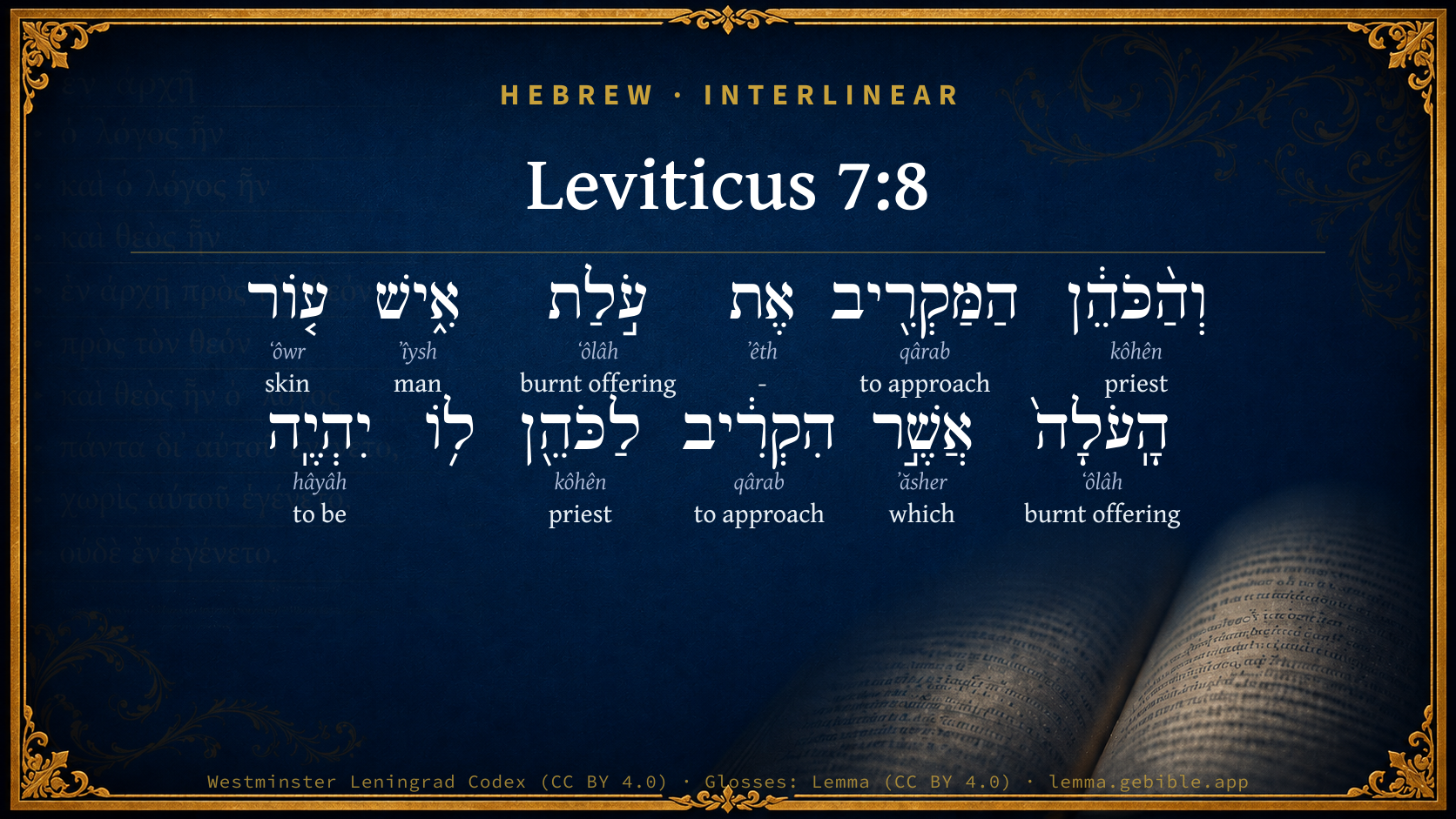
Leviticus 7:8

Hebrew (Westminster Leningrad Codex) Leviticus 7:8 appears in the Hebrew Old Testament. The text above is from the Westminster Leningrad Codex. Each word links to its Strong’s number, a concise gloss, and parsing drawn from the Open Scriptures Hebrew Bible morphology. Click any word for its full Brown-Driver-Briggs (BDB) entry.
Download image
Cite this verse

Leviticus 7:8 (World English Bible). Public Domain. Lemma interlinear Bible study tool, https://lemma.gebible.app/v/leviticus/7/8.

Show BibTeX & RIS
BibTeX
RIS
English Translation
The priest who offers any man's burnt offering, even the priest shall have for himself the skin of the burnt offering which he has offered.
World English Bible · Public Domain
Download a study sheet

One document with this verse’s original text, its word-by-word gloss line, the meaning frame, cross-references with their text, attributed commentary, and full source and license credits — printable, and it pastes into notes with its structure intact.

This verse Autodidact and up

Study sheet (.html) Plain text (.txt)

A passage Seminary Student

Up to 50 verses in one chapter. A passage sheet keeps up to 6 commentary sources and 12 cross-references per verse, in the order this page ranks them, and says so on the sheet whenever that leaves anything out. Ask for a single verse and you get the Autodidact verse sheet above.

Everything on this page stays free to read, with no account — the sheet is a download of what is already on screen, not access to it.

Want to remove ads? Support Godless Engineer
Compare translations 3

The same verse in 3 English versions, stacked beneath the original-language interlinear above. Click any original word for its lexicon entry.

Each is an independent rendering of the whole verse — the interlinear is not word-aligned to these translations.

Highlighted words mark where these versions differ — a whole-verse word diff, not a word-by-word alignment.

  • World English Bible Public Domain
    The priest who offers any man's burnt offering, even the priest shall have for himself the skin of the burnt offering which he has offered.
  • King James Version Public Domain
    And the priest that offereth any man's burnt offering, even the priest shall have to himself the skin of the burnt offering which he hath offered.
  • unfoldingWord Literal Text CC BY-SA 4.0
    And the priest, the one who presents a burnt offering of a man, the skin of the burnt offering that he presents for the priest. It shall be for him.

unfoldingWord Literal Text — © unfoldingWord, licensed CC BY-SA 4.0. Word-aligned USFM3 via Door43 (git.door43.org/unfoldingWord/en_ult).

Versions to compare (up to 4)

3 of 4 selected

Show all 18 translations

Every available English version of this verse, each an independent rendering of the whole verse.

  • World English Bible Public Domain
    The priest who offers any man's burnt offering, even the priest shall have for himself the skin of the burnt offering which he has offered.
  • Berean Standard Bible Public Domain
    As for the priest who presents a burnt offering for anyone, the hide of that offering belongs to him.
  • Majority Standard Bible Public Domain
    As for the priest who presents a burnt offering for anyone, the hide of that offering belongs to him.
  • King James Version Public Domain
    And the priest that offereth any man's burnt offering, even the priest shall have to himself the skin of the burnt offering which he hath offered.
  • American Standard Version (1901) Public Domain
    And the priest that offereth any man's burnt-offering, even the priest shall have to himself the skin of the burnt-offering which he hath offered.
  • Revised Version (1885) Public Domain
    And the priest that offereth any man’s burnt offering, even the priest shall have to himself the skin of the burnt offering which he hath offered.
  • Geneva Bible (1599) Public Domain
    Also the Priest that offereth any mans burnt offring, shall haue the skinne of the burnt offring which he hath offered.
  • Douay-Rheims (1899) Public Domain
    The priest that offereth the victim of holocaust, shall have the skin thereof.
  • Young's Literal Translation Public Domain
    `And the priest who is bringing near any man's burnt-offering, the skin of the burnt-offering which he hath brought near, it is the priest's, his own;
  • Literal Standard Version CC BY-SA 4.0
    And the priest who is bringing any man’s burnt-offering near, the skin of the burnt-offering which he has brought near, it is the priest’s, his own;
  • Unlocked Literal Bible CC BY-SA 4.0
    The priest who offers anyone's burnt offering may have for himself the hide of that offering.
  • unfoldingWord Literal Text CC BY-SA 4.0
    And the priest, the one who presents a burnt offering of a man, the skin of the burnt offering that he presents for the priest. It shall be for him.
  • Darby Bible Public Domain
    And [as to] the priest that presenteth any man's burnt-offering, the skin of the burnt-offering which he hath presented shall be the priest's for himself.
  • World Messianic Bible Public Domain
    The priest who offers any man’s burnt offering shall have for himself the skin of the burnt offering which he has offered.
  • Webster's Bible Public Domain
    And the priest that offereth any man's burnt-offering, even the priest shall have to himself the skin of the burnt-offering which he hath offered.
  • Free Bible Version CC BY-SA 4.0
    In the case of ordinary burnt offerings, the priest shall have the animal's skin.
  • Bible in Basic English Public Domain
    And the priest offering any man's burned offering for him, may have the skin of the burned offering which is offered by him.
  • JPS Tanakh (1917) Public Domain
    And the priest that offereth any man's burnt-offering, even the priest shall have to himself the skin of the burnt-offering which he hath offered.

Literal Standard Version (2020), Covenant Press — licensed CC BY-SA 4.0. Text via the HelloAO Bible API (eBible.org). Unlocked Literal Bible (unfoldingWord) — licensed CC BY-SA 4.0. Text via the HelloAO Bible API (eBible.org). unfoldingWord Literal Text — © unfoldingWord, licensed CC BY-SA 4.0. Word-aligned USFM3 via Door43 (git.door43.org/unfoldingWord/en_ult). Free Bible Version, Dr. Jonathan Gallagher — licensed CC BY-SA 4.0. Text via the HelloAO Bible API (eBible.org).

Word by word

More ways to search: Search by grammar → Find every occurrence → Compare this word →

Practice this passage: Drill this verse → Learn its vocabulary →

ע֤וֹר
ʻôwr
H5785
“skin of”
Noun, Common, Masculine, Singular, Construct
Part of Speech
Noun
Type
Common
Gender
Masculine
Number
Singular
State
Construct
Full BDB Definition

Origin: from H5783

TWOT: 1589a

skin, hide - skin (of men) - hide (of animals)
  1. וְהַ֨כֹּהֵ֔ן kôhên H3548 “and · the · priest” Conjunction + Particle, Definite Article + Noun, Common, Masculine, Singular, Absolute
  2. הַמַּקְרִ֖יב qârab H7126 “the · approaching” Particle, Definite Article + Verb, Hiphil, Participle Active, Masculine, Singular, Absolute
  3. אֶת ʼêth H853 “-” Particle, Direct Object
  4. עֹ֣לַת ʻôlâh H5930 “burnt offering of” Noun, Common, Feminine, Singular, Construct
  5. אִ֑ישׁ ʼîysh H376 “man” Noun, Common, Masculine, Singular, Absolute
  6. הָֽעֹלָה֙ ʻôlâh H5930 “the · burnt offering” Particle, Definite Article + Noun, Common, Feminine, Singular, Absolute
  7. אֲשֶׁ֣ר ʼăsher H834 “which” Particle, Relative
  8. הִקְרִ֔יב qârab H7126 “to approach” Verb, Hiphil, Perfect, 3rd Person, Masculine, Singular
  9. לַכֹּהֵ֖ן kôhên H3548 “to/for the · priest” Preposition, Determined + Noun, Common, Masculine, Singular, Absolute
  10. יִהְיֶֽה hâyâh H1961 “to be” Verb, Qal, Imperfect, 3rd Person, Masculine, Singular

About this verse

These counts appear in no published source. They are computed here, from the morphology-tagged text and Lemma’s own curated glosses. What Lemma adds →

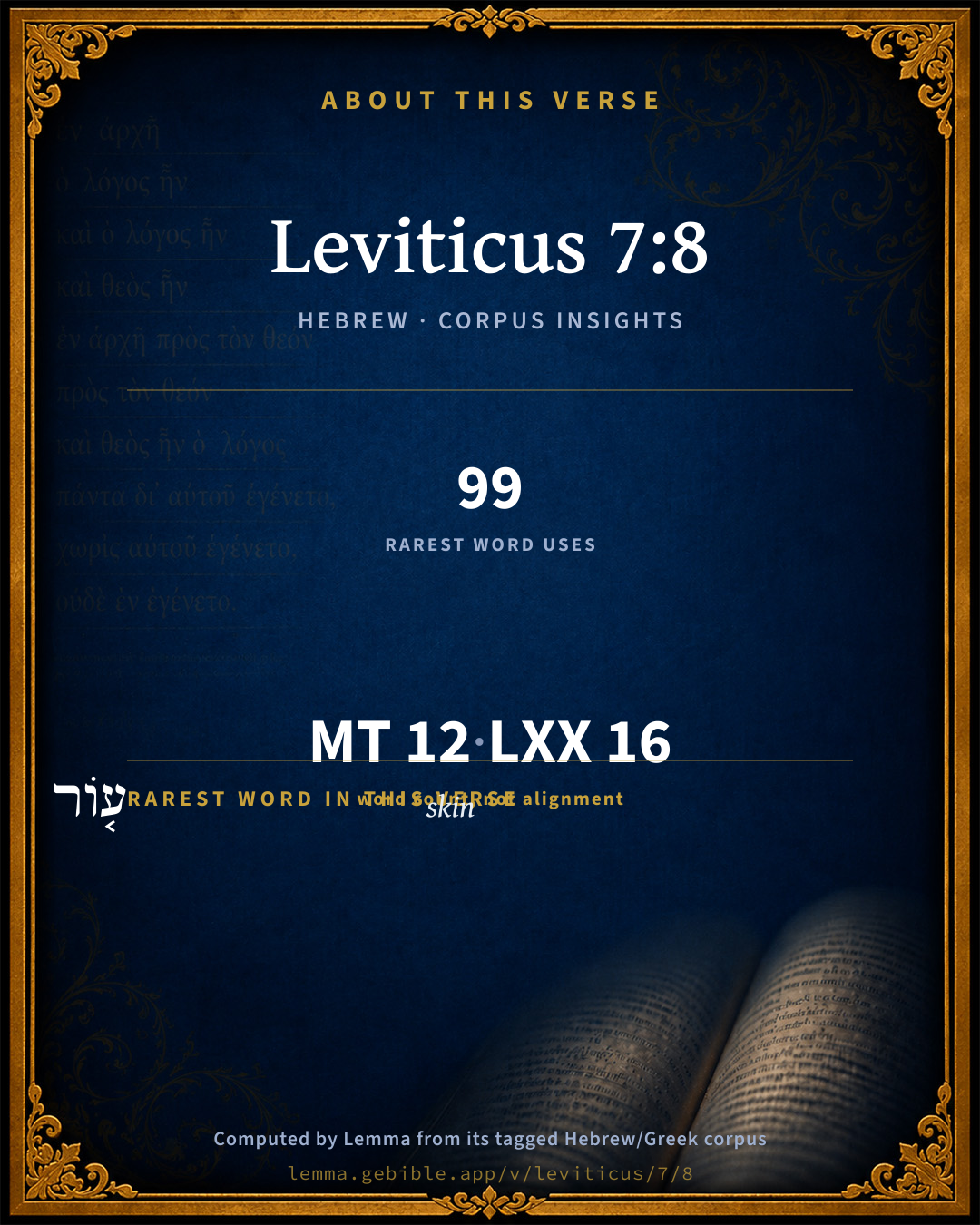
12
words
8
distinct lemmas
Pentateuch
section

Grammatical profile

  • 3 verbs
  • 6 nouns
  • 1 preposition
  • 2 particles

Verb forms

  • הַמַּקְרִ֖יב Hiphil · Participle Active
  • הִקְרִ֔יב Hiphil · Perfect
  • יִהְיֶֽה Qal · Imperfect

Repetition

Words recur within this verse — often emphatic in Hebrew:

  • וְהַ֨כֹּהֵ֔ן priest H3548 ×2
  • הַמַּקְרִ֖יב to approach H7126 ×2
  • עֹ֣לַת burnt offering H5930 ×2

Hebrew & Septuagint length

In English translation the verse runs 25 words from the Hebrew and 44 from the Septuagint (LXX English) — the Septuagint runs noticeably longer here. See the side-by-side →

A rough comparison of the two English renderings, which tokenize alike — not a word-level alignment.

Word counts can differ between the Hebrew and the Greek without any difference in meaning — e.g. the Hebrew direct-object marker אֵת has no separate Greek word, and Greek often adds the article ὁ.

In the original languages it is 12 Hebrew tokens and 16 Greek tokens — but the two are counted differently (Hebrew bundles its prefixes and suffixes into one token; the Greek is in lemma form), so that isn’t a like-for-like length.

Cross-references

6

Topical passages linked to Leviticus 7:8 in the Treasury of Scripture Knowledge — connected by theme and wording, ordered by reader-vote popularity; previews shown in the World English Bible.

  • Genesis 3:21 Yahweh God made coats of skins for Adam and for his wife, and clothed them.
  • Exodus 29:14 But the flesh of the bull, and its skin, and its dung, you shall burn with fire outside of the camp: it is a sin-offering.
  • Leviticus 1:6 He shall flay the burnt offering, and cut it into pieces.
  • Leviticus 4:11 The bull's skin, all its flesh, with its head, and with its legs, its innards, and its dung,
  • Numbers 19:5 One shall burn the heifer in his sight; her skin, and her flesh, and her blood, with her dung, shall he burn:
  • Romans 13:14 But put on the Lord Jesus Christ, and make no provision for the flesh, for its lusts.

Cross-references courtesy of OpenBible.info (CC BY 4.0).

Hebrew and Greek witnesses Masoretic Hebrew ↔ Greek Septuagint

The same verse in the two great witnesses to the Old Testament, shown verse-for-verse.

Here the Septuagint runs noticeably longer than the Hebrew — LXX2012 (modern English Septuagint) 44 words vs World English Bible 25. A rough length comparison of the two English translations, not a word-level alignment — read both below.

These are two independent witnesses, not word-aligned to each other, and the Septuagint is shown in lemma (dictionary) form.

Hebrew Leviticus 7:8 Masoretic · Westminster Leningrad Codex

וְהַ֨כֹּהֵ֔ן הַמַּקְרִ֖יב אֶת עֹ֣לַת אִ֑ישׁ ע֤וֹר הָֽעֹלָה֙ אֲשֶׁ֣ר הִקְרִ֔יב לַכֹּהֵ֖ן ל֥וֹ יִהְיֶֽה

The priest who offers any man's burnt offering, even the priest shall have for himself the skin of the burnt offering which he has offered.

World English Bible · Public Domain

Greek LXX Leviticus 7:8 Septuagint · lemma form

καί ὁ ἱερεύς ὁ προςἄγω ὁλοκαύτωμα ἄνθρωπος ὁ δέρμα ὁ ὁλοκαύτωσις ὅς αὐτός προςφέρω αὐτός εἰμί

And if he do at all eat of the flesh on the third day, it shall not be accepted for him that offers: it shall not be reckoned to him, it is pollution; and whatever soul shall eat of it, shall bear his iniquity.

LXX2012 (modern English Septuagint) · Public Domain

Hebrew: Westminster Leningrad Codex (CC BY 4.0). Greek: Septuagint (public domain); English from LXX2012 (modern English Septuagint) (Public Domain). How the Septuagint differs from the Hebrew →

Targum (Aramaic paraphrase)

2

The Targum is the ancient Jewish Aramaic paraphrase of the Hebrew Scriptures — an interpretive translation, not the Hebrew text itself. Onkelos (literal) and Pseudo-Jonathan (expansive) render the Torah, and Jonathan the Prophets. Coverage is partial: where no permissively-licensed English translation exists for a verse, only the Aramaic is shown. This is verse-level text, not a word-by-word alignment to the Hebrew.

  1. Targum Onkelos Torah (Genesis–Deuteronomy)
    וְכַהֲנָא דִמְקָרֵב יַת עֲלַת גְבַר מְשַׁךְ עֲלָתָא דִי יְקָרֵב לְכַהֲנָא דִילֵהּ יְהֵי

    (no public-domain English translation for this verse)

    Targum Onkelos — Aramaic: “Onkelos Genesis” (public domain); “Onkelos Exodus” (public domain); “Onkelos Leviticus” (public domain); “Onkelos Numbers” (public domain); “Onkelos Deuteronomy” (public domain). English: “Sefaria Community Translation” (CC0 1.0 (public-domain dedication)); “J.W. Etheridge. The Targums of Onkelos and Jonathan Ben Uzziel on the Pentateuch. London: Longmans, Green, 1862” (public domain). Text via Sefaria.

  2. Targum Pseudo-Jonathan Torah (Genesis–Deuteronomy)
    וְכַהֲנָא דִמְקַרִיב יַת עוֹלַת גְבַר אוֹחֲרָן מְשַׁךְ עֲלָתָא דִיקְרֵיב לְכַהֲנָא דִילֵיהּ יְהֵי

    And when the priest offereth another man's burnt sacrifice, the skin of the burnt sacrifice which he offereth shall be the priest's.

    Targum Pseudo-Jonathan — Aramaic: “Targum Jonathan on Genesis” (public domain); “Targum Jonathan on Exodus” (public domain); “Targum Jonathan on Leviticus” (public domain); “Targum Jonathan on Numbers” (public domain); “Targum Jonathan on Deuteronomy” (public domain). English: “The Targum of Jonathan ben Uzziel, trans. J. W. Etheridge, London, 1862” (public domain). Text via Sefaria.

Commentary

Notes on Leviticus 7:8 from classic Christian and Jewish commentators (each source and its license shown beneath its notes). The classic Christian expositions comment on the surrounding passage and are grouped to its opening verse, so a note may address several verses; the Jewish commentaries on the Tanakh (Rashi and others) are per-verse, so they appear only where the commentator wrote on this verse.

Lemma curates 59 commentaries, every one of them public domain or Creative Commons licensed, each selected and text-cleaned for this edition rather than reprinted as found. About our sources →

Trapp's Complete Commentary

John Trapp

Lev 7:8 And the priest that offereth any man’s burnt offering, [even] the priest shall have to himself the skin of the burnt offering which he hath offered.

Ver. 8. The priest shall have to himself.] It is a sign of gasping devotion when men are so straithanded to their ministers, who should have part of all. {Gal 6:6}

John Trapp, A Commentary or Exposition upon All the Books of the Old and New Testament (1647–1656) — public domain. Text from a community e-Sword module.

Jamieson, Fausset & Brown

Robert Jamieson, A. R. Fausset & David Brown

the priest shall have to himself the skin of the burnt offering which he hath offered--All the flesh and the fat of the burnt offerings being consumed, nothing remained to the priest but the skin. It has been thought that this was a patriarchal usage, incorporated with the Mosaic law, and that the right of the sacrificer to the skin of the victim was transmitted from the example of Adam (see on Gen 3:21).

Jamieson, Fausset & Brown — Commentary Critical and Explanatory on the Whole Bible (1871) — public domain (CC PDM 1.0). Text via the HelloAO Bible API.

Adam Clarke's Commentary

Verse 8. The priest shall have to himself the skin] Bishop Patrick supposes that this right of the priest to the skin commenced with the offering of Adam, "for it is probable," says he, "that Adam himself offered the first sacrifice, and had the skin given him by God to make garments for him and his wife; in conformity to which the priests ever after had the skin of the whole burnt-offerings for their portion, which was a custom among the Gentiles as well as the Jews, who gave the skins of their sacrifices to their priests, when they were not burnt with the sacrifices, as in some sin-offerings they were among the Jews, see Le 4:11. And they employed them to a superstitious use, by lying upon them in their temples, in hopes to have future things revealed to them in their dreams.

Of this we have a proof in Virgil, AEn. lib. vii., ver. 86-95.

"-------------huc dona sacerdos

Cum tulit, et caesarum ovium sub nocte silenti

Pellibus incubuit stratis, somnosque petivit;

Multa modus simulncra videt volitantia miris,

Et varias audit voces, fruiturque deorum

Colloquio, atque imis Acheronta affatur Avernis.

Hic et tum pater ipse petens responsa Latinus

Centum lanigeras mactabat rite bidentes,

Atque harum effultus tergo stratisque jacebat

Velleribus. Subita ex alto vox reddita luco est."

First, on the fleeces of the slaughter'd sheep

By night the sacred priest dissolves in sleep,

When in a train, before his slumbering eye,

Thin airy forms and wondrous visions fly.

He calls the powers who guard the infernal floods,

And talks, inspired, familiar with the gods.

To this dread oracle the prince withdrew,

And first a hundred sheep the monarch slew;

Then on their fleeces lay; and from the wood

He heard, distinct, these accents of the god.

-PITT.

The same superstition, practised precisely in the same way and for the same purposes, prevail to the present day in the Highlands of Scotland, as the reader may see from the following note of Sir Walter Scott, in his Lady of the Lake: -

"The Highlanders of Scotland, like all rude people, had various superstitious modes of inquiring into futurity. One of the most noted was the togharm. A person was wrapped up in the skin of a newly-slain bullock, and deposited beside a water-fall, or at the bottom of a precipice, or in some other strange, wild, and unusual situation, where the scenery around him suggested nothing but objects of horror. In this situation he revolved in his mind the question proposed; and whatever was impressed upon him by his exalted imagination, passed for the inspiration of the disembodied spirits who haunt these desolate recesses. One way of consulting this oracle was by a party of men, who first retired to solitary places, remote from any house, and there they singled out one of their number, and wrapt him in a big cow's hide, which they folded about him; his whole body was covered with it except his head, and so left in this posture all night, until his invisible friends relieved him by giving a proper answer to the question in hand; which he received, as he fancied, from several persons that he found about him all that time. His consorts returned to him at day-break; and then he communicated his news to them, which often proved fatal to those concerned in such unwarrantable inquiries.

"Mr. Alexander Cooper, present minister of North Virt, told me that one John Erach, in the Isle of Lewis, assured him it was his fate to have been led by his curiosity with some who consulted this oracle, and that he was a night within the hide above mentioned, during which time he felt and heard such terrible things that he could not express them: the impression made on him was such as could never go off; and he said, for a thousand worlds he would never again be concerned in the like performance, for it had disordered him to a high degree. He confessed it ingenuously, and with an air of great remorse, and seemed to be very penitent under a just sense of so great a crime: he declared this about five years since, and is still living in the Isle of Lewis for any thing I know." - Description of the Western Isles, p. 110. See also Pennant's Scottish Tour, vol. ii., p. 301; and Sir W. Scott's Lady of the Lake.

Adam Clarke's Commentary on the Bible (1810–1826) — public domain. Text from a community e-Sword/MySword module.

Ellicott's Commentary for English Readers

(8) The priest shall have to himself the skin.—As the skin was the only part not consumed by the fire, in the case of the burnt offering, it fell to the share of the officiating priest. According to the rule which obtained during the second Temple, all the skins of the most holy things belonged to the officiating priests—i.e., those of the trespass offering, the sin offerings of the laity, &c.—whereas those of the holy things—i.e., those of the peace offerings—belonged to the owners of the victims. These skins, which accumulated during the week, the priests whose course it was to serve divided between them every Sabbath evening.

A Bible Commentary for English Readers, edited by Charles John Ellicott (1878–1897) — public domain. Text from a community e-Sword module.

The Cambridge Bible for Schools and Colleges

gen. ed. J. J. S. Perowne

8. The rule that the skin of the Burnt-Offering belongs to the priest who offers it is extended in the Mishna to the skins of the ‘most holy,’ i.e. the Sin- and Guilt-Offerings. Perhaps this is implied in Lev_7:7. We gather from Zebaḥim 103 b (Tal. Bab.) that the skin of the Peace-Offering belonged to the offerer. It is doubtful whether the skin of a priest’s Burnt-Offering is here included: after the analogy of the priestly minḥah (Lev_6:23) the whole of a priest’s sacrifice must be burnt.

The Cambridge Bible for Schools and Colleges (gen. ed. J. J. S. Perowne; Cambridge University Press, 1878–1918) — public domain. Text from a community e-Sword module.

John Gill's Exposition

And the priest that offereth any man's burnt offering,.... In which the flesh was wholly burnt, and nothing of it remained to requite the priest for his trouble, as in other offerings:

even the priest shall have to himself the skin of the burnt offering, which he hath offered; in some cases the skin itself was burnt, and then he could have nothing, see Lev 4:11 but in others the skin was reserved for the priest. There seems to be an emphasis upon the phrase "to himself", and may signify, that though in other things other priests might partake with him, yet not in this; and so Maimonides (z) observes, that the skin was not given to every priest, but to him that offered the sacrifice; and elsewhere (a) he says, the skins of light holy things are the owner's, but the skins of the most holy things are the priest's. And some have thought this law has some respect to the case of Adam, and is agreeable thereunto; who having offered sacrifice according to divine directions given him, had coats made for him and his wife of the skins of the slain beasts; and it was usual with the Heathen priests to have the skins of the sacrifices, and in which they slept in their temples and others also were desirous of the same, in order by dreams or otherwise to get knowledge of things future; See Gill on Amo 2:8.

(z) In Misn. Challah, c. 4. sect. 9. (a) In Misn. Zebachim, c. 12. sect. 3.

John Gill's Exposition of the Whole Bible (1746–1763) — public domain (CC PDM 1.0). Text via the HelloAO Bible API.

Albert Barnes' Notes on the Bible

The skin of the burnt offering - It is most likely that the skins of the sin-offering and the trespass-offering also fell to the lot of the officiating priest.

Albert Barnes' Notes on the Bible (1834–1885) — public domain. Text from a community e-Sword/MySword module.

Haydock's Catholic Bible Commentary

Skin. Of these skins a great profit was made. (Philo, de Præm. Sacerd.)

George Leo Haydock (1774–1849), Haydock's Catholic Family Bible and Commentary, 1859 edition — public domain. Excludes Psalms (Douay-Rheims chapter numbering differs from Protestant) and Deuterocanonical books (Catholic canon only).

Whedon's Commentary on the Bible

Daniel D. Whedon

8. The skin of the burnt offering — This was a perquisite of the priest, to be kept or sold at his pleasure. Bishop Patrick suggests that Adam was the first priest who offered a burnt offering, and that the presentation of the skin to him by the Creator established the precedent here ratified by the ceremonial law. The same custom is found among pagans, whose priests superstitiously thought that by lying upon these skins they would be endowed with the gift of prescience. See Virgil’s AEneid, book vii, 7:86-95. The same superstition lingers to this day in the Highlands of Scotland.

Daniel D. Whedon (gen. ed.), Commentary on the Old and New Testaments (1874–1909) — public domain. Text from a community e-Sword module.

Rashi

Rabbi Shlomo Yitzchaki (Rashi)

עור העלה אשר הקריב לכהן לו יהיה [AND THE PRIEST THAT OFFERETH ANY MAN’S BURNT OFFERING] EVEN THE PRIEST SHALL HAVE TO HIMSELF THE SKIN OF THE BURNT OFFERING WHICH HE HATH OFFERED — thus excluding the טבול יום, the מחוסר כפורים and the אונן (cf. Rashi on v. 7) — that these have no share in the skins of burnt offerings (Sifra, Tzav, Chapter 9 5; Zevachim 103b).

Rashi on the Tanakh — English translations: “The Judaica Press complete Tanach with Rashi, translated by A. J. Rosenberg” (CC BY 4.0); “Pentateuch with Rashi's commentary by M. Rosenbaum and A.M. Silbermann, 1929-1934” (public domain); “The Metsudah Tanach series, Lakewood, N.J” (CC BY 4.0); and “The Book of Joshua, Metsudah Publications, 1997” (CC BY 4.0). Text via Sefaria.

Ramban (Nachmanides)

Rabbi Moshe ben Nachman (Ramban / Nachmanides)

AND THE PRIEST THAT OFFERETH ANY MAN’S BURNT-OFFERING, EVEN THE PRIEST SHALL HAVE TO HIMSELF THE SKIN OF THE BURNT-OFFERING. This law applies to all offerings, and although Scripture mentions only the burnt-offering, it holds good of the sin-offering and guilt-offering mentioned above. Such is not the case, however, in reference to the peace-offerings [the skin of which belongs to the owner]; therefore Scripture mentioned the law of the priests’ due in the middle of the offerings, before it speaks of the peace-offerings [further on in Verses 11-21].The interpretation of the Rabbis as found in the Torath Kohanim is as follows: 9:2. “[From the verse here] I know only that the skin of the burnt-offering [belongs to the priest]. Whence do I know that the same law applies to the skins of [the other] most holy offerings? Scripture therefore says, that offereth. Or perhaps I might think that I am to include [also] the skins of the offerings which are holy to a lesser degree [such as the peace-offering etc.]; Scripture therefore says, burnt-offering, thus teaching that just as the burnt-offering is distinguished by being of the most holy degree of offerings, [so also this law holds good of all most holy offerings], thus excluding those which are holy in a minor degree.”By way of the plain meaning of Scripture, it was not necessary to state this law [that the skin of the animal belongs to the priest] in connection with the sin-offering and guilt-offering, since they are part of the gifts given to the priests, and the priests thus are entitled to the meat and also the skin, but in the case of the burnt-offering [where the priests do not receive any of the meat, since it is wholly burnt on the altar], it was necessary for Scripture to say that they do acquire the skin. This is the interpretation of Rabbi [Yehuda Hanasi] who says, “Essentially we need this verse only for the skin of the burnt-offering [to teach that it belongs to the priest], since the skin always follows the meat” (further, 16:27) (Torath Kohanim, Tzav 9:5). Hence the Torah had to explain that the burnt-offering is different; but in the case of the sin-offering and the guilt-offering, it was not necessary to mention that the skin belongs to the priest, for since he acquired the right to the meat, the skin naturally came with it. [and here Scripture tells us that it is not to be burnt with the meat]. So also is it explained in the Torath Kohanim. (further, 16:27) (Torath Kohanim, Tzav 9:5). Hence the Torah had to explain that the burnt-offering is different; but in the case of the sin-offering and the guilt-offering, it was not necessary to mention that the skin belongs to the priest, for since he acquired the right to the meat, the skin naturally came with it.

Ramban (Nachmanides) on the Tanakh — English translation: “Commentary on the Torah by Ramban (Nachmanides). Translated and annotated by Charles B. Chavel. New York, Shilo Pub. House, 1971-1976” (CC BY 4.0). Text via Sefaria.

Lesson kit

Teaching starters — assembled from the data on this page, not authored interpretation. Every prompt links to the verse data it draws on. Edit before teaching.

Leviticus, in the Pentateuch, opens this verse with 12 words (8 distinct Hebrew lemmas). Its most distinctive word is ʻôwr (“skin”). The Greek Septuagint runs longer here. A historical commentator’s framing appears above. Read the whole chapter for the surrounding context.

Discussion questions

  1. The word ʻôwr carries the sense “skin.” How does it shape the verse?
  2. How does Genesis 3:21, which shares this passage’s theme, read alongside this verse?
  3. What does the repetition of “priest” (2× in this one verse) do in this verse?
  4. The Septuagint runs longer here than the Hebrew. What might account for the difference?
  5. These translations render this verse differently; the difference is in the English rendering, not the original. What questions does that raise?
  6. «הַמַּקְרִ֖יב» is a Hiphil Participle Active verb. How does that grammatical form shape the action described?
  7. Compare how Trapp's Complete Commentary and Jamieson, Fausset & Brown read this verse. Where do they agree or differ?

Things to notice

Reading settings

Reading text

Shown beneath each verse's original-language words.

Old Testament
Old Testament edition

Read the OT as the Masoretic Hebrew (MT) or the Greek Septuagint (LXX).

English shown for the Greek Septuagint (in the Hebrew ↔ Greek comparison).

Comparing translations? Open the Compare panel on any verse page to stack up to four side by side.