
Genesis 43:19

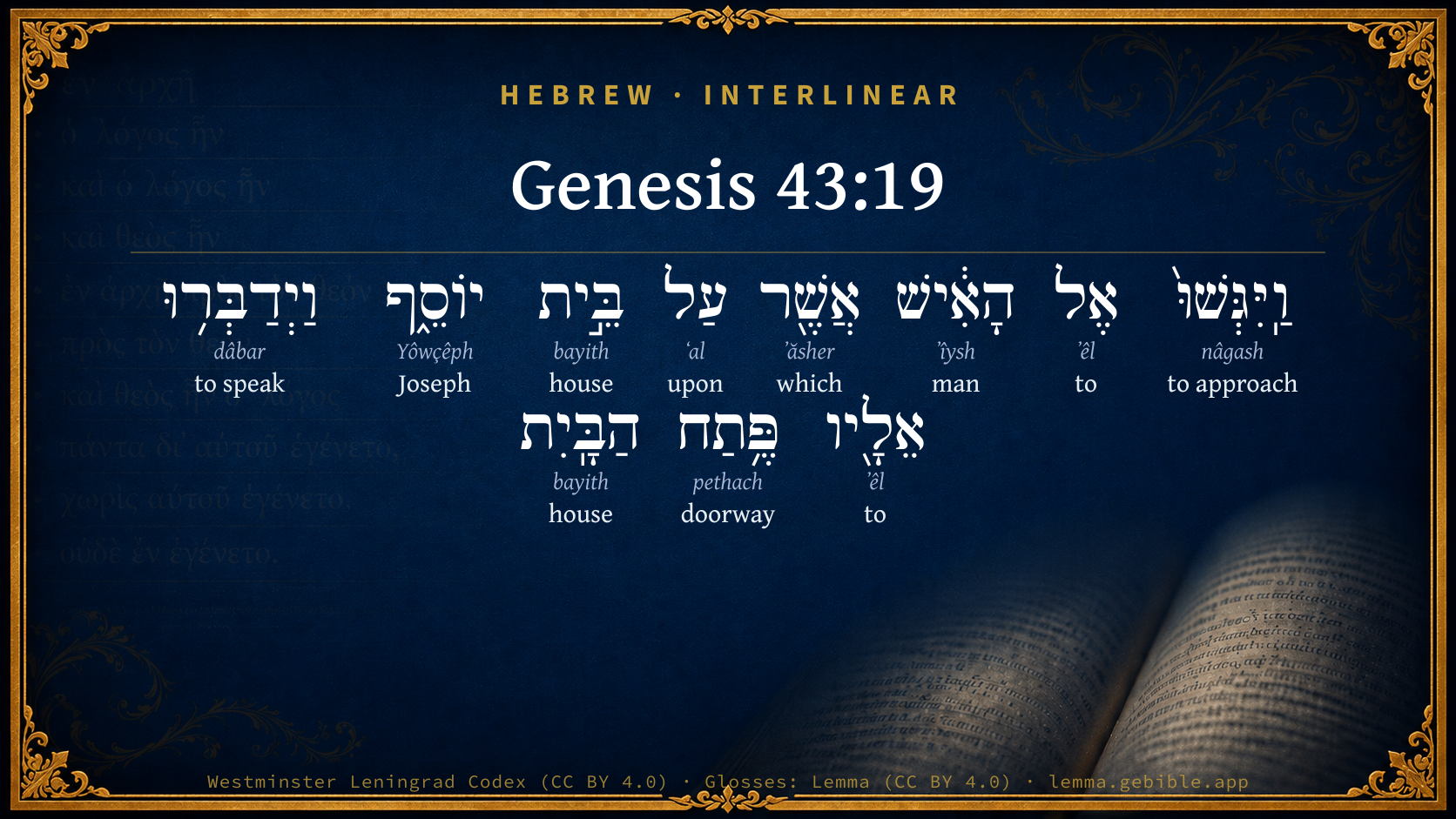
Hebrew (Westminster Leningrad Codex) Genesis 43:19 appears in the Hebrew Old Testament. The text above is from the Westminster Leningrad Codex. Each word links to its Strong’s number, a concise gloss, and parsing drawn from the Open Scriptures Hebrew Bible morphology. Click any word for its full Brown-Driver-Briggs (BDB) entry.
Download image
Cite this verse

Genesis 43:19 (World English Bible). Public Domain. Lemma interlinear Bible study tool, https://lemma.gebible.app/v/genesis/43/19.

Show BibTeX & RIS
BibTeX
RIS
English Translation
They came near to the steward of Joseph's house, and they spoke to him at the door of the house,
World English Bible · Public Domain
Download a study sheet

One document with this verse’s original text, its word-by-word gloss line, the meaning frame, cross-references with their text, attributed commentary, and full source and license credits — printable, and it pastes into notes with its structure intact.

This verse Autodidact and up

Study sheet (.html) Plain text (.txt)

A passage Seminary Student

Up to 50 verses in one chapter. A passage sheet keeps up to 6 commentary sources and 12 cross-references per verse, in the order this page ranks them, and says so on the sheet whenever that leaves anything out. Ask for a single verse and you get the Autodidact verse sheet above.

Everything on this page stays free to read, with no account — the sheet is a download of what is already on screen, not access to it.

Want to remove ads? Support Godless Engineer
Compare translations 3

The same verse in 3 English versions, stacked beneath the original-language interlinear above. Click any original word for its lexicon entry.

Each is an independent rendering of the whole verse — the interlinear is not word-aligned to these translations.

Highlighted words mark where these versions differ — a whole-verse word diff, not a word-by-word alignment.

  • World English Bible Public Domain
    They came near to the steward of Joseph's house, and they spoke to him at the door of the house,
  • King James Version Public Domain
    And they came near to the steward of Joseph's house, and they communed with him at the door of the house,
  • unfoldingWord Literal Text CC BY-SA 4.0
    Then they went near to the man who over Joseph’s house and spoke to him the entrance of the house.

unfoldingWord Literal Text — © unfoldingWord, licensed CC BY-SA 4.0. Word-aligned USFM3 via Door43 (git.door43.org/unfoldingWord/en_ult).

Versions to compare (up to 4)

3 of 4 selected

Show all 18 translations

Every available English version of this verse, each an independent rendering of the whole verse.

  • World English Bible Public Domain
    They came near to the steward of Joseph's house, and they spoke to him at the door of the house,
  • Berean Standard Bible Public Domain
    So they approached Joseph’s steward and spoke to him at the entrance to the house.
  • Majority Standard Bible Public Domain
    So they approached Joseph’s steward and spoke to him at the entrance to the house.
  • King James Version Public Domain
    And they came near to the steward of Joseph's house, and they communed with him at the door of the house,
  • American Standard Version (1901) Public Domain
    And they came near to the steward of Joseph's house, and they spake unto him at the door of the house,
  • Revised Version (1885) Public Domain
    And they came near to the steward of Joseph’s house, and they spake unto him at the door of the house,
  • Geneva Bible (1599) Public Domain
    Therefore came they to Iosephs stewarde, and communed with him at the doore of ye house.
  • Douay-Rheims (1899) Public Domain
    Wherefore going up to the steward of the house, at the door,
  • Young's Literal Translation Public Domain
    And they come nigh unto the man who `is' over the house of Joseph, and speak unto him at the opening of the house,
  • Literal Standard Version CC BY-SA 4.0
    And they come near to the man who [is] over the house of Joseph, and speak to him at the opening of the house,
  • Unlocked Literal Bible CC BY-SA 4.0
    They approached the steward of Joseph's house, and they spoke to him at the door of the house,
  • unfoldingWord Literal Text CC BY-SA 4.0
    Then they went near to the man who over Joseph’s house and spoke to him the entrance of the house.
  • Darby Bible Public Domain
    And they came up to the man that was over Joseph's house, and they spoke to him at the door of the house,
  • World Messianic Bible Public Domain
    They came near to the steward of Joseph’s house, and they spoke to him at the door of the house,
  • Webster's Bible Public Domain
    \\43:20\\And said, O sir, we came down indeed at the first time to buy food:
  • Free Bible Version CC BY-SA 4.0
    So they went and spoke to Joseph's household supervisor at the entrance to the house.
  • Bible in Basic English Public Domain
    And said, O my lord, we only came down the first time to get food;
  • JPS Tanakh (1917) Public Domain
    And they came near to the steward of Joseph's house, and they spoke unto him at the door of the house,

Literal Standard Version (2020), Covenant Press — licensed CC BY-SA 4.0. Text via the HelloAO Bible API (eBible.org). Unlocked Literal Bible (unfoldingWord) — licensed CC BY-SA 4.0. Text via the HelloAO Bible API (eBible.org). unfoldingWord Literal Text — © unfoldingWord, licensed CC BY-SA 4.0. Word-aligned USFM3 via Door43 (git.door43.org/unfoldingWord/en_ult). Free Bible Version, Dr. Jonathan Gallagher — licensed CC BY-SA 4.0. Text via the HelloAO Bible API (eBible.org).

Word by word

More ways to search: Search by grammar → Find every occurrence → Compare this word →

Practice this passage: Drill this verse → Learn its vocabulary →

וַֽיִּגְּשׁוּ֙
nâgash
H5066
“and · to approach”
Conjunction + Verb, Qal, Sequential Imperfect, 3rd Person, Masculine, Plural
Part of Speech
Conjunction + Verb
Stem
Qal
Form
Sequential Imperfect
Person
3rd Person
Gender
Masculine
Number
Plural
Full BDB Definition

Origin: a primitive root

TWOT: 1297

to draw near, approach - (Qal) to draw or come near - of humans - of sexual intercourse - of inanimate subject - to approach one another - (Niphal) to draw near - (Hiphil) to cause to approach, bring near, bring - (Hophal) to be brought near - (Hithpael) to draw near
  1. אֶל ʼêl H413 “to” Preposition
  2. הָאִ֔ישׁ ʼîysh H376 “the · man” Particle, Definite Article + Noun, Common, Masculine, Singular, Absolute
  3. אֲשֶׁ֖ר ʼăsher H834 “which” Particle, Relative
  4. עַל ʻal H5921 “upon” Preposition
  5. בֵּ֣ית bayith H1004 “house of” Noun, Common, Masculine, Singular, Construct
  6. יוֹסֵ֑ף Yôwçêph H3130 “Joseph” Noun, Proper
  7. וַיְדַבְּר֥וּ dâbar H1696 “and · to speak” Conjunction + Verb, Piel, Sequential Imperfect, 3rd Person, Masculine, Plural
  8. אֵלָ֖יו ʼêl H413 “to · him” Preposition + Suffix, Personal, 3rd Person, Masculine, Singular
  9. פֶּ֥תַח pethach H6607 “doorway of” Noun, Common, Masculine, Singular, Construct
  10. הַבָּֽיִת bayith H1004 “the · house” Particle, Definite Article + Noun, Common, Masculine, Singular, Absolute

About this verse

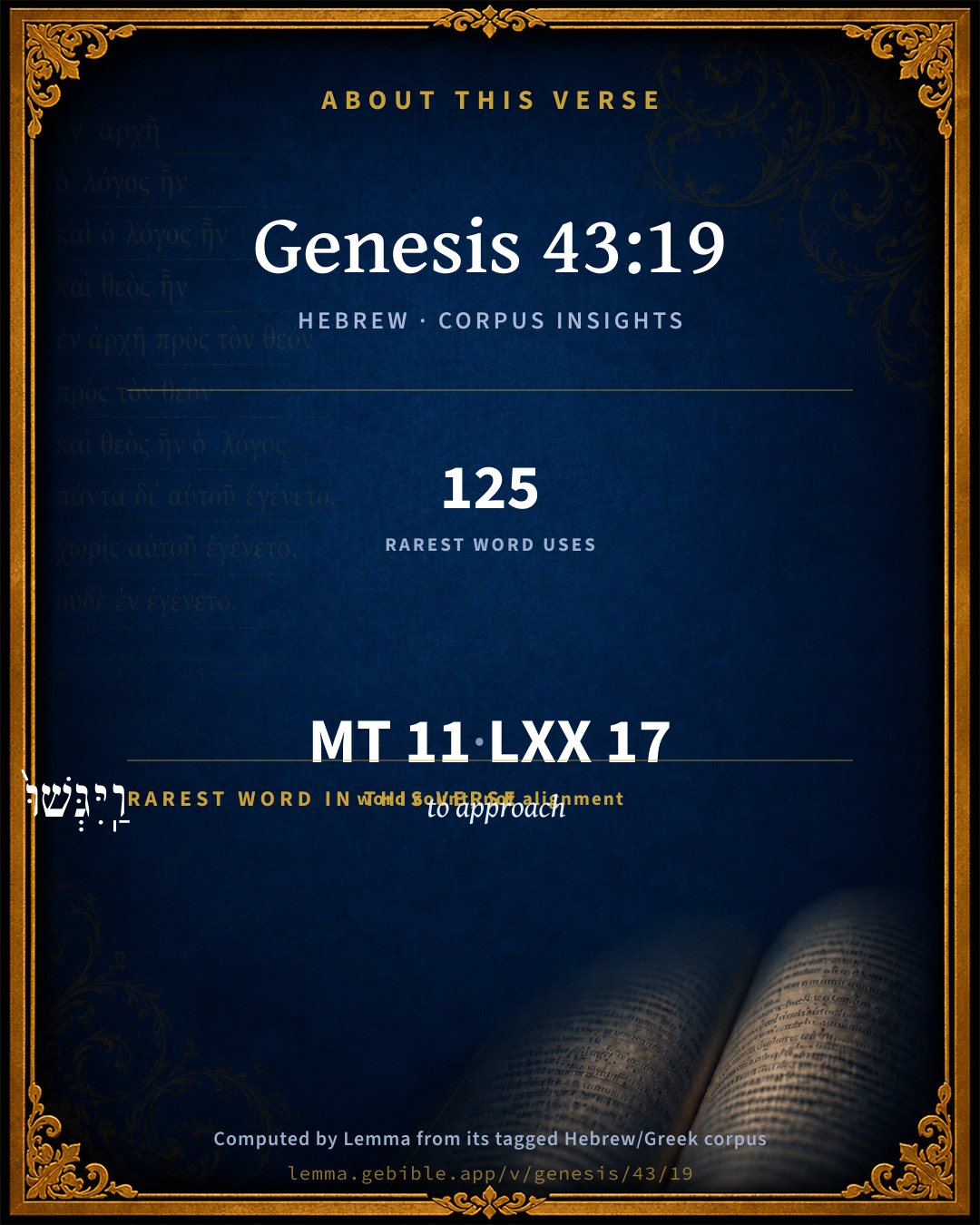
These counts appear in no published source. They are computed here, from the morphology-tagged text and Lemma’s own curated glosses. What Lemma adds →

11
words
9
distinct lemmas
Pentateuch
section

Grammatical profile

  • 2 verbs
  • 5 nouns
  • 3 prepositions
  • 1 particle

Verb forms

  • וַֽיִּגְּשׁוּ֙ Qal · Sequential Imperfect
  • וַיְדַבְּר֥וּ Piel · Sequential Imperfect

Repetition

Words recur within this verse — often emphatic in Hebrew:

  • בֵּ֣ית house H1004 ×2
  • אֶל to H413 ×2

Hebrew & Septuagint length

In English translation the verse runs 20 words from the Hebrew and 22 from the Septuagint (LXX English) — closely comparable.

A rough comparison of the two English renderings, which tokenize alike — not a word-level alignment.

Word counts can differ between the Hebrew and the Greek without any difference in meaning — e.g. the Hebrew direct-object marker אֵת has no separate Greek word, and Greek often adds the article ὁ.

In the original languages it is 11 Hebrew tokens and 17 Greek tokens — but the two are counted differently (Hebrew bundles its prefixes and suffixes into one token; the Greek is in lemma form), so that isn’t a like-for-like length.

Hebrew and Greek witnesses Masoretic Hebrew ↔ Greek Septuagint

The same verse in the two great witnesses to the Old Testament, shown verse-for-verse.

These are two independent witnesses, not word-aligned to each other, and the Septuagint is shown in lemma (dictionary) form.

Hebrew Genesis 43:19 Masoretic · Westminster Leningrad Codex

וַֽיִּגְּשׁוּ֙ אֶל הָאִ֔ישׁ אֲשֶׁ֖ר עַל בֵּ֣ית יוֹסֵ֑ף וַיְדַבְּר֥וּ אֵלָ֖יו פֶּ֥תַח הַבָּֽיִת

They came near to the steward of Joseph's house, and they spoke to him at the door of the house,

World English Bible · Public Domain

Greek LXX Genesis 43:19 Septuagint · lemma form

προςἔρχομαι δέ πρός ὁ ἄνθρωπος ὁ ἐπί ὁ οἶκος ιωσηφ λαλέω αὐτός ἐν ὁ πυλών ὁ οἶκος

And having approached the man who was over the house of Joseph, they spoke to him in the porch of the house,

LXX2012 (modern English Septuagint) · Public Domain

On this verse, The Pulpit Commentary discusses the Septuagint’s reading. Read the note in Commentary ↓

Hebrew: Westminster Leningrad Codex (CC BY 4.0). Greek: Septuagint (public domain); English from LXX2012 (modern English Septuagint) (Public Domain). How the Septuagint differs from the Hebrew →

Targum (Aramaic paraphrase)

2

The Targum is the ancient Jewish Aramaic paraphrase of the Hebrew Scriptures — an interpretive translation, not the Hebrew text itself. Onkelos (literal) and Pseudo-Jonathan (expansive) render the Torah, and Jonathan the Prophets. Coverage is partial: where no permissively-licensed English translation exists for a verse, only the Aramaic is shown. This is verse-level text, not a word-by-word alignment to the Hebrew.

  1. Targum Onkelos Torah (Genesis–Deuteronomy)
    וּקְרִיבוּ לְוַת גַּבְרָא דִּי מְמַנָּא עַל בֵּית יוֹסֵף וּמַלִּילוּ עִמֵּהּ בִּתְרַע בֵּיתָא

    (no public-domain English translation for this verse)

    Targum Onkelos — Aramaic: “Onkelos Genesis” (public domain); “Onkelos Exodus” (public domain); “Onkelos Leviticus” (public domain); “Onkelos Numbers” (public domain); “Onkelos Deuteronomy” (public domain). English: “Sefaria Community Translation” (CC0 1.0 (public-domain dedication)); “J.W. Etheridge. The Targums of Onkelos and Jonathan Ben Uzziel on the Pentateuch. London: Longmans, Green, 1862” (public domain). Text via Sefaria.

  2. Targum Pseudo-Jonathan Torah (Genesis–Deuteronomy)
    וּקְרִיבוּ לְוַת גַבְרָא דִי מְמַנָא אַפִּיטְרוֹפּוֹס עַל בֵּית יוֹסֵף וּמַלִילוּ עִמֵיהּ בִּתְרַע בֵּיתֵיהּ

    And they drew near the man who had been appointed intendant over Joseph's house, and spake with him at the gate of the house.

    Targum Pseudo-Jonathan — Aramaic: “Targum Jonathan on Genesis” (public domain); “Targum Jonathan on Exodus” (public domain); “Targum Jonathan on Leviticus” (public domain); “Targum Jonathan on Numbers” (public domain); “Targum Jonathan on Deuteronomy” (public domain). English: “The Targum of Jonathan ben Uzziel, trans. J. W. Etheridge, London, 1862” (public domain). Text via Sefaria.

Commentary

Notes on Genesis 43:19 from classic Christian and Jewish commentators (each source and its license shown beneath its notes). The classic Christian expositions comment on the surrounding passage and are grouped to its opening verse, so a note may address several verses; the Jewish commentaries on the Tanakh (Rashi and others) are per-verse, so they appear only where the commentator wrote on this verse.

Lemma curates 59 commentaries, every one of them public domain or Creative Commons licensed, each selected and text-cleaned for this edition rather than reprinted as found. About our sources →

Trapp's Complete Commentary

John Trapp

Gen 43:19 And they came near to the steward of Joseph’s house, and they communed with him at the door of the house,

Ver. 19. And they came near.] {See Trapp on "Gen 43:20"}

John Trapp, A Commentary or Exposition upon All the Books of the Old and New Testament (1647–1656) — public domain. Text from a community e-Sword module.

The Biblical Illustrator

Joseph S. Exell

Gen_43:19-25

And they came near to the steward of Josephs house, and they communed with him

Josephs steward

I.

HE LISTENS PATIENTLY TO THE EXPLANATION OF THEIR CONDUCT, OFFERED BY JOSEPHS BRETHREN.

II. HE TREATS THEM WITH A WISE KINDNESS AND WITH PIETY. (T. H.Leale.)

Lessons

1. Just orders are readily entertained by honest servants from their masters (Gen_43:17).

2. The house of kindness may sometimes terrify souls as the house of dangers.

3. Innocency itself may be suspicious of wrong charges, to raise up fear.

4. Groundless jealousies pretend dangers where none are (Gen_43:18).

5. Wisdom suggests unto innocency a fair defence to prevent danger (Gen_43:19).

6. Innocencys plain acknowledgment of its designs is its best apology (Gen_43:20.)

7. Declaration of events of providence as they are tends to justify the innocent.

8. Where providence orders good, souls may make question of receiving or keeping it (Gen_43:21).

9. Just souls will deal justly in dealing with others about buying, &c.

10. Innoceney may plead ignorance of the fact of sin plainly, being not guilty (Gen_43:22).

11. Upright hearts in power will speak peace and encouragement to fearful spirits.

12. Good hearts teach to ascribe all good providences unto God in covenant.

13. Just men will own their acts to discharge the innocent. So the steward.

14. Conditions being performed, hostages must be in justice returned (Gen_43:23).

15. Good hospitality will labour, to afford room and all convenient refreshings to its guests.

16. Hospitality in truth, provides for beasts as well as men (Gen_43:24).

17. Prudence will put men upon care to prepare a present for rulers in time of danger.

18. Courtesy from hosts gives opportunity for guests to express their returns.

19. Noon refreshments are suitable to mornings labours.

20. Good rulers are careful first to work and then to eat (Gen_43:25). (G. Hughes, B. D.)

The Biblical Illustrator, edited by Joseph S. Exell (c. 1880s–1900s) — public domain. Text from a community e-Sword module.

The Preacher's Complete Homiletical Commentary

Joseph S. Exell (gen. ed.)

CRITICAL NOTES.—

Gen_43:23. I had your money.] Heb. “Your money came to me.” He means to tell them, “You cannot be called to account for the money, for I had it. Whatever became of it afterwards, I hereby acknowledge the receipt of it for the corn. You are credited with payment in full; therefore give yourselves no uneasiness on that score.”—(Bush.)—

MAIN HOMILETICS OF THE PARAGRAPH.—Gen_43:19-25

JOSEPH’S STEWARD

This incident shows how the spirit of Joseph’s character had been imparted to his subordinate. This steward was influenced by his master for good, and some traces of that influence are here manifest:

I. He listens patiently to the explanation of their conduct, offered by Joseph’s brethren. In all Joseph’s treatment of his brethren in Egypt up to this point, there was nothing arbitrary or unkind. It was throughout justified by the circumstances, as they appeared. Joseph was always ready to listen to reason, and to give due consideration to any explanation that might be offered. He was considerate and patient towards these suspicious men in giving them time to clear themselves. This steward reflected so much of his master’s character that he was also considerate and patient in his treatment of these men. The circumstances were suspicious, and they felt that their conduct needed an explanation. He listened to them in the spirit of a just and merciful man. Most men of his class are full of the insolence of office; but here was a man of a better sort, and chiefly made such, as we have reason to believe, through the good influence of his master.

II. He treats them with a wise kindness, and with piety.

1. With a wise kindness. He does not seek further to increase their fears, but hastens to relieve them. He was more merciful than to stretch them any longer on the rack of suspense, and too wise to inflict pain when no good end could be served thereby. To give them hope and confidence he brings Simeon out unto them, who being released, as they must well know, by Joseph’s order, would be a proof to them that all was well.

2. With piety. He assures them that all the strange things which had lately happened to them were ordered and guided by God’s providence. (Gen_43:23.) He had the acknowledgment of their money, and they must regard it as the gift of God. No charge could now be brought against them, and this relief to their anxiety they must regard also as the gift of God. In this steward we have an instance of a man whose character had been moulded by another. We have no doubt that Joseph had spoken to him concerning the God of his fathers, and thus he learnt the sentiments and language of his pious master. Many have received religious truths and convictions from those placed over them, from those who used their influence and authority to spread the knowledge and the fear of God. Such a strong character as Joseph’s would be sure to impress itself upon all who came under its gracious influence.

SUGGESTIVE COMMENTS ON THE VERSES

Gen_43:19-20. They were afraid of sharing the fate of Simeon, or of being made slaves. They lost no time, therefore, in explaining their own behaviour and notifying misapprehension, if any existed, in the minds of Joseph and his servants. The richest feast will afford little gratification to a troubled mind.—(Bush).

Gen_43:22. “We cannot tell.” It was a wise discretion to speak thus, for it might have exposed them to great risk to utter the suspicion which lurked in their minds. Besides, they did not know, and it was better, therefore, to acknowledge their ignorance at once. They had a theory, but it was neither safe nor expedient to make it known.

Often circumstances may be such as to throw grave suspicion upon good men. Therefore it is of the utmost importance to have a well-established character which shall avail for a man’s defence when unjust suspicion has fixed upon him. Here also appears the disadvantage of a bad character, that such an one is suspected of wrong doing even when he is not guilty. Besides, these men feel that they have a bad record with their own conscience, and “a guilty conscience needs no accuser.” Trust in God is the chief confidence in such a dark hour. (Psalms 37)—(Jacobus).

Gen_43:23. How perfectly comforting that this officer of Egypt’s dreaded lord acknowledges the God of the Hebrews, and recognises Him as the God of these brothers and of their fathers. What a rebuke to their lack of faith. Why should they have been so slow to see His hand in thus supplying them with corn without money and without price? Here again is our New Testament Joseph, who will have no money for what He has to give, but gives it all freely and of grace, and on no other terms, to whosoever will.—(Jacobus).

“The feeble-minded” must be comforted (1Th_5:14); not crushed, or cashiered, as the wounded deer is by the whole herd. David, in the spirit of prophecy, pronounceth a bitter curse upon those that “persecuteth him whom God hath smitten, and talked to the grief of those whom He had wounded.” (Psa_69:26). Joseph’s steward had learned better things of his master.—(Trapp).

Gen_43:24-25. Joseph would be at home at the dining hour of noon, from his public and official duties, and they will be prepared to meet him with a gift especially because of the glad tidings that they were to eat bread there. Jesus has spread a table for us, and anointed our head with generous oil, and made our cup run over, and chiefly He has spread His own sacramental table, and will sup with us, and we with Him. Well may we bring presents. He will take as purchase-money for His provisions of grace no pay for the Bread of Life. But He will receive our grateful offerings of praise, and with such sacrifices God is well pleased.—(Jacobus.)

The Preacher's Complete Homiletical Commentary (gen. ed. Joseph S. Exell; Funk & Wagnalls, c. 1892) — public domain (pre-1929). A full-Bible homiletical/sermon-outline anthology covering 65 of 66 books (2 John is absent from the source module). Text from a community e-Sword module.

Tyndale Open Study Notes

Tyndale Open Resources

43:19-22 The brothers, completely vulnerable and feeling the weight of God’s judgment on their consciences, approached the manager in desperation.

Tyndale Open Study Notes — © Tyndale Open Resources, licensed CC BY-SA 4.0. Text via the HelloAO Bible API.

Ellicott's Commentary for English Readers

(19) At the door of the house.—Alarmed at a thing so unexpected as being taken to the house of the governor, they can see nothing but danger, and will not enter until they receive the assurance of safety from the officer “who was over Joseph’s house.” (See Note on Gen_43:25.)

A Bible Commentary for English Readers, edited by Charles John Ellicott (1878–1897) — public domain. Text from a community e-Sword module.

The Cambridge Bible for Schools and Colleges

gen. ed. J. J. S. Perowne

19. at the door of the house] Before crossing the threshold they wished to explain their innocence about the money.

According to the old Hebrew law, a thief who failed to make restitution might be seized and sold for a slave (Exo_22:3).

The Cambridge Bible for Schools and Colleges (gen. ed. J. J. S. Perowne; Cambridge University Press, 1878–1918) — public domain. Text from a community e-Sword module.

John Gill's Exposition

And said, O sir,.... Or, "on me, my lord" (a), one said in the name of the rest, perhaps Judah, on me let the blame lie, if guilty of rudeness in making our address to thee; or as the Vulgate Latin version, "we pray, sir, that thou wouldest hear us"; and so Jarchi and Aben Ezra say the phrase is expressive of beseeching, entreating, and supplicating:

we came indeed down at the first time to buy food; not to spy the land but to buy corn, and not to get it by fraud or tricking but by paying for it the price that was required.

(a) "in me Domine mi", Montanus.

John Gill's Exposition of the Whole Bible (1746–1763) — public domain (CC PDM 1.0). Text via the HelloAO Bible API.

Whedon's Commentary on the Bible

Daniel D. Whedon

19. Communed at the door — Before they will enter the house, they resolve to have an understanding about the money that was returned in their sacks.

Daniel D. Whedon (gen. ed.), Commentary on the Old and New Testaments (1874–1909) — public domain. Text from a community e-Sword module.

The Pulpit Commentary

Vers. 19-22. And they came near to the steward of Joseph"s house (literally, the man who was over Joseph"s house), and they communed (or spake) with him at the door of the house (i.e. before they entered), and said, O sir, literally, Pray, my lord; deomeqapurie (LXX)we came indeed down at the first time to buy food: and it came to pass, when we came to the inn, or halting-place (vide Gen_42:27) that we opened our sacks, this was not strictly accurate, as only one sack had been opened at the wayside khan, while the others were not examined till they had reached home; though, as an explanation of the difficulty, it has been suggested (vide Keil"s "Introduction," vol. 1. p. 109, note by Prof. Douglas) that all the sacks may have been, and probably were, opened at the inn, but that only one man found his money in his sack"s mouth, as the next clause explainsand, behold, every man"s money was in the mouth of his sack, literally, a mans money in the mouth of his sack, i.e. one of them found his money there, while the others discovered their money, which was not "in the sack"s mouth," but in the, (Gen_42:35) only on emptying their sacks at homeour money in full weight (literally, according to its weight): and we have brought it again in our hand. And other money (i.e. the second silver of ver. 12) have we brought down in our hands to buy food: we cannot tell who put our money in our sacks.

The Pulpit Commentary (1880–1919), ed. H.D.M. Spence-Jones & Joseph S. Exell — public domain. Text from a community e-Sword module.

Radak

Rabbi David Kimhi (Radak)

פתח הבית, in order that the people of Joseph’s household should not overhear them.

Radak on the Tanakh — English translations: “Sefaria Community Translation” (CC0 1.0 (public-domain dedication)); “Eliyahu Munk, HaChut Hameshulash” (CC BY 4.0); “Rabbi Mike Feuer, Jerusalem Anthology” (CC BY 4.0); and “R. David Kimhi on the first book of Psalms, Translated by R.G. Finch, London, 1919” (public domain). Text via Sefaria.

Lesson kit

Teaching starters — assembled from the data on this page, not authored interpretation. Every prompt links to the verse data it draws on. Edit before teaching.

Genesis, in the Pentateuch, opens this verse with 11 words (9 distinct Hebrew lemmas). Its most distinctive word is nâgash (“to approach”). A historical commentator’s framing appears above. Read the whole chapter for the surrounding context.

Discussion questions

  1. The word nâgash carries the sense “to approach.” How does it shape the verse?
  2. What does the repetition of “house” (2× in this one verse) do in this verse?
  3. These translations render this verse differently; the difference is in the English rendering, not the original. What questions does that raise?
  4. «וַֽיִּגְּשׁוּ֙» is a Qal Sequential Imperfect verb. How does that grammatical form shape the action described?
  5. Compare how Trapp's Complete Commentary and The Biblical Illustrator read this verse. Where do they agree or differ?

Things to notice

Reading settings

Reading text

Shown beneath each verse's original-language words.

Old Testament
Old Testament edition

Read the OT as the Masoretic Hebrew (MT) or the Greek Septuagint (LXX).

English shown for the Greek Septuagint (in the Hebrew ↔ Greek comparison).

Comparing translations? Open the Compare panel on any verse page to stack up to four side by side.