
Exodus 2:14

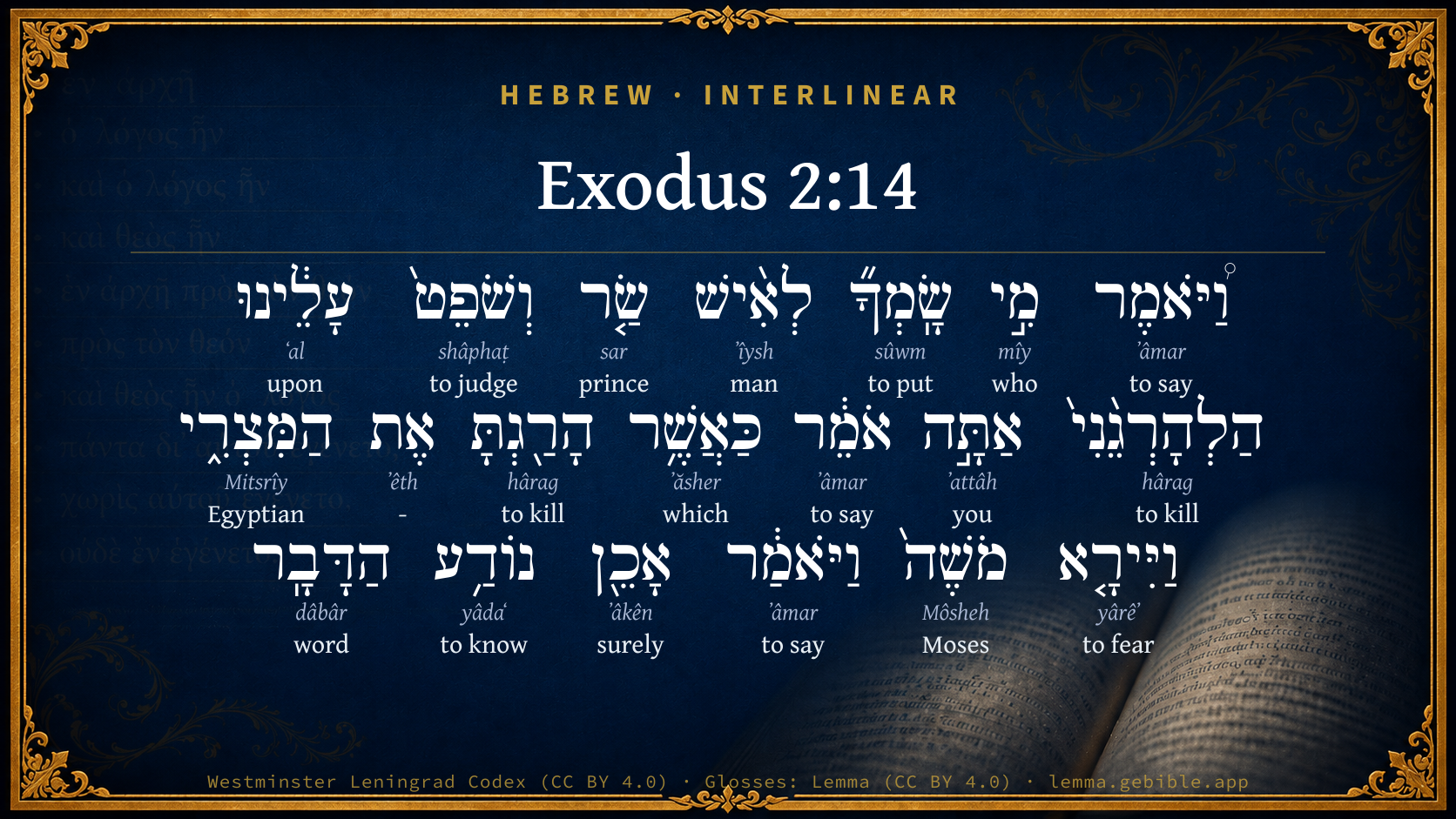
Hebrew (Westminster Leningrad Codex) Exodus 2:14 appears in the Hebrew Old Testament. The text above is from the Westminster Leningrad Codex. Each word links to its Strong’s number, a concise gloss, and parsing drawn from the Open Scriptures Hebrew Bible morphology. Click any word for its full Brown-Driver-Briggs (BDB) entry.
Download image
Cite this verse

Exodus 2:14 (World English Bible). Public Domain. Lemma interlinear Bible study tool, https://lemma.gebible.app/v/exodus/2/14.

Show BibTeX & RIS
BibTeX
RIS
English Translation
He said, "Who made you a prince and a judge over us? Do you plan to kill me, as you killed the Egyptian?" Moses was afraid, and said, "Surely this thing is known."
World English Bible · Public Domain
Download a study sheet

One document with this verse’s original text, its word-by-word gloss line, the meaning frame, cross-references with their text, attributed commentary, and full source and license credits — printable, and it pastes into notes with its structure intact.

This verse Autodidact and up

Study sheet (.html) Plain text (.txt)

A passage Seminary Student

Up to 50 verses in one chapter. A passage sheet keeps up to 6 commentary sources and 12 cross-references per verse, in the order this page ranks them, and says so on the sheet whenever that leaves anything out. Ask for a single verse and you get the Autodidact verse sheet above.

Everything on this page stays free to read, with no account — the sheet is a download of what is already on screen, not access to it.

Want to remove ads? Support Godless Engineer
Compare translations 3

The same verse in 3 English versions, stacked beneath the original-language interlinear above. Click any original word for its lexicon entry.

Each is an independent rendering of the whole verse — the interlinear is not word-aligned to these translations.

Highlighted words mark where these versions differ — a whole-verse word diff, not a word-by-word alignment.

  • World English Bible Public Domain
    He said, "Who made you a prince and a judge over us? Do you plan to kill me, as you killed the Egyptian?" Moses was afraid, and said, "Surely this thing is known."
  • King James Version Public Domain
    And he said, Who made thee a prince and a judge over us? intendest thou to kill me, as thou killedst the Egyptian? And Moses feared, and said, Surely this thing is known.
  • unfoldingWord Literal Text CC BY-SA 4.0
    And he said, “Who set you as the ruler man and judge over us? Are you saying to kill me like you killed the Egyptian?” And Moses feared and said, “Certainly the thing is known.”

unfoldingWord Literal Text — © unfoldingWord, licensed CC BY-SA 4.0. Word-aligned USFM3 via Door43 (git.door43.org/unfoldingWord/en_ult).

Versions to compare (up to 4)

3 of 4 selected

Show all 18 translations

Every available English version of this verse, each an independent rendering of the whole verse.

  • World English Bible Public Domain
    He said, "Who made you a prince and a judge over us? Do you plan to kill me, as you killed the Egyptian?" Moses was afraid, and said, "Surely this thing is known."
  • Berean Standard Bible Public Domain
    But the man replied, “Who made you ruler and judge over us? Are you planning to kill me as you killed the Egyptian?” Then Moses was afraid and thought, “This thing I have done has surely become known.”
  • Majority Standard Bible Public Domain
    But the man replied, “Who made you ruler and judge over us? Are you planning to kill me as you killed the Egyptian?” Then Moses was afraid and thought, “This thing I have done has surely become known.”
  • King James Version Public Domain
    And he said, Who made thee a prince and a judge over us? intendest thou to kill me, as thou killedst the Egyptian? And Moses feared, and said, Surely this thing is known.
  • American Standard Version (1901) Public Domain
    And he said, Who made thee a prince and a judge over us? Thinkest thou to kill me, as thou killedst the Egyptian? And Moses feared, and said, Surely the thing is known.
  • Revised Version (1885) Public Domain
    And he said, Who made thee a prince and a judge over us? thinkest thou to kill me, as thou killedst the Egyptian? And Moses feared, and said, Surely the thing is known.
  • Geneva Bible (1599) Public Domain
    And hee answered, Who made thee a man of authoritie, and a iudge ouer vs? Thinkest thou to kill mee, as thou killedst the Egyptian? Then Moses feared and sayde, Certainly this thing is knowen.
  • Douay-Rheims (1899) Public Domain
    But he answered: Who hath appointed thee prince and judge over us: wilt thou kill me, as thou didst yesterday kill the Egyptian? Moses feared, and said: How is this come to be known?
  • Young's Literal Translation Public Domain
    and he saith, `Who set thee for a head and a judge over us? to slay me art thou saying `it', as thou hast slain the Egyptian?' and Moses feareth, and saith, `Surely the thing hath been known.'
  • Literal Standard Version CC BY-SA 4.0
    And he says, “Who set you for a head and judge over us? Are you saying [it] to slay me as you have slain the Egyptian?” And Moses fears and says, “Surely the thing has been known.”
  • Unlocked Literal Bible CC BY-SA 4.0
    But the man said, “Who made you a leader and judge over us? Are you planning to kill me as you killed that Egyptian?” Then Moses became afraid and said, “What I did has certainly become known to others.”
  • unfoldingWord Literal Text CC BY-SA 4.0
    And he said, “Who set you as the ruler man and judge over us? Are you saying to kill me like you killed the Egyptian?” And Moses feared and said, “Certainly the thing is known.”
  • Darby Bible Public Domain
    And he said, Who made thee ruler and judge over us? dost thou intend to kill me, as thou killedst the Egyptian? Then Moses feared, and said, Surely the matter is known.
  • World Messianic Bible Public Domain
    He said, “Who made you a prince and a judge over us? Do you plan to kill me, as you killed the Egyptian?” Moses was afraid, and said, “Surely this thing is known.”
  • Webster's Bible Public Domain
    And he said, Who made thee a prince and a judge over us? intendest thou to kill me, as thou killedst the Egyptian? And Moses feared, and said, Surely this thing is known.
  • Free Bible Version CC BY-SA 4.0
    “Who put you in charge to judge us?” the man replied. “Are you going to kill me like you did the Egyptian?” Moses became frightened at this, and said to himself, “People know what I've done!”
  • Bible in Basic English Public Domain
    And he said, Who made you a ruler and a judge over us? are you going to put me to death as you did the Egyptian? And Moses was in fear, and said, It is clear that the thing has come to light.
  • JPS Tanakh (1917) Public Domain
    And he said: 'Who made thee a ruler and a judge over us? thinkest thou to kill me, as thou didst kill the Egyptian?' And Moses feared, and said: 'Surely the thing is known.'

Literal Standard Version (2020), Covenant Press — licensed CC BY-SA 4.0. Text via the HelloAO Bible API (eBible.org). Unlocked Literal Bible (unfoldingWord) — licensed CC BY-SA 4.0. Text via the HelloAO Bible API (eBible.org). unfoldingWord Literal Text — © unfoldingWord, licensed CC BY-SA 4.0. Word-aligned USFM3 via Door43 (git.door43.org/unfoldingWord/en_ult). Free Bible Version, Dr. Jonathan Gallagher — licensed CC BY-SA 4.0. Text via the HelloAO Bible API (eBible.org).

Word by word

More ways to search: Search by grammar → Find every occurrence → Compare this word →

Practice this passage: Drill this verse → Learn its vocabulary →

אָכֵ֖ן
ʼâkên
H403
“surely”
Adverb
Part of Speech
Adverb
Full BDB Definition

Origin: from H3559 [compare H3651 ]

TWOT: 86

surely, truly, indeed - truly, indeed (strong assertive force) - but indeed, but in fact (emphasizing a contrast)
  1. וַ֠יֹּאמֶר ʼâmar H559 “and · to say” Conjunction + Verb, Qal, Sequential Imperfect, 3rd Person, Masculine, Singular
  2. מִ֣י mîy H4310 “who” Particle, Interrogative
  3. שָֽׂמְךָ֞ sûwm H7760 “to put · you” Verb, Qal, Perfect, 3rd Person, Masculine, Singular + Suffix, Personal, 2nd Person, Masculine, Singular
  4. לְאִ֨ישׁ ʼîysh H376 “to/for · man” Preposition + Noun, Common, Masculine, Singular, Absolute
  5. שַׂ֤ר sar H8269 “prince” Noun, Common, Masculine, Singular, Absolute
  6. וְשֹׁפֵט֙ shâphaṭ H8199 “and · judging” Conjunction + Verb, Qal, Participle Active, Masculine, Singular, Absolute
  7. עָלֵ֔ינוּ ʻal H5921 “upon · us” Preposition + Suffix, Personal, 1st Person, Common, Plural
  8. הַלְהָרְגֵ֨נִי֙ hârag H2026 “to kill · me” Particle, Interrogative + Preposition + Verb, Qal, Infinitive Construct + Suffix, Personal, 1st Person, Common, Singular
  9. אַתָּ֣ה ʼattâh H859 “you” Pronoun, Personal, 2nd Person, Masculine, Singular
  10. אֹמֵ֔ר ʼâmar H559 “saying” Verb, Qal, Participle Active, Masculine, Singular, Absolute
  11. כַּאֲשֶׁ֥ר ʼăsher H834 “like/as · which” Preposition + Particle, Relative
  12. הָרַ֖גְתָּ hârag H2026 “to kill” Verb, Qal, Perfect, 2nd Person, Masculine, Singular
  13. אֶת ʼêth H853 “-” Particle, Direct Object
  14. הַמִּצְרִ֑י Mitsrîy H4713 “the · Egyptian” Particle, Definite Article + Noun, Gentilic, Masculine, Singular, Absolute
  15. וַיִּירָ֤א yârêʼ H3372 “and · to fear” Conjunction + Verb, Qal, Sequential Imperfect, 3rd Person, Masculine, Singular
  16. מֹשֶׁה֙ Môsheh H4872 “Moses” Noun, Proper
  17. וַיֹּאמַ֔ר ʼâmar H559 “and · to say” Conjunction + Verb, Qal, Sequential Imperfect, 3rd Person, Masculine, Singular
  18. נוֹדַ֥ע yâdaʻ H3045 “to know” Verb, Niphal, Perfect, 3rd Person, Masculine, Singular
  19. הַדָּבָֽר dâbâr H1697 “the · word” Particle, Definite Article + Noun, Common, Masculine, Singular, Absolute

About this verse

These counts appear in no published source. They are computed here, from the morphology-tagged text and Lemma’s own curated glosses. What Lemma adds →

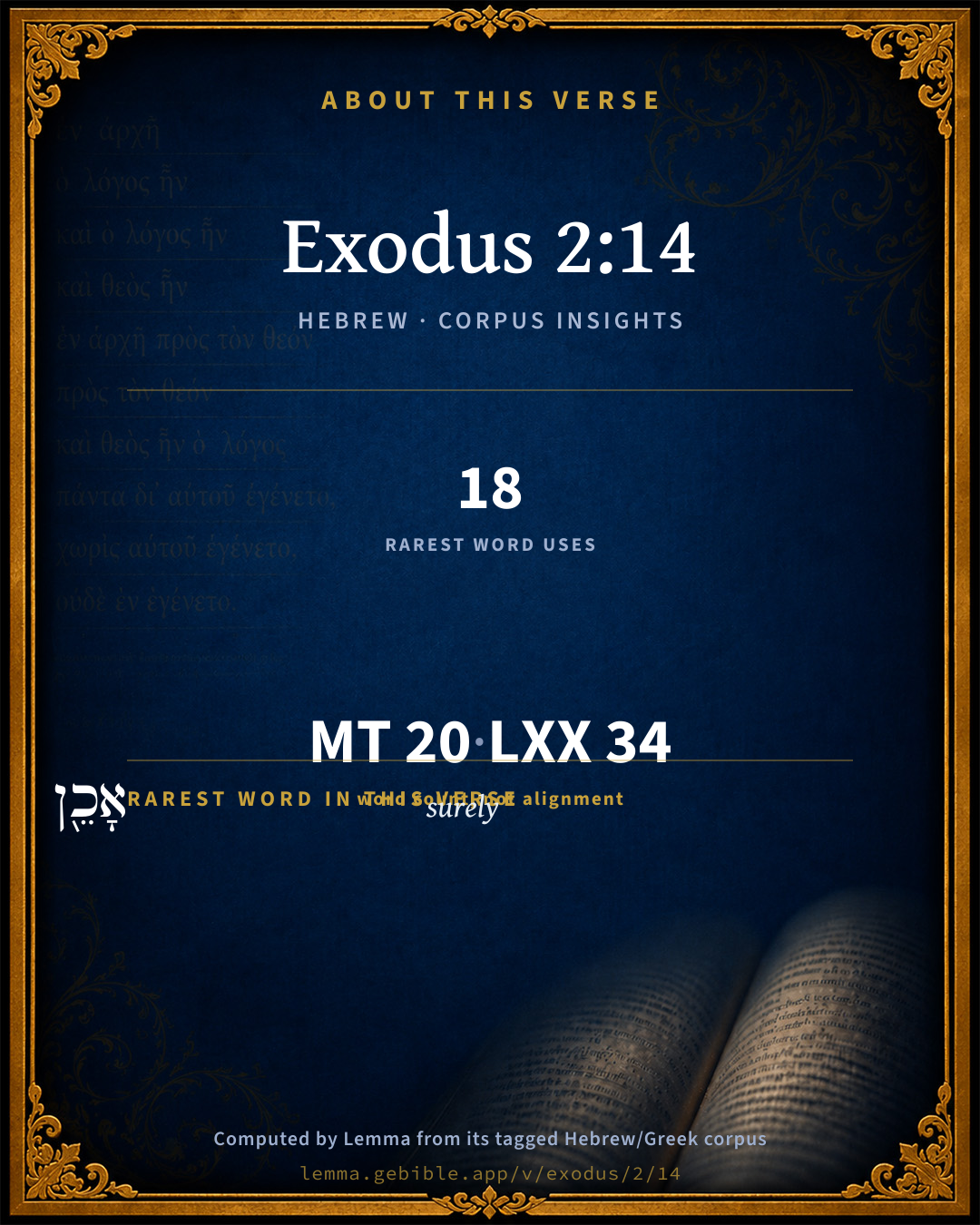
20
words
17
distinct lemmas
Pentateuch
section

Notable vocabulary

The rarest word here is אָכֵ֖ן surely H403 — appearing just 18 times in the whole Hebrew Bible.

Shared distinctive vocabulary

אָכֵ֖ן surely H403 occurs in 17 verses of the Hebrew Bible. Also found in:

Grammatical profile

  • 9 verbs
  • 5 nouns
  • 1 pronoun
  • 1 preposition
  • 1 adverb
  • 3 particles

Verb forms

  • וַ֠יֹּאמֶר Qal · Sequential Imperfect
  • שָֽׂמְךָ֞ Qal · Perfect
  • וְשֹׁפֵט֙ Qal · Participle Active
  • הַלְהָרְגֵ֨נִי֙ Qal · Infinitive Construct
  • אֹמֵ֔ר Qal · Participle Active
  • הָרַ֖גְתָּ Qal · Perfect
  • וַיִּירָ֤א Qal · Sequential Imperfect
  • וַיֹּאמַ֔ר Qal · Sequential Imperfect
  • נוֹדַ֥ע Niphal · Perfect

Repetition

Words recur within this verse — often emphatic in Hebrew:

  • וַ֠יֹּאמֶר to say H559 ×3
  • הַלְהָרְגֵ֨נִי֙ to kill H2026 ×2

Hebrew & Septuagint length

In English translation the verse runs 33 words from the Hebrew and 38 from the Septuagint (LXX English) — closely comparable.

A rough comparison of the two English renderings, which tokenize alike — not a word-level alignment.

Word counts can differ between the Hebrew and the Greek without any difference in meaning — e.g. the Hebrew direct-object marker אֵת has no separate Greek word, and Greek often adds the article ὁ.

In the original languages it is 20 Hebrew tokens and 34 Greek tokens — but the two are counted differently (Hebrew bundles its prefixes and suffixes into one token; the Greek is in lemma form), so that isn’t a like-for-like length.

Cross-references

15

Topical passages linked to Exodus 2:14 in the Treasury of Scripture Knowledge — connected by theme and wording, ordered by reader-vote popularity; previews shown in the World English Bible.

  • Luke 12:14 But he said to him, "Man, who made me a judge or an arbitrator over you?"
  • Matthew 21:23 When he had come into the temple, the chief priests and the elders of the people came to him as he was teaching, and said, "By what authority do you do these things? Who gave you this authority?"
  • Genesis 19:9 They said, "Stand back!" They said, "This one fellow came in to live as a foreigner, and he appoints himself a judge. Now will we deal worse with you, than with them!" They pressed hard on the man, even Lot, and drew near to break the door.
  • Genesis 37:19–20 They said one to another, "Behold, this dreamer comes.
  • Psalms 2:2–6 The kings of the earth take a stand, And the rulers take counsel together, Against Yahweh, and against his anointed, saying,
  • Luke 19:14 But his citizens hated him, and sent an envoy after him, saying, 'We don't want this man to reign over us.'
  • Genesis 13:8 Abram said to Lot, "Please, let there be no strife between me and you, and between my herdsmen and your herdsmen; for we are relatives.
  • Numbers 16:3 and they assembled themselves together against Moses and against Aaron, and said to them, You take too much on you, seeing all the congregation are holy, everyone of them, and Yahweh is among them: why then lift yourselves up above the assembly of Yahweh?
  • Numbers 16:13 is it a small thing that you have brought us up out of a land flowing with milk and honey, to kill us in the wilderness, but you must needs make yourself also a prince over us?
  • Proverbs 19:12 The king's wrath is like the roaring of a lion, But his favor is like dew on the grass.
  • Proverbs 29:25 The fear of man proves to be a snare, But whoever puts his trust in Yahweh is kept safe.
  • Acts 7:26–28 "The day following, he appeared to them as they fought, and urged them to be at peace again, saying, 'Sirs, you are brothers. Why do you wrong one another?'
  • Acts 7:35 "This Moses, whom they refused, saying, 'Who made you a ruler and a judge?'--God has sent him as both a ruler and a deliverer by the hand of the angel who appeared to him in the bush.
  • Genesis 37:8–11 His brothers said to him, "Will you indeed reign over us? Or will you indeed have dominion over us?" They hated him all the more for his dreams and for his words.
  • Luke 19:27 But bring those enemies of mine who didn't want me to reign over them here, and kill them before me.'"

Cross-references courtesy of OpenBible.info (CC BY 4.0).

Hebrew and Greek witnesses Masoretic Hebrew ↔ Greek Septuagint

The same verse in the two great witnesses to the Old Testament, shown verse-for-verse.

These are two independent witnesses, not word-aligned to each other, and the Septuagint is shown in lemma (dictionary) form.

Hebrew Exodus 2:14 Masoretic · Westminster Leningrad Codex

וַ֠יֹּאמֶר מִ֣י שָֽׂמְךָ֞ לְאִ֨ישׁ שַׂ֤ר וְשֹׁפֵט֙ עָלֵ֔ינוּ הַלְהָרְגֵ֨נִי֙ אַתָּ֣ה אֹמֵ֔ר כַּאֲשֶׁ֥ר הָרַ֖גְתָּ אֶת הַמִּצְרִ֑י וַיִּירָ֤א מֹשֶׁה֙ וַיֹּאמַ֔ר אָכֵ֖ן נוֹדַ֥ע הַדָּבָֽר

He said, "Who made you a prince and a judge over us? Do you plan to kill me, as you killed the Egyptian?" Moses was afraid, and said, "Surely this thing is known."

World English Bible · Public Domain

Greek LXX Exodus 2:14 Septuagint · lemma form

ὁ δέ εἶπον τίς σύ καταἵστημι ἄρχων καί δικαστής ἐπί ἐγώ μή ἀνααἱρέω ἐγώ σύ θέλω ὅς τρόπος ἀνααἱρέω χθές ὁ αἰγύπτιος φοβέω δέ μωυσῆς καί εἶπον εἰ οὕτως ἐμφάνης γίγνομαι ὁ ῥῆμα οὗτος

And he said, Who made you a ruler and a judge over us? will you kill me as you yesterday killed the Egyptian? Then Moses was alarmed, and said, If it be thus, this matter has become known.

LXX2012 (modern English Septuagint) · Public Domain

Hebrew: Westminster Leningrad Codex (CC BY 4.0). Greek: Septuagint (public domain); English from LXX2012 (modern English Septuagint) (Public Domain). How the Septuagint differs from the Hebrew →

Targum (Aramaic paraphrase)

2

The Targum is the ancient Jewish Aramaic paraphrase of the Hebrew Scriptures — an interpretive translation, not the Hebrew text itself. Onkelos (literal) and Pseudo-Jonathan (expansive) render the Torah, and Jonathan the Prophets. Coverage is partial: where no permissively-licensed English translation exists for a verse, only the Aramaic is shown. This is verse-level text, not a word-by-word alignment to the Hebrew.

  1. Targum Onkelos Torah (Genesis–Deuteronomy)
    וַאֲמַר מָן שַׁוְיָךְ לִגְבַר רַב וְדַיָן עֲלָנָא הַלְמִקְטְלִי אַתְּ אָמַר כְּמָא דִקְטַלְתָּ יָת מִצְרָאָה וּדְחִיל משֶׁה וַאֲמַר בְּקוּשְׁטָא אִתְיְדַע פִּתְגָמָא:

    (no public-domain English translation for this verse)

    Targum Onkelos — Aramaic: “Onkelos Genesis” (public domain); “Onkelos Exodus” (public domain); “Onkelos Leviticus” (public domain); “Onkelos Numbers” (public domain); “Onkelos Deuteronomy” (public domain). English: “Sefaria Community Translation” (CC0 1.0 (public-domain dedication)); “J.W. Etheridge. The Targums of Onkelos and Jonathan Ben Uzziel on the Pentateuch. London: Longmans, Green, 1862” (public domain). Text via Sefaria.

  2. Targum Pseudo-Jonathan Torah (Genesis–Deuteronomy)
    וַאֲמַר לֵיהּ דָתָן מַאן הוּא דְמַנֵי יָתָךְ לִגְבַר רַב וְדַיָין עֲלָנָא הֲלָא לְמִקְטְלִי אַנְתְּ אָמַר כְּמָא דִקְטַלְתָּ יַת מִצְרָאֵי וּדְחֵיל משֶׁה וַאֲמַר בְּקוּשְׁטָא אִתְפַּרְסַם פִּתְגָמָא

    And Dathan said to him, Who is he who hath appointed thee a chief man and a judge over us? Wilt thou kill me, said he, as thou didst the Mizraite? And Mosheh was afraid, and said, Verily, the thing has become known.

    Targum Pseudo-Jonathan — Aramaic: “Targum Jonathan on Genesis” (public domain); “Targum Jonathan on Exodus” (public domain); “Targum Jonathan on Leviticus” (public domain); “Targum Jonathan on Numbers” (public domain); “Targum Jonathan on Deuteronomy” (public domain). English: “The Targum of Jonathan ben Uzziel, trans. J. W. Etheridge, London, 1862” (public domain). Text via Sefaria.

Commentary

Notes on Exodus 2:14 from classic Christian and Jewish commentators (each source and its license shown beneath its notes). The classic Christian expositions comment on the surrounding passage and are grouped to its opening verse, so a note may address several verses; the Jewish commentaries on the Tanakh (Rashi and others) are per-verse, so they appear only where the commentator wrote on this verse.

Lemma curates 59 commentaries, every one of them public domain or Creative Commons licensed, each selected and text-cleaned for this edition rather than reprinted as found. About our sources →

Trapp's Complete Commentary

John Trapp

Exo 2:14 And he said, Who made thee a prince and a judge over us? intendest thou to kill me, as thou killedst the Egyptian? And Moses feared, and said, Surely this thing is known.

Ver. 14. And he said.] Yea, "he thrust Moses away." {Act 7:27} Doing wickedly "with both hands earnestly." {Mic 7:3} This act of his is imputed to the whole people, who therefore were deprived of Moses for forty years. So true is that of the wise man, "One sinner destroyeth much good." {Ecc 9:18}

John Trapp, A Commentary or Exposition upon All the Books of the Old and New Testament (1647–1656) — public domain. Text from a community e-Sword module.

Joseph Benson's Commentary

Exo 2:14. He said, Who made thee a prince? — He challengeth his authority. A man needs no great authority for giving a friendly reproof; it is an act of kindness; yet this man will needs interpret it an act of dominion, and represents his reprover as imperious and assuming. Thus, when people are sick of good discourse, or a seasonable admonition, they will call it preaching, as if a man could not speak a word for God, and against sin, but he took too much upon him. Yet Moses was indeed a prince and a judge, and knew it, and thought the Hebrews would have understood it; but they stood in their own light, and thrust him away, Act 7:25-27. Intendest thou to kill me? — See what base constructions malice puts upon the best words and actions!

Joseph Benson's Commentary on the Old and New Testaments (1811–1818) — public domain. Text from a community e-Sword module.

Tyndale Open Study Notes

Tyndale Open Resources

2:14 The arrogant response of the Hebrew man, “Who appointed you to be our prince and judge?” foreshadows how the rest of the Hebrews would respond to Moses in later years—they would not thank him for his efforts on their behalf. If Moses were to succeed, he would have to depend solely on a sense of his divine calling.

Tyndale Open Study Notes — © Tyndale Open Resources, licensed CC BY-SA 4.0. Text via the HelloAO Bible API.

Geneva Bible (1599)

Geneva Bible translators

Though by his fear he showed his infirmity, yet faith covered it, Heb. 11:27.

Geneva Bible (1599) marginal notes — public domain. Text via Bolls.life.

Adam Clarke's Commentary

Verse 14. And Moses feared] He saw that the Israelites were not as yet prepared to leave their bondage; and that though God had called him to be their leader, yet his providence had not yet sufficiently opened the way; and had he stayed in Egypt he must have endangered his life. Prudence therefore dictated an escape for the present to the land of Midian.

Adam Clarke's Commentary on the Bible (1810–1826) — public domain. Text from a community e-Sword/MySword module.

Ellicott's Commentary for English Readers

(14) Who made thee a prince and a judge over us?—As the reputed son of a princess, Moses would be in some sort a “prince.” But no one had given him jurisdiction over the Hebrews. He had not really interfered as one who claimed authority, but as any man of position and education naturally interferes to stop a quarrel.

Intendest thou to kill me?—Here is the sting of the rejoinder; here was the assumption of authority—not in the interposition of to-day, but in the blow of yesterday. That fatal error laid Moses open to attack, and deprived him of the influence as a peacemaker which he might otherwise have exercised over his countrymen.

Surely this thing is known.—We are not told how the “thing” came to be known. “Murder will out,” says the English proverb. Perhaps, though Moses thought himself unnoticed, some Egyptian had seen the deed. Perhaps the man whom he had avenged had told the tale.

A Bible Commentary for English Readers, edited by Charles John Ellicott (1878–1897) — public domain. Text from a community e-Sword module.

The Cambridge Bible for Schools and Colleges

gen. ed. J. J. S. Perowne

14. Moses’ motive in slaying the Egyptian must thus have been misunderstood; it was not seen that he was really intending to help his people. Cf. Act_7:25. At the same time Moses now shewed definitely that he no longer desired to be counted a son of Pharaoh’s daughter (v. 10), but that he wished to throw in his lot with his own people; cf. Heb_11:24-26.

‘In both these acts, the future hero shews himself courageous and energetic, burning with patriotic ardour, full of a strong sense of justice and of sympathy with the suffering, in their service readily giving up all material advantages. To free him, however, from all excess and impetuous passion, and to purify and deepen his spirit, he is now, as a result of his deed of blood, to be removed for a while into another environment’ (Dillm.M). In slaying the Egyptian, Moses acted without authority; his act was consequently unjustifiable, and there was cogency in the Israelite’s remonstrance, ‘Who made thee a ruler and a judge over us?’ Motives, in themselves praiseworthy, of justice, patriotism, and sympathy with the oppressed, led him to interpose in an ill-considered manner, and he was obliged to take refuge in flight. Augustine, c. Faust. xxii. 70 (quoted by Keil), points out both the good and the bad features a Moses’ act: he had fine qualities, but they needed training and disciplining, in order to produce worthy fruits. ‘Reperio non debuisse hominem ab illo, qui nullam ordinatam potestatem gerebat, quamvis injuriosum et improbum, occidi. Verumtamen animae virtutis capaces ac fertiles praemittunt saepe vitia, quibus hoc ipsum indicent, cui virtuti sint potissimum accommodatae, si fuerint praeceptis excultae.’ And after referring to Peter’s action in defending his Master with the sword (Joh_18:20), he continues, ‘Uterque non detestabili immanitate, sed emendabili animositate justitiae regulam excessit; uterque odio improbitatis alienae, sed ille fraterno, hic dominico, licet adhuc carnali, tamen amore peccavit.’

The Cambridge Bible for Schools and Colleges (gen. ed. J. J. S. Perowne; Cambridge University Press, 1878–1918) — public domain. Text from a community e-Sword module.

John Gill's Exposition

And he said, who made thee a prince and a judge over us?.... God had designed him for one, and so he appeared to be afterwards; but this man's meaning is, that he was not appointed by Pharaoh's order then, and so had nothing to do to interfere in their differences and quarrels; though Moses did not take upon him to act in an authoritative way, but to exhort and persuade them to peace and love, as they were brethren:

intendest thou to kill me, as thou killedst the Egyptian? if this was Dathan, or however the same Hebrew that he had defended and rescued from the Egyptian, it was very ungenerous in him to upbraid him with it; or if that Hebrew had made him his confident, and acquainted him with that affair, as it was unfaithful to betray it, since it was in favour of one of his own people, it was ungrateful to reproach him with it:

and Moses feared; lest the thing should be discovered and be told to Pharaoh, and he should suffer for it: this fear that possessed Moses was before he fled from Egypt, and went to Midian, not when he forsook it, and never returned more, at the departure of the children of Israel, to which the apostle refers, Heb 11:27 and is no contradiction to this:

and said, surely this thing is known; he said this within himself, he concluded from this speech, that either somebody had seen him commit the fact he was not aware of, or the Hebrew, whose part he took, had through weakness told it to another, from whom this man had it, or to himself; for by this it seems that he was not the same Hebrew, on whose account Moses had slain the Egyptian, for then the thing would have been still a secret between them as before; only the other Hebrew this was now contending with must hereby come to the knowledge of it, and so Moses might fear, that getting into more hands it would come out, as it did; See Gill on Act 7:27. See Gill on Act 7:28. See Gill on Act 7:29.

John Gill's Exposition of the Whole Bible (1746–1763) — public domain (CC PDM 1.0). Text via the HelloAO Bible API.

Haydock's Catholic Bible Commentary

Feared. St. Paul, (Hebrews xi. 27,) is speaking of his leaving Egypt, at the head of the people, when he says, not fearing the fierceness of the king. Without being dismayed on this occasion, by the unexpected discovery of what he had done, (which was perhaps undesignedly made public by the Hebrew whom he had rescued,) he resolves not to tempt God. (Haydock)

George Leo Haydock (1774–1849), Haydock's Catholic Family Bible and Commentary, 1859 edition — public domain. Excludes Psalms (Douay-Rheims chapter numbering differs from Protestant) and Deuterocanonical books (Catholic canon only).

Matthew Poole's English Annotations

Moses feared, through the weakness of his faith, which afterwards growing stronger, he feared not that which now he did fear, the wrath of the king, Heb 11:27. Distinguish the times, and scriptures agree which seemed to clash together.

Matthew Poole's English Annotations on the Holy Bible (1683–1685) — public domain. Text from a community e-Sword/MySword module.

The Pulpit Commentary

Who made thee a prince and a judge over us? It was not his interference now, but his wrongful act of the day before, that exposed Moses to this rebuke. There was no assumption of lordship or of judicial authority in the bare inquiry, "Why smitest thou thy neighhour?" nor in the fuller phrase reported by St. Stephen, "Sirs, ye are brethren. Why do ye wrong one to another?", (Act_7:26) unless as coupled with the deed of the preceding day. Thus the violence of today renders of no avail the loving persuasion of to-morrow; the influence for good which the education and position of Moses might have enabled him to exercise upon his nation was lost by the very act to which he had been urged by his sympathy with them; it was an act which could be thrown in his teeth, an act which he could not justify, which he trembled to find was known. The retort of the aggressor stopped his mouth at once, and made his interposition valueless.

The Pulpit Commentary (1880–1919), ed. H.D.M. Spence-Jones & Joseph S. Exell — public domain. Text from a community e-Sword module.

John Wesley's Explanatory Notes

He said, Who made thee a prince? - He challengeth his authority; Who made thee a prince? - A man needs no great authority for giving a friendly reproof; it is an act of kindness; yet this man needs will interpret it an act of dominion, and represents his reprover as imperious and assuming. Thus, when people are sick of good discourse, or a seasonable admonition, they will call it preaching, as if a man could not speak a word for God, and against sin, but he took too much upon him. Yet Moses was indeed a prince, and a judge, and knew it, and thought the Hebrews would have understood it; but they stood in their own light, and thrust him away. Acts vii, 25, 27. Intendest thou to kill me? - See what base constructions malice puts upon the best words and actions. Moses, for reproving him, is presently charged with a design to kill him.

John Wesley, Explanatory Notes Upon the Whole Bible (1754–1765) — public domain. Text via the GEBible commentary corpus.

Rashi

Rabbi Shlomo Yitzchaki (Rashi)

מי שמך לאיש WHO MADE THEE A PERSONAGE (lit., a man), and you are yet only a boy (Midrash Tanchuma, Shemot 10).

הלהרגני אתה אמר lit. WILT THOU SPEAK IN ORDER TO SLAY ME — From this we may learn that he had killed him by the mere utterance of the “Shem Hamephorash” (Midrash Tanchuma, Shemot 10; Exodus Rabbah 1:30).

ויירא משה AND MOSES FEARED — Explain it in its literal sense: he was afraid of Pharaoh. A Midrashic explanation is: he felt distressed because he saw that there were wicked men among the Israelites — common informers. He said: Since this is so (מעתה), perhaps they are not worthy to be delivered from bondage (Midrash Tanchuma, Shemot 10).

אכן נדע הדבר SURELY THE THING IS KNOWN — Explain it in its literal sense: the fact that I have killed the Egyptian is known. A Midrashic explanation is: now there is known to me that matter about which I have been puzzled — how has Israel sinned more than all the seventy nations, that they should be oppressed by this crushing servitude? But now I see that they deserve this (Exodus Rabbah 1:30).

Rashi on the Tanakh — English translations: “The Judaica Press complete Tanach with Rashi, translated by A. J. Rosenberg” (CC BY 4.0); “Pentateuch with Rashi's commentary by M. Rosenbaum and A.M. Silbermann, 1929-1934” (public domain); “The Metsudah Tanach series, Lakewood, N.J” (CC BY 4.0); and “The Book of Joshua, Metsudah Publications, 1997” (CC BY 4.0). Text via Sefaria.

Ramban (Nachmanides)

Rabbi Moshe ben Nachman (Ramban / Nachmanides)

WILT THOU SPEAK TO KILL ME? “From here we learn that Moses had killed the Egyptian by merely pronouncing the Tetragrammaton.” or Shem Hamyuchad) is the Proper Name of G-d. It consists of four Hebrew letters, the utterance of which is now forbidden. It is translated here as the Eternal. By pronouncing this Name, Moses needed no weapon to accomplish his purpose of bringing about the deserved death of the Egyptian. Thus the language of Rashi, and it is also a Midrash of our Rabbis. But I wonder. If so, who told the wicked one [Moses] said to the wicked one, ‘Why do you smite thy fellow?’ that Moses killed him? Perhaps Moses placed his hands upon the Egyptian and cursed him in the Name of G-d, [and the Hebrew who was now quarrelling with Moses saw him doing that]. This would explain the term vayach (‘and he smote’ the Egyptian). (II Kings 19:35). Now just as in that case vayach does not signify a physical act of striking by hand but rather the inflicting of defeat by supernatural power, so also here in the case of Moses. (Bachya.) It may be that because the Egyptian had fallen dead before him [after he had pronounced the Tetragrammaton over him], Moses feared that they may report him and so he buried the Egyptian in the sand. The Hebrew who saw him doing that reckoned that Moses had caused [the Egyptian’s death somehow, even though he did not know that he had killed him by pronouncing the Tetragrammaton]. Perhaps he thought Moses had killed him by the sword, as he saw only the burial.In line with the plain meaning of Scripture, scholars say. that the expression, wilt thou ‘omer’ (speak), means “think,” since we find amirah (speaking) referring to the thought of the heart. I said in my heart; I say, that an untimely birth is better than he., 6:3. It is obvious that Ramban’s intent in selecting these two verses from the Book of Ecclesiastes is to show that the term amirah (saying) as such is equivalent to amirah b’leiv (speaking in one’s heart). Hence the Book of Ecclesiastes uses them interchangeably. But here there is no need for this, for [the intent of the Hebrew’s words to Moses] is as follows: “Who made thee a ruler and a judge over us? Is it because thou dost desire to kill me as thou didst kill the Egyptian that thou reprovest me and sayest, ‘Why smitest thou thy fellow?’” alludes to that which Moses had said in Verse 13: Why smitest thou thy fellow? The Hebrew thus said to Moses: “Is it because you desire to kill me as you killed the Egyptian that you reproved me by saying, ‘Why do you smite your fellow?’”

Ramban (Nachmanides) on the Tanakh — English translation: “Commentary on the Torah by Ramban (Nachmanides). Translated and annotated by Charles B. Chavel. New York, Shilo Pub. House, 1971-1976” (CC BY 4.0). Text via Sefaria.

Lesson kit

Teaching starters — assembled from the data on this page, not authored interpretation. Every prompt links to the verse data it draws on. Edit before teaching.

Exodus, in the Pentateuch, opens this verse with 20 words (17 distinct Hebrew lemmas). Its most distinctive word is ʼâkên (“surely”). A historical commentator’s framing appears above. Read the whole chapter for the surrounding context.

Discussion questions

  1. The word ʼâkên carries the sense “surely.” How does it shape the verse?
  2. How does Genesis 28:16, which shares the word «surely», read alongside this verse?
  3. What does the repetition of “to say” (3× in this one verse) do in this verse?
  4. These translations render this verse differently; the difference is in the English rendering, not the original. What questions does that raise?
  5. «וַ֠יֹּאמֶר» is a Qal Sequential Imperfect verb. How does that grammatical form shape the action described?
  6. Compare how Trapp's Complete Commentary and Joseph Benson's Commentary read this verse. Where do they agree or differ?

Things to notice

Reading settings

Reading text

Shown beneath each verse's original-language words.

Old Testament
Old Testament edition

Read the OT as the Masoretic Hebrew (MT) or the Greek Septuagint (LXX).

English shown for the Greek Septuagint (in the Hebrew ↔ Greek comparison).

Comparing translations? Open the Compare panel on any verse page to stack up to four side by side.