
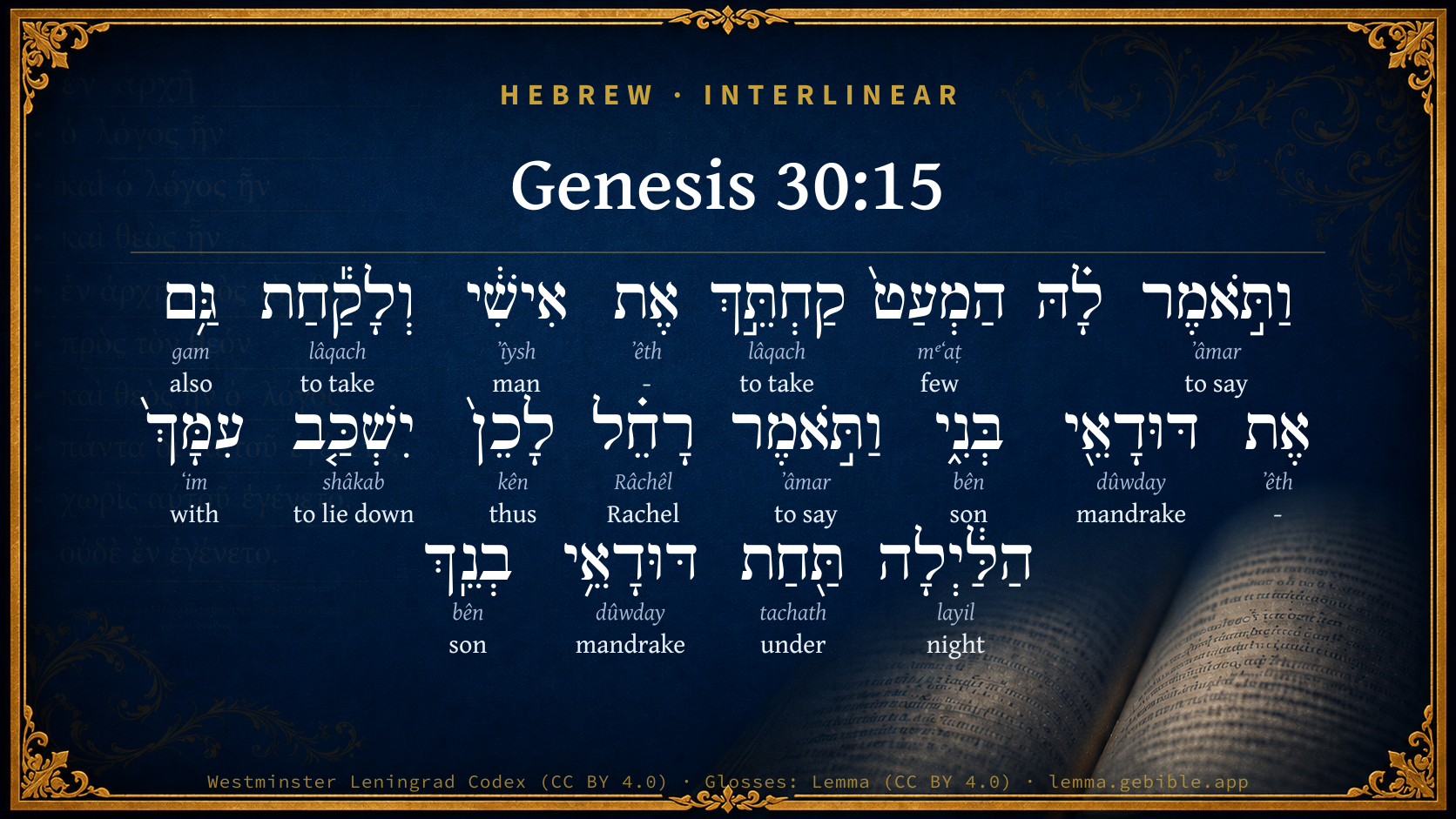
Genesis 30:15

Hebrew (Westminster Leningrad Codex) Genesis 30:15 appears in the Hebrew Old Testament. The text above is from the Westminster Leningrad Codex. Each word links to its Strong’s number, a concise gloss, and parsing drawn from the Open Scriptures Hebrew Bible morphology. Click any word for its full Brown-Driver-Briggs (BDB) entry.
Download image
Cite this verse

Genesis 30:15 (World English Bible). Public Domain. Lemma interlinear Bible study tool, https://lemma.gebible.app/v/genesis/30/15.

Show BibTeX & RIS
BibTeX
RIS
English Translation
She said to her, "Is it a small matter that you have taken away my husband? Would you take away my son's mandrakes, also?" Rachel said, "Therefore he will lie with you tonight for your son's mandrakes."
World English Bible · Public Domain
Download a study sheet

One document with this verse’s original text, its word-by-word gloss line, the meaning frame, cross-references with their text, attributed commentary, and full source and license credits — printable, and it pastes into notes with its structure intact.

This verse Autodidact and up

Study sheet (.html) Plain text (.txt)

A passage Seminary Student

Up to 50 verses in one chapter. A passage sheet keeps up to 6 commentary sources and 12 cross-references per verse, in the order this page ranks them, and says so on the sheet whenever that leaves anything out. Ask for a single verse and you get the Autodidact verse sheet above.

Everything on this page stays free to read, with no account — the sheet is a download of what is already on screen, not access to it.

Want to remove ads? Support Godless Engineer
Compare translations 3

The same verse in 3 English versions, stacked beneath the original-language interlinear above. Click any original word for its lexicon entry.

Each is an independent rendering of the whole verse — the interlinear is not word-aligned to these translations.

Highlighted words mark where these versions differ — a whole-verse word diff, not a word-by-word alignment.

  • World English Bible Public Domain
    She said to her, "Is it a small matter that you have taken away my husband? Would you take away my son's mandrakes, also?" Rachel said, "Therefore he will lie with you tonight for your son's mandrakes."
  • King James Version Public Domain
    And she said unto her, Is it a small matter that thou hast taken my husband? and wouldest thou take away my son's mandrakes also? And Rachel said, Therefore he shall lie with thee to night for thy son's mandrakes.
  • unfoldingWord Literal Text CC BY-SA 4.0
    But she said to her, “Is it a small matter you have taken my husband? And would you also take my son’s mandrakes?” Then Rachel said, “Therefore he may lie with you tonight for your son’s mandrakes.”

unfoldingWord Literal Text — © unfoldingWord, licensed CC BY-SA 4.0. Word-aligned USFM3 via Door43 (git.door43.org/unfoldingWord/en_ult).

Versions to compare (up to 4)

3 of 4 selected

Show all 18 translations

Every available English version of this verse, each an independent rendering of the whole verse.

  • World English Bible Public Domain
    She said to her, "Is it a small matter that you have taken away my husband? Would you take away my son's mandrakes, also?" Rachel said, "Therefore he will lie with you tonight for your son's mandrakes."
  • Berean Standard Bible Public Domain
    But Leah replied, “Is it not enough that you have taken away my husband? Now you want to take my son’s mandrakes as well?” “Very well,” said Rachel, “he may sleep with you tonight in exchange for your son’s mandrakes.”
  • Majority Standard Bible Public Domain
    But Leah replied, “Is it not enough that you have taken away my husband? Now you want to take my son’s mandrakes as well?” “Very well,” said Rachel, “he may sleep with you tonight in exchange for your son’s mandrakes.”
  • King James Version Public Domain
    And she said unto her, Is it a small matter that thou hast taken my husband? and wouldest thou take away my son's mandrakes also? And Rachel said, Therefore he shall lie with thee to night for thy son's mandrakes.
  • American Standard Version (1901) Public Domain
    And she said unto her, Is it a small matter that thou hast taken away my husband? and wouldest thou take away my son's mandrakes also? And Rachel said, Therefore he shall lie with thee to-night for thy son's mandrakes.
  • Revised Version (1885) Public Domain
    And she said unto her, Is it a small matter that thou hast taken away my husband? and wouldest thou take away my son’s mandrakes also? And Rachel said, Therefore he shall lie with thee to-night for thy son’s mandrakes.
  • Geneva Bible (1599) Public Domain
    But shee answered her, Is it a small matter for thee to take mine husband, except thou take my sonnes mandrakes also? Then sayde Rahel, Therefore he shall sleepe with thee this night for thy sonnes mandrakes.
  • Douay-Rheims (1899) Public Domain
    She answered: Dost thou think it a small matter, that thou hast taken my husband from me, unless thou take also my son's mandrakes? Rachel said: He shall sleep with thee this night, for thy son's mandrakes.
  • Young's Literal Translation Public Domain
    And she saith to her, `Is thy taking my husband a little thing, that thou hast taken also the love-apples of my son?' and Rachel saith, `Therefore doth he lie with thee to-night, for thy son's love-apples.'
  • Literal Standard Version CC BY-SA 4.0
    And she says to her, “Is your taking my husband a little thing, that you have also taken the love-apples of my son?” And Rachel says, “He therefore lies with you tonight, for your son’s love-apples.”
  • Unlocked Literal Bible CC BY-SA 4.0
    Leah said to her, “Is it a small matter to you, that you have taken away my husband? Do you now want to take away my son's mandrakes, too?” Rachel said, “Then he will sleep with you tonight, in exchange for your son's mandrakes.”
  • unfoldingWord Literal Text CC BY-SA 4.0
    But she said to her, “Is it a small matter you have taken my husband? And would you also take my son’s mandrakes?” Then Rachel said, “Therefore he may lie with you tonight for your son’s mandrakes.”
  • Darby Bible Public Domain
    And she said to her, Is it [too] little that thou hast taken my husband, that thou wilt take my son's mandrakes also? And Rachel said, Therefore he shall lie with thee to-night for thy son's mandrakes.
  • World Messianic Bible Public Domain
    Leah said to her, “Is it a small matter that you have taken away my husband? Would you take away my son’s mandrakes, also?” Rachel said, “Therefore he will lie with you tonight for your son’s mandrakes.”
  • Webster's Bible Public Domain
    And she said to her, Is it a small matter that thou hast taken my husband? and wouldest thou take away my son's mandrakes also? And Rachel said, Therefore he shall lie with thee to-night for thy son's mandrakes.
  • Free Bible Version CC BY-SA 4.0
    “Aren't you satisfied with stealing my husband?” Leah replied. “Are you going to take my son's mandrakes too?” “Fine, he can sleep with you tonight if you give me some mandrakes in return,” Rachel responded.
  • Bible in Basic English Public Domain
    But Leah said to her, Is it a small thing that you have taken my husband from me? and now would you take my son's love-fruits? Then Rachel said, You may have him tonight in exchange for your son's love-fruits.
  • JPS Tanakh (1917) Public Domain
    And she said unto her: 'Is it a small matter that thou hast taken away my husband? and wouldest thou take away my son's mandrakes also?' And Rachel said: 'Therefore he shall lie with thee to-night for thy son's mandrakes.'

Literal Standard Version (2020), Covenant Press — licensed CC BY-SA 4.0. Text via the HelloAO Bible API (eBible.org). Unlocked Literal Bible (unfoldingWord) — licensed CC BY-SA 4.0. Text via the HelloAO Bible API (eBible.org). unfoldingWord Literal Text — © unfoldingWord, licensed CC BY-SA 4.0. Word-aligned USFM3 via Door43 (git.door43.org/unfoldingWord/en_ult). Free Bible Version, Dr. Jonathan Gallagher — licensed CC BY-SA 4.0. Text via the HelloAO Bible API (eBible.org).

Word by word

More ways to search: Search by grammar → Find every occurrence → Compare this word →

Practice this passage: Drill this verse → Learn its vocabulary →

דּוּדָאֵ֖י
dûwday
H1736
“mandrakes of”
Noun, Common, Masculine, Plural, Construct
Part of Speech
Noun
Type
Common
Gender
Masculine
Number
Plural
State
Construct
Full BDB Definition

Origin: from H1731

TWOT: 410d

mandrake, love-apple - as exciting sexual desire, and favouring procreation
  1. וַתֹּ֣אמֶר ʼâmar H559 “and · to say” Conjunction + Verb, Qal, Sequential Imperfect, 3rd Person, Feminine, Singular
  2. הַמְעַט֙ mᵉʻaṭ H4592 “few” Particle, Interrogative + Noun, Common, Masculine, Singular, Absolute
  3. קַחְתֵּ֣ךְ lâqach H3947 “to take · you” Verb, Qal, Infinitive Construct + Suffix, Personal, 2nd Person, Feminine, Singular
  4. אֶת ʼêth H853 “-” Particle, Direct Object
  5. אִישִׁ֔י ʼîysh H376 “man · my” Noun, Common, Masculine, Singular, Construct + Suffix, Personal, 1st Person, Common, Singular
  6. וְלָקַ֕חַת lâqach H3947 “and · to take” Conjunction + Preposition + Verb, Qal, Infinitive Construct
  7. גַּ֥ם gam H1571 “also” Particle, Accusative
  8. אֶת ʼêth H853 “-” Particle, Direct Object
  9. בְּנִ֑י bên H1121 “son · my” Noun, Common, Masculine, Singular, Construct + Suffix, Personal, 1st Person, Common, Singular
  10. וַתֹּ֣אמֶר ʼâmar H559 “and · to say” Conjunction + Verb, Qal, Sequential Imperfect, 3rd Person, Feminine, Singular
  11. רָחֵ֗ל Râchêl H7354 “Rachel” Noun, Proper
  12. לָכֵן֙ kên H3651 “to/for · thus” Preposition + Adverb
  13. יִשְׁכַּ֤ב shâkab H7901 “to lie down” Verb, Qal, Imperfect, 3rd Person, Masculine, Singular
  14. עִמָּךְ֙ ʻim H5973 “with · you” Preposition + Suffix, Personal, 2nd Person, Feminine, Singular
  15. הַלַּ֔יְלָה layil H3915 “the · night” Particle, Definite Article + Noun, Common, Masculine, Singular, Absolute
  16. תַּ֖חַת tachath H8478 “under” Preposition
  17. דּוּדָאֵ֥י dûwday H1736 “mandrakes of” Noun, Common, Masculine, Plural, Construct
  18. בְנֵֽךְ bên H1121 “son · your” Noun, Common, Masculine, Singular, Construct + Suffix, Personal, 2nd Person, Feminine, Singular

About this verse

These counts appear in no published source. They are computed here, from the morphology-tagged text and Lemma’s own curated glosses. What Lemma adds →

20
words
14
distinct lemmas
Pentateuch
section

Notable vocabulary

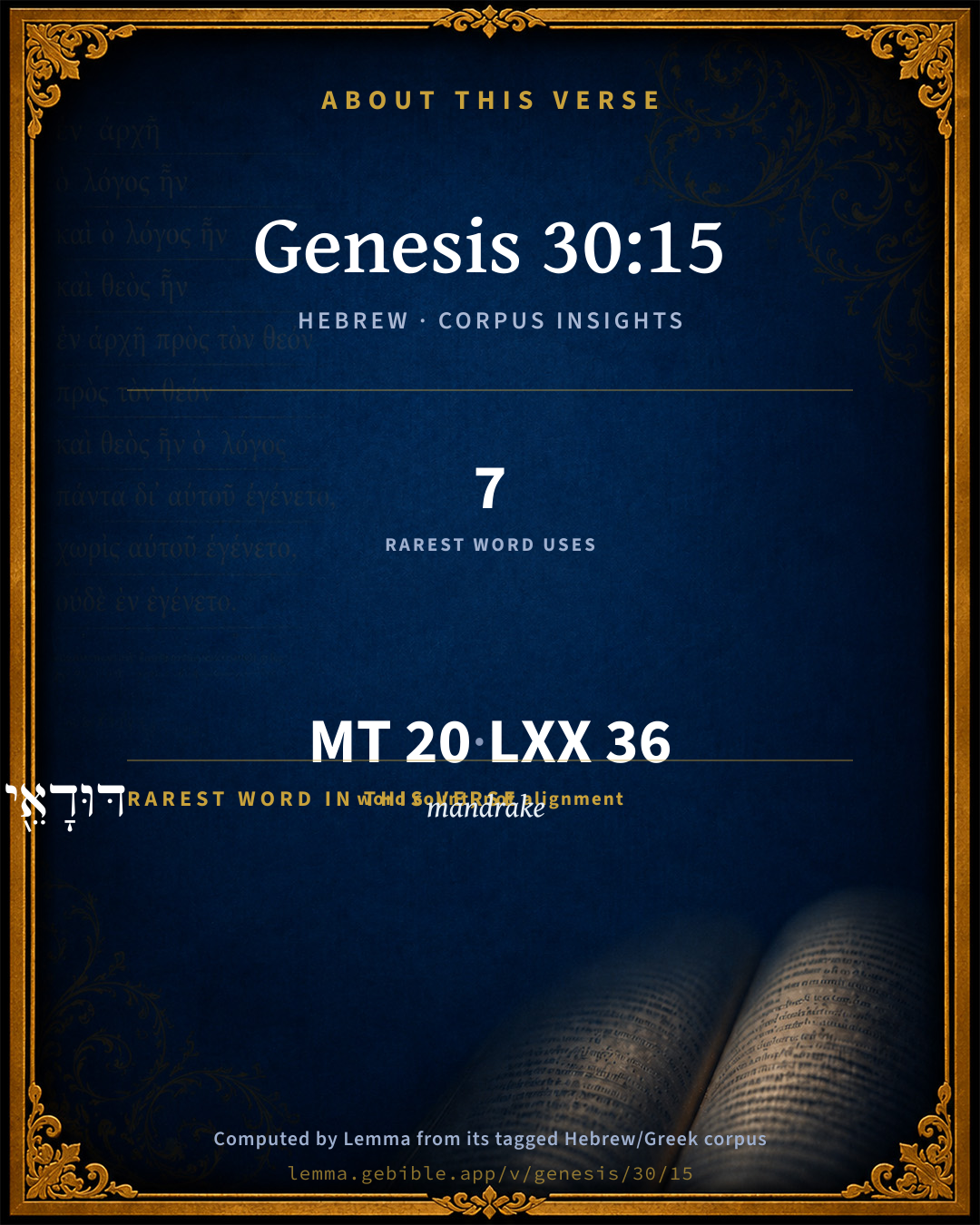
The rarest word here is דּוּדָאֵ֖י mandrake H1736 — appearing just 7 times in the whole Hebrew Bible.

Shared distinctive vocabulary

דּוּדָאֵ֖י mandrake H1736 occurs in 5 verses of the Hebrew Bible. Also found in:

Grammatical profile

  • 5 verbs
  • 8 nouns
  • 3 prepositions
  • 1 adverb
  • 3 particles

Verb forms

  • וַתֹּ֣אמֶר Qal · Sequential Imperfect
  • קַחְתֵּ֣ךְ Qal · Infinitive Construct
  • וְלָקַ֕חַת Qal · Infinitive Construct
  • וַתֹּ֣אמֶר Qal · Sequential Imperfect
  • יִשְׁכַּ֤ב Qal · Imperfect

Repetition

Words recur within this verse — often emphatic in Hebrew:

  • וַתֹּ֣אמֶר to say H559 ×2
  • קַחְתֵּ֣ךְ to take H3947 ×2
  • דּוּדָאֵ֖י mandrake H1736 ×2
  • בְּנִ֑י son H1121 ×2

Hebrew & Septuagint length

In English translation the verse runs 37 words from the Hebrew and 37 from the Septuagint (LXX English) — the same length.

A rough comparison of the two English renderings, which tokenize alike — not a word-level alignment.

Word counts can differ between the Hebrew and the Greek without any difference in meaning — e.g. the Hebrew direct-object marker אֵת has no separate Greek word, and Greek often adds the article ὁ.

In the original languages it is 20 Hebrew tokens and 36 Greek tokens — but the two are counted differently (Hebrew bundles its prefixes and suffixes into one token; the Greek is in lemma form), so that isn’t a like-for-like length.

Cross-references

5

Topical passages linked to Genesis 30:15 in the Treasury of Scripture Knowledge — connected by theme and wording, ordered by reader-vote popularity; previews shown in the World English Bible.

  • Numbers 16:13 is it a small thing that you have brought us up out of a land flowing with milk and honey, to kill us in the wilderness, but you must needs make yourself also a prince over us?
  • Numbers 16:9–10 [seems it but] a small thing to you, that the God of Israel has separated you from the congregation of Israel, to bring you near to himself, to do the service of the tent of Yahweh, and to stand before the congregation to minister to them;
  • Isaiah 7:13 He said, "Listen now, house of David: Is it not enough for you to try the patience of men, that you will try the patience of my God also?
  • Ezekiel 16:47 Yet have you not walked in their ways, nor done after their abominations; but, as [if that were] a very little [thing], you were more corrupt than they in all your ways.
  • 1 Corinthians 4:3 But with me it is a very small thing that I should be judged by you, or by man's judgment. Yes, I don't judge my own self.

Cross-references courtesy of OpenBible.info (CC BY 4.0).

Hebrew and Greek witnesses Masoretic Hebrew ↔ Greek Septuagint

The same verse in the two great witnesses to the Old Testament, shown verse-for-verse.

These are two independent witnesses, not word-aligned to each other, and the Septuagint is shown in lemma (dictionary) form.

Hebrew Genesis 30:15 Masoretic · Westminster Leningrad Codex

וַתֹּ֣אמֶר לָ֗הּ הַמְעַט֙ קַחְתֵּ֣ךְ אֶת אִישִׁ֔י וְלָקַ֕חַת גַּ֥ם אֶת דּוּדָאֵ֖י בְּנִ֑י וַתֹּ֣אמֶר רָחֵ֗ל לָכֵן֙ יִשְׁכַּ֤ב עִמָּךְ֙ הַלַּ֔יְלָה תַּ֖חַת דּוּדָאֵ֥י בְנֵֽךְ

She said to her, "Is it a small matter that you have taken away my husband? Would you take away my son's mandrakes, also?" Rachel said, "Therefore he will lie with you tonight for your son's mandrakes."

World English Bible · Public Domain

Greek LXX Genesis 30:15 Septuagint · lemma form

εἶπον δέ λεια οὐ ἱκανός σύ ὅτι λαμβάνω ὁ ἀνήρ ἐγώ μή καί ὁ μανδραγόρας ὁ υἱός ἐγώ λαμβάνω εἶπον δέ ραχηλ οὐ οὕτως κοιμάω μετά σύ ὁ νύξ οὗτος ἀντί ὁ μανδραγόρας ὁ υἱός σύ

And Lea said, Is it not enough for you that you have taken my husband, will you also take my son's mandrakes? And Rachel said, Not so: let him lie with you tonight for your son's mandrakes.

LXX2012 (modern English Septuagint) · Public Domain

Hebrew: Westminster Leningrad Codex (CC BY 4.0). Greek: Septuagint (public domain); English from LXX2012 (modern English Septuagint) (Public Domain). How the Septuagint differs from the Hebrew →

Targum (Aramaic paraphrase)

2

The Targum is the ancient Jewish Aramaic paraphrase of the Hebrew Scriptures — an interpretive translation, not the Hebrew text itself. Onkelos (literal) and Pseudo-Jonathan (expansive) render the Torah, and Jonathan the Prophets. Coverage is partial: where no permissively-licensed English translation exists for a verse, only the Aramaic is shown. This is verse-level text, not a word-by-word alignment to the Hebrew.

  1. Targum Onkelos Torah (Genesis–Deuteronomy)
    וַאֲמֶרֶת לַהּ הַזְעֵיר דִּדְבַרְתְּ יָת בַּעְלִי וְתִסְּבִין אַף יָת יַבְרוּחֵי דִּבְרִי וַאֲמֶרֶת רָחֵל בְּכֵן יִשְׁכּוּב עִמָּךְ בְּלֵילְיָא חֳלַף יַבְרוּחֵי דִּבְרִיךְ

    (no public-domain English translation for this verse)

    Targum Onkelos — Aramaic: “Onkelos Genesis” (public domain); “Onkelos Exodus” (public domain); “Onkelos Leviticus” (public domain); “Onkelos Numbers” (public domain); “Onkelos Deuteronomy” (public domain). English: “Sefaria Community Translation” (CC0 1.0 (public-domain dedication)); “J.W. Etheridge. The Targums of Onkelos and Jonathan Ben Uzziel on the Pentateuch. London: Longmans, Green, 1862” (public domain). Text via Sefaria.

  2. Targum Pseudo-Jonathan Torah (Genesis–Deuteronomy)
    וַאֲמַרַת לָהּ הַזְעֵיר הוּא דִנְסִיבַת יַת בַּעֲלִי וְאַנְתְּ בַּעְיָא לְמֵיסַב אוּף יַת יַבְרוּחֵי דִבְרִי וַאֲמַרַת רָחֵל בְּגִין כֵּן יִשְׁכּוּב עִמָךְ בְּלֵילְיָא הָדֵין חוֹלַף יַבְרוּחֵי דִבְרִיךְ

    And she said to her, Is it a little thing that thou hast taken my husband, and thou seekest to take also my son's mandrakes? And Rahel said, Therefore shall he lie with thee this night for thy son's mandrakes.

    Targum Pseudo-Jonathan — Aramaic: “Targum Jonathan on Genesis” (public domain); “Targum Jonathan on Exodus” (public domain); “Targum Jonathan on Leviticus” (public domain); “Targum Jonathan on Numbers” (public domain); “Targum Jonathan on Deuteronomy” (public domain). English: “The Targum of Jonathan ben Uzziel, trans. J. W. Etheridge, London, 1862” (public domain). Text via Sefaria.

Commentary

Notes on Genesis 30:15 from classic Christian and Jewish commentators (each source and its license shown beneath its notes). The classic Christian expositions comment on the surrounding passage and are grouped to its opening verse, so a note may address several verses; the Jewish commentaries on the Tanakh (Rashi and others) are per-verse, so they appear only where the commentator wrote on this verse.

Lemma curates 59 commentaries, every one of them public domain or Creative Commons licensed, each selected and text-cleaned for this edition rather than reprinted as found. About our sources →

Trapp's Complete Commentary

John Trapp

Gen 30:15 And she said unto her, [Is it] a small matter that thou hast taken my husband? and wouldest thou take away my son’s mandrakes also? And Rachel said, Therefore he shall lie with thee to night for thy son’s mandrakes.

Ver. 15. Therefore he shall lie with thee, &c.] Thus he is bought and sold by his emulous wives: which was no small affliction to him, and a punishment of his polygamy.

John Trapp, A Commentary or Exposition upon All the Books of the Old and New Testament (1647–1656) — public domain. Text from a community e-Sword module.

Adam Clarke's Commentary

Verse 15. Thou hast taken my husband] It appears probable that Rachel had found means to engross the whole of Jacob's affection and company, and that she now agreed to let him visit the tent of Leah, on account of receiving some of the fruits or plants which Reuben had found.

Adam Clarke's Commentary on the Bible (1810–1826) — public domain. Text from a community e-Sword/MySword module.

John Calvin's Commentaries

15. Is it a small matter that thou hast taken my husband? Moses leaves more for his readers to reflect upon than he expresses in words; namely, that Jacob’s house had been filled with contentions and strifes. For Leah speaks haughtily, because her mind had been long so exasperated that she could not address herself mildly and courteously to her sister: Perhaps the sisters were not thus contentious by nature; but God suffered them to contend with each other, that the punishment of polygamy might be exhibited to posterity. And it is not to be doubted that this domestic private quarrel, yea, hostile dissension, brought great grief and torment to the holy man. But the reason why he found himself thus distracted by opposite parties was, that against all right, he had broken the unity of the conjugal bond.

John Calvin's Commentaries (1540-1563) — public domain. Text from the Calvin Translation Society English edition (1840s-50s) via the Christian Classics Ethereal Library (ccel.org). Calvin's coverage is partial (roughly two-thirds of the Bible); uncommented books and verses are honest gaps, never fabricated. The 19th-century editor's footnotes and remarks are omitted so the notes are faithfully Calvin's own voice.

John Gill's Exposition

And Leah said, God hath given me my hire,.... Of the mandrakes with which she had hired of Rachel a night's lodging with Jacob, and for which she had a sufficient recompense, by the son that God had given her: and she added another reason, and a very preposterous one, and shows she put a wrong construction on the blessing she received:

because I have given my maiden to my husband; which, she judged, was so well pleasing to God, that he had rewarded her with another son:

and she called his name Issachar, which signifies "hire" or "reward"; or, there is a reward, or a man of reward.

John Gill's Exposition of the Whole Bible (1746–1763) — public domain (CC PDM 1.0). Text via the HelloAO Bible API.

Haydock's Catholic Bible Commentary

From me. Lia was aware that Jacob’s affection lay entirely towards Rachel; particularly now, as she had ceased to bear children herself. (Haydock) --- This might, when it is my turn to have him. To prevent any jealousy, the husband visited his wives one after another, as was the case with Smerdis, the king of Persia. (Herodotus iii. 79; Exodus xxi. 10.) (Calmet)

George Leo Haydock (1774–1849), Haydock's Catholic Family Bible and Commentary, 1859 edition — public domain. Excludes Psalms (Douay-Rheims chapter numbering differs from Protestant) and Deuterocanonical books (Catholic canon only).

Matthew Poole's English Annotations

Jacob either did equally divide the times between his two wives; or rather, had more estranged himself from Leah, and cohabited principally with Rachel, which occasioned the foregoing expostulation.

Matthew Poole's English Annotations on the Holy Bible (1683–1685) — public domain. Text from a community e-Sword/MySword module.

The Pulpit Commentary

And she (Leah) said unto her, stomachose (Calvin)Is it a small matter that thou hast taken my husband? literally, Is it little thy taking away my husband? meaning that Rachel had been the cause of Jacob s forsaking her (Leah"s) societyand wouldest thou take away (literally, and to take also= wouldst thou take? expressive of strong surprise) my son"s mandrakes also? Calvin thinks it unlikely that Jacob s wives were naturally quarrelsome; sod Deus confligere eas inter se passus est ut polygamiae puma ad posteras extaret. And Rachel said (in order to induce Leah"s compliance with her request), Therefore he shall be with thee tonight for thy son"s mandrakes.

The Pulpit Commentary (1880–1919), ed. H.D.M. Spence-Jones & Joseph S. Exell — public domain. Text from a community e-Sword module.

Rashi

Rabbi Shlomo Yitzchaki (Rashi)

Is it a small matter that thou hast taken my husband and that thou wouldst do this in addition — TO TAKE MY SON’S MANDRAKES ALSO? It should therefore be translated in the Targum by ולמיטב, the infinitive like the Hebrew infinitive ולקחת “and to take.”

לכן ישכב עמך הלילה THEREFORE SHALL HE BE WITH THEE TONIGHT —He should have stayed this night with me but I cede it to you in return for your son’s mandrakes. Because she thought lightly of companionship with so righteous a man she was not privileged to be buried together with him (Genesis Rabbah 72:3).

Rashi on the Tanakh — English translations: “The Judaica Press complete Tanach with Rashi, translated by A. J. Rosenberg” (CC BY 4.0); “Pentateuch with Rashi's commentary by M. Rosenbaum and A.M. Silbermann, 1929-1934” (public domain); “The Metsudah Tanach series, Lakewood, N.J” (CC BY 4.0); and “The Book of Joshua, Metsudah Publications, 1997” (CC BY 4.0). Text via Sefaria.

Ramban (Nachmanides)

Rabbi Moshe ben Nachman (Ramban / Nachmanides)

IS IT A SMALL MATTER THAT THOU HAST TAKEN AWAY MY HUSBAND? The intent thereof is as follows: “Is it a small matter that you take my husband unto yourself as if you are his wife and I am the handmaid? Will you now also make yourself the mistress to take the mandrakes in whose odor I delight?”It is possible that Rachel wanted the mandrakes in honor of Jacob to perfume his couch. Leah had done in the customary way of women, just as it is written, I have perfumed my bed with myrrh, aloes and cinnamon. Therefore, Leah said, Is it a small matter that thou hast taken away my husband from me that you now also take my son’s mandrakes to win him over with them?And some scholars say that duda’im are herbs, which act as a male aphrodisiac, the word being derived from the expression, the time of ‘dodim’ (love). Therefore Leah said, Is it a small matter that thou hast taken away my husband? as I have mentioned.

Ramban (Nachmanides) on the Tanakh — English translation: “Commentary on the Torah by Ramban (Nachmanides). Translated and annotated by Charles B. Chavel. New York, Shilo Pub. House, 1971-1976” (CC BY 4.0). Text via Sefaria.

Sforno

Rabbi Ovadia Sforno

Isn’t it enough that you took. You should not have agreed to become my co-wife in the first place, since the Torah disapproves of marrying sisters.

Would you also take. Do you now wish to increase Yaakov’s love for you and his hatred for me?

Sforno on the Tanakh — English translation: “Yalkut, Sifsei Chachomim Chumash, Metsudah Publications, 2009” (CC BY 4.0). Text via Sefaria.

Radak

Rabbi David Kimhi (Radak)

המעט קחתך את אישי, seeing that Rachel still did not have any children Yaakov slept with her far more often than he did with Leah in order to soothe her mind.

את אישי, she meant that Yaakov was her husband no less than he was Rachel’s husband.

ולקחת גם את דודאי בני, the word ולקחת is in an infinitive mode, as if she had said ותרצי לקחת, “you want to take.” If the meaning of the word would be as the translater (Onkelos) renders it as ותסבין, the letter ת in ולקחת should have had a dagesh as is customary, for instance in Kings I 14,3 ולקחת בידך.

לכן, in exchange for this.

Radak on the Tanakh — English translations: “Sefaria Community Translation” (CC0 1.0 (public-domain dedication)); “Eliyahu Munk, HaChut Hameshulash” (CC BY 4.0); “Rabbi Mike Feuer, Jerusalem Anthology” (CC BY 4.0); and “R. David Kimhi on the first book of Psalms, Translated by R.G. Finch, London, 1919” (public domain). Text via Sefaria.

Lesson kit

Teaching starters — assembled from the data on this page, not authored interpretation. Every prompt links to the verse data it draws on. Edit before teaching.

Genesis, in the Pentateuch, opens this verse with 20 words (14 distinct Hebrew lemmas). Its most distinctive word is dûwday (“mandrake”). A historical commentator’s framing appears above. Read the whole chapter for the surrounding context.

Discussion questions

  1. The word dûwday carries the sense “mandrake.” How does it shape the verse?
  2. How does Genesis 30:14, which shares the word «mandrake», read alongside this verse?
  3. What does the repetition of “to say” (2× in this one verse) do in this verse?
  4. The translations on this page render this verse differently — a whole-verse word diff, not a word-by-word alignment. What might account for the different wordings?
  5. «וַתֹּ֣אמֶר» is a Qal Sequential Imperfect verb. How does that grammatical form shape the action described?
  6. Compare how Trapp's Complete Commentary and Adam Clarke's Commentary read this verse. Where do they agree or differ?

Things to notice

Reading settings

Reading text

Shown beneath each verse's original-language words.

Old Testament
Old Testament edition

Read the OT as the Masoretic Hebrew (MT) or the Greek Septuagint (LXX).

English shown for the Greek Septuagint (in the Hebrew ↔ Greek comparison).

Comparing translations? Open the Compare panel on any verse page to stack up to four side by side.