Exodus 16:21

Hebrew (Westminster Leningrad Codex) Exodus 16:21 appears in the Hebrew Old Testament. The text above is from the Westminster Leningrad Codex. Each word links to its Strong’s number, a concise gloss, and parsing drawn from the Open Scriptures Hebrew Bible morphology. Click any word for its full Brown-Driver-Briggs (BDB) entry.
Download image
Cite this verse

Exodus 16:21 (World English Bible). Public Domain. Lemma interlinear Bible study tool, https://lemma.gebible.app/v/exodus/16/21.

Show BibTeX & RIS
BibTeX
RIS
English Translation
They gathered it morning by morning, everyone according to his eating. When the sun grew hot, it melted.
World English Bible · Public Domain
Highlights
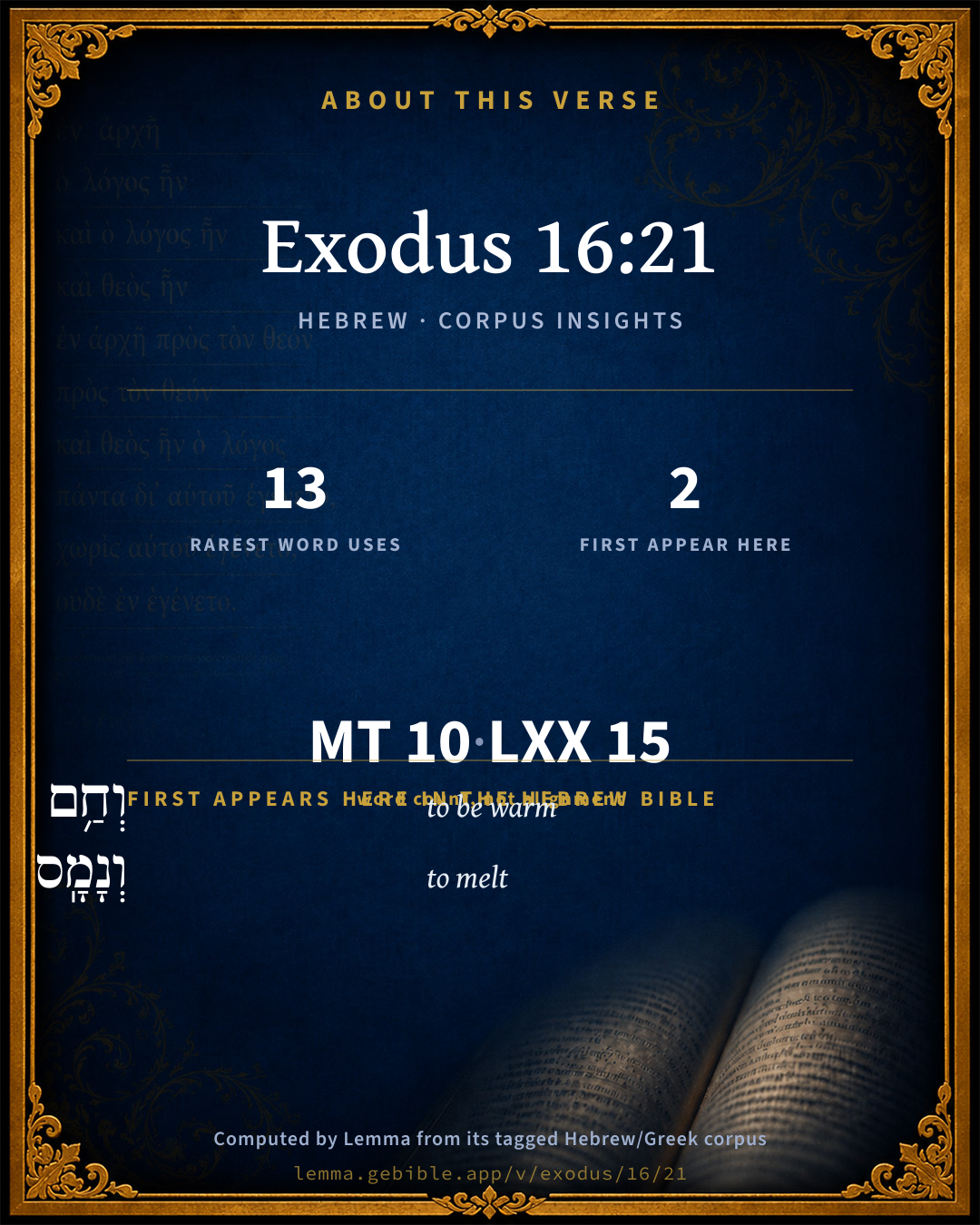
  • 2 first appearances in the Hebrew Bible
Full analysis ↓
Download a study sheet

One document with this verse’s original text, its word-by-word gloss line, the meaning frame, cross-references with their text, attributed commentary, and full source and license credits — printable, and it pastes into notes with its structure intact.

This verse Autodidact and up

Study sheet (.html) Plain text (.txt)

A passage Seminary Student

Up to 50 verses in one chapter. A passage sheet keeps up to 6 commentary sources and 12 cross-references per verse, in the order this page ranks them, and says so on the sheet whenever that leaves anything out. Ask for a single verse and you get the Autodidact verse sheet above.

Everything on this page stays free to read, with no account — the sheet is a download of what is already on screen, not access to it.

Want to remove ads? Support Godless Engineer
Compare translations 3

The same verse in 3 English versions, stacked beneath the original-language interlinear above. Click any original word for its lexicon entry.

Each is an independent rendering of the whole verse — the interlinear is not word-aligned to these translations.

Highlighted words mark where these versions differ — a whole-verse word diff, not a word-by-word alignment.

  • World English Bible Public Domain
    They gathered it morning by morning, everyone according to his eating. When the sun grew hot, it melted.
  • King James Version Public Domain
    And they gathered it every morning, every man according to his eating: and when the sun waxed hot, it melted.
  • unfoldingWord Literal Text CC BY-SA 4.0
    And they gathered it morning by morning, each man according to the mouths of his eating. And the sun became hot, and it melted.

unfoldingWord Literal Text — © unfoldingWord, licensed CC BY-SA 4.0. Word-aligned USFM3 via Door43 (git.door43.org/unfoldingWord/en_ult).

Versions to compare (up to 4)

3 of 4 selected

Show all 18 translations

Every available English version of this verse, each an independent rendering of the whole verse.

  • World English Bible Public Domain
    They gathered it morning by morning, everyone according to his eating. When the sun grew hot, it melted.
  • Berean Standard Bible Public Domain
    Every morning each one gathered as much as was needed, and when the sun grew hot, it melted away.
  • Majority Standard Bible Public Domain
    Every morning each one gathered as much as was needed, and when the sun grew hot, it melted away.
  • King James Version Public Domain
    And they gathered it every morning, every man according to his eating: and when the sun waxed hot, it melted.
  • American Standard Version (1901) Public Domain
    And they gathered it morning by morning, every man according to his eating: and when the sun waxed hot, it melted.
  • Revised Version (1885) Public Domain
    And they gathered it morning by morning, every man according to his eating: and when the sun waxed hot, it melted.
  • Geneva Bible (1599) Public Domain
    And they gathered it euery morning, euery man according to his eating: for when the heate of the sunne came, it was melted.
  • Douay-Rheims (1899) Public Domain
    Now every one of them gathered in the morning, as much as might suffice to eat: and after the sun grew hot, it melted.
  • Young's Literal Translation Public Domain
    And they gather it morning by morning, each according to his eating; when the sun hath been warm, then it hath melted.
  • Literal Standard Version CC BY-SA 4.0
    And they gather it morning by morning, each according to his eating; when the sun has been warm, then it has melted.
  • Unlocked Literal Bible CC BY-SA 4.0
    They gathered it morning by morning. Each person gathered enough to eat for that day. When the sun became hot, it melted.
  • unfoldingWord Literal Text CC BY-SA 4.0
    And they gathered it morning by morning, each man according to the mouths of his eating. And the sun became hot, and it melted.
  • Darby Bible Public Domain
    And they gathered it every morning, every man as much as he could eat; and when the sun became hot, it melted.
  • World Messianic Bible Public Domain
    They gathered it morning by morning, everyone according to his eating. When the sun grew hot, it melted.
  • Webster's Bible Public Domain
    And they gathered it every morning, every man according to his eating: and when the sun became hot, it melted.
  • Free Bible Version CC BY-SA 4.0
    So each morning everyone collected as much as they needed, and when the sun became hot, it melted away to nothing.
  • Bible in Basic English Public Domain
    And they took it up morning by morning, every man as he had need: and when the sun was high it was gone.
  • JPS Tanakh (1917) Public Domain
    And they gathered it morning by morning, every man according to his eating; and as the sun waxed hot, it melted.

Literal Standard Version (2020), Covenant Press — licensed CC BY-SA 4.0. Text via the HelloAO Bible API (eBible.org). Unlocked Literal Bible (unfoldingWord) — licensed CC BY-SA 4.0. Text via the HelloAO Bible API (eBible.org). unfoldingWord Literal Text — © unfoldingWord, licensed CC BY-SA 4.0. Word-aligned USFM3 via Door43 (git.door43.org/unfoldingWord/en_ult). Free Bible Version, Dr. Jonathan Gallagher — licensed CC BY-SA 4.0. Text via the HelloAO Bible API (eBible.org).

Word by word

More ways to search: Search by grammar → Find every occurrence → Compare this word →

Practice this passage: Drill this verse → Learn its vocabulary →

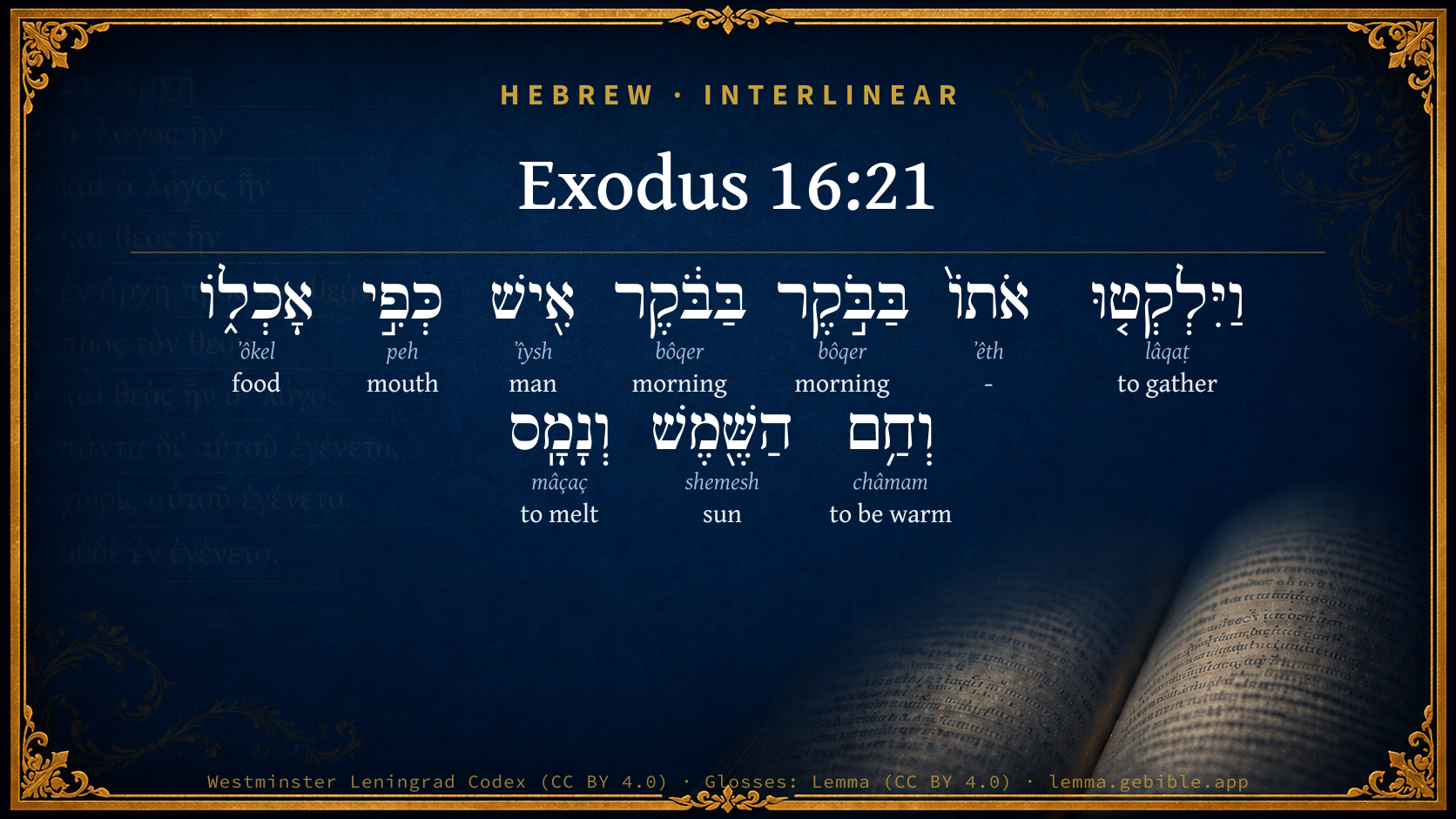
וְחַ֥ם
châmam
H2552
“and · to be warm”
Conjunction + Verb, Qal, Perfect, 3rd Person, Masculine, Singular
Part of Speech
Conjunction + Verb
Stem
Qal
Form
Perfect
Person
3rd Person
Gender
Masculine
Number
Singular
Full BDB Definition

Origin: a primitive root

TWOT: TWOT- 677

to be hot, become warm - (Qal) - to be or grow warm - of passion (figuratively) - (Niphal) to become aroused, inflame oneself with - (Piel) to warm - (Hithpael) to warm oneself
  1. וַיִּלְקְט֤וּ lâqaṭ H3950 “and · to gather” Conjunction + Verb, Qal, Sequential Imperfect, 3rd Person, Masculine, Plural
  2. אֹתוֹ֙ ʼêth H853 “- · him” Particle, Direct Object + Suffix, Personal, 3rd Person, Masculine, Singular
  3. בַּבֹּ֣קֶר bôqer H1242 “in/at the · morning” Preposition, Determined + Noun, Common, Masculine, Singular, Absolute
  4. בַּבֹּ֔קֶר bôqer H1242 “in/at the · morning” Preposition, Determined + Noun, Common, Masculine, Singular, Absolute
  5. אִ֖ישׁ ʼîysh H376 “man” Noun, Common, Masculine, Singular, Absolute
  6. כְּפִ֣י peh H6310 “like/as · mouth of” Preposition + Noun, Common, Masculine, Singular, Construct
  7. אָכְל֑וֹ ʼôkel H400 “food · his” Noun, Common, Masculine, Singular, Construct + Suffix, Personal, 3rd Person, Masculine, Singular
  8. הַשֶּׁ֖מֶשׁ shemesh H8121 “the · sun” Particle, Definite Article + Noun, Common, Both, Singular, Absolute
  9. וְנָמָֽס mâçaç H4549 “and · to melt” Conjunction + Verb, Niphal, Perfect, 3rd Person, Masculine, Singular

About this verse

These counts appear in no published source. They are computed here, from the morphology-tagged text and Lemma’s own curated glosses. What Lemma adds →

10
words
9
distinct lemmas
Pentateuch
section

Notable vocabulary

The rarest word here is וְחַ֥ם to be warm H2552 — appearing just 13 times in the whole Hebrew Bible.

First appearance in Scripture

These words make their first canonical appearance in the Hebrew Bible here:

  • וְחַ֥ם to be warm H2552
  • וְנָמָֽס to melt H4549

Shared distinctive vocabulary

וְחַ֥ם to be warm H2552 occurs in 12 verses of the Hebrew Bible. Also found in:

Grammatical profile

  • 3 verbs
  • 6 nouns
  • 1 particle

Verb forms

  • וַיִּלְקְט֤וּ Qal · Sequential Imperfect
  • וְחַ֥ם Qal · Perfect
  • וְנָמָֽס Niphal · Perfect

Repetition

A word recurs within this verse — often emphatic in Hebrew:

  • בַּבֹּ֣קֶר morning H1242 ×2

Hebrew & Septuagint length

In English translation the verse runs 18 words from the Hebrew and 19 from the Septuagint (LXX English) — closely comparable.

A rough comparison of the two English renderings, which tokenize alike — not a word-level alignment.

Word counts can differ between the Hebrew and the Greek without any difference in meaning — e.g. the Hebrew direct-object marker אֵת has no separate Greek word, and Greek often adds the article ὁ.

In the original languages it is 10 Hebrew tokens and 15 Greek tokens — but the two are counted differently (Hebrew bundles its prefixes and suffixes into one token; the Greek is in lemma form), so that isn’t a like-for-like length.

Cross-references

6

Topical passages linked to Exodus 16:21 in the Treasury of Scripture Knowledge — connected by theme and wording, ordered by reader-vote popularity; previews shown in the World English Bible.

  • Proverbs 6:6–11 Go to the ant, you sluggard. Consider her ways, and be wise;
  • Ecclesiastes 9:10 Whatever your hand finds to do, do it with your might; for there is no work, nor device, nor knowledge, nor wisdom, in Sheol, where you are going.
  • Ecclesiastes 12:1 Remember also your Creator in the days of your youth, Before the evil days come, and the years draw near, When you will say, "I have no pleasure in them;"
  • Matthew 6:33 But seek first God's Kingdom, and his righteousness; and all these things will be given to you as well.
  • John 12:35 Jesus therefore said to them, "Yet a little while the light is with you. Walk while you have the light, that darkness doesn't overtake you. He who walks in the darkness doesn't know where he is going.
  • 2 Corinthians 6:2 for he says, "At an acceptable time I listened to you, In a day of salvation I helped you." Behold, now is the acceptable time. Behold, now is the day of salvation.

Cross-references courtesy of OpenBible.info (CC BY 4.0).

Hebrew and Greek witnesses Masoretic Hebrew ↔ Greek Septuagint

The same verse in the two great witnesses to the Old Testament, shown verse-for-verse.

These are two independent witnesses, not word-aligned to each other, and the Septuagint is shown in lemma (dictionary) form.

Hebrew Exodus 16:21 Masoretic · Westminster Leningrad Codex

וַיִּלְקְט֤וּ אֹתוֹ֙ בַּבֹּ֣קֶר בַּבֹּ֔קֶר אִ֖ישׁ כְּפִ֣י אָכְל֑וֹ וְחַ֥ם הַשֶּׁ֖מֶשׁ וְנָמָֽס

They gathered it morning by morning, everyone according to his eating. When the sun grew hot, it melted.

World English Bible · Public Domain

Greek LXX Exodus 16:21 Septuagint · lemma form

καί συνλέγω αὐτός πρωΐ πρωΐ ἕκαστος ὁ καταἥκω αὐτός ἡνίκα δέ διαθερμαίνω ὁ ἥλιος τήκω

And they gathered it every morning, each man what he needed, and when the sun waxed hot it melted.

LXX2012 (modern English Septuagint) · Public Domain

Hebrew: Westminster Leningrad Codex (CC BY 4.0). Greek: Septuagint (public domain); English from LXX2012 (modern English Septuagint) (Public Domain). How the Septuagint differs from the Hebrew →

Targum (Aramaic paraphrase)

2

The Targum is the ancient Jewish Aramaic paraphrase of the Hebrew Scriptures — an interpretive translation, not the Hebrew text itself. Onkelos (literal) and Pseudo-Jonathan (expansive) render the Torah, and Jonathan the Prophets. Coverage is partial: where no permissively-licensed English translation exists for a verse, only the Aramaic is shown. This is verse-level text, not a word-by-word alignment to the Hebrew.

  1. Targum Onkelos Torah (Genesis–Deuteronomy)
    וּלְקָטוּ יָתֵהּ בִּצְפַר בִּצְפָר גְבַר לְפוּם מֵיכְלֵהּ וּמָא דְמִשְׁתָּאַר מִנֵהּ עַל אַפֵּי חַקְלָא כַּד חֲמָא עֲלוֹהִי שִׁמְשָׁא פָּשָׁר:

    (no public-domain English translation for this verse)

    Targum Onkelos — Aramaic: “Onkelos Genesis” (public domain); “Onkelos Exodus” (public domain); “Onkelos Leviticus” (public domain); “Onkelos Numbers” (public domain); “Onkelos Deuteronomy” (public domain). English: “Sefaria Community Translation” (CC0 1.0 (public-domain dedication)); “J.W. Etheridge. The Targums of Onkelos and Jonathan Ben Uzziel on the Pentateuch. London: Longmans, Green, 1862” (public domain). Text via Sefaria.

  2. Targum Pseudo-Jonathan Torah (Genesis–Deuteronomy)
    וַהֲווֹ מְלַקְטִין יָתֵיהּ מִן עִדַן צַפְרָא עַד אַרְבַּע שָׁעִין דְּיוֹמָא אֵינַשׁ לְפוּם מֵיכְלֵיהּ וּמִן אַרְבַּע שָׁעִין וּלְהָאֵל שָׁחִין שִׁימְשָׁא עִילוֹי וַהֲוָה שַׁיִיח וּמִתְעַבֵיד מַבּוּעִין דְּמַיִין וְנַגְדִין עַד יַמָא רַבָּא וְאַתְיָין חֵיוַן דַּכְיַין וּבְעִירָן וְשַׁתְיַין מִינֵהּ וַהֲווֹ בְּנֵי יִשְרָאֵל צַדְיַין וְאָכְלִין יַתְהוֹן

    And they gathered from the time of the dawn until the fourth hour of the day, every man according to his eating; but at the fourth hour, when the sun had waxed hot upon it, it liquefied, and made streams of water, which flowed away into the Great Sea; and wild animals that were clean, and cattle, came to drink of it, and the sons of Israel hunted, and ate them.

    Targum Pseudo-Jonathan — Aramaic: “Targum Jonathan on Genesis” (public domain); “Targum Jonathan on Exodus” (public domain); “Targum Jonathan on Leviticus” (public domain); “Targum Jonathan on Numbers” (public domain); “Targum Jonathan on Deuteronomy” (public domain). English: “The Targum of Jonathan ben Uzziel, trans. J. W. Etheridge, London, 1862” (public domain). Text via Sefaria.

Commentary

Notes on Exodus 16:21 from classic Christian and Jewish commentators (each source and its license shown beneath its notes). The classic Christian expositions comment on the surrounding passage and are grouped to its opening verse, so a note may address several verses; the Jewish commentaries on the Tanakh (Rashi and others) are per-verse, so they appear only where the commentator wrote on this verse.

Lemma curates 59 commentaries, every one of them public domain or Creative Commons licensed, each selected and text-cleaned for this edition rather than reprinted as found. About our sources →

Trapp's Complete Commentary

John Trapp

Exo 16:21 And they gathered it every morning, every man according to his eating: and when the sun waxed hot, it melted.

Ver. 21. It melted.] Or, Putrified, faded, dissolved. Some Papists derive their Mass from this root: and well it may; nam per eam omnis pietas linquefacta est et dissoluta, saith Rivet: for it is the utter bane of all good, as being a mass or heap of abominations.

John Trapp, A Commentary or Exposition upon All the Books of the Old and New Testament (1647–1656) — public domain. Text from a community e-Sword module.

Joseph Benson's Commentary

Exo 16:21. It melted — As much of it as was left upon the ground, not, it seems, from its own nature, which was so solid that it could endure the fire; but that it might not be corrupted, or trodden under foot, or despised, and that they might be compelled, as it were, to the more entire dependance upon God.

Joseph Benson's Commentary on the Old and New Testaments (1811–1818) — public domain. Text from a community e-Sword module.

Tyndale Open Study Notes

Tyndale Open Resources

16:21-30 Although the Sabbath was a day set apart for the Lord (16:23), it was also the Lord’s gift to his people (16:29). Rest and worship are not meant to be an obligation, but a privilege. However, given the human determination to meet our needs in our own way, rest and worship are given as commands (16:28).

Tyndale Open Study Notes — © Tyndale Open Resources, licensed CC BY-SA 4.0. Text via the HelloAO Bible API.

John Gill's Exposition

And it came to pass, that on the sixth day,.... Of the week, or from the first raining of the manna, which was the same:

they gathered twice as much bread; as they had used to do on other days, a greater quantity falling, and which was more easily taken up:

two omers for one man; or, "instead of one" (t) of one omer; so it turned out when they came to measure what they had gathered; otherwise they had no intention in gathering it, but lying in a great quantity, they gathered as much as they could, or could well carry, and upon measuring it so it proved; for it does not appear that Moses had as yet acquainted them what was to be, or would be gathered on this day; nor had he any orders so to do from the Lord, only he was told by him that so it would be, and accordingly it came to pass, see Exo 16:5.

and all the rulers of the congregation came and told Moses; what had happened, that the people that day had gathered as much more as they had used to do on other days: these seem to be the overseers of this affair, before whom what was gathered was brought, and in whose presence it was measured, and who took care that everyone should have his omer and no more: this makes it plain that the people acted without design, and knew not that they were to gather on this day double to other days; since the rulers knew nothing of it, nor of the reason of it, and it can hardly be imagined that the people should know and the rulers be ignorant.

(t) "pro uno", Tigurine version.

John Gill's Exposition of the Whole Bible (1746–1763) — public domain (CC PDM 1.0). Text via the HelloAO Bible API.

Albert Barnes' Notes on the Bible

It melted - This refers to the manna which was not gathered.

Albert Barnes' Notes on the Bible (1834–1885) — public domain. Text from a community e-Sword/MySword module.

Haydock's Catholic Bible Commentary

Morning. Wisdom xvi. 28, we find the reason of this ordinance, which enforces diligence, and was a constant admonition to bless God without delay. (Haydock) --- It melted, that it might not be trodden under foot by the profane. (Menochius)

George Leo Haydock (1774–1849), Haydock's Catholic Family Bible and Commentary, 1859 edition — public domain. Excludes Psalms (Douay-Rheims chapter numbering differs from Protestant) and Deuterocanonical books (Catholic canon only).

Matthew Poole's English Annotations

To wit, as much of it as was left upon the ground. This was not from its own nature, which was so solid that it could endure the fire, and was bruised by a pestle; but from God’s wise providence, partly, that it might not be corrupted or trodden under foot, or otherwise abused, and so despised; partly, that it might not remain there to tempt any of them to gather more of it than they should; and partly, that all their stock of provision being wasted, they might be obliged to the more entire dependence upon God. And this is here mentioned as a reason why they gathered it in the morning.

Matthew Poole's English Annotations on the Holy Bible (1683–1685) — public domain. Text from a community e-Sword/MySword module.

The Pulpit Commentary

When the sun waxed hot it melted. The manna had to be gathered early. What had not been collected before the sun grew hot, melted away and disappeared from sight. In this respect the miraculous manna resembled both the manna of commerce and the "air-honey."

The Pulpit Commentary (1880–1919), ed. H.D.M. Spence-Jones & Joseph S. Exell — public domain. Text from a community e-Sword module.

Rashi

Rabbi Shlomo Yitzchaki (Rashi)

וחם השמש ונמס AND WHEN THE SUN WAXED HOT, IT MELTED — What was left in the field (outside the inhabited camp) melted and ran in streams; the harts and the roes drank therefrom, and the nations of the world hunted them and experienced through them the taste of the Manna, and thereby understood how great was Israel’s excellency (Mekhilta).

ונמס Onkelos translates by פָּשָׁר, having the same meaning as פושרים, tepid waters: through the sun it became warm and turned into tepid water; old French détemperer. An example of it (פשר) occurs in Treatise Sanhedrin at the end of the chapter that begins, ארבע מיתות‎ (Sanhedrin 67b).

Rashi on the Tanakh — English translations: “The Judaica Press complete Tanach with Rashi, translated by A. J. Rosenberg” (CC BY 4.0); “Pentateuch with Rashi's commentary by M. Rosenbaum and A.M. Silbermann, 1929-1934” (public domain); “The Metsudah Tanach series, Lakewood, N.J” (CC BY 4.0); and “The Book of Joshua, Metsudah Publications, 1997” (CC BY 4.0). Text via Sefaria.

Lesson kit

Teaching starters — assembled from the data on this page, not authored interpretation. Every prompt links to the verse data it draws on. Edit before teaching.

Exodus, in the Pentateuch, opens this verse with 10 words (9 distinct Hebrew lemmas). Its most distinctive word is châmam (“to be warm”). A historical commentator’s framing appears above. Read the whole chapter for the surrounding context.

Discussion questions

  1. The word châmam carries the sense “to be warm.” How does it shape the verse?
  2. 2 words here appear for the first time in Scripture. What is being introduced at this debut?
  3. 1 Kings 1:2 shares the word «to be warm» with this verse. How do the two illuminate each other?
  4. “morning” occurs 2× in this one verse. What is the effect of the repetition?
  5. These translations render this verse differently. What is at stake in choosing one wording over another?
  6. The verb «וַיִּלְקְט֤וּ» is Qal Sequential Imperfect. How does its form color the action?
  7. Reading how Trapp's Complete Commentary and Joseph Benson's Commentary read this verse, where do the two commentators agree and where do they part?

Things to notice

Reading settings

Reading text

Shown beneath each verse's original-language words.

Old Testament
Old Testament edition

Read the OT as the Masoretic Hebrew (MT) or the Greek Septuagint (LXX).

English shown for the Greek Septuagint (in the Hebrew ↔ Greek comparison).

Comparing translations? Open the Compare panel on any verse page to stack up to four side by side.