Genesis 20:8

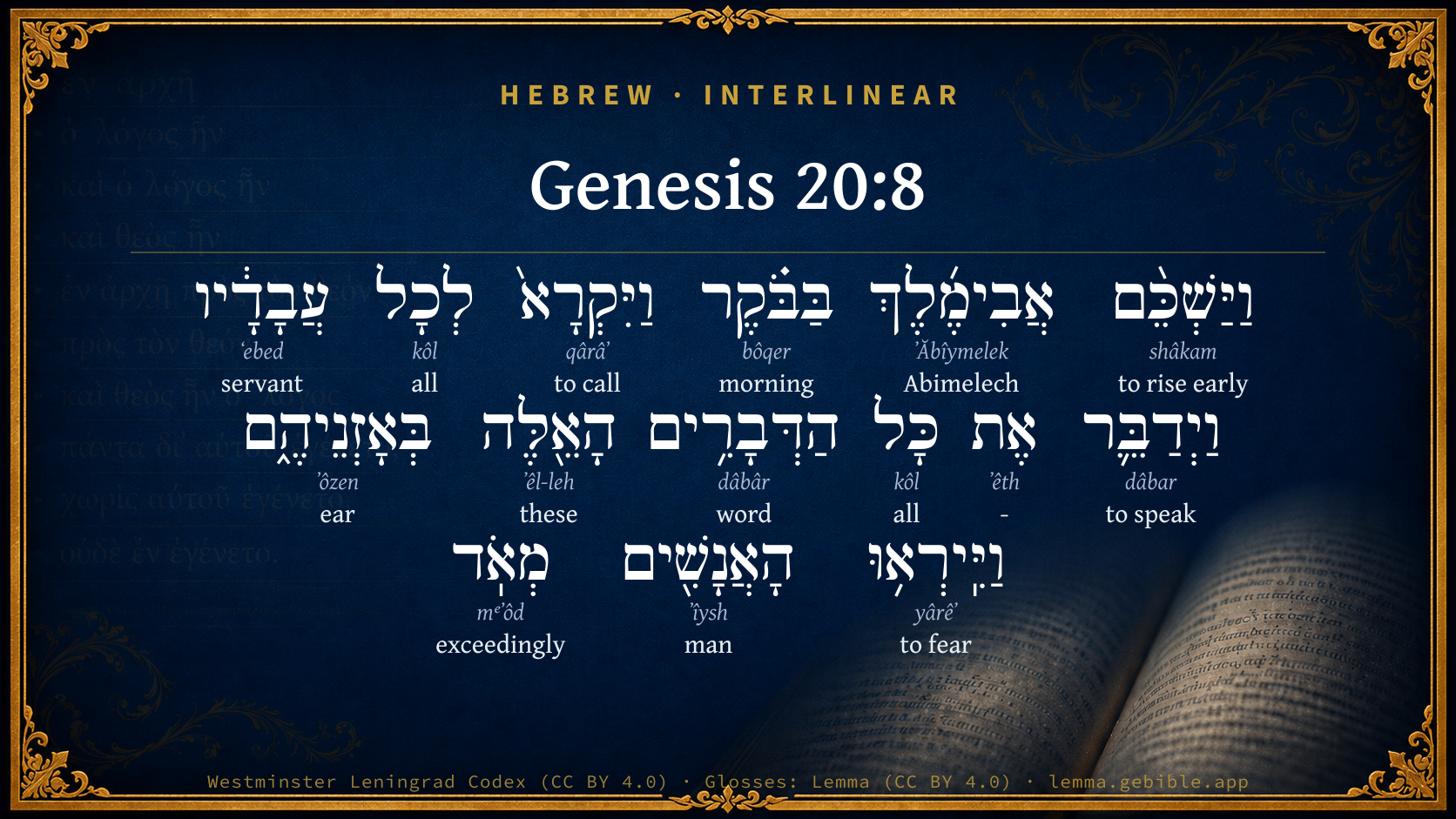
Hebrew (Westminster Leningrad Codex) Genesis 20:8 appears in the Hebrew Old Testament. The text above is from the Westminster Leningrad Codex. Each word links to its Strong’s number, a concise gloss, and parsing drawn from the Open Scriptures Hebrew Bible morphology. Click any word for its full Brown-Driver-Briggs (BDB) entry.
Download image
Cite this verse

Genesis 20:8 (World English Bible). Public Domain. Lemma interlinear Bible study tool, https://lemma.gebible.app/v/genesis/20/8.

Show BibTeX & RIS
BibTeX
RIS
English Translation
Abimelech rose early in the morning, and called all his servants, and told all these things in their ear. The men were very scared.
World English Bible · Public Domain
Highlights
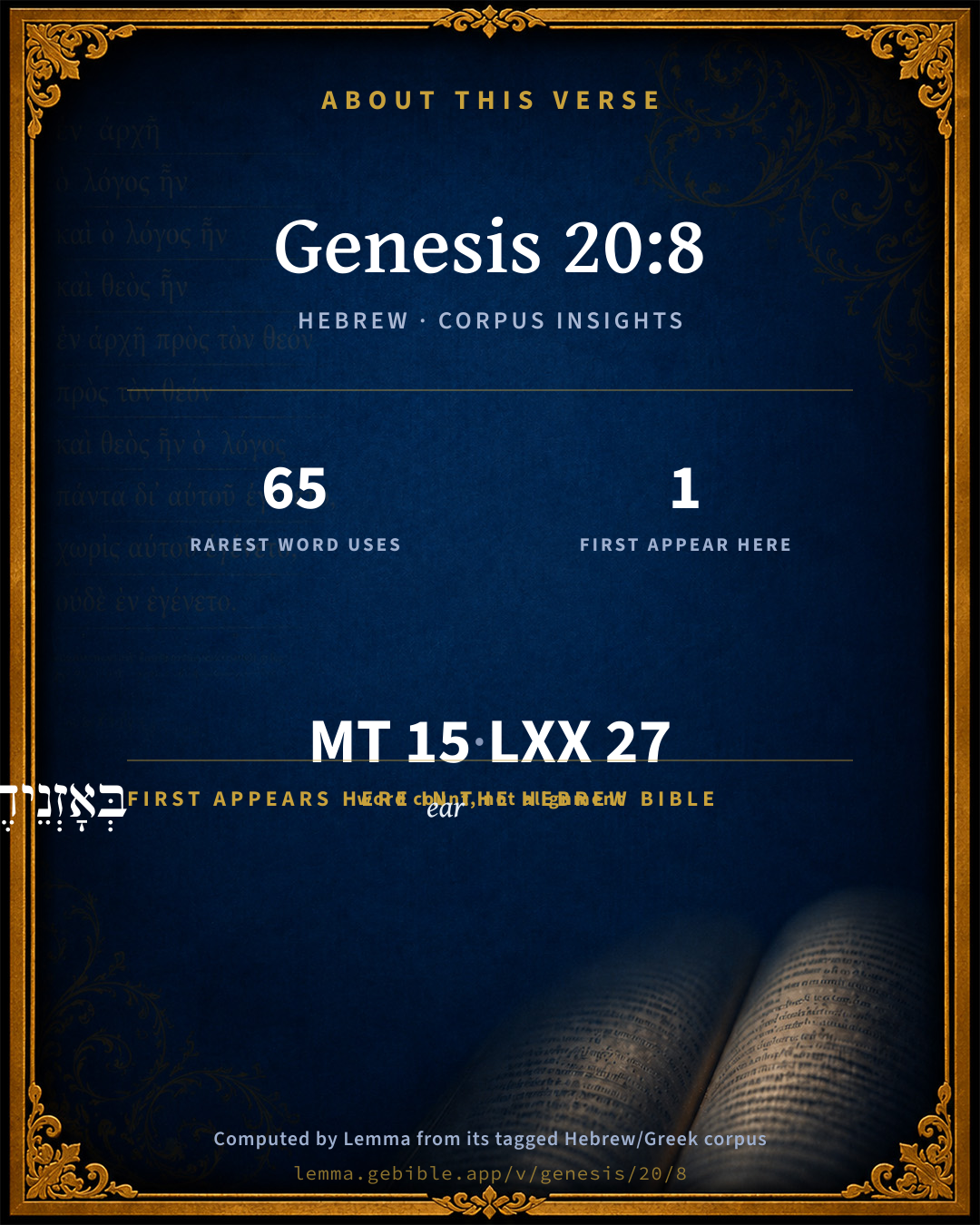
  • 1 first appearance in the Hebrew Bible
Full analysis ↓
Download a study sheet

One document with this verse’s original text, its word-by-word gloss line, the meaning frame, cross-references with their text, attributed commentary, and full source and license credits — printable, and it pastes into notes with its structure intact.

This verse Autodidact and up

Study sheet (.html) Plain text (.txt)

A passage Seminary Student

Up to 50 verses in one chapter. A passage sheet keeps up to 6 commentary sources and 12 cross-references per verse, in the order this page ranks them, and says so on the sheet whenever that leaves anything out. Ask for a single verse and you get the Autodidact verse sheet above.

Everything on this page stays free to read, with no account — the sheet is a download of what is already on screen, not access to it.

Want to remove ads? Support Godless Engineer
Compare translations 3

The same verse in 3 English versions, stacked beneath the original-language interlinear above. Click any original word for its lexicon entry.

Each is an independent rendering of the whole verse — the interlinear is not word-aligned to these translations.

Highlighted words mark where these versions differ — a whole-verse word diff, not a word-by-word alignment.

  • World English Bible Public Domain
    Abimelech rose early in the morning, and called all his servants, and told all these things in their ear. The men were very scared.
  • King James Version Public Domain
    Therefore Abimelech rose early in the morning, and called all his servants, and told all these things in their ears: and the men were sore afraid.
  • unfoldingWord Literal Text CC BY-SA 4.0
    So Abimelech got up early in the morning and called for all of his servants, and he told all those things in their ears, and the men were very afraid.

unfoldingWord Literal Text — © unfoldingWord, licensed CC BY-SA 4.0. Word-aligned USFM3 via Door43 (git.door43.org/unfoldingWord/en_ult).

Versions to compare (up to 4)

3 of 4 selected

Show all 18 translations

Every available English version of this verse, each an independent rendering of the whole verse.

  • World English Bible Public Domain
    Abimelech rose early in the morning, and called all his servants, and told all these things in their ear. The men were very scared.
  • Berean Standard Bible Public Domain
    Early the next morning Abimelech got up and summoned all his servants; and when he described to them all that had happened, the men were terrified.
  • Majority Standard Bible Public Domain
    Early the next morning Abimelech got up and summoned all his servants; and when he described to them all that had happened, the men were terrified.
  • King James Version Public Domain
    Therefore Abimelech rose early in the morning, and called all his servants, and told all these things in their ears: and the men were sore afraid.
  • American Standard Version (1901) Public Domain
    And Abimelech rose early in the morning, and called all his servants, and told all these things in their ear. And the men were sore afraid.
  • Revised Version (1885) Public Domain
    And Abimelech rose early in the morning, and called all his servants, and told all these things in their ears: and the men were sore afraid.
  • Geneva Bible (1599) Public Domain
    Then Abimelech rising vp early in ye morning, called all his seruants, and tolde all these things vnto them, and the men were sore afraid.
  • Douay-Rheims (1899) Public Domain
    And Abimelech forthwith rising up in the night, called all his servants: and spoke all these words in their hearing, and all the men were exceedingly afraid.
  • Young's Literal Translation Public Domain
    And Abimelech riseth early in the morning, and calleth for all his servants, and speaketh all these words in their ears; and the men fear exceedingly;
  • Literal Standard Version CC BY-SA 4.0
    And Abimelech rises early in the morning, and calls for all his servants, and speaks all these words in their ears; and the men fear exceedingly;
  • Unlocked Literal Bible CC BY-SA 4.0
    Abimelech rose early in the morning and called all of his servants to himself. He told all these things to them, and the men were very afraid.
  • unfoldingWord Literal Text CC BY-SA 4.0
    So Abimelech got up early in the morning and called for all of his servants, and he told all those things in their ears, and the men were very afraid.
  • Darby Bible Public Domain
    And Abimelech rose early in the morning, and called all his servants, and spoke all these words in their ears; and the men were greatly afraid.
  • World Messianic Bible Public Domain
    Abimelech rose early in the morning, and called all his servants, and told all these things in their ear. The men were very scared.
  • Webster's Bible Public Domain
    Therefore Abimelech rose early in the morning, and called all his servants, and told all these things in their ears: and the men were greatly afraid.
  • Free Bible Version CC BY-SA 4.0
    Abimelech got up early in the morning and called all his servants together. He explained everything that had happened, and they were all terrified.
  • Bible in Basic English Public Domain
    So Abimelech got up early in the morning and sent for all his servants and gave them word of these things, and they were full of fear.
  • JPS Tanakh (1917) Public Domain
    And Abimelech rose early in the morning, and called all his servants, and told all these things in their ears; and the men were sore afraid.

Literal Standard Version (2020), Covenant Press — licensed CC BY-SA 4.0. Text via the HelloAO Bible API (eBible.org). Unlocked Literal Bible (unfoldingWord) — licensed CC BY-SA 4.0. Text via the HelloAO Bible API (eBible.org). unfoldingWord Literal Text — © unfoldingWord, licensed CC BY-SA 4.0. Word-aligned USFM3 via Door43 (git.door43.org/unfoldingWord/en_ult). Free Bible Version, Dr. Jonathan Gallagher — licensed CC BY-SA 4.0. Text via the HelloAO Bible API (eBible.org).

Word by word

More ways to search: Search by grammar → Find every occurrence → Compare this word →

Practice this passage: Drill this verse → Learn its vocabulary →

וַיַּשְׁכֵּ֨ם
shâkam
H7925
“and · to rise early”
Conjunction + Verb, Hiphil, Sequential Imperfect, 3rd Person, Masculine, Singular
Part of Speech
Conjunction + Verb
Stem
Hiphil
Form
Sequential Imperfect
Person
3rd Person
Gender
Masculine
Number
Singular
Full BDB Definition

Origin: a primitive root

TWOT: 2386

to rise or start early - (Hiphil) - to rise early, make an early start - early (as adverb)
  1. אֲבִימֶ֜לֶךְ ʼĂbîymelek H40 “Abimelech” Noun, Proper
  2. בַּבֹּ֗קֶר bôqer H1242 “in/at the · morning” Preposition, Determined + Noun, Common, Masculine, Singular, Absolute
  3. וַיִּקְרָא֙ qârâʼ H7121 “and · to call” Conjunction + Verb, Qal, Sequential Imperfect, 3rd Person, Masculine, Singular
  4. לְכָל kôl H3605 “to/for · all of” Preposition + Noun, Common, Masculine, Singular, Construct
  5. עֲבָדָ֔יו ʻebed H5650 “servants · his” Noun, Common, Masculine, Plural, Construct + Suffix, Personal, 3rd Person, Masculine, Singular
  6. וַיְדַבֵּ֛ר dâbar H1696 “and · to speak” Conjunction + Verb, Piel, Sequential Imperfect, 3rd Person, Masculine, Singular
  7. אֶת ʼêth H853 “-” Particle, Direct Object
  8. כָּל kôl H3605 “all of” Noun, Common, Masculine, Singular, Construct
  9. הַדְּבָרִ֥ים dâbâr H1697 “the · words” Particle, Definite Article + Noun, Common, Masculine, Plural, Absolute
  10. הָאֵ֖לֶּה ʼêl-leh H428 “the · these” Particle, Definite Article + Pronoun, Demonstrative, Common, Plural
  11. בְּאָזְנֵיהֶ֑ם ʼôzen H241 “in/at · ears · their” Preposition + Noun, Common, Feminine, Dual, Construct + Suffix, Personal, 3rd Person, Masculine, Plural
  12. וַיִּֽירְא֥וּ yârêʼ H3372 “and · to fear” Conjunction + Verb, Qal, Sequential Imperfect, 3rd Person, Masculine, Plural
  13. הָאֲנָשִׁ֖ים ʼîysh H376 “the · men” Particle, Definite Article + Noun, Common, Masculine, Plural, Absolute
  14. מְאֹֽד mᵉʼôd H3966 “exceedingly” Adverb

About this verse

These counts appear in no published source. They are computed here, from the morphology-tagged text and Lemma’s own curated glosses. What Lemma adds →

15
words
14
distinct lemmas
Pentateuch
section

First appearance in Scripture

This word makes its first canonical appearance in the Hebrew Bible here:

  • בְּאָזְנֵיהֶ֑ם ear H241

Grammatical profile

  • 4 verbs
  • 8 nouns
  • 1 pronoun
  • 1 adverb
  • 1 particle

Verb forms

  • וַיַּשְׁכֵּ֨ם Hiphil · Sequential Imperfect
  • וַיִּקְרָא֙ Qal · Sequential Imperfect
  • וַיְדַבֵּ֛ר Piel · Sequential Imperfect
  • וַיִּֽירְא֥וּ Qal · Sequential Imperfect

Repetition

A word recurs within this verse — often emphatic in Hebrew:

  • לְכָל all H3605 ×2

Hebrew & Septuagint length

In English translation the verse runs 24 words from the Hebrew and 27 from the Septuagint (LXX English) — closely comparable.

A rough comparison of the two English renderings, which tokenize alike — not a word-level alignment.

Word counts can differ between the Hebrew and the Greek without any difference in meaning — e.g. the Hebrew direct-object marker אֵת has no separate Greek word, and Greek often adds the article ὁ.

In the original languages it is 15 Hebrew tokens and 27 Greek tokens — but the two are counted differently (Hebrew bundles its prefixes and suffixes into one token; the Greek is in lemma form), so that isn’t a like-for-like length.

Hebrew and Greek witnesses Masoretic Hebrew ↔ Greek Septuagint

The same verse in the two great witnesses to the Old Testament, shown verse-for-verse.

These are two independent witnesses, not word-aligned to each other, and the Septuagint is shown in lemma (dictionary) form.

Hebrew Genesis 20:8 Masoretic · Westminster Leningrad Codex

וַיַּשְׁכֵּ֨ם אֲבִימֶ֜לֶךְ בַּבֹּ֗קֶר וַיִּקְרָא֙ לְכָל עֲבָדָ֔יו וַיְדַבֵּ֛ר אֶת כָּל הַדְּבָרִ֥ים הָאֵ֖לֶּה בְּאָזְנֵיהֶ֑ם וַיִּֽירְא֥וּ הָאֲנָשִׁ֖ים מְאֹֽד

Abimelech rose early in the morning, and called all his servants, and told all these things in their ear. The men were very scared.

World English Bible · Public Domain

Greek LXX Genesis 20:8 Septuagint · lemma form

καί ὀρθρίζω αβιμελεχ ὁ πρωΐ καί καλέω πᾶς ὁ παῖς αὐτός καί λαλέω πᾶς ὁ ῥῆμα οὗτος εἰς ὁ οὖς αὐτός φοβέω δέ πᾶς ὁ ἄνθρωπος σφόδρα

And Abimelech rose early in the morning, and called all his servants, and he spoke all these words in their ears, and all the men feared exceedingly.

LXX2012 (modern English Septuagint) · Public Domain

On this verse, Haydock's Catholic Bible Commentary discusses the Septuagint’s reading. Read the note in Commentary ↓

Hebrew: Westminster Leningrad Codex (CC BY 4.0). Greek: Septuagint (public domain); English from LXX2012 (modern English Septuagint) (Public Domain). How the Septuagint differs from the Hebrew →

Targum (Aramaic paraphrase)

2

The Targum is the ancient Jewish Aramaic paraphrase of the Hebrew Scriptures — an interpretive translation, not the Hebrew text itself. Onkelos (literal) and Pseudo-Jonathan (expansive) render the Torah, and Jonathan the Prophets. Coverage is partial: where no permissively-licensed English translation exists for a verse, only the Aramaic is shown. This is verse-level text, not a word-by-word alignment to the Hebrew.

  1. Targum Onkelos Torah (Genesis–Deuteronomy)
    וְאַקְדֵּים אֲבִימֶלֶךְ בְּצַפְרָא וּקְרָא לְכָל עַבְדּוֹהִי וּמַלִּיל יַת כָּל פִּתְגָּמַיָּא הָאִלֵּין קֳדָמֵיהוֹן וּדְחִילוּ גּוּבְרַיָּא לַחֲדָא

    (no public-domain English translation for this verse)

    Targum Onkelos — Aramaic: “Onkelos Genesis” (public domain); “Onkelos Exodus” (public domain); “Onkelos Leviticus” (public domain); “Onkelos Numbers” (public domain); “Onkelos Deuteronomy” (public domain). English: “Sefaria Community Translation” (CC0 1.0 (public-domain dedication)); “J.W. Etheridge. The Targums of Onkelos and Jonathan Ben Uzziel on the Pentateuch. London: Longmans, Green, 1862” (public domain). Text via Sefaria.

  2. Targum Pseudo-Jonathan Torah (Genesis–Deuteronomy)
    וְאַקְדִים אֲבִימֶלֶךְ בְּצַפְרָא וּקְרָא לְכָל עַבְדוֹי וּמַלֵיל יַת כָּל פִּתְגָמַיָא הָאִילֵין קֳדָמֵיהוֹן וּדְחִילוּ גוּבְרַיָא לַחֲדָא

    And Abimelek arose in the morning, and called all his servants, and told all these words before them; and the men feared greatly.

    Targum Pseudo-Jonathan — Aramaic: “Targum Jonathan on Genesis” (public domain); “Targum Jonathan on Exodus” (public domain); “Targum Jonathan on Leviticus” (public domain); “Targum Jonathan on Numbers” (public domain); “Targum Jonathan on Deuteronomy” (public domain). English: “The Targum of Jonathan ben Uzziel, trans. J. W. Etheridge, London, 1862” (public domain). Text via Sefaria.

Commentary

Notes on Genesis 20:8 from classic Christian and Jewish commentators (each source and its license shown beneath its notes). The classic Christian expositions comment on the surrounding passage and are grouped to its opening verse, so a note may address several verses; the Jewish commentaries on the Tanakh (Rashi and others) are per-verse, so they appear only where the commentator wrote on this verse.

Lemma curates 59 commentaries, every one of them public domain or Creative Commons licensed, each selected and text-cleaned for this edition rather than reprinted as found. About our sources →

Matthew Henry's Commentary

Abimelech, being thus warned of God in a dream, takes the warning, and, as one truly afraid of sin and its consequences, he rises early to obey the directions given him.

I. He has a caution for his servants, Gen 20:8. Abraham himself could not be more careful than he was to command his household in this matter. Note, Those whom God has convinced of sin and danger ought to tell others what God has done for their souls, that they also may be awakened and brought to a like holy fear.

II. He has a chiding for Abraham. Observe,

1. The serious reproof which Abimelech gave to Abraham, Gen 20:9, Gen 20:10. His reasoning with Abraham upon this occasion was very strong, and yet very mild. Nothing could be said better; he does not reproach him, nor insult over him, does not say, "Is this your profession? I see, though you will not swear, you will lie. If these be prophets, I will beg to be freed from the sight of them:" but he fairly represents the injury Abraham had done him, and calmly signifies his resentment of it. (1.) He calls that sin which he now found he had been in danger of a great sin. Note, Even the light of nature teaches men that the sin of adultery is a very great sin: be it observed, to the shame of many who call themselves Christians, and yet make a light matter of it. (2.) He looks upon it that both himself and his kingdom would have been exposed to the wrath of God if he had been guilty of this sin, though ignorantly. Note, The sins of kings often prove the plagues of kingdoms; rulers should therefore, for their people's sake, dread sin. (3.) He charges Abraham with doing that which was not justifiable, in disowning his marriage. This he speaks of justly, and yet tenderly; he does not call him a liar and cheat, but tells him he had done deeds that ought not to be done. Note, Equivocation and dissimulation, however they may be palliated, are very bad things, and by no means to be admitted in any case. (4.) He takes it as a very great injury to himself and his family that Abraham had thus exposed them to sin: "What have I offended thee? If I had been thy worst enemy, thou couldst not have done me a worse turn, nor taken a more effectual course to be revenged on me." Note, We ought to reckon that those do us the greatest unkindness in the world that any way tempt us or expose us to sin, though they may pretend friendship, and offer that which is grateful enough to corrupt nature. (5.) He challenges him to assign a cause for his suspecting them as a dangerous people for an honest man to live among: "What sawest thou, that thou hast done this thing? Gen 20:10. What reason hadst thou to think that if we had known her to be thy wife thou wouldst have been exposed to any danger by it?" Note, A suspicion of our goodness is justly reckoned a greater affront than a slight upon our greatness.

2. The poor excuse that Abraham made for himself.

(1.) He pleaded the bad opinion he had of the place, Gen 20:11. He thought within himself (though he could not give any good reason for his thinking so), "Surely the fear of God is not in this place, and then they will slay me." [1.] Little good is to be expected where no fear of God is. See Psa 36:1. [2.] There are many places and persons that have more of the fear of God in them than we think they have: perhaps they are not called by our dividing name, they do not wear our badges, they do not tie themselves to that which we have an opinion of; and therefore we conclude they have not the fear of God in their hearts, which is very injurious both of Christ and Christians, and makes us obnoxious to God's judgment, Mat 7:1. [3.] Uncharitableness and censoriousness are sins that are the cause of many other sins. When men have once persuaded themselves concerning such and such that they have not the fear of God, they think this will justify them in the most unjust and unchristian practices towards them. Men would not do ill if they did not first think ill.

(2.) He excused it from the guilt of a downright lie by making it out that, in a sense, she was his sister, Gen 20:12. Some think she was own sister to Lot, who is called his brother Lot (Gen 14:16), though he was his nephew; so Sarah is called his sister. But those to whom he said, She is my sister, understood that she was so his sister as not to be capable of being his wife; so that it was an equivocation, with an intent to deceive.

(3.) He clears himself from the imputation of an affront designed to Abimelech in it by alleging that it had been his practice before, according to an agreement between him and his wife, when they first became sojourners (Gen 20:13): "When God caused me to wander from my father's house, then we settled this matter." Note, [1.] God is to be acknowledged in all our wanderings. [2.] Those that travel abroad, and converse much with strangers, as they have need of the wisdom of the serpent, so it is requisite that that wisdom be ever tempered with the innocence of the dove. It may, for aught I know, be suggested that God denied to Abraham to punish them for this sinful compact if they will not own their marriage, why should God own it? But we may suppose that, after this reproof which Abimelech gave them, they agreed never to do so again, and then presently we read (Gen 21:1, Gen 21:2) that Sarah conceived.

Matthew Henry's Commentary on the Whole Bible (1708–1710) — public domain (CC PDM 1.0). Text via the HelloAO Bible API.

Trapp's Complete Commentary

John Trapp

Gen 20:8 Therefore Abimelech rose early in the morning, and called all his servants, and told all these things in their ears: and the men were sore afraid.

Ver. 8. Therefore Abimelech rose early, &c.] He "made haste, and delayed not to keep God’s commandments". {Psa 119:60} This is a check to our dulness, whom so many exhortations and menaces of God’s mouth move not to amend. Some are semper victuri , as Seneca saith. They defer so long till the drawbridge be taken up, till the gale of grace be blown over, till the bridegroom goes by, and so are shut out with the foolish virgins, for their lingering and futuring. Nolite vero tempus in nugis terere, vel Cras, ut ille, Seria, reiectis in hilari compotatione, literis indiciis hodie morituri, protelare . At the next puff of breath thou mayest blow away thy life; or, by not discerning thy time, thou mayest lose thy soul, as Saul did his kingdom. Opportunities are headlong. {a}

And called all his servants.] Nature taught infidels to take care of their own families. Socrates is said to have called philosophy down from heaven to earth; {b} that is, to have directed men to be good at home, and setting aside other studies, chiefly to mind,

“ Aedibus in propriis quae pravae aut recta gerantur. ”

Cato said that he could pardon all men’s faults, save only the faults of his own family. And Augustus, when he went about to restrain garish attire, and looseness of life in others, was jeered and upbraided at Rome with the excesses and enormities of his own household. He had three untoward children whom he was wont to term tres vomicas, tria carcinomata so many mattery impostumes, ulcerous sores. His wife Livia was thought to be too familiar with her friend and physician, Eudemus; Pliny calls him her paramour. Tacitus saith, he was specie artis, frequens secretis . All this might be without his fault, but not without his reproach. {c} The malicious Pharisees could object it to our Saviour - "thy disciples wash not," "thy disciples fast not," &c.; as if he were much to blame for suffering such things. And surely, he is not a complete Christian, walks not "in a perfect way," that is not good "at home," {Psa 101:2} that is, not relatively good. The fifth commandment is called by Philo, εντολη μικτη, a mixed commandment, and made a part of the first table. It is therefore set between both tables of the law, saith another, because all we get from God or men we bring it home to our houses - as Abimelech here relates his divine dream to his servants - the place of well employing it.

And the men were sore afraid.] This fear freed them; for according to men’s fear, so is God’s displeasure. {Psa 90:11} Cavebis si pavebis .{ Rom 11:21} But they that tremble not in hearing, shall be crushed to pieces in feeling, said that martyr. {d} This was a sign that the Israelites feared God, when they believed God, and his servant Moses. {Exo 4:31} The best way of prevention is to tremble at God’s judgments, while they hang in the threatenings. But frequentissimum initium calamitatis securitas , saith Paterculus. Sola igitur securitas est, nunquam esse securum, sed semper pavidum et trementem , saith another. {e} Should servants fear their masters {Col 3:22} because they have power over the flesh, and not we fear God? &c.

{a} εις αυριον τασπουδαια, vox erat Archiae illius Thebanorum praefecti

{b} Wolfius in Tiliani tab. Philosoph.

{c} Oττιτοι εν μεγαροισι κακων, αγαθων τε τετυκται - Dio in Vita. - Sueton. in Aug., cap. 65.

{d} Bradford Of Repent.

{e} R. Grosthead.

John Trapp, A Commentary or Exposition upon All the Books of the Old and New Testament (1647–1656) — public domain. Text from a community e-Sword module.

The Preacher's Complete Homiletical Commentary

Joseph S. Exell (gen. ed.)

CRITICAL NOTES.—

Gen_20:8. Servants.] Court officers—his counsellors. (1Ki_1:2; 1Ki_10:5; 2Ki_6:8.)

Gen_20:10. What sawest thou, that thou hast done this thing?] “What purpose hadst thou in view—what could have been thy motive?”

Gen_20:13. God caused me to wander.] One of the rare instances in which the plural verb is used with the name God, itself in the plural form. “If the verb be plural, it is only an instance of the literal meaning of Elohim, the Eternal Supernatural Powers, coming into view.” (Murphy.)

Gen_20:16. Behold he is unto thee for a covering of the eyes.] Heb. “Lo, it is to thee as a covering of the eyes.” “Not, as some imagine, a veil, understanding the present as money to buy one; but it is rather a peace-offering in consideration of the damage done to them. ‘To cover one’s face’ is the Heb. idiom for causing one to forget a wrong done. (Ch. Gen_32:20-21.) ‘I will cover his face,’ i.e., I will appease him with a present. (Job_9:24.) So, also, to cover sin is to pardon—to see it no more.” (Jacobus.) Thus she was reproved. Heb. So thou art judged, i.e., justice has been done to thee. “The original of this is most naturally taken as a part of Abimelech’s speech, and then it is to be translated, And all this that thou mayest be righted. All this had been done or given, that the injury to Sarah may be redressed.” (Murphy.) He had now made amends for all that had happened.

MAIN HOMILETICS OF THE PARAGRAPH.—Gen_20:8-16

MORALITY OUTSIDE OF THE CHURCH

The Divine call of Abraham was the first step towards the formation of the visible Church, and the interests of that Church centre in his life. He was the home of Revelation, the expositor of the known will of God. To Abimelech no Divine communication had been made. He, therefore, represents those who are outside the Church. All that was good in him was the product of what is called “Natural Religion.” This history shows what fair and noble things of life and conduct may grow from such a soil.

I. Morality outside the Church may attain to great excellence. The conduct of Abimelech shows that men may attain to principles of virtue and righteous living who are yet beyond the pale of revelation. He represents heathen morality at its best. There is much to admire both in his thought and feeling concerning human conduct.

1. Belief in a moral standard of right and wrong. He did not regard human actions as indifferent, or to be determined by the mere will and caprice of the individual without any reference to their moral qualities and issues. They are to be referred to a standard, whose witness and counterpart is the law written in the heart. In his view there were “deeds that ought not to be done” (Gen_20:9). Moral obligation is herein implied. This ought and ought not is the imperative of conscience. The action of conscience implies that there is a law existing somewhere. Though the man may be greatly ignorant, yet that faculty when awakened obeys the impulse from an unseen source.

2. Belief in the moral relations of human society. He knows that the welfare of nations depends upon their righteousness (Gen_20:4). He censures the conduct of Abraham, which had nearly involved both himself and his nation in a great sin (Gen_20:9). The members of human society are so connected together by the principle of mutual dependence, and the ties of a common interest, that the great sins of the few must affect the many. A nation cannot maintain existence without some moral bonds.

3. A sense of injured moral feeling in the presence of wrong. He not only recognised the moral character of actions, and held human responsibility as a doctrine, but also as a principle of heart and life. He felt strongly upon the subject. His moral sensibilities were wounded and outraged at the very thought of the sin which he was so near committing.

4. A readiness to make restitution for faults committed against others (Gen_20:14-15). Abimelech not only restores Abraham his wife, but gives him presents by way of atonement for any wrong he may unwittingly have done him. His high sense of justice is not content with sentiment and abstractions, but contemplates practical duty.

II. Morality outside the Church may have lessons of reproof for those who are within it. Sarah stood “reproved” (Gen_20:16), and so did Abraham; for they had agreed together to act this part. They held to a statement which, though not altogether false, was a moral untruth—a deceit and a culpable concealment. The manly and open conduct of the heathen king reproved them.

1. For their mean subterfuges. This conduct was unworthy of them as persons of wealth and position, and whose previous history entitled them to respect and honour from the surrounding people. To take the lowest ground, it lacked open sincerity and manly courage. It was a mean subterfuge unworthy of noble souls. The cunning and dissembling in their conduct towards others, too often practised by professing Christians, is reproved by the more open and manly dealing of many who have enjoyed no religious advantages.

2. Their distrust of Providence. Surely the patriarch and his wife had sufficient proof already of the power and willingness of God to protect them, and bring them out of every danger. They imperiled the truth to prevent (as they considered) worse consequences; and thus they took refuge in a human expedient instead of trusting in God. Surely the heathen have reason to reprove us when we cannot trust our God, in whom we profess to believe, in the time of peril. In so far as we act as if we had no Divine director, we belie our profession of religion. There are actions in the life of many, who are yet true members of the Church, which really show a practical disbelief in the help and guidance of Providence.

3. Their religious prejudices. Abraham excuses his conduct by saying, “Because I thought; surely, the fear of God is not in this place.” (Gen_20:11.) He considered, that those not so favoured of God as himself were without any just ideas of duty and of the purpose of life. He took it for granted that men who had no special revelation must, of necessity, be without moral principle, and not to be trusted. How incorrectly do the best of men often judge of those who are outside their own pale! Men find it hard to believe in the goodness of those whose views on the subject of religion are essentially different from their own. Some narrow-minded Christians selfishly rest in the thought that they are the special favourites of God, and form harsh and uncharitable judgments of all the rest of mankind. We have no right to limit the grace of God by confiding its operation to the Church only. The revelation of Christianity may be the privilege of the few, but the dispensation of it is intended for the benefit of all. The hindrances to the universal sway of God’s truth and righteousness arise from man. His infinite goodness would bless all. His grace can raise the fruits of righteousness even where there is no open vision, and where religious minds think His fear does not exist. We are not to despise human goodness because it has not been nourished in the Church.

SUGGESTIVE COMMENTS ON THE VERSES

Gen_20:8. It is wise to act promptly upon Divine warnings.

1. As they concern ourselves. Abimelech had taken a wrong step, but by the grace of God was prevented from rushing into greater evil. His was the fault, and the matter concerned himself first of all.

2. As they concern others. The king announced the fact to his household, for he could not transgress the moral law without bringing upon them also the effects of his great sin. Human interests are so related that the results of a man’s sin must spread far beyond himself.

There is hope for men who are afraid of the judgments of God. It shows their minds are fully alive to their real situation. There is a courage of open defiance which only comes of ignorance. When men begin to fear they are ready to listen to the voice of wisdom.

Nature taught infidels to take care of their own families. Socrates is said to have called philosophy down from heaven to earth; that is, to have directed men to be good at home. The malicious Pharisees could object it to our Saviour—“Thy disciples wash not,” “Thy disciples fast not,” etc.; as if He were much to blame for suffering such things. And surely, he is not a complete Christian, walks not “in a perfect way,” that is not good “at home” (Psa_101:2.) The fifth commandment is called by Philo a mixed commandment, and made a part of the first table. It is therefore set betwixt both tables of the law, saith another, because all we get from God or men we bring it home to our houses—as Abimelech here relates his divine dream to his servants—the place of well employing it.—(Trapp.)

The prompt obedience of this heathen king reproves us who have greater privileges. God appeared to him only in a dream, but us He calls daily by Moses, by the prophets, by apostles, and by His only-begotten Son. Should all this convergence of testimony and spiritual force have less effect upon us than a single vision had upon this man?

Gen_20:9. A heathen king reproving the Father of the Faithful! The better the man who is subjected to such reproach, the more shameful the position.

The dangers of life’s pilgrimage are so great that believers are tempted to adopt worldly policy and scheming for their own safety, but when such devices are discovered they bring shame and contempt.

Were we to judge simply from this portion of the sacred narrative we should be ready to think that Abraham had been the heathen and Abimelech the prophet of the Lord. In this offended king’s reproof we see much to admire and to commend. Considering the injury he had sustained, and the danger to which he had been exposed, it is truly wonderful that he should express himself with such mildness and moderation. The occasion would almost have justified the bitterest reproaches; and it might well have been expected that Abimelech would cast reflections upon the partriarch’s religion, condemning that as worthless or him as hypocritical. He never once complained of the punishment which he and his family had suffered, nor of the danger to which they had been exposed, but only of their seduction into sin. He considered this as the greatest injury that could have been done to him, and inquires with artless but earnest anxiety what he had done to provoke Abraham to the commission of it.—(Bush.)

There are moral properties belonging to human actions by which they are referred to an eternal law of right and wrong. The heathen have a conscience which pronounces upon the character of their actions.

The sense of moral obligation makes religion possible to man.

Gen_20:10-11. Under the influence of fear Abraham could not see his own conduct in the right light. Abimelech now bids him consider it with the coolness and severity of reason.

Prejudice.—

1. It is often strong in those who enjoy high religious privileges. Abraham thought himself so highly favoured of God that he was unwilling to admit that any goodness could be found among those who were less favoured. The pride of our superior position renders us indisposed to believe in the virtues of those who by their providential position are ignorant of the written Word.

2. The evils of it are great.

(1) It limits the power of the grace of God. He can fulfil Himself in many ways and work by many methods. He is not confined to one mode of making Himself known.

(2) It is a sin against charity. Charity inclines to hope for the best, and is most at home with large views.

(3) It issues in committing wrong against others. Abraham greatly wronged this man. Those hasty judgments of mankind, which have their root in our own pride and self-importance, cause us to sin against others.

Could not that God who had brought him out from an idolatrous country, and preserved Lot and Melchizedek in the midst of the most abandoned people, have some “hidden ones” in Gerar also? Or, supposing that there were none who had truly feared God, must they therefore be so impious as to murder him in order to possess his wife? There can be no doubt that many who are not truly religious have well-nigh as high a sense of honour and as great an abhorrence of atrocious crimes as any converted man can feel; and therefore the reproach which he so unjustifiably cast on them returned deservedly on his own head.—(Bush.)

The doctrine of human depravity does not oblige us to believe that all men are vicious.

The fear of God may exist among those who have had no special revelation of His will.

The history of the first formation of the Church does not shut out hope of the salvability of the heathen.

The fear of God is the best foundation for the stability and the prosperity of nations.

The fear of God is the best curb to restrain from evil, and spur to incite to good. All honesty flows from this holy fear. It is a problem in Aristotle, why men are trusted in more than other creatures? The answer is, “Man only reverenceth God;” therefore you may trust in him, therefore you may commit yourself to him. He that truly feareth God is like unto Cato, of whom it is said, “He never did well that he might appear to do so, but because he could do no otherwise.” You need not fear me, said Joseph to his brethren, for I fear God, and so dare do you no hurt. Ought ye not to have feared God? said Nehemiah to those usurious Jews (Neh_5:9).—(Trapp.)

“They will slay me.” The tendency of selfishness is to lead men to lean upon their own wisdom and to distrust God. The thought of our own safety may so absorb us, that we become unmindful of what is due to God’s honour.

Gen_20:12. The slight semblance of truth by which the falsehood was upheld only testified that it was known to be a falsehood in the conscience.—(Alford.)

The root of bitterness, in this melancholy instance, was an evil heart of unbelief. The element of unbelief enters into all sins—and into none more than into this sin of concealment or disguise. To dissemble before men is to distrust God. Had Abraham been exercising his faith in God, as simply and as implicitly, in reference to the providence which watched over him, as in reference to the righteousness which justified him, he would not have thought of resorting to any carnal or crooked policy. The particular measure of precaution which he did adopt might seem the most prudent and the best, as well for his partner as for himself. If he was to do anything for himself in this matter, perhaps nothing else could be suggested than what he actually did. But the evil was that he did anything; that he did not leave the entire management of the affair to God; that he did not resolve to stand still and see the salvation of the Lord.—(Candlish.)

Abraham failed where many believers are so likely to fail.

1. Not in wrong views of their covenant relations with God. In this Abraham was correct to the revealed will of the Almighty. He had not fallen into any doctrinal error. So believers may commit serious faults while they still hold the great verities of religion.

2. Not in wrong views of the requirements of the godly life. Abraham, all the time, well knew what was required of him in the service of his God. He would have shrunk from any act of open disobedience. But,

3. Believers often fail where Abraham failed, in the practical application of principles to the duties and difficulties of common life. We may be right in our views of doctrine and duty, and yet make serious mistakes in applying them to special cases arising from the complications of human affairs.

The immense power of evil which is in the world is a strong temptation to the people of God, by leading them to resort to worldly devices in order to meet that evil.

Scripture history shows that many of the saints of God failed exactly in those graces for which they were chiefly distinguished. Thus Moses, the meekest man, spake unadvisedly with his lips. Elijah the brave showed himself a coward and was ready to give up his work in despair. Abraham was renowned for his faith. At the call of God, he went forth not knowing whither he went. When God promised him a son, against hope he believed in hope. When afterwards he offered up that son, he accounted that God was able to raise him from the dead. He lived by faith, ordering all his public and private affairs by the thought that he was immediately under the eye of God. Yet in that which was the strength of his spiritual character, he failed.

Gen_20:13. He was sent forth to go he knew not whither, and in allusion to this he is said to have “wandered.” But what is “wandering” to us, when led by Divine guidance, is a definite course of journeying to the omniscient eye that watches over and orders our steps. The fact which Abraham here mentions of an early precautionary arrangement between him and Sarah, would go far to set him right in Abimelech’s esteem, as it would prove that he did not resort to the expedient because he thought worse of him and his people than of the other nations among whom he expected to sojourn. Neither the king nor people of Gerar were at all in his view when he proposed to adopt the artifice in question.—(Bush.)

That which may seem to be kindness, in its effects upon others, may be done at the expense of our Godward duties.

Here is a man who lives a life of faith, and in all sincerity intends it, yet employs a carnal device, which is inconsistent with the idea of such a life. What contradictions there are, even in the best of saints!

Human prudence may be disloyalty to God.

Gen_20:14. Abimelech bestows his royal bounty, the prophet gives his prayers. Each makes such restitution as he can for his fault.

Abraham by his conduct had exposed another man to the danger of a great sin—he had made a fatal impression and exercised an evil influence. Opportunities were lost, and mischief done, as it seemed, beyond all repair. But prayer sets all right.

In restoring Sarah to her husband, Abimelech obeyed the command of God. (Gen_20:7.)

To make restitution is one of the conditions by which we obtain the gifts which come by prayer.

Gen_20:15. Acts of kindness towards those whom we have justly reproved show that we love them still.

Pharaoh complimented Abraham out of his land (ch. Gen_12:20); Abimelech gives him leave to dwell where he pleases. The one was moved only by fear, the other had comfort with his fear. Abimelech felt that the presence of this good man in his land would be a blessing to him.

We should set a value on the prayers of others which have brought a blessing to us, and strive to retain the benefit of them.

Gen_20:16. Gentle reproofs wound not when accompanied by deeds of kindness.

Abimelech’s high sense of justice:

1. In making atonement for the wrong he had done—unwittingly, indeed, on his part, but still a wrong in its effect upon others. This large gift was for “a covering of the eyes,” i.e., for a peace-offering to cover up the offence.

2. In vindicating Sarah’s character. “Unto all that are with thee, and with all other.” All her family would be interested in this act of justice towards her good name.

To render justice to others was a good preparation for enjoying the full benefits of the prophet’s prayers and intercessions.

Abimelech is afterwards greatly blessed for his kindness to Abraham. He had, indeed, received a prophet and had a prophet’s reward. (Ch. Gen_21:22-34.)

The Preacher's Complete Homiletical Commentary (gen. ed. Joseph S. Exell; Funk & Wagnalls, c. 1892) — public domain (pre-1929). A full-Bible homiletical/sermon-outline anthology covering 65 of 66 books (2 John is absent from the source module). Text from a community e-Sword module.

Tyndale Open Study Notes

Tyndale Open Resources

20:8-10 Abraham had earned rebukes from Abimelech and from God (cp. 12:17-19). Abimelech was angry that Abraham’s deception had made him guilty of this great sin (see study note on 20:3-7). He knew that taking a married woman into his harem was wrong.

Tyndale Open Study Notes — © Tyndale Open Resources, licensed CC BY-SA 4.0. Text via the HelloAO Bible API.

Geneva Bible (1599)

Geneva Bible translators

Hebrew, in their ears.

Geneva Bible (1599) marginal notes — public domain. Text via Bolls.life.

Adam Clarke's Commentary

Verse 8. Abimelech rose early, c.] God came to Abimelech in a dream by night, and we find as the day broke he arose, assembled his servants, (what we would call his courtiers,) and communicated to them what he had received from God. They were all struck with astonishment, and discerned the hand of God in this business. Abraham is then called, and in a most respectful and pious manner the king expostulates with him for bringing him and his people under the Divine displeasure, by withholding from him the information that Sarah was his wife when, by taking her, he sought only an honourable alliance with his family.

Adam Clarke's Commentary on the Bible (1810–1826) — public domain. Text from a community e-Sword/MySword module.

John Calvin's Commentaries

8. Therefore Abimelech rose early in the morning. Moses teaches how efficacious the oracle had been. For Abimelech, alarmed at the voice of God, arose in the morning, not only that he himself might quickly obey the command enjoined upon him but that he might also exhort his own people to do the same. An example of such ready obedience is shown us in a heathen king, that we may no more make excuses for our torpor, when we are so little profited by the Divine remonstrances. God appeared to him in a dream; but since he daily cries aloud in our ears, by Moses, by the prophets and by the apostles, and finally, by his only-begotten Son, it were absurd to suppose that so many testimonies should avail less than the vision of a single dream.

John Calvin's Commentaries (1540-1563) — public domain. Text from the Calvin Translation Society English edition (1840s-50s) via the Christian Classics Ethereal Library (ccel.org). Calvin's coverage is partial (roughly two-thirds of the Bible); uncommented books and verses are honest gaps, never fabricated. The 19th-century editor's footnotes and remarks are omitted so the notes are faithfully Calvin's own voice.

John Gill's Exposition

Therefore Abimelech rose early in the morning,.... Awaking upon the dream, could sleep no more, his thoughts running upon what had been said to him by the Lord in it: wherefore as soon as it was light he rose from his bed:

and called all his servants; his household servants, and particularly his courtiers and counsellors, who had advised him to take Sarah for his wife, and had been assisting in it:

and told all those things in their ears: how that God appeared to him in a dream, and told him that Sarah, whom he had taken into his house, was another man's wife, and that if he did not immediately return her to her husband, he would die, and all that belonged to him:

and the men were sore afraid; lest they should be struck with death; and perhaps they might call to mind the burning of Sodom and Gomorrah for their sins, they had lately heard of, and might fear that some such calamity would befall them.

John Gill's Exposition of the Whole Bible (1746–1763) — public domain (CC PDM 1.0). Text via the HelloAO Bible API.

Haydock's Catholic Bible Commentary

In the night, (de nocte) or "as soon as it began to dawn." (Septuagint)

George Leo Haydock (1774–1849), Haydock's Catholic Family Bible and Commentary, 1859 edition — public domain. Excludes Psalms (Douay-Rheims chapter numbering differs from Protestant) and Deuterocanonical books (Catholic canon only).

Matthew Poole's English Annotations

His servants; his counsellors and principal officers, as that word is used, 1Ki 1:2; 10:13.

Matthew Poole's English Annotations on the Holy Bible (1683–1685) — public domain. Text from a community e-Sword/MySword module.

Whedon's Commentary on the Bible

Daniel D. Whedon

8. Rose early — The visions of the night had made a profound impression, stirring the depths of his soul, and he hastened with the dawn to inquire into the matter. Compare Dan_6:19.

Called all his servants — His courtiers and counsellors.

Told all these things — This procedure is another evidence of the integrity and uprightness of this king. He has nothing to conceal, though much to excite and trouble him.

The men were sore afraid — Their king had also become a prophet, and revealed to them the word of God, and the revelation filled them with deepest reverence and awe.

Daniel D. Whedon (gen. ed.), Commentary on the Old and New Testaments (1874–1909) — public domain. Text from a community e-Sword module.

The Pulpit Commentary

Therefore Abimelech rose early in the morning, an evidence of the terror into which" he had been cast by the Divine communication, and of his earnest desire to carry out the Divine instructionsand called all his servants, and told all these things in their ears: confessed his fault, explained his danger, and affirmed his intention to repair his error; a proof of the humility of this God-fearing king (Lange)and the men were sere afraid. It spoke well for the king"s household that they received the communication with seriousness.

The Pulpit Commentary (1880–1919), ed. H.D.M. Spence-Jones & Joseph S. Exell — public domain. Text from a community e-Sword module.

Keil & Delitzsch

C. F. Keil & F. Delitzsch

Abimelech carried out the divine instructions. The next morning he collected his servants together and related what had occurred, at which the men were greatly alarmed. He then sent for Abraham, and complained most bitterly of his conduct, by which he had brought a great sin upon him and his kingdom.

Keil & Delitzsch — Biblical Commentary on the Old Testament (1861–1891) — public domain (CC PDM 1.0). Text via the HelloAO Bible API. (Old Testament only.)

Kretzmann's Popular Commentary

Paul E. Kretzmann

Abimelech Reproves Abraham

v. 8. Therefore Abimelech rose early in the morning, and called all his servants, and told all these things in their ears; and the men were sore afraid. The sincerity of Abimelech is shown by the fact that he lost no time in righting the unconscious wrong which he had committed. At the very earliest opportunity he informed his servants of the true state of affairs, to whom the effect of his own reverent fear was communicated.

v. 9. Then Abimelech called Abraham and said unto him, What hast thou done unto us? And what have I offended thee that thou hast brought on me and on my kingdom a great sin? Thou hast done deeds unto me that ought not to be done. Abimelech’s open stand in this matter, particularly in inquiring of Abraham the reason and the object of his behavior, was well taken, for the king had acted in good faith, a fact that cannot be alleged on Abraham’s side.

v. 10. And Abimelech said unto Abraham, What sawest thou that thou hast done this thing? He wanted to know what Abraham had had before his eyes, what object he had had in acting as he did.

v. 11. And Abraham said, Because I thought, Surely the fear of God is not in this place; and they will slay me for my wife’s sake.

v. 12. And yet indeed she is my sister; she is the daughter of my father, but not the daughter of my mother; and she became my wife.

v. 13. And it came to pass, when God caused me to wander from my father’s house, that I said unto her, This is thy kindness which thou shalt show unto me: at every place whither we shall come say of me, He is my brother. This was an explanation, an attempted defense, but a questionable excuse at best, that he had not supposed that men feared God in the land of Abimelech, that consequently he feared for his life on account of Sarah, that he had made an agreement with his wife to have her masquerade as his sister. The Lord could very well have protected him and his wife without such questionable means. The Bible does not hide from us the weaknesses and foibles of the saints, but frankly tells them for our warning. If we are honestly engaged in the work of our calling, we need not resort to subterfuges to save our lives. Without the will of God not a hair of our heads may be touched.

Paul E. Kretzmann, Popular Commentary of the Bible (1921–1924) — public domain. Text from a community e-Sword module.

unfoldingWord translationNotes

Door43 World Missions Community

He told all these things to them

"He told them everything that God had told him"

What have you done to us?

Abimelech used this rhetorical question to accuse Abraham. AT: "You have done something bad to us!" or "Look what you have done to us!" (See: Rhetorical Question)

to us

The word "us" here is exclusive and does not include Abraham and Sarah. If your language uses an exclusive form of "we" or "us," use it here. (See: Exclusive and Inclusive "We")

How have I sinned against you, that you have brought ... sin?

Abimelech used this rhetorical question to remind Abraham that he had not sinned against Abraham. AT: "I have done nothing against you to cause you to bring ... sin." (See: Rhetorical Question)

that you have brought on me and on my kingdom a great sin

To cause someone to be guilty of sinning is spoken of as if "sin" was a thing that could be placed on a person. AT: "that you should make me and my kingdom guilty of such a terrible sin" (See: Metaphor)

on my kingdom

Here "kingdom" stands for the people. AT: "on the people of my kingdom" (See: Metonymy)

You have done to me that which ought not to be done

"You should not have done this to me"

translationWords

Abimelech

servant

Abraham

sin

unfoldingWord translationNotes — © Distant Shores Media and the Door43 World Missions Community, licensed CC BY-SA 4.0. Source: git.door43.org/Door43/en_tn.

Radak

Rabbi David Kimhi (Radak)

וישכם, he did not wait until the hour that kings normally rise from their beds seeing that his heart was trembling on account of the dream he had just experienced, in which G’d told him that he was in need of forgiveness and the prayer by the prophet even though he would restore Avraham’s wife to him.

ויראו האנשים מאר, all his servants who had agreed with their king appropriating this woman, and who had praised her beauty in his ears.

Radak on the Tanakh — English translations: “Sefaria Community Translation” (CC0 1.0 (public-domain dedication)); “Eliyahu Munk, HaChut Hameshulash” (CC BY 4.0); “Rabbi Mike Feuer, Jerusalem Anthology” (CC BY 4.0); and “R. David Kimhi on the first book of Psalms, Translated by R.G. Finch, London, 1919” (public domain). Text via Sefaria.

Lesson kit

Teaching starters — assembled from the data on this page, not authored interpretation. Every prompt links to the verse data it draws on. Edit before teaching.

Genesis, in the Pentateuch, opens this verse with 15 words (14 distinct Hebrew lemmas). Its most distinctive word is shâkam (“to rise early”). A historical commentator’s framing appears above. Read the whole chapter for the surrounding context.

Discussion questions

  1. What does “to rise early” (shâkam) contribute to the verse as a whole?
  2. The word “ear” first appears here in Scripture. What is being introduced at this debut?
  3. “all” occurs 2× in this one verse. What is the effect of the repetition?
  4. The translations on this page render this verse differently — a whole-verse word diff, not a word-by-word alignment. What might account for the different wordings?
  5. The verb «וַיַּשְׁכֵּ֨ם» is Hiphil Sequential Imperfect. How does its form color the action?
  6. Reading how Matthew Henry's Commentary and Trapp's Complete Commentary read this verse, where do the two commentators agree and where do they part?

Things to notice

Reading settings

Reading text

Shown beneath each verse's original-language words.

Old Testament
Old Testament edition

Read the OT as the Masoretic Hebrew (MT) or the Greek Septuagint (LXX).

English shown for the Greek Septuagint (in the Hebrew ↔ Greek comparison).

Comparing translations? Open the Compare panel on any verse page to stack up to four side by side.