Genesis 13:8

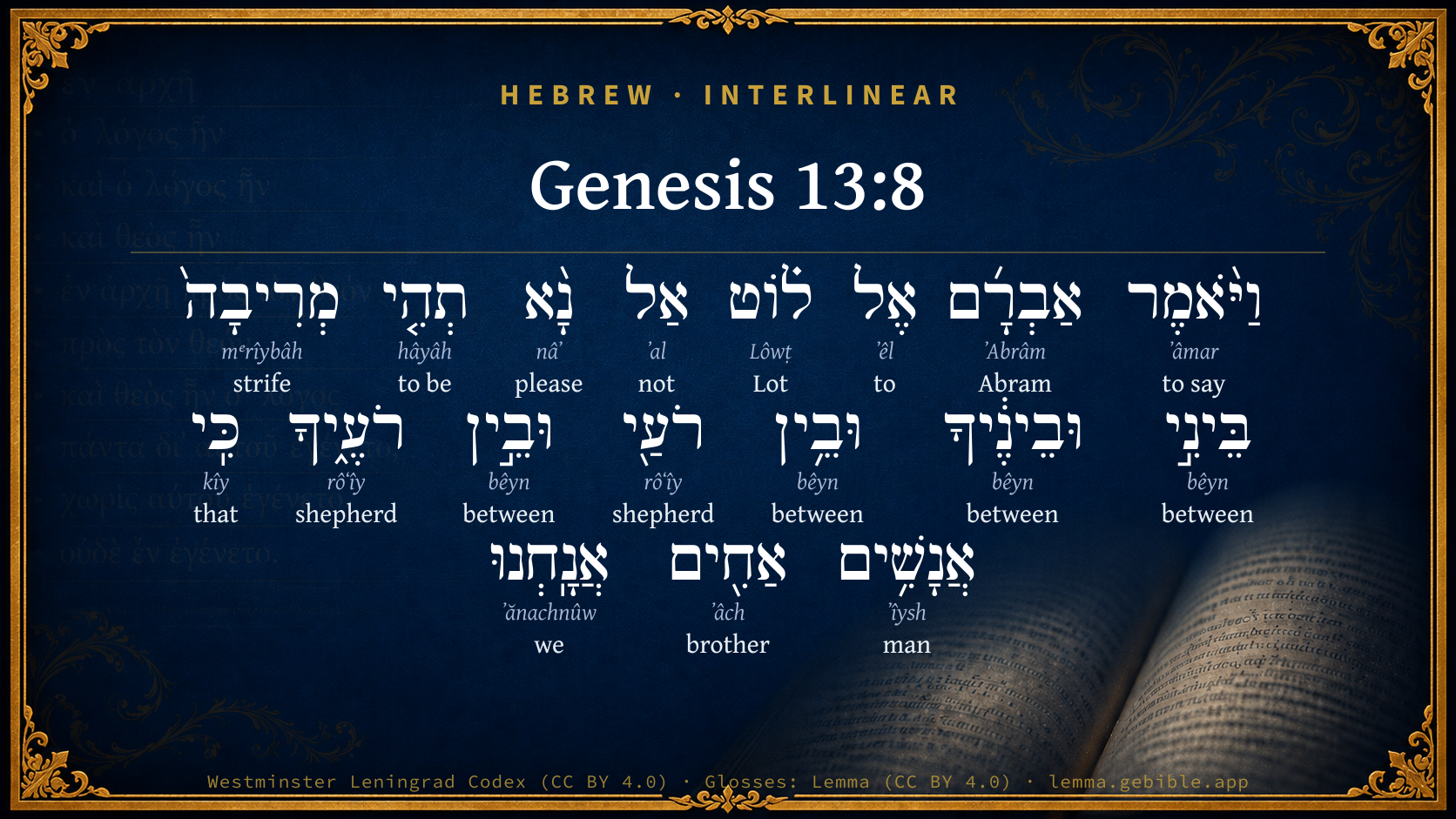
Hebrew (Westminster Leningrad Codex) Genesis 13:8 appears in the Hebrew Old Testament. The text above is from the Westminster Leningrad Codex. Each word links to its Strong’s number, a concise gloss, and parsing drawn from the Open Scriptures Hebrew Bible morphology. Click any word for its full Brown-Driver-Briggs (BDB) entry.
Download image
Cite this verse

Genesis 13:8 (World English Bible). Public Domain. Lemma interlinear Bible study tool, https://lemma.gebible.app/v/genesis/13/8.

Show BibTeX & RIS
BibTeX
RIS
English Translation
Abram said to Lot, "Please, let there be no strife between me and you, and between my herdsmen and your herdsmen; for we are relatives.
World English Bible · Public Domain
Highlights
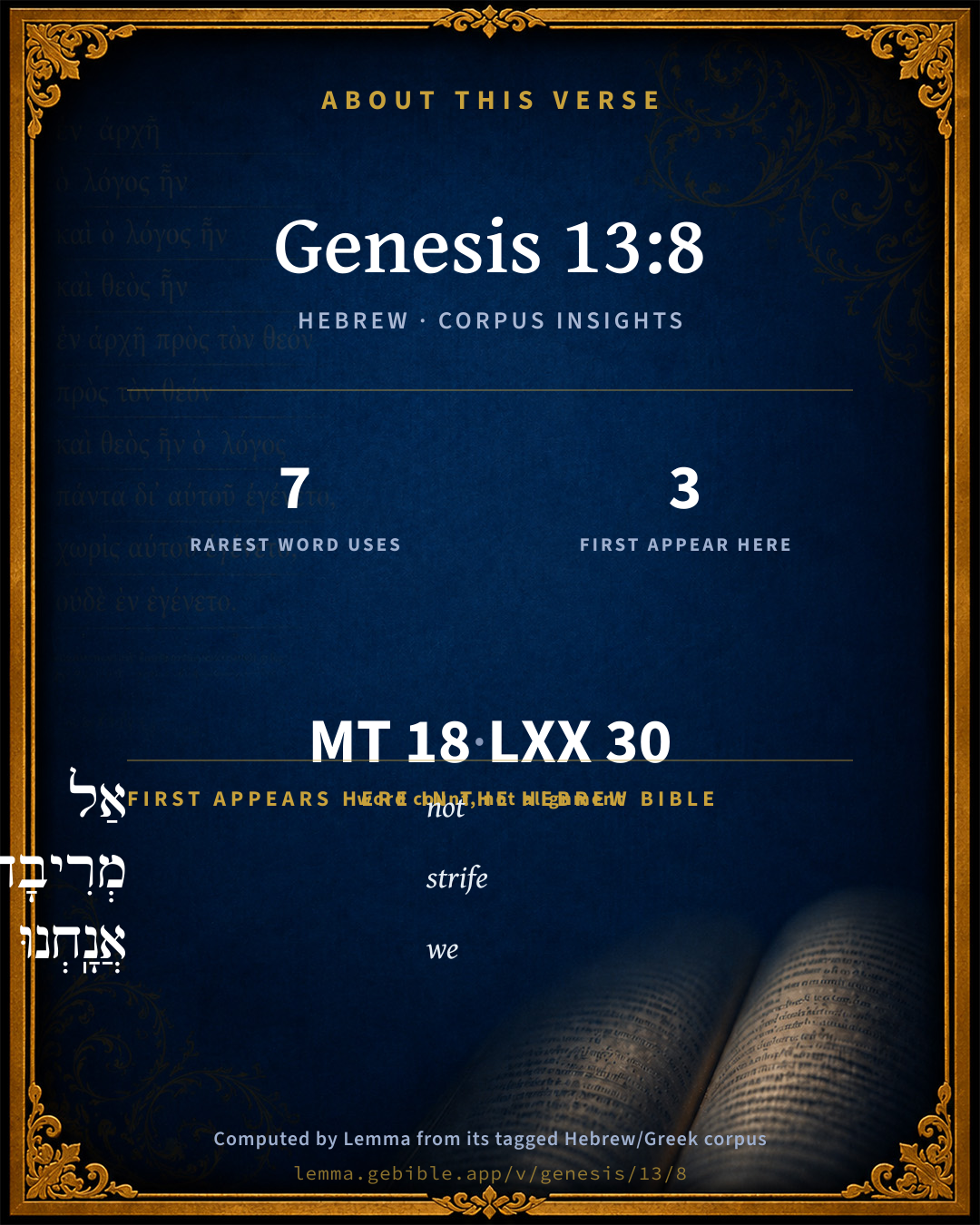
  • 3 first appearances in the Hebrew Bible
Full analysis ↓
Download a study sheet

One document with this verse’s original text, its word-by-word gloss line, the meaning frame, cross-references with their text, attributed commentary, and full source and license credits — printable, and it pastes into notes with its structure intact.

This verse Autodidact and up

Study sheet (.html) Plain text (.txt)

A passage Seminary Student

Up to 50 verses in one chapter. A passage sheet keeps up to 6 commentary sources and 12 cross-references per verse, in the order this page ranks them, and says so on the sheet whenever that leaves anything out. Ask for a single verse and you get the Autodidact verse sheet above.

Everything on this page stays free to read, with no account — the sheet is a download of what is already on screen, not access to it.

Want to remove ads? Support Godless Engineer
Compare translations 3

The same verse in 3 English versions, stacked beneath the original-language interlinear above. Click any original word for its lexicon entry.

Each is an independent rendering of the whole verse — the interlinear is not word-aligned to these translations.

Highlighted words mark where these versions differ — a whole-verse word diff, not a word-by-word alignment.

  • World English Bible Public Domain
    Abram said to Lot, "Please, let there be no strife between me and you, and between my herdsmen and your herdsmen; for we are relatives.
  • King James Version Public Domain
    And Abram said unto Lot, Let there be no strife, I pray thee, between me and thee, and between my herdmen and thy herdmen; for we be brethren.
  • unfoldingWord Literal Text CC BY-SA 4.0
    So Abram said to Lot, “Please do not let there be strife between me and you, or between my herdsmen and your herdsmen, because we men, brothers.

unfoldingWord Literal Text — © unfoldingWord, licensed CC BY-SA 4.0. Word-aligned USFM3 via Door43 (git.door43.org/unfoldingWord/en_ult).

Versions to compare (up to 4)

3 of 4 selected

Show all 18 translations

Every available English version of this verse, each an independent rendering of the whole verse.

  • World English Bible Public Domain
    Abram said to Lot, "Please, let there be no strife between me and you, and between my herdsmen and your herdsmen; for we are relatives.
  • Berean Standard Bible Public Domain
    So Abram said to Lot, “Please let there be no contention between you and me, or between your herdsmen and my herdsmen. After all, we are brothers.
  • Majority Standard Bible Public Domain
    So Abram said to Lot, “Please let there be no contention between you and me, or between your herdsmen and my herdsmen. After all, we are kinsmen.
  • King James Version Public Domain
    And Abram said unto Lot, Let there be no strife, I pray thee, between me and thee, and between my herdmen and thy herdmen; for we be brethren.
  • American Standard Version (1901) Public Domain
    And Abram said unto Lot, Let there be no strife, I pray thee, between me and thee, and between my herdsmen and thy herdsmen; for we are brethren.
  • Revised Version (1885) Public Domain
    And Abram said unto Lot, Let there be no strife, I pray thee, between me and thee, and between my herdmen and thy herdmen; for we are brethren.
  • Geneva Bible (1599) Public Domain
    Then saide Abram vnto Lot, Let there be no strife, I pray thee, betweene thee and me, neither betweene mine heardmen and thine heardmen: for we be brethren.
  • Douay-Rheims (1899) Public Domain
    Abram therefore said to Lot: Let there be no quarrel, I beseech thee, between me and thee, and between my herdsmen and thy herdsmen: for we are brethren.
  • Young's Literal Translation Public Domain
    And Abram saith unto Lot, `Let there not, I pray thee, be strife between me and thee, and between my shepherds and thy shepherds, for we `are' men -- brethren.
  • Literal Standard Version CC BY-SA 4.0
    And Abram says to Lot, “Please let there not be strife between me and you, and between my shepherds and your shepherds, for we [are] men—brothers.
  • Unlocked Literal Bible CC BY-SA 4.0
    So Abram said to Lot, “Let there be no strife between you and me, and between your herdsmen and my herdsmen; after all, we are family.
  • unfoldingWord Literal Text CC BY-SA 4.0
    So Abram said to Lot, “Please do not let there be strife between me and you, or between my herdsmen and your herdsmen, because we men, brothers.
  • Darby Bible Public Domain
    And Abram said to Lot, I pray thee let there be no contention between me and thee, and between my herdsmen and thy herdsmen, for we are brethren.
  • World Messianic Bible Public Domain
    Abram said to Lot, “Please, let there be no strife between you and me, and between your herdsmen and my herdsmen; for we are relatives.
  • Webster's Bible Public Domain
    And Abram said to Lot, Let there be no strife, I pray thee, between me and thee, and between my herdmen and thy herdmen; for we are brethren.
  • Free Bible Version CC BY-SA 4.0
    So Abram said to Lot, “Please don't let's have arguments between us, or between our herdsmen, because we're family.
  • Bible in Basic English Public Domain
    Then Abram said to Lot, Let there be no argument between me and you, and between my herdmen and your herdmen, for we are brothers.
  • JPS Tanakh (1917) Public Domain
    And Abram said unto Lot: 'Let there be no strife, I pray thee, between me and thee, and between my herdmen and thy herdmen; for we are brethren.

Literal Standard Version (2020), Covenant Press — licensed CC BY-SA 4.0. Text via the HelloAO Bible API (eBible.org). Unlocked Literal Bible (unfoldingWord) — licensed CC BY-SA 4.0. Text via the HelloAO Bible API (eBible.org). unfoldingWord Literal Text — © unfoldingWord, licensed CC BY-SA 4.0. Word-aligned USFM3 via Door43 (git.door43.org/unfoldingWord/en_ult). Free Bible Version, Dr. Jonathan Gallagher — licensed CC BY-SA 4.0. Text via the HelloAO Bible API (eBible.org).

Word by word

More ways to search: Search by grammar → Find every occurrence → Compare this word →

Practice this passage: Drill this verse → Learn its vocabulary →

מְרִיבָה֙
mᵉrîybâh
H4808
“strife”
Noun, Common, Feminine, Singular, Absolute
Part of Speech
Noun
Type
Common
Gender
Feminine
Number
Singular
State
Absolute
Full BDB Definition

Origin: from H7378

TWOT: 2159c

strife, contention
  1. וַיֹּ֨אמֶר ʼâmar H559 “and · to say” Conjunction + Verb, Qal, Sequential Imperfect, 3rd Person, Masculine, Singular
  2. אַבְרָ֜ם ʼAbrâm H87 “Abram” Noun, Proper
  3. אֶל ʼêl H413 “to” Preposition
  4. ל֗וֹט Lôwṭ H3876 “Lot” Noun, Proper
  5. אַל ʼal H408 “not” Particle, Negative
  6. נָ֨א nâʼ H4994 “please” Particle, Exhortation
  7. תְהִ֤י hâyâh H1961 “to be” Verb, Qal, Jussive, 3rd Person, Feminine, Singular
  8. בֵּינִ֣י bêyn H996 “between · me” Preposition + Suffix, Personal, 1st Person, Common, Singular
  9. וּבֵינֶ֔יךָ bêyn H996 “and · between · you” Conjunction + Preposition + Suffix, Personal, 2nd Person, Masculine, Singular
  10. וּבֵ֥ין bêyn H996 “and · between” Conjunction + Preposition
  11. רֹעַ֖י rôʻîy H7473 “shepherd · me” Verb, Qal, Participle Active, Masculine, Plural, Construct + Suffix, Personal, 1st Person, Common, Singular
  12. וּבֵ֣ין bêyn H996 “and · between” Conjunction + Preposition
  13. רֹעֶ֑יךָ rôʻîy H7473 “shepherd · you” Verb, Qal, Participle Active, Masculine, Plural, Construct + Suffix, Personal, 2nd Person, Masculine, Singular
  14. כִּֽי kîy H3588 “that” Conjunction
  15. אֲנָשִׁ֥ים ʼîysh H376 “men” Noun, Common, Masculine, Plural, Absolute
  16. אַחִ֖ים ʼâch H251 “brothers” Noun, Common, Masculine, Plural, Absolute
  17. אֲנָֽחְנוּ ʼănachnûw H587 “we” Pronoun, Personal, 1st Person, Common, Plural

About this verse

These counts appear in no published source. They are computed here, from the morphology-tagged text and Lemma’s own curated glosses. What Lemma adds →

18
words
14
distinct lemmas
Pentateuch
section

Notable vocabulary

The rarest word here is מְרִיבָה֙ strife H4808 — appearing just 7 times in the whole Hebrew Bible.

First appearance in Scripture

These words make their first canonical appearance in the Hebrew Bible here:

  • אַל not H408
  • מְרִיבָה֙ strife H4808
  • אֲנָֽחְנוּ we H587

Shared distinctive vocabulary

מְרִיבָה֙ strife H4808 occurs in 7 verses of the Hebrew Bible. Also found in:

Grammatical profile

  • 4 verbs
  • 5 nouns
  • 1 pronoun
  • 5 prepositions
  • 1 conjunction
  • 2 particles

Verb forms

  • וַיֹּ֨אמֶר Qal · Sequential Imperfect
  • תְהִ֤י Qal · Jussive
  • רֹעַ֖י Qal · Participle Active
  • רֹעֶ֑יךָ Qal · Participle Active

Repetition

Words recur within this verse — often emphatic in Hebrew:

  • בֵּינִ֣י between H996 ×4
  • רֹעַ֖י shepherd H7473 ×2

Hebrew & Septuagint length

In English translation the verse runs 25 words from the Hebrew and 26 from the Septuagint (LXX English) — closely comparable.

A rough comparison of the two English renderings, which tokenize alike — not a word-level alignment.

Word counts can differ between the Hebrew and the Greek without any difference in meaning — e.g. the Hebrew direct-object marker אֵת has no separate Greek word, and Greek often adds the article ὁ.

In the original languages it is 18 Hebrew tokens and 30 Greek tokens — but the two are counted differently (Hebrew bundles its prefixes and suffixes into one token; the Greek is in lemma form), so that isn’t a like-for-like length.

Cross-references

26

Topical passages linked to Genesis 13:8 in the Treasury of Scripture Knowledge — connected by theme and wording, ordered by reader-vote popularity; previews shown in the World English Bible.

  • 1 Corinthians 6:6–7 But brother goes to law with brother, and that before unbelievers!
  • Acts 7:26 "The day following, he appeared to them as they fought, and urged them to be at peace again, saying, 'Sirs, you are brothers. Why do you wrong one another?'
  • Psalms 133:1 See how good and how pleasant it is For brothers to live together in unity!
  • Genesis 11:27–31 Now this is the history of the generations of Terah. Terah became the father of Abram, Nahor, and Haran. Haran became the father of Lot.
  • Genesis 45:24 So he sent his brothers away, and they departed. He said to them, "See that you don't quarrel on the way."
  • Proverbs 15:1 A gentle answer turns away wrath, But a harsh word stirs up anger.
  • Proverbs 20:3 It is an honor for a man to keep aloof from strife; But every fool will be quarreling.
  • Romans 12:10 In love of the brothers be tenderly affectionate one to another; in honor preferring one another;
  • Ephesians 4:2–3 with all lowliness and humility, with patience, bearing with one another in love;
  • 1 Peter 3:8 Finally, be all like-minded, compassionate, loving as brothers, tenderhearted, courteous,
  • 1 Peter 4:8 And above all things be earnest in your love among yourselves, for love covers a multitude of sins.
  • 2 Peter 1:7 and in godliness brotherly affection; and in brotherly affection, love.
  • 1 John 2:9–11 He who says he is in the light and hates his brother, is in the darkness even until now.
  • 1 John 3:14–19 We know that we have passed out of death into life, because we love the brothers. He who doesn't love his brother remains in death.
  • 1 John 4:20–21 If a man says, "I love God," and hates his brother, he is a liar; for he who doesn't love his brother whom he has seen, how can he love God whom he has not seen?
  • Exodus 2:13 He went out the second day, and, behold, two men of the Hebrews were fighting with each other. He said to him who did the wrong, "Why do you strike your fellow?"
  • Proverbs 15:18 A wrathful man stirs up contention, But one who is slow to anger appeases strife.
  • Matthew 5:9 Blessed are the peacemakers, For they shall be called children of God.
  • Philippians 2:14 Do all things without murmurings and disputes,
  • 1 Thessalonians 4:9 But concerning brotherly love, you have no need that one write to you. For you yourselves are taught by God to love one another,
  • Hebrews 12:14 Follow after peace with all men, and the sanctification without which no man will see the Lord,
  • Hebrews 13:1 Let brotherly love continue.
  • James 3:17–18 But the wisdom that is from above is first pure, then peaceful, gentle, reasonable, full of mercy and good fruits, without partiality, and without hypocrisy.
  • 1 Peter 1:22 Seeing you have purified your souls in your obedience to the truth through the Spirit in sincere brotherly affection, love one another from the heart fervently:
  • 1 Peter 2:17 Honor all men. Love the brotherhood. Fear God. Honor the king.
  • 1 John 4:7 Beloved, let us love one another, for love is of God; and everyone who loves is born of God, and knows God.

Cross-references courtesy of OpenBible.info (CC BY 4.0).

Hebrew and Greek witnesses Masoretic Hebrew ↔ Greek Septuagint

The same verse in the two great witnesses to the Old Testament, shown verse-for-verse.

These are two independent witnesses, not word-aligned to each other, and the Septuagint is shown in lemma (dictionary) form.

Hebrew Genesis 13:8 Masoretic · Westminster Leningrad Codex

וַיֹּ֨אמֶר אַבְרָ֜ם אֶל ל֗וֹט אַל נָ֨א תְהִ֤י מְרִיבָה֙ בֵּינִ֣י וּבֵינֶ֔יךָ וּבֵ֥ין רֹעַ֖י וּבֵ֣ין רֹעֶ֑יךָ כִּֽי אֲנָשִׁ֥ים אַחִ֖ים אֲנָֽחְנוּ

Abram said to Lot, "Please, let there be no strife between me and you, and between my herdsmen and your herdsmen; for we are relatives.

World English Bible · Public Domain

Greek LXX Genesis 13:8 Septuagint · lemma form

εἶπον δέ αβραμ ὁ λωτ μή εἰμί μάχη ἀνά μέσος ἐγώ καί σύ καί ἀνά μέσος ὁ ποιμήν ἐγώ καί ἀνά μέσος ὁ ποιμήν σύ ὅτι ἄνθρωπος ἀδελφός ἐγώ εἰμί

And Abram said to Lot, Let there not be a strife between me and you, and between my herdmen and your herdmen, for we are brethren.

LXX2012 (modern English Septuagint) · Public Domain

Hebrew: Westminster Leningrad Codex (CC BY 4.0). Greek: Septuagint (public domain); English from LXX2012 (modern English Septuagint) (Public Domain). How the Septuagint differs from the Hebrew →

Targum (Aramaic paraphrase)

2

The Targum is the ancient Jewish Aramaic paraphrase of the Hebrew Scriptures — an interpretive translation, not the Hebrew text itself. Onkelos (literal) and Pseudo-Jonathan (expansive) render the Torah, and Jonathan the Prophets. Coverage is partial: where no permissively-licensed English translation exists for a verse, only the Aramaic is shown. This is verse-level text, not a word-by-word alignment to the Hebrew.

  1. Targum Onkelos Torah (Genesis–Deuteronomy)
    וַאֲמַר אַבְרָם לְלוֹט לָא כְעַן תְּהֵי מַצוּתָא בֵּינָא וּבֵינָךְ וּבֵין רַעֲוָתִי וּבֵין רַעֲוָתָךְ אֲרֵי גוּבְרִין אַחִין אֲנָחְנָא

    And Abram said to Lot, Let there not now be contention between me and thee, and between my shepherds and thy shepherds; for men, brethren, are we.

    Targum Onkelos — Aramaic: “Onkelos Genesis” (public domain); “Onkelos Exodus” (public domain); “Onkelos Leviticus” (public domain); “Onkelos Numbers” (public domain); “Onkelos Deuteronomy” (public domain). English: “Sefaria Community Translation” (CC0 1.0 (public-domain dedication)); “J.W. Etheridge. The Targums of Onkelos and Jonathan Ben Uzziel on the Pentateuch. London: Longmans, Green, 1862” (public domain). Text via Sefaria.

  2. Targum Pseudo-Jonathan Torah (Genesis–Deuteronomy)
    וַאֲמַר אַבְרָם לְלוֹט לָא כְעַן תְּהֵי מַצוּתָא בֵּינָא וּבֵינָךְ וּבֵין רַעֲוָותִי וּבֵין רַעֲוָותָךְ אֲרוּם גוּבְרִין אָחִין אֲנַחְנָא

    And Abram said to Lot, Between me and thee let there not now be controversy, nor between my shepherds and thy shepherds; for we are brother-men.

    Targum Pseudo-Jonathan — Aramaic: “Targum Jonathan on Genesis” (public domain); “Targum Jonathan on Exodus” (public domain); “Targum Jonathan on Leviticus” (public domain); “Targum Jonathan on Numbers” (public domain); “Targum Jonathan on Deuteronomy” (public domain). English: “The Targum of Jonathan ben Uzziel, trans. J. W. Etheridge, London, 1862” (public domain). Text via Sefaria.

Commentary

Notes on Genesis 13:8 from classic Christian and Jewish commentators (each source and its license shown beneath its notes). The classic Christian expositions comment on the surrounding passage and are grouped to its opening verse, so a note may address several verses; the Jewish commentaries on the Tanakh (Rashi and others) are per-verse, so they appear only where the commentator wrote on this verse.

Lemma curates 59 commentaries, every one of them public domain or Creative Commons licensed, each selected and text-cleaned for this edition rather than reprinted as found. About our sources →

Trapp's Complete Commentary

John Trapp

Gen 13:8 And Abram said unto Lot, Let there be no strife, I pray thee, between me and thee, and between my herdmen and thy herdmen; for we [be] brethren.

Ver. 8. And Abram said to Lot.] Speech endeth anger, silence nourisheth it. Much malice and grudge would be avoided, and the very poison of it drawn out, did we but give it a vent at first, by reasoning with the party that wronged us, and expostulating the injury, which most times is but a mere mistake. Now many, on the contrary, harbour this viper in their bosoms, till it hath eaten to their hearts; they not only let "the sun go down," but go its whole round "upon their wrath," {Eph 4:26} and cannot find time from one end of the year to the other, to utter their minds, and compound their discords. Not only Abram, but Aristippus shall rise up in judgment against such pseudo-Christians, and condemn them. For when Aeschines and he had been at long debate, {a} and there was, I stout, and thou stout, and neither could find in their hearts to go to the other; Aristippus went at length to Aeschines, and said unto him, "Shall we not agree to be friends, before we make ourselves a common scorn to the whole country?" Whereunto when Aeschines answered, that he was content to be friends with all his heart; Aristippus replied, "Remember then, that although I were the elder and the better man, yet I first sought unto thee." "In very deed," said Aeschines, "thou art a far better man than I; for I began the quarrel, and thou hast been first in making up the breach." And thus these two became fast friends for ever.

For we are brethren.] This is a cooler; and should be like the angel that stayed Abram’s hand when the blow was coming.

{a} Plutarch De Cohib. Ira, Laer., lib. ii.

John Trapp, A Commentary or Exposition upon All the Books of the Old and New Testament (1647–1656) — public domain. Text from a community e-Sword module.

Joseph Benson's Commentary

Gen 13:8-9. Although Abram was the elder, wiser, and every way worthier person than Lot, yet he voluntarily, and without reluctance or hesitation, relinquishes his own right to his inferior for the sake of peace, that no scandal might be brought on the true religion, hereby leaving a noble example for our imitation. Let there be no strife between me and thee —

So nearly related as kinsmen, and as worshippers and children of the one living and true God. Betwixt us a contention will be very indecent, and of scandalous tendency.

Joseph Benson's Commentary on the Old and New Testaments (1811–1818) — public domain. Text from a community e-Sword module.

Tyndale Open Study Notes

Tyndale Open Resources

13:8-13 Abram, to whom the land was promised, might have told Lot to find his own place. Abram’s generosity was an act of faith; he knew that even if he gave the whole land away, God would still give it to him and his descendants. Abram did not have to cling to things, whereas Lot’s choices were self-seeking.

13:8 Abram was concerned that there be no conflict (Hebrew meribah) between them, as they were close relatives (literally brothers). Moses later reproved Israel over the incident in the wilderness at Meribah (Exod 17:1-7; Num 20:1-13) and instructed them on exercising faith in such situations. Meribah thereafter became a watchword for testing and striving with the Lord in unbelief (see Ps 95).

Tyndale Open Study Notes — © Tyndale Open Resources, licensed CC BY-SA 4.0. Text via the HelloAO Bible API.

Geneva Bible (1599)

Geneva Bible translators

He cutteth off the occasion of contention: therefore the evil ceaseth.

Geneva Bible (1599) marginal notes — public domain. Text via Bolls.life.

Adam Clarke's Commentary

Verse 8. For we be brethren.] We are of the same family, worship the same God in the same way, have the same promises, and look for the same end. Why then should there be strife? If it appear to be unavoidable from our present situation, let that situation be instantly changed, for no secular advantages can counterbalance the loss of peace.

Adam Clarke's Commentary on the Bible (1810–1826) — public domain. Text from a community e-Sword/MySword module.

John Calvin's Commentaries

8. And Abram said unto Lot. Moses first states, that Abram no sooner perceived the strifes which had arisen, than he fulfilled the duty of a good householder, by attempting to restore peace among his domestics; and that afterwards, by his moderation, he endeavored to remedy the evil by removing it. And although the servants alone were contending, he yet does not say in vain, Let there be no strife between me and thee: because it was scarcely possible but that the contagion of the strife should reach from the domestics to their lords, although they were in other respects perfectly agreed. He also foresaw that their friendship could not long remain entire, unless he attempted, in time, to heal the insidious evil. Moreover, he calls to mind the bond of consanguinity between them; not because this alone ought to avail to promote mutual peace, but that he might more easily bend and mollify the mind of his nephew. For when the fear of God is less effectual with us than it ought to be; it is useful to call in other helps also, which may retain us in our duty. Now however since we all are adopted as sons of God, with the condition annexed, that we should be mutually brethren to each other: this sacred bond is less valued by us than it ought to be, if it does not prove sufficient to allay our contentions.

John Calvin's Commentaries (1540-1563) — public domain. Text from the Calvin Translation Society English edition (1840s-50s) via the Christian Classics Ethereal Library (ccel.org). Calvin's coverage is partial (roughly two-thirds of the Bible); uncommented books and verses are honest gaps, never fabricated. The 19th-century editor's footnotes and remarks are omitted so the notes are faithfully Calvin's own voice.

Ellicott's Commentary for English Readers

(8, 9) Let there be no strife.—It is evident that Lot was beginning to take part with his herdmen, and regard himself as an injured man. But Abram meets him with the utmost generosity, acknowledges that their growth in wealth rendered a separation necessary, and gives him his choice. And Lot accepts it. Instead of feeling that it was due to his uncle’s age and rank to yield to him the preference, he greedily accepts the offer, selects the region that seemed to offer the greatest earthly advantages, but finds in the long run that it has perils which far outweigh its promises of wealth and pleasure.

A Bible Commentary for English Readers, edited by Charles John Ellicott (1878–1897) — public domain. Text from a community e-Sword module.

The Cambridge Bible for Schools and Colleges

gen. ed. J. J. S. Perowne

8. for we are brethren] i.e. kinsmen; Abram being Lot’s uncle. Cf. Gen_14:14, “and when Abram heard that his brother (i.e. Lot) was taken captive.”

Abram, as the elder, takes the lead in the conference: his proposal is made with generosity and dignity. Lot, though the younger, is to have his choice.

The Cambridge Bible for Schools and Colleges (gen. ed. J. J. S. Perowne; Cambridge University Press, 1878–1918) — public domain. Text from a community e-Sword module.

John Gill's Exposition

And Abram said unto Lot,.... Being either an ear witness himself of the contentions of their servants, or having it reported to him by credible persons, he applied himself to Lot, in order to make peace, being a wise and good man; and though he was senior in years, and superior in substance, and higher in the class of relation, and upon all accounts the greatest man, yet he makes the proposal first, and lays a scheme before Lot for their future friendship, and to prevent quarrels, and the mischievous consequences of them:

let there be no strife, I pray thee, between me and thee; there had been none yet, but it was very likely there would, if the dissension should go on between their servants; they could not well avoid interesting themselves in it, when it related to their respective properties; and there must be a right and wrong in such cases to be looked into and adjusted, which might occasion a difference between them; and this Abram was desirous of preventing, and therefore bespeaks his kinsman in this loving, affectionate, and condescending language:

and or between my herdmen and thy herdmen; as he understood there was, and which, if not timely put an end to, might be of bad consequence to them both, especially as to their peace and comfort, giving this excellent reason to enforce his request:

for we be brethren; or "men brethren we be" (u); we are men, let us act like such, the rational and humane part; they were brethren being men, so by nature all are brethren; by natural relation, Lot being the son of his brother Haran; brethren in religion, of the same faith in the one true and living God, and worshippers of him; and therefore on all accounts, by the ties of nature, relation, and religion, they were obliged to seek and cultivate peace and love.

(u) "viri fratres vos", Pagninus Montanus, Drusius, Schmidt.

John Gill's Exposition of the Whole Bible (1746–1763) — public domain (CC PDM 1.0). Text via the HelloAO Bible API.

Haydock's Catholic Bible Commentary

Abram therefore, for fear of raising a quarrel with the Pherezites also, who might complain that these strangers were eating up what they had before taken possession of, suggests to his nephew the propriety of their taking different courses. Being the older, he divides, and the younger chooses, according to an ancient and laudable custom. (St. Augustine, City of God xvi. 20.)

George Leo Haydock (1774–1849), Haydock's Catholic Family Bible and Commentary, 1859 edition — public domain. Excludes Psalms (Douay-Rheims chapter numbering differs from Protestant) and Deuterocanonical books (Catholic canon only).

Matthew Poole's English Annotations

Abram said unto Lot. The elder, and wiser, and worthier person relinquisheth his own right to his inferior for peace sake, leaving us a noble example for our imitation.

Between me and thee, and between; or, or between, & c., and for or, as Exo 21:17; Psa 8:4, compared with Mat 15:14; Heb 2:6, for there was no strife between Abram and Lot, though he feared it might pass from the feet to the head.

For we be brethren, i.e. both by nature near kinsmen, as the word brother is oft used, and in the faith and religion too, amongst whom contentions are very indecent and scandalous.

Matthew Poole's English Annotations on the Holy Bible (1683–1685) — public domain. Text from a community e-Sword/MySword module.

Whedon's Commentary on the Bible

Daniel D. Whedon

8. Abram said — Abram’s words and proposition on the occasion are most magnanimous, and every way worthy of the father of the faithful. “He walks,” says Murphy, “in the moral atmosphere of the Sermon on the Mount. Mat_5:38-42.”

We be brethren — Hebrews, Men brethren are we. Compare Act_15:13; Act_23:1. Their kinship and religious affinity would authorize this warm expression.

Daniel D. Whedon (gen. ed.), Commentary on the Old and New Testaments (1874–1909) — public domain. Text from a community e-Sword module.

The Pulpit Commentary

And Abram said unto Lot. Perceiving probably that Lot"s face was not towards him as usual, and being desirous to avert the danger of collision between his nephew and himself. Let there be no strife, I pray thee, between me and thee, and (i.e. either identifying himself and his nephew with their subordinates, or fearing that the strife of their subordinates might spread to themselves, hence, as) between my herd-men and thy herdmen; for we be brethren. Literally, men brethren (cf. Gen_11:27, Gen_11:31; Exo_2:13; Psa_133:1) Abram and Lot were kinsmen by nature, by relationship, and by faith (vide 2Pe_2:7)

HOMILIES BY F. HASTINGS Ver. 8.

Abraham, the peaceable man.

there be no strife, I pray thee, between me and thee." Abraham had a nephew who attached himself to his fortunes and shared his fate. Food, fodder, and water became scarce. The flocks of Lot and of Abraham are more than the land can sustain; the herdsmen of each strive together. Servants will often be more bitter towards the servants of a rival of their master, than those immediately concerned. Pathetic is the appeal of the patriarch for the maintenance of peace.

I IT IS A MOST DESIRABLE THING TO LIVE IN PEACE WITH OTHERS. We are commanded to do so: "As much as lieth in you live peaceably with all men." We may not sacrifice any good principle for the sake of ease, but we are to strive to maintain peace. In matters of faith a man may have to take up at times such a position that others will speak ill of him, but in regard to the neighborly life he must by all means cultivate amity and concord. Little is ever gained by standing on "our rights." Scandal is always the fruit of quarrelling. The worldly-minded are sure to plume themselves on their superior goodness when the spiritually-minded contend. In many homes there is jangling, sneering, and strife; scathing remarks like hot cinders from Vesuvius fall carelessly around. Tyrannous tempers become like tornados, and moodiness kills like the choke-damp of an ill-ventilated mine. Among nations there should be maintenance of peace. The common sense of most should "hold the fretful realm in awe." In the Church strife should cease. It will when each sect seeks to make men Christ-like and not uniform bigots.

II THERE ARE ALWAYS MEANS OF MAINTAINING PEACE WHEN IT IS DESIRED. Abraham acted most unselfishly with this view; he yielded his claim to a choice. Lot owed much to Abraham, yet he seized an advantage. Lot looks towards Sodom; the strip of green beside the lake and reaching to Jordan reminds him of the land of Nile. The spirit of Egypt, whence he had lately come, is in him; he chooses Sodom, but with its green pastures he has to take its awful corruption. Abraham turns away in the direction alone left to him. He has his tent, his altar, the promises, and his God; he will live in peace. His Father will not forsake him; indeed God very speedily renews his promises to Abraham, and thus the unselfishness of a peaceful man met with an appropriate reward. H.

The Pulpit Commentary (1880–1919), ed. H.D.M. Spence-Jones & Joseph S. Exell — public domain. Text from a community e-Sword module.

Keil & Delitzsch

C. F. Keil & F. Delitzsch

To put an end to the strife between their herdsmen, Abram proposed to Lot that they should separate, as strife was unseemly between אחים אנשׁים, men who stood in the relation of brethren, and left him to choose his ground. "If thou to the left, I will turn to the right; and if thou to the right, I will turn to the left." Although Abram was the older, and the leader of the company, he was magnanimous enough to leave the choice to his nephew, who was the younger, in the confident assurance that the Lord would so direct the decision, that His promise would be fulfilled.

Keil & Delitzsch — Biblical Commentary on the Old Testament (1861–1891) — public domain (CC PDM 1.0). Text via the HelloAO Bible API. (Old Testament only.)

unfoldingWord translationNotes

Door43 World Missions Community

Let there be no strife between you and me

"Let's not quarrel"

strife

arguments or fights

between your herdsmen and my herdsmen

"let's stop the men who take care of our animals from quarreling"

after all, we are family

"because we are family"

family

"kinsmen" or "relatives." Lot was Abraham's nephew.

Is not the whole land before you?

This rhetorical question can be translated as a positive statement. AT: "The whole land is available for you to use." (See: Rhetorical Question)

Go ahead and separate yourself from me

Abraham was speaking kindly to Lot and encouraging him to do something that would help them both. "Let's separate."

If you go to the left, then I will go to the right

Possible meanings are 1) "If you go one way, then I will go the other" or 2) "If you go to the north, I will go to the south." Abram let Lot choose the part of the land he wanted, and Abram would take what remained.

translationWords

Abraham

Lot

unfoldingWord translationNotes — © Distant Shores Media and the Door43 World Missions Community, licensed CC BY-SA 4.0. Source: git.door43.org/Door43/en_tn.

Rashi

Rabbi Shlomo Yitzchaki (Rashi)

אנשים אחים BROTHERS — i. e. kinsmen. The Midrashic explanation is: that they resembled each other in their facial features (Genesis Rabbah 41:6).

Rashi on the Tanakh — English translations: “The Judaica Press complete Tanach with Rashi, translated by A. J. Rosenberg” (CC BY 4.0); “Pentateuch with Rashi's commentary by M. Rosenbaum and A.M. Silbermann, 1929-1934” (public domain); “The Metsudah Tanach series, Lakewood, N.J” (CC BY 4.0); and “The Book of Joshua, Metsudah Publications, 1997” (CC BY 4.0). Text via Sefaria.

Radak

Rabbi David Kimhi (Radak)

ויאמר...ביני ובינך, if our shepherds keep on quarrelling it will not be long before we start quarrelling ourselves.

Radak on the Tanakh — English translations: “Sefaria Community Translation” (CC0 1.0 (public-domain dedication)); “Eliyahu Munk, HaChut Hameshulash” (CC BY 4.0); “Rabbi Mike Feuer, Jerusalem Anthology” (CC BY 4.0); and “R. David Kimhi on the first book of Psalms, Translated by R.G. Finch, London, 1919” (public domain). Text via Sefaria.

Lesson kit

Teaching starters — assembled from the data on this page, not authored interpretation. Every prompt links to the verse data it draws on. Edit before teaching.

Genesis, in the Pentateuch, opens this verse with 18 words (14 distinct Hebrew lemmas). Its most distinctive word is mᵉrîybâh (“strife”). A historical commentator’s framing appears above. Read the whole chapter for the surrounding context.

Discussion questions

  1. How does “strife” (mᵉrîybâh) shape what this verse is saying?
  2. 3 words here appear for the first time in Scripture. What is being introduced at this debut?
  3. Numbers 27:14 shares the word «strife» with this verse. How do the two illuminate each other?
  4. “between” occurs 4× in this one verse. What is the effect of the repetition?
  5. These translations render this verse differently. What is at stake in choosing one wording over another?
  6. The verb «וַיֹּ֨אמֶר» is Qal Sequential Imperfect. How does its form color the action?
  7. Reading how Trapp's Complete Commentary and Joseph Benson's Commentary read this verse, where do the two commentators agree and where do they part?

Things to notice

Reading settings

Reading text

Shown beneath each verse's original-language words.

Old Testament
Old Testament edition

Read the OT as the Masoretic Hebrew (MT) or the Greek Septuagint (LXX).

English shown for the Greek Septuagint (in the Hebrew ↔ Greek comparison).

Comparing translations? Open the Compare panel on any verse page to stack up to four side by side.