Genesis 37:15

Hebrew (Westminster Leningrad Codex) Genesis 37:15 appears in the Hebrew Old Testament. The text above is from the Westminster Leningrad Codex. Each word links to its Strong’s number, a concise gloss, and parsing drawn from the Open Scriptures Hebrew Bible morphology. Click any word for its full Brown-Driver-Briggs (BDB) entry.
Download image
Cite this verse

Genesis 37:15 (World English Bible). Public Domain. Lemma interlinear Bible study tool, https://lemma.gebible.app/v/genesis/37/15.

Show BibTeX & RIS
BibTeX
RIS
English Translation
A certain man found him, and behold, he was wandering in the field: and the man asked him, saying, "What are you looking for?"
World English Bible · Public Domain
Download a study sheet

One document with this verse’s original text, its word-by-word gloss line, the meaning frame, cross-references with their text, attributed commentary, and full source and license credits — printable, and it pastes into notes with its structure intact.

This verse Autodidact and up

Study sheet (.html) Plain text (.txt)

A passage Seminary Student

Up to 50 verses in one chapter. A passage sheet keeps up to 6 commentary sources and 12 cross-references per verse, in the order this page ranks them, and says so on the sheet whenever that leaves anything out. Ask for a single verse and you get the Autodidact verse sheet above.

Everything on this page stays free to read, with no account — the sheet is a download of what is already on screen, not access to it.

Want to remove ads? Support Godless Engineer
Compare translations 3

The same verse in 3 English versions, stacked beneath the original-language interlinear above. Click any original word for its lexicon entry.

Each is an independent rendering of the whole verse — the interlinear is not word-aligned to these translations.

Highlighted words mark where these versions differ — a whole-verse word diff, not a word-by-word alignment.

  • World English Bible Public Domain
    A certain man found him, and behold, he was wandering in the field: and the man asked him, saying, "What are you looking for?"
  • King James Version Public Domain
    And a certain man found him, and, behold, he was wandering in the field: and the man asked him, saying, What seekest thou?
  • unfoldingWord Literal Text CC BY-SA 4.0
    And a man found him, and behold, he was wandering around in the fields. So the man asked him, saying, “What are you looking for?”

unfoldingWord Literal Text — © unfoldingWord, licensed CC BY-SA 4.0. Word-aligned USFM3 via Door43 (git.door43.org/unfoldingWord/en_ult).

Versions to compare (up to 4)

3 of 4 selected

Show all 18 translations

Every available English version of this verse, each an independent rendering of the whole verse.

  • World English Bible Public Domain
    A certain man found him, and behold, he was wandering in the field: and the man asked him, saying, "What are you looking for?"
  • Berean Standard Bible Public Domain
    a man found him wandering in the field and asked, “What are you looking for?”
  • Majority Standard Bible Public Domain
    a man found him wandering in the field and asked, “What are you looking for?”
  • King James Version Public Domain
    And a certain man found him, and, behold, he was wandering in the field: and the man asked him, saying, What seekest thou?
  • American Standard Version (1901) Public Domain
    And a certain man found him, and, behold, he was wandering in the field: and the man asked him, saying, What seekest thou?
  • Revised Version (1885) Public Domain
    And a certain man found him, and, behold, he was wandering in the field: and the man asked him, saying, What seekest thou?
  • Geneva Bible (1599) Public Domain
    Then a man found him: for lo, hee was wandring in the fielde, and the man asked him, saying, What seekest thou?
  • Douay-Rheims (1899) Public Domain
    And a man found him there wandering in the field, and asked what he sought.
  • Young's Literal Translation Public Domain
    And a man findeth him, and lo, he is wandering in the field, and the man asketh him, saying, `What seekest thou?'
  • Literal Standard Version CC BY-SA 4.0
    And a man finds him, and behold, he is wandering in the field, and the man asks him, saying, “What do you seek?”
  • Unlocked Literal Bible CC BY-SA 4.0
    A certain man found Joseph. Behold, Joseph was wandering in a field. The man asked him, “What do you seek?”
  • unfoldingWord Literal Text CC BY-SA 4.0
    And a man found him, and behold, he was wandering around in the fields. So the man asked him, saying, “What are you looking for?”
  • Darby Bible Public Domain
    And a man found him, and behold, he was wandering in the country; and the man asked him, saying, What seekest thou?
  • World Messianic Bible Public Domain
    A certain man found him, and behold, he was wandering in the field. The man asked him, “What are you looking for?”
  • Webster's Bible Public Domain
    And a certain man found him, and behold he was wandering in the field: and the man asked him, saying, What seekest thou?
  • Free Bible Version CC BY-SA 4.0
    and arrived in Shechem. A man there found him wandering about in the field, so he asked him, “What are you looking for?”
  • Bible in Basic English Public Domain
    And a man saw him wandering in the country, and said to him, What are you looking for?
  • JPS Tanakh (1917) Public Domain
    And a certain man found him, and, behold, he was wandering in the field. And the man asked him, saying: 'What seekest thou?'

Literal Standard Version (2020), Covenant Press — licensed CC BY-SA 4.0. Text via the HelloAO Bible API (eBible.org). Unlocked Literal Bible (unfoldingWord) — licensed CC BY-SA 4.0. Text via the HelloAO Bible API (eBible.org). unfoldingWord Literal Text — © unfoldingWord, licensed CC BY-SA 4.0. Word-aligned USFM3 via Door43 (git.door43.org/unfoldingWord/en_ult). Free Bible Version, Dr. Jonathan Gallagher — licensed CC BY-SA 4.0. Text via the HelloAO Bible API (eBible.org).

Word by word

More ways to search: Search by grammar → Find every occurrence → Compare this word →

Practice this passage: Drill this verse → Learn its vocabulary →

תֹעֶ֖ה
tâʻâh
H8582
“going astray”
Verb, Qal, Participle Active, Masculine, Singular, Absolute
Part of Speech
Verb
Stem
Qal
Form
Participle Active
Gender
Masculine
Number
Singular
State
Absolute
Full BDB Definition

Origin: a primitive root

TWOT: 2531

to err, wander, go astray, stagger - (Qal) to err - to wander about (physically) - of intoxication - of sin (ethically) - wandering (of the mind) - (Niphal) - to be made to wander about, be made to stagger (drunkard) - to be led astray (ethically) - (Hiphil) to cause to wander - to cause to wander about (physically) - to cause to wander (of intoxication) - to cause to err, mislead (mentally and morally)
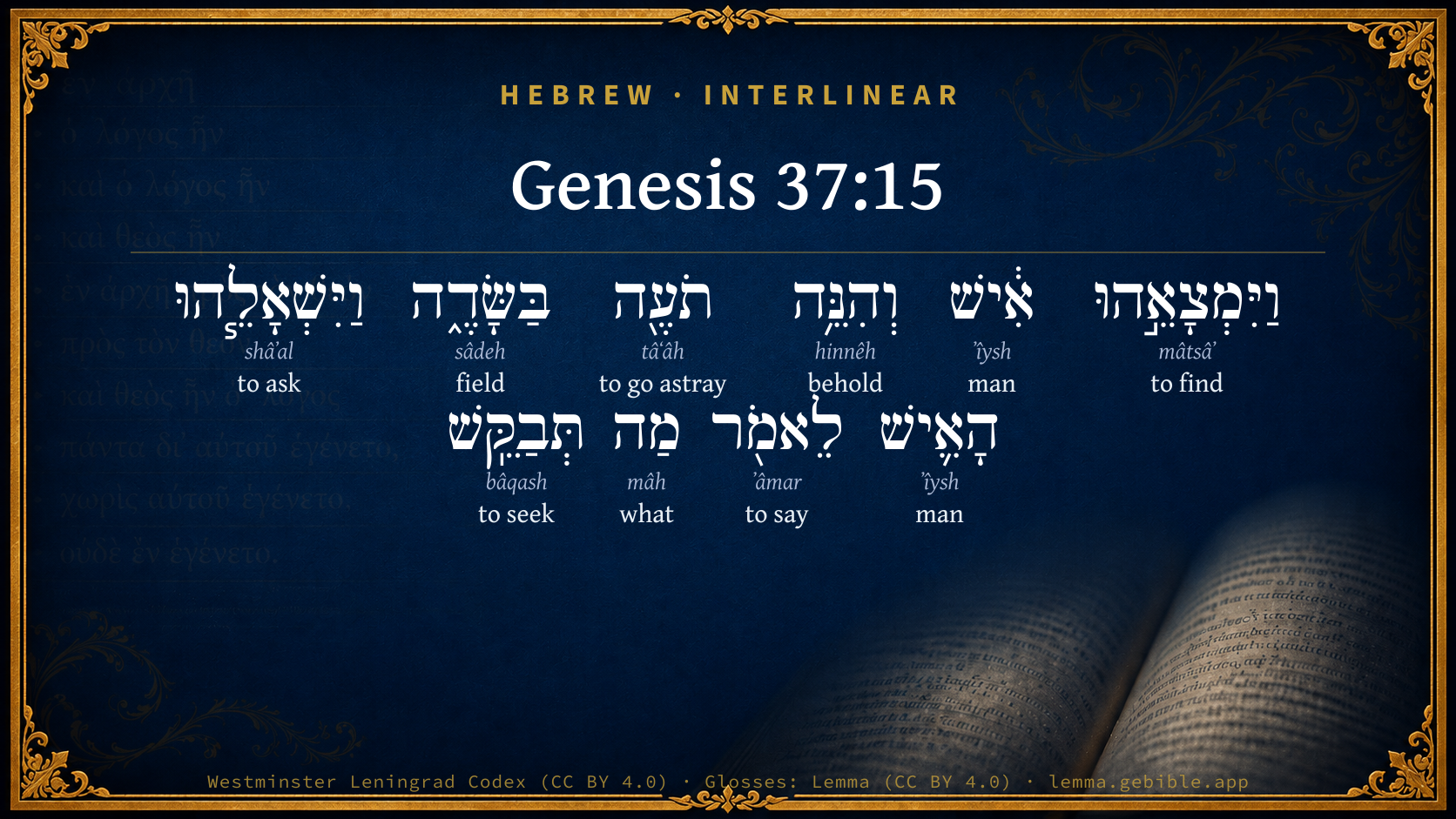
  1. וַיִּמְצָאֵ֣הוּ mâtsâʼ H4672 “and · to find · him” Conjunction + Verb, Qal, Sequential Imperfect, 3rd Person, Masculine, Singular + Suffix, Personal, 3rd Person, Masculine, Singular
  2. אִ֔ישׁ ʼîysh H376 “man” Noun, Common, Masculine, Singular, Absolute
  3. וְהִנֵּ֥ה hinnêh H2009 “and · behold” Conjunction + Particle, Demonstrative
  4. בַּשָּׂדֶ֑ה sâdeh H7704 “in/at the · field” Preposition, Determined + Noun, Common, Masculine, Singular, Absolute
  5. וַיִּשְׁאָלֵ֧הוּ shâʼal H7592 “and · to ask · him” Conjunction + Verb, Qal, Sequential Imperfect, 3rd Person, Masculine, Singular + Suffix, Personal, 3rd Person, Masculine, Singular
  6. הָאִ֛ישׁ ʼîysh H376 “the · man” Particle, Definite Article + Noun, Common, Masculine, Singular, Absolute
  7. לֵאמֹ֖ר ʼâmar H559 “to say” Preposition + Verb, Qal, Infinitive Construct
  8. מַה mâh H4100 “what” Particle, Interrogative
  9. תְּבַקֵּֽשׁ bâqash H1245 “to seek” Verb, Piel, Imperfect, 2nd Person, Masculine, Singular

About this verse

These counts appear in no published source. They are computed here, from the morphology-tagged text and Lemma’s own curated glosses. What Lemma adds →

10
words
9
distinct lemmas
Pentateuch
section

Shared distinctive vocabulary

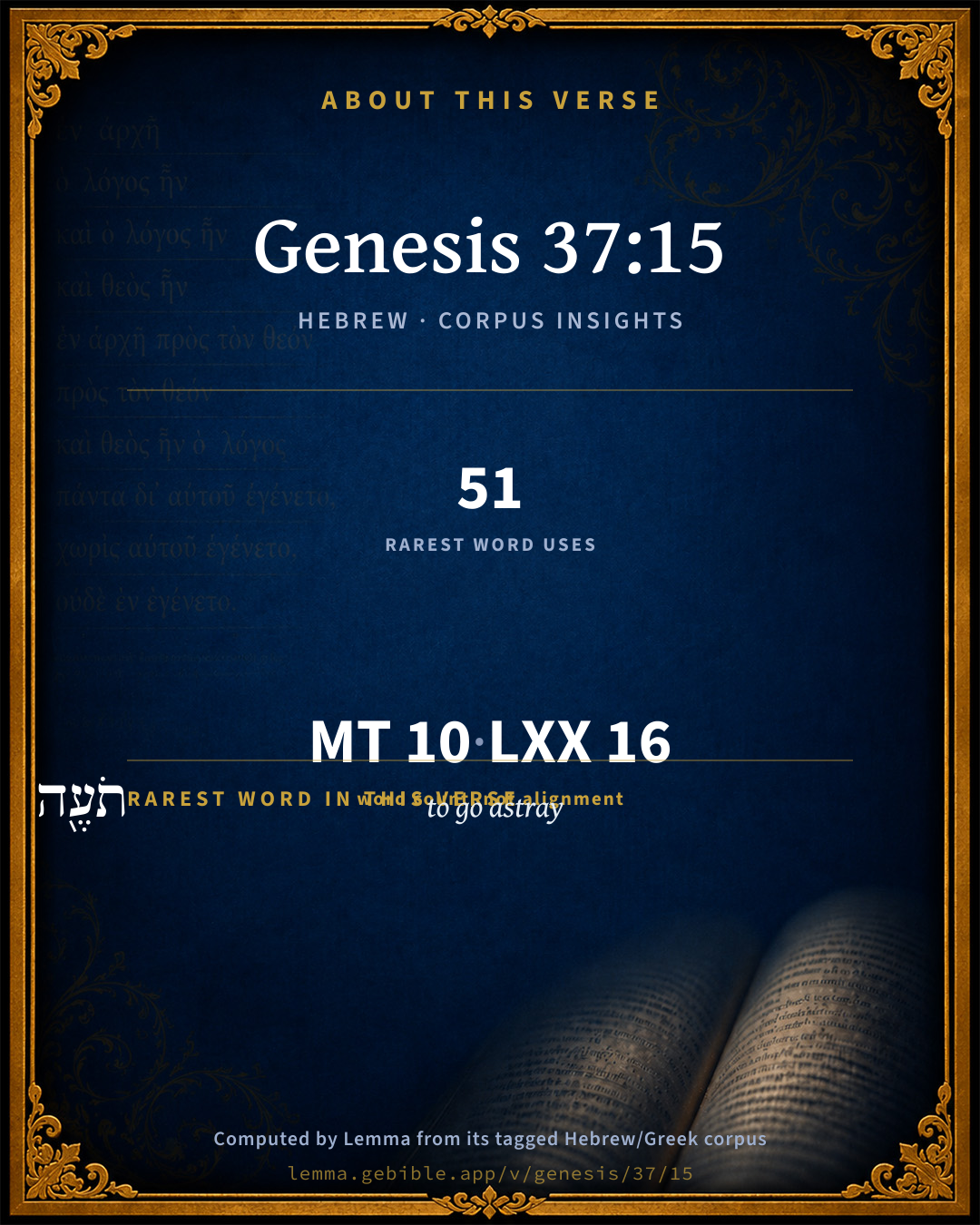
תֹעֶ֖ה to go astray H8582 occurs in 45 verses of the Hebrew Bible. Also found in:

Grammatical profile

  • 5 verbs
  • 3 nouns
  • 2 particles

Verb forms

  • וַיִּמְצָאֵ֣הוּ Qal · Sequential Imperfect
  • תֹעֶ֖ה Qal · Participle Active
  • וַיִּשְׁאָלֵ֧הוּ Qal · Sequential Imperfect
  • לֵאמֹ֖ר Qal · Infinitive Construct
  • תְּבַקֵּֽשׁ Piel · Imperfect

Repetition

A word recurs within this verse — often emphatic in Hebrew:

  • אִ֔ישׁ man H376 ×2

Hebrew & Septuagint length

In English translation the verse runs 24 words from the Hebrew and 18 from the Septuagint (LXX English) — closely comparable.

A rough comparison of the two English renderings, which tokenize alike — not a word-level alignment.

Word counts can differ between the Hebrew and the Greek without any difference in meaning — e.g. the Hebrew direct-object marker אֵת has no separate Greek word, and Greek often adds the article ὁ.

In the original languages it is 10 Hebrew tokens and 16 Greek tokens — but the two are counted differently (Hebrew bundles its prefixes and suffixes into one token; the Greek is in lemma form), so that isn’t a like-for-like length.

Cross-references

8

Topical passages linked to Genesis 37:15 in the Treasury of Scripture Knowledge — connected by theme and wording, ordered by reader-vote popularity; previews shown in the World English Bible.

  • Judges 4:22 Behold, as Barak pursued Sisera, Jael came out to meet him, and said to him, Come, and I will show you the man whom you seek. He came to her; and, behold, Sisera lay dead, and the tent-pin was in his temples.
  • John 4:27 At this, his disciples came. They marveled that he was speaking with a woman; yet no one said, "What are you looking for?" or, "Why do you speak with her?"
  • Genesis 21:14 Abraham rose up early in the morning, and took bread and a bottle of water, and gave it to Hagar, putting it on her shoulder, and gave her the child, and sent her away. She departed, and wandered in the wilderness of Beersheba.
  • 2 Kings 6:19 Elisha said to them, This is not the way, neither is this the city: follow me, and I will bring you to the man whom you seek. He led them to Samaria.
  • John 1:38 Jesus turned, and saw them following, and said to them, "What are you looking for?" They said to him, "Rabbi" (which is to say, being interpreted, Teacher), "where are you staying?"
  • John 18:4 Jesus therefore, knowing all the things that were happening to him, went forth, and said to them, "Who are you looking for?"
  • John 18:7 Again therefore he asked them, "Who are you looking for?" They said, "Jesus of Nazareth."
  • John 20:15 Jesus said to her, "Woman, why are you weeping? Who are you looking for?" She, supposing him to be the gardener, said to him, "Sir, if you have carried him away, tell me where you have laid him, and I will take him away."

Cross-references courtesy of OpenBible.info (CC BY 4.0).

Hebrew and Greek witnesses Masoretic Hebrew ↔ Greek Septuagint

The same verse in the two great witnesses to the Old Testament, shown verse-for-verse.

These are two independent witnesses, not word-aligned to each other, and the Septuagint is shown in lemma (dictionary) form.

Hebrew Genesis 37:15 Masoretic · Westminster Leningrad Codex

וַיִּמְצָאֵ֣הוּ אִ֔ישׁ וְהִנֵּ֥ה תֹעֶ֖ה בַּשָּׂדֶ֑ה וַיִּשְׁאָלֵ֧הוּ הָאִ֛ישׁ לֵאמֹ֖ר מַה תְּבַקֵּֽשׁ

A certain man found him, and behold, he was wandering in the field: and the man asked him, saying, "What are you looking for?"

World English Bible · Public Domain

Greek LXX Genesis 37:15 Septuagint · lemma form

καί εὑρίσκω αὐτός ἄνθρωπος πλανάω ἐν ὁ πεδίον ἐρωτάω δέ αὐτός ὁ ἄνθρωπος λέγω τίς ζητέω

And a man found him wandering in the field; and the man asked him, saying, What seek you?

LXX2012 (modern English Septuagint) · Public Domain

Hebrew: Westminster Leningrad Codex (CC BY 4.0). Greek: Septuagint (public domain); English from LXX2012 (modern English Septuagint) (Public Domain). How the Septuagint differs from the Hebrew →

Targum (Aramaic paraphrase)

2

The Targum is the ancient Jewish Aramaic paraphrase of the Hebrew Scriptures — an interpretive translation, not the Hebrew text itself. Onkelos (literal) and Pseudo-Jonathan (expansive) render the Torah, and Jonathan the Prophets. Coverage is partial: where no permissively-licensed English translation exists for a verse, only the Aramaic is shown. This is verse-level text, not a word-by-word alignment to the Hebrew.

  1. Targum Onkelos Torah (Genesis–Deuteronomy)
    וְאַשְׁכְּחֵהּ גַבְרָא וְהָא תָעֵי בְּחַקְלָא וּשְׁאָלִנֵּהּ גַבְרָא לְמֵימָר מָה אַתְּ בָּעֵי

    (no public-domain English translation for this verse)

    Targum Onkelos — Aramaic: “Onkelos Genesis” (public domain); “Onkelos Exodus” (public domain); “Onkelos Leviticus” (public domain); “Onkelos Numbers” (public domain); “Onkelos Deuteronomy” (public domain). English: “Sefaria Community Translation” (CC0 1.0 (public-domain dedication)); “J.W. Etheridge. The Targums of Onkelos and Jonathan Ben Uzziel on the Pentateuch. London: Longmans, Green, 1862” (public domain). Text via Sefaria.

  2. Targum Pseudo-Jonathan Torah (Genesis–Deuteronomy)
    וְאַשְׁכְּחֵיהּ גַבְרִיאֵל בִּדְמוּת גַבְרָא וְהָא טָעֵי בְחַקְלָא וְשַׁאֲלֵיהּ גַבְרָא לְמֵימָר מָה אַנְתְּ בָּעֵי

    And Gabriel in the likeness of a man found him wandering field. And the man asked him, saying, What seekest thou?

    Targum Pseudo-Jonathan — Aramaic: “Targum Jonathan on Genesis” (public domain); “Targum Jonathan on Exodus” (public domain); “Targum Jonathan on Leviticus” (public domain); “Targum Jonathan on Numbers” (public domain); “Targum Jonathan on Deuteronomy” (public domain). English: “The Targum of Jonathan ben Uzziel, trans. J. W. Etheridge, London, 1862” (public domain). Text via Sefaria.

Commentary

Notes on Genesis 37:15 from classic Christian and Jewish commentators (each source and its license shown beneath its notes). The classic Christian expositions comment on the surrounding passage and are grouped to its opening verse, so a note may address several verses; the Jewish commentaries on the Tanakh (Rashi and others) are per-verse, so they appear only where the commentator wrote on this verse.

Lemma curates 59 commentaries, every one of them public domain or Creative Commons licensed, each selected and text-cleaned for this edition rather than reprinted as found. About our sources →

Trapp's Complete Commentary

John Trapp

Gen 37:15 And a certain man found him, and, behold, [he was] wandering in the field: and the man asked him, saying, What seekest thou?

Ver. 15. What seekest thou?] This was not the angel Gabriel, as the Hebrews will have it; but some courteous passenger, that thus offereth himself to wandering Joseph, and sets him in his way again. At Athens there were public curses appointed against such as showed not those their error that were out of the way. {a} See the like, Deu 27:18. "Brethren," saith St James, "if any of you do err from the truth, and one convert him, let him know that he saves a soul from death"; {Jas 5:19-20} yea, he pulls him out of the fire of hell, saith Jude {b} {Jdg 1:23} for they that err from God’s commandments are cursed. {Psa 119:21}

{a} Dion. Lamb., in Corn. Nep.

{b} Ex igne gehennali - Pareus.

John Trapp, A Commentary or Exposition upon All the Books of the Old and New Testament (1647–1656) — public domain. Text from a community e-Sword module.

The Cambridge Bible for Schools and Colleges

gen. ed. J. J. S. Perowne

15. a certain man] Evidently Joseph and his brethren were well known, and not unfavourably, in the region of Shechem. The lad’s wandering in uncertainty appeals to the reader’s sympathy. The Targum of Palestine says the “man” was the angel Gabriel.

The Cambridge Bible for Schools and Colleges (gen. ed. J. J. S. Perowne; Cambridge University Press, 1878–1918) — public domain. Text from a community e-Sword module.

John Gill's Exposition

And he said, I seek my brethren,.... Whom, no doubt, he described to the man, and told him who they were, and to whom they belonged; or otherwise the man would have been at a loss to know who he meant, and what further to say to him, and without which Joseph would never have made the following request to him:

tell me, I pray thee, where they feed their flocks; in what part of the country they are, what field they are in, how far to it, and which the way.

John Gill's Exposition of the Whole Bible (1746–1763) — public domain (CC PDM 1.0). Text via the HelloAO Bible API.

Whedon's Commentary on the Bible

Daniel D. Whedon

15. Wandering in the field — Wandering about the field that belonged to his father at Shechem. The fact of his going alone and unattended from Hebron to Shechem and beyond, shows the quiet and peace that prevailed in the land at that time.

Daniel D. Whedon (gen. ed.), Commentary on the Old and New Testaments (1874–1909) — public domain. Text from a community e-Sword module.

The Pulpit Commentary

Vers. 15, 16. And a certain man (or simply a man) found him, and, behold, he was wandering in the field (obviously seeking some thing or person): and the man asked him, saying, What seekest thou? And he said, I seek my brethren: or, more emphatically, My Brethren I (sc. am) seekingtell me, I pray thee, where they feed their flocks or, Where (are) they shepherding?

The Pulpit Commentary (1880–1919), ed. H.D.M. Spence-Jones & Joseph S. Exell — public domain. Text from a community e-Sword module.

unfoldingWord translationNotes

Door43 World Missions Community

A certain man found Joseph. Behold, Joseph was wandering in a field

"A certain man found Joseph wandering in a field"

Behold

This marks the beginning of another event in the larger story. It may involve different people than the previous events. Your language may have a way of doing this.

What do you seek?

"What are you looking for?"

Tell me, please, where

"Please tell me where"

tending the flock

"shepherding their flock"

Dothan

This is the name of a place that is about 22 kilometers from Shechem. (See: How to Translate Names)

translationWords

flocks

unfoldingWord translationNotes — © Distant Shores Media and the Door43 World Missions Community, licensed CC BY-SA 4.0. Source: git.door43.org/Door43/en_tn.

Rashi

Rabbi Shlomo Yitzchaki (Rashi)

וימצאהו איש AND A MAN FOUND HIM — This was the angel Gabriel (Genesis Rabbah 84:14) as it is said, (Daniel 9:21) and the man (והאיש) Gabriel” (Midrash Tanchuma, Vayeshev 2:3).

Rashi on the Tanakh — English translations: “The Judaica Press complete Tanach with Rashi, translated by A. J. Rosenberg” (CC BY 4.0); “Pentateuch with Rashi's commentary by M. Rosenbaum and A.M. Silbermann, 1929-1934” (public domain); “The Metsudah Tanach series, Lakewood, N.J” (CC BY 4.0); and “The Book of Joshua, Metsudah Publications, 1997” (CC BY 4.0). Text via Sefaria.

Ramban (Nachmanides)

Rabbi Moshe ben Nachman (Ramban / Nachmanides)

AND A MAN FOUND HIM, AND BEHOLD, HE WAS STRAYING IN THE FIELD. The verse is stating that Joseph was straying from the road, not knowing where to go, and he entered a field since he was looking for them in a place of pasture. Scripture mentions this at length in order to relate that many events befell him which could properly have caused him to return, but he endured everything patiently for the honor of his father. It also informs us that the Divine decree is true and man’s industry is worthless. The Holy One, blessed be He, sent him a guide without his knowledge in order to bring him into their hands. It is this that our Rabbis intended when they said that these men … And ‘the man’ said … (Verses 15, 17). were angels, for these events did not occur without purpose, but rather to inform us that It is the counsel of the Eternal that shall stand.

Ramban (Nachmanides) on the Tanakh — English translation: “Commentary on the Torah by Ramban (Nachmanides). Translated and annotated by Charles B. Chavel. New York, Shilo Pub. House, 1971-1976” (CC BY 4.0). Text via Sefaria.

Radak

Rabbi David Kimhi (Radak)

וימצאהו איש, after arriving in Shechem and not finding any trace of his brothers, Joseph went in all directions to see if he could find them, and in the process he lost his way.

Radak on the Tanakh — English translations: “Sefaria Community Translation” (CC0 1.0 (public-domain dedication)); “Eliyahu Munk, HaChut Hameshulash” (CC BY 4.0); “Rabbi Mike Feuer, Jerusalem Anthology” (CC BY 4.0); and “R. David Kimhi on the first book of Psalms, Translated by R.G. Finch, London, 1919” (public domain). Text via Sefaria.

Lesson kit

Teaching starters — assembled from the data on this page, not authored interpretation. Every prompt links to the verse data it draws on. Edit before teaching.

Genesis, in the Pentateuch, opens this verse with 10 words (9 distinct Hebrew lemmas). Its most distinctive word is tâʻâh (“to go astray”). A historical commentator’s framing appears above. Read the whole chapter for the surrounding context.

Discussion questions

  1. How does “to go astray” (tâʻâh) shape what this verse is saying?
  2. Genesis 20:13 shares the word «to go astray» with this verse. How do the two illuminate each other?
  3. “man” occurs 2× in this one verse. What is the effect of the repetition?
  4. The translations on this page render this verse differently — a whole-verse word diff, not a word-by-word alignment. What might account for the different wordings?
  5. The verb «וַיִּמְצָאֵ֣הוּ» is Qal Sequential Imperfect. How does its form color the action?
  6. Reading how Trapp's Complete Commentary and The Cambridge Bible for Schools and Colleges read this verse, where do the two commentators agree and where do they part?

Things to notice

Reading settings

Reading text

Shown beneath each verse's original-language words.

Old Testament
Old Testament edition

Read the OT as the Masoretic Hebrew (MT) or the Greek Septuagint (LXX).

English shown for the Greek Septuagint (in the Hebrew ↔ Greek comparison).

Comparing translations? Open the Compare panel on any verse page to stack up to four side by side.