
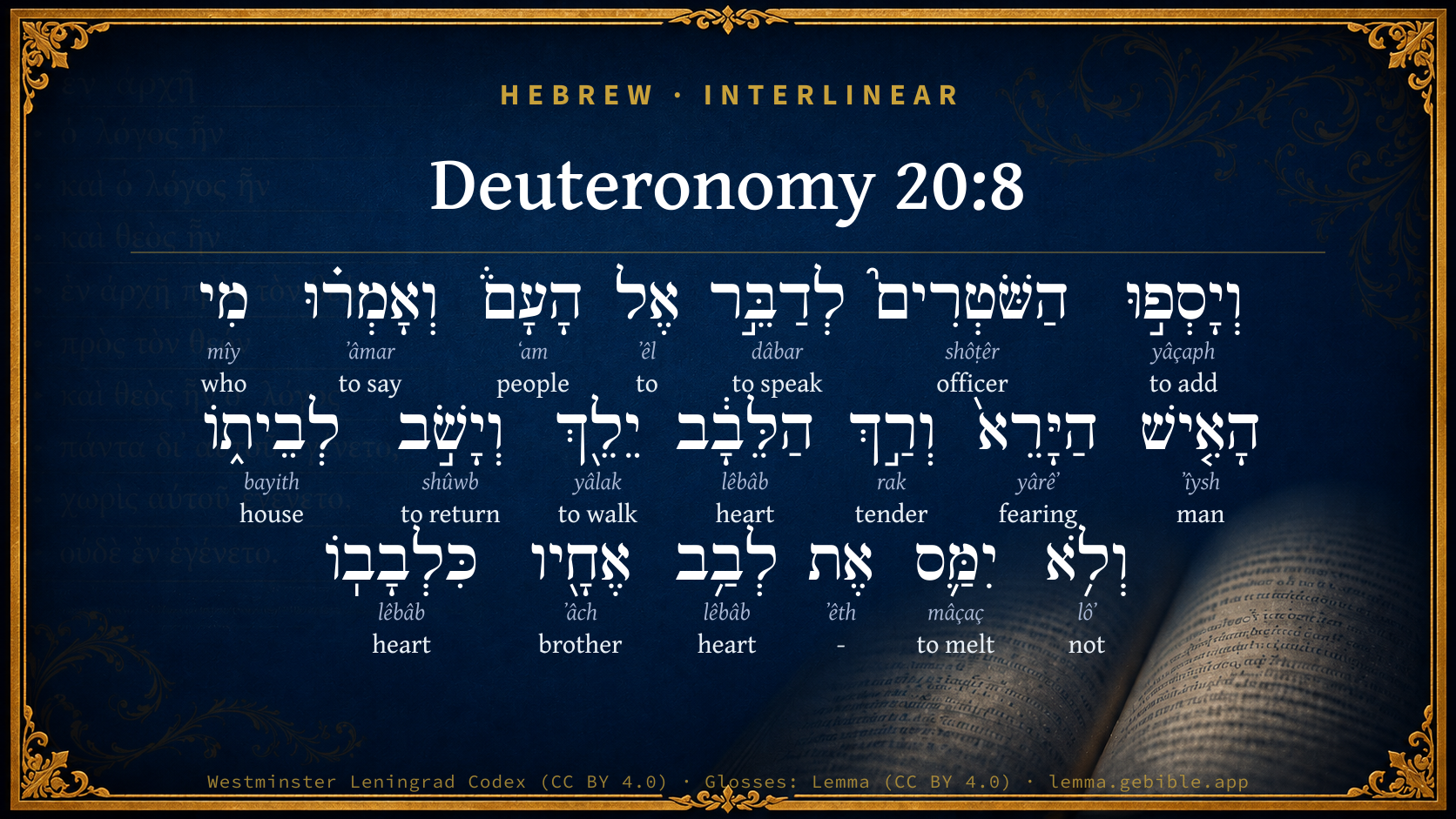
Deuteronomy 20:8

Hebrew (Westminster Leningrad Codex) Deuteronomy 20:8 appears in the Hebrew Old Testament. The text above is from the Westminster Leningrad Codex. Each word links to its Strong’s number, a concise gloss, and parsing drawn from the Open Scriptures Hebrew Bible morphology. Click any word for its full Brown-Driver-Briggs (BDB) entry.
Download image
Cite this verse

Deuteronomy 20:8 (World English Bible). Public Domain. Lemma interlinear Bible study tool, https://lemma.gebible.app/v/deuteronomy/20/8.

Show BibTeX & RIS
BibTeX
RIS
English Translation
The officers shall speak further to the people, and they shall say, What man is there who is fearful and faint-hearted? let him go and return to his house, lest his brother's heart melt as his heart.
World English Bible · Public Domain
Download a study sheet

One document with this verse’s original text, its word-by-word gloss line, the meaning frame, cross-references with their text, attributed commentary, and full source and license credits — printable, and it pastes into notes with its structure intact.

This verse Autodidact and up

Study sheet (.html) Plain text (.txt)

A passage Seminary Student

Up to 50 verses in one chapter. A passage sheet keeps up to 6 commentary sources and 12 cross-references per verse, in the order this page ranks them, and says so on the sheet whenever that leaves anything out. Ask for a single verse and you get the Autodidact verse sheet above.

Everything on this page stays free to read, with no account — the sheet is a download of what is already on screen, not access to it.

Want to remove ads? Support Godless Engineer
Compare translations 3

The same verse in 3 English versions, stacked beneath the original-language interlinear above. Click any original word for its lexicon entry.

Each is an independent rendering of the whole verse — the interlinear is not word-aligned to these translations.

Highlighted words mark where these versions differ — a whole-verse word diff, not a word-by-word alignment.

  • World English Bible Public Domain
    The officers shall speak further to the people, and they shall say, What man is there who is fearful and faint-hearted? let him go and return to his house, lest his brother's heart melt as his heart.
  • King James Version Public Domain
    And the officers shall speak further unto the people, and they shall say, What man is there that is fearful and fainthearted? let him go and return unto his house, lest his brethren's heart faint as well as his heart.
  • unfoldingWord Literal Text CC BY-SA 4.0
    And the officers shall continue to speak to the people and say, ‘Who the man who fears and soft of heart? Let him go and return to his house, and the heart of his brother will not melt like his heart.’

unfoldingWord Literal Text — © unfoldingWord, licensed CC BY-SA 4.0. Word-aligned USFM3 via Door43 (git.door43.org/unfoldingWord/en_ult).

Versions to compare (up to 4)

3 of 4 selected

Show all 18 translations

Every available English version of this verse, each an independent rendering of the whole verse.

  • World English Bible Public Domain
    The officers shall speak further to the people, and they shall say, What man is there who is fearful and faint-hearted? let him go and return to his house, lest his brother's heart melt as his heart.
  • Berean Standard Bible Public Domain
    Then the officers shall speak further to the army, saying, “Is any man afraid or fainthearted? Let him return home, so that the hearts of his brothers will not melt like his own.”
  • Majority Standard Bible Public Domain
    Then the officers shall speak further to the army, saying, “Is any man afraid or fainthearted? Let him return home, so that the hearts of his brothers will not melt like his own.”
  • King James Version Public Domain
    And the officers shall speak further unto the people, and they shall say, What man is there that is fearful and fainthearted? let him go and return unto his house, lest his brethren's heart faint as well as his heart.
  • American Standard Version (1901) Public Domain
    And the officers shall speak further unto the people, and they shall say, What man is there that is fearful and faint-hearted? let him go and return unto his house, lest his brethren's heart melt as his heart.
  • Revised Version (1885) Public Domain
    And the officers shall speak further unto the people, and they shall say, What man is there that is fearful and fainthearted? let him go and return unto his house, lest his brethren’s heart melt as his heart.
  • Geneva Bible (1599) Public Domain
    And let the officers speake further vnto the people, and say, Whosoeuer is afrayde and faynt hearted, let him go and returne vnto his house, least his brethrens heart faynt like his heart.
  • Douay-Rheims (1899) Public Domain
    After these things are declared they shall add the rest, and shall speak to the people: What man is there that is fearful, and faint hearted? let him go, and return to his house, lest he make the hearts of his brethren to fear, as he himself is possessed with fear.
  • Young's Literal Translation Public Domain
    `And the authorities have added to speak unto the people, and said, Who `is' the man that is afraid and tender of heart? -- let him go and turn back to his house, and the heart of his brethren doth not melt like his heart;
  • Literal Standard Version CC BY-SA 4.0
    And the authorities have added to speak to the people and said, Who [is] the man that is afraid and tender of heart? Let him go and return to his house, and the heart of his brothers does not melt like his heart.
  • Unlocked Literal Bible CC BY-SA 4.0
    The officers must speak further to the people and say, 'What man is there who is fearful or fainthearted? Let him go and return to his house, so that his brother's heart does not melt like his own heart.'
  • unfoldingWord Literal Text CC BY-SA 4.0
    And the officers shall continue to speak to the people and say, ‘Who the man who fears and soft of heart? Let him go and return to his house, and the heart of his brother will not melt like his heart.’
  • Darby Bible Public Domain
    And the officers shall speak further unto the people, and shall say, What man is there that is timid and faint-hearted? let him go and return unto his house, lest his brethren's heart melt as well as his heart.
  • World Messianic Bible Public Domain
    The officers shall speak further to the people, and they shall say, “What man is there who is fearful and faint-hearted? Let him go and return to his house, lest his brother’s heart melt as his heart.”
  • Webster's Bible Public Domain
    And the officers shall speak further to the people, and they shall say, What man is there that is fearful and faint-hearted? let him go and return to his house, lest his brethren's heart should faint as well as his heart.
  • Free Bible Version CC BY-SA 4.0
    The officers are also to tell the army, “Is there any man here who is afraid or nervous? He can go home, so he won't affect his fellow-soldiers and make them as frightened as himself.”
  • Bible in Basic English Public Domain
    And let the overseers go on to say to the people, If there is any man whose heart is feeble with fear, let him go back to his house before he makes the hearts of his countrymen feeble.
  • JPS Tanakh (1917) Public Domain
    And the officers shall speak further unto the people, and they shall say: 'What man is there that is fearful and faint-hearted? let him go and return unto his house, lest his brethren's heart melt as his heart.'

Literal Standard Version (2020), Covenant Press — licensed CC BY-SA 4.0. Text via the HelloAO Bible API (eBible.org). Unlocked Literal Bible (unfoldingWord) — licensed CC BY-SA 4.0. Text via the HelloAO Bible API (eBible.org). unfoldingWord Literal Text — © unfoldingWord, licensed CC BY-SA 4.0. Word-aligned USFM3 via Door43 (git.door43.org/unfoldingWord/en_ult). Free Bible Version, Dr. Jonathan Gallagher — licensed CC BY-SA 4.0. Text via the HelloAO Bible API (eBible.org).

Word by word

More ways to search: Search by grammar → Find every occurrence → Compare this word →

Practice this passage: Drill this verse → Learn its vocabulary →

וְרַ֣ךְ
rak
H7390
“and · tender of”
Conjunction + Adjective, Adjective, Masculine, Singular, Construct
Part of Speech
Conjunction + Adjective
Type
Adjective
Gender
Masculine
Number
Singular
State
Construct
Full BDB Definition

Origin: from H7401

TWOT: 2164a

tender, soft, delicate, weak - tender, delicate (of flesh) - weak of heart, timid - soft (of words) - gentle words (substantive)
  1. וְיָסְפ֣וּ yâçaph H3254 “and · to add” Conjunction + Verb, Qal, Sequential Perfect, 3rd Person, Common, Plural
  2. הַשֹּׁטְרִים֮ shôṭêr H7860 “the · officer” Particle, Definite Article + Verb, Qal, Participle Active, Masculine, Plural, Absolute
  3. לְדַבֵּ֣ר dâbar H1696 “to speak” Preposition + Verb, Piel, Infinitive Construct
  4. אֶל ʼêl H413 “to” Preposition
  5. הָעָם֒ ʻam H5971 “the · people” Particle, Definite Article + Noun, Common, Masculine, Singular, Absolute
  6. וְאָמְר֗וּ ʼâmar H559 “and · to say” Conjunction + Verb, Qal, Sequential Perfect, 3rd Person, Common, Plural
  7. מִי mîy H4310 “who” Particle, Interrogative
  8. הָאִ֤ישׁ ʼîysh H376 “the · man” Particle, Definite Article + Noun, Common, Masculine, Singular, Absolute
  9. הַיָּרֵא֙ yârêʼ H3373 “the · fearing” Particle, Definite Article + Adjective, Adjective, Masculine, Singular, Absolute
  10. הַלֵּבָ֔ב lêbâb H3824 “the · heart” Particle, Definite Article + Noun, Common, Masculine, Singular, Absolute
  11. יֵלֵ֖ךְ yâlak H3212 “to walk” Verb, Qal, Imperfect, 3rd Person, Masculine, Singular
  12. וְיָשֹׁ֣ב shûwb H7725 “and · to return” Conjunction + Verb, Qal, Imperfect, 3rd Person, Masculine, Singular
  13. לְבֵית֑וֹ bayith H1004 “to/for · house · his” Preposition + Noun, Common, Masculine, Singular, Construct + Suffix, Personal, 3rd Person, Masculine, Singular
  14. וְלֹ֥א lôʼ H3808 “and · not” Conjunction + Particle, Negative
  15. יִמַּ֛ס mâçaç H4549 “to melt” Verb, Niphal, Imperfect, 3rd Person, Masculine, Singular
  16. אֶת ʼêth H853 “-” Particle, Direct Object
  17. לְבַ֥ב lêbâb H3824 “heart of” Noun, Common, Masculine, Singular, Construct
  18. אֶחָ֖יו ʼâch H251 “brothers · his” Noun, Common, Masculine, Plural, Construct + Suffix, Personal, 3rd Person, Masculine, Singular
  19. כִּלְבָבֽוֹ lêbâb H3824 “like/as · heart · his” Preposition + Noun, Common, Masculine, Singular, Construct + Suffix, Personal, 3rd Person, Masculine, Singular

About this verse

These counts appear in no published source. They are computed here, from the morphology-tagged text and Lemma’s own curated glosses. What Lemma adds →

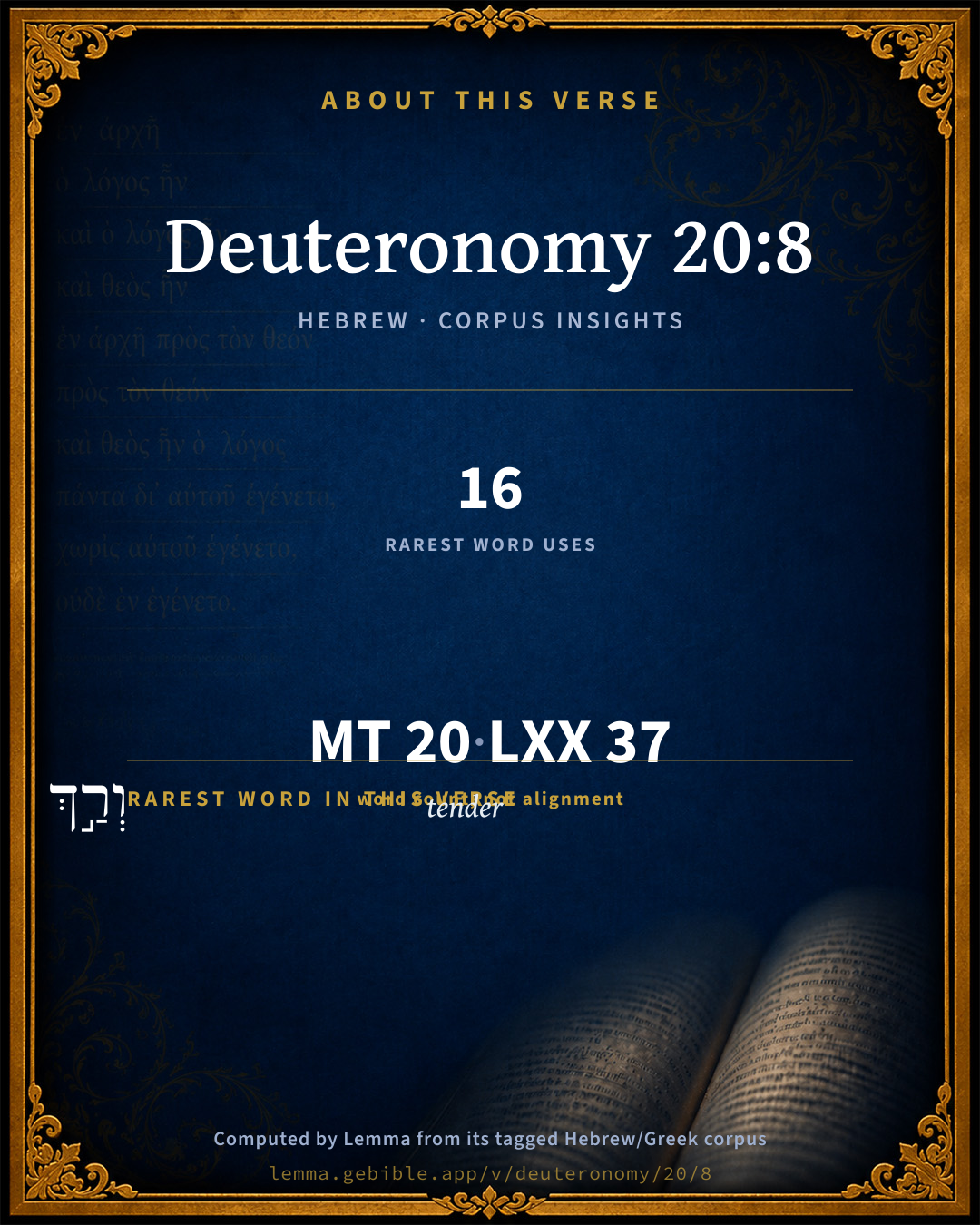
20
words
18
distinct lemmas
Pentateuch
section

Notable vocabulary

The rarest word here is וְרַ֣ךְ tender H7390 — appearing just 16 times in the whole Hebrew Bible.

Shared distinctive vocabulary

וְרַ֣ךְ tender H7390 occurs in 16 verses of the Hebrew Bible. Also found in:

Grammatical profile

  • 7 verbs
  • 7 nouns
  • 2 adjectives
  • 1 preposition
  • 3 particles

Verb forms

  • וְיָסְפ֣וּ Qal · Sequential Perfect
  • הַשֹּׁטְרִים֮ Qal · Participle Active
  • לְדַבֵּ֣ר Piel · Infinitive Construct
  • וְאָמְר֗וּ Qal · Sequential Perfect
  • יֵלֵ֖ךְ Qal · Imperfect
  • וְיָשֹׁ֣ב Qal · Imperfect
  • יִמַּ֛ס Niphal · Imperfect

Repetition

A word recurs within this verse — often emphatic in Hebrew:

  • הַלֵּבָ֔ב heart H3824 ×3

Hebrew & Septuagint length

In English translation the verse runs 37 words from the Hebrew and 43 from the Septuagint (LXX English) — closely comparable.

A rough comparison of the two English renderings, which tokenize alike — not a word-level alignment.

Word counts can differ between the Hebrew and the Greek without any difference in meaning — e.g. the Hebrew direct-object marker אֵת has no separate Greek word, and Greek often adds the article ὁ.

In the original languages it is 20 Hebrew tokens and 37 Greek tokens — but the two are counted differently (Hebrew bundles its prefixes and suffixes into one token; the Greek is in lemma form), so that isn’t a like-for-like length.

Cross-references

11

Topical passages linked to Deuteronomy 20:8 in the Treasury of Scripture Knowledge — connected by theme and wording, ordered by reader-vote popularity; previews shown in the World English Bible.

  • Judges 7:3 Now therefore proclaim in the ears of the people, saying, Whoever is fearful and trembling, let him return and depart from Mount Gilead. There returned of the people twenty-two thousand; and there remained ten thousand.
  • Deuteronomy 1:28 Where are we going up? our brothers have made our heart to melt, saying, The people are greater and taller than we; the cities are great and fortified up to the sky; and moreover we have seen the sons of the Anakim there.
  • Revelation 21:8 But for the cowardly, unbelieving, sinners, abominable, murderers, sexually immoral, sorcerers, idolaters, and all liars, their part is in the lake that burns with fire and sulfur, which is the second death."
  • Acts 15:37–38 Barnabas planned to take John, who was called Mark, with them also.
  • Numbers 32:9 For when they went up to the valley of Eshcol, and saw the land, they discouraged the heart of the children of Israel, that they should not go into the land which Yahweh had given them.
  • Deuteronomy 23:9 When you go forth in camp against your enemies, then you shall keep you from every evil thing.
  • Luke 9:62 But Jesus said to him, "No one, having put his hand to the plow, and looking back, is fit for the Kingdom of God."
  • Exodus 15:15 Then the chiefs of Edom were dismayed. Trembling takes hold of the mighty men of Moab. All the inhabitants of Canaan are melted away.
  • Numbers 13:31–14:3 But the men who went up with him said, We aren't able to go up against the people; for they are stronger than we.
  • 1 Corinthians 15:33 Don't be deceived! "Evil companionships corrupt good morals."
  • Revelation 3:16 So, because you are lukewarm, and neither hot nor cold, I will vomit you out of my mouth.

Cross-references courtesy of OpenBible.info (CC BY 4.0).

Hebrew and Greek witnesses Masoretic Hebrew ↔ Greek Septuagint

The same verse in the two great witnesses to the Old Testament, shown verse-for-verse.

These are two independent witnesses, not word-aligned to each other, and the Septuagint is shown in lemma (dictionary) form.

Hebrew Deuteronomy 20:8 Masoretic · Westminster Leningrad Codex

וְיָסְפ֣וּ הַשֹּׁטְרִים֮ לְדַבֵּ֣ר אֶל הָעָם֒ וְאָמְר֗וּ מִי הָאִ֤ישׁ הַיָּרֵא֙ וְרַ֣ךְ הַלֵּבָ֔ב יֵלֵ֖ךְ וְיָשֹׁ֣ב לְבֵית֑וֹ וְלֹ֥א יִמַּ֛ס אֶת לְבַ֥ב אֶחָ֖יו כִּלְבָבֽוֹ

The officers shall speak further to the people, and they shall say, What man is there who is fearful and faint-hearted? let him go and return to his house, lest his brother's heart melt as his heart.

World English Bible · Public Domain

Greek LXX Deuteronomy 20:8 Septuagint · lemma form

καί προςτίθημι ὁ γραμματεύς λαλέω πρός ὁ λαός καί εἶπον τίς ὁ ἄνθρωπος ὁ φοβέω καί δειλός ὁ καρδία πορεύομαι καί ἀποστρέφω εἰς ὁ οἰκία αὐτός ἵνα μή δειλιαίνω ὁ καρδία ὁ ἀδελφός αὐτός ὥσπερ ὁ αὐτός

And the scribes shall speak further to the people, and say, What man is he that fears and is cowardly in his heart? Let him go and return to his house, lest he make the heart of his brother fail, as his own.

LXX2012 (modern English Septuagint) · Public Domain

Hebrew: Westminster Leningrad Codex (CC BY 4.0). Greek: Septuagint (public domain); English from LXX2012 (modern English Septuagint) (Public Domain). How the Septuagint differs from the Hebrew →

Targum (Aramaic paraphrase)

2

The Targum is the ancient Jewish Aramaic paraphrase of the Hebrew Scriptures — an interpretive translation, not the Hebrew text itself. Onkelos (literal) and Pseudo-Jonathan (expansive) render the Torah, and Jonathan the Prophets. Coverage is partial: where no permissively-licensed English translation exists for a verse, only the Aramaic is shown. This is verse-level text, not a word-by-word alignment to the Hebrew.

  1. Targum Onkelos Torah (Genesis–Deuteronomy)
    וְיוֹסְפוּן סָרְכַיָא לְמַלָלָא עִם עַמָא וְיֵימְרוּן מָן גַבְרָא דְדָחֵל וּתְבִיר לִבָּא יְהַךְ וִיתוּב לְבֵיתֵהּ וְלָא יִתְּבַר יָת לִבָּא דַאַחוֹהִי כְּלִבֵּהּ

    (no public-domain English translation for this verse)

    Targum Onkelos — Aramaic: “Onkelos Genesis” (public domain); “Onkelos Exodus” (public domain); “Onkelos Leviticus” (public domain); “Onkelos Numbers” (public domain); “Onkelos Deuteronomy” (public domain). English: “Sefaria Community Translation” (CC0 1.0 (public-domain dedication)); “J.W. Etheridge. The Targums of Onkelos and Jonathan Ben Uzziel on the Pentateuch. London: Longmans, Green, 1862” (public domain). Text via Sefaria.

  2. Targum Pseudo-Jonathan Torah (Genesis–Deuteronomy)
    וְיוֹסְפוּן סַרְכַיָא לְמַלָלָא עִם עַמָּא וְיֵימְרוּן מַאן הוּא גַבְרָא דְדָחֵיל מֵחוֹבֵי וְלִבֵּיהּ תְּבִיר יְהַךְ וִיתוּב לְבֵיתֵיהּ דִּלְמָא יְקַבְּלוּן אָחוֹי בְּחוֹבוֹי וְיִתְבַּר לִבְּהוֹן הֵיךְ לִבֵּיהּ

    Yet more shall the officers speak to the people, and say, Who is the man who is afraid on account of his sin and whose heart is broken? let him go and return to his house, that his brethren be not implicated in his sins, and their heart be broken like his.

    Targum Pseudo-Jonathan — Aramaic: “Targum Jonathan on Genesis” (public domain); “Targum Jonathan on Exodus” (public domain); “Targum Jonathan on Leviticus” (public domain); “Targum Jonathan on Numbers” (public domain); “Targum Jonathan on Deuteronomy” (public domain). English: “The Targum of Jonathan ben Uzziel, trans. J. W. Etheridge, London, 1862” (public domain). Text via Sefaria.

Commentary

Notes on Deuteronomy 20:8 from classic Christian and Jewish commentators (each source and its license shown beneath its notes). The classic Christian expositions comment on the surrounding passage and are grouped to its opening verse, so a note may address several verses; the Jewish commentaries on the Tanakh (Rashi and others) are per-verse, so they appear only where the commentator wrote on this verse.

Lemma curates 59 commentaries, every one of them public domain or Creative Commons licensed, each selected and text-cleaned for this edition rather than reprinted as found. About our sources →

Trapp's Complete Commentary

John Trapp

Deu 20:8 And the officers shall speak further unto the people, and they shall say, What man [is there that is] fearful and fainthearted? let him go and return unto his house, lest his brethren’s heart faint as well as his heart.

Ver. 9. Captains of the armies to lead the people.] As Hannibal did, of whom Livy {a} reports, that Princeps proelium inibat, ultimus, conserto proelio, excedebat; he was first in the battle, and last out. And the same is storied of Albert, marquess of Brandenburg: In congressibus prior pugnam iniit, victor h praelio excessit ultimus. {b}

{a} Decad. iii. lib. i.

{b} Bucholc.

John Trapp, A Commentary or Exposition upon All the Books of the Old and New Testament (1647–1656) — public domain. Text from a community e-Sword module.

Adam Clarke's Commentary

Verse 8. What man is there that is fearful and faint-hearted?] The original רך rach, signifies tender or soft-hearted. And a soft heart the man must have who, in such a contest, after such a permission, could turn his back upon his enemies and his brethren. However, such were the troops commanded by Gideon in his war against the Midianites; for after he gave this permission, out of 32,000 men only 10,000 remained to fight! Jdg 7:3. There could be no deception in a business of this kind; for the departure of the 22,000 was the fullest proof of their dastardliness which they could possibly give.

Adam Clarke's Commentary on the Bible (1810–1826) — public domain. Text from a community e-Sword/MySword module.

The Cambridge Bible for Schools and Colleges

gen. ed. J. J. S. Perowne

8. shall speak further] The change in the formula is no proof that this is a later addition to the law (as Steuern. avers).

fearful and fainthearted] It is true that such were also supposed to be possessed by evil spirits (Schwally). For a Celtic analogy see Scott’s Fair Maid of Perth, in which Conacher’s timidity is attributed by his foster-father to possession. But there is no evidence of such a superstition here. The rule is rather in sympathy with this Book’s constant insistence upon whole-hearted devotion in the service of God. In no direction of life is He content with less. Cp. Jdg_7:3.

lest his brethren’s heart, etc.] ‘Fear is catching.’ (M. Henry.)

The Cambridge Bible for Schools and Colleges (gen. ed. J. J. S. Perowne; Cambridge University Press, 1878–1918) — public domain. Text from a community e-Sword module.

John Gill's Exposition

And the officers shall speak further unto the people,.... According to Maimonides (n), the priest the anointed of war spoke to the end of Deu 20:7 and which the officers repeated after him to the people aloud, as before observed; and then after that an officer speaks of himself, or in his own words, and not in those of the priest, as follows:

what man that is fearful, &c. and then another officer causes all the people to hear it:

and they shall say, what man is there that is fearful and fainthearted? that has not courage to face his enemies, to whom the terrors of war, and especially of death, are dreadful; the Targum of Jonathan adds,"because of his sin;''whose sins stare him in the face, and lie heavy on his conscience; so that he is afraid he shall die in battle, and in his sins, and suffer divine vengeance; both these senses are observed in the Misnah (y). According to R. Akiba, a fearful and fainthearted man is one"that cannot stand in battle array, or behold a drawn sword; but R. Jose the Galilean says, he is one that is afraid of the transgressions he has committed; and therefore the law joins to this all those things for which a man may return;''as having built a new house, planted a vineyard, and betrothed a wife; that so it might be thought it was on account of one or other of these that he returned, and not through faintheartedness, either because of the terrors of war, or of his own conscience for his sins:

let him go and return to his house, lest his brethren's heart faint as well as his heart; lest, by his pale looks and trembling joints, his fainting fits and swoons, he discourage the rest in the same company with him, and by his example make them unfit for war also.

(n) Ut supra. (Hilchot Melachim, c. 7. sect. 3.) (y) Misn. Sotah, c. 8. sect. 5.

John Gill's Exposition of the Whole Bible (1746–1763) — public domain (CC PDM 1.0). Text via the HelloAO Bible API.

Haydock's Catholic Bible Commentary

Fear. Such often occasion the loss of battles. Alexander sent away all who had not courage to follow him in his expeditions. (Curtius x.) The Rabbins condemn these faint-hearted soldiers to carry water, &c., for the army, to prepare the roads and places for encampments. (Calmet) --- But this seems contrary to the intention of the lawgiver, who sends them back to their houses.

George Leo Haydock (1774–1849), Haydock's Catholic Family Bible and Commentary, 1859 edition — public domain. Excludes Psalms (Douay-Rheims chapter numbering differs from Protestant) and Deuterocanonical books (Catholic canon only).

Whedon's Commentary on the Bible

Daniel D. Whedon

8. Fearful and fainthearted — These were to leave the army. Only the valorous were to constitute the force that was to go forth to battle.

Daniel D. Whedon (gen. ed.), Commentary on the Old and New Testaments (1874–1909) — public domain. Text from a community e-Sword module.

The Pulpit Commentary

The shoterim were also to allow any that were naturally timid and fainthearted to return to their homes, lest, if they remained with the host, others, infected by them, should lose courage and become unfit for service. His brethren"s heart faint; literally, flow down or melt (cf. Jos_7:5) in Deu_1:28, this verb is rendered by "discouraged."

The Pulpit Commentary (1880–1919), ed. H.D.M. Spence-Jones & Joseph S. Exell — public domain. Text from a community e-Sword module.

unfoldingWord translationNotes

Door43 World Missions Community

General Information:

Moses continues describing situations that allow a man to leave the military.

What man is there who is fearful or fainthearted? Let him go and return to his house

"If any soldier here is afraid and not brave, he should go back to his house"

fearful or fainthearted

Both of these words mean basically the same thing. AT: "afraid to fight in battle" (See: Doublet)

his brother's heart does not melt like his own heart

This is an idiom. AT: "another Israelite does not become afraid like he is afraid" (See: Idiom)

brother's heart ... his own heart

Here "heart" represents a person's courage. (See: Metonymy)

they must appoint commanders over them

"the officers must appoint people to be commanders and to lead the people of Israel"

translationWords

brother

heart

appoint

commander

unfoldingWord translationNotes — © Distant Shores Media and the Door43 World Missions Community, licensed CC BY-SA 4.0. Source: git.door43.org/Door43/en_tn.

Rashi

Rabbi Shlomo Yitzchaki (Rashi)

ויספו השטרים AND THE BAILIFFS [SHALL SPEAK] FURTHER [UNTO THE PEOPLE] — Why does it here state: they shall speak further unto the people? The meaning is that they added this to the words of the priest, for the priest spoke and proclaimed from שמע ישראל (v. 3) to להושיע אתכם (end of 5:4), whilst the paragraphs beginning with מי האיש (v. 5) and with the second מי האיש (v. 6) and with the third מי האיש (v. 7) the priest said quietly and the officers proclaimed. This paragraph, the officers spoke and proclaimed, so that Scripture rightly introduces this last part by the word ויספו השוטרים (Sotah 43a).

הירא ורך הלבב [WHAT MAN IS THERE] WHO IS FEARFUL AND FAINT-HEARTED — Rabbi Akiba said, Take these words as what they literally imply; they mean that he cannot stand in the dense ranks of battle and look on a naked sword. Rabbi Jose, the Galilean, said that it means one who is afraid of the sins he has committed, and therefore Scripture gave him the opportunity of attributing his return home to his house, his vineyard, or his wife, in order to veil the motives of those who really returned because of the sins they had committed, so that people should not know they were great sinners, and whoever saw a person returning would say, “Perhaps he has built a house, or planted a vineyard or betrothed a wife” (Sotah 44a).

Rashi on the Tanakh — English translations: “The Judaica Press complete Tanach with Rashi, translated by A. J. Rosenberg” (CC BY 4.0); “Pentateuch with Rashi's commentary by M. Rosenbaum and A.M. Silbermann, 1929-1934” (public domain); “The Metsudah Tanach series, Lakewood, N.J” (CC BY 4.0); and “The Book of Joshua, Metsudah Publications, 1997” (CC BY 4.0). Text via Sefaria.

Ramban (Nachmanides)

Rabbi Moshe ben Nachman (Ramban / Nachmanides)

AND THE OFFICERS SHALL SPEAK FURTHER UNTO THE PEOPLE, AND THEY SHALL SAY: ‘WHAT MAN IS THERE THAT IS FEARFUL.’ According to the opinion of Rabbi Yosei the Galilean [who says, the fearful is someone who is afraid that he will fall in battle as punishment for his transgressions], after the priest had assured them that G-d would help them and that not one man of them will be lacking, it was fitting that the righteous put their trust in Him, [that He will help them not to be overthrown in battle]. Then, the officers warn those that are afraid [to go into battle] because of the transgressions they had committed. The Torah, therefore, gave everyone the opportunity of attributing his return home because of his house, his vineyard, or his wife, in order to serve as a pretext for others who are returning home because they are afraid of their transgressions. And the meaning of the expression lest he die in the battle [mentioned in each of the three categories] is that he will think so in his heart and he will flee [despite the fact that the priest had already assured them that no one would be lacking after the battle]. But in the opinion of the Rabbi Akiba [who says that fearful is he who cannot endure a pitched battle or bear to see a drawn sword,] the verse is to be understood in its simple meaning, that whoever is still afraid after the assurance of the priest, does not trust in G-d properly and the miracle [of being saved] will not be done for him [and therefore the Torah gave him the opportunity to return home].

FAINT-HEARTED. The meaning thereof is that it is not in his nature to see the stroke of the sword, and slaughter, for the fearful is he who does not trust, and Scripture commands him to return to his home because of his deficient trust. The faint-hearted is sent home because of the weakness of his nature, for he will flee or faint. Now the Rabbis have said in the Yerushalmi that “all who return home need to bring proof for their words,” that is to say, they are to bring proof concerning the [new] house, the vineyard, or the wife before the captain of the host who then gives him permission to return home. Similarly they also said according to the opinion of Rabbi Yosei the Galilean [who says the fearful is he that is afraid because of his transgressions] that he needs to bring proof concerning the transgression he committed, for otherwise most of the people would have been returning home under false pleas. But according to Rabbi Akiba, the faint-hearted cannot endure pitched battle or bear to see a drawn sword, [the Yerushalmi states] he need not bring proof, “for his witnesses are with him” [i.e., everybody sees that he is fearful and faint-hearted].

LEST HIS BRETHREN’S HEART MELT AS HIS HEART. The author of the Hilchoth Gedoloth considered this verse a negative commandment, meaning that [if he is fearful and faint-hearted] he should not avoid returning home, lest he melt his brethren’s heart like his own. (melt) is to be understood as a transitive verb [‘lest he cause his brethren’s heart to melt’ “] — Ramban’s intent is to differ with Ibn Ezra who interpreted the word yimas as a passive [lest his brethren’s heart ‘be melted’] and the particle eth [yimas ‘eth’ l’vav echav] is redundant. Ramban’s opinion, as based upon the Hilchoth Gedoloth, is that yimas is a transitive verb and the particle eth is a necessary part of the verse. It is similar to the verse, and its flesh shall not be eaten [which is counted among the negative commandments].

Ramban (Nachmanides) on the Tanakh — English translation: “Commentary on the Torah by Ramban (Nachmanides). Translated and annotated by Charles B. Chavel. New York, Shilo Pub. House, 1971-1976” (CC BY 4.0). Text via Sefaria.

Lesson kit

Teaching starters — assembled from the data on this page, not authored interpretation. Every prompt links to the verse data it draws on. Edit before teaching.

Deuteronomy, in the Pentateuch, opens this verse with 20 words (18 distinct Hebrew lemmas). Its most distinctive word is rak (“tender”). A historical commentator’s framing appears above. Read the whole chapter for the surrounding context.

Discussion questions

  1. What does “tender” (rak) contribute to the verse as a whole?
  2. How does Genesis 18:7, which shares the word «tender», read alongside this verse?
  3. What does the repetition of “heart” (3× in this one verse) do in this verse?
  4. These translations render this verse differently. What is at stake in choosing one wording over another?
  5. «וְיָסְפ֣וּ» is a Qal Sequential Perfect verb. How does that grammatical form shape the action described?
  6. Compare how Trapp's Complete Commentary and Adam Clarke's Commentary read this verse. Where do they agree or differ?

Things to notice

Reading settings

Reading text

Shown beneath each verse's original-language words.

Old Testament
Old Testament edition

Read the OT as the Masoretic Hebrew (MT) or the Greek Septuagint (LXX).

English shown for the Greek Septuagint (in the Hebrew ↔ Greek comparison).

Comparing translations? Open the Compare panel on any verse page to stack up to four side by side.