Genesis 30:43

Hebrew (Westminster Leningrad Codex) Genesis 30:43 appears in the Hebrew Old Testament. The text above is from the Westminster Leningrad Codex. Each word links to its Strong’s number, a concise gloss, and parsing drawn from the Open Scriptures Hebrew Bible morphology. Click any word for its full Brown-Driver-Briggs (BDB) entry.
Download image
Cite this verse

Genesis 30:43 (World English Bible). Public Domain. Lemma interlinear Bible study tool, https://lemma.gebible.app/v/genesis/30/43.

Show BibTeX & RIS
BibTeX
RIS
English Translation
The man increased exceedingly, and had large flocks, maid-servants and men-servants, and camels and donkeys.
World English Bible · Public Domain
Download a study sheet

One document with this verse’s original text, its word-by-word gloss line, the meaning frame, cross-references with their text, attributed commentary, and full source and license credits — printable, and it pastes into notes with its structure intact.

This verse Autodidact and up

Study sheet (.html) Plain text (.txt)

A passage Seminary Student

Up to 50 verses in one chapter. A passage sheet keeps up to 6 commentary sources and 12 cross-references per verse, in the order this page ranks them, and says so on the sheet whenever that leaves anything out. Ask for a single verse and you get the Autodidact verse sheet above.

Everything on this page stays free to read, with no account — the sheet is a download of what is already on screen, not access to it.

Want to remove ads? Support Godless Engineer
Compare translations 3

The same verse in 3 English versions, stacked beneath the original-language interlinear above. Click any original word for its lexicon entry.

Each is an independent rendering of the whole verse — the interlinear is not word-aligned to these translations.

Highlighted words mark where these versions differ — a whole-verse word diff, not a word-by-word alignment.

  • World English Bible Public Domain
    The man increased exceedingly, and had large flocks, maid-servants and men-servants, and camels and donkeys.
  • King James Version Public Domain
    And the man increased exceedingly, and had much cattle, and maidservants, and menservants, and camels, and asses.
  • unfoldingWord Literal Text CC BY-SA 4.0
    so that the man prospered very greatly, and he owned large flock, and maidservants and menservants and camels and donkeys.

unfoldingWord Literal Text — © unfoldingWord, licensed CC BY-SA 4.0. Word-aligned USFM3 via Door43 (git.door43.org/unfoldingWord/en_ult).

Versions to compare (up to 4)

3 of 4 selected

Show all 18 translations

Every available English version of this verse, each an independent rendering of the whole verse.

  • World English Bible Public Domain
    The man increased exceedingly, and had large flocks, maid-servants and men-servants, and camels and donkeys.
  • Berean Standard Bible Public Domain
    Thus Jacob became exceedingly prosperous. He owned large flocks, maidservants and menservants, and camels and donkeys.
  • Majority Standard Bible Public Domain
    Thus Jacob became exceedingly prosperous. He owned large flocks, maidservants and menservants, and camels and donkeys.
  • King James Version Public Domain
    And the man increased exceedingly, and had much cattle, and maidservants, and menservants, and camels, and asses.
  • American Standard Version (1901) Public Domain
    And the man increased exceedingly, and had large flocks, and maid-servants and men-servants, and camels and asses.
  • Revised Version (1885) Public Domain
    And the man increased exceedingly, and had large flocks, and maidservants and menservants, and camels and asses.
  • Geneva Bible (1599) Public Domain
    So the man increased exceedingly, and had many flockes, and maide seruantes, and men seruants, and camels and asses.
  • Douay-Rheims (1899) Public Domain
    And the man was enriched exceedingly, and he had many flocks, maid servants and men servants, camels and asses.
  • Young's Literal Translation Public Domain
    And the man increaseth very exceedingly, and hath many flocks, and maid-servants, and men-servants, and camels, and asses.
  • Literal Standard Version CC BY-SA 4.0
    And the man increases very exceedingly, and has many flocks, and maidservants, and menservants, and camels, and donkeys.
  • Unlocked Literal Bible CC BY-SA 4.0
    The man became very prosperous. He had large flocks, female servants and male servants, and camels and donkeys.
  • unfoldingWord Literal Text CC BY-SA 4.0
    so that the man prospered very greatly, and he owned large flock, and maidservants and menservants and camels and donkeys.
  • Darby Bible Public Domain
    And the man increased very, very much, and had much cattle, and bondwomen, and bondmen, and camels, and asses.
  • World Messianic Bible Public Domain
    The man increased exceedingly, and had large flocks, female servants and male servants, and camels and donkeys.
  • Webster's Bible Public Domain
    And the man increased exceedingly, and had many cattle, and maid-servants, and men-servants, and camels, and asses.
  • Free Bible Version CC BY-SA 4.0
    In this way Jacob became an extremely rich man with large flocks, and many male and female slaves, camels, and donkeys.
  • Bible in Basic English Public Domain
    So Jacob's wealth was greatly increased; he had great flocks and women-servants and men-servants and camels and asses.
  • JPS Tanakh (1917) Public Domain
    And the man increased exceedingly, and had large flocks, and maid-servants and men-servants, and camels and asses.

Literal Standard Version (2020), Covenant Press — licensed CC BY-SA 4.0. Text via the HelloAO Bible API (eBible.org). Unlocked Literal Bible (unfoldingWord) — licensed CC BY-SA 4.0. Text via the HelloAO Bible API (eBible.org). unfoldingWord Literal Text — © unfoldingWord, licensed CC BY-SA 4.0. Word-aligned USFM3 via Door43 (git.door43.org/unfoldingWord/en_ult). Free Bible Version, Dr. Jonathan Gallagher — licensed CC BY-SA 4.0. Text via the HelloAO Bible API (eBible.org).

Word by word

More ways to search: Search by grammar → Find every occurrence → Compare this word →

Practice this passage: Drill this verse → Learn its vocabulary →

וַיִּפְרֹ֥ץ
pârats
H6555
“and · to break through”
Conjunction + Verb, Qal, Sequential Imperfect, 3rd Person, Masculine, Singular
Part of Speech
Conjunction + Verb
Stem
Qal
Form
Sequential Imperfect
Person
3rd Person
Gender
Masculine
Number
Singular
Full BDB Definition

Origin: a primitive root

TWOT: 1826

to break through or down or over, burst, breach - (Qal) - to break or burst out (from womb or enclosure) - to break through or down, make a breach in - to break into - to break open - to break up, break in pieces - to break out (violently) upon - to break over (limits), increase - to use violence - to burst open - to spread, distribute - (Niphal) to be broken through - (Pual) to be broken down - (Hithpael) to break away
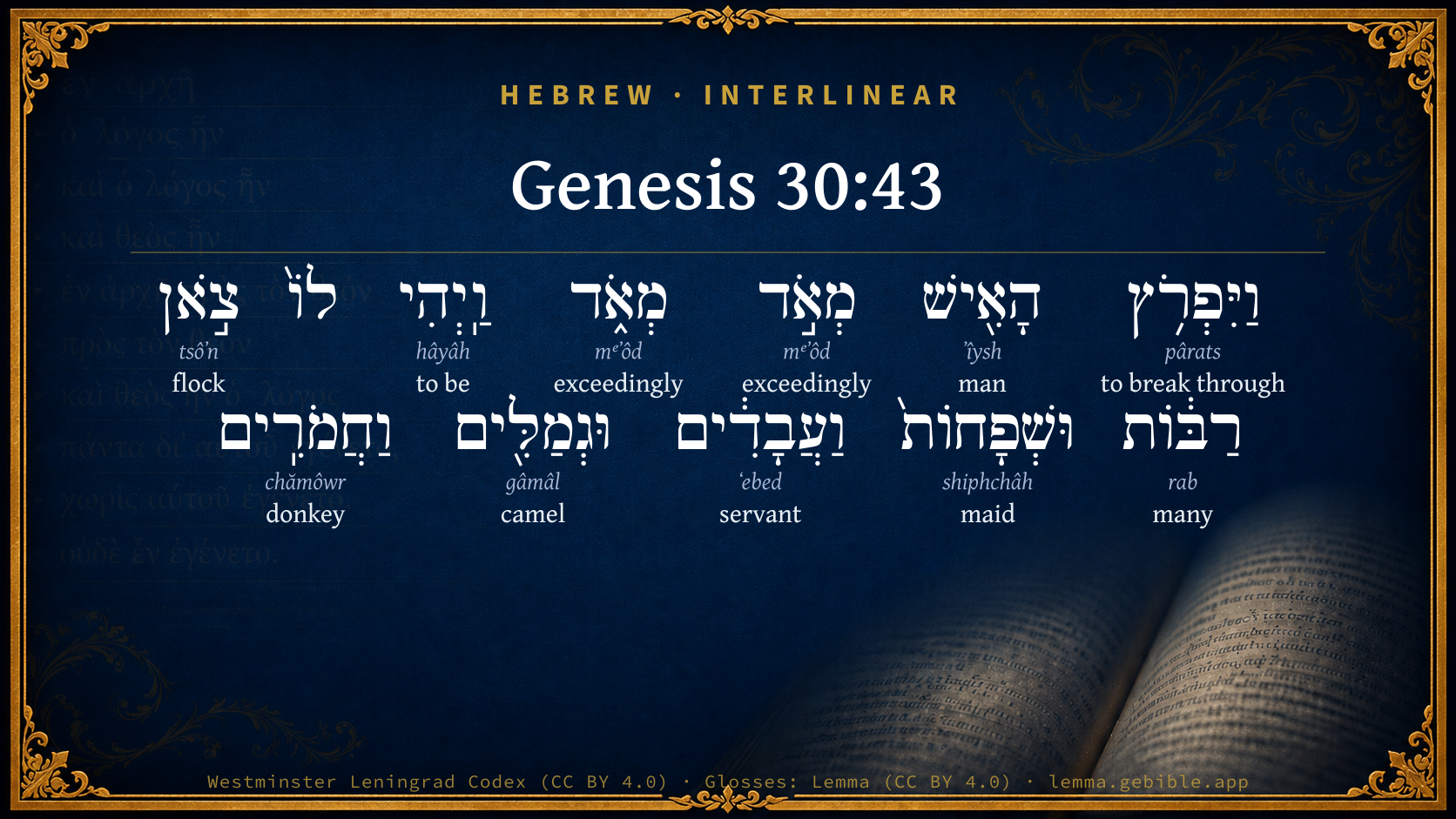
  1. הָאִ֖ישׁ ʼîysh H376 “the · man” Particle, Definite Article + Noun, Common, Masculine, Singular, Absolute
  2. מְאֹ֣ד mᵉʼôd H3966 “exceedingly” Adverb
  3. מְאֹ֑ד mᵉʼôd H3966 “exceedingly” Adverb
  4. וַֽיְהִי hâyâh H1961 “and · to be” Conjunction + Verb, Qal, Sequential Imperfect, 3rd Person, Masculine, Singular
  5. צֹ֣אן tsôʼn H6629 “flock” Noun, Common, Both, Singular, Absolute
  6. רַבּ֔וֹת rab H7227 “many” Adjective, Adjective, Feminine, Plural, Absolute
  7. וּשְׁפָחוֹת֙ shiphchâh H8198 “and · maids” Conjunction + Noun, Common, Feminine, Plural, Absolute
  8. וַעֲבָדִ֔ים ʻebed H5650 “and · servants” Conjunction + Noun, Common, Masculine, Plural, Absolute
  9. וּגְמַלִּ֖ים gâmâl H1581 “and · camels” Conjunction + Noun, Common, Masculine, Plural, Absolute
  10. וַחֲמֹרִֽים chămôwr H2543 “and · donkeys” Conjunction + Noun, Common, Both, Plural, Absolute

About this verse

These counts appear in no published source. They are computed here, from the morphology-tagged text and Lemma’s own curated glosses. What Lemma adds →

12
words
10
distinct lemmas
Pentateuch
section

Shared distinctive vocabulary

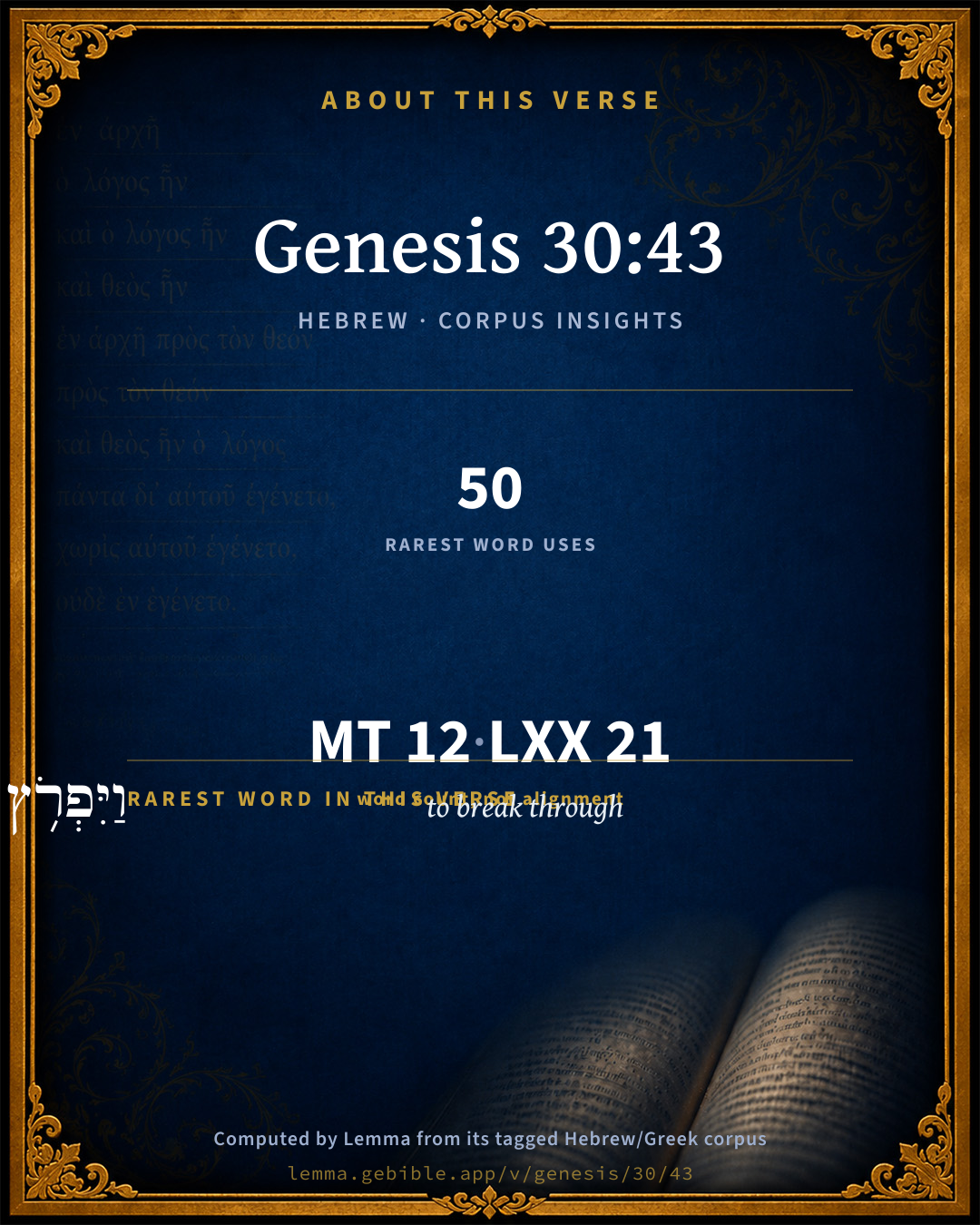
וַיִּפְרֹ֥ץ to break through H6555 occurs in 48 verses of the Hebrew Bible. Also found in:

Grammatical profile

  • 2 verbs
  • 6 nouns
  • 1 adjective
  • 1 preposition
  • 2 adverbs

Verb forms

  • וַיִּפְרֹ֥ץ Qal · Sequential Imperfect
  • וַֽיְהִי Qal · Sequential Imperfect

Repetition

A word recurs within this verse — often emphatic in Hebrew:

  • מְאֹ֣ד exceedingly H3966 ×2

Hebrew & Septuagint length

In English translation the verse runs 15 words from the Hebrew and 21 from the Septuagint (LXX English) — the Septuagint runs noticeably longer here. See the side-by-side →

A rough comparison of the two English renderings, which tokenize alike — not a word-level alignment.

Word counts can differ between the Hebrew and the Greek without any difference in meaning — e.g. the Hebrew direct-object marker אֵת has no separate Greek word, and Greek often adds the article ὁ.

In the original languages it is 12 Hebrew tokens and 21 Greek tokens — but the two are counted differently (Hebrew bundles its prefixes and suffixes into one token; the Greek is in lemma form), so that isn’t a like-for-like length.

Cross-references

13

Topical passages linked to Genesis 30:43 in the Treasury of Scripture Knowledge — connected by theme and wording, ordered by reader-vote popularity; previews shown in the World English Bible.

  • Genesis 24:35 Yahweh has blessed my master greatly. He has become great. He has given him flocks and herds, silver and gold, men-servants and maid-servants, and camels and donkeys.
  • Genesis 26:13–14 The man grew great, and grew more and more until he became very great.
  • Genesis 30:30 For it was little which you had before I came, and it has increased to a multitude. Yahweh has blessed you wherever I turned. Now when will I provide for my own house also?"
  • Genesis 13:2 Abram was very rich in cattle, in silver, and in gold.
  • Genesis 12:16 He dealt well with Abram for her sake. He had sheep, and oxen, and male donkeys, and men-servants, and maid-servants, and female donkeys, and camels.
  • Genesis 28:15 Behold, I am with you, and will keep you, wherever you go, and will bring you again into this land. For I will not leave you, until I have done that which I have spoken of to you."
  • Genesis 32:10 I am not worthy of the least of all the loving kindnesses, and of all the truth, which you have shown to your servant; for with just my staff I passed over this Jordan; and now I have become two companies.
  • Genesis 33:11 Please take the gift that I brought to you; because God has dealt graciously with me, and because I have enough." He urged him, and he took it.
  • Ecclesiastes 2:7 I bought men-servants and maid-servants, and had servants born in my house. I also had great possessions of herds and flocks, above all who were before me in Jerusalem;
  • Genesis 31:7–8 Your father has deceived me, and changed my wages ten times, but God didn't allow him to hurt me.
  • Genesis 31:42 Unless the God of my father, the God of Abraham, and the fear of Isaac, had been with me, surely now you would have sent me away empty. God has seen my affliction and the labor of my hands, and rebuked you last night."
  • Ezekiel 39:10 so that they shall take no wood out of the field, neither cut down any out of the forests; for they shall make fires of the weapons; and they shall plunder those who plundered them, and rob those who robbed them, says the Lord Yahweh.
  • Genesis 36:7 For their substance was too great for them to dwell together, and the land of their travels couldn't bear them because of their cattle.

Cross-references courtesy of OpenBible.info (CC BY 4.0).

Hebrew and Greek witnesses Masoretic Hebrew ↔ Greek Septuagint

The same verse in the two great witnesses to the Old Testament, shown verse-for-verse.

Here the Septuagint runs noticeably longer than the Hebrew — LXX2012 (modern English Septuagint) 21 words vs World English Bible 15. A rough length comparison of the two English translations, not a word-level alignment — read both below.

These are two independent witnesses, not word-aligned to each other, and the Septuagint is shown in lemma (dictionary) form.

Hebrew Genesis 30:43 Masoretic · Westminster Leningrad Codex

וַיִּפְרֹ֥ץ הָאִ֖ישׁ מְאֹ֣ד מְאֹ֑ד וַֽיְהִי לוֹ֙ צֹ֣אן רַבּ֔וֹת וּשְׁפָחוֹת֙ וַעֲבָדִ֔ים וּגְמַלִּ֖ים וַחֲמֹרִֽים

The man increased exceedingly, and had large flocks, maid-servants and men-servants, and camels and donkeys.

World English Bible · Public Domain

Greek LXX Genesis 30:43 Septuagint · lemma form

καί πλουτέω ὁ ἄνθρωπος σφόδρα σφόδρα καί γίγνομαι αὐτός κτῆνος πολύς καί βοῦς καί παῖς καί παιδίσκη καί κάμηλος καί ὄνος

And the man became very rich, and he had many cattle, and oxen, and servants, and maidservants, and camels, and asses.

LXX2012 (modern English Septuagint) · Public Domain

Hebrew: Westminster Leningrad Codex (CC BY 4.0). Greek: Septuagint (public domain); English from LXX2012 (modern English Septuagint) (Public Domain). How the Septuagint differs from the Hebrew →

Targum (Aramaic paraphrase)

2

The Targum is the ancient Jewish Aramaic paraphrase of the Hebrew Scriptures — an interpretive translation, not the Hebrew text itself. Onkelos (literal) and Pseudo-Jonathan (expansive) render the Torah, and Jonathan the Prophets. Coverage is partial: where no permissively-licensed English translation exists for a verse, only the Aramaic is shown. This is verse-level text, not a word-by-word alignment to the Hebrew.

  1. Targum Onkelos Torah (Genesis–Deuteronomy)
    וּתְקֵיף גַּבְרָא לַחֲדָא לַחֲדָא וַהֲווֹ לֵהּ עָן סַגִּיאָן וְאַמְהָן וְעַבְדִּין וְגַמְלִין וַחֲמָרִין

    (no public-domain English translation for this verse)

    Targum Onkelos — Aramaic: “Onkelos Genesis” (public domain); “Onkelos Exodus” (public domain); “Onkelos Leviticus” (public domain); “Onkelos Numbers” (public domain); “Onkelos Deuteronomy” (public domain). English: “Sefaria Community Translation” (CC0 1.0 (public-domain dedication)); “J.W. Etheridge. The Targums of Onkelos and Jonathan Ben Uzziel on the Pentateuch. London: Longmans, Green, 1862” (public domain). Text via Sefaria.

  2. Targum Pseudo-Jonathan Torah (Genesis–Deuteronomy)
    וּתְקֵיף גַבְרָא לַחֲדָא לַחֲדָא וַהֲווֹ לֵיהּ עָאן סַגִיאִין וְאַמְהָן וְעַבְדִין וּגְמַלִין וְחַמְרִין

    And the man increased greatly, and had a multitude of flocks, and handmaids and servants, and camels, and asses.

    Targum Pseudo-Jonathan — Aramaic: “Targum Jonathan on Genesis” (public domain); “Targum Jonathan on Exodus” (public domain); “Targum Jonathan on Leviticus” (public domain); “Targum Jonathan on Numbers” (public domain); “Targum Jonathan on Deuteronomy” (public domain). English: “The Targum of Jonathan ben Uzziel, trans. J. W. Etheridge, London, 1862” (public domain). Text via Sefaria.

Commentary

Notes on Genesis 30:43 from classic Christian and Jewish commentators (each source and its license shown beneath its notes). The classic Christian expositions comment on the surrounding passage and are grouped to its opening verse, so a note may address several verses; the Jewish commentaries on the Tanakh (Rashi and others) are per-verse, so they appear only where the commentator wrote on this verse.

Lemma curates 59 commentaries, every one of them public domain or Creative Commons licensed, each selected and text-cleaned for this edition rather than reprinted as found. About our sources →

Trapp's Complete Commentary

John Trapp

Gen 30:43 And the man increased exceedingly, and had much cattle, and maidservants, and menservants, and camels, and asses.

Ver. 43. And the man increased exceedingly.] So shall all those do, if it be for their eternal good, that depend upon God for success and blessing upon their hard and honest labours. As for others, that will needs care and carve for themselves, being troubled about many things, but neglecting that "one thing necessary," the Lord either gives the souls of such over to suffer shipwreck, or else strips them of all their lading and tacklings, breaking their estates all to pieces, and making them glad to go to heaven upon a broken plank.

John Trapp, A Commentary or Exposition upon All the Books of the Old and New Testament (1647–1656) — public domain. Text from a community e-Sword module.

Joseph Benson's Commentary

Gen 30:43. The man increased exceedingly — Upon the whole of what is said here, and in the following chapter, we may conclude that Jacob’s behaviour in this affair was generous, fair, and candid; that he chose the ring-streaked cattle with a view to prevent disputes, trusting that God would so order it, agreeably to his petition at Beth-el, that he should have enough, being determined to be content with what God’s providence should give him; and that, when he made use of the rods, it was an act of faith, and in obedience to God’s command. We have the more reason to think this, because we find nothing but good arose to Jacob from it; whereas, we may remark, that though the Scripture often mentions the misconduct of good men, yet it always takes care to inform us, that evil arose to them in consequence of such actions. We may observe also God’s faithfulness; he had promised Jacob at Beth-el to be with him in all places whither he should go; and we find him accordingly blessing Laban because he was with him: so that, though Laban had but little when Jacob came to him, it was, under him, increased to a multitude. We ought likewise to take notice that, though Jacob, from what he says to Laban in the following chapter, appears to have been a most industrious, faithful servant, yet he attributes all the increase of the flock to the blessing of God, and not to his own care.

Joseph Benson's Commentary on the Old and New Testaments (1811–1818) — public domain. Text from a community e-Sword module.

Tyndale Open Study Notes

Tyndale Open Resources

30:43 Jacob became very wealthy, in fulfillment of God’s promises to him (27:28; 28:13-15).

Tyndale Open Study Notes — © Tyndale Open Resources, licensed CC BY-SA 4.0. Text via the HelloAO Bible API.

Adam Clarke's Commentary

Verse 43. And the man increased exceedingly] No wonder, when he used such means as the above. And had maid-servants, and men-servants-he was obliged to increase these as his cattle multiplied. And camels and asses, to transport his tents, baggage, and family from place to place, being obliged often to remove for the benefit of pasturage.

We have already seen many difficulties in this chapter, and strange incidents, for which we are not able to account.

1. The vicarious bearing of children;

2. The nature and properties of the mandrakes;

3. The bargain of Jacob and Laban; and

4. The business of the party-coloured flocks produced by means of the females looking at the variegated rods.

These, especially the three last, may be ranked among the most difficult things in this book. Without encumbering the page with quotations and opinions, I have given the best sense I could; and think it much better and safer to confess ignorance, than, under the semblance of wisdom and learning, to multiply conjectures. Jacob certainly manifested much address in the whole of his conduct with Laban; but though nothing can excuse overreaching or insincerity, yet no doubt Jacob supposed himself justified in taking these advantages of a man who had greatly injured and defrauded him. Had Jacob got Rachel at first, for whom he had honestly and faithfully served seven years, there is no evidence whatever that he would have taken a second wife. Laban, by having imposed his eldest daughter upon him, and by obliging him to serve seven years for her who never was an object of his affection, acted a part wholly foreign to every dictate of justice and honesty; (for though it was a custom in that country not to give the younger daughter in marriage before the elder, yet, as he did not mention this to Jacob, it cannot plead in his excuse;) therefore, speaking after the manner of men, he had reason to expect that Jacob should repay him in his own coin, and right himself by whatever means came into his power; and many think that he did not transgress the bounds of justice, even in the business of the party-coloured cattle.

The talent possessed by Jacob was a most dangerous one; he was what may be truly called a scheming man; his wits were still at work, and as he devised so he executed, being as fruitful in expedients as he was in plans. This was the principal and the most prominent characteristic of his life; and whatever was excessive here was owing to his mother's tuition; she was evidently a woman who paid little respect to what is called moral principle, and sanctified all kinds of means by the goodness of the end at which she aimed; which in social, civil, and religious life, is the most dangerous principle on which a person can possibly act. In this art she appears to have instructed her son; and, unfortunately for himself, he was in some instances but too apt a proficient. Early habits are not easily rooted out, especially those of a bad kind. Next to the influence and grace of the Spirit of God is a good and religious education. Parents should teach their children to despise and abhor low cunning, to fear a lie, and tremble at an oath; and in order to be successful, they should illustrate their precepts by their own regular and conscientious example. How far God approved of the whole of Jacob's conduct I shall not inquire; it is certain that he attributes his success to Divine interposition, and God himself censures Laban's conduct towards him; see Ge 31:7-12. But still he appears to have proceeded farther than this interposition authorized him to go, especially in the means he used to improve his own breed, which necessarily led to the deterioration of Laban's cattle; for, after the transactions referred to above, these cattle could be of but little worth. The whole account, with all its lights and shades, I consider as another proof of the impartiality of the Divine historian, and a strong evidence of the authenticity of the Pentateuch. Neither the spirit of deceit, nor the partiality of friendship, could ever pen such an account.

Adam Clarke's Commentary on the Bible (1810–1826) — public domain. Text from a community e-Sword/MySword module.

John Calvin's Commentaries

43. And the man increased exceedingly. Moses added this for the purpose of showing that he was not made thus suddenly rich without a miracle. We shall see hereafter how great his wealth was. For being entirely destitute, he yet gathered out of nothing, greater riches than any man of moderate wealth could do in twenty or thirty years. And that no one may deem this fabulous, as not being in accordance with the usual method, Moses meets the objection by saying, that the holy man was enriched in an extraordinary manner.

John Calvin's Commentaries (1540-1563) — public domain. Text from the Calvin Translation Society English edition (1840s-50s) via the Christian Classics Ethereal Library (ccel.org). Calvin's coverage is partial (roughly two-thirds of the Bible); uncommented books and verses are honest gaps, never fabricated. The 19th-century editor's footnotes and remarks are omitted so the notes are faithfully Calvin's own voice.

Ellicott's Commentary for English Readers

(43) The man increased exceedingly.—Heb., broke forth, as in Gen_30:30. Wool, as the chief material for clothing, is a very valuable commodity in the East, and by the sale of it Jacob would obtain means for the purchase of male and female servants and camels. The latter were especially valuable for purposes of commerce, in which Jacob evidently was actively engaged, and whence probably came his chief gains.

A Bible Commentary for English Readers, edited by Charles John Ellicott (1878–1897) — public domain. Text from a community e-Sword module.

The Cambridge Bible for Schools and Colleges

gen. ed. J. J. S. Perowne

43. increased exceedingly] Cf. the description of the wealth of Abraham and Isaac, Gen_13:2, Gen_24:35, Gen_26:13-14.

Cf. Shakespeare, Merchant of Venice, Act i. Scene iii.:

“Shy. mark what Jacob did.

When Laban and himself were compromised

That all the eanlings which were streak’d and pied

Should fall as Jacob’s hire.…

The skilful shepherd peel’d me certain wands, …

He stuck them up before the fulsome ewes,

Who, then conceiving, did in eaning time

Fall parti-colour’d lambs, and those were Jacob’s.

This was a way to thrive, and he was blest.”

The Cambridge Bible for Schools and Colleges (gen. ed. J. J. S. Perowne; Cambridge University Press, 1878–1918) — public domain. Text from a community e-Sword module.

The Pulpit Commentary

And as the apparent result of the triple stratagem, though vide supra, ver. 38, and cf. Gen_31:12the man increased exceedingly, literally, broke forth greatly (vide ver. 80)and had much cattle, and maid-servants, and men-servants, and camels, and asses like Abraham (Gen_13:2) and Isaac. (Gen_26:13, Gen_26:14) Thus far the historian simply narrates the fact of the patriarch"s priority, and the steps which to it, "without expressing approbation of his conduct or describing his increasing wealth as a blessing from God. The verdict is contained in what follows (Keil).

HOMILIES BY R.A. REDFORD Ver. 43.

Jacob"s history an illustration of the blending together of the natural and the supernatural in God s dealings.

"And the man increased exceedingly," &c. ;

I The PROMISE TO GUIDE, protect, and bless fulfilled in connection with the employment of ordinary faculties and instrumentalities. Jacob"s craft partly natural, but in this instance specially assisted that he might be helped in an emergency. The "supplanter" in this case represented the better cause.

II HUMAN DEVICES only apparently, and not really, thwart the purposes of God. Jacob represents the people of God. The victory is appointed them. Their interests must be served by the kingdoms of this world, though for a season the advantage appears on the side of the mere calculating, selfish policy. The true wisdom is that which cometh from above.

III INCREASE in the best sense is God"s promise. It will be sent as he wills and when he wills, but will be found the true answer to prayer and the true manifestation of love. On all that belongs to us the blessing rests. Spiritual prosperity carries with it all other. Though the individual may be called to suffer for the sake of the community, the promise to the Church must be fulfilled. "It is our Father"s good pleasure to give us the kingdom." "The meek shall inherit the earth. R.

The Pulpit Commentary (1880–1919), ed. H.D.M. Spence-Jones & Joseph S. Exell — public domain. Text from a community e-Sword module.

unfoldingWord translationNotes

Door43 World Missions Community

The man

"Jacob"

became very prosperous

"greatly prospered" or "became very wealthy"

translationWords

prosper

flocks

servant

camel

donkey

unfoldingWord translationNotes — © Distant Shores Media and the Door43 World Missions Community, licensed CC BY-SA 4.0. Source: git.door43.org/Door43/en_tn.

Rashi

Rabbi Shlomo Yitzchaki (Rashi)

צאן רבות MANY SHEEP — sheep that multiplied and were fruitful more than other sheep (Genesis Rabbah 73:11).

ושפחות ועבדים AND HANDMAIDS, AND MEN-SERVANTS — he used to sell his sheep at a high price and he bought for himself all these (Tanchuma Yashan 1:7:24).

Rashi on the Tanakh — English translations: “The Judaica Press complete Tanach with Rashi, translated by A. J. Rosenberg” (CC BY 4.0); “Pentateuch with Rashi's commentary by M. Rosenbaum and A.M. Silbermann, 1929-1934” (public domain); “The Metsudah Tanach series, Lakewood, N.J” (CC BY 4.0); and “The Book of Joshua, Metsudah Publications, 1997” (CC BY 4.0). Text via Sefaria.

Radak

Rabbi David Kimhi (Radak)

ויפרץ, this refers to financial success, not to the number of offspring. This is also what G’d had promised Yaakov in 28,14 when He said: ופרצת ימה וקדמה וגו'. Yaakov’s wealth is symbolically described as bursting through its fences. There is not enough space to accommodate it. Clearly, this is one of the instances in which the Torah deliberately indulges in exaggeration in order to illustrate its point.

מאד מאד, to emphasise further the quantitative element the Torah speaks of.

ויהי לו צאן רבות, the feminine ending in רבות refers to the females of the sheep, the ones producing the lambs. One single ram would service many ewes. Cattle are not mentioned here at all as Yaakov’s work was restricted to raising sheep and goats. He did possess cattle, however.

Radak on the Tanakh — English translations: “Sefaria Community Translation” (CC0 1.0 (public-domain dedication)); “Eliyahu Munk, HaChut Hameshulash” (CC BY 4.0); “Rabbi Mike Feuer, Jerusalem Anthology” (CC BY 4.0); and “R. David Kimhi on the first book of Psalms, Translated by R.G. Finch, London, 1919” (public domain). Text via Sefaria.

Lesson kit

Teaching starters — assembled from the data on this page, not authored interpretation. Every prompt links to the verse data it draws on. Edit before teaching.

Genesis, in the Pentateuch, opens this verse with 12 words (10 distinct Hebrew lemmas). Its most distinctive word is pârats (“to break through”). The Greek Septuagint runs longer here. A historical commentator’s framing appears above. Read the whole chapter for the surrounding context.

Discussion questions

  1. What does “to break through” (pârats) contribute to the verse as a whole?
  2. Genesis 28:14 shares the word «to break through» with this verse. How do the two illuminate each other?
  3. “exceedingly” occurs 2× in this one verse. What is the effect of the repetition?
  4. Compared with the Hebrew, the Septuagint runs longer here. What questions does that raise?
  5. These translations render this verse differently; the difference is in the English rendering, not the original. What questions does that raise?
  6. The verb «וַיִּפְרֹ֥ץ» is Qal Sequential Imperfect. How does its form color the action?
  7. Reading how Trapp's Complete Commentary and Joseph Benson's Commentary read this verse, where do the two commentators agree and where do they part?

Things to notice

Reading settings

Reading text

Shown beneath each verse's original-language words.

Old Testament
Old Testament edition

Read the OT as the Masoretic Hebrew (MT) or the Greek Septuagint (LXX).

English shown for the Greek Septuagint (in the Hebrew ↔ Greek comparison).

Comparing translations? Open the Compare panel on any verse page to stack up to four side by side.