Genesis 13:11

Hebrew (Westminster Leningrad Codex) Genesis 13:11 appears in the Hebrew Old Testament. The text above is from the Westminster Leningrad Codex. Each word links to its Strong’s number, a concise gloss, and parsing drawn from the Open Scriptures Hebrew Bible morphology. Click any word for its full Brown-Driver-Briggs (BDB) entry.
Download image
Cite this verse

Genesis 13:11 (World English Bible). Public Domain. Lemma interlinear Bible study tool, https://lemma.gebible.app/v/genesis/13/11.

Show BibTeX & RIS
BibTeX
RIS
English Translation
So Lot chose the Plain of the Jordan for himself. Lot traveled east, and they separated themselves the one from the other.
World English Bible · Public Domain
Download a study sheet

One document with this verse’s original text, its word-by-word gloss line, the meaning frame, cross-references with their text, attributed commentary, and full source and license credits — printable, and it pastes into notes with its structure intact.

This verse Autodidact and up

Study sheet (.html) Plain text (.txt)

A passage Seminary Student

Up to 50 verses in one chapter. A passage sheet keeps up to 6 commentary sources and 12 cross-references per verse, in the order this page ranks them, and says so on the sheet whenever that leaves anything out. Ask for a single verse and you get the Autodidact verse sheet above.

Everything on this page stays free to read, with no account — the sheet is a download of what is already on screen, not access to it.

Want to remove ads? Support Godless Engineer
Compare translations 3

The same verse in 3 English versions, stacked beneath the original-language interlinear above. Click any original word for its lexicon entry.

Each is an independent rendering of the whole verse — the interlinear is not word-aligned to these translations.

Highlighted words mark where these versions differ — a whole-verse word diff, not a word-by-word alignment.

  • World English Bible Public Domain
    So Lot chose the Plain of the Jordan for himself. Lot traveled east, and they separated themselves the one from the other.
  • King James Version Public Domain
    Then Lot chose him all the plain of Jordan; and Lot journeyed east: and they separated themselves the one from the other.
  • unfoldingWord Literal Text CC BY-SA 4.0
    So Lot chose for himself all the plain of the Jordan, and Lot traveled to the east, and they separated from each other.

unfoldingWord Literal Text — © unfoldingWord, licensed CC BY-SA 4.0. Word-aligned USFM3 via Door43 (git.door43.org/unfoldingWord/en_ult).

Versions to compare (up to 4)

3 of 4 selected

Show all 18 translations

Every available English version of this verse, each an independent rendering of the whole verse.

  • World English Bible Public Domain
    So Lot chose the Plain of the Jordan for himself. Lot traveled east, and they separated themselves the one from the other.
  • Berean Standard Bible Public Domain
    So Lot chose the whole plain of the Jordan for himself and set out toward the east. And Abram and Lot parted company.
  • Majority Standard Bible Public Domain
    So Lot chose the whole plain of the Jordan for himself and set out toward the east. And Abram and Lot parted company.
  • King James Version Public Domain
    Then Lot chose him all the plain of Jordan; and Lot journeyed east: and they separated themselves the one from the other.
  • American Standard Version (1901) Public Domain
    So Lot chose him all the Plain of the Jordan; and Lot journeyed east: and they separated themselves the one from the other.
  • Revised Version (1885) Public Domain
    So Lot chose him all the Plain of Jordan; and Lot journeyed east: and they separated themselves the one from the other.
  • Geneva Bible (1599) Public Domain
    Then Lot chose vnto him all the plaine of Iorden, and tooke his iourney from the East: and they departed the one from the other.
  • Douay-Rheims (1899) Public Domain
    And Lot chose to himself the country about the Jordan, and he departed from the east: and they were separated one brother from the other.
  • Young's Literal Translation Public Domain
    and Lot chooseth for himself the whole circuit of the Jordan; and Lot journeyeth from the east, and they are parted -- a man from his companion;
  • Literal Standard Version CC BY-SA 4.0
    and Lot chooses for himself the whole circuit of the Jordan; and Lot journeys from the east, and they are parted—a man from his companion;
  • Unlocked Literal Bible CC BY-SA 4.0
    So Lot chose for himself all the plain of the Jordan and traveled east, and the relatives separated from each other.
  • unfoldingWord Literal Text CC BY-SA 4.0
    So Lot chose for himself all the plain of the Jordan, and Lot traveled to the east, and they separated from each other.
  • Darby Bible Public Domain
    And Lot chose for himself all the plain of the Jordan; and Lot went toward the east. And they separated the one from the other:
  • World Messianic Bible Public Domain
    So Lot chose the Plain of the Jordan for himself. Lot traveled east, and they separated themselves from one another.
  • Webster's Bible Public Domain
    Then Lot chose him all the plain of Jordan; and Lot journeyed east: and they separated themselves the one from the other.
  • Free Bible Version CC BY-SA 4.0
    So Lot chose the whole Jordan valley and went east, and the two separated from each other.
  • Bible in Basic English Public Domain
    So Lot took for himself all the valley of Jordan, and went to the east, and they were parted from one another.
  • JPS Tanakh (1917) Public Domain
    So Lot chose him all the plain of the Jordan; and Lot journeyed east; and they separated themselves the one from the other.

Literal Standard Version (2020), Covenant Press — licensed CC BY-SA 4.0. Text via the HelloAO Bible API (eBible.org). Unlocked Literal Bible (unfoldingWord) — licensed CC BY-SA 4.0. Text via the HelloAO Bible API (eBible.org). unfoldingWord Literal Text — © unfoldingWord, licensed CC BY-SA 4.0. Word-aligned USFM3 via Door43 (git.door43.org/unfoldingWord/en_ult). Free Bible Version, Dr. Jonathan Gallagher — licensed CC BY-SA 4.0. Text via the HelloAO Bible API (eBible.org).

Word by word

More ways to search: Search by grammar → Find every occurrence → Compare this word →

Practice this passage: Drill this verse → Learn its vocabulary →

וַיִּפָּ֣רְד֔וּ
pârad
H6504
“and · to divide”
Conjunction + Verb, Niphal, Sequential Imperfect, 3rd Person, Masculine, Plural
Part of Speech
Conjunction + Verb
Stem
Niphal
Form
Sequential Imperfect
Person
3rd Person
Gender
Masculine
Number
Plural
Full BDB Definition

Origin: a primitive root

TWOT: 1806

to separate, divide - (Qal) to divide - (Niphal) - to divide, separate - to be divided, be separated - (Piel) to be separated - (Pual) to be divided - (Hiphil) - to divide, separate - to make a division, make a separation - (Hithpael) to be divided, be separated, get separated
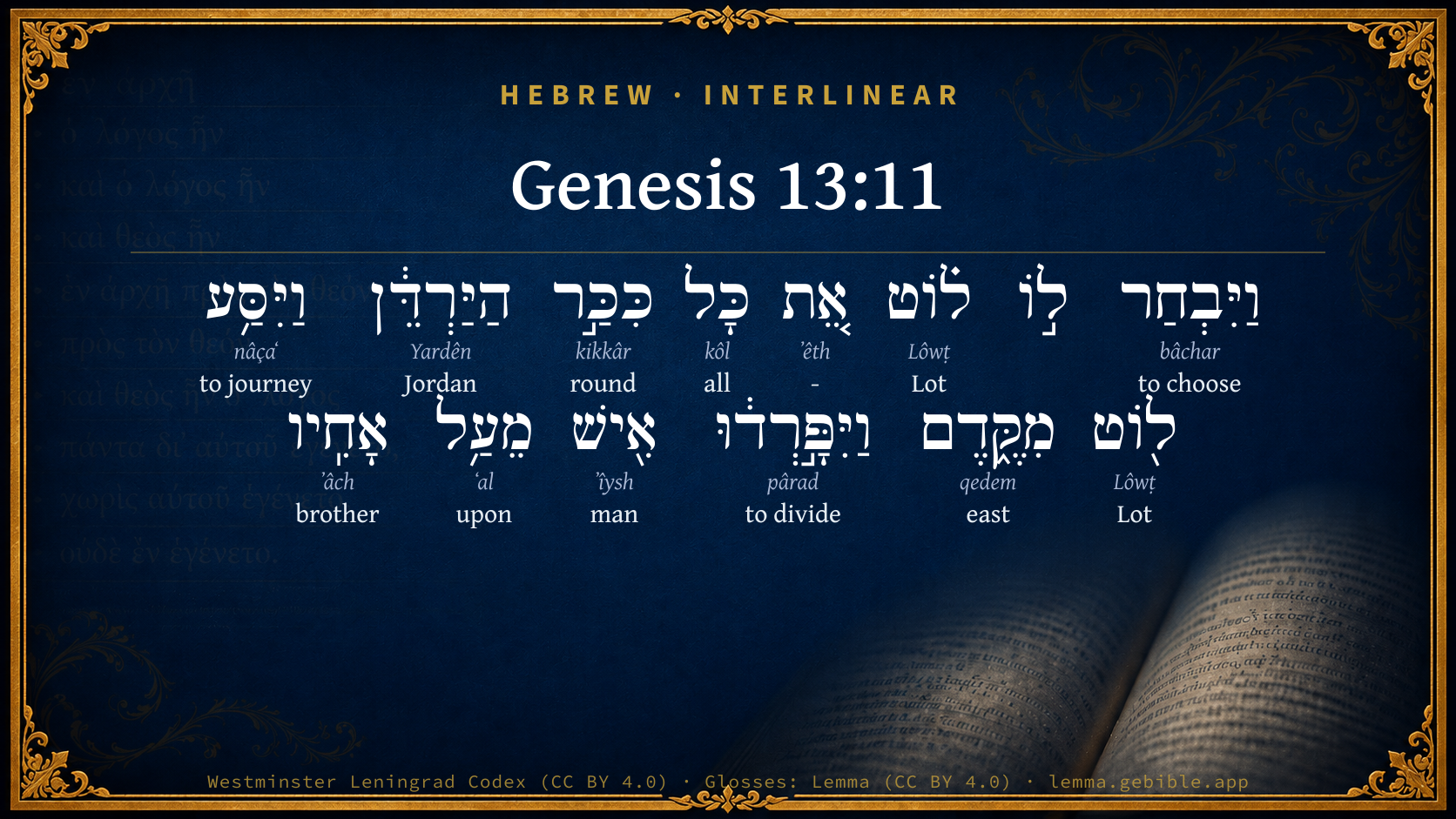
  1. וַיִּבְחַר bâchar H977 “and · to choose” Conjunction + Verb, Qal, Sequential Imperfect, 3rd Person, Masculine, Singular
  2. ל֗וֹט Lôwṭ H3876 “Lot” Noun, Proper
  3. אֵ֚ת ʼêth H853 “-” Particle, Direct Object
  4. כָּל kôl H3605 “all of” Noun, Common, Masculine, Singular, Construct
  5. כִּכַּ֣ר kikkâr H3603 “round of” Noun, Common, Both, Singular, Construct
  6. הַיַּרְדֵּ֔ן Yardên H3383 “the · Jordan” Particle, Definite Article + Noun, Proper
  7. וַיִּסַּ֥ע nâçaʻ H5265 “and · to journey” Conjunction + Verb, Qal, Sequential Imperfect, 3rd Person, Masculine, Singular
  8. ל֖וֹט Lôwṭ H3876 “Lot” Noun, Proper
  9. מִקֶּ֑דֶם qedem H6924 “from · east” Preposition + Noun, Common, Masculine, Singular, Absolute
  10. אִ֖ישׁ ʼîysh H376 “man” Noun, Common, Masculine, Singular, Absolute
  11. מֵעַ֥ל ʻal H5921 “from · upon” Preposition + Preposition
  12. אָחִֽיו ʼâch H251 “brother · his” Noun, Common, Masculine, Singular, Construct + Suffix, Personal, 3rd Person, Masculine, Singular

About this verse

These counts appear in no published source. They are computed here, from the morphology-tagged text and Lemma’s own curated glosses. What Lemma adds →

14
words
12
distinct lemmas
Pentateuch
section

Shared distinctive vocabulary

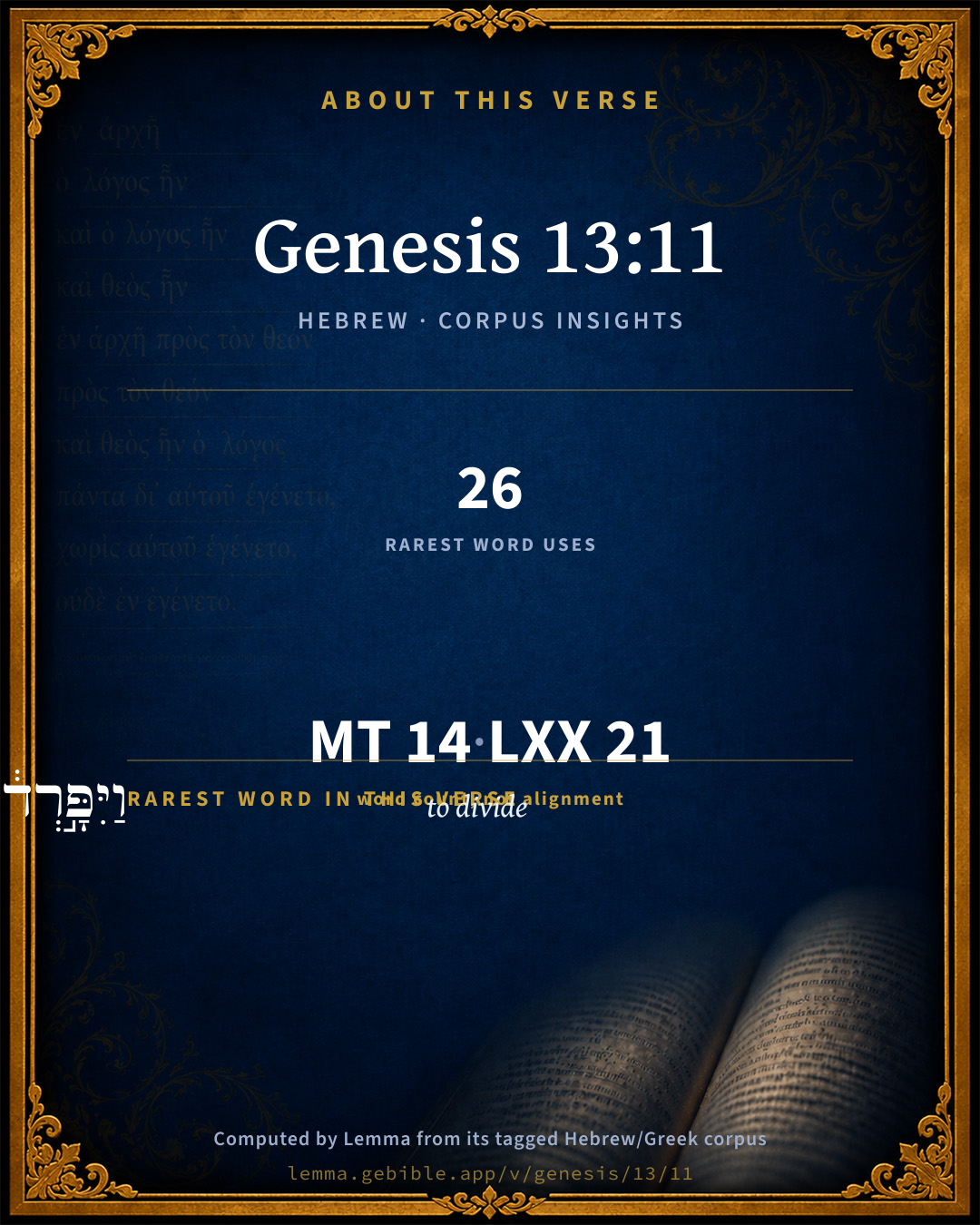
וַיִּפָּ֣רְד֔וּ to divide H6504 occurs in 26 verses of the Hebrew Bible. Also found in:

Grammatical profile

  • 3 verbs
  • 8 nouns
  • 2 prepositions
  • 1 particle

Verb forms

  • וַיִּבְחַר Qal · Sequential Imperfect
  • וַיִּסַּ֥ע Qal · Sequential Imperfect
  • וַיִּפָּ֣רְד֔וּ Niphal · Sequential Imperfect

Repetition

A word recurs within this verse — often emphatic in Hebrew:

  • ל֗וֹט Lot H3876 ×2

Hebrew & Septuagint length

In English translation the verse runs 22 words from the Hebrew and 32 from the Septuagint (LXX English) — the Septuagint runs noticeably longer here. See the side-by-side →

A rough comparison of the two English renderings, which tokenize alike — not a word-level alignment.

Word counts can differ between the Hebrew and the Greek without any difference in meaning — e.g. the Hebrew direct-object marker אֵת has no separate Greek word, and Greek often adds the article ὁ.

In the original languages it is 14 Hebrew tokens and 21 Greek tokens — but the two are counted differently (Hebrew bundles its prefixes and suffixes into one token; the Greek is in lemma form), so that isn’t a like-for-like length.

Cross-references

8

Topical passages linked to Genesis 13:11 in the Treasury of Scripture Knowledge — connected by theme and wording, ordered by reader-vote popularity; previews shown in the World English Bible.

  • Genesis 13:9 Isn't the whole land before you? Please separate yourself from me. If you go to the left hand, then I will go to the right. Or if you go to the right hand, then I will go to the left."
  • Psalms 119:63 I am a friend of all those who fear you, Of those who observe your precepts.
  • Proverbs 27:10 Don't forsake your friend and your father's friend. Don't go to your brother's house in the day of your disaster: Better is a neighbor who is near than a distant brother.
  • Hebrews 10:25 not forsaking our own assembling together, as the custom of some is, but exhorting one another; and so much the more, as you see the Day approaching.
  • 1 Peter 2:17 Honor all men. Love the brotherhood. Fear God. Honor the king.
  • Genesis 13:14 Yahweh said to Abram, after Lot was separated from him, "Now, lift up your eyes, and look from the place where you are, northward and southward and eastward and westward,
  • Psalms 16:3 As for the saints who are in the earth, They are the excellent ones in whom is all my delight.
  • Genesis 19:17 It came to pass, when they had taken them out, that he said, "Escape for your life! Don't look behind you, neither stay anywhere in the plain. Escape to the mountain, lest you be consumed!"

Cross-references courtesy of OpenBible.info (CC BY 4.0).

Hebrew and Greek witnesses Masoretic Hebrew ↔ Greek Septuagint

The same verse in the two great witnesses to the Old Testament, shown verse-for-verse.

Here the Septuagint runs noticeably longer than the Hebrew — LXX2012 (modern English Septuagint) 32 words vs World English Bible 22. A rough length comparison of the two English translations, not a word-level alignment — read both below.

These are two independent witnesses, not word-aligned to each other, and the Septuagint is shown in lemma (dictionary) form.

Hebrew Genesis 13:11 Masoretic · Westminster Leningrad Codex

וַיִּבְחַר ל֣וֹ ל֗וֹט אֵ֚ת כָּל כִּכַּ֣ר הַיַּרְדֵּ֔ן וַיִּסַּ֥ע ל֖וֹט מִקֶּ֑דֶם וַיִּפָּ֣רְד֔וּ אִ֖ישׁ מֵעַ֥ל אָחִֽיו

So Lot chose the Plain of the Jordan for himself. Lot traveled east, and they separated themselves the one from the other.

World English Bible · Public Domain

Greek LXX Genesis 13:11 Septuagint · lemma form

καί ἐκλέγω ἑαυτοῦ λωτ πᾶς ὁ περίχωρος ὁ ἰορδάνης καί ἀποαἴρω λωτ ἀπό ἀνατολή καί διαχωρίζω ἕκαστος ἀπό ὁ ἀδελφός αὐτός

And Lot chose for himself all the country round Jordan, and Lot went from the east, and they were separated each from his brother. And Abram lived in the land of Chanaan.

LXX2012 (modern English Septuagint) · Public Domain

Hebrew: Westminster Leningrad Codex (CC BY 4.0). Greek: Septuagint (public domain); English from LXX2012 (modern English Septuagint) (Public Domain). How the Septuagint differs from the Hebrew →

Targum (Aramaic paraphrase)

2

The Targum is the ancient Jewish Aramaic paraphrase of the Hebrew Scriptures — an interpretive translation, not the Hebrew text itself. Onkelos (literal) and Pseudo-Jonathan (expansive) render the Torah, and Jonathan the Prophets. Coverage is partial: where no permissively-licensed English translation exists for a verse, only the Aramaic is shown. This is verse-level text, not a word-by-word alignment to the Hebrew.

  1. Targum Onkelos Torah (Genesis–Deuteronomy)
    וּבְחַר לֵיהּ לוֹט יַת כָּל מֵישַׁר יַרְדְנָא וּנְטַל לוֹט מִלְקַדְמִין וְאִתַּפְרָשׁוּ גְבַר מִלְוַת אָחוּהִי

    And Lot chose to him all the plain of Yardena; and Lot went forth before, and they were separated each man from his brother.

    Targum Onkelos — Aramaic: “Onkelos Genesis” (public domain); “Onkelos Exodus” (public domain); “Onkelos Leviticus” (public domain); “Onkelos Numbers” (public domain); “Onkelos Deuteronomy” (public domain). English: “Sefaria Community Translation” (CC0 1.0 (public-domain dedication)); “J.W. Etheridge. The Targums of Onkelos and Jonathan Ben Uzziel on the Pentateuch. London: Longmans, Green, 1862” (public domain). Text via Sefaria.

  2. Targum Pseudo-Jonathan Torah (Genesis–Deuteronomy)
    וּבְחַר לֵיהּ לוֹט יַת כָּל מֵישַׁר יַרְדְנָא וּנְטַל לוֹט מִמַדִינְחָא וְאִיתְפַּרְשׁוּ אֵינַשׁ מֵעַל אָחוֹי

    And Lot chose to him all the plain of Jardena; and Lot journeyed from the east, and they separated the one man from his brother.

    Targum Pseudo-Jonathan — Aramaic: “Targum Jonathan on Genesis” (public domain); “Targum Jonathan on Exodus” (public domain); “Targum Jonathan on Leviticus” (public domain); “Targum Jonathan on Numbers” (public domain); “Targum Jonathan on Deuteronomy” (public domain). English: “The Targum of Jonathan ben Uzziel, trans. J. W. Etheridge, London, 1862” (public domain). Text via Sefaria.

Commentary

Notes on Genesis 13:11 from classic Christian and Jewish commentators (each source and its license shown beneath its notes). The classic Christian expositions comment on the surrounding passage and are grouped to its opening verse, so a note may address several verses; the Jewish commentaries on the Tanakh (Rashi and others) are per-verse, so they appear only where the commentator wrote on this verse.

Lemma curates 59 commentaries, every one of them public domain or Creative Commons licensed, each selected and text-cleaned for this edition rather than reprinted as found. About our sources →

The Cambridge Bible for Schools and Colleges

gen. ed. J. J. S. Perowne

11. So Lot chose] This verse points onward both to the catastrophe in 19 and to the dwelling-place of the Moabites and Ammonites. Lot’s selection (a) disregarded the rights of Abram his senior; (b) was based on the material attractions of the country; (c) ignored the characteristics of the people of the land (Gen_13:13). Its importance lay in its symbolical resignation of any claim upon the land of Palestine by the Moabites and Ammonites.

and Lot journeyed east] This is the account according to J. The next two clauses are from P: they repeat the same thought and interrupt the sentence. The words in Gen_13:12 “and moved his tent as far as Sodom” continue the sentence “journeyed east,” and follow very awkwardly after the words “dwelled in the cities of the Plain.” This is a rare instance of unskilful combination of the two strata of tradition.

13 (J). the men of Sodom] The mention of the wickedness of the people is here emphasized in reference to (a) the selfish choice of Lot (Gen_13:11); (b) the coming story of the overthrow of the cities of the Plain (19); (c) the immediate assurance to Abram of Jehovah’s blessing outweighing all earthly privileges.

sinners against the Lord] i.e. by immorality, not idolatry. Jehovah’s supremacy over the heathen world is here implied, as in Gen_12:10-20 in connexion with Egypt, and in Gen_10:10 in the mention of Nimrod.

14–17 (J). The promise of the land to Abram and his seed (Gen_12:7) is renewed with more minute description, (a) as to the extent of the country (Gen_13:14-15); (b) as to the infinite number of his descendants (Gen_13:16).

The Cambridge Bible for Schools and Colleges (gen. ed. J. J. S. Perowne; Cambridge University Press, 1878–1918) — public domain. Text from a community e-Sword module.

Trapp's Complete Commentary

John Trapp

Gen 13:11 Then Lot chose him all the plain of Jordan; and Lot journeyed east: and they separated themselves the one from the other.

Ver. 11. And they separated themselves the one from the other.] But not very far asunder. And herein they became a symbol of friendship: for friends, as parallel lines, neither go far apart, nor yet interfere one with another.

John Trapp, A Commentary or Exposition upon All the Books of the Old and New Testament (1647–1656) — public domain. Text from a community e-Sword module.

Tyndale Open Study Notes

Tyndale Open Resources

13:11-18 The narrator makes numerous contrasts between Lot and Abram.

13:11 Lot’s choice was totally selfish, without concern for Abram or faith in the Lord. • The region called the whole Jordan Valley (literally the circle of the Jordan) is believed to have been near the south end of the Dead Sea, based on descriptions in ancient records that locate cities of the Plain. This area is now very desolate.

Tyndale Open Study Notes — © Tyndale Open Resources, licensed CC BY-SA 4.0. Text via the HelloAO Bible API.

Geneva Bible (1599)

Geneva Bible translators

This was done by God’s providence, that only Abram and his seed might dwell in the land of Canaan.

Geneva Bible (1599) marginal notes — public domain. Text via Bolls.life.

Jamieson, Fausset & Brown

Robert Jamieson, A. R. Fausset & David Brown

Then Lot chose him all the plain--a choice excellent from a worldly point of view, but most inexpedient for his best interests. He seems, though a good man, to have been too much under the influence of a selfish and covetous spirit: and how many, alas! imperil the good of their souls for the prospect of worldly advantage.

Jamieson, Fausset & Brown — Commentary Critical and Explanatory on the Whole Bible (1871) — public domain (CC PDM 1.0). Text via the HelloAO Bible API.

Adam Clarke's Commentary

Verse 11. Then Lot chose him all the plain] A little civility or good breeding is of great importance in the concerns of life. Lot either had none, or did not profit by it. He certainly should have left the choice to the patriarch, and should have been guided by his counsel; but he took his own way, trusting to his own judgment, and guided only by the sight of his eyes: he beheld all the plain of Jordan, that it was well watered, c. so he chose the land, without considering the character of the inhabitants, or what advantages or disadvantages it might afford him in spiritual things. This choice, as we shall see in the sequel, had nearly proved the ruin of his body, soul, and family.

Adam Clarke's Commentary on the Bible (1810–1826) — public domain. Text from a community e-Sword/MySword module.

Ellicott's Commentary for English Readers

(11) Lot journeyed east.—This is the word translated “eastward” in Gen_2:8, and “from the east” in Gen_11:2. Here it can only mean towards the east.

A Bible Commentary for English Readers, edited by Charles John Ellicott (1878–1897) — public domain. Text from a community e-Sword module.

John Gill's Exposition

Then Lot chose him all the plain of Jordan,.... Because of its good pasturage, and because of the plenty of water there; the want of both which was the inconvenience he had laboured under, and had occasioned the strife between his and Abram's servants:

and Lot journeyed east, or "eastward"; for the plain of Jordan, and that part of the land on which Sodom and Gomorrah stood, were to the east of Bethel: the phrase is by some rendered "from the east" (y), and the particle used most commonly so signifies; and Jarchi observes, that he journeyed from east to west; and Aben Ezra says, that Sodom was at the west of Bethel, in which he is most certainly wrong, for it was most clearly in the eastern part of the land; wherefore others, that follow this version, interpret it, that he went from the east of Bethel, or he went into that country situated at the east with respect to the land of Canaan; but it is best to render it as we do, east or eastward, to or towards the east (z):

and they separated themselves the one from the other; that is, Abram and Lot, they parted good friends by consent; and the one went with his family, flocks, and herds, to one place, and settled there; and the other in another place, and so further animosities and contentions were prevented.

(y) "ab Oriente", V. L. Pagninus, Montanus, Tigurine version, Cocceius, Schmidt. (z) "Orientem versus", Junius & Tremellius, Piscator, Drusius, Cartwrightus.

John Gill's Exposition of the Whole Bible (1746–1763) — public domain (CC PDM 1.0). Text via the HelloAO Bible API.

Haydock's Catholic Bible Commentary

From the east of Pentapolis to Sodom, (Menochius) or to the east of the place where Abram was, as Onkelos has it. The Hebrew may signify either. (Grotius.)

George Leo Haydock (1774–1849), Haydock's Catholic Family Bible and Commentary, 1859 edition — public domain. Excludes Psalms (Douay-Rheims chapter numbering differs from Protestant) and Deuterocanonical books (Catholic canon only).

Matthew Poole's English Annotations

Lot journeyed east; Heb. from the east, or eastward, as the Hebrew particle min is sometimes used: see Gen 2:8; 2Sa 2:2, compared with 1Ch 13:6.

Matthew Poole's English Annotations on the Holy Bible (1683–1685) — public domain. Text from a community e-Sword/MySword module.

The Pulpit Commentary

Then Lot chose him all the plain of Jordan. Allured by its beauty and fertility, and heedless of other or higher considerations. And Lot journeyed east, sdQmi =versus orientem (cf. Gen_11:2) And they separated themselves the one from the other. Literally, a man from his brother.

HOMILIES BY J.F. MONTGOMERY

Ver. 11.

Lot"s unwise choice.

Lot chose him all the plain of Jordan." To Lot no doubt this seemed but a matter of prudence, a, choice of pastures, yet it stamped his after life. He was a godly man. We miss the point if we think of him as careless. The lesson is for God"s people. At first guided by his uncle, but time came when he must act alone. Pastures of Bethel not sufficient. Strife between the herdsmen. God uses little things to work his will. In every life times when choice must be made. Perhaps definite and distinct, e.g. leaving home, or choice of a profession; perhaps less marked, as in the choice of friends and associates, or the habits imperceptibly formed. We must be thus tried; needful for our training. (Jam_1:12) A sevenfold blessing "to him that overcometh". (Rev 2:, Rev_2:3)

I EVIL OF LOT"S CHOICE. He chose the best pasture. Why should he not? The fault lay in the motive, the want of spiritual thought in a secular matter. He broke no positive law, but looked only to worldly good. The evil of Sodom was disregarded. No prayer for guidance; no thought how he could best serve God (cf. Jam_1:14)

II EFFECT OF LOT"S CHOICE.

1. No real happiness. His soul vexed. (2Pe_2:8) His life; fretting at evil which he had not resolution to escape from.

2. Real injury. His character enervated. From dwelling in plain came into the city; formed connections there. Irresolute and lingering when warned to flee. His prayer for himself only. Was saved "as by fire". (1Co_3:15) We are tried daily, in the valley or on the mountain. We cannot avoid trials; not good for us if we could. The one way of safety: "Seek first the kingdom of God." There is an evil terribly widespread of seeking first the world; thinking not to neglect God, but putting Christianity into corners of the life. What saith the world? Haste to be rich, or great; take thine ease; assert thyself; be high-spirited. And the customs of society and much of education repeat the lesson. But what saith Christ? Look unto me. Not at stated times, but always. The cause of much dispeace, of many spiritual sorrows, (1Ti_6:10) is want of thoroughness in taking Christ as our guide. Lot was preserved. Will any say, "I ask no more"? "Remember Lot"s wife." How narrow the line between his hesitation and her looking back! The grain may sprout through thorns, (Mat_13:22) but the thorns are ever growing. M.

The parting off friends.

I The SADNESS Of this parting. It was a parting

1. Of kinsmen (men, brethren).

2. Of kinsmen in a foreign land.

3. Of kinsmen by their own hand.

II The CAUSE of this parting.

1. The difficulty of finding sustenance together.

2. The danger of collision if they kept together.

III The MANNER of this parting.

1. After prayer.

2. In peace.

3. With magnanimity on the part of Abram.

4. With meanness on that of Lot. Lessons:

1. It is sad when brethren cannot dwell together in unity.

2. It is better that brethren should separate than quarrel. W.

The Pulpit Commentary (1880–1919), ed. H.D.M. Spence-Jones & Joseph S. Exell — public domain. Text from a community e-Sword module.

Rashi

Rabbi Shlomo Yitzchaki (Rashi)

ככר The word means “a plain” as the Targum translates it.

מקדם FROM THE EAST — He removed from Abram and went westward of Abram — consequently he travelled from the East to the West. A Midrashic explanation is: He wandered away from the Originator (מקדמונו) of the Universe, saying, “I want neither Abram nor his God” (Genesis Rabbah 41:7).

Rashi on the Tanakh — English translations: “The Judaica Press complete Tanach with Rashi, translated by A. J. Rosenberg” (CC BY 4.0); “Pentateuch with Rashi's commentary by M. Rosenbaum and A.M. Silbermann, 1929-1934” (public domain); “The Metsudah Tanach series, Lakewood, N.J” (CC BY 4.0); and “The Book of Joshua, Metsudah Publications, 1997” (CC BY 4.0). Text via Sefaria.

Radak

Rabbi David Kimhi (Radak)

ויבחר לו לוט את כל ככר הירדן, the reference is to one area within the Jordan valley, the use of the word כל here meaning that all the areas within that region were equally good as grazing land for his flocks.

ויסע לוט מקדם, in an easterly direction from the location where he had been with Avram. The river Jordan is east of the land of Canaan, being its eastern boundary. We already explained the letter מ in the word מנגב in 13,3 as meaning “in a southerly direction,” here too the letter מ in the word מקדם means “in an easterly direction.” [the author does not want us to think that the letter מ in either word means “away from,” as if it did the verse would not make sense. Ed.]

ויפרדו איש מעל אחיו, Lot’s traveling towards the Jordan valley resulted in these two brothers separating from one another. Seeing that it was Lot who severed the relationship, it seems strange that the Torah describes it as איש מעל אחיו, “one from another,” as if they were both separating from one another. The Torah describes not the parting, but the result of the parting; after Lot had moved they were in effect apart from one another. Now Avram was a resident of the land of Canaan, whereas Lot had become a resident of the cities in that valley, i.e. he no longer shared Avram’s destiny in the land of Canaan. Even though both were essentially nomads, moving with their herds and flocks, their home bases were different from one another. Lot, although aware of the evil reputation of the people in the cities of that valley, had decided to ignore this, preferring to concentrate on the advantages offered by the land itself.

Radak on the Tanakh — English translations: “Sefaria Community Translation” (CC0 1.0 (public-domain dedication)); “Eliyahu Munk, HaChut Hameshulash” (CC BY 4.0); “Rabbi Mike Feuer, Jerusalem Anthology” (CC BY 4.0); and “R. David Kimhi on the first book of Psalms, Translated by R.G. Finch, London, 1919” (public domain). Text via Sefaria.

Lesson kit

Teaching starters — assembled from the data on this page, not authored interpretation. Every prompt links to the verse data it draws on. Edit before teaching.

Genesis, in the Pentateuch, opens this verse with 14 words (12 distinct Hebrew lemmas). Its most distinctive word is pârad (“to divide”). The Greek Septuagint runs longer here. A historical commentator’s framing appears above. Read the whole chapter for the surrounding context.

Discussion questions

  1. The word pârad carries the sense “to divide.” How does it shape the verse?
  2. Genesis 2:10 shares the word «to divide» with this verse. How do the two illuminate each other?
  3. “Lot” occurs 2× in this one verse. What is the effect of the repetition?
  4. Compared with the Hebrew, the Septuagint runs longer here. What questions does that raise?
  5. The translations on this page render this verse differently — a whole-verse word diff, not a word-by-word alignment. What might account for the different wordings?
  6. The verb «וַיִּבְחַר» is Qal Sequential Imperfect. How does its form color the action?
  7. Reading how The Cambridge Bible for Schools and Colleges and Trapp's Complete Commentary read this verse, where do the two commentators agree and where do they part?

Things to notice

Reading settings

Reading text

Shown beneath each verse's original-language words.

Old Testament
Old Testament edition

Read the OT as the Masoretic Hebrew (MT) or the Greek Septuagint (LXX).

English shown for the Greek Septuagint (in the Hebrew ↔ Greek comparison).

Comparing translations? Open the Compare panel on any verse page to stack up to four side by side.