Deuteronomy 22:28

Hebrew (Westminster Leningrad Codex) Deuteronomy 22:28 appears in the Hebrew Old Testament. The text above is from the Westminster Leningrad Codex. Each word links to its Strong’s number, a concise gloss, and parsing drawn from the Open Scriptures Hebrew Bible morphology. Click any word for its full Brown-Driver-Briggs (BDB) entry.
Download image
Cite this verse

Deuteronomy 22:28 (World English Bible). Public Domain. Lemma interlinear Bible study tool, https://lemma.gebible.app/v/deuteronomy/22/28.

Show BibTeX & RIS
BibTeX
RIS
English Translation
If a man find a lady who is a virgin, who is not pledged to be married, and lay hold on her, and lie with her, and they be found;
World English Bible · Public Domain
Download a study sheet

One document with this verse’s original text, its word-by-word gloss line, the meaning frame, cross-references with their text, attributed commentary, and full source and license credits — printable, and it pastes into notes with its structure intact.

This verse Autodidact and up

Study sheet (.html) Plain text (.txt)

A passage Seminary Student

Up to 50 verses in one chapter. A passage sheet keeps up to 6 commentary sources and 12 cross-references per verse, in the order this page ranks them, and says so on the sheet whenever that leaves anything out. Ask for a single verse and you get the Autodidact verse sheet above.

Everything on this page stays free to read, with no account — the sheet is a download of what is already on screen, not access to it.

Want to remove ads? Support Godless Engineer
Compare translations 3

The same verse in 3 English versions, stacked beneath the original-language interlinear above. Click any original word for its lexicon entry.

Each is an independent rendering of the whole verse — the interlinear is not word-aligned to these translations.

Highlighted words mark where these versions differ — a whole-verse word diff, not a word-by-word alignment.

  • World English Bible Public Domain
    If a man find a lady who is a virgin, who is not pledged to be married, and lay hold on her, and lie with her, and they be found;
  • King James Version Public Domain
    If a man find a damsel that is a virgin, which is not betrothed, and lay hold on her, and lie with her, and they be found;
  • unfoldingWord Literal Text CC BY-SA 4.0
    If a man finds a virgin girl that is not engaged, and he seizes her and lies with her, and they are discovered,

unfoldingWord Literal Text — © unfoldingWord, licensed CC BY-SA 4.0. Word-aligned USFM3 via Door43 (git.door43.org/unfoldingWord/en_ult).

Versions to compare (up to 4)

3 of 4 selected

Show all 18 translations

Every available English version of this verse, each an independent rendering of the whole verse.

  • World English Bible Public Domain
    If a man find a lady who is a virgin, who is not pledged to be married, and lay hold on her, and lie with her, and they be found;
  • Berean Standard Bible Public Domain
    If a man encounters a virgin who is not pledged in marriage, and he seizes her and lies with her, and they are discovered,
  • Majority Standard Bible Public Domain
    If a man encounters a virgin who is not pledged in marriage, and he seizes her and lies with her, and they are discovered,
  • King James Version Public Domain
    If a man find a damsel that is a virgin, which is not betrothed, and lay hold on her, and lie with her, and they be found;
  • American Standard Version (1901) Public Domain
    If a man find a damsel that is a virgin, that is not betrothed, and lay hold on her, and lie with her, and they be found;
  • Revised Version (1885) Public Domain
    If a man find a damsel that is a virgin, which is not betrothed, and lay hold on her, and lie with her, and they be found;
  • Geneva Bible (1599) Public Domain
    If a man finde a mayde that is not betrothed, and take her, and lye with her, and they be founde,
  • Douay-Rheims (1899) Public Domain
    If a man find a damsel that is a virgin, who is not espoused, and taking her, lie with her, and the matter come to judgment:
  • Young's Literal Translation Public Domain
    `When a man findeth a damsel, a virgin who is not betrothed, and hath caught her, and lain with her, and they have been found,
  • Literal Standard Version CC BY-SA 4.0
    When a man finds a girl, a virgin who is not betrothed, and has caught her, and lain with her, and they have been found,
  • Unlocked Literal Bible CC BY-SA 4.0
    If a man finds a girl who is a virgin but who is not engaged, and if he seizes her and sleeps with her, and if they are discovered,
  • unfoldingWord Literal Text CC BY-SA 4.0
    If a man finds a virgin girl that is not engaged, and he seizes her and lies with her, and they are discovered,
  • Darby Bible Public Domain
    If a man find a damsel, a virgin, who is not betrothed, and lay hold on her, and lie with her, and they be found,
  • World Messianic Bible Public Domain
    If a man finds a lady who is a virgin, who is not pledged to be married, grabs her and lies with her, and they are found,
  • Webster's Bible Public Domain
    If a man shall find a damsel that is a virgin, who is not betrothed, and lay hold on her, and lie with her, and they be found;
  • Free Bible Version CC BY-SA 4.0
    If a man happens to meet a virgin who is not engaged, and he grabs her and rapes her, and someone sees them,
  • Bible in Basic English Public Domain
    If a man sees a young virgin, who has not given her word to be married to anyone, and he takes her by force and has connection with her, and discovery is made of it;
  • JPS Tanakh (1917) Public Domain
    If a man find a damsel that is a virgin, that is not betrothed, and lay hold on her, and lie with her, and they be found;

Literal Standard Version (2020), Covenant Press — licensed CC BY-SA 4.0. Text via the HelloAO Bible API (eBible.org). Unlocked Literal Bible (unfoldingWord) — licensed CC BY-SA 4.0. Text via the HelloAO Bible API (eBible.org). unfoldingWord Literal Text — © unfoldingWord, licensed CC BY-SA 4.0. Word-aligned USFM3 via Door43 (git.door43.org/unfoldingWord/en_ult). Free Bible Version, Dr. Jonathan Gallagher — licensed CC BY-SA 4.0. Text via the HelloAO Bible API (eBible.org).

Word by word

More ways to search: Search by grammar → Find every occurrence → Compare this word →

Practice this passage: Drill this verse → Learn its vocabulary →

אֹרָ֔שָׂה
ʼâras
H781
“to betroth”
Verb, Pual, Perfect, 3rd Person, Feminine, Singular
Part of Speech
Verb
Stem
Pual
Form
Perfect
Person
3rd Person
Gender
Feminine
Number
Singular
Full BDB Definition

Origin: a primitive root

TWOT: 170

to betroth, engage - (Piel) to betroth (man or woman) - (Pual) to be betrothed
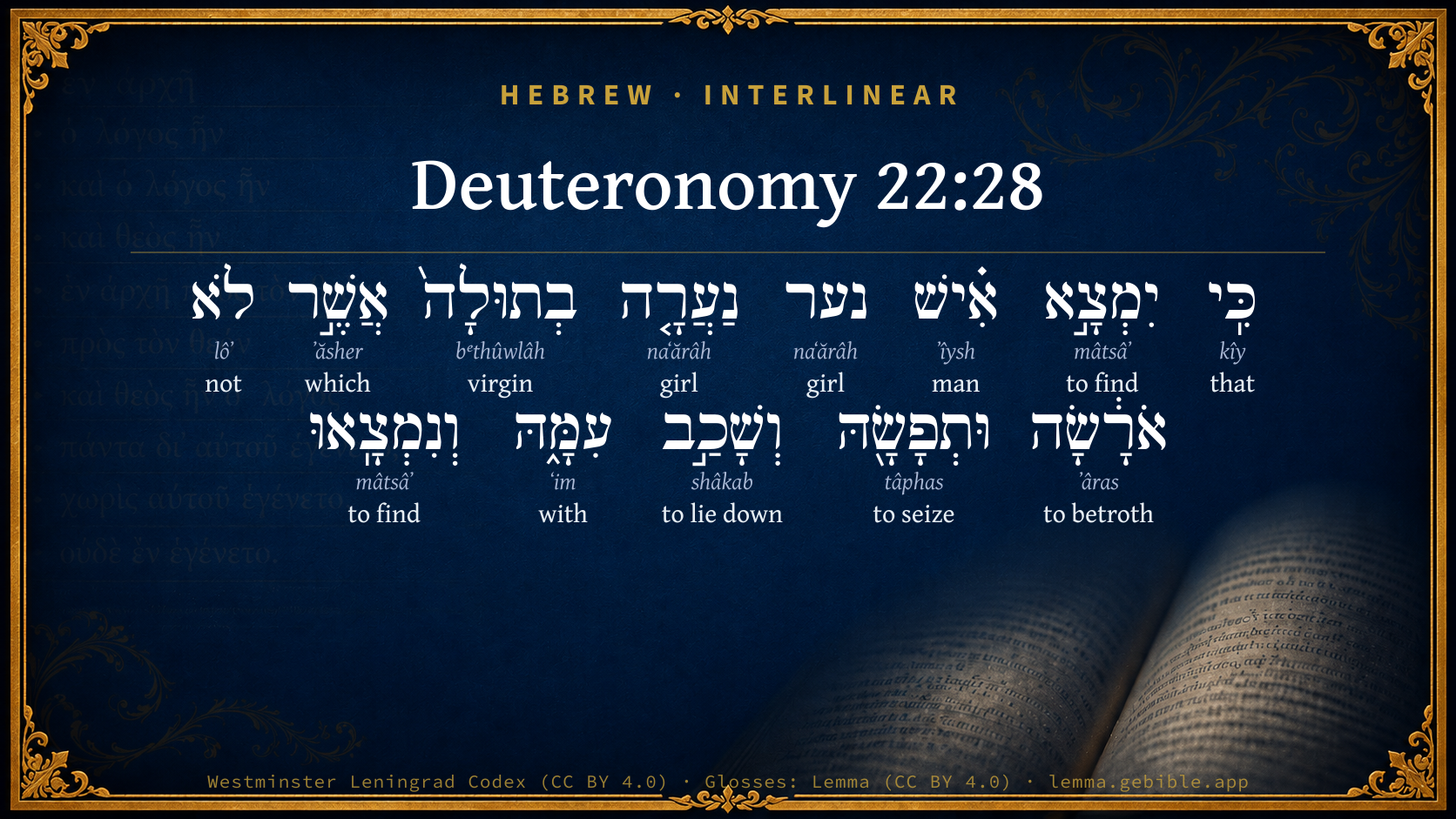
  1. כִּֽי kîy H3588 “that” Conjunction
  2. יִמְצָ֣א mâtsâʼ H4672 “to find” Verb, Qal, Imperfect, 3rd Person, Masculine, Singular
  3. אִ֗ישׁ ʼîysh H376 “man” Noun, Common, Masculine, Singular, Absolute
  4. נער naʻărâh H5291 “girl” Noun, Common, Feminine, Singular, Absolute
  5. נַעֲרָ֤ה naʻărâh H5291 “girl” Noun, Common, Feminine, Singular, Absolute
  6. בְתוּלָה֙ bᵉthûwlâh H1330 “virgin” Noun, Common, Feminine, Singular, Absolute
  7. אֲשֶׁ֣ר ʼăsher H834 “which” Particle, Relative
  8. לֹא lôʼ H3808 “not” Particle, Negative
  9. וּתְפָשָׂ֖הּ tâphas H8610 “and · to seize · her” Conjunction + Verb, Qal, Sequential Perfect, 3rd Person, Masculine, Singular + Suffix, Personal, 3rd Person, Feminine, Singular
  10. וְשָׁכַ֣ב shâkab H7901 “and · to lie down” Conjunction + Verb, Qal, Sequential Perfect, 3rd Person, Masculine, Singular
  11. עִמָּ֑הּ ʻim H5973 “with · her” Preposition + Suffix, Personal, 3rd Person, Feminine, Singular
  12. וְנִמְצָֽאוּ mâtsâʼ H4672 “and · to find” Conjunction + Verb, Niphal, Sequential Perfect, 3rd Person, Common, Plural

About this verse

These counts appear in no published source. They are computed here, from the morphology-tagged text and Lemma’s own curated glosses. What Lemma adds →

13
words
11
distinct lemmas
Pentateuch
section

Notable vocabulary

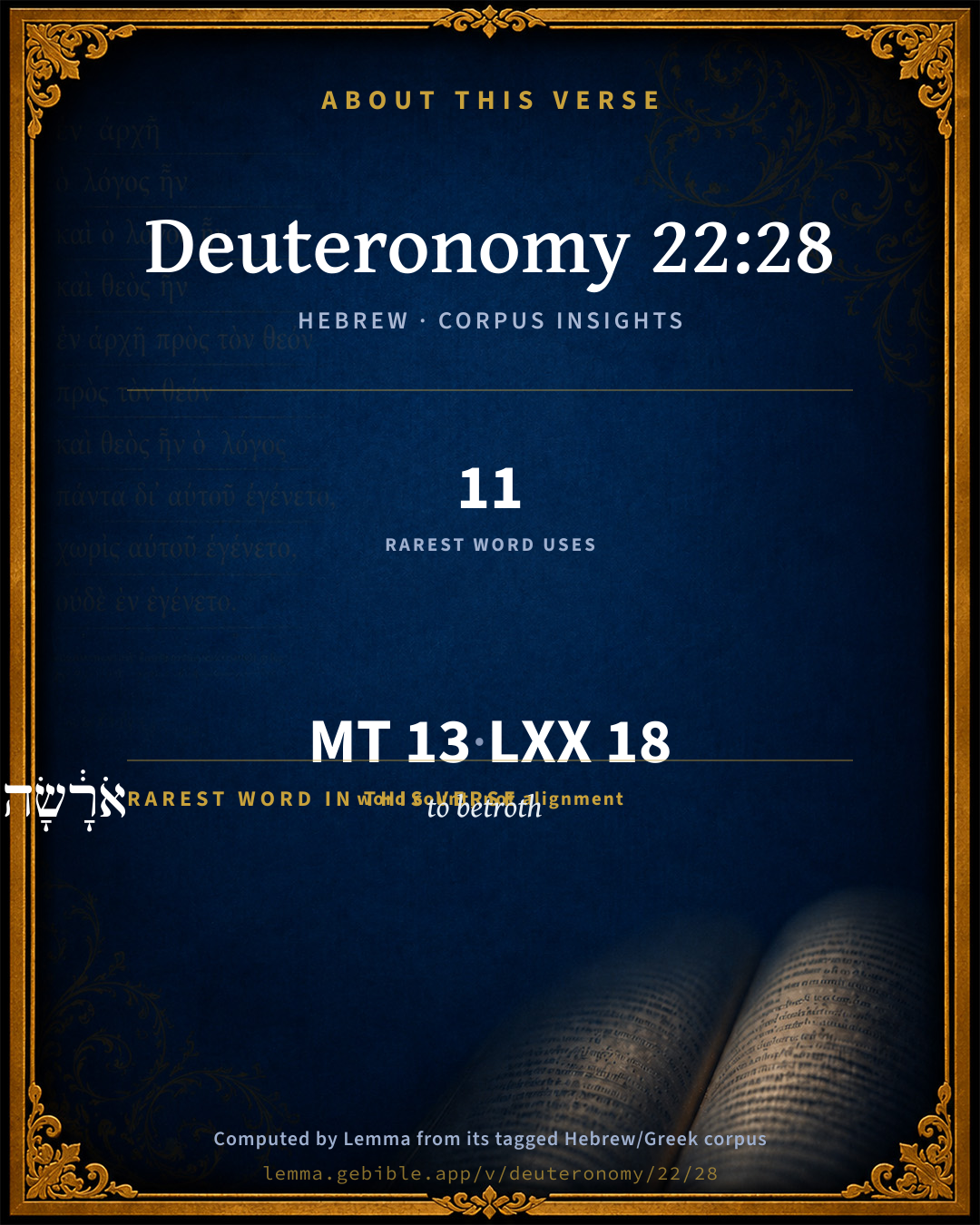
The rarest word here is אֹרָ֔שָׂה to betroth H781 — appearing just 11 times in the whole Hebrew Bible.

Shared distinctive vocabulary

אֹרָ֔שָׂה to betroth H781 occurs in 10 verses of the Hebrew Bible. Also found in:

Grammatical profile

  • 5 verbs
  • 4 nouns
  • 1 preposition
  • 1 conjunction
  • 2 particles

Verb forms

  • יִמְצָ֣א Qal · Imperfect
  • אֹרָ֔שָׂה Pual · Perfect
  • וּתְפָשָׂ֖הּ Qal · Sequential Perfect
  • וְשָׁכַ֣ב Qal · Sequential Perfect
  • וְנִמְצָֽאוּ Niphal · Sequential Perfect

Repetition

Words recur within this verse — often emphatic in Hebrew:

  • יִמְצָ֣א to find H4672 ×2
  • נער girl H5291 ×2

Hebrew & Septuagint length

In English translation the verse runs 30 words from the Hebrew and 25 from the Septuagint (LXX English) — closely comparable.

A rough comparison of the two English renderings, which tokenize alike — not a word-level alignment.

Word counts can differ between the Hebrew and the Greek without any difference in meaning — e.g. the Hebrew direct-object marker אֵת has no separate Greek word, and Greek often adds the article ὁ.

In the original languages it is 13 Hebrew tokens and 18 Greek tokens — but the two are counted differently (Hebrew bundles its prefixes and suffixes into one token; the Greek is in lemma form), so that isn’t a like-for-like length.

Cross-references

1

Topical passages linked to Deuteronomy 22:28 in the Treasury of Scripture Knowledge — connected by theme and wording, ordered by reader-vote popularity; previews shown in the World English Bible.

  • Exodus 22:16–17 "If a man entices a virgin who isn't pledged to be married, and lies with her, he shall surely pay a dowry for her to be his wife.

Cross-references courtesy of OpenBible.info (CC BY 4.0).

Hebrew and Greek witnesses Masoretic Hebrew ↔ Greek Septuagint

The same verse in the two great witnesses to the Old Testament, shown verse-for-verse.

These are two independent witnesses, not word-aligned to each other, and the Septuagint is shown in lemma (dictionary) form.

Hebrew Deuteronomy 22:28 Masoretic · Westminster Leningrad Codex

כִּֽי יִמְצָ֣א אִ֗ישׁ נער נַעֲרָ֤ה בְתוּלָה֙ אֲשֶׁ֣ר לֹא אֹרָ֔שָׂה וּתְפָשָׂ֖הּ וְשָׁכַ֣ב עִמָּ֑הּ וְנִמְצָֽאוּ

If a man find a lady who is a virgin, who is not pledged to be married, and lay hold on her, and lie with her, and they be found;

World English Bible · Public Domain

Greek LXX Deuteronomy 22:28 Septuagint · lemma form

ἐάν δέ τις εὑρίσκω ὁ παῖς ὁ παρθένος ὅστις οὐ μνηστεύω καί βιάζομαι κοιμάω μετά αὐτός καί εὑρίσκω

And if any one should find a young virgin who has not been betrothed, and should force her and lie with her, and be found,

LXX2012 (modern English Septuagint) · Public Domain

On this verse, The Cambridge Bible for Schools and Colleges discusses the Septuagint’s reading. Read the note in Commentary ↓

Hebrew: Westminster Leningrad Codex (CC BY 4.0). Greek: Septuagint (public domain); English from LXX2012 (modern English Septuagint) (Public Domain). How the Septuagint differs from the Hebrew →

Targum (Aramaic paraphrase)

2

The Targum is the ancient Jewish Aramaic paraphrase of the Hebrew Scriptures — an interpretive translation, not the Hebrew text itself. Onkelos (literal) and Pseudo-Jonathan (expansive) render the Torah, and Jonathan the Prophets. Coverage is partial: where no permissively-licensed English translation exists for a verse, only the Aramaic is shown. This is verse-level text, not a word-by-word alignment to the Hebrew.

  1. Targum Onkelos Torah (Genesis–Deuteronomy)
    אֲרֵי יַשְׁכַּח גְבַר עוּלֶמְתָּא בְתֻלְתָּא דִי לָא מְאָרְסָא וְיֶחֱדִנַהּ וְיִשְׁכּוּב עִמַהּ וְיִשְׁתַּכְּחוּן

    (no public-domain English translation for this verse)

    Targum Onkelos — Aramaic: “Onkelos Genesis” (public domain); “Onkelos Exodus” (public domain); “Onkelos Leviticus” (public domain); “Onkelos Numbers” (public domain); “Onkelos Deuteronomy” (public domain). English: “Sefaria Community Translation” (CC0 1.0 (public-domain dedication)); “J.W. Etheridge. The Targums of Onkelos and Jonathan Ben Uzziel on the Pentateuch. London: Longmans, Green, 1862” (public domain). Text via Sefaria.

  2. Targum Pseudo-Jonathan Torah (Genesis–Deuteronomy)
    אֲרוּם יַשְׁכַּח גְּבַר עוּלֵימְתָּא בְּתוּלְתָּא דְלָא מִיקַדְשָׁא וְיֵחוּד בָּהּ וּמְשַׁמֵּשׁ עִמָּהּ וּמִשְׁתַּכְּחִין

    If a man find a damsel who is not betrothed, and seize and lie with her, and they be found,

    Targum Pseudo-Jonathan — Aramaic: “Targum Jonathan on Genesis” (public domain); “Targum Jonathan on Exodus” (public domain); “Targum Jonathan on Leviticus” (public domain); “Targum Jonathan on Numbers” (public domain); “Targum Jonathan on Deuteronomy” (public domain). English: “The Targum of Jonathan ben Uzziel, trans. J. W. Etheridge, London, 1862” (public domain). Text via Sefaria.

Commentary

Notes on Deuteronomy 22:28 from classic Christian and Jewish commentators (each source and its license shown beneath its notes). The classic Christian expositions comment on the surrounding passage and are grouped to its opening verse, so a note may address several verses; the Jewish commentaries on the Tanakh (Rashi and others) are per-verse, so they appear only where the commentator wrote on this verse.

Lemma curates 59 commentaries, every one of them public domain or Creative Commons licensed, each selected and text-cleaned for this edition rather than reprinted as found. About our sources →

Ellicott's Commentary for English Readers

Deu_22:28-29.—SEDUCTION.

See Exo_22:16-17. The sin of seduction before marriage is punished by a heavy fine. We have recently amended our own laws in the direction of this very precept. But the fact that marriage was made compulsory in these cases makes the Law stricter still. It seems, however, from Exo_22:17, that the girl’s father might forbid the marriage, though the seducer could not escape from it in any other way.

(30) See Lev_18:7. A principle, not merely a precept, is implied here, as appears by the details of Leviticus 18

A Bible Commentary for English Readers, edited by Charles John Ellicott (1878–1897) — public domain. Text from a community e-Sword module.

The Cambridge Bible for Schools and Colleges

gen. ed. J. J. S. Perowne

28, 29. Of Intercourse with a Virgin not Betrothed. The man shall pay a bride-price (see on Deu_22:22) and marry her without power of divorce. For seduction E, Exo_22:16 f., exacts the bride-price but the father may refuse his daughter to the man. Among the Tiyâha Arabs the seducer of a woman pays the blood-price of two men; if he will marry her he must furnish the full bride-price (Musil, Ethn. Ber. 210).

lay hold on her] Not the same vb as in Deu_22:25, usually explained as rape, but this is not certain.

and he be found] So LXX. Heb. they is due to dittography.

The Cambridge Bible for Schools and Colleges (gen. ed. J. J. S. Perowne; Cambridge University Press, 1878–1918) — public domain. Text from a community e-Sword module.

John Gill's Exposition

Then the man that lay with her shall give unto the damsel's father fifty shekels of silver, For the abuse of his daughter; and besides this was obliged to give her her dowry also, as Philo (d) says, which is commonly said to be fifty more:

and she shall be his wife; if her father and she agreed to it; and in such a case the man was not at his liberty to refuse, be she what she would, agreeable or not, handsome or ugly; he must, as the Jews express it, drink out of his pot, or marry her, if she is lame, or blind, or full of ulcers (e):

because he hath humbled her he may not put her away all his days: to all the other parts of his punishment, paying a fine of fifty shekels to the damsel's father, a dowry of the same sum to her, obligation to marry her whether he likes her or not, this is added, that he is not allowed to divorce her as long as he lives; which was permitted to other men, and this was wisely ordered to preserve chastity.

(d) De Special. Leg. p. 787. (e) Misn. Cetubot, c. 3. sect. 5.

John Gill's Exposition of the Whole Bible (1746–1763) — public domain (CC PDM 1.0). Text via the HelloAO Bible API.

Matthew Poole's English Annotations

i.e. An unmarried man, as appears,

1. From his obligation to marry the person he abused, which it is not probable would have been imposed upon him, had he been married.

2. Because if the man had been married, this had been adultery, and so had been punished with death. Lay hold on her; which notes some kind of force or artifice, whereby she was overpowered; whereas Exo 22:16, she was enticed, which implies consent, and therefore the man doth here receive a greater punishment, because he used hostile violence towards her, which was the greater sin.

Matthew Poole's English Annotations on the Holy Bible (1683–1685) — public domain. Text from a community e-Sword/MySword module.

unfoldingWord translationNotes

Door43 World Missions Community

but who is not engaged

"but whose parents have not promised another man that she will marry him"

if they are discovered

This can be stated in active form. AT: "if somebody finds out what happened" (See: Active or Passive)

fifty shekels of silver

A shekel weighs eleven grams. AT: "fifty pieces of silver" or "550 grams of silver" (See: Biblical Money and Numbers)

He may not send her away during all his days

This is an idiom. AT: "He must never divorce her during his entire life" (See: Idiom)

translationWords

virgin

silver

humiliate

send

day

unfoldingWord translationNotes — © Distant Shores Media and the Door43 World Missions Community, licensed CC BY-SA 4.0. Source: git.door43.org/Door43/en_tn.

Lesson kit

Teaching starters — assembled from the data on this page, not authored interpretation. Every prompt links to the verse data it draws on. Edit before teaching.

Deuteronomy, in the Pentateuch, opens this verse with 13 words (11 distinct Hebrew lemmas). Its most distinctive word is ʼâras (“to betroth”). A historical commentator’s framing appears above. Read the whole chapter for the surrounding context.

Discussion questions

  1. How does “to betroth” (ʼâras) shape what this verse is saying?
  2. How does Exodus 22:16, which shares the word «to betroth», read alongside this verse?
  3. What does the repetition of “to find” (2× in this one verse) do in this verse?
  4. These translations render this verse differently; the difference is in the English rendering, not the original. What questions does that raise?
  5. «יִמְצָ֣א» is a Qal Imperfect verb. How does that grammatical form shape the action described?
  6. Compare how Ellicott's Commentary for English Readers and The Cambridge Bible for Schools and Colleges read this verse. Where do they agree or differ?

Things to notice

Reading settings

Reading text

Shown beneath each verse's original-language words.

Old Testament
Old Testament edition

Read the OT as the Masoretic Hebrew (MT) or the Greek Septuagint (LXX).

English shown for the Greek Septuagint (in the Hebrew ↔ Greek comparison).

Comparing translations? Open the Compare panel on any verse page to stack up to four side by side.