Genesis 19:4

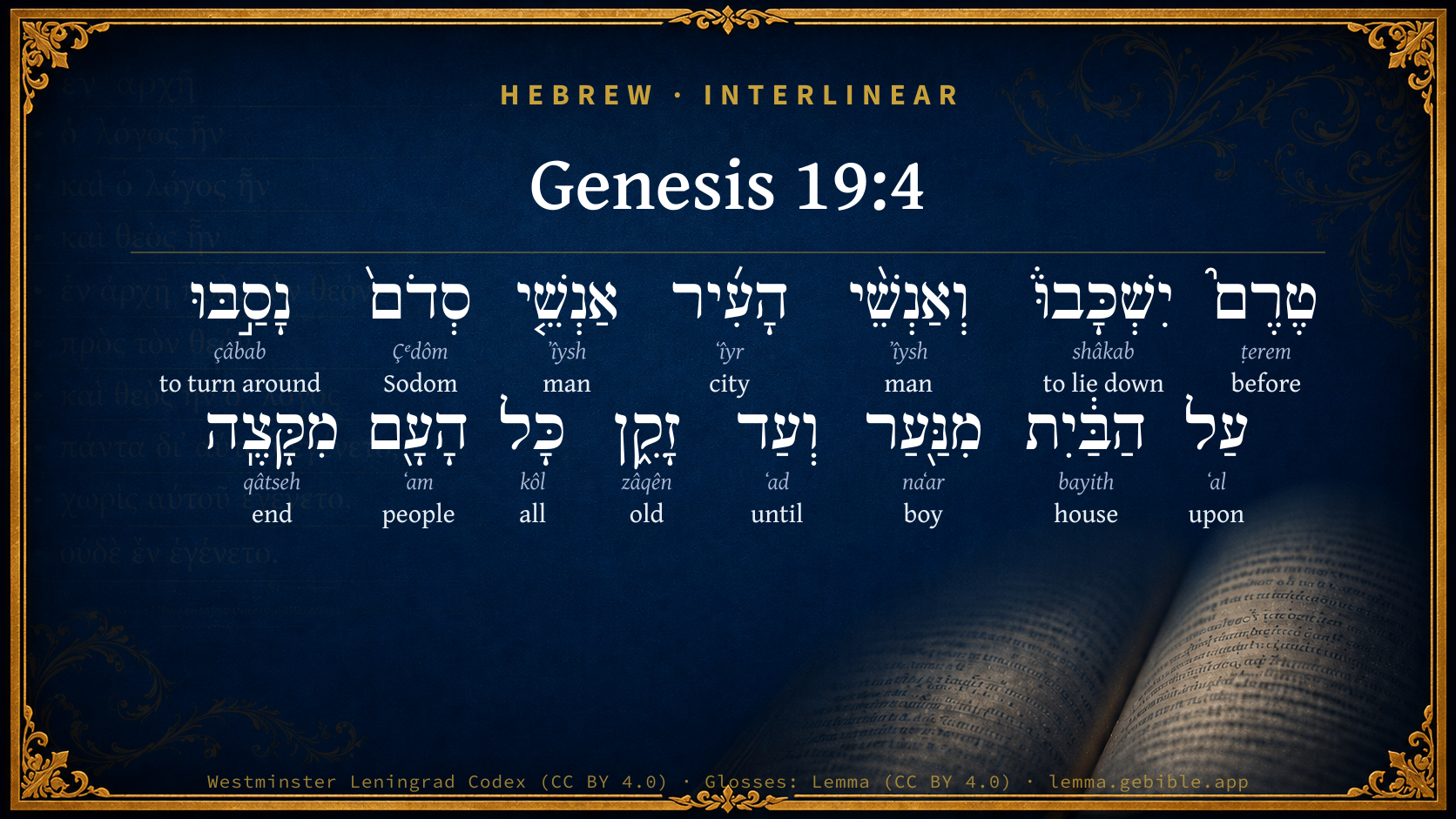
Hebrew (Westminster Leningrad Codex) Genesis 19:4 appears in the Hebrew Old Testament. The text above is from the Westminster Leningrad Codex. Each word links to its Strong’s number, a concise gloss, and parsing drawn from the Open Scriptures Hebrew Bible morphology. Click any word for its full Brown-Driver-Briggs (BDB) entry.
Download image
Cite this verse

Genesis 19:4 (World English Bible). Public Domain. Lemma interlinear Bible study tool, https://lemma.gebible.app/v/genesis/19/4.

Show BibTeX & RIS
BibTeX
RIS
English Translation
But before they lay down, the men of the city, the men of Sodom, surrounded the house, both young and old, all the people from every quarter.
World English Bible · Public Domain
Highlights
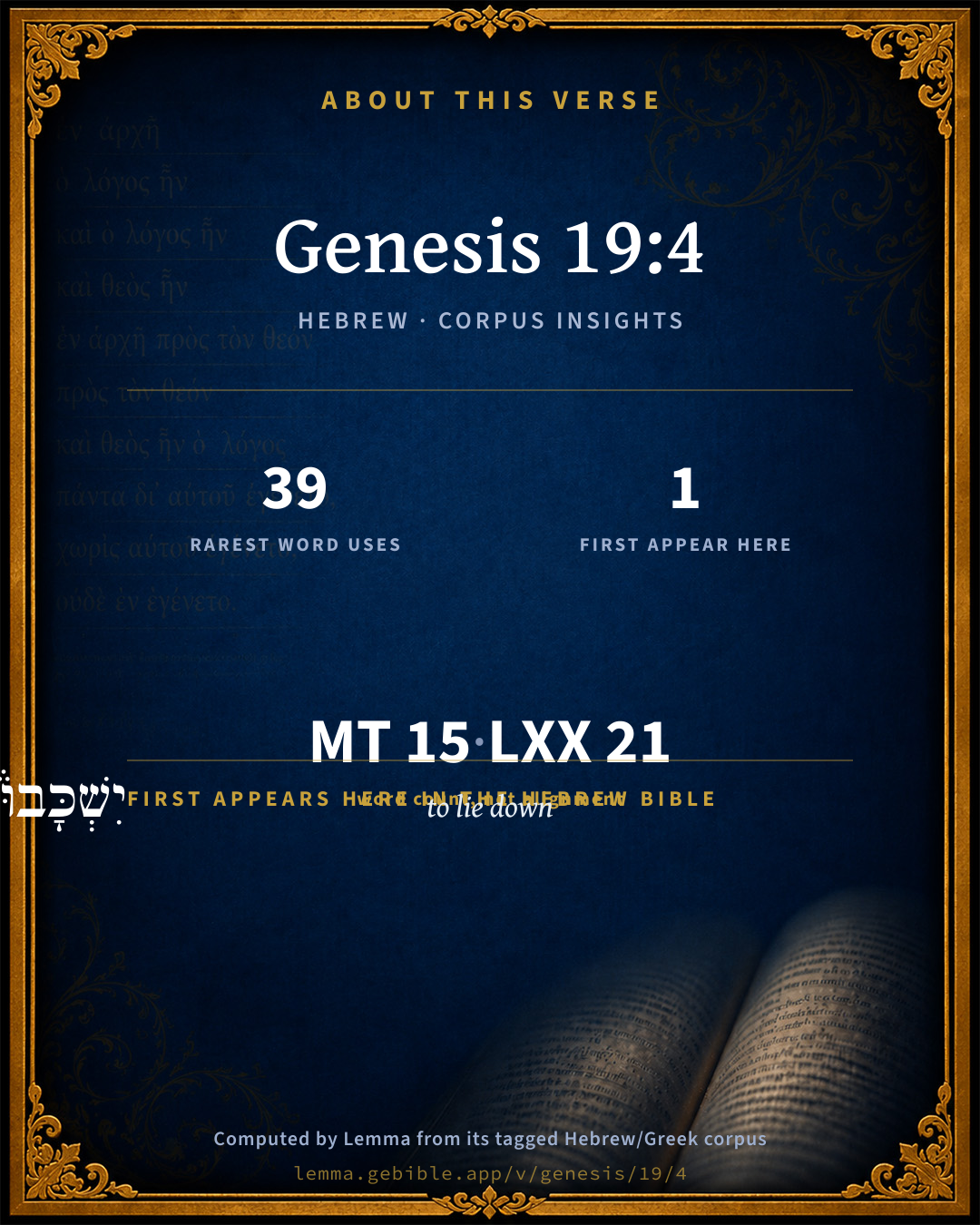
  • 1 first appearance in the Hebrew Bible
Full analysis ↓
Download a study sheet

One document with this verse’s original text, its word-by-word gloss line, the meaning frame, cross-references with their text, attributed commentary, and full source and license credits — printable, and it pastes into notes with its structure intact.

This verse Autodidact and up

Study sheet (.html) Plain text (.txt)

A passage Seminary Student

Up to 50 verses in one chapter. A passage sheet keeps up to 6 commentary sources and 12 cross-references per verse, in the order this page ranks them, and says so on the sheet whenever that leaves anything out. Ask for a single verse and you get the Autodidact verse sheet above.

Everything on this page stays free to read, with no account — the sheet is a download of what is already on screen, not access to it.

Want to remove ads? Support Godless Engineer
Compare translations 3

The same verse in 3 English versions, stacked beneath the original-language interlinear above. Click any original word for its lexicon entry.

Each is an independent rendering of the whole verse — the interlinear is not word-aligned to these translations.

Highlighted words mark where these versions differ — a whole-verse word diff, not a word-by-word alignment.

  • World English Bible Public Domain
    But before they lay down, the men of the city, the men of Sodom, surrounded the house, both young and old, all the people from every quarter.
  • King James Version Public Domain
    But before they lay down, the men of the city, even the men of Sodom, compassed the house round, both old and young, all the people from every quarter:
  • unfoldingWord Literal Text CC BY-SA 4.0
    Before they lay down, then the men of the city, the men of Sodom, surrounded the house, from the young and to the old, all the people from the edge.

unfoldingWord Literal Text — © unfoldingWord, licensed CC BY-SA 4.0. Word-aligned USFM3 via Door43 (git.door43.org/unfoldingWord/en_ult).

Versions to compare (up to 4)

3 of 4 selected

Show all 18 translations

Every available English version of this verse, each an independent rendering of the whole verse.

  • World English Bible Public Domain
    But before they lay down, the men of the city, the men of Sodom, surrounded the house, both young and old, all the people from every quarter.
  • Berean Standard Bible Public Domain
    Before they had gone to bed, all the men of the city of Sodom, both young and old, surrounded the house.
  • Majority Standard Bible Public Domain
    Before they had gone to bed, all the men of the city of Sodom, both young and old, surrounded the house.
  • King James Version Public Domain
    But before they lay down, the men of the city, even the men of Sodom, compassed the house round, both old and young, all the people from every quarter:
  • American Standard Version (1901) Public Domain
    But before they lay down, the men of the city, `even' the men of Sodom, compassed the house round, both young and old, all the people from every quarter;
  • Revised Version (1885) Public Domain
    But before they lay down, the men of the city, even the men of Sodom, compassed the house round, both young and old, all the people from every quarter;
  • Geneva Bible (1599) Public Domain
    But before they went to bed, the men of the citie, euen the men of Sodom compassed the house rounde about from the yong euen to the olde, all the people from all quarters.
  • Douay-Rheims (1899) Public Domain
    But before they went to bed, the men of the city beset the house both young and old, all the people together.
  • Young's Literal Translation Public Domain
    Before they lie down, the men of the city -- men of Sodom -- have come round about against the house, from young even unto aged, all the people from the extremity;
  • Literal Standard Version CC BY-SA 4.0
    Before they lie down, the men of the city—men of Sodom—have surrounded the house, from young even to aged, all the people from the extremity;
  • Unlocked Literal Bible CC BY-SA 4.0
    But before they lay down, the men of the city, the men of Sodom, surrounded the house, both young and old, all the men from every part of the city.
  • unfoldingWord Literal Text CC BY-SA 4.0
    Before they lay down, then the men of the city, the men of Sodom, surrounded the house, from the young and to the old, all the people from the edge.
  • Darby Bible Public Domain
    Before they lay down, the men of the city, the men of Sodom, surrounded the house, from the youngest to the oldest -- all the people from every quarter.
  • World Messianic Bible Public Domain
    But before they lay down, the men of the city, the men of Sodom, surrounded the house, both young and old, all the people from every quarter.
  • Webster's Bible Public Domain
    But before they lay down, the men of the city, even the men of Sodom, surrounded the house, both old and young, all the people from every quarter:
  • Free Bible Version CC BY-SA 4.0
    But they hadn't even gone to bed before the men of Sodom, young and old, from every part of town, came and surrounded the house.
  • Bible in Basic English Public Domain
    But before they had gone to bed, the men of the town, all the men of Sodom, came round the house, young and old, from every part of the town;
  • JPS Tanakh (1917) Public Domain
    But before they lay down, the men of the city, even the men of Sodom, compassed the house round, both young and old, all the people from every quarter.

Literal Standard Version (2020), Covenant Press — licensed CC BY-SA 4.0. Text via the HelloAO Bible API (eBible.org). Unlocked Literal Bible (unfoldingWord) — licensed CC BY-SA 4.0. Text via the HelloAO Bible API (eBible.org). unfoldingWord Literal Text — © unfoldingWord, licensed CC BY-SA 4.0. Word-aligned USFM3 via Door43 (git.door43.org/unfoldingWord/en_ult). Free Bible Version, Dr. Jonathan Gallagher — licensed CC BY-SA 4.0. Text via the HelloAO Bible API (eBible.org).

Word by word

More ways to search: Search by grammar → Find every occurrence → Compare this word →

Practice this passage: Drill this verse → Learn its vocabulary →

סְדֹם֙
Çᵉdôm
H5467
“Sodom”
Noun, Proper
Part of Speech
Noun
Type
Proper
Full BDB Definition

Origin: from an unused root meaning to scorch

TWOT: 1465

Sodom = "burning" - a Canaanite city, usually paired with Gomorrah, located in the area of the Dead Sea and the Jordan river; both cities destroyed by God in judgment
  1. טֶרֶם֮ ṭerem H2962 “before” Adverb
  2. יִשְׁכָּבוּ֒ shâkab H7901 “to lie down” Verb, Qal, Imperfect, 3rd Person, Masculine, Plural
  3. וְאַנְשֵׁ֨י ʼîysh H376 “and · men of” Conjunction + Noun, Common, Masculine, Plural, Construct
  4. הָעִ֜יר ʻîyr H5892 “the · city” Particle, Definite Article + Noun, Common, Feminine, Singular, Absolute
  5. אַנְשֵׁ֤י ʼîysh H376 “men of” Noun, Common, Masculine, Plural, Construct
  6. נָסַ֣בּוּ çâbab H5437 “to turn around” Verb, Niphal, Perfect, 3rd Person, Common, Plural
  7. עַל ʻal H5921 “upon” Preposition
  8. הַבַּ֔יִת bayith H1004 “the · house” Particle, Definite Article + Noun, Common, Masculine, Singular, Absolute
  9. מִנַּ֖עַר naʻar H5288 “from · boy” Preposition + Noun, Common, Masculine, Singular, Absolute
  10. וְעַד ʻad H5704 “and · until” Conjunction + Preposition
  11. זָקֵ֑ן zâqên H2205 “old” Adjective, Adjective, Masculine, Singular, Absolute
  12. כָּל kôl H3605 “all of” Noun, Common, Masculine, Singular, Construct
  13. הָעָ֖ם ʻam H5971 “the · people” Particle, Definite Article + Noun, Common, Masculine, Singular, Absolute
  14. מִקָּצֶֽה qâtseh H7097 “from · end” Preposition + Noun, Common, Both, Singular, Absolute

About this verse

These counts appear in no published source. They are computed here, from the morphology-tagged text and Lemma’s own curated glosses. What Lemma adds →

15
words
14
distinct lemmas
Pentateuch
section

First appearance in Scripture

This word makes its first canonical appearance in the Hebrew Bible here:

  • יִשְׁכָּבוּ֒ to lie down H7901

Shared distinctive vocabulary

סְדֹם֙ Sodom H5467 occurs in 38 verses of the Hebrew Bible. Also found in:

Grammatical profile

  • 2 verbs
  • 9 nouns
  • 1 adjective
  • 2 prepositions
  • 1 adverb

Verb forms

  • יִשְׁכָּבוּ֒ Qal · Imperfect
  • נָסַ֣בּוּ Niphal · Perfect

Repetition

A word recurs within this verse — often emphatic in Hebrew:

  • וְאַנְשֵׁ֨י man H376 ×2

Hebrew & Septuagint length

In English translation the verse runs 27 words from the Hebrew and 24 from the Septuagint (LXX English) — closely comparable.

A rough comparison of the two English renderings, which tokenize alike — not a word-level alignment.

Word counts can differ between the Hebrew and the Greek without any difference in meaning — e.g. the Hebrew direct-object marker אֵת has no separate Greek word, and Greek often adds the article ὁ.

In the original languages it is 15 Hebrew tokens and 21 Greek tokens — but the two are counted differently (Hebrew bundles its prefixes and suffixes into one token; the Greek is in lemma form), so that isn’t a like-for-like length.

Cross-references

11

Topical passages linked to Genesis 19:4 in the Treasury of Scripture Knowledge — connected by theme and wording, ordered by reader-vote popularity; previews shown in the World English Bible.

  • Genesis 13:13 Now the men of Sodom were exceedingly wicked and sinners against Yahweh.
  • Proverbs 4:16 For they don't sleep, unless they do evil. Their sleep is taken away, unless they make someone fall.
  • Genesis 18:20 Yahweh said, "Because the cry of Sodom and Gomorrah is great, and because their sin is very grievous,
  • Exodus 23:2 You shall not follow a crowd to do evil; neither shall you testify in court to side with a multitude to pervert justice;
  • Exodus 16:2 The whole congregation of the children of Israel murmured against Moses and against Aaron in the wilderness;
  • Proverbs 6:18 A heart that devises wicked schemes, Feet that are swift in running to mischief,
  • Jeremiah 5:1–6 Run you back and forth through the streets of Jerusalem, and see now, and know, and seek in the broad places of it, if you can find a man, if there are any who does justly, who seeks truth; and I will pardon her.
  • Jeremiah 5:31 the prophets prophesy falsely, and the priests bear rule by their means; and my people love to have it so: and what will you do in the end of it?
  • Micah 7:3 Their hands are on that which is evil to do it diligently. The ruler and judge ask for a bribe; And the powerful man dictates the evil desire of his soul. Thus they conspire together.
  • Matthew 27:20–25 Now the chief priests and the elders persuaded the multitudes to ask for Barabbas, and destroy Jesus.
  • Romans 3:15 "Their feet are swift to shed blood.

Cross-references courtesy of OpenBible.info (CC BY 4.0).

Hebrew and Greek witnesses Masoretic Hebrew ↔ Greek Septuagint

The same verse in the two great witnesses to the Old Testament, shown verse-for-verse.

These are two independent witnesses, not word-aligned to each other, and the Septuagint is shown in lemma (dictionary) form.

Hebrew Genesis 19:4 Masoretic · Westminster Leningrad Codex

טֶרֶם֮ יִשְׁכָּבוּ֒ וְאַנְשֵׁ֨י הָעִ֜יר אַנְשֵׁ֤י סְדֹם֙ נָסַ֣בּוּ עַל הַבַּ֔יִת מִנַּ֖עַר וְעַד זָקֵ֑ן כָּל הָעָ֖ם מִקָּצֶֽה

But before they lay down, the men of the city, the men of Sodom, surrounded the house, both young and old, all the people from every quarter.

World English Bible · Public Domain

Greek LXX Genesis 19:4 Septuagint · lemma form

πρό ὁ κοιμάω καί ὁ ἀνήρ ὁ πόλις ὁ σοδομίτης περικυκλόω ὁ οἰκία ἀπό νεανίσκος ἕως πρεσβύτερος ἅπας ὁ λαός ἅμα

But before they went to sleep, the men of the city, the Sodomites, compassed the house, both young and old, all the people together.

LXX2012 (modern English Septuagint) · Public Domain

Hebrew: Westminster Leningrad Codex (CC BY 4.0). Greek: Septuagint (public domain); English from LXX2012 (modern English Septuagint) (Public Domain). How the Septuagint differs from the Hebrew →

Targum (Aramaic paraphrase)

2

The Targum is the ancient Jewish Aramaic paraphrase of the Hebrew Scriptures — an interpretive translation, not the Hebrew text itself. Onkelos (literal) and Pseudo-Jonathan (expansive) render the Torah, and Jonathan the Prophets. Coverage is partial: where no permissively-licensed English translation exists for a verse, only the Aramaic is shown. This is verse-level text, not a word-by-word alignment to the Hebrew.

  1. Targum Onkelos Torah (Genesis–Deuteronomy)
    עַד לָא שְׁכִיבוּ וְאֲנָשֵׁי קַרְתָּא אֲנָשֵׁי סְדוֹם אַקִּיפוּ עַל בֵּיתָא מֵעוּלֵימָא וְעַד סָבָא כָּל עַמָּא מִסּוֹפֵהּ

    (no public-domain English translation for this verse)

    Targum Onkelos — Aramaic: “Onkelos Genesis” (public domain); “Onkelos Exodus” (public domain); “Onkelos Leviticus” (public domain); “Onkelos Numbers” (public domain); “Onkelos Deuteronomy” (public domain). English: “Sefaria Community Translation” (CC0 1.0 (public-domain dedication)); “J.W. Etheridge. The Targums of Onkelos and Jonathan Ben Uzziel on the Pentateuch. London: Longmans, Green, 1862” (public domain). Text via Sefaria.

  2. Targum Pseudo-Jonathan Torah (Genesis–Deuteronomy)
    עַד דְלָא שְׁכִיבוּ וְאַנְשִׁין רַשִׁיעִין דִבְקַרְתָּא אֵינָשֵׁי סְדוֹם אַחֲזָרוּ עַל בֵּיתָא מִטַלְיָא וְעַד סָבָא כָּל עַמָא מִסֵיפָא

    They had not yet lain down, when the wicked men of the city, the men of Sedom, came round upon the house, from the youth to the old man, all the people throughout.

    Targum Pseudo-Jonathan — Aramaic: “Targum Jonathan on Genesis” (public domain); “Targum Jonathan on Exodus” (public domain); “Targum Jonathan on Leviticus” (public domain); “Targum Jonathan on Numbers” (public domain); “Targum Jonathan on Deuteronomy” (public domain). English: “The Targum of Jonathan ben Uzziel, trans. J. W. Etheridge, London, 1862” (public domain). Text via Sefaria.

Commentary

Notes on Genesis 19:4 from classic Christian and Jewish commentators (each source and its license shown beneath its notes). The classic Christian expositions comment on the surrounding passage and are grouped to its opening verse, so a note may address several verses; the Jewish commentaries on the Tanakh (Rashi and others) are per-verse, so they appear only where the commentator wrote on this verse.

Lemma curates 59 commentaries, every one of them public domain or Creative Commons licensed, each selected and text-cleaned for this edition rather than reprinted as found. About our sources →

Matthew Henry's Commentary

Now it appeared, beyond contradiction, that the cry of Sodom was no louder than there was cause for. This night's work was enough to fill the measure. For we find here,

I. That they were all wicked, Gen 19:4. Wickedness had become universal, and they were unanimous in any vile design. Here were old and young, and all from every quarter, engaged in this riot; the old were not past it, and the young had soon come up to it. Either they had no magistrates to keep the peace, and protect the peaceable, or their magistrates were themselves aiding and abetting. Note, When the disease of sin has become epidemical, it is fatal to any place, Isa 1:5-7.

II. That they had arrived at the highest pitch of wickedness; they were sinners before the Lord exceedingly (Gen 13:13); for, 1. It was the most unnatural and abominable wickedness that they were now set upon, a sin that still bears their name, and is called Sodomy. They were carried headlong by those vile affections (Rom 1:26, Rom 1:27), which are worse than brutish, and the eternal reproach of the human nature, and which cannot be thought of without horror by those that have the least spark of virtue and any remains of natural light and conscience. Note, Those that allow themselves in unnatural uncleanness are marked for the vengeance of eternal fire. See Jde 1:7. 2. They were not ashamed to own it, and to prosecute their design by force and arms. The practice would have been bad enough if it had been carried on by intrigue and wheedling; but they proclaimed war with virtue, and bade open defiance to it. Hence daring sinners are said to declare their sin as Sodom, Isa 3:9. Note, Those that have become impudent in sin generally prove impenitent in sin; and it will be their ruin. Those have hard hearts indeed that sin with a high hand, Jer 6:15. 3. When Lot interposed, with all the mildness imaginable, to check the rage and fury of their lust, they were most insolently rude and abusive to him. He ventured himself among them, Jer 6:6. He spoke civilly to them, called them brethren (Gen 19:7), and begged of them not to do so wickedly; and, being greatly disturbed at their vile attempt, he unadvisedly and unjustifiably offered to prostitute his two daughters to them, Gen 19:8. It is true, of two evils we must choose the less; but of two sins we must choose neither, nor ever do evil that good may come of it. He reasoned with them, pleaded the laws of hospitality and the protection of his house which his guests were entitled to; but he might as well have offered reason to a roaring lion and a raging bear as to these head-strong sinners, who were governed only by lust and passion. Lot's arguing with them does but exasperate them; and, to complete their wickedness, and fill up the measure of it, they fall foul upon him. (1.) They ridicule him, charge him with the absurdity of pretending to be a magistrate, when he was not so much as a free-man of their city, Gen 19:9. Note, It is common for a reprover to be unjustly upbraided as a usurper; and, while offering the kindness of a friend, to be charged with assuming the authority of a judge: as if a man might not speak reason without taking too much upon him. (2.) They threaten him, and lay violent hands upon him; and the good man is in danger of being pulled in pieces by this outrageous rabble. Note, [1.] Those that hate to be reformed hate those that reprove them, though with ever so much tenderness. Presumptuous sinners do by their consciences as the Sodomites did by Lot, baffle their checks, stifle their accusations, press hard upon them, till they have seared them and quite stopped their mouths, and so made themselves ripe for ruin. [2.] Abuses offered to God's messengers and to faithful reprovers soon fill the measure of a people's wickedness, and bring destruction without remedy. See Pro 29:1, and Ch2 36:16. If reproofs remedy not, there is no remedy. See Ch2 25:16.

III. That nothing less than the power of an angel could save a good man out of their wicked hands. It was now past dispute what Sodom's character was and what course must be taken with it, and therefore the angels immediately give a specimen of what they further intended. 1. They rescue Lot, Ch2 25:10. Note, He that watereth shall be watered also himself. Lot was solicitous to protect them, and now they take effectual care for his safety, in return for his kindness. Note further, Angels are employed for the special preservation of those that expose themselves to danger by well-doing. The saints, at death, are pulled like Lot into a house of perfect safety, and the door shut for ever against those that pursue them. 2. They chastise the insolence of the Sodomites: They smote them with blindness, Gen 19:11. This was designed, (1.) To put an end to their attempt, and disable them from pursuing it. Justly were those struck blind who had been deaf to reason. Violent persecutors are often infatuated so that they cannot push on their malicious designs against God's messengers, Job 5:14, Job 5:15. Yet these Sodomites, after they were struck blind, continued seeking the door, to break it down, till they were tired. No judgments will, of themselves, change the corrupt natures and purposes of wicked men. If their minds had not been blinded as well as their bodies, they would have said, as the magicians, This is the finger of God, and would have submitted. (2.) It was to be an earnest of their utter ruin, the next day. When God, in a way of righteous judgment, blinds men, their condition is already desperate, Rom 11:8, Rom 11:9.

Matthew Henry's Commentary on the Whole Bible (1708–1710) — public domain (CC PDM 1.0). Text via the HelloAO Bible API.

The Cambridge Bible for Schools and Colleges

gen. ed. J. J. S. Perowne

4. the men of the city] The repulsive incident recorded in this passage (Gen_19:4-11) contrasts the hospitable conduct of Lot with the gross behaviour of the people of Sodom towards strangers, and has for all time associated the name of the city with shameless vice (cf. Isa_3:9).

from every quarter] Lit. “from the end.” As in 1Ki_12:31, the phrase means “from all classes of the people.” The writer insists upon the fact that “all” of every age and class were involved in the same guilt. Compare the scene in Jdg_19:23.

The Cambridge Bible for Schools and Colleges (gen. ed. J. J. S. Perowne; Cambridge University Press, 1878–1918) — public domain. Text from a community e-Sword module.

Trapp's Complete Commentary

John Trapp

Gen 19:4 But before they lay down, the men of the city, [even] the men of Sodom, compassed the house round, both old and young, all the people from every quarter:

Ver. 4. Both old and young.] Nulla aetas erat culpae immunis, ideo nec exitii . - Ambrose. Sin spreads as leaven, and is as catching as the plague; like the Jerusalem artichoke, plant it where you will, it overruns the ground, and chokes the heart.

John Trapp, A Commentary or Exposition upon All the Books of the Old and New Testament (1647–1656) — public domain. Text from a community e-Sword module.

The Biblical Illustrator

Joseph S. Exell

Gen_19:4-11

But the men put forth their hand, and pulled Lot into the house to them, and shut to the door

The eve of judgment to sinners

I.

THEIR WICKEDNESS IS UNABATED.

1. It extends to all classes of the community.

2. It includes the most shameful lusts.

3. It opposes the righteous to the last.

II. THEY EXPOSE THEMSELVES TO INFLICTIONS WHICH FORESHADOW FUTURE JUDGMENTS. Blindness-moral as well as physical.

III. THEIR CONDUCT OFTEN BECOMES A SOURCE OF DANGEROUS PERPLEXITY TO THE RIGHTEOUS (see Gen_19:5; Gen_19:8). Lot was prepared to violate one duty in order to maintain another. Let a man do right, and put his trust in God. (T. H. Leale.)

Shamelessness of sinners

Their shameless speech to have the men brought out that they might know them, very notably discovereth unto us the impudency that sin effecteth in time, when it once getteth rule. Surely it taketh all modesty, and shame, and honesty away, and proveth the saying to be most true: Consuctudo peccandi tollit sensum peccati. The custom of sin taketh away all sense and feeling of sin. At the beginning men shame to have it known what they do, though they fear not to do it, and they will use all cloaks and covers that possible they can to hide their wickedness. But at last they grow bold and, impudent, as these men did, even to say what care we. And why? Certainly because this is the course of sin in Gods judgment, that it shall benumb and harden the heart wherein it is suffered, and so sear up the conscience, and conceit in time, that there shall be no shame left, but such a thick vizard pulled over the face, that it can blush at nothing, either to say it or do it. Behold these brazen-brewed wretches here, who, after long use of sin (no doubt at first more secret), are now come to require these men openly and to tell the cause, that they might know them without all shame or spark of shame, in, and at so horrible abomination. Marvel not then any more, that the adulterer blusheth not, the drunkard shameth not, nor the blaspheming swearer hideth not his face. You see the reason; custom to do evil in that kind hath utterly bereaved him of feeling and shame as it did these Sodomites. A heavy and fearful case for Gods plague is even at the door of such people, as you see it was here for these Sodomites. It was well said of him that said it, if God take from a man his bodily eye that he cannot see, or his bodily ear that he cannot hear, every man seeth the judgment and perceiveth the loss; but when God in wrath taketh away the inward eye and ear of the mind and heart, that what sin soever he committeth, he neither seeth, nor heareth, nor feeleth, no man thinketh this a plague, or any rod of God. But O fearful plague! etc. (Bishop Babington.)

Mild speech to pacify

In Lots going out to them, shutting the door after him, and calling them brethren, we may note a godly discretion and wisdom in dealing to pacify outrageous beasts. Fire quencheth not fire, but milder and softer speeches many times, and most times appeaseth disorder, though here it could not, for the strength of sin that had so mightily possessed them. To brute beasts are overcome with fair speeches, and become tame; a soft answer breaketh anger, when a cutting tongue stirreth up wrath. Full of grace is that man and woman that can be mild and sweet to effect goodness. (Bishop Babington.)

Blindness.

1. Physical. They lost the power of distinct vision.

2. Mental. They were the subjects of illusions. The imagination was diseased, so that they were deceived by false appearances. They acted as distracted persons.

3. Moral. They madly persisted in their designs, though an act of Providence had rendered it impossible of accomplishment.

Judgment at hand

The Scriptural signs that the judgment is near are:--

1. That God abandons men or communities to out-breaking and presumptuous sins.

2. That warnings and chastisements fail to produce their effect, and especially when the person grows harder under them.

3. That God removes the good from any community--so, before the flood, so before the destruction of Jerusalem.

4. The deep, undisturbed security of those over whom it is suspended. (Gosman.)

Gods time to strike

Many a one is hardened by the good word of God, and, instead of receiving the counsel, rages at the messenger; when men are grown to that pass, that they are no whir better by afflictions, and worse with admonitions, God finds it time to strike. (Bishop Hall.)

The Biblical Illustrator, edited by Joseph S. Exell (c. 1880s–1900s) — public domain. Text from a community e-Sword module.

Joseph Benson's Commentary

Gen 19:4-5. No description which could be given of their vile and abominable conduct, however laboured, could possibly have conveyed so striking an idea of their unparalleled wickedness, as this simple narrative of facts. Here were old and young, all from every quarter — Collected for practices too shameful to be mentioned! Either they had no magistrates to protect the peaceable, or their magistrates themselves were aiding and abetting.

Joseph Benson's Commentary on the Old and New Testaments (1811–1818) — public domain. Text from a community e-Sword module.

The Preacher's Complete Homiletical Commentary

Joseph S. Exell (gen. ed.)

CRITICAL NOTES.—

Gen_19:5. That we may know them.] A well-known euphemism for a foul crime which derives its name from this infamous place. “From Leviticus 22-25 we learn that the practice of the sin here contemplated was among the principal causes why God exterminated the Canaanitish nations.” (Alford.) This sin was also the curse of heathenism, even in the best days of Rome. (Rom_1:22.)

Gen_19:5. And they called unto Lot.] “That is, with a loud voice; demanded vociferously; which was virtually proclaiming their own shame. In allusion to the circumstance mentioned in this verse, the prophet says of Jerusalem, Isa_3:9 : ‘They declare their sin as Sodom, they hide it not.’ Compare the similar instance of enormous wickedness recorded, Jdg_19:22, etc.” (Bush.)

Gen_19:6. And Lot went out at the door.] “The original here, as in Gen_19:11, employs two distinct words for ‘door;’ the one signifying the aperture, passage, or doorway, through which ingress and egress were made; the other denoting the ‘leaf’ of the door, hung upon hinges, by which the aperture was closed. The distinction is very accurately preserved throughout the subsequent narrative, Gen_19:9-11.” (Bush.)

Gen_19:9. He will needs be a judge.] Heb. He will judge to judge. “He continually acteth as judge.” “It is recorded of Lot in the N.T. that he was greatly and constantly worried and worn down by their gross outrages, and probably he had often rebuked them.” (2Pe_2:7-8.) (Jacobus.)

Gen_19:11. Blindness.] Onk. Fatuity of sight. “Mental blindness, in which the eye sees, but does not see the right object.” (Keil.) The original word occurs only here and in 2Ki_16:18. “The judgment consisted not in a total privation of sight, in which case they would, of course, have desisted from their assault on Lot, and endeavoured to make their way home, but in a confused vision, such as is occasioned by vertigo of the brain, in which objects swim before the eyes, and mock every attempt to approach or seize them.” (Bush.)

MAIN HOMILETICS OF THE PARAGRAPH.—Gen_19:4-11

THE EVE OF JUDGMENT TO SINNERS

The conduct of the men of Sodom, who were so near their doom, is an example of that kind of conduct which the wicked among mankind will still show when the last Judgment draws nigh.

I. Their wickedness is unabated. Time had brought no change for the better with this wicked people. They rather grew worse and worse, descending to the lowest depths of sin and vice. The last days of the world may be days of light and of widely diffused knowledge, yet they will not reveal an universal moral improvement amongst mankind. We are taught in Scripture to expect that these will be perilous times when lawlessness will prevail and iniquity abound. The tares will stand until the harvest shall be reaped. We may note the features of the wickedness recorded here, and they are types of the state of a large portion of human society when the end shall come.

1. It extends to all classes of the community. “The men of Sodom compassed the house round, both old and young, all the people, from every quarter.” (Gen_19:4.) All classes and all ages were infected by the prevailing vices and sins. With the exception of righteous Lot and his family none escaped from the mire and sink of the greatest pollutions. The saddest fact of all, the “young,” too, had imbibed evil principles, and were corrupted in their ways. When the contagion of vice so fastens upon the youth of a nation the swiftest judgments may be expected.

2. It includes the most shameful sins. The men of Sodom desired Lot to give up the strangers sheltered under his roof to their vile lusts. The sin in which they had so bad an eminence derives its very name from this infamous place. They do not seek to hide their sin, but openly avow their love of deeds against the use of nature. It is sad to reflect that men in their vile passions are capable of descending below the level of the brutes. Even the refining influences of civilisation do not suffice to root out some degrading forms of vice, for this unnatural practice prevailed during the best days of Rome. The penal codes of nations still show that this shameful crime has not perished from the earth. How true the Bible is to the facts of human nature, degrading though they be!

3. It opposes the righteous to the last. Lot could not entertain these strangers without making his house a mark for the assaults of these wicked men. They scrupled not to use open violence against him. (Gen_19:9.) There must ever be an antagonism between the spirit of the world and that which is of God, and to the end this will bear sad fruit in the persecution of the good. To the last the righteous will suffer at the hands of evil men.

II. They expose themselves to inflictions which foreshadow future judgments. These men were stricken with blindness; a blindness which not only confused the vision but also the mind with insane delusions. This was a more awful visitation than the mere deprivation of sight. Moral blindness and madness prepare the way for the extreme retribution. Sinners will be the victims of such moral infatuation till the end of time. These men, though stricken by such an awful calamity, yet desisted not in their wickedness, but “wearied themselves to find the door.” Sinners to the latest times will still engage in the insane endeavour to continue the war against Omnipotence. Moral blindness is a punishment—an act of judgment. God has determined that those who will not see shall not see. Those who refuse to believe shall, in the end, not be able to believe. (Joh_12:38-40.) Powers disused are taken away, as in the case of him who hid his talent in the earth. Judgment has already begun with those whose souls are seized with infatuation. When Christ comes for judgment He will find men acting as distracted persons, full of mirth and jollity, though destruction is around them and they are so close upon their doom. (Mat_24:37-39.)

III. Their conduct often becomes a source of dangerous perplexity to the righteous. These vile sinners made a shameful demand of Lot (Gen_19:5). He refused to yield to them, because he would not be a party to so foul a crime, and he must not betray the rights of hospitality. It was a point of honour, in Oriental countries, to defend at all costs the stranger who was received into the house. In his perplexity, Lot made a desperate suggestion (Gen_19:8). He violated one duty to maintain another. The conflict of duties into which he was forced by this situation disturbed his moral sense. He was like a man bewildered, who is ready to receive any solution of his difficulty. The complication of events led him into temptation and a snare. The awful wickedness of the world often places godly men in circumstances of great perplexity and danger to their souls. So it will be in the end of the world. Because of abounding iniquity the love of many shall wax cold. It would seem that even the very elect shall run the risk of deception. The immense power of evil which is in the world will try the righteous to the last. The severity of the trial is admitted, and yet in the worst possible case a man’s duty is still clear. He should do the right, and put his trust in God. It is ours to obey, even in the face of most enormous difficulties, and to leave the consequences with Him. Faith shows a sure way out of the utmost perplexity.

SUGGESTIVE COMMENTS ON THE VERSES

Gen_19:4. There are sufficient reasons to justify those terrible acts of Divine vengeance which are recorded in sacred history.

How easily sin is roused to action. The baseness of these wicked neighbours soon betrays itself!

The utter corruption of youth is the last stage in the degeneration of a people. This is the most fatal spot on the social body, showing that mortification has already set in.

The kind offices which Lot was about to perform for these strangers was not an easy exercise of godly charity, or one implying little personal risk. He made his house a mark for the assaults of those men of Belial, who could scarce endure that so godly a man should dwell among them, far less that he should reprove or restrain their sins. That fearful night tried both them and Lot. “The wicked plot against the just.” Doubtless they have an old grudge to satisfy. And now they seize the opportunity of at once indulging their passions, and wreaking their vengeance on one whose faithful testimony and consistent life they have found to be an intolerable offence and provocation.—(Candlish.)

The signal had but to be given, and the universal mass of the population were ready at once to flock together to any scene of riot and debauchery. Had they had any useful occupation to follow, were they not completely sunk in profligate idleness, they could not all have found time thus suddenly to rendezvous for deeds of iniquity. But from the peculiar emphasis of the language it would seem that there were no exceptions. Sodom was full of Sodomites. What must have been the extent of its abominations, when the aged, instead of restraining the young, were actually urging them forward in the course of iniquity by their own pernicious example!—(Bush.)

How often it has happened that houses where the voice of prayer and praise was heard have been the mark for the assaults of wicked men, while the abodes of vice and blasphemy have remained unmolested. Such is that hatred of goodness, which is found in the natural heart!

Gen_19:5. There is a maturity of corruption in which wicked men are not ashamed to proclaim their sin.

There are sins which in a special manner sully the honour of human nature, put men beyond the pale of common regard, and tend to destroy a people from among the family of nations.

Gen_19:6. It is a duty of religion to protect those whom Providence has thrown in our way and given into our care.

Lot shut the door behind him for the purpose of protecting his guests, We put ourselves best in the way of a favourable Providence when we use all reasonable means.

The conduct of Lot in going out and expostulating with them, was in several respects praiseworthy. His “shutting the door after him,” expressed how delicately he felt for his guests, though at present he does not appear to have considered them in any other light than strangers. It was saying in effect, “Let not their ears be offended with what passes abroad; whatever is scurrilous, obscene, or abusive, let me hear it, but not them.”—(Fuller.)

Gen_19:7. It is the duty of good men to dissuade the wicked from sin.

When we cannot by our precept or example turn men entirely from the power of Satan unto God, we must not be indifferent to lesser reforms in their character. It is something if we are able to save them from the grossest sins; for they are then better prepared to listen to the wisdom of the just, and to learn righteousness.

A certain respectful behaviour is due even to the vilest sinners. Even in their lowest degradation we must recognise their humanity.

Lot’s gentle and respectful manner of treating this worst of mobs is worthy of notice. Though he could have entertained no respect for them on the score of character, yet he forbore the use of opprobrious terms. Recognising in them his fellow-creatures and near neighbours, he calls them brethren, if perchance by such conciliatory language he may gam their ear, and eventually dissuade them from their wicked purpose.—(Bush.)

Gen_19:8. It is difficult to give an account of this offer consistently with any estimate of Lot as a “righteous man.” But in our estimating we must remember that the same offer was made and the thing actually done in the parallel case at Gibeah of Benjamin (Jdg_19:24.) Guided by that other case, we cannot, as some have done, suppose that Lot had any end in view beyond that which the proposal declares, or that it was due to his perturbation of mind, as Augustine sugests. He seems simply to have had in view the averting of a fearful crime (enhanced in this case by its violating the sacred rights of hospitality) by the permission of another crime, the very thought of which we happily in these Christian days cannot find place for in a father’s heart.—(Alford.)

When, to turn off their attention from his guests, he proposes to bring out and surrender his daughters to their pleasure, he hints at an expedient which can by no means be justified. It is not for us to have recourse to one evil in the hope of preventing a greater; but rather to consent to no evil. His regard to the rites of hospitality was indeed commendable; but having used all proper means of preserving his guests, he ought to have left the event to God. It is possible, indeed, that owing to the excessive perturbation of his mind he was scarcely master of his words or actions, and that some excuse may be suggested for him on this score; but in all probability if he had never lived in Sodom, nor become familiarised to their profligate manners, he would not have made such a proposal. As it was, he evidently gained nothing by it but an increased measure of abuse. Persuasion has no force with men who are under the dominion of their lusts, and nothing is more common than for kind admonitions and faithful rebukes to be attributed to unmannerly and arrogant dictation. So Lot’s endeavours to restrain these desperate Sodomites from the commission of iniquity was taken in evil part; their resentment was inflamed against him; they thirsted for revenge, and not content with having the men brought out, they will go in unto them, and break the door open to effect their purpose!—(Bush.)

A polluted moral atmosphere is dangerous to the most vigorous righteous character. The whole tone of the spiritual life may become lowered, the conception of duty debased. (1Co_15:33.)

Evil examples around affect righteous souls, as it were, inductively. The bad influence is felt, and souls are injured even when they have avoided contact.

Strong faith teaches a man to do the right, even in the most perplexing situations. Results may be safely left with God, who knows how to deliver the godly in the time of temptation.

Gen_19:9. This seems to be a menace to frighten Lot out of the way of their perverse will. It is probable, indeed, that he and his family would not have been so long safe in this wicked place had he not been the occasion of a great deliverance to the whole city when they were carried away by the four kings. The threat is followed by a taunt when the sorely vexed host hesitated to give up the strangers. He will needs be a judge. It is evident Lot had been in the habit of remonstrating with them. From threats and taunts they soon proceed to violence.—(Murphy.)

Majorities do not always determine what is right and just. Lot was one against many. The people of Sodom thought that numbers was some justification of their cause, and they derided the opinion of an individual.

The wisdom of the stranger is not to be scorned because he is such. Many nations have risen in the scale of civilisation and become great by giving heed to words of truth and righteousness which have been brought to them by strangers.

How unseasonable are the reproaches of the wicked! Ten such strangers would have saved Sodom!

Gen_19:10. God’s people are safe when angels stand sentries at their doors. Moses again calls the heavenly messengers by a name indicative, not of what they were, but of what they seemed; for, although they now began to put forth a superhuman power, they had not yet revealed themselves as ministers sent from heaven. The incident here related of them teaches us that though God, in His deep wisdom, often sees fit to defer, till His people are brought into the most trying straits, the aid which He purposes to afford, yet He will not fail them in the last extremity. Lot was made to feel his extremity before the needed succour was vouchsafed him; but as he had kindly and generously opened his doors for the reception of God’s messengers; as he had recognised a special providence in their being sent within the sphere of his hospitality; and as he had exposed himself to great perils in their defence, the Most High would not leave him without a witness of His guardian care. By this seasonable interference He reminds us how calmly we may resign ourselves to the custody of an ever-watchful Providence while engaged in the way of duty, and how intrepidly we may face dangers and enemies while following that “which right is.”—(Bush.)

Lot is saved by those for whose protection he had ventured all. Thus, often before we look for it, loving deeds bring their own reward.

The righteous discover the hand of God in their deliverance.

Gen_19:11. Blindness.

1. Physical. They lost the power of distinct vision.

2. Mental. They were the subjects of illusions. The imagination was diseased, so that they were deceived by false appearances. They acted as distracted persons.

3. Moral. They madly persisted in their design, though an act of Providence had rendered it impossible of accomplishment.

Moral infatuation usually precedes God’s great judgments upon men and nations.

The Scriptural signs that the judgment is near are:—

1. That God abandons men or communities to out-breaking and presumptuous sins.

2. That warnings and chastisements fail to produce their effect, and especially when the person grows harder under them.

3. That God removes the good from any community—so, before the Flood, so before the destruction of Jerusalem.

4. The deep, undisturbed security of those over whom it is suspended.—(Gosman.)

Many a one is hardened by the good word of God, and, instead of receiving the counsel, rages at the messenger: when men are grown to that pass, that they are no whit better by afflictions, and worse with admonitions, God finds it time to strike. Now, Lot’s guests begin to show themselves angels, and first delivered Lot in Sodom, then from Sodom; first strike them with blindness whom they will after consume with fire. How little did the Sodomites think that vengeance was so near them! While they were groping in the streets, and cursing those whom they could not find, Lot with the angels is in secure light, and sees them miserable, and foresees them burning. It is the use of God to blind and besot those whom He means to destroy.—(Bishop Hall.)

Blindness, both of body and mind, saith Aben Ezra, such as tormented their eyes, as if they had been pricked with thorns, as the Hebrew word signifies. And yet they continue groping for the door, as if they were ambitious of destruction, which now was next door by. Deus quem destruit dementat. So Pharaoh, when under that palpable three days’ darkness, rageth against God, and threateneth Moses with death. Though doomsday should be to-morrow next, wicked men must and will serve their lusts. Vale lumen amicum! said Theotimus in St. Ambrose, who chose rather to lose his sight than his sin.—(Trapp.)

God sends judicial blindness upon wicked men, and thus their purposes are frustrated. They weary themselves in a vain effort.

The persecuted for righteousness’ sake have the angels on their side, and no weapon that is formed against them can prosper.

The Preacher's Complete Homiletical Commentary (gen. ed. Joseph S. Exell; Funk & Wagnalls, c. 1892) — public domain (pre-1929). A full-Bible homiletical/sermon-outline anthology covering 65 of 66 books (2 John is absent from the source module). Text from a community e-Sword module.

Tyndale Open Study Notes

Tyndale Open Resources

19:4-5 The townsmen’s vileness was matched by Lot’s hypocrisy (19:6-9).

Tyndale Open Study Notes — © Tyndale Open Resources, licensed CC BY-SA 4.0. Text via the HelloAO Bible API.

Geneva Bible (1599)

Geneva Bible translators

Nothing is more dangerous than to dwell where sin reigneth: for it corrupteth all.

Geneva Bible (1599) marginal notes — public domain. Text via Bolls.life.

Jamieson, Fausset & Brown

Robert Jamieson, A. R. Fausset & David Brown

men of Sodom, compassed the house--Appalling proofs are here given of their wickedness. It is evident that evil communications had corrupted good manners; otherwise Lot would never have acted as he did.

Jamieson, Fausset & Brown — Commentary Critical and Explanatory on the Whole Bible (1871) — public domain (CC PDM 1.0). Text via the HelloAO Bible API.

John Calvin's Commentaries

4. Before they lay down. Here, in a single crime, Moses sets before our eyes a lively picture of Sodom. For it is hence obvious, how diabolical was their consent in all wickedness, since they all so readily conspired to perpetrate the most abominable crime. The greatness of their iniquity and wantonness, is apparent from the fact, that, in a collected troop, they approach, as enemies, to lay siege to the house of Lot. How blind and impetuous is their lust; since, without shame, they rush together like brute animals! how great their ferocity and cruelty; since they reproachfully threaten the holy man, and proceed to all extremities! Hence also we infer, that they were not contaminated with one vice only, but were given up to all audacity in crime, so that no sense of shame was left them. And Ezekiel (as we have above related) accurately describes from what beginnings of evil they had proceeded to this extreme turpitude, (Ezekiel 16:49) What Paul says, also refers to the same point: that God punished the impiety of men, when he cast them into such a state of blindness, that they gave themselves up to abominable lusts, and dishonored their own bodies. (Romans 1:18.) But when the sense of shame is overcome, and the reins are given to lust, a vile and outrageous barbarism necessarily succeeds, and many kinds of sin are blended together, so that a most confused chaos is the result. But if this severe vengeance of God so fell upon the men of Sodom, that they became blind with rage, and prostituted themselves to all kinds of crime, certainly we shall scarcely be more mildly treated, whose iniquity is the less excusable, because the truth of God has been more clearly revealed unto us.

Both old and young. Moses passes over many things in silence which may come unsought into the reader’s mind: for instance, he does not mention by whom the multitude had been stirred up. Yet it is probable that there were some who fanned the flame: nevertheless, we hence perceive how freely they were disposed to commit iniquity; since, as at a given signal, they immediately assemble. It also shows how completely destitute they were of all remaining shame; for, neither did any gravity restrain the old, nor any modesty, suitable to their age, restrain the young: finally, he intimates, that all regard to honor was gone, and that the order of nature was perverted, when he says, that young and old flew together from the extreme parts of the city.

John Calvin's Commentaries (1540-1563) — public domain. Text from the Calvin Translation Society English edition (1840s-50s) via the Christian Classics Ethereal Library (ccel.org). Calvin's coverage is partial (roughly two-thirds of the Bible); uncommented books and verses are honest gaps, never fabricated. The 19th-century editor's footnotes and remarks are omitted so the notes are faithfully Calvin's own voice.

Ellicott's Commentary for English Readers

(4) From every quarter.—Heb., from the end. This may mean, either, “to the last man.” or “from the very end of the town.” In either case it shows that there were not in Sodom the ten righteous men who would have availed to save it (Gen_18:32).

A Bible Commentary for English Readers, edited by Charles John Ellicott (1878–1897) — public domain. Text from a community e-Sword module.

John Gill's Exposition

But before they lay down,.... Upon their beds to sleep; it was between supper time and bedtime that the following affair happened, while the angels were talking to Lot about the men of Sodom, and inquiring what sort of men they were, as the Jewish writers (l) suggest:

the men of the city, even the men of Sodom, compassed the house round about; the house of Lot, where the angels were:

both old and young: the males of the city of every age; some that were past committing the sin they were so infamous for, as well as those that burned with that unnatural lust; some that could not be actors were willing to be spectators; and all were curious to see the lovely persons, that it was reported all over the city were seen to go into Lot's house:

all the people from every quarter; all from one end of the city to the other, and from every corner in it: which shows the general corruption and depravity of the city, that it was so far from having ten righteous persons in it, that of the proper inhabitants of it, there was not, as Jarchi notes, one righteous person, no, not one.

(l) Bereshit Rabba, ut supra. (sect. 50. fol. 44. 4.)

John Gill's Exposition of the Whole Bible (1746–1763) — public domain (CC PDM 1.0). Text via the HelloAO Bible API.

Haydock's Catholic Bible Commentary

Together. The whole city was corrupt; even the children were taught iniquity, as soon as they came to the years of discretion. (Menochius)

George Leo Haydock (1774–1849), Haydock's Catholic Family Bible and Commentary, 1859 edition — public domain. Excludes Psalms (Douay-Rheims chapter numbering differs from Protestant) and Deuterocanonical books (Catholic canon only).

Matthew Poole's English Annotations

Before they lay down to sleep, of which this word is used, Gen 28:13; Lev 14:47; 26:6.

All the people from every quarter; some to exercise villany, and some to please themselves with the contemplation of it, and some out of curiosity, &c. This is added to show how universally corrupt they were, and that there were not ten righteous men there.

Matthew Poole's English Annotations on the Holy Bible (1683–1685) — public domain. Text from a community e-Sword/MySword module.

Whedon's Commentary on the Bible

Daniel D. Whedon

4. All the people from every quarter — Hebrews, from the extremity, that is, of the city. Here we have a picture of the vilest kind of a rabble, debased to the most shameless licentiousness.

Daniel D. Whedon (gen. ed.), Commentary on the Old and New Testaments (1874–1909) — public domain. Text from a community e-Sword module.

The Pulpit Commentary

But before they lay down, the men of the city, even the men of Sodom, compassed the house round, both old and young, all the people from every quarter. i.e. of the town, as in Jer_51:31 (Lange) from the extremity, or extremities, of the town (Kalisch); from the extremities, i.e. all the population contained within the extremities (Rosenm all the citizens to the last man (Keil). The text probably conveys the writer"s idea.

The Pulpit Commentary (1880–1919), ed. H.D.M. Spence-Jones & Joseph S. Exell — public domain. Text from a community e-Sword module.

John Wesley's Explanatory Notes

Here were old and young all from every quarter - The old were not past it, and the young were soon come up to it. Either they had no magistrates to protect the peaceable, or their magistrates were themselves aiding and abetting.

John Wesley, Explanatory Notes Upon the Whole Bible (1754–1765) — public domain. Text via the GEBible commentary corpus.

Kretzmann's Popular Commentary

Paul E. Kretzmann

The Esvil Intention of the Sodomites

v. 4. But before they lay down, the men of the city, even the men of Sodom, compassed the house round, both old and young, all the people from every quarter;

v. 5. and they called unto Lot and said unto him, Where are the men which came in to thee this night? Bring them out unto us that we may know them. The evening meal having been eaten, the people of Lot’s household, together with their guests, were about to retire for the night, when they were rudely disturbed. Emphasis is laid upon the fact that all the people, even down to the last man, took part in this shameless demand, openly stating that they wanted to abuse the guests of Lot in a violation of nature which was one of the greatest curses of heathenism, the sin of pederasty. All the men of Sodom were guilty of this lustful abomination, of this demonic error. Cf Rom 1:27.

v. 6. And Lot went out at the door unto them, and shut the door after him,

v. 7. and said, I pray you, brethren, do not so wickedly. This was the consequence of Lot’s having settled in the midst of a godless and wicked people. Lot, having gone out and locked the door behind him in order to protect his guests, confronted a mob that had gone crazy with unnatural lust. His plea, in which he addressed them as brethren and begged them not to act in such a wicked manner, fell on deaf ears.

v. 8. Behold now, I have two daughters which have not known man; let me, I pray you, bring them out unto you, and do ye to them as is good in your eyes; only unto these men do nothing, for therefore came they under the shadow of my roof. So sacred were the persons and the lives of his guests in the eyes of Lot that he was willing to set aside even his fatherly feeling and duty and to sacrifice his daughters to the lust of the brutes out in the street, if the latter would but be satisfied. As for the guests, he reminds the mob of the duty of hospitality; for it was in order to be sheltered against danger and wickedness that they had entered his house. To try to hinder a sin by committing sin can never be excused, and the fact of Lot’s offer may be accounted for only by the fact of his extreme consternation.

v. 9. And they said, Stand back, that is, stand aside, make room for us to enter. And they said again, This one fellow came in to sojourn, and he will needs be a judge. Now will we deal worse with thee than with them. Their coarse objection is that this single man, the one that had come and was living as a stranger among them with their permission, now was passing a verdict upon their behavior, as he had undoubtedly done often before, 2Pe 2:7-8. Crazed with lust, they now pressed forward to kill Lot and then to carry out their intention upon his guests. And they pressed sore upon the man, even Lot, and came near to break the door. It was a moment of the greatest danger.

v. 10. But the men put forth their hand, and pulled Lot into the house to them, and shut to the door.

v. 11. And they smote the men that were at the door of the house with blindness, both small and great, so that they wearied themselves to find the door. The angels interfered when the danger was at its height. With a quick movement they drew Lot into the house and locked the door. And the members of the crazed mob were stricken with blindness; they were deprived of their sight and, at the same time, confused in their minds. Although they continued their efforts to find the door which led through the arched entrance into the interior of the house, they were unable to do so, and finally grew tired and desisted. This incident proved to the angels that all the inhabitants of Sodom were steeped in the vices which cried to heaven, for Sodomitic lewdness cries to heaven, as the sinners of our days will also find out to their eternal sorrow. And let us not forget that there is a sin which is even worse than that of the Sodomites, namely, that of rejecting Christ, His Word, and His grace, Mat 11:24.

Paul E. Kretzmann, Popular Commentary of the Bible (1921–1924) — public domain. Text from a community e-Sword module.

unfoldingWord translationNotes

Door43 World Missions Community

before they lay down

"before the people in Lot's house lay down to go to sleep"

the men of the city, the men of Sodom

"the men of the city, that is, the men of Sodom" or just "the men of the city of Sodom"

the house

"Lot's house"

both young and old

"from the youngest to the oldest." This means "men of all ages" and refers to the men of Sodom who were surrounding Lot's house.

that came in to you

"that went into your house"

sleep with them

"engage in sex with them." Your language may have a more polite way of saying this. AT: "know them intimately or sexually" (See: Euphemism)

translationWords

Sodom

Lot

had relations with

unfoldingWord translationNotes — © Distant Shores Media and the Door43 World Missions Community, licensed CC BY-SA 4.0. Source: git.door43.org/Door43/en_tn.

Rashi

Rabbi Shlomo Yitzchaki (Rashi)

טרם ישכבו ואנשי העיר אנשי סדום The following explanation is given in Genesis Rabbah 50:5: Before they lay down, the men of the city were a topic of conversation (literally, were in the mouths of the angels), for they asked Lot about their character and doings, and the latter replied that most of them were wicked. They were still speaking about them, 'ואנשי סדום וגו “when the men of Sodom etc.” However the real sense of the text is: The men of the city, wicked men, compassed the house. Because they were wicked he designates them as “men of Sodom”, just as Scripture said, (Genesis 13:13) “And the men of Sodom were wicked and sinners”.

כל העם מקצה ALL THE PEOPLE FROM EVERY QUARTER — from one end of the city to the other end, and no-one protested, for there was not even one righteous person amongst them (Genesis Rabbah 50:5).

Rashi on the Tanakh — English translations: “The Judaica Press complete Tanach with Rashi, translated by A. J. Rosenberg” (CC BY 4.0); “Pentateuch with Rashi's commentary by M. Rosenbaum and A.M. Silbermann, 1929-1934” (public domain); “The Metsudah Tanach series, Lakewood, N.J” (CC BY 4.0); and “The Book of Joshua, Metsudah Publications, 1997” (CC BY 4.0). Text via Sefaria.

Radak

Rabbi David Kimhi (Radak)

טרם, why did the Torah have to write the wordsאנשי סדום, “the men of Sodom,” having already immediately before identified these men as אנשי העיר, the men of the town?” The Torah wanted to emphasise that by their actions they proved that they must be inhabitants of the city of Sodom. This bore out the Torah’s previous characterisation of the inhabitants of this city as רעים וחטאים, “wicked and sinful,” (13,13)

ועד זקן, the old people were no better than the people in their prime whose perversions might have been due to their youthful vigour. All the people ganged up on Lot’s house. As a result of their extreme self-centeredness, they had passed a law that no stranger was to be entertained in that city. Lot’s having broken with this tradition so enraged them that they decided to teach him a lesson by attacking his guests. The reason why the Torah goes into all this detail is merely so that subsequent generations will realise that G’d’s action in destroying such people was justified.

Radak on the Tanakh — English translations: “Sefaria Community Translation” (CC0 1.0 (public-domain dedication)); “Eliyahu Munk, HaChut Hameshulash” (CC BY 4.0); “Rabbi Mike Feuer, Jerusalem Anthology” (CC BY 4.0); and “R. David Kimhi on the first book of Psalms, Translated by R.G. Finch, London, 1919” (public domain). Text via Sefaria.

Lesson kit

Teaching starters — assembled from the data on this page, not authored interpretation. Every prompt links to the verse data it draws on. Edit before teaching.

Genesis, in the Pentateuch, opens this verse with 15 words (14 distinct Hebrew lemmas). Its most distinctive word is Çᵉdôm (“Sodom”). A historical commentator’s framing appears above. Read the whole chapter for the surrounding context.

Discussion questions

  1. The word Çᵉdôm carries the sense “Sodom.” How does it shape the verse?
  2. The word “to lie down” first appears here in Scripture. What is being introduced at this debut?
  3. Genesis 10:19 shares the word «Sodom» with this verse. How do the two illuminate each other?
  4. “man” occurs 2× in this one verse. What is the effect of the repetition?
  5. The translations on this page render this verse differently — a whole-verse word diff, not a word-by-word alignment. What might account for the different wordings?
  6. The verb «יִשְׁכָּבוּ֒» is Qal Imperfect. How does its form color the action?
  7. Reading how Matthew Henry's Commentary and The Cambridge Bible for Schools and Colleges read this verse, where do the two commentators agree and where do they part?

Things to notice

Reading settings

Reading text

Shown beneath each verse's original-language words.

Old Testament
Old Testament edition

Read the OT as the Masoretic Hebrew (MT) or the Greek Septuagint (LXX).

English shown for the Greek Septuagint (in the Hebrew ↔ Greek comparison).

Comparing translations? Open the Compare panel on any verse page to stack up to four side by side.