Genesis 44:15

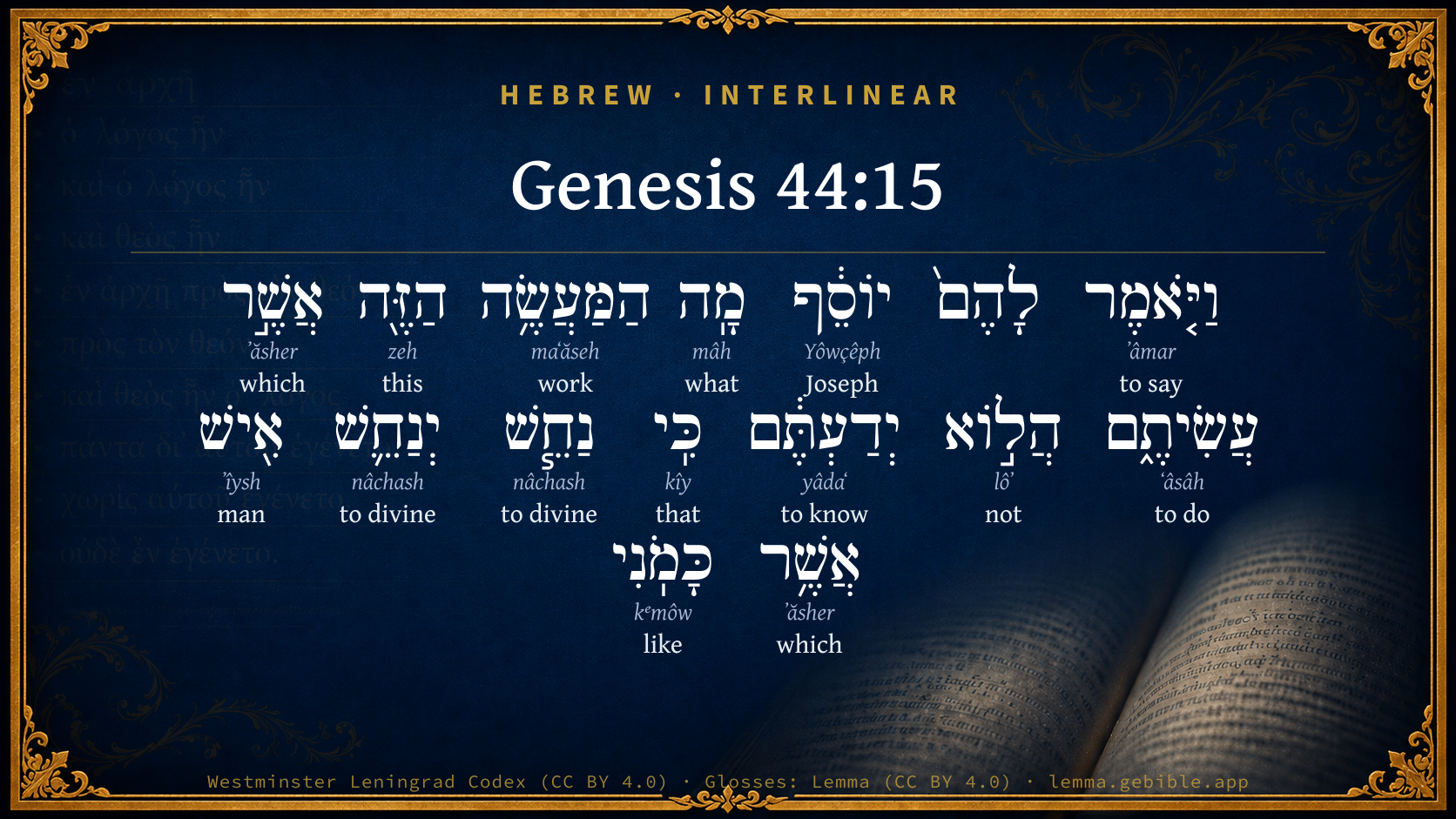
Hebrew (Westminster Leningrad Codex) Genesis 44:15 appears in the Hebrew Old Testament. The text above is from the Westminster Leningrad Codex. Each word links to its Strong’s number, a concise gloss, and parsing drawn from the Open Scriptures Hebrew Bible morphology. Click any word for its full Brown-Driver-Briggs (BDB) entry.
Download image
Cite this verse

Genesis 44:15 (World English Bible). Public Domain. Lemma interlinear Bible study tool, https://lemma.gebible.app/v/genesis/44/15.

Show BibTeX & RIS
BibTeX
RIS
English Translation
Joseph said to them, "What deed is this that you have done? Don't you know that such a man as I can indeed divine?"
World English Bible · Public Domain
Download a study sheet

One document with this verse’s original text, its word-by-word gloss line, the meaning frame, cross-references with their text, attributed commentary, and full source and license credits — printable, and it pastes into notes with its structure intact.

This verse Autodidact and up

Study sheet (.html) Plain text (.txt)

A passage Seminary Student

Up to 50 verses in one chapter. A passage sheet keeps up to 6 commentary sources and 12 cross-references per verse, in the order this page ranks them, and says so on the sheet whenever that leaves anything out. Ask for a single verse and you get the Autodidact verse sheet above.

Everything on this page stays free to read, with no account — the sheet is a download of what is already on screen, not access to it.

Want to remove ads? Support Godless Engineer
Compare translations 3

The same verse in 3 English versions, stacked beneath the original-language interlinear above. Click any original word for its lexicon entry.

Each is an independent rendering of the whole verse — the interlinear is not word-aligned to these translations.

Highlighted words mark where these versions differ — a whole-verse word diff, not a word-by-word alignment.

  • World English Bible Public Domain
    Joseph said to them, "What deed is this that you have done? Don't you know that such a man as I can indeed divine?"
  • King James Version Public Domain
    And Joseph said unto them, What deed is this that ye have done? wot ye not that such a man as I can certainly divine?
  • unfoldingWord Literal Text CC BY-SA 4.0
    Then Joseph said to them, “What this deed that you have done? Did you not know that a man who like me indeed divines?”

unfoldingWord Literal Text — © unfoldingWord, licensed CC BY-SA 4.0. Word-aligned USFM3 via Door43 (git.door43.org/unfoldingWord/en_ult).

Versions to compare (up to 4)

3 of 4 selected

Show all 18 translations

Every available English version of this verse, each an independent rendering of the whole verse.

  • World English Bible Public Domain
    Joseph said to them, "What deed is this that you have done? Don't you know that such a man as I can indeed divine?"
  • Berean Standard Bible Public Domain
    “What is this deed you have done?” Joseph declared. “Do you not know that a man like me can surely divine the truth?”
  • Majority Standard Bible Public Domain
    “What is this deed you have done?” Joseph declared. “Do you not know that a man like me can surely divine the truth?”
  • King James Version Public Domain
    And Joseph said unto them, What deed is this that ye have done? wot ye not that such a man as I can certainly divine?
  • American Standard Version (1901) Public Domain
    And Joseph said unto them, What deed is this that ye have done? know ye not that such a man as I can indeed divine?
  • Revised Version (1885) Public Domain
    And Joseph said unto them, What deed is this that ye have done? know ye not that such a man as I can indeed divine?
  • Geneva Bible (1599) Public Domain
    Then Ioseph sayd vnto them, What acte is this, which ye haue done? know ye not that such a man as I, can deuine and prophecie?
  • Douay-Rheims (1899) Public Domain
    And he said to them: Why would you do so? know you not that there is no one like me in the science of divining.
  • Young's Literal Translation Public Domain
    and Joseph saith to them, `What `is' this deed that ye have done? have ye not known that a man like me doth diligently observe?'
  • Literal Standard Version CC BY-SA 4.0
    and Joseph says to them, “What [is] this deed that you have done? Have you not known that a man like me diligently observes?”
  • Unlocked Literal Bible CC BY-SA 4.0
    Joseph said to them, “What is this that you have done? Do you not know that a man like me practices divination?”
  • unfoldingWord Literal Text CC BY-SA 4.0
    Then Joseph said to them, “What this deed that you have done? Did you not know that a man who like me indeed divines?”
  • Darby Bible Public Domain
    And Joseph said to them, What deed is this which ye have done? Did ye not know that such a man as I can certainly divine?
  • World Messianic Bible Public Domain
    Joseph said to them, “What deed is this that you have done? Don’t you know that such a man as I can indeed do divination?”
  • Webster's Bible Public Domain
    And Joseph said to them, What deed is this that ye have done? knew ye not that such a man as I can certainly divine?
  • Free Bible Version CC BY-SA 4.0
    “Why did you do this?” Joseph asked. “Don't you know a man like me can find out things through divination?”
  • Bible in Basic English Public Domain
    And Joseph said, What is this thing which you have done? had you no thought that such a man as I would have power to see what is secret?
  • JPS Tanakh (1917) Public Domain
    And Joseph said unto them: 'What deed is this that ye have done? know ye not that such a man as I will indeed divine?'

Literal Standard Version (2020), Covenant Press — licensed CC BY-SA 4.0. Text via the HelloAO Bible API (eBible.org). Unlocked Literal Bible (unfoldingWord) — licensed CC BY-SA 4.0. Text via the HelloAO Bible API (eBible.org). unfoldingWord Literal Text — © unfoldingWord, licensed CC BY-SA 4.0. Word-aligned USFM3 via Door43 (git.door43.org/unfoldingWord/en_ult). Free Bible Version, Dr. Jonathan Gallagher — licensed CC BY-SA 4.0. Text via the HelloAO Bible API (eBible.org).

Word by word

More ways to search: Search by grammar → Find every occurrence → Compare this word →

Practice this passage: Drill this verse → Learn its vocabulary →

נַחֵ֧שׁ
nâchash
H5172
“to divine”
Verb, Piel, Infinitive Absolute
Part of Speech
Verb
Stem
Piel
Form
Infinitive Absolute
Full BDB Definition

Origin: a primitive root

TWOT: 1348

to practice divination, divine, observe signs, learn by experience, diligently observe, practice fortunetelling, take as an omen - (Piel) - to practice divination - to observe the signs or omens
  1. וַיֹּ֤אמֶר ʼâmar H559 “and · to say” Conjunction + Verb, Qal, Sequential Imperfect, 3rd Person, Masculine, Singular
  2. יוֹסֵ֔ף Yôwçêph H3130 “Joseph” Noun, Proper
  3. מָֽה mâh H4100 “what” Particle, Interrogative
  4. הַמַּעֲשֶׂ֥ה maʻăseh H4639 “the · work” Particle, Definite Article + Noun, Common, Masculine, Singular, Absolute
  5. הַזֶּ֖ה zeh H2088 “the · this” Particle, Definite Article + Pronoun, Demonstrative, Masculine, Singular
  6. אֲשֶׁ֣ר ʼăsher H834 “which” Particle, Relative
  7. עֲשִׂיתֶ֑ם ʻâsâh H6213 “to do” Verb, Qal, Perfect, 2nd Person, Masculine, Plural
  8. הֲל֣וֹא lôʼ H3808 “not” Particle, Interrogative + Particle, Negative
  9. יְדַעְתֶּ֔ם yâdaʻ H3045 “to know” Verb, Qal, Perfect, 2nd Person, Masculine, Plural
  10. כִּֽי kîy H3588 “that” Conjunction
  11. יְנַחֵ֛שׁ nâchash H5172 “to divine” Verb, Piel, Imperfect, 3rd Person, Masculine, Singular
  12. אִ֖ישׁ ʼîysh H376 “man” Noun, Common, Masculine, Singular, Absolute
  13. אֲשֶׁ֥ר ʼăsher H834 “which” Particle, Relative
  14. כָּמֹֽנִי kᵉmôw H3644 “like · me” Preposition + Suffix, Personal, 1st Person, Common, Singular

About this verse

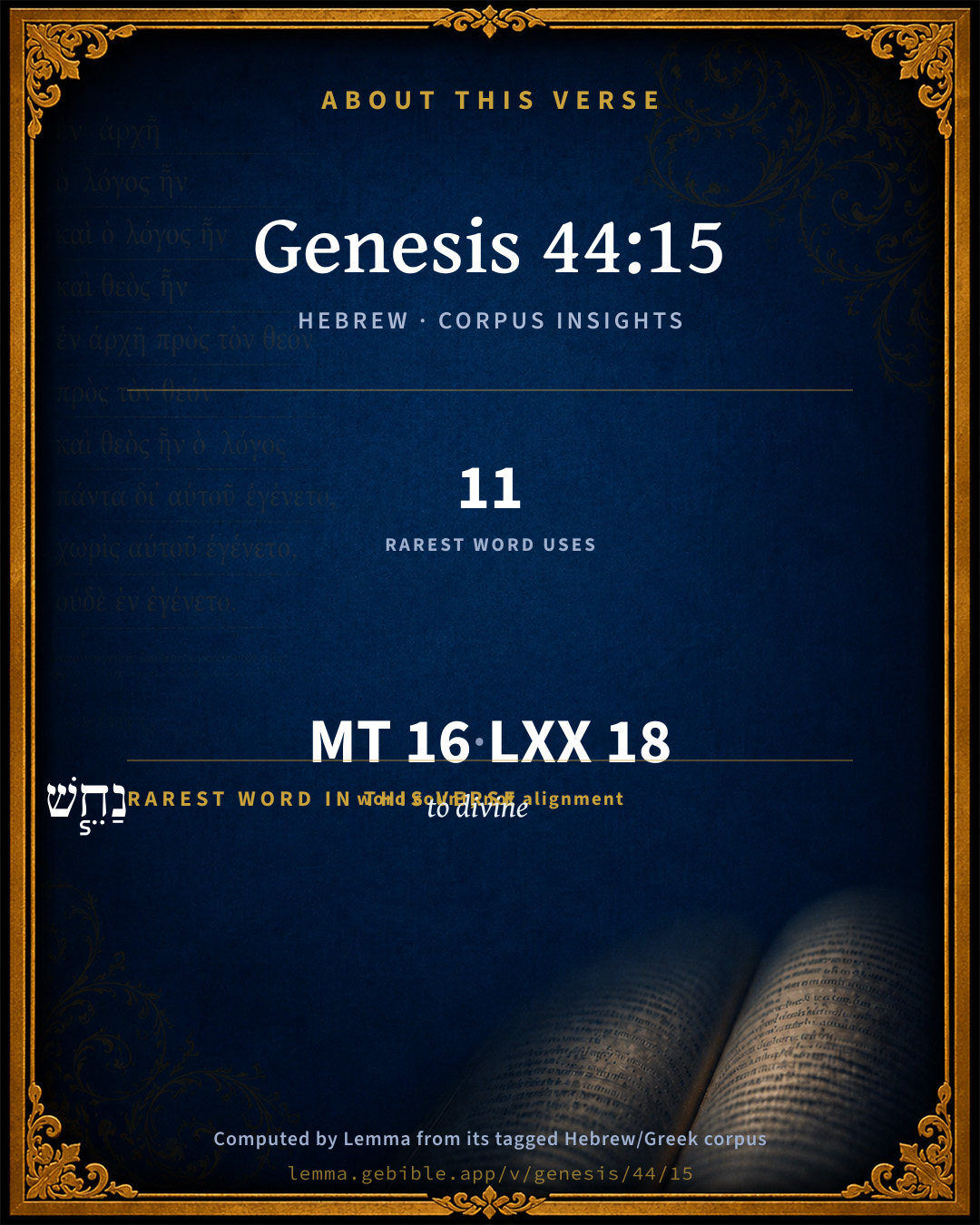
These counts appear in no published source. They are computed here, from the morphology-tagged text and Lemma’s own curated glosses. What Lemma adds →

16
words
13
distinct lemmas
Pentateuch
section

Notable vocabulary

The rarest word here is נַחֵ֧שׁ to divine H5172 — appearing just 11 times in the whole Hebrew Bible.

Shared distinctive vocabulary

נַחֵ֧שׁ to divine H5172 occurs in 9 verses of the Hebrew Bible. Also found in:

Grammatical profile

  • 5 verbs
  • 3 nouns
  • 1 pronoun
  • 2 prepositions
  • 1 conjunction
  • 4 particles

Verb forms

  • וַיֹּ֤אמֶר Qal · Sequential Imperfect
  • עֲשִׂיתֶ֑ם Qal · Perfect
  • יְדַעְתֶּ֔ם Qal · Perfect
  • נַחֵ֧שׁ Piel · Infinitive Absolute
  • יְנַחֵ֛שׁ Piel · Imperfect

Repetition

Words recur within this verse — often emphatic in Hebrew:

  • נַחֵ֧שׁ to divine H5172 ×2
  • אֲשֶׁ֣ר which H834 ×2

Hebrew & Septuagint length

In English translation the verse runs 24 words from the Hebrew and 25 from the Septuagint (LXX English) — closely comparable.

A rough comparison of the two English renderings, which tokenize alike — not a word-level alignment.

Word counts can differ between the Hebrew and the Greek without any difference in meaning — e.g. the Hebrew direct-object marker אֵת has no separate Greek word, and Greek often adds the article ὁ.

In the original languages it is 16 Hebrew tokens and 18 Greek tokens — but the two are counted differently (Hebrew bundles its prefixes and suffixes into one token; the Greek is in lemma form), so that isn’t a like-for-like length.

Cross-references

6

Topical passages linked to Genesis 44:15 in the Treasury of Scripture Knowledge — connected by theme and wording, ordered by reader-vote popularity; previews shown in the World English Bible.

  • Genesis 3:13 Yahweh God said to the woman, "What is this you have done?" The woman said, "The serpent deceived me, and I ate."
  • Genesis 4:10 Yahweh said, "What have you done? The voice of your brother's blood cries to me from the ground.
  • Genesis 21:26 Abimelech said, "I don't know who has done this thing. Neither did you tell me, neither did I hear of it, until today."
  • Genesis 39:8 But he refused, and said to his master's wife, "Behold, my master doesn't know what is with me in the house, and he has put all that he has into my hand.
  • Genesis 44:4–5 When they had gone out of the city, and were not yet far off, Joseph said to his steward, "Up, follow after the men. When you overtake them, ask them, 'Why have you rewarded evil for good?
  • Exodus 32:1 When the people saw that Moses delayed to come down from the mountain, the people gathered themselves together to Aaron, and said to him, "Come, make us gods, which shall go before us; for as for this Moses, the man who brought us up out of the land of Egypt, we don't know what has become of him."

Cross-references courtesy of OpenBible.info (CC BY 4.0).

Hebrew and Greek witnesses Masoretic Hebrew ↔ Greek Septuagint

The same verse in the two great witnesses to the Old Testament, shown verse-for-verse.

These are two independent witnesses, not word-aligned to each other, and the Septuagint is shown in lemma (dictionary) form.

Hebrew Genesis 44:15 Masoretic · Westminster Leningrad Codex

וַיֹּ֤אמֶר לָהֶם֙ יוֹסֵ֔ף מָֽה הַמַּעֲשֶׂ֥ה הַזֶּ֖ה אֲשֶׁ֣ר עֲשִׂיתֶ֑ם הֲל֣וֹא יְדַעְתֶּ֔ם כִּֽי נַחֵ֧שׁ יְנַחֵ֛שׁ אִ֖ישׁ אֲשֶׁ֥ר כָּמֹֽנִי

Joseph said to them, "What deed is this that you have done? Don't you know that such a man as I can indeed divine?"

World English Bible · Public Domain

Greek LXX Genesis 44:15 Septuagint · lemma form

εἶπον δέ αὐτός ιωσηφ τίς ὁ πρᾶγμα οὗτος ὅς ποιέω οὐ οἶδα ὅτι οἰωνισμός οἰωνίζομαι ἄνθρωπος οἷος ἐγώ

And Joseph said to them, What is this thing that you⌃ have done? know you⌃ not that a man such as I can surely divine?

LXX2012 (modern English Septuagint) · Public Domain

On this verse, Haydock's Catholic Bible Commentary discusses the Septuagint’s reading. Read the note in Commentary ↓

Hebrew: Westminster Leningrad Codex (CC BY 4.0). Greek: Septuagint (public domain); English from LXX2012 (modern English Septuagint) (Public Domain). How the Septuagint differs from the Hebrew →

Targum (Aramaic paraphrase)

2

The Targum is the ancient Jewish Aramaic paraphrase of the Hebrew Scriptures — an interpretive translation, not the Hebrew text itself. Onkelos (literal) and Pseudo-Jonathan (expansive) render the Torah, and Jonathan the Prophets. Coverage is partial: where no permissively-licensed English translation exists for a verse, only the Aramaic is shown. This is verse-level text, not a word-by-word alignment to the Hebrew.

  1. Targum Onkelos Torah (Genesis–Deuteronomy)
    וַאֲמַר לְהוֹן יוֹסֵף מָה עוֹבָדָא הָדֵין דִּי עֲבַדְתּוּן הֲלָא יְדַּעְתּוּן אֲרֵי בָדָקָא מְבָדֵק גַּבְרָא דִּי כְוָתִי

    (no public-domain English translation for this verse)

    Targum Onkelos — Aramaic: “Onkelos Genesis” (public domain); “Onkelos Exodus” (public domain); “Onkelos Leviticus” (public domain); “Onkelos Numbers” (public domain); “Onkelos Deuteronomy” (public domain). English: “Sefaria Community Translation” (CC0 1.0 (public-domain dedication)); “J.W. Etheridge. The Targums of Onkelos and Jonathan Ben Uzziel on the Pentateuch. London: Longmans, Green, 1862” (public domain). Text via Sefaria.

  2. Targum Pseudo-Jonathan Torah (Genesis–Deuteronomy)
    וַאֲמַר לְהוֹם יוֹסֵף מַה עוּבְדָא הָדֵין דַעֲבַדְתּוּן הֲלָא יְדַעְתּוּן אֲרוּם מְטַיְירָא יְטַיֵיר גְבַר דִכְוָותִי

    And Joseph said to them, What deed is this that you have done? Could you not know that a man like me divining can divine?

    Targum Pseudo-Jonathan — Aramaic: “Targum Jonathan on Genesis” (public domain); “Targum Jonathan on Exodus” (public domain); “Targum Jonathan on Leviticus” (public domain); “Targum Jonathan on Numbers” (public domain); “Targum Jonathan on Deuteronomy” (public domain). English: “The Targum of Jonathan ben Uzziel, trans. J. W. Etheridge, London, 1862” (public domain). Text via Sefaria.

Commentary

Notes on Genesis 44:15 from classic Christian and Jewish commentators (each source and its license shown beneath its notes). The classic Christian expositions comment on the surrounding passage and are grouped to its opening verse, so a note may address several verses; the Jewish commentaries on the Tanakh (Rashi and others) are per-verse, so they appear only where the commentator wrote on this verse.

Lemma curates 59 commentaries, every one of them public domain or Creative Commons licensed, each selected and text-cleaned for this edition rather than reprinted as found. About our sources →

Trapp's Complete Commentary

John Trapp

Gen 44:15 And Joseph said unto them, What deed [is] this that ye have done? wot ye not that such a man as I can certainly divine?

Ver. 15. What deed is this that ye have done?] As Joseph here, so Christ sometimes impersonates an adversary, when he intends most love.

Wot ye not that such a man as I, &c.] If that be true that some conceive of Joseph, that he, here and at Gen 44:5, made himself a soothsayer, he was certainly to blame. "The lip of excellency becometh not a fool," saith Solomon, but "much less do lying lips a prince." {Pro 17:7, marg.} That is, it is naught when wicked men will be using gracious words, to seem religious. But it is far worse, when good men will use the fashion of the wicked, that they may seem impious.

John Trapp, A Commentary or Exposition upon All the Books of the Old and New Testament (1647–1656) — public domain. Text from a community e-Sword module.

The Cambridge Bible for Schools and Colleges

gen. ed. J. J. S. Perowne

15. such a man as I] The Grand Vizier, second only to Pharaoh (see Gen_44:18), married into the family of the Priest of On, and one “in whom the spirit of God is” (Gen_41:38).

The Cambridge Bible for Schools and Colleges (gen. ed. J. J. S. Perowne; Cambridge University Press, 1878–1918) — public domain. Text from a community e-Sword module.

John Gill's Exposition

And Joseph said unto them, what deed is this ye have done?.... An action so wicked, base, and ungrateful, attended with such aggravated circumstances, that it can scarcely be said how bad a one it is, and may be well wondered at, that men who had received such favours could ever be guilty of; this he said, putting on a stern countenance, and seemingly in great anger and wrath:

wot ye not that such a man as I can certainly divine? either that he could divine himself, though not by the cup, of which here no mention is made, but in some other way used by the Egyptians; or that he had diviners with him, as Aben Ezra, with whom he could consult, to find out the person that took the cup; or surely they must needs think that such a man as he, who had such great knowledge of things, natural and political, and whose name was Zaphnathpaaneah, a revealer of secrets, would be able to search into and find out an affair of this kind; See Gill on Gen 41:45; and they might well conclude, that a man so sagacious and penetrating would easily conjecture who were the persons that took away his cup, even the strangers that had dined with him so lately, and therefore could never expect to go off with it.

John Gill's Exposition of the Whole Bible (1746–1763) — public domain (CC PDM 1.0). Text via the HelloAO Bible API.

Haydock's Catholic Bible Commentary

The science of divining. He speaks of himself according to what he was esteemed in that kingdom. And, indeed, he being truly a prophet, knew more without comparison than any of the Egyptian sorcerers. (Challoner) --- Hebrew, Septuagint, and Chaldean, "knew ye not that a man like me would divine with certainty," and presently discover any fraud? (Calmet)

George Leo Haydock (1774–1849), Haydock's Catholic Family Bible and Commentary, 1859 edition — public domain. Excludes Psalms (Douay-Rheims chapter numbering differs from Protestant) and Deuterocanonical books (Catholic canon only).

Rashi

Rabbi Shlomo Yitzchaki (Rashi)

'הלא ידעתם כי נחש ינחש וגו KNOW YE NOT THAT SUCH A MAN AS I CAN CERTAINLY DIVINE? — Are you not aware that so distinguished a person as I am knows how to divine, and (even though you have robbed me of the goblet by which I divine) to discover by my own intelligence and common sense or by logical deduction that it was you who stole the goblet!

Rashi on the Tanakh — English translations: “The Judaica Press complete Tanach with Rashi, translated by A. J. Rosenberg” (CC BY 4.0); “Pentateuch with Rashi's commentary by M. Rosenbaum and A.M. Silbermann, 1929-1934” (public domain); “The Metsudah Tanach series, Lakewood, N.J” (CC BY 4.0); and “The Book of Joshua, Metsudah Publications, 1997” (CC BY 4.0). Text via Sefaria.

Sforno

Rabbi Ovadia Sforno

What is this deed. It was not only wicked but foolish as well, because I am an expert diviner.

Sforno on the Tanakh — English translation: “Yalkut, Sifsei Chachomim Chumash, Metsudah Publications, 2009” (CC BY 4.0). Text via Sefaria.

Lesson kit

Teaching starters — assembled from the data on this page, not authored interpretation. Every prompt links to the verse data it draws on. Edit before teaching.

Genesis, in the Pentateuch, opens this verse with 16 words (13 distinct Hebrew lemmas). Its most distinctive word is nâchash (“to divine”). A historical commentator’s framing appears above. Read the whole chapter for the surrounding context.

Discussion questions

  1. The word nâchash carries the sense “to divine.” How does it shape the verse?
  2. Genesis 30:27 shares the word «to divine» with this verse. How do the two illuminate each other?
  3. “to divine” occurs 2× in this one verse. What is the effect of the repetition?
  4. These translations render this verse differently; the difference is in the English rendering, not the original. What questions does that raise?
  5. The verb «וַיֹּ֤אמֶר» is Qal Sequential Imperfect. How does its form color the action?
  6. Reading how Trapp's Complete Commentary and The Cambridge Bible for Schools and Colleges read this verse, where do the two commentators agree and where do they part?

Things to notice

Reading settings

Reading text

Shown beneath each verse's original-language words.

Old Testament
Old Testament edition

Read the OT as the Masoretic Hebrew (MT) or the Greek Septuagint (LXX).

English shown for the Greek Septuagint (in the Hebrew ↔ Greek comparison).

Comparing translations? Open the Compare panel on any verse page to stack up to four side by side.