
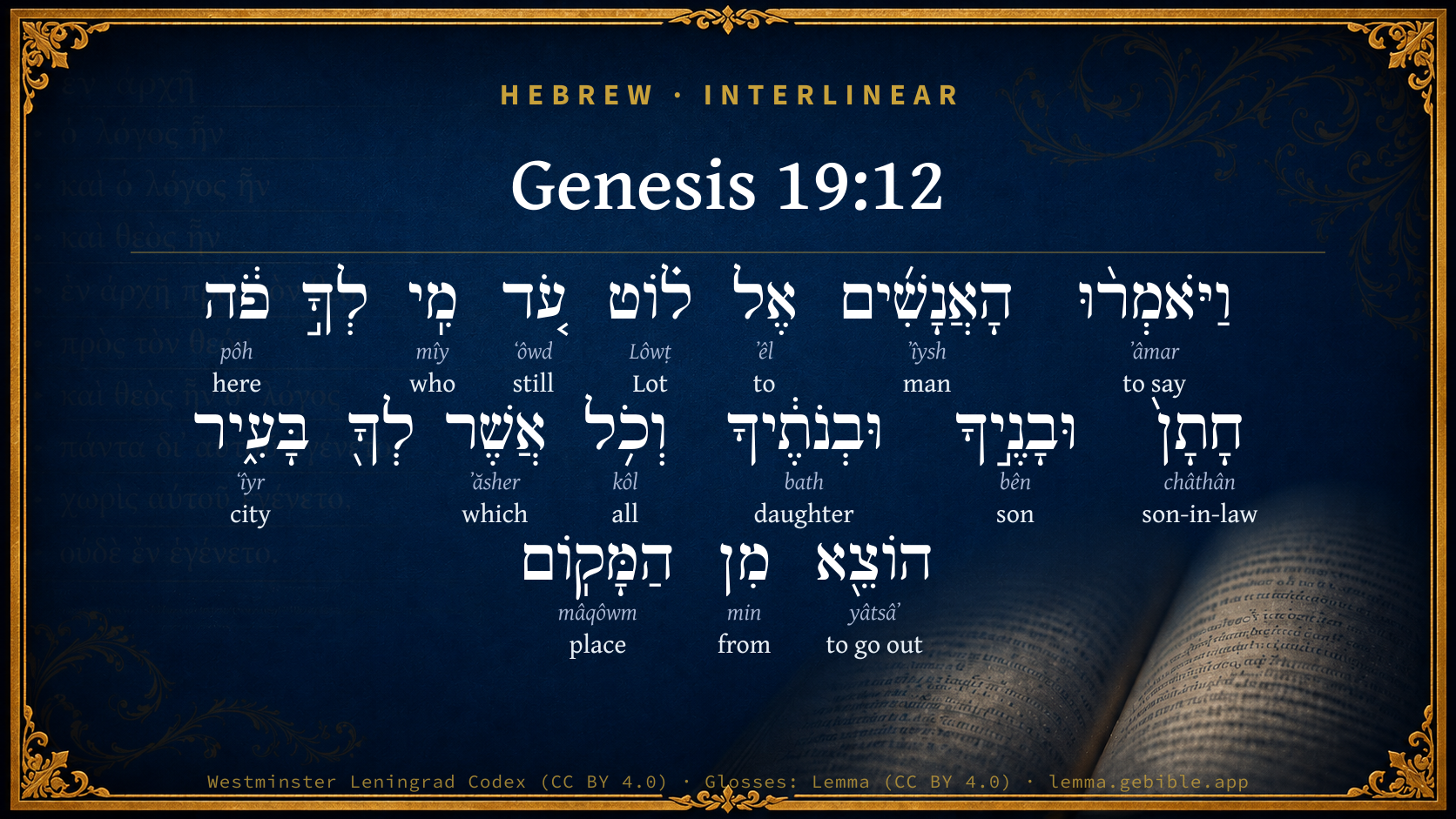
Genesis 19:12

Hebrew (Westminster Leningrad Codex) Genesis 19:12 appears in the Hebrew Old Testament. The text above is from the Westminster Leningrad Codex. Each word links to its Strong’s number, a concise gloss, and parsing drawn from the Open Scriptures Hebrew Bible morphology. Click any word for its full Brown-Driver-Briggs (BDB) entry.
Download image
Cite this verse

Genesis 19:12 (World English Bible). Public Domain. Lemma interlinear Bible study tool, https://lemma.gebible.app/v/genesis/19/12.

Show BibTeX & RIS
BibTeX
RIS
English Translation
The men said to Lot, "Do you have anybody else here? Sons-in-law, your sons, your daughters, and whoever you have in the city, bring them out of the place:
World English Bible · Public Domain
Highlights
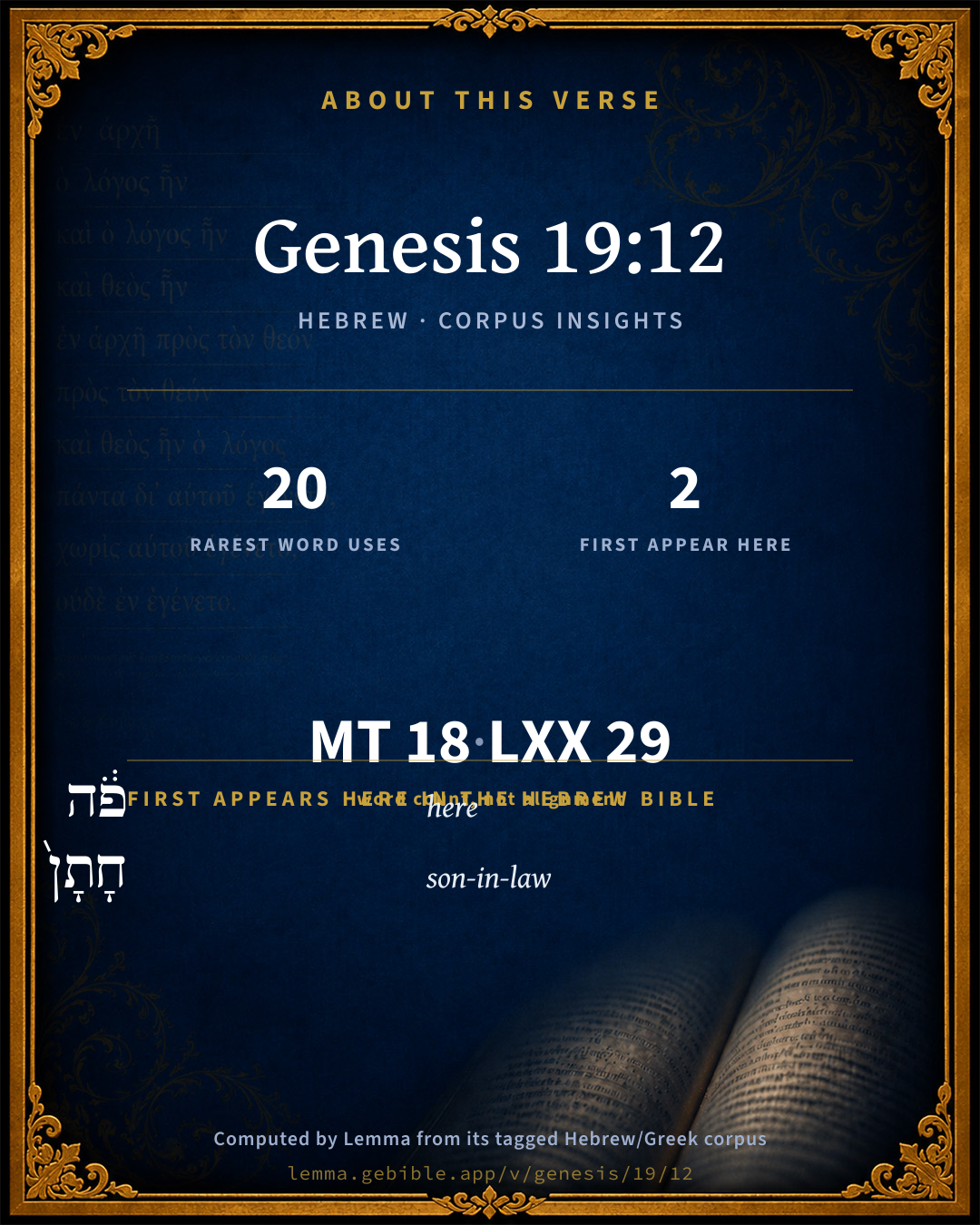
  • 2 first appearances in the Hebrew Bible
Full analysis ↓
Download a study sheet

One document with this verse’s original text, its word-by-word gloss line, the meaning frame, cross-references with their text, attributed commentary, and full source and license credits — printable, and it pastes into notes with its structure intact.

This verse Autodidact and up

Study sheet (.html) Plain text (.txt)

A passage Seminary Student

Up to 50 verses in one chapter. A passage sheet keeps up to 6 commentary sources and 12 cross-references per verse, in the order this page ranks them, and says so on the sheet whenever that leaves anything out. Ask for a single verse and you get the Autodidact verse sheet above.

Everything on this page stays free to read, with no account — the sheet is a download of what is already on screen, not access to it.

Want to remove ads? Support Godless Engineer
Compare translations 3

The same verse in 3 English versions, stacked beneath the original-language interlinear above. Click any original word for its lexicon entry.

Each is an independent rendering of the whole verse — the interlinear is not word-aligned to these translations.

Highlighted words mark where these versions differ — a whole-verse word diff, not a word-by-word alignment.

  • World English Bible Public Domain
    The men said to Lot, "Do you have anybody else here? Sons-in-law, your sons, your daughters, and whoever you have in the city, bring them out of the place:
  • King James Version Public Domain
    And the men said unto Lot, Hast thou here any besides? son in law, and thy sons, and thy daughters, and whatsoever thou hast in the city, bring them out of this place:
  • unfoldingWord Literal Text CC BY-SA 4.0
    Then the men said to Lot, “Who else to you here, a son-in-law or your sons or your daughters or anyone who to you in the city? Take out from this place,

unfoldingWord Literal Text — © unfoldingWord, licensed CC BY-SA 4.0. Word-aligned USFM3 via Door43 (git.door43.org/unfoldingWord/en_ult).

Versions to compare (up to 4)

3 of 4 selected

Show all 18 translations

Every available English version of this verse, each an independent rendering of the whole verse.

  • World English Bible Public Domain
    The men said to Lot, "Do you have anybody else here? Sons-in-law, your sons, your daughters, and whoever you have in the city, bring them out of the place:
  • Berean Standard Bible Public Domain
    Then the two men said to Lot, “Do you have anyone else here—a son-in-law, your sons or daughters, or anyone else in the city who belongs to you? Get them out of here,
  • Majority Standard Bible Public Domain
    Then the two men said to Lot, “Do you have anyone else here—a son-in-law, your sons or daughters, or anyone else in the city who belongs to you? Get them out of here,
  • King James Version Public Domain
    And the men said unto Lot, Hast thou here any besides? son in law, and thy sons, and thy daughters, and whatsoever thou hast in the city, bring them out of this place:
  • American Standard Version (1901) Public Domain
    And the men said unto Lot, Hast thou here any besides? son-in-law, and thy sons, and thy daughters, and whomsoever thou hast in the city, bring them out of the place:
  • Revised Version (1885) Public Domain
    And the men said unto Lot, Hast thou here any besides? son in law, and thy sons, and thy daughters, and whomsoever thou hast in the city; bring them out of the place:
  • Geneva Bible (1599) Public Domain
    Then the men said vnto Lot, Whom hast thou yet here? either sonne in lawe, or thy sonnes, or thy daughters, or whatsoeuer thou hast in the citie, bring it out of this place.
  • Douay-Rheims (1899) Public Domain
    And they said to Lot: Hast thou here ally of thine? son in law, or sons, or daughters, all that are thine bring them out of this city:
  • Young's Literal Translation Public Domain
    And the men say unto Lot, `Whom hast thou here still? son-in-law, thy sons also, and thy daughters, and all whom thou hast in the city, bring out from this place;
  • Literal Standard Version CC BY-SA 4.0
    And the men say to Lot, “Whom have you here still? Son-in-law, your sons also, and your daughters, and all whom you have in the city, bring out from this place;
  • Unlocked Literal Bible CC BY-SA 4.0
    Then the men said to Lot, “Do you have anyone else here? Any sons-in-law, your sons and your daughters, and whoever you have in the city, get them out of here.
  • unfoldingWord Literal Text CC BY-SA 4.0
    Then the men said to Lot, “Who else to you here, a son-in-law or your sons or your daughters or anyone who to you in the city? Take out from this place,
  • Darby Bible Public Domain
    And the men said to Lot, Whom hast thou here besides? a son-in-law, and thy sons, and thy daughters, and all whom thou hast in the city -- bring [them] out of the place.
  • World Messianic Bible Public Domain
    The men said to Lot, “Do you have anybody else here? Sons-in-law, your sons, your daughters, and whomever you have in the city, bring them out of the place:
  • Webster's Bible Public Domain
    And the men said to Lot, Hast thou here any besides? son-in-law, and thy sons, and thy daughters, and whatever thou hast in the city, bring them out of this place:
  • Free Bible Version CC BY-SA 4.0
    The two men asked Lot, “Is there anyone else here who's part of your family—sons-in-law, or sons or daughters, or anyone else in the town? If there are, make sure they leave,
  • Bible in Basic English Public Domain
    Then the men said to Lot, Are there any others of your family here? sons-in-law or sons or daughters, take them all out of this place;
  • JPS Tanakh (1917) Public Domain
    And the men said unto Lot: 'Hast thou here any besides? son-in-law, and thy sons, and thy daughters, and whomsoever thou hast in the city; bring them out of the place;

Literal Standard Version (2020), Covenant Press — licensed CC BY-SA 4.0. Text via the HelloAO Bible API (eBible.org). Unlocked Literal Bible (unfoldingWord) — licensed CC BY-SA 4.0. Text via the HelloAO Bible API (eBible.org). unfoldingWord Literal Text — © unfoldingWord, licensed CC BY-SA 4.0. Word-aligned USFM3 via Door43 (git.door43.org/unfoldingWord/en_ult). Free Bible Version, Dr. Jonathan Gallagher — licensed CC BY-SA 4.0. Text via the HelloAO Bible API (eBible.org).

Word by word

More ways to search: Search by grammar → Find every occurrence → Compare this word →

Practice this passage: Drill this verse → Learn its vocabulary →

חָתָן֙
châthân
H2860
“son-in-law”
Noun, Common, Masculine, Singular, Absolute
Part of Speech
Noun
Type
Common
Gender
Masculine
Number
Singular
State
Absolute
Full BDB Definition

Origin: from H2859

TWOT: 781c

son-in-law, daughter's husband, bridegroom, husband
  1. וַיֹּאמְר֨וּ ʼâmar H559 “and · to say” Conjunction + Verb, Qal, Sequential Imperfect, 3rd Person, Masculine, Plural
  2. הָאֲנָשִׁ֜ים ʼîysh H376 “the · men” Particle, Definite Article + Noun, Common, Masculine, Plural, Absolute
  3. אֶל ʼêl H413 “to” Preposition
  4. ל֗וֹט Lôwṭ H3876 “Lot” Noun, Proper
  5. עֹ֚ד ʻôwd H5750 “still” Adverb
  6. מִֽי mîy H4310 “who” Particle, Interrogative
  7. פֹ֔ה pôh H6311 “here” Adverb
  8. וּבָנֶ֣יךָ bên H1121 “and · sons · your” Conjunction + Noun, Common, Masculine, Plural, Construct + Suffix, Personal, 2nd Person, Masculine, Singular
  9. וּבְנֹתֶ֔יךָ bath H1323 “and · daughters · your” Conjunction + Noun, Common, Feminine, Plural, Construct + Suffix, Personal, 2nd Person, Masculine, Singular
  10. וְכֹ֥ל kôl H3605 “and · all” Conjunction + Noun, Common, Masculine, Singular, Absolute
  11. אֲשֶׁר ʼăsher H834 “which” Particle, Relative
  12. בָּעִ֑יר ʻîyr H5892 “in/at the · city” Preposition, Determined + Noun, Common, Feminine, Singular, Absolute
  13. הוֹצֵ֖א yâtsâʼ H3318 “go out” Verb, Hiphil, Imperative, 2nd Person, Masculine, Singular
  14. מִן min H4480 “from” Preposition
  15. הַמָּקֽוֹם mâqôwm H4725 “the · place” Particle, Definite Article + Noun, Common, Masculine, Singular, Absolute

About this verse

These counts appear in no published source. They are computed here, from the morphology-tagged text and Lemma’s own curated glosses. What Lemma adds →

18
words
16
distinct lemmas
Pentateuch
section

Notable vocabulary

The rarest word here is חָתָן֙ son-in-law H2860 — appearing just 20 times in the whole Hebrew Bible.

First appearance in Scripture

These words make their first canonical appearance in the Hebrew Bible here:

  • פֹ֔ה here H6311
  • חָתָן֙ son-in-law H2860

Shared distinctive vocabulary

חָתָן֙ son-in-law H2860 occurs in 19 verses of the Hebrew Bible. Also found in:

Grammatical profile

  • 2 verbs
  • 8 nouns
  • 4 prepositions
  • 2 adverbs
  • 2 particles

Verb forms

  • וַיֹּאמְר֨וּ Qal · Sequential Imperfect
  • הוֹצֵ֖א Hiphil · Imperative

Hebrew & Septuagint length

In English translation the verse runs 29 words from the Hebrew and 30 from the Septuagint (LXX English) — closely comparable.

A rough comparison of the two English renderings, which tokenize alike — not a word-level alignment.

Word counts can differ between the Hebrew and the Greek without any difference in meaning — e.g. the Hebrew direct-object marker אֵת has no separate Greek word, and Greek often adds the article ὁ.

In the original languages it is 18 Hebrew tokens and 29 Greek tokens — but the two are counted differently (Hebrew bundles its prefixes and suffixes into one token; the Greek is in lemma form), so that isn’t a like-for-like length.

Cross-references

10

Topical passages linked to Genesis 19:12 in the Treasury of Scripture Knowledge — connected by theme and wording, ordered by reader-vote popularity; previews shown in the World English Bible.

  • Genesis 7:1 Yahweh said to Noah, "Come with all of your household into the ark, for I have seen your righteousness before me in this generation.
  • 2 Peter 2:7 and delivered righteous Lot, who was very distressed by the lustful life of the wicked
  • Revelation 18:4 I heard another voice from heaven, saying, "Come out of her, my people, that you have no participation in her sins, and that you don't receive of her plagues,
  • Genesis 19:17 It came to pass, when they had taken them out, that he said, "Escape for your life! Don't look behind you, neither stay anywhere in the plain. Escape to the mountain, lest you be consumed!"
  • Numbers 16:26 He spoke to the congregation, saying, Depart, I pray you, from the tents of these wicked men, and touch nothing of theirs, lest you be consumed in all their sins.
  • Joshua 6:22–23 Joshua said to the two men who had spied out the land, Go into the prostitute's house, and bring out there the woman, and all that she has, as you swore to her.
  • 2 Peter 2:9 the Lord knows how to deliver the godly out of temptation and to keep the unrighteous under punishment for the day of judgment;
  • Genesis 19:14 Lot went out, and spoke to his sons-in-law, who were pledged to marry his daughters, and said, "Get up! Get out of this place, for Yahweh will destroy the city." But he seemed to his sons-in-law to be joking.
  • Genesis 19:22 Hurry, escape there, for I can't do anything until you get there." Therefore the name of the city was called Zoar.
  • Jeremiah 32:39 and I will give them one heart and one way, that they may fear me forever, for the good of them, and of their children after them:

Cross-references courtesy of OpenBible.info (CC BY 4.0).

Hebrew and Greek witnesses Masoretic Hebrew ↔ Greek Septuagint

The same verse in the two great witnesses to the Old Testament, shown verse-for-verse.

These are two independent witnesses, not word-aligned to each other, and the Septuagint is shown in lemma (dictionary) form.

Hebrew Genesis 19:12 Masoretic · Westminster Leningrad Codex

וַיֹּאמְר֨וּ הָאֲנָשִׁ֜ים אֶל ל֗וֹט עֹ֚ד מִֽי לְךָ֣ פֹ֔ה חָתָן֙ וּבָנֶ֣יךָ וּבְנֹתֶ֔יךָ וְכֹ֥ל אֲשֶׁר לְךָ֖ בָּעִ֑יר הוֹצֵ֖א מִן הַמָּקֽוֹם

The men said to Lot, "Do you have anybody else here? Sons-in-law, your sons, your daughters, and whoever you have in the city, bring them out of the place:

World English Bible · Public Domain

Greek LXX Genesis 19:12 Septuagint · lemma form

εἶπον δέ ὁ ἀνήρ πρός λωτ εἰμί τίς σύ ὧδε γαμβρός ἤ υἱός ἤ θυγάτηρ ἤ εἰ τίς σύ ἄλλος εἰμί ἐν ὁ πόλις ἐκἄγω ἐκ ὁ τόπος οὗτος

And the men said to Lot, Have you here sons-in-law, or sons or daughters, or if you have any other friend in the city, bring them out of this place.

LXX2012 (modern English Septuagint) · Public Domain

On this verse, The Preacher's Complete Homiletical Commentary discusses the Septuagint’s reading. Read the note in Commentary ↓

Hebrew: Westminster Leningrad Codex (CC BY 4.0). Greek: Septuagint (public domain); English from LXX2012 (modern English Septuagint) (Public Domain). How the Septuagint differs from the Hebrew →

Targum (Aramaic paraphrase)

2

The Targum is the ancient Jewish Aramaic paraphrase of the Hebrew Scriptures — an interpretive translation, not the Hebrew text itself. Onkelos (literal) and Pseudo-Jonathan (expansive) render the Torah, and Jonathan the Prophets. Coverage is partial: where no permissively-licensed English translation exists for a verse, only the Aramaic is shown. This is verse-level text, not a word-by-word alignment to the Hebrew.

  1. Targum Onkelos Torah (Genesis–Deuteronomy)
    וַאֲמָרוּ גֻּבְרַיָּא לְלוֹט עוֹד מָן לָךְ הָכָא חַתְנָא וּבְנָךְ וּבְנָתָךְ וְכֹל דִּי לָךְ בְּקַרְתָּא אַפֵּיק מִן אַתְרָא

    (no public-domain English translation for this verse)

    Targum Onkelos — Aramaic: “Onkelos Genesis” (public domain); “Onkelos Exodus” (public domain); “Onkelos Leviticus” (public domain); “Onkelos Numbers” (public domain); “Onkelos Deuteronomy” (public domain). English: “Sefaria Community Translation” (CC0 1.0 (public-domain dedication)); “J.W. Etheridge. The Targums of Onkelos and Jonathan Ben Uzziel on the Pentateuch. London: Longmans, Green, 1862” (public domain). Text via Sefaria.

  2. Targum Pseudo-Jonathan Torah (Genesis–Deuteronomy)
    וַאֲמָרוּ גוּבְרַיָא לְלוֹט אִית טוּב מַאן לָךְ בְּקַרְתָּא קָרִיב אוֹ אָחָא הָכָא חַתְנָךְ בְּנָךְ בְּנָתָךְ הַנְפֵּק מִן אַתְרָא

    And the Men said to Lot, Hast thou yet in this city kinsman or brother? Thy sons-in-law, thy sons and thy daughters, take forth from the place;

    Targum Pseudo-Jonathan — Aramaic: “Targum Jonathan on Genesis” (public domain); “Targum Jonathan on Exodus” (public domain); “Targum Jonathan on Leviticus” (public domain); “Targum Jonathan on Numbers” (public domain); “Targum Jonathan on Deuteronomy” (public domain). English: “The Targum of Jonathan ben Uzziel, trans. J. W. Etheridge, London, 1862” (public domain). Text via Sefaria.

Commentary

Notes on Genesis 19:12 from classic Christian and Jewish commentators (each source and its license shown beneath its notes). The classic Christian expositions comment on the surrounding passage and are grouped to its opening verse, so a note may address several verses; the Jewish commentaries on the Tanakh (Rashi and others) are per-verse, so they appear only where the commentator wrote on this verse.

Lemma curates 59 commentaries, every one of them public domain or Creative Commons licensed, each selected and text-cleaned for this edition rather than reprinted as found. About our sources →

Matthew Henry's Commentary

We have here the preparation for Lot's deliverance.

I. Notice is given him of the approach of Sodom's ruin: We will destroy this place, Gen 19:13. Note, The holy angels are ministers of God's wrath for the destruction of sinners, as well as of his mercy for the preservation and deliverance of his people. In this sense, the good angels become evil angels, Psa 78:49.

II. He is directed to give notice to his friends and relations, that they, it they would, might be saved with him (Gen 19:12): "Hast thou here any besides, that thou art concerned for? If thou hast, go tell them what is coming." Now this implies, 1. The command of a great duty, which was to do all he could for the salvation of those about him, to snatch them as brands out of the fire. Note, Those who through grace are themselves delivered out of a sinful state should do what they can for the deliverance of others, especially their relations. 2. The offer of great favour. They do not ask whether he knew any righteous ones in the city fit to be spared: no, they knew there were none; but they ask what relations he had there, that, whether righteous or unrighteous, they might be saved with him. Note, Bad people often fare the better in this world for the sake of their good relations. It is good being akin to a godly man.

III. He applies himself accordingly to his sons-in-law, Gen 19:14. Observe, 1. The fair warning that Lot gave them: Up, get you out of this place. The manner of expression is startling and quickening. It was no time to trifle when the destruction was just at the door. They had not forty days to repent in, as the Ninevites had. Now or never they must make their escape. At midnight this cry was made. Such as this is our call to the unconverted, to turn and live. 2. The slight they put upon this warning: He seemed to them as one that mocked. They thought, perhaps, that the assault which the Sodomites had just now made upon his house had disturbed his head, and put him into such a fright that he knew not what he said; or they thought that he was not in earnest with them. Those who lived a merry life, and made a jest of everything, made a jest of this warning, and so they perished in the overthrow. Thus many who are warned of the misery and danger they are in by sin make a light matter of it, and think their ministers do but jest with them; such will perish with their blood upon their own heads.

Matthew Henry's Commentary on the Whole Bible (1708–1710) — public domain (CC PDM 1.0). Text via the HelloAO Bible API.

Trapp's Complete Commentary

John Trapp

Gen 19:12 And the men said unto Lot, Hast thou here any besides? son in law, and thy sons, and thy daughters, and whatsoever thou hast in the city, bring [them] out of this place:

Ver. 12. Hast thou here any, &c.] It is something for safety, to be Lot’s kinsman. So the Kenites in Saul’s time, receive life from Jethro’s dust, many ages after his death, and favour from his hospitality. {1Sa 15:6}

John Trapp, A Commentary or Exposition upon All the Books of the Old and New Testament (1647–1656) — public domain. Text from a community e-Sword module.

The Biblical Illustrator

Joseph S. Exell

Gen_19:12

Hast thou here any besides?

--

A solemn inquiry concerning our families

I. Such a question as this APPEALS TO OUR NATURAL AFFECTION. Surely, unless we have lost manhood, we love our kindred and desire their good. We have not yet become like the ostriches in the wilderness, which care not for their young. Our flesh has not congealed into marble, nor are our hearts become like millstones; we have a very tender concern for those united to us by ties of nature, and esteem them as parts of ourselves. What parent is not glad to see his children in good health? We will watch them all through the weary night when they are ill, and can we not pray for them when they are sick with sin? Parents, be parents indeed. Brothers, act a true fraternal part. Sisters, let your tender love find a fitting channel. Husbands and wives, let your conjugal union awaken you to tenderest emotions. Let every fond relationship stir us to care for others, while the inquiry is made: Hast thou here any besides?

II. The question is one which AROUSES HOLY SOLICITUDE. To provoke you to earnest solicitude this morning, let me remind you of times when we should be anxious about our friends and children.

1. When first we ourselves look to Christ, we should care for others. We would not eat our morsel alone, lest it grow stale through our selfishness. This wood drops with honey; we cannot eat it all, let us call others to taste its sweetness.

2. Then there are times of Christian enjoyment.

3. Me-thinks when we are downcast, when our soul is filled with bitter trouble, then also is an appropriate season to pray for others. God turned the captivity of Job when he prayed for his friends, and he may turn our captivity when we do the same.

4. It may also help to stimulate this holy solicitude, to think of how we shall feel in regard to our children and friends when they come to lie sick.

Can we gaze upon their pallid countenances without bitter reproaches for our past supineness?

5. Think, again, how you would care for your friends if you were yourself this morning very nigh unto death. You cannot come back from heaven; if you have neglected a duty, you cannot leave heaven to perform it.

III. Such a question as this is calculated to EXCITE US TO ANXIOUS EFFORT; for mere solicitude without effort is not genuine. A man must not pretend that he cares for the souls of others so long as he leaves one stone unturned which might be the means of blessing them.

1. It seems to me, then, that if we are in a right state of heart this morning, one of the first things we shall do will be to tell those dear to us of their danger. Let not thy friend perish through ignorance. Tell him that whosoever cometh unto Christ He will in no wise cast out; that there is life in a look at the crucified Saviour; that whosoever believeth that Jesus is the Christ, is born of God. Preach no salvation by works; but preach faith, and works only as the fruit of faith; and let the doctrine that Christ came to seek and to save that which was lost be clearly set before thy friends face.

2. Remember it is not enough coldly to warn them of danger and doctrinally to teach the remedy. There are many who will go so far; but I hold, my brethren and sisters, that we are bound to use a constraint with our friends. Do not misunderstand me--only a loving and a tender constraint, such as these angels used with Lot. Press them, plead with them, take them by the hand. I remember an old man who was a nursing-father to all the young men in the parish where he lived. This one thing he used to do; there was scarcely a lad whom he would not know and speak to, and there was a time with most of the lads when he specially sought to see them decided. Suppose one of them was going away to London, he would be sure to ask him to have a cup of tea with him. You are going away, John, he would say; I should not like you to go without spending an evening with me. If it was a fine sunshiny evening, he would say, You know I have often talked to you about the things of God, and I am afraid that as yet there has been no impression produced. You are going to London, and will meet with many temptations, and I fear you may fall into them, but I should like to pray with you once before you go. Let us walk down the field together. There was a tree, an old oak tree, in a solitary place, where he would say, To help you to recollect my words better, we will pray under this tree. The young and the old knelt together, and the old man poured out his soul before God; and when he had wrestled with

God, and talked with his young friend, he would say, Now, when I am dead and gone, you will perhaps come back to the place where you lived when a youth; let that tree be a witness between God and your soul, that here I wrestled with you; and if you forget God, and do not give your heart to Christ, let that tree stand to accuse your conscience till it yields to the entreaties of Divine love. Now here was a using of what I have styled constraint; but it is not a constraint, as physical force; of course that is never to be used; but the constraint of spiritual force, Divine love, and earnestness. May I ask whether we have all done our duty in this matter?

IV. Our text FOSTERS A VERY CHEERING HOPE. It says, Hast thou here any besides? as much as if it would say, Hope for them all. Why should they not all be brought out of Sodom? Why should one be left behind?

V. The text SUGGESTS A VERY SOLEMN FEAR, namely, that there may be some in our households who will not be saved. Ah! young men and women; ah! you who are fathers of Christian children, but not converted yourselves; you who are godless daughters and unregenerate sons of Christian people, you are lost now, you may be lost for ever l Lots sons-in-law were consumed, and why not you? Saved shall the patriarch be, but not saved the patriarchs son, except he shall flee out of Sodom. (C. H.Spurgeon.)

Lessons

1. While God blinds the wicked, He maketh way for His servants to escape.

2. Sweet is the providence, and solicitous is the care of God by His angel over His saints to save them.

3. Sons and daughters fare the better with God for being related to holy parents.

4. God calleth His, and all that are near and dear to Him, out of the place upon which vengeance is determined (Rev_18:4).

5. Approaching vengeance discovered should make saints quit themselves from among the wicked (Gen_19:12).

6. When the cry of sins groweth great against Gods face, it is time for saints to haste from thence.

7. Jehovah commissions destroyers to blot out the wicked in the earth. 8, Good angels are sometimes commissioned to destroy the wicked as well as to save the righteous. (G. Hughes, B. D.)

The Biblical Illustrator, edited by Joseph S. Exell (c. 1880s–1900s) — public domain. Text from a community e-Sword module.

The Pulpit Commentary

CHAPTER 19:12-28

Vers. 12, 13. And the men said unto Lot, after the incident recorded in the preceding verses. Lot by this time had doubtless recognized their celestial character; accordingly, the Codex Samaritanus reads angels Hast thou here any besides? (i.e. any other relatives or friends in the city in addition to the daughters then present in the house) son in law, and thy sons, and thy daughters, and whatsoever (not of things, but of persons) thou hast in the city, bring them out of this place: for we will destroy this place (literally, for destroying this place are we, i.e. we are here for that purpose), because the cry of them not "the outcry on account of them," i.e. which the men of Sodom extort from others (Gesenius), but the cry against them which ascends to heaven, the cry for vengeance on their iniquities (cf. Gen_4:10 Gen_18:20 is waxen great before the face of the Lord; cf. Gen_6:11 Gen_10:9) and the Lord (Jehovah) hath sent us (language never employed by the Maleaeh Jehovah) to destroy it.

The Pulpit Commentary (1880–1919), ed. H.D.M. Spence-Jones & Joseph S. Exell — public domain. Text from a community e-Sword module.

The Preacher's Complete Homiletical Commentary

Joseph S. Exell (gen. ed.)

CRITICAL NOTES.—

Gen_19:12. Son-in-law, and thy sons, and thy daughters.] “The mention of the son-in-law before the sons and daughters is somewhat surprising. Lange has proposed to read thus: ‘Hast thou here any besides as son-in-law?’ (i.e., connected with thee by marriage), and then follows the mention of the members of Lot’s own family. And this would certainly be a more probable arrangement.” (Alford.)

Gen_19:13. The cry of them is waxen great before the face of the Lord.] Heb. Is become great before Jehovah.

Gen_19:14. Spake unto his sons-in-law.] “Some hold these to have been only betrothed to his two daughters before mentioned: and so the Vulgate renders His sons-in-law, who were about to receive his daughters. So also Josephus, and of the moderns, Kalisch, Keil, Lange, Ewald, etc. On the other hand, the LXX. keeps the past tense, and is followed by Rosenmuller, Knobel, and Delitzsch. Certainly, in Gen_19:15, the ‘two daughters which are here’ seem to be distinguished from other daughters who were absent. On the whole, the more probable view seems that there were husbands of married daughters living in the city, whereas his two virgin daughters lived with their father at home.” (Alford.)

Gen_19:15. When the morning arose.] The day-dawn; for the sun did not rise till Lot entered Zoar (Gen_19:23). “The Heb. root signifies splitting or breaking, the streaks of light breaking up the eastern clouds; and it ‘arose,’ because the dawn advances from the horizon upwards.” Thy two daughters which are here. Heb. “Which are found.” Chal. “Which are found faithful with thee.” Seems to imply that some of Lot’s daughters were not thus found, and therefore perished in the destruction of the city. In the iniquity of the city. The Heb. term signifies either the iniquity or the punishment of the iniquity.

Gen_19:16. While he lingered.] Heb. “He delayed or distracted himself.” “The original is peculiar and emphatic in its import, leading us to fear that it was not altogether a compassionate sympathy that detained his steps. The word properly implies that ‘he suffered himself to be hindered and embarrassed with distracting cares.’ ” (Bush.) The Lord being merciful unto him. Heb. “In the gentle mercy of the Lord upon him.”

Gen_19:17. The plain.] The country round Jordan—the same word as that used in ch. Gen_13:10. The mountain. The mountainous region of Moab, lying several miles to the east of Sodom.

Gen_19:19. Lest some evil take me.]. Heb. “Lest the evil, or, this evil”—the threatened destruction.

Gen_19:20. It is a little one.] Formerly known by the name of “Bela” (Gen_14:2), now called Zoar from this circumstance. The Jerus. Targ. reads: “It is little, and its sins are little.”

MAIN HOMILETICS OF THE PARAGRAPH.—Gen_19:12-22

THE DELIVERANCE OF THE RIGHTEOUS IN THE TIME OF JUDGMENT

I. God makes known to them the way of deliverance. The angels who had come for the salvation of Lot commanded him, saying, “Arise, take thy wife, and thy two daughters which are here, lest thou be consumed in the iniquity of the city” (Gen_19:15.) He is told, further, to escape for his life, not to look behind him, but to escape to the mountain lest he be consumed (Gen_19:17). This was God’s revealed way of deliverance. This was His purpose to save, and the manner in which that purpose was to be accomplished. But we learn from this history—

1. That God’s way of deliverance is often against our will. Lot lingered as if still unwilling to leave the city. As the Heb. word imports, he delayed, or hindered himself. He suffered many cares and anxieties of business still to hold him to this doomed spot. The angels had to lay their hands upon Lot, and his wife, and his two daughters, and deliver them from destruction, as it were, by a loving violence. The causes of this lingering and hesitation are—

(1) We forget what should be our chief care. It was life here that was at stake. House, and goods, and residence in a rich and pleasant country are of little moment when compared with the value of our lives, with a possession so close and intimate, nearer to us than anything else—ourselves. A man is not profited if he gains the whole world and loses himself. It is folly, when the greatest treasure of all is threatened, to run any risk by losing time over insignificant matters. Such conduct shows that we lack that true nobility of soul which only sets value upon the highest and best things.

(2) We are paralysed by fear. The thought that there is danger near fills us with alarm. We are like those upon whose vital power sudden fear places an arrest. Fear is one of the greatest foes of faith—a hindrance to all effective action. The man who hid his talent in the earth was moved thereto by fear, and therefore he could do nothing. It is only by looking from our danger to God and His salvation that we can be safe. We learn further:

2. That God’s way of deliverance does not destroy the necessity for our own exertion. (Gen_19:17.) Life is at stake, and Lot has no promise of safety but in flight to the mountain. If he lingers behind, and refuses to make haste, he must be involved in the general destruction. God will not save him without some effort on his part. This is our case. Nothing less than our life is concerned. We are in danger of failing to attain to our better and nobler life, of falling into the condemnation of the wicked. There is only one way of escape—by renouncing ourselves, our trust in our own strength, our sins, and accepting fully of God’s way of salvation. We must not linger in the plain of self, or stand still in regretful contemplation of what we have renounced, but must flee to the mountain, to the rock that is higher than we are, for there alone can we rest in safety.

3. That God’s way of deliverance is only effective through His mercy. Lot and his family were brought forth and set without the city, “the Lord being merciful unto him.” (Gen_19:16.) It was by constraining love that he was saved after all. His purpose was too weak to have accomplished his deliverance, and had he been left to himself he would have perished in the common destruction.

“E’en Lot himself could lingering stand

When vengeance was in view;

’Twas mercy plucked him by the hand

Or he had perished too.”

Besides the call of God bidding us to “escape,” and showing the way of escape, there must be a powerful influence of mercy, otherwise we shall fail of salvation.

II. God is ready to deliver others for their sakes. The household of Lot, son-in-law and sons, were offered the same mercy. Though some of them were reckless and unworthy they were allowed to share in the blessings of the household covenant. Any connection with the people of God is a privilege which may be improved into a real benefit.

1. Hence the righteous can offer salvation to the last. Lot went out and warned his sons-in-law of the coming danger and exhorted them to escape. (Gen_19:14.) He was to them a preacher of righteousness, even when they were upon the verge of doom. The door of mercy remains open to the last, and men may find salvation though they come late. It is our duty to proclaim the mercy of God towards sinners while there is time.

2. Our efforts may be unavailing. Lot “seemed as one that mocked unto his sons-in-law.” (Gen_19:14.) His warning had no effect upon them. They refused to receive the offered mercy. They saw no danger; all things were around them as they had been, and there were no signs that so terrible a destruction was prepared and about to fall. They regarded Lot’s words as idle tales, and they believed them not. Thus when sinners are informed of their danger, and exhorted to seek the way of safety, they do not believe that they are in any peril, and therefore despise the message.

III. In the midst of abounding corruption only the few escape. After all this warning and exhortation, only Lot, his wife, and two daughters, escaped from the destruction of Sodom; and one, even of this small number, perished by the way! So it was in the Deluge, and in all God’s great judgments on the world. There are times when the wickedness of nations grows rank, and almost universal. That wickedness shows itself in various forms. At one time, it is laxity of morals; at another, it is a prevailing unbelief and a spirit of blasphemy; or it is lawless defiance of authority; or it may be worldliness, coarse or refined. It has ever happened that only the few have escaped the contagion of the abounding iniquity. Such is the character of the world, mostly evil! The majority are found ranging themselves on the side of the kingdom of darkness. These facts, though painful, must be admitted. They teach us—

1. The tremendous power of evil. The moral infection of sin has clung to human nature with an awful tenacity. The course of time, the progress of humanity in arts, sciences, and the refinements of life, have not sufficed to wear out the strength of the poison. This power of evil is a sad and disquieting factor in our estimate of the grandeur of man.

2. They teach us to approve of God’s great judgments upon mankind. The Scriptures record the wholesale destruction of peoples and nations on account of their sin. With our compassionate feelings we sometimes think these judgments harsh, or even unjust. But we become reconciled to them, and are ready to believe that they have a sufficient cause, when we think of the enormous wickedness which has provoked them. The long-suffering of God is great; it waits, but there must be an end. If we could only know all that God knows, and see all that He sees of the wickedness of mankind, instead of being distressed at the rigour of His judgments, we should only wonder at His patience.

IV. The righteous can only be saved out of the scenes of iniquity, not in them. Lot and his family could not be saved while they remained in Sodom. As for Lot, the men “brought him forth, and set him without the city.” (Gen_19:16.) The world is the City of Destruction, and we must separate ourselves from it or we cannot be saved. The principles of the world, its spirit, its acts, are enmity against God. We cannot separate ourselves from the outward world, either of nature or of man, but we can be unworldly as Christ was unworldly. He lived and mingled with men in the ways of social intercourse, but He had far other aims, and was sustained by higher hopes and principles. What God requires of us is that we should not partake of that spirit of life which rules in the hearts of men who are alienated from Him. If we are saved, it must be in the kingdom of light and not in the kingdom of darkness. It must be not in the Sodom which God has doomed, but in the place to which He invites us.

SUGGESTIVE COMMENTS ON THE VERSES

Gen_19:12. Here we are to mark the mercy of the Divine proceedings. Ten righteous men would have saved the city; but there seems to have been only one. He, however, shall at all events escape; and not only so, but all that belong to him shall be delivered for his sake, or, if otherwise, it shall be their own fault. It shall not be for the want of a proffered opportunity or a faithful warning. Sons-in-law, sons, daughters, or whatever he had, are directed to be brought out of the doomed city, which was rapidly approaching the crisis of its fate. That remarkable feature of the Divine administration by which the wicked are blessed for the sake of the righteous is here most signally illustrated; for that such were the sons-in-law is evident from the contemptuous manner in which they received the warning, and the fact that they perished in the perdition of the city.—(Bush.)

There are privileges which men have from their connection with the righteous, and to which they have no proper right on the ground of personal character. The indirect advantages of the piety of the few are great. The world little knows for how many blessings it is indebted to the Church.

Gen_19:13. God sends judgments upon wicked nations only after all admonitions and chastisements have failed.

The sins of men have a voice which assails heaven and dares its justice.

Even the good angels are God’s executioners. And the first execution they did in the world that we read of was among these filthy Sodomites. So it will be, likely, at the last day. And St. Peter seems to say as much. (2Pe_2:9.) The Lord reserves the unjust to the day of judgment to be punished, “but chiefly them that walk after the flesh in the lust of uncleanness.” Mark that chiefly.—(Trapp.)

Gen_19:14. Lot is found here in the character of a preacher of righteousness, and his message is an example of that kind of warning which must be given to sinners.

1. Abrupt and pointed. The case is urgent and admits of no delay. Those concerned, in this instance, were personally addressed, and the danger to which they were exposed was announced in few words. The preacher knew the danger, and men make short work of it when they feel intensely. Like the disciples in the storm, who did not venture upon a long discourse regarding the violence of the winds and the rage of the sea, but had only time to say, “Lord, save us, or we perish.” Sinners must be roused by sharp and cutting words which admit of no doubtful meaning.

2. Authoritative. Lot signified to these sinners the authority by which he spake: “For the Lord will destroy this city.” Ministers of the Gospel have authority for warning sinners of their danger.

3. Affectionate. Lot went forth at an unusual hour of the night to warn those who were bound to him by the ties of natural relationship. We may be sure that, though his language was earnest and faithful, yet his manner was loving and kind. From the deep affection of his heart he would implore them to obey his message. In such a manner must the righteous preach to sinners as to those who belong to the same family, but who are unworthy and rebellious children.

4. In the face of all discouragements. Lot’s message was received with derision, yet he warned them to the last. We must do our duty though our message may be rejected with a heartless disdain. We have delivered our souls.

Lot at once believes what the angels tell him; and he is not afraid to avow his belief. Often before he has warned the ungodly to flee from the wrath to come. Often has he testified against their wickedness; and knowing the terror of the Lord he has sought to persuade men. But who hath believed his report? All day long he has stretched forth his hands to a disobedient and gainsaying people; and as their conversation has vexed him, so his interference has only served to irritate them. Even his own relatives and acquaintances—the very men who are, or are to be, his sons-in-law, to whom his daughters are married or betrothed—are led astray with the error of the wicked. Where are they during this memorable night, when Lot is entertaining his holy guests, and the people have risen in their fury against him? Have they turned their backs on the dwelling of the righteous? Are they keeping company with sinners—if not encouraging, at least not disowning their iniquity? Well might Lot hesitate in these circumstances—however warm his natural affection, and however strong his sense of duty—and be tempted to conclude that, having enough to do at home, he need not venture on a fruitless experiment abroad. It is incurring risk in vain. For how can he expect to be believed, when he has so incredible a tale to tell.—(Candlish.)

The derision of sinners is one of the saddest griefs of the righteous. They recognise in this those signs of infatuation which go before destruction. Mocking is the last refuge of those who oppose the truth, and there is a laughter which is mad.

The lack of belief in God has the same effect upon the soul as the privation of the organs of special sense has upon the body. Therefore men can sport unawares upon the very edge of destruction.

He warns them like a prophet, and advises them like a father, but both in vain: he seems to them as if he mocked, and they do more than seem to him to mock again.—(Bp. Hall.)

The Gospel message has often been regarded as an appeal to the fears and credulities of men, but the end will show that the danger against which they are warned is a dread reality.

The derisive mirth and scorn of sinners in this world will be their sad remembrance in the world to come.

The impenitent may scoff at the warnings of the righteous, but their city in which they trusted shall surely be destroyed.

The most faithful preaching may, in many instances, fail of success. In mechanics we can calculate the whole effect of a number of forces acting in certain directions, but we cannot with the same confidence predict the effect of spiritual forces. We have to deal with that unmanageable factor, the perversity of the human will.

Sodom a type of the spiritual Babylon (Rev_11:8). Whoever will not be borne away and crushed with the godless, he must early and cheerfully separate himself from them while he has time and leisure (Rev_18:4).—(Lange.)

Gen_19:15. The commendable faith and piety of Lot were still mingled with some degree of human infirmity. He was disposed to linger, and had to be hastened by the angels. It is easy, indeed, to conceive that one in his situation, though prepared, on the whole, to obey the Divine summons, should still have felt a strong repugnance to an instantaneous flight. His was a struggle like that of the endangered mariner who feels that his only chance of escaping shipwreck and saving his life is to cast all his goods overboard, and yet hesitates and lingers, and can scarcely bring himself to part with what he holds so dear. In Lot’s case, however, we may have the charity to believe it was not solely the thought of losing all his worldly substance that made him falter. It was, indeed, putting his fortitude to a severe test to know that he must forsake all, and go forth homeless and destitute, he knew not whither; and our own habitual, practical distrust of Providence enables us but too easily to enter into his feelings, and perhaps to find an apology for them on this score. It may be, also, that his heart was agonised at the thought of leaving so many relatives behind him to perish in the perdition of the city; and we may suppose that it was mainly in consequence of this strong conflict that he so deferred his flight that his deliverers were at last obliged to have recourse to that kind of violence to hasten his departure. Such, in thousands of instances, is the struggle in the minds of men when they are called to leave all and flee from the wrath to come. They do not wholly disbelieve or reject the warnings addressed to them; they are convinced that there is peril in their path, and that ere long something must be done to avoid it; an awful sound is ever and anon in their ears, urging them to expedite their flight from the devoted city; but still they linger, and still would linger to their final undoing, did not the same compulsory mercy of heaven which rescued Lot, save them also from the consequences of their destructive apathy.—(Bush.)

Such is the strength of temptation, and the infirmity even of the best, that the righteous are only saved with difficulty. Their will is too weak, and even they must fail unless constrained by the loving violence of Divine grace.

The love of God not only seeks us and warns us of our danger, but also draws us by a sweet compulsion.

Even those who are in the way of salvation must be hastened on to the place of safety by urging upon them the danger of perdition.

Are you in danger of perishing in the midst of those on whom the wrath of God lies? Are you entangled in the world’s friendship, and is the world swiftly to be judged? Is the morning almost already arisen—the morning of the judgment day? And are you still to be delivered? Is the harvest past? Is the summer ended? And are you not saved? And when you open your drowsy eyes, and listlessly catch the hasty summons to arise—will you still complain that it is too soon to be up? And will you still murmur your fond and deprecating entreaty—“Yet a little sleep, a little slumber?” Bless the Lord, if in such a crisis He has not taken you at your word, and let you alone, as you wished Him to do. He leaves you not to repose. He cuts short your half-waking and dreamy musing. He hastens you. He fairly arouses and alarms you—not dealing with you tenderly, as if He feared to give you pain, but, if need be, with unrelenting and unpitying severity, shaking you from your security, and telling you the truth. Awake! Arise! Lest thou be consumed in the iniquity of the city.—(Candlish.)

It was a source of spiritual danger to Lot to have gone to dwell in Sodom at all. That danger had now arrived at a critical stage, and he must do that which he ought to have done at the first—separate himself without delay from that wicked community.

Gen_19:16. There is, indeed, scarcely any surer or more characteristic sign of the Lord’s manner of delivering the godly out of temptation than this. He uses a constraining force, and teaches them to use it. The kingdom of heaven is taken by violence. For, first, He rouses them betimes, and hastens them to depart, on pain of instant destruction. Again, when they loiter and linger, loath to leave all the world behind, He constrains, and as it were, compels them. Nor will He suffer them so much as to look back or pause; onwards, still onwards, for your lives, is His word. Thus decisive and peremptory is the Lord’s dealing with those whom He would save. Nor is it more peremptory than the case requires. For, in this sense, it is true that the righteous scarcely are saved;

1. Not without a loud and startling, as well as a timely alarm.

2. Not without a powerful hand laying hold of them, and dragging them, almost reluctant, along.

3. Not without a call to them to see to the completeness as well as to the promptitude of their escape, and a terrible warning against a single glance behind.—(Candlish.)

We can only be saved from the destruction of the wicked by a loving hand laid upon us—that love which constrains. The love of Christ softens and subdues our nature, so that we feel its gentle power and follow the direction of His will.

If we are saved, it is against our natural will. The mercy of God is, therefore, displayed in drawing us towards Himself.

Such is the infirmity of human nature that men who have principle of sufficient strength to renounce the world, are yet subject to a kind of infatuation when they seriously make that attempt. They are like the wanderer amidst the snows, who feels the fatal torpor creeping upon his frozen limbs, and is tempted to take his rest in what must prove the sleep of death. He needs some one at hand to rouse him up and urge him on to the place of safety.

We are all naturally in Sodom; if God did not hale us out, whilst we linger we should be condemned with the world. If God meets with a very good field He pulls up the weeds and lets the corn grow; if indifferent, He lets the corn and weeds grow together; if very ill, He gathers the few ears of corn and burns the weeds.—(Bishop Hall.)

The losses and afflictions of the righteous are only God’s way of laying His loving hand upon them, to the intent that they might not be condemned with the world.

The ultimate force upon which our salvation depends is the loving mercy of God. Our purpose is too weak to secure salvation, even after the promise of it has been given.

Our infirmities would be ever bringing us into danger only that the Lord has compassion upon them.

It is the duty of the godly man to remove himself from every scene which endangers the safety of his soul.

Gen_19:17. It is impossible not to spiritualise this history, for considered in itself it has little use. Here we discern the Gospel message.

1. We must strive to escape from our danger. The safety of our souls is involved. We shall lose all if we remain in a state of nature.

2. We must not swerve from our purpose to attain the end of our striving. We may look down through despondency; we ought to look up; but whether we look down or look up we must never look back.

3. We must actually obtain our salvation. We are not safe until we have reached the mountain—until we have laid hold on Christ. There is no salvation in any other.

To look behind upon that world which we have set our hearts to forsake is:—

1. A cause of serious delay. This is the least mischief conceivable by such a course. We certainly interrupt our journey, and delay to make our salvation secure.

2. Shows a divided interest, a distracted attention. Our purpose is hereby weakened, and we cannot follow God with all our heart.

3. A sign of unbelief. It shows some lingering love towards the sins we have left. It is an interruption of the life of our faith which, should it continue, would be fatal.

There were many places about the “plain” which seemed to promise a safe shelter to Lot, but he was told not to stay therein. There are human systems of thought and belief which seem to offer shelter and repose to our souls, but there is no safety for us but in Christ.

God Himself—the Covenant angel—is the Speaker here, and such He is in His message of salvation to mankind. His command to us is, Be saved, which is also an invitation, a privilege. With the command He furnishes the strength to perform.

Salvation implies the effort to renounce ourselves—a hard work. Our Lord requires His disciple to take up His cross and follow Him. This is but a merciful severity.

But shall we say that these Divine monitors were therefore impertinently officious or needlessly severe? Assuredly the more faithful and earnest they were in the discharge of their duty, the more real benevolence they exercised; nor could they have displayed their love in any better way than by seizing hold of them to quicken their pace, and urging them by the most powerful considerations to secure their own safety. In like manner should the earnest appeals and exhortations of Christ’s ministers to the impenitent be regarded. They are really prompted by the most benevolent motives. Knowing the tenors of the Lord they endeavour to persuade men. In uttering the denunciations of heaven they may be accused as needlessly harsh or severe; but it is a most unjust imputation, for what they speak will soon be found true; and in thus discharging their duty they perform an office worthy of an angel. They believe God’s threatenings, and therefore they speak; and should they speak smooth things to their hearers, and prophesy deceits, they would prove their bitterest enemies. In this urgent matter concealment is treachery and fidelity is love. They must be an echo of the angel’s voice, and cry aloud, “Escape for your lives, look not behind you, nor tarry in all the plain.” With what altered emotions does Lot now survey that ensnaring plain which had been his great temptation! For many a day he had roved at ease with his flocks and herds over that goodly ground; but now he is to pass over it with the utmost speed, not a moment is to be lost. Fly he must for his life to the mountains beyond, for a deluge of fire is about to break forth and flow on that accursed soil! Ah, how easily can the hand of God turn our choicest worldly comforts into wormwood and gall! How easily can He rob our enjoyments of their zest, and convert our earthly Edens into a dreary waste! “Little children, keep yourselves from idols.”—(Bush.)

The Preacher's Complete Homiletical Commentary (gen. ed. Joseph S. Exell; Funk & Wagnalls, c. 1892) — public domain (pre-1929). A full-Bible homiletical/sermon-outline anthology covering 65 of 66 books (2 John is absent from the source module). Text from a community e-Sword module.

Jamieson, Fausset & Brown

Robert Jamieson, A. R. Fausset & David Brown

Hast thou here any besides? . . . we will destroy this place--Apostolic authority has declared Lot was "a righteous man" (Pe2 2:8), at bottom good, though he contented himself with lamenting the sins that he saw, instead of acting on his own convictions, and withdrawing himself and family from such a sink of corruption. But favor was shown him: and even his bad relatives had, for his sake, an offer of deliverance, which was ridiculed and spurned (Pe2 3:4).

Jamieson, Fausset & Brown — Commentary Critical and Explanatory on the Whole Bible (1871) — public domain (CC PDM 1.0). Text via the HelloAO Bible API.

Adam Clarke's Commentary

Verse 12. Hast thou here any besides? son-in-law] Here there appears to be but one meant, as the word חתן chathan is in the singular number; but in Ge 19:14 the word is plural, חתיו chathanaiv, his sons-in-law. There were only two in number; as we do not hear that Lot had more than two daughters: and these seem not to have been actually married to those daughters, but only betrothed, as is evident from what Lot says, Ge 19:8; for they had not known man, but were the spouses elect of those who are here called his sons-in-law. But though these might be reputed as a part of Lot's family, and entitled on this account to God's protection, yet it is sufficiently plain that they did not escape the perdition of these wicked men; and the reason is given, Ge 19:14, they received the solemn warning as a ridiculous tale, the creature of Lot's invention, or the offspring of his fear. Therefore they made no provision for their escape, and doubtless perished, notwithstanding the sincerely offered grace, in the perdition that fell on this ungodly city.

Adam Clarke's Commentary on the Bible (1810–1826) — public domain. Text from a community e-Sword/MySword module.

John Calvin's Commentaries

12. Hast thou here any besides? At length the angels declare for what purpose they came, and what they were about to do. For so great was the indignity of the last act of this people, that Lot must now see how impossible it was for God to bear with them any longer. And, in the first place, they declare, that they are come to destroy the city, because the cry of it was waxen great. By which words they mean, that God was provoked, not by one act of wickedness only, but that, after he had long spared them, he was now, at last, almost compelled, by their immense mass of crimes, to come down to inflict punishment. For we must maintain, that the more sins men heap together, the higher will their wickedness rise, and the nearer will it approach to God, to cry aloud for vengeance. Wherefore, as the angels testify, that God had been hitherto longsuffering, and of great forbearance; so they declare, on the other hand, what issue awaits all those, who, having gathered together mountains of guilt, exalt themselves with daily increasing audacity, as if, like the giants, they were about to assail heaven. They, however, explain the cause of this destruction, not only that Lot may ascribe praise to the divine righteousness and equity, but that he, being impressed with fear, may the more quickly hasten his departure. For, such is the indolence of our flesh, that we slowly and coldly set ourselves to escape the judgment of God, unless we are deeply stirred by the dread of it: thus Noah, alarmed by the terror of the deluge, applied his industry to the framing of the ark. Meanwhile, the angels inspire the mind of the holy man with hope; lest he should tremble, or should be so possessed by fear, and so desponding respecting his deliverance, as to be too slow to depart. For they not only promise that he shall be safe, but also grant, unasked, the life of his family. And truly, he ought not to have doubted respecting his own life, when he saw others freely given him, as by a superabundance of favor. It is however asked, ‘Why was God willing to offer his kindness to ungrateful men, by whom he knew it would be rejected?’ The same question may be put respecting the preaching of the gospel; for God was not ignorant that few would become partakers of that salvation, which nevertheless, he commands to be offered indiscriminately to all. In this way, unbelievers are rendered more inexcusable, when they reject the message of salvation. The chief reason, however, why Lot is commanded to set before his own family the hope of deliverance, is, that he may embrace, with greater confidence, the offered favor of God, and may strenuously and quickly prepare himself to depart, not doubting of his own preservation. It is, with probability, inferred from this place, that he had, then, no sons in that city; for, in consequence of the exhortation of the angels he would immediately have attempted to draw them out of it. We have before seen, that he had an ample and numerous band of servants; but no mention is made of them, since the freemen are here only reckoned. It is, nevertheless, probable, that some servants went forth with him, to carry provisions and some portion of furniture. For, whence did his daughters obtain in the desert mountain, the wine which they gave their father, unless some things, which Moses does not mention, had been conveyed by asses, or camels, or wagons? It was however possible, that, in so great a number, many chose rather to perish with the men of Sodom, than to become associates and companions of their lord, in seeking safety. But it is better to leave as we find them, those things which the Spirit of God has not revealed.

John Calvin's Commentaries (1540-1563) — public domain. Text from the Calvin Translation Society English edition (1840s-50s) via the Christian Classics Ethereal Library (ccel.org). Calvin's coverage is partial (roughly two-thirds of the Bible); uncommented books and verses are honest gaps, never fabricated. The 19th-century editor's footnotes and remarks are omitted so the notes are faithfully Calvin's own voice.

The Cambridge Bible for Schools and Colleges

gen. ed. J. J. S. Perowne

12. And the men said] The incident just described had revealed the corrupt condition of the city. It had been tried by a simple test, and found wanting. Sodom is doomed; but Lot is to be saved.

any besides] The deliverance of the man carries with it the deliverance of the household.

son in law, and thy sons, &c.] A strange collocation. We should expect the sons and daughters first. Then again, why “son in law” in the singular? LXX has γαμβροί, which is probably a correction; Lat. generum. The proposal of Holzinger to put “son in law” in the previous clause is no improvement. Its prominence would be an additional difficulty.

The Cambridge Bible for Schools and Colleges (gen. ed. J. J. S. Perowne; Cambridge University Press, 1878–1918) — public domain. Text from a community e-Sword module.

John Gill's Exposition

And the men said unto Lot,.... When they had got him into the house again, they began to make themselves known unto him, and to acquaint him with the business they came to do:

hast thou here any besides? which they ask not as being ignorant, though angels know not everything relative to men, but to show their great regard to Lot, who had been so kind to them, and so careful of them; that for his sake they would save them all, if they would take the benefit of their protection, and in this they doubtless had the mind of God revealed to them:

son in law, and thy sons, and thy daughters; it should be rendered either "son-in-law, or thy sons, or thy daughters" (o); if thou hast any son-in-law that has married a daughter of thine, or any sons of thine own that live from thee; or grandsons, the sons of thy married daughters, as Jarchi interprets it; or any other daughters besides those two we here see:

and whatsoever thou hast in the city, bring them out of this place; that is, whatsoever relations he had, whether more near or remote; for as for his goods, whether in his own house, or in any other part of the city, there was no time for saving them.

(o) "generum aut filios aut filias", V. L. so Junius & Tremellius, Piscator, Schmidt.

John Gill's Exposition of the Whole Bible (1746–1763) — public domain (CC PDM 1.0). Text via the HelloAO Bible API.

Whedon's Commentary on the Bible

Daniel D. Whedon

12. Hast thou here any besides — For Lot’s sake, sons, daughters, family, and possessions may be saved. So, on the other hand, in the ministry of vengeance, all these perish with the accursed father.

Jos_7:24-25.

Daniel D. Whedon (gen. ed.), Commentary on the Old and New Testaments (1874–1909) — public domain. Text from a community e-Sword module.

Keil & Delitzsch

C. F. Keil & F. Delitzsch

The sin of Sodom had now become manifest. The men, Lot's guests, made themselves known to him as the messengers of judgment sent by Jehovah, and ordered him to remove any one that belonged to him out of the city. "Son-in-law (the singular without the article, because it is only assumed as a possible circumstance that he may have sons-in-law), and thy sons, and thy daughters, and all that belongs to thee" (sc., of persons, not of things). Sons Lot does not appear to have had, as we read nothing more about them, but only "sons-in-law (בנתיו לקחי) who were about to take his daughters," as Josephus, the Vulgate, Ewald, and many others correctly render it. The lxx, Targums, Knobel, and Delitzsch adopt the rendering "who had taken his daughters," in proof of which the last two adduce הנּמצאת in Gen 19:15 as decisive. But without reason; for this refers not to the daughters who were still in the father's house, as distinguished form those who were married, but to his wife and two daughters who were to be found with him in the house, in distinction from the bridegrooms, who also belonged to him, but were not yet living with him, and who had received his summons in scorn, because in their carnal security they did not believe in any judgment of God (Luk 17:28-29). If Lot had had married daughters, he would undoubtedly have called upon them to escape along with their husbands, his sons-in-law.

Keil & Delitzsch — Biblical Commentary on the Old Testament (1861–1891) — public domain (CC PDM 1.0). Text via the HelloAO Bible API. (Old Testament only.)

Kretzmann's Popular Commentary

Paul E. Kretzmann

The Rescue of Lot

v. 12. And the men said unto Lot, Hast thou here any besides? Son-in-law, and thy sons, and thy daughters, and whatsoever thou hast in the city, bring them out of this place;

v. 13. for we will destroy this place, because the cry of them is waxen great before the face of the Lord; and the Lord hath sent us to destroy it. In their capacity of protecting servants to the children of God, the angels now bid Lot bring any relatives that he may have in the city out as quickly as possible, in case there should be a son-in-law, and then any sons and daughters. This order they substantiate with a definite reference to the destruction of the city which they had been given charge of.

v. 14. And Lot went out and spake unto his sons-in-law, which married his daughters, and said, Up, get you out of this place; for the Lord will destroy this city. The two daughters of Lot were still living in his house, but they were engaged to be married, their husbands to-be being designated as Lot’s sons-in-law, since before the Lord a valid betrothal is equal to a marriage, so far as its obligation is concerned. Lot urged these two men to flee out of the city, since the Lord was about to destroy it. But he seemed as one that mocked unto his sons-in-law. They laughed at him for his foolish fears, since they, in their fleshly security, did not believe that the judgment of God was near. Cf Luk 17:28-29.

v. 15. And when the morning arose, then the angels hastened Lot, saying, Arise, take thy wife and thy two daughters which are here, lest thou be consumed in the iniquity of the city. The new day dawned, and Lot was still busy with his affairs or felt loath to leave the associations of the city where he had his wealth. But the angels urged him to arouse himself and to lead forth the relatives who were present with him in the house, as there was no time to lose. Lot showed the weakness of the flesh which finds its delight in the things of this world.

v. 16. And while he lingered, the men laid hold upon his hand and upon the hand of his wife and upon the hand of his two daughters, the Lord being merciful unto him; and they brought him forth, and set him without the city. Lot was preserved in the general destruction almost by force, since the angels, by virtue of the fact that God intended to spare him in mercy, took hold of him, of his wife, and of his two daughters and drew them out of the city.

v. 17. And it came to pass, when they had brought them forth abroad, that he said, Escape for thy life. Look not behind thee, neither stay thou in all the plain; escape to the mountain, lest thou be consumed. The angels, having attended to their duty of bringing the fugitives forth out of the city, left them for other work, and the Lord took charge of their flight by bidding them escape to the mountains in the east, later those of Moab. Leave the valley, look straight ahead of you, hide in the mountains, those were the orders of the Lord.

v. 18. And Lot said unto them, Oh, not so, my Lord!

v. 19. Behold now, thy servant hath found grace in Thy sight, and Thou hast magnified Thy mercy which Thou hast showed unto me in saving my life; and I cannot escape to the mountain, lest some evil take me and I die.

v. 20. Behold now, this city is near to flee unto, and it is a little one; oh, let me escape thither, (is it not a little one?) and my soul shall live. Whether the Lord had again joined the angels after Lot had left Sodom, or whether Lot spoke these words to the angels as Jehovah’s representatives before they turned back to their gruesome work, is immaterial. But his prayer shows that fear, confusion, terror had reduced him to a state of gibbering helplessness, which caused him to appeal to the grace and mercy of the Lord in permitting him to flee into the little town of Bela. Lot’s argument was that the city was so very small; surely, to save it from destruction would make little difference.

v. 21. And he said unto him, See, I have accepted thee concerning this thing also, that I will not overthrow this city for the which thou hast spoken.

v. 22. Haste thee, escape thither; for I cannot do anything till thou be come thither. Therefore the name of the city was called Zoar. Thus did the Lord have compassion on Lot’s weakness and magnify His grace upon him, even to the extent of delaying the entire judgment of destruction until Lot reached the haven of Zoar (little). Thus the believers are often full of doubt and timidity when they are placed before the necessity of renouncing everything that this world offers. But God bears patiently with their weakness and helps them in spite of themselves.

Paul E. Kretzmann, Popular Commentary of the Bible (1921–1924) — public domain. Text from a community e-Sword module.

unfoldingWord translationNotes

Door43 World Missions Community

Then the men said

"Then the two men said" or "Then the angels said"

Do you have anyone else here?

"Are there any other members of your family in the city?" or "Do you have any other family members in this place?"

whoever you have in the city

"any other members of your family living in this city"

we are about to destroy

The word "we" here is exclusive. Only the two angels would destroy the city; Lot would not destroy it. If your language has an exclusive form of "we," use it here. (See: Exclusive and Inclusive "We")

the accusations against it before Yahweh have become so loud

This can be reworded so that the abstract noun "accusations" is expressed as a verb. See how similar words are translated in Genesis 18:20. AT: "so many people have been telling Yahweh that the people of this city are doing evil things" (See: Abstract Nouns)

translationWords

Lot

Yahweh

unfoldingWord translationNotes — © Distant Shores Media and the Door43 World Missions Community, licensed CC BY-SA 4.0. Source: git.door43.org/Door43/en_tn.

Rashi

Rabbi Shlomo Yitzchaki (Rashi)

עד מי לך פה WHOM HAST THOU YET HERE — The evident sense of the verse is: whom else have you in this city besides thy wife and daughters who are at home with you.

חתן ובניך ובנותיך SON-IN-LAW, THY SONS AND THY DAUGHTERS — If you have a son-in-law, sons or daughters take them out of this place.

ובניך THY SONS means the sons of your married daughters. The Midrashic explanation of עוד YET is: since they have perpetrated so disgraceful an act, can you yet be so bold (more literally, “can you yet open your mouth”) to speak in defence of them? — for the whole night through he had been talking in favor of them. To obtain this explanation you must read: עוד מי לך פֶּה Have you yet a mouth! (instead of פֹּה here) (Genesis Rabbah 50:5).

Rashi on the Tanakh — English translations: “The Judaica Press complete Tanach with Rashi, translated by A. J. Rosenberg” (CC BY 4.0); “Pentateuch with Rashi's commentary by M. Rosenbaum and A.M. Silbermann, 1929-1934” (public domain); “The Metsudah Tanach series, Lakewood, N.J” (CC BY 4.0); and “The Book of Joshua, Metsudah Publications, 1997” (CC BY 4.0). Text via Sefaria.

Ramban (Nachmanides)

Rabbi Moshe ben Nachman (Ramban / Nachmanides)

SON-IN-LAW, AND THY SONS, AND THY DAUGHTERS. Rashi comments: “Whom else of your family have you in the city besides your wife and daughters who are at home with you? If you have additionally a son-in-law, or sons and daughters, take them out from this place.” Now if so, they [the angels] spoke in the manner of ordinary people for Lot had no sons, only daughters.Rabbi Abraham ibn Ezra explained: “Son-in-law, and thy sons — sons-in-law who are [as dear to you] as your sons.”It is possible that Lot had grown sons who were married, and he spoke with his sons-in-law first as he thought that his own sons would listen to him [and leave the place]. But as his sons-in-law laughed at him and their conversation continued, dawn appeared, and the angels only permitted him to take those who were at hand. Thus the merit of Lot could have saved his sons and daughters and sons-in-law, not as Abraham had thought that He would make the righteous perish with the wicked. It is clear that the angels were acquainted with the knowledge of the Most High on this matter since the city of Zoar was also saved by his prayer. It is possible that [the salvation of Lot’s family was not on account of his merit but] was in honor of his hospitality for it is the ethical way of messengers to save their host and all that belong to him, just as the messengers of Joshua also saved all the families of their hostess. And in Bereshith Rabbah it is said, “Because Lot honored the angel by offering him hospitality, he in turn befriended Lot.”

Ramban (Nachmanides) on the Tanakh — English translation: “Commentary on the Torah by Ramban (Nachmanides). Translated and annotated by Charles B. Chavel. New York, Shilo Pub. House, 1971-1976” (CC BY 4.0). Text via Sefaria.

Radak

Rabbi David Kimhi (Radak)

?ויאמרו...עוד מי לך פה, the same as asking “who else do you have here (in town)?”

ובניך, your grandchildren, the children of your daughters. Lot did not have any sons. If he would have had any they would have been in the house with him, whereas married daughters would not. Or, he would have spoken to his sons also, just as he went out and spoke to his sons-in-law.

וכל אשר לך בעיר,.and any livestock and chattels you may have in this town.

הוצא מן המקום, do not only remove it from this town but from the entire region.

Radak on the Tanakh — English translations: “Sefaria Community Translation” (CC0 1.0 (public-domain dedication)); “Eliyahu Munk, HaChut Hameshulash” (CC BY 4.0); “Rabbi Mike Feuer, Jerusalem Anthology” (CC BY 4.0); and “R. David Kimhi on the first book of Psalms, Translated by R.G. Finch, London, 1919” (public domain). Text via Sefaria.

Lesson kit

Teaching starters — assembled from the data on this page, not authored interpretation. Every prompt links to the verse data it draws on. Edit before teaching.

Genesis, in the Pentateuch, opens this verse with 18 words (16 distinct Hebrew lemmas). Its most distinctive word is châthân (“son-in-law”). A historical commentator’s framing appears above. Read the whole chapter for the surrounding context.

Discussion questions

  1. How does “son-in-law” (châthân) shape what this verse is saying?
  2. 2 words make their first appearance in Scripture here. What does this debut establish?
  3. How does Genesis 19:14, which shares the word «son-in-law», read alongside this verse?
  4. The translations on this page render this verse differently — a whole-verse word diff, not a word-by-word alignment. What might account for the different wordings?
  5. «וַיֹּאמְר֨וּ» is a Qal Sequential Imperfect verb. How does that grammatical form shape the action described?
  6. Compare how Matthew Henry's Commentary and Trapp's Complete Commentary read this verse. Where do they agree or differ?

Things to notice

Reading settings

Reading text

Shown beneath each verse's original-language words.

Old Testament
Old Testament edition

Read the OT as the Masoretic Hebrew (MT) or the Greek Septuagint (LXX).

English shown for the Greek Septuagint (in the Hebrew ↔ Greek comparison).

Comparing translations? Open the Compare panel on any verse page to stack up to four side by side.