
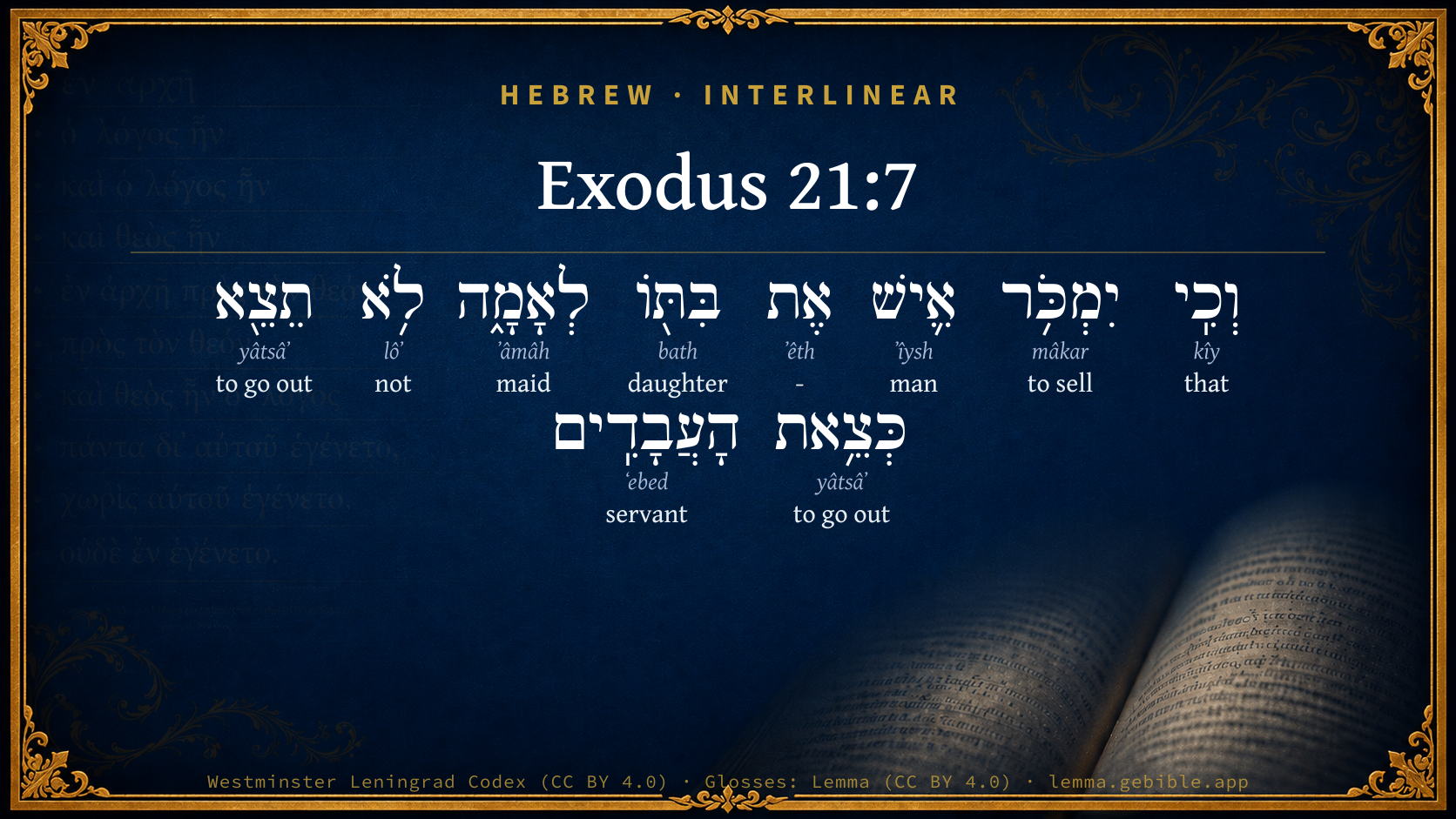
Exodus 21:7

Hebrew (Westminster Leningrad Codex) Exodus 21:7 appears in the Hebrew Old Testament. The text above is from the Westminster Leningrad Codex. Each word links to its Strong’s number, a concise gloss, and parsing drawn from the Open Scriptures Hebrew Bible morphology. Click any word for its full Brown-Driver-Briggs (BDB) entry.
Download image
Cite this verse

Exodus 21:7 (World English Bible). Public Domain. Lemma interlinear Bible study tool, https://lemma.gebible.app/v/exodus/21/7.

Show BibTeX & RIS
BibTeX
RIS
English Translation
"If a man sells his daughter to be a maid-servant, she shall not go out as the men-servants do.
World English Bible · Public Domain
Download a study sheet

One document with this verse’s original text, its word-by-word gloss line, the meaning frame, cross-references with their text, attributed commentary, and full source and license credits — printable, and it pastes into notes with its structure intact.

This verse Autodidact and up

Study sheet (.html) Plain text (.txt)

A passage Seminary Student

Up to 50 verses in one chapter. A passage sheet keeps up to 6 commentary sources and 12 cross-references per verse, in the order this page ranks them, and says so on the sheet whenever that leaves anything out. Ask for a single verse and you get the Autodidact verse sheet above.

Everything on this page stays free to read, with no account — the sheet is a download of what is already on screen, not access to it.

Want to remove ads? Support Godless Engineer
Compare translations 3

The same verse in 3 English versions, stacked beneath the original-language interlinear above. Click any original word for its lexicon entry.

Each is an independent rendering of the whole verse — the interlinear is not word-aligned to these translations.

Highlighted words mark where these versions differ — a whole-verse word diff, not a word-by-word alignment.

  • World English Bible Public Domain
    "If a man sells his daughter to be a maid-servant, she shall not go out as the men-servants do.
  • King James Version Public Domain
    And if a man sell his daughter to be a maidservant, she shall not go out as the menservants do.
  • unfoldingWord Literal Text CC BY-SA 4.0
    And if a man sells his daughter as a female servant, she shall not go out as the male servants go out.

unfoldingWord Literal Text — © unfoldingWord, licensed CC BY-SA 4.0. Word-aligned USFM3 via Door43 (git.door43.org/unfoldingWord/en_ult).

Versions to compare (up to 4)

3 of 4 selected

Show all 18 translations

Every available English version of this verse, each an independent rendering of the whole verse.

  • World English Bible Public Domain
    "If a man sells his daughter to be a maid-servant, she shall not go out as the men-servants do.
  • Berean Standard Bible Public Domain
    And if a man sells his daughter as a servant, she is not to go free as the menservants do.
  • Majority Standard Bible Public Domain
    And if a man sells his daughter as a servant, she is not to go free as the menservants do.
  • King James Version Public Domain
    And if a man sell his daughter to be a maidservant, she shall not go out as the menservants do.
  • American Standard Version (1901) Public Domain
    And if a man sell his daughter to be a maid-servant, she shall not go out as the men-servants do.
  • Revised Version (1885) Public Domain
    And if a man sell his daughter to be a maidservant, she shall not go out as the menservants do.
  • Geneva Bible (1599) Public Domain
    Likewise if a man sell his daughter to be a seruant, she shall not goe out as the men seruantes doe.
  • Douay-Rheims (1899) Public Domain
    If any man sell his daughter to be a servant, she shall not go out as bondwomen are wont to go out.
  • Young's Literal Translation Public Domain
    `And when a man selleth his daughter for a handmaid, she doth not go out according to the going out of the men-servants;
  • Literal Standard Version CC BY-SA 4.0
    And when a man sells his daughter for a handmaid, she does not go out according to the going out of the menservants;
  • Unlocked Literal Bible CC BY-SA 4.0
    If a man sells his daughter as a female servant, she must not go free as the male servants do.
  • unfoldingWord Literal Text CC BY-SA 4.0
    And if a man sells his daughter as a female servant, she shall not go out as the male servants go out.
  • Darby Bible Public Domain
    And if a man shall sell his daughter as a handmaid, she shall not go out as the bondmen go out.
  • World Messianic Bible Public Domain
    “If a man sells his daughter to be a female servant, she shall not go out as the male servants do.
  • Webster's Bible Public Domain
    And if a man shall sell his daughter to be a maid-servant, she shall not depart as the men-servants do.
  • Free Bible Version CC BY-SA 4.0
    If a man sells his daughter as a slave, she is not to be freed in the same way as male slaves.
  • Bible in Basic English Public Domain
    And if a man gives his daughter for a price to be a servant, she is not to go away free as the men-servants do.
  • JPS Tanakh (1917) Public Domain
    And if a man sell his daughter to be a maid-servant, she shall not go out as the men-servants do.

Literal Standard Version (2020), Covenant Press — licensed CC BY-SA 4.0. Text via the HelloAO Bible API (eBible.org). Unlocked Literal Bible (unfoldingWord) — licensed CC BY-SA 4.0. Text via the HelloAO Bible API (eBible.org). unfoldingWord Literal Text — © unfoldingWord, licensed CC BY-SA 4.0. Word-aligned USFM3 via Door43 (git.door43.org/unfoldingWord/en_ult). Free Bible Version, Dr. Jonathan Gallagher — licensed CC BY-SA 4.0. Text via the HelloAO Bible API (eBible.org).

Word by word

More ways to search: Search by grammar → Find every occurrence → Compare this word →

Practice this passage: Drill this verse → Learn its vocabulary →

לְאָמָ֑ה
ʼâmâh
H519
“to/for · maid”
Preposition + Noun, Common, Feminine, Singular, Absolute
Part of Speech
Preposition + Noun
Type
Common
Gender
Feminine
Number
Singular
State
Absolute
Full BDB Definition

Origin: apparently a primitive word

TWOT: 112

maid-servant, female slave, maid, handmaid, concubine - of humility (figuratively)
  1. וְכִֽי kîy H3588 “and · that” Conjunction + Conjunction
  2. יִמְכֹּ֥ר mâkar H4376 “to sell” Verb, Qal, Imperfect, 3rd Person, Masculine, Singular
  3. אִ֛ישׁ ʼîysh H376 “man” Noun, Common, Masculine, Singular, Absolute
  4. אֶת ʼêth H853 “-” Particle, Direct Object
  5. בִּתּ֖וֹ bath H1323 “daughter · his” Noun, Common, Feminine, Singular, Construct + Suffix, Personal, 3rd Person, Masculine, Singular
  6. לֹ֥א lôʼ H3808 “not” Particle, Negative
  7. תֵצֵ֖א yâtsâʼ H3318 “to go out” Verb, Qal, Imperfect, 3rd Person, Feminine, Singular
  8. כְּצֵ֥את yâtsâʼ H3318 “like/as · to go out” Preposition + Verb, Qal, Infinitive Construct
  9. הָעֲבָדִֽים ʻebed H5650 “the · servants” Particle, Definite Article + Noun, Common, Masculine, Plural, Absolute

About this verse

These counts appear in no published source. They are computed here, from the morphology-tagged text and Lemma’s own curated glosses. What Lemma adds →

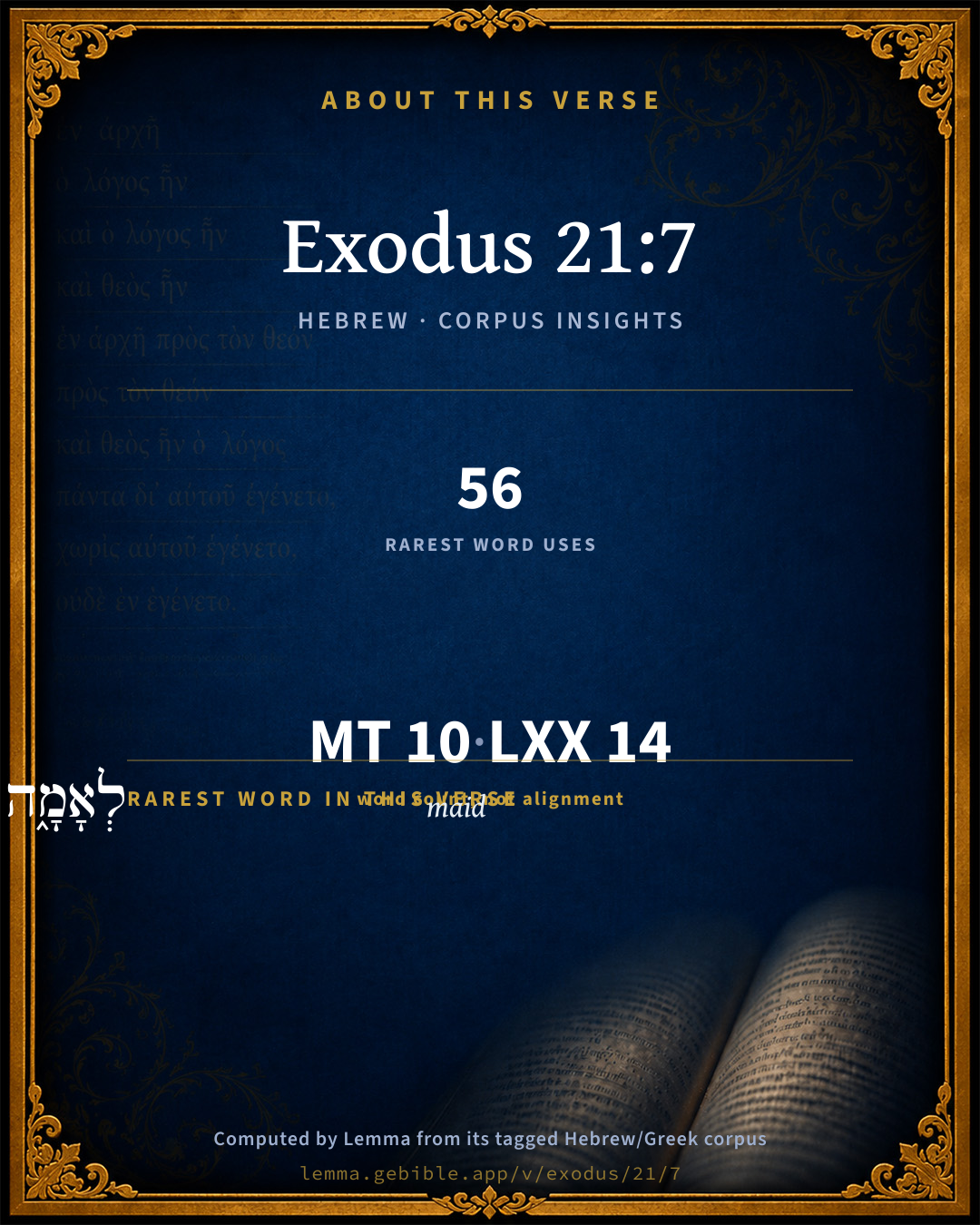
10
words
9
distinct lemmas
Pentateuch
section

Shared distinctive vocabulary

לְאָמָ֑ה maid H519 occurs in 49 verses of the Hebrew Bible. Also found in:

Grammatical profile

  • 3 verbs
  • 4 nouns
  • 1 conjunction
  • 2 particles

Verb forms

  • יִמְכֹּ֥ר Qal · Imperfect
  • תֵצֵ֖א Qal · Imperfect
  • כְּצֵ֥את Qal · Infinitive Construct

Repetition

A word recurs within this verse — often emphatic in Hebrew:

  • תֵצֵ֖א to go out H3318 ×2

Hebrew & Septuagint length

In English translation the verse runs 19 words from the Hebrew and 18 from the Septuagint (LXX English) — closely comparable.

A rough comparison of the two English renderings, which tokenize alike — not a word-level alignment.

Word counts can differ between the Hebrew and the Greek without any difference in meaning — e.g. the Hebrew direct-object marker אֵת has no separate Greek word, and Greek often adds the article ὁ.

In the original languages it is 10 Hebrew tokens and 14 Greek tokens — but the two are counted differently (Hebrew bundles its prefixes and suffixes into one token; the Greek is in lemma form), so that isn’t a like-for-like length.

Cross-references

2

Topical passages linked to Exodus 21:7 in the Treasury of Scripture Knowledge — connected by theme and wording, ordered by reader-vote popularity; previews shown in the World English Bible.

  • Nehemiah 5:5 Yet now our flesh is as the flesh of our brothers, our children as their children: and, behold, we bring into bondage our sons and our daughters to be servants, and some of our daughters are brought into bondage [already]: neither is it in our power to help it; for other men have our fields and our vineyards.
  • Exodus 21:2–3 If you buy a Hebrew servant, he shall serve six years and in the seventh he shall go out free without paying anything.

Cross-references courtesy of OpenBible.info (CC BY 4.0).

Hebrew and Greek witnesses Masoretic Hebrew ↔ Greek Septuagint

The same verse in the two great witnesses to the Old Testament, shown verse-for-verse.

These are two independent witnesses, not word-aligned to each other, and the Septuagint is shown in lemma (dictionary) form.

Hebrew Exodus 21:7 Masoretic · Westminster Leningrad Codex

וְכִֽי יִמְכֹּ֥ר אִ֛ישׁ אֶת בִּתּ֖וֹ לְאָמָ֑ה לֹ֥א תֵצֵ֖א כְּצֵ֥את הָעֲבָדִֽים

"If a man sells his daughter to be a maid-servant, she shall not go out as the men-servants do.

World English Bible · Public Domain

Greek LXX Exodus 21:7 Septuagint · lemma form

ἐάν δέ τις ἀποδίδωμι ὁ ἑαυτοῦ θυγάτηρ οἰκέτις οὐ ἀποἔρχομαι ὥσπερ ἀποτρέχω ὁ δούλη

And if any one sell his daughter as a domestic, she shall not depart as the maidservants depart.

LXX2012 (modern English Septuagint) · Public Domain

Hebrew: Westminster Leningrad Codex (CC BY 4.0). Greek: Septuagint (public domain); English from LXX2012 (modern English Septuagint) (Public Domain). How the Septuagint differs from the Hebrew →

Targum (Aramaic paraphrase)

2

The Targum is the ancient Jewish Aramaic paraphrase of the Hebrew Scriptures — an interpretive translation, not the Hebrew text itself. Onkelos (literal) and Pseudo-Jonathan (expansive) render the Torah, and Jonathan the Prophets. Coverage is partial: where no permissively-licensed English translation exists for a verse, only the Aramaic is shown. This is verse-level text, not a word-by-word alignment to the Hebrew.

  1. Targum Onkelos Torah (Genesis–Deuteronomy)
    וַאֲרֵי יְזַבֵּן גְבַר יָת בְּרַתֵּהּ לְאַמְהוּ לָא תִפּוֹק כְּמַפְקָנוּת עַבְדַיָא:

    (no public-domain English translation for this verse)

    Targum Onkelos — Aramaic: “Onkelos Genesis” (public domain); “Onkelos Exodus” (public domain); “Onkelos Leviticus” (public domain); “Onkelos Numbers” (public domain); “Onkelos Deuteronomy” (public domain). English: “Sefaria Community Translation” (CC0 1.0 (public-domain dedication)); “J.W. Etheridge. The Targums of Onkelos and Jonathan Ben Uzziel on the Pentateuch. London: Longmans, Green, 1862” (public domain). Text via Sefaria.

  2. Targum Pseudo-Jonathan Torah (Genesis–Deuteronomy)
    וַאֲרוּם יִזְבּוֹן גְּבַר בַּר יִשְרָאֵל יַת בְּרַתֵּיהּ זְעֵירְתָּא לְאַמְהוּ לָא תִיפּוֹק כְּמַפְקָנוּת עַבְדַיָא כְּנַעֲנָאֵי דְּמִשְׁתַּחְרְרִין בְּשִׁינָא וְעֵינָא אֱלָהֵן בִּשְׁנִין דִּשְׁמִיטָתָא וּבְסִימָנַיָא וּבְיוּבְלָא וּבְמוֹתַת רִבּוֹנָהָא וּפוּרְעַן כַּסְפָּא

    And if a man of Israel sell his daughter, a little handmaid, she shall not go forth according to the going forth of the servants of the Kenaanaee, who are set at liberty on account of the tooth or the eye; but in the years of remission, and with tokens, and at the jubela, and on the death of her master, and by redemption with money.

    Targum Pseudo-Jonathan — Aramaic: “Targum Jonathan on Genesis” (public domain); “Targum Jonathan on Exodus” (public domain); “Targum Jonathan on Leviticus” (public domain); “Targum Jonathan on Numbers” (public domain); “Targum Jonathan on Deuteronomy” (public domain). English: “The Targum of Jonathan ben Uzziel, trans. J. W. Etheridge, London, 1862” (public domain). Text via Sefaria.

Commentary

Notes on Exodus 21:7 from classic Christian and Jewish commentators (each source and its license shown beneath its notes). The classic Christian expositions comment on the surrounding passage and are grouped to its opening verse, so a note may address several verses; the Jewish commentaries on the Tanakh (Rashi and others) are per-verse, so they appear only where the commentator wrote on this verse.

Lemma curates 59 commentaries, every one of them public domain or Creative Commons licensed, each selected and text-cleaned for this edition rather than reprinted as found. About our sources →

Jamieson, Fausset & Brown

Robert Jamieson, A. R. Fausset & David Brown

LAWS FOR MAIDSERVANTS. (Exo. 21:7-36)

if a man sell his daughter--Hebrew girls might be redeemed for a reasonable sum. But in the event of her parents or friends being unable to pay the redemption money, her owner was not at liberty to sell her elsewhere. Should she have been betrothed to him or his son, and either change their minds, a maintenance must be provided for her suitable to her condition as his intended wife, or her freedom instantly granted.

Jamieson, Fausset & Brown — Commentary Critical and Explanatory on the Whole Bible (1871) — public domain (CC PDM 1.0). Text via the HelloAO Bible API.

Trapp's Complete Commentary

John Trapp

Exo 21:7 And if a man sell his daughter to be a maidservant, she shall not go out as the menservants do.

Ver. 7. She shall not go out.] But upon better terms. He that was to come "in the form of a servant," {Php 2:7} see what care he takes of poor servants’ welfare. Lawyers seldom speak but for great men, or when they may have great gifts. Christ is not of that humour.

John Trapp, A Commentary or Exposition upon All the Books of the Old and New Testament (1647–1656) — public domain. Text from a community e-Sword module.

The Biblical Illustrator

Joseph S. Exell

Exo_21:7-11

If a man sell his daughter to be a maidservant.

Degraded condition of girls in Africa

The condition of girls in Africa is thus described by a missionary: A father looks upon his girl as being of the value only of so many goats, and he is ready to sell her as soon as any man offers him the required payment. Thus, while she is quite young--perhaps only four or five--her life and liberty may have been sold away by her own father, and sooner or later she must become the wife, the slave, the drudge of her owner. While at Mayumba, near the mouth of the Congo river, I one afternoon heard a child screaming frantically behind the house where I was staying, and going out I found a little Bavilla girl, not more than four years old, who had just been brought down the lagoon from her home away in the Mamba hills, where she had been bought by a Mayumba man. The crew of the canoe in which she had been brought down--six big, fierce-looking men--were standing around the little prisoner, pointing their guns and spears at her just for the sport of seeing her shake and scream with fright; and a band of women were dancing with wild delight at the heartless game. It was possible to save the poor child from the cruel treatment just then, but that was only the beginning of a lifetime of suffering for her in the midst of a strange people, with no friend at hand to help or protect her.

The Biblical Illustrator, edited by Joseph S. Exell (c. 1880s–1900s) — public domain. Text from a community e-Sword module.

Joseph Benson's Commentary

Exo 21:7. If a man sell his daughter — A Hebrew, as appears by the opposition of one of a strange nation, Exo 21:8. To be a maid-servant — Which was allowed in cases of extreme necessity; she shall not go out as the men-servants do — Gaining her liberty after a servitude of six years, but upon better terms, as being one of the weaker and more helpless sex.

Joseph Benson's Commentary on the Old and New Testaments (1811–1818) — public domain. Text from a community e-Sword module.

The Preacher's Complete Homiletical Commentary

Joseph S. Exell (gen. ed.)

CRITICAL NOTES.—

Exo_21:7. Not as the men-servants] From Deu_15:17, ‘Kalisch infers that in this place foreign female servants are intended, whereas in that place Hebrew domestics are meant, by which supposition the seeming contradiction is removed.

MAIN HOMILETICS OF THE PARAGRAPH.—Exo_21:7-11

THE RIGHTS OF THE FEMALE SLAVE

This passage is somewhat obscure, and in its interpretation we find comparatively little help from the Commentators. It treats of that state of concubinage which was assumed and provided for by the law of Moses. “The natural desire of offspring was, in the Jew, consecrated into a religious hope, which tended to redeem concubinage from the debasement into which the grosser motives for its adoption might have brought it.”

I. The Israelitish daughter as servant and concubine. On account of poverty the Israelite sold his daughter, not merely as a slave, but with the hope that ultimately she would become the wife of her master, or of his son. In this respect she is not to be treated as a male slave. She is not to be sent out in the seventh year, but remain as one of the members of the family. Practically she has become a concubine, and if her rights are respected, it is far better for her to remain in the house of her master, than to go out free as did the manservant in the seventh year. “She shall not go out as the menservants do.” The master must not follow mere caprice. Lust must be checked. She has rights which must be respected.

II. Her rights when betrothed unto the master. He has no power to deal with her as he lists, even though she be evil in his eyes. “If she please not her master, then shall he let her be redeemed.” The father may redeem her by paying back either the whole or part of the purchase money. The master has no power to sell her unto a strange nation. “The Greek, too, did not sell a Greek slave to go beyond the boundary of the land” (Knobel). Her lot would be more severe in a strange land than in her own country. To sell her into a strange land would be to deal unjustly by her. This would be to increase the injustice, if. after having dealt deceitfully with her, he were to sell her unto a strange nation.

III. Her rights when betrothed unto the son. “And if he have betrothed her unto his son, he shall deal with her after the manner of daughters.” “As his son’s concubine, she is to be regarded by him as a daughter.” The servile merged in the connubial relation, and her children would be free.

IV. Her rights if displaced by another. “If he take him another wife, her food, her raiment, and her duty of marriage, shall he not diminish.” If the master take another wife for the son, then the concubine’s domestic rights must remain inviolate. She must have her proper food, her fitting raiment, and her recognised seat and resting-place in the house as a lawful concubine.

V. The concubine’s remedy if her rights are not regarded. “And if he do not these three unto her, then shall she go out free without money.” She becomes a free woman, and the master can get no compensation. Learn that the weakest have rights which must be regarded—and that masters must conduct themselves so as to promote the welfare of the community and the consolidation of the nation.—W. Burrows, B.A.

SUGGESTIVE COMMENTS ON THE VERSES

Exo_21:7-11. It is a great hardness of heart to sell children for the advantage of men to unnatural fathers.

God’s special judgments take care for daughters as the weaker sex, before men. God will not have any to make merchandise of the children of the Church.

Man’s deceitfulness occasions God’s faithfulness to provide for His oppressed children.

God’s judgments determine all relations justly to be used, servants as servants, children as children.

God’s justice appears in legal freedom, and His goodness to the Gospel freedom under Christ our head.

ILLUSTRATIONS

BY

REV. WILLIAM ADAMSON

Slave-Service! Exo_21:7. Swinnock says that civil subjection to man came in by sinful defection from God. The word “servant” is thought to be derived from a servando, because those who were taken in battle and might have been slain were saved (2Ki_5:2). As servitude came in with a curse (Gen_9:25), so sovereignty is promised as a blessing (Gen_27:9). It was usual for the debtor to become servant to the creditor amongst the Romans, by the law of the Twelve Tables. The French were wont also to sell themselves to noblemen for debt; and the Jews were not ignorant of this practice (2Ki_4:1). Titus Sempronius would sell his aged and weak servants as cattle. Cato Pollio commanded one of his servants to be thrown into his fishponds for breaking a glass which he valued highly, though he had an abundant stock of them. When Augustus Cæsar heard of it, he entered the place where the glasses were, and broke them all.

“Why didst thou this? Man! was he not thy brother?

Bone of thy bone, and flesh and blood of thine?

But ah, this truth, by Heaven and reason taught,

Was neverfully credited on earth.”

—Pollok.

The Preacher's Complete Homiletical Commentary (gen. ed. Joseph S. Exell; Funk & Wagnalls, c. 1892) — public domain (pre-1929). A full-Bible homiletical/sermon-outline anthology covering 65 of 66 books (2 John is absent from the source module). Text from a community e-Sword module.

Tyndale Open Study Notes

Tyndale Open Resources

21:7-9 A female slave was treated differently from a male, possibly because it was understood that she was sold to become a concubine. For such a woman to be released after seven years would not be just. She would either have to return to her father (who clearly did not want her, having previously sold her), marry (an unlikely prospect for a former concubine), or become a prostitute. Thus, it was best for her to remain in the home of her master. Presumably, if a man bought a girl to be his son’s wife (21:9), it was understood that the purchase price was not actually buying her but was the equivalent of a bride-price. Typically, a young man wishing to marry a girl had to give her father a gift of some sort, either money or a gift in kind (see 22:16; Gen 24:53). A woman for whom a bride-price had been paid was not a slave.

Tyndale Open Study Notes — © Tyndale Open Resources, licensed CC BY-SA 4.0. Text via the HelloAO Bible API.

Geneva Bible (1599)

Geneva Bible translators

Constrained either by poverty, or else to the intent that the master should marry her.

Geneva Bible (1599) marginal notes — public domain. Text via Bolls.life.

Adam Clarke's Commentary

Verse 7. If a man sell his daughter] This the Jews allowed no man to do but in extreme distress - when he had no goods, either movable or immovable left, even to the clothes on his back; and he had this permission only while she was unmarriageable. It may appear at first view strange that such a law should have been given; but let it be remembered, that this servitude could extend, at the utmost, only to six years; and that it was nearly the same as in some cases of apprenticeship among us, where the parents bind the child for seven years, and have from the master so much per week during that period.

Adam Clarke's Commentary on the Bible (1810–1826) — public domain. Text from a community e-Sword/MySword module.

Ellicott's Commentary for English Readers

(7) If a man sell his daughter to be a maidservant.—The right of selling their children into slavery was regarded in ancient times as inherent in the patria potestas, and was practised largely by many nations (Herod. v. 6; Heyne, Opusc., vol. iv., p. 125). Among the Hebrews such sales were, comparatively speaking, rare; but still they occasionally took place, in consequence of extreme poverty (Neh_5:5). Women sold in this way might claim their freedom at the end of six years if they chose (Deu_15:17); but if purchased to be wives, they received a further protection. If the intention were carried out, they were to be entitled to the status of wives during their whole lifetime, even though their husbands contracted further marriages (Exo_21:10). If, instead of becoming the wife of her purchaser, a woman was made over by him to his son, she was to enjoy all the rights of a daughter (Exo_21:9). If the purchaser declined to act in either of these two ways, he was compelled to take one of two other courses. Either he must get another Hebrew to discharge his obligation of marriage (Exo_21:8), or he must return the maid intact to her father, without making any demand for the restitution of the purchase-money (Exo_21:11). These provisions afforded a considerable protection to the slave-concubine, who might otherwise have been liable to grievous wrong and oppression.

A Bible Commentary for English Readers, edited by Charles John Ellicott (1878–1897) — public domain. Text from a community e-Sword module.

The Cambridge Bible for Schools and Colleges

gen. ed. J. J. S. Perowne

7. if a man sell his daughter] as he easily might do, either from actual poverty, or because he was in such circumstances that it would be more advantageous for his daughter to be the concubine of a well-to-do neighbour than to marry a man in her own social position.

maidservant] better, bondwoman (RVm.), or female slave: ‘maid-servant’ has associations which are not at all those of ancient Hebrew society. Here the word (’âmâh) denotes in particular a female slave bought not only to do household work, but also to be her master’s concubine. Cf. the same word in Gen_21:10 ff. (of Hagar), Jdg_9:18 (of Gideon’s concubine; see Exo_8:31), Exo_19:19.

as the male slaves do] v. 2.

7–11. Hebrew female slaves. The law for female slaves is different. A female slave does not receive her freedom at the end of six years (v. 7); still, she cannot be sold to a non-Israelite; and if her master, before actually taking her as his concubine, finds he does not like her she must be redeemed (v. 8). If her master has bought her for his son she must have the usual rights of a daughter (v. 9). If her master take another concubine, she is in no respect to be defrauded of her food, dress, and conjugal rights (v. 10): if these be withheld, her freedom must be given her unconditionally (v. 11). The reason for the different treatment of female slaves is to be found in the fact that a female slave was as a rule (v. 8) her master’s concubine; she stood consequently to her master in a relation which could not suitably be terminated at the end of six years. Concubinage was common among the ancient Hebrews (among the patriarchs, Gen_16:3; Gen_22:24; Gen_30:3; Gen_30:9; Gen_36:12; in the time of the Judges, Jdg_8:31; Jdg_9:18; Jdg_19:1 ff.; and among the early kings, 2Sa_3:7; 2Sa_5:13; 2Sa_15:16; 2Sa_21:11; 1Ki_11:3), as it was also among the Babylonians in the age of Ḥammurabi (Code, §§ 144–71[186]), and as it is still in Mohammedan countries (see e.g. Lane, Modern Egyptians, i. 122, 227, 232 f.).

[186] Cf. the interesting case attested by two contemporary contract-tablets (Pinches, OT. in the Light of Ass. and Bab. records and legends, p. 174 f.; Cook, Moses and Ḥamm. p. 113 f.): a man marries his wife’s sister, to become her waiting-maid.

The Cambridge Bible for Schools and Colleges (gen. ed. J. J. S. Perowne; Cambridge University Press, 1878–1918) — public domain. Text from a community e-Sword module.

John Gill's Exposition

And if a man sell his daughter to be a maidservant,.... That is, if an Israelite, as the Targum of Jonathan, sells his little daughter, as the same Targum, and so Jarchi and Aben Ezra, one that is under age, that is not arrived to the age of twelve years and a day, and this through poverty; he not being able to support himself and his family, puts his daughter out to service, or rather sells her to be a servant:

she shall not go out as the menservants do; that are sold, before described; or rather, according to the Targum,"as the Canaanitish servants go out, who are made free, because of a tooth, or an eye, (the loss of them, Exo 21:26) but in the years of release, and with the signs (of puberty), and in the jubilee, and at the death of their masters, with redemption of silver,''so Jarchi.

John Gill's Exposition of the Whole Bible (1746–1763) — public domain (CC PDM 1.0). Text via the HelloAO Bible API.

Albert Barnes' Notes on the Bible

A man might, in accordance with existing custom, sell his daughter to another man with a view to her becoming an inferior wife, or concubine. In this case, she was not “to go out,” like the bondman; that is, she was not to be dismissed at the end of the sixth year. But women who were bound in any other way, would appear to have been under the same conditions as bondmen. See Deu 15:17.

Albert Barnes' Notes on the Bible (1834–1885) — public domain. Text from a community e-Sword/MySword module.

Haydock's Catholic Bible Commentary

Go out, to work in the fields, according to Grotius; or rather, to enjoy her liberty. A father who sold his daughter, always expected that she should be the wife of the purchaser, or of his son. If this did not take place, she was free after six years, or before, if her master died. Constantine sanctioned the power of the Romans to sell their children. The Phrygians and Thebans had the like custom. (Calmet)

George Leo Haydock (1774–1849), Haydock's Catholic Family Bible and Commentary, 1859 edition — public domain. Excludes Psalms (Douay-Rheims chapter numbering differs from Protestant) and Deuterocanonical books (Catholic canon only).

Matthew Poole's English Annotations

A man, i.e. a Hebrew, as appears by the opposition of one of a strange nation, Exo 21:8.

For a man to

sell his daughter to be a maid-servant was allowed in case of extreme necessity, because of the hardness of their hearts.

She shall not go out as the men-servants do, but upon better terms, as being one of the weaker and more helpless sex.

Quest. How doth this agree with Deu 15:17,

Also unto thy maid-servant thou shalt do likewise?

Answ. 1. Distinguish persons. She, Deu 15:17 was sold by herself, and that to mere servitude; this here was sold by her father, not only for service, but in order to her marriage, as the following verses sufficiently imply.

2. Distinguish things. The likeness between men-servants and maid-servants was only in the rites used, in case she consented to perpetual servitude. The difference here is, in case they both were made free, in which case she had some privileges, which here follow.

Matthew Poole's English Annotations on the Holy Bible (1683–1685) — public domain. Text from a community e-Sword/MySword module.

Whedon's Commentary on the Bible

Daniel D. Whedon

7. Sell his daughter — This might occur because of extreme poverty and want. Neh_5:5. The verses following show that this kind of a sale was contemplated as essentially a betrothal; but they also serve to exhibit the inferior position in which women were held as compared with men. They might be sold by their parents for maidservants, and so take the place of concubines in the family of the purchaser. But this statute was attended by the following provisions: (1.) A maidservant, thus acquired, was not to obtain her freedom in the seventh year, like the men-servants of Exo_21:2. (2.) She could not be sold into a strange nation. (3.) She might be redeemed, either by her father, were he able, or by another Hebrew who desired her for a concubine. (4.) Her master might betroth her to his son, and in that case she was to be treated by him as a daughter. (5.) Her rights as a concubine were not to be changed by his taking another woman into the same relation. (6.) If her rights were withheld she was entitled to freedom. On the whole these laws, though far below the standard of Christian ethics, were mild and tolerant for the time.

Daniel D. Whedon (gen. ed.), Commentary on the Old and New Testaments (1874–1909) — public domain. Text from a community e-Sword module.

The Pulpit Commentary

If a man sell his daughter to be a maid-servant. Among ancient nations the father"s rights over his children were generally regarded as including the right to sell them for slaves. In civilised nations the right was seldom exercised; but what restrained men was rather a sentiment of pride than any doubt of such sales being proper. Many barbarous nations, like the Thracians (Heb_5:6), made a regular practice of selling their daughters. Even at Athens there was a time when sales of children had been common (Plut. Vit. Solon. Existing custom, it is clear, sanctioned such sales among the Hebrews, and what the law now did was to step in and mitigate the evil consequences. (Compare the comment on verse 2.) These were greatest in the case of females. Usually they were bought to be made the concubines, or secondary wives of their masters. If this intention were carried out, then they were to be entitled to their status and maintenance as wives during their lifetime, even though their husband took another (legitimate) wife (ver. 10). If the retention was not carried out, either the man was to marry her to one of his sons (ver. 9), or he was to sell his rights over her altogether with his obligations to another Hebrew; or he was to send her back at once intact to her father"s house, without making any claim on him to refund the purchase-money. These provisos may not have furnished a remedy against all the wrongs of a weak, and, no doubt, an oppressed class; but they were important mitigations of the existing usages, and protected the slave-concubine to a considerable extent.

The Pulpit Commentary (1880–1919), ed. H.D.M. Spence-Jones & Joseph S. Exell — public domain. Text from a community e-Sword module.

Keil & Delitzsch

C. F. Keil & F. Delitzsch

The daughter of an Israelite, who had been sold by her father as a maid-servant (לאמה), i.e., as the sequel shows, as a housekeeper and concubine, stood in a different relation to her master's house. She was not to go out like the men-servants, i.e., not to be sent away as free at the end of six years of service; but the three following regulations, which are introduced by אם (Exo 21:8), ואם (Exo 21:9), and ואם (Exo 21:11), were to be observed with regard to her. In the first place (Exo 21:8), "if she please not her master, who hath betrothed her to himself, then shall he let her be redeemed." The לא before יעדהּ is one of the fifteen cases in which לא has been marked in the Masoretic text as standing for לו; and it cannot possibly signify not in the passage before us. For if it were to be taken as a negative, "that he do not appoint her," sc., as a concubine for himself, the pronoun לו would certainly not be omitted. הפדּהּ (for הפדּהּ, see Ges. 53, Note 6), to let her be redeemed, i.e., to allow another Israelite to buy her as a concubine; for there can hardly have been any thought of redemption on the part of the father, as it would no doubt be poverty alone that caused him to sell his daughter (Lev 25:39). But "to sell her unto a strange nation (i.e., to any one but a Hebrew), he shall have no power, if he acts unfaithfully towards her," i.e., if he do not grant her the promised marriage. In the second place (Exo 21:9, Exo 21:10), "if he appoint her as his son's wife, he shall act towards her according to the rights of daughters," i.e., treat her as a daughter; "and if he take him (the son) another (wife), - whether because the son was no longer satisfied, or because the father gave the son another wife in addition to her - "her food (שׁאר flesh as the chief article of food, instead of לחם, bread, because the lawgiver had persons of property in his mind, who were in a position to keep concubines), her raiment, and her duty of marriage he shall not diminish," i.e., the claims which she had as a daughter for support, and as his son's wife for conjugal rights, were not to be neglected; he was not to allow his son, therefore, to put her away or treat her badly. With this explanation the difficulties connected with every other are avoided. For instance, if we refer the words of Exo 21:9 to the son, and understand them as meaning, "if the son should take another wife," we introduce a change of subject without anything to indicate it. If, on the other hand, we regard them as meaning, "if the father (the purchaser) should take to himself another wife," this ought to have come before Exo 21:9. In the third place (Exo 21:11), "if he do not (do not grant) these three unto her, she shall go out for nothing, without money." "These three" are food, clothing, and conjugal rights, which are mentioned just before; not "si eam non desponderit sibi nec filio, nec redimi sit passus" (Rabbins and others), nor "if he did not give her to his son as a concubine, but diminished her," as Knobel explains it.

Keil & Delitzsch — Biblical Commentary on the Old Testament (1861–1891) — public domain (CC PDM 1.0). Text via the HelloAO Bible API. (Old Testament only.)

unfoldingWord translationNotes

Door43 World Missions Community

has designated

"has chosen"

he must let her be bought back

This can be stated in active form. AT: "he must allow her father to buy her back" (See: Active or Passive)

has no right to sell

"has no authority to sell"

he has treated her deceitfully

"he has deceived her"

translationWords

alien

deceive

unfoldingWord translationNotes — © Distant Shores Media and the Door43 World Missions Community, licensed CC BY-SA 4.0. Source: git.door43.org/Door43/en_tn.

Rashi

Rabbi Shlomo Yitzchaki (Rashi)

וכי ימכר איש את בתו לאמה AND IF A MAN SELL HIS DAUGHTER TO BE A MAIDSERVANT — The text speaks of a minor daughter (under 12 years of age). You might think that he may sell her also although she may have shown signs of incipient puberty and is no longer a minor! You must admit, however, that the à fortiori argument applies: How is it in the case of a woman who was sold at an earlier age (as a minor)? She goes free on showing signs of incipient puberty, as it is said, (v. 11) “then shall she go out free without money”, which law we explain to refer to a woman who has showed such signs during the period of slavery! Is it not the conclusion that she who is of such an age and has not yet been sold shall not be sold at all?! (Arakhin 29b, cf. Mekhilta).

לא תצא כצאת העבדים SHE SHALL NOT GO OUT AS THE MENSERVANTS DO — i. e. not under the circumstances that the Canaanitish menservants’ departure takes place, for these go free in consequence of the loss of their tooth or eye inflicted by their master; this woman, however, shall not go free because of such loss of her tooth or eye, but shall serve either six years or until the Jubilee, or until she shows signs of incipient puberty. Whichsoever of these periods comes first brings her freedom first. — He (the master), however, has to pay her the value of her eye or the value of her tooth. — Or perhaps this is not so, but, “she shall not go out as the men-servants do,” means she shall not go free as the Hebrew menservants do, viz., at the end of six years or at the Jubilee? Scripture, however, states, (Deuteronomy 15:12) And if thy brother, an Hebrew man or an Hebrew woman be sold unto thee”, comparing the Hebrew woman with the Hebrew man in regard to all reasons for departure (i. e. also with regard to her going free in the Jubilee, for that she goes free in the seventh year is stated in the text just quoted). How is it in the case of a Hebrew man? He goes free at the end of six years and at the Jubilee! So, too, does the Hebrew woman go free at the end of six years and at the Jubilee. What then do these words mean: “she shall not go out as the menservants do”? They mean: she shall not go free in consequence of the loss of one of “the tips of her limbs” (i. e. the ends of limbs that project from the body) (cf. Mishnah Negaim 6:7) inflicted by the master, as the Canaanitish servants do when they that lose “the tips of their limbs” (Mekhilta; Kiddushin 20a). Incidentally I may add that you might think that the Hebrew manservant shall go free in consequence of loss of one of the tips of his limbs and that only the Hebrew maidservant differs in this respect from the Canaanitish servant, since Scripture expressly specified her in the words: she shall not go out free etc. Scripture, however, states “an Hebrew man or an Hebrew woman” thereby comparing the Hebrew man with the Hebrew woman. What is the case with the Hebrew woman? She does not go free in consequence of loss of one of “the tips of her limbs”! So, too, the Hebrew man does not go free as compensation for the injury inflicted on one of “the tips of his limbs” (cf. Mekhilta).

Rashi on the Tanakh — English translations: “The Judaica Press complete Tanach with Rashi, translated by A. J. Rosenberg” (CC BY 4.0); “Pentateuch with Rashi's commentary by M. Rosenbaum and A.M. Silbermann, 1929-1934” (public domain); “The Metsudah Tanach series, Lakewood, N.J” (CC BY 4.0); and “The Book of Joshua, Metsudah Publications, 1997” (CC BY 4.0). Text via Sefaria.

Ramban (Nachmanides)

Rabbi Moshe ben Nachman (Ramban / Nachmanides)

SHE SHALL NOT GO OUT AS THE MENSERVANTS DO. This means that the Hebrew maidservant does not go out free “in consequence of the loss of a tooth or an eye, as Canaanite slaves do.” Thus is Rashi’s language, and our Rabbis interpreted it likewise. Indeed it is so, for a Hebrew servant is not called eved [as in Verse 2 here: if thou buy an ‘eved ivri’ — a Hebrew servant] but never just eved, which term by itself signifies a Canaanite bondman. Here in Verse 7 where it just says ha’avadim (menservants) it must therefore refer to the Canaanite bondmen. For a similar statement of Ramban see also further Verse 20. without any further qualification.But I wonder: why does Scripture find it necessary altogether to tell us this [that a Hebrew maidservant does not go out free because of the loss of a tooth or eye, as Canaanite bondmen do]? Perhaps it is to tell us that we should not argue by applying the method of kal vachomer Note 208. — The kal vachomer in this case would be as follows: A Canaanite bondwoman who does not go out free at the end of six years or in the jubilee year, does go out free because of the loss of any of the chief external organs. It is therefore only logical that a Hebrew maidservant, who does go out free at the end of six years or in the jubilee, should surely go out free because of the loss of any chief external organs. from a Canaanite women, that a Hebrew maidservant goes out free because of the loss of a tooth or eye. This law is stated expressly in the case of a Hebrew woman, but such is also the law for a Hebrew man, who has been compared to her [thus he too does not go out free because of the loss of any of the chief external organs]. The author of the ‘Hilchoth Gedoloth,’ (613) Commandments, for in a preface to this work the author was the first scholar who attempted to define each separate commandment (see my foreword to “The Commandments,” Vol. I pp. viii — ix). wrote, however, that [the verse is not needed to exclude this kal vachomer, Note 208. — The kal vachomer in this case would be as follows: A Canaanite bondwoman who does not go out free at the end of six years or in the jubilee year, does go out free because of the loss of any of the chief external organs. It is therefore only logical that a Hebrew maidservant, who does go out free at the end of six years or in the jubilee, should surely go out free because of the loss of any chief external organs. for even if Scripture had not excluded it, we could not have argued that a Hebrew woman should go out free in consequence of the loss of a tooth or eye], because the going forth to freedom by slaves on account of the loss of a tooth or eye is a penalty [to the master], and you cannot derive a law by logical argument from penalties. The author of the ‘Hilchoth Gedoloth’ thus considered this verse a negative commandment wherein G-d warns the master that if he wants to send her out free because of the loss of a tooth or eye, that he transgresses a prohibition; but instead he is to pay her monetary compensation for the tooth or eye, and she shall stay with him up to the time [of six years, or before if she produces signs of puberty], to be designated as the master’s wife [or his son’s]. For it would be a great injustice if, after causing her the loss of a tooth in his anger and blemishing her thereby, he would then send her out of his house, when she had hoped to become his wife. Moreover, many times the monetary compensation for the damage done to the chief external organs, is more than the earnings for her labor if her days as a handmaid have nearly terminated. Therefore Scripture was strict upon the master and made a clear prohibition, so that he should not rob her of the monetary compensation due to her for the loss of any of her chief organs, even if he should want to let her go free on account of them. It may be that sending her to freedom is itself forbidden before the fixed time, for Scripture has obliged the master to support her and that she stay with him, in case she finds favor in his eyes and becomes his wife; just as He warned him with a prohibition that [after he marries her and takes another wife] her food, her raiment, and her conjugal rights shall he not diminish. In accordance with this opinion [the author of the ‘Hilchoth Gedoloth’] counted the verse, She shall not go out as the menservants do among the three hundred and sixty-five negative commandments.

Ramban (Nachmanides) on the Tanakh — English translation: “Commentary on the Torah by Ramban (Nachmanides). Translated and annotated by Charles B. Chavel. New York, Shilo Pub. House, 1971-1976” (CC BY 4.0). Text via Sefaria.

Lesson kit

Teaching starters — assembled from the data on this page, not authored interpretation. Every prompt links to the verse data it draws on. Edit before teaching.

Exodus, in the Pentateuch, opens this verse with 10 words (9 distinct Hebrew lemmas). Its most distinctive word is ʼâmâh (“maid”). A historical commentator’s framing appears above. Read the whole chapter for the surrounding context.

Discussion questions

  1. How does “maid” (ʼâmâh) shape what this verse is saying?
  2. Genesis 20:17 shares the word «maid» with this verse. How do the two illuminate each other?
  3. “to go out” occurs 2× in this one verse. What is the effect of the repetition?
  4. These translations render this verse differently; the difference is in the English rendering, not the original. What questions does that raise?
  5. The verb «יִמְכֹּ֥ר» is Qal Imperfect. How does its form color the action?
  6. Reading how Jamieson, Fausset & Brown and Trapp's Complete Commentary read this verse, where do the two commentators agree and where do they part?

Things to notice

Reading settings

Reading text

Shown beneath each verse's original-language words.

Old Testament
Old Testament edition

Read the OT as the Masoretic Hebrew (MT) or the Greek Septuagint (LXX).

English shown for the Greek Septuagint (in the Hebrew ↔ Greek comparison).

Comparing translations? Open the Compare panel on any verse page to stack up to four side by side.