Exodus 21:20

Hebrew (Westminster Leningrad Codex) Exodus 21:20 appears in the Hebrew Old Testament. The text above is from the Westminster Leningrad Codex. Each word links to its Strong’s number, a concise gloss, and parsing drawn from the Open Scriptures Hebrew Bible morphology. Click any word for its full Brown-Driver-Briggs (BDB) entry.
Download image
Cite this verse

Exodus 21:20 (World English Bible). Public Domain. Lemma interlinear Bible study tool, https://lemma.gebible.app/v/exodus/21/20.

Show BibTeX & RIS
BibTeX
RIS
English Translation
"If a man strikes his servant or his maid with a rod, and he dies under his hand, he shall surely be punished.
World English Bible · Public Domain
Download a study sheet

One document with this verse’s original text, its word-by-word gloss line, the meaning frame, cross-references with their text, attributed commentary, and full source and license credits — printable, and it pastes into notes with its structure intact.

This verse Autodidact and up

Study sheet (.html) Plain text (.txt)

A passage Seminary Student

Up to 50 verses in one chapter. A passage sheet keeps up to 6 commentary sources and 12 cross-references per verse, in the order this page ranks them, and says so on the sheet whenever that leaves anything out. Ask for a single verse and you get the Autodidact verse sheet above.

Everything on this page stays free to read, with no account — the sheet is a download of what is already on screen, not access to it.

Want to remove ads? Support Godless Engineer
Compare translations 3

The same verse in 3 English versions, stacked beneath the original-language interlinear above. Click any original word for its lexicon entry.

Each is an independent rendering of the whole verse — the interlinear is not word-aligned to these translations.

Highlighted words mark where these versions differ — a whole-verse word diff, not a word-by-word alignment.

  • World English Bible Public Domain
    "If a man strikes his servant or his maid with a rod, and he dies under his hand, he shall surely be punished.
  • King James Version Public Domain
    And if a man smite his servant, or his maid, with a rod, and he die under his hand; he shall be surely punished.
  • unfoldingWord Literal Text CC BY-SA 4.0
    And if a man hits his male servant or his female servant with a staff and he dies under his hand, he shall certainly be avenged.

unfoldingWord Literal Text — © unfoldingWord, licensed CC BY-SA 4.0. Word-aligned USFM3 via Door43 (git.door43.org/unfoldingWord/en_ult).

Versions to compare (up to 4)

3 of 4 selected

Show all 18 translations

Every available English version of this verse, each an independent rendering of the whole verse.

  • World English Bible Public Domain
    "If a man strikes his servant or his maid with a rod, and he dies under his hand, he shall surely be punished.
  • Berean Standard Bible Public Domain
    If a man strikes his manservant or maidservant with a rod, and the servant dies by his hand, he shall surely be punished.
  • Majority Standard Bible Public Domain
    If a man strikes his manservant or maidservant with a rod, and the servant dies by his hand, he shall surely be punished.
  • King James Version Public Domain
    And if a man smite his servant, or his maid, with a rod, and he die under his hand; he shall be surely punished.
  • American Standard Version (1901) Public Domain
    And if a man smite his servant, or his maid, with a rod, and he die under his hand; he shall surely be punished.
  • Revised Version (1885) Public Domain
    And if a man smite his servant, or his maid, with a rod, and he die under his hand; he shall surely be punished.
  • Geneva Bible (1599) Public Domain
    And if a man smite his seruant, or his maide with a rod, and he die vnder his hande, he shalbe surely punished.
  • Douay-Rheims (1899) Public Domain
    He that striketh his bondman or bondwoman with a rod, and they die under his hands, shall be guilty of the crime.
  • Young's Literal Translation Public Domain
    `And when a man smiteth his man-servant or his handmaid, with a rod, and he hath died under his hand -- he is certainly avenged;
  • Literal Standard Version CC BY-SA 4.0
    And when a man strikes his manservant or his handmaid with a rod, and he has died under his hand—he is certainly avenged;
  • Unlocked Literal Bible CC BY-SA 4.0
    If a man hits his male servant or his female servant with a staff, and if the servant dies as a result of the blow, then that man must surely be punished.
  • unfoldingWord Literal Text CC BY-SA 4.0
    And if a man hits his male servant or his female servant with a staff and he dies under his hand, he shall certainly be avenged.
  • Darby Bible Public Domain
    And if a man strike his bondman or his handmaid with a staff, and he die under his hand, he shall certainly be avenged.
  • World Messianic Bible Public Domain
    “If a man strikes his servant or his maid with a rod, and he dies under his hand, the man shall surely be punished.
  • Webster's Bible Public Domain
    And if a man shall smite his servant, or his maid, with a rod, and he shall die under his hand; he shall be surely punished.
  • Free Bible Version CC BY-SA 4.0
    Anyone who hits their male or female slave with a rod, and the slave dies as a result, must be punished.
  • Bible in Basic English Public Domain
    If a man gives his man-servant or his woman-servant blows with a rod, causing death, he is certainly to undergo punishment.
  • JPS Tanakh (1917) Public Domain
    And if a man smite his bondman, or his bondwoman, with a rod, and he die under his hand, he shall surely be punished.

Literal Standard Version (2020), Covenant Press — licensed CC BY-SA 4.0. Text via the HelloAO Bible API (eBible.org). Unlocked Literal Bible (unfoldingWord) — licensed CC BY-SA 4.0. Text via the HelloAO Bible API (eBible.org). unfoldingWord Literal Text — © unfoldingWord, licensed CC BY-SA 4.0. Word-aligned USFM3 via Door43 (git.door43.org/unfoldingWord/en_ult). Free Bible Version, Dr. Jonathan Gallagher — licensed CC BY-SA 4.0. Text via the HelloAO Bible API (eBible.org).

Word by word

More ways to search: Search by grammar → Find every occurrence → Compare this word →

Practice this passage: Drill this verse → Learn its vocabulary →

נָקֹ֖ם
nâqam
H5358
“to avenge”
Verb, Qal, Infinitive Absolute
Part of Speech
Verb
Stem
Qal
Form
Infinitive Absolute
Full BDB Definition

Origin: a primitive root

TWOT: 1413

to avenge, take vengeance, revenge, avenge oneself, be avenged, be punished - (Qal) - to avenge, take vengeance - to entertain revengeful feelings - (Niphal) - to avenge oneself - to suffer vengeance - (Piel) to avenge - (Hophal) to be avenged, vengeance be taken (for blood) - (Hithpael) to avenge oneself
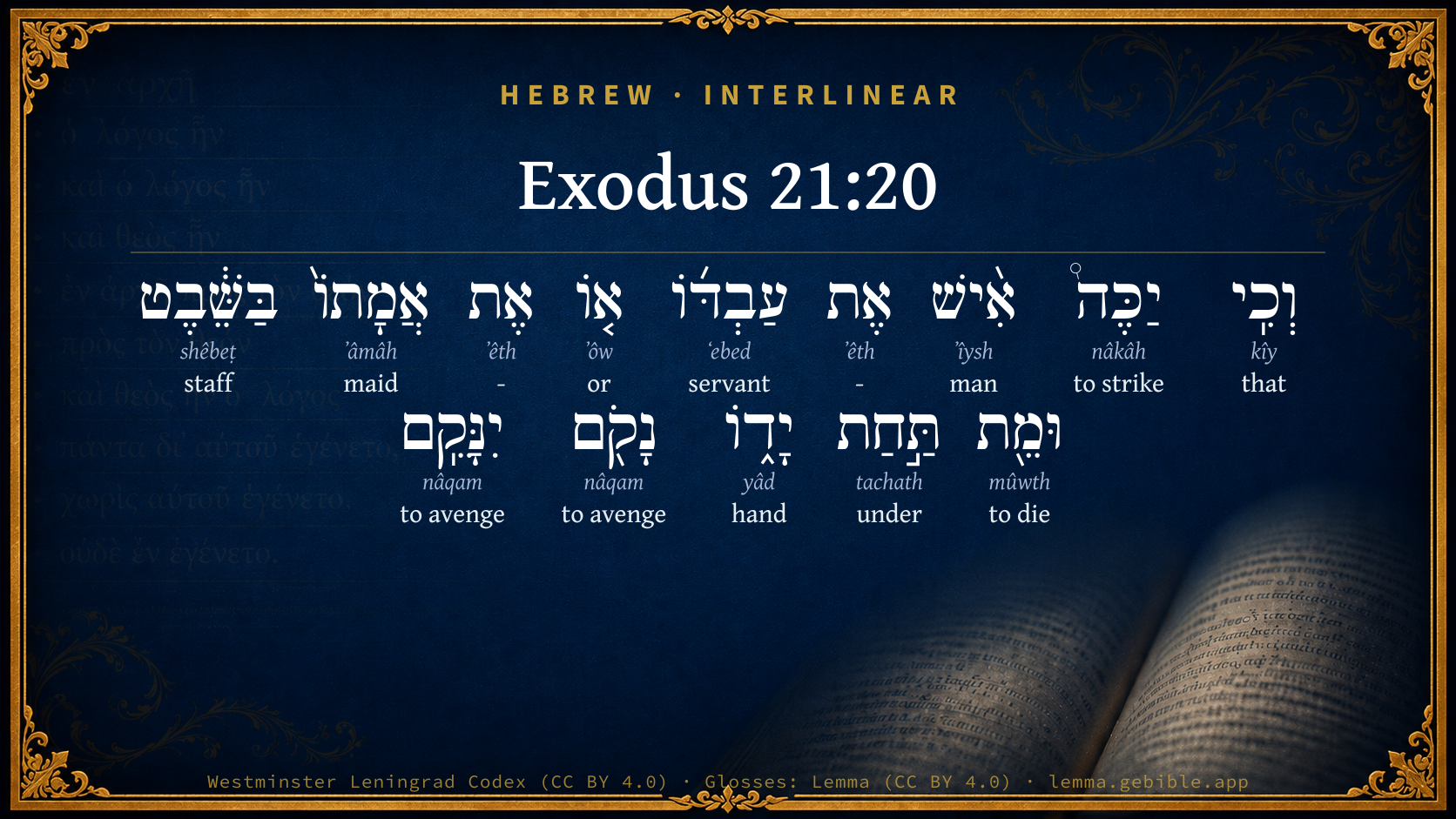
  1. וְכִֽי kîy H3588 “and · that” Conjunction + Conjunction
  2. יַכֶּה֩ nâkâh H5221 “to strike” Verb, Hiphil, Imperfect, 3rd Person, Masculine, Singular
  3. אִ֨ישׁ ʼîysh H376 “man” Noun, Common, Masculine, Singular, Absolute
  4. אֶת ʼêth H853 “-” Particle, Direct Object
  5. עַבְדּ֜וֹ ʻebed H5650 “servant · his” Noun, Common, Masculine, Singular, Construct + Suffix, Personal, 3rd Person, Masculine, Singular
  6. א֤וֹ ʼôw H176 “or” Conjunction
  7. אֶת ʼêth H853 “-” Particle, Direct Object
  8. אֲמָתוֹ֙ ʼâmâh H519 “maid · his” Noun, Common, Feminine, Singular, Construct + Suffix, Personal, 3rd Person, Masculine, Singular
  9. בַּשֵּׁ֔בֶט shêbeṭ H7626 “in/at the · staff” Preposition, Determined + Noun, Common, Masculine, Singular, Absolute
  10. וּמֵ֖ת mûwth H4191 “and · to die” Conjunction + Verb, Qal, Sequential Perfect, 3rd Person, Masculine, Singular
  11. תַּ֣חַת tachath H8478 “under” Preposition
  12. יָד֑וֹ yâd H3027 “hand · his” Noun, Common, Both, Singular, Construct + Suffix, Personal, 3rd Person, Masculine, Singular
  13. יִנָּקֵֽם nâqam H5358 “to avenge” Verb, Niphal, Imperfect, 3rd Person, Masculine, Singular

About this verse

These counts appear in no published source. They are computed here, from the morphology-tagged text and Lemma’s own curated glosses. What Lemma adds →

14
words
12
distinct lemmas
Pentateuch
section

Shared distinctive vocabulary

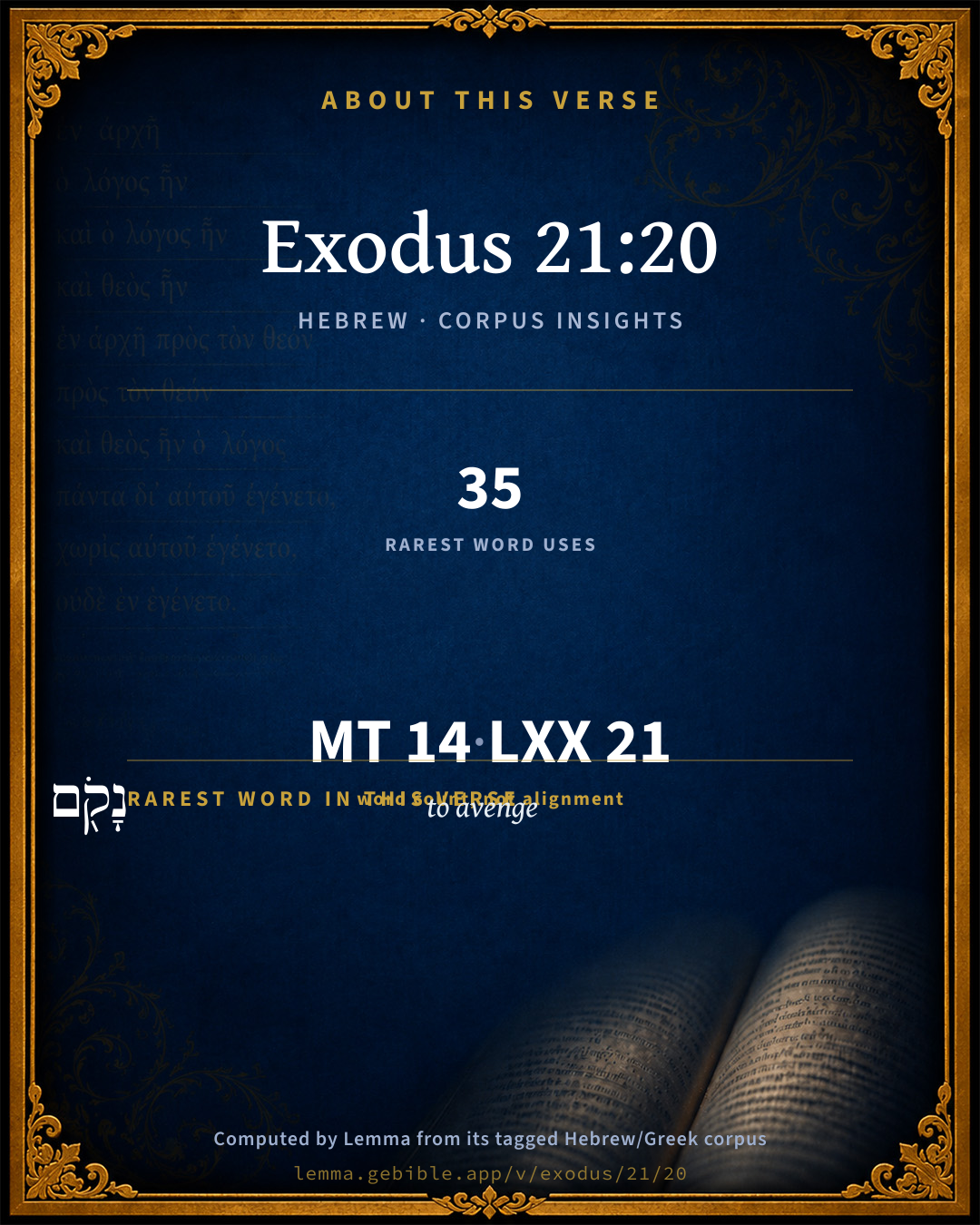
נָקֹ֖ם to avenge H5358 occurs in 31 verses of the Hebrew Bible. Also found in:

Grammatical profile

  • 4 verbs
  • 5 nouns
  • 1 preposition
  • 2 conjunctions
  • 2 particles

Verb forms

  • יַכֶּה֩ Hiphil · Imperfect
  • וּמֵ֖ת Qal · Sequential Perfect
  • נָקֹ֖ם Qal · Infinitive Absolute
  • יִנָּקֵֽם Niphal · Imperfect

Repetition

A word recurs within this verse — often emphatic in Hebrew:

  • נָקֹ֖ם to avenge H5358 ×2

Hebrew & Septuagint length

In English translation the verse runs 23 words from the Hebrew and 25 from the Septuagint (LXX English) — closely comparable.

A rough comparison of the two English renderings, which tokenize alike — not a word-level alignment.

Word counts can differ between the Hebrew and the Greek without any difference in meaning — e.g. the Hebrew direct-object marker אֵת has no separate Greek word, and Greek often adds the article ὁ.

In the original languages it is 14 Hebrew tokens and 21 Greek tokens — but the two are counted differently (Hebrew bundles its prefixes and suffixes into one token; the Greek is in lemma form), so that isn’t a like-for-like length.

Cross-references

10

Topical passages linked to Exodus 21:20 in the Treasury of Scripture Knowledge — connected by theme and wording, ordered by reader-vote popularity; previews shown in the World English Bible.

  • Deuteronomy 19:21 Your eyes shall not pity; life [shall go] for life, eye for eye, tooth for tooth, hand for hand, foot for foot.
  • Proverbs 29:19 A servant can't be corrected by words. Though he understands, yet he will not respond.
  • Genesis 4:15 Yahweh said to him, "Therefore whoever slays Cain, vengeance will be taken on him sevenfold." Yahweh appointed a sign for Cain, lest any finding him should strike him.
  • Genesis 4:24 If Cain will be avenged seven times, Truly Lamech seventy-seven times."
  • Genesis 9:6 Whoever sheds man's blood, by man will his blood be shed, for in the image of God made he man.
  • Exodus 21:26–27 "If a man strikes his servant's eye, or his maid's eye, and destroys it, he shall let him go free for his eye's sake.
  • Numbers 35:19 The avenger of blood shall himself put the murderer to death: when he meets him, he shall put him to death.
  • Numbers 35:30–33 Whoever kills any person, the murderer shall be slain at the mouth of witnesses: but one witness shall not testify against any person that he die.
  • Isaiah 58:3–4 Why have we fasted, [say they], and you don't see? [why] have we afflicted our soul, and you take no knowledge? Behold, in the day of your fast you find [your own] pleasure, and exact all your labors.
  • Romans 13:4 for he is a servant of God to you for good. But if you do that which is evil, be afraid, for he doesn't bear the sword in vain; for he is a minister of God, an avenger for wrath to him who does evil.

Cross-references courtesy of OpenBible.info (CC BY 4.0).

Hebrew and Greek witnesses Masoretic Hebrew ↔ Greek Septuagint

The same verse in the two great witnesses to the Old Testament, shown verse-for-verse.

These are two independent witnesses, not word-aligned to each other, and the Septuagint is shown in lemma (dictionary) form.

Hebrew Exodus 21:20 Masoretic · Westminster Leningrad Codex

וְכִֽי יַכֶּה֩ אִ֨ישׁ אֶת עַבְדּ֜וֹ א֤וֹ אֶת אֲמָתוֹ֙ בַּשֵּׁ֔בֶט וּמֵ֖ת תַּ֣חַת יָד֑וֹ נָקֹ֖ם יִנָּקֵֽם

"If a man strikes his servant or his maid with a rod, and he dies under his hand, he shall surely be punished.

World English Bible · Public Domain

Greek LXX Exodus 21:20 Septuagint · lemma form

ἐάν δέ τις πατάσσω ὁ παῖς αὐτός ἤ ὁ παιδίσκη αὐτός ἐν ῥάβδος καί ἀποθνήσκω ὑπό ὁ χείρ αὐτός δίκη ἐκδικέω

And if a man strike his man-servant or his maidservant, with a rod, and the party die under his hands, he shall be surely punished.

LXX2012 (modern English Septuagint) · Public Domain

Hebrew: Westminster Leningrad Codex (CC BY 4.0). Greek: Septuagint (public domain); English from LXX2012 (modern English Septuagint) (Public Domain). How the Septuagint differs from the Hebrew →

Targum (Aramaic paraphrase)

2

The Targum is the ancient Jewish Aramaic paraphrase of the Hebrew Scriptures — an interpretive translation, not the Hebrew text itself. Onkelos (literal) and Pseudo-Jonathan (expansive) render the Torah, and Jonathan the Prophets. Coverage is partial: where no permissively-licensed English translation exists for a verse, only the Aramaic is shown. This is verse-level text, not a word-by-word alignment to the Hebrew.

  1. Targum Onkelos Torah (Genesis–Deuteronomy)
    וַאֲרֵי יִמְחֵי גְבַר יָת עַבְדֵהּ אוֹ יָת אַמְתֵהּ בְּשָׁלְטָּן וִימוּת תְּחוֹת יְדֵהּ אִתְדָנָא יִתְּדָן:

    (no public-domain English translation for this verse)

    Targum Onkelos — Aramaic: “Onkelos Genesis” (public domain); “Onkelos Exodus” (public domain); “Onkelos Leviticus” (public domain); “Onkelos Numbers” (public domain); “Onkelos Deuteronomy” (public domain). English: “Sefaria Community Translation” (CC0 1.0 (public-domain dedication)); “J.W. Etheridge. The Targums of Onkelos and Jonathan Ben Uzziel on the Pentateuch. London: Longmans, Green, 1862” (public domain). Text via Sefaria.

  2. Targum Pseudo-Jonathan Torah (Genesis–Deuteronomy)
    וַאֲרוּם יִמְחֵי גְבַר יַת עַבְדֵיהּ כְּנַעֲנָאָה אוֹ יַת אַמְתֵיהּ כְּנַעֲנִיתָא בְּשַׁרְבִיטָא וִימוּת בְּהַהוּא יוֹמָא תְּחוֹת יְדֵיהּ יִתְדְּנָא יִתְדַן דִּין קְטִילַת סַיְיפָא

    And when a man hath smitten his Kenaanite man-servant or maid-servant with a staff, and he die the same day under his hand, he shall be judged with the judgment of death by the sword.

    Targum Pseudo-Jonathan — Aramaic: “Targum Jonathan on Genesis” (public domain); “Targum Jonathan on Exodus” (public domain); “Targum Jonathan on Leviticus” (public domain); “Targum Jonathan on Numbers” (public domain); “Targum Jonathan on Deuteronomy” (public domain). English: “The Targum of Jonathan ben Uzziel, trans. J. W. Etheridge, London, 1862” (public domain). Text via Sefaria.

Commentary

Notes on Exodus 21:20 from classic Christian and Jewish commentators (each source and its license shown beneath its notes). The classic Christian expositions comment on the surrounding passage and are grouped to its opening verse, so a note may address several verses; the Jewish commentaries on the Tanakh (Rashi and others) are per-verse, so they appear only where the commentator wrote on this verse.

Lemma curates 59 commentaries, every one of them public domain or Creative Commons licensed, each selected and text-cleaned for this edition rather than reprinted as found. About our sources →

Trapp's Complete Commentary

John Trapp

Exo 21:20 And if a man smite his servant, or his maid, with a rod, and he die under his hand; he shall be surely punished.

Ver. 20. He shall be surely punished.] At the discretion of the magistrate, who is the "revenger to execute wrath upon him that doeth evil." {Rom 13:4}

John Trapp, A Commentary or Exposition upon All the Books of the Old and New Testament (1647–1656) — public domain. Text from a community e-Sword module.

The Biblical Illustrator

Joseph S. Exell

Exo_21:20-21

If a man smite his servant.

Masters and servants

1. It is supposed that masters in the Church of God may be cruel in correcting servants, but it is sin.

2. It is possible that death may follow upon such cruel smiting.

3. In such case the life of the vilest slaves is precious with God, and He requireth it with death (Exo_21:20).

4. Correction due unto servants which endangers not life, is supposed lawful.

5. No governor is guilty by Gods law upon such due chastening.

6. Servants are the due purchase of their lords for their labours not for their lives.

7. The lives and comforts of poorest slaves are dear to God and secured by Him (Exo_21:21). (G. Hughes, B. D.)

The Biblical Illustrator, edited by Joseph S. Exell (c. 1880s–1900s) — public domain. Text from a community e-Sword module.

Joseph Benson's Commentary

Exo 21:20. With a rod — The usual instrument of correction, whereby is implied, that if he killed the person with a sword or any such weapon he was to be put to death; and he die under his hand — While the master is correcting him; he shall be punished — As the magistrate or judge shall think fit, according to the circumstances.

Joseph Benson's Commentary on the Old and New Testaments (1811–1818) — public domain. Text from a community e-Sword module.

Ellicott's Commentary for English Readers

(20) And if a man smite his servant.—The homicide hitherto considered has been that of freemen; but the Mosaic Law was not content to stop at this point. Unlike most other codes, it proceeded to forbid the homicide of slaves. Hitherto, throughout the East, and also in many parts of the West, slaves had been regarded as so absolutely their master’s property that he was entitled to do as he pleased with them. Now, for the first time—so far as we know—was the life of the slave protected. The exact extent of the protection is uncertain. According to the Talmud, the master who killed his slave was put to death; according to some modern Jews, as Kalisch, he had merely to pay a fine. In any case, the killing was an offence of which the law took cognisance. Later on it appears that even assaults on slaves, if they reached a certain intensity, were unlawful, and involved the slave’s compulsory emancipation (Exo_21:26-27).

With a rod.—The usual instrument of punishment. It would follow, as a matter of course, that if a more dangerous implement was used the master was punished with equal, or greater, severity.

A Bible Commentary for English Readers, edited by Charles John Ellicott (1878–1897) — public domain. Text from a community e-Sword module.

The Cambridge Bible for Schools and Colleges

gen. ed. J. J. S. Perowne

20. his servant, or his maid] i.e. (cf. marg.) his male or female slave.

a rod] The usual implement of punishment (Pro_10:13; Pro_13:24).

punished] lit. avenged; so v. 21. In what the punishment consisted, is not stated. The Jews (Mechilta, Ps.-Jon., &c.) understood death (viz. by the sword) to be intended: but in that case ‘he shall surely be put to death’ would certainly have been said, as in other cases (vv. 12, 15, 16, & c.); besides, vv. 21 (cf. 19 f.), 26 f. (cf. 23 ff.), 32 (cf. 28 ff.) shew that a marked difference was made between a slave and a free man. No doubt the determination of the penalty was left to the discretion of the judge (Di.), or it was a fine payable to the sanctuary (Bä.), the amount of which varied with the means of the slave’s master.

20, 21. Beating a slave so that he dies. Vv. 26 f., 32, also deal with injuries to slaves. The penalties prescribed shew that less was thought of the life of a slave than of that of a free man,—in v. 21 he is called simply his master’s ‘money’; at the same time he has rights, and cannot be treated with entire impunity. The position of slaves in Israel must thus have been considerably better than that of slaves in Rome, at least in the time of the Republic, when their masters could kill them with impunity (Dion. Halic. vii. 68, Plutarch, Cato 21,—cited by Kn.).

The Cambridge Bible for Schools and Colleges (gen. ed. J. J. S. Perowne; Cambridge University Press, 1878–1918) — public domain. Text from a community e-Sword module.

John Gill's Exposition

And if a man smite his servant or his maid with a rod,.... A Canaanitish servant or maid, as the Targum of Jonathan, and so Jarchi; and that only with a rod for the correction of them, and not with a sword or any such destroying weapon, which would seem as though he intended to kill, yet nevertheless:

and he die under his hand; immediately, while he is smiting or beating him or her, on the same day, as the above Targum interprets it:

he shall be surely punished; or condemned to the punishment of being slain with the sword, as the said Targum and Jarchi explain it: this law was made to deter masters from using severity and cruelty towards their servants.

John Gill's Exposition of the Whole Bible (1746–1763) — public domain (CC PDM 1.0). Text via the HelloAO Bible API.

Albert Barnes' Notes on the Bible

The Jewish authorities appear to be right in referring this law, like those in Exo 21:26-27, Exo 21:32, to foreign slaves (see Lev 25:44-46). The protection here afforded to the life of a slave may seem to us but a slight one; but it is the very earliest trace of such protection in legislation, and it stands in strong and favorable contrast with the old laws of Greece, Rome, and other nations. If the slave survived the castigation a day or two, the master did not become amenable to the law, because the loss of the slave was accounted, under the circumstances, as a punishment.

Albert Barnes' Notes on the Bible (1834–1885) — public domain. Text from a community e-Sword/MySword module.

Matthew Poole's English Annotations

His servant, namely, a stranger; for an Israelite was to be better used. See Lev 25:39,40, &c.

With a rod; a fit and usual instrument for correction, whereby it is implied, that if he killed him with a sword, or any such weapon, he was to die for it.

Under his hand, i.e. whilst the master is correcting him.

He shall be surely punished; not with death, for then it would have been said so, as it is before and after; but as the magistrate or judge shall think fit, according to the diversity of circumstances; and therefore no particular punishment is set down.

Matthew Poole's English Annotations on the Holy Bible (1683–1685) — public domain. Text from a community e-Sword/MySword module.

Whedon's Commentary on the Bible

Daniel D. Whedon

20. Smite his servant — Many writers assume that foreign bondservants, not Hebrew servants, are intended here; but the law itself does not so discriminate. The reason given in the next verse, namely, that the servant is his property, evidently led to a distinction in the punishment of this kind of manslaughter. It was assumed that no man would wilfully destroy his own property by killing his slave. It was considered a master’s right to chastise his servant, or his maid, with a rod, and if death resulted from the excessive severity of the punishment it would be accidental rather than intentional. In case death resulted the man was to be surely punished, but the measure of the penalty is not prescribed; that was doubtless to be left to the magistrates to determine.

Daniel D. Whedon (gen. ed.), Commentary on the Old and New Testaments (1874–1909) — public domain. Text from a community e-Sword module.

The Pulpit Commentary

Vers. 20, 21. Homicide of slaves. In most ancient states the slave was the absolute property of his master, and might be ill-used to any extent, even killed, without the law in any way interfering. It is said that the state of things was different in Egypt (Kalisch); but we have scarcely sufficient evidence on the point to be certain that the slave enjoyed there any real and efficient protection. At Athens, beyond a doubt, the law protected the life of the slave; and a very moderate amount of ill-treatment entitled a slave to bring an action. At Rome, on the contrary, "the master could treat the slave as he pleased, could sell him, punish him, and put him to death" (Dict. of Greek & Roman Antiq; . p. 1036). And this was the ordinary state of the law, particularly in Oriental countries. The Mosaic legislation must be regarded as having greatly ameliorated the condition of the native slave population. Hebrew bondmen it placed nearly upon a par with hired servants; (Lev_25:40) foreign slaves, whether prisoners taken in war, or persons bought in the market, it protected to a very great extent. By the law given in verses 26, 27, it largely controlled the brutality of masters, who had to emancipate their slaves if they did them any serious injury. By the law laid down in verse 20, it gave their lives the same protection, or nearly the same, as the lives of freemen. "Smiting "was allowed as a discipline, without which slavery cannot exist; but such smiting as resulted in death was, as a general rule, punishable like any other homicide. The only exception was, if the slave did not die for some days (ver. 21). In that case the master was considered not to have intended the slave"s death, and to be sufficiently punished by the loss of his property.

If a man smite his servant, or his maid. "Maids" would commonly be chastised by their mistress, or by an upper servant acting under the mistress"s authority. "A man" here means "any one." With a rod. The rods wherewith Egyptian slaves were chastised appear upon the monuments. They were long canes, like those used by our schoolmasters. Under his hand. Criminals in the East are said often to die under the bastinado; and even in our own country there have been cases of soldiers dying under the lash. A special delicacy of the nervous system will make a punishment of the kind fatal to some, which would have been easily borne by others.

The servant dying under chastisement.

This law has frequently been seized on as a blot on the Mosaic legislation as inculcating the odious doctrine which lies at the root of modernslave-systems, viz. that the slave is a mere "chattel," and as such, has no personal rights is entitled to no protection of life or limb. The interpretation put on this particular clause is the more unfair, that it must be admitted to be opposed to the spirit and enactments of the law as a whole, taking, as this does, so exceptionally humane a view of the slave"s position (see above); and is, moreover, directly in the teeth of such clauses as those in the immediate context a man smite the eye of a servant," etc. (vers. 26, 27). The enactment will appear in its right light if we view it with regard to the following considerations:

1. The law deals with slavery, not from the point of view of abstract right from which point of view it could only be condemned but as arecognised part of the then existing constitution of society. It takes its existence for granted. It deals with it as statesmen have constantly to deal with institutions and customs which they do not wholly approve of, but which they cannot summarily abolish without entailing on society worse evils than those from which escape is sought. But if the right to hold property in slaves to however limited an extent be granted, the corollaries of this possession must be granted also. A slave cannot be treated in the eye of the law quite as a free man. His position is relatively a degraded one. The owner of slaves has pecuniary and proprietary rights in his bondservants, which the law must take account of. The slave is the owner"s "money.

1. The aim of the law is not to place the slave at the master"s mercy, but to restrict the master"s power over him. Ancient law recognised no restriction. The Mosaic law does. It goes at least thus far, that if the slave dies under the rod, the master shall be punished. The drift and bent of the law is for the slave"s benefit.

2. It is important to remember that the case is treated here, not in its moral aspects, but solely as a question in criminal jurisprudence. The moral law has its own say in the matter, and. pronounces its own judgment, irrespectively of whether the individual is proceeded against under criminal law or not. The master who, by the undue exercise of the large right of chastisement which the usage of the time allowed him, occasioned his slave"s death, was responsible to God for the excess of passion which led to this catastrophe. The law of Moses gave no sanction to the master to endanger his servant"s life with the rod. But moral offences do not always admit of being dealt with as crimes. To convict of murder, e.g. , there is proof required of malice prepense, and this, in the case before us, was precisely what was not forthcoming. The legal tribunals had. authority to punish the master, if the slave died under his hand; if immediate death did not take place, the master was to have the benefit of the doubt, and in view of the heavy money loss sustained in the death of the slave (on the average, "thirty shekels of silver," ver. 32), was not to be further proceeded against.

3. The law in this verse taken in conjunction with others was really apowerful deterrent from the misuse of authority on the part of the master.

(1) It relates only to chastisement with the rod. If the master assaulted his slave with any lethal weapon, the case came under other laws, and might involve his being tried for murder.

(2) The case supposed is that of a slave dying under bona fide chastisement. If murderous intent could be proved against the master whether the slave lingered a day or two or not there is no reason to doubt but that the law of ver. 14 would have been applied, and the master would have been put to death.

(3) Involving, as the death of the slave did, criminal proceedings, and, on conviction, severe punishment, the mere danger of a fatal result ensuing would be a powerful deterrent from exceptional violence. The punishment appears to have been left to the discretion of the judges, and probably ranged from the death penalty (if deliberate murder could be proved), to a simple money fine. The mere risk of incurring such a penalty would inspire salutary caution.

(4) The master also knew that if, by his temporary violence, the slave should suffer serious bodily injury, he would be entitled, if he did not die, to claim his freedom (vers, 26, 27). The fear of losing a valuable property, whether by death, or, if the slave did not die, in the way last mentioned, would infallibly co-operate with other motives in the direction of restraint. The case, therefore, stood thus, that failing proof of direct intent to murder, the probabilities were in favour of the theory that the death of the slave to whom severe chastisement had been administered, was a result not designed; and the money loss involved in the death of the slave being regarded as equivalent to a heavy fine, the law, in ordinary cases, did not see it necessary to go further. But if the case was so serious that the slave had actually died under his master"s hand, or within a short space of time, then, whether the death was designed or not, the law took the matter up, and inflicted punishment according to discretion. Criminal law could scarcely have done more. The amelioration of the condition of the slave was to be looked for mainly from moral influences, which, under the Mosaic system, were assuredly not wanting. J.O.

The Pulpit Commentary (1880–1919), ed. H.D.M. Spence-Jones & Joseph S. Exell — public domain. Text from a community e-Sword module.

John Wesley's Explanatory Notes

Direction is given what should be done, if a servant died by his master's correction. This servant must not be an Israelite, but a Gentile slave, as the Negroes to our planters; and it is supposed that he smite him with a rod, and not with any thing that was likely to give a mortal wound, yet if he died under his hand, he should be punished for his cruelty, at the discretion of the Judges, upon consideration of circumstances.

John Wesley, Explanatory Notes Upon the Whole Bible (1754–1765) — public domain. Text via the GEBible commentary corpus.

unfoldingWord translationNotes

Door43 World Missions Community

as a result of the blow

"because of the injury" or "because his master hit him"

that man must surely be punished

This can be stated in active form. AT: "you must certainly punish that man" (See: Active or Passive)

for he will have suffered the loss of the servant

You can express clearly in the translation that the servant was valuable to his master. AT: "because he has already lost his servant who was valuable to him" (See: Assumed Knowledge and Implicit Information)

translationWords

punish

unfoldingWord translationNotes — © Distant Shores Media and the Door43 World Missions Community, licensed CC BY-SA 4.0. Source: git.door43.org/Door43/en_tn.

Rashi

Rabbi Shlomo Yitzchaki (Rashi)

וכי יכה איש את עבדו או את אמתו AND IF A MAN SMITE HIS SERVANT OR HIS MAIDSERVANT — Scripture speaks of a Canaanitish servant. Or perhaps this is not so, but it speaks of a Hebrew servant? Scripture however states, (Exodus 21:21) “for he is his money”. How is it in the case of his money? It is something that is his forever (i. e. it is something the possession of which is not limited to a definite time)! So also the servant referred to here is such a one as is his forever (and only a Canaanitish servant serves his master for ever, cf. Leviticus 25:46, whilst the Hebrew servant goes free after six years). But surely he (one that smites his servant) is included in the general statement, (Exodus 21:12) ”Whosoever smiteth a man [so that he die shall surely be put to death]”; why, then, is this case mentioned at all? But Scripture singles it out from the general statement that he (who smiteth his servant etc.) may be subject to the particular regulation of “a day or two” (Exodus 21:21) — that if he (the servant) does not die beneath his hand and continue to live twenty-four hours his master should be freed from the death-penalty (Mekhilta).

בשבט WITH A ROD — Scripture speaks of a rod that is capable of inflicting death. Or perhaps it speaks even of one that is not capable of inflicting death (but some-how or other the servant died beneath his hand)? Scripture however states, (Numbers 35:17) in reference to an Israellite (cf. Numbers 35:15) “And if he smote him with a stone in the hand, wherewith he may die, [and he die, he is a murderer]”. Now is not the following statement a logical conclusion à fortiori? How is it if one has killed an Israelite whose case is more stringent (inasmuch as the leniency mentioned in v. 21 is not applied to it)? He is not subject to the death penalty unless he smote him with an instrument capable of inflicting death and unless it be a limb through the striking of which by such an instrument he is likely to die! Then in the case of a servant where (as can be seen from v. 21) the conditions are less stringent, does it not follow all the more that he is not subject to the death penalty? (cf. Mekhilta).

נקם ינקם HE SHALL SURELY BE AVENGED — This means execution by the sword. For thus does Scripture state, (Leviticus 26:25) “a sword avenging the vengeance of my covenant” (Mekhilta; Sanhedrin 52b).

Rashi on the Tanakh — English translations: “The Judaica Press complete Tanach with Rashi, translated by A. J. Rosenberg” (CC BY 4.0); “Pentateuch with Rashi's commentary by M. Rosenbaum and A.M. Silbermann, 1929-1934” (public domain); “The Metsudah Tanach series, Lakewood, N.J” (CC BY 4.0); and “The Book of Joshua, Metsudah Publications, 1997” (CC BY 4.0). Text via Sefaria.

Ramban (Nachmanides)

Rabbi Moshe ben Nachman (Ramban / Nachmanides)

IF A MAN SMITE HIS BONDMAN. Our Sages have already perforce derived from the expression, for he is his money, that this verse speaks of a Canaanite bondman, and the plain meaning of Scripture is indeed as they say, for his countryman, a Hebrew man or woman, is not called plain eved or amah without any further qualifications. Scripture states ‘basheivet’ [with a patach under the beth, which indicates the definite article, thus meaning] “with the rod”: [And if a man smite his bondman, or his bondwoman, with the rod], because it is the custom of a ruler or master to keep in his hand a rod, and G-d therefore warned him that even if it be a rod of correction and not a wooden cane, he should be careful with it and should not use it to hit even a Ganaanite bondman with a persecution that none restrained. This is the purport of the expression, and he die under his hand, meaning that he kept striking him until he died. It was not necessary for Scripture to state the punishment which he is liable to, but it just stated that he is not to go free merely because the bondman is his money, but he shall surely be punished, as is the punishment of anyone who strikes another person so that he dies, where Scripture has said, he shall surely be put to death. In line with the plain meaning of Scripture the intention of: Notwithstanding, if a day or two ‘ya’amod’, [generally translated “he continues”], is that the bondman literally gets up “and stands” on his feet. This is why it was necessary for Scripture to say a day or two, the meaning thereof being that if on that day or on the following day the bondman will stand up on his feet, he [i.e., the master] shall not be punished. And the verse is to be understood as if it said: “notwithstanding, [if he stands up] ‘bayom’ or ‘bayomayim’ (in a day or in two) or ‘l’yom’ or ‘l’yomayim’ (to a day or to two). [literally: “a day or two”]. This fits in with the translation of ya’amod as “he continues,” thus: if he continues [living] a day or two. Ramban who interprets ya’amod in its literal sense — “he stands up” — therefore concludes that the sense of the verse is: “notwithstanding, if he stands up in a day or in two etc.” The opinion of the Rabbis mentioned further on will explain sufficiently why the Torah did write here yom o yomayim. There are many such cases [where the prefix beth or lamed is missing as it is assumed in the meaning of the word]. Thus, at first He had said, and he die under his hand, which might be taken to have meant that the bondman died immediately at the time he struck him; therefore He referred back and explained that if on the day he struck him he stood up on his feet, or even if he could not stand at all on that day, but did so on the next day, the master is free from punishment. But if he did not stand up at all, the master is liable to punishment, even though the bondman only died on the second day, for that too is considered as if he died under his hand. It did not mention a case where he stood up on the third day, for if the bondman lived three days, the master is free from the death penalty, since this is no longer considered a case of he die under his hand.In the opinion of our Rabbis Scripture mentioned yom o yomayim [“a day or two,” and not bayom o bayomayim, “in a day or in two”], in order to teach us that [for the master to go free] the bondman must have survived twenty-four hours, and the meaning of the expression used is: “a complete day [consisting, as it does, of twenty-four hours]; or two days, neither of which consists of a complete day, [but instead the period of twenty-four hours is made up of the parts of two separate days].” Had it said just “a day,” the bondman would have had to continue living for a night first and then the following day, as is the “day” of the Torah mentioned at the creation (Genesis 1:5). and in connection with the Sabbaths and festivals; [but now that it said, a day or two it means any period of twenty-four hours, as explained above]. The word ya’amod [in accordance with the opinion of the Rabbis] then means that “he continues to live.” Similarly, that they may ‘ya’amdu’ many days, means “continue to exist.” And this is the correct and true interpretation of the verse.

Ramban (Nachmanides) on the Tanakh — English translation: “Commentary on the Torah by Ramban (Nachmanides). Translated and annotated by Charles B. Chavel. New York, Shilo Pub. House, 1971-1976” (CC BY 4.0). Text via Sefaria.

Sforno

Rabbi Ovadia Sforno

[The death] must be avenged. The slave must be avenged because the master had no right to strike him so viciously.

Sforno on the Tanakh — English translation: “Yalkut, Sifsei Chachomim Chumash, Metsudah Publications, 2009” (CC BY 4.0). Text via Sefaria.

Lesson kit

Teaching starters — assembled from the data on this page, not authored interpretation. Every prompt links to the verse data it draws on. Edit before teaching.

Exodus, in the Pentateuch, opens this verse with 14 words (12 distinct Hebrew lemmas). Its most distinctive word is nâqam (“to avenge”). A historical commentator’s framing appears above. Read the whole chapter for the surrounding context.

Discussion questions

  1. How does “to avenge” (nâqam) shape what this verse is saying?
  2. How does Genesis 4:15, which shares the word «to avenge», read alongside this verse?
  3. What does the repetition of “to avenge” (2× in this one verse) do in this verse?
  4. These translations render this verse differently. What is at stake in choosing one wording over another?
  5. «יַכֶּה֩» is a Hiphil Imperfect verb. How does that grammatical form shape the action described?
  6. Compare how Trapp's Complete Commentary and The Biblical Illustrator read this verse. Where do they agree or differ?

Things to notice

Reading settings

Reading text

Shown beneath each verse's original-language words.

Old Testament
Old Testament edition

Read the OT as the Masoretic Hebrew (MT) or the Greek Septuagint (LXX).

English shown for the Greek Septuagint (in the Hebrew ↔ Greek comparison).

Comparing translations? Open the Compare panel on any verse page to stack up to four side by side.