
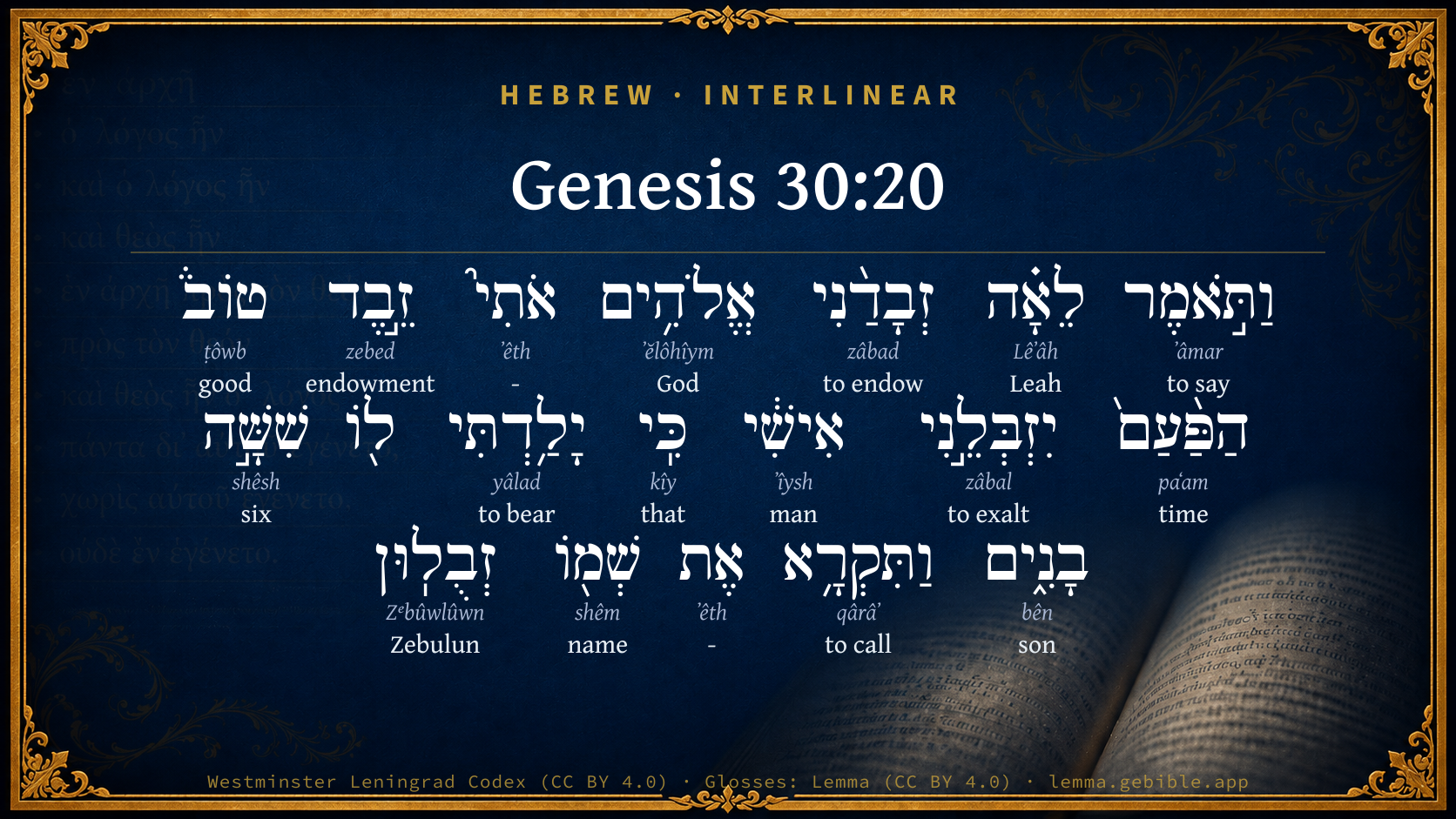
Genesis 30:20

Hebrew (Westminster Leningrad Codex) Genesis 30:20 appears in the Hebrew Old Testament. The text above is from the Westminster Leningrad Codex. Each word links to its Strong’s number, a concise gloss, and parsing drawn from the Open Scriptures Hebrew Bible morphology. Click any word for its full Brown-Driver-Briggs (BDB) entry.
Download image
Cite this verse

Genesis 30:20 (World English Bible). Public Domain. Lemma interlinear Bible study tool, https://lemma.gebible.app/v/genesis/30/20.

Show BibTeX & RIS
BibTeX
RIS
English Translation
Leah said, "God has endowed me with a good dowry. Now my husband will live with me, because I have borne him six sons." She named him Zebulun.
World English Bible · Public Domain
Highlights
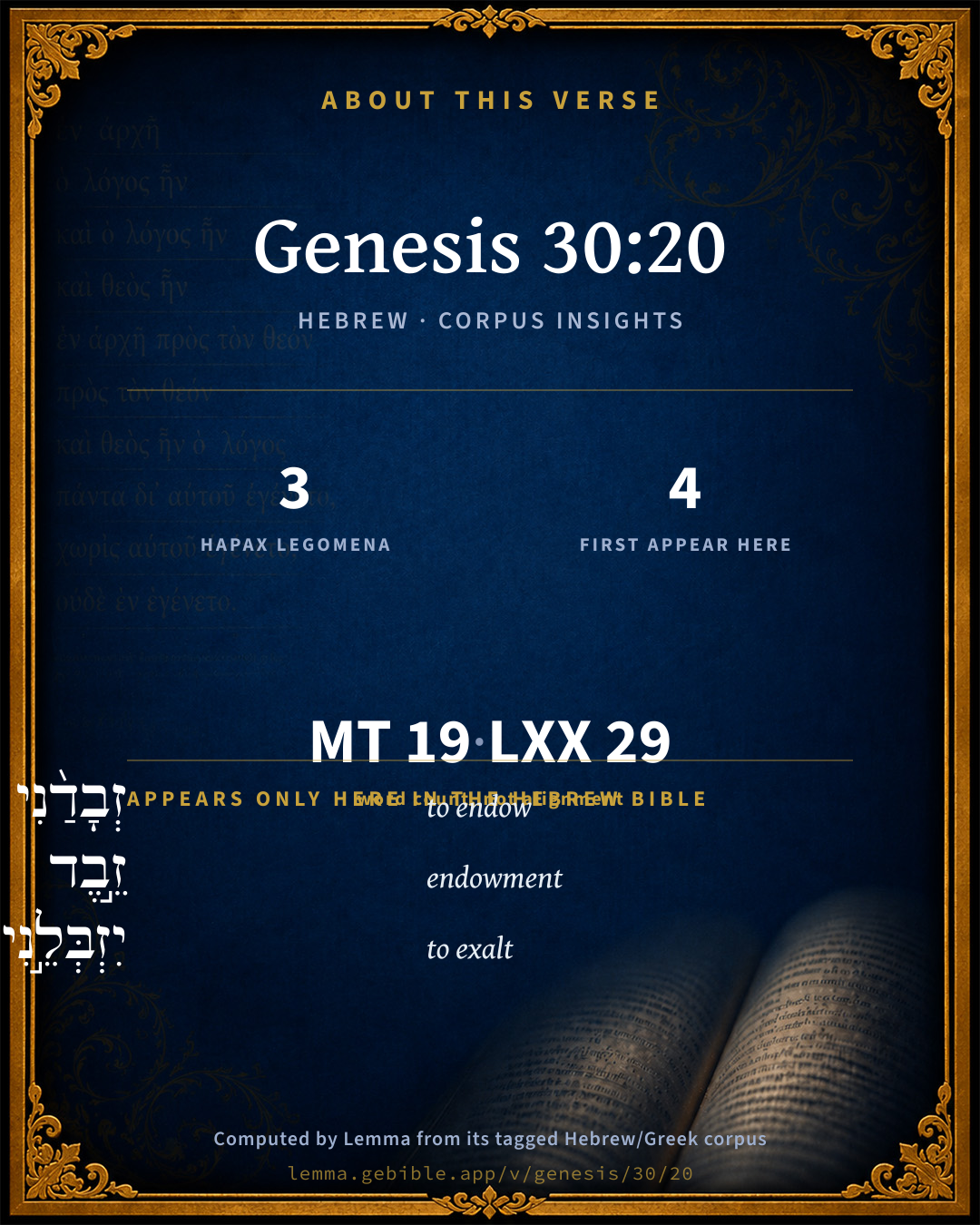
  • 3 hapax legomena — only here in the Hebrew Bible
  • 4 first appearances in the Hebrew Bible
Full analysis ↓
Download a study sheet

One document with this verse’s original text, its word-by-word gloss line, the meaning frame, cross-references with their text, attributed commentary, and full source and license credits — printable, and it pastes into notes with its structure intact.

This verse Autodidact and up

Study sheet (.html) Plain text (.txt)

A passage Seminary Student

Up to 50 verses in one chapter. A passage sheet keeps up to 6 commentary sources and 12 cross-references per verse, in the order this page ranks them, and says so on the sheet whenever that leaves anything out. Ask for a single verse and you get the Autodidact verse sheet above.

Everything on this page stays free to read, with no account — the sheet is a download of what is already on screen, not access to it.

Want to remove ads? Support Godless Engineer
Compare translations 3

The same verse in 3 English versions, stacked beneath the original-language interlinear above. Click any original word for its lexicon entry.

Each is an independent rendering of the whole verse — the interlinear is not word-aligned to these translations.

Highlighted words mark where these versions differ — a whole-verse word diff, not a word-by-word alignment.

  • World English Bible Public Domain
    Leah said, "God has endowed me with a good dowry. Now my husband will live with me, because I have borne him six sons." She named him Zebulun.
  • King James Version Public Domain
    And Leah said, God hath endued me with a good dowry; now will my husband dwell with me, because I have born him six sons: and she called his name Zebulun.
  • unfoldingWord Literal Text CC BY-SA 4.0
    And Leah said, “God has presented me a good present. This time my husband will honor me because I have born six sons for him.” So she called his name Zebulun.

unfoldingWord Literal Text — © unfoldingWord, licensed CC BY-SA 4.0. Word-aligned USFM3 via Door43 (git.door43.org/unfoldingWord/en_ult).

Versions to compare (up to 4)

3 of 4 selected

Show all 18 translations

Every available English version of this verse, each an independent rendering of the whole verse.

  • World English Bible Public Domain
    Leah said, "God has endowed me with a good dowry. Now my husband will live with me, because I have borne him six sons." She named him Zebulun.
  • Berean Standard Bible Public Domain
    “God has given me a good gift,” she said. “This time my husband will honor me, because I have borne him six sons.” And she named him Zebulun.
  • Majority Standard Bible Public Domain
    “God has given me a good gift,” she said. “This time my husband will honor me, because I have borne him six sons.” And she named him Zebulun.
  • King James Version Public Domain
    And Leah said, God hath endued me with a good dowry; now will my husband dwell with me, because I have born him six sons: and she called his name Zebulun.
  • American Standard Version (1901) Public Domain
    And Leah said, God hath endowed me with a good dowry; now will my husband dwell with me, because I have borne him six sons: and she called his name Zebulun.
  • Revised Version (1885) Public Domain
    And Leah said, God hath endowed me with a good dowry; now will my husband dwell with me, because I have borne him six sons: and she called his name Zebulun.
  • Geneva Bible (1599) Public Domain
    Then Leah said, God hath endued me with a good dowrie: nowe will mine husband dwell with me, because I haue borne him sixe sonnes: and she called his name Zebulun.
  • Douay-Rheims (1899) Public Domain
    And said: God hath endowed me with a good dowry: this turn also my husband will be with me, because I have borne him six sons: and therefore she called his name Zabulon.
  • Young's Literal Translation Public Domain
    and Leah saith, `God hath endowed me -- a good dowry; this time doth my husband dwell with me, for I have borne to him six sons;' and she calleth his name Zebulun;
  • Literal Standard Version CC BY-SA 4.0
    and Leah says, “God has endowed me—a good dowry; this time my husband dwells with me, for I have borne six sons to him”; and she calls his name Zebulun;
  • Unlocked Literal Bible CC BY-SA 4.0
    Leah said, “God has given me a good gift. Now my husband will honor me, because I have borne him six sons.” She called his name Zebulun.
  • unfoldingWord Literal Text CC BY-SA 4.0
    And Leah said, “God has presented me a good present. This time my husband will honor me because I have born six sons for him.” So she called his name Zebulun.
  • Darby Bible Public Domain
    and Leah said, God has endowed me with a good dowry; this time will my husband dwell with me, because I have borne him six sons. And she called his name Zebulun.
  • World Messianic Bible Public Domain
    Leah said, “God has endowed me with a good dowry. Now my husband will live with me, because I have borne him six sons.” She named him Zebulun.
  • Webster's Bible Public Domain
    And Leah said, God hath endowed me with a good dower; now will my husband dwell with me, because I have borne him six sons: and she called his name Zebulun.
  • Free Bible Version CC BY-SA 4.0
    Leah said, “God has given me a good gift. Now my husband will honor me because I've given him six sons.” So she named him Zebulun.
  • Bible in Basic English Public Domain
    And she said, God has given me a good bride-price; now at last will I have my husband living with me, for I have given him six sons: and she gave him the name Zebulun.
  • JPS Tanakh (1917) Public Domain
    And Leah said: 'God hath endowed me with a good dowry; now will my husband dwell with me, because I have borne him six sons.' And she called his name Zebulun.

Literal Standard Version (2020), Covenant Press — licensed CC BY-SA 4.0. Text via the HelloAO Bible API (eBible.org). Unlocked Literal Bible (unfoldingWord) — licensed CC BY-SA 4.0. Text via the HelloAO Bible API (eBible.org). unfoldingWord Literal Text — © unfoldingWord, licensed CC BY-SA 4.0. Word-aligned USFM3 via Door43 (git.door43.org/unfoldingWord/en_ult). Free Bible Version, Dr. Jonathan Gallagher — licensed CC BY-SA 4.0. Text via the HelloAO Bible API (eBible.org).

Word by word

More ways to search: Search by grammar → Find every occurrence → Compare this word →

Practice this passage: Drill this verse → Learn its vocabulary →

זְבָדַ֨נִי
zâbad
H2064
“to endow · me”
Verb, Qal, Perfect, 3rd Person, Masculine, Singular + Suffix, Personal, 1st Person, Common, Singular
Part of Speech
Verb
Stem
Qal
Form
Perfect
Person
3rd Person
Gender
Masculine
Number
Singular
Full BDB Definition

Origin: a primitive root

TWOT: 524

(Qal) to endow, bestow, endow with, bestow upon
  1. וַתֹּ֣אמֶר ʼâmar H559 “and · to say” Conjunction + Verb, Qal, Sequential Imperfect, 3rd Person, Feminine, Singular
  2. לֵאָ֗ה Lêʼâh H3812 “Leah” Noun, Proper
  3. אֱלֹהִ֥ים ʼĕlôhîym H430 “God(s)” Noun, Common, Masculine, Plural, Absolute
  4. אֹתִי֮ ʼêth H853 “- · me” Particle, Direct Object + Suffix, Personal, 1st Person, Common, Singular
  5. זֵ֣בֶד zebed H2065 “endowment” Noun, Common, Masculine, Singular, Absolute
  6. טוֹב֒ ṭôwb H2896 “good” Adjective, Adjective, Masculine, Singular, Absolute
  7. הַפַּ֨עַם֙ paʻam H6471 “the · time” Particle, Definite Article + Noun, Common, Feminine, Singular, Absolute
  8. יִזְבְּלֵ֣נִי zâbal H2082 “to exalt · me” Verb, Qal, Imperfect, 3rd Person, Masculine, Singular + Suffix, Personal, 1st Person, Common, Singular
  9. אִישִׁ֔י ʼîysh H376 “man · my” Noun, Common, Masculine, Singular, Construct + Suffix, Personal, 1st Person, Common, Singular
  10. כִּֽי kîy H3588 “that” Conjunction
  11. יָלַ֥דְתִּי yâlad H3205 “to bear” Verb, Qal, Perfect, 1st Person, Common, Singular
  12. שִׁשָּׁ֣ה shêsh H8337 “six” Adjective, Cardinal number, Masculine, Singular, Absolute
  13. בָנִ֑ים bên H1121 “sons” Noun, Common, Masculine, Plural, Absolute
  14. וַתִּקְרָ֥א qârâʼ H7121 “and · to call” Conjunction + Verb, Qal, Sequential Imperfect, 3rd Person, Feminine, Singular
  15. אֶת ʼêth H853 “-” Particle, Direct Object
  16. שְׁמ֖וֹ shêm H8034 “name · his” Noun, Common, Masculine, Singular, Construct + Suffix, Personal, 3rd Person, Masculine, Singular
  17. זְבֻלֽוּן Zᵉbûwlûwn H2074 “Zebulun” Noun, Proper

About this verse

These counts appear in no published source. They are computed here, from the morphology-tagged text and Lemma’s own curated glosses. What Lemma adds →

19
words
17
distinct lemmas
Pentateuch
section

Notable vocabulary

3 hapax legomena — words that appear only here in the entire Hebrew Bible:

  • זְבָדַ֨נִי to endow H2064
  • זֵ֣בֶד endowment H2065
  • יִזְבְּלֵ֣נִי to exalt H2082

First appearance in Scripture

These words make their first canonical appearance in the Hebrew Bible here:

  • זְבָדַ֨נִי to endow H2064
  • זֵ֣בֶד endowment H2065
  • יִזְבְּלֵ֣נִי to exalt H2082
  • זְבֻלֽוּן Zebulun H2074

Shared distinctive vocabulary

לֵאָ֗ה Leah H3812 occurs in 32 verses of the Hebrew Bible. Also found in:

Grammatical profile

  • 5 verbs
  • 8 nouns
  • 2 adjectives
  • 1 preposition
  • 1 conjunction
  • 2 particles

Verb forms

  • וַתֹּ֣אמֶר Qal · Sequential Imperfect
  • זְבָדַ֨נִי Qal · Perfect
  • יִזְבְּלֵ֣נִי Qal · Imperfect
  • יָלַ֥דְתִּי Qal · Perfect
  • וַתִּקְרָ֥א Qal · Sequential Imperfect

Hebrew & Septuagint length

In English translation the verse runs 28 words from the Hebrew and 31 from the Septuagint (LXX English) — closely comparable.

A rough comparison of the two English renderings, which tokenize alike — not a word-level alignment.

Word counts can differ between the Hebrew and the Greek without any difference in meaning — e.g. the Hebrew direct-object marker אֵת has no separate Greek word, and Greek often adds the article ὁ.

In the original languages it is 19 Hebrew tokens and 29 Greek tokens — but the two are counted differently (Hebrew bundles its prefixes and suffixes into one token; the Greek is in lemma form), so that isn’t a like-for-like length.

Cross-references

9

Topical passages linked to Genesis 30:20 in the Treasury of Scripture Knowledge — connected by theme and wording, ordered by reader-vote popularity; previews shown in the World English Bible.

  • Genesis 35:23 The sons of Leah: Reuben (Jacob's firstborn), Simeon, Levi, Judah, Issachar, and Zebulun.
  • Genesis 49:13 "Zebulun will dwell at the haven of the sea. He will be for a haven of ships. His border will be on Sidon.
  • Matthew 4:13 Leaving Nazareth, he came and lived in Capernaum, which is by the sea, in the region of Zebulun and Naphtali,
  • Genesis 46:14 The sons of Zebulun: Sered, Elon, and Jahleel.
  • Judges 4:10 Barak called Zebulun and Naphtali together to Kedesh; and there went up ten thousand men at his feet: and Deborah went up with him.
  • Judges 5:14 Out of Ephraim [came down] they whose root is in Amalek; After you, Benjamin, among your peoples; Out of Machir came down governors, Out of Zebulun those who handle the marshal's staff.
  • Psalms 68:27 There is little Benjamin, their ruler, The princes of Judah, their council, The princes of Zebulun, and the princes of Naphtali.
  • Genesis 29:34 She conceived again, and bare a son. Said, "Now this time will my husband be joined to me, because I have borne him three sons." Therefore was his name called Levi.
  • Genesis 30:15 She said to her, "Is it a small matter that you have taken away my husband? Would you take away my son's mandrakes, also?" Rachel said, "Therefore he will lie with you tonight for your son's mandrakes."

Cross-references courtesy of OpenBible.info (CC BY 4.0).

Hebrew and Greek witnesses Masoretic Hebrew ↔ Greek Septuagint

The same verse in the two great witnesses to the Old Testament, shown verse-for-verse.

These are two independent witnesses, not word-aligned to each other, and the Septuagint is shown in lemma (dictionary) form.

Hebrew Genesis 30:20 Masoretic · Westminster Leningrad Codex

וַתֹּ֣אמֶר לֵאָ֗ה זְבָדַ֨נִי אֱלֹהִ֥ים אֹתִי֮ זֵ֣בֶד טוֹב֒ הַפַּ֨עַם֙ יִזְבְּלֵ֣נִי אִישִׁ֔י כִּֽי יָלַ֥דְתִּי ל֖וֹ שִׁשָּׁ֣ה בָנִ֑ים וַתִּקְרָ֥א אֶת שְׁמ֖וֹ זְבֻלֽוּן

Leah said, "God has endowed me with a good dowry. Now my husband will live with me, because I have borne him six sons." She named him Zebulun.

World English Bible · Public Domain

Greek LXX Genesis 30:20 Septuagint · lemma form

καί εἶπον λεια δωρέομαι ἐγώ ὁ θεός δῶρον καλός ἐν ὁ νῦν καιρός αἱρετίζω ἐγώ ὁ ἀνήρ ἐγώ τίκτω γάρ αὐτός υἱός ἕξ καί καλέω ὁ ὄνομα αὐτός ζαβουλων

And Lea said, God has given me a good gift in this time; my husband will choose me, for I have born him six sons: and she called his name, Zabulon.

LXX2012 (modern English Septuagint) · Public Domain

On this verse, Ellicott's Commentary for English Readers discusses the Septuagint’s reading. Read the note in Commentary ↓

Hebrew: Westminster Leningrad Codex (CC BY 4.0). Greek: Septuagint (public domain); English from LXX2012 (modern English Septuagint) (Public Domain). How the Septuagint differs from the Hebrew →

Targum (Aramaic paraphrase)

2

The Targum is the ancient Jewish Aramaic paraphrase of the Hebrew Scriptures — an interpretive translation, not the Hebrew text itself. Onkelos (literal) and Pseudo-Jonathan (expansive) render the Torah, and Jonathan the Prophets. Coverage is partial: where no permissively-licensed English translation exists for a verse, only the Aramaic is shown. This is verse-level text, not a word-by-word alignment to the Hebrew.

  1. Targum Onkelos Torah (Genesis–Deuteronomy)
    וַאֲמֶרֶת לֵאָה יְהַב יְיָ יָתֵהּ לִי חָלַק טַב הָדָא זִמְנָא יְהֵי מְדוֹרֵהּ דְּבַעְלִי לְוָתִי אֲרֵי יְלֵידִית לֵהּ שִׁתָּא בְנִין וּקְרַת יָת שְׁמֵהּ זְבֻלוּן

    (no public-domain English translation for this verse)

    Targum Onkelos — Aramaic: “Onkelos Genesis” (public domain); “Onkelos Exodus” (public domain); “Onkelos Leviticus” (public domain); “Onkelos Numbers” (public domain); “Onkelos Deuteronomy” (public domain). English: “Sefaria Community Translation” (CC0 1.0 (public-domain dedication)); “J.W. Etheridge. The Targums of Onkelos and Jonathan Ben Uzziel on the Pentateuch. London: Longmans, Green, 1862” (public domain). Text via Sefaria.

  2. Targum Pseudo-Jonathan Torah (Genesis–Deuteronomy)
    וַאֲמַרַת לֵאָה עָבַד יָתִי יְיָ זְבוּדִין טָבִין מִבְּנִין זִמְנָא הָדָא יְהֵי מְדוֹרֵיהּ דְבַעֲלִי עִמִי אֲרוּם יְלִידַת לֵיהּ שִׁיתָּא בְנִין וְהֵיכְדִין עֲתִידִין בְּנוֹי לְקַבָּלָא חוּלַק טַב וּקְרַת יַת שְׁמֵיהּ זְבוּלוּן

    and said, The Lord hath endowed me with a good dowry by children. This time will the habitation of my husband be with me, because I have borne him six sons: and thus shall his children receive a good portion. And she called his name Zebulun.

    Targum Pseudo-Jonathan — Aramaic: “Targum Jonathan on Genesis” (public domain); “Targum Jonathan on Exodus” (public domain); “Targum Jonathan on Leviticus” (public domain); “Targum Jonathan on Numbers” (public domain); “Targum Jonathan on Deuteronomy” (public domain). English: “The Targum of Jonathan ben Uzziel, trans. J. W. Etheridge, London, 1862” (public domain). Text via Sefaria.

Commentary

Notes on Genesis 30:20 from classic Christian and Jewish commentators (each source and its license shown beneath its notes). The classic Christian expositions comment on the surrounding passage and are grouped to its opening verse, so a note may address several verses; the Jewish commentaries on the Tanakh (Rashi and others) are per-verse, so they appear only where the commentator wrote on this verse.

Lemma curates 59 commentaries, every one of them public domain or Creative Commons licensed, each selected and text-cleaned for this edition rather than reprinted as found. About our sources →

Trapp's Complete Commentary

John Trapp

Gen 30:20 And Leah said, God hath endued me [with] a good dowry; now will my husband dwell with me, because I have born him six sons: and she called his name Zebulun.

Ver. 20. God hath endued me with a good dowry.] That is, as it proves, though children are dulcis acerbitas , saith one; certain cares, but uncertain comforts, saith another; {a} yet all men desire them: how much more should we covet grace, and those things that accompany salvation! These having gotten, we may safely and surely say, "God hath endued me with a good dowry."

{a} Fροντιδες μεγαλαι, ελπιδες αδηλοι. - Plutar., De Prolis Amore.

John Trapp, A Commentary or Exposition upon All the Books of the Old and New Testament (1647–1656) — public domain. Text from a community e-Sword module.

Jamieson, Fausset & Brown

Robert Jamieson, A. R. Fausset & David Brown

And Leah said, God hath endued me with a good dowry--The birth of a son is hailed with demonstrations of joy, and the possession of several sons confers upon the mother an honor and respectability proportioned to their number. The husband attaches a similar importance to the possession, and it forms a bond of union which renders it impossible for him ever to forsake or to be cold to a wife who has borne him sons. This explains the happy anticipations Leah founded on the possession of her six sons.

Jamieson, Fausset & Brown — Commentary Critical and Explanatory on the Whole Bible (1871) — public domain (CC PDM 1.0). Text via the HelloAO Bible API.

Adam Clarke's Commentary

Verse 20. Now will my husband dwell with me] יזבלני yizbeleni; and she called his name Zebulun, זבל a dwelling or cohabitation, as she now expected that Jacob would dwell with her, as he had before dwelt with Rachel.

Adam Clarke's Commentary on the Bible (1810–1826) — public domain. Text from a community e-Sword/MySword module.

Ellicott's Commentary for English Readers

(20) Zebulun.—Leah is more than usually obscure in the reasons she gives for this name; for she plays upon two words, which probably both belonged to the Mesopotamian pato is: and as this was a Syriac dialect, we must look to that language for their explanation. The first is zebed; and here there is no difficulty. It means such presents as a father gives his daughter on her marriage, over and above those enumerated in the marriage contract. Of the second, zabal, there is no trace. Nor do the Syro-Arabic lexicons acknowledge in the word “Zebulun” such a sense as that of dwelling, given it in our margin. Bar-Ali explains it as meaning “salvation of the night, or a good dowry,” and Bar- Bahlul, “a dowry of the night,” both deriving it from zebed, a dowry, and lun, to pass the night. The derivation is wrong as far as concerns lun; for the word Zebulun is formed simply from zebed, the final d of which is changed into I for mere reasons of euphony. The Versions take the word zabal as mean ing, “to be with,” Vulg.; “to choose,” LXX.; “to cleave to,” Syriac. It occurs nowhere else, but the substantive zebul is not uncommon, and means dwelling, station.

As a woman’s value in the East rises with each son, Leah now hoped for more love from her husband. Nor does she seem to have been disappointed.

A Bible Commentary for English Readers, edited by Charles John Ellicott (1878–1897) — public domain. Text from a community e-Sword module.

The Cambridge Bible for Schools and Colleges

gen. ed. J. J. S. Perowne

20. dwell] Heb. zabal, “he dwelt.” In this verse we have two explanations of the name “Zebulun.” In the first clause Leah says “God has endowed (zabad) me with a good dowry (zebed)”; cf. the names Zabdi (Jos_7:1) and Zebedee (Mar_1:19). In the second clause the derivation is taken from the word zabal, “he dwelt.” Presumably both popular etymologies were current. The interchange of d and l sounds is well known; cf. δάκρυον = Lat. lachryma. Assyriologists suggest a derivation from the Assyrian zabalu, “lift up,” “exalt,” “honour.”

The two tribes of Issachar and Zebulun occupied adjoining territories.

The Cambridge Bible for Schools and Colleges (gen. ed. J. J. S. Perowne; Cambridge University Press, 1878–1918) — public domain. Text from a community e-Sword module.

John Gill's Exposition

And she conceived and bare a son,.... Through the goodness of God unto her, and for which she was greatly thankful:

and said, God hath taken away my reproach; the reproach of barrenness with which she was reproached among her neighbours; and perhaps by her sister Leah, and indeed it was a general reproach in those times; and especially, it was the more grievous to good women in the family of Abraham, because they were not the means of multiplying his seed according to the promise, and could have no hope of the Messiah springing from them.

John Gill's Exposition of the Whole Bible (1746–1763) — public domain (CC PDM 1.0). Text via the HelloAO Bible API.

Haydock's Catholic Bible Commentary

Zabulon, "dwelling or cohabiting." Zobad (which resembles the sound of Zobal) means to endow, (Calmet) to which she seems also to refer; as if her marriage was renewed, and God had given her more children for a dowry. (Menochius)

George Leo Haydock (1774–1849), Haydock's Catholic Family Bible and Commentary, 1859 edition — public domain. Excludes Psalms (Douay-Rheims chapter numbering differs from Protestant) and Deuterocanonical books (Catholic canon only).

Whedon's Commentary on the Bible

Daniel D. Whedon

20. Zebulun — Which means, dwelling or habitation; for now she fondly hopes that her husband will dwell with her; cleave to her in his home-life with a warmer attachment.

Daniel D. Whedon (gen. ed.), Commentary on the Old and New Testaments (1874–1909) — public domain. Text from a community e-Sword module.

Rashi

Rabbi Shlomo Yitzchaki (Rashi)

זבד טוב A GOOD DOWRY — explain it as the Targum renders it: a good portion.

יזבלני WILL RESIDE WITH ME — It has the same meaning as (1 Kings 8:13) “a house for dwelling (זבול)”. In old French herbergerie, a dwelling house. Leah meant: From now on his real home will be with me since I have as many children as all his other wives together.

Rashi on the Tanakh — English translations: “The Judaica Press complete Tanach with Rashi, translated by A. J. Rosenberg” (CC BY 4.0); “Pentateuch with Rashi's commentary by M. Rosenbaum and A.M. Silbermann, 1929-1934” (public domain); “The Metsudah Tanach series, Lakewood, N.J” (CC BY 4.0); and “The Book of Joshua, Metsudah Publications, 1997” (CC BY 4.0). Text via Sefaria.

Ramban (Nachmanides)

Rabbi Moshe ben Nachman (Ramban / Nachmanides)

G-D HATH ‘Z’VADANI’ (ENDOWED) ME WITH A GOOD ‘ZEVED’ (DOWRY). The commentators have not found the source of this word in the Sacred Language.We could perhaps say that zeved is a composite word formed from zeh bad, just as is the word madua, [which is composed of the two words, mah dua, meaning “what is the opinion of this matter” or simply “why”] or the word bagad in its written form. [It is read, however, as two words: ba gad (good luck cometh.)] Since the vowel signs segol and patach interchange in many places, particularly in composite words, [the second segol in zeved could have come from the patach of bad: zeh bad]. So also in the word tzalmaveth, [which consists of the two words: tzeil maveth (the shade of death)], and the word biladai, [composed of bal ad (except unto, except unto me, or except me)]. And the second part (bad) of the word zeved comes from the word badim (branches), as in, ‘badei’ (staves) of accacia-wood; And it brought forth ‘badim’ (branches), and shot forth sprigs. The thick branches of a tree are called badim, and then the word was appropriated to mean “children,” as in, The first-born of death shall devour ‘badav’ (his sons); His ill-founded ‘badav’ (sons)., etc. Therefore Leah said that this son whom G-d had given her would be a good son for he will cause her husband to reside in her shadow, as “he will now ‘yizbleini’ (dwell with me) in my shadow.” Similarly, I have surely built Thee a house ‘z’vul’ (of habitation), meaning “in order to abide in His shadow.” This was said in this fashion out of respect for the Supreme One, just as Solomon said, Behold, heaven and the heaven of heavens cannot contain Thee, how much less this house that I have builded!, Verse 27. Likewise, The sun and moon stand still ‘z’vulah’ (in their habitation), meaning “stand still in the place where they abide,” as it is said, In them [the heavens] hath He set a tent for the sun. Now Onkelos translated zeved tov as a good portion. I did not understand his reasoning until I saw in the Jerusalem Targum: (translations) of the Pentateuch are Onkelos, Yonathan, and Yerushalmi. The latter has not reached us in its entirety. “The word of G-d has outfitted me (zavad) with good provision.” [Zavad is written here with two vavim instead of the beth with which the word zeved is written in the Torah.] From this I learned that both Onkelos and the Jerusalem Targum considered the word zeved of the Torah, which is spelled with the letter beth, as if it were written with the letter vav, and they connected it to the Aramaic language which translates the Hebrew word tzeidah (provision) as zvadim (provisions). Leah thus said that G-d had made this son a good provision and a good portion for her because her husband, due to her many children, will now live mainly with her, and thus she will be supported together with him when it is well with him. The vav and the beth are used interchangeably in our language in many places, such as: ta’avah (desire) written with a vav, and ta’avah, written with a beth; geivi (My back) — [written with a vav] — I have given to the smiters, and, Upon ‘gabi’ (my back) — [written with a beth] — the plowers plowed. So also, ‘Lekitzvei’ (To the bottoms) — [written with a beth] — of the mountains I went down, is as if it were written, lekitzvei with a vav. Also, ‘Laparbor’ (For the precinct) — [written with a beth] — westward, four at the causeway, serves as the basis of the word parvor, written with a vav, as it is written, By the chamber of Nethan-melech the officer, which was ‘baparvorim’ (in the precincts), written with a vav, and the meaning of both forms, [whether written with a beth or vav] is the Court which is outside the wall. ‘Umigrash’ (And open land) round about the cities, is rendered by the Jerusalem Targum as, uparvor. And so did the Jonathan Targum translate migrashoth (open lands) as parvoraya. In the Mishnah we also find the vav and the beth interchange: “A tarvad (spoon)-full,” written with a vav, and in some editions it is written, tarbad, with a beth; “A board which has no levizbeiz (edges),” written with a beth, and in certain places they use the word lizbeiz, written with a beth, while in other places they use lizveiz written with a vav. Also, itztaba (a balcony), written with a beth, and itztava, written with a vav, and many other similar words. In the Jerusalem Talmud they also write avir (space) with a beth in place of the usual vav, as they were not particular about that.

Ramban (Nachmanides) on the Tanakh — English translation: “Commentary on the Torah by Ramban (Nachmanides). Translated and annotated by Charles B. Chavel. New York, Shilo Pub. House, 1971-1976” (CC BY 4.0). Text via Sefaria.

Sforno

Rabbi Ovadia Sforno

Elokim has given. Hashem gave her Yissachar in reward for her first effort in giving Yaakov her maidservant and He gave her Zevulun in reward for her second effort in trading the jasmine flowers for an additional night with him.

A goodly portion. She was deserving of reward because her only intention was to increase Hashem’s honor.

Sforno on the Tanakh — English translation: “Yalkut, Sifsei Chachomim Chumash, Metsudah Publications, 2009” (CC BY 4.0). Text via Sefaria.

Radak

Rabbi David Kimhi (Radak)

ותהר...ותאמר זבדני אלוקים אותי זבד טוב, the meaning of the name corresponds to the circumstances surrounding the child’s birth. As to the apparent repetition, i.e. saying אותי, something already mentioned by the suffix ני in the word זבדני, this may have been to make her intention in naming the boy even more unmistakable. It is also possible that the letters את in this word mean “from,” as in Genesis 44,3 הם יצאו את העיר, “they had departed from the city,” so that the suffix י would make the word mean “from me.” She would then have emphasised that not only had she been built up through raising the children of her handmaid, but that G’d had even granted her additional children from her own womb. She was grateful that her husband’s semen when sleeping with her did not go to waste. She was grateful that the gift of this baby originated in her womb.

הפעם יזבלני, my house will now become his permanent residence seeing that I have born six sons for him. She perpetuated this feeling of Yaakov making his home predominantly in her tent by naming the child Zevulun.

Radak on the Tanakh — English translations: “Sefaria Community Translation” (CC0 1.0 (public-domain dedication)); “Eliyahu Munk, HaChut Hameshulash” (CC BY 4.0); “Rabbi Mike Feuer, Jerusalem Anthology” (CC BY 4.0); and “R. David Kimhi on the first book of Psalms, Translated by R.G. Finch, London, 1919” (public domain). Text via Sefaria.

Lesson kit

Teaching starters — assembled from the data on this page, not authored interpretation. Every prompt links to the verse data it draws on. Edit before teaching.

Genesis, in the Pentateuch, opens this verse with 19 words (17 distinct Hebrew lemmas). Its most distinctive word is zâbad (“to endow”). A historical commentator’s framing appears above. Read the whole chapter for the surrounding context.

Discussion questions

  1. What does “to endow” (zâbad) contribute to the verse as a whole?
  2. 3 words here appear nowhere else in the Hebrew Bible. Why might the author reach for such rare wording?
  3. 4 words make their first appearance in Scripture here. What does this debut establish?
  4. How does Genesis 29:16, which shares the word «Leah», read alongside this verse?
  5. The translations on this page render this verse differently — a whole-verse word diff, not a word-by-word alignment. What might account for the different wordings?
  6. «וַתֹּ֣אמֶר» is a Qal Sequential Imperfect verb. How does that grammatical form shape the action described?
  7. Compare how Trapp's Complete Commentary and Jamieson, Fausset & Brown read this verse. Where do they agree or differ?

Things to notice

Reading settings

Reading text

Shown beneath each verse's original-language words.

Old Testament
Old Testament edition

Read the OT as the Masoretic Hebrew (MT) or the Greek Septuagint (LXX).

English shown for the Greek Septuagint (in the Hebrew ↔ Greek comparison).

Comparing translations? Open the Compare panel on any verse page to stack up to four side by side.