Exodus 21:26

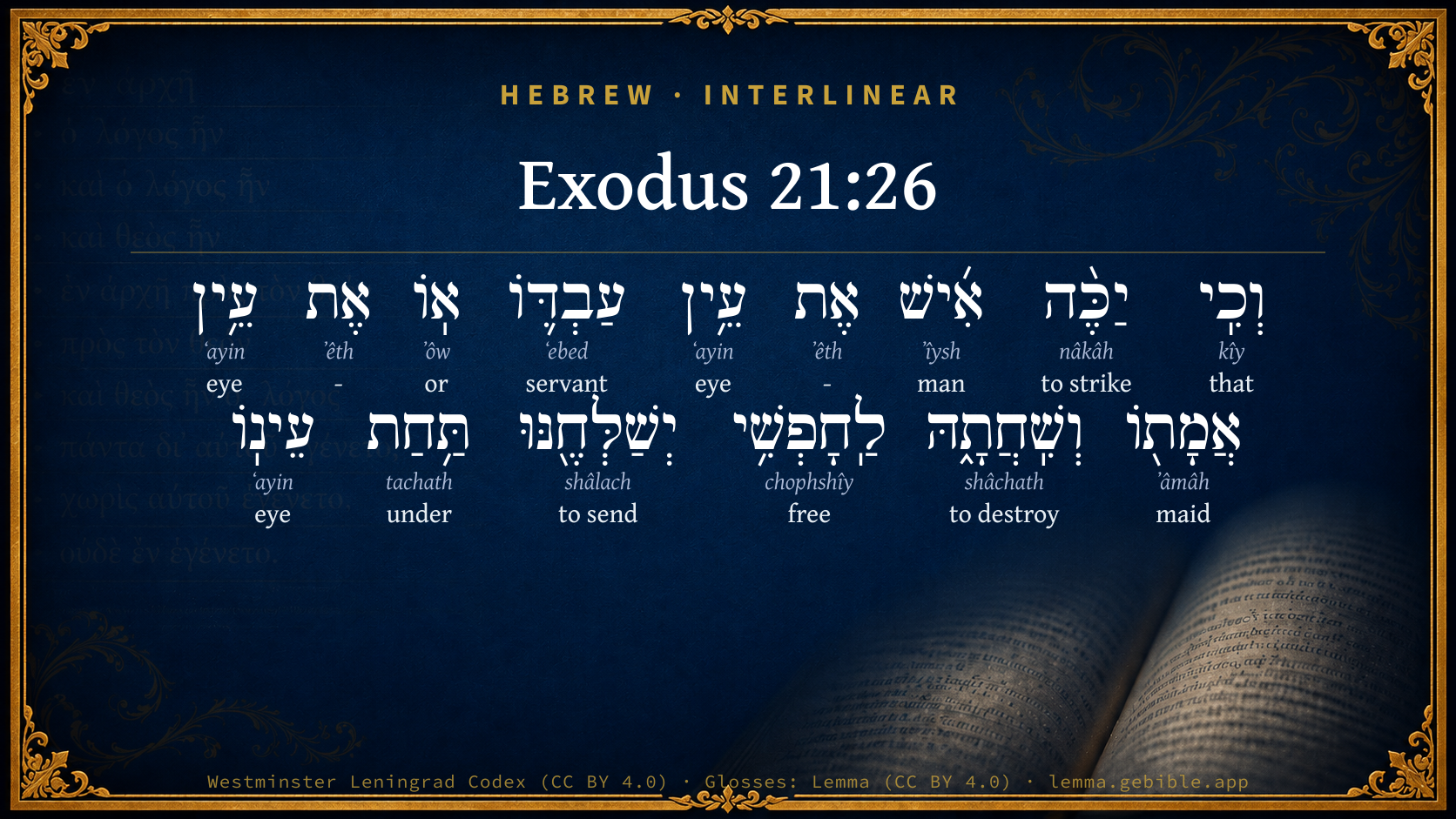
Hebrew (Westminster Leningrad Codex) Exodus 21:26 appears in the Hebrew Old Testament. The text above is from the Westminster Leningrad Codex. Each word links to its Strong’s number, a concise gloss, and parsing drawn from the Open Scriptures Hebrew Bible morphology. Click any word for its full Brown-Driver-Briggs (BDB) entry.
Download image
Cite this verse

Exodus 21:26 (World English Bible). Public Domain. Lemma interlinear Bible study tool, https://lemma.gebible.app/v/exodus/21/26.

Show BibTeX & RIS
BibTeX
RIS
English Translation
"If a man strikes his servant's eye, or his maid's eye, and destroys it, he shall let him go free for his eye's sake.
World English Bible · Public Domain
Download a study sheet

One document with this verse’s original text, its word-by-word gloss line, the meaning frame, cross-references with their text, attributed commentary, and full source and license credits — printable, and it pastes into notes with its structure intact.

This verse Autodidact and up

Study sheet (.html) Plain text (.txt)

A passage Seminary Student

Up to 50 verses in one chapter. A passage sheet keeps up to 6 commentary sources and 12 cross-references per verse, in the order this page ranks them, and says so on the sheet whenever that leaves anything out. Ask for a single verse and you get the Autodidact verse sheet above.

Everything on this page stays free to read, with no account — the sheet is a download of what is already on screen, not access to it.

Want to remove ads? Support Godless Engineer
Compare translations 3

The same verse in 3 English versions, stacked beneath the original-language interlinear above. Click any original word for its lexicon entry.

Each is an independent rendering of the whole verse — the interlinear is not word-aligned to these translations.

Highlighted words mark where these versions differ — a whole-verse word diff, not a word-by-word alignment.

  • World English Bible Public Domain
    "If a man strikes his servant's eye, or his maid's eye, and destroys it, he shall let him go free for his eye's sake.
  • King James Version Public Domain
    And if a man smite the eye of his servant, or the eye of his maid, that it perish; he shall let him go free for his eye's sake.
  • unfoldingWord Literal Text CC BY-SA 4.0
    And if a man hits the eye of his male servant or the eye of his female servant and destroys it, he shall let him go free in compensation for his eye.

unfoldingWord Literal Text — © unfoldingWord, licensed CC BY-SA 4.0. Word-aligned USFM3 via Door43 (git.door43.org/unfoldingWord/en_ult).

Versions to compare (up to 4)

3 of 4 selected

Show all 18 translations

Every available English version of this verse, each an independent rendering of the whole verse.

  • World English Bible Public Domain
    "If a man strikes his servant's eye, or his maid's eye, and destroys it, he shall let him go free for his eye's sake.
  • Berean Standard Bible Public Domain
    If a man strikes and blinds the eye of his manservant or maidservant, he must let the servant go free as compensation for the eye.
  • Majority Standard Bible Public Domain
    If a man strikes and blinds the eye of his manservant or maidservant, he must let the servant go free as compensation for the eye.
  • King James Version Public Domain
    And if a man smite the eye of his servant, or the eye of his maid, that it perish; he shall let him go free for his eye's sake.
  • American Standard Version (1901) Public Domain
    And if a man smite the eye of his servant, or the eye of his maid, and destroy it; he shall let him go free for his eye's sake.
  • Revised Version (1885) Public Domain
    And if a man smite the eye of his servant, or the eye of his maid, and destroy it; he shall let him go free for his eye’s sake.
  • Geneva Bible (1599) Public Domain
    And if a man smite his seruant in the eie, or his maide in the eye, and hath perished it, hee shall let him goe free for his eye.
  • Douay-Rheims (1899) Public Domain
    If any man strike the eye of his manservant or maidservant, and leave them but one eye, he shall let them go free for the eye which he put out.
  • Young's Literal Translation Public Domain
    `And when a man smiteth the eye of his man-servant, or the eye of his handmaid, and hath destroyed it, as a freeman he doth send him away for his eye;
  • Literal Standard Version CC BY-SA 4.0
    And when a man strikes the eye of his manservant, or the eye of his handmaid, and has destroyed it, he sends him away as a freeman for his eye;
  • Unlocked Literal Bible CC BY-SA 4.0
    If a man hits the eye of his male servant or of his female servant and destroys it, then he must let the servant go free in compensation for his eye.
  • unfoldingWord Literal Text CC BY-SA 4.0
    And if a man hits the eye of his male servant or the eye of his female servant and destroys it, he shall let him go free in compensation for his eye.
  • Darby Bible Public Domain
    And if a man strike the eye of his bondman or the eye of his handmaid, and it be marred, he shall let him go for his eye.
  • World Messianic Bible Public Domain
    “If a man strikes his servant’s eye, or his maid’s eye, and destroys it, he shall let him go free for his eye’s sake.
  • Webster's Bible Public Domain
    And if a man shall smite the eye of his servant, or the eye of his maid, that it shall perish; he shall let him go free for his eye's sake.
  • Free Bible Version CC BY-SA 4.0
    Anyone who hits their male or female slave in the eye and blinds them must free the slave as compensation for the eye.
  • Bible in Basic English Public Domain
    If a man gives his man-servant or his woman-servant a blow in the eye, causing its destruction, he is to let him go free on account of the damage to his eye.
  • JPS Tanakh (1917) Public Domain
    And if a man smite the eye of his bondman, or the eye of his bondwoman, and destroy it, he shall let him go free for his eye's sake.

Literal Standard Version (2020), Covenant Press — licensed CC BY-SA 4.0. Text via the HelloAO Bible API (eBible.org). Unlocked Literal Bible (unfoldingWord) — licensed CC BY-SA 4.0. Text via the HelloAO Bible API (eBible.org). unfoldingWord Literal Text — © unfoldingWord, licensed CC BY-SA 4.0. Word-aligned USFM3 via Door43 (git.door43.org/unfoldingWord/en_ult). Free Bible Version, Dr. Jonathan Gallagher — licensed CC BY-SA 4.0. Text via the HelloAO Bible API (eBible.org).

Word by word

More ways to search: Search by grammar → Find every occurrence → Compare this word →

Practice this passage: Drill this verse → Learn its vocabulary →

לַֽחָפְשִׁ֥י
chophshîy
H2670
“to/for the · free”
Preposition, Determined + Adjective, Adjective, Masculine, Singular, Absolute
Part of Speech
Preposition + Adjective
Type
Adjective
Gender
Masculine
Number
Singular
State
Absolute
Full BDB Definition

Origin: from H2666

TWOT: 717c

free - free (from slavery) - free (from taxes or obligations)
  1. וְכִֽי kîy H3588 “and · that” Conjunction + Conjunction
  2. יַכֶּ֨ה nâkâh H5221 “to strike” Verb, Hiphil, Imperfect, 3rd Person, Masculine, Singular
  3. אִ֜ישׁ ʼîysh H376 “man” Noun, Common, Masculine, Singular, Absolute
  4. אֶת ʼêth H853 “-” Particle, Direct Object
  5. עֵ֥ין ʻayin H5869 “eye of” Noun, Common, Both, Singular, Construct
  6. עַבְדּ֛וֹ ʻebed H5650 “servant · his” Noun, Common, Masculine, Singular, Construct + Suffix, Personal, 3rd Person, Masculine, Singular
  7. אֽוֹ ʼôw H176 “or” Conjunction
  8. אֶת ʼêth H853 “-” Particle, Direct Object
  9. עֵ֥ין ʻayin H5869 “eye of” Noun, Common, Both, Singular, Construct
  10. אֲמָת֖וֹ ʼâmâh H519 “maid · his” Noun, Common, Feminine, Singular, Construct + Suffix, Personal, 3rd Person, Masculine, Singular
  11. וְשִֽׁחֲתָ֑הּ shâchath H7843 “and · to destroy · her” Conjunction + Verb, Piel, Sequential Perfect, 3rd Person, Masculine, Singular + Suffix, Personal, 3rd Person, Feminine, Singular
  12. יְשַׁלְּחֶ֖נּוּ shâlach H7971 “to send · him” Verb, Piel, Imperfect, 3rd Person, Masculine, Singular + Suffix, Personal, 3rd Person, Masculine, Singular
  13. תַּ֥חַת tachath H8478 “under” Preposition
  14. עֵינֽוֹ ʻayin H5869 “eye · his” Noun, Common, Both, Singular, Construct + Suffix, Personal, 3rd Person, Masculine, Singular

About this verse

These counts appear in no published source. They are computed here, from the morphology-tagged text and Lemma’s own curated glosses. What Lemma adds →

15
words
12
distinct lemmas
Pentateuch
section

Notable vocabulary

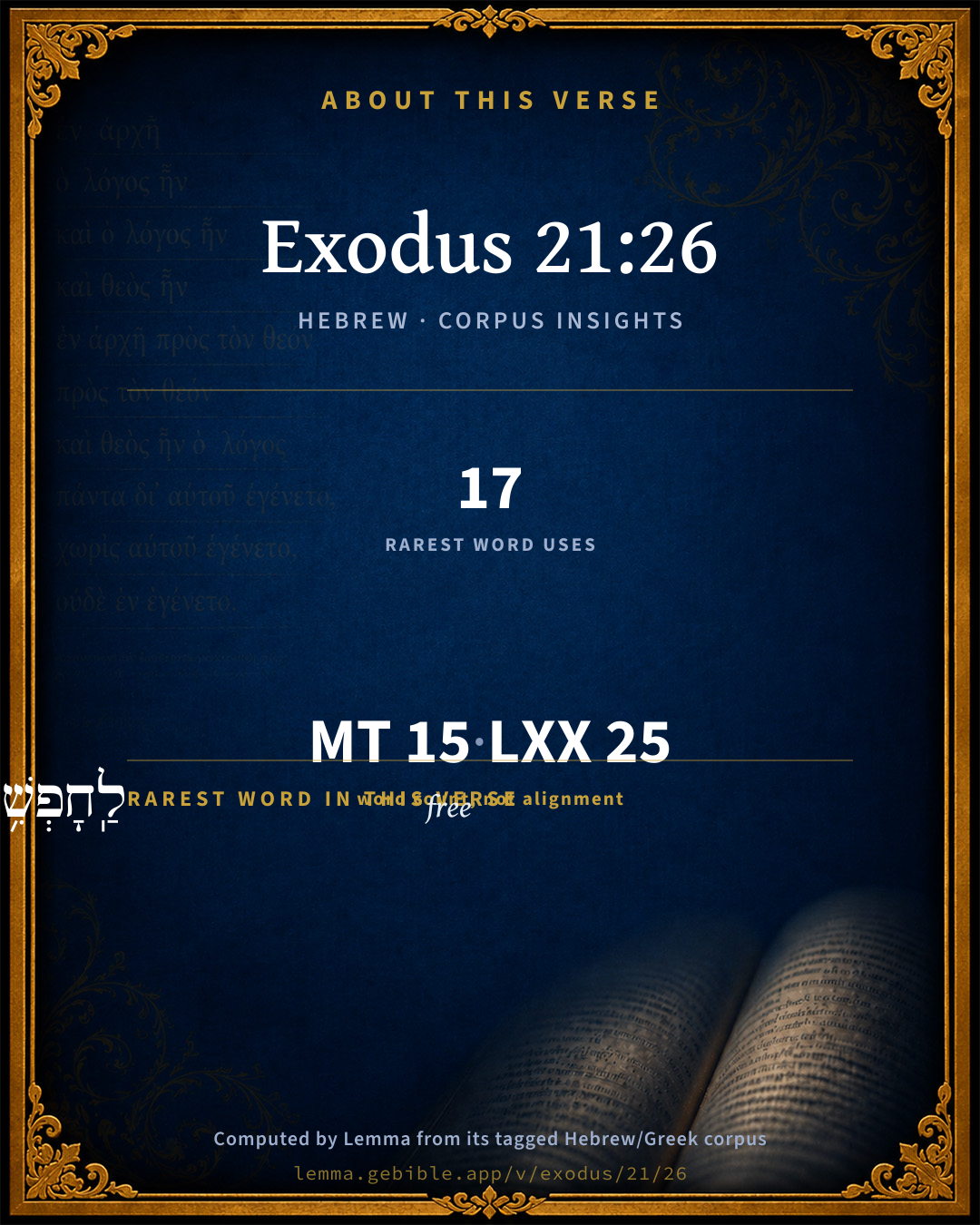
The rarest word here is לַֽחָפְשִׁ֥י free H2670 — appearing just 17 times in the whole Hebrew Bible.

Shared distinctive vocabulary

לַֽחָפְשִׁ֥י free H2670 occurs in 17 verses of the Hebrew Bible. Also found in:

Grammatical profile

  • 3 verbs
  • 6 nouns
  • 1 adjective
  • 1 preposition
  • 2 conjunctions
  • 2 particles

Verb forms

  • יַכֶּ֨ה Hiphil · Imperfect
  • וְשִֽׁחֲתָ֑הּ Piel · Sequential Perfect
  • יְשַׁלְּחֶ֖נּוּ Piel · Imperfect

Repetition

A word recurs within this verse — often emphatic in Hebrew:

  • עֵ֥ין eye H5869 ×3

Hebrew & Septuagint length

In English translation the verse runs 24 words from the Hebrew and 29 from the Septuagint (LXX English) — closely comparable.

A rough comparison of the two English renderings, which tokenize alike — not a word-level alignment.

Word counts can differ between the Hebrew and the Greek without any difference in meaning — e.g. the Hebrew direct-object marker אֵת has no separate Greek word, and Greek often adds the article ὁ.

In the original languages it is 15 Hebrew tokens and 25 Greek tokens — but the two are counted differently (Hebrew bundles its prefixes and suffixes into one token; the Greek is in lemma form), so that isn’t a like-for-like length.

Cross-references

11

Topical passages linked to Exodus 21:26 in the Treasury of Scripture Knowledge — connected by theme and wording, ordered by reader-vote popularity; previews shown in the World English Bible.

  • Exodus 21:20 "If a man strikes his servant or his maid with a rod, and he dies under his hand, he shall surely be punished.
  • Deuteronomy 16:19 You shall not wrest justice: you shall not respect persons; neither shall you take a bribe; for a bribe does blind the eyes of the wise, and pervert the words of the righteous.
  • Nehemiah 5:5 Yet now our flesh is as the flesh of our brothers, our children as their children: and, behold, we bring into bondage our sons and our daughters to be servants, and some of our daughters are brought into bondage [already]: neither is it in our power to help it; for other men have our fields and our vineyards.
  • Job 31:13–15 "If I have despised the cause of my man-servant Or of my maid-servant, When they contended with me;
  • Psalms 9:12 For he who avenges blood remembers them. He doesn't forget the cry of the afflicted.
  • Psalms 10:14 But you do see trouble and grief; You consider it to take it into your hand. You help the victim and the fatherless.
  • Psalms 10:18 To judge the fatherless and the oppressed, That man who is of the earth may terrify no more.
  • Psalms 72:12–14 For he will deliver the needy when he cries; The poor, who has no helper.
  • Proverbs 22:22–23 Don't exploit the poor, because he is poor; And don't crush the needy in court;
  • Ephesians 6:9 You masters, do the same things to them, and give up threatening, knowing that he who is both their Master and yours is in heaven, and there is no partiality with him.
  • Colossians 4:1 Masters, give to your servants that which is just and equal, knowing that you also have a Master in heaven.

Cross-references courtesy of OpenBible.info (CC BY 4.0).

Hebrew and Greek witnesses Masoretic Hebrew ↔ Greek Septuagint

The same verse in the two great witnesses to the Old Testament, shown verse-for-verse.

These are two independent witnesses, not word-aligned to each other, and the Septuagint is shown in lemma (dictionary) form.

Hebrew Exodus 21:26 Masoretic · Westminster Leningrad Codex

וְכִֽי יַכֶּ֨ה אִ֜ישׁ אֶת עֵ֥ין עַבְדּ֛וֹ אֽוֹ אֶת עֵ֥ין אֲמָת֖וֹ וְשִֽׁחֲתָ֑הּ לַֽחָפְשִׁ֥י יְשַׁלְּחֶ֖נּוּ תַּ֥חַת עֵינֽוֹ

"If a man strikes his servant's eye, or his maid's eye, and destroys it, he shall let him go free for his eye's sake.

World English Bible · Public Domain

Greek LXX Exodus 21:26 Septuagint · lemma form

ἐάν δέ τις πατάσσω ὁ ὀφθαλμός ὁ οἰκέτης αὐτός ἤ ὁ ὀφθαλμός ὁ θεράπαινα αὐτός καί ἐκτυφλόω ἐλεύθερος ἐκ ἀποστέλλω αὐτός ἀντί ὁ ὀφθαλμός αὐτός

And if one strike the eye of his man-servant, or the eye of his maidservant, and put it out, he shall let them go free for their eye's sake.

LXX2012 (modern English Septuagint) · Public Domain

On this verse, John Gill's Exposition discusses the Septuagint’s reading. Read the note in Commentary ↓

Hebrew: Westminster Leningrad Codex (CC BY 4.0). Greek: Septuagint (public domain); English from LXX2012 (modern English Septuagint) (Public Domain). How the Septuagint differs from the Hebrew →

Targum (Aramaic paraphrase)

2

The Targum is the ancient Jewish Aramaic paraphrase of the Hebrew Scriptures — an interpretive translation, not the Hebrew text itself. Onkelos (literal) and Pseudo-Jonathan (expansive) render the Torah, and Jonathan the Prophets. Coverage is partial: where no permissively-licensed English translation exists for a verse, only the Aramaic is shown. This is verse-level text, not a word-by-word alignment to the Hebrew.

  1. Targum Onkelos Torah (Genesis–Deuteronomy)
    וַאֲרֵי יִמְחֵי גְבַר יָת עֵינָא דְעַבְדֵהּ אוֹ יָת עֵינָא דְאַמְתֵהּ וִיחַבְּלִנַהּ לְבַר חוֹרִין יִפְטְּרִנֵהּ חֳלָף עֵינֵהּ:

    (no public-domain English translation for this verse)

    Targum Onkelos — Aramaic: “Onkelos Genesis” (public domain); “Onkelos Exodus” (public domain); “Onkelos Leviticus” (public domain); “Onkelos Numbers” (public domain); “Onkelos Deuteronomy” (public domain). English: “Sefaria Community Translation” (CC0 1.0 (public-domain dedication)); “J.W. Etheridge. The Targums of Onkelos and Jonathan Ben Uzziel on the Pentateuch. London: Longmans, Green, 1862” (public domain). Text via Sefaria.

  2. Targum Pseudo-Jonathan Torah (Genesis–Deuteronomy)
    וַאֲרוּם יִמְחֵי גְּבַר יַת עֵינָא דְעַבְדֵיהּ כְּנַעֲנָאֵי אוֹ יַת עֵינָא דְאַמְתֵיהּ כְּנַעֲנִיתָא וְסָמִינָהּ לְבַר חוֹרִין יִפְטְרִינֵיהּ חוֹלַף עֵינֵיהּ

    And when a man strikes the eye of his Kenaanite servant or handmaid, and causeth blindness, he shall let him go free, on account of the eye.

    Targum Pseudo-Jonathan — Aramaic: “Targum Jonathan on Genesis” (public domain); “Targum Jonathan on Exodus” (public domain); “Targum Jonathan on Leviticus” (public domain); “Targum Jonathan on Numbers” (public domain); “Targum Jonathan on Deuteronomy” (public domain). English: “The Targum of Jonathan ben Uzziel, trans. J. W. Etheridge, London, 1862” (public domain). Text via Sefaria.

Commentary

Notes on Exodus 21:26 from classic Christian and Jewish commentators (each source and its license shown beneath its notes). The classic Christian expositions comment on the surrounding passage and are grouped to its opening verse, so a note may address several verses; the Jewish commentaries on the Tanakh (Rashi and others) are per-verse, so they appear only where the commentator wrote on this verse.

Lemma curates 59 commentaries, every one of them public domain or Creative Commons licensed, each selected and text-cleaned for this edition rather than reprinted as found. About our sources →

Trapp's Complete Commentary

John Trapp

Exo 21:26 And if a man smite the eye of his servant, or the eye of his maid, that it perish; he shall let him go free for his eye’s sake.

Ver. 26. And if a man smite the eye of his servant.] Think the same, saith Aben Ezra, of the other principal members, which the Jews call capita membrorum: these are the ten fingers, the ten toes, the two ears, the nose, and the yard.

John Trapp, A Commentary or Exposition upon All the Books of the Old and New Testament (1647–1656) — public domain. Text from a community e-Sword module.

Joseph Benson's Commentary

Exo 21:26-28. He shall let him go free — A very fit recompense to a servant for such a loss, and certainly meant to be extended to every other material personal injury. If an ox — Or any other creature.

Joseph Benson's Commentary on the Old and New Testaments (1811–1818) — public domain. Text from a community e-Sword module.

Adam Clarke's Commentary

Verse 26. If a man smite the eye, &c.] See the following verse.

Adam Clarke's Commentary on the Bible (1810–1826) — public domain. Text from a community e-Sword/MySword module.

Ellicott's Commentary for English Readers

(26, 27) The eye . . . Tooth.—An exception to the law of retaliation is here made. If the injurer is a free man and the injured person a slave, the marked social inequality of the parties would make exact retaliation an injustice. Is the slave, then, to be left without protection? By no means. As the legislation had already protected his life (Exo_21:20), so it now protects him from permanent damage to his person. The master who inflicts any such permanent damage—from the least to the greatest—loses all property in his slave, and is bound at once to emancipate him. The loss of an eye is viewed as the greatest permanent injury to the person; the loss of a tooth as the least.

A Bible Commentary for English Readers, edited by Charles John Ellicott (1878–1897) — public domain. Text from a community e-Sword module.

The Cambridge Bible for Schools and Colleges

gen. ed. J. J. S. Perowne

26, 27. Striking out the eye or tooth of a slave. The person of slave being not as valuable as that of a free man, the lex talionis (vv. 23–25) is not applicable in his case (cf. Ḥamm. § 199, as compared with § 196): the slave, however, receives his freedom as compensation for his injury, and his master pays for his maltreatment of him by the loss of his services.

The Cambridge Bible for Schools and Colleges (gen. ed. J. J. S. Perowne; Cambridge University Press, 1878–1918) — public domain. Text from a community e-Sword module.

John Gill's Exposition

If a man smite the eye of his servant,.... Give him a blow on the eye in a passion, as a correction for some fault he has committed:

or the eye of his maid, that it perish; strike her on that part in like manner, so that the eye is beaten or drops out, or however loses its sight, and "is blinded", as the Septuagint version; or "corrupts" it (k), it turns black and blue, and gathers corrupt matter, and becomes a sore eye; yet if the sight is not lost, or corrupts so as to perish, this law does not take place; the Targum of Jonathan, and to Jarchi restrain this to a Canaanitish servant or maid:

he shall let him go free for his eye's sake; or "them", as the Septuagint; his right to them as a servant was hereby forfeited, and he was obliged to give them their freedom, let the time of servitude, that was to come, be what it would. This law was made to deter masters from using their servants with cruelty, since though humanity and goodness would not restrain them from ill usage of them, their own profit and advantage by them might.

(k) "et corruperit eum", Pagninus, Montanus, Drusius; so Ainsworth.

John Gill's Exposition of the Whole Bible (1746–1763) — public domain (CC PDM 1.0). Text via the HelloAO Bible API.

Albert Barnes' Notes on the Bible

Freedom was the proper equivalent for permanent injury.

Albert Barnes' Notes on the Bible (1834–1885) — public domain. Text from a community e-Sword/MySword module.

Haydock's Catholic Bible Commentary

CHAPTER XXI.

George Leo Haydock (1774–1849), Haydock's Catholic Family Bible and Commentary, 1859 edition — public domain. Excludes Psalms (Douay-Rheims chapter numbering differs from Protestant) and Deuterocanonical books (Catholic canon only).

Whedon's Commentary on the Bible

Daniel D. Whedon

26, 27. Eye of his servant — Here again we note that the male or female servant was reckoned as not enjoying the same natural rights as freemen. The lex talionis did not apply to them, but they were allowed their freedom as a compensation. But we should observe how the provisions of this statute, as well as those of Exo_21:20-21, must have tended to mitigate the wrongs of slavery, and protect the lives and persons of slaves, in a way unknown to the laws and customs of other ancient nations.

Daniel D. Whedon (gen. ed.), Commentary on the Old and New Testaments (1874–1909) — public domain. Text from a community e-Sword module.

The Pulpit Commentary

Vers. 26, 27. Assaults on Slaves. The general law of retaliation was not made to extend to slaves. For ordinary blows the slave was not thought entitled to compensation, any more than the child. They were natural incidents of his condition. In extremer cases, where he was permanently injured in an organ or a member, he was, however, considered to have ground of complaint and to deserve a recompense. But for him to revenge himself upon his master by inflicting the same on him was not to be thought of. It would have put the slave into a false position, have led to his prolonged ill-treatment, and have been an undue degradation of the master. Therefore, compulsory emancipation was made the penalty of all such aggravated assaults, even the slightest (ver. 27).

Vers. 26, 27. If a man smite the eye, etc. The "eye" seems to be selected as the most precious of our organs, the "tooth" as that the loss of which is of least consequence. The principle was that any permanent loss of any part of his frame entitled the slave to his liberty. A very considerable check must have been put on the brutality of masters by this enactment.

The Pulpit Commentary (1880–1919), ed. H.D.M. Spence-Jones & Joseph S. Exell — public domain. Text from a community e-Sword module.

unfoldingWord translationNotes

Door43 World Missions Community

If a man

Here "man" refers to the owner of a slave.

in compensation

"as payment." Compensation is what someone does for another person or gives to another person to make up for what he has caused that person to lose.

unfoldingWord translationNotes — © Distant Shores Media and the Door43 World Missions Community, licensed CC BY-SA 4.0. Source: git.door43.org/Door43/en_tn.

Rashi

Rabbi Shlomo Yitzchaki (Rashi)

את עין עבדו [AND IF A MAN SMITE] THE EYE OF HIS SERVANT — of a Canaanitish servant; but the Hebrew servant does not got free on account of his tooth or his eye having been knocked out by his master, as we have stated in our comment on the passage לא תצא כצאת העבדים (v. 7).

תחת עינו [HE SHALL LET HIM GO FREE] FOR HIS EYE’S SAKE — and similarly if he cuts off one of the twenty-four “tips of limbs” viz., the fingers, the toes, the two ears, the nose and the ראש הגויה, the membrum (cf. Mishnah Negaim 6:7). But why, since the precept is not applicable to eye and tooth alone but to twenty-four limbs, are both the eye and the tooth, mentioned? One would have stufficed! Because if only the eye were mentioned and not the tooth also, I might have said: What it the characteristic of the eye? It came into the world together with him! So, too, this law is applicable only to such limbs as came into the world together with him, but not to the tooth, for the tooth did not come into the world together with him. If, on the other hand, only the tooth had been mentioned and not the eye also, I might have said: the law applies even to a case when the master knocked out a child-slave’s tooth which grows again (more lit., which has a substitute) after a time. Therefore the eye is also mentioned to intimate that the law can be applied only when the master knocks out the tooth of his adult slave which, like the eye, does not grow again. (Kiddushin 24b).

Rashi on the Tanakh — English translations: “The Judaica Press complete Tanach with Rashi, translated by A. J. Rosenberg” (CC BY 4.0); “Pentateuch with Rashi's commentary by M. Rosenbaum and A.M. Silbermann, 1929-1934” (public domain); “The Metsudah Tanach series, Lakewood, N.J” (CC BY 4.0); and “The Book of Joshua, Metsudah Publications, 1997” (CC BY 4.0). Text via Sefaria.

Lesson kit

Teaching starters — assembled from the data on this page, not authored interpretation. Every prompt links to the verse data it draws on. Edit before teaching.

Exodus, in the Pentateuch, opens this verse with 15 words (12 distinct Hebrew lemmas). Its most distinctive word is chophshîy (“free”). A historical commentator’s framing appears above. Read the whole chapter for the surrounding context.

Discussion questions

  1. How does “free” (chophshîy) shape what this verse is saying?
  2. How does Exodus 21:2, which shares the word «free», read alongside this verse?
  3. What does the repetition of “eye” (3× in this one verse) do in this verse?
  4. These translations render this verse differently; the difference is in the English rendering, not the original. What questions does that raise?
  5. «יַכֶּ֨ה» is a Hiphil Imperfect verb. How does that grammatical form shape the action described?
  6. Compare how Trapp's Complete Commentary and Joseph Benson's Commentary read this verse. Where do they agree or differ?

Things to notice

Reading settings

Reading text

Shown beneath each verse's original-language words.

Old Testament
Old Testament edition

Read the OT as the Masoretic Hebrew (MT) or the Greek Septuagint (LXX).

English shown for the Greek Septuagint (in the Hebrew ↔ Greek comparison).

Comparing translations? Open the Compare panel on any verse page to stack up to four side by side.