Genesis 43:33

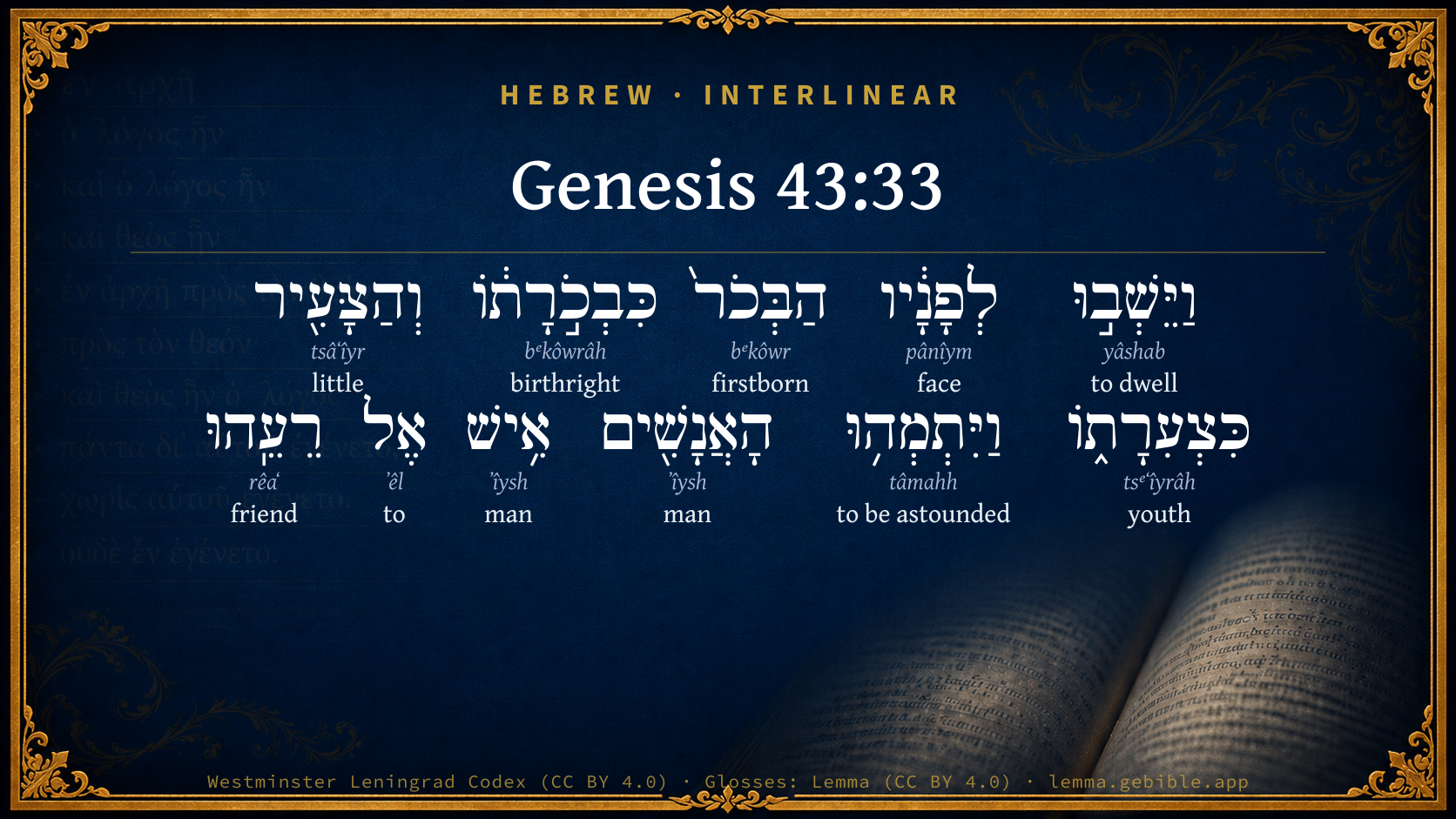
Hebrew (Westminster Leningrad Codex) Genesis 43:33 appears in the Hebrew Old Testament. The text above is from the Westminster Leningrad Codex. Each word links to its Strong’s number, a concise gloss, and parsing drawn from the Open Scriptures Hebrew Bible morphology. Click any word for its full Brown-Driver-Briggs (BDB) entry.
Download image
Cite this verse

Genesis 43:33 (World English Bible). Public Domain. Lemma interlinear Bible study tool, https://lemma.gebible.app/v/genesis/43/33.

Show BibTeX & RIS
BibTeX
RIS
English Translation
They sat before him, the firstborn according to his birthright, and the youngest according to his youth, and the men marveled one with another.
World English Bible · Public Domain
Highlights
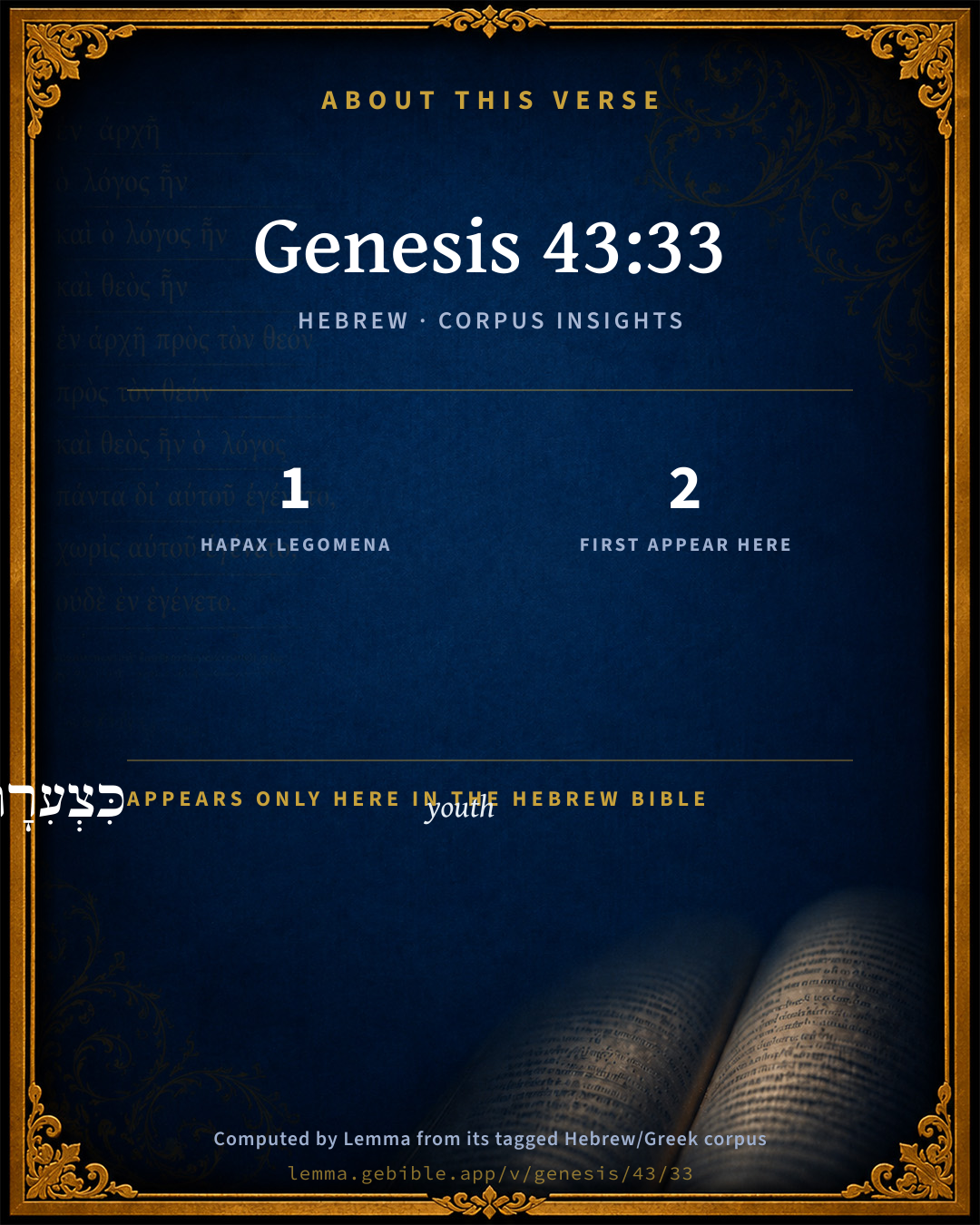
  • 1 hapax legomenon — only here in the Hebrew Bible
  • 2 first appearances in the Hebrew Bible
Full analysis ↓
Download a study sheet

One document with this verse’s original text, its word-by-word gloss line, the meaning frame, cross-references with their text, attributed commentary, and full source and license credits — printable, and it pastes into notes with its structure intact.

This verse Autodidact and up

Study sheet (.html) Plain text (.txt)

A passage Seminary Student

Up to 50 verses in one chapter. A passage sheet keeps up to 6 commentary sources and 12 cross-references per verse, in the order this page ranks them, and says so on the sheet whenever that leaves anything out. Ask for a single verse and you get the Autodidact verse sheet above.

Everything on this page stays free to read, with no account — the sheet is a download of what is already on screen, not access to it.

Want to remove ads? Support Godless Engineer
Compare translations 3

The same verse in 3 English versions, stacked beneath the original-language interlinear above. Click any original word for its lexicon entry.

Each is an independent rendering of the whole verse — the interlinear is not word-aligned to these translations.

Highlighted words mark where these versions differ — a whole-verse word diff, not a word-by-word alignment.

  • World English Bible Public Domain
    They sat before him, the firstborn according to his birthright, and the youngest according to his youth, and the men marveled one with another.
  • King James Version Public Domain
    And they sat before him, the firstborn according to his birthright, and the youngest according to his youth: and the men marveled one at another.
  • unfoldingWord Literal Text CC BY-SA 4.0
    And they were sitting before him, the firstborn according to his birthright and the youngest according to his youth, and the men were astonished each to his neighbor.

unfoldingWord Literal Text — © unfoldingWord, licensed CC BY-SA 4.0. Word-aligned USFM3 via Door43 (git.door43.org/unfoldingWord/en_ult).

Versions to compare (up to 4)

3 of 4 selected

Show all 18 translations

Every available English version of this verse, each an independent rendering of the whole verse.

  • World English Bible Public Domain
    They sat before him, the firstborn according to his birthright, and the youngest according to his youth, and the men marveled one with another.
  • Berean Standard Bible Public Domain
    They were seated before Joseph in order by age, from the firstborn to the youngest, and the men looked at one another in astonishment.
  • Majority Standard Bible Public Domain
    They were seated before Joseph in order by age, from the firstborn to the youngest, and the men looked at one another in astonishment.
  • King James Version Public Domain
    And they sat before him, the firstborn according to his birthright, and the youngest according to his youth: and the men marveled one at another.
  • American Standard Version (1901) Public Domain
    And they sat before him, the first-born according to his birthright, and the youngest according to his youth: and the men marvelled one with another.
  • Revised Version (1885) Public Domain
    And they sat before him, the firstborn according to his birthright, and the youngest according to his youth: and the men marveled one with another.
  • Geneva Bible (1599) Public Domain
    So they sate before him: the eldest according vnto his age, and the yongest according vnto his youth. and the men marueiled among themselues.
  • Douay-Rheims (1899) Public Domain
    They sat before him, the firstborn according to his birthright, and the youngest according to his age. And they wondered very much:
  • Young's Literal Translation Public Domain
    And they sit before him, the first-born according to his birthright, and the young one according to his youth, and the men wonder one at another;
  • Literal Standard Version CC BY-SA 4.0
    And they sit before him, the firstborn according to his birthright, and the young one according to his youth, and the men wonder one at another;
  • Unlocked Literal Bible CC BY-SA 4.0
    The brothers sat before him, the firstborn according to his birthright, and the youngest according to his youth. The men were astonished together.
  • unfoldingWord Literal Text CC BY-SA 4.0
    And they were sitting before him, the firstborn according to his birthright and the youngest according to his youth, and the men were astonished each to his neighbor.
  • Darby Bible Public Domain
    And they sat before him, the firstborn according to his birthright, and the youngest according to his youth; and the men marvelled one at another.
  • World Messianic Bible Public Domain
    They sat before him, the firstborn according to his birthright, and the youngest according to his youth, and the men marveled with one another.
  • Webster's Bible Public Domain
    \\43:34\\And he took and sent messes to them from before him: but Benjamin's mess was five times so much as any of theirs. And they drank, and were merry with him.
  • Free Bible Version CC BY-SA 4.0
    The brothers had been seated in front of him in order by age, from the firstborn, the oldest, down to the youngest, and they looked at each other in complete surprise.
  • Bible in Basic English Public Domain
    And Joseph sent food to them from his table, but he sent five times as much to Benjamin as to any of the others. And they took wine freely with him.
  • JPS Tanakh (1917) Public Domain
    And they sat before him, the firstborn according to his birthright, and the youngest according to his youth; and the men marvelled one with another.

Literal Standard Version (2020), Covenant Press — licensed CC BY-SA 4.0. Text via the HelloAO Bible API (eBible.org). Unlocked Literal Bible (unfoldingWord) — licensed CC BY-SA 4.0. Text via the HelloAO Bible API (eBible.org). unfoldingWord Literal Text — © unfoldingWord, licensed CC BY-SA 4.0. Word-aligned USFM3 via Door43 (git.door43.org/unfoldingWord/en_ult). Free Bible Version, Dr. Jonathan Gallagher — licensed CC BY-SA 4.0. Text via the HelloAO Bible API (eBible.org).

Word by word

More ways to search: Search by grammar → Find every occurrence → Compare this word →

Practice this passage: Drill this verse → Learn its vocabulary →

כִּצְעִרָת֑וֹ
tsᵉʻîyrâh
H6812
“like/as · youth · his”
Preposition + Noun, Common, Feminine, Singular, Construct + Suffix, Personal, 3rd Person, Masculine, Singular
Part of Speech
Preposition + Noun
Type
Common
Gender
Feminine
Number
Singular
State
Construct
Full BDB Definition

Origin: from H6810

TWOT: 1948b

youth
  1. וַיֵּשְׁב֣וּ yâshab H3427 “and · to dwell” Conjunction + Verb, Qal, Sequential Imperfect, 3rd Person, Masculine, Plural
  2. לְפָנָ֔יו pânîym H6440 “to/for · face(s) · his” Preposition + Noun, Common, Both, Plural, Construct + Suffix, Personal, 3rd Person, Masculine, Singular
  3. הַבְּכֹר֙ bᵉkôwr H1060 “the · firstborn” Particle, Definite Article + Noun, Common, Masculine, Singular, Absolute
  4. כִּבְכֹ֣רָת֔וֹ bᵉkôwrâh H1062 “like/as · birthright · his” Preposition + Noun, Common, Both, Singular, Construct + Suffix, Personal, 3rd Person, Masculine, Singular
  5. וְהַצָּעִ֖יר tsâʻîyr H6810 “and · the · little” Conjunction + Particle, Definite Article + Adjective, Adjective, Masculine, Singular, Absolute
  6. וַיִּתְמְה֥וּ tâmahh H8539 “and · to be astounded” Conjunction + Verb, Qal, Sequential Imperfect, 3rd Person, Masculine, Plural
  7. הָאֲנָשִׁ֖ים ʼîysh H376 “the · men” Particle, Definite Article + Noun, Common, Masculine, Plural, Absolute
  8. אִ֥ישׁ ʼîysh H376 “man” Noun, Common, Masculine, Singular, Absolute
  9. אֶל ʼêl H413 “to” Preposition
  10. רֵעֵֽהוּ rêaʻ H7453 “friend · his” Noun, Common, Masculine, Singular, Construct + Suffix, Personal, 3rd Person, Masculine, Singular

About this verse

These counts appear in no published source. They are computed here, from the morphology-tagged text and Lemma’s own curated glosses. What Lemma adds →

11
words
10
distinct lemmas
Pentateuch
section

Notable vocabulary

1 hapax legomenon — a word that appears only here in the entire Hebrew Bible:

  • כִּצְעִרָת֑וֹ youth H6812

First appearance in Scripture

These words make their first canonical appearance in the Hebrew Bible here:

  • כִּצְעִרָת֑וֹ youth H6812
  • וַיִּתְמְה֥וּ to be astounded H8539

Shared distinctive vocabulary

וַיִּתְמְה֥וּ to be astounded H8539 occurs in 8 verses of the Hebrew Bible. Also found in:

Grammatical profile

  • 2 verbs
  • 7 nouns
  • 1 adjective
  • 1 preposition

Verb forms

  • וַיֵּשְׁב֣וּ Qal · Sequential Imperfect
  • וַיִּתְמְה֥וּ Qal · Sequential Imperfect

Repetition

A word recurs within this verse — often emphatic in Hebrew:

  • הָאֲנָשִׁ֖ים man H376 ×2

Hebrew & Septuagint length

In English translation the verse runs 24 words from the Hebrew and 29 from the Septuagint (LXX English) — closely comparable.

A rough comparison of the two English renderings, which tokenize alike — not a word-level alignment.

Word counts can differ between the Hebrew and the Greek without any difference in meaning — e.g. the Hebrew direct-object marker אֵת has no separate Greek word, and Greek often adds the article ὁ.

Hebrew and Greek witnesses Masoretic Hebrew ↔ Greek Septuagint

The same verse in the two great witnesses to the Old Testament, shown verse-for-verse.

These are two independent witnesses, not word-aligned to each other, and the Septuagint is shown in lemma (dictionary) form.

Hebrew Genesis 43:33 Masoretic · Westminster Leningrad Codex

וַיֵּשְׁב֣וּ לְפָנָ֔יו הַבְּכֹר֙ כִּבְכֹ֣רָת֔וֹ וְהַצָּעִ֖יר כִּצְעִרָת֑וֹ וַיִּתְמְה֥וּ הָאֲנָשִׁ֖ים אִ֥ישׁ אֶל רֵעֵֽהוּ

They sat before him, the firstborn according to his birthright, and the youngest according to his youth, and the men marveled one with another.

World English Bible · Public Domain

Greek LXX Genesis 43:33 Septuagint · lemma form

καταἵζω δέ ἐναντίον αὐτός ὁ πρωτότοκος κατά ὁ πρεσβεῖον αὐτός καί ὁ νέος κατά ὁ νεότης αὐτός ἐκἵστημι δέ ὁ ἄνθρωπος ἕκαστος πρός ὁ ἀδελφός αὐτός

And they sat before him, the firstborn according to his seniority, and the younger according to his youth; and the men looked with amazement every one at his brother.

LXX2012 (modern English Septuagint) · Public Domain

Hebrew: Westminster Leningrad Codex (CC BY 4.0). Greek: Septuagint (public domain); English from LXX2012 (modern English Septuagint) (Public Domain). How the Septuagint differs from the Hebrew →

Targum (Aramaic paraphrase)

2

The Targum is the ancient Jewish Aramaic paraphrase of the Hebrew Scriptures — an interpretive translation, not the Hebrew text itself. Onkelos (literal) and Pseudo-Jonathan (expansive) render the Torah, and Jonathan the Prophets. Coverage is partial: where no permissively-licensed English translation exists for a verse, only the Aramaic is shown. This is verse-level text, not a word-by-word alignment to the Hebrew.

  1. Targum Onkelos Torah (Genesis–Deuteronomy)
    וְאַסְחָרוּ קֳדָמוֹהִי רַבָּא כְּרַבְיוּתֵהּ וּזְעִירָא כִּזְעֵרוּתֵהּ וּתְמָהוּ גֻּבְרַיָּא גְּבַר לְחַבְרֵהּ

    (no public-domain English translation for this verse)

    Targum Onkelos — Aramaic: “Onkelos Genesis” (public domain); “Onkelos Exodus” (public domain); “Onkelos Leviticus” (public domain); “Onkelos Numbers” (public domain); “Onkelos Deuteronomy” (public domain). English: “Sefaria Community Translation” (CC0 1.0 (public-domain dedication)); “J.W. Etheridge. The Targums of Onkelos and Jonathan Ben Uzziel on the Pentateuch. London: Longmans, Green, 1862” (public domain). Text via Sefaria.

  2. Targum Pseudo-Jonathan Torah (Genesis–Deuteronomy)
    וְאַחְזָרוּ קֳדָמוֹי רַבָּא כְּהִלְכַת רַבָּנוֹתֵיהּ וּזְעֵירָא כְּהִלְכַת זְעֵירוֹתֵיהּ וַהֲוָה נָקִיט כַּסָא דְכַסְפָּא בִּידֵיהּ וּמְקַשְׁקֵשׁ כִּמְנַחֵשׁ בְּנָהָא דְלֵאָה סָדַר מִצִיטְרָא חָדָא וּבְנָהָא דְזִלְפָּה מִצִיטְרָא חָדָא וּבְנָהָא דְבִלְהָה מִצִיטְרָא חָדָא וּבִנְיָמִין בַּר רָחֵל סָדַר לְצִיטְרֵיהּ וְתַמְהוּ גוּבְרַיָא אֵינַשׁ בְּחַבְרֵיהּ

    And they sat around him, the greatest according to his majority, and the less according to his minority. For he had taken the silver cup in his hand, and, sounding as if divining he had set in order the sons of Leah on one side, and the sons of Zilpha on the other side, and the sons of Bilhah on another side, and Benjamin the son of Rahel he ordered by the side of himself. And the men wondered each at the other.

    Targum Pseudo-Jonathan — Aramaic: “Targum Jonathan on Genesis” (public domain); “Targum Jonathan on Exodus” (public domain); “Targum Jonathan on Leviticus” (public domain); “Targum Jonathan on Numbers” (public domain); “Targum Jonathan on Deuteronomy” (public domain). English: “The Targum of Jonathan ben Uzziel, trans. J. W. Etheridge, London, 1862” (public domain). Text via Sefaria.

Commentary

Notes on Genesis 43:33 from classic Christian and Jewish commentators (each source and its license shown beneath its notes). The classic Christian expositions comment on the surrounding passage and are grouped to its opening verse, so a note may address several verses; the Jewish commentaries on the Tanakh (Rashi and others) are per-verse, so they appear only where the commentator wrote on this verse.

Lemma curates 59 commentaries, every one of them public domain or Creative Commons licensed, each selected and text-cleaned for this edition rather than reprinted as found. About our sources →

Trapp's Complete Commentary

John Trapp

Gen 43:33 And they sat before him, the firstborn according to his birthright, and the youngest according to his youth: and the men marvelled one at another.

Ver 33. And they sat before him, &c.] He marshalled them in their right rank and degree; and this amazed them. He made them an absolute feast, such as Varro describes with these conditions; Si belli conveniant homines, si temporis sit habita ratio, si locus sit non ingratus, si non negligens apparatus. {a} This feast is of that sort in use among the Romans, that were called χαριστια, to which were invited none but kinsfolks, to continue love and seek reconciliation where had been any breach. {b}

{a} In Veter. Fragm.

{b} Val. Max., lib. ii. cap. 1.

John Trapp, A Commentary or Exposition upon All the Books of the Old and New Testament (1647–1656) — public domain. Text from a community e-Sword module.

Joseph Benson's Commentary

Gen 43:33. The men marvelled one at another — They were greatly surprised how he should know their respective ages, so as to place them, or cause them to sit down, exactly according to their seniority, as if he could certainly divine. Some, indeed, think they placed themselves so, according to their custom; but if so, why should particular notice be taken of it? And why should they marvel at it? This was, as it were, a preparative to the discovery of himself.

Joseph Benson's Commentary on the Old and New Testaments (1811–1818) — public domain. Text from a community e-Sword module.

Tyndale Open Study Notes

Tyndale Open Resources

43:33 to their amazement: This ruler knew more about the brothers than seemed possible (cp. 44:15).

Tyndale Open Study Notes — © Tyndale Open Resources, licensed CC BY-SA 4.0. Text via the HelloAO Bible API.

Adam Clarke's Commentary

Verse 33. The first-born according to his birthright] This must greatly astonish these brethren, to find themselves treated with so much ceremony, and at the same time with so much discernment of their respective ages.

Adam Clarke's Commentary on the Bible (1810–1826) — public domain. Text from a community e-Sword/MySword module.

John Calvin's Commentaries

33. The first-born according to his birthright Although of the sons of Jacob four were born of bond-women; yet, since they were the elder, they had precedence of their younger brethren, who had descended from free-born mothers; whence it appears that they had been accustomed by their father to keep this order. What, then, some one may say, becomes of the declaration, “the son of the bond-woman shall not be heir with the son of the free-woman?” Truly, I think, since Ishmael was rejected, by the divine oracle proceeding from the mouth of Sarah, as Esau was afterwards, Jacob was fully taught that he had as many heirs as he had sons. Hence arose that equality which caused each to keep his place, first, middle, or last, according to his age. But the design of Moses was to show, that although Benjamin was the youngest, yet he was preferred to all the rest in honor; because Joseph could not refrain from giving him the principal token of his love. It was, indeed, his intention to remain unknown; but affection so far prevails, that, beyond the purpose of his mind, he suddenly breaks out into a declaration of his affection. From the concluding portion of the chapter we gather, what I recently intimated, that the feast was unusually luxurious, and that they were received to it, in a liberal and joyful manner, beyond the daily custom. For the word שכר (shakar,) they “were merry,” signifies, either that they were not always accustomed to drink wine, or that there was more than ordinary indulgence at the sumptuous tables spread for them. Here, however, no intemperance is implied, (so that drunkards may not plead the example of the holy fathers as a pretext for their crime,) but an honorable and moderate liberality. I acknowledge, indeed, that the word has a double meaning, and is often taken in an ill sense; as in Genesis 9:21, and in similar places: but in the present instance the design of Moses is clear. Should any one object, that a frugal use of food and drink is simply that which suffices for the nourishing of the body: I answer, although food is properly for the supply of our necessities, yet the legitimate use of it may proceed further. For it is not in vain, that our food has savor as well as vital nutriment; but thus our heavenly Father sweetly delights us with his delicacies. And his benignity is not in vain commended in Psalm 104:15, where he is said to create “wine that maketh glad the heart of man.” Nevertheless, the more kindly he indulges us, the more solicitously ought we to restrict ourselves to a frugal use of his gifts. For we know how unbridled are the appetites of the flesh. Whence it happens that, in abundance, it is almost always lascivious, and in penury, impatient. We must, however, adhere to St. Paul’s method, that we know how to abound and to suffer need; that is, we must take great care if we have unusual plenty, that it does not hurry us into luxury; and, on the other hand, we must see to it, that we bear poverty with an equal mind. Some one, perhaps, will say, that the flesh is more than sufficiently ingenious in giving a specious color to its excesses; and, therefore, nothing more should be allowed to it than necessity demands. And, truly, I confess, we must diligently attend to what Paul prescribes, (Romans 13:14,)

“Make not provision for the flesh to fulfill the lusts thereof.”

But because it greatly concerns all pious people to receive their food from the hand of God, with quiet consciences, it is necessary for them to know to what extent the use of food and wine is lawful.

John Calvin's Commentaries (1540-1563) — public domain. Text from the Calvin Translation Society English edition (1840s-50s) via the Christian Classics Ethereal Library (ccel.org). Calvin's coverage is partial (roughly two-thirds of the Bible); uncommented books and verses are honest gaps, never fabricated. The 19th-century editor's footnotes and remarks are omitted so the notes are faithfully Calvin's own voice.

Ellicott's Commentary for English Readers

(33) They sat.—The Egyptians are always represented on the monuments as sitting at their meals. For the Hebrew custom see Note on Gen_27:19. The brethren, on finding themselves placed according to their age, must have supposed that Joseph possessed powers of divination, especially as the giving of due precedence was and is looked upon in the East as a matter of high importance.

A Bible Commentary for English Readers, edited by Charles John Ellicott (1878–1897) — public domain. Text from a community e-Sword module.

The Cambridge Bible for Schools and Colleges

gen. ed. J. J. S. Perowne

33. marvelled] The men were mystified by their arrangement in order of birth. It suggested magic. It was one of the uncanny things that they could not account for.

The Cambridge Bible for Schools and Colleges (gen. ed. J. J. S. Perowne; Cambridge University Press, 1878–1918) — public domain. Text from a community e-Sword module.

John Gill's Exposition

And he took and sent messes unto there from before him,.... The several dishes were brought before him, who cut them up, and sent to everyone their part and portion, as was usual in those times and countries, and afterwards elsewhere (e), for the master of the family or feast to divide the food into parts, and to give to every guest his part; and these were called, from their being sent, "missus", and from whence seems to be our English word "messes", here used:

but Benjamin's mess was five times so much as any of theirs; which was done out of his great affection to him, being his own brother both by father and mother's side; and, as some think, to try his brethren, how they stood affected to Benjamin, and observe if this did not raise their envy to him, as his father's particular respect to him had raised it in them against himself; and that, if it should, he might provide for his safety, lest they should use him in like manner as they had used him. This undoubtedly was designed as a peculiar favour, and a mark of special honour and respect, it being usual for princes to send messes from their tables to such as they favoured; and particularly it was usual with the Egyptians for their kings to have double messes more than the rest, in honour of them, as Herodotus (f) relates: Benjamin's mess consisted either of five parts, or it was five times bigger than what was sent to the rest; not but that they had all what was sufficient; there was no want to any, but great plenty of everything for them all; nor was this designed Benjamin, that he should eat the larger quantity, only to show him distinguishing respect:

and they drank, and were merry with him; after dinner they drank wine liberally and plentifully, but not to excess and intemperance, yet so as to be cheerful and in good spirits; their fears being all dissipated by this generous entertainment they met with.

(e) Athenaei Deipnosophist. l. 1. (f) Erato, sive, l. 6. c. 57.

Next: Genesis Chapter 44

John Gill's Exposition of the Whole Bible (1746–1763) — public domain (CC PDM 1.0). Text via the HelloAO Bible API.

Haydock's Catholic Bible Commentary

They sat. This posture is more ancient than that of lying down at table. The Hebrews adopted the latter, from the Persians, during the captivity, Esther i. 6, and vii. 8. --- We have at least no earlier vestige of this custom in Scripture. (Calmet) --- Very much: as they were placed in that order by the steward. They knew not how he could so exactly discover who was born first, as there was so short an interval between the births of many of them. (Haydock)

George Leo Haydock (1774–1849), Haydock's Catholic Family Bible and Commentary, 1859 edition — public domain. Excludes Psalms (Douay-Rheims chapter numbering differs from Protestant) and Deuterocanonical books (Catholic canon only).

Matthew Poole's English Annotations

The youngest according to his youth; being so placed either by Joseph’s appointment; or rather by their own choice, and according to their custom; by which the elder, though the handmaidens’ children, took place of the younger, who by that order were taught what veneration they owe to the aged, and how great a sin it is, though very customary, in young men to despise those whom they should reverence.

The men, not the Egyptians, but the Hebrews, the men last spoken of,

marvelled; either at the matter and manner of the feasts and entertainments of the Egyptians; or rather, at the singular honour which Joseph did to them above all others, the reason whereof they could not conceive, and therefore marvelled at it.

Matthew Poole's English Annotations on the Holy Bible (1683–1685) — public domain. Text from a community e-Sword/MySword module.

Whedon's Commentary on the Bible

Daniel D. Whedon

33. According to his birthright — Well might the men marvel at being arranged at the table thus according to their ages. Joseph thus prepared the way for an open recognition, and sought to impress them with the idea that he knew them better than they imagined.

Daniel D. Whedon (gen. ed.), Commentary on the Old and New Testaments (1874–1909) — public domain. Text from a community e-Sword module.

The Pulpit Commentary

And they sat before him, that the Egyptians sat at meals is in exact accordance With the representations on the monuments, in which they are never exhibited as reposing on couches, but always as seated round a circular table resembling the mono-podium of the Romans (vide Wilkinson, "Ancient Egyptians," vol. 2. pp. 40, 41, with Dr. Bitch"s note; Hengetenberg"s "Egypt and the Books of Moses," Genesis 1. p. 38)the firstborn according to his birthright, and the youngest according to his youth: and the men marveled one at another probably thinking that Joseph must have been supernaturally enlightened to discover so exactly the ages of strangers.

The Pulpit Commentary (1880–1919), ed. H.D.M. Spence-Jones & Joseph S. Exell — public domain. Text from a community e-Sword module.

John Wesley's Explanatory Notes

He placed his brethren according to their seniority, as if he could certainly divine. Some think they placed themselves so according to their custom; but if so, I see not why such particular notice is taken of it, especially as a thing they marvelled at.

John Wesley, Explanatory Notes Upon the Whole Bible (1754–1765) — public domain. Text via the GEBible commentary corpus.

Rashi

Rabbi Shlomo Yitzchaki (Rashi)

הבכור כבכרתו THE FIRST-BORN ACCORDING TO HIS BIRTHRIGHT — He struck the goblet and called aloud: Reuben, Simeon, Levi, Judah, Issachar and Zebulon, sons of one mother, take your seats at the table in this order which is the order in which you were born — and similarly in the case of them all. When he reached Benjamin’s name he said, “This one has no mother and I have no mother — let him sit beside me” (Genesis Rabbah 92:5).

Rashi on the Tanakh — English translations: “The Judaica Press complete Tanach with Rashi, translated by A. J. Rosenberg” (CC BY 4.0); “Pentateuch with Rashi's commentary by M. Rosenbaum and A.M. Silbermann, 1929-1934” (public domain); “The Metsudah Tanach series, Lakewood, N.J” (CC BY 4.0); and “The Book of Joshua, Metsudah Publications, 1997” (CC BY 4.0). Text via Sefaria.

Radak

Rabbi David Kimhi (Radak)

וישבו לפניו, in the order in which Joseph had given instructions to seat them.

הבכור כבכורתו ויתמהו, the oldest in accordance with his seniority etc. They were amazed. They could not explain to themselves how Joseph had known their respective ages seeing that only seven years separated all of them from the oldest except for Binyamin, whom they had described as the youngest so that Joseph knew about him. According to Bereshit Rabbah 92,5 Joseph had made a great pretense of consulting the goblet he used to drink from to determine the seating arrangement to correspond with their importance. He would claim that seeing that Yehudah was destined to become a king, he should sit at the head of the brothers. Reuven who was the biological senior of the brothers should sit next to Yehudah. He would continue in this fashion, explaining the reason why he had chosen to seat the brothers in the sequence he assigned to them. When he came to Binyamin, he said: “seeing that I have no mother and he has no mother let him sit closest to me.” No wonder that the brothers were utterly confused by this.

Radak on the Tanakh — English translations: “Sefaria Community Translation” (CC0 1.0 (public-domain dedication)); “Eliyahu Munk, HaChut Hameshulash” (CC BY 4.0); “Rabbi Mike Feuer, Jerusalem Anthology” (CC BY 4.0); and “R. David Kimhi on the first book of Psalms, Translated by R.G. Finch, London, 1919” (public domain). Text via Sefaria.

Lesson kit

Teaching starters — assembled from the data on this page, not authored interpretation. Every prompt links to the verse data it draws on. Edit before teaching.

Genesis, in the Pentateuch, opens this verse with 11 words (10 distinct Hebrew lemmas). Its most distinctive word is tsᵉʻîyrâh (“youth”). A historical commentator’s framing appears above. Read the whole chapter for the surrounding context.

Discussion questions

  1. How does “youth” (tsᵉʻîyrâh) shape what this verse is saying?
  2. 1 word here appears nowhere else in the Hebrew Bible. Why might the author reach for such rare wording?
  3. 2 words make their first appearance in Scripture here. What does this debut establish?
  4. How does Job 26:11, which shares the word «to be astounded», read alongside this verse?
  5. What does the repetition of “man” (2× in this one verse) do in this verse?
  6. These translations render this verse differently. What is at stake in choosing one wording over another?
  7. «וַיֵּשְׁב֣וּ» is a Qal Sequential Imperfect verb. How does that grammatical form shape the action described?
  8. Compare how Trapp's Complete Commentary and Joseph Benson's Commentary read this verse. Where do they agree or differ?

Things to notice

  • 1 word in this verse appears nowhere else in the Hebrew Bible.
  • 2 words make their first canonical appearance in Scripture here.
  • These translations choose different wording for 8 words in this verse.
  • “man” occurs 2× in this single verse.
  • 10 distinct Hebrew lemmas span 11 words in this verse.

Reading settings

Reading text

Shown beneath each verse's original-language words.

Old Testament
Old Testament edition

Read the OT as the Masoretic Hebrew (MT) or the Greek Septuagint (LXX).

English shown for the Greek Septuagint (in the Hebrew ↔ Greek comparison).

Comparing translations? Open the Compare panel on any verse page to stack up to four side by side.