
Genesis 47:6

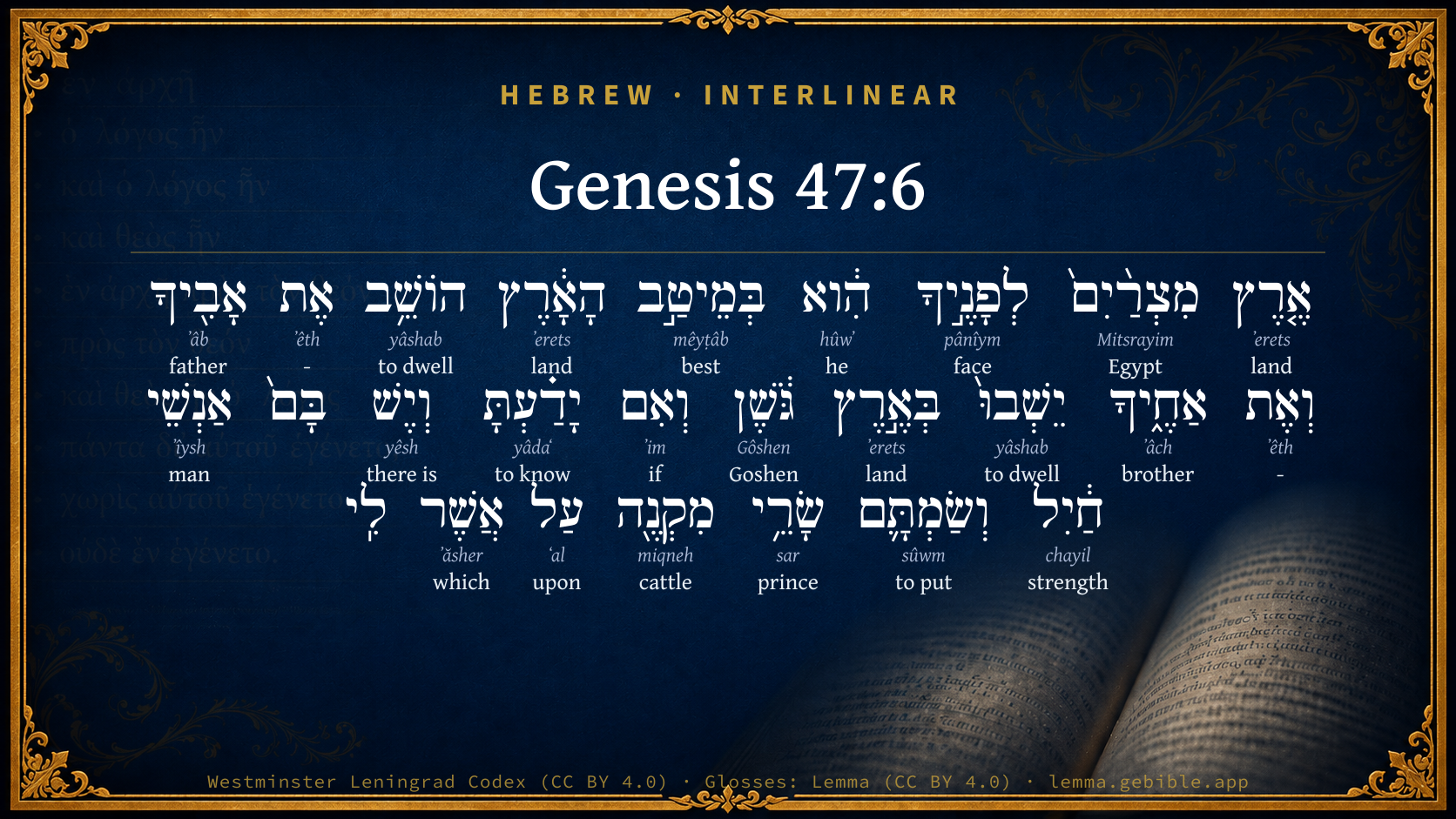
Hebrew (Westminster Leningrad Codex) Genesis 47:6 appears in the Hebrew Old Testament. The text above is from the Westminster Leningrad Codex. Each word links to its Strong’s number, a concise gloss, and parsing drawn from the Open Scriptures Hebrew Bible morphology. Click any word for its full Brown-Driver-Briggs (BDB) entry.
Download image
Cite this verse

Genesis 47:6 (World English Bible). Public Domain. Lemma interlinear Bible study tool, https://lemma.gebible.app/v/genesis/47/6.

Show BibTeX & RIS
BibTeX
RIS
English Translation
The land of Egypt is before you. Make your father and your brothers dwell in the best of the land. Let them dwell in the land of Goshen. If you know any able men among them, then put them in charge of my cattle."
World English Bible · Public Domain
Highlights Full analysis ↓
Download a study sheet

One document with this verse’s original text, its word-by-word gloss line, the meaning frame, cross-references with their text, attributed commentary, and full source and license credits — printable, and it pastes into notes with its structure intact.

This verse Autodidact and up

Study sheet (.html) Plain text (.txt)

A passage Seminary Student

Up to 50 verses in one chapter. A passage sheet keeps up to 6 commentary sources and 12 cross-references per verse, in the order this page ranks them, and says so on the sheet whenever that leaves anything out. Ask for a single verse and you get the Autodidact verse sheet above.

Everything on this page stays free to read, with no account — the sheet is a download of what is already on screen, not access to it.

Want to remove ads? Support Godless Engineer
Compare translations 3

The same verse in 3 English versions, stacked beneath the original-language interlinear above. Click any original word for its lexicon entry.

Each is an independent rendering of the whole verse — the interlinear is not word-aligned to these translations.

Highlighted words mark where these versions differ — a whole-verse word diff, not a word-by-word alignment.

  • World English Bible Public Domain
    The land of Egypt is before you. Make your father and your brothers dwell in the best of the land. Let them dwell in the land of Goshen. If you know any able men among them, then put them in charge of my cattle."
  • King James Version Public Domain
    The land of Egypt is before thee; in the best of the land make thy father and brethren to dwell; in the land of Goshen let them dwell: and if thou knowest any men of activity among them, then make them rulers over my cattle.
  • unfoldingWord Literal Text CC BY-SA 4.0
    The land of Egypt before you. Settle your father and your brothers in the best land; let them settle in the land of Goshen. And if you know that there are men of ability among them, then appoint them overseers of livestock over that to me.”

unfoldingWord Literal Text — © unfoldingWord, licensed CC BY-SA 4.0. Word-aligned USFM3 via Door43 (git.door43.org/unfoldingWord/en_ult).

Versions to compare (up to 4)

3 of 4 selected

Show all 18 translations

Every available English version of this verse, each an independent rendering of the whole verse.

  • World English Bible Public Domain
    The land of Egypt is before you. Make your father and your brothers dwell in the best of the land. Let them dwell in the land of Goshen. If you know any able men among them, then put them in charge of my cattle."
  • Berean Standard Bible Public Domain
    the land of Egypt is before you; settle your father and brothers in the best part of the land. They may dwell in the land of Goshen. And if you know of any talented men among them, put them in charge of my own livestock.”
  • Majority Standard Bible Public Domain
    the land of Egypt is before you; settle your father and brothers in the best part of the land. They may dwell in the land of Goshen. And if you know of any talented men among them, put them in charge of my own livestock.”
  • King James Version Public Domain
    The land of Egypt is before thee; in the best of the land make thy father and brethren to dwell; in the land of Goshen let them dwell: and if thou knowest any men of activity among them, then make them rulers over my cattle.
  • American Standard Version (1901) Public Domain
    the land of Egypt is before thee; in the best of the land make thy father and thy brethren to dwell; in the land of Goshen let them dwell: and if thou knowest any able men among them, then make them rulers over my cattle.
  • Revised Version (1885) Public Domain
    the land of Egypt is before thee; in the best of the land make thy father and thy brethren to dwell; in the land of Goshen let them dwell: and if thou knowest any able men among them, then make them rulers over my cattle.
  • Geneva Bible (1599) Public Domain
    The lande of Egypt is before thee: in the best place of the land make thy father and thy brethren dwel: let the dwel in the land of Goshen: and if thou knowest that there be men of actiuitie among them, make them rulers ouer my cattell.
  • Douay-Rheims (1899) Public Domain
    The land of Egypt is before thee: make them dwell in the best place, and give them the land of Gessen. And if thou knowest that there are industrious men among them, make them rulers over my cattle.
  • Young's Literal Translation Public Domain
    the land of Egypt is before thee; in the best of the land cause thy father and thy brethren to dwell -- they dwell in the land of Goshen, and if thou hast known, and there are among them men of ability, then thou hast set them heads over the cattle I have.'
  • Literal Standard Version CC BY-SA 4.0
    the land of Egypt is before you; cause your father and your brothers to dwell in the best of the land—they dwell in the land of Goshen, and if you have known, and there are among them men of ability, then you have set them [as] heads over the livestock I have.”
  • Unlocked Literal Bible CC BY-SA 4.0
    The land of Egypt is before you. Settle your father and your brothers in the best region, the land of Goshen. If you know any capable men among them, put them in charge of my livestock.”
  • unfoldingWord Literal Text CC BY-SA 4.0
    The land of Egypt before you. Settle your father and your brothers in the best land; let them settle in the land of Goshen. And if you know that there are men of ability among them, then appoint them overseers of livestock over that to me.”
  • Darby Bible Public Domain
    The land of Egypt is before thee; in the best of the land settle thy father and thy brethren: let them dwell in the land of Goshen. And if thou knowest men of activity among them, then set them as overseers of cattle over what I have.
  • World Messianic Bible Public Domain
    The land of Egypt is before you. Make your father and your brothers dwell in the best of the land. Let them dwell in the land of Goshen. If you know any able men among them, then put them in charge of my livestock.”
  • Webster's Bible Public Domain
    The land of Egypt is before thee; in the best of the land make thy father and brethren to dwell; in the land of Goshen let them dwell; and if thou knowest any men of activity among them, then make them rulers over my cattle.
  • Free Bible Version CC BY-SA 4.0
    you can choose wherever you like in Egypt, the best place, for them to live. Let them live in Goshen. If you know any of them who are good at what they do, put them in charge of my livestock as well.”
  • Bible in Basic English Public Domain
    And Jacob and his sons came to Joseph in Egypt, and when word of it came to the ears of Pharaoh, king of Egypt, he said to Joseph, Your father and brothers have come to you; all the land of Egypt is before you; let your father and your brothers have the best of the land for their resting-place.
  • JPS Tanakh (1917) Public Domain
    the land of Egypt is before thee; in the best of the land make thy father and thy brethren to dwell; in the land of Goshen let them dwell. And if thou knowest any able men among them, then make them rulers over my cattle.'

Literal Standard Version (2020), Covenant Press — licensed CC BY-SA 4.0. Text via the HelloAO Bible API (eBible.org). Unlocked Literal Bible (unfoldingWord) — licensed CC BY-SA 4.0. Text via the HelloAO Bible API (eBible.org). unfoldingWord Literal Text — © unfoldingWord, licensed CC BY-SA 4.0. Word-aligned USFM3 via Door43 (git.door43.org/unfoldingWord/en_ult). Free Bible Version, Dr. Jonathan Gallagher — licensed CC BY-SA 4.0. Text via the HelloAO Bible API (eBible.org).

Word by word

More ways to search: Search by grammar → Find every occurrence → Compare this word →

Practice this passage: Drill this verse → Learn its vocabulary →

בְּמֵיטַ֣ב
mêyṭâb
H4315
“in/at · best of”
Preposition + Noun, Common, Masculine, Singular, Construct
Part of Speech
Preposition + Noun
Type
Common
Gender
Masculine
Number
Singular
State
Construct
Full BDB Definition

Origin: from H3190

TWOT: 863a

the best - as superlative
  1. אֶ֤רֶץ ʼerets H776 “land of” Noun, Common, Both, Singular, Construct
  2. מִצְרַ֨יִם֙ Mitsrayim H4714 “Egypt” Noun, Proper
  3. לְפָנֶ֣יךָ pânîym H6440 “to/for · face(s) · your” Preposition + Noun, Common, Both, Plural, Construct + Suffix, Personal, 2nd Person, Masculine, Singular
  4. הִ֔וא hûwʼ H1931 “he” Pronoun, Personal, 3rd Person, Feminine, Singular
  5. הָאָ֔רֶץ ʼerets H776 “the · land” Particle, Definite Article + Noun, Common, Both, Singular, Absolute
  6. הוֹשֵׁ֥ב yâshab H3427 “dwell” Verb, Hiphil, Imperative, 2nd Person, Masculine, Singular
  7. אֶת ʼêth H853 “-” Particle, Direct Object
  8. אָבִ֖יךָ ʼâb H1 “father · your” Noun, Common, Masculine, Singular, Construct + Suffix, Personal, 2nd Person, Masculine, Singular
  9. וְאֶת ʼêth H853 “and · -” Conjunction + Particle, Direct Object
  10. אַחֶ֑יךָ ʼâch H251 “brothers · your” Noun, Common, Masculine, Plural, Construct + Suffix, Personal, 2nd Person, Masculine, Singular
  11. יֵשְׁבוּ֙ yâshab H3427 “to dwell” Verb, Qal, Imperfect, 3rd Person, Masculine, Plural
  12. בְּאֶ֣רֶץ ʼerets H776 “in/at · land of” Preposition + Noun, Common, Both, Singular, Construct
  13. גֹּ֔שֶׁן Gôshen H1657 “Goshen” Noun, Proper
  14. וְאִם ʼim H518 “and · if” Conjunction + Conjunction
  15. יָדַ֗עְתָּ yâdaʻ H3045 “to know” Verb, Qal, Perfect, 2nd Person, Masculine, Singular
  16. וְיֶשׁ yêsh H3426 “and · there is” Conjunction + Particle, Demonstrative
  17. אַנְשֵׁי ʼîysh H376 “men of” Noun, Common, Masculine, Plural, Construct
  18. חַ֔יִל chayil H2428 “strength” Noun, Common, Masculine, Singular, Absolute
  19. וְשַׂמְתָּ֛ם sûwm H7760 “and · to put · them” Conjunction + Verb, Qal, Sequential Perfect, 2nd Person, Masculine, Singular + Suffix, Personal, 3rd Person, Masculine, Plural
  20. שָׂרֵ֥י sar H8269 “princes of” Noun, Common, Masculine, Plural, Construct
  21. מִקְנֶ֖ה miqneh H4735 “cattle” Noun, Common, Masculine, Singular, Absolute
  22. עַל ʻal H5921 “upon” Preposition
  23. אֲשֶׁר ʼăsher H834 “which” Particle, Relative

About this verse

These counts appear in no published source. They are computed here, from the morphology-tagged text and Lemma’s own curated glosses. What Lemma adds →

26
words
20
distinct lemmas
Pentateuch
section

Notable vocabulary

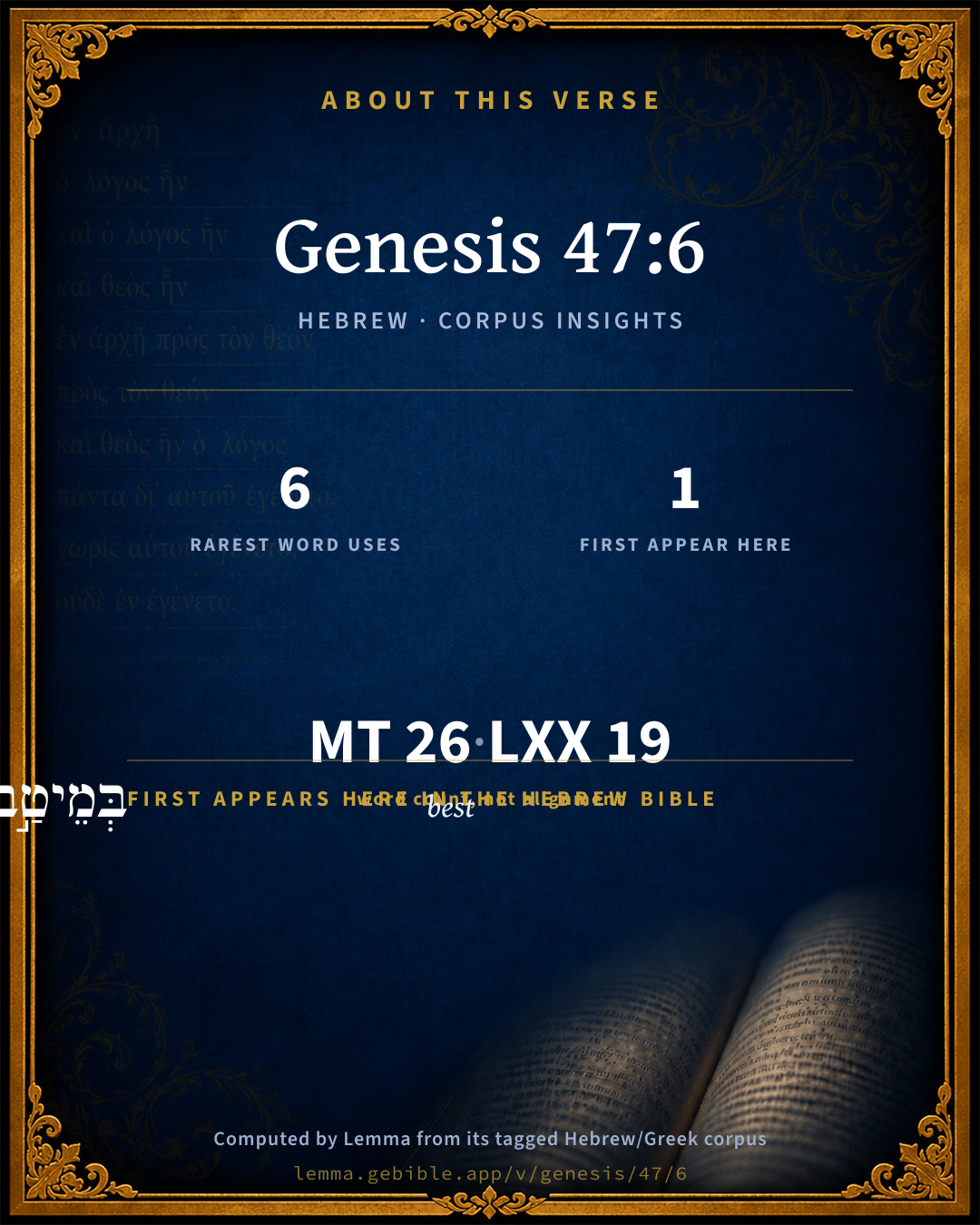
The rarest word here is בְּמֵיטַ֣ב best H4315 — appearing just 6 times in the whole Hebrew Bible.

First appearance in Scripture

This word makes its first canonical appearance in the Hebrew Bible here:

  • בְּמֵיטַ֣ב best H4315

Shared distinctive vocabulary

בְּמֵיטַ֣ב best H4315 occurs in 5 verses of the Hebrew Bible. Also found in:

Grammatical profile

  • 4 verbs
  • 13 nouns
  • 1 pronoun
  • 3 prepositions
  • 1 conjunction
  • 4 particles

Verb forms

  • הוֹשֵׁ֥ב Hiphil · Imperative
  • יֵשְׁבוּ֙ Qal · Imperfect
  • יָדַ֗עְתָּ Qal · Perfect
  • וְשַׂמְתָּ֛ם Qal · Sequential Perfect

Repetition

Words recur within this verse — often emphatic in Hebrew:

  • אֶ֤רֶץ land H776 ×3
  • הוֹשֵׁ֥ב to dwell H3427 ×2

Hebrew & Septuagint length

In English translation the verse runs 44 words from the Hebrew and 18 from the Septuagint (LXX English) — the Septuagint runs noticeably shorter here. See the side-by-side →

A rough comparison of the two English renderings, which tokenize alike — not a word-level alignment.

Word counts can differ between the Hebrew and the Greek without any difference in meaning — e.g. the Hebrew direct-object marker אֵת has no separate Greek word, and Greek often adds the article ὁ.

In the original languages it is 26 Hebrew tokens and 19 Greek tokens — but the two are counted differently (Hebrew bundles its prefixes and suffixes into one token; the Greek is in lemma form), so that isn’t a like-for-like length.

Cross-references

18

Topical passages linked to Genesis 47:6 in the Treasury of Scripture Knowledge — connected by theme and wording, ordered by reader-vote popularity; previews shown in the World English Bible.

  • Genesis 47:11 Joseph placed his father and his brothers, and gave them a possession in the land of Egypt, in the best of the land, in the land of Rameses, as Pharaoh had commanded.
  • Exodus 18:21 Moreover you shall provide out of all the people able men, such as fear God: men of truth, hating unjust gain; and place such over them, to be rulers of thousands, rulers of hundreds, rulers of fifties, and rulers of tens.
  • Proverbs 22:29 Do you see a man skilled in his work? He will serve kings; He won't serve obscure men.
  • Genesis 47:4 They said to Pharaoh, "We have come to live as foreigners in the land, for there is no pasture for your servants' flocks. For the famine is severe in the land of Canaan. Now therefore, please let your servants dwell in the land of Goshen."
  • Exodus 18:25 Moses chose able men out of all Israel, and made them heads over the people, rulers of thousands, rulers of hundreds, rulers of fifties, and rulers of tens.
  • 2 Chronicles 26:10 He built towers in the wilderness, and hewed out many cisterns, for he had much cattle; in the lowland also, and in the plain: [and he had] farmers and vineyard keepers in the mountains and in the fruitful fields; for he loved farming.
  • Genesis 13:9 Isn't the whole land before you? Please separate yourself from me. If you go to the left hand, then I will go to the right. Or if you go to the right hand, then I will go to the left."
  • Genesis 20:15 Abimelech said, "Behold, my land is before you. Dwell where it pleases you."
  • Genesis 34:10 You shall dwell with us: and the land will be before you. Live and trade in it, and get possessions in it."
  • Genesis 45:18–20 Take your father and your households, and come to me, and I will give you the good of the land of Egypt, and you will eat the fat of the land.'
  • Genesis 47:16 Joseph said, "Give your cattle; and I will give you food for your cattle, if money fails."
  • Exodus 9:3–6 behold, the hand of Yahweh is on your cattle which are in the field, on the horses, on the donkeys, on the camels, on the herds, and on the flocks with a very grievous pestilence.
  • Exodus 9:10 They took ashes of the furnace, and stood before Pharaoh; and Moses sprinkled it up toward the sky; and it became a boil breaking forth with boils on man and on animal.
  • Exodus 9:21 Whoever didn't regard the word of Yahweh left his servants and his cattle in the field.
  • 1 Samuel 21:7 Now a certain man of the servants of Saul was there that day, detained before Yahweh; and his name was Doeg the Edomite, the best of the herdsmen who belonged to Saul.
  • 1 Chronicles 27:29–31 and over the herds that fed in Sharon was Shitrai the Sharonite: and over the herds that were in the valleys was Shaphat the son of Adlai:
  • Proverbs 21:1 The king's heart is in Yahweh's hand like the watercourses. He turns it wherever he desires.
  • John 17:2 even as you gave him authority over all flesh, he will give eternal life to all whom you have given him.

Cross-references courtesy of OpenBible.info (CC BY 4.0).

Hebrew and Greek witnesses Masoretic Hebrew ↔ Greek Septuagint

The same verse in the two great witnesses to the Old Testament, shown verse-for-verse.

Here the Septuagint runs noticeably shorter than the Hebrew — LXX2012 (modern English Septuagint) 18 words vs World English Bible 44. A rough length comparison of the two English translations, not a word-level alignment — read both below.

These are two independent witnesses, not word-aligned to each other, and the Septuagint is shown in lemma (dictionary) form.

Hebrew Genesis 47:6 Masoretic · Westminster Leningrad Codex

אֶ֤רֶץ מִצְרַ֨יִם֙ לְפָנֶ֣יךָ הִ֔וא בְּמֵיטַ֣ב הָאָ֔רֶץ הוֹשֵׁ֥ב אֶת אָבִ֖יךָ וְאֶת אַחֶ֑יךָ יֵשְׁבוּ֙ בְּאֶ֣רֶץ גֹּ֔שֶׁן וְאִם יָדַ֗עְתָּ וְיֶשׁ בָּם֙ אַנְשֵׁי חַ֔יִל וְשַׂמְתָּ֛ם שָׂרֵ֥י מִקְנֶ֖ה עַל אֲשֶׁר לִֽי

The land of Egypt is before you. Make your father and your brothers dwell in the best of the land. Let them dwell in the land of Goshen. If you know any able men among them, then put them in charge of my cattle."

World English Bible · Public Domain

Greek LXX Genesis 47:6 Septuagint · lemma form

ἰδού ὁ γῆ αἴγυπτος ἐναντίον σύ εἰμί ἐν ὁ βελτίων γῆ καταοἰκίζω ὁ πατήρ σύ καί ὁ ἀδελφός σύ

Behold, the land of Egypt is before you; settle your father and your brethren in the best land.

LXX2012 (modern English Septuagint) · Public Domain

On this verse, The Cambridge Bible for Schools and Colleges discusses the Septuagint’s reading. Read the note in Commentary ↓

Hebrew: Westminster Leningrad Codex (CC BY 4.0). Greek: Septuagint (public domain); English from LXX2012 (modern English Septuagint) (Public Domain). How the Septuagint differs from the Hebrew →

Targum (Aramaic paraphrase)

2

The Targum is the ancient Jewish Aramaic paraphrase of the Hebrew Scriptures — an interpretive translation, not the Hebrew text itself. Onkelos (literal) and Pseudo-Jonathan (expansive) render the Torah, and Jonathan the Prophets. Coverage is partial: where no permissively-licensed English translation exists for a verse, only the Aramaic is shown. This is verse-level text, not a word-by-word alignment to the Hebrew.

  1. Targum Onkelos Torah (Genesis–Deuteronomy)
    אַרְעָא דְמִצְרַיִם קֳדָמָךְ הִיא בִּדְשַׁפִּיר בְּאַרְעָא אוֹתֵיב יָת אֲבוּךְ וְיָת אַחָיךְ יֵתְבוּן בְּאַרְעָא דְגשֶׁן וְאִם יָדַעְתְּ וְאִית בְּהוֹן גֻּבְרִין דְּחֵילָא וּתְמַנִּנוּן רַבָּנֵי גֵיתֵי עַל דִּי לִי

    (no public-domain English translation for this verse)

    Targum Onkelos — Aramaic: “Onkelos Genesis” (public domain); “Onkelos Exodus” (public domain); “Onkelos Leviticus” (public domain); “Onkelos Numbers” (public domain); “Onkelos Deuteronomy” (public domain). English: “Sefaria Community Translation” (CC0 1.0 (public-domain dedication)); “J.W. Etheridge. The Targums of Onkelos and Jonathan Ben Uzziel on the Pentateuch. London: Longmans, Green, 1862” (public domain). Text via Sefaria.

  2. Targum Pseudo-Jonathan Torah (Genesis–Deuteronomy)
    אַרְעָא דְמִצְרַיִם קֳדָמָךְ הוּא בְּבֵית שְׁפַר אַרְעָא אוֹתִיב יַת אַבָּךְ וְיַת אָחָךְ יֵתְבוּן בְּאַרְעָא דְגשֶׁן וְאִין חַכִּימְתָּא דְאִית בְּהוֹם גוּבְרִין דְחֵילָא וּתְמַנִינוּן רַבָּנֵי גֵיתֵי עַל דִידִי

    The land of Mizraim is before thee. In the fairest part of the land make thy father and thy brethren to dwell: let them dwell in the land of Goshen. And if thou know any among them men of ability, appoint them masters over my flocks.

    Targum Pseudo-Jonathan — Aramaic: “Targum Jonathan on Genesis” (public domain); “Targum Jonathan on Exodus” (public domain); “Targum Jonathan on Leviticus” (public domain); “Targum Jonathan on Numbers” (public domain); “Targum Jonathan on Deuteronomy” (public domain). English: “The Targum of Jonathan ben Uzziel, trans. J. W. Etheridge, London, 1862” (public domain). Text via Sefaria.

Commentary

Notes on Genesis 47:6 from classic Christian and Jewish commentators (each source and its license shown beneath its notes). The classic Christian expositions comment on the surrounding passage and are grouped to its opening verse, so a note may address several verses; the Jewish commentaries on the Tanakh (Rashi and others) are per-verse, so they appear only where the commentator wrote on this verse.

Lemma curates 59 commentaries, every one of them public domain or Creative Commons licensed, each selected and text-cleaned for this edition rather than reprinted as found. About our sources →

Trapp's Complete Commentary

John Trapp

Gen 47:6 The land of Egypt [is] before thee; in the best of the land make thy father and brethren to dwell; in the land of Goshen let them dwell: and if thou knowest [any] men of activity among them, then make them rulers over my cattle.

Ver. 6. If thou knowest any men of activity.] Or ability of body and mind; such as "Jeroboam, a mighty man of valour," {1Ki 11:28} and fit for the work; prudent and diligent, ingenious and industrious, that hath a dexterity and handiness to the business. Such St Paul would have all Christians to be. {Tit 3:8; Tit 3:14} "Let them that have believed in God," saith he, "be careful to maintain good works," or profess honest trades, "for necessary uses," and that therein they be their crafts masters, and excel others, Aιεν αριστευειν και υπειροχον εμμεναι αλλων. This was Cicero’s posy from his youth, as himself witnesseth. And Plutarch tells us that all his strife and drift was, all his life long, to leave others behind him, and to be the best at anything he ever undertook. {a} This should he every man’s endeavour in his place and station, as that which is "good before God, and profitable unto men," as the apostle there subjoineth. Solomon also assures us that such shall "stand before kings," and not live long in a low place. {Pro 22:29}

{a} των καλων εργων προιστασθαι. - Homer. ινα παντων κραστος τυγχανη. - Plut.

John Trapp, A Commentary or Exposition upon All the Books of the Old and New Testament (1647–1656) — public domain. Text from a community e-Sword module.

Joseph Benson's Commentary

Gen 47:6. Any man of activity — Literally, according to the Hebrew, If thou knowest, and there is among them men of strength or vigour, (חיל,) namely, of body or mind, fit for the employment. From which expression it seems rather probable that those five presented to Pharaoh were of the meaner sort of them.

Joseph Benson's Commentary on the Old and New Testaments (1811–1818) — public domain. Text from a community e-Sword module.

Geneva Bible (1599)

Geneva Bible translators

Joseph’s great modesty appeareth in that he would enterprise nothing without the king’s commandment.

Geneva Bible (1599) marginal notes — public domain. Text via Bolls.life.

Adam Clarke's Commentary

Verse 6. In the best of the land make thy father and brethren to dwell; in the land of Goshen let them dwell] So it appears that the land of Goshen was the best of the land of Egypt.

Men of activity] אנשי חיל anshey chayil, stout or robust men - such as were capable of bearing fatigue, and of rendering their authority respectable.

Rulers over my cattle.] מקנה mikneh signifies not only cattle, but possessions or property of any kind; though most usually cattle are intended, because in ancient times they constituted the principal part of a man's property. The word may be taken here in a more extensive sense, and the circumstances of the case seem obviously to require it. If every shepherd was an abomination to the Egyptians, however we may understand or qualify the expression, is it to be supposed that Pharaoh should desire that the brethren of his prime minister, of his chief favourite, should be employed in some of the very meanest offices in the land? We may therefore safely understand Pharaoh as expressing his will, that the brethren of Joseph should be appointed as overseers or superintendents of his domestic concerns, while Joseph superintended those of the state.

Adam Clarke's Commentary on the Bible (1810–1826) — public domain. Text from a community e-Sword/MySword module.

John Calvin's Commentaries

6. The land of Egypt. This is recorded not only to show that Jacob was courteously received, but also, that nothing was given him by Joseph but at the command of the king. For the greater was his power, the more strictly was he bound to take care, lest, being liberal with the king’s property, he might defraud both him and his people. And I would that this moderation so prevailed among the nobles of the world, that they would conduct themselves, in their private affairs, no otherwise than if they were plebeians: but now, they seem to themselves to have no power, unless they may prove it by their license to sin. And although Joseph, by the king’s permission, places his family amidst the best pastures; yet he does not avail himself of the other portion of the royal beneficence, to make his brethren keepers of the king’s cattle; not only because this privilege would have excited the envy of many against them, but because he was unwilling to be entangled in such a snare.

John Calvin's Commentaries (1540-1563) — public domain. Text from the Calvin Translation Society English edition (1840s-50s) via the Christian Classics Ethereal Library (ccel.org). Calvin's coverage is partial (roughly two-thirds of the Bible); uncommented books and verses are honest gaps, never fabricated. The 19th-century editor's footnotes and remarks are omitted so the notes are faithfully Calvin's own voice.

The Cambridge Bible for Schools and Colleges

gen. ed. J. J. S. Perowne

6. in the test] Cf. Exo_22:4. The land of Goshen was fertile and good for grazing: but only by Oriental courtesy could it be called “the best” land in Egypt.

able men] So LXX ἄνδρες δυνατοί. Cf. Exo_18:21; Exo_18:25. R.V. marg. men of activity as Lat. viri industrii.

rulers over my cattle] Pharaoh is ready to confer positions of authority, without further enquiry, upon the most capable of Joseph’s brothers. The mention of the royal herds shews us that the position of herdsmen was fully recognized among the Egyptians: see note on Gen_46:34.

The Cambridge Bible for Schools and Colleges (gen. ed. J. J. S. Perowne; Cambridge University Press, 1878–1918) — public domain. Text from a community e-Sword module.

John Gill's Exposition

The land of Egypt is before thee,.... To choose what part of it he should judge most suitable and agreeable to his father and brethren:

in the best of the land make thy father and brethren to dwell, in the land of Goshen let them dwell; as is requested; and which was, as Pharaoh here suggests, the best part of the land, the most fertile and fruitful, and the fittest for cattle, being full of pastures through the river Nile and the canals of it, and Goshen being the most fertile portion in the land of Rameses, as in Gen 47:11; this, Dr. Shaw observes (k), could be no other than what lay within two or three leagues at the most from the Nile, because the rest of the Egyptian Arabia, which reaches beyond the influence of this river to the eastward, is a barren inhospitable wilderness:

and if thou knowest any man of activity among them; strong in body, and of great parts, and endowments of mind, and of great skill, and diligence, and industry in the management of flocks and herds:

then make them rulers over my cattle; or "rulers of cattle over those that are mine" (l): that is, over his shepherds, to take care that they do their work well and faithfully: from whence it appears that Pharaoh had flocks and herds and shepherds; and therefore it cannot be thought that the Egyptians in those times abstained from eating of animals, or that all shepherds, without exception, were an abomination to them, only foreign ones that lived on spoil and plunder, and made excursions into their country for such purposes: the office he assigned to men of skill and industry was like that which Doeg the Edomite was in, who was the chief of the herdsmen of Saul, Sa1 21:7.

(k) Travels, p. 306. (l) "magistros pecuariae super illos, qui sunt mihi", Junius & Tremellius, Piscator; so Schmidt and Answorth.

John Gill's Exposition of the Whole Bible (1746–1763) — public domain (CC PDM 1.0). Text via the HelloAO Bible API.

Matthew Poole's English Annotations

The land of Egypt is before thee, to view it, and take thy choice where thou pleasest, it is in thy power. See Gen 13:9.

Any man of activity, or, of strength, or vigour of body and mind, fit for the employment. By which expression it seems probable that those five presented to Pharaoh were of the meanest sort of them. See Poole on "Gen 47:2".

Matthew Poole's English Annotations on the Holy Bible (1683–1685) — public domain. Text from a community e-Sword/MySword module.

Whedon's Commentary on the Bible

Daniel D. Whedon

6. The land of Egypt is before thee — “Although they belonged to the abominated caste, all Egypt was at their disposal for Joseph’s sake.

In the land of Goshen let them dwell — Since this is your petition.

And if thou knowest any men of activity among them — Rather, men of ability, namely, for such office.

Make them rulers over my cattle — Literally, princes of (the shepherds or herdsmen of) my cattle. Not overseers of his household, (as A. Clarke,) for the word signifies only property in cattle. (Gesenius; Knobel.) Pharaoh would make Joseph’s brethren, as far as they were competent, overseers of his herdsmen and shepherds. So Doeg, the Edomite, was overseer of Saul’s herdsmen. (1Sa_21:7.)” — Newhall.

“The land where Israel was to dwell is here called Goshen, and in Gen_47:11, Rameses. In Exo_12:37, Israel is said to have set out from Rameses. This place was near the seat of government, since Joseph told his father that he would there dwell near him, (Gen_45:10,) and apparently between Palestine and Joseph’s residence, (Gen_46:28-29,) which was probably usually at Memphis, although sometimes, perhaps, at Zoan. See note on Exo_1:8. It was under the government of Egypt, and yet hardly reckoned a part of the country, and appears not to have been occupied to any great extent by the native inhabitants, as the reason assigned for settling the Israelites there is, that they might not come in contact with the Egyptians. Gen_46:33-34. Every thing thus indicates that Goshen, or Rameses, was the frontier province, nearest to Palestine, lying along the Pelusiac arm of the Nile, and stretching from thence eastward to the desert. The Israelites may have spread eastward as they multiplied, across the Pelusiac to or across the Tanitic arm. This was the best of the land for a pastoral people like Israel, although not so fertile as the country nearer the Nile; yet it was well irrigated from Egypt’s great river. It was traversed by an ancient canal, which, according to Strabo, once carried the Nile water into the Red Sea, and on the banks of which it is probable that the Israelites built the treasure-city Raamses or Rameses. Exo_1:11. This canal traversed the wadies Tumeylat and Seven Wells, which was the richest portion of Goshen, although the Israelites doubtless drove their flocks up the water-courses into fertile tracts of the desert. The present Sweet-water Canal of M. Lesseps has simply reopened the works of the Pharaohs, carrying the Nile water through these broad wadies to Lake Timsah, and thence south through the Bitter Lakes to the Red Sea at Suez.

“Robinson made careful inquiries concerning the fertility of this province at present, and found that it now ‘bears the highest valuation, yields the largest revenue,’ and that ‘there are here more flocks and herds than anywhere else in Egypt, and also more fishermen.’ — Biblical Researches, 1:54. This country now produces, according to Lane, (Modern Egyptians, 1:242,) cucumbers and melons, gourds, onions, leeks, beans, chick-peas and lupins; and the inhabitants also make use of small salted fish for food; a list of productions closely corresponding with that given in Num_11:5, where the murmuring Israelites say, ‘We remember the fish that we did eat in Egypt freely, the cucumbers, and the melons, and the leeks, and the onions, and the garlic.’ The opening of the Suez Canal has increased the fertility of the land since the visits of Robinson and Lane.

“Large heaps of ruins are now found south-west of Belbeis, which are called by the Arabs the hills or graves of the Jews, (Tel el Jehud, Turbeh el Jehud,) which may be memorials of the Israelitish sojourn. Many traces of ancient sites are scattered along the Wady Tumeylat. The geographical position of Goshen was such that the plagues of hail and darkness might sweep down the Nile valley, and even cover Zoan, while Goshen (on the east) was left untouched.” — Newhall.

Daniel D. Whedon (gen. ed.), Commentary on the Old and New Testaments (1874–1909) — public domain. Text from a community e-Sword module.

Rashi

Rabbi Shlomo Yitzchaki (Rashi)

אנשי חיל MEN OF ACTIVITY — skilled in their occupation of tending sheep.

על אשר לי OVER THAT WHICH IS MINE — over my sheep.

Rashi on the Tanakh — English translations: “The Judaica Press complete Tanach with Rashi, translated by A. J. Rosenberg” (CC BY 4.0); “Pentateuch with Rashi's commentary by M. Rosenbaum and A.M. Silbermann, 1929-1934” (public domain); “The Metsudah Tanach series, Lakewood, N.J” (CC BY 4.0); and “The Book of Joshua, Metsudah Publications, 1997” (CC BY 4.0). Text via Sefaria.

Radak

Rabbi David Kimhi (Radak)

אנשי חיל, capable cattle (livestock) breeders.

Radak on the Tanakh — English translations: “Sefaria Community Translation” (CC0 1.0 (public-domain dedication)); “Eliyahu Munk, HaChut Hameshulash” (CC BY 4.0); “Rabbi Mike Feuer, Jerusalem Anthology” (CC BY 4.0); and “R. David Kimhi on the first book of Psalms, Translated by R.G. Finch, London, 1919” (public domain). Text via Sefaria.

Lesson kit

Teaching starters — assembled from the data on this page, not authored interpretation. Every prompt links to the verse data it draws on. Edit before teaching.

Genesis, in the Pentateuch, opens this verse with 26 words (20 distinct Hebrew lemmas). Its most distinctive word is mêyṭâb (“best”). The Greek Septuagint runs shorter here. A historical commentator’s framing appears above. Read the whole chapter for the surrounding context.

Discussion questions

  1. What does “best” (mêyṭâb) contribute to the verse as a whole?
  2. This is the first place “best” appears in Scripture (first appears here). What does its debut here establish?
  3. How does Genesis 47:11, which shares the word «best», read alongside this verse?
  4. What does the repetition of “land” (3× in this one verse) do in this verse?
  5. The Septuagint runs shorter here than the Hebrew. What might account for the difference?
  6. These translations render this verse differently. What is at stake in choosing one wording over another?
  7. «הוֹשֵׁ֥ב» is a Hiphil Imperative verb. How does that grammatical form shape the action described?
  8. Compare how Trapp's Complete Commentary and Joseph Benson's Commentary read this verse. Where do they agree or differ?

Things to notice

Reading settings

Reading text

Shown beneath each verse's original-language words.

Old Testament
Old Testament edition

Read the OT as the Masoretic Hebrew (MT) or the Greek Septuagint (LXX).

English shown for the Greek Septuagint (in the Hebrew ↔ Greek comparison).

Comparing translations? Open the Compare panel on any verse page to stack up to four side by side.