Daniel 10:5

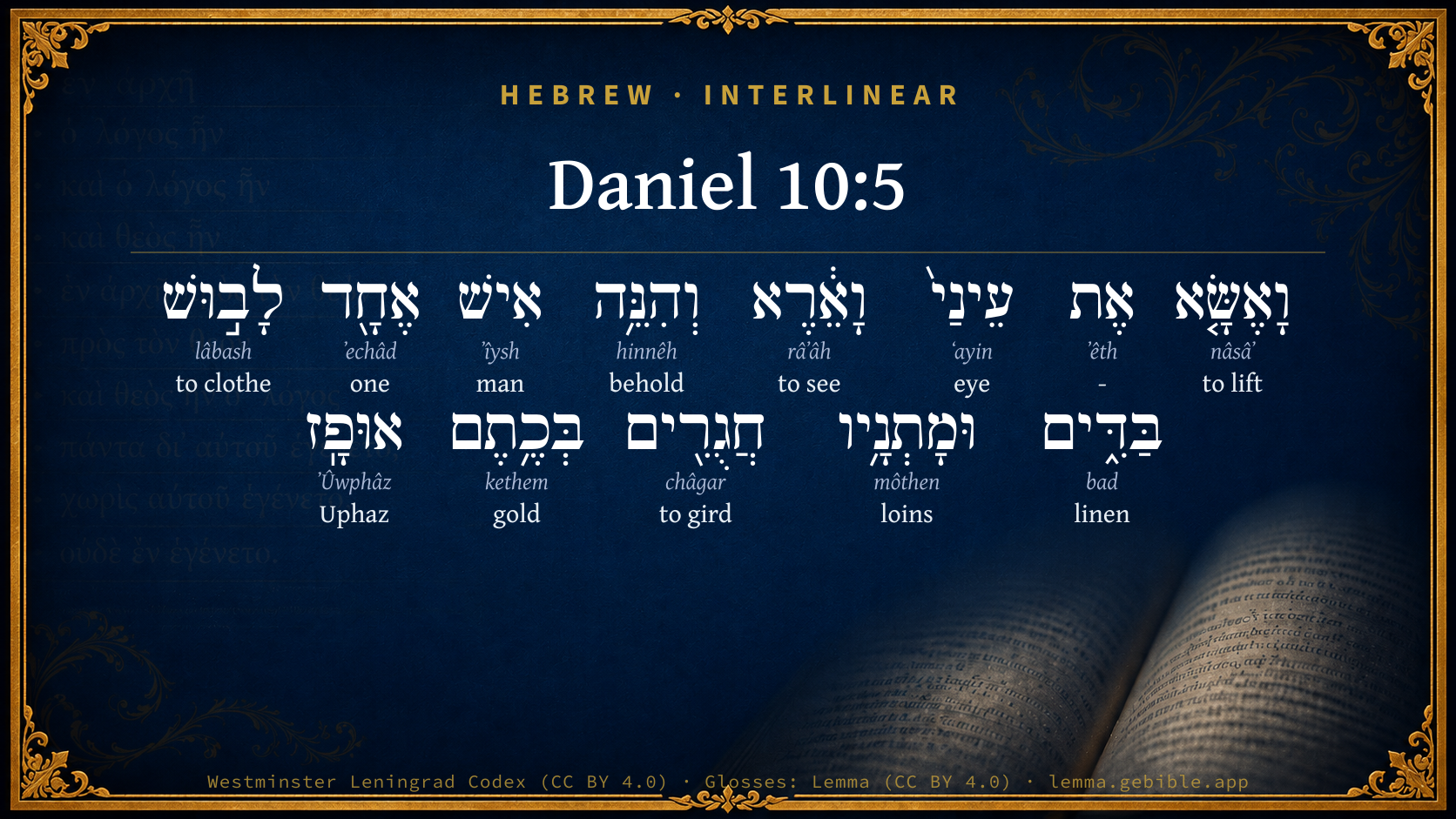
Hebrew (Westminster Leningrad Codex) Daniel 10:5 appears in the Hebrew Old Testament. The text above is from the Westminster Leningrad Codex. Each word links to its Strong’s number, a concise gloss, and parsing drawn from the Open Scriptures Hebrew Bible morphology. Click any word for its full Brown-Driver-Briggs (BDB) entry.
Download image
Cite this verse

Daniel 10:5 (World English Bible). Public Domain. Lemma interlinear Bible study tool, https://lemma.gebible.app/v/daniel/10/5.

Show BibTeX & RIS
BibTeX
RIS
English Translation
I lifted up my eyes, and looked, and, behold, a man clothed in linen, whose loins were girded with pure gold of Uphaz:
World English Bible · Public Domain
Download a study sheet

One document with this verse’s original text, its word-by-word gloss line, the meaning frame, cross-references with their text, attributed commentary, and full source and license credits — printable, and it pastes into notes with its structure intact.

This verse Autodidact and up

Study sheet (.html) Plain text (.txt)

A passage Seminary Student

Up to 50 verses in one chapter. A passage sheet keeps up to 6 commentary sources and 12 cross-references per verse, in the order this page ranks them, and says so on the sheet whenever that leaves anything out. Ask for a single verse and you get the Autodidact verse sheet above.

Everything on this page stays free to read, with no account — the sheet is a download of what is already on screen, not access to it.

Want to remove ads? Support Godless Engineer
Compare translations 3

The same verse in 3 English versions, stacked beneath the original-language interlinear above. Click any original word for its lexicon entry.

Each is an independent rendering of the whole verse — the interlinear is not word-aligned to these translations.

Highlighted words mark where these versions differ — a whole-verse word diff, not a word-by-word alignment.

  • World English Bible Public Domain
    I lifted up my eyes, and looked, and, behold, a man clothed in linen, whose loins were girded with pure gold of Uphaz:
  • King James Version Public Domain
    Then I lifted up mine eyes, and looked, and behold a certain man clothed in linen, whose loins were girded with fine gold of Uphaz:
  • unfoldingWord Literal Text CC BY-SA 4.0
    I lifted up my eyes and looked, and behold, there was a man dressed in linen, whose waist was girded with a belt of pure gold from Uphaz.

unfoldingWord Literal Text — © unfoldingWord, licensed CC BY-SA 4.0. Word-aligned USFM3 via Door43 (git.door43.org/unfoldingWord/en_ult).

Versions to compare (up to 4)

3 of 4 selected

Show all 18 translations

Every available English version of this verse, each an independent rendering of the whole verse.

  • World English Bible Public Domain
    I lifted up my eyes, and looked, and, behold, a man clothed in linen, whose loins were girded with pure gold of Uphaz:
  • Berean Standard Bible Public Domain
    I lifted up my eyes, and behold, there was a certain man dressed in linen, with a belt of fine gold from Uphaz around his waist.
  • Majority Standard Bible Public Domain
    I lifted up my eyes, and behold, there was a certain man dressed in linen, with a belt of fine gold from Uphaz around his waist.
  • King James Version Public Domain
    Then I lifted up mine eyes, and looked, and behold a certain man clothed in linen, whose loins were girded with fine gold of Uphaz:
  • American Standard Version (1901) Public Domain
    I lifted up mine eyes, and looked, and, behold, a man clothed in linen, whose loins were girded with pure gold of Uphaz:
  • Revised Version (1885) Public Domain
    I lifted up mine eyes, and looked, and behold a man clothed in linen, whose loins were girded with pure gold of Uphaz:
  • Geneva Bible (1599) Public Domain
    And I lift vp mine eyes, and looked, and beholde, there was a man clothed in linnen, whose loynes were girded with fine golde of Vphaz.
  • Douay-Rheims (1899) Public Domain
    And I lifted up my eyes, and I saw: and behold a man clothed in linen, and his loins were girded with the finest gold:
  • Young's Literal Translation Public Domain
    and I lift up mine eyes, and look, and lo, a certain one clothed in linen, and his loins girt with pure gold of Uphaz,
  • Literal Standard Version CC BY-SA 4.0
    and I lift up my eyes, and look, and behold, a certain one clothed in linen, and his loins girt with pure gold of Uphaz,
  • Unlocked Literal Bible CC BY-SA 4.0
    I looked up and saw a man dressed in linen, with a belt around his waist made of pure gold from Uphaz.
  • unfoldingWord Literal Text CC BY-SA 4.0
    I lifted up my eyes and looked, and behold, there was a man dressed in linen, whose waist was girded with a belt of pure gold from Uphaz.
  • Darby Bible Public Domain
    and I lifted up mine eyes and looked, and behold, a certain man clothed in linen, and his loins were girded with pure gold of Uphaz;
  • World Messianic Bible Public Domain
    I lifted up my eyes and looked, and behold, there was a man clothed in linen, whose waist was adorned with pure gold of Uphaz.
  • Webster's Bible Public Domain
    Then I lifted up my eyes, and looked, and behold a certain man clothed in linen, whose loins were girded with fine gold of Uphaz:
  • Free Bible Version CC BY-SA 4.0
    I looked around and saw a man dressed in linen, and around his waist was a belt of pure gold.
  • Bible in Basic English Public Domain
    And lifting up my eyes I saw the form of a man clothed in a linen robe, and round him there was a band of gold, of the best gold:
  • JPS Tanakh (1917) Public Domain
    I lifted up mine eyes, and looked, and behold a man clothed in linen, whose loins were girded with fine gold of Uphaz;

Literal Standard Version (2020), Covenant Press — licensed CC BY-SA 4.0. Text via the HelloAO Bible API (eBible.org). Unlocked Literal Bible (unfoldingWord) — licensed CC BY-SA 4.0. Text via the HelloAO Bible API (eBible.org). unfoldingWord Literal Text — © unfoldingWord, licensed CC BY-SA 4.0. Word-aligned USFM3 via Door43 (git.door43.org/unfoldingWord/en_ult). Free Bible Version, Dr. Jonathan Gallagher — licensed CC BY-SA 4.0. Text via the HelloAO Bible API (eBible.org).

Word by word

More ways to search: Search by grammar → Find every occurrence → Compare this word →

Practice this passage: Drill this verse → Learn its vocabulary →

אוּפָֽז
ʼÛwphâz
H210
“Uphaz”
Noun, Proper
Part of Speech
Noun
Type
Proper
Full BDB Definition

Origin: perhaps a corruption of H211

TWOT: None

Uphaz = "desire of fine gold" - a place famous for its gold (site unknown)
  1. וָאֶשָּׂ֤א nâsâʼ H5375 “and · to lift” Conjunction + Verb, Qal, Sequential Imperfect, 1st Person, Common, Singular
  2. אֶת ʼêth H853 “-” Particle, Direct Object
  3. עֵינַי֙ ʻayin H5869 “eyes · my” Noun, Common, Both, Dual, Construct + Suffix, Personal, 1st Person, Common, Singular
  4. וָאֵ֔רֶא râʼâh H7200 “and · to see” Conjunction + Verb, Qal, Sequential Imperfect, 1st Person, Common, Singular
  5. וְהִנֵּ֥ה hinnêh H2009 “and · behold” Conjunction + Particle, Demonstrative
  6. אִישׁ ʼîysh H376 “man” Noun, Common, Masculine, Singular, Absolute
  7. אֶחָ֖ד ʼechâd H259 “one” Adjective, Cardinal number, Masculine, Singular, Absolute
  8. לָב֣וּשׁ lâbash H3847 “clothed” Verb, Qal, Participle Passive, Masculine, Singular, Absolute
  9. בַּדִּ֑ים bad H906 “linen” Noun, Common, Masculine, Plural, Absolute
  10. וּמָתְנָ֥יו môthen H4975 “and · loins · his” Conjunction + Noun, Common, Masculine, Dual, Construct + Suffix, Personal, 3rd Person, Masculine, Singular
  11. חֲגֻרִ֖ים châgar H2296 “girded” Verb, Qal, Participle Passive, Masculine, Plural, Absolute
  12. בְּכֶ֥תֶם kethem H3800 “in/at · gold of” Preposition + Noun, Common, Masculine, Singular, Construct

About this verse

These counts appear in no published source. They are computed here, from the morphology-tagged text and Lemma’s own curated glosses. What Lemma adds →

13
words
13
distinct lemmas
Prophets
section

Notable vocabulary

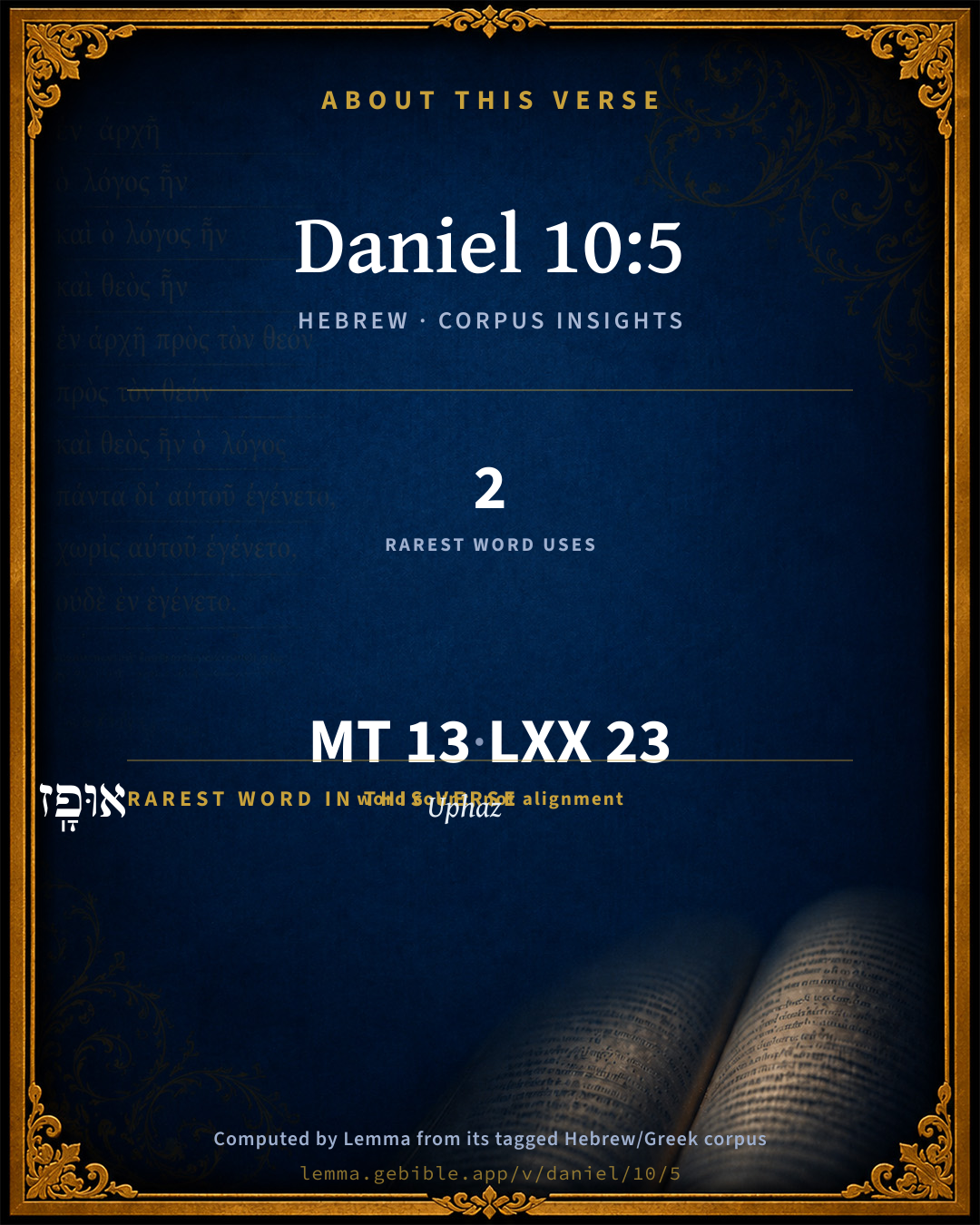
The rarest word here is אוּפָֽז Uphaz H210 — appearing just 2 times in the whole Hebrew Bible.

Shared distinctive vocabulary

אוּפָֽז Uphaz H210 occurs in 2 verses of the Hebrew Bible. Also found in:

Grammatical profile

  • 4 verbs
  • 6 nouns
  • 1 adjective
  • 2 particles

Verb forms

  • וָאֶשָּׂ֤א Qal · Sequential Imperfect
  • וָאֵ֔רֶא Qal · Sequential Imperfect
  • לָב֣וּשׁ Qal · Participle Passive
  • חֲגֻרִ֖ים Qal · Participle Passive

Hebrew & Septuagint length

In English translation the verse runs 23 words from the Hebrew and 24 from the Septuagint (LXX English) — closely comparable.

A rough comparison of the two English renderings, which tokenize alike — not a word-level alignment.

Word counts can differ between the Hebrew and the Greek without any difference in meaning — e.g. the Hebrew direct-object marker אֵת has no separate Greek word, and Greek often adds the article ὁ.

In the original languages it is 13 Hebrew tokens and 23 Greek tokens — but the two are counted differently (Hebrew bundles its prefixes and suffixes into one token; the Greek is in lemma form), so that isn’t a like-for-like length.

Cross-references

9

Topical passages linked to Daniel 10:5 in the Treasury of Scripture Knowledge — connected by theme and wording, ordered by reader-vote popularity; previews shown in the World English Bible.

  • Ezekiel 9:2 Behold, six men came from the way of the upper gate, which lies toward the north, every man with his slaughter weapon in his hand; and one man in the midst of them clothed in linen, with a writer's inkhorn by his side. They went in, and stood beside the brazen altar.
  • Daniel 12:6–7 One said to the man clothed in linen, who was above the waters of the river, How long shall it be to the end of these wonders?
  • Revelation 1:13–15 And among the lampstands was one like a son of man, clothed with a robe reaching down to his feet, and with a golden sash around his chest.
  • Jeremiah 10:9 There is silver beaten into plates, which is brought from Tarshish, and gold from Uphaz, the work of the artificer and of the hands of the goldsmith; blue and purple for their clothing; they are all the work of skillful men.
  • Revelation 15:6–7 The seven angels who had the seven plagues came out, clothed with pure, bright linen, and wearing golden sashes around their breasts.
  • Joshua 5:13 It happened, when Joshua was by Jericho, that he lifted up his eyes and looked, and, behold, there stood a man over against him with his sword drawn in his hand: and Joshua went to him, and said to him, Are you for us, or for our adversaries?
  • Isaiah 11:5 Righteousness shall be the belt of his waist, and faithfulness the belt of his loins.
  • Zechariah 1:8 "I had a vision in the night, and, behold, a man riding on a red horse, and he stood among the myrtle trees that were in a ravine; and behind him there were red, brown, and white horses.
  • Ephesians 6:14 Stand therefore, having the utility belt of truth buckled around your waist, and having put on the breastplate of righteousness,

Cross-references courtesy of OpenBible.info (CC BY 4.0).

Hebrew and Greek witnesses Masoretic Hebrew ↔ Greek Septuagint

The same verse in the two great witnesses to the Old Testament, shown verse-for-verse.

These are two independent witnesses, not word-aligned to each other, and the Septuagint is shown in lemma (dictionary) form.

Hebrew Daniel 10:5 Masoretic · Westminster Leningrad Codex

וָאֶשָּׂ֤א אֶת עֵינַי֙ וָאֵ֔רֶא וְהִנֵּ֥ה אִישׁ אֶחָ֖ד לָב֣וּשׁ בַּדִּ֑ים וּמָתְנָ֥יו חֲגֻרִ֖ים בְּכֶ֥תֶם אוּפָֽז

I lifted up my eyes, and looked, and, behold, a man clothed in linen, whose loins were girded with pure gold of Uphaz:

World English Bible · Public Domain

Greek LXX Daniel 10:5 Septuagint · lemma form

καί αἴρω ὁ ὀφθαλμός ἐγώ καί ὁράω καί ἰδού ἄνθρωπος εἷς ἐνδύω βύσσινος καί ὁ ὀσφύς περιζώννυμι βύσσινος καί ἐκ μέσος αὐτός φῶς

And I lifted up my eyes, and looked, and behold a man clothed in linen, and his loins were girded with gold of Ophaz:

LXX2012 (modern English Septuagint) · Public Domain

On this verse, Ellicott's Commentary for English Readers discusses the Septuagint’s reading. Read the note in Commentary ↓

Hebrew: Westminster Leningrad Codex (CC BY 4.0). Greek: Septuagint (public domain); English from LXX2012 (modern English Septuagint) (Public Domain). How the Septuagint differs from the Hebrew →

Commentary

Notes on Daniel 10:5 from classic Christian and Jewish commentators (each source and its license shown beneath its notes). The classic Christian expositions comment on the surrounding passage and are grouped to its opening verse, so a note may address several verses; the Jewish commentaries on the Tanakh (Rashi and others) are per-verse, so they appear only where the commentator wrote on this verse.

Lemma curates 59 commentaries, every one of them public domain or Creative Commons licensed, each selected and text-cleaned for this edition rather than reprinted as found. About our sources →

Trapp's Complete Commentary

John Trapp

Dan 10:5 Then I lifted up mine eyes, and looked, and behold a certain man clothed in linen, whose loins [were] girded with fine gold of Uphaz:

Ver. 5. Then I lifted up mine eyes, and looked,] viz., After my long fasting, praying, and meditating. So Moses and Elias, those great fasters, met together with our Saviour gloriously in the mount at his transfiguration. It is abstinence, not fulness, that makes a man capable of heavenly visions of divine glory.

Behold a certain man.] Heb., One man; a singular man, a glorious person; Messias the prince, described here by his habit and parts as a judge, say some, or as a priest, say others. See Dan 12:6-7 Rev 1:13-15; Rev 10:5.

Clothed in linen.] To show his innocence and purity, as also his righteousnesses, imputed and imparted, wherewith he clotheth his saints, {Rev 19:8} that fine white linen and shining.

Whose loins were girded with fine gold of Uphaz.] Or, Of Ophir; Peru, haply, or Malaca, or Sopbala. This golden girdle about his loins denoteth Christ’s strength and alacrity. {Psa 93:1 Luk 17:8}

John Trapp, A Commentary or Exposition upon All the Books of the Old and New Testament (1647–1656) — public domain. Text from a community e-Sword module.

Joseph Benson's Commentary

Dan 10:5-6. I lifted up mine eyes — Being by the river-side, in deep contemplation, I looked up, and saw a person appear before me, clothed in linen, &c. — “Who this certain person was we may be at no loss to determine, if we consider him as described in the attire of the high-priest, and compare the passage with Exo 28:29., and the description of the Son of man by St. John in the Rev 1:13. If, however, he were not the Son of God himself, he was probably an angel of the highest order.” — Wintle. Concerning the fine gold of Uphaz, see note on Jer 10:9. His body was like the beryl — That is, cerulean, or of a bluish-green colour; his face as the appearance of lightning — See Mat 28:3. By this was symbolically expressed his perspicacity, or quickness in discerning and knowing every thing; and his eyes as lamps of fire — To signify the comprehensiveness and piercing terribleness of his knowledge; his arms and feet like polished brass — Of a bright flaming colour: see Rev 1:15. As the arms and feet in men are the instruments of action, by them we are here to understand his actions, the purity of which is meant to be expressed by the shining brass; and the voice of his words like the voice of a multitude — By which greatness or terribleness of his voice was signified his denouncing terrible judgments on kings and kingdoms.

Joseph Benson's Commentary on the Old and New Testaments (1811–1818) — public domain. Text from a community e-Sword module.

Tyndale Open Study Notes

Tyndale Open Resources

10:5-6 The man dressed in linen clothing is an unidentified messenger of the Lord (cp. 10:16, 18; 12:6-7; see also Ezek 9:3).

Tyndale Open Study Notes — © Tyndale Open Resources, licensed CC BY-SA 4.0. Text via the HelloAO Bible API.

Geneva Bible (1599)

Geneva Bible translators

This was the Angel of God, which was sent to assure Daniel in this prophecy that followeth.

Geneva Bible (1599) marginal notes — public domain. Text via Bolls.life.

Jamieson, Fausset & Brown

Robert Jamieson, A. R. Fausset & David Brown

lifted up mine eyes--from the ground on which they had been fixed in his mourning.

certain man--literally, "one man." An angel of the highest order; for in Dan 8:16 he commands Gabriel to make Daniel to understand the vision, and in Dan 12:6 one of the two angels inquires of him how long it would be till the end predicted.

linen--the raiment of priests, being the symbol of sanctity, as more pure than wool (Exo 28:42); also of prophets (Jer 13:1); and of angels (Rev 15:6).

girded with . . . gold--that is, with a girdle interwoven with gold (Rev 1:13).

Jamieson, Fausset & Brown — Commentary Critical and Explanatory on the Whole Bible (1871) — public domain (CC PDM 1.0). Text via the HelloAO Bible API.

Adam Clarke's Commentary

Verse 5. Clothed in linen] The description is intended to point out the splendour of the garments.

Gold of Uphaz] The same as Ophir.

Adam Clarke's Commentary on the Bible (1810–1826) — public domain. Text from a community e-Sword/MySword module.

John Calvin's Commentaries

As to the word Uphaz, some think it to be a pearl or precious stone, and they take the word כתם, kethem, which precedes it, for pure gold. Others take uphaz adjectivally, for pure gold. I do not suppose it to be an epithet, but I rather subscribe to the view of those who understand it as the proper name of a place, because this view is in accordance with the phraseology of the tenth chapter of Jeremiah. There is another opinion which is unsuitable. Uphaz is said to be derived from the noun Phaz, and is called “pure,” the letter Aleph being redundant. The above mentioned passage of Jeremiah is sufficient to prove my assertion, that it signifies a certain region; and so some have translated it by ophir. The word תרשש, tharsis, is thought to mean chrysolite: some think it denotes the color of the sea, and then, by a figure of speech, take it generally for any sea. It is also said to mean sky-colored.

Daniel now begins to relate the manner in which the vision was offered to him. He says, when he stood on the bank of the river a man appeared to him, different from the common order of men. He calls him a man, but shews him to be endued, or adorned with attributes which inspire full confidence in his celestial glory. We have elsewhere stated, how angels are called men, whenever God wished them to put on this outward form. The name of men is therefore used metaphorically whenever they assumed that form by God’s command, and now Daniel speaks after the accustomed manner. Meanwhile, some absurdly imagine angels to have been really men, since they assumed this appearance, and were clothed in a human body. We ought not to believe them to be really men, because they appeared under a human form. Christ, indeed, was really man, in consequence of his springing from the seed of Abraham, David, and Adam. But as regards angels, God clothes them for a single day or a short period in bodies, for a distinct purpose and a special use. Wherefore, I assert the gross error of those who suppose angels to become men, as often as they are corporeally visible in a human form. Still they may be called men, because Scripture accommodates itself to our senses, as we know sufficiently well. Daniel therefore says, he saw a man, and afterwards distinguishes him from the human race, and shews fixed and conspicuous marks inscribed upon him, which discover him to be an angel sent down from heaven, and not a mere earthly mortal. Some philosophize with subtlety on the word raised, as if Daniel so raised his eyes upwards as to be unconscious of all earthly objects; but this does not appear to me sufficiently certain. The Prophet wishes to impress the certainty of the vision; not only was his mind composed and collected, but he applied all his senses to the one object before him — the attainment of some consolation from God. The Prophet, therefore, denotes the earnestness of his desire, for when he looked round he found himself subject to many cares and anxieties. Again, with reference to the marks by which Daniel might infer the object of his vision to be neither earthly nor mortal, he first says, he was clothed in linen This kind of garment was common enough among the people of the East. Those regions are remarkably warm, and their inhabitants need not protect themselves against the cold, as we are necessarily compelled to do. They seldom wear woolen clothing. But on special occasions when they wish to use more splendid attire, they put on linen tunics, as we learn not only from many passages of Scripture, but also from profane writers. Hence I take this passage as if Daniel had said, the man appeared to him in splendid apparel. For בדים, bedim, is supposed not to mean common linen, but a more exquisite kind of fabric. This is one point.

He next says, He was girt with pure gold; that is, with a golden belt. The Orientals were formerly accustomed to gird themselves with belts or girdles, as their garments were long and reached almost down to the feet. Hence it became necessary for those who wished to move expeditiously to gird themselves with belts. When the angel appeared with raiment of this kind, the difference between himself and other men was displayed to the Prophet. Some refer the linen garment to the priesthood of Christ, and treat the girdle as an emblem of rigor. But these are mere refinements, and seem to me destitute of all reality. I therefore am content with the simple opinion on which I have touched, namely, this form of clothing distinguished the angel from ordinary mortals. But this will appear clearer from the following verse. For Daniel says, His body was sky-colored, or like the precious stone called beryl, of a golden hue Without doubt, the Prophet beheld something different from a human form, for the purpose of his clearly ascertaining the vision not to be a man, but an angel in the form of man. I leave the allegory here, although it proceeds throughout the whole verse. I am aware of the plausible nature of allegories, but when we reverently weigh the teachings of the Holy Spirit, those speculations which at first sight pleased us exceedingly, vanish from our view. I am not captivated by these enticements myself, and I wish all my hearers to be persuaded of this, — nothing can be better than a sober treatment of Scripture. We ought never to fetch from a distance subtle explanations, for the true sense will, as I have previously expressed it, flow naturally from a passage when it is weighed with maturer deliberation. He says, His face was like the appearance of lightning This, again, assured the Prophet of his being an more than earthly mortal. His eyes would lead to the same conclusion; they were like lamps of fire; then his arms and feet were like polished or burnished brass; lastly, the voice of his words was the voice of a tumult, or noise, or multitude. The sum of the whole is this, — the angel, though clad in human form, possessed certain conspicuous marks by which God separated him from the common crowd of men. Thus Daniel clearly perceived the divine mission of the angel, and God wished to establish the confidence and certainty of those prophecies which will afterwards follow in the eleventh chapter. Let us proceed:

John Calvin's Commentaries (1540-1563) — public domain. Text from the Calvin Translation Society English edition (1840s-50s) via the Christian Classics Ethereal Library (ccel.org). Calvin's coverage is partial (roughly two-thirds of the Bible); uncommented books and verses are honest gaps, never fabricated. The 19th-century editor's footnotes and remarks are omitted so the notes are faithfully Calvin's own voice.

Ellicott's Commentary for English Readers

(5) A certain man.—The appearance of this person is minutely described, while that of the angels is not mentioned. The dress especially recalls to our minds the clothing of the high priest. (See Exo_39:27-29, and comp. Rev_1:13.) The person himself is carefully distinguished from Michael (Dan_10:21), and as we may infer from Daniel’s silence (comp. Dan_9:21), he is distinct from Gabriel also. He is the same man who stood before Daniel (Dan_8:15), and must be regarded as “the Angel of God” (Exo_32:34), or “God’s Presence” (Exo_33:14), or “God’s Name;” in fact, the One who was the Logos.

Uphaz.—A place only mentioned in this passage and Jer_10:9. The locality of it is unknown. The additions of the LXX. should be noted.

A Bible Commentary for English Readers, edited by Charles John Ellicott (1878–1897) — public domain. Text from a community e-Sword module.

The Cambridge Bible for Schools and Colleges

gen. ed. J. J. S. Perowne

5. lift up mine eyes] in the vision: cf. Dan_8:3.

and saw] Daniel (Dan_10:4) was on the side of the river; and it appears from Dan_12:6-7, that the figure which he beheld was directly above the river itself, and consequently (Dan_10:16) ‘in front of’ him. The description of the shining being which follows, contains many reminiscences of Ezekiel 1, 9.

a certain man] a man: the Hebrew idiom, as 1Ki_22:9, &c.

clothed in linen] The expression is suggested probably by Eze_9:2-3; Eze_9:11; Eze_10:2; Eze_10:6-7. (White) linen garments were worn (on certain occasions) by priests or others performing sacred offices (Lev_6:10; Lev_16:4; 1Sa_2:18; 1Sa_22:18; 2Sa_6:14). Here, as in Ezek., the linen vesture indicates a celestial visitant: cf. Mar_16:5, Rev_15:6 (R.V. marg.).

whose loins, &c.] A girdle richly ornamented with gold was about his loins.

fine gold] Heb. kéthem, a choice, poetical word (e.g. Job_28:19; Job_31:24), the one generally used in the expression ‘gold of Ophir’ (Job_28:16; Psa_45:9; Isa_13:12).

Uphaz] only besides in Jer_10:9, ‘gold (zâhâb) from Uphaz.’ No place Uphaz is, however, known; hence the reading in Jer. is probably corrupt, and we should read there ‘from Ophir’ (with Targ., Pesh., MSS. of LXX., and many moderns). Either the author of Daniel borrowed the expression from Jer_10:9, after the text there had been corrupted; or we may suppose that Uphaz (אופז) here is simply a scribal error for Ophir (אופר): comp. the last note.

5–9. The dazzling being seen by Daniel in his vision, and the effects of the spectacle upon him. For a vision following a fast, cf. Apoc. of Baruch Dan_10:7, ix. 2, vii. 5, x. 5, 6, xxi. 1, xliii. 3, xlvii. 2; 2Es_5:13; 2Es_5:20; 2Es_6:31; 2Es_6:35; 2Es_9:24; 2Es_9:26; 2Es_12:51 : also Act_10:10.

The Cambridge Bible for Schools and Colleges (gen. ed. J. J. S. Perowne; Cambridge University Press, 1878–1918) — public domain. Text from a community e-Sword module.

John Gill's Exposition

Then I lifted up mine eyes, and looked,.... Being excited to it, by an object presented, of an unusual appearance, which engaged his attention, and caused him to look wistly at it:

and, behold a certain man clothed in linen; not Gabriel, but the Son of God, the Messiah; who, though not as yet incarnate, yet was so in the counsel and purpose of God; had agreed in covenant to be man, was promised and prophesied of as such; and now appeared in a human form, as he frequently did before his incarnation, as a pledge of it, and showing his readiness to assume human nature: he appears here "clothed in linen", in the habit of a priest; which office he sustains, and executes by the sacrifice of himself, and by his prevalent intercession; and may denote his purity and innocence, as well as direct us to his spotless righteousness he is the author of, which is like fine linen, clean and white, Rev 19:8,

whose loins were girded with fine gold of Uphaz; or of Fez, which is the best gold. Some take it to be the same with the gold of Ophir, often spoken of in Scripture; so the Targum on Jer 10:9, renders Uphaz by Ophir. Ptolemy (i) makes mention of a river called Phasis in the island of Taprobane or Zeilan, where Bochart (k) seems to think Ophir was, from whence the gold of that name came; and the same geographer (l) takes notice of a city and river of the same name in Colchis; perhaps the same with Pison, which encompassed Havilah, where was good gold, Gen 2:11, and both Strabo (m) and Pliny (n) say that much gold was found in that country, and taken out of rivers there; and was so plentiful, that even chambers were made of gold, Some think that this was an island in India called Paz or Topaz, and might with the Jews go by all three names, Paz, Topaz, and Uphaz (o); however, it is certain, that very fine gold, even the finest gold, is here designed: and the loins of this illustrious Person being girded with a girdle made of it, as it may be expressive of his royal dignity, so likewise of his readiness to do any service he was employed in, as man and Mediator; and especially the great work of man's redemption and salvation, for the sake of which he would really become man, as he has, as well as now he appeared as one; see Rev 1:13 where Christ is said to be "girt with a golden girdle"; and such an one was this; and which is to be understood, not of his girdle as a King, which is a girdle of faithfulness and righteousness, Isa 11:5, all his administrations of government being just and true; though such a girdle well suits him, and his character in the discharge of every office, as well as his kingly office; nor of his girdle as a Prophet, which is the girdle of truth, which all his faithful ministers are girt with, Eph 6:14, and he in a more eminent manner, who is full of grace and truth, and by whom both came, and who is truth itself; but of his girdle as a Priest; for as such is he here habited, and such a girdle the priests used to wear, even the girdle of the ephod, made of gold, blue, purple, and fine twined linen, Exo 28:8, and this is the girdle of love, which constrained Christ to become the surety and substitute of his people; to take upon him their nature, and their sins; to offer himself a sacrifice for them, and to be their advocate with the Father; and the form and matter of this girdle being round about him, and of gold, may denote the perfection, duration, and eternity of his love.

(i) Geograph. l. 7. c. 4. (k) Phaleg. l. 2. c. 27. col. 141. (l) Ptolem. Geograph. l. 5. c. 10. (m) Geograph. l. 11. p. 343. (n) Nat. Hist. l. 33. c. 3. (o) Hiller. Onomastic. Sacr. c. 8. p. 141.

John Gill's Exposition of the Whole Bible (1746–1763) — public domain (CC PDM 1.0). Text via the HelloAO Bible API.

Albert Barnes' Notes on the Bible

Then I lifted up mine eyes, and looked ... - While he was engaged in devotion. What is here said would lead us to suppose that he had been occupied in deep thought and meditation, perhaps with his eyes fixed on the ground.

Behold, a certain man clothed in linen - One who had the form and appearance of a man.

The subsequent disclosures showed that he was an angel, but when angels have appeared on earth they have commonly assumed the human form. The margin is, “one.” So also is the Hebrew “one man.” From Dan 12:6, it would seem that two other such beings appeared in the course of the vision, but either one only was manifest now to Daniel, or his attention was particularly directed to him. The name of this celestial messenger is not given, but all the circumstances of the case lead us to suppose that it was the same who had appeared to him on the banks of the Ulai Dan 8:16, and the same who had made the revelation of the seventy weeks, Dan 9:21, following. Linen was the common raiment of priests, because it was supposed to be more pure than wool, Exo 28:42; Lev 6:10; Lev 16:4, Lev 16:23; 1Sa 2:18. It was also worn by prophets, Jer 13:1, and is represented as the raiment of angels, Rev 15:6. The nature of the raiment would suggest the idea at once that this person thus appearing was one sustaining a saintly character.

Whose loins were girded with fine gold of Uphaz - With a girdle made of fine gold; that is, probably, it was made of something in which fine gold was interwoven, so as to give it the appearance of pure gold. It was customary in the East, as it is now, to wear a girdle around the loins. See the notes at Mat 5:38-41. These girdles are often made of rich material, and are highly ornamented. Compare the notes at Rev 1:13. Nothing is known of Uphaz, unless, as Gesenius supposes, the word is a corruption of Ophir, made by a change of a single letter - ז (z) for ר (r). Ophir was celebrated for its gold, but its situation is unknown. See the notes at Job 22:24.

Albert Barnes' Notes on the Bible (1834–1885) — public domain. Text from a community e-Sword/MySword module.

Haydock's Catholic Bible Commentary

Linen. Hebrew: baddim. --- Finest. Hebrew: uphaz, (Haydock) from Phasis or Ophir.

George Leo Haydock (1774–1849), Haydock's Catholic Family Bible and Commentary, 1859 edition — public domain. Excludes Psalms (Douay-Rheims chapter numbering differs from Protestant) and Deuterocanonical books (Catholic canon only).

Matthew Poole's English Annotations

He beheld wistly and with a composed mind.

A certain man; which man some will have an angel, either Gabriel, who appeared to him before, or Michael, chief among the angels, Jude 9, archangel, who is mentioned after. Or rather, Christ, who was true man.

1. He appeared to Daniel in royal and priestly robes, which was not proper for any angel.

2. He appeared in so great brightness and majesty, which made Daniel astonished, and laid him prostrate.

3. Compare this place with Dan 12:6,7, and you find him the same as here, revealing the secrets of times, and of God’s providence towards his church, which is Christ.

Clothed in linen, whose loins were girded with fine gold of Uphaz: see Rev 1:13-17, where the Lord Jesus Christ is described as here in Daniel, and for the same end. Now he appeared thus before his incarnation, in the Old Testament, as a prelude of it, as the best expositors grant it. By this appearance the Lord Christ held out clearly his three offices of King, Priest, and Prophet. The girding of loins signifies his readiness to obey the commands and do the work of his Father; besides the ornament of the curious golden girdle.

Matthew Poole's English Annotations on the Holy Bible (1683–1685) — public domain. Text from a community e-Sword/MySword module.

Whedon's Commentary on the Bible

Daniel D. Whedon

5, 6. This angelic man (doubtless Gabriel, Dan_9:21), clothed in the pure white linen robes of Jehovah’s priest (Lev_6:10; compare Eze_9:2), is very like the man Ezekiel saw on Jehovah’s throne (Eze_1:4; Eze_1:24; Eze_1:26), and very like the transfigured Christ afterward seen by the apostle John (Rev_1:13-15); but all those who live near to God grow to look like him (compare Rev_19:10-11). His girdle was of the gold of Uphaz, or, with the change of one consonant, Ophir. (Compare Psa_45:9.) Beryl is almost universally supposed to be chrysolite. (See note Eze_1:16.)

Daniel D. Whedon (gen. ed.), Commentary on the Old and New Testaments (1874–1909) — public domain. Text from a community e-Sword module.

The Pulpit Commentary

Vers. 5, 6. Then I lifted up mine eyes, and looked, and behold a certain man clothed in linen, whose loins were girded with fine gold of Uphas: his body also was like the beryl, and his face as the appearance of lightning, and his eyes as lamps of fire, and his arms and his feet like in colour to polished brass, and the voice of his words like the voice of a multitude. The version given by the Septuagint exhibits traces of confluence, "And it was apparently reading yhiYiw (vayyehee) on the four and twentieth day of the first month, I was upon the bank of the great river Tigris, and I lifted up mine eyes, and saw, and behold a man clothed in fine linen (bussina), and girt about the loins with fine linen (bussinw), and from his middle there was light, and his month was as the sea, and his face as the appearance of lightning, and his eyes as lamps of fire, his arms and feet as gleaming brass, and the voice (fwnh) of his speech as the voice of a multitude." It would seem that the translator had that might be due to blunder, or may be a case of doublet a phenomenon so frequent. The difficult word Uphaz, which only occurs elsewhere in Jer_10:9, is omitted; "from his middle there was light" is probably an effort to render this clause, which the translator seems to have read mithoq "or. Possibly the mysterious clause, "and his mouth was like the sea," may be another attempt to render these unaccustomed words. Theodotion merely transliterates into baddi and vyvirt into qarsiv, and regards Uphaz as a garment, which, in the case before us, was golden (crusiw). In the Syriac of the Peshitta, the translator escapes the difficulty of bad, deem by rendering it "glory." The next clause is also paraphrastic, "the girdle of his loins (back) was of splendid magnificence:" this last is his rendering of Uphaz. The next verse does not call for remark. Jerome, in the Vulgate, renders tarsheesh as chrysolithus an interpretation very generally followed now. In the Massoretic text, the use of the numeral "one," almost as our indefinite article, has to be noted. Baddeem is the plural of a word used mainly for the material of which the garments of the priests were made; it occurs also in the vision of Ezekiel. The singularity is that in Ezekiel, as in Daniel, the word is always plural whereas in the rest of Scripture it is always singular. Uphaz occurs, as above mentioned, only in Jer_10:9; it is by some supposed tobe a variation on Ophir. As here, it is connected in Jeremiah with Tarshish. Fiirst suggests paz, "fine gold", (Job_28:17) and Wa yai. "coast or island," thus making it equivalent to Gold Coast." Kethem, "fine gold," is associated in Isa_13:12 with "Ophir," as here with" Uphaz;" this might hint at the identity of the two places. That, however, is an uncertain basis. The fact that Tarshish and Uphaz are brought together, would indicate that, like Tarshish, it was in Spain. Kneucker, in Schenkel"s "Bibellexikon," decides for Hy-phasis, South Arabia, on the uncertain ground of the sound of the name. Bochart would place it in Ceylon, because Ptolemy mentions a harbour and river of the name of Phasis. Tarshish is the Tartessus of the Greeks and the modern Tharsis; here the chrysolite or topaz, as brought from thence. Margelothayo , "his feet," is the most common rendering; but yon Lengerke would render, "the place where his feet rested a rendering which, while it suits the form of the word, does not suit the context. It occurs four times in Ruth in one connection, and not elsewhere, save here. "Like in colour to polished brass" is a phrase which occurs in Eze_1:7. Professor Bevan says, "What meaning the author attached to llq (qalal) polished," it is impossible to say." All the versions render" gleaming," in both passages; there seems no need to suggest a corruption of the text. The vision here has a great resemblance, though with many pointsof contrast, to Eze_1:4-25 Eze_8:2 Eze_9:2 Eze_10:1-22. Many passages in the Apocalypse show traces of its influence: thus Rev_1:14, Rev_1:15, the appearance of our Lord; also Rev_10:1-3. The vision in Ezekiel 1. is a theophany; this, however, is not the appearance of a direct symbol of God, but the appearance of one of his angels. The whole aspect is one of terror and splendour. It has been noted that the yellow gleam of the topaz suits well the tint of the Oriental complexion. When we compare this with Ezekiel"s vision, we find a reticence in Ezekiel"s description; he does not affirm (Eze_1:27) that it is a man he sees, but only one in human likeness. Whereas Daniel distinctly says that it was a man. In the case of Ezekiel, it was a theophany which he saw; it was an angelophany which appeared to Daniel. "The voice of a multitude" refers to the sound of the shout of a multitude; the effect it produces is not merely the volume of sound, but the difference of tones and the difference of moment of utterance give a sense of vastness and multitudinousness, always impressive, and indeed awe-inspiring.

The Pulpit Commentary (1880–1919), ed. H.D.M. Spence-Jones & Joseph S. Exell — public domain. Text from a community e-Sword module.

John Wesley's Explanatory Notes

A certain man - Very probably Christ, who appeared to Daniel in royal and priestly robes, and in so great brightness and majesty.

John Wesley, Explanatory Notes Upon the Whole Bible (1754–1765) — public domain. Text via the GEBible commentary corpus.

Rashi

Rabbi Shlomo Yitzchaki (Rashi)

clad in linen a linen garment.

with a girdle of gold studded with jewels Heb. בְּכֶתֶם אוּפָז, with a girdle of a cluster of pearls. Every [instance of] כֶּתֶם is an expression of a cluster of gold and precious stones.

Rashi on the Tanakh — English translations: “The Judaica Press complete Tanach with Rashi, translated by A. J. Rosenberg” (CC BY 4.0); “Pentateuch with Rashi's commentary by M. Rosenbaum and A.M. Silbermann, 1929-1934” (public domain); “The Metsudah Tanach series, Lakewood, N.J” (CC BY 4.0); and “The Book of Joshua, Metsudah Publications, 1997” (CC BY 4.0). Text via Sefaria.

Lesson kit

Teaching starters — assembled from the data on this page, not authored interpretation. Every prompt links to the verse data it draws on. Edit before teaching.

Daniel, in the Prophets, opens this verse with 13 words (13 distinct Hebrew lemmas). Its most distinctive word is ʼÛwphâz (“Uphaz”). A historical commentator’s framing appears above. Read the whole chapter for the surrounding context.

Discussion questions

  1. What does “Uphaz” (ʼÛwphâz) contribute to the verse as a whole?
  2. How does Jeremiah 10:9, which shares the word «Uphaz», read alongside this verse?
  3. These translations render this verse differently; the difference is in the English rendering, not the original. What questions does that raise?
  4. «וָאֶשָּׂ֤א» is a Qal Sequential Imperfect verb. How does that grammatical form shape the action described?
  5. Compare how Trapp's Complete Commentary and Joseph Benson's Commentary read this verse. Where do they agree or differ?

Things to notice

Reading settings

Reading text

Shown beneath each verse's original-language words.

Old Testament
Old Testament edition

Read the OT as the Masoretic Hebrew (MT) or the Greek Septuagint (LXX).

English shown for the Greek Septuagint (in the Hebrew ↔ Greek comparison).

Comparing translations? Open the Compare panel on any verse page to stack up to four side by side.