Exodus 7:12

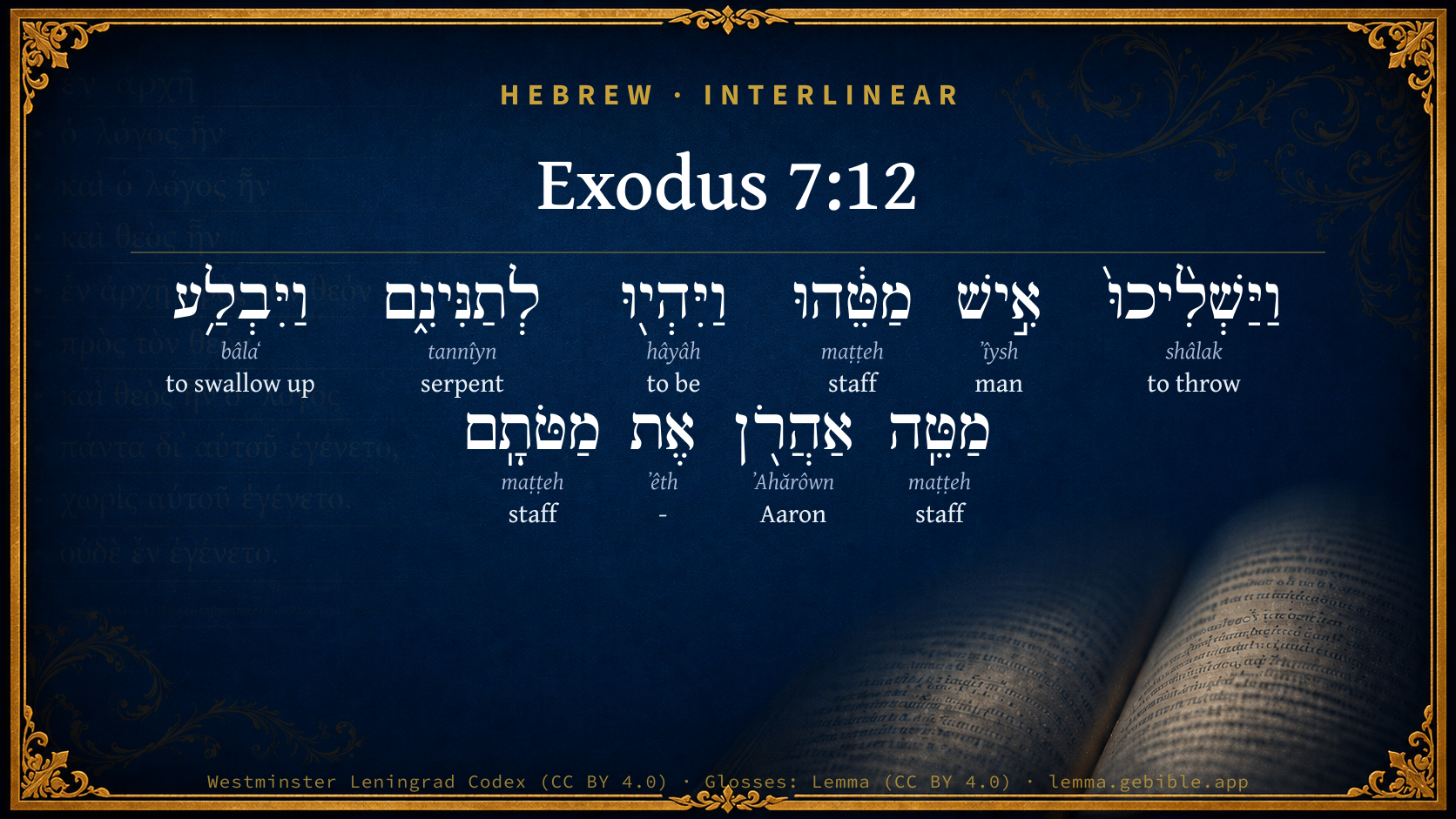
Hebrew (Westminster Leningrad Codex) Exodus 7:12 appears in the Hebrew Old Testament. The text above is from the Westminster Leningrad Codex. Each word links to its Strong’s number, a concise gloss, and parsing drawn from the Open Scriptures Hebrew Bible morphology. Click any word for its full Brown-Driver-Briggs (BDB) entry.
Download image
Cite this verse

Exodus 7:12 (World English Bible). Public Domain. Lemma interlinear Bible study tool, https://lemma.gebible.app/v/exodus/7/12.

Show BibTeX & RIS
BibTeX
RIS
English Translation
For they cast down every man his rod, and they became serpents: but Aaron's rod swallowed up their rods.
World English Bible · Public Domain
Download a study sheet

One document with this verse’s original text, its word-by-word gloss line, the meaning frame, cross-references with their text, attributed commentary, and full source and license credits — printable, and it pastes into notes with its structure intact.

This verse Autodidact and up

Study sheet (.html) Plain text (.txt)

A passage Seminary Student

Up to 50 verses in one chapter. A passage sheet keeps up to 6 commentary sources and 12 cross-references per verse, in the order this page ranks them, and says so on the sheet whenever that leaves anything out. Ask for a single verse and you get the Autodidact verse sheet above.

Everything on this page stays free to read, with no account — the sheet is a download of what is already on screen, not access to it.

Want to remove ads? Support Godless Engineer
Compare translations 3

The same verse in 3 English versions, stacked beneath the original-language interlinear above. Click any original word for its lexicon entry.

Each is an independent rendering of the whole verse — the interlinear is not word-aligned to these translations.

Highlighted words mark where these versions differ — a whole-verse word diff, not a word-by-word alignment.

  • World English Bible Public Domain
    For they cast down every man his rod, and they became serpents: but Aaron's rod swallowed up their rods.
  • King James Version Public Domain
    For they cast down every man his rod, and they became serpents: but Aaron's rod swallowed up their rods.
  • unfoldingWord Literal Text CC BY-SA 4.0
    And each man threw down his staff, and they became serpents. And the staff of Aaron swallowed up their staffs.

unfoldingWord Literal Text — © unfoldingWord, licensed CC BY-SA 4.0. Word-aligned USFM3 via Door43 (git.door43.org/unfoldingWord/en_ult).

Versions to compare (up to 4)

3 of 4 selected

Show all 18 translations

Every available English version of this verse, each an independent rendering of the whole verse.

  • World English Bible Public Domain
    For they cast down every man his rod, and they became serpents: but Aaron's rod swallowed up their rods.
  • Berean Standard Bible Public Domain
    Each one threw down his staff, and it became a serpent. But Aaron’s staff swallowed up the other staffs.
  • Majority Standard Bible Public Domain
    Each one threw down his staff, and it became a serpent. But Aaron’s staff swallowed up the other staffs.
  • King James Version Public Domain
    For they cast down every man his rod, and they became serpents: but Aaron's rod swallowed up their rods.
  • American Standard Version (1901) Public Domain
    For they cast down every man his rod, and they became serpents: but Aaron's rod swallowed up their rods.
  • Revised Version (1885) Public Domain
    For they cast down every man his rod, and they became serpents: but Aaron’s rod swallowed up their rods.
  • Geneva Bible (1599) Public Domain
    For they cast downe euery man his rod, and they were turned into serpents: but Aarons rodde deuoured their rods.
  • Douay-Rheims (1899) Public Domain
    And they every one cast down their rods, and they were turned into serpents: but Aaron's rod devoured their rods.
  • Young's Literal Translation Public Domain
    and they cast down each his rod, and they become monsters, and the rod of Aaron swalloweth their rods;
  • Literal Standard Version CC BY-SA 4.0
    and they each cast down his rod, and they become dragons, and the rod of Aaron swallows their rods;
  • Unlocked Literal Bible CC BY-SA 4.0
    Each man threw down his staff, and the staffs became snakes. But Aaron's staff swallowed up their snakes.
  • unfoldingWord Literal Text CC BY-SA 4.0
    And each man threw down his staff, and they became serpents. And the staff of Aaron swallowed up their staffs.
  • Darby Bible Public Domain
    they cast down every man his staff, and they became serpents; but Aaron's staff swallowed up their staves.
  • World Messianic Bible Public Domain
    For they each cast down their rods, and they became serpents; but Aaron’s rod swallowed up their rods.
  • Webster's Bible Public Domain
    For they cast down every man his rod, and they became serpents: but Aaron's rod swallowed up their rods.
  • Free Bible Version CC BY-SA 4.0
    Each of them threw down their walking sticks and they also turned into snakes, but Aaron's walking stick swallowed up all their walking sticks.
  • Bible in Basic English Public Domain
    For every one of them put down his rod on the earth, and they became snakes: but Aaron's rod made a meal of their rods.
  • JPS Tanakh (1917) Public Domain
    For they cast down every man his rod, and they became serpents; but Aaron's rod swallowed up their rods.

Literal Standard Version (2020), Covenant Press — licensed CC BY-SA 4.0. Text via the HelloAO Bible API (eBible.org). Unlocked Literal Bible (unfoldingWord) — licensed CC BY-SA 4.0. Text via the HelloAO Bible API (eBible.org). unfoldingWord Literal Text — © unfoldingWord, licensed CC BY-SA 4.0. Word-aligned USFM3 via Door43 (git.door43.org/unfoldingWord/en_ult). Free Bible Version, Dr. Jonathan Gallagher — licensed CC BY-SA 4.0. Text via the HelloAO Bible API (eBible.org).

Word by word

More ways to search: Search by grammar → Find every occurrence → Compare this word →

Practice this passage: Drill this verse → Learn its vocabulary →

לְתַנִּינִ֑ם
tannîyn
H8577
“to/for · serpents”
Preposition + Noun, Common, Masculine, Plural, Absolute
Part of Speech
Preposition + Noun
Type
Common
Gender
Masculine
Number
Plural
State
Absolute
Full BDB Definition

Origin: intensive from the same as H8565

TWOT: 2528b

dragon, serpent, sea monster - dragon or dinosaur - sea or river monster - serpent, venomous snake
  1. וַיַּשְׁלִ֨יכוּ֙ shâlak H7993 “and · to throw” Conjunction + Verb, Hiphil, Sequential Imperfect, 3rd Person, Masculine, Plural
  2. אִ֣ישׁ ʼîysh H376 “man” Noun, Common, Masculine, Singular, Absolute
  3. מַטֵּ֔הוּ maṭṭeh H4294 “staff · his” Noun, Common, Masculine, Singular, Construct + Suffix, Personal, 3rd Person, Masculine, Singular
  4. וַיִּהְי֖וּ hâyâh H1961 “and · to be” Conjunction + Verb, Qal, Sequential Imperfect, 3rd Person, Masculine, Plural
  5. וַיִּבְלַ֥ע bâlaʻ H1104 “and · to swallow up” Conjunction + Verb, Qal, Sequential Imperfect, 3rd Person, Masculine, Singular
  6. מַטֵּֽה maṭṭeh H4294 “staff of” Noun, Common, Masculine, Singular, Construct
  7. אַהֲרֹ֖ן ʼAhărôwn H175 “Aaron” Noun, Proper
  8. אֶת ʼêth H853 “-” Particle, Direct Object
  9. מַטֹּתָֽם maṭṭeh H4294 “staffs · their” Noun, Common, Masculine, Plural, Construct + Suffix, Personal, 3rd Person, Masculine, Plural

About this verse

These counts appear in no published source. They are computed here, from the morphology-tagged text and Lemma’s own curated glosses. What Lemma adds →

10
words
8
distinct lemmas
Pentateuch
section

Shared distinctive vocabulary

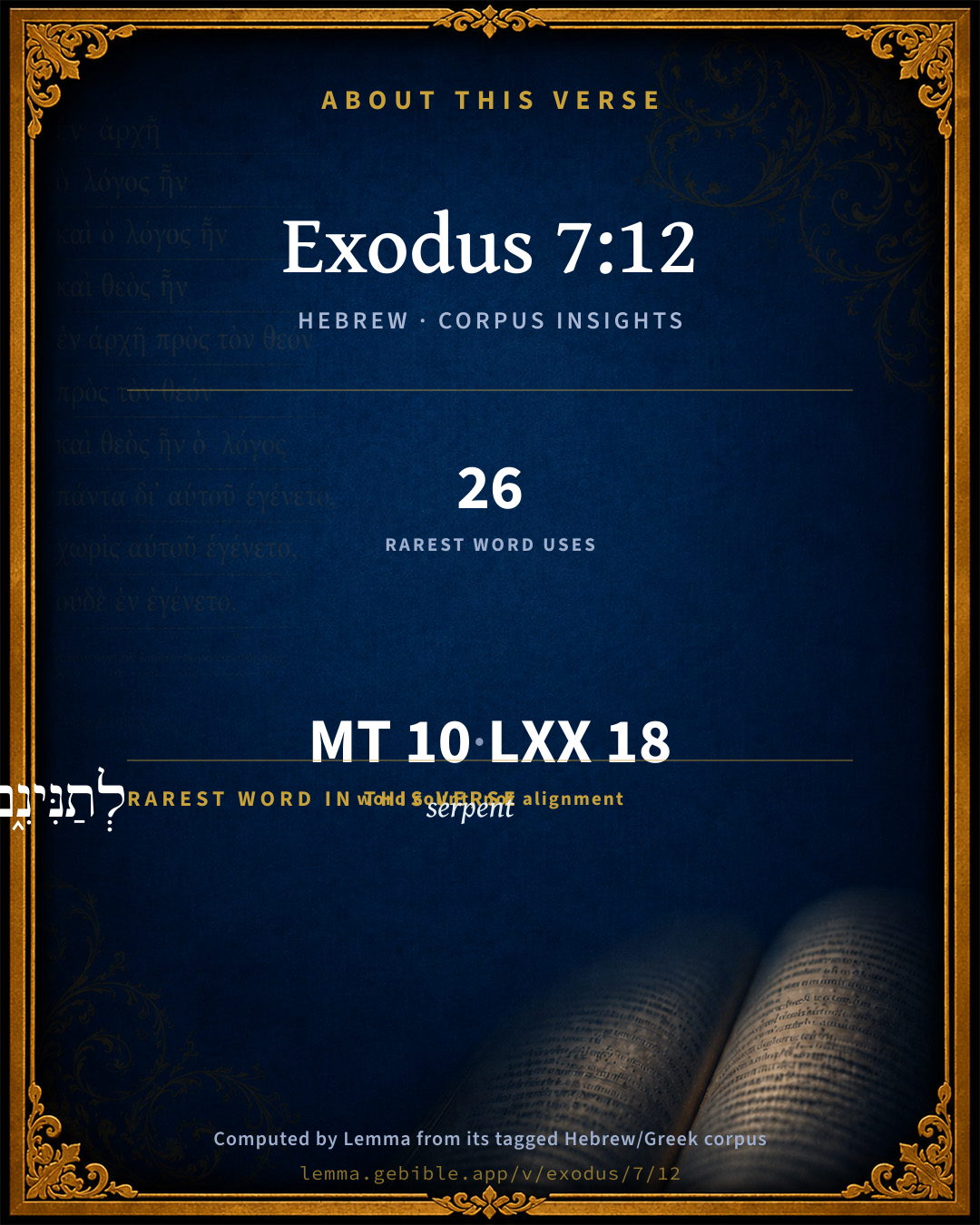
לְתַנִּינִ֑ם serpent H8577 occurs in 26 verses of the Hebrew Bible. Also found in:

Grammatical profile

  • 3 verbs
  • 6 nouns
  • 1 particle

Verb forms

  • וַיַּשְׁלִ֨יכוּ֙ Hiphil · Sequential Imperfect
  • וַיִּהְי֖וּ Qal · Sequential Imperfect
  • וַיִּבְלַ֥ע Qal · Sequential Imperfect

Repetition

A word recurs within this verse — often emphatic in Hebrew:

  • מַטֵּ֔הוּ staff H4294 ×3

Hebrew & Septuagint length

In English translation the verse runs 19 words from the Hebrew and 20 from the Septuagint (LXX English) — closely comparable.

A rough comparison of the two English renderings, which tokenize alike — not a word-level alignment.

Word counts can differ between the Hebrew and the Greek without any difference in meaning — e.g. the Hebrew direct-object marker אֵת has no separate Greek word, and Greek often adds the article ὁ.

In the original languages it is 10 Hebrew tokens and 18 Greek tokens — but the two are counted differently (Hebrew bundles its prefixes and suffixes into one token; the Greek is in lemma form), so that isn’t a like-for-like length.

Cross-references

6

Topical passages linked to Exodus 7:12 in the Treasury of Scripture Knowledge — connected by theme and wording, ordered by reader-vote popularity; previews shown in the World English Bible.

  • 1 John 4:4 You are of God, little children, and have overcome them; because greater is he who is in you than he who is in the world.
  • Exodus 8:18–19 The magicians tried with their enchantments to bring forth lice, but they couldn't. There were lice on man, and on animal.
  • Exodus 9:11 The magicians couldn't stand before Moses because of the boils; for the boils were on the magicians, and on all the Egyptians.
  • Acts 8:9–13 But there was a certain man, Simon by name, who used to practice sorcery in the city, and amazed the people of Samaria, making himself out to be some great one,
  • Acts 13:8–11 But Elymas the sorcerer (for so is his name by interpretation) withstood them, seeking to turn aside the proconsul from the faith.
  • Acts 19:19–20 Many of those who practiced magical arts brought their books together and burned them in the sight of all. They counted the price of them, and found it to be fifty thousand pieces of silver.

Cross-references courtesy of OpenBible.info (CC BY 4.0).

Hebrew and Greek witnesses Masoretic Hebrew ↔ Greek Septuagint

The same verse in the two great witnesses to the Old Testament, shown verse-for-verse.

These are two independent witnesses, not word-aligned to each other, and the Septuagint is shown in lemma (dictionary) form.

Hebrew Exodus 7:12 Masoretic · Westminster Leningrad Codex

וַיַּשְׁלִ֨יכוּ֙ אִ֣ישׁ מַטֵּ֔הוּ וַיִּהְי֖וּ לְתַנִּינִ֑ם וַיִּבְלַ֥ע מַטֵּֽה אַהֲרֹ֖ן אֶת מַטֹּתָֽם

For they cast down every man his rod, and they became serpents: but Aaron's rod swallowed up their rods.

World English Bible · Public Domain

Greek LXX Exodus 7:12 Septuagint · lemma form

καί ῥίπτω ἕκαστος ὁ ῥάβδος αὐτός καί γίγνομαι δράκων καί καταπίνω ὁ ῥάβδος ὁ ααρων ὁ ἐκεῖνος ῥάβδος

And they cast down each his rod, and they became serpents, but the rod of Aaron swallowed up their rods.

LXX2012 (modern English Septuagint) · Public Domain

Hebrew: Westminster Leningrad Codex (CC BY 4.0). Greek: Septuagint (public domain); English from LXX2012 (modern English Septuagint) (Public Domain). How the Septuagint differs from the Hebrew →

Targum (Aramaic paraphrase)

2

The Targum is the ancient Jewish Aramaic paraphrase of the Hebrew Scriptures — an interpretive translation, not the Hebrew text itself. Onkelos (literal) and Pseudo-Jonathan (expansive) render the Torah, and Jonathan the Prophets. Coverage is partial: where no permissively-licensed English translation exists for a verse, only the Aramaic is shown. This is verse-level text, not a word-by-word alignment to the Hebrew.

  1. Targum Onkelos Torah (Genesis–Deuteronomy)
    וּרְמוֹ גְבַר חוּטְרֵהּ וַהֲווֹ לְתַנִינַיָא וּבְלַע חֻטְרָא דְאַהֲרֹן יָת חֻטְרֵיהוֹן:

    (no public-domain English translation for this verse)

    Targum Onkelos — Aramaic: “Onkelos Genesis” (public domain); “Onkelos Exodus” (public domain); “Onkelos Leviticus” (public domain); “Onkelos Numbers” (public domain); “Onkelos Deuteronomy” (public domain). English: “Sefaria Community Translation” (CC0 1.0 (public-domain dedication)); “J.W. Etheridge. The Targums of Onkelos and Jonathan Ben Uzziel on the Pentateuch. London: Longmans, Green, 1862” (public domain). Text via Sefaria.

  2. Targum Pseudo-Jonathan Torah (Genesis–Deuteronomy)
    וּטְלָקוּן אֵינַשׁ חוּטְרֵיהּ וַהֲווֹ לְחָרְמָנִין וּמִן יַד אִתְהֲפִּיכוּ לְמֶהֱוֵי כְּמִן שֵׁירוּיָא וּבְלַע חוּטְרָא דְאַהֲרן יַת חוּטְרֵיהוֹן

    They threw down each man his rod, and they became basilisks; but were forthwith changed to be what they were at first; and the rod of Aharon swallowed up their rods.

    Targum Pseudo-Jonathan — Aramaic: “Targum Jonathan on Genesis” (public domain); “Targum Jonathan on Exodus” (public domain); “Targum Jonathan on Leviticus” (public domain); “Targum Jonathan on Numbers” (public domain); “Targum Jonathan on Deuteronomy” (public domain). English: “The Targum of Jonathan ben Uzziel, trans. J. W. Etheridge, London, 1862” (public domain). Text via Sefaria.

Commentary

Notes on Exodus 7:12 from classic Christian and Jewish commentators (each source and its license shown beneath its notes). The classic Christian expositions comment on the surrounding passage and are grouped to its opening verse, so a note may address several verses; the Jewish commentaries on the Tanakh (Rashi and others) are per-verse, so they appear only where the commentator wrote on this verse.

Lemma curates 59 commentaries, every one of them public domain or Creative Commons licensed, each selected and text-cleaned for this edition rather than reprinted as found. About our sources →

Trapp's Complete Commentary

John Trapp

Exo 7:12 For they cast down every man his rod, and they became serpents: but Aaron’s rod swallowed up their rods.

Ver. 12. And they became serpents.] Not really such, but in appearance only. The devil’s miracles are mere impostures, phantasms, delusions. And this was the first plague that God inflicted upon Pharaoh.

Swallowed up their rods.] That is, their dragons. So hath Christ, who is life essential, swallowed up death in victory. {1Co 15:55}

John Trapp, A Commentary or Exposition upon All the Books of the Old and New Testament (1647–1656) — public domain. Text from a community e-Sword module.

Joseph Benson's Commentary

Exo 7:12. They became serpents — The authors of the Universal History cast considerable light on this subject: “If it be asked,” say they, “why God suffered the magicians to act thus, by a power borrowed from the devil, in order to invalidate, if possible, those miracles which his servant wrought by his divine power, the following reasons may be given for it: First, It was necessary that those magicians should be suffered to exert the utmost of their power against Moses, in order to clear him from the imputation of magic or sorcery; for as the notion of such an extraordinary art was very rife, not only among the Egyptians, but all other nations, if they had not entered into this strenuous competition with him, and been at length overcome by him, both the Hebrews and Egyptians would have been more apt to attribute all his miracles to his skill in magic, than to the divine power. Secondly, It was necessary in order to confirm the faith of the wavering and desponding Israelites, by making them see the difference between Moses’s acting by the power of God, and the sorcerers by that of Satan. And, lastly, In order to preserve them afterward from being seduced by any false miracles, from the true worship of God.”

Joseph Benson's Commentary on the Old and New Testaments (1811–1818) — public domain. Text from a community e-Sword module.

Jamieson, Fausset & Brown

Robert Jamieson, A. R. Fausset & David Brown

but Aaron's rod swallowed up their rods--This was what they could not be prepared for, and the discomfiture appeared in the loss of their rods, which were probably real serpents.

Jamieson, Fausset & Brown — Commentary Critical and Explanatory on the Whole Bible (1871) — public domain (CC PDM 1.0). Text via the HelloAO Bible API.

Adam Clarke's Commentary

Verse 12. Aaron's rod swallowed up their rods.] As Egypt was remarkably addicted to magic, sorcery, c., it was necessary that God should permit Pharaoh's wise men to act to the utmost of their skill in order to imitate the work of God, that his superiority might be clearly seen, and his powerful working incontestably ascertained and this was fully done when Aaron's rod swallowed up their rods. We have already seen that the names of two of the chief of these magicians were Jannes and Jambres; See Clarke on Ex 2:10, and 2Ti 3:8. Many traditions and fables concerning these may be seen in the eastern writers.

Adam Clarke's Commentary on the Bible (1810–1826) — public domain. Text from a community e-Sword/MySword module.

The Cambridge Bible for Schools and Colleges

gen. ed. J. J. S. Perowne

12. swallowed up their rods] and so gave proof of Aaron’s superiority to the magicians.

The Cambridge Bible for Schools and Colleges (gen. ed. J. J. S. Perowne; Cambridge University Press, 1878–1918) — public domain. Text from a community e-Sword module.

John Gill's Exposition

For they cast down every man his rod, and they became serpents,.... That is, they seemed to be so, as Josephus (z) expresses it, but not really, in which he is followed by many; though some think that the devil assisted in this affair, and in an instant, as soon as the rods were cast down, removed them and put real serpents in their room:

but Aaron's rod swallowed up their rods; that is, the serpent that Aaron's rod was turned into, swallowed up the rods of the magicians, which never were otherwise than rods only in appearance; or if real serpents were put in the room of them, these were devoured by his serpent called his rod, because it was before turned into a serpent, as Aben Ezra observes; though the Targums of Jonathan, Jarchi, and R. Jeshua, suppose this was done after the serpent became a rod again; which makes the miracle the greater and more wonderful, that a rod should devour other rods; and supposing them real serpents, this was what the magicians could not make their rods do, and in which they were outdone by Aaron.

(z) Antiqu. ut supra. (l. 2. c. 13 sect. 3.)

John Gill's Exposition of the Whole Bible (1746–1763) — public domain (CC PDM 1.0). Text via the HelloAO Bible API.

Haydock's Catholic Bible Commentary

Devoured. Thus the superiority remained with Aaron. The rod was then restored to its pristine form, ver. 15. (Haydock)

George Leo Haydock (1774–1849), Haydock's Catholic Family Bible and Commentary, 1859 edition — public domain. Excludes Psalms (Douay-Rheims chapter numbering differs from Protestant) and Deuterocanonical books (Catholic canon only).

Matthew Poole's English Annotations

They became serpents; either,

1. In appearance. For the Scripture oft speaks of things otherwise than they are, because they seem to be so. And therefore as the devil appearing to Saul in the likeness of Samuel is called Samuel; so may these rods upon the same account be called serpents, because through diabolical illusion they seemed to be so. Or,

2. Really, in manner expressed, Exo 7:11.

Aaron’s rod swallowed up their rods; by which it was evident, either that Aaron’s rod was turned into a real serpent, because it had the real properties and effects of a serpent, viz. to devour; or, at least, that the God of Israel was infinitely more powerful than the Egyptian idols or devils.

Matthew Poole's English Annotations on the Holy Bible (1683–1685) — public domain. Text from a community e-Sword/MySword module.

Whedon's Commentary on the Bible

Daniel D. Whedon

12. They cast down every man his rod, and they became serpents — Crocodiles, as above. Moses wrought a miracle which they could easily imitate, for all the apparent transformations with which our modern jugglers have made us familiar, and even more wonderful ones than these, have been practised in Egypt and the East from an unknown antiquity. The author describes the transaction just as it appeared to those who saw it, as we would describe similar apparent transformations wrought by a juggler today, but his language cannot fairly be pressed to prove that these magicians possessed any supernatural power. The most famous magicians have always professed to deceive, and declared that their most striking exploits were mere illusions; and how much more than deception there is in magic and sorcery, and whether all their wonders are literally “lying wonders,” must be held as still open questions; but it is certain that Satan has ever used such dark arts and powers to resist the truth. See the Introduction to the History of the Plagues, 2.

But Aaron’s rod swallowed up their rods — This was prophetic of the religion that was soon to swallow up all the boasted wisdom of Egypt, and the true miracle was thus also distinguished from the “lying wonder.”

Daniel D. Whedon (gen. ed.), Commentary on the Old and New Testaments (1874–1909) — public domain. Text from a community e-Sword module.

The Pulpit Commentary

But Aaron"s rod swallowed up their rods. Aaron"s serpent turned upon its rivals and devoured them, thus exhibiting a marked superiority.

The Pulpit Commentary (1880–1919), ed. H.D.M. Spence-Jones & Joseph S. Exell — public domain. Text from a community e-Sword module.

Scofield Reference Notes

C. I. Scofield

Aaron’s rod

(Cf) Exo 4:2 As Moses’ rod was the rod of power, the rod of the King Deu 33:4; Deu 33:5 so Aaron’s was the rod of life, the rod of the Priest. As here the serpents, symbols of Satan, who had the power of death; Rev 12:9; Heb 2:14 are swallowed up, so in resurrection death will be "swallowed up in victory"; 1Co 15:54; Num 17:8.

The Scofield Reference Bible (1917 edition), notes by C. I. Scofield — public domain. Text from a community e-Sword module.

Rashi

Rabbi Shlomo Yitzchaki (Rashi)

ויבלע מטה אהרן BUT AARON’S STAFF SWALLOWED (It states that the staff swallowed) — after it had again become a staff it swallowed all of them (Shabbat 97 a; Exodus Rabbah 9:7).

Rashi on the Tanakh — English translations: “The Judaica Press complete Tanach with Rashi, translated by A. J. Rosenberg” (CC BY 4.0); “Pentateuch with Rashi's commentary by M. Rosenbaum and A.M. Silbermann, 1929-1934” (public domain); “The Metsudah Tanach series, Lakewood, N.J” (CC BY 4.0); and “The Book of Joshua, Metsudah Publications, 1997” (CC BY 4.0). Text via Sefaria.

Lesson kit

Teaching starters — assembled from the data on this page, not authored interpretation. Every prompt links to the verse data it draws on. Edit before teaching.

Exodus, in the Pentateuch, opens this verse with 10 words (8 distinct Hebrew lemmas). Its most distinctive word is tannîyn (“serpent”). A historical commentator’s framing appears above. Read the whole chapter for the surrounding context.

Discussion questions

  1. The word tannîyn carries the sense “serpent.” How does it shape the verse?
  2. Genesis 1:21 shares the word «serpent» with this verse. How do the two illuminate each other?
  3. “staff” occurs 3× in this one verse. What is the effect of the repetition?
  4. These translations render this verse differently; the difference is in the English rendering, not the original. What questions does that raise?
  5. The verb «וַיַּשְׁלִ֨יכוּ֙» is Hiphil Sequential Imperfect. How does its form color the action?
  6. Reading how Trapp's Complete Commentary and Joseph Benson's Commentary read this verse, where do the two commentators agree and where do they part?

Things to notice

Reading settings

Reading text

Shown beneath each verse's original-language words.

Old Testament
Old Testament edition

Read the OT as the Masoretic Hebrew (MT) or the Greek Septuagint (LXX).

English shown for the Greek Septuagint (in the Hebrew ↔ Greek comparison).

Comparing translations? Open the Compare panel on any verse page to stack up to four side by side.