Ezekiel 27:10

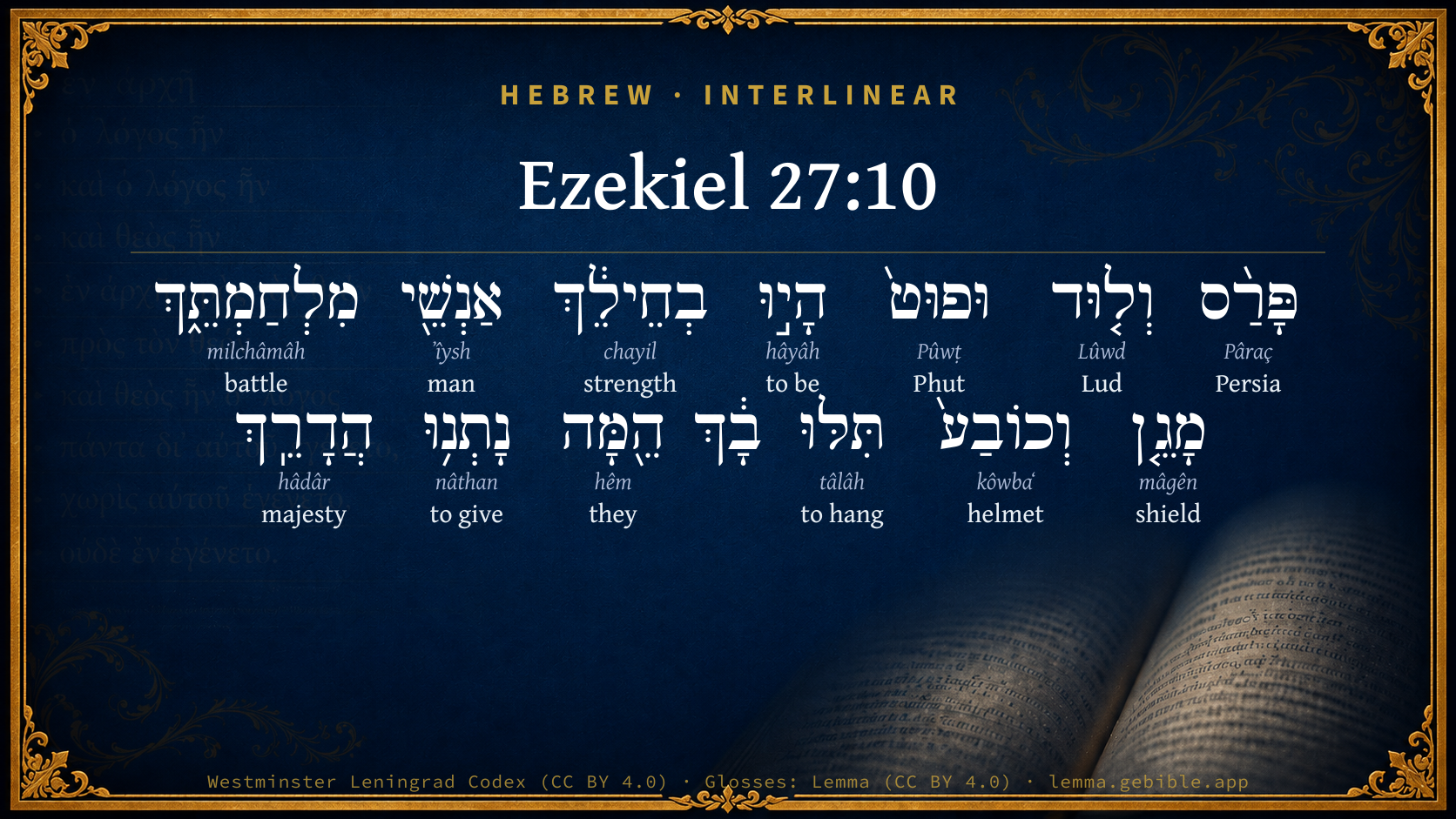
Hebrew (Westminster Leningrad Codex) Ezekiel 27:10 appears in the Hebrew Old Testament. The text above is from the Westminster Leningrad Codex. Each word links to its Strong’s number, a concise gloss, and parsing drawn from the Open Scriptures Hebrew Bible morphology. Click any word for its full Brown-Driver-Briggs (BDB) entry.
Download image
Cite this verse

Ezekiel 27:10 (World English Bible). Public Domain. Lemma interlinear Bible study tool, https://lemma.gebible.app/v/ezekiel/27/10.

Show BibTeX & RIS
BibTeX
RIS
English Translation
Persia and Lud and Put were in your army, your men of war: they hanged the shield and helmet in you; they set forth your comeliness.
World English Bible · Public Domain
Download a study sheet

One document with this verse’s original text, its word-by-word gloss line, the meaning frame, cross-references with their text, attributed commentary, and full source and license credits — printable, and it pastes into notes with its structure intact.

This verse Autodidact and up

Study sheet (.html) Plain text (.txt)

A passage Seminary Student

Up to 50 verses in one chapter. A passage sheet keeps up to 6 commentary sources and 12 cross-references per verse, in the order this page ranks them, and says so on the sheet whenever that leaves anything out. Ask for a single verse and you get the Autodidact verse sheet above.

Everything on this page stays free to read, with no account — the sheet is a download of what is already on screen, not access to it.

Want to remove ads? Support Godless Engineer
Compare translations 3

The same verse in 3 English versions, stacked beneath the original-language interlinear above. Click any original word for its lexicon entry.

Each is an independent rendering of the whole verse — the interlinear is not word-aligned to these translations.

Highlighted words mark where these versions differ — a whole-verse word diff, not a word-by-word alignment.

  • World English Bible Public Domain
    Persia and Lud and Put were in your army, your men of war: they hanged the shield and helmet in you; they set forth your comeliness.
  • King James Version Public Domain
    They of Persia and of Lud and of Phut were in thine army, thy men of war: they hanged the shield and helmet in thee; they set forth thy comeliness.
  • unfoldingWord Literal Text CC BY-SA 4.0
    Persia, Lydia, and Libya were in your army, your men of war. They hung shield and helmet within you; they showed your splendor.

unfoldingWord Literal Text — © unfoldingWord, licensed CC BY-SA 4.0. Word-aligned USFM3 via Door43 (git.door43.org/unfoldingWord/en_ult).

Versions to compare (up to 4)

3 of 4 selected

Show all 18 translations

Every available English version of this verse, each an independent rendering of the whole verse.

  • World English Bible Public Domain
    Persia and Lud and Put were in your army, your men of war: they hanged the shield and helmet in you; they set forth your comeliness.
  • Berean Standard Bible Public Domain
    Men of Persia, Lydia, and Put served as warriors in your army. They hung their shields and helmets on your walls; they gave you splendor.
  • Majority Standard Bible Public Domain
    Men of Persia, Lydia, and Put served as warriors in your army. They hung their shields and helmets on your walls; they gave you splendor.
  • King James Version Public Domain
    They of Persia and of Lud and of Phut were in thine army, thy men of war: they hanged the shield and helmet in thee; they set forth thy comeliness.
  • American Standard Version (1901) Public Domain
    Persia and Lud and Put were in thine army, thy men of war: they hanged the shield and helmet in thee; they set forth thy comeliness.
  • Revised Version (1885) Public Domain
    Persia and Lud and Put were in thine army, thy men of war: they hanged the shield and helmet in thee; they set forth thy comeliness.
  • Geneva Bible (1599) Public Domain
    They of Persia, and of Lud and of Phut were in thine armie: thy men of warre they hanged the shielde and helmet in thee: they set foorth thy beautie.
  • Douay-Rheims (1899) Public Domain
    The Persians, and Lydians, and the Libyans were thy soldiers in thy army: they hung up the buckler and the helmet in thee for thy ornament.
  • Young's Literal Translation Public Domain
    Persian and Lud and Phut Have been in thy forces -- thy men of war. Shield and helmet they hung up in thee, They -- they have given out thine honour.
  • Literal Standard Version CC BY-SA 4.0
    Persia and Lud and Phut || Have been in your forces—your men of war. They hung up shield and helmet in you, || They have given out your honor.
  • Unlocked Literal Bible CC BY-SA 4.0
    Persia, Lydia, and Libya were in your army, your men of war. they hung shield and helmet within you; they showed your splendor.
  • unfoldingWord Literal Text CC BY-SA 4.0
    Persia, Lydia, and Libya were in your army, your men of war. They hung shield and helmet within you; they showed your splendor.
  • Darby Bible Public Domain
    Persia and Lud and Phut were in thine army, thy men of war: they hanged shield and helmet in thee; they gave splendour to thee.
  • World Messianic Bible Public Domain
    “‘“Persia, Lud, and Put were in your army, your men of war. They hung the shield and helmet in you. They showed your beauty.
  • Webster's Bible Public Domain
    They of Persia and of Lud and of Phut were in thy army, thy military men: they hung the shield and helmet in thee; they set forth thy comeliness.
  • Free Bible Version CC BY-SA 4.0
    Men from Persia, Lydia, and Put were soldiers in your army. They lived among you, hanging up their shields and helmets with you, making you famous.
  • Bible in Basic English Public Domain
    Cush and Lud and Put were in your army, your men of war, hanging up their body-covers and head-dresses of war in you: they gave you your glory.
  • JPS Tanakh (1917) Public Domain
    Persia and Lud and Put were in thine army, thy men of war; they hanged the shield and helmet in thee, they set forth thy comeliness.

Literal Standard Version (2020), Covenant Press — licensed CC BY-SA 4.0. Text via the HelloAO Bible API (eBible.org). Unlocked Literal Bible (unfoldingWord) — licensed CC BY-SA 4.0. Text via the HelloAO Bible API (eBible.org). unfoldingWord Literal Text — © unfoldingWord, licensed CC BY-SA 4.0. Word-aligned USFM3 via Door43 (git.door43.org/unfoldingWord/en_ult). Free Bible Version, Dr. Jonathan Gallagher — licensed CC BY-SA 4.0. Text via the HelloAO Bible API (eBible.org).

Word by word

More ways to search: Search by grammar → Find every occurrence → Compare this word →

Practice this passage: Drill this verse → Learn its vocabulary →

וְל֤וּד
Lûwd
H3865
“and · Lud”
Conjunction + Noun, Proper
Part of Speech
Conjunction + Noun
Type
Proper
Full BDB Definition

Origin: probably of foreign derivation

TWOT: None

Lud or Lydia = "strife" - the 4th listed son of Shem and supposed progenitor of the Lydians (noun proper masculine) - descendants of Lud the son of Shem who settled in northern Africa (noun patrial)
  1. פָּרַ֨ס Pâraç H6539 “Persia” Noun, Proper
  2. וּפוּט֙ Pûwṭ H6316 “and · Phut” Conjunction + Noun, Proper
  3. הָי֣וּ hâyâh H1961 “to be” Verb, Qal, Perfect, 3rd Person, Common, Plural
  4. בְחֵילֵ֔ךְ chayil H2428 “in/at · strength · your” Preposition + Noun, Common, Masculine, Singular, Construct + Suffix, Personal, 2nd Person, Feminine, Singular
  5. אַנְשֵׁ֖י ʼîysh H376 “men of” Noun, Common, Masculine, Plural, Construct
  6. מִלְחַמְתֵּ֑ךְ milchâmâh H4421 “battle · your” Noun, Common, Feminine, Singular, Construct + Suffix, Personal, 2nd Person, Feminine, Singular
  7. מָגֵ֤ן mâgên H4043 “shield” Noun, Common, Both, Singular, Absolute
  8. וְכוֹבַע֙ kôwbaʻ H3553 “and · helmet” Conjunction + Noun, Common, Masculine, Singular, Absolute
  9. תִּלּוּ tâlâh H8518 “to hang” Verb, Piel, Perfect, 3rd Person, Common, Plural
  10. הֵ֖מָּה hêm H1992 “they” Pronoun, Personal, 3rd Person, Masculine, Plural
  11. נָתְנ֥וּ nâthan H5414 “to give” Verb, Qal, Perfect, 3rd Person, Common, Plural
  12. הֲדָרֵֽךְ hâdâr H1926 “majesty · your” Noun, Common, Masculine, Singular, Construct + Suffix, Personal, 2nd Person, Feminine, Singular

About this verse

These counts appear in no published source. They are computed here, from the morphology-tagged text and Lemma’s own curated glosses. What Lemma adds →

14
words
13
distinct lemmas
Prophets
section

Notable vocabulary

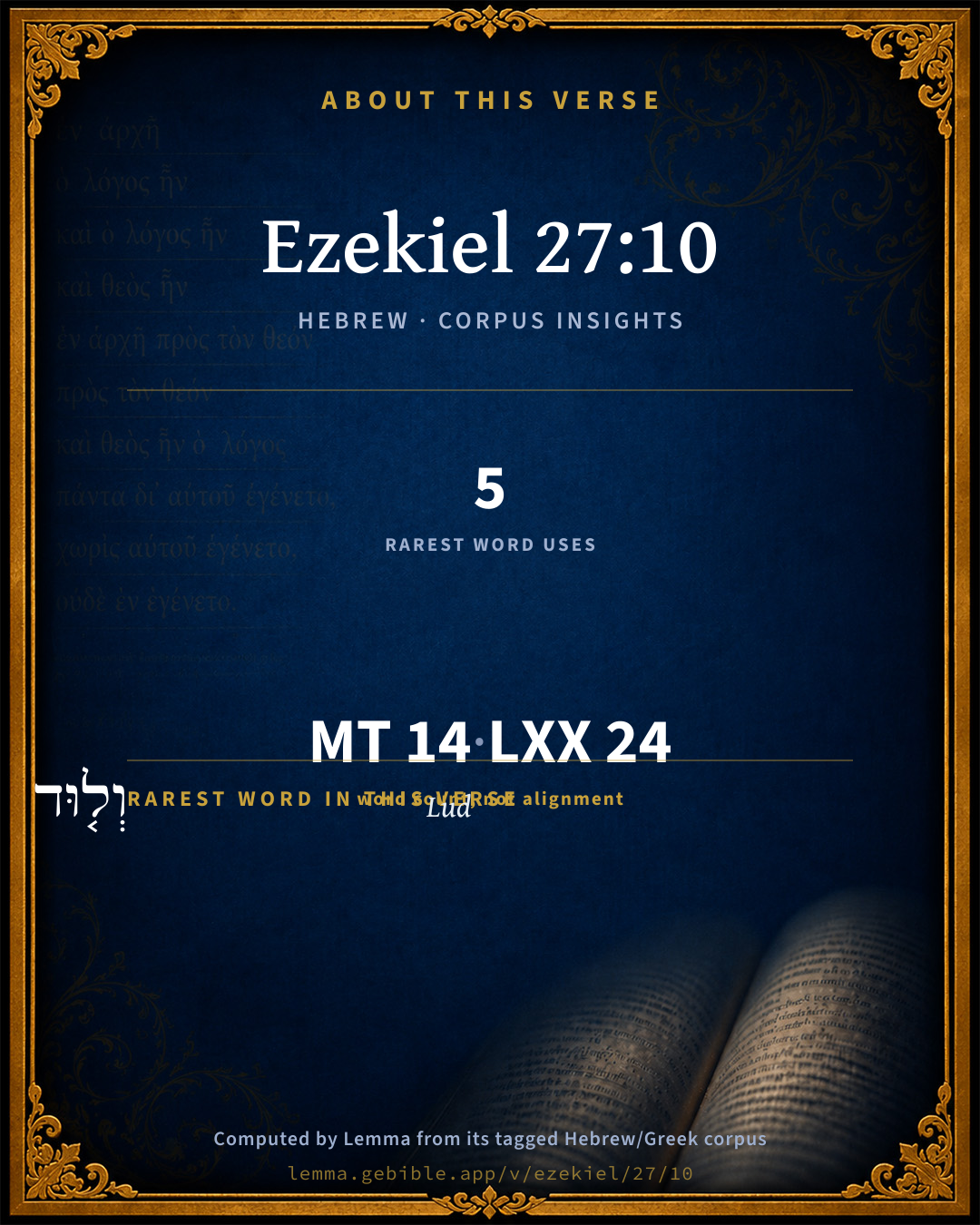
The rarest word here is וְל֤וּד Lud H3865 — appearing just 5 times in the whole Hebrew Bible.

Shared distinctive vocabulary

וְל֤וּד Lud H3865 occurs in 5 verses of the Hebrew Bible. Also found in:

Grammatical profile

  • 3 verbs
  • 9 nouns
  • 1 pronoun
  • 1 preposition

Verb forms

  • הָי֣וּ Qal · Perfect
  • תִּלּוּ Piel · Perfect
  • נָתְנ֥וּ Qal · Perfect

Hebrew & Septuagint length

In English translation the verse runs 26 words from the Hebrew and 22 from the Septuagint (LXX English) — closely comparable.

A rough comparison of the two English renderings, which tokenize alike — not a word-level alignment.

Word counts can differ between the Hebrew and the Greek without any difference in meaning — e.g. the Hebrew direct-object marker אֵת has no separate Greek word, and Greek often adds the article ὁ.

In the original languages it is 14 Hebrew tokens and 24 Greek tokens — but the two are counted differently (Hebrew bundles its prefixes and suffixes into one token; the Greek is in lemma form), so that isn’t a like-for-like length.

Cross-references

14

Topical passages linked to Ezekiel 27:10 in the Treasury of Scripture Knowledge — connected by theme and wording, ordered by reader-vote popularity; previews shown in the World English Bible.

  • Ezekiel 30:5 Ethiopia, and Put, and Lud, and all the mixed people, and Cub, and the children of the land that is in league, shall fall with them by the sword.
  • Ezekiel 38:5 Persia, Cush, and Put with them, all of them with shield and helmet;
  • Song of Solomon 4:4 Your neck is like David's tower built for an armory, Whereon there hang a thousand shields, All the shields of the mighty men.
  • Isaiah 66:19 I will set a sign among them, and I will send such as escape of them to the nations, to Tarshish, Pul, and Lud, who draw the bow, to Tubal and Javan, to the isles afar off, who have not heard my fame, neither have seen my glory; and they shall declare my glory among the nations.
  • Jeremiah 46:9 Go up, you horses; and rage, you chariots; and let the mighty men go forth: Cush and Put, who handle the shield; and the Ludim, who handle and bend the bow.
  • Genesis 10:6 The sons of Ham: Cush, Mizraim, Put, and Canaan.
  • Genesis 10:13 Mizraim became the father of Ludim, Anamim, Lehabim, Naphtuhim,
  • Genesis 10:22 The sons of Shem: Elam, Asshur, Arpachshad, Lud, and Aram.
  • 1 Chronicles 1:8 The sons of Ham: Cush, and Mizraim, Put, and Canaan.
  • 1 Chronicles 1:11 Mizraim became the father of Ludim, and Anamim, and Lehabim, and Naphtuhim,
  • 1 Chronicles 1:17 The sons of Shem: Elam, and Asshur, and Arpachshad, and Lud, and Aram, and Uz, and Hul, and Gether, and Meshech.
  • Ezekiel 27:11 The men of Arvad with your army were on your walls round about, and valorous men were in your towers; they hanged their shields on your walls round about; they have perfected your beauty.
  • Daniel 5:28 PERES; your kingdom is divided, and given to the Medes and Persians.
  • Nahum 3:9 Cush and Egypt were her boundless strength. Put and Libya were her helpers.

Cross-references courtesy of OpenBible.info (CC BY 4.0).

Hebrew and Greek witnesses Masoretic Hebrew ↔ Greek Septuagint

The same verse in the two great witnesses to the Old Testament, shown verse-for-verse.

These are two independent witnesses, not word-aligned to each other, and the Septuagint is shown in lemma (dictionary) form.

Hebrew Ezekiel 27:10 Masoretic · Westminster Leningrad Codex

פָּרַ֨ס וְל֤וּד וּפוּט֙ הָי֣וּ בְחֵילֵ֔ךְ אַנְשֵׁ֖י מִלְחַמְתֵּ֑ךְ מָגֵ֤ן וְכוֹבַע֙ תִּלּוּ בָ֔ךְ הֵ֖מָּה נָתְנ֥וּ הֲדָרֵֽךְ

Persia and Lud and Put were in your army, your men of war: they hanged the shield and helmet in you; they set forth your comeliness.

World English Bible · Public Domain

Greek LXX Ezekiel 27:10 Septuagint · lemma form

πέρσης καί λυδοί καί λίβυες εἰμί ἐν ὁ δύναμις σύ ἀνήρ πολεμιστής σύ πέλτη καί περικεφαλαία κρεμάζω ἐν σύ οὗτος δίδωμι ὁ δόξα σύ

Persians and Lydians and Libyans were in your army: your warriors hung in you shields and helmets; these gave you your glory.

LXX2012 (modern English Septuagint) · Public Domain

On this verse, Albert Barnes' Notes on the Bible discusses the Septuagint’s reading. Read the note in Commentary ↓

Hebrew: Westminster Leningrad Codex (CC BY 4.0). Greek: Septuagint (public domain); English from LXX2012 (modern English Septuagint) (Public Domain). How the Septuagint differs from the Hebrew →

Targum (Aramaic paraphrase)

1

The Targum is the ancient Jewish Aramaic paraphrase of the Hebrew Scriptures — an interpretive translation, not the Hebrew text itself. Onkelos (literal) and Pseudo-Jonathan (expansive) render the Torah, and Jonathan the Prophets. Coverage is partial: where no permissively-licensed English translation exists for a verse, only the Aramaic is shown. This is verse-level text, not a word-by-word alignment to the Hebrew.

  1. Targum Jonathan Prophets (Joshua–Malachi)
    פַּרְסָאֵי וְלוּדָאֵי וּפוּטְאֵי הֲווֹ בְמַשְׁרִיתֵיךְ גַבְרֵי עָבְדֵי קְרָבִיךְ עֲגִילִין וְקוּלְסִין תְּלוֹ בִּיךְ אִינוּן אַסְגִיאוּ זִיוֵיךְ:

    (no public-domain English translation for this verse)

    Targum Jonathan — Aramaic: “Mikraot Gedolot” (public domain). English: “Sefaria Community Translation” (CC0 1.0 (public-domain dedication)); “London "Chaldee Paraphrase," 1871” (public domain). Text via Sefaria.

Commentary

Notes on Ezekiel 27:10 from classic Christian and Jewish commentators (each source and its license shown beneath its notes). The classic Christian expositions comment on the surrounding passage and are grouped to its opening verse, so a note may address several verses; the Jewish commentaries on the Tanakh (Rashi and others) are per-verse, so they appear only where the commentator wrote on this verse.

Lemma curates 59 commentaries, every one of them public domain or Creative Commons licensed, each selected and text-cleaned for this edition rather than reprinted as found. About our sources →

Trapp's Complete Commentary

John Trapp

Eze 27:10 They of Persia and of Lud and of Phut were in thine army, thy men of war: they hanged the shield and helmet in thee; they set forth thy comeliness.

Ver. 10. They set forth thy comeliness.] They were to thee both for muniment and for ornament.

John Trapp, A Commentary or Exposition upon All the Books of the Old and New Testament (1647–1656) — public domain. Text from a community e-Sword module.

Albert Barnes' Notes on the Bible

The prophet here leaves the allegory of the ship to describe the armies of the Tyrians composed of mercenary soldiers.

Eze 27:10

Persia - The name of this people does not occur in the more ancient books of the Old Testament; but in the books of the exile and after the exile it is frequent. This exactly corresponds with the record of history. It was just at the time that Ezekiel wrote that the rude and warlike people of Persia were rising into notice, soon about to seize, under Cyrus, the empire of the Asiatic world.

Lud - See Gen 10:13. The union here of “Lud with Phut,” an undoubtedly African tribe (compare Eze 30:5; Isa 66:19) seems to indicate Lud to be of Hamitic race, not the Semitic race. Both names occur repeatedly on Egyptian inscriptions, especially as supplying mercenary soldiers.

Phut - Libyans (see Gen 10:6).

Eze 27:11

Gammadims - Rendered by Septuagint “watchmen;” by others, “brave warriors;” but more probably the name of some nation of which we have no record. The custom of hanging shields upon the walls of a town by way of ornament seems to have been of purely Phoenician origin, and thence introduced by Solomon into Jerusalem 1Ki 10:16.

Albert Barnes' Notes on the Bible (1834–1885) — public domain. Text from a community e-Sword/MySword module.

Tyndale Open Study Notes

Tyndale Open Resources

27:10 Persia, Lydia, and Libya: Persia was far to the east over land, while Lydia was northwest in what is now Turkey. Libya was southwest on the shore of the Mediterranean.

Tyndale Open Study Notes — © Tyndale Open Resources, licensed CC BY-SA 4.0. Text via the HelloAO Bible API.

Jamieson, Fausset & Brown

Robert Jamieson, A. R. Fausset & David Brown

Persia . . . Phut--warriors from the extreme east and west.

Lud--the Lydians of Asia Minor, near the Meander, famed for archery (Isa 66:19); rather than those of Ethiopia, as the Lydians of Asia Minor form a kind of intermediate step between Persia and Phut (the Libyans about Cyrene, shielded warriors, Jer 46:9, descended from Phut, son of Ham).

hanged . . . shield . . . comeliness--Warriors hanged their accoutrements on the walls for ornament. Divested of the metaphor, it means that it was an honor to thee to have so many nations supplying thee with hired soldiers.

Jamieson, Fausset & Brown — Commentary Critical and Explanatory on the Whole Bible (1871) — public domain (CC PDM 1.0). Text via the HelloAO Bible API.

Adam Clarke's Commentary

Verse 10. They of Persia] Lud, the Lydians; Phut, a people of Africa, see Ge 10:6. From these places they had auxiliary troops; for as they traded with the then known world, were rich, and could afford to give good pay, they no doubt had soldiers and sailors from every part. Skilful and desperate men will go any where after their price.

Adam Clarke's Commentary on the Bible (1810–1826) — public domain. Text from a community e-Sword/MySword module.

Ellicott's Commentary for English Readers

(10) Of Persia and of Lud and of Phut.—Tyre, like most commercial nations, depended chiefly on mercenaries for the rank and file of its army. Persia, more anciently called Elam, was just now rising into prominence. Its soldiers were probably obtained by the Tyrians from their commerce in the Persian Gulf. Lud is not the one mentioned among the children of Shem (Gen_10:22), but the Ludim (Lydians) of Hamite family, descended from Mizraim (Gen_10:13). Phut was also an African tribe (Gen_10:6). Both are repeatedly mentioned on the Egyptian monuments as furnishing mercenaries to the army.

A Bible Commentary for English Readers, edited by Charles John Ellicott (1878–1897) — public domain. Text from a community e-Sword module.

The Cambridge Bible for Schools and Colleges

gen. ed. J. J. S. Perowne

10. Her men of war.

Her mercenaries were drawn from all quarters of the world. The people called here “they of Persia” appears along with Cush and Phut, African peoples, in the army of Gog, ch. Eze_38:5, in which, however, northern nations as Gomer and Togarmah are also mustered. The host of Gog includes the nations lying on the outskirts of the known world, and Persia might be named among them, though the first certain mention of that country is in Ezr_4:5; Ezr_9:9, &c. Others have thought here of some African people. Lud is named, ch. Eze_30:5, along with Cush and Phut, as allies of Egypt (Jer_46:9); and in Gen_10:13 Ludim is the firstborn of Mizraim (Egypt). In Isa_66:19 Lud is named after Tarshish, and probably some people lying on the African coast, W. of Egypt, is referred to. Phut (Gen_10:6) is son of Ham, and brother of Cush (Ethiopia), Mizraim (Egypt) and Canaan (Phœnicia). In Eze_30:5 (Jer_46:9; Nah_3:9) the people is an ally of Egypt. LXX. renders Lybians. The inhabitants of western Egypt, or those on its western border may be referred to.

they hanged the shield] The great ship is still spoken of. A figure of a ship so adorned and dressed with weapons hung on its sides is given in Layard, Nineveh, ii. p. 388. The practice of hanging weapons on buildings was not unknown in Israel, Son_4:4 (1Ma_4:57).

The Cambridge Bible for Schools and Colleges (gen. ed. J. J. S. Perowne; Cambridge University Press, 1878–1918) — public domain. Text from a community e-Sword module.

John Gill's Exposition

The men of Arvad, with thine army were upon thy walls round about,.... Placed there for the defence of the city, to watch against an enemy, lest it should be surprised; here they were upon the patrol day and night; see Isa 62:6, these were the men of the same place before mentioned, Eze 27:8 which furnished Tyre both with mariners and soldiers:

and the Gammadims were in thy towers: not the Medes, as Symmachus renders it; nor the Cappadocians, as the Targum; much less were they images of their tutelar gods, as Spencer thinks, of a cubit long; nor "pygmies", as the Vulgate Latin version renders it; which to mention would not be to the honour of their militia; though Kimchi and Ben Melech call them dwarfs, men of a small stature, of a cubit high, from whence they are supposed to have their name; so Schindler (q): rather they were the inhabitants of some place in Phoenicia; either of Ancon; which in Greek signifies a cubit, as Gamad does in Hebrew; or of Gammade, the same which Pliny (r) corruptly calls Gamale. Hillerus (s) thinks the word signifies "ambidexters", or left handed men, such as Ehud:

they hanged their shields upon thy walls roundabout. Kimchi and Ben Melech observe it was a custom in some places to hang such weapons upon the tops of towers, and upon the walls of them; which might be done, either that they might be ready to take up and make use of, whenever occasion required; or to dismay their enemies, and to show them that they were provided for them:

they have made thy beauty perfect; besides the beauty of her buildings and shipping, there was the beauty of her militia; which was increased by the soldiers from Persia, Lydia, and Lybia, and added to by the men of Arvad, but completed by the Gammadim; and particularly being glided, as probably they were, looked very glittering and beautiful in the rays of the sun.

(q) Lexic. Pentaglott. col. 319, 320. (r) Nat. Hist. l. 2. c. 91. (s) Onomast. Sacr. p. 159.

John Gill's Exposition of the Whole Bible (1746–1763) — public domain (CC PDM 1.0). Text via the HelloAO Bible API.

Haydock's Catholic Bible Commentary

Lybians. Hebrew, "Phut." They had been expelled by the Cyreneans. Tyre had in her pay the most warlike nations of Persia, &c. Cyrus soon after shook off the yoke of the Medes, and conquered the Lydians. --- Hung up, ver. 11. This was very usual, Canticle of Canticles iv. 4., and Isaias xxii. 8. (Calmet)

George Leo Haydock (1774–1849), Haydock's Catholic Family Bible and Commentary, 1859 edition — public domain. Excludes Psalms (Douay-Rheims chapter numbering differs from Protestant) and Deuterocanonical books (Catholic canon only).

Matthew Poole's English Annotations

They of Persia; Persians, excellent archers.

Of Lud; Lydians; not those Croesus was king over, but those that dwelt in Egypt about the lake Marcotis, or higher towards Ethiopia, if they were not of that country, Ethiopians themselves.

Of Phut; Libyans, a people of Africa; these were the hired soldiers, and ever served in their army under Tyrian commanders.

Men of war; stationary soldiers in time of peace, and who were sent out by sea or land as occasion required in a time of war.

They hanged the shield, in time of peace; or might they not, so often as they came off the guard, bring each man his armour, and hang it up in the public armoury?

The shield, which defended the body, and helmet, which covered the head.

They set forth thy comeliness; these stout, expert, well-armed guards were an honour to the state they served, and their arsenal especially did prove the gallantry of this Tyrian state.

Matthew Poole's English Annotations on the Holy Bible (1683–1685) — public domain. Text from a community e-Sword/MySword module.

Whedon's Commentary on the Bible

Daniel D. Whedon

10. Persia… Lud… Phut — The Persians appear for the first time in Ezekiel’s century as a national power (Toy). (See notes Dan_5:28.) They were probably near relatives of the Medes, with whom they had a close alliance, and were at this time the enemies of Assyria. Toy, because of the parallel list (Eze_30:5), changes Persia (Paras) to Cush. Lud originally came from Egypt (Gen_10:13), and was her warm ally (Jer_46:9) and suffered in her downfall (Eze_30:5), though Gen_10:22, points to a Semitic origin. A prehistoric migration into the Nile Delta might account for this divergence of statement. Jensen believes the people referred to are not the Lydians (Assyrian, Lu-ud-di) as has been commonly assumed, but some nomadic tribe of the Syrian desert living between Aram and Uz on one side and Babylonia on the other (Sunday School Times, February 11, 1899). George Adam Smith and many others believe them to have been Libyans (as LXX.). Put, or Phut, was of Hamitic origin and a close relative of the Ethiopians, Egyptians, and Canaanites (Phoenicians, Gen_10:6). The nation appears in many places as a close ally of Egypt (Eze_30:5; Jer_46:9; Nah_3:9). It also appears in the army of Gog (Eze_38:5). Scholars have generally identified these people with various African nations, as the Nubians or Libyans. A text of Nebuchadnezzar states that in his thirty-seventh year in a campaign against Egypt he defeated “the soldiers of the city of Pudhu-yavan, a distant land which is within the sea,” from which Sayce draws the conclusion that “Phut of the Ionians” may have been Kyrene, or Pelusium, or some other settlement of the Greek mercenaries in Egypt. However, the names of towns migrate rapidly, and the use of the “yavan” as a descriptive term may indicate that there was an original Phut which was not “Phut of the Ionians.” Edward Glaser believes that he has found a Phut (Puta) in Southwest Arabia (Acad., 40:76), at which place, close to the base of the Gala Mountains, Mr. W. Bent has found an ancient harbor resembling closely that which is pictured on the Egyptian monuments as that of Punt, the land of incense. (See note Eze_27:21.) Naville, however, is sure that Punt was on the African coast of the Red Sea (Deir el Bahari, 3:1898). It is at any rate plain that Tyre formed her army largely of mercenaries, and it is very natural that she should choose allies of Egypt in her defense against the aggressions of Assyria.

Hanged the shield and helmet in thee — So the walls were adorned (See Eze_27:11 and Son_4:4).

Daniel D. Whedon (gen. ed.), Commentary on the Old and New Testaments (1874–1909) — public domain. Text from a community e-Sword module.

The Pulpit Commentary

Persia. The name does not meet us in any Old Testament book before the exile, Elam taking its place. It was just about the time that Ezekiel wrote that the Persians were becoming conspicuous through their alliance with the Modes. So we find it again in Eze_38:5 Dan_5:28; 2Ch_36:20, 2Ch_36:22; Ezr_1:1 Ezr_4:5; Est_1:3. Here they are named as mercenaries in the Tyrian army. Lud. The LXX and the Vulgate, led by the similarity of sound, give Lydians in Gen_10:13 the Ludim appear as descendants of Mizraim, while Lud in Gen_10:22 is joined with Elam and Asshur as among the sons of Shem. Its combination with "Phut" (i.e. Libya) here and in Jer_46:9 is infavor of its referring to an African nation. (comp. also Eze_30:5; Isa_66:19) Phut. Both the LXX and the Vulgate give Libyans. in Gen_10:6 the name is joined with Cash and Mizraim. The Lubim (Libyans) are named as forming part of Shishak"s army in 2Ch_12:3 2Ch_16:8, and in Nah_3:9 and Jer_46:9 as closely allied with the Egyptians. Ezekiel names Phut again as sharing in the fall of Tyre, (Eze_30:5) and as serving in the army of Gog. (Eze_38:5) Mr. R. S. Peele is inclined to identify them with the Nubians.

The Pulpit Commentary (1880–1919), ed. H.D.M. Spence-Jones & Joseph S. Exell — public domain. Text from a community e-Sword module.

John Wesley's Explanatory Notes

Lud - Lydians, not those Cresus was king over, but those that dwelt in Egypt about the lake Maraeolis. Phut - Lybians, a people of Africa; these were their hired soldiers. Hanged the shield - In time of peace. They set forth - These stout, expert, well armed guards, were an honour to thee.

John Wesley, Explanatory Notes Upon the Whole Bible (1754–1765) — public domain. Text via the GEBible commentary corpus.

unfoldingWord translationNotes

Door43 World Missions Community

Connecting Statement:

Yahweh continues giving Ezekiel his message to Tyre.

General Information:

The words "you" and "your" in these verses refer to Tyre.

Persia, Lydia ... Libya ... Arvad ... Helek ... Gammad

These are the names of places. (See: How to Translate Names)

your men of war

"men who fought in your wars" or "serving as your warriors"

your splendor

The abstract noun "splendor" can be translated using the adjective "splendid." AT: "how splendid you were" or "how majestic you were" (See: Abstract Nouns)

They completed your beauty

The abstract noun "beauty" can be translated using the adjective "beautiful." AT: "They finished making you beautiful" or "They made you perfectly beautiful" (See: Abstract Nouns)

translationWords

Persia

shield

splendor

people group

watchtower

unfoldingWord translationNotes — © Distant Shores Media and the Door43 World Missions Community, licensed CC BY-SA 4.0. Source: git.door43.org/Door43/en_tn.

Lesson kit

Teaching starters — assembled from the data on this page, not authored interpretation. Every prompt links to the verse data it draws on. Edit before teaching.

Ezekiel, in the Prophets, opens this verse with 14 words (13 distinct Hebrew lemmas). Its most distinctive word is Lûwd (“Lud”). A historical commentator’s framing appears above. Read the whole chapter for the surrounding context.

Discussion questions

  1. How does “Lud” (Lûwd) shape what this verse is saying?
  2. How does Genesis 10:22, which shares the word «Lud», read alongside this verse?
  3. These translations render this verse differently; the difference is in the English rendering, not the original. What questions does that raise?
  4. «הָי֣וּ» is a Qal Perfect verb. How does that grammatical form shape the action described?
  5. Compare how Trapp's Complete Commentary and Albert Barnes' Notes on the Bible read this verse. Where do they agree or differ?

Things to notice

Reading settings

Reading text

Shown beneath each verse's original-language words.

Old Testament
Old Testament edition

Read the OT as the Masoretic Hebrew (MT) or the Greek Septuagint (LXX).

English shown for the Greek Septuagint (in the Hebrew ↔ Greek comparison).

Comparing translations? Open the Compare panel on any verse page to stack up to four side by side.