
Deuteronomy 25:5

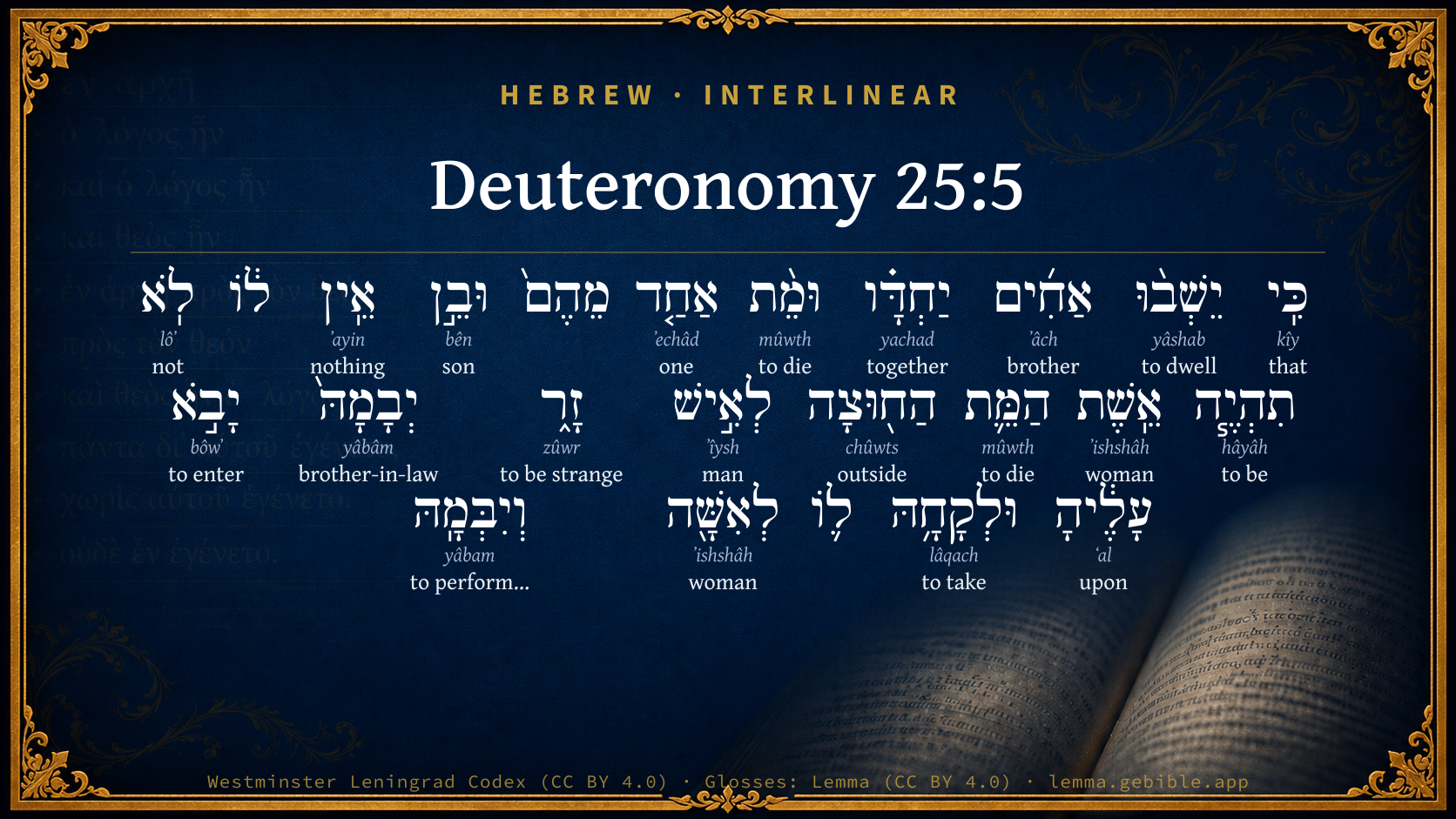
Hebrew (Westminster Leningrad Codex) Deuteronomy 25:5 appears in the Hebrew Old Testament. The text above is from the Westminster Leningrad Codex. Each word links to its Strong’s number, a concise gloss, and parsing drawn from the Open Scriptures Hebrew Bible morphology. Click any word for its full Brown-Driver-Briggs (BDB) entry.
Download image
Cite this verse

Deuteronomy 25:5 (World English Bible). Public Domain. Lemma interlinear Bible study tool, https://lemma.gebible.app/v/deuteronomy/25/5.

Show BibTeX & RIS
BibTeX
RIS
English Translation
If brothers dwell together, and one of them die, and have no son, the wife of the dead shall not be married outside to a stranger: her husband's brother shall go in to her, and take her to him as wife, and perform the duty of a husband's brother to her.
World English Bible · Public Domain
Highlights
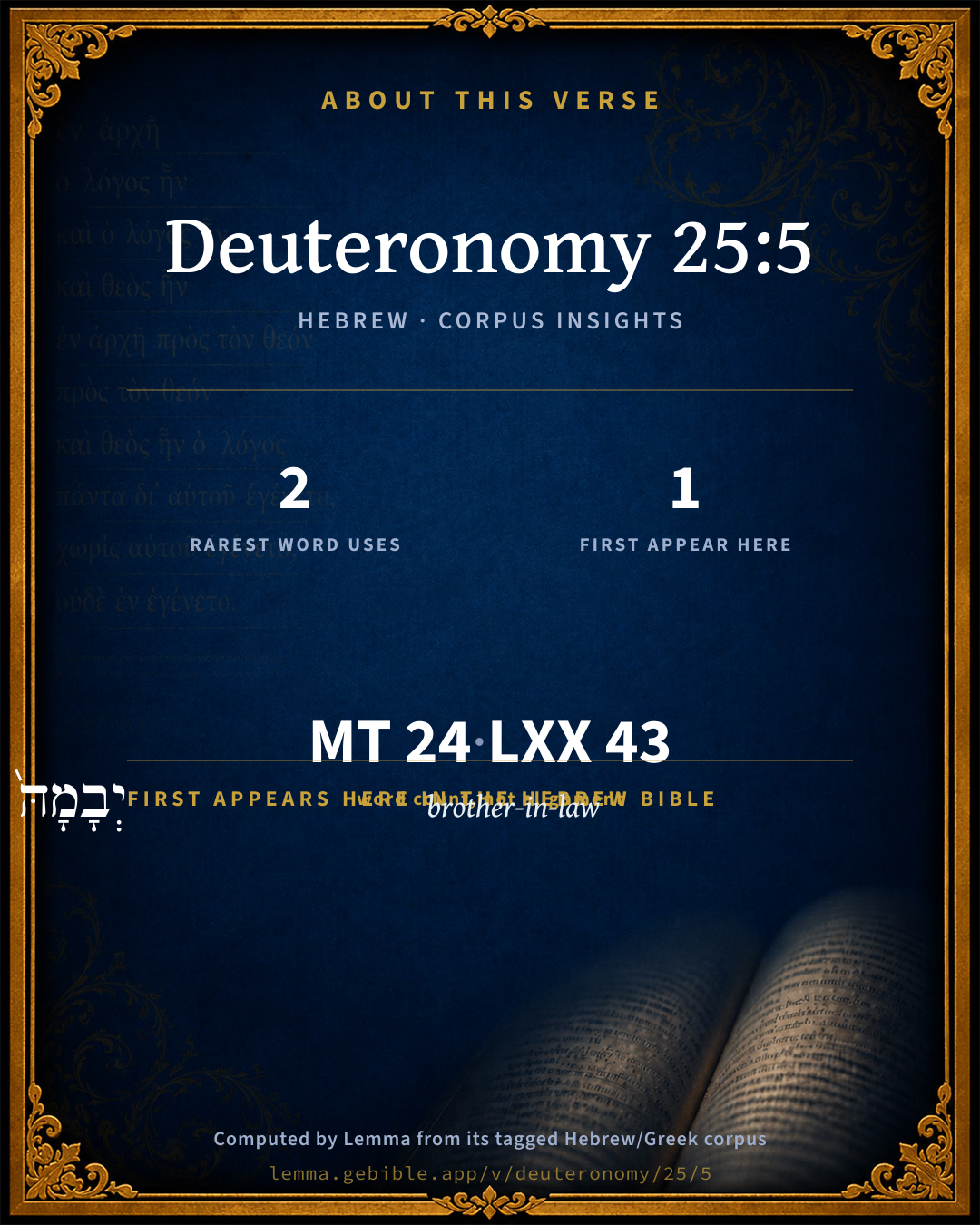
  • 1 first appearance in the Hebrew Bible
Full analysis ↓
Download a study sheet

One document with this verse’s original text, its word-by-word gloss line, the meaning frame, cross-references with their text, attributed commentary, and full source and license credits — printable, and it pastes into notes with its structure intact.

This verse Autodidact and up

Study sheet (.html) Plain text (.txt)

A passage Seminary Student

Up to 50 verses in one chapter. A passage sheet keeps up to 6 commentary sources and 12 cross-references per verse, in the order this page ranks them, and says so on the sheet whenever that leaves anything out. Ask for a single verse and you get the Autodidact verse sheet above.

Everything on this page stays free to read, with no account — the sheet is a download of what is already on screen, not access to it.

Want to remove ads? Support Godless Engineer
Compare translations 3

The same verse in 3 English versions, stacked beneath the original-language interlinear above. Click any original word for its lexicon entry.

Each is an independent rendering of the whole verse — the interlinear is not word-aligned to these translations.

Highlighted words mark where these versions differ — a whole-verse word diff, not a word-by-word alignment.

  • World English Bible Public Domain
    If brothers dwell together, and one of them die, and have no son, the wife of the dead shall not be married outside to a stranger: her husband's brother shall go in to her, and take her to him as wife, and perform the duty of a husband's brother to her.
  • King James Version Public Domain
    If brethren dwell together, and one of them die, and have no child, the wife of the dead shall not marry without unto a stranger: her husband's brother shall go in unto her, and take her to him to wife, and perform the duty of an husband's brother unto her.
  • unfoldingWord Literal Text CC BY-SA 4.0
    If brothers live together and one of them dies, and he does not have a son, the wife of the dead man shall not be for a strange man from outside. Her brother-in-law shall go in to her and take her for himself as a wife, and her brother-in-law.

unfoldingWord Literal Text — © unfoldingWord, licensed CC BY-SA 4.0. Word-aligned USFM3 via Door43 (git.door43.org/unfoldingWord/en_ult).

Versions to compare (up to 4)

3 of 4 selected

Show all 18 translations

Every available English version of this verse, each an independent rendering of the whole verse.

  • World English Bible Public Domain
    If brothers dwell together, and one of them die, and have no son, the wife of the dead shall not be married outside to a stranger: her husband's brother shall go in to her, and take her to him as wife, and perform the duty of a husband's brother to her.
  • Berean Standard Bible Public Domain
    When brothers dwell together and one of them dies without a son, the widow must not marry outside the family. Her husband’s brother is to take her as his wife and fulfill the duty of a brother-in-law for her.
  • Majority Standard Bible Public Domain
    When brothers dwell together and one of them dies without a son, the widow must not marry outside the family. Her husband’s brother is to take her as his wife and fulfill the duty of a brother-in-law for her.
  • King James Version Public Domain
    If brethren dwell together, and one of them die, and have no child, the wife of the dead shall not marry without unto a stranger: her husband's brother shall go in unto her, and take her to him to wife, and perform the duty of an husband's brother unto her.
  • American Standard Version (1901) Public Domain
    If brethren dwell together, and one of them die, and have no son, the wife of the dead shall not be married without unto a stranger: her husband's brother shall go in unto her, and take her to him to wife, and perform the duty of a husband's brother unto her.
  • Revised Version (1885) Public Domain
    If brethren dwell together, and one of them die, and have no son, the wife of the dead shall not marry without unto a stranger: her husband’s brother shall go in unto her, and take her to him to wife, and perform the duty of an husband’s brother unto her.
  • Geneva Bible (1599) Public Domain
    If brethren dwell together, and one of them dye and haue no sonne, the wife of the dead shall not marry without: that is, vnto a stranger, but his kinseman shall goe in vnto her, and take her to wife, and doe the kinsemans office to her.
  • Douay-Rheims (1899) Public Domain
    When brethren dwell together, and one of them dieth without children, the wife of the deceased shall not marry to another: but his brother shall take her, and raise up seed for his brother:
  • Young's Literal Translation Public Domain
    `When brethren dwell together, and one of them hath died, and hath no son, the wife of the dead is not without to a strange man; her husband's brother doth go in unto her, and hath taken her to him for a wife, and doth perform the duty of her husband's brother;
  • Literal Standard Version CC BY-SA 4.0
    When brothers dwell together, and one of them has died and has no son, the wife of the dead is not given to a strange man; her husband’s brother goes in to her, and has taken her to him for a wife, and performs the duty of her husband’s brother;
  • Unlocked Literal Bible CC BY-SA 4.0
    If brothers live together and one of them dies, not having any son, then the wife of the dead man must not be married off to someone else outside the family. Instead, her husband's brother must sleep with her and take her to himself as a wife, and do the duty of a husband's brother to her.
  • unfoldingWord Literal Text CC BY-SA 4.0
    If brothers live together and one of them dies, and he does not have a son, the wife of the dead man shall not be for a strange man from outside. Her brother-in-law shall go in to her and take her for himself as a wife, and her brother-in-law.
  • Darby Bible Public Domain
    If brethren dwell together, and one of them die, and have no son, the wife of the dead shall not marry a stranger abroad: her husband's brother shall go in unto her, and take her to him as wife, and perform the duty of a husband's brother unto her.
  • World Messianic Bible Public Domain
    If brothers dwell together, and one of them dies and has no son, the wife of the dead shall not be married outside to a stranger. Her husband’s brother shall go in to her, and take her as his wife, and perform the duty of a husband’s brother to her.
  • Webster's Bible Public Domain
    If brethren shall dwell together, and one of them shall die and have no child, the wife of the dead shall not marry without to a stranger: her husband's brother shall go in to her, and take her to him for a wife, and perform the duty of a husband's brother to her.
  • Free Bible Version CC BY-SA 4.0
    When two brothers live near to each other and one of them dies without having a son, the widow is not to marry a stranger outside the family. Her husband's brother is to marry her and sleep with her, fulfilling the requirements of a brother-in-law to provide her with children.
  • Bible in Basic English Public Domain
    If brothers are living together and one of them, at his death, has no son, the wife of the dead man is not to be married outside the family to another man: let her husband's brother go in to her and make her his wife, doing as it is right for a brother-in-law to do.
  • JPS Tanakh (1917) Public Domain
    If brethren dwell together, and one of them die, and have no child, the wife of the dead shall not be married abroad unto one not of his kin; her husband's brother shall go in unto her, and take her to him to wife, and perform the duty of a husband's brother unto her.

Literal Standard Version (2020), Covenant Press — licensed CC BY-SA 4.0. Text via the HelloAO Bible API (eBible.org). Unlocked Literal Bible (unfoldingWord) — licensed CC BY-SA 4.0. Text via the HelloAO Bible API (eBible.org). unfoldingWord Literal Text — © unfoldingWord, licensed CC BY-SA 4.0. Word-aligned USFM3 via Door43 (git.door43.org/unfoldingWord/en_ult). Free Bible Version, Dr. Jonathan Gallagher — licensed CC BY-SA 4.0. Text via the HelloAO Bible API (eBible.org).

Word by word

More ways to search: Search by grammar → Find every occurrence → Compare this word →

Practice this passage: Drill this verse → Learn its vocabulary →

יְבָמָהּ֙
yâbâm
H2993
“brother-in-law · her”
Noun, Common, Masculine, Singular, Construct + Suffix, Personal, 3rd Person, Feminine, Singular
Part of Speech
Noun
Type
Common
Gender
Masculine
Number
Singular
State
Construct
Full BDB Definition

Origin: from (the orig. of) H2992

TWOT: 836a

brother-in-law, husband's brother
  1. כִּֽי kîy H3588 “that” Conjunction
  2. יֵשְׁב֨וּ yâshab H3427 “to dwell” Verb, Qal, Imperfect, 3rd Person, Masculine, Plural
  3. אַחִ֜ים ʼâch H251 “brothers” Noun, Common, Masculine, Plural, Absolute
  4. יַחְדָּ֗ו yachad H3162 “together” Adverb
  5. וּמֵ֨ת mûwth H4191 “and · to die” Conjunction + Verb, Qal, Sequential Perfect, 3rd Person, Masculine, Singular
  6. אַחַ֤ד ʼechâd H259 “one” Adjective, Cardinal number, Masculine, Singular, Absolute
  7. וּבֵ֣ן bên H1121 “and · son” Conjunction + Noun, Common, Masculine, Singular, Absolute
  8. אֵֽין ʼayin H369 “nothing” Particle, Negative
  9. לֹֽא lôʼ H3808 “not” Particle, Negative
  10. תִהְיֶ֧ה hâyâh H1961 “to be” Verb, Qal, Imperfect, 3rd Person, Feminine, Singular
  11. אֵֽשֶׁת ʼishshâh H802 “woman of” Noun, Common, Feminine, Singular, Construct
  12. הַמֵּ֛ת mûwth H4191 “the · dying” Particle, Definite Article + Verb, Qal, Participle Active, Masculine, Singular, Absolute
  13. הַח֖וּצָה chûwts H2351 “the · outside · toward” Particle, Definite Article + Noun, Common, Masculine, Singular, Absolute + Suffix, Demonstrative
  14. לְאִ֣ישׁ ʼîysh H376 “to/for · man” Preposition + Noun, Common, Masculine, Singular, Absolute
  15. זָ֑ר zûwr H2114 “strange” Adjective, Adjective, Masculine, Singular, Absolute
  16. יָבֹ֣א bôwʼ H935 “to enter” Verb, Qal, Imperfect, 3rd Person, Masculine, Singular
  17. עָלֶ֔יהָ ʻal H5921 “upon · her” Preposition + Suffix, Personal, 3rd Person, Feminine, Singular
  18. וּלְקָחָ֥הּ lâqach H3947 “and · to take · her” Conjunction + Verb, Qal, Sequential Perfect, 3rd Person, Masculine, Singular + Suffix, Personal, 3rd Person, Feminine, Singular
  19. לְאִשָּׁ֖ה ʼishshâh H802 “to/for · woman” Preposition + Noun, Common, Feminine, Singular, Absolute
  20. וְיִבְּמָֽהּ yâbam H2992 “and · to perform levirate marriage · her” Conjunction + Verb, Piel, Sequential Perfect, 3rd Person, Masculine, Singular + Suffix, Personal, 3rd Person, Feminine, Singular

About this verse

These counts appear in no published source. They are computed here, from the morphology-tagged text and Lemma’s own curated glosses. What Lemma adds →

24
words
19
distinct lemmas
Pentateuch
section

Notable vocabulary

The rarest word here is יְבָמָהּ֙ brother-in-law H2993 — appearing just 2 times in the whole Hebrew Bible.

First appearance in Scripture

This word makes its first canonical appearance in the Hebrew Bible here:

  • יְבָמָהּ֙ brother-in-law H2993

Shared distinctive vocabulary

יְבָמָהּ֙ brother-in-law H2993 occurs in 2 verses of the Hebrew Bible. Also found in:

Grammatical profile

  • 7 verbs
  • 7 nouns
  • 2 adjectives
  • 4 prepositions
  • 1 conjunction
  • 1 adverb
  • 2 particles

Verb forms

  • יֵשְׁב֨וּ Qal · Imperfect
  • וּמֵ֨ת Qal · Sequential Perfect
  • תִהְיֶ֧ה Qal · Imperfect
  • הַמֵּ֛ת Qal · Participle Active
  • יָבֹ֣א Qal · Imperfect
  • וּלְקָחָ֥הּ Qal · Sequential Perfect
  • וְיִבְּמָֽהּ Piel · Sequential Perfect

Repetition

Words recur within this verse — often emphatic in Hebrew:

  • וּמֵ֨ת to die H4191 ×2
  • אֵֽשֶׁת woman H802 ×2

Hebrew & Septuagint length

In English translation the verse runs 51 words from the Hebrew and 56 from the Septuagint (LXX English) — closely comparable.

A rough comparison of the two English renderings, which tokenize alike — not a word-level alignment.

Word counts can differ between the Hebrew and the Greek without any difference in meaning — e.g. the Hebrew direct-object marker אֵת has no separate Greek word, and Greek often adds the article ὁ.

In the original languages it is 24 Hebrew tokens and 43 Greek tokens — but the two are counted differently (Hebrew bundles its prefixes and suffixes into one token; the Greek is in lemma form), so that isn’t a like-for-like length.

Cross-references

7

Topical passages linked to Deuteronomy 25:5 in the Treasury of Scripture Knowledge — connected by theme and wording, ordered by reader-vote popularity; previews shown in the World English Bible.

  • Matthew 22:24 saying, "Teacher, Moses said, 'If a man dies, having no children, his brother shall marry his wife, and raise up seed for his brother.'
  • Luke 20:28 They asked him, "Teacher, Moses wrote to us that if a man's brother dies having a wife, and he is childless, his brother should take the wife, and raise up children for his brother.
  • Genesis 38:8–9 Judah said to Onan, "Go in to your brother's wife, and perform the duty of a husband's brother to her, and raise up seed to your brother."
  • Mark 12:19 "Teacher, Moses wrote to us, 'If a man's brother dies, and leaves a wife behind him, and leaves no children, that his brother should take his wife, and raise up offspring for his brother.'
  • Ruth 1:12–13 Turn again, my daughters, go your way; for I am too old to have a husband. If I should say, I have hope, if I should even have a husband tonight, and should also bear sons;
  • Ruth 3:9 He said, Who are you? She answered, I am Ruth your handmaid: spread therefore your skirt over your handmaid; for you are a near kinsman.
  • Ruth 4:5 Then said Boaz, What day you buy the field of the hand of Naomi, you must buy it also of Ruth the Moabitess, the wife of the dead, to raise up the name of the dead on his inheritance.

Cross-references courtesy of OpenBible.info (CC BY 4.0).

Hebrew and Greek witnesses Masoretic Hebrew ↔ Greek Septuagint

The same verse in the two great witnesses to the Old Testament, shown verse-for-verse.

These are two independent witnesses, not word-aligned to each other, and the Septuagint is shown in lemma (dictionary) form.

Hebrew Deuteronomy 25:5 Masoretic · Westminster Leningrad Codex

כִּֽי יֵשְׁב֨וּ אַחִ֜ים יַחְדָּ֗ו וּמֵ֨ת אַחַ֤ד מֵהֶם֙ וּבֵ֣ן אֵֽין ל֔וֹ לֹֽא תִהְיֶ֧ה אֵֽשֶׁת הַמֵּ֛ת הַח֖וּצָה לְאִ֣ישׁ זָ֑ר יְבָמָהּ֙ יָבֹ֣א עָלֶ֔יהָ וּלְקָחָ֥הּ ל֛וֹ לְאִשָּׁ֖ה וְיִבְּמָֽהּ

If brothers dwell together, and one of them die, and have no son, the wife of the dead shall not be married outside to a stranger: her husband's brother shall go in to her, and take her to him as wife, and perform the duty of a husband's brother to her.

World English Bible · Public Domain

Greek LXX Deuteronomy 25:5 Septuagint · lemma form

ἐάν δέ καταοἰκέω ἀδελφός ἐπί ὁ αὐτός καί ἀποθνήσκω εἷς ἐκ αὐτός σπέρμα δέ μή εἰμί αὐτός οὐ εἰμί ὁ γυνή ὁ θνήσκω ἔξω ἀνήρ μή ἐγγίζω ὁ ἀδελφός ὁ ἀνήρ αὐτός εἰςἔρχομαι πρός αὐτός καί λαμβάνω αὐτός ἑαυτοῦ γυνή καί συνοἰκέω αὐτός

And if brethren should live together, and one of them should die, and should not have seed, the wife of the deceased shall not marry out of the family to a man not related: her husband's brother shall go in to her, and shall take her to himself for a wife, and shall dwell with her.

LXX2012 (modern English Septuagint) · Public Domain

On this verse, The Cambridge Bible for Schools and Colleges discusses the Septuagint’s reading. Read the note in Commentary ↓

Hebrew: Westminster Leningrad Codex (CC BY 4.0). Greek: Septuagint (public domain); English from LXX2012 (modern English Septuagint) (Public Domain). How the Septuagint differs from the Hebrew →

Targum (Aramaic paraphrase)

2

The Targum is the ancient Jewish Aramaic paraphrase of the Hebrew Scriptures — an interpretive translation, not the Hebrew text itself. Onkelos (literal) and Pseudo-Jonathan (expansive) render the Torah, and Jonathan the Prophets. Coverage is partial: where no permissively-licensed English translation exists for a verse, only the Aramaic is shown. This is verse-level text, not a word-by-word alignment to the Hebrew.

  1. Targum Onkelos Torah (Genesis–Deuteronomy)
    אֲרֵי יֵתְבוּן אַחִין כַּחֲדָא וִימוּת חַד מִנְהוֹן וּבַר לֵית לֵהּ לָא תְהֵי אִתַּת מֵתָנָא לְבָרָא לִגְבַר אוֹחֲרָן יְבָמַהּ יֵעוּל עֲלַהּ וְיִסְבַהּ לֵהּ לְאִנְתּוּ וְיִבְּמַהּ

    (no public-domain English translation for this verse)

    Targum Onkelos — Aramaic: “Onkelos Genesis” (public domain); “Onkelos Exodus” (public domain); “Onkelos Leviticus” (public domain); “Onkelos Numbers” (public domain); “Onkelos Deuteronomy” (public domain). English: “Sefaria Community Translation” (CC0 1.0 (public-domain dedication)); “J.W. Etheridge. The Targums of Onkelos and Jonathan Ben Uzziel on the Pentateuch. London: Longmans, Green, 1862” (public domain). Text via Sefaria.

  2. Targum Pseudo-Jonathan Torah (Genesis–Deuteronomy)
    כַּד דַּיְירִין בְּעַלְמָא הָדֵין שָׁעָה חֲדָא אַחִין מִן אַבָּא דִּמְיַחֲדִין בְּאַחְסַנְתָּא לָא תֶהֱוֵי אִתַּת שְׁכִיבָא הֶפְקֵרָא בְּשׁוּקָא לִגְבַר חִילוֹנָאֵי יְבָמָהּ יֵיעוּל עֲלָהּ וְיִסְבִּינָהּ לֵיהּ לְאִינְתּוּ וְיַבֵּם יָתָהּ

    When brethren from the (same) father inhabit this world at the same time, and have the same inheritance, the wife of one of them, who may have died, shall not go forth into the street to marry a stranger; her brother-in-law shall go to her, and take her to wife, and become her husband.

    Targum Pseudo-Jonathan — Aramaic: “Targum Jonathan on Genesis” (public domain); “Targum Jonathan on Exodus” (public domain); “Targum Jonathan on Leviticus” (public domain); “Targum Jonathan on Numbers” (public domain); “Targum Jonathan on Deuteronomy” (public domain). English: “The Targum of Jonathan ben Uzziel, trans. J. W. Etheridge, London, 1862” (public domain). Text via Sefaria.

Commentary

Notes on Deuteronomy 25:5 from classic Christian and Jewish commentators (each source and its license shown beneath its notes). The classic Christian expositions comment on the surrounding passage and are grouped to its opening verse, so a note may address several verses; the Jewish commentaries on the Tanakh (Rashi and others) are per-verse, so they appear only where the commentator wrote on this verse.

Lemma curates 59 commentaries, every one of them public domain or Creative Commons licensed, each selected and text-cleaned for this edition rather than reprinted as found. About our sources →

Matthew Henry's Commentary

Here is, I. The law settled concerning the marrying of the brother's widow. It appears from the story of Judah's family that this had been an ancient usage (Gen 38:8), for the keeping up of distinct families. The case put is a case that often happens, of a man's dying without issue, it may be in the prime of his time, soon after his marriage, and while his brethren were yet so young as to be unmarried. Now in this case, 1. The widow was not to marry again into any other family, unless all the relations of her husband did refuse her, that the estate she was endowed with might not be alienated. 2. The husband's brother, or next of kin, must marry her, partly out of respect to her, who, having forgotten her own people and her father's house, should have all possible kindness shown her by the family into which she was married; and partly out of respect to the deceased husband, that though he was dead and gone he might not be forgotten, nor lost out of the genealogies of his tribe; for the first-born child, which the brother or next kinsman should have by the widow, should be denominated from him that was dead, and entered in the genealogy as his child, Deu 25:5, Deu 25:6. Under that dispensation we have reason to think men had not so clear and certain a prospect of living themselves on the other side death as we have now, to whom life and immortality are brought to light by the gospel; and therefore they could not but be the more desirous to live in their posterity, which innocent desire was in some measure gratified by this law, an expedient being found out that, though a man had no child by his wife, yet his name should not be put out of Israel, that is, out of the pedigree, or, which is equivalent, remain there under the brand of childlessness. The Sadducees put a case to our Saviour upon this law, with a design to perplex the doctrine of the resurrection by it (Mat 22:24, etc.), perhaps insinuating that there was no need of maintaining the immortality of the soul and a future state, since the law had so well provided for the perpetuating of men's names and families in the world. But, 3. If the brother, or next of kin, declined to do this good office to the memory of him that was gone, what must be done in that case? Why, (1.) He shall not be compelled to do it, Deu 25:7. If he like her not, he is at liberty to refuse her, which, some think, was not permitted in this case before this law of Moses. Affection is all in all to the comfort of the conjugal relation; this is a thing which cannot be forced, and therefore the relation should not be forced without it. (2.) Yet he shall be publicly disgraced for not doing it. The widow, as the person most concerned for the name and honour of the deceased, was to complain to the elders of his refusal; if he persist in it, she must pluck off his shoe, and spit in his face, in open court (or, as the Jewish doctors moderate it, spit before his face), thus to fasten a mark of infamy upon him, which was to remain with his family after him, Deu 25:8-10. Note, Those justly suffer in their own reputation who do not do what they ought to preserve the name and honour of others. He that would not build up his brother's house deserved to have this blemish put upon his own, that it should be called the house of him that had his shoe loosed, in token that he deserved to go barefoot. In the case of Ruth we find this law executed (Rut 4:7), but because, upon the refusal of the next kinsman, there was another ready to perform the duty of a husband's brother, it was that other that plucked off the shoe, and not the widow - Boaz, and not Ruth.

II. A law for the punishing of an immodest woman, Deu 25:11, Deu 25:12. The woman that by the foregoing law was to complain against her husband's brother for not marrying her, and to spit in his face before the elders, needed a good measure of assurance; but, lest the confidence which that law supported should grow to an excess unbecoming the sex, here is a very severe but just law to punish impudence and immodesty. 1. The instance of it is confessedly scandalous to the highest degree. A woman could not do it unless she were perfectly lost to all virtue and honour. 2. The occasion is such as might in part excuse it; it was to help her husband out of the hands of one that was too hard for him. Now if the doing of it in a passion, and with such a good intention, was to be so severely punished, much more when it was done wantonly and in lust. 3. The punishment was that her hand should be cut off; and the magistrates must not pretend to be more merciful than God: Thy eye shall not pity her. Perhaps our Saviour alludes to this law when he commands us to cut off the right hand that offends us, or is an occasion of sin to us. Better put the greatest hardships that can be upon the body than ruin the soul for ever. Modesty is the hedge of chastity, and therefore ought to be very carefully preserved and kept up by both sexes.

Matthew Henry's Commentary on the Whole Bible (1708–1710) — public domain (CC PDM 1.0). Text via the HelloAO Bible API.

Ellicott's Commentary for English Readers

Deu_25:5-10. LEVIRATE MARRIAGES.

(5) If brethren dwell together.—This law is made the subject of a whole treatise in the Talmud, called Yebâmôth. The object of the law was held to be attained if the family of the dead man was perpetuated, and did not become extinct. And therefore the marriage specified was not necessarily between the brother and the brother’s wife, but might be between other representatives of the two persons in question. (See Ruth 4)

The law is older than Moses. We first hear of it in the household of Judah the son of Jacob (Gen_38:8). The violation of the law then was punished with death, not with disgrace only.

But that which makes the law most memorable, is the teaching elicited from the lips of our Saviour by the question which the Sadducees raised upon it (see marginal reference). It is worth while to observe that the law itself demands that in some sense there should be a resurrection. Boaz puts it thus (Rth_4:5), “to raise up the name of the dead upon his inheritance.” Why should the name of the dead be kept up, if the dead has passed out of existence? We may well believe that this law was partly intended (like baptism for the dead, or like giving children the names of their departed progenitors) for the express purpose of keeping alive the hope of resurrection in the minds of the chosen people.

(11,12) When men strive together. . . .—Another precept of humanity. In Exo_21:22, “If men strive and hurt a woman with child,” punishment or compensation must follow. The law in this place is the counterpart of that. Men must be protected as well as women.

Putteth forth her hand and taketh him.—“Him,” i.e., him that smiteth her husband. The precept is to enforce modesty as well as to protect humanity.

A Bible Commentary for English Readers, edited by Charles John Ellicott (1878–1897) — public domain. Text from a community e-Sword module.

The Cambridge Bible for Schools and Colleges

gen. ed. J. J. S. Perowne

5. brethren] of the same mother. In the Sg. passages, as we have seen, brother is fellow-Israelite.

dwell together] On the same estate (cp. Gen_13:6; Gen_36:7); this limitation is striking.

son] LXX seed, followed by Jos. IV. Antt. viii. 23, and in Mat_22:24, Mar_12:19. Luk_20:28 has children. So Vulg. and most moderns, A.V. child. But the LXX and the quotations in the gospels are evidently under the influence of the later law of P which allowed inheritance by daughters. See introd. note. Son, R.V., is the proper rendering.

without unto a stranger] Outside the family. Stranger, ‘ish zar, is a man of another family. Cp. Pro_5:10, Hos_5:7, Lev_22:12.

husband’s brother … perform the duty of an husband’s brother] Heb. yabam, and the demon. verb therefrom, yibbem, to act as a husband’s brother.

5–10. Of Levirate Marriage

If, of brothers dwelling together, one die childless, his widow shall not marry beyond the family, her husband’s brother shall marry her, and their firstborn be the dead man’s heir and continue his name in Israel (Deu_25:5 f.). But if the husband’s brother decline this duty, even if after it is pressed on him by the elders, then, in their presence, shall the widow formally dishonour him as a recusant to the family, and the dishonour shall adhere (Deu_25:7-10).—Peculiar to D’s code, but neither in the direct address nor with D’s phraseology. It has the same opening, the same care in putting the case, the same style of introducing conditions (but if and not D’s only = rak, see on Deu_10:15) and of accumulating these, as the other marriage laws, Deu_21:15-17, Deu_22:13-21, Deu_24:1-4; and, like them, it brings in the elders. Probably, therefore, as we have suggested in regard to them, it is a law taken by D from a previous code. Cp. Dillmann who also points out that the terms like not to, refuseth and go up to the gate are not current in D. There is nothing to betray whether D has modified the law. Steuern. assigns it, with those other laws, to his Pl. author.

Heb. had not only a special term for a husband’s brother, yabam, but a vb. derived from it, yibbem, to express his duty of marrying his brother’s widow; the adj. Levirate similarly comes from Lat. levir, husband’s brother.

The use of these Heb. terms by this law proves that the practice was already established in Israel.

Levirate marriage in different forms is found among many peoples. Hindoo law sanctions it in case of no male issue by the first marriage, and only till the birth of a son. But in India of course, the re-marriage of even virgin widows has always been strongly opposed (Dubois, Hindu Manners, Customs and Ceremonies, trans. by Beauchamp with notes, 2nd ed. 24, 215, 358). Sometimes it is compulsory, sometimes only permissive, sometimes limited to the younger brother, sometimes enforced only where the widow has children, in order to provide for their education. In some Arab tribes ‘when a married brother dies, at the grave his surviving brother asks her relatives to give him the widow in marriage and says, “Give me compensation through her, etc.,” and his request is granted’ (Musil, Ethn. Ber. 426). No motive nor condition is stated. The custom has been traced to different origins—to the practice of polyandry, to the need of performing rites to the spirit of the deceased (for Levirate marriage and ancestor worship are often found together), and to the principle of ‘Baal-Marriage,’ that the wife was the property of her husband and so passed with the rest of his estate to the nearest of kin. The different forms of the institution among different peoples prove that it had different origins. In Israel there is no trace of an origin in polyandry; and but little evidence of a connection with ancestor worship. On the whole subject see Maine, Early Law and Custom, chs. iii. f.; W. R. Smith, Kinship, etc., 122–135; Westermarck, Human Marriage; Benzinger and Nowack’s works on Hebrew Archaeology; and Driver’s summary notes, Deut. 280–285.

An early instance is given by J, Genesis 38, which (Deu_25:8) uses the same term for the duty of a husband’s brother, but implies that if brothers fail the duty might be assumed by another agnate and even by the husband’s father; further that not the firstborn only, but all the children of the new marriage, belonged to the dead man. In Rth_1:11-13; Rth_1:4, where the Heb. term for Levirate marriage is not used (though the cognate sister-in-law occurs in Deu_1:15), the right of Na‘omi’s widowed daughters-in-law to any further sons she might have had is implied; and in the want of these, regarded as a divine affliction, the right of marrying Ruth passes to the next of kin, with that of the redemption of the dead husband’s property; and again the son of the widow’s marriage with the kinsman is regarded as his son and not that of her first husband. In D’s law the duty of marrying the childless widow is limited to that brother of her dead husband who had been living with him, on the same estate; and the right of succession to the dead man is limited to the firstborn of the new marriage. In H, Lev_18:16, marriage with a brother’s wife is forbidden, and, Lev_20:21, is a defilement, cursed with childlessness. By some this has been regarded as the general rule, to which D’s provides in the interest of the family a carefully limited exception (Driver, Deut. 285, Levit. 88). It seems more likely that D’s law is (as we have seen) a modification of the old practice, entirely independent of H’s law. P, by allowing daughters to inherit (Num_27:1-12), abolished part of the need for Levirate marriages; but obviously D knows nothing of P’s law; for his own is limited to sons. Among the later Jews the law of D was observed but with the difference introduced by P. Not a sonless, but only a childless, marriage was now its occasion. See on Deu_25:5.

The Cambridge Bible for Schools and Colleges (gen. ed. J. J. S. Perowne; Cambridge University Press, 1878–1918) — public domain. Text from a community e-Sword module.

Trapp's Complete Commentary

John Trapp

Deu 25:5 If brethren dwell together, and one of them die, and have no child, the wife of the dead shall not marry without unto a stranger: her husband’s brother shall go in unto her, and take her to him to wife, and perform the duty of an husband’s brother unto her.

Ver. 5. Her husband’s brother.] This was a special exception from that general law, {Lev 18:16} but yet gave no liberty under this pretext, to have more wives than one at once. {See Trapp on "Mat 22:23"}

John Trapp, A Commentary or Exposition upon All the Books of the Old and New Testament (1647–1656) — public domain. Text from a community e-Sword module.

Albert Barnes' Notes on the Bible

The law of levirate marriage. The law on this subject is not unique to the Jews, but is found (see Gen 38:8) in all essential respects the same among various Oriental nations, ancient and modern. The rules in these verses, like those upon divorce, do but incorporate existing immemorial usages, and introduce various wise and politic limitations and mitigations of them. The root of the obligation here imposed upon the brother of the deceased husband lies in the primitive idea of childlessness being a great calamity (compare Gen 16:4; and note), and extinction of name and family one of the greatest that could happen (compare Deu 9:14; Psa 109:12-15). To avert this the ordinary rules as to intermarriage are in the case in question (compare Lev 18:16) set aside. The obligation was onerous (compare Rth 4:6), and might be repugnant; and it is accordingly considerably reduced and restricted by Moses. The duty is recognized as one of affection for the memory of the deceased; it is not one which could be enforced at law. That it continued down to the Christian era is apparent from the question on this point put to Jesus by the Sadducees (see the marginal references).

Deu 25:5

No child - literally, “no son.” The existence of a daughter would clearly suffice. The daughter would inherit the name and property of the father; compare Num 27:1-11.

Deu 25:9

Loose his shoe from off his foot - In token of taking from the unwilling brother all right over the wife and property of the deceased. Planting the foot on a thing was an usual symbol of lordship and of taking possession (compare Gen 13:17; Jos 10:24), and loosing the shoe and handing it to another in like manner signified a renunciation and transfer of right and title (compare Rth 4:7-8; Psa 60:8, and Psa 108:9). The widow here is directed herself, as the party slighted and injured, to deprive her brother-law of his shoe, and spit in his face (compare Num 12:14). The action was intended to aggravate the disgrace conceived to attach to the conduct of the man.

Deu 25:10

The house ... - Equivalent to “the house of the barefooted one.” To go barefoot was a sign of the most abject condition; compare 2Sa 15:30.

Albert Barnes' Notes on the Bible (1834–1885) — public domain. Text from a community e-Sword/MySword module.

Joseph Benson's Commentary

Deu 25:5-6. If brethren dwell together — In the same town, or, at least, country. For if the next brother had removed his habitation into remote parts, or were carried thither into captivity, then the wife of the dead had her liberty to marry the next kinsman that lived in the same place with her. One — Any of them, for the words are general, and the reason of the law was to keep up the distinction of tribes and families, that so the Messiah might be discovered by the family from which he was appointed to proceed; and also of inheritances, which were divided among all the brethren, the firstborn having only a double portion. A stranger — To one of another family. That his name be not put out — That a family be not lost. So this was a provision that the number of their families might not be diminished.

Joseph Benson's Commentary on the Old and New Testaments (1811–1818) — public domain. Text from a community e-Sword module.

Whedon's Commentary on the Bible

Daniel D. Whedon

OF MARRIAGE WITH THE WIDOW OF A BROTHER WHO HAS DIED CHILDLESS, Deu_25:5-10.

5. Her husband’s brother shall… take her — That is, if the married one died, leaving no child, the widow was not to be married to a stranger; her brother-in-law was to marry her. The custom was no doubt an old traditional one among the Israelites. Comp. Gen_38:8. For an illustration see the case of Boaz and Ruth, Ruth 4.

Daniel D. Whedon (gen. ed.), Commentary on the Old and New Testaments (1874–1909) — public domain. Text from a community e-Sword module.

Keil & Delitzsch

C. F. Keil & F. Delitzsch

On Levirate Marriages. - Deu 25:5, Deu 25:6. If brothers lived together, and one of them died childless, the wife of the deceased was not to be married outside (i.e., away from the family) to a strange man (one not belonging to her kindred); her brother-in-law was to come to her and take her for his wife, and perform the duty of a brother-in-law to her. יבּם, denom. from יבם, a brother-in-law, husband's brother, lit., to act the brother-in-law, i.e., perform the duty of a brother-in-law, which consisted in his marrying his deceased brother's widow, and begetting a son of children with her, the first-born of whom was "to stand upon the name of his deceased brother," i.e., be placed in the family of the deceased, and be recognised as the heir of his property, that his name (the name of the man who had died childless) might not be wiped out or vanish out of Israel. The provision, "without having a son" (ben), has been correctly interpreted by the lxx, Vulg., Josephus (Ant. iv. 8, 23), and the Rabbins, as signifying childless (having no seed, Mat 22:25); for if the deceased had simply a daughter, according to Num 27:4., the perpetuation of his house and name was to be ensured through her. The obligation of a brother-in-law's marriage only existed in cases where the brothers had lived together, i.e., in one and the same place, not necessarily in one house or with a common domestic establishment and home (vid., Gen 13:6; Gen 36:7). - This custom of a brother-in-law's (Levirate) marriage, which is met with in different nations, and as an old traditional custom among the Israelites (see at Gen 38:8.), had its natural roots in the desire inherent in man, who is formed for immortality, and connected with the hitherto undeveloped belief in an eternal life, to secure a continued personal existence for himself and immorality for his name, through the perpetuation of his family and in the life of the son who took his place. This desire was not suppressed in Israel by divine revelation, but rather increased, inasmuch as the promises given to the patriarchs were bound up with the preservation and propagation of their seed and name. The promise given to Abraham for his seed would of necessity not only raise the begetting of children in the religious views of the Israelites into the work desired by God and well-pleasing to Him, but would also give this significance to the traditional custom of preserving the name and family by the substitution of a marriage of duty, that they would thereby secure to themselves and their family a share in the blessing of promise. Moses therefore recognised this custom as perfectly justifiable; but he sought to restrain it within such limits, that it should not present any impediment to the sanctification of marriage aimed at by the law. He took away the compulsory character, which it hitherto possessed, by prescribing in Deu 25:7., that if the surviving brother refused to marry his widowed sister-in-law, she was to bring the matter into the gate before the elders of the town (vid., Deu 21:19), i.e., before the magistrates; and if the brother-in-law still persisted in his refusal, she was to take his shoe from off his foot and spit in his face, with these words: "So let it be done to the man who does not build up his brother's house."

The taking off of the shoe was an ancient custom in Israel, adopted, according to Rut 4:7, in cases of redemption and exchange, for the purpose of confirming commercial transactions. The usage arose from the fact, that when any one took possession of landed property he did so by treading upon the soil, and asserting his right of possession by standing upon it in his shoes. In this way the taking off of the shoe and handing it to another became a symbol of the renunciation of a man's position and property, - a symbol which was also common among the Indians and the ancient Germans (see my Archologie, ii. p. 66). But the custom was an ignominious one in such a case as this, when the shoe was publicly taken off the foot of the brother-in-law by the widow whom he refused to marry. He was thus deprived of the position which he ought to have occupied in relation to her and to his deceased brother, or to his paternal house; and the disgrace involved in this was still further heightened by the fact that his sister-in-law spat in his face. This is the meaning of the words (cf. Num 12:14), and not merely spit on the ground before his eyes, as Saalschtz and others as well as the Talmudists (tr. Jebam. xii. 6) render it, for the purpose of diminishing the disgrace. "Build up his brother's house," i.e., lay the foundation of a family or posterity for him (cf. Gen 16:2). - In addition to this, the unwilling brother-in-law was to receive a name of ridicule in Israel: "House of the shoe taken off" (הנּעל חלוּץ, taken off as to his shoe; cf. Ewald, 288, b.), i.e., of the barefooted man, equivalent to "the miserable fellow;" for it was only in miserable circumstances that the Hebrews went barefoot (vid., Isa 20:2-3;

Keil & Delitzsch — Biblical Commentary on the Old Testament (1861–1891) — public domain (CC PDM 1.0). Text via the HelloAO Bible API. (Old Testament only.)

Tyndale Open Study Notes

Tyndale Open Resources

25:5 The term rendered duties of a brother-in-law refers to the levirate (Latin for brother-in-law) marriage custom. The brother of a deceased man was encouraged to marry his brother’s widow and father her children so that the name of the dead brother would not be forgotten. For examples of this custom, see Gen 38:6-11; Ruth 3:12-13; 4:1-12; Luke 20:27-33.

Tyndale Open Study Notes — © Tyndale Open Resources, licensed CC BY-SA 4.0. Text via the HelloAO Bible API.

Geneva Bible (1599)

Geneva Bible translators

Because the Hebrew word signifieth not the natural brother, and the word that signifieth a brother, is taken also for a kinsman: it seemeth that it is not meant that the natural brother should marry his brother’s wife, but some other of the kindred that was in that degree which might marry.

Geneva Bible (1599) marginal notes — public domain. Text via Bolls.life.

Jamieson, Fausset & Brown

Robert Jamieson, A. R. Fausset & David Brown

the wife of the dead shall not marry without unto a stranger: her husband's brother . . . shall take her to him to wife--This usage existed before the age of Moses (Gen 38:8). But the Mosaic law rendered the custom obligatory (Mat 22:25) on younger brothers, or the nearest kinsman, to marry the widow (Rut 4:4), by associating the natural desire of perpetuating a brother's name with the preservation of property in the Hebrew families and tribes. If the younger brother declined to comply with the law, the widow brought her claim before the authorities of the place at a public assembly (the gate of the city); and he having declared his refusal, she was ordered to loose the thong of his shoe--a sign of degradation--following up that act by spitting on the ground-- the strongest expression of ignominy and contempt among Eastern people. The shoe was kept by the magistrate as an evidence of the transaction, and the parties separated.

Jamieson, Fausset & Brown — Commentary Critical and Explanatory on the Whole Bible (1871) — public domain (CC PDM 1.0). Text via the HelloAO Bible API.

John Gill's Exposition

If brethren dwell together,.... Not only in the same country, province, town, or city, but in the same house; such who had been from their youth brought up together in their father's house, and now one of them being married, as the case put supposes, they that were unmarried might live with him, and especially if the father was dead; and so may except such as were abroad, and in foreign countries, or at such a distance that this law coals not well be observed by them; though the Targum of Jonathan, and so Jarchi, interpret it of their being united in an inheritance, all by virtue of relation having a claim to their father's inheritance; so that it mattered not where they dwelt, it is the relation that is regarded, and their right of inheritance; and the above Targum describes them as brethren on the father's side, and so Jarchi says excepts his brother on the mother's side; for brethren by the mother's side, in case of inheritance, and the marrying of a brother's wife, were not reckoned brethren, as Maimonides (h) observes; who adds, that there is no brotherhood but on the father's side. Some think that when there were no brethren in a strict and proper sense, the near kinsmen, sometimes called brethren, were to do the office here enjoined, and which they conclude from the case of Boaz and Ruth; but Aben Ezra contradicts this, and says that instance is no proof of it, it respecting another affair, not marriage, but redemption; and says that brethren, absolutely and strictly speaking are here meant; which is agreeably to their tradition (i):

and one of them die, and have no child: son, or daughter, son's son, or daughter's son, or daughter's daughter, as Jarchi notes; if there were either of these, children or grandchildren, of either sex, there was no obligation to marry a brother's wife; so, in the case put to Christ, there was no issue, the person was childless, Mat 22:24,

the wife of the dead shall not marry without unto a stranger; by whom is meant not a Gentile, or a proselyte of the gate, or of righteousness, but any Israelite whatever, that was not of her husband's family; she might not marry out of the family; that is, she was refused by all, the design of the law being to secure inheritances, and continue them in families to which they belonged:

her husband's brother shall go in unto her, and take her to him to wife; that is, supposing him to be unmarried, and this is indeed supposed in the first clause of the text, by dwelling with his brother; for had he been married, he would have dwelt with his wife and family apart; besides, if this law obliged a married man to marry his brother's wife, polygamy would be required and established by a law of God, which was never otherwise than permitted. This is to be understood of the eldest brother, as Jarchi, who is in an unmarried state; so it is said in the Misnah (k),"the command is upon the eldest to marry his brother's wife; if he will not, they go to all the brethren; if they will not, they return to the eldest; and say to him, upon thee is the commandment, either allow the shoe to be plucked off, or marry;''and such a course we find was taken among the Jews in our Lord's time, Mat 22:25,

and perform the duty of an husband's brother to her; cohabit together as man and wife, in order to raise up seed to his brother, and perform all the offices and duties of an husband to a wife; but the marriage solemnity was not to take place when it was agreed to, until three months or ninety days had passed from the death of the brother, that it might be known whether she was with child or no by her husband, and in such a case this law had no force; so runs the Jewish canon (l)"a brother's wife may not pluck off the shoe, nor be married, until three months;''that is, after her husband's death.

(h) Hilchot Yebum Vechalitzah, c, 1, sect, 7. (i) Misn. Yebamot, c. 4. sect. 5. (k) Yebamot, c. 4. sect. 5. (l) Ib. sect. 10.

John Gill's Exposition of the Whole Bible (1746–1763) — public domain (CC PDM 1.0). Text via the HelloAO Bible API.

Haydock's Catholic Bible Commentary

Together, as the sons of Juda did: (Genesis xxxviii. 8,) though custom (Calmet) and analogy extend this to other brothers, at least to those who live in the promised land, and have the inheritance in common, as appears from the history of Ruth, Ruth i. 13, &c. Noemi supposes that all the sons whom she might have had, would have been under the same obligation towards her daughter-in-law. The Rabbins restrain this law as much as they can, asserting that if the deceased left an adopted or natural child, the brother need not marry his widow, nor was any obliged but the next in age, and not married. St. Justin (q. 132,) teaches the reverse. (Calmet) --- Half-brothers were included, (Menochius) and indeed every relation, in order, who, upon the refusal of the next heir, wished to take possession of the deceased person’s land, Ruth iv. (Haydock) --- The Jews no longer observe this law, as they have not possession of Chanaan. (Cuneus i. 7.) --- Fagius asserts that it was neglected after the captivity of Babylon, because the inheritances were confounded. (Calmet) --- This, however, does not seem to have been the opinion of those who have undertaken to reconcile the genealogy of our Saviour, given by Sts. Matthew and Luke, by supposing that St. Joseph was the son of Jacob by birth, and of Heli according to the law. (St. Hilary) Africanus says (Ep. to Aristides) that "Heli dying without issue, Jacob was obliged to marry his widow, by whom he had Joseph, a descendant of Solomon by Jacob, and of Nathan by Heli," as their common mother, Esta, had married successively Mathan and Melchi, (or rather Mathat) who sprung from those two branches of David’s family. (Dupin) (Haydock) --- The Athenians followed a similar regulation with respect to orphan young women, whom the next of kin were bound to marry and to endow. The Tartars assert their right to marry the widows of their brethren. The Egyptians did not consider the marriage as real, nor any relationship contracted, in case the woman had no issue, on which principle there was no impediment ot prevent the brother from marrying the widow of his brother. On other occasions such contracts were declared illegal, Leviticus xviii. 16. (Calmet) --- This was a positive law, (Worthington; Genesis xxxviii.) which admitted of an exception.

George Leo Haydock (1774–1849), Haydock's Catholic Family Bible and Commentary, 1859 edition — public domain. Excludes Psalms (Douay-Rheims chapter numbering differs from Protestant) and Deuterocanonical books (Catholic canon only).

Matthew Poole's English Annotations

Brethren; strictly so called, as is evident from Deu 25:7; Gen 38:8; Rth 1:13; Mat 22:24,25. Dwell together; either,

1. Strictly, in the same house or family; which is not probable, because the married brother may be presumed to have left his father’s house, and set up a family of his own. Or,

2. More largely, in the same town or city, or, at least, country. This is added for a relief of their consciences, that if the next brother had removed his habitation into remote parts, or were carried thither into captivity, which God foresaw would be their case, then the wife of the dead had her liberty to marry to the next kinsman that lived in the same place with her. One of them; either,

1. The first and eldest of them, as it was practised, Gen 38:6, &c., and expounded, Mat 22:25; one being oft put for the first, as Gen 1:5; 2:11; Hag 1:1; Mar 16:2. And the chief care was about the first-born, who were invested with singular privileges, and were types of Christ. Or,

2. Any of them, for the words are general, and so the practice may seem to have been, Rth 3; and the reason of the law may seem to be in a great measure the same, which was to keep up the distinction, as of tribes and families, that so the Messias might be discovered by the family from which he was appointed to proceed, so also of inheritances, which were divided among all the brethren, the first-born having only a double portion.

Have no child, Heb. no son. But son is oft put for any child, male or female, both in Scripture and other authors; and therefore the Hebrew no son is rendered no child here, as it is in effect, Mat 22:24; Mar 12:19; Luk 20:28. And indeed this caution was not necessary when there was a daughter, whose child might be adopted into the name and family of its grandfather.

Unto a stranger, i.e. to one of another family, as that word is oft used.

Her husband’s brother shall go in unto her, except he was married himself, as may appear by other scriptures, and by the reason of the thing, and, as some add, from the phrase of dwelling together, to wit, in their father’s family.

Matthew Poole's English Annotations on the Holy Bible (1683–1685) — public domain. Text from a community e-Sword/MySword module.

The Pulpit Commentary

Vers. 5-10Levirate marriages. If a man who was married died without issue, his surviving brother was required to marry the widow, so as to raise up a successor to the deceased, who should be his heir. The brother who refused this duty must be publicly disgraced. The design of this institution which was not originated by Moses, but came down from early times, (Gen_38:8) and is to be found amongst ether nations than the Jews, and that even in the present day was to preserve a family from becoming extinct and to secure the property of a family from passing into the hands of a stranger. The notion that the usage "had its natural roots in the desire inherent in man who is born for immortality, and connected with the hitherto undeveloped belief in an eternal life, to secure a continued personal existence for himself and immortality for his name through the perpetuation of his family, and in the life of the son who took his place" (Keil), seems wholly fanciful.

Dwell together; i.e. not necessarily in the same house, but in the same community or place (cf. Gen_13:6 Gen_26:7) And have no child; literally, have no son; but this is rightly interpreted as meaning child (so the LXX; Vulgate; Josephus, "Antiq.," 4:8, 23; Mat_22:25; Madmen., "In Jibbum.," 2:6-9); for, if the deceased left a daughter, the perpetuation of the family and the retention of the property might be secured through her. (cf. Num_27:4, etc.)

Vers. 5-10. Family honor to be maintained.

This law supposes a state of society and a kind of public opinion which does not now exist, and in detail it is therefore obsolete. But the principle it involves is clear, viz. that in married life the honor of the family on both sides is an object of mutual interest and concern, not only during the events of life, but also in case of arrangements at and after death.

Vers. 5-10. The levitate law.

At the root of this law, which obtained widely in the East, we find ideas and feelings such as these

I RESPECT FOR THE HONOR OF THE FAMILY. In the East, as is well known, childlessness is reckoned a calamity, almost a disgrace. Hence, as well as for other reasons, the severity of the law in ver. 11. Hence also this custom of marrying a brother"s widow, in order to raise up seed to the brother. The motive is plainly to avert disgrace from a brother"s house, to wipe out his reproach, to hand down his name in honor. We may respect the feeling while repudiating the form in which it embodied itself. What touches the credit of our families ought to be felt to concern ourselves. Not in the sense, certainly, of leading us to uphold that credit at the expense of truth and of justice to others; but in the sense of doing everything we can with a good conscience to maintain or redeem it.

II DESIRE FOR A PERPETUATED NAME. The men of the old dispensation, as Matthew Henry says, not having so clear and certain a prospect of living themselves on the other side death as we have now, were the more anxious to live in their posterity. The principle is the same at bottom as that which leads us to wish for personal immortality. What man desires is perpetuated existence, of which existence in one"s posterity is a kind of shadow, affording, in contemplation, a like shadow of satisfaction" to the mind. Positivism, in falling back from a personal to a corporate immortality, is thus a movement in the wrong direction. The exchange it proposes is the substance for the shadow. The desire to exist in the remembrance of posterity, and to be well thought of by them, is, however, a legitimate principle of action. It should operate in leading us to live good and useful lives, which is the secret of the only lasting honor.

Only the actions of the just Smell sweet and blossom in the dust.

III THE DISGRACE ATTACHING TO REFUSAL OF THE DUTIES IMPOSED ON US BY RELATIONSHIP TO THE DEAD. The disgrace in this case was emphatically marked (vers. 9, 10). The wishes of the dead should be very sacred to us. The duties which spring from the bond of relationship, or from express request, should, if possible, be faithfully discharged. Aiding in the settlement of affairs, seeing provision made for a widow and children, accepting and fulfilling trusts, etc. J.O.

Vers. 5-10. The rights of the firstborn.

We have already observed that the firstborn had a right to a double share of the family inheritance. (Deu_21:17) We have before us another of his rights a seed was to be raised up unto him by his younger brothers, that his name should not be put out in Israel. In a peasant proprietary such as existed in Palestine, we can easily understand the importance of such a regulation. It was, moreover, esteemed a most disgraceful act to refuse to raise up seed unto a dead brother, and the man guilty of it had to suffer the indignity of being spat upon, and of having his shoe contemptuously loosed.

Now, there can be no question that Jesus Christ occupies the position of Eldest Brother in the family of God. Not only was it declared prophetically, "I will make him my Firstborn, higher than the kings of the earth", (Psa_89:27) but he is expressly called "the Firstborn from the dead," "the Firstborn among many brethren," and "the Firstborn of every creature". (Col_1:18; Rom_8:29; Col_1:15) Undoubtedly, then, the rights guaranteed by Jewish Law to the firstborn were intended to illustrate the rights of Jesus Christ.

I JESUS CHRIST, LIKE THE DEAD FIRSTBORN, HAS TO DEPEND ON OTHERS FOR A SPIRITUAL SEED. For in the nature of things it would have been incongruous for Incarnate God to have entered into marriage with any daughter of Adam, and to have become physically a father. His condescension was surely great enough in becoming man at all, and it could not be expected that he would enter into still closer relations to the race. None ever stood in the relation to physical children of Jesus Christ; it would have made a confusion in the contemplated spiritual relationship. Hence our Lord bad to look to others to raise him up a seed.

II IT LIFTS THE FAMILY RELATION INTO THE HOLIEST LIGHT TO THINK THAT WE MAY BE RAISING UP A SPIRITUAL SEED FOR JESUS. How holy all marriage relations become when it is felt to be possible to be providing the Great Elder Brother with a spiritual seed! The children sent of God are then regarded as Christ"s; we dedicate them to him in prayer, and perhaps also in baptism; we handle them and rear them as consecrated things; we train them up in his nurture and admonition, and we feel honored in having any part in the formation of the mighty family.

III IT LIFTS THE PASTORAL AS WELL AS PARENTAL RELATION INTO THE HOLIEST LIGHT. In Weemse"s book on the "Ceremonial Laws of Moses," where "the privileges of the firstborn" are so fully discussed, the application is made to preachers rather than to parents. But we think that parents should feel the elevation of spirit and life which the idea of raising up a seed for Jesus is fitted to impart. And if parents should feel it, much more should pastors. We are meant to be the "spiritual fathers" of men. We have exceptional advantages in prosecuting the holy work. Oh, how glorious it is to think of adding by our faithful labors to the great family of God! It is the Name and honor of Jesus which we should seek to perpetuate by our pastoral labors. And so our aim is to have men born again through the incorruptible seed, the Word of God, which liveth and abideth forever. (1Pe_1:23)

IV ANY REFUSAL TO RAISE UP A SEED FOR JESUS WILL BE VISITED BY GOD IN DUE SEASON WITH DIRE DISGRACE. For the spitting in the face and the unloosing of the shoe are but symbols of the dire disgrace which shall overtake all who will not engage in this holy work. It is a work for Church members as well as for ministers. It lies as a responsibility upon every one that names the Name of Jesus, and is a younger brother or sister in the family of God. Woe be to the person who is indifferent to this!

And surely it should stimulate us to remember that the great ambition of Jesus is to have "many brethren." The mightier the multitude of redeemed ones the better. The glory and honor of Immanuel shall thus be the more thoroughly secured. He has no desire to be the solitary and selfish heir; but the whole plan of redemption is to have as many as possible "joint-heirs" with him. As families and as Churches grow in numbers and in loyalty to Jesus, his rights as Firstborn are being regarded and secured. (Rom_8:17)

We cannot picture the dire disgrace which the refusal to secure the rights of Jesus Christ will entail. But the selfish souls will be the off scouring of all things; angels will despise them as having highest honor within reach, and not having the heart to accept it. Oh, let every one that has a word to speak and a kindness to perform in the Name of Jesus, do it in the holy hope of increasing the spiritual seed of the great and loving Elder Brother! R.M.E.

The Pulpit Commentary (1880–1919), ed. H.D.M. Spence-Jones & Joseph S. Exell — public domain. Text from a community e-Sword module.

John Wesley's Explanatory Notes

Together - In the same town, or at least country. For if the next brother had removed his habitation into remote parts, on were carried thither into captivity, then the wife of the dead had her liberty to marry the next kinsman that lived in the same place with her. One - Any of them, for the words are general, and the reason of the law was to keep up the distinction of tribes and families, that so the Messiah might be discovered by the family from which he was appointed to proceed; and also of inheritances, which were divided among all the brethren, the first-born having only a double portion. A stranger - To one of another family.

John Wesley, Explanatory Notes Upon the Whole Bible (1754–1765) — public domain. Text via the GEBible commentary corpus.

Kretzmann's Popular Commentary

Paul E. Kretzmann

The Levirate Marriage

v. 5. If brethren dwell together, upon the same paternal inheritance, and one of them die and have no child, no one to perpetuate his family, and thus to keep his property in the possession of the family, the wife of the dead shall not marry without unto a stranger, any one outside her tribe or kindred; her husband’s brother, or, as history shows, her nearest kinsman, Gen 38:8; Rth 1:12, shall go in unto her and take her to him to wife, and perform the duty of an husband’s brother unto her. Thus the marriage with a sister-in-law, otherwise forbidden by Law, Lev 18:16, was made a duty in this case.

v. 6. And it shall be that the first-born which she beareth shall succeed in the name of his brother which is dead, being considered and registered in the genealogical table as the son and rightful heir of his mother’s first husband, that his name be not put out of Israel. In this way many difficult questions concerning inheritances were avoided.

v. 7. And if the man like not to take his brother’s wife, for the marriage was not an absolute or unavoidable duty, then let his brother’s wife go up to the gate unto the elders, for questions of right and justice mere usually disposed of in the open space inside the city gates, and say, My husband’s brother refuseth to raise up unto his brother a name in Israel, to perpetuate his family in the manner here provided for, he will not perform the duty of my husband’s brother, namely, by marrying the widow.

v. 8. Then the elders of his city shall call him and speak unto him; and if he stand to it and say, I like not to take her, if he found himself unable to throw off the unwillingness to comply with the custom as fixed by the levirate lam,

v. 9. then shall his brother’s wife come unto him in the presence of the elders, go directly up to him right there in public, because he was bound to submit to what followed, and loose his shoe from off his foot, and spit in his face, and shall answer and say, So shall it be done unto that man that will not build up his brother’s house. Her act of contempt in a way compensated her for the reproach which the man heaped upon her by refusing to marry her, and thus to found and establish his brother’s family. The taking off of the shoe was a custom signifying the ceding of a piece of ground or property to some one else, just as one declares his rights of ownership by stepping upon such property. The disgrace in this case consisted in the fact that the woman loosed the man’s shoe, thus publicly depriving him of his right to the property of his dead brother.

v. 10. And his name shall be called in Israel "The house of him that hath his shoe loosed. " So the disgrace would rest upon the man, even in the nickname which he bore, for having neglected the duty of relationship to his brother. There is no discrepancy between this passage and the law of Leviticus 18. For the marriage with one’s sister-in-law was forbidden when there were children, since the integrity of the brother’s house was thus upheld; here it was commanded in order to keep the family of the brother from becoming extinct.

Paul E. Kretzmann, Popular Commentary of the Bible (1921–1924) — public domain. Text from a community e-Sword module.

unfoldingWord translationNotes

Door43 World Missions Community

General Information:

Moses is still speaking to the people of Israel.

If brothers live together

Possible meanings are: 1) "If brothers live on the same property" or 2) "If brothers live near each other."

then the wife of the dead man must not be married off to someone

This can be stated in active form. AT: "then the family of the dead man must not let the widow marry someone" (See: Active or Passive)

do the duty of a husband's brother to her

"do what the brother of a dead husband is supposed to do"

will succeed in the name of that man's dead brother

The word "name" is a metonym for the person's family line. AT: "will continue the family line of that man's dead brother" (See: Metonymy)

so that his name will not perish from Israel

The word "name" is a metonym for the person's family line. AT: "so that his family line will not disappear from Israel" (See: Metonymy)

translationWords

brother

life

die

son

family

had relations with

firstborn

name

perish

Israel

unfoldingWord translationNotes — © Distant Shores Media and the Door43 World Missions Community, licensed CC BY-SA 4.0. Source: git.door43.org/Door43/en_tn.

Rashi

Rabbi Shlomo Yitzchaki (Rashi)

כי ישבו אחים יחדו IF BRETHREN ABIDE TOGETHER, [AND ONE OF THEM DIE … THE WIFE OF THE DEAD SHALL NOT MARRY ABROAD] — This does not mean that they abide in one city but that they have one “abiding” in the world (that they were living at the same time) thus excluding from the operation of this law the wife of one’s brother who never was in his “world” (i.e. a woman may not marry her brother-in-law who was born after her husband’s death) (Sifrei Devarim 288:2; Yevamot 17b).

יחדו TOGETHER — means reciprocally associated (מיוחדים) in the law of inheritance (i.e. that they become the heirs of one another), thus excluding from the duty of יבום the brother on the mother’s side (Sifrei Devarim 288:2).

ובן אין לו AND HE HAS NO SON — The last two words suggest עין עליו, investigate about him whether he has descendants of any kind — a son, or a daughter, or a son’s son or a son’s daughter, or a daughter’s son or daughter’s daughter (cf. Yevamot 22b).

Rashi on the Tanakh — English translations: “The Judaica Press complete Tanach with Rashi, translated by A. J. Rosenberg” (CC BY 4.0); “Pentateuch with Rashi's commentary by M. Rosenbaum and A.M. Silbermann, 1929-1934” (public domain); “The Metsudah Tanach series, Lakewood, N.J” (CC BY 4.0); and “The Book of Joshua, Metsudah Publications, 1997” (CC BY 4.0). Text via Sefaria.

Lesson kit

Teaching starters — assembled from the data on this page, not authored interpretation. Every prompt links to the verse data it draws on. Edit before teaching.

Deuteronomy, in the Pentateuch, opens this verse with 24 words (19 distinct Hebrew lemmas). Its most distinctive word is yâbâm (“brother-in-law”). A historical commentator’s framing appears above. Read the whole chapter for the surrounding context.

Discussion questions

  1. What does “brother-in-law” (yâbâm) contribute to the verse as a whole?
  2. This is the first place “brother-in-law” appears in Scripture (first appears here). What does its debut here establish?
  3. How does Deuteronomy 25:7, which shares the word «brother-in-law», read alongside this verse?
  4. What does the repetition of “to die” (2× in this one verse) do in this verse?
  5. These translations render this verse differently. What is at stake in choosing one wording over another?
  6. «יֵשְׁב֨וּ» is a Qal Imperfect verb. How does that grammatical form shape the action described?
  7. Compare how Matthew Henry's Commentary and Ellicott's Commentary for English Readers read this verse. Where do they agree or differ?

Things to notice

Reading settings

Reading text

Shown beneath each verse's original-language words.

Old Testament
Old Testament edition

Read the OT as the Masoretic Hebrew (MT) or the Greek Septuagint (LXX).

English shown for the Greek Septuagint (in the Hebrew ↔ Greek comparison).

Comparing translations? Open the Compare panel on any verse page to stack up to four side by side.