
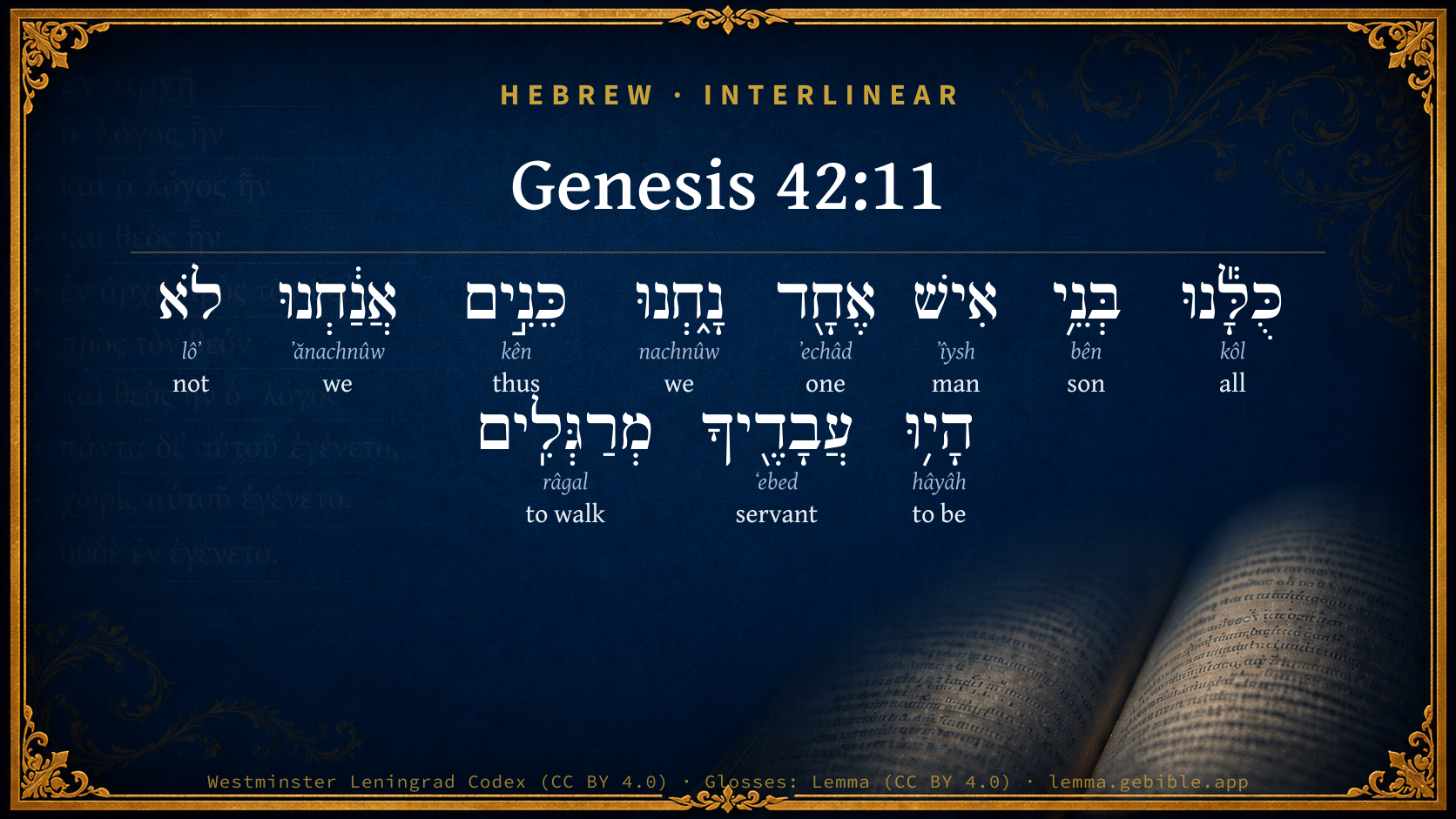
Genesis 42:11

Hebrew (Westminster Leningrad Codex) Genesis 42:11 appears in the Hebrew Old Testament. The text above is from the Westminster Leningrad Codex. Each word links to its Strong’s number, a concise gloss, and parsing drawn from the Open Scriptures Hebrew Bible morphology. Click any word for its full Brown-Driver-Briggs (BDB) entry.
Download image
Cite this verse

Genesis 42:11 (World English Bible). Public Domain. Lemma interlinear Bible study tool, https://lemma.gebible.app/v/genesis/42/11.

Show BibTeX & RIS
BibTeX
RIS
English Translation
We are all one man's sons; we are honest men. Your servants are not spies."
World English Bible · Public Domain
Highlights
  • 1 first appearance in the Hebrew Bible
Full analysis ↓
Download a study sheet

One document with this verse’s original text, its word-by-word gloss line, the meaning frame, cross-references with their text, attributed commentary, and full source and license credits — printable, and it pastes into notes with its structure intact.

This verse Autodidact and up

Study sheet (.html) Plain text (.txt)

A passage Seminary Student

Up to 50 verses in one chapter. A passage sheet keeps up to 6 commentary sources and 12 cross-references per verse, in the order this page ranks them, and says so on the sheet whenever that leaves anything out. Ask for a single verse and you get the Autodidact verse sheet above.

Everything on this page stays free to read, with no account — the sheet is a download of what is already on screen, not access to it.

Want to remove ads? Support Godless Engineer
Compare translations 3

The same verse in 3 English versions, stacked beneath the original-language interlinear above. Click any original word for its lexicon entry.

Each is an independent rendering of the whole verse — the interlinear is not word-aligned to these translations.

Highlighted words mark where these versions differ — a whole-verse word diff, not a word-by-word alignment.

  • World English Bible Public Domain
    We are all one man's sons; we are honest men. Your servants are not spies."
  • King James Version Public Domain
    We are all one man's sons; we are true men, thy servants are no spies.
  • unfoldingWord Literal Text CC BY-SA 4.0
    All of us sons of one man. We honest. Your servants are not spies.”

unfoldingWord Literal Text — © unfoldingWord, licensed CC BY-SA 4.0. Word-aligned USFM3 via Door43 (git.door43.org/unfoldingWord/en_ult).

Versions to compare (up to 4)

3 of 4 selected

Show all 18 translations

Every available English version of this verse, each an independent rendering of the whole verse.

  • World English Bible Public Domain
    We are all one man's sons; we are honest men. Your servants are not spies."
  • Berean Standard Bible Public Domain
    We are all sons of one man. Your servants are honest men, not spies.”
  • Majority Standard Bible Public Domain
    We are all sons of one man. Your servants are honest men, not spies.”
  • King James Version Public Domain
    We are all one man's sons; we are true men, thy servants are no spies.
  • American Standard Version (1901) Public Domain
    We are all one man's sons; we are true men, thy servants are no spies.
  • Revised Version (1885) Public Domain
    We are all one man’s sons; we are true men, thy servants are no spies.
  • Geneva Bible (1599) Public Domain
    Wee are all one mans sonnes: wee meane truely, and thy seruants are no spies.
  • Douay-Rheims (1899) Public Domain
    We are all the sons of one man: we are come as peaceable men, neither do thy servants go about any evil.
  • Young's Literal Translation Public Domain
    we `are' all of us sons of one man, we `are' right men; thy servants have not been spies;'
  • Literal Standard Version CC BY-SA 4.0
    we [are] all of us sons of one man, we [are] right men; your servants have not been spies”;
  • Unlocked Literal Bible CC BY-SA 4.0
    We are all one man's sons. We are honest men. Your servants are not spies.”
  • unfoldingWord Literal Text CC BY-SA 4.0
    All of us sons of one man. We honest. Your servants are not spies.”
  • Darby Bible Public Domain
    We are all one man's sons; we are honest: thy servants are not spies.
  • World Messianic Bible Public Domain
    We are all one man’s sons; we are honest men. Your servants are not spies.”
  • Webster's Bible Public Domain
    We are all one man's sons; we are true men; thy servants are no spies.
  • Free Bible Version CC BY-SA 4.0
    We're all the sons of one man and we're honest. We're not spies!”
  • Bible in Basic English Public Domain
    We are all one man's sons, we are true men; we have not come with any secret purpose.
  • JPS Tanakh (1917) Public Domain
    We are all one man's sons; we are upright men, thy servants are no spies.'

Literal Standard Version (2020), Covenant Press — licensed CC BY-SA 4.0. Text via the HelloAO Bible API (eBible.org). Unlocked Literal Bible (unfoldingWord) — licensed CC BY-SA 4.0. Text via the HelloAO Bible API (eBible.org). unfoldingWord Literal Text — © unfoldingWord, licensed CC BY-SA 4.0. Word-aligned USFM3 via Door43 (git.door43.org/unfoldingWord/en_ult). Free Bible Version, Dr. Jonathan Gallagher — licensed CC BY-SA 4.0. Text via the HelloAO Bible API (eBible.org).

Word by word

More ways to search: Search by grammar → Find every occurrence → Compare this word →

Practice this passage: Drill this verse → Learn its vocabulary →

About this verse

These counts appear in no published source. They are computed here, from the morphology-tagged text and Lemma’s own curated glosses. What Lemma adds →

11
words
11
distinct lemmas
Pentateuch
section

Notable vocabulary

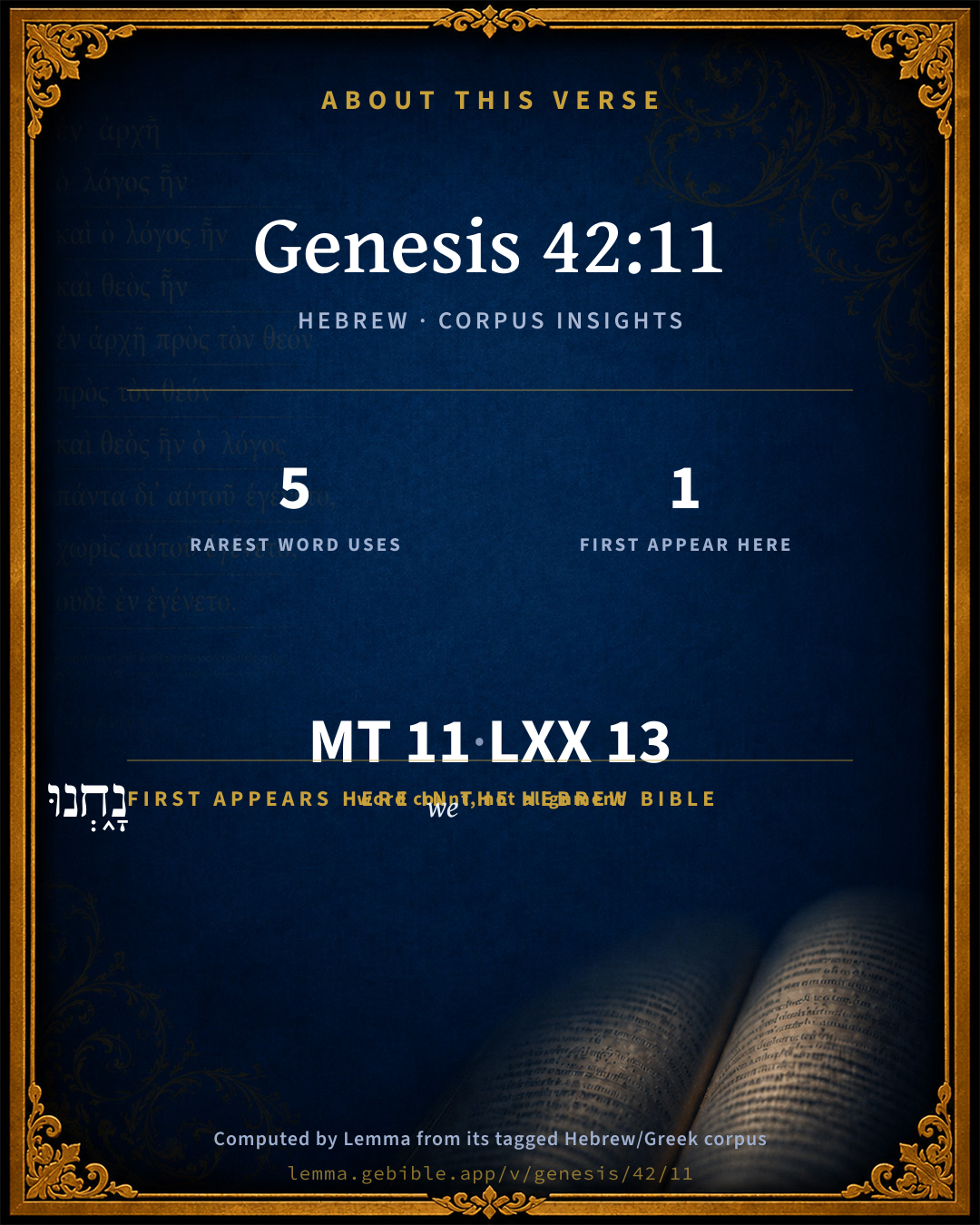
The rarest word here is נָ֑חְנוּ we H5168 — appearing just 5 times in the whole Hebrew Bible.

First appearance in Scripture

This word makes its first canonical appearance in the Hebrew Bible here:

  • נָ֑חְנוּ we H5168

Shared distinctive vocabulary

נָ֑חְנוּ we H5168 occurs in 5 verses of the Hebrew Bible. Also found in:

Grammatical profile

  • 2 verbs
  • 4 nouns
  • 2 adjectives
  • 2 pronouns
  • 1 particle

Verb forms

  • הָי֥וּ Qal · Perfect
  • מְרַגְּלִֽים Piel · Participle Active

Hebrew & Septuagint length

In English translation the verse runs 15 words from the Hebrew and 15 from the Septuagint (LXX English) — the same length.

A rough comparison of the two English renderings, which tokenize alike — not a word-level alignment.

Word counts can differ between the Hebrew and the Greek without any difference in meaning — e.g. the Hebrew direct-object marker אֵת has no separate Greek word, and Greek often adds the article ὁ.

In the original languages it is 11 Hebrew tokens and 13 Greek tokens — but the two are counted differently (Hebrew bundles its prefixes and suffixes into one token; the Greek is in lemma form), so that isn’t a like-for-like length.

Cross-references

4

Topical passages linked to Genesis 42:11 in the Treasury of Scripture Knowledge — connected by theme and wording, ordered by reader-vote popularity; previews shown in the World English Bible.

  • Genesis 42:19 If you are honest men, then let one of your brothers be bound in your prison-house; but you go, carry grain for the famine of your houses.
  • 2 Corinthians 6:4 but in everything commending ourselves, as servants of God, in great endurance, in afflictions, in hardships, in distresses,
  • Genesis 42:33–34 The man, the lord of the land, said to us, 'Hereby will I know that you are honest men. Leave one of your brothers with me, and take grain for the famine of your houses, and go your way.
  • John 7:18 He who speaks from himself seeks his own glory, but he who seeks the glory of him who sent him, the same is true, and no unrighteousness is in him.

Cross-references courtesy of OpenBible.info (CC BY 4.0).

Hebrew and Greek witnesses Masoretic Hebrew ↔ Greek Septuagint

The same verse in the two great witnesses to the Old Testament, shown verse-for-verse.

These are two independent witnesses, not word-aligned to each other, and the Septuagint is shown in lemma (dictionary) form.

Hebrew Genesis 42:11 Masoretic · Westminster Leningrad Codex

כֻּלָּ֕נוּ בְּנֵ֥י אִישׁ אֶחָ֖ד נָ֑חְנוּ כֵּנִ֣ים אֲנַ֔חְנוּ לֹא הָי֥וּ עֲבָדֶ֖יךָ מְרַגְּלִֽים

We are all one man's sons; we are honest men. Your servants are not spies."

World English Bible · Public Domain

Greek LXX Genesis 42:11 Septuagint · lemma form

πᾶς εἰμί υἱός εἷς ἄνθρωπος εἰρηνικός εἰμί οὐ εἰμί ὁ παῖς σύ κατάσκοπος

we are all sons of one man; we are peaceful, your servants are not spies.

LXX2012 (modern English Septuagint) · Public Domain

Hebrew: Westminster Leningrad Codex (CC BY 4.0). Greek: Septuagint (public domain); English from LXX2012 (modern English Septuagint) (Public Domain). How the Septuagint differs from the Hebrew →

Targum (Aramaic paraphrase)

2

The Targum is the ancient Jewish Aramaic paraphrase of the Hebrew Scriptures — an interpretive translation, not the Hebrew text itself. Onkelos (literal) and Pseudo-Jonathan (expansive) render the Torah, and Jonathan the Prophets. Coverage is partial: where no permissively-licensed English translation exists for a verse, only the Aramaic is shown. This is verse-level text, not a word-by-word alignment to the Hebrew.

  1. Targum Onkelos Torah (Genesis–Deuteronomy)
    כֻּלָּנָא בְּנֵי גַּבְרָא חַד נָחְנָא כֵּיוָנֵי אֲנַחְנָא לָא הֲווֹ עַבְדָיךְ אַלִּילֵי

    (no public-domain English translation for this verse)

    Targum Onkelos — Aramaic: “Onkelos Genesis” (public domain); “Onkelos Exodus” (public domain); “Onkelos Leviticus” (public domain); “Onkelos Numbers” (public domain); “Onkelos Deuteronomy” (public domain). English: “Sefaria Community Translation” (CC0 1.0 (public-domain dedication)); “J.W. Etheridge. The Targums of Onkelos and Jonathan Ben Uzziel on the Pentateuch. London: Longmans, Green, 1862” (public domain). Text via Sefaria.

  2. Targum Pseudo-Jonathan Torah (Genesis–Deuteronomy)
    כֻּלָנָא בְּנֵי גַבְרָא חָד נַחְנָא מְהֶמְנֵי אֲנַחְנָא לָא הֲווֹ עַבְדָךְ אַלִילֵי

    we are all the sons of one man; we are true; thy servants are not spies.

    Targum Pseudo-Jonathan — Aramaic: “Targum Jonathan on Genesis” (public domain); “Targum Jonathan on Exodus” (public domain); “Targum Jonathan on Leviticus” (public domain); “Targum Jonathan on Numbers” (public domain); “Targum Jonathan on Deuteronomy” (public domain). English: “The Targum of Jonathan ben Uzziel, trans. J. W. Etheridge, London, 1862” (public domain). Text via Sefaria.

Commentary

Notes on Genesis 42:11 from classic Christian and Jewish commentators (each source and its license shown beneath its notes). The classic Christian expositions comment on the surrounding passage and are grouped to its opening verse, so a note may address several verses; the Jewish commentaries on the Tanakh (Rashi and others) are per-verse, so they appear only where the commentator wrote on this verse.

Lemma curates 59 commentaries, every one of them public domain or Creative Commons licensed, each selected and text-cleaned for this edition rather than reprinted as found. About our sources →

Trapp's Complete Commentary

John Trapp

Gen 42:11 We [are] all one man’s sons; we [are] true [men], thy servants are no spies.

Ver. 11. We are all one man’s sons.] Therefore no spies; for what one man would hazard all his sons at once upon so dangerous a design?

We are true men.] Heb., Recti. The Popish doctors reject those ancient authors that are alleged against them, with Non sunt Recti in Curia. Bellarmine saith, To Irenaeus, Tertullian, Eusebius, and Luther, I answer, Omnes manifesti haeretici sunt; when anything in the decrees likes not the Pope, he sets Palea upon it, &c. {a}

{a} De Christo, lib. i. cap. 4.

John Trapp, A Commentary or Exposition upon All the Books of the Old and New Testament (1647–1656) — public domain. Text from a community e-Sword module.

The Biblical Illustrator

Joseph S. Exell

Gen_42:11-17

We are true men

True life

I.

THE MISTAKEN ESTIMATE. We are true men. Were they? They spoke for themselves, they spoke for one another; but had they a good report of the truth itself? You know better than that--they were not true men, anything but true men. How came it to pass that they formed such a mistaken estimate of themselves? How comes it to pass that men now-a-days form similarly false estimates of themselves?

1. They dwelt on their superficial goodness, and forgot their deeper wickedness. We are no spies. No; they felt hurt by the very suspicion; they would have scorned the thing. But there are worse things than going forth to see the nakedness of the land, worse men than spies. And these very men were guilty of far greater wickedness (see Gen_37:2; Gen_37:4-5; Gen_37:11; Gen_37:18; Gen_37:20). They were guilty of malice, falsehood, treachery, murder. Their conduct was unmanly, unbrotherly, unfilial. They were not spies, but they were liars, impostors, kidnappers, fratricides, monsters. But they ignored the profound wickedness, and dwelt fondly upon a goodness which was not very good. Is not this a very common method with us still? We think how blameless we are in matters on the very surface of life, and forget how guilty we are in the weightier matters of the law.

2. They dwelt on their exceptional goodness, and forgot their prevailing wickedness. We are no spies. They were right here, but in how many respects were they wanting? How many base characteristics they had we have just seen. But is not this seizing on some creditable trait of character, and ignoring all the bad traits a constant source of self deception? Says the prodigal son, listening to some story of covetousness and meanness, Well, anyhow, nobody can charge me with money-grubbing! And the man who is a walking lie, a mass of selfishness, full of egotism and pride, will reply, when some one is convicted of tippling, Well, thank heaven, I never was a beast! People think sometimes that the Pharisee is only found in the Church among seemingly good people; but the Pharisee is in the world also, in the most outrageous stoners, and it is often curious to hear the sanctimonious accent in the hiccup of the drunkard, and to see the broad phylactery showing through the finery of the harlot. The apostle says, If we offend in one point we are guilty of all, but we argue as if to keep one point was to be innocent of all. True men. They are true all round, the soundness of their hearts discovering itself in the harmony and beauty of their whole life. But, alas I we judge ourselves by some phase of exceptional goodness, and because we are not spies conclude ourselves saints.

3. They dwelt on their present goodness and forgot their past wickedness. We are no spies. They were right in that matter, right at that time, but what of the past? The moral insensibility and forgetfulness exhibited by these men is simply surprising. So it is with ourselves. Nothing is more startling than our moral unconsciousness and forgetfulness. We easily believe time sponges out all disagreeable records, and presents us with a clean state. True men. We are not true men until we are purged from our old sins.

II. THE PAINFUL EXPOSURE. How wonderfully God can cleave to our very heart, and show us what spirit we are of, no matter how profoundly we may have been disguised from ourselves. Many years ago in Brazil a slave found what was supposed to be a diamond of nearly a pound weight. It was presented to the emperor, constantly guarded by soldiers, and was supposed to represent millions of money. But an English mineralogist produced a cutting diamond, and scratched the supposed mammoth prize. One scratch was enough, if it had been a real gem it would not have taken a scratch, it was no diamond at all, the millions vanished in a moment into thin air. So God detects and exposes character. It was thus in the narrative before us. And Joseph said unto them the third day, This do, and live; for I fear God: if ye be true men bring your youngest brother unto me. That single scratch spoiled all the string of diamonds. And they said one to another, We are verily guilty concerning our brother, in that we saw the anguish of his soul, and we would not hear; therefore is this distress come upon us. The true men were found out, they knew themselves to be frauds. So God finds us all out one day or the other, one way or other. We notice sometimes with our friends how they suddenly stand revealed to us in a light most unexpected; they flash upon us in a character hitherto wholly unsuspected by us. And so our true self is long concealed from ourself, but at last God by His Spirit makes us know our true self, and we are filled with astonishment and distress. By Christ the thoughts of many hearts are revealed. By the Spirit of Christ the world is convinced of sin, of righteousness, and of judgment. The Pharisee at last becomes a publican, and smiting on his breast, cries, God be merciful to me a sinner. A true man. Is not that the very grandest character you can give a man? How eloquent it is! A true man. Is not that the very grandest epitaph you can write over the dead? Rich man, successful man, great man, gifted man, no, none of these are to be compared with a true man. We all covet that inscription far more than sculptured urn or animated bust. And yet many of us are painfully conscious that we are not true men. Oh! no, far from it. How full we are of weakness, hypocrisy, confusion, misery. False and full of sin I am. But we may be all made true men. Jesus was the true man, the Son of Man, as Luther calls Him, the Proper Man. Oh! how brave, noble, majestic, tender, pure, true, was the ideal Man. How grand is man when he reaches the full conception of his nature! And Christ can make us true men, that is His mission. (W. L. Watkinson.)

Searchings of heart

I. PAINFUL SUSPENSE.

II. PANGS OF REMORSE.

III. A PERPLEXING INCIDENT (Gen_42:27-28).

IV. A PLAINTIVE LAMENT (Gen_42:36; Gen_42:38). (W. S. Smith, B. D.)

The accusation

Far be it from us to say that Joseph had attained absolute perfection when he was on earth, although his virtues were far beyond those of most other men. It will not be easy, or rather it will be impossible, to exempt him from the charge of dissimulation, when he alleged that his brethren were spies. His words are not to be considered as an assertion, but they express a suspicion, which certainly did not enter into his mind. His design was good. He meant to humble them for their good, but good intentions will not excuse a departure from truth. He knew that they were not spies come to see the nakedness of the land, but he wished, without discovering himself to them, to be informed of the welfare of his father and of his fathers house. It is to be remembered that Joseph lived before the law was given. The light which discovers sin and duty shone less brightly in his days than in ours, and therefore the limits between what is lawful and what is unlawful would not be so easily discerned. It is likewise to be feared that Josephs station as Prime Minister in the court of Pharaoh led him into connections, and placed him in circumstances, unfavourable to progress in virtue. He held fast his integrity, and would not let it go amidst great temptations, but human infirmity discovered itself in some parts of his conduct. (G. Lawson, D. D.)

The answer

It could not be supposed that one man would suffer ten of his sons to engage at once in a business so full of perils as that of spies, or that so many brethren should risk the almost total extirpation of their fathers house at one blow. It requires a very daring spirit for a man to venture his own life in an office so desperate; but who would venture at once his own life and the life of almost all that are dear to him along with his own? Clear proof, at least, is requisite before belief can be given to an accusation so improbable as this which was laid against Josephs brethren, when it was known that they all belonged to the same house, and that there was only one brother left at home with a father sinking under the burden of age. We are true men, we are no spies. We are what we pretend to be, and have assumed no false character. The business of a spy is not in all cases unlawful. It is a business, however, so full of temptations to falsehood that an honest man will not rashly undertake it. (G. Lawson, D. D.)

Put to the test unconsciously

The whole treatment of his brothers by Joseph was meant to prove their characters, and see whether they had or had not repented of their sin against him, and whether they had or had not changed their disposition and mode of life. They did not know that he was thus experimenting on them, but the result satisfied him, and led to his revelation of himself to them. Now it is often similar with men and their fellows. When Gideon led his army to the brook, and saw his soldiers drink, they had no idea that he was picking out his three hundred for his midnight attack on the Midianitish camp. But so it was; for those who did not care luxuriously to go down on hands and knees to put their mouths to the stream, but who simply lapped the water up with their hands as a dog laps up with his tongue, showed thereby that they had the qualities of rapidity, dash, and hardihood which were specially needed for the service on which he was bent, and therefore they were selected for it. Even so men have been watched by others when they were not thinking of anything of the kind, and the diligence, energy, integrity, and amiability which they have shown has commended them to those interested for some situation of trust, honour, and emolument. Young man, your employer is testing yon when you do not know it, therefore see that you are faithful and obliging even in that which is least, that you may approve yourself worthy of something greater. Many incidents might here be narrated to prove that men have risen from comparative obscurity to eminence simply because they had been tested, unwittingly to themselves, by others who were on the outlook for the agents that would most effectually serve their purpose. When they rose, envious people prated about luck, but they who knew best spoke about character manifested by faithfulness in that which was least, and saw in their promotion the earthly miniature of the doing of the last Judge, who shall say to him whom He approves, Thou hast been faithful over a few things, I will make thee ruler over many things, enter thou into the joy of thy Lord. (W. M. Taylor, D. D.)

The Biblical Illustrator, edited by Joseph S. Exell (c. 1880s–1900s) — public domain. Text from a community e-Sword module.

Tyndale Open Study Notes

Tyndale Open Resources

42:11 Joseph knew that they had not always been the honest men they claimed to be.

Tyndale Open Study Notes — © Tyndale Open Resources, licensed CC BY-SA 4.0. Text via the HelloAO Bible API.

Adam Clarke's Commentary

Verse 11. We are all one man's sons] We do not belong to different tribes, and it is not likely that one family would make a hostile attempt upon a whole kingdom. This seems to be the very ground that Joseph took, viz., that they were persons belonging to different tribes. Against this particularly they set up their defence, asserting that they all belonged to one family; and it is on the proof of this that Joseph puts them, Ge 42:15, in obliging them to leave one as a hostage, and insisting on their bringing their remaining brother; so that he took exactly the same precautions to detect them as if he had had no acquaintance with them, and had every reason to be suspicious.

Adam Clarke's Commentary on the Bible (1810–1826) — public domain. Text from a community e-Sword/MySword module.

Ellicott's Commentary for English Readers

(11) We are all one man’s sons.—Joseph’s brethren had probably expected this accusation, and their answer, as Abravanel points out, is a sound one: for no man would send his whole family on so dangerous an errand. And thus they press their family relations as a proof of their being true, that is, honest, just men, with no evil designs; and Joseph, who was glad in this way to obtain intelligence of his father and Benjamin, finally, after persisting in the accusation until he had learned all he wished to know, accepts their argument as valid.

A Bible Commentary for English Readers, edited by Charles John Ellicott (1878–1897) — public domain. Text from a community e-Sword module.

The Cambridge Bible for Schools and Colleges

gen. ed. J. J. S. Perowne

11. true men] Lit. “straight,” i.e. genuine and above suspicion.

The Cambridge Bible for Schools and Colleges (gen. ed. J. J. S. Perowne; Cambridge University Press, 1878–1918) — public domain. Text from a community e-Sword module.

John Gill's Exposition

And they said, thy servants are twelve brethren,.... Or rather, "were twelve", since one afterwards is said not to be:

the sons of one man in the land of Canaan; of Jacob, who dwelt there; this is said with the same view as before, to show the improbability of their being spies:

and, behold, the youngest is this day with our father: meaning Benjamin, whom Joseph was eager to hear of, and no doubt was glad to hear he was alive, and his father also, and that they were both together in the land of Canaan:

and one is not; is not in the land of the living, is dead; for so they thought Joseph was, who is the person intended, as appears from what both Reuben and Judah afterwards say, Gen 42:22; and yet he was before them, and was the person they were speaking to: this must be very striking and affecting to Joseph, who knew full well they meant himself.

John Gill's Exposition of the Whole Bible (1746–1763) — public domain (CC PDM 1.0). Text via the HelloAO Bible API.

Matthew Poole's English Annotations

We are all one man’s sons, and therefore not spies; for it is not likely either that a father would venture so many sons upon so hazardous an employment, or that such a work would have been trusted in the hands of one family only.

We are true men, who honestly and truly mean what we pretend, and have no other design in our coming hither.

Matthew Poole's English Annotations on the Holy Bible (1683–1685) — public domain. Text from a community e-Sword/MySword module.

Rashi

Rabbi Shlomo Yitzchaki (Rashi)

כלנו בני איש אחד נחנו WE ARE ALL ONE MAN’S SONS — The Holy Spirit was enkindled in them and they included him with themselves (by using the word “We”) that he, also, was the son of their father (Genesis Rabbah 91:7).

כנים means TRUE MEN — Similar examples of כן in sense of true, right, are (Exodus 10:29) “Thou hast spoken right (כן)”; (Numbers 27:7) “The daughters of Zelophechad speak (כן) right”; (Isaiah 16:6) “and his wrath, his untruthful (לא־כן) boastings”.

Rashi on the Tanakh — English translations: “The Judaica Press complete Tanach with Rashi, translated by A. J. Rosenberg” (CC BY 4.0); “Pentateuch with Rashi's commentary by M. Rosenbaum and A.M. Silbermann, 1929-1934” (public domain); “The Metsudah Tanach series, Lakewood, N.J” (CC BY 4.0); and “The Book of Joshua, Metsudah Publications, 1997” (CC BY 4.0). Text via Sefaria.

Ramban (Nachmanides)

Rabbi Moshe ben Nachman (Ramban / Nachmanides)

WE ARE ALL ONE MAN’s SONS. It is possible to explain this plea as follows: They said that “since we are brothers, one man’s sons, who do not separate from each other for such is our father’s will, we all came to buy food, and we did not send one of us with his servants.” This indeed was the truth, for why should Jacob have sent them all, except that it was not their wish to be separated from one another. It is also possible that they did so because of the extreme famine, lest the grain brought by their servants be robbed from them on the way.It is also possible that they said to him: “We are all one man’s sons. You can investigate him, for he is known in the gates by the vastness of his wealth and the multitude of his children. And if you will inquire and investigate, you will know that we are trustworthy, righteous men, sons of a righteous one, and not spies.”

THY SERVANTS HAVE NOT BEEN SPIES. The meaning of this expression is: “We have been trustworthy in all our affairs from our youth on. Your servants have not been spies from then till now.” Similarly, We have not been spies, means: “We have never been spies.”Now our Rabbis have been aroused by the matter we have discussed, and they have expounded that they entered the city by ten different gates in the manner of spies, and it was for this reason that he accused them. Now this is plausible; however, Scripture does not mention it! Moreover, at the very outset, the brothers said to him in defense of themselves, We are all one man’s sons, and [if, as the Midrash has it, the basis of his accusation was that they entered by ten different gates], this itself indicates their guilt. Now it is possible to say in explanation of the Midrash that Joseph originally said to them, “you entered by ten gates, and now you are all gathering in one place and conspiring together. This is nothing other than the behavior of spies.” Thereupon they said to him, “It is because we are brothers that we are gathered together.” But he said, “Not so, but you have come to find out the condition of the land. If you were brothers you should have entered by one gate, just as you are now together.” Then they told him that one of them is gone, and that they had gone in search of him, [which was why they entered by different gates]. Scripture, however, does not care to prolong the discussion of the motivation of their arguments.

Ramban (Nachmanides) on the Tanakh — English translation: “Commentary on the Torah by Ramban (Nachmanides). Translated and annotated by Charles B. Chavel. New York, Shilo Pub. House, 1971-1976” (CC BY 4.0). Text via Sefaria.

Radak

Rabbi David Kimhi (Radak)

כלנו בני איש אחד, if you claimed that the fact that we stick together is proof that we are spies, consider that the reason why we stick together is because we are all sons of the same father. This is why we always ask our questions in unison. We belong to the same family, and are honest upright people.

Radak on the Tanakh — English translations: “Sefaria Community Translation” (CC0 1.0 (public-domain dedication)); “Eliyahu Munk, HaChut Hameshulash” (CC BY 4.0); “Rabbi Mike Feuer, Jerusalem Anthology” (CC BY 4.0); and “R. David Kimhi on the first book of Psalms, Translated by R.G. Finch, London, 1919” (public domain). Text via Sefaria.

Lesson kit

Teaching starters — assembled from the data on this page, not authored interpretation. Every prompt links to the verse data it draws on. Edit before teaching.

Genesis, in the Pentateuch, opens this verse with 11 words (11 distinct Hebrew lemmas). Its most distinctive word is nachnûw (“we”). A historical commentator’s framing appears above. Read the whole chapter for the surrounding context.

Discussion questions

  1. The word nachnûw carries the sense “we.” How does it shape the verse?
  2. The word “we” first appears here in Scripture. What is being introduced at this debut?
  3. Exodus 16:7 shares the word «we» with this verse. How do the two illuminate each other?
  4. The translations on this page render this verse differently — a whole-verse word diff, not a word-by-word alignment. What might account for the different wordings?
  5. The verb «הָי֥וּ» is Qal Perfect. How does its form color the action?
  6. Reading how Trapp's Complete Commentary and The Biblical Illustrator read this verse, where do the two commentators agree and where do they part?

Things to notice

Reading settings

Reading text

Shown beneath each verse's original-language words.

Old Testament
Old Testament edition

Read the OT as the Masoretic Hebrew (MT) or the Greek Septuagint (LXX).

English shown for the Greek Septuagint (in the Hebrew ↔ Greek comparison).

Comparing translations? Open the Compare panel on any verse page to stack up to four side by side.