
Exodus 11:7

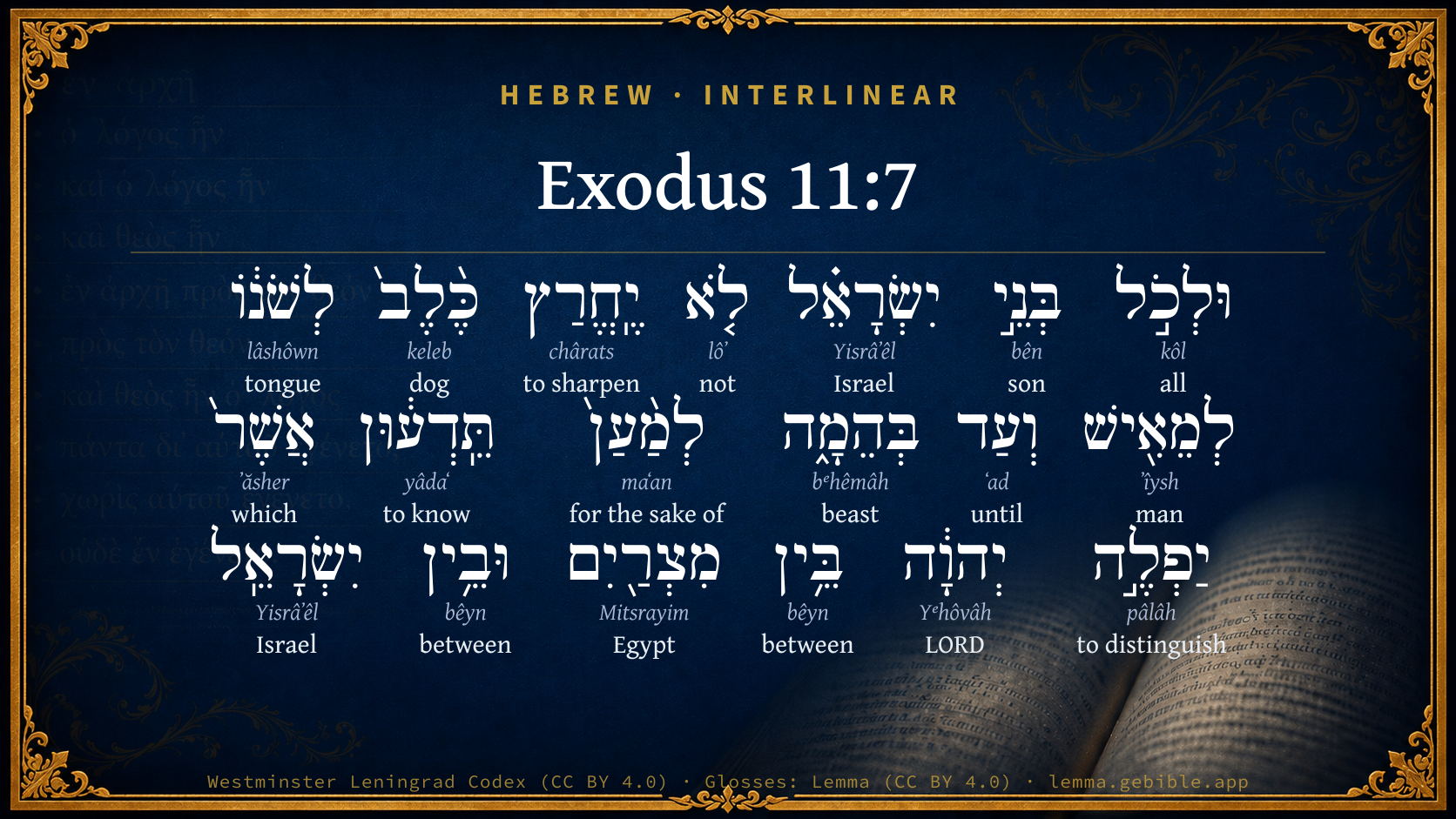
Hebrew (Westminster Leningrad Codex) Exodus 11:7 appears in the Hebrew Old Testament. The text above is from the Westminster Leningrad Codex. Each word links to its Strong’s number, a concise gloss, and parsing drawn from the Open Scriptures Hebrew Bible morphology. Click any word for its full Brown-Driver-Briggs (BDB) entry.
Download image
Cite this verse

Exodus 11:7 (World English Bible). Public Domain. Lemma interlinear Bible study tool, https://lemma.gebible.app/v/exodus/11/7.

Show BibTeX & RIS
BibTeX
RIS
English Translation
But against any of the children of Israel a dog won't even bark or move its tongue, against man or animal; that you may know that Yahweh makes a distinction between the Egyptians and Israel.
World English Bible · Public Domain
Highlights
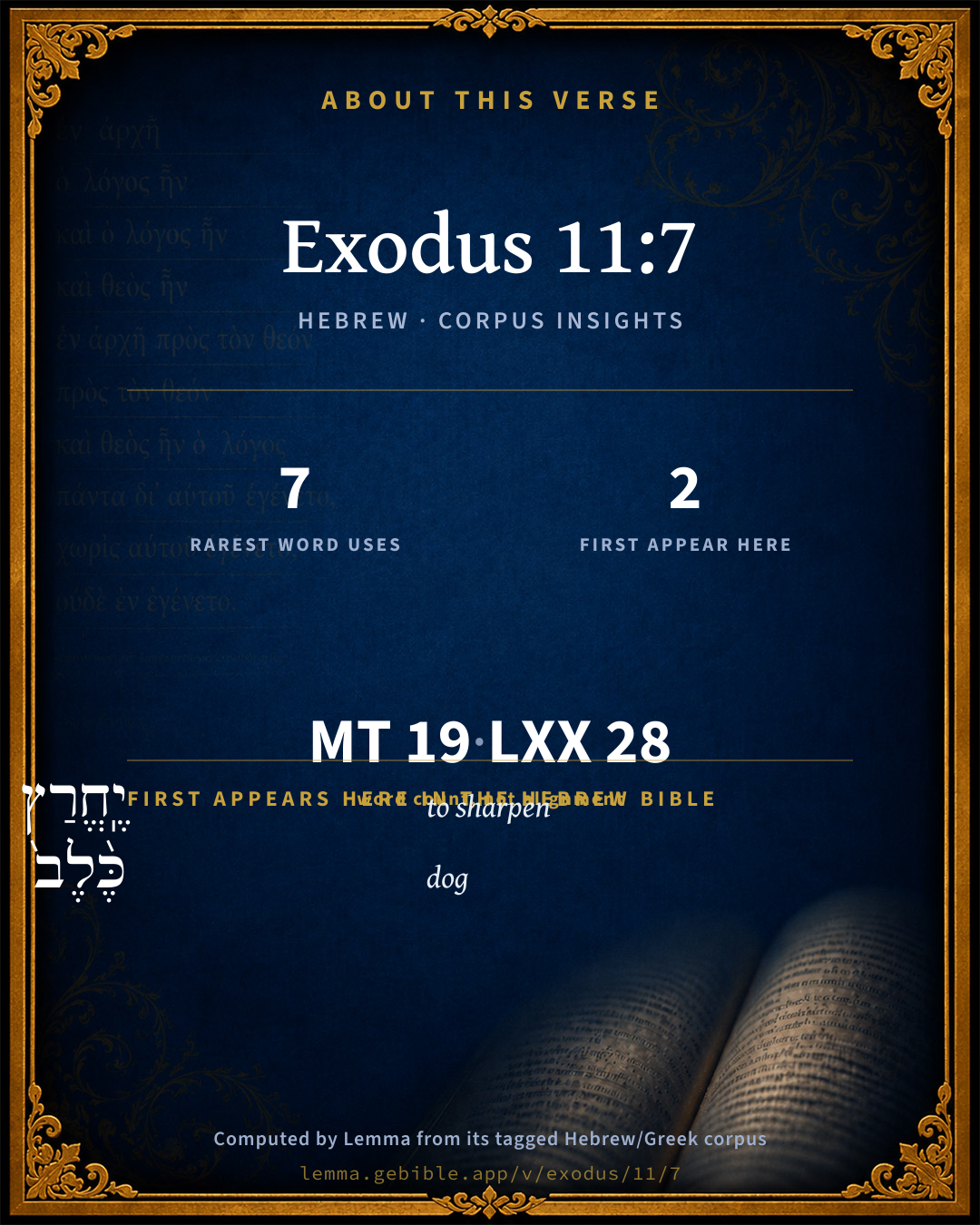
  • 2 first appearances in the Hebrew Bible
Full analysis ↓
Download a study sheet

One document with this verse’s original text, its word-by-word gloss line, the meaning frame, cross-references with their text, attributed commentary, and full source and license credits — printable, and it pastes into notes with its structure intact.

This verse Autodidact and up

Study sheet (.html) Plain text (.txt)

A passage Seminary Student

Up to 50 verses in one chapter. A passage sheet keeps up to 6 commentary sources and 12 cross-references per verse, in the order this page ranks them, and says so on the sheet whenever that leaves anything out. Ask for a single verse and you get the Autodidact verse sheet above.

Everything on this page stays free to read, with no account — the sheet is a download of what is already on screen, not access to it.

Want to remove ads? Support Godless Engineer
Compare translations 3

The same verse in 3 English versions, stacked beneath the original-language interlinear above. Click any original word for its lexicon entry.

Each is an independent rendering of the whole verse — the interlinear is not word-aligned to these translations.

Highlighted words mark where these versions differ — a whole-verse word diff, not a word-by-word alignment.

  • World English Bible Public Domain
    But against any of the children of Israel a dog won't even bark or move its tongue, against man or animal; that you may know that Yahweh makes a distinction between the Egyptians and Israel.
  • King James Version Public Domain
    But against any of the children of Israel shall not a dog move his tongue, against man or beast: that ye may know how that the LORD doth put a difference between the Egyptians and Israel.
  • unfoldingWord Literal Text CC BY-SA 4.0
    But to each of the sons of Israel, a dog will not sharpen his tongue, from man to beast, so that you will know that Yahweh distinguishes between Egypt and between Israel.’

unfoldingWord Literal Text — © unfoldingWord, licensed CC BY-SA 4.0. Word-aligned USFM3 via Door43 (git.door43.org/unfoldingWord/en_ult).

Versions to compare (up to 4)

3 of 4 selected

Show all 18 translations

Every available English version of this verse, each an independent rendering of the whole verse.

  • World English Bible Public Domain
    But against any of the children of Israel a dog won't even bark or move its tongue, against man or animal; that you may know that Yahweh makes a distinction between the Egyptians and Israel.
  • Berean Standard Bible Public Domain
    But among all the Israelites, not even a dog will snarl at man or beast.’ Then you will know that the LORD makes a distinction between Egypt and Israel.
  • Majority Standard Bible Public Domain
    But among all the Israelites, not even a dog will snarl at man or beast.’ Then you will know that the LORD makes a distinction between Egypt and Israel.
  • King James Version Public Domain
    But against any of the children of Israel shall not a dog move his tongue, against man or beast: that ye may know how that the LORD doth put a difference between the Egyptians and Israel.
  • American Standard Version (1901) Public Domain
    But against any of the children of Israel shall not a dog move his tongue, against man or beast: that ye may know how that Jehovah doth make a distinction between the Egyptians and Israel.
  • Revised Version (1885) Public Domain
    But against any of the children of Israel shall not a dog move his tongue, against man or beast: that ye may know how that the LORD doth put a difference between the Egyptians and Israel.
  • Geneva Bible (1599) Public Domain
    But against none of ye children of Israel shall a dogge moue his tongue, neyther against man nor beast, that ye may knowe that the Lord putteth a difference betweene the Egyptians and Israel.
  • Douay-Rheims (1899) Public Domain
    But with all the children of Israel there shall not a dog make the least noise, from man even to beast: that you may know how wonderful a difference the Lord maketh between the Egyptians and Israel.
  • Young's Literal Translation Public Domain
    `And against all the sons of Israel a dog sharpeneth not its tongue, from man even unto beast, so that ye know that Jehovah doth make a separation between the Egyptians and Israel;
  • Literal Standard Version CC BY-SA 4.0
    and against all the sons of Israel a dog does not sharpen its tongue, from man even to beast, so that you know that YHWH makes a separation between the Egyptians and Israel.
  • Unlocked Literal Bible CC BY-SA 4.0
    But not even a dog will bark against any of the people of Israel, against either man or beast. In this way you will know that I am treating the Egyptians and the Israelites differently.'
  • unfoldingWord Literal Text CC BY-SA 4.0
    But to each of the sons of Israel, a dog will not sharpen his tongue, from man to beast, so that you will know that Yahweh distinguishes between Egypt and between Israel.’
  • Darby Bible Public Domain
    But against any of the children of Israel shall not a dog move his tongue, against man or beast; that ye may know that Jehovah distinguisheth between the Egyptians and Israel.
  • World Messianic Bible Public Domain
    But against any of the children of Israel a dog won’t even bark or move its tongue, against man or animal, that you may know that the LORD makes a distinction between the Egyptians and Israel.
  • Webster's Bible Public Domain
    But against any of the children of Israel shall not a dog move his tongue, against man or beast: that ye may know how the LORD doth put a difference between the Egyptians and Israel.
  • Free Bible Version CC BY-SA 4.0
    But among all the Israelites there won't even be the sound of a dog barking at them or their animals. That way you will know that the Lord distinguishes between Egypt and Israel.
  • Bible in Basic English Public Domain
    But against the children of Israel, man or beast, not so much as the tongue of a dog will be moved: so that you may see how the Lord makes a division between Israel and the Egyptians.
  • JPS Tanakh (1917) Public Domain
    But against any of the children of Israel shall not a dog whet his tongue, against man or beast; that ye may know how that the LORD doth put a difference between the Egyptians and Israel.

Literal Standard Version (2020), Covenant Press — licensed CC BY-SA 4.0. Text via the HelloAO Bible API (eBible.org). Unlocked Literal Bible (unfoldingWord) — licensed CC BY-SA 4.0. Text via the HelloAO Bible API (eBible.org). unfoldingWord Literal Text — © unfoldingWord, licensed CC BY-SA 4.0. Word-aligned USFM3 via Door43 (git.door43.org/unfoldingWord/en_ult). Free Bible Version, Dr. Jonathan Gallagher — licensed CC BY-SA 4.0. Text via the HelloAO Bible API (eBible.org).

Word by word

More ways to search: Search by grammar → Find every occurrence → Compare this word →

Practice this passage: Drill this verse → Learn its vocabulary →

יַפְלֶ֣ה
pâlâh
H6395
“to distinguish”
Verb, Hiphil, Imperfect, 3rd Person, Masculine, Singular
Part of Speech
Verb
Stem
Hiphil
Form
Imperfect
Person
3rd Person
Gender
Masculine
Number
Singular
Full BDB Definition

Origin: a primitive root

TWOT: 1772

to be distinct, marked out, be separated, be distinguished - (Niphal) - to be distinct, be separated, be distinguished - to be wonderful - (Hiphil) to make separate, set apart
  1. וּלְכֹ֣ל kôl H3605 “and · to/for · all of” Conjunction + Preposition + Noun, Common, Masculine, Singular, Construct
  2. בְּנֵ֣י bên H1121 “sons of” Noun, Common, Masculine, Plural, Construct
  3. יִשְׂרָאֵ֗ל Yisrâʼêl H3478 “Israel” Noun, Proper
  4. לֹ֤א lôʼ H3808 “not” Particle, Negative
  5. יֶֽחֱרַץ chârats H2782 “to sharpen” Verb, Qal, Imperfect, 3rd Person, Masculine, Singular
  6. כֶּ֨לֶב֙ keleb H3611 “dog” Noun, Common, Masculine, Singular, Absolute
  7. לְשֹׁנ֔וֹ lâshôwn H3956 “tongue · his” Noun, Common, Both, Singular, Construct + Suffix, Personal, 3rd Person, Masculine, Singular
  8. לְמֵאִ֖ישׁ ʼîysh H376 “to/for · from · man” Preposition + Preposition + Noun, Common, Masculine, Singular, Absolute
  9. וְעַד ʻad H5704 “and · until” Conjunction + Preposition
  10. בְּהֵמָ֑ה bᵉhêmâh H929 “beast” Noun, Common, Feminine, Singular, Absolute
  11. לְמַ֨עַן֙ maʻan H4616 “for the sake of” Preposition
  12. תֵּֽדְע֔וּן yâdaʻ H3045 “to know” Verb, Qal, Imperfect, 2nd Person, Masculine, Plural + Suffix, n
  13. אֲשֶׁר֙ ʼăsher H834 “which” Particle, Relative
  14. יְהוָ֔ה Yᵉhôvâh H3068 “LORD” Noun, Proper
  15. בֵּ֥ין bêyn H996 “between” Preposition
  16. מִצְרַ֖יִם Mitsrayim H4714 “Egypt” Noun, Proper
  17. וּבֵ֥ין bêyn H996 “and · between” Conjunction + Preposition
  18. יִשְׂרָאֵֽל Yisrâʼêl H3478 “Israel” Noun, Proper

About this verse

These counts appear in no published source. They are computed here, from the morphology-tagged text and Lemma’s own curated glosses. What Lemma adds →

19
words
17
distinct lemmas
Pentateuch
section

Notable vocabulary

The rarest word here is יַפְלֶ֣ה to distinguish H6395 — appearing just 7 times in the whole Hebrew Bible.

First appearance in Scripture

These words make their first canonical appearance in the Hebrew Bible here:

  • יֶֽחֱרַץ to sharpen H2782
  • כֶּ֨לֶב֙ dog H3611

Shared distinctive vocabulary

יַפְלֶ֣ה to distinguish H6395 occurs in 7 verses of the Hebrew Bible. Also found in:

Grammatical profile

  • 3 verbs
  • 10 nouns
  • 4 prepositions
  • 2 particles

Verb forms

  • יֶֽחֱרַץ Qal · Imperfect
  • תֵּֽדְע֔וּן Qal · Imperfect
  • יַפְלֶ֣ה Hiphil · Imperfect

Repetition

Words recur within this verse — often emphatic in Hebrew:

  • יִשְׂרָאֵ֗ל Israel H3478 ×2
  • בֵּ֥ין between H996 ×2

Hebrew & Septuagint length

In English translation the verse runs 35 words from the Hebrew and 37 from the Septuagint (LXX English) — closely comparable.

A rough comparison of the two English renderings, which tokenize alike — not a word-level alignment.

Word counts can differ between the Hebrew and the Greek without any difference in meaning — e.g. the Hebrew direct-object marker אֵת has no separate Greek word, and Greek often adds the article ὁ.

In the original languages it is 19 Hebrew tokens and 28 Greek tokens — but the two are counted differently (Hebrew bundles its prefixes and suffixes into one token; the Greek is in lemma form), so that isn’t a like-for-like length.

Cross-references

8

Topical passages linked to Exodus 11:7 in the Treasury of Scripture Knowledge — connected by theme and wording, ordered by reader-vote popularity; previews shown in the World English Bible.

  • Joshua 10:21 that all the people returned to the camp to Joshua at Makkedah in peace: none moved his tongue against any of the children of Israel.
  • Exodus 8:22 I will set apart in that day the land of Goshen, in which my people dwell, that no swarms of flies shall be there; to the end you may know that I am Yahweh in the midst of the earth.
  • Exodus 10:23 They didn't see one another, neither did anyone rise from his place for three days; but all the children of Israel had light in their dwellings.
  • Malachi 3:18 Then you shall return and discern between the righteous and the wicked, between him who serves God and him who doesn't serve him.
  • Exodus 9:4 Yahweh will make a distinction between the cattle of Israel and the cattle of Egypt; and there shall nothing die of all that belongs to the children of Israel."'"
  • Job 5:16 So the poor has hope, And injustice shuts her mouth.
  • Exodus 7:22 The magicians of Egypt did in like manner with their enchantments; and Pharaoh's heart was hardened, and he didn't listen to them; as Yahweh had spoken.
  • 1 Corinthians 4:7 For who makes you different? And what do you have that you didn't receive? But if you did receive it, why do you boast as if you had not received it?

Cross-references courtesy of OpenBible.info (CC BY 4.0).

Hebrew and Greek witnesses Masoretic Hebrew ↔ Greek Septuagint

The same verse in the two great witnesses to the Old Testament, shown verse-for-verse.

These are two independent witnesses, not word-aligned to each other, and the Septuagint is shown in lemma (dictionary) form.

Hebrew Exodus 11:7 Masoretic · Westminster Leningrad Codex

וּלְכֹ֣ל בְּנֵ֣י יִשְׂרָאֵ֗ל לֹ֤א יֶֽחֱרַץ כֶּ֨לֶב֙ לְשֹׁנ֔וֹ לְמֵאִ֖ישׁ וְעַד בְּהֵמָ֑ה לְמַ֨עַן֙ תֵּֽדְע֔וּן אֲשֶׁר֙ יַפְלֶ֣ה יְהוָ֔ה בֵּ֥ין מִצְרַ֖יִם וּבֵ֥ין יִשְׂרָאֵֽל

But against any of the children of Israel a dog won't even bark or move its tongue, against man or animal; that you may know that Yahweh makes a distinction between the Egyptians and Israel.

World English Bible · Public Domain

Greek LXX Exodus 11:7 Septuagint · lemma form

καί ἐν πᾶς ὁ υἱός ἰσραήλ οὐ γρύζω κύων ὁ γλῶσσα αὐτός ἀπό ἄνθρωπος ἕως κτῆνος ὅπως οἶδα ὅσος παραδοξάζω κύριος ἀνά μέσος ὁ αἰγύπτιος καί ὁ ἰσραήλ

But among all the children of Israel shall not a dog snarl with his tongue, either at man or beast; that you may know how wide a distinction the Lord will make between the Egyptians and Israel.

LXX2012 (modern English Septuagint) · Public Domain

Hebrew: Westminster Leningrad Codex (CC BY 4.0). Greek: Septuagint (public domain); English from LXX2012 (modern English Septuagint) (Public Domain). How the Septuagint differs from the Hebrew →

Targum (Aramaic paraphrase)

2

The Targum is the ancient Jewish Aramaic paraphrase of the Hebrew Scriptures — an interpretive translation, not the Hebrew text itself. Onkelos (literal) and Pseudo-Jonathan (expansive) render the Torah, and Jonathan the Prophets. Coverage is partial: where no permissively-licensed English translation exists for a verse, only the Aramaic is shown. This is verse-level text, not a word-by-word alignment to the Hebrew.

  1. Targum Onkelos Torah (Genesis–Deuteronomy)
    וּלְכֹל בְּנֵי יִשְׂרָאֵל לָא יַנְזֵק כַּלְבָּא בְּלִישְׁנֵהּ לְמִנְבַּח לְמֵאֲנָשָׁא וְעַד בְּעִירָא בְּדִיל דְתִדְעוּן דְיַפְרֵישׁ יְיָ בֵּין מִצְרַיִם וּבֵין יִשְׂרָאֵל:

    (no public-domain English translation for this verse)

    Targum Onkelos — Aramaic: “Onkelos Genesis” (public domain); “Onkelos Exodus” (public domain); “Onkelos Leviticus” (public domain); “Onkelos Numbers” (public domain); “Onkelos Deuteronomy” (public domain). English: “Sefaria Community Translation” (CC0 1.0 (public-domain dedication)); “J.W. Etheridge. The Targums of Onkelos and Jonathan Ben Uzziel on the Pentateuch. London: Longmans, Green, 1862” (public domain). Text via Sefaria.

  2. Targum Pseudo-Jonathan Torah (Genesis–Deuteronomy)
    וּלְכָל בְּנֵי יִשְרָאֵל לָא יְהַנְזַק כַּלְבָּא בְּלִשְׁנֵיהּ לְמִנְבַּח לְמֵאֱנָשָׁא וְעַד בְּעִירָא מִן בִּגְלַל דְּתִנְדְּעוּן דְּיַפְרֵישׁ יְיָ בֵּין מִצְרָאֵי וּבֵינֵי יִשְרָאֵל

    But any of the children of Israel a dog shall not harm by lifting up his tongue against either man or beast; that they may know that the Lord maketh distinction between the Mizraites and the sons of Israel.

    Targum Pseudo-Jonathan — Aramaic: “Targum Jonathan on Genesis” (public domain); “Targum Jonathan on Exodus” (public domain); “Targum Jonathan on Leviticus” (public domain); “Targum Jonathan on Numbers” (public domain); “Targum Jonathan on Deuteronomy” (public domain). English: “The Targum of Jonathan ben Uzziel, trans. J. W. Etheridge, London, 1862” (public domain). Text via Sefaria.

Commentary

Notes on Exodus 11:7 from classic Christian and Jewish commentators (each source and its license shown beneath its notes). The classic Christian expositions comment on the surrounding passage and are grouped to its opening verse, so a note may address several verses; the Jewish commentaries on the Tanakh (Rashi and others) are per-verse, so they appear only where the commentator wrote on this verse.

Lemma curates 59 commentaries, every one of them public domain or Creative Commons licensed, each selected and text-cleaned for this edition rather than reprinted as found. About our sources →

Trapp's Complete Commentary

John Trapp

Exo 11:7 But against any of the children of Israel shall not a dog move his tongue, against man or beast: that ye may know how that the LORD doth put a difference between the Egyptians and Israel.

Ver. 7. Shall not a dog move his tongue.] And yet how many dead dogs do now-a-days bark and snarl {a} at the Israel of God! Which, nevertheless, is not without God, {2Sa 16:9-10} who will one day make iniquity to stop her mouth, {Job 5:16} Why should this dead dog curse? said Abishai.

{a} Canina facundia.

John Trapp, A Commentary or Exposition upon All the Books of the Old and New Testament (1647–1656) — public domain. Text from a community e-Sword module.

Joseph Benson's Commentary

Exo 11:7. Shall not a dog move his tongue — A proverbial expression, importing all should be peace and quietness among the Israelites, far from any frightful outcry: that in that memorable night they should meet with nothing to molest or disturb them.

Joseph Benson's Commentary on the Old and New Testaments (1811–1818) — public domain. Text from a community e-Sword module.

Tyndale Open Study Notes

Tyndale Open Resources

11:7 As stated explicitly in the fourth, fifth, seventh, and ninth plagues (8:23; 9:6, 26; 10:23), the Lord distinguished between his people and the Egyptians. These events clearly resulted from the express activity of God and were not just a chance collection of natural tragedies.

Tyndale Open Study Notes — © Tyndale Open Resources, licensed CC BY-SA 4.0. Text via the HelloAO Bible API.

Jamieson, Fausset & Brown

Robert Jamieson, A. R. Fausset & David Brown

against any of the children of Israel shall not a dog move his tongue--No town or village in Egypt or in the East generally is free from the nuisance of dogs, who prowl about the streets and make the most hideous noise at any passers-by at night. What an emphatic significance does the knowledge of this circumstance give to this fact in the sacred record, that on the awful night that was coming, when the air should be rent with the piercing shrieks of mourners, so great and universal would be the panic inspired by the hand of God, that not a dog would move his tongue against the children of Israel!

Jamieson, Fausset & Brown — Commentary Critical and Explanatory on the Whole Bible (1871) — public domain (CC PDM 1.0). Text via the HelloAO Bible API.

Adam Clarke's Commentary

Verse 7. Not a dog move his tongue] This passage has been generally understood as a proverbial expression, intimating that the Israelites should not only be free from this death, but that they should depart without any kind of molestation. For though there must be much bustle and comparative confusion in the sudden removal of six hundred thousand persons with their wives, children, goods, cattle, c., yet this should produce so little alarm that even the dogs should not bark at them, which it would be natural to expect, as the principal stir was to be about midnight.

After giving this general explanation from others, I may be permitted to hazard a conjecture of my own. And,

1. Is it not probable that the allusion is here made to a well-known custom of dogs howling when any mortality is in a village, street, or even house, where such animals are? There are innumerable instances of the faithful house-dog howling when a death happens in a family, as if distressed on the account, feeling for the loss of his benefactor but their apparent presaging such an event by their cries, as some will have it, may be attributed, not to any prescience, but to the exquisite keenness of their scent. If the words may be understood in this way, then the great cry through the whole land of Egypt may refer to this very circumstance: as dogs were sacred among them, and consequently religiously preserved, they must have existed in great multitudes.

2. We know that one of their principal deities was Osiris, whose son, worshipped under the form of a dog, or a man with a dog's head, was called Anubis latrator, the barking Anubis. May he not be represented as deploring a calamity which he had no power to prevent among his worshippers, nor influence to inflict punishment upon those who set his deity at naught? Hence while there was a great cry, צעקה גדלה tseakah gedolah, throughout all the land of Egypt, because of the mortality in every house, yet among the Israelites there was no death, consequently no dog moved his tongue to howl for their calamity; nor could the object of the Egyptians' worship inflict any similar punishment on the worshippers of Jehovah.

In honour of this dog-god there was a city called Anubis in Egypt, by the Greeks called Cynopolis, the city of the dog, the same that is now called Menich; in this he had a temple, and dogs, which were sacred to him, were here fed with consecrated victuals.

Thus, as in the first plagues their magicians were confounded, so in this last their gods were put to flight. And may not this be referred to in Ex 12:12, when Jehovah says: Against all the gods of Egypt I will execute judgment? Should it be objected, that to consider the passage in this light would be to acknowledge the being and deity of the fictitious Anubis, it may be answered, that in the sacred writings it is not an uncommon thing to see the idol acknowledged in order to show its nullity, and the more forcibly to express contempt for it, for its worshippers, and for its worship. Thus Isaiah represents the Babylonish idols as being endued with sense, bowing down under the judgments of God, utterly unable to help themselves or their worshippers, and being a burden to the beasts that carried them:

BEL boweth down, NEBO stoopeth; their idols were upon the beasts and upon the cattle: your carriages were heavy laden; they are a burden to the weary beast. THEY stoop, they bow down together; they could not deliver the burden, but themselves are gone into captivity; Isa 46:1-2. The case of Elijah and the prophets of Baal should not be forgotten here; this prophet, by seeming to acknowledge the reality of Baal's being, though by a strong irony, poured the most sovereign contempt upon him, his worshippers, and his worship: And Elijah mocked them, and said, Cry aloud; FOR HE IS A GOD: either he is talking, or he is pursuing, or he is in a journey, or peradventure he sleepeth and must be awaked; 1Kg 18:27. See the observations at the end of chap. xii. See Clarke on Ex 12:51.

The Lord doth put a difference] See on Ex 8:22. See Clarke on Ex 8:22. And for the variations between the Hebrew and Samaritan Pentateuch in this place, see at the end of the chapter. See Clarke on Ex 11:9.

Adam Clarke's Commentary on the Bible (1810–1826) — public domain. Text from a community e-Sword/MySword module.

Ellicott's Commentary for English Readers

(7) Shall not a dog move his tongue.—Com pare Jos_10:21. The expression is evidently proverbial.

A Bible Commentary for English Readers, edited by Charles John Ellicott (1878–1897) — public domain. Text from a community e-Sword module.

The Cambridge Bible for Schools and Colleges

gen. ed. J. J. S. Perowne

7. shall not a dog whet his tongue] A proverbial expression, implying that not only should they suffer no actual harm, but no unfriendly sound should even be heard against them. Cf. Jdt_11:19; and, with ‘no man’ as subject, Jos_10:21.

that ye may know, &c.] cf. on Exo_8:10, and p. 56.

put a difference] in the Heb. a single word, the verb rendered ‘sever’ on Exo_8:22, Exo_9:4.

The Cambridge Bible for Schools and Colleges (gen. ed. J. J. S. Perowne; Cambridge University Press, 1878–1918) — public domain. Text from a community e-Sword module.

John Gill's Exposition

But against any of the children of Israel shall not a dog move his tongue, against man or beast,.... That is, as no hurt should be done to man or beast among them, to the firstborn of either of them, so there would be no noise or cry in their dwellings, but the profoundest silence, stillness, and quietness among them; though this is generally understood of what would be their case when on their march departing out of Egypt, which was immediately upon the slaying of the firstborn; and, if literally understood, it was a very extraordinary thing that a dog, which barks at the least noise that is made, especially in the night, yet not one should move his tongue or bark, or rather "sharpen" (u) his tongue, snarl and grin, when 600,000 men, besides women and children, with their flocks and herds, set out on their journey, and must doubtless march through many places where dogs were, before they came to the Red sea; though it may also be interpreted figuratively, that not an Egyptian, though ever so spiteful and malicious, and ill disposed to the children of Israel, should offer to do any hurt either to the Israelites or their cattle, or exclaim against them on account of the slaughter of their firstborn, or say one word against their departure, or attempt to stop them, but on the contrary would hasten their going, and be urgent for it:

that ye may know how that the Lord doth put a difference between the Egyptians and Israel; by preserving them and theirs, when the firstborn of Egypt were destroyed, and by causing stillness and quietness among them when there was an hideous outcry and doleful lamentation among the Egyptians; and by bringing Israel quietly out from among them, none offering to give the least molestation.

(u) non acuet, Noldius, p. 517. No. 1471. so Jarchi.

John Gill's Exposition of the Whole Bible (1746–1763) — public domain (CC PDM 1.0). Text via the HelloAO Bible API.

Albert Barnes' Notes on the Bible

Shall not a dog move his tongue - A proverb expressive of freedom from alarm and immunity front assault.

Albert Barnes' Notes on the Bible (1834–1885) — public domain. Text from a community e-Sword/MySword module.

Haydock's Catholic Bible Commentary

Dog. They shall enjoy a profound peace, (Judith xi. 5,) while Egypt is in tears. Calmet here inserts the speech from the Samaritan copy, "And the man Moses;" &c. (ver. 3, and seq.[following]) deeming it essential to the context, and very agreeable to the spirit of Moses, who has many repetitions. (Haydock)

George Leo Haydock (1774–1849), Haydock's Catholic Family Bible and Commentary, 1859 edition — public domain. Excludes Psalms (Douay-Rheims chapter numbering differs from Protestant) and Deuterocanonical books (Catholic canon only).

Matthew Poole's English Annotations

Instead of those loud cries of the Egyptian families, there shall be so great a tranquillity among the Israelites, that even the dogs, which are sensible of, and awaked, and provoked by, the least noise, shall not be stirred up by them.

Matthew Poole's English Annotations on the Holy Bible (1683–1685) — public domain. Text from a community e-Sword/MySword module.

Whedon's Commentary on the Bible

Daniel D. Whedon

7. Shall not a dog move his tongue — The very dogs of Egypt shall respect the people before whom their masters cower in fear.

Daniel D. Whedon (gen. ed.), Commentary on the Old and New Testaments (1874–1909) — public domain. Text from a community e-Sword module.

The Pulpit Commentary

Shall not a dog move his tongue. So far from a sudden destruction coming upon them, there shall not so much as a dog bark at them- They shall incur no hurt no danger. (Compare Jos_10:21) That ye may know how that the Lord doth put a differencei.e. , "that both ye courtiers and all Egypt may know how great a difference God puts between us his peculiar people-and you wretched idolaters."

The Pulpit Commentary (1880–1919), ed. H.D.M. Spence-Jones & Joseph S. Exell — public domain. Text from a community e-Sword module.

Rashi

Rabbi Shlomo Yitzchaki (Rashi)

לא יחרץ כלב לשנו NO DOG SHALL חרץ HIS TONGUE — I say that it has the meaning of sharpening: “no dog shall whet his tongue”. So, too: (Joshua 10:21) “לא חרץ his tongue against any of the children of Israel”, i. e. “none whetted”; (II Samuel 5:24) “then תחרץ” — then thou shalt utter a sharp sound; (Isaiah 41:15) “a threshing-sledge חרוץ” i. e. sharp; (Proverbs 21:5) “the plans of a חרוץ” — of “an acute and sharp man”; (Proverbs 10:4) “the hand of the חרוצים maketh rich”, i. e. the hand of the acute — of sharp merchants.

אשר יפלה meant THAT HE MAKETH A DIFFERENCE.

Rashi on the Tanakh — English translations: “The Judaica Press complete Tanach with Rashi, translated by A. J. Rosenberg” (CC BY 4.0); “Pentateuch with Rashi's commentary by M. Rosenbaum and A.M. Silbermann, 1929-1934” (public domain); “The Metsudah Tanach series, Lakewood, N.J” (CC BY 4.0); and “The Book of Joshua, Metsudah Publications, 1997” (CC BY 4.0). Text via Sefaria.

Lesson kit

Teaching starters — assembled from the data on this page, not authored interpretation. Every prompt links to the verse data it draws on. Edit before teaching.

Exodus, in the Pentateuch, opens this verse with 19 words (17 distinct Hebrew lemmas). Its most distinctive word is pâlâh (“to distinguish”). A historical commentator’s framing appears above. Read the whole chapter for the surrounding context.

Discussion questions

  1. The word pâlâh carries the sense “to distinguish.” How does it shape the verse?
  2. 2 words make their first appearance in Scripture here. What does this debut establish?
  3. How does Exodus 8:22, which shares the word «to distinguish», read alongside this verse?
  4. What does the repetition of “Israel” (2× in this one verse) do in this verse?
  5. These translations render this verse differently. What is at stake in choosing one wording over another?
  6. «יֶֽחֱרַץ» is a Qal Imperfect verb. How does that grammatical form shape the action described?
  7. Compare how Trapp's Complete Commentary and Joseph Benson's Commentary read this verse. Where do they agree or differ?

Things to notice

Reading settings

Reading text

Shown beneath each verse's original-language words.

Old Testament
Old Testament edition

Read the OT as the Masoretic Hebrew (MT) or the Greek Septuagint (LXX).

English shown for the Greek Septuagint (in the Hebrew ↔ Greek comparison).

Comparing translations? Open the Compare panel on any verse page to stack up to four side by side.