
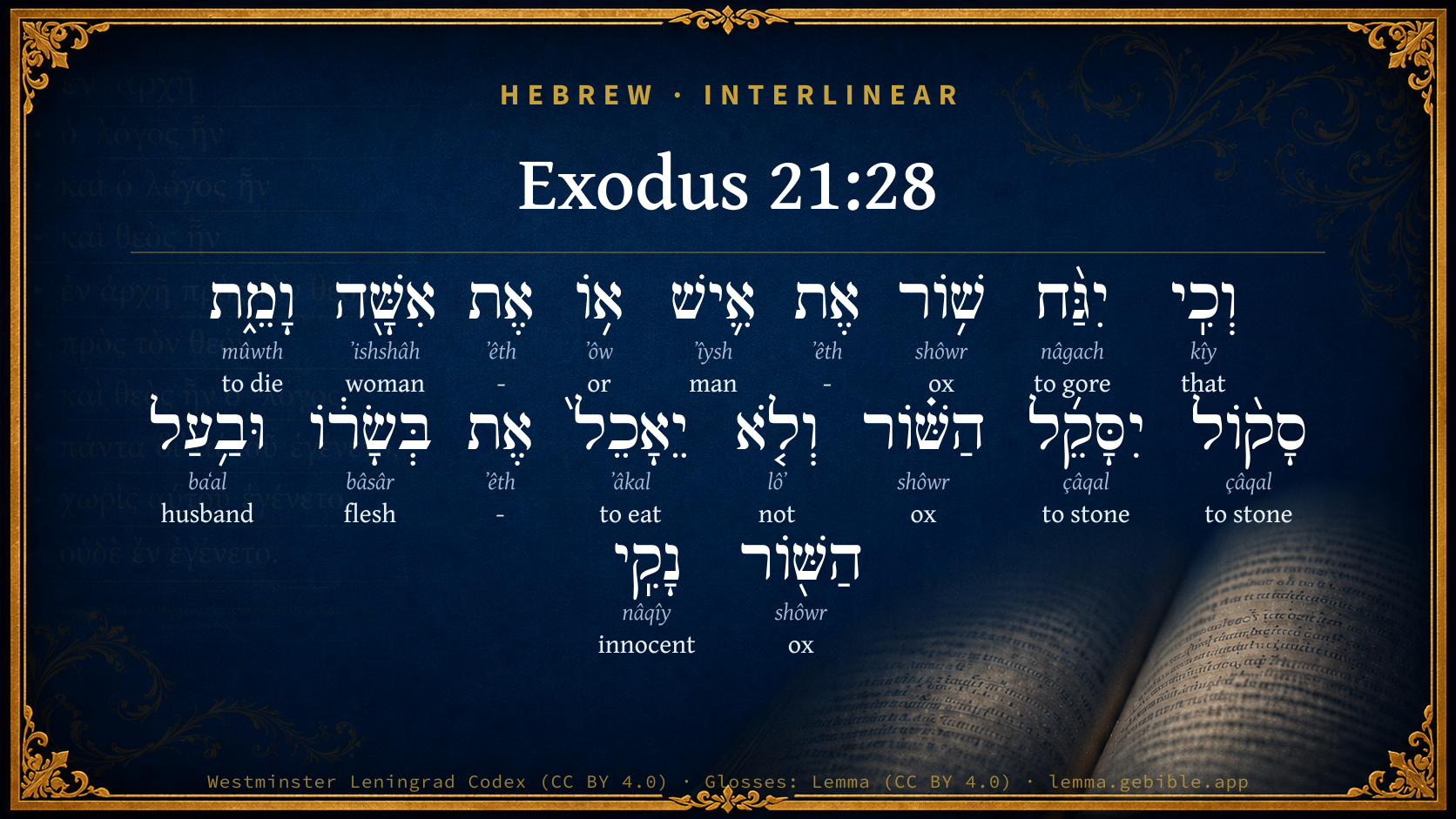
Exodus 21:28

Hebrew (Westminster Leningrad Codex) Exodus 21:28 appears in the Hebrew Old Testament. The text above is from the Westminster Leningrad Codex. Each word links to its Strong’s number, a concise gloss, and parsing drawn from the Open Scriptures Hebrew Bible morphology. Click any word for its full Brown-Driver-Briggs (BDB) entry.
Download image
Cite this verse

Exodus 21:28 (World English Bible). Public Domain. Lemma interlinear Bible study tool, https://lemma.gebible.app/v/exodus/21/28.

Show BibTeX & RIS
BibTeX
RIS
English Translation
"If a bull gores a man or a woman to death, the bull shall surely be stoned, and its flesh shall not be eaten; but the owner of the bull shall not be held responsible.
World English Bible · Public Domain
Highlights
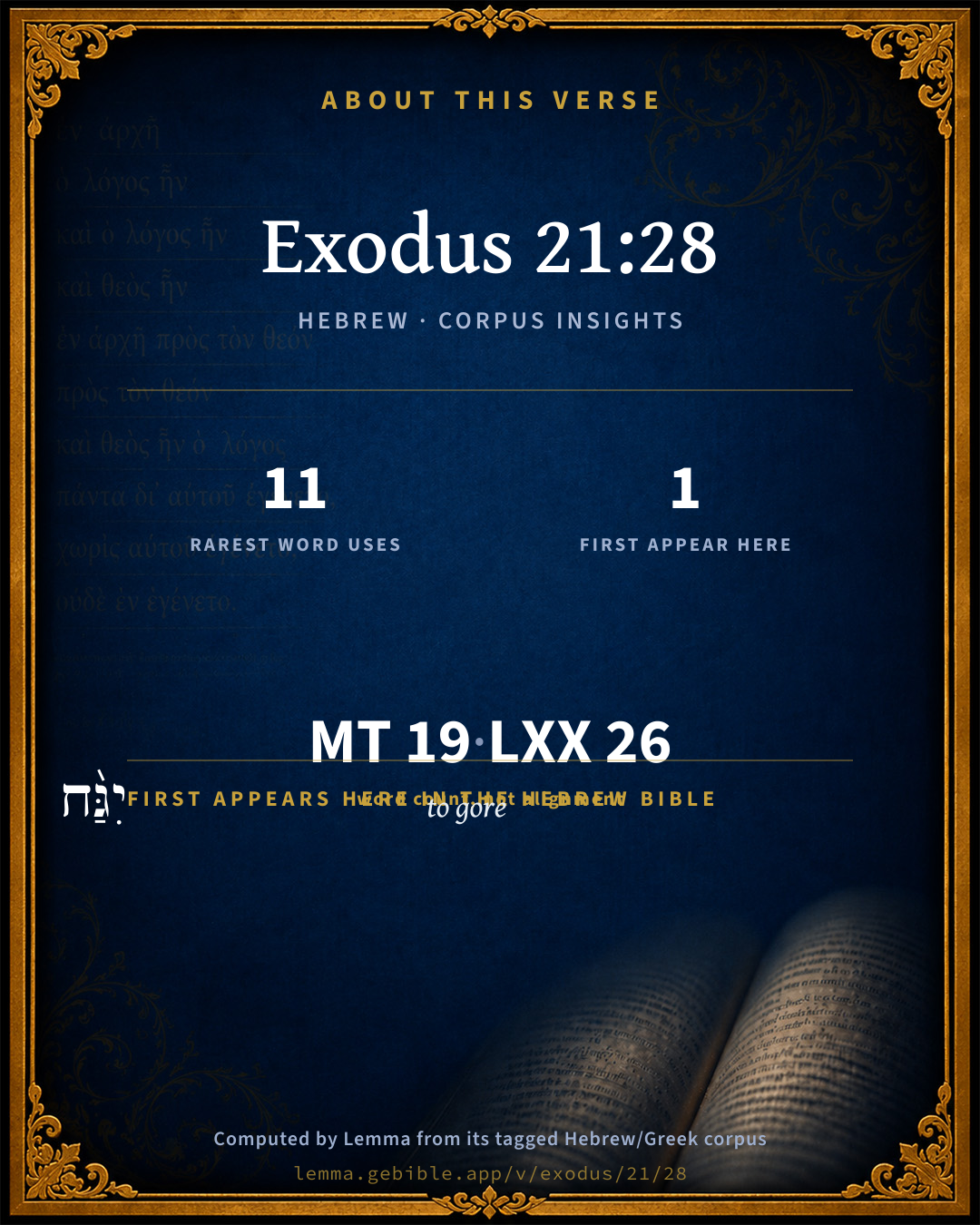
  • 1 first appearance in the Hebrew Bible
Full analysis ↓
Download a study sheet

One document with this verse’s original text, its word-by-word gloss line, the meaning frame, cross-references with their text, attributed commentary, and full source and license credits — printable, and it pastes into notes with its structure intact.

This verse Autodidact and up

Study sheet (.html) Plain text (.txt)

A passage Seminary Student

Up to 50 verses in one chapter. A passage sheet keeps up to 6 commentary sources and 12 cross-references per verse, in the order this page ranks them, and says so on the sheet whenever that leaves anything out. Ask for a single verse and you get the Autodidact verse sheet above.

Everything on this page stays free to read, with no account — the sheet is a download of what is already on screen, not access to it.

Want to remove ads? Support Godless Engineer
Compare translations 3

The same verse in 3 English versions, stacked beneath the original-language interlinear above. Click any original word for its lexicon entry.

Each is an independent rendering of the whole verse — the interlinear is not word-aligned to these translations.

Highlighted words mark where these versions differ — a whole-verse word diff, not a word-by-word alignment.

  • World English Bible Public Domain
    "If a bull gores a man or a woman to death, the bull shall surely be stoned, and its flesh shall not be eaten; but the owner of the bull shall not be held responsible.
  • King James Version Public Domain
    If an ox gore a man or a woman, that they die: then the ox shall be surely stoned, and his flesh shall not be eaten; but the owner of the ox shall be quit.
  • unfoldingWord Literal Text CC BY-SA 4.0
    And if an ox gores a man or a woman and he dies, the ox shall surely be stoned, and its flesh shall not be eaten, but the owner of the ox is innocent.

unfoldingWord Literal Text — © unfoldingWord, licensed CC BY-SA 4.0. Word-aligned USFM3 via Door43 (git.door43.org/unfoldingWord/en_ult).

Versions to compare (up to 4)

3 of 4 selected

Show all 18 translations

Every available English version of this verse, each an independent rendering of the whole verse.

  • World English Bible Public Domain
    "If a bull gores a man or a woman to death, the bull shall surely be stoned, and its flesh shall not be eaten; but the owner of the bull shall not be held responsible.
  • Berean Standard Bible Public Domain
    If an ox gores a man or woman to death, the ox must surely be stoned, and its meat must not be eaten. But the owner of the ox shall not be held responsible.
  • Majority Standard Bible Public Domain
    If an ox gores a man or woman to death, the ox must surely be stoned, and its meat must not be eaten. But the owner of the ox shall not be held responsible.
  • King James Version Public Domain
    If an ox gore a man or a woman, that they die: then the ox shall be surely stoned, and his flesh shall not be eaten; but the owner of the ox shall be quit.
  • American Standard Version (1901) Public Domain
    And if an ox gore a man or a woman to death, the ox shall be surely stoned, and its flesh shall not be eaten; but the owner of the ox shall be quit.
  • Revised Version (1885) Public Domain
    And if an ox gore a man or a woman, that they die, the ox shall be surely stoned, and his flesh shall not be eaten; but the owner of the ox shall be quit.
  • Geneva Bible (1599) Public Domain
    If an oxe gore a man or a woman, that he die, the oxe shalbe stoned to death, and his flesh shall not be eaten, but the owner of the oxe shall goe quite.
  • Douay-Rheims (1899) Public Domain
    If an ox gore a man or a woman, and they die, he shall be stoned: and his flesh shall not be eaten, but the owner of the ox shall be quit.
  • Young's Literal Translation Public Domain
    `And when an ox doth gore man or woman, and they have died, the ox is certainly stoned, and his flesh is not eaten, and the owner of the ox `is' acquitted;
  • Literal Standard Version CC BY-SA 4.0
    And when an ox gores man or woman, and they have died, the ox is certainly stoned, and his flesh is not eaten, and the owner of the ox [is] acquitted;
  • Unlocked Literal Bible CC BY-SA 4.0
    If an ox gores a man or a woman to death, the ox must surely be stoned, and its flesh must not be eaten; but the ox's owner must be acquitted of guilt.
  • unfoldingWord Literal Text CC BY-SA 4.0
    And if an ox gores a man or a woman and he dies, the ox shall surely be stoned, and its flesh shall not be eaten, but the owner of the ox is innocent.
  • Darby Bible Public Domain
    And if an ox gore a man or a woman, so that they die, then the ox shall certainly be stoned, and its flesh shall not be eaten; but the owner of the ox shall be guiltless.
  • World Messianic Bible Public Domain
    “If a bull gores a man or a woman to death, the bull shall surely be stoned, and its meat shall not be eaten; but the owner of the bull shall not be held responsible.
  • Webster's Bible Public Domain
    If an ox shall gore a man or a woman, that they die: then the ox shall be surely stoned, and his flesh shall not be eaten; but the owner of the ox shall be quit.
  • Free Bible Version CC BY-SA 4.0
    If an ox uses its horns to kill a man or woman, the ox must be stoned to death, and its meat must not be eaten. But the owner of the ox won't be punished.
  • Bible in Basic English Public Domain
    If an ox comes to be the cause of death to a man or a woman, the ox is to be stoned, and its flesh may not be used for food; but the owner will not be judged responsible.
  • JPS Tanakh (1917) Public Domain
    And if an ox gore a man or a woman, that they die, the ox shall be surely stoned, and its flesh shall not be eaten; but the owner of the ox shall be quit.

Literal Standard Version (2020), Covenant Press — licensed CC BY-SA 4.0. Text via the HelloAO Bible API (eBible.org). Unlocked Literal Bible (unfoldingWord) — licensed CC BY-SA 4.0. Text via the HelloAO Bible API (eBible.org). unfoldingWord Literal Text — © unfoldingWord, licensed CC BY-SA 4.0. Word-aligned USFM3 via Door43 (git.door43.org/unfoldingWord/en_ult). Free Bible Version, Dr. Jonathan Gallagher — licensed CC BY-SA 4.0. Text via the HelloAO Bible API (eBible.org).

Word by word

More ways to search: Search by grammar → Find every occurrence → Compare this word →

Practice this passage: Drill this verse → Learn its vocabulary →

יִגַּ֨ח
nâgach
H5055
“to gore”
Verb, Qal, Imperfect, 3rd Person, Masculine, Singular
Part of Speech
Verb
Stem
Qal
Form
Imperfect
Person
3rd Person
Gender
Masculine
Number
Singular
Full BDB Definition

Origin: a primitive root

TWOT: 1291

to push, thrust, gore - (Qal) to gore - (Piel) to push or thrust at - (Hithpael) to engage in thrusting, wage war
  1. וְכִֽי kîy H3588 “and · that” Conjunction + Conjunction
  2. שׁ֥וֹר shôwr H7794 “ox” Noun, Common, Masculine, Singular, Absolute
  3. אֶת ʼêth H853 “-” Particle, Direct Object
  4. אִ֛ישׁ ʼîysh H376 “man” Noun, Common, Masculine, Singular, Absolute
  5. א֥וֹ ʼôw H176 “or” Conjunction
  6. אֶת ʼêth H853 “-” Particle, Direct Object
  7. אִשָּׁ֖ה ʼishshâh H802 “woman” Noun, Common, Feminine, Singular, Absolute
  8. וָמֵ֑ת mûwth H4191 “and · to die” Conjunction + Verb, Qal, Perfect, 3rd Person, Masculine, Singular
  9. סָק֨וֹל çâqal H5619 “to stone” Verb, Qal, Infinitive Absolute
  10. יִסָּקֵ֜ל çâqal H5619 “to stone” Verb, Niphal, Imperfect, 3rd Person, Masculine, Singular
  11. הַשּׁ֗וֹר shôwr H7794 “the · ox” Particle, Definite Article + Noun, Common, Masculine, Singular, Absolute
  12. וְלֹ֤א lôʼ H3808 “and · not” Conjunction + Particle, Negative
  13. יֵאָכֵל֙ ʼâkal H398 “to eat” Verb, Niphal, Imperfect, 3rd Person, Masculine, Singular
  14. אֶת ʼêth H853 “-” Particle, Direct Object
  15. בְּשָׂר֔וֹ bâsâr H1320 “flesh · his” Noun, Common, Masculine, Singular, Construct + Suffix, Personal, 3rd Person, Masculine, Singular
  16. וּבַ֥עַל baʻal H1167 “and · husband of” Conjunction + Noun, Common, Masculine, Singular, Construct
  17. הַשּׁ֖וֹר shôwr H7794 “the · ox” Particle, Definite Article + Noun, Common, Masculine, Singular, Absolute
  18. נָקִֽי nâqîy H5355 “innocent” Adjective, Adjective, Masculine, Singular, Absolute

About this verse

These counts appear in no published source. They are computed here, from the morphology-tagged text and Lemma’s own curated glosses. What Lemma adds →

19
words
14
distinct lemmas
Pentateuch
section

Notable vocabulary

The rarest word here is יִגַּ֨ח to gore H5055 — appearing just 11 times in the whole Hebrew Bible.

First appearance in Scripture

This word makes its first canonical appearance in the Hebrew Bible here:

  • יִגַּ֨ח to gore H5055

Shared distinctive vocabulary

יִגַּ֨ח to gore H5055 occurs in 10 verses of the Hebrew Bible. Also found in:

Grammatical profile

  • 5 verbs
  • 7 nouns
  • 1 adjective
  • 2 conjunctions
  • 4 particles

Verb forms

  • יִגַּ֨ח Qal · Imperfect
  • וָמֵ֑ת Qal · Perfect
  • סָק֨וֹל Qal · Infinitive Absolute
  • יִסָּקֵ֜ל Niphal · Imperfect
  • יֵאָכֵל֙ Niphal · Imperfect

Repetition

Words recur within this verse — often emphatic in Hebrew:

  • שׁ֥וֹר ox H7794 ×3
  • סָק֨וֹל to stone H5619 ×2

Hebrew & Septuagint length

In English translation the verse runs 35 words from the Hebrew and 35 from the Septuagint (LXX English) — the same length.

A rough comparison of the two English renderings, which tokenize alike — not a word-level alignment.

Word counts can differ between the Hebrew and the Greek without any difference in meaning — e.g. the Hebrew direct-object marker אֵת has no separate Greek word, and Greek often adds the article ὁ.

In the original languages it is 19 Hebrew tokens and 26 Greek tokens — but the two are counted differently (Hebrew bundles its prefixes and suffixes into one token; the Greek is in lemma form), so that isn’t a like-for-like length.

Cross-references

3

Topical passages linked to Exodus 21:28 in the Treasury of Scripture Knowledge — connected by theme and wording, ordered by reader-vote popularity; previews shown in the World English Bible.

  • Exodus 21:32 If the bull gores a man-servant or a maid-servant, thirty shekels of silver shall be given to their master, and the ox shall be stoned.
  • Genesis 9:5–6 I will surely require your blood of your lives. At the hand of every animal I will require it. At the hand of man, even at the hand of every man's brother, I will require the life of man.
  • Leviticus 20:15–16 "'If a man lies with an animal, he shall surely be put to death; and you shall kill the animal.

Cross-references courtesy of OpenBible.info (CC BY 4.0).

Hebrew and Greek witnesses Masoretic Hebrew ↔ Greek Septuagint

The same verse in the two great witnesses to the Old Testament, shown verse-for-verse.

These are two independent witnesses, not word-aligned to each other, and the Septuagint is shown in lemma (dictionary) form.

Hebrew Exodus 21:28 Masoretic · Westminster Leningrad Codex

וְכִֽי יִגַּ֨ח שׁ֥וֹר אֶת אִ֛ישׁ א֥וֹ אֶת אִשָּׁ֖ה וָמֵ֑ת סָק֨וֹל יִסָּקֵ֜ל הַשּׁ֗וֹר וְלֹ֤א יֵאָכֵל֙ אֶת בְּשָׂר֔וֹ וּבַ֥עַל הַשּׁ֖וֹר נָקִֽי

"If a bull gores a man or a woman to death, the bull shall surely be stoned, and its flesh shall not be eaten; but the owner of the bull shall not be held responsible.

World English Bible · Public Domain

Greek LXX Exodus 21:28 Septuagint · lemma form

ἐάν δέ κερατίζω ταῦρος ἀνήρ ἤ γυνή καί ἀποθνήσκω λίθος λιθοβολέω ὁ ταῦρος καί οὐ βιβρώσκω ὁ κρέας αὐτός ὁ δέ κύριος ὁ ταῦρος ἀθῷος εἰμί

And if a bull gore a man or woman and they die, the bull shall be stoned with stones, and his flesh shall not be eaten; but the owner of the bull shall be clear.

LXX2012 (modern English Septuagint) · Public Domain

On this verse, Adam Clarke's Commentary discusses the Septuagint’s reading. Read the note in Commentary ↓

Hebrew: Westminster Leningrad Codex (CC BY 4.0). Greek: Septuagint (public domain); English from LXX2012 (modern English Septuagint) (Public Domain). How the Septuagint differs from the Hebrew →

Targum (Aramaic paraphrase)

2

The Targum is the ancient Jewish Aramaic paraphrase of the Hebrew Scriptures — an interpretive translation, not the Hebrew text itself. Onkelos (literal) and Pseudo-Jonathan (expansive) render the Torah, and Jonathan the Prophets. Coverage is partial: where no permissively-licensed English translation exists for a verse, only the Aramaic is shown. This is verse-level text, not a word-by-word alignment to the Hebrew.

  1. Targum Onkelos Torah (Genesis–Deuteronomy)
    וַאֲרֵי יַגַח תּוֹרָא יָת גַבְרָא אוֹ יָת אִתְּתָא וִימוּת אִתְרְגְמָא יִתְרְגֵם תּוֹרָא וְלָא יִתְאָכֵל יָת בִּסְרֵהּ וּמָרֵהּ דְתוֹרָא יְהֵי זַכָּאָה:

    (no public-domain English translation for this verse)

    Targum Onkelos — Aramaic: “Onkelos Genesis” (public domain); “Onkelos Exodus” (public domain); “Onkelos Leviticus” (public domain); “Onkelos Numbers” (public domain); “Onkelos Deuteronomy” (public domain). English: “Sefaria Community Translation” (CC0 1.0 (public-domain dedication)); “J.W. Etheridge. The Targums of Onkelos and Jonathan Ben Uzziel on the Pentateuch. London: Longmans, Green, 1862” (public domain). Text via Sefaria.

  2. Targum Pseudo-Jonathan Torah (Genesis–Deuteronomy)
    וַאֲרוּם יִנְגַשׁ תּוֹר יַת גְּבַר אוֹ יַת אִיתָא וִימוּת יִתְרְגָמָא יִתְרְגֵם תּוֹרָא וְלָא יִתְנְכֵס לְמֵיכוּל יַת בִּשְרֵיהּ וּמָרֵיהּ דְּתוֹרָא יְהֵי זַכְּאַי מִדִּין קְטוֹל וְאוּף מִדְמֵי עַבְדָא וְאַמְהוּ

    And if an ox goreth a man or woman to cause death, the ox must be stoned, but shall not be killed that his flesh may be eaten; and the owner of the ox shall be exempt from the condemnation of death, and also from the price of the servant or handmaid.

    Targum Pseudo-Jonathan — Aramaic: “Targum Jonathan on Genesis” (public domain); “Targum Jonathan on Exodus” (public domain); “Targum Jonathan on Leviticus” (public domain); “Targum Jonathan on Numbers” (public domain); “Targum Jonathan on Deuteronomy” (public domain). English: “The Targum of Jonathan ben Uzziel, trans. J. W. Etheridge, London, 1862” (public domain). Text via Sefaria.

Commentary

Notes on Exodus 21:28 from classic Christian and Jewish commentators (each source and its license shown beneath its notes). The classic Christian expositions comment on the surrounding passage and are grouped to its opening verse, so a note may address several verses; the Jewish commentaries on the Tanakh (Rashi and others) are per-verse, so they appear only where the commentator wrote on this verse.

Lemma curates 59 commentaries, every one of them public domain or Creative Commons licensed, each selected and text-cleaned for this edition rather than reprinted as found. About our sources →

Trapp's Complete Commentary

John Trapp

Exo 21:28 If an ox gore a man or a woman, that they die: then the ox shall be surely stoned, and his flesh shall not be eaten; but the owner of the ox [shall be] quit.

Ver. 28. Then the ox shall be surely stoned.] God requiring man’s blood even of beasts. {Gen 9:5} {See Trapp on "Gen 9:5"}

John Trapp, A Commentary or Exposition upon All the Books of the Old and New Testament (1647–1656) — public domain. Text from a community e-Sword module.

The Biblical Illustrator

Joseph S. Exell

Exo_21:28-36

If an ox gore.

Gods regard for the safety of man and beast

I. God cares for the safety of man.

1. If an ox injured a man for the first time, the life of the ox only was forfeited (Exo_21:28). But--

2. If the owner of the ox, acquainted with the proved vicious character of his beast, neglected to put him under restraint, and the ox killed his victim--as culpably negligent,--

(1) the owner was put to death; or--

(2) his life commuted for a fine.

II. God cares for the safety of the beast. Other Scriptures demonstrate this (Mat_6:26, etc.).

III. Provision for the safety of others should be made.

1. This provision should be made promptly.

2. This provision should be permanent.

Application:

1. Beware of injuring your neighbours soul by an unguarded inconsistency.

2. Beware of injuring your neighbours friendship by any unguarded passion.

3. Beware of injuring your neighbours character by any unguarded word.

4. Beware of injuring your neighbours peace by any unguarded look or action.

5. In all matters concerning your neighbour, remember that Whatsoever ye would, etc. (J. W. Burn.)

The penalties of carelessness

I. Life is superior to property. The ox that had gored a man to death was to be killed, and put out of the way. The ox is stoned to death; and, legally, it would involve physical uncleanness to eat of the flesh.

II. The careless man is culpable. If the animal had been known to gore; if this fact had been testified to the owner, and proper precautions had not been taken, then the owner was in some measure participant in the evil doings of the vicious creature. Carelessness is culpable. He that knoweth to do good, and doeth it not, to him it is sin. To prevent evil by wise precaution is our bounden duty, and is an indirect method of doing good. All life is precious; but it seems to be indicated that some lives are more precious than others. Thirty shekels is a high price for some; but a hundred shekels would be a low price for others. After death has visited, then estimates nearer the truth of a mans worth will be formed.

III. Man is responsible for preventable evil. If into the uncovered pit an ox or an ass fall, the owner of the pit shall make good the damage. Will the Almighty hold us responsible for the moral pits we have left uncovered? We have not placed precautionary signals in sufficient number along those highways where moral pits and quagmires abound. (W. Burrows, B. A.)

Punishment of criminal carelessness

If Moses had to regulate our legislation in reference to railway accidents, he would put it on altogether a new basis. If half-a-dozen people were killed and a score seriously injured through the mail running into a goods train, and Moses found that the engine driver who missed the signal had been on his engine twelve or fourteen hours, or that the pointsman who turned the mail into the goods siding had been kept at his post for, perhaps, a still longer period, I cannot help thinking that managers and directors would stand a chance of having a much, sharper punishment than they commonly receive now. And if criminal carelessness which might be fatal to life was punished by Moses with death, I think that fraudulent acts which are certain to injure the health and perhaps the life of the community, would have been punished by him not less severely. He would certainly have approved the sentence under which a few months ago a large farmer, greatly to his own astonishment and the astonishment of his friends, was put in prison for sending diseased meat to market; only I think that the old Jewish legislator would have inflicted a still heavier punishment--a few years penal servitude instead of a month or twos imprisonment. Chemists, who adulterate the drugs on which the rescue of life depends--the rescue of the life not only of ordinary members of the community like ourselves, whom also Moses would have protected, but of men of science, poets, and statesmen, whose death would be a calamity to the nation, and to the world--would I think, have been made responsible by him for the death of those who perished through their fault; and if they were not stoned or hung for murder, which I think would have been possible, a criminal penalty so heavy would have been inflicted on them, and they would have been branded with such imfamy, that other evil-disposed persons would have feared to repeat the crime. (R. W. Dale, D. D.)

Responsibility respecting life

We have this principle certainly in our law, but with what beneficial effect a much wider application of it might be made! Look at a few instances of carelessness. There is a block of crowded, unventilated, and badly-drained houses, into which necessity drives the poor to herd, and where they sicken and die. Think you this principle would not lay hands on the owner of such property? Would it spare a corporation if it neglected to deal with a pestilence breeding quarter? Neither would trifling carelessness escape. What is trifling? A traveller goes to a strange hotel, and retires to damp sheets, and ever afterwards suffers from ill-health, sometimes speedily loses life. Think of the thousands who travel, and follow even one stricken one into a sorrowful and bereaved family! Carelessness, when seen in its consummation, speaks for itself. But worse than carelessness is selfishness which pursues its ends regardless of others. In the sloppy winter of the Franco-German war, an army contractor furnished boots with paper soles to the French. In the Crimean war we heard of manufacturers who supplied blankets which, so to speak, rotted on the backs of our soldiers. How much death and disaster was due to this selfishness! Because we cannot count the victims is there no guilt? Moses would say, if life be lost and can be traced to a man, let him atone for it; results must be dealt with. Life is the one sacred thing. Nor is it difficult to see that such a principle applies itself to the selfishness of those who by their trickery and roguery in business ruin the commerce of their country. Alas! for the advice because it is utopian, and more because it is needed, but it is true that no tribunal would better serve England at this juncture than one which held the terror of moral justice over manufacturers who send out worthless goods and taint our honest name, and impair our credit the wide world over. They rob others, and they destroy their country. There are traitors to-day as real as those who in olden days took a bribe and sold their armies or their castles to the enemy. (W. Senior, B. A.)

A needful warning

On a cold Sabbath morning in February, a gentleman was walking along, somewhat hastily, through the snow. He noticed a bright-looking little lad standing upon the pavement, with his cap in his hand and his eyes fixed upon one spot on the sidewalk. As he approached him he looked up to him, and pointing to the place, said, Please dont step there, sir. I slipped there and fell down. What a different world this would be if all Christians were as particular as this lad to warn others against dangers, whether temporal or spiritual. (Christian Herald.)

A danger signal

At Saltcoats, not very far from the shore, stands a beacon in the winter. If you were to ask any one who belongs to that place, why it is there, you would be told this story:--A merchant from Glasgow, with his family, was residing there for the summer months. One morning the merchant went out to bathe before breakfast, and he thought he was quite safe as long as he kept near the shore. But there was a pit there which he did not know anything of, and into this pit he fell, and nothing more was seen or heard of him. After this accident a beacon was put up as a warning to all others to keep from the spot. What were the feelings that prompted this beacon to be put up? It must have been feelings of love to keep all others from danger. (Christian Herald.)

.

The Biblical Illustrator, edited by Joseph S. Exell (c. 1880s–1900s) — public domain. Text from a community e-Sword module.

The Preacher's Complete Homiletical Commentary

Joseph S. Exell (gen. ed.)

MAIN HOMILETICS OF THE PARAGRAPH.—Exo_21:28-36

GOD’S REGARD FOR THE SAFETY OF MAN AND BEAST.—Exo_21:28-36

This is an extension of the principle maintained in the preceding section,—the sanctity of human life. So sacred is it, that it is not merely to be protected from injury or murder, but from accident. And not only human but animal life. Even that must not be sacrificed carelessly. Then—

I. God cares for the safety of man.

1. If an ox injured a man for the first time, the life of the ox only was forfeited (Exo_21:28). But

2. If the owner of the ox, acquainted with the proved vicious character of his beast, neglected to put him under restraint, and the ox killed his victim as culpably negligent,

(1) the owner was put to death; or

(2) his life commuted for a fine.

II. God cares for the safety of the beast. Other scriptures demonstrate this (Mat_6:26; &c.).

1. In the case of a beast falling into an unprotected pit (or well), the penalty was adequate remuneration for the loss (Exo_21:33-34).

2. In the event of an ox exhibiting vicious propensities for the first time, both the ox and its victim were to be sold and the proceeds equally divided; but after its proved viciousness, the owner for culpable carelessness was to bear the entire loss.

None but a superficial mind will deem this legislation trivial. It involves important principles recognised in all civilised codes. The application is, that God’s regard, as expressed in the law, should be man’s as expressed in action. The Jew, in the literal case before us, must put a wall round his pits or wells, or cover them in some way and “keep in” his intractable bulls: the Christian, in practical life, must adopt every precaution necessary for the safety of his neighbour or his neighbour’s property. Hence there are matters about which a man may not simply consult his own interest. God and society demand that we consult the interest of others. Thus selfishness is checked, and provision made for harmony and peace and safety between man and man. The text suggests—

I. That provision for the safety of others should be made. We must not argue that others are able to take care of themselves, and if they walk into danger it is their own fault. No, the Christian law is, “Thou shalt love thy neighbour as thyself.” We may be able to walk amidst the dangers of our own field with impunity, because we are familiar with them, and are armed against them. Our neighbour may not be. Wherefore, “If eating flesh or drinking wine,” &c. “Destroy not thy brother for whom Christ died.”

II. That this provision should be made promptly. We must not argue that it will be time to adopt precautions when we see our neighbour coming. No, Christian life must be regulated by the principle that “prevention is better than cure.” We are not at liberty to wait till the accident has occurred. Life is too short, and too valuable, for such experiments. We save life equally by prevention as by rescue. There may be no conspicuous heroism in taking precautions, but God counts it as very acceptable service. Davy did more for humanity by inventing his simple lamp than he would by daring attempts to rescue hundreds of victims from exploded mines. And so it is better by far to save a man from moral ruin than by indefatigable attempts to save him when ruined.

III. That this provision should be permanent. That accidents are exceptional does not alter the case. Most of the permanent arrangements of life are made to meet exceptional cases. A house is not built for weather, which with us is pretty uniformly mild; but so as to stand the severe stress of occasional torrents and winds. A shipbuilder does not contemplate the fair weather; but the exceptional storm. So our neighbour may be calling, or his ox straying, at any moment. The visit may be uncertain, but the uncertainty is permanent. So should be our means of meeting it. Be prepared, therefore, for accidents, and make sure in case of uncertainties. And depend upon this, he who is careful about his neighbour will be equal to any emergency that may occur respecting himself.

Application—(i.) Beware of injuring your neighbour’s soul by any unguarded inconsistency. (ii.) Beware of injuring your neighbour’s friendship by any unguarded passion. (iii.) Beware of injuring your neighbour’s character by any unguarded word. (iv.) Beware of injuring your neighbour’s peace by any unguarded look or action. (v.) In all matters concerning your neighbour, remember that “Whatsoever ye would that men should do unto you, do ye even so unto them.”

—J. W. Burn.

THE PENALTIES OF CARELESSNESS

In a nomadic state of society, great care is required in the management of cattle, if interests are not to clash, if the welfare of the community is to be promoted. Even when the children of Israel reached the Promised Land, there would be still need for caution, and great precision in the laying down of laws. The wise foresight of the legislator is seen in these particular laws with reference to dangerous cattle.

I. Life is superior to property.—The ox that had gored a man to death was to be killed, and put out of the way. His flesh was not to be eaten. The ox is stoned to death; and, legally, it would involve physical uncleanness to eat of the flesh. Is there Old Testament symbolism in this fact? Does the ox symbolise the murderer? Does the Almighty thus in a most significant manner set forth the awfulness of murder? This, however, may be safely inferred, that property should ever be subordinate to life. What a pity that this noble principle of the Mosaic code is not more fully carried out in modern days! We rightly slaughter cattle to prevent the spread of disease; but the farmer would object to have an ox slaughtered because it had unfortunately gored a man to death. There is still at work in modern society the influence of this mistaken principle,—the omnipotence of property. We need to learn the preciousness of human life.

II. The careless man is culpable.—If the animal had been known to gore; if this fact had been testified to the owner, and proper precautions had not been taken, then the owner was in some measure participant in the evil doings of the vicious creature. Carelessness is culpable. He that knoweth to do good, and doeth it not, to him it is sin. To prevent evil by wise precaution is our bounden duty, and is an indirect method of doing good. There are degrees of carelessness, and degrees of guilt. The man may so conduct himself as to declare that he rather rejoiced in the ox’s murderous tendency; and, if so, the man must not only have his ox killed, but he himself is to be put to death. But there may be mitigating circumstances about the owner’s conduct. The sufferers may take a lenient view of the transaction. Then the owner of the ox shall give a proper ransom for the life which has been forfeited, whether son or daughter. But if it be a manservant or a maidservant that is killed, then thirty shekels of silver shall be given to the master; which was probably the usual market price of a slave. All life is precious; but it seems to be indicated that some lives are more precious than others. Thirty shekels is a high price for some; but a hundred shekels would be a low price for others. After death has visited, then estimates nearer the truth of a man’s worth will be formed.

III. Man is responsible for preventable evil.—If into the uncovered pit an ox or an ass fall, the owner of the pit shall make good the damage. He shall pay the price of the animal so killed; and receive the dead beast, of which he could only use the skin, and other such parts. The flesh was unclean. If we leave a pit uncovered we must take the consequences. Will the Almighty hold us responsible for the moral pits we have left uncovered? We have not placed precautionary signals in sufficient number along those highways where moral pits and quagmires abound.

IV. Community of interest.—In the Jewish polity men were not to be allowed to consider their own interests as paramount. They were to consider the welfare of others. The man, whose ox had killed the ox of another, was in a measure responsible for the loss occasioned. The goring ox was to be sold, and thus removed out of the sight of those to whom it had rendered itself obnoxious And the money got for the living ox was to be divided; and the dead ox also they shall divide. It is likely that the dead ox had gored. But if the ox had been known to gore aforetime, then the owner must pay ox for ox; and the dead shall be his own. The master must be watchful over the very cattle that he owns. He must have respect to the welfare of his neighbour. Let us feel that we have interests in common. The prosperity of one is the prosperity of all in a degree. In the long run there can be no individual interests separate from the interests of the whole community. Selfishness is self-defeating and suicidal. If there cannot be community of goods, there must always be community of interests—W. Burrows, B.A.

ILLUSTRATIONS

BY

REV. WILLIAM ADAMSON

Pitfalls! Exo_21:33-34. Evils are wrought by want of thought, as well as by want of heart. Bare want of thought is censured as sinful. There is a selfish and heedless disregard of the rights and personal safety of others. But there are moral as well as material pits. The gin-palace keeper should be compelled to write up, “An open pit here.” Keepers of haunts of vice should be forced to have for their sign the opinion of the wise man in the Book of Proverbs—“The Way to the Pit.”

“Our dangers and delights are near allies;

From the same stem the rose and prickle rise.”

—Daniel.

The Preacher's Complete Homiletical Commentary (gen. ed. Joseph S. Exell; Funk & Wagnalls, c. 1892) — public domain (pre-1929). A full-Bible homiletical/sermon-outline anthology covering 65 of 66 books (2 John is absent from the source module). Text from a community e-Sword module.

Tyndale Open Study Notes

Tyndale Open Resources

21:28-32 If an animal caused a person’s death and the owner was judged to be negligent, the relatives of the deceased could demand the death penalty for both the animal and its owner. However, that penalty was not mandatory, and the relatives could elect to accept compensation (21:30).

Tyndale Open Study Notes — © Tyndale Open Resources, licensed CC BY-SA 4.0. Text via the HelloAO Bible API.

Geneva Bible (1599)

Geneva Bible translators

If the beast be punished, much more shall the murderer.

Geneva Bible (1599) marginal notes — public domain. Text via Bolls.life.

Jamieson, Fausset & Brown

Robert Jamieson, A. R. Fausset & David Brown

If an ox gore a man or a woman, that they die--For the purpose of sanctifying human blood, and representing all injuries affecting life in a serious light, an animal that occasioned death was to be killed or suffer punishment proportioned to the degree of damage it had caused. Punishments are still inflicted on this principle in Persia and other countries of the East; and among a rude people greater effect is thus produced in inspiring caution, and making them keep noxious animals under restraint, than a penalty imposed on the owners.

Jamieson, Fausset & Brown — Commentary Critical and Explanatory on the Whole Bible (1871) — public domain (CC PDM 1.0). Text via the HelloAO Bible API.

Adam Clarke's Commentary

Verse 28. If an ox gore a man] It is more likely that a bull is here intended, as the word signifies both, see Ex 22:1; and the Septuagint translate the שור shor of the original by ταυρος, a bull. Mischief of this kind was provided against by most nations. It appears that the Romans twisted hay about the horns of their dangerous cattle, that people seeing it might shun them; hence that saying of Horace. Sat., lib. i., sat. 4, ver. 34: Faenum habet in cornu, longe fuge. "He has hay on his horns; fly for life!" The laws of the twelve tables ordered, That the owner of the beast should pay for what damages he committed, or deliver him to the person injured. See Clarke on Ex 22:1.

His flesh shall not be eaten] This served to keep up a due detestation of murder, whether committed by man or beast; and at the same time punished the man as far as possible, by the total loss of the beast.

Adam Clarke's Commentary on the Bible (1810–1826) — public domain. Text from a community e-Sword/MySword module.

Ellicott's Commentary for English Readers

(28) The ox shall be surely stoned—i.e., he shall die the death of a murderer.

His flesh shall not be eaten.—An ox killed by stoning would not be bled in the usual way, and would be “unclean” food for Hebrews. According to the Rabbis, the flesh might not even be disposed of to the Gentiles, but had to be buried. If this were so, the object must have been to mark strongly that whatever creature took human life was accursed.

(28-32) Injuries to the person might arise either from man or from animals. Protection from both was needed. The law given to Noah (Gen_9:5) had already laid it down that whenever a beast killed a man his life was to be forfeit. This law was now re-enacted, but with a further and very important proviso. If the animal had an owner, and the owner had reason to know that it was dangerous, then not only the beast, but the owner also was to be held guilty. He was to be liable to a process for murder (Exo_21:29); but, with the consent of the aggrieved family, might pay a sum of money as compensation instead (Exo_21:30). In the case of a slave, the sum was fixed at what was regarded as the standard price of a slave (Lev_25:44-46; Lev_27:3), viz., thirty silver shekels.

A Bible Commentary for English Readers, edited by Charles John Ellicott (1878–1897) — public domain. Text from a community e-Sword module.

The Cambridge Bible for Schools and Colleges

gen. ed. J. J. S. Perowne

28. shall be stoned] The sanctity of human life demanded that an animal, not less than a man, should suffer for violating it: cf. (in P) Gen_9:5. Stoning was a common punishment among the Hebrew see e.g. Lev_20:2; Lev_20:27; Lev_24:14; Lev_24:16; Lev_24:23, Deu_13:10; Deu_17:5; Deu_21:21; Deu_22:21; Deu_22:24 f.: of an animal, as here, vv. 29, 32, Exo_19:13.

For the punishment of an animal—and even of an inanimate object, such as a piece of wood or stone—which had caused the death of a human being, there are many analogies. At Athens the court of the Phylobasileis (‘Tribe-kings’) in the Prytaneion, established, it was said, Draco (b.c. 624), investigated cases thus arising (Demosth. adv. Aristocr. § 76, p. 645, Arist. Constit. of Athens, 57 end); and so Plato (Legg. ix. 873 e–874 a) would have an animal or inanimate object that had killed a man tried, and, if found guilty, expelled from the country (the animal having been first slain). Pausanias (v. 27. 10; vi. 11. 6) mentions two cases of statues, one thrown into the sea, and the other ceremonially purified, for having caused a death. An interesting collection of parallels from many different nations is given by Frazer, Pausanias, ii. 370 ff. (cited by Cook, p. 252, who also refers to Baring-Gould, Curiosities of Olden Times, 1895, p. 57 ff.),—many taken from Chambers, Book of Days, i. 126 ff. In mediaeval Europe animals charged with causing a death were often tried in a court of law, and, if found guilty, killed: a cow was executed in this way in France as late as 1740.

his flesh shall not be eaten] Blood-guilt would be resting upon it, which would be transferred to any one partaking of it.

quit] i.e. pronounced innocent, acquitted, as v. 19. The owner is acquitted, because it is assumed to be the first time that the animal has so acted. On ‘quit,’ see Aldis Wright’s Bible Word-Book, s.v.

28–32. Injury done by a vicious ox to a free man or woman. Cf Ḥamm. §§ 250–2.

28–36. Bodily injuries due to animals, or neglect of reasonable precautions.

The Cambridge Bible for Schools and Colleges (gen. ed. J. J. S. Perowne; Cambridge University Press, 1878–1918) — public domain. Text from a community e-Sword module.

John Gill's Exposition

If an ox gore a man or a woman, that they die,.... That are Israelites, of whom only Aben Ezra interprets it; but though they may be principally designed, yet not solely; for no doubt if one of another nation was gored to death by the ox of an Israelite, the same penalty would be inflicted, as follows:

then the ox shall be surely stoned; which is but an exemplification of the original law given to Noah and his sons, Gen 9:5, "at the hand of every beast will I require it"; i.e. the blood of the lives of men; which shows the care God takes of them, that even a beast must die that is the means of shedding man's blood:

and his flesh shall not be eaten; it being as an impure beast according to this sentence, as Maimonides (l) observes; and even though it might have been killed in a regular manner before it was stoned, it was not to be eaten; no, not even by Heathens, nor by dogs might it be eaten, as a dead carcass might by a proselyte of the gate, or a stranger; this might not be given nor sold to him; for, as Aben Ezra observes, all profit of them is here forbidden:

but the owner of the ox shall be quit; from punishment, as the last mentioned writer observes, from suffering death; he shall only suffer the loss of his ox: the Targum of Jonathan is,"he shall be quit from the judgment of slaughter (or condemnation of murder), and also from the price of a servant or maid,''which was thirty shekels, Exo 21:32.

(l) Hilchot Maacolot Asurot, c. 4. sect. 22.

John Gill's Exposition of the Whole Bible (1746–1763) — public domain (CC PDM 1.0). Text via the HelloAO Bible API.

Albert Barnes' Notes on the Bible

The animal was slain as a tribute to the sanctity of human life (Compare the marginal references and Gen 4:11). It was stoned, and its flesh was treated as carrion. Guilty negligence on the part of its owner was reckoned a capital offence, to be commuted for a fine.

In the case of a slave, the payment was the standard price of a slave, thirty shekels of silver. See Lev 25:44-46; Lev 27:3, and the marginal references for the New Testament application of this fact.

Albert Barnes' Notes on the Bible (1834–1885) — public domain. Text from a community e-Sword/MySword module.

Haydock's Catholic Bible Commentary

Stoned, that he may do no more harm, and that the owner may be punished at least by this loss. (Haydock) --- Sentence was passed by the 23 judges. By the Roman law, the animal which struck a man was forfeited to him (Calmet); and its master had to make good all damages. ( Justinian iv. 9.)

George Leo Haydock (1774–1849), Haydock's Catholic Family Bible and Commentary, 1859 edition — public domain. Excludes Psalms (Douay-Rheims chapter numbering differs from Protestant) and Deuterocanonical books (Catholic canon only).

Matthew Poole's English Annotations

Under which you are to understand any other creatures of like nature which hurt a man in such a dangerous manner, whether with their horns, or teeth, or feet; but he mentions only the ox or bull, and his goring with his horn, because this is most frequently done.

Ox shall be stoned; partly, to prevent future mischiefs from that creature; partly, to punish its master for his negligence in not keeping it in; and principally, for man’s admonition, for whom seeing the beasts were made, it is not strange nor unjust if it be destroyed for man’s good. God would hereby show that he would not, and men should not, spare a wilful murderer.

His flesh shall not be eaten; both because it was forbidden food, its blood being not let out; and for the punishment of the owner, who was hereby hindered from the sale of it, to beget in all the greater detestation of murderers, when they observe the poor beast upon this account accursed, and therefore not to be touched or tasted.

Matthew Poole's English Annotations on the Holy Bible (1683–1685) — public domain. Text from a community e-Sword/MySword module.

Whedon's Commentary on the Bible

Daniel D. Whedon

28-32. If an ox gore a man — This statute further guards the sanctity of human life. A potent object-lesson lay in the command that the murderous animal’s flesh shall not be eaten, for it was to be regarded as polluted with the curse of a human life destroyed. Even the owner of such an ox might suffer the death penalty if he had knowingly permitted him to run at large after being duly admonished of the animal’s vicious habit. This penalty might, however, be commuted for a sum of money, which was, doubtless, left to the magistrates to determine. The valuation fixed by the law as the price of a slave thus killed was thirty shekels of silver. Comp. Zec_11:12-13; and Mat_26:15; Mat_27:3-4.

Daniel D. Whedon (gen. ed.), Commentary on the Old and New Testaments (1874–1909) — public domain. Text from a community e-Sword module.

The Pulpit Commentary

Vers. 28-32. Injuries done by cattle to slaves and freemen. For the purpose of inculcating as strongly as possible the principle of the sanctity of human life, the legislator notices the case where mortal injury is done to a person by a domesticated animal. The ox is taken as the example, being the animal most likely to inflict such an injury. In accordance with the declaration already made to Noah, (Gen_9:6) it is laid down that the destructive beast must be killed. Further, to mark the abhorrence in which murder ought to be held, the provision is made, that none of the creature"s flesh must be eaten. The question then arises, is the owner to suffer any punishment? This is answered in the way that natural equity points out he had reason to know the savage temper of the animal, he is to he held responsible; if otherwise, he is to go free." In the former case, the Hebrew law assigned a higher degree of responsibility than accords with modern notions; but practically the result was not very different. The neglectful Hebrew owner was held to have been guilty of a capital offence, but was allowed to "redeem his life" by a fine. His modern counterpart would be held to have been guilty simply of laches or neglect of duty, and would be punished by fine or imprisonment

The ox shall be surely stoned. He shall suffer the same death that would have been the portion of a human murderer. His flesh shall not be eaten. The animal was regarded as accursed, and therefore, as a matter of course, no Hebrew might eat of it. According to the Rabbinical commentators, it was not even lawful to sell the carcase to Gentiles. The owner shall be quiti.e. , "shall be liable to no punishment."

The Pulpit Commentary (1880–1919), ed. H.D.M. Spence-Jones & Joseph S. Exell — public domain. Text from a community e-Sword module.

Kretzmann's Popular Commentary

Paul E. Kretzmann

Ordinances for the Protection of Life and Property

v. 28. If an ox gore a man or a woman that they die, then the ox shall be surely stoned, and his flesh shall not be eaten, be considered unclean; but the owner of the ox shall be quit, shall be considered and declared innocent of any wrongdoing.

v. 29. But if the ox were wont to push with his horn in time past, and it hath been testified to his owner, and he hath not kept him in, if the owner was fully aware that the ox was in the habit of attacking people, that he was of a mean disposition, and yet did not confine him, but that he hath killed a man or a woman, the ox shall be stoned, and his owner also shall be put to death, because he, by his neglect in watching the vicious animal, became the cause of the deaths. There was a possibility, however, of a man’s saving his life in such a case.

v. 30. If there be laid on him a sum of money, then he shall give for the ransom of his life whatsoever is laid upon him, as a punishment for his criminal carelessness.

v. 31. Whether he have gored a son or have gored a daughter, according to this judgment shall it be done unto him. The law was justly strict and made no distinction between men and women; it was a case of paying the price of ransom or the penalty of death.

v. 32. If the ox shall push a manservant or a maid-servant, the injury resulting in death, he, the owner of the vicious brute, shall give unto their master thirty shekels of silver, probably the usual market price of a slave, and the ox shall be stoned. Thus we also, in passing judgment upon any trespass, distinguish between sins of weakness and sins of malice, between transgressions by neglect, by mistake, and by criminal intent, being very careful not to accuse anyone unjustly.

v. 33. And if a man shall open a pit, or if a man shall dig a pit and not cover it, and an ox or an ass fall therein, the result being that his neighbor is harmed in his possessions,

v. 34. the owner of the pit shall make it good, and give money unto the owner of them, restore their full value in money; and the dead beast shall be his, he may dispose of the carcass as he sees fit.

v. 35. And if one man’s ox hurt another’s that he die, then they shall sell the live ox, the one that did the damage, and divide the money of it; and the dead ox also they shall divide, both parties, in this case, bearing the loss equally, since it could rarely be determined which animal was the aggressor.

v. 36. Or if it be known that the ox hath used to push in time past, and his owner hath not kept him in, he shall surely pay ox for ox; and the dead shall be his own. In this case the owner of the mean animal would be guilty of criminal neglect, of punishable carelessness, and would therefore have to restore to his neighbor the full value of the animal which was dead through the viciousness of his ox, only the carcass being his. To this day the right understanding of the Seventh Commandment demands that full restoration be made to one’s neighbor, not only in case of theft, but whenever he has suffered damage, even through the agency of a brute beast.

Paul E. Kretzmann, Popular Commentary of the Bible (1921–1924) — public domain. Text from a community e-Sword module.

unfoldingWord translationNotes

Door43 World Missions Community

an ox gores

"an ox injures with its horns"

the ox must surely be stoned

This can be stated in active form. AT: "you must stone the ox to death" (See: Active or Passive)

its flesh must not be eaten

This can be stated in active form. AT: "you must not eat its flesh" (See: Active or Passive)

the ox's owner must be acquitted

This can be stated in active form. AT: "you must acquit the ox's owner" (See: Active or Passive)

its owner also must be put to death

This can be stated in active form. AT: "you must also kill its owner" (See: Active or Passive)

If a payment is required for his life

If the ox's owner can pay a fine to save his own life, then he must pay whatever the judges decide. The full meaning of this can be stated clearly. This can also be stated in active form. AT: "if the owner of the bull can pay a fine to save his own life, he must pay the full amount that the judges say that he must pay" (See: Assumed Knowledge and Implicit Information and Active or Passive)

translationWords

cow

stone

flesh

acquit

guilt

unfoldingWord translationNotes — © Distant Shores Media and the Door43 World Missions Community, licensed CC BY-SA 4.0. Source: git.door43.org/Door43/en_tn.

Rashi

Rabbi Shlomo Yitzchaki (Rashi)

וכי יגח שור AND IF AN OX THRUST — This law applies to an ox as well to any other cattle, wild beast or fowl, but Scripture mentions the ox, because it speaks of what usually occurs (Bava Kamma 54b).

ולא יאכל את בשרו AND ITS FLESH SHALL NOT BE EATEN — From what is implied in the words “the ox shall surely be stoned” do I not know that it becomes carrion, and carrion of course is prohibited to be eaten? Why then is it stated, “and its flesh shall not be eaten”? It is to intimate that even if he slaughtered the animal according to regulation after sentence of stoning has been pronounced but before it had been carried out it is forbidden to be eaten. Whence may it be proved that under such circumstances it is prohibited to derive any other benefit from it? Scripture therefore states: “and the owner of the ox is נקי” — it is a phrase such as a man uses to his fellow: that man there has gone away “empty” (נקי) of all his property (he has nothing whatever left), and he has not the slightest benefit of it. This is how the Halachic Midrash explains it (Bava Kamma 41a). However, the real sense of ובעל השור נקי, is what it literally means: the owner of the ox shall be guiltless. Because Scripture says with reference to the מועד (an ox which inflicted injury three times in succession, and about which its owner must therefore be regarded as forewarned), (v. 29) “and his owner also shall be put to death”, it was forced to state with regard to the תם (a hitherto innocuous animal, having inflicted an injury for the first time) “the owner of the ox shall be guiltless”.

Rashi on the Tanakh — English translations: “The Judaica Press complete Tanach with Rashi, translated by A. J. Rosenberg” (CC BY 4.0); “Pentateuch with Rashi's commentary by M. Rosenbaum and A.M. Silbermann, 1929-1934” (public domain); “The Metsudah Tanach series, Lakewood, N.J” (CC BY 4.0); and “The Book of Joshua, Metsudah Publications, 1997” (CC BY 4.0). Text via Sefaria.

Lesson kit

Teaching starters — assembled from the data on this page, not authored interpretation. Every prompt links to the verse data it draws on. Edit before teaching.

Exodus, in the Pentateuch, opens this verse with 19 words (14 distinct Hebrew lemmas). Its most distinctive word is nâgach (“to gore”). A historical commentator’s framing appears above. Read the whole chapter for the surrounding context.

Discussion questions

  1. The word nâgach carries the sense “to gore.” How does it shape the verse?
  2. This is the first place “to gore” appears in Scripture (first appears here). What does its debut here establish?
  3. How does Exodus 21:31, which shares the word «to gore», read alongside this verse?
  4. What does the repetition of “ox” (3× in this one verse) do in this verse?
  5. These translations render this verse differently. What is at stake in choosing one wording over another?
  6. «יִגַּ֨ח» is a Qal Imperfect verb. How does that grammatical form shape the action described?
  7. Compare how Trapp's Complete Commentary and The Biblical Illustrator read this verse. Where do they agree or differ?

Things to notice

Reading settings

Reading text

Shown beneath each verse's original-language words.

Old Testament
Old Testament edition

Read the OT as the Masoretic Hebrew (MT) or the Greek Septuagint (LXX).

English shown for the Greek Septuagint (in the Hebrew ↔ Greek comparison).

Comparing translations? Open the Compare panel on any verse page to stack up to four side by side.