Deuteronomy 1:13

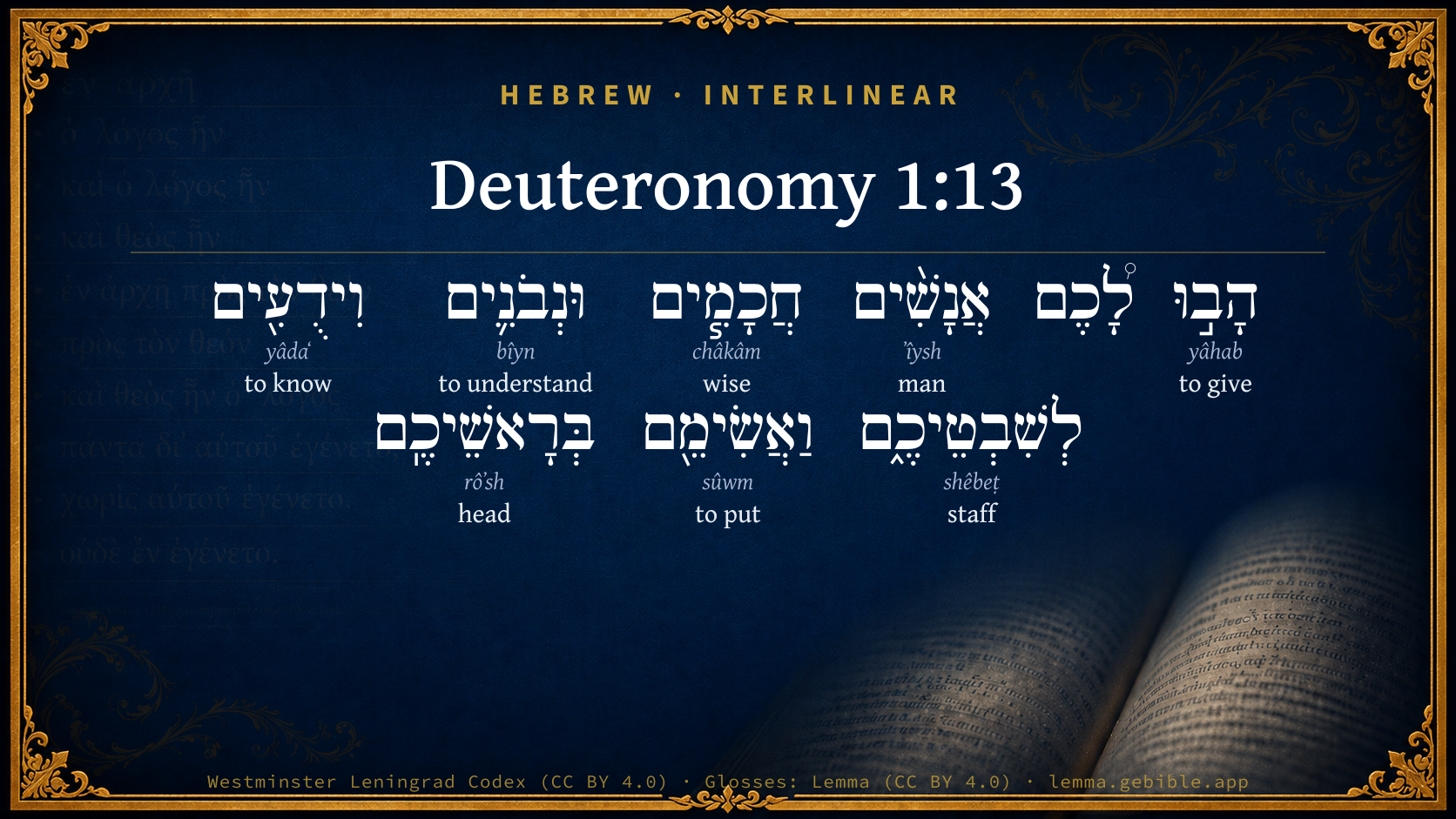
Hebrew (Westminster Leningrad Codex) Deuteronomy 1:13 appears in the Hebrew Old Testament. The text above is from the Westminster Leningrad Codex. Each word links to its Strong’s number, a concise gloss, and parsing drawn from the Open Scriptures Hebrew Bible morphology. Click any word for its full Brown-Driver-Briggs (BDB) entry.
Download image
Cite this verse

Deuteronomy 1:13 (World English Bible). Public Domain. Lemma interlinear Bible study tool, https://lemma.gebible.app/v/deuteronomy/1/13.

Show BibTeX & RIS
BibTeX
RIS
English Translation
Take wise men of understanding and well known according to your tribes, and I will make them heads over you.
World English Bible · Public Domain
Download a study sheet

One document with this verse’s original text, its word-by-word gloss line, the meaning frame, cross-references with their text, attributed commentary, and full source and license credits — printable, and it pastes into notes with its structure intact.

This verse Autodidact and up

Study sheet (.html) Plain text (.txt)

A passage Seminary Student

Up to 50 verses in one chapter. A passage sheet keeps up to 6 commentary sources and 12 cross-references per verse, in the order this page ranks them, and says so on the sheet whenever that leaves anything out. Ask for a single verse and you get the Autodidact verse sheet above.

Everything on this page stays free to read, with no account — the sheet is a download of what is already on screen, not access to it.

Want to remove ads? Support Godless Engineer
Compare translations 3

The same verse in 3 English versions, stacked beneath the original-language interlinear above. Click any original word for its lexicon entry.

Each is an independent rendering of the whole verse — the interlinear is not word-aligned to these translations.

Highlighted words mark where these versions differ — a whole-verse word diff, not a word-by-word alignment.

  • World English Bible Public Domain
    Take wise men of understanding and well known according to your tribes, and I will make them heads over you.
  • King James Version Public Domain
    Take you wise men, and understanding, and known among your tribes, and I will make them rulers over you.
  • unfoldingWord Literal Text CC BY-SA 4.0
    Nominate for yourselves wise and understanding and well-known men from your tribes, and I will appoint them as your heads.’

unfoldingWord Literal Text — © unfoldingWord, licensed CC BY-SA 4.0. Word-aligned USFM3 via Door43 (git.door43.org/unfoldingWord/en_ult).

Versions to compare (up to 4)

3 of 4 selected

Show all 18 translations

Every available English version of this verse, each an independent rendering of the whole verse.

  • World English Bible Public Domain
    Take wise men of understanding and well known according to your tribes, and I will make them heads over you.
  • Berean Standard Bible Public Domain
    Choose for yourselves wise, understanding, and respected men from each of your tribes, and I will appoint them as your leaders.”
  • Majority Standard Bible Public Domain
    Choose for yourselves wise, understanding, and respected men from each of your tribes, and I will appoint them as your leaders.”
  • King James Version Public Domain
    Take you wise men, and understanding, and known among your tribes, and I will make them rulers over you.
  • American Standard Version (1901) Public Domain
    Take you wise men, and understanding, and known, according to your tribes, and I will make them heads over you.
  • Revised Version (1885) Public Domain
    Take you wise men, and understanding, and known, according to your tribes, and I will make them heads over you.
  • Geneva Bible (1599) Public Domain
    Bring you men of wisedome and of vnderstanding, and knowen among your tribes, and I will make them rulers ouer you:
  • Douay-Rheims (1899) Public Domain
    (The Lord God of your fathers add to this number many thousands, and bless you as he hath spoken.)
  • Young's Literal Translation Public Domain
    Give for yourselves men, wise and intelligent, and known to your tribes, and I set them for your heads;
  • Literal Standard Version CC BY-SA 4.0
    Provide wise and understanding men for yourselves that are known to your tribes, and I set them for your heads;
  • Unlocked Literal Bible CC BY-SA 4.0
    Take wise men, understanding men, and men of good repute from each tribe, and I will make them heads over you.'
  • unfoldingWord Literal Text CC BY-SA 4.0
    Nominate for yourselves wise and understanding and well-known men from your tribes, and I will appoint them as your heads.’
  • Darby Bible Public Domain
    Provide you wise and understanding and known men, according to your tribes, that I may make them your chiefs.
  • World Messianic Bible Public Domain
    Take wise men of understanding who are respected among your tribes, and I will make them heads over you.”
  • Webster's Bible Public Domain
    Take ye wise men, and understanding, and known among your tribes, and I will make them rulers over you.
  • Free Bible Version CC BY-SA 4.0
    You must choose for yourselves wise, experienced men with good judgment from each of your tribes, and I will put them in charge as your leaders.”
  • Bible in Basic English Public Domain
    Take for yourselves men who are wise, far-seeing, and respected among you, from your tribes, and I will make them rulers over you.
  • JPS Tanakh (1917) Public Domain
    Get you, from each one of your tribes, wise men, and understanding, and full of knowledge, and I will make them heads over you.'

Literal Standard Version (2020), Covenant Press — licensed CC BY-SA 4.0. Text via the HelloAO Bible API (eBible.org). Unlocked Literal Bible (unfoldingWord) — licensed CC BY-SA 4.0. Text via the HelloAO Bible API (eBible.org). unfoldingWord Literal Text — © unfoldingWord, licensed CC BY-SA 4.0. Word-aligned USFM3 via Door43 (git.door43.org/unfoldingWord/en_ult). Free Bible Version, Dr. Jonathan Gallagher — licensed CC BY-SA 4.0. Text via the HelloAO Bible API (eBible.org).

Word by word

More ways to search: Search by grammar → Find every occurrence → Compare this word →

Practice this passage: Drill this verse → Learn its vocabulary →

הָב֣וּ
yâhab
H3051
“give”
Verb, Qal, Imperative, 2nd Person, Masculine, Plural
Part of Speech
Verb
Stem
Qal
Form
Imperative
Person
2nd Person
Gender
Masculine
Number
Plural
Full BDB Definition

Origin: a primitive root

TWOT: 849

to give, provide, ascribe, come - (Qal) - to give - to set, place - to provide (with reflexive) - to ascribe (glory) - to grant, permit, come now
  1. אֲנָשִׁ֨ים ʼîysh H376 “men” Noun, Common, Masculine, Plural, Absolute
  2. חֲכָמִ֧ים châkâm H2450 “wise” Adjective, Adjective, Masculine, Plural, Absolute
  3. וּנְבֹנִ֛ים bîyn H995 “and · understanding” Conjunction + Verb, Niphal, Participle Active, Masculine, Plural, Absolute
  4. וִידֻעִ֖ים yâdaʻ H3045 “and · known” Conjunction + Verb, Qal, Participle Passive, Masculine, Plural, Absolute
  5. לְשִׁבְטֵיכֶ֑ם shêbeṭ H7626 “to/for · staffs · your” Preposition + Noun, Common, Masculine, Plural, Construct + Suffix, Personal, 2nd Person, Masculine, Plural
  6. וַאֲשִׂימֵ֖ם sûwm H7760 “and · to put · them” Conjunction + Verb, Qal, Imperfect, 1st Person, Common, Singular + Suffix, Personal, 3rd Person, Masculine, Plural
  7. בְּרָאשֵׁיכֶֽם rôʼsh H7218 “in/at · heads · your” Preposition + Noun, Common, Masculine, Plural, Construct + Suffix, Personal, 2nd Person, Masculine, Plural

About this verse

These counts appear in no published source. They are computed here, from the morphology-tagged text and Lemma’s own curated glosses. What Lemma adds →

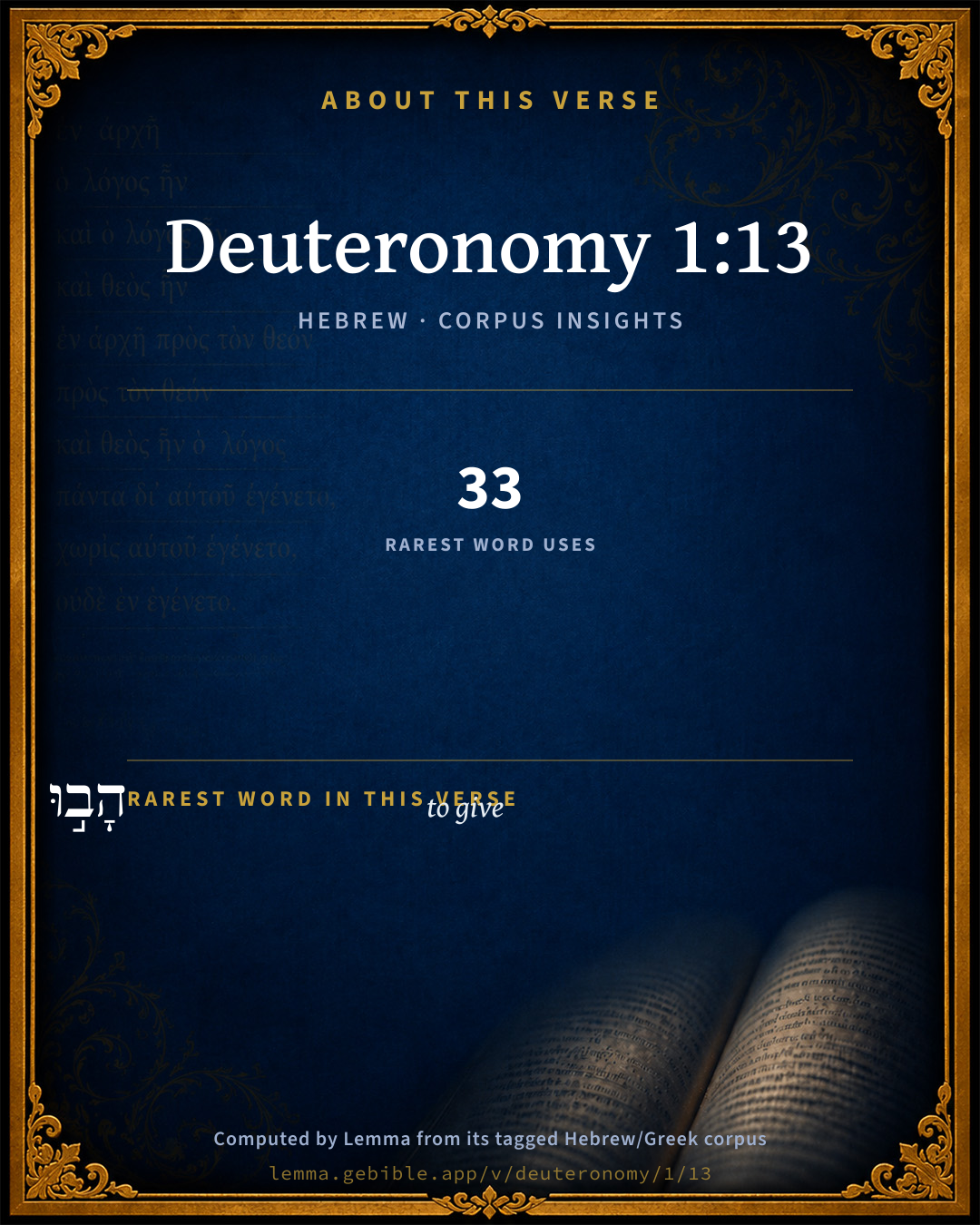
9
words
8
distinct lemmas
Pentateuch
section

Shared distinctive vocabulary

הָב֣וּ to give H3051 occurs in 29 verses of the Hebrew Bible. Also found in:

Grammatical profile

  • 4 verbs
  • 3 nouns
  • 1 adjective
  • 1 preposition

Verb forms

  • הָב֣וּ Qal · Imperative
  • וּנְבֹנִ֛ים Niphal · Participle Active
  • וִידֻעִ֖ים Qal · Participle Passive
  • וַאֲשִׂימֵ֖ם Qal · Imperfect

Hebrew & Septuagint length

In English translation the verse runs 20 words from the Hebrew and 20 from the Septuagint (LXX English) — the same length.

A rough comparison of the two English renderings, which tokenize alike — not a word-level alignment.

Word counts can differ between the Hebrew and the Greek without any difference in meaning — e.g. the Hebrew direct-object marker אֵת has no separate Greek word, and Greek often adds the article ὁ.

Cross-references

4

Topical passages linked to Deuteronomy 1:13 in the Treasury of Scripture Knowledge — connected by theme and wording, ordered by reader-vote popularity; previews shown in the World English Bible.

  • Exodus 18:21 Moreover you shall provide out of all the people able men, such as fear God: men of truth, hating unjust gain; and place such over them, to be rulers of thousands, rulers of hundreds, rulers of fifties, and rulers of tens.
  • Numbers 11:16–17 Yahweh said to Moses, Gather to me seventy men of the elders of Israel, whom you know to be the elders of the people, and officers over them; and bring them to the tent of meeting, that they may stand there with you.
  • Acts 1:21–23 Of the men therefore who have accompanied us all the time that the Lord Jesus went in and out among us,
  • Acts 6:2–6 The twelve summoned the multitude of the disciples and said, "It is not appropriate for us to forsake the word of God and serve tables.

Cross-references courtesy of OpenBible.info (CC BY 4.0).

Hebrew and Greek witnesses Masoretic Hebrew ↔ Greek Septuagint

The same verse in the two great witnesses to the Old Testament, shown verse-for-verse.

These are two independent witnesses, not word-aligned to each other, and the Septuagint is shown in lemma (dictionary) form.

Hebrew Deuteronomy 1:13 Masoretic · Westminster Leningrad Codex

הָב֣וּ לָ֠כֶם אֲנָשִׁ֨ים חֲכָמִ֧ים וּנְבֹנִ֛ים וִידֻעִ֖ים לְשִׁבְטֵיכֶ֑ם וַאֲשִׂימֵ֖ם בְּרָאשֵׁיכֶֽם

Take wise men of understanding and well known according to your tribes, and I will make them heads over you.

World English Bible · Public Domain

Greek LXX Deuteronomy 1:13 Septuagint · lemma form

δίδωμι ἑαυτοῦ ἀνήρ σοφός καί ἐπιστήμων καί συνετός εἰς ὁ φυλή σύ καί καταἵστημι ἐπί σύ ἡγέομαι σύ

Take to yourselves wise and understanding and prudent men for your tribes, and I will set your leaders over you.

LXX2012 (modern English Septuagint) · Public Domain

On this verse, The Cambridge Bible for Schools and Colleges discusses the Septuagint’s reading. Read the note in Commentary ↓

Hebrew: Westminster Leningrad Codex (CC BY 4.0). Greek: Septuagint (public domain); English from LXX2012 (modern English Septuagint) (Public Domain). How the Septuagint differs from the Hebrew →

Targum (Aramaic paraphrase)

2

The Targum is the ancient Jewish Aramaic paraphrase of the Hebrew Scriptures — an interpretive translation, not the Hebrew text itself. Onkelos (literal) and Pseudo-Jonathan (expansive) render the Torah, and Jonathan the Prophets. Coverage is partial: where no permissively-licensed English translation exists for a verse, only the Aramaic is shown. This is verse-level text, not a word-by-word alignment to the Hebrew.

  1. Targum Onkelos Torah (Genesis–Deuteronomy)
    הָבוּ לְכוֹן גֻבְרִין חַכִּימִין וְסוּכְלְתָנוּן וּמַדְעָן לְשִׁבְטֵיכוֹן וֶאֱמַנִנוּן רֵישִׁין עֲלֵיכוֹן

    (no public-domain English translation for this verse)

    Targum Onkelos — Aramaic: “Onkelos Genesis” (public domain); “Onkelos Exodus” (public domain); “Onkelos Leviticus” (public domain); “Onkelos Numbers” (public domain); “Onkelos Deuteronomy” (public domain). English: “Sefaria Community Translation” (CC0 1.0 (public-domain dedication)); “J.W. Etheridge. The Targums of Onkelos and Jonathan Ben Uzziel on the Pentateuch. London: Longmans, Green, 1862” (public domain). Text via Sefaria.

  2. Targum Pseudo-Jonathan Torah (Genesis–Deuteronomy)
    זַמְנוּ לְכוֹן גּוּבְרִין חַכִּימִין וְסוּכְלְתָנוּן מֵרַעֲיוֹנֵיהוֹן וּמָארֵי מַנְדְּעָא לְשִׁבְטֵיכוֹן וְאֵימַנִינוּן רֵישִׁין עֲלֵיכוֹן

    Present, then, from among you wise men, prudent in their thinking, men of wisdom, by your tribes, and I will appoint them to be chiefs over you.

    Targum Pseudo-Jonathan — Aramaic: “Targum Jonathan on Genesis” (public domain); “Targum Jonathan on Exodus” (public domain); “Targum Jonathan on Leviticus” (public domain); “Targum Jonathan on Numbers” (public domain); “Targum Jonathan on Deuteronomy” (public domain). English: “The Targum of Jonathan ben Uzziel, trans. J. W. Etheridge, London, 1862” (public domain). Text via Sefaria.

Commentary

Notes on Deuteronomy 1:13 from classic Christian and Jewish commentators (each source and its license shown beneath its notes). The classic Christian expositions comment on the surrounding passage and are grouped to its opening verse, so a note may address several verses; the Jewish commentaries on the Tanakh (Rashi and others) are per-verse, so they appear only where the commentator wrote on this verse.

Lemma curates 59 commentaries, every one of them public domain or Creative Commons licensed, each selected and text-cleaned for this edition rather than reprinted as found. About our sources →

Tyndale Open Study Notes

Tyndale Open Resources

1:13 Those who were well-respected had lives and reputations that were above reproach, even on close scrutiny.

Tyndale Open Study Notes — © Tyndale Open Resources, licensed CC BY-SA 4.0. Text via the HelloAO Bible API.

Geneva Bible (1599)

Geneva Bible translators

Whose godliness and uprightness is known.

Geneva Bible (1599) marginal notes — public domain. Text via Bolls.life.

Adam Clarke's Commentary

Verse 13. Take you wise men] חכמים chachamim, such as had gained knowledge by great labour and study. Understanding נבנים nebonim, persons of discernment, judicious men. Known, ידעים yeduim, persons practised in the operations of nature, capable of performing curious and important works.

Adam Clarke's Commentary on the Bible (1810–1826) — public domain. Text from a community e-Sword/MySword module.

The Cambridge Bible for Schools and Colleges

gen. ed. J. J. S. Perowne

13. Take you] Heb. Give yourselves: Jos_18:4. The people themselves are to elect as in Deu_16:18, consistently with the emphasis, so frequent in D, on the judicial responsibilities of the whole people. In E, Exo_18:25 (cp. Num_11:16), Moses chooses.

wise men, and understanding, and known] With the LXX some take the last term as synonymous with the others; either reading as in the Heb. the pass. part. experienced, or the act. Part. knowing. The pass. part. is perhaps the better, but as meaning known: men reputed for their judicial gifts, as among the Arabs to-day. While here the emphasis is laid on intellectual gifts, which, however, in D always include the moral; E, Exo_18:21, more definitely expresses the latter: men of power (Dri. capable, worthy), fearing God, men of troth, hating unjust gain.

according to your tribes] E, Exo_18:21; Exo_18:25 : out of, all the people, all Israel. E and D use shebet for tribe, but P’s usual term is maṭṭah.

make them heads over you] Rather, set them as your chiefs.

The Cambridge Bible for Schools and Colleges (gen. ed. J. J. S. Perowne; Cambridge University Press, 1878–1918) — public domain. Text from a community e-Sword module.

Matthew Poole's English Annotations

Persons of knowledge, wisdom, and experience, men famous, and had in reputation, for ability and integrity; for to such they would more readily submit.

Matthew Poole's English Annotations on the Holy Bible (1683–1685) — public domain. Text from a community e-Sword/MySword module.

The Pulpit Commentary

Take you; literally, give to you or for you, i.e. yourselves. The selection was to be made by the people themselves. Jethro, in giving Moses the advice on which he thus acted, described the men who were to be selected as "such as fear God, men of truth, hating covetousness". (Exo_18:21) Moses here describes them rather by qualities, indicating ability and fitness for such a post as that to which they were to be called; they were to be wise (which, indeed, may be regarded as comprehending all good moral qualities); understanding men, men of discernment and sagacity, as well as intelligence; and known among their tribes, men of good repute in the community. ("quorum conversatio sit probata," Vulgate; comp. Act_6:3; 1Ti_3:7) And I will make them rulers over you; literally, will set them for your heads, i.e. will appoint them to act as superintendents, managers, and judges over you.

The Pulpit Commentary (1880–1919), ed. H.D.M. Spence-Jones & Joseph S. Exell — public domain. Text from a community e-Sword module.

Rashi

Rabbi Shlomo Yitzchaki (Rashi)

הבו לכם means GET YOURSELVES READY for the matter (cf. Rashi on Genesis 11:3).

אנשים MEN — But would it enter your mind that he would take women? Why then does it state here men? It means that he should take righteous, desirable men (cf. Sifrei Devarim 13:2).

חכמים ונבנים WISE AND UNDERSTANDING [MEN] — i.e. men who can understand a matter out of (i.e. by comparison with) another matter. — This is what Arius asked R. Jose: what is the difference between wise men and understanding men? A wise man is like a rich money changer: when people bring him dinars to examine (to value) he examines them; and when they do not bring to him, he sits and does nothing (he does not go out to seek any). An understanding man, however, is like a merchant money changer: when they bring him coins to examine, he examines them; and when they do not bring to him, he goes about and brings of his own money (i.e. he himself buys coins) (cf. Sifrei Devarim 13:3).

וידעים לשבטיכם AND [MEN] KNOWN AMONGST YOUR TRIBES — i.e. men who are known to you. For if he were to come before me wrapped in his robe, “I" would not know who he is and of what tribe he is, and whether he is fitted for the office: but you know him for you have been brought up with him. On this account it states: known amongst your tribes (Sifrei Devarim 13:4).

בראשיכם [AND I WILL PLACE THEM] AT YOUR HEADS — as chiefs and persons honoured by you., i.e., that ye should pay them respect and reverence.

ואשמם — This word lacks the letter י (after the ש: our editions, however, have it): this teaches that Israel's transgressions (אשם) are placed upon the heads of their judges, because it is their duty to prevent them from sinning, and to direct them into the right path (Sifrei Devarim 13:6).

Rashi on the Tanakh — English translations: “The Judaica Press complete Tanach with Rashi, translated by A. J. Rosenberg” (CC BY 4.0); “Pentateuch with Rashi's commentary by M. Rosenbaum and A.M. Silbermann, 1929-1934” (public domain); “The Metsudah Tanach series, Lakewood, N.J” (CC BY 4.0); and “The Book of Joshua, Metsudah Publications, 1997” (CC BY 4.0). Text via Sefaria.

Ramban (Nachmanides)

Rabbi Moshe ben Nachman (Ramban / Nachmanides)

VIDU’IM L’SHIVTEICHEM’ (AND KNOWN AMONG YOUR TRIBES) — “men who are known to you. For if he were to come before me [Moses] wrapped in his robe, I would not know who he is and of what tribe he is, but you know him for you have raised him.” This is Rashi’s language quoting the Sifre. 13. And if so, ‘l’shivteichem’ (among your tribes) is connected with the word ‘vidu’im’ (and known). (and known) ‘l’shivteichem’ [literally: “‘to’ or ‘from’ each of your tribes”]. Now Rashi, on the basis of the Sifre, connects the last two words — “known to your tribes.” Ramban will explain l’shivteichem as referring to the first part of the verse: “Get you … from each of your tribes” and the word vidu’im he will explain as meaning and known to be judges and being qualified. But in line with the plain meaning of Scripture the purport of the verse is as follows: “Get you, from each of your tribes wise men.” 13. And the meaning of the word vidu’im in my opinion is that “they are known as judges,” that is to say, their capability is known and recognized as qualifying them to be appointed judges. Now [Moses] epitomized the qualities of the judges in the word vidu’im, because the judges need to be able men, such as fear G-d; men of truth, hating unjust gain, as Jethro said. And these men [that were appointed] were known from the beginning to be judges, for everyone was saying, “This one is fit to be a judge.”

Ramban (Nachmanides) on the Tanakh — English translation: “Commentary on the Torah by Ramban (Nachmanides). Translated and annotated by Charles B. Chavel. New York, Shilo Pub. House, 1971-1976” (CC BY 4.0). Text via Sefaria.

Lesson kit

Teaching starters — assembled from the data on this page, not authored interpretation. Every prompt links to the verse data it draws on. Edit before teaching.

Deuteronomy, in the Pentateuch, opens this verse with 9 words (8 distinct Hebrew lemmas). Its most distinctive word is yâhab (“to give”). A historical commentator’s framing appears above. Read the whole chapter for the surrounding context.

Discussion questions

  1. What does “to give” (yâhab) contribute to the verse as a whole?
  2. Genesis 11:3 shares the word «to give» with this verse. How do the two illuminate each other?
  3. These translations render this verse differently; the difference is in the English rendering, not the original. What questions does that raise?
  4. The verb «הָב֣וּ» is Qal Imperative. How does its form color the action?
  5. Reading how Tyndale Open Study Notes and Geneva Bible (1599) read this verse, where do the two commentators agree and where do they part?

Things to notice

Reading settings

Reading text

Shown beneath each verse's original-language words.

Old Testament
Old Testament edition

Read the OT as the Masoretic Hebrew (MT) or the Greek Septuagint (LXX).

English shown for the Greek Septuagint (in the Hebrew ↔ Greek comparison).

Comparing translations? Open the Compare panel on any verse page to stack up to four side by side.