
Genesis 41:12

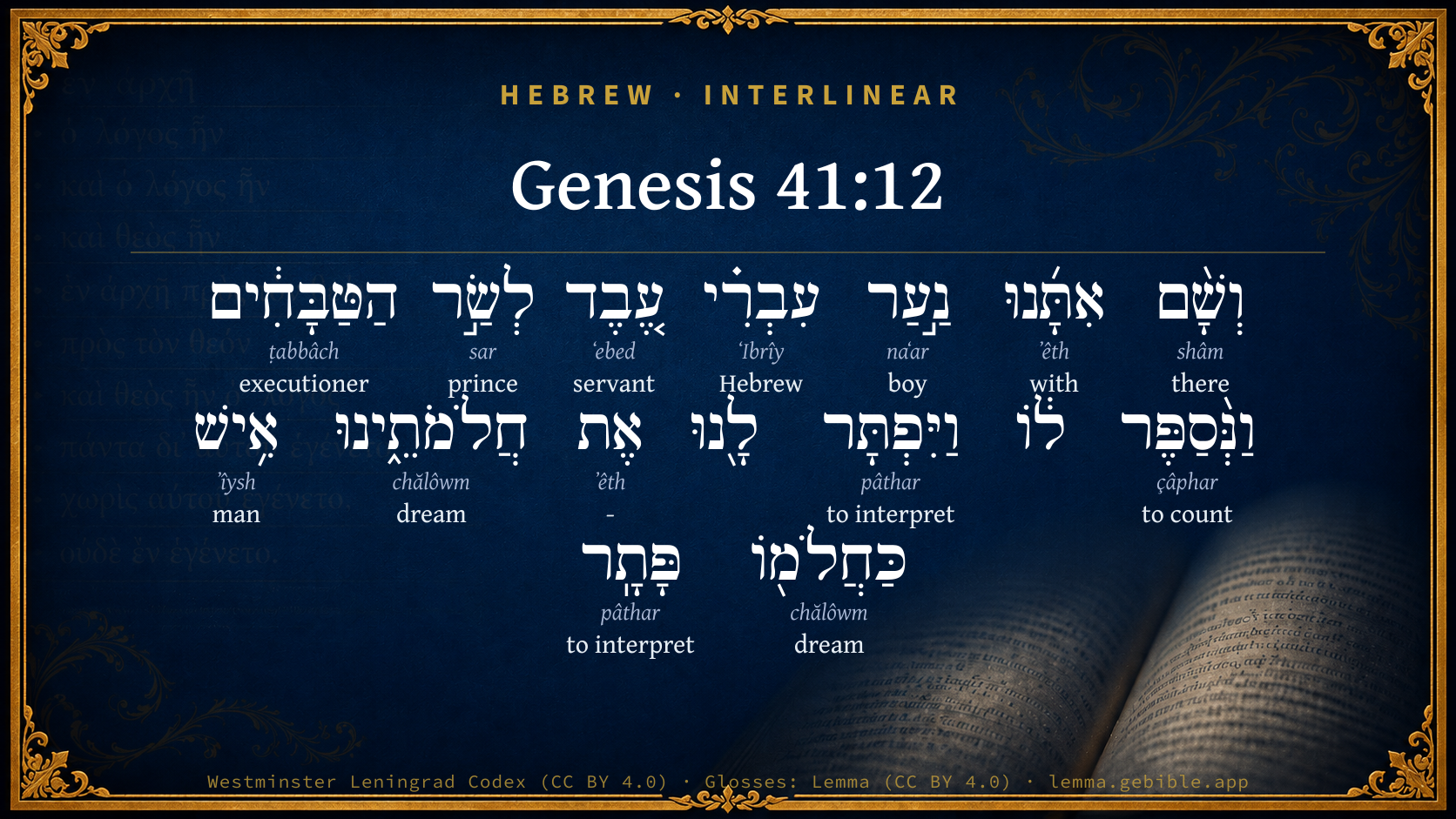
Hebrew (Westminster Leningrad Codex) Genesis 41:12 appears in the Hebrew Old Testament. The text above is from the Westminster Leningrad Codex. Each word links to its Strong’s number, a concise gloss, and parsing drawn from the Open Scriptures Hebrew Bible morphology. Click any word for its full Brown-Driver-Briggs (BDB) entry.
Download image
Cite this verse

Genesis 41:12 (World English Bible). Public Domain. Lemma interlinear Bible study tool, https://lemma.gebible.app/v/genesis/41/12.

Show BibTeX & RIS
BibTeX
RIS
English Translation
There was with us there a young man, a Hebrew, servant to the captain of the guard, and we told him, and he interpreted to us our dreams. To each man according to his dream he interpreted.
World English Bible · Public Domain
Download a study sheet

One document with this verse’s original text, its word-by-word gloss line, the meaning frame, cross-references with their text, attributed commentary, and full source and license credits — printable, and it pastes into notes with its structure intact.

This verse Autodidact and up

Study sheet (.html) Plain text (.txt)

A passage Seminary Student

Up to 50 verses in one chapter. A passage sheet keeps up to 6 commentary sources and 12 cross-references per verse, in the order this page ranks them, and says so on the sheet whenever that leaves anything out. Ask for a single verse and you get the Autodidact verse sheet above.

Everything on this page stays free to read, with no account — the sheet is a download of what is already on screen, not access to it.

Want to remove ads? Support Godless Engineer
Compare translations 3

The same verse in 3 English versions, stacked beneath the original-language interlinear above. Click any original word for its lexicon entry.

Each is an independent rendering of the whole verse — the interlinear is not word-aligned to these translations.

Highlighted words mark where these versions differ — a whole-verse word diff, not a word-by-word alignment.

  • World English Bible Public Domain
    There was with us there a young man, a Hebrew, servant to the captain of the guard, and we told him, and he interpreted to us our dreams. To each man according to his dream he interpreted.
  • King James Version Public Domain
    And there was there with us a young man, an Hebrew, servant to the captain of the guard; and we told him, and he interpreted to us our dreams; to each man according to his dream he did interpret.
  • unfoldingWord Literal Text CC BY-SA 4.0
    Now there with us a young Hebrew man, a servant for the chief of the guards. And we told to him, and he interpreted our dreams for us. He interpreted each according to his dream.

unfoldingWord Literal Text — © unfoldingWord, licensed CC BY-SA 4.0. Word-aligned USFM3 via Door43 (git.door43.org/unfoldingWord/en_ult).

Versions to compare (up to 4)

3 of 4 selected

Show all 18 translations

Every available English version of this verse, each an independent rendering of the whole verse.

  • World English Bible Public Domain
    There was with us there a young man, a Hebrew, servant to the captain of the guard, and we told him, and he interpreted to us our dreams. To each man according to his dream he interpreted.
  • Berean Standard Bible Public Domain
    Now a young Hebrew was there with us, a servant of the captain of the guard. We told him our dreams and he interpreted them for us individually.
  • Majority Standard Bible Public Domain
    Now a young Hebrew was there with us, a servant of the captain of the guard. We told him our dreams and he interpreted them for us individually.
  • King James Version Public Domain
    And there was there with us a young man, an Hebrew, servant to the captain of the guard; and we told him, and he interpreted to us our dreams; to each man according to his dream he did interpret.
  • American Standard Version (1901) Public Domain
    And there was with us there a young man, a Hebrew, servant to the captain of the guard; and we told him, and he interpreted to us our dreams; to each man according to his dream he did interpret.
  • Revised Version (1885) Public Domain
    And there was with us there a young man, an Hebrew, servant to the captain of the guard; and we told him, and he interpreted to us our dreams; to each man according to his dream he did interpret.
  • Geneva Bible (1599) Public Domain
    And there was with vs a yong man, an Ebrew, seruant vnto the chiefe steward, whome when we told, he declared our dreames to vs, to euery one he declared according to his dreame.
  • Douay-Rheims (1899) Public Domain
    The king being angry with his servants, commanded me and the chief baker to be cast into the prison of the captain of the soldiers:
  • Young's Literal Translation Public Domain
    And there `is' with us a youth, a Hebrew, servant to the chief of the executioners, and we recount to him, and he interpreteth to us our dreams, `to' each according to his dream hath he interpreted,
  • Literal Standard Version CC BY-SA 4.0
    And there [is] with us a youth, a Hebrew, servant to the chief of the executioners, and we recount to him, and he interprets to us our dreams, [to] each according to his dream has he interpreted,
  • Unlocked Literal Bible CC BY-SA 4.0
    There was with us there a young Hebrew man, a servant of the captain of the guard. We told him and he interpreted for us our dreams. He interpreted for each of us according to his dream.
  • unfoldingWord Literal Text CC BY-SA 4.0
    Now there with us a young Hebrew man, a servant for the chief of the guards. And we told to him, and he interpreted our dreams for us. He interpreted each according to his dream.
  • Darby Bible Public Domain
    And there was there with us a Hebrew youth, a bondman of the captain of the life-guard, to whom we told [them], and he interpreted to us our dreams; to each he interpreted according to his dream.
  • World Messianic Bible Public Domain
    There was with us there a young man, a Hebrew, servant to the captain of the guard, and we told him, and he interpreted to us our dreams. He interpreted to each man according to his dream.
  • Webster's Bible Public Domain
    And there was there with us a young man, a Hebrew, servant to the captain of the guard; and we told him, and he interpreted to us our dreams; to each man according to his dream he interpreted.
  • Free Bible Version CC BY-SA 4.0
    A young Hebrew was there with us, a slave of the commander of the guard. When we told him our dreams, he interpreted for us the meaning of our different dreams.
  • Bible in Basic English Public Domain
    And there was with us a young Hebrew, the captain's servant, and when we put our dreams before him, he gave us the sense of them.
  • JPS Tanakh (1917) Public Domain
    And there was with us there a young man, a Hebrew, servant to the captain of the guard; and we told him, and he interpreted to us our dreams; to each man according to his dream he did interpret.

Literal Standard Version (2020), Covenant Press — licensed CC BY-SA 4.0. Text via the HelloAO Bible API (eBible.org). Unlocked Literal Bible (unfoldingWord) — licensed CC BY-SA 4.0. Text via the HelloAO Bible API (eBible.org). unfoldingWord Literal Text — © unfoldingWord, licensed CC BY-SA 4.0. Word-aligned USFM3 via Door43 (git.door43.org/unfoldingWord/en_ult). Free Bible Version, Dr. Jonathan Gallagher — licensed CC BY-SA 4.0. Text via the HelloAO Bible API (eBible.org).

Word by word

More ways to search: Search by grammar → Find every occurrence → Compare this word →

Practice this passage: Drill this verse → Learn its vocabulary →

וַיִּפְתָּר
pâthar
H6622
“and · to interpret”
Conjunction + Verb, Qal, Sequential Imperfect, 3rd Person, Masculine, Singular
Part of Speech
Conjunction + Verb
Stem
Qal
Form
Sequential Imperfect
Person
3rd Person
Gender
Masculine
Number
Singular
Full BDB Definition

Origin: a primitive root

TWOT: 1860

(Qal) to interpret (dreams)
  1. וְשָׁ֨ם shâm H8033 “and · there” Conjunction + Adverb
  2. אִתָּ֜נוּ ʼêth H854 “with · us” Preposition + Suffix, Personal, 1st Person, Common, Plural
  3. נַ֣עַר naʻar H5288 “boy” Noun, Common, Masculine, Singular, Absolute
  4. עִבְרִ֗י ʻIbrîy H5680 “Hebrew” Noun, Gentilic, Masculine, Singular, Absolute
  5. עֶ֚בֶד ʻebed H5650 “servant” Noun, Common, Masculine, Singular, Absolute
  6. לְשַׂ֣ר sar H8269 “to/for · prince of” Preposition + Noun, Common, Masculine, Singular, Construct
  7. הַטַּבָּחִ֔ים ṭabbâch H2876 “the · executioners” Particle, Definite Article + Noun, Common, Masculine, Plural, Absolute
  8. וַנְּ֨סַפֶּר çâphar H5608 “and · to count” Conjunction + Verb, Piel, Sequential Imperfect, 1st Person, Common, Plural
  9. אֶת ʼêth H853 “-” Particle, Direct Object
  10. חֲלֹמֹתֵ֑ינוּ chălôwm H2472 “dreams · our” Noun, Common, Masculine, Plural, Construct + Suffix, Personal, 1st Person, Common, Plural
  11. אִ֥ישׁ ʼîysh H376 “man” Noun, Common, Masculine, Singular, Absolute
  12. כַּחֲלֹמ֖וֹ chălôwm H2472 “like/as · dream · his” Preposition + Noun, Common, Masculine, Singular, Construct + Suffix, Personal, 3rd Person, Masculine, Singular
  13. פָּתָֽר pâthar H6622 “to interpret” Verb, Qal, Perfect, 3rd Person, Masculine, Singular

About this verse

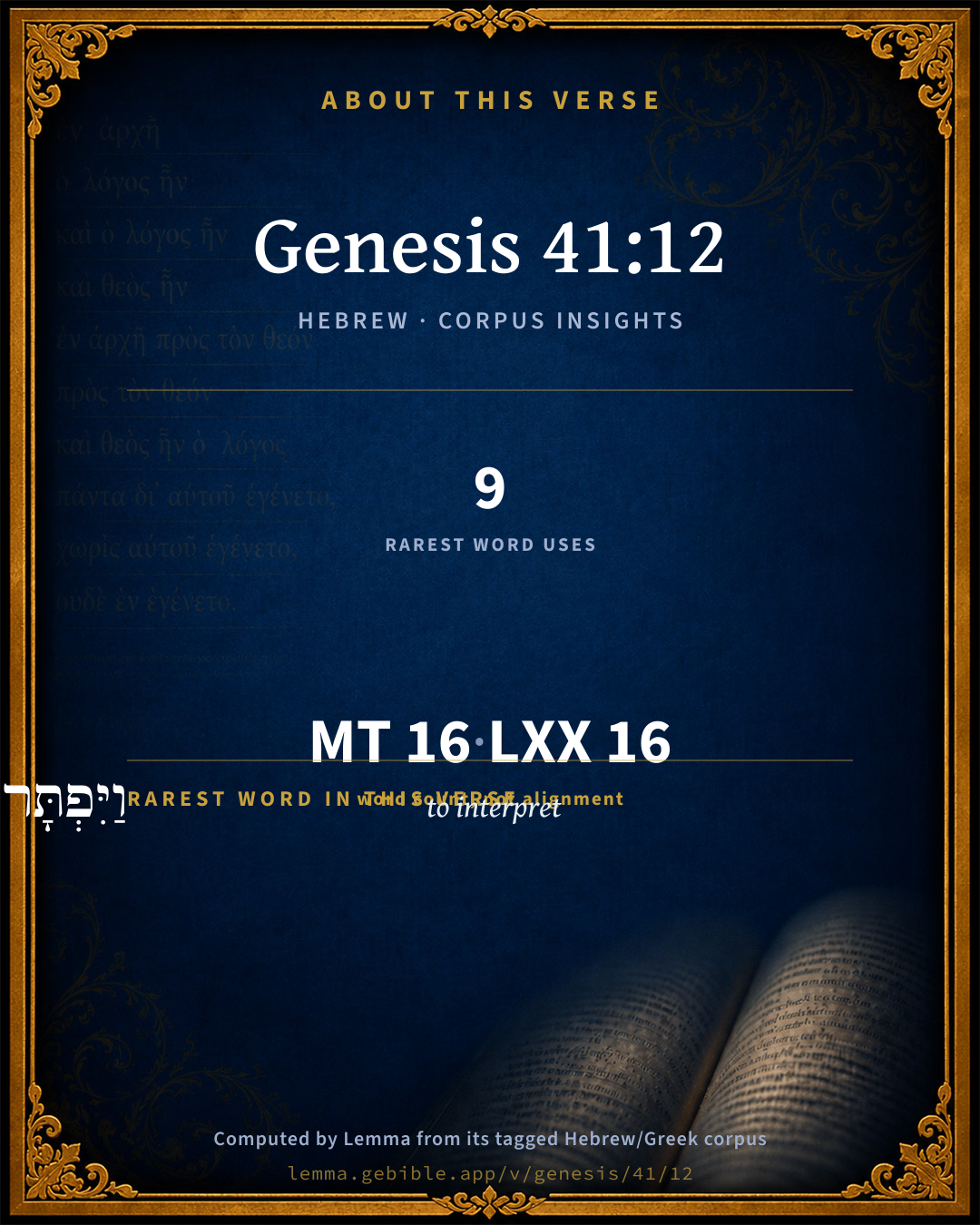
These counts appear in no published source. They are computed here, from the morphology-tagged text and Lemma’s own curated glosses. What Lemma adds →

16
words
12
distinct lemmas
Pentateuch
section

Notable vocabulary

The rarest word here is וַיִּפְתָּר to interpret H6622 — appearing just 9 times in the whole Hebrew Bible.

Shared distinctive vocabulary

וַיִּפְתָּר to interpret H6622 occurs in 7 verses of the Hebrew Bible. Also found in:

Grammatical profile

  • 3 verbs
  • 8 nouns
  • 3 prepositions
  • 1 adverb
  • 1 particle

Verb forms

  • וַנְּ֨סַפֶּר Piel · Sequential Imperfect
  • וַיִּפְתָּר Qal · Sequential Imperfect
  • פָּתָֽר Qal · Perfect

Repetition

Words recur within this verse — often emphatic in Hebrew:

  • וַיִּפְתָּר to interpret H6622 ×2
  • חֲלֹמֹתֵ֑ינוּ dream H2472 ×2

Hebrew & Septuagint length

In English translation the verse runs 37 words from the Hebrew and 31 from the Septuagint (LXX English) — closely comparable.

A rough comparison of the two English renderings, which tokenize alike — not a word-level alignment.

Word counts can differ between the Hebrew and the Greek without any difference in meaning — e.g. the Hebrew direct-object marker אֵת has no separate Greek word, and Greek often adds the article ὁ.

In the original languages it is 16 Hebrew tokens and 16 Greek tokens — but the two are counted differently (Hebrew bundles its prefixes and suffixes into one token; the Greek is in lemma form), so that isn’t a like-for-like length.

Cross-references

4

Topical passages linked to Genesis 41:12 in the Treasury of Scripture Knowledge — connected by theme and wording, ordered by reader-vote popularity; previews shown in the World English Bible.

  • Genesis 37:36 The Midianites sold him into Egypt to Potiphar, an officer of Pharaoh's, the captain of the guard.
  • Genesis 40:12–19 Joseph said to him, "This is the interpretation of it: the three branches are three days.
  • Genesis 39:1 Joseph was brought down to Egypt. Potiphar, an officer of Pharaoh's, the captain of the guard, an Egyptian, bought him from the hand of the Ishmaelites that had brought him down there.
  • Genesis 39:20 Joseph's master took him, and put him into the prison, the place where the king's prisoners were bound, and he was there in custody.

Cross-references courtesy of OpenBible.info (CC BY 4.0).

Hebrew and Greek witnesses Masoretic Hebrew ↔ Greek Septuagint

The same verse in the two great witnesses to the Old Testament, shown verse-for-verse.

These are two independent witnesses, not word-aligned to each other, and the Septuagint is shown in lemma (dictionary) form.

Hebrew Genesis 41:12 Masoretic · Westminster Leningrad Codex

וְשָׁ֨ם אִתָּ֜נוּ נַ֣עַר עִבְרִ֗י עֶ֚בֶד לְשַׂ֣ר הַטַּבָּחִ֔ים וַנְּ֨סַפֶּר ל֔וֹ וַיִּפְתָּר לָ֖נוּ אֶת חֲלֹמֹתֵ֑ינוּ אִ֥ישׁ כַּחֲלֹמ֖וֹ פָּתָֽר

There was with us there a young man, a Hebrew, servant to the captain of the guard, and we told him, and he interpreted to us our dreams. To each man according to his dream he interpreted.

World English Bible · Public Domain

Greek LXX Genesis 41:12 Septuagint · lemma form

εἰμί δέ ἐκεῖ μετά ἐγώ νεανίσκος παῖς εβραῖος ὁ ἀρχιμάγειρος καί διαἡγέομαι αὐτός καί συνκρίνω ἐγώ

And there was there with us a young man, a Hebrew servant of the captain of the guard; and we related to him our dreams, and he interpreted them to us.

LXX2012 (modern English Septuagint) · Public Domain

Hebrew: Westminster Leningrad Codex (CC BY 4.0). Greek: Septuagint (public domain); English from LXX2012 (modern English Septuagint) (Public Domain). How the Septuagint differs from the Hebrew →

Targum (Aramaic paraphrase)

2

The Targum is the ancient Jewish Aramaic paraphrase of the Hebrew Scriptures — an interpretive translation, not the Hebrew text itself. Onkelos (literal) and Pseudo-Jonathan (expansive) render the Torah, and Jonathan the Prophets. Coverage is partial: where no permissively-licensed English translation exists for a verse, only the Aramaic is shown. This is verse-level text, not a word-by-word alignment to the Hebrew.

  1. Targum Onkelos Torah (Genesis–Deuteronomy)
    וְתַמָּן עִמָּנָא עוּלֵם עִבְרָאָה עַבְדָא לְרַב קָטוֹלַיָּא וְאִשְׁתָּעֵינָא לֵהּ וּפָשַׁר לָנָא יָת חֶלְמָנָא גְּבַר כְּחֶלְמֵהּ פָּשָׁר

    (no public-domain English translation for this verse)

    Targum Onkelos — Aramaic: “Onkelos Genesis” (public domain); “Onkelos Exodus” (public domain); “Onkelos Leviticus” (public domain); “Onkelos Numbers” (public domain); “Onkelos Deuteronomy” (public domain). English: “Sefaria Community Translation” (CC0 1.0 (public-domain dedication)); “J.W. Etheridge. The Targums of Onkelos and Jonathan Ben Uzziel on the Pentateuch. London: Longmans, Green, 1862” (public domain). Text via Sefaria.

  2. Targum Pseudo-Jonathan Torah (Genesis–Deuteronomy)
    וְתַמָן עִמָנָא טַלְיָא עִיבְרָאֵי עַבְדָא לְרַב סַפּוֹקְלַטוֹרְיָא וְאִשְׁתָּעִינָא לֵיהּ וּפָשַׁר לָנָא יַת חֵילְמָנָא גְבַר הֵי כְּפוּשְׁרַן חֵילְמֵיהּ פָּשָׁר

    And there was with us a Hebrew youth, a servant of the chief executioner; and we recounted to him, and he explained the dream to us, to each man be explained the interpretation of his dream.

    Targum Pseudo-Jonathan — Aramaic: “Targum Jonathan on Genesis” (public domain); “Targum Jonathan on Exodus” (public domain); “Targum Jonathan on Leviticus” (public domain); “Targum Jonathan on Numbers” (public domain); “Targum Jonathan on Deuteronomy” (public domain). English: “The Targum of Jonathan ben Uzziel, trans. J. W. Etheridge, London, 1862” (public domain). Text via Sefaria.

Commentary

Notes on Genesis 41:12 from classic Christian and Jewish commentators (each source and its license shown beneath its notes). The classic Christian expositions comment on the surrounding passage and are grouped to its opening verse, so a note may address several verses; the Jewish commentaries on the Tanakh (Rashi and others) are per-verse, so they appear only where the commentator wrote on this verse.

Lemma curates 59 commentaries, every one of them public domain or Creative Commons licensed, each selected and text-cleaned for this edition rather than reprinted as found. About our sources →

Trapp's Complete Commentary

John Trapp

Gen 41:12 And [there was] there with us a young man, an Hebrew, servant to the captain of the guard; and we told him, and he interpreted to us our dreams; to each man according to his dream he did interpret.

Ver. 12. And he interpreted to us our dreams.] And well you requited him! But better late than never, {a} though a ready despatch doubleth the benefit. Howbeit God had an overruling hand in it, for Joseph’s greatest good: he turneth the world’s ingratitude to the salvation of his servants.

{a} Praestat sero quam nunquam.

John Trapp, A Commentary or Exposition upon All the Books of the Old and New Testament (1647–1656) — public domain. Text from a community e-Sword module.

Geneva Bible (1599)

Geneva Bible translators

Read Gen. 40:5.

Geneva Bible (1599) marginal notes — public domain. Text via Bolls.life.

The Cambridge Bible for Schools and Colleges

gen. ed. J. J. S. Perowne

12. servant to the captain of the guard] It will be remembered that, in the E story, Joseph is the slave of the captain, and not a fellow-prisoner of the chief butler.

The Cambridge Bible for Schools and Colleges (gen. ed. J. J. S. Perowne; Cambridge University Press, 1878–1918) — public domain. Text from a community e-Sword module.

John Gill's Exposition

And there was there with us a young man,.... Who was in the prison with them, had the care of them, and waited upon them; he was then about twenty eight years of age; for it was two years ago he speaks of, and Joseph was thirty when he stood before Pharaoh, Gen 41:46,

an Hebrew servant to the captain of the guard; he first describes him by his age, a young man, then by his descent, an Hebrew, and by his state and condition, a servant; neither of them tended much to recommend him to the king:

and we told him; that is, their dreams:

and he interpreted to us our dream, to each man according to his dream did he interpret; told them what their dreams presignified, what the events would be they portended; the interpretation was different according to their dreams.

John Gill's Exposition of the Whole Bible (1746–1763) — public domain (CC PDM 1.0). Text via the HelloAO Bible API.

Haydock's Catholic Bible Commentary

Servant. Chap. xxxix. 4. He waited also upon the prisoners of rank, chap. xl. 4. (Haydock)

George Leo Haydock (1774–1849), Haydock's Catholic Family Bible and Commentary, 1859 edition — public domain. Excludes Psalms (Douay-Rheims chapter numbering differs from Protestant) and Deuterocanonical books (Catholic canon only).

unfoldingWord translationNotes

Door43 World Missions Community

General Information:

The chief cupbearer continues to speak to Pharaoh.

There was with us there

"In prison there was with the chief baker and me"

the captain of the guard

The soldier in charge of the royal guards. See how you translated this in Genesis 40:2-3.

We told him and he interpreted for us our dreams

"We told him our dreams and he explained their meanings to us"

He interpreted for each of us according to his dream

Here "his" refers to the cupbearer and baker individually, not to the one interpreting the dream. AT: "He explained what was going to happen to both of us" (See: First, Second, or Third Person)

It came about

This phrase is used here to mark an important event in the story. If your language has a way for doing this, you could consider using it here.

as he interpreted for us, so it happened

"what he explained about the dreams is what later happened"

Pharaoh restored me to my post

Here the cupbearer uses Pharaoh's title in speaking to him as a way of honoring him. AT: "You allowed me to return to my job" (See: First, Second, or Third Person)

the other one

"the chief baker"

he hanged

Here "he" refers to Pharaoh. And, it stands for the soldiers that Pharaoh commanded to hang the chief baker. AT: "you ordered your soldiers to hang" (See: First, Second, or Third Person and Metonymy)

translationWords

Hebrew

servant

dream

Pharaoh

restore

hang

unfoldingWord translationNotes — © Distant Shores Media and the Door43 World Missions Community, licensed CC BY-SA 4.0. Source: git.door43.org/Door43/en_tn.

Rashi

Rabbi Shlomo Yitzchaki (Rashi)

נער עברי עבד A LAD, AN HEBREW, A SLAVE — Cursed be the wicked for the favours they do are never really complete! He mentions him in disparaging language.

נער a lad, unwise and unfitted for a high position.

עברי a Hebrew, who does not even know our language;

עבד a slave — and it is written in the laws of Egypt that a slave may neither become a ruler nor dress in princely robes (Genesis Rabbah 89:7).

איש כחלמו EACH MAN ACCORDING TO HIS DREAM — He interpreted in accordance with the dream and approximating to its contents.

Rashi on the Tanakh — English translations: “The Judaica Press complete Tanach with Rashi, translated by A. J. Rosenberg” (CC BY 4.0); “Pentateuch with Rashi's commentary by M. Rosenbaum and A.M. Silbermann, 1929-1934” (public domain); “The Metsudah Tanach series, Lakewood, N.J” (CC BY 4.0); and “The Book of Joshua, Metsudah Publications, 1997” (CC BY 4.0). Text via Sefaria.

Ramban (Nachmanides)

Rabbi Moshe ben Nachman (Ramban / Nachmanides)

TO EACH MAN ACCORDING TO HIS DREAM. He interpreted it in accordance with the dream and consistent with its contents. Thus the words of Rashi. A more correct interpretation would be for Rashi to say that “he interpreted it in accordance with the truth of the dream as it was destined to befall him, for as he interpreted it, so it befell us.” Similar in thought is the verse, Every man according to his blessing he blessed them, i.e., according to the blessing which was destined to come upon him.But in my opinion there is no need for this. Instead, the verse is stating that “he interpreted his dream for each man, and as he interpreted it to each one, so it came upon us.” The chief of the butlers is thus saying that these were different dreams with different interpretations, as he would explain, so that Pharaoh should not think that the two [the butler and the baker] dreamed one dream having one interpretation. In my opinion, a similar thought is conveyed in the verse, Every man according to his blessing he blessed them, meaning that he did not bless them with one blessing common to all, but with a unique blessing for each one, as he explained to each son and spoke to him.

Ramban (Nachmanides) on the Tanakh — English translation: “Commentary on the Torah by Ramban (Nachmanides). Translated and annotated by Charles B. Chavel. New York, Shilo Pub. House, 1971-1976” (CC BY 4.0). Text via Sefaria.

Radak

Rabbi David Kimhi (Radak)

נער, seeing that he performed personal valet duties for them in the prison he referred to him as a נער, [describing his function. Ed.] He added that Joseph was also עבד לשר הטבחים, he had been informed about Joseph’s immediate past before he was thrown into jail. He gave this information so that anyone enquiring about him would know the name of the person they were trying to locate.

איש כחלומו, the prefix ל is missing here in front of the word איש. The word איש has to be understood as if the cup-bearer had said: לאיש, meaning that each of the two received an interpretation tailored to his particular dream. One dream had been appropriate for a cup-bearer, the other for a baker. One dream dealt with a drink, the other with food, baked goods.

Radak on the Tanakh — English translations: “Sefaria Community Translation” (CC0 1.0 (public-domain dedication)); “Eliyahu Munk, HaChut Hameshulash” (CC BY 4.0); “Rabbi Mike Feuer, Jerusalem Anthology” (CC BY 4.0); and “R. David Kimhi on the first book of Psalms, Translated by R.G. Finch, London, 1919” (public domain). Text via Sefaria.

Lesson kit

Teaching starters — assembled from the data on this page, not authored interpretation. Every prompt links to the verse data it draws on. Edit before teaching.

Genesis, in the Pentateuch, opens this verse with 16 words (12 distinct Hebrew lemmas). Its most distinctive word is pâthar (“to interpret”). A historical commentator’s framing appears above. Read the whole chapter for the surrounding context.

Discussion questions

  1. The word pâthar carries the sense “to interpret.” How does it shape the verse?
  2. Genesis 40:8 shares the word «to interpret» with this verse. How do the two illuminate each other?
  3. “to interpret” occurs 2× in this one verse. What is the effect of the repetition?
  4. These translations render this verse differently. What is at stake in choosing one wording over another?
  5. The verb «וַנְּ֨סַפֶּר» is Piel Sequential Imperfect. How does its form color the action?
  6. Reading how Trapp's Complete Commentary and Geneva Bible (1599) read this verse, where do the two commentators agree and where do they part?

Things to notice

Reading settings

Reading text

Shown beneath each verse's original-language words.

Old Testament
Old Testament edition

Read the OT as the Masoretic Hebrew (MT) or the Greek Septuagint (LXX).

English shown for the Greek Septuagint (in the Hebrew ↔ Greek comparison).

Comparing translations? Open the Compare panel on any verse page to stack up to four side by side.