
Ezekiel 18:5

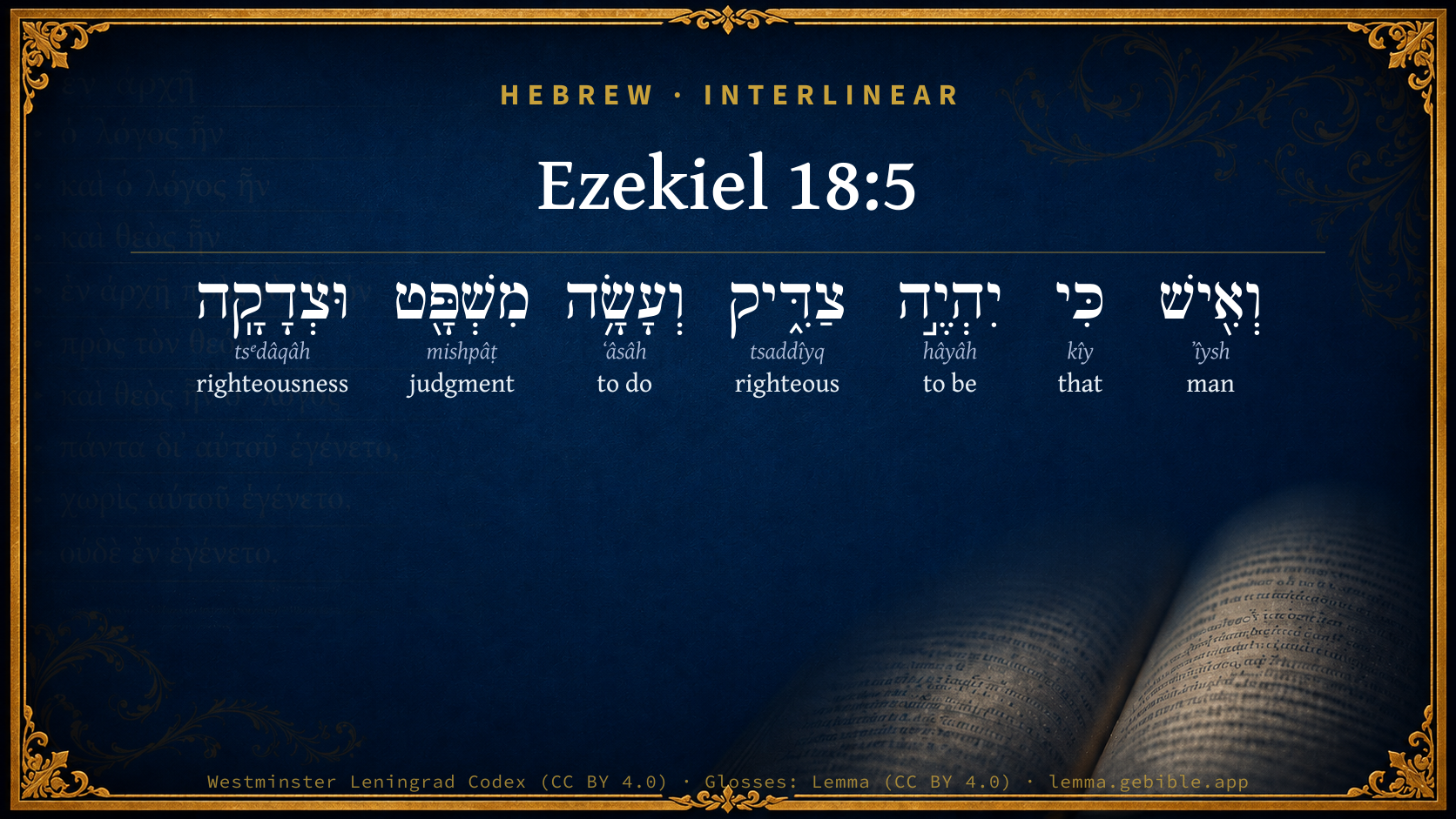
Hebrew (Westminster Leningrad Codex) Ezekiel 18:5 appears in the Hebrew Old Testament. The text above is from the Westminster Leningrad Codex. Each word links to its Strong’s number, a concise gloss, and parsing drawn from the Open Scriptures Hebrew Bible morphology. Click any word for its full Brown-Driver-Briggs (BDB) entry.
Download image
Cite this verse

Ezekiel 18:5 (World English Bible). Public Domain. Lemma interlinear Bible study tool, https://lemma.gebible.app/v/ezekiel/18/5.

Show BibTeX & RIS
BibTeX
RIS
English Translation
But if a man is just, and does that which is lawful and right,
World English Bible · Public Domain
Download a study sheet

One document with this verse’s original text, its word-by-word gloss line, the meaning frame, cross-references with their text, attributed commentary, and full source and license credits — printable, and it pastes into notes with its structure intact.

This verse Autodidact and up

Study sheet (.html) Plain text (.txt)

A passage Seminary Student

Up to 50 verses in one chapter. A passage sheet keeps up to 6 commentary sources and 12 cross-references per verse, in the order this page ranks them, and says so on the sheet whenever that leaves anything out. Ask for a single verse and you get the Autodidact verse sheet above.

Everything on this page stays free to read, with no account — the sheet is a download of what is already on screen, not access to it.

Want to remove ads? Support Godless Engineer
Compare translations 3

The same verse in 3 English versions, stacked beneath the original-language interlinear above. Click any original word for its lexicon entry.

Each is an independent rendering of the whole verse — the interlinear is not word-aligned to these translations.

Highlighted words mark where these versions differ — a whole-verse word diff, not a word-by-word alignment.

  • World English Bible Public Domain
    But if a man is just, and does that which is lawful and right,
  • King James Version Public Domain
    But if a man be just, and do that which is lawful and right,
  • unfoldingWord Literal Text CC BY-SA 4.0
    What can be said about a man who is righteous and who carries out justice and righteousness—

unfoldingWord Literal Text — © unfoldingWord, licensed CC BY-SA 4.0. Word-aligned USFM3 via Door43 (git.door43.org/unfoldingWord/en_ult).

Versions to compare (up to 4)

3 of 4 selected

Show all 18 translations

Every available English version of this verse, each an independent rendering of the whole verse.

  • World English Bible Public Domain
    But if a man is just, and does that which is lawful and right,
  • Berean Standard Bible Public Domain
    Now suppose a man is righteous and does what is just and right:
  • Majority Standard Bible Public Domain
    Now suppose a man is righteous and does what is just and right:
  • King James Version Public Domain
    But if a man be just, and do that which is lawful and right,
  • American Standard Version (1901) Public Domain
    But if a man be just, and do that which is lawful and right,
  • Revised Version (1885) Public Domain
    But if a man be just, and do that which is lawful and right,
  • Geneva Bible (1599) Public Domain
    But if a man be iust, and doe that which is lawfull, and right,
  • Douay-Rheims (1899) Public Domain
    And if a man be just, and do judgment and justice,
  • Young's Literal Translation Public Domain
    And a man, when he is righteous, And hath done judgment and righteousness,
  • Literal Standard Version CC BY-SA 4.0
    And a man, when he is righteous, || And has done judgment and righteousness,
  • Unlocked Literal Bible CC BY-SA 4.0
    What can be said about a man who is righteous and who carries out justice and righteousness—
  • unfoldingWord Literal Text CC BY-SA 4.0
    What can be said about a man who is righteous and who carries out justice and righteousness—
  • Darby Bible Public Domain
    And if a man be righteous, and do judgment and justice:
  • World Messianic Bible Public Domain
    “But if a man is just, and does that which is lawful and right,
  • Webster's Bible Public Domain
    But if a man is just, and doeth that which is lawful and right,
  • Free Bible Version CC BY-SA 4.0
    Take the example of a man who is a good person, doing what is fair and right.
  • Bible in Basic English Public Domain
    But if a man is upright, living rightly and doing righteousness,
  • JPS Tanakh (1917) Public Domain
    But if a man be just, and do that which is lawful and right,

Literal Standard Version (2020), Covenant Press — licensed CC BY-SA 4.0. Text via the HelloAO Bible API (eBible.org). Unlocked Literal Bible (unfoldingWord) — licensed CC BY-SA 4.0. Text via the HelloAO Bible API (eBible.org). unfoldingWord Literal Text — © unfoldingWord, licensed CC BY-SA 4.0. Word-aligned USFM3 via Door43 (git.door43.org/unfoldingWord/en_ult). Free Bible Version, Dr. Jonathan Gallagher — licensed CC BY-SA 4.0. Text via the HelloAO Bible API (eBible.org).

Word by word

More ways to search: Search by grammar → Find every occurrence → Compare this word →

Practice this passage: Drill this verse → Learn its vocabulary →

וּצְדָקָֽה
tsᵉdâqâh
H6666
“and · righteousness”
Conjunction + Noun, Common, Feminine, Singular, Absolute
Part of Speech
Conjunction + Noun
Type
Common
Gender
Feminine
Number
Singular
State
Absolute
Full BDB Definition

Origin: from H6663

TWOT: 1879b

justice, righteousness - righteousness (in government) - of judge, ruler, king - of law - of Davidic king Messiah - righteousness (of God's attribute) - righteousness (in a case or cause) - righteousness, truthfulness - righteousness (as ethically right) - righteousness (as vindicated), justification, salvation - of God - prosperity (of people) - righteous acts
  1. וְאִ֖ישׁ ʼîysh H376 “and · man” Conjunction + Noun, Common, Masculine, Singular, Absolute
  2. כִּי kîy H3588 “that” Conjunction
  3. יִהְיֶ֣ה hâyâh H1961 “to be” Verb, Qal, Imperfect, 3rd Person, Masculine, Singular
  4. צַדִּ֑יק tsaddîyq H6662 “righteous” Adjective, Adjective, Masculine, Singular, Absolute
  5. וְעָשָׂ֥ה ʻâsâh H6213 “and · to do” Conjunction + Verb, Qal, Sequential Perfect, 3rd Person, Masculine, Singular
  6. מִשְׁפָּ֖ט mishpâṭ H4941 “judgment” Noun, Common, Masculine, Singular, Absolute

About this verse

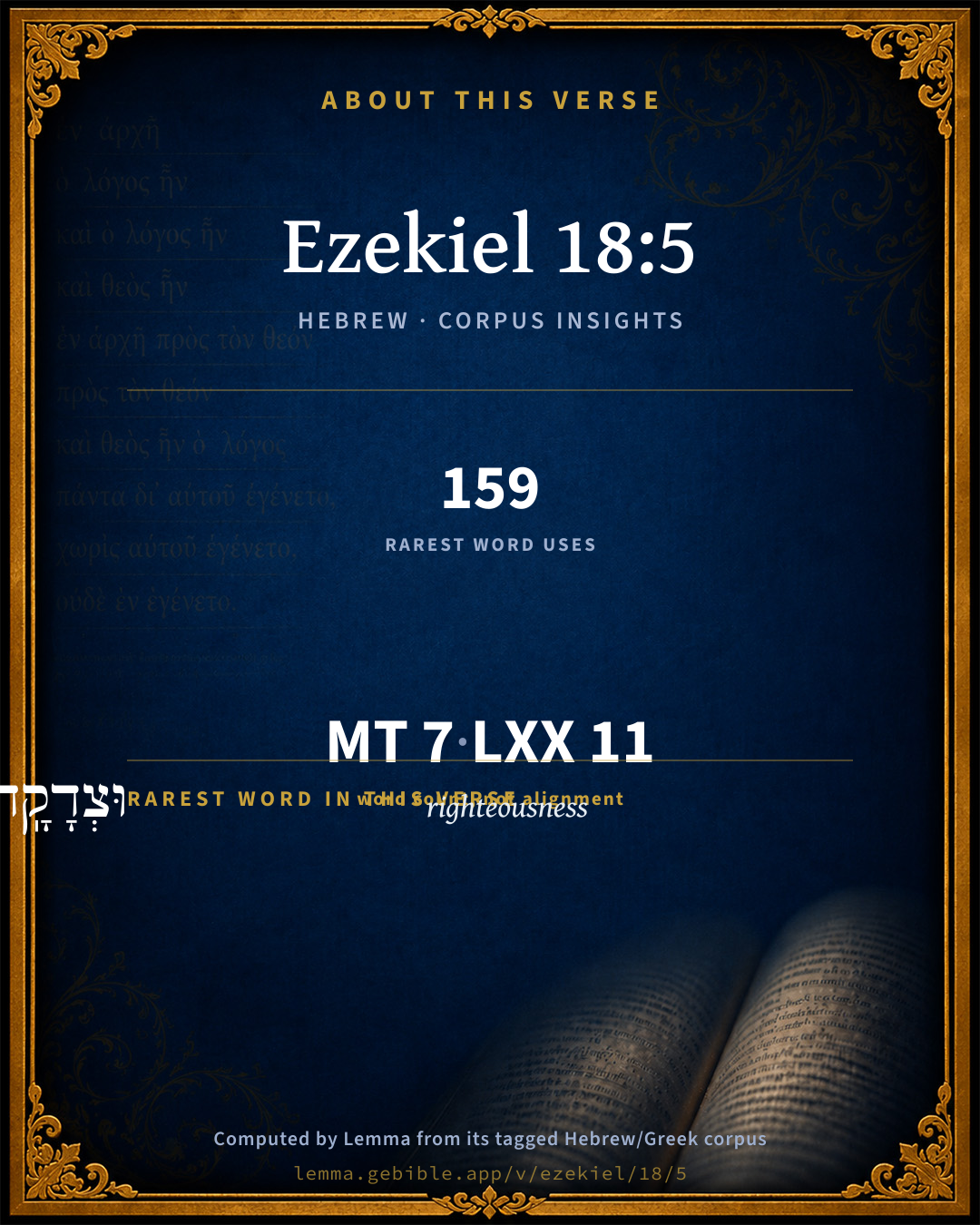
These counts appear in no published source. They are computed here, from the morphology-tagged text and Lemma’s own curated glosses. What Lemma adds →

7
words
7
distinct lemmas
Prophets
section

Grammatical profile

  • 2 verbs
  • 3 nouns
  • 1 adjective
  • 1 conjunction

Verb forms

  • יִהְיֶ֣ה Qal · Imperfect
  • וְעָשָׂ֥ה Qal · Sequential Perfect

Hebrew & Septuagint length

In English translation the verse runs 14 words from the Hebrew and 12 from the Septuagint (LXX English) — closely comparable.

A rough comparison of the two English renderings, which tokenize alike — not a word-level alignment.

Word counts can differ between the Hebrew and the Greek without any difference in meaning — e.g. the Hebrew direct-object marker אֵת has no separate Greek word, and Greek often adds the article ὁ.

In the original languages it is 7 Hebrew tokens and 11 Greek tokens — but the two are counted differently (Hebrew bundles its prefixes and suffixes into one token; the Greek is in lemma form), so that isn’t a like-for-like length.

Cross-references

15

Topical passages linked to Ezekiel 18:5 in the Treasury of Scripture Knowledge — connected by theme and wording, ordered by reader-vote popularity; previews shown in the World English Bible.

  • Ezekiel 33:14 Again, when I say to the wicked, You shall surely die; if he turn from his sin, and do that which is lawful and right;
  • Proverbs 21:3 To do righteousness and justice Is more acceptable to Yahweh than sacrifice.
  • 1 John 3:7 Little children, let no one lead you astray. He who does righteousness is righteous, even as he is righteous.
  • Genesis 18:19 For I have known him, to the end that he may command his children and his household after him, that they may keep the way of Yahweh, to do righteousness and justice; to the end that Yahweh may bring on Abraham that which he has spoken of him."
  • Psalms 15:2–5 He who walks blamelessly does what is right, And speaks truth in his heart;
  • Psalms 24:4–6 He who has clean hands and a pure heart; Who has not lifted up his soul to falsehood, And has not sworn deceitfully.
  • Matthew 7:21–27 Not everyone who says to me, 'Lord, Lord,' will enter into the Kingdom of Heaven; but he who does the will of my Father who is in heaven.
  • Romans 2:7–10 to those who by patience in well-doing seek for glory and honor and incorruptibility, eternal life;
  • James 1:22–25 But be doers of the word, and not only hearers, deluding your own selves.
  • James 2:14–26 What good is it, my brothers, if a man says he has faith, but has no works? Can faith save him?
  • 1 John 2:3 This is how we know that we know him: if we keep his commandments.
  • 1 John 2:29 If you know that he is righteous, you know that everyone who practices righteousness is born of him.
  • 1 John 5:2–5 By this we know that we love the children of God, when we love God and keep his commandments.
  • Revelation 22:14 Blessed are those who do his commandments, that they may have the right to the tree of life, and may enter in by the gates into the city.
  • Jeremiah 22:15 Shall you reign, because you strive to excel in cedar? Didn't your father eat and drink, and do justice and righteousness? then it was well with him.

Cross-references courtesy of OpenBible.info (CC BY 4.0).

Hebrew and Greek witnesses Masoretic Hebrew ↔ Greek Septuagint

The same verse in the two great witnesses to the Old Testament, shown verse-for-verse.

These are two independent witnesses, not word-aligned to each other, and the Septuagint is shown in lemma (dictionary) form.

Hebrew Ezekiel 18:5 Masoretic · Westminster Leningrad Codex

וְאִ֖ישׁ כִּי יִהְיֶ֣ה צַדִּ֑יק וְעָשָׂ֥ה מִשְׁפָּ֖ט וּצְדָקָֽה

But if a man is just, and does that which is lawful and right,

World English Bible · Public Domain

Greek LXX Ezekiel 18:5 Septuagint · lemma form

ὁ δέ ἄνθρωπος ὅς εἰμί δίκαιος ὁ ποιέω κρίμα καί δικαιοσύνη

But the man who shall be just, who executes judgment and righteousness,

LXX2012 (modern English Septuagint) · Public Domain

On this verse, Keil & Delitzsch discusses the Septuagint’s reading. Read the note in Commentary ↓

Hebrew: Westminster Leningrad Codex (CC BY 4.0). Greek: Septuagint (public domain); English from LXX2012 (modern English Septuagint) (Public Domain). How the Septuagint differs from the Hebrew →

Targum (Aramaic paraphrase)

1

The Targum is the ancient Jewish Aramaic paraphrase of the Hebrew Scriptures — an interpretive translation, not the Hebrew text itself. Onkelos (literal) and Pseudo-Jonathan (expansive) render the Torah, and Jonathan the Prophets. Coverage is partial: where no permissively-licensed English translation exists for a verse, only the Aramaic is shown. This is verse-level text, not a word-by-word alignment to the Hebrew.

  1. Targum Jonathan Prophets (Joshua–Malachi)
    וּגְבַר אֲרֵי יְהֵי זַכַּאי וְיַעְבֵיד דִין דִקְשׁוֹט וְזָכוּ:

    (no public-domain English translation for this verse)

    Targum Jonathan — Aramaic: “Mikraot Gedolot” (public domain). English: “Sefaria Community Translation” (CC0 1.0 (public-domain dedication)); “London "Chaldee Paraphrase," 1871” (public domain). Text via Sefaria.

Commentary

Notes on Ezekiel 18:5 from classic Christian and Jewish commentators (each source and its license shown beneath its notes). The classic Christian expositions comment on the surrounding passage and are grouped to its opening verse, so a note may address several verses; the Jewish commentaries on the Tanakh (Rashi and others) are per-verse, so they appear only where the commentator wrote on this verse.

Lemma curates 59 commentaries, every one of them public domain or Creative Commons licensed, each selected and text-cleaned for this edition rather than reprinted as found. About our sources →

Jamieson, Fausset & Brown

Robert Jamieson, A. R. Fausset & David Brown

Here begins the illustration of God's impartiality in a series of supposed cases. The first case is given in Eze 18:5-9, the just man. The excellencies are selected in reference to the prevailing sins of the age, from which such a one stood aloof; hence arises the omission of some features of righteousness, which, under different circumstances, would have been desirable to be enumerated. Each age has its own besetting temptations, and the just man will be distinguished by his guarding against the peculiar defilements, inward and outward, of his age.

just . . . lawful . . . right--the duties of the second table of the law, which flow from the fear of God. Piety is the root of all charity; to render to each his own, as well to our neighbor, as to God.

Jamieson, Fausset & Brown — Commentary Critical and Explanatory on the Whole Bible (1871) — public domain (CC PDM 1.0). Text via the HelloAO Bible API.

Ellicott's Commentary for English Readers

(5) If a man be just.—At the opening and close of the statement in regard to the righteous man (Eze_18:5; Eze_18:9), he is described in general and comprehensive terms; while in the intermediate verses various particulars of an upright life are specified as examples of the whole. These particulars have reference, first, to religious duties (Eze_18:6 a), then to moral obligations, such as the avoidance of adultery (Eze_18:6 b), and finally to duties negative and positive towards one’s neighbour (Eze_18:7-8). The whole, including Eze_18:5; Eze_18:9, may be considered as a terse summary of the practical duty of man.

A Bible Commentary for English Readers, edited by Charles John Ellicott (1878–1897) — public domain. Text from a community e-Sword module.

The Cambridge Bible for Schools and Colleges

gen. ed. J. J. S. Perowne

5–20. Developement of the principle in three instances, chosen so as to exhibit it in its most paradoxical form

5–9. The man that is righteous shall live. First, his righteousness is defined generally as doing judgment or right and justice, Eze_18:5. Then it is analysed into: (1) religious duties, Eze_18:6; (2) duties relating to marriage and the relations of men and women, Eze_18:6; (3) duties to one’s neighbour, Eze_18:7-8; and (4) finally all these duties are brought under the conception of obedience to the commands of God, Eze_18:9.

The Cambridge Bible for Schools and Colleges (gen. ed. J. J. S. Perowne; Cambridge University Press, 1878–1918) — public domain. Text from a community e-Sword module.

Trapp's Complete Commentary

John Trapp

Eze 18:5 But if a man be just, and do that which is lawful and right,

Ver. 5. But if a man be just.] Keep faith and a good conscience; do good acts, and have good aims; do all as well as any, not this or that, but this and that too, as here it followeth, duties of piety, and duties of charity.

John Trapp, A Commentary or Exposition upon All the Books of the Old and New Testament (1647–1656) — public domain. Text from a community e-Sword module.

Joseph Benson's Commentary

Eze 18:5-9. If a man be just — Or righteous, rather, as the word צדיק properly signifies; for it is not mere honesty, but true religion that is intended. And hath not eaten upon the mountains — Feasted on the sacrifices they offered to false gods. Idolatrous worship was commonly performed upon mountains or high places; and eating part of the sacrifice was properly maintaining communion with the idol to which it was offered. Neither hath lifted up his eyes to the idols — In prayer and adoration. And hath restored to the debtor his pledge — That is, what he could not be in want of without great inconvenience; such as clothes, bedding, and the like. God forbade the Jews to detain all night any pledge of this kind which they took from a poor man, (see the margin,) which was, in effect, to enjoin them to lend to the poor, without either pawn or usury. Hath given his bread to the hungry — After the offices of justice, come those of charity or beneficence: see margin. That hath not given forth upon usury — Usury, when exacted of the poor, has been generally condemned as no better than oppression, and is particularly forbidden by the law: see the margin. It is probable this sort of usury is chiefly here meant, because it is joined with oppression, violence, and want of charity. Every kind and degree of usury, however, was forbidden to the Israelites among one another, to promote a spirit of mutual kindness. But this law was peculiar to them: like their not reaping the corners of their fields, and their not gleaning their vines and olive-trees. Neither hath taken any increase — This seems to be meant of taking any advantage of the poor upon any occasion: see note on Lev 25:36. Hath executed true judgment between man and man — Whenever he has been appointed a judge or an arbiter of differences between men; or, according as he has opportunity of doing it. Hath walked in my statutes, and kept my judgments — My ordinances and commandments, attending diligently to the various institutions of my worship, and living in continual obedience to my will as revealed in my word, and that from a principle of faith in, and love to me, Deu 6:5; and Deu 30:20; to deal truly — Uprightly and sincerely, according to the best of his knowledge; he is just — Righteous in a gospel sense. Righteousness has been imputed to him, Gen 15:6; Psa 32:1-2; and implanted in him, Deu 5:29; Deu 30:6; Psa 51:10; otherwise it would not be thus practised by him. His person has been justified, and his nature renewed, otherwise he would neither have inclination nor power to walk thus before God in all well-pleasing. He shall surely live, saith the Lord God — Shall enjoy the comfort and reward of his obedience, and shall not need to fear any of those punishments that befall the wicked. He lives to God here, and shall live with him hereafter: see notes on Psalms 15.

Joseph Benson's Commentary on the Old and New Testaments (1811–1818) — public domain. Text from a community e-Sword module.

The Preacher's Complete Homiletical Commentary

Joseph S. Exell (gen. ed.)

(Eze_18:5-9.)

EXEGETICAL NOTES.—True righteousness is described as the fulfilment of the commandments of God. Through such righteousness the righteous shall live.

Eze_18:5. “That which is lawful and right” (Heb.) “Judgment and righteousness.” The deeds must conform to the rule of right, and the motive must be the love of right. “The first application of the principle is made to the righteous man. He is described according to Being and Doing,—essentially and actually; in particular, doing judgment, in general, righteousness: His doing is then more precisely depicted, not without a tendency to antithesis.”—Lange.

Eze_18:6. “Hath not eaten upon the mountains.” Mountains where idol festivals were held (Eze_6:13). Eating that which was offered in sacrifice to an idol was supposed to secure the favour of that deity (1Co_10:20-21). “Neither hath lifted up his eyes to the idols of the house of Israel.” The “lifting up of the eyes” denotes the expectation of help (Psa_121:1). “Neither hath come near to a menstruous woman.” Conjugal intercourse with a wife while she was set apart for her uncleanness was forbidden by the law of Israel on pain of death. It was a defilement of the marriage relation. (Lev_18:19; Lev_20:18). “The prohibition of impurities in the married state is included, which is directed against unbridled lust that bows not to the ordinance of God.”—(Hengstenberg.)

Eze_18:7. “Restored to the debtor his pledge.” This restoration was commanded by the law, as the things taken in pledge were considered as necessary to the existence of the poor man (Exo_22:25; Deu_24:6; Deu_24:10, etc.). “His bread to the hungry.” Not regarding it as his; not saying with Nabal, “Shall I take my bread … and give it away?” (1Sa_25:11).

Eze_18:8. “Given forth upon usury, neither hath taken any increase.” The Hebrew word for usury is very expressive. It literally signifies biting, and must have originated in the practice of taking exorbitant interest. The law of Moses absolutely prohibited the Jews from taking any interest from their brethren, but permitted them to do so from a foreigner (Exo_22:25; Deu_23:19-20). “Increase” is another term expressive of interest or usury, denoting riches obtained by lending money at high interest, or by making exorbitant charges on the natural productions of the soil.”—(Henderson). The taking of “increase” on a loan of the necessaries of life was forbidden to the Israelite (Lev_25:36-37). “Hath executed true judgment between man and man.” In the special capacity of a judge or arbiter.

Eze_18:9. “He is just.” Really such—righteousness as contra-distinguished from its semblance. “He shall surely live.” He shall save his soul—shall live in the fullest, deepest sense of the word. “The man who was blameless with respect to all the points here specified was accounted righteous in the eye of the law, and entitled to enjoy the life which the law secured.”—(Henderson.)

HOMILETICS

A PICTURE OF RIGHTEOUSNESS (Eze_18:5-9)

The whole of this paragraph is an expansion of the words, “If a man be just’ and do that which is lawful and right” (Eze_18:5). Righteousness consists in the fulfilment of the commandments of God’s law. It is conformity to a standard which is not arbitrary, but founded upon the nature of God Himself and His relations to mankind. But more particularly, righteousness consists—

I. In the proper discharge of religious duties. Those duties which more nearly concern God and His worship. They are laid down in the first Table of the Law. In this passage, they are described negatively as consisting, in general, in the avoidance of idolatry.

(1) In its grosser forms. Such as, “eating upon the mountains” (Eze_18:6), i.e., observing the sacrificial festivals of the heathen gods and, therefore, sacrificing to idols (Deu_12:2, etc.). This was the chief transgression by outward acts against the law of Divine worship. There can be no true righteousness unless God is worshipped in purity and sincerity. But idolatry is also to be avoided,—

(2.) In its more refined forms. Some of the prophet’s countrymen could not degrade themselves so far as to join in outward acts of idolatrous worship. But the essential spirit of idolatry was in them. They “lifted up their eyes to the idols of the house of Israel” in the expectation of help from them, thus offering supplication to them and making them an object of trust. Israel had done this in times past, and was doing so still (Deu_4:19; Eze_6:13). God will have no compromises or accommodations in the matter of His worship. He regards the direction of the heart, and we cannot escape His condemnation by merely avoiding the grosser forms of sin while we retain the abominable thing itself.

II. In the proper discharge of moral duties. Those which are concerned with the relations of men to one another. The moral law is the foundation of the peace and welfare of society—the bond which holds it together. The following principles underlie the moral duties insisted on here.

1. The principle of purity. That purity which consists in the proper control of the lusts of the flesh. “Neither hath defiled his neighbour’s wife” (Eze_18:6). The marriage relation is to be held sacred. Sins against it tend to destroy the very foundations of society, make havoc of the peace of families, and are a fruitful source of many crimes and disorders. Sins of impurity pollute the mind, extinguish the better instincts of the mind and heart, and tend more than any other to drag a man down to the level of the brute. This principle of purity is to be observed within the marriage relation itself, “Neither hath come near to a menstruous woman” (Eze_18:6). Conjugal intercourse with a wife during menstruation was forbidden by the law as a defilement of the marriage relation (Lev_18:19; Lev_20:18). Marriage was not to be regarded as giving the right to an unbridled licence of indulgence, but it was to be under the control of wholesome moral laws.

2. The principle of kindness. The righteous man is to abstain from all oppression, to spoil none by violence, to withhold the hand from every iniquity done against another (Eze_18:7-8). But there must be also active goodness. “Hath given his bread to the hungry, and hath covered the naked with a garment” (Eze_18:7). kindness is to be shown towards the unhappy and the unfortunate. We may claim the right to do what we like with our own, and the law of our nation may uphold us therein. But there is another law—the law of kindness within our hearts—that bids us spend our treasure for the good of our fellow men. We are just as much bound to do good to others as not to rob them, to reach forth the hand to help them as not to smite them with the fist of wickedness. God uses the righteous man as the means by which He manifests His own loving kindness to those who are in distress. And especially is kindness to be shown towards brethren—those who are of the same commonwealth and religion as ourselves. The Israelites were forbidden to take usury from their brethren on a loan of money, or “increase” on a loan of the necessaries of life (Lev_25:36-37). They were forbidden to exercise their full rights, even when a brother through poverty had sold himself into slavery. “Thou shalt not rule over him with rigour, but shalt fear thy God” (Lev_25:43).

3. The principle of mercy. The proper objects of kindness and pity are the unhappy and unfortunate: but the objects of mercy are the undeserving. Mercy is shown towards those who have no claim upon us. “Hath restored to the debtor his pledge” (Eze_18:7). The godly man will not stand upon his rights to the real injury of another. The debtor has no claim upon us, and is, therefore, a proper object of our mercy.

4. The principle of justice. “Hath executed true judgment between man and man” (Eze_18:8). In every dispute the righteous man, when appealed to, will give a judgment which is according to truth. “To deal truly,” lit. “to do truth,” i.e., to act with uprightness and sincerity (Psa_51:6; 1Co_5:8, Eph_4:21).

III. In the practical recognition of the truth that all duties have reference to God. The Bible knows nothing of “independent morality.” “My statutes,” “My judgments” (Eze_18:9). We are to practise all religious and moral duties because they are pleasing to God; they are according to His will. This doctrine saves religion from being degraded into a mere sentiment. True religion is devotion to a Living Person, obedience to a Living Will. It also saves morality from being regarded as founded solely upon utilitarianism. We are to love men and do our duty towards them for God’s sake.

(Eze_18:7)

I. Wherein this oppression consists.

1. In outreaching men in buying or selling. Men must neither sell too dear, nor buy too cheap; which is contrary to the practice of the world (Lev_25:14).

(1.) It is oppression when the buyer will wring a commodity out of his neighbour’s or brother’s hand, which he is unwilling to part withal. Ahab will have Naboth’s vineyard (1 Kings 22.)

(2.) When he makes advantage of the seller’s necessity. And so many monied men will furnish sellers and needy men with money, upon condition they may have such wares, such a house, such land, at an easier rate. Such advantage they made of them who were necessitated to mortgage their lands, vineyards, and houses for money to buy corn (Neh_5:3).

(3.) When he disparageth the commodities of the seller (Pro_20:14).

2. In withholding that which is right and due to others (St. Jas_5:4; St. Luk_10:7; Lev_19:13; Mal_3:5). If any withhold the portion of orphans, legacies given to the poor, the estates and rights of widows, they will lie under the censure of being oppressors.

3. In laying too heavy burdens and tasks upon others. The Egyptians oppressed the Israelites (Exo_3:7). And many lay more upon their servants than they can well perform. They must be up early, fare hard, work hard, and be worn out before their time. And what is this but oppression in a high degree? Whereas the rule is, “Masters, give unto your servants that which is just and equal; knowing that ye also have a Master in heaven” (Col_4:1).

4. In preventing and delaying of justice and judgment. In this way the petitions and causes of widows, orphans and poor people cannot be heard (Isa_1:23). The fatherless and widows had no gifts, no bribes to give them; the rich had, and by that means justice was perverted, and judgment delayed (Amo_6:12). And this sin is reckoned amongst the mighty ones (Amo_5:12).

5. In imposing upon men’s consciences those things which are doubtful and disputable. When doctrines, worship, disciplines are imposed upon men’s consciences, which cannot clearly be made out to them, it is the height of oppression, and the ground-work of persecution. The Scribes and Pharisees taught for doctrines the commandments of men (St. Mat_15:9); they laid grievous burdens upon men’s shoulders and hearts (St. Mat_23:4). Whatever is done with doubting is of sin (Rom_14:23).

II.The evil of oppressing.

1. It is an unnatural evil. No creatures do oppress those of their own kind. But men most unnaturally prey upon one another; one man is a wolf to another (Eze_22:27). Lions have spared men (Daniel 6); ravens fed men (1 Kings 17.); and yet one man seeks to eat up and devour another.

2. There is little fear of God in the hearts of those who oppress others. “Ye shall not oppress one another; but thou shalt fear thy God” (Lev_25:17). It is here intimated that, if they oppress, they do not fear God; if they fear God, they will not oppress; for “by the fear of the Lord men depart from evil” (Pro_16:6). The Jews oppressing one another is attributed to their not fearing God (Neh_5:9).

3. It is against that great and common rule of equity (St. Mat_7:12). St. Jerome calls this sentence of Christ “the summary of justice.”

4. It is a sin which greatly provokes God. Dreadful woes are denounced against it, and dreadful judgments upon those who are guilty of it (Mic_2:12; Hab_2:12; Zep_3:1; Jer_22:13; Isa_10:1-3; Exo_22:21-24). “But hath restored to the debtor his pledge,” etc. The Lord gave them laws concerning this (Exo_22:26). They might not take the upper millstone, nor a widow’s garment, for pledges; and what they did take they were faithfully and speedily to return. Job complains of the wicked that they took the widow’s ox for a pledge, and the garments of the poor (Job_24:3; Job_24:9). “Hath spoiled none by violence.” Wicked men are said to “drink the wine of violence.” “They sleep not except they cause some to fall” (Pro_4:16-17). “He hath given his bread to the hungry, hath covered the naked with a garment.” This is the exercise of faith (Ecc_11:1). It makes a man to be of good report (Psa_112:9). It is the special distinction of a good man (Psa_112:1; Psa_112:9). It is feeding of Christ (St. Mat_25:35; Mat_25:40). It is an honour to religion (St. Jas_1:27). It procures many a prayer and blessing (2Co_9:10; Job_29:13; 2Ti_1:16). It makes like unto God (St. Luk_6:36). It is lending to the Lord (Pro_19:17). It is pleasing and acceptable to God (Acts 10; Heb_13:16).—Greenhill.

The Preacher's Complete Homiletical Commentary (gen. ed. Joseph S. Exell; Funk & Wagnalls, c. 1892) — public domain (pre-1929). A full-Bible homiletical/sermon-outline anthology covering 65 of 66 books (2 John is absent from the source module). Text from a community e-Sword module.

Keil & Delitzsch

C. F. Keil & F. Delitzsch

The Righteous Man Shall Not Die

Eze 18:5. If a man is righteous, and doeth right and righteousness, Eze 18:6. And doth not eat upon the mountains, and doth not lift up his eyes to the idols of the house of Israel, and doth not defile his neighbour's wife, and doth not approach his wife in her uncleanness, Eze 18:7. Oppresseth no one, restoreth his security (lit., debt-pledge), committeth no robbery, giveth his bread to the hungry, and covereth the naked with clothes, Eze 18:8. Doth not give upon usury, and taketh not interest, withholdeth his hand from wrong, executeth judgment of truth between one and another, Eze 18:9. Walketh in my statutes, and keepeth my rights to execute truth; he is righteous, he shall live, is the saying of the Lord "Jehovah." - The exposition of the assertion, that God only punishes the sinner, not the innocent, commences with a picture of the righteousness which has the promise of life. The righteousness consists in the fulfilment of the commandments of the law: viz., (1) those relating to religious duties, such as the avoidance of idolatry, whether of the grosser kind, such as eating upon the mountains, i.e., observing sacrificial festivals, and therefore sacrificing to idols (cf. Deu 12:2.), or of a more refined description, e.g., lifting up the eyes to idols, to look to them, or make them the object of trust, and offer supplication to them (cf. Psa 121:1; Deu 4:19), as Israel had done, and was doing still (cf. Eze 6:13); and (2) those relating to moral obligations, such as the avoidance of adultery (compare Exo 20:14; Lev 20:10; Deu 22:22; and for טמּא, Gen 34:5), and of conjugal intercourse with a wife during menstruation, which was a defilement of the marriage relation (cf. Lev 18:19; Lev 20:18). All these sins were forbidden in the law on pain of death. To these there are appended duties to a neighbour (Eze 18:7.), viz., to abstain from oppressing any one (Exo 22:28; Lev 15:14, Lev 15:17), to restore the pledge to a debtor (Exo 22:25; Deu 24:6, Deu 24:10.). חוב is hardly to be taken in any other sense than as in apposition to חבלתו, "his pledge, which is debt," equivalent to his debt-pledge or security, like דּרכּך זמּה in Eze 16:27. The supposition of Hitzig, that חוב is a participle, like קום in Kg2 16:7, in the sense of debtor, is a far less natural one, and has no valid support in the free rendering of the lxx, ἐνεχυρασμὸν ὀφείλοντος. The further duties are to avoid taking unlawful possession of the property of another (cf. Lev. 5:23); to feed the hungry, clothe the naked (cf. Isa 58:5; Mat 25:26; Jam 2:15-16); to abstain from practising usury (Deu 23:20; cf. Exo 22:24) and taking interest (Lev 25:36-37); in judicial sentences, to draw back the hand from wrong, and promote judgment of truth, - a sentence in accordance with the true nature of the case (see the comm. on Zac 7:9); and, lastly, to walk in the statutes and rights of the Lord, - an expression which embraces, in conclusion, all that is essential to the righteousness required by the law. - This definition of the idea of true righteousness, which preserves from death and destruction, and ensures life to the possessor, is followed in Eze 18:10. by a discussion of the attitude which God sustains towards the sons.

Keil & Delitzsch — Biblical Commentary on the Old Testament (1861–1891) — public domain (CC PDM 1.0). Text via the HelloAO Bible API. (Old Testament only.)

Tyndale Open Study Notes

Tyndale Open Resources

18:5-9 God’s justice is worked out in a case study by following three hypothetical generations. In the first generation, a righteous man was faithful in worshiping the Lord, sexually pure, and fair in dealing with others. A person who lives like that has no need to fear God’s judgment.

Tyndale Open Study Notes — © Tyndale Open Resources, licensed CC BY-SA 4.0. Text via the HelloAO Bible API.

Adam Clarke's Commentary

Verse 5. If a man be just, and do that which is lawful and right] If he be just or holy within, and do what is according to law and equity. What is meant by this, is immediately specified.

Adam Clarke's Commentary on the Bible (1810–1826) — public domain. Text from a community e-Sword/MySword module.

John Calvin's Commentaries

Here the Prophet confirms his former teaching by examples. For he first says, if any one faithfully keep the law, he shall prosper, since God will repay the reward of justice: afterwards he adds, if the just man beget a son unlike himself, the justice of the father shall not profit the degenerate son, but he shall receive the reward of his iniquity. But if this second person should beget a son who does not imitate his father, God promises that this third person shall be acceptable by him, because he is just, and therefore enjoys prosperity and happiness. We see, then, that the grandfather and grandson are here spoken of, and that the son of the first, and father of the third, is placed between them. But this is the Spirit’s intention, that God has prepared a reward for each according to their lives, so that he does not permit them to be deprived of their promised blessing, nor let the impious and despisers of his law escape. Now let us come to the words, if any one has been just, says he, he shall be just, therefore he shall live. He speaks generally first: he afterwards enumerates certain species under which he embraces the sum of the whole law. The full sentence is, if any one has been just, he shall live in consequence of his justice. But the Prophet defines what it is to be just, and he there chooses certain parts of the law: by putting a part for the whole, as I have said, he signifies, that whoever faithfully observes the law is esteemed just before God. Now we must examine each of these kinds of justice, and afterwards come to the general doctrine. He says first, that he is just who does justice and judgement. By the word judgment holy Scripture signifies rectitude; but when the two words are joined together, judgment seems to express more than justice: for justice is nothing but equity, fidelity, integrity, when we abstain altogether from fraud and violence, and deal with our brethren as we wish them to deal with us. Whoever so conducts himself is said to do justice; but judgment is extended further, namely, when we not only desire to benefit but defend our brethren, when unjustly oppressed, as far as we can, and when we oppose the lust and violence of those who would overthrow all that is right and holy. Hence to do judgment and justice is nothing else than to abstain from all injury by cultivating good faith and equity with our neighbors: then to defend all good causes, and to take the innocent under our patronage when we see them unjustly injured and oppressed. But these duties belong properly to the second table of the law. But it is clear from this that we fear God when we live justly with our brethren, for piety is the root of charity. Although many profane persons seem blameless in their life, and manifest a rare integrity, yet no one ever loves his neighbor from his heart, unless he fears and reverences God. Since, therefore, charity flows from piety and the fear of God, as often as we see the duties of the second table placed before us, we should learn them to be the testimonies to the worship of God, as is this place: but then the Prophet also adds certain parts of the first table.

John Calvin's Commentaries (1540-1563) — public domain. Text from the Calvin Translation Society English edition (1840s-50s) via the Christian Classics Ethereal Library (ccel.org). Calvin's coverage is partial (roughly two-thirds of the Bible); uncommented books and verses are honest gaps, never fabricated. The 19th-century editor's footnotes and remarks are omitted so the notes are faithfully Calvin's own voice.

John Gill's Exposition

And hath not oppressed any,.... By fraud or force, particularly the poor, to the great grief and hurt of them:

but hath restored to the debtor his pledge; which was pawned; not embezzling it, or keeping it beyond the time fixed by the law of God, Deu 24:12;

hath spoiled none by violence; has not committed theft and robbery, or done injury to any man's person and property:

hath given his bread to the hungry; which was his own; what he had laboured for, and come by honestly, and so had a right to dispose of; and being merciful, as well as just, eats not his morsel alone, but distributes it to the poor and hungry, Isa 58:7;

and hath covered the naked with a garment; as Job did, as well as the former, and for which Dorcas is commended, Job 31:17.

John Gill's Exposition of the Whole Bible (1746–1763) — public domain (CC PDM 1.0). Text via the HelloAO Bible API.

Matthew Poole's English Annotations

So far is God from perverse and froward partiality in his judgments, that none ever had cause to complain hereof.

If a man, without respect of persons, every one, whoever he be, be just; faultless and unstained, which may refer to his temper and disposition of mind; and if his conversation hath agreed with the law of God and rule of justice in all points, in private and public affairs among men.

Matthew Poole's English Annotations on the Holy Bible (1683–1685) — public domain. Text from a community e-Sword/MySword module.

Whedon's Commentary on the Bible

Daniel D. Whedon

5. If a man be just — The just man, according to Ezekiel’s definition, is one who is faithful to God and is obedient to his written law (Eze_18:6); he does that which is “lawful and right;” he is a pure man and a religious man. He is not only honest but merciful (Eze_18:7), generous and true-hearted (Eze_18:8-9), one who is true to God and kind to his brother. This is very similar to Micah’s “good man,” who must “do justly, love mercy, and walk humbly with his God” (Mic_6:8) — see also Job’s righteous man (31), Isaiah’s (Isa_58:5-7), and the Psalmist’s (15). With Ezekiel’s description of the just man it is also interesting to compare the “superior man” of Confucius and the “righteous man” of the Egyptians of Moses’s day. Chinese “justice” had to do wholly with this world, but the Egyptians, like the Hebrews, believed God was man’s neighbor, to whom he owed duties of honor and gratitude and worship. In the confession of every orthodox Egyptian occurs the expression, “I permitted no one to suffer hunger, I pressed forth no tear, I did harm to no man, I did not commit adultery, I was not unchaste, I was not a quarreler, I have told no lie,” etc. There occur also declarations of positive virtue: “I gave bread to the hungry, drink to the thirsty, clothing to the naked.” (See the author’s Ancient Egypt, p. 11, etc.) It has often been insinuated that Ezekiel considered obedience to the “law” as the whole duty of man. But while the injunctions here are almost certainly taken from the written law, for he uses the very word for law which is used in Deu_12:1 (see, for full discussion, Konig vs. Smend, Revue de l’Hist, des Rels., 1894); yet he does not identify justice with the mere formal and technical observance of those statutes and ordinances. (Compare Eze_18:31.) The statement which he here very properly emphasizes — a statement which marks a new era in religious thought — is, that it is only through obedience that a man can become just. Ezekiel saw that what his auditors most needed was a humble obedience to God’s will and a reverence for the written Scriptures. It was no doubt to a people already scrupulous about obeying the letter of the law that Isaiah spoke, urging the more spiritual idea of justice (Isa_5:1; Isa_6:11; Isa_51:7; Isa_56:6-8; Isa_62:1-3). Ezekiel’s audience was not prepared for this highest teaching, but there is no good reason for believing that Ezekiel was not in full sympathy with Isaiah’s best thought.

Daniel D. Whedon (gen. ed.), Commentary on the Old and New Testaments (1874–1909) — public domain. Text from a community e-Sword module.

The Pulpit Commentary

Vers. 5-9. The verses that follow are noticeable as forming one of the most complete pictures of a righteous life presented in the Old Testament. It ads characteristic of Ezekiel that he starts from the avoidance of sins against the first table of the commandments. To eat upon the mountains was to take part in the sacrificial feasts on the places, of which he had already spoken. (Eze_16:16; comp. 22:9; Deu_12:2) The words, lifted up his eyes, as in Deu_4:19 and Psa_121:1, implied every form of idolatrous adoration. The two sins that follow seem to us, as compared with each other, to stand on a very different footing. To Ezekiel, however, they both appeared as mala prohibita, to each of which the Law assigned the punishment of death (Lev_18:19 Lev_20:10, Lev_20:18; Deu_22:22) each involving the dominance of animal passions, in the one case, over the sacred rights of others; in the other, over a law of self-restraint which rested partly on physical grounds, the act condemned frustrating the final cause of the union of the sexes; partly, also, on its ethical significance. The prominence given to it implies that the sin was common, and that it brought with it an infinite degradation of the holiest ties.

Vers. 5-18. The moral alternative.

With a legal minuteness, and with a directness and plainness becoming to the teacher of practical morality, the prophet presents the alternative and antithesis of human life. If not in every particular, still in almost every particular, the picture of the good and of the bad man printed in this passage would be admitted by moralists of every school to be faithful and fair.

I THE DESCRIPTION OF THE GOOD AND OF THE BAD MAN. As the classes are exclusive, each negativing the other, it is sufficient to name the characteristics of the good man, with the understanding that the bad man is he in whom these characteristics are wanting.

1. The good man is characterized by justice in dealing with his fellow men.

2. He refrains from idolatry of every kind.

3. He avoids adultery and every form of impurity.

4. He refrains from oppressing those who, for any reason, are within hispower.

5. He abstains from violence in the treatment of others.

6. He is charitable to the poor and needy.

7. He forbears taking advantage of those who, by misfortune and poverty,are within his power.

8. He scrupulously and cheerfully obeys the Divine laws.

II THE RECOMPENSE OF THE GOOD AND OF THE BAD MAN.

1. To the good is promised life, which is to be understood, not in thenarrow and physical signification of the word, but in its large and scriptural sense.

2. Against the wicked is threatened death, which is to be interpreted asincluding the effects of God"s righteous anger a doom the most awful which can be pronounced and executed.

APPLICATION. The minister of religion may from this solemn passage learn the imperative duty of teaching morality. There must indeed be a foundation laid for such preaching in spiritual and evangelical doctrine; but the superstructure must not be neglected. The wise teacher, before entering into detail as to human character and conduct, will consider his audience, and the time and occasion; for all subjects are not to be treated before persons of every class, of every age, of both sexes. But he will find opportunities for stating and enforcing the precepts of the Law in the spirit and with the motives of the gospel. And the faithful minister will not shrink from depicting, though for the most part in careful and scriptural language, the penalties following upon disobedience to God"s laws, as well as the rewards assured to the loyal and the good. It is true that those who are saved are saved by grace; but it is also true that all men, without exception, are judged by their works, and that God will bring every work into judgment, and every secret thing, whether it be good or bad. T.

Vers. 5-24. God"s remonstrance with man"s reason.

It is an act of singular kindness that God should stoop to reason with the perverted mind of man. It had been a pleasure to instruct the uncorrupted mind; but now that the instrument is injured, it requires infinitely more patience and skill to deal with it. Yet God deigns to explain his principles of rule, and will eventually vindicate, as supremely just, every secret act. But sinful men are self-blinded.

I WE ARE REMINDED OF MAN"S RESPONSIBILITY. God deals with men as creatures capable of discerning between right and wrong. Man"s morality is, in God"s sight, everything. To be righteous is his glory. The final inquiry will be not Is he rich or poor? learned or unlearned? but this only Is he righteous or unrighteous? Every man is undergoing moral trial. He must give an account of himself before God.

II IDOLATRY IS A ROOT OF VARIOUS IMMORALITY. It is not merely a creed, nor yet only a form of worship. It indicates a state of heart, a departure from the soul"s anchorage. The living God is the Source of human purity, human greatness, and to wander from him is to drift into darkness and vice and ruin. Wherever idolatry has prevailed, there has prevailed also unchastity, licentiousness, violence, and cruelty.

III PARENTAL INFLUENCE IS POTENT, YET NOT FATAL. A father"s opinions and beliefs will, in the first instance, he conveyed to his child; yet soon the child wilt gather opinions and teaching from other sources, and often modifies or reverses the beliefs of its parent. The evil example of a parent moulds, more or less, the character of a child. As a parent is the channel of natural life to the child, so too he may become the channel of moral and spiritual life. As a fact, the results of parental influence are conspicuously seen. Yet a son is not doomed to copy the character of his parent, nor fated to imitate his vices. He has the power to consider, to ponder, to choose, to resist. Strong influence is not fate.

IV REPENTANCE, AT ANY STAGE OF HUMAN PROBATION, IS POSSIBLE. It is recognized, throughout the Bible, that a man may turn from evil ways. If, at any point short of death, a man is disposed to turn from a vicious course, all the resources of God"s skill and power are on his side. There is no hindrance to a man"s reformation and restoration save his own unwillingness, Incessantly, God is inviting such repentance.

V REPENTANCE LEADS TO COMPLETE AND PERFECT RIGHTEOUSNESS. Repentance is not merely a negation; it is a positive good. It is the first link in a golden chain that shall bind the soul in sweet allegiance to God. It is the first drop in a precious shower of blessing. It is the foundationstone of a new character. It is the seed of a magnificent harvest. From true repentance every virtue, every excellence, every noble quality, shall spring. Give it time, and it shall bear upon its branches all the figurers and fruits of goodness. It is the first ray of heaven struggling to find entrance into man"s heart.

VI RIGHTEOUSNESS IS INCIPIENT LIFE. "In his righteousness that he hath done, he shall live." Only that man who is righteous truly lives. The life of a man must include the life of conscience the life of the soul. To eat, drink, sleep, is the life of an animal, not the life of an immortal. The first activities of conscience are the movements and signs of life. Therefore penitence is nascent life. Reformation is life. Reconciliation with God is life the budding of the heavenly life. The limb of grace on earth is the dawnof an eternal day. Such righteousness brings peace, rest, joy, into the heart heaven begun below. These are the first fruits of the coming Harvest."the just shall live by his faith. D.

Vers. 5-9. The just man delineated,

if a man be just, and do that which is lawful and right," etc.

I THE CHARACTER MENTIONED. "If a man be just," or righteous. This justness or righteousness is not merely a state of correct opinion; or of becoming feeling on moral questions; or of religious profession. (Mat_7:21) It is a condition of character. The just man "is marked by this, that his settled principles, his customary desire, is to do, not what is pleasant, not what is advantageous to self, but what is right." "Little children, let no man lead you astray: he that doeth righteousness is righteous.

II THE CONDUCT EXHIBITED. The just man "does that which is lawful and right." Certain features of his conduct are here plainly set forth.

1. Complete abstinence from idolatrous practices. "Hath not eaten upon the mountains, neither hath lifted up his eyes to the idols of the house of Israel." The eating upon tie mountains refers to the sacrificial feasts in connection with the worship of idols. (cf. 1Co_8:4-10 1Co_10:7) Idolatry had become so prevalent and popular that certain idols were regarded as belonging to the people of Israel, the chosen people of the Lord Jehovah. But to these the just man pays no deference: he neither seeks their favour nor dreads their displeasure; but he worships God alone. Our idols today are pursuits, possessions, persons, to whom we are ianordinately attached. Anything which we allow as a rival to God for the affection of our heart or the devotion of our life is an idol to us.

2. Scrupulous maintenance of chastity. "Neither hath defiled his neighbour"s wife, neither hath come near to a menstruous woman." The just man controls his carnal appetites by his reason and conscience.

3. C areful avoidance of oppression of any kind or degree.

(1) Robbery by violence. "Hath spoiled none by violence.

(2) Injustice by peaceful means. "And hath not oppressed any, but hath restored to the debtor his pledge. The pledge referred to is some of the necessaries of life, as in Exo_22:26, "If thou at all take the neighbour"s garment to pledge, thou shalt restore it unto him by that the sun goeth down: for that is his only covering, it is "his garment for his skin: wherein shall he sleep?

(3) Injustice by making a man"s poverty the occasion of personal profit. "He hath not given forth upon usury, neither hath taken any increase." "Usury," says the "Speaker"s Commentary, "is the profit exacted for the loan of money, increase that which is taken for goods; both are alike forbidden. (Lev_25:36; Deu_23:19) The placing out of capitol at interest for commercial purposes is not taken into consideration at all. The case is that of money lent to a brother in distress, in which no advantage is to be taken, nor profit required.

4. Exercise of practical philanthropy. "Hath given his bread to the hungry, and hath covered the naked with a garment." The just man as delineated by the prophet not only refrains from injuring any one, but also endeavours to help those who need his aid. In the Bible a high estimate is placed upon the exhibition of practical kindness to the poor and needy. (cf. Job_31:16; Isa_58:7; Mat_25:35, Mat_25:36, Mat_25:40) Our Lord reckons and will reward such actions as done unto him.

5. Righteous dealings with men. "That hath withdrawn his hand from iniquity, hath executed true judgment between man and man." The last clause, perhaps, refers to the duties of a judge. But in every capacity and in all his conduct the truly just man endeavors to do what is right and true, and to promote the doing of the same by others. And as Matthew Henry expounds, "If at any time he has been drawn in through inadvertency to that which afterwards has appeared to him to be a wrong thing, he does not persist in it because he has begun it, but withdraws his hand from that which he now perceives to be iniquity.

6. Faithful obedience to God. "Hath walked in my statutes, and hath kept my judgments, to deal truly." The just man renders positive and active compliance with the holy will of God. That will is his rule of action; and he endeavours to be true to it and true to the Author of it. The man whose conduct is thus sketched by the prophet is pronounced a just man, a righteous man. "He is just," not only in profession, but in fact; not only before man, but before God.

III THE DESTINY ASSERTED. "He shall surely live, saith the Lord God in the fullest and deepest sense of the word." This life is the antithesis of the death predicated of the sinner: "The soul that sinneth, it shall die." The "just shall surely live; .... The just shall live by his faith." The life of truth and righteousness, of kindness towards man and reverence towards God, is already his. And its continuance is promised by God. "He shall surely live," spiritually, progressively, eternally. W.J.

The Pulpit Commentary (1880–1919), ed. H.D.M. Spence-Jones & Joseph S. Exell — public domain. Text from a community e-Sword module.

Kretzmann's Popular Commentary

Paul E. Kretzmann

The Principle of God’s Avenging Justice

v. 5. But if a man be just, righteous in all his doing, and do that which is lawful and right, literally, "judgment and righteousness," exercising himself in the demands of the Law of God,

v. 6. and hath not eaten upon the mountains, in sacrificial meals consecrated to idols, neither hath lifted up his eyes to the idols of the house of Israel, in order to make them objects of confidence, of worshipful supplication, neither hath defiled his neighbor’s wife, in the sin of adultery, Exo 20:14; Lev 20:10, neither hath come near to a menstruous woman, Lev 18:19; Lev 20:18,

v. 7. and hath not oppressed any, no matter with what degree of violence this was done, Exo 22:28; Lev 25:14-17, but hath restored to the debtor his pledge, the Law requiring that this raiment be restored before sunset, Exo 22:26-27, hath spoiled none by violence, not gaining the property of another by false ware or dealing, hath given his bread to the hungry, Isa 58:7, and hath covered the naked with a garment, Mat 25:26;

v. 8. he that hath not given forth upon usury, neither hath taken any increase, in exacting interest from a poor neighbor, contrary to the law of love, Deu 23:20; Lev 25:36-37, that hath withdrawn his hand from iniquity, from the injustice or wickedness which selfishness prompts, in promoting one’s own gain at the expense of one’s neighbor, hath executed true judgment between man and man, literally, "the judgment of truth," namely, in a manner in full agreement with the facts and conditions of every case presented,

v. 9. hath walked in My statutes and hath kept My judgments, in all ordinances, whether pertaining to Israel only or to all men, to deal truly, with sound integrity: he is just, he shall surely live, saith the Lord God. It is not that the righteousness of a man’s life earns for him the fullness of life, including the blessings of eternal life, but that God rewards such evidences of true faith by bestowing His mercy upon the believers. Such a man, then, stands before the Lord for his own person, responsible for himself, the Lord dealing with his case on its own merits, regardless of his children or other relatives.

v. 10. If he beget a son that is a robber, one addicted to violence, a shedder of blood, and that doeth the like to any one of these things, becoming guilty of any of the sins mentioned in the next verses,

v. 11. and that doeth not any of those duties, or, "whereas the father was not guilty of such wickedness," but even hath eaten upon the mountains and defiled his neighbor’s wife,

v. 12. hath oppressed the poor and needy, those unable to defend themselves against violence in any form, hath spoiled by violence, hath not restored the pledge, and hath lifted up his eyes to the idols, hath committed abomination, such as is mentioned at the end of v. 6,

v. 13. hath given forth upon usury, and hath taken increase: shall he then live? Is it possible for him to become a partaker of that fullness of life which God has intended for His children? He shall not live; he hath done all these abominations; he shall surely die, be condemned to eternal death if he persists in his wickedness; his blood shall be upon him, he will have but himself to blame for the terrible fate which will surely strike him. The thought of this paragraph, then, is this: If the wicked son of a righteous man will be punished if he commits even so much as a single sin of those which his father abhorred, how much more if he become guilty of the entire catalog of sins which are enumerated! So much for the second generation and its wickedness.

v. 14. Now, lo, if he beget a son, thereby establishing the third generation of the family whose example is cited for the sake of the lesson the entire parable teaches, that seeth all his father’s sins which he hath done, and considereth, carefully observing the wickedness of his doings, and doeth not such like, not following in his father’s footsteps,

v. 15. that hath not eaten upon the mountains, neither hath lifted up his eyes to the idols of the house of Israel, hath not defiled his neighbor’s wife,

v. 16. neither hath oppressed any, hath not withholden the pledge, literally, "and the pledge not hath he pledged," neither hath spoiled by violence, but hath given his bread to the hungry and hath covered the naked with a garment,

v. 17. that hath taken off his hand from the poor, abstaining from doing him harm, even if he might have done so with impunity, that hath not received usury nor increase, hath executed My judgments, hath walked in My statutes, thus refusing to partake of the guilt of his father: he shall not die for the iniquity of his father, the father’s guilt not being imputed to him; he shall surely live.

v. 18. As for his father, because he cruelly oppressed, spoiled his brother by violence, and did that which is not good among his people, as stated in detail above, lo, even he shall die in his iniquity, being punished for the guilt which he loaded upon himself.

v. 19. Yet say ye, in accordance with the ancient false proverb which had been in circulation, Why? Doth not the son bear the iniquity of the father? That is, Would not that be the right and the just thing? God’s answer is, When the son hath done that which is lawful and right and hath kept all My statutes and hath done them, he shall surely live. On the basis of all the arguments offered thus far the Lord now states His conclusion.

v. 20. The soul that sinneth, It shall die, every person in the world being held responsible for his own acts. The son shall not bear the iniquity of the father, so that his father’s guilt would be imputed to him, neither shall the father bear the iniquity of the son; the righteousness of the righteous shall be upon him, so that he who is righteous, even if only by virtue of the righteousness of Christ imputed to him, will receive the reward of righteousness, and the wickedness of the wicked shall be upon him, so that he is compelled to endure its punishment. In this way the Lord stated the principle of His avenging justice, a principle which He has ever followed in all His dealings with men.

Paul E. Kretzmann, Popular Commentary of the Bible (1921–1924) — public domain. Text from a community e-Sword module.

unfoldingWord translationNotes

Door43 World Missions Community

he does not eat upon the mountains

People often worshiped and offered sacrifices to pagan gods on the mountains. It is implied that this person has not participated in these kinds of pagan rituals. AT: "he does not eat meat sacrificed to idols on the mountains" (See: Assumed Knowledge and Implicit Information)

lift up his eyes to the idols

The idiom "lift up his eyes" refers to looking toward something. With reference to idols, this gesture represents worshiping or praying to idols. AT: "worship the idols" or "pray to the idols" (See: Symbolic Action)

the house of Israel

The word "house" is a metonym for the family that lives in the house, in this case the Israelites, the descendants of Jacob over many years. See how you translated this in Ezekiel 3:1. AT: "the Israelite people group" (See: Metonymy)

approached a woman during her monthly period

It is implicit that he has not approached a woman in order to sleep with her. AT: "approached a woman to sleep with her during her monthly period" (See: Assumed Knowledge and Implicit Information)

translationWords

righteous

just

false god

house

defile

neighbor

unfoldingWord translationNotes — © Distant Shores Media and the Door43 World Missions Community, licensed CC BY-SA 4.0. Source: git.door43.org/Door43/en_tn.

Lesson kit

Teaching starters — assembled from the data on this page, not authored interpretation. Every prompt links to the verse data it draws on. Edit before teaching.

Ezekiel, in the Prophets, opens this verse with 7 words (7 distinct Hebrew lemmas). Its most distinctive word is tsᵉdâqâh (“righteousness”). A historical commentator’s framing appears above. Read the whole chapter for the surrounding context.

Discussion questions

  1. What does “righteousness” (tsᵉdâqâh) contribute to the verse as a whole?
  2. How does Ezekiel 33:14, which shares this passage’s theme, read alongside this verse?
  3. The translations on this page render this verse differently — a whole-verse word diff, not a word-by-word alignment. What might account for the different wordings?
  4. «יִהְיֶ֣ה» is a Qal Imperfect verb. How does that grammatical form shape the action described?
  5. Compare how Jamieson, Fausset & Brown and Ellicott's Commentary for English Readers read this verse. Where do they agree or differ?

Things to notice

Reading settings

Reading text

Shown beneath each verse's original-language words.

Old Testament
Old Testament edition

Read the OT as the Masoretic Hebrew (MT) or the Greek Septuagint (LXX).

English shown for the Greek Septuagint (in the Hebrew ↔ Greek comparison).

Comparing translations? Open the Compare panel on any verse page to stack up to four side by side.