
Deuteronomy 1:16

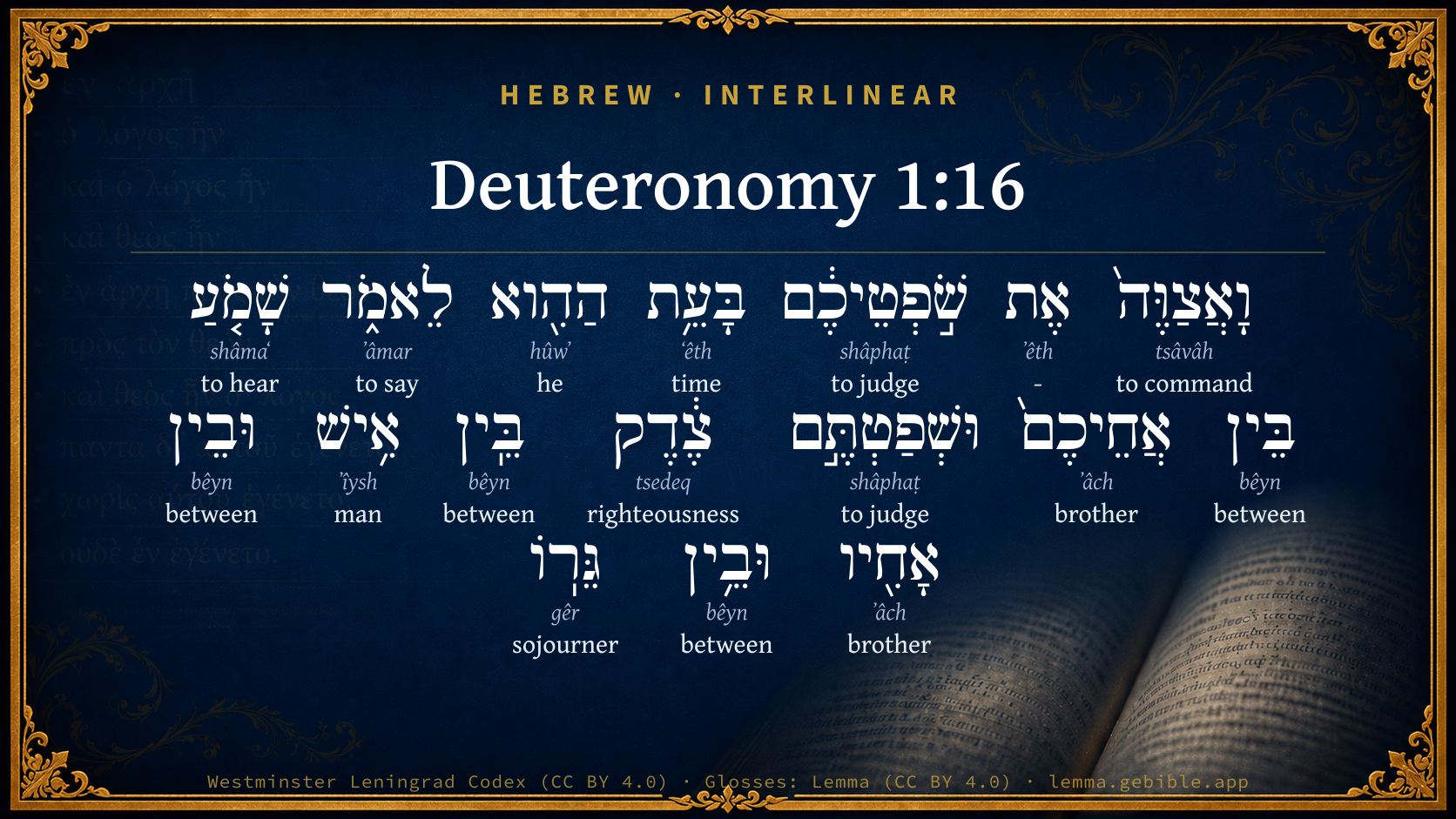
Hebrew (Westminster Leningrad Codex) Deuteronomy 1:16 appears in the Hebrew Old Testament. The text above is from the Westminster Leningrad Codex. Each word links to its Strong’s number, a concise gloss, and parsing drawn from the Open Scriptures Hebrew Bible morphology. Click any word for its full Brown-Driver-Briggs (BDB) entry.
Download image
Cite this verse

Deuteronomy 1:16 (World English Bible). Public Domain. Lemma interlinear Bible study tool, https://lemma.gebible.app/v/deuteronomy/1/16.

Show BibTeX & RIS
BibTeX
RIS
English Translation
I charged your judges at that time, saying, Hear [the causes] between your brothers, and judge righteously between a man and his brother, and the foreigner who is living with him.
World English Bible · Public Domain
Download a study sheet

One document with this verse’s original text, its word-by-word gloss line, the meaning frame, cross-references with their text, attributed commentary, and full source and license credits — printable, and it pastes into notes with its structure intact.

This verse Autodidact and up

Study sheet (.html) Plain text (.txt)

A passage Seminary Student

Up to 50 verses in one chapter. A passage sheet keeps up to 6 commentary sources and 12 cross-references per verse, in the order this page ranks them, and says so on the sheet whenever that leaves anything out. Ask for a single verse and you get the Autodidact verse sheet above.

Everything on this page stays free to read, with no account — the sheet is a download of what is already on screen, not access to it.

Want to remove ads? Support Godless Engineer
Compare translations 3

The same verse in 3 English versions, stacked beneath the original-language interlinear above. Click any original word for its lexicon entry.

Each is an independent rendering of the whole verse — the interlinear is not word-aligned to these translations.

Highlighted words mark where these versions differ — a whole-verse word diff, not a word-by-word alignment.

  • World English Bible Public Domain
    I charged your judges at that time, saying, Hear [the causes] between your brothers, and judge righteously between a man and his brother, and the foreigner who is living with him.
  • King James Version Public Domain
    And I charged your judges at that time, saying, Hear the causes between your brethren, and judge righteously between every man and his brother, and the stranger that is with him.
  • unfoldingWord Literal Text CC BY-SA 4.0
    And I commanded your judges at that time, saying, ‘Listen in between your brothers, and you should judge righteously between a man and between his brother, and between his foreigner.

unfoldingWord Literal Text — © unfoldingWord, licensed CC BY-SA 4.0. Word-aligned USFM3 via Door43 (git.door43.org/unfoldingWord/en_ult).

Versions to compare (up to 4)

3 of 4 selected

Show all 18 translations

Every available English version of this verse, each an independent rendering of the whole verse.

  • World English Bible Public Domain
    I charged your judges at that time, saying, Hear [the causes] between your brothers, and judge righteously between a man and his brother, and the foreigner who is living with him.
  • Berean Standard Bible Public Domain
    At that time I charged your judges: “Hear the disputes between your brothers, and judge fairly between a man and his brother or a foreign resident.
  • Majority Standard Bible Public Domain
    At that time I charged your judges: “Hear the disputes between your brothers, and judge fairly between a man and his brother or a foreign resident.
  • King James Version Public Domain
    And I charged your judges at that time, saying, Hear the causes between your brethren, and judge righteously between every man and his brother, and the stranger that is with him.
  • American Standard Version (1901) Public Domain
    And I charged your judges at that time, saying, Hear `the causes' between your brethren, and judge righteously between a man and his brother, and the sojourner that is with him.
  • Revised Version (1885) Public Domain
    And I charged your judges at that time, saying, Hear the causes between your brethren, and judge righteously between a man and his brother, and the stranger that is with him.
  • Geneva Bible (1599) Public Domain
    And I charged your iudges that same time, saying, Heare the controuersies betweene your brethren, and iudge righteously betweene euery man and his brother, and the stranger that is with him.
  • Douay-Rheims (1899) Public Domain
    Then you answered me: The thing is good which thou meanest to do.
  • Young's Literal Translation Public Domain
    And I command your judges at that time, saying, Hearkening between your brethren -- then ye have judged righteousness between a man, and his brother, and his sojourner;
  • Literal Standard Version CC BY-SA 4.0
    And I command your judges at that time, saying, Listen between your brothers—then you have judged [in] righteousness between a man, and his brother, and his sojourner;
  • Unlocked Literal Bible CC BY-SA 4.0
    I commanded your judges at that time, saying, 'Hear the disputes between your brothers, and judge righteously between a man and his brother, and the foreigner who is with him.
  • unfoldingWord Literal Text CC BY-SA 4.0
    And I commanded your judges at that time, saying, ‘Listen in between your brothers, and you should judge righteously between a man and between his brother, and between his foreigner.
  • Darby Bible Public Domain
    And I commanded your judges at that time, saying, Hear [the causes] between your brethren, and judge righteously between a man and his brother, and him also that sojourneth with him.
  • World Messianic Bible Public Domain
    I commanded your judges at that time, saying, “Hear cases between your brothers and judge righteously between a man and his brother, and the foreigner who is living with him.
  • Webster's Bible Public Domain
    And I charged your judges at that time, saying, Hear the causes between your brethren, and judge righteously between every man and his brother, and the stranger that is with him.
  • Free Bible Version CC BY-SA 4.0
    At the same time I gave strict instructions to your judges: “Hear the cases brought between your brothers, and make sure you are fair when you judge between a man and his brother or a foreigner living among you.
  • Bible in Basic English Public Domain
    And at that time I gave orders to your judges, saying, Let all questions between your brothers come before you for hearing, and give decisions uprightly between a man and his brother or one from another nation who is with him.
  • JPS Tanakh (1917) Public Domain
    And I charged your judges at that time, saying: 'Hear the causes between your brethren, and judge righteously between a man and his brother, and the stranger that is with him.

Literal Standard Version (2020), Covenant Press — licensed CC BY-SA 4.0. Text via the HelloAO Bible API (eBible.org). Unlocked Literal Bible (unfoldingWord) — licensed CC BY-SA 4.0. Text via the HelloAO Bible API (eBible.org). unfoldingWord Literal Text — © unfoldingWord, licensed CC BY-SA 4.0. Word-aligned USFM3 via Door43 (git.door43.org/unfoldingWord/en_ult). Free Bible Version, Dr. Jonathan Gallagher — licensed CC BY-SA 4.0. Text via the HelloAO Bible API (eBible.org).

Word by word

More ways to search: Search by grammar → Find every occurrence → Compare this word →

Practice this passage: Drill this verse → Learn its vocabulary →

גֵּרֽוֹ
gêr
H1616
“sojourner · his”
Noun, Common, Masculine, Singular, Construct + Suffix, Personal, 3rd Person, Masculine, Singular
Part of Speech
Noun
Type
Common
Gender
Masculine
Number
Singular
State
Construct
Full BDB Definition

Origin: from H1481

TWOT: 330a

sojourner - a temporary inhabitant, a newcomer lacking inherited rights - of foreigners in Israel, though conceded rights
  1. וָאֲצַוֶּה֙ tsâvâh H6680 “and · to command” Conjunction + Verb, Piel, Sequential Imperfect, 1st Person, Common, Singular
  2. אֶת ʼêth H853 “-” Particle, Direct Object
  3. שֹׁ֣פְטֵיכֶ֔ם shâphaṭ H8199 “judging · you” Verb, Qal, Participle Active, Masculine, Plural, Construct + Suffix, Personal, 2nd Person, Masculine, Plural
  4. בָּעֵ֥ת ʻêth H6256 “in/at the · time” Preposition, Determined + Noun, Common, Both, Singular, Absolute
  5. הַהִ֖וא hûwʼ H1931 “the · he” Particle, Definite Article + Pronoun, Personal, 3rd Person, Feminine, Singular
  6. לֵאמֹ֑ר ʼâmar H559 “to say” Preposition + Verb, Qal, Infinitive Construct
  7. שָׁמֹ֤עַ shâmaʻ H8085 “to hear” Verb, Qal, Infinitive Absolute
  8. בֵּין bêyn H996 “between” Preposition
  9. אֲחֵיכֶם֙ ʼâch H251 “brothers · your” Noun, Common, Masculine, Plural, Construct + Suffix, Personal, 2nd Person, Masculine, Plural
  10. וּשְׁפַטְתֶּ֣ם shâphaṭ H8199 “and · to judge” Conjunction + Verb, Qal, Sequential Perfect, 2nd Person, Masculine, Plural
  11. צֶ֔דֶק tsedeq H6664 “righteousness” Noun, Common, Masculine, Singular, Absolute
  12. בֵּֽין bêyn H996 “between” Preposition
  13. אִ֥ישׁ ʼîysh H376 “man” Noun, Common, Masculine, Singular, Absolute
  14. וּבֵין bêyn H996 “and · between” Conjunction + Preposition
  15. אָחִ֖יו ʼâch H251 “brother · his” Noun, Common, Masculine, Singular, Construct + Suffix, Personal, 3rd Person, Masculine, Singular
  16. וּבֵ֥ין bêyn H996 “and · between” Conjunction + Preposition

About this verse

These counts appear in no published source. They are computed here, from the morphology-tagged text and Lemma’s own curated glosses. What Lemma adds →

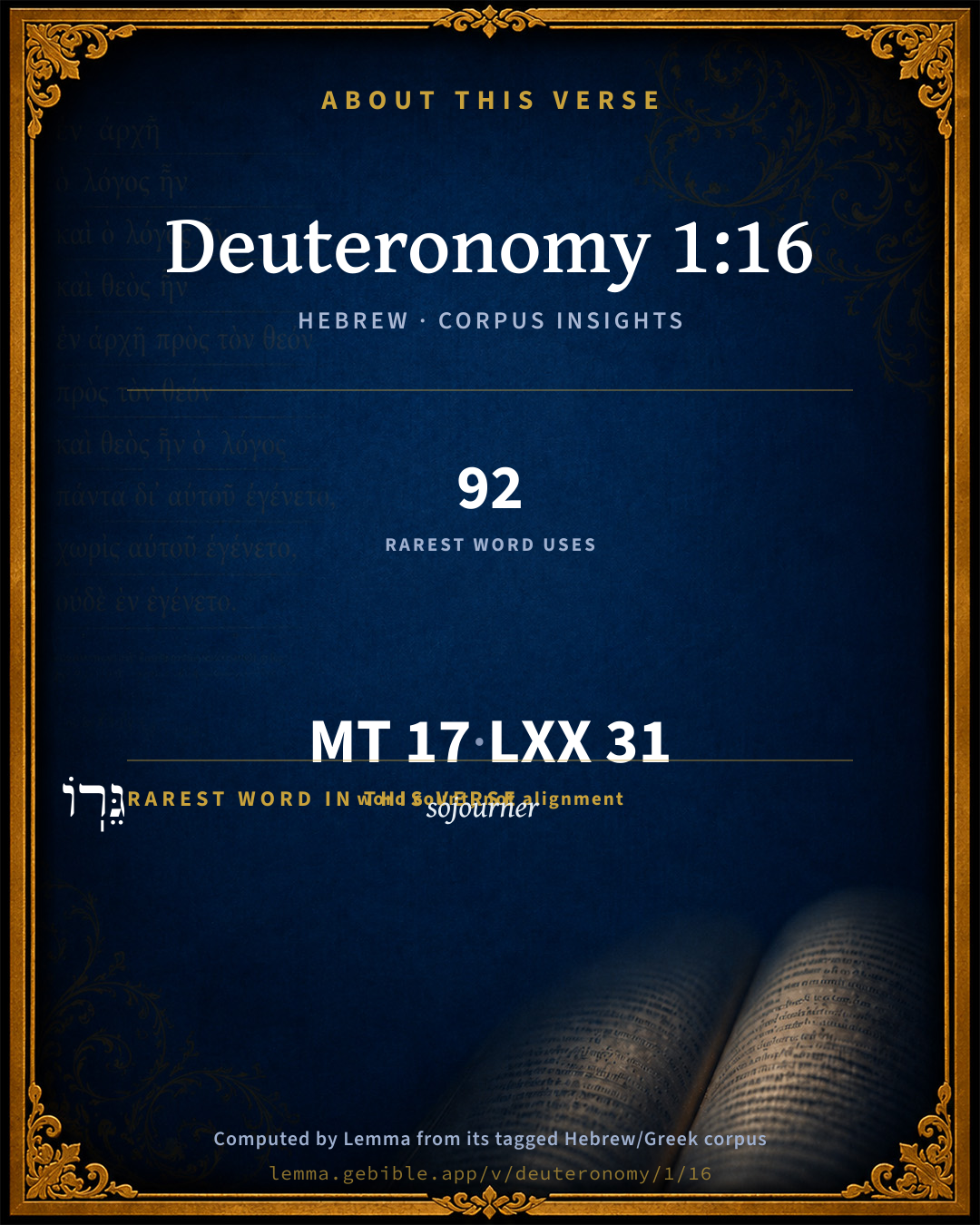
17
words
12
distinct lemmas
Pentateuch
section

Grammatical profile

  • 5 verbs
  • 6 nouns
  • 1 pronoun
  • 4 prepositions
  • 1 particle

Verb forms

  • וָאֲצַוֶּה֙ Piel · Sequential Imperfect
  • שֹׁ֣פְטֵיכֶ֔ם Qal · Participle Active
  • לֵאמֹ֑ר Qal · Infinitive Construct
  • שָׁמֹ֤עַ Qal · Infinitive Absolute
  • וּשְׁפַטְתֶּ֣ם Qal · Sequential Perfect

Repetition

Words recur within this verse — often emphatic in Hebrew:

  • בֵּין between H996 ×4
  • שֹׁ֣פְטֵיכֶ֔ם to judge H8199 ×2
  • אֲחֵיכֶם֙ brother H251 ×2

Hebrew & Septuagint length

In English translation the verse runs 31 words from the Hebrew and 30 from the Septuagint (LXX English) — closely comparable.

A rough comparison of the two English renderings, which tokenize alike — not a word-level alignment.

Word counts can differ between the Hebrew and the Greek without any difference in meaning — e.g. the Hebrew direct-object marker אֵת has no separate Greek word, and Greek often adds the article ὁ.

In the original languages it is 17 Hebrew tokens and 31 Greek tokens — but the two are counted differently (Hebrew bundles its prefixes and suffixes into one token; the Greek is in lemma form), so that isn’t a like-for-like length.

Cross-references

18

Topical passages linked to Deuteronomy 1:16 in the Treasury of Scripture Knowledge — connected by theme and wording, ordered by reader-vote popularity; previews shown in the World English Bible.

  • John 7:24 Don't judge according to appearance, but judge righteous judgment."
  • Exodus 22:21 "You shall not wrong an alien, neither shall you oppress him, for you were aliens in the land of Egypt.
  • Exodus 23:2–3 You shall not follow a crowd to do evil; neither shall you testify in court to side with a multitude to pervert justice;
  • Exodus 23:7–9 "Keep far from a false charge, and don't kill the innocent and righteous: for I will not justify the wicked.
  • Leviticus 24:22 You shall have one kind of law, for the foreigner as well as the native-born: for I am Yahweh your God.'"
  • Deuteronomy 16:18–19 Judges and officers shall you make you in all your gates, which Yahweh your God gives you, according to your tribes; and they shall judge the people with righteous judgment.
  • 2 Chronicles 19:6–10 and said to the judges, Consider what you do: for you don't judge for man, but for Yahweh; and [he is] with you in the judgment.
  • 1 Timothy 5:21 I charge you in the sight of God, and Christ Jesus, and the chosen angels, that you observe these things without prejudice, doing nothing by partiality.
  • Leviticus 19:15 "'You shall do no injustice in judgment: you shall not be partial to the poor, nor show favoritism to the great; but in righteousness shall you judge your neighbor.
  • Numbers 27:19 and set him before Eleazar the priest, and before all the congregation; and give him a charge in their sight.
  • Deuteronomy 24:14 You shall not oppress a hired servant who is poor and needy, whether he be of your brothers, or of your foreigners who are in your land within your gates:
  • Deuteronomy 27:11 Moses charged the people the same day, saying,
  • Deuteronomy 31:14 Yahweh said to Moses, Behold, your days approach that you must die: call Joshua, and present yourselves in the tent of meeting, that I may give him a charge. Moses and Joshua went, and presented themselves in the tent of meeting.
  • 2 Samuel 23:3 The God of Israel said, The Rock of Israel spoke to me: One who rules over men righteously, Who rules in the fear of God,
  • Psalms 58:1 Do you indeed speak righteousness, silent ones? Do you judge blamelessly, you sons of men?
  • 1 Timothy 6:17 Charge those who are rich in this present world that they not be haughty, nor have their hope set on the uncertainty of riches, but on the living God, who richly provides us with everything to enjoy;
  • Deuteronomy 10:18–19 He does execute justice for the fatherless and widow, and loves the foreigner, in giving him food and clothing.
  • 1 Thessalonians 2:11 As you know how we exhorted, comforted, and implored every one of you, as a father does his own children,

Cross-references courtesy of OpenBible.info (CC BY 4.0).

Hebrew and Greek witnesses Masoretic Hebrew ↔ Greek Septuagint

The same verse in the two great witnesses to the Old Testament, shown verse-for-verse.

These are two independent witnesses, not word-aligned to each other, and the Septuagint is shown in lemma (dictionary) form.

Hebrew Deuteronomy 1:16 Masoretic · Westminster Leningrad Codex

וָאֲצַוֶּה֙ אֶת שֹׁ֣פְטֵיכֶ֔ם בָּעֵ֥ת הַהִ֖וא לֵאמֹ֑ר שָׁמֹ֤עַ בֵּין אֲחֵיכֶם֙ וּשְׁפַטְתֶּ֣ם צֶ֔דֶק בֵּֽין אִ֥ישׁ וּבֵין אָחִ֖יו וּבֵ֥ין גֵּרֽוֹ

I charged your judges at that time, saying, Hear [the causes] between your brothers, and judge righteously between a man and his brother, and the foreigner who is living with him.

World English Bible · Public Domain

Greek LXX Deuteronomy 1:16 Septuagint · lemma form

καί ἐντέλλομαι ὁ κριτής σύ ἐν ὁ καιρός ἐκεῖνος λέγω διαἀκούω ἀνά μέσος ὁ ἀδελφός σύ καί κρίνω δικαίως ἀνά μέσος ἀνήρ καί ἀνά μέσος ἀδελφός καί ἀνά μέσος προσήλυτος αὐτός

And I charged your judges at that time, saying, Hear causes between your brethren, and judge rightly between a man and his brother, and the stranger that is with him.

LXX2012 (modern English Septuagint) · Public Domain

Hebrew: Westminster Leningrad Codex (CC BY 4.0). Greek: Septuagint (public domain); English from LXX2012 (modern English Septuagint) (Public Domain). How the Septuagint differs from the Hebrew →

Targum (Aramaic paraphrase)

2

The Targum is the ancient Jewish Aramaic paraphrase of the Hebrew Scriptures — an interpretive translation, not the Hebrew text itself. Onkelos (literal) and Pseudo-Jonathan (expansive) render the Torah, and Jonathan the Prophets. Coverage is partial: where no permissively-licensed English translation exists for a verse, only the Aramaic is shown. This is verse-level text, not a word-by-word alignment to the Hebrew.

  1. Targum Onkelos Torah (Genesis–Deuteronomy)
    וּפַקֵדִית יָת דַיָנֵיכוֹן בְּעִדָנָא הַהִיא לְמֵימָר שְׁמָעוּ בֵּין אַחֵיכוֹן וּתְדוּנוּן קוּשְׁטָא בֵּין גַבְרָא וּבֵין אֲחוּהִי וּבֵין גִיוֹרֵהּ

    (no public-domain English translation for this verse)

    Targum Onkelos — Aramaic: “Onkelos Genesis” (public domain); “Onkelos Exodus” (public domain); “Onkelos Leviticus” (public domain); “Onkelos Numbers” (public domain); “Onkelos Deuteronomy” (public domain). English: “Sefaria Community Translation” (CC0 1.0 (public-domain dedication)); “J.W. Etheridge. The Targums of Onkelos and Jonathan Ben Uzziel on the Pentateuch. London: Longmans, Green, 1862” (public domain). Text via Sefaria.

  2. Targum Pseudo-Jonathan Torah (Genesis–Deuteronomy)
    וּפַקֵּדִית יַת דַּיָינֵיכוֹן בְּעִידָנָא הַהִיא יַת סִדְרֵי דִינַיָא לְמֵימָר קַבִּילוּ מִן אֲחוּכוֹן דְּלָא יְמַלֵּיל חָד כָּל מִילוֹי וְחָד מְקַטַע מִילוֹי וּמִדִּשְׁמַעֲתּוּן מִלֵּיהוֹן לֵית אֶפְשַׁר לְכוֹן דְּלָא לְמִדַנְהוֹן וּתְדוּנוּן דִּינָא בִּקְשׁוֹט וּפְשָׁרוּת שְׁלָמָא בֵּין גַּבְרָא לְאָחוֹי וּבֵין מַאן דְּמֶאֱגַר מִילֵי דִינִין

    And I charged your judges at that time with the orders of judgments, saying: So hear your brethren that one may not (be permitted to) speak all his words, while another is compelled to cut his words short; and so hearken to their words, as that it may be impossible for you not to judge them, and deliver judgment in truth, and to resolve (a matter) completely between a man and his brother, and between him who hireth words of litigation.

    Targum Pseudo-Jonathan — Aramaic: “Targum Jonathan on Genesis” (public domain); “Targum Jonathan on Exodus” (public domain); “Targum Jonathan on Leviticus” (public domain); “Targum Jonathan on Numbers” (public domain); “Targum Jonathan on Deuteronomy” (public domain). English: “The Targum of Jonathan ben Uzziel, trans. J. W. Etheridge, London, 1862” (public domain). Text via Sefaria.

Commentary

Notes on Deuteronomy 1:16 from classic Christian and Jewish commentators (each source and its license shown beneath its notes). The classic Christian expositions comment on the surrounding passage and are grouped to its opening verse, so a note may address several verses; the Jewish commentaries on the Tanakh (Rashi and others) are per-verse, so they appear only where the commentator wrote on this verse.

Lemma curates 59 commentaries, every one of them public domain or Creative Commons licensed, each selected and text-cleaned for this edition rather than reprinted as found. About our sources →

Trapp's Complete Commentary

John Trapp

Deu 1:16 And I charged your judges at that time, saying, Hear [the causes] between your brethren, and judge righteously between [every] man and his brother, and the stranger [that is] with him.

Ver. 16. Hear the causes, &c.] Hear them out. In the Forum of Rome the accuser had six hours allotted him to accuse, the accused had nine hours to make his answer {a}

And judge righteously.] So upright was the sentence of the Areopagites in Athens, that none could ever say he was unjustly condemned; nay, both parties, as well those that are cast as they that cast, are alike contented. {b}

{a} Ulpian., in Orat. Demosth. de fal legat.

{b} ηππωμενοι σπεργουσιν ομοιως τοιν κεκρατηκοσι.

John Trapp, A Commentary or Exposition upon All the Books of the Old and New Testament (1647–1656) — public domain. Text from a community e-Sword module.

Joseph Benson's Commentary

Deu 1:16. The stranger — That converseth or dealeth with him. To such God would have justice equally administered as to his own people, partly for the honour of religion, and partly for the interest which every man hath in matters of common right.

Joseph Benson's Commentary on the Old and New Testaments (1811–1818) — public domain. Text from a community e-Sword module.

Tyndale Open Study Notes

Tyndale Open Resources

1:16-17 Be . . . impartial (literally Do not notice faces): People appearing before the court should be treated as though they were wearing a mask to conceal their identity. Judges were not to be influenced by rich and powerful persons in the community but were to judge on the basis of God’s own impartiality (10:17) and treat all persons equally under the law.

Tyndale Open Study Notes — © Tyndale Open Resources, licensed CC BY-SA 4.0. Text via the HelloAO Bible API.

Ellicott's Commentary for English Readers

(16) And I charged your judges . . . saying.—These instructions given by Moses are an admirable expansion, but only an expansion, of those of Jethro(Exo_18:21), that the judges must be “able men, such as fear God, men of truth, hating covetousness”—a sentence older than the Decalogue itself.

A Bible Commentary for English Readers, edited by Charles John Ellicott (1878–1897) — public domain. Text from a community e-Sword module.

The Cambridge Bible for Schools and Colleges

gen. ed. J. J. S. Perowne

16. judges] Unless the previous emendation be accepted the term judges appears here for the first time in the passage.

Hear … and judge righteously] The two indispensables: patient, equal hearing, and impartial decision.

your brethren] Your fellow-Israelites.

the stranger that is with him] His Gêr or sojourner: any non-Israelite who leaving his own kin settles under the protection of an Israelite family or individual; in distinction from the ‘ezraḥ or born Israelite (Jos_8:33). The Ar. equivalents are ǧar and ṣarîḥ. See W. R. Smith, OTJC2, 342n., and Rel. Sem. 75 ff. In E the Gêr is not to be wronged, Exo_22:21; Exo_23:9, and to have rest on the Sabbath, Exo_23:12; cp. Exo_20:8. In D his equal rights at law are reiterated here, Deu_24:17, Deu_27:19; not to be oppressed, Deu_24:14, but cherished, Deu_10:19; to share with the Levite and the poor, Deu_14:29, Deu_16:11-14, Deu_24:19 ff., Deu_26:11 ff.; to rest on the Sabbath, Deu_5:14; enter the covenant, Deu_29:11; and keep the Law, Deu_31:12; only he is to have freedom in meats forbidden to Israel, Deu_14:21; if Israel persists in sin the Gêr shall rise over him, Deut 18:43. See on Deu_10:19 and Deu_14:21 where the different treatment of the Gêr in P is noted.

The Cambridge Bible for Schools and Colleges (gen. ed. J. J. S. Perowne; Cambridge University Press, 1878–1918) — public domain. Text from a community e-Sword module.

John Gill's Exposition

And I charged your judges at that time,.... When they were appointed and constituted, even the heads and rulers before spoken of; this charge is also new, and not recorded before:

saying, hear the causes between your brethren; hear both sides, and all that each of them have to say; not suffer one to say all he has to say, and oblige the other to cut his words short, as the Targum of Jonathan paraphrases it; but give them leave and time to tell their case, and give the best evidence they can of it:

and judge righteously; impartially, just as the case really appears to be, and according to the evidence given:

between every man and his brother; between an Israelite and an Israelite:

and the stranger that is with him; between an Israelite and proselyte, whether a proselyte of the gate, or of righteousness; the same justice was to be done to them as to an Israelite.

John Gill's Exposition of the Whole Bible (1746–1763) — public domain (CC PDM 1.0). Text via the HelloAO Bible API.

Matthew Poole's English Annotations

That converseth or dealeth with him. To such God would have justice equally administered as to his own people, partly for the honour of religion, and partly for the interest which every man hath in matters of common right.

Matthew Poole's English Annotations on the Holy Bible (1683–1685) — public domain. Text from a community e-Sword/MySword module.

John Wesley's Explanatory Notes

The stranger - That converseth or dealeth with himn. To Such God would have justice equally adtninistred as to his own people, partly for the honour of religion, and partly for the interest which every man hath in matters of common right.

John Wesley, Explanatory Notes Upon the Whole Bible (1754–1765) — public domain. Text via the GEBible commentary corpus.

Rashi

Rabbi Shlomo Yitzchaki (Rashi)

ואצוה את שפטיכם AND I COMMANDED YOUR JUDGES — I said to them: be deliberate in judgment: if a certain point of law comes before you once, twice, three times, do not say, "This point of law has already come before me several times”, but discuss it well on that occasion also (Sifrei Devarim 16:1).

בעת ההוא [AND I COMMANDED YOUR JUDGES] AT THAT TIME — As soon as I appointed them, I said to them, "It is not now as heretofore: heretofore you were your own masters (lit., under your own control), now you are in the service of the Community!” (Sifrei Devarim 16:2).

שמע — This grammatical form expresses constant doing: oyant in old French, be hearing, just as זכור and שמור (see Rashi on Numbers 25:17).

ובין גרו AND BETWEEN HIS גר — this is his opponent in the lawsuit who merely heaps up (אוגר) words against him. Another explanation of AND BETWEEN HIS גר — also in a matter concerning a dwelling house (גור = to dwell), — in the division of property amongst brothers, even if it be a dispute about an oven and a kitchen range (cf. Sifrei Devarim 16:8-9; Sanhedrin 7b).

Rashi on the Tanakh — English translations: “The Judaica Press complete Tanach with Rashi, translated by A. J. Rosenberg” (CC BY 4.0); “Pentateuch with Rashi's commentary by M. Rosenbaum and A.M. Silbermann, 1929-1934” (public domain); “The Metsudah Tanach series, Lakewood, N.J” (CC BY 4.0); and “The Book of Joshua, Metsudah Publications, 1997” (CC BY 4.0). Text via Sefaria.

Lesson kit

Teaching starters — assembled from the data on this page, not authored interpretation. Every prompt links to the verse data it draws on. Edit before teaching.

Deuteronomy, in the Pentateuch, opens this verse with 17 words (12 distinct Hebrew lemmas). Its most distinctive word is gêr (“sojourner”). A historical commentator’s framing appears above. Read the whole chapter for the surrounding context.

Discussion questions

  1. What does “sojourner” (gêr) contribute to the verse as a whole?
  2. How does John 7:24, which shares this passage’s theme, read alongside this verse?
  3. What does the repetition of “between” (4× in this one verse) do in this verse?
  4. These translations render this verse differently; the difference is in the English rendering, not the original. What questions does that raise?
  5. «וָאֲצַוֶּה֙» is a Piel Sequential Imperfect verb. How does that grammatical form shape the action described?
  6. Compare how Trapp's Complete Commentary and Joseph Benson's Commentary read this verse. Where do they agree or differ?

Things to notice

Reading settings

Reading text

Shown beneath each verse's original-language words.

Old Testament
Old Testament edition

Read the OT as the Masoretic Hebrew (MT) or the Greek Septuagint (LXX).

English shown for the Greek Septuagint (in the Hebrew ↔ Greek comparison).

Comparing translations? Open the Compare panel on any verse page to stack up to four side by side.