
Genesis 34:22

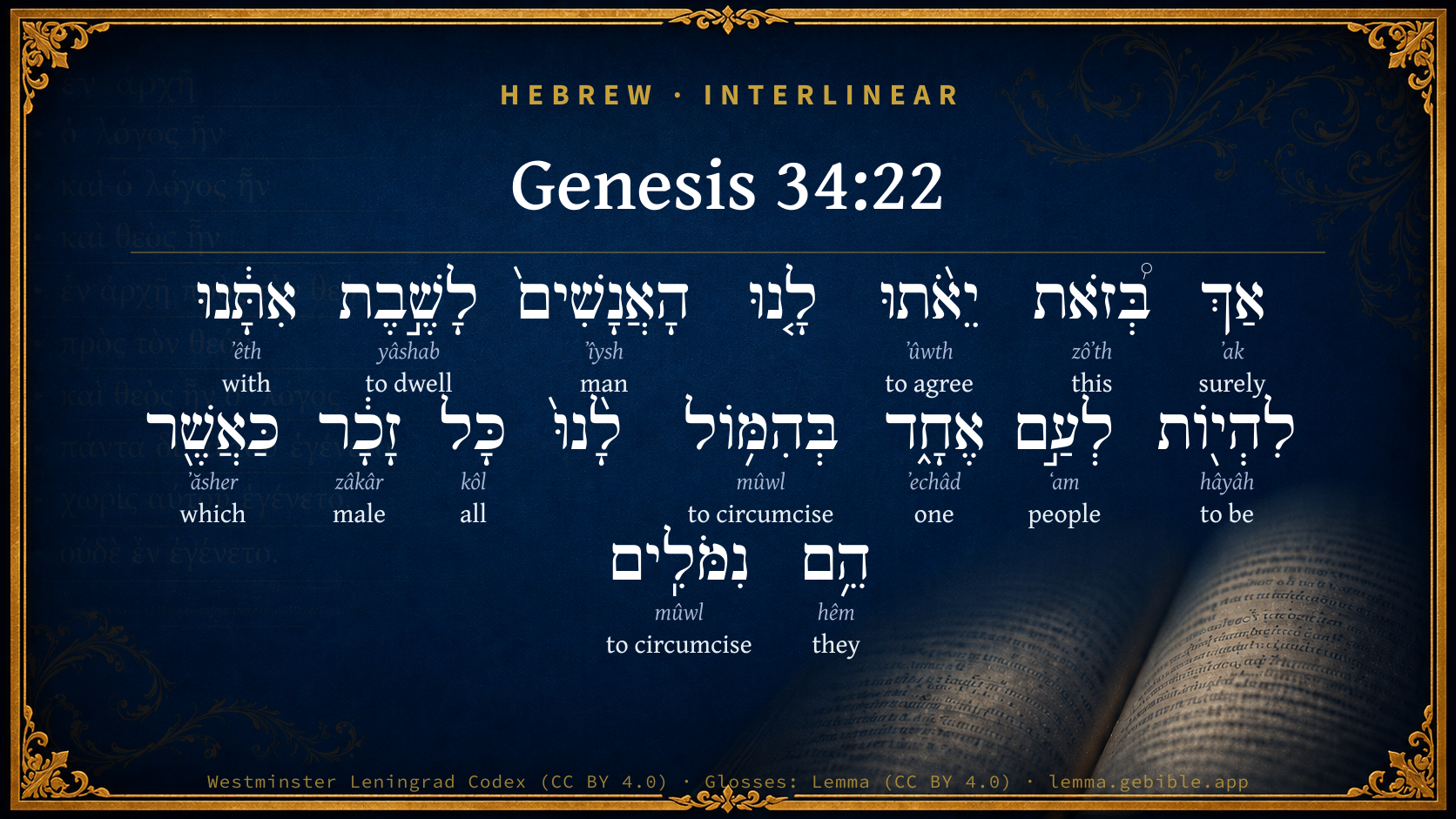
Hebrew (Westminster Leningrad Codex) Genesis 34:22 appears in the Hebrew Old Testament. The text above is from the Westminster Leningrad Codex. Each word links to its Strong’s number, a concise gloss, and parsing drawn from the Open Scriptures Hebrew Bible morphology. Click any word for its full Brown-Driver-Briggs (BDB) entry.
Download image
Cite this verse

Genesis 34:22 (World English Bible). Public Domain. Lemma interlinear Bible study tool, https://lemma.gebible.app/v/genesis/34/22.

Show BibTeX & RIS
BibTeX
RIS
English Translation
Only on this condition will the men consent to us to dwell with us, to become one people, if every male among us be circumcised, as they are circumcised.
World English Bible · Public Domain
Download a study sheet

One document with this verse’s original text, its word-by-word gloss line, the meaning frame, cross-references with their text, attributed commentary, and full source and license credits — printable, and it pastes into notes with its structure intact.

This verse Autodidact and up

Study sheet (.html) Plain text (.txt)

A passage Seminary Student

Up to 50 verses in one chapter. A passage sheet keeps up to 6 commentary sources and 12 cross-references per verse, in the order this page ranks them, and says so on the sheet whenever that leaves anything out. Ask for a single verse and you get the Autodidact verse sheet above.

Everything on this page stays free to read, with no account — the sheet is a download of what is already on screen, not access to it.

Want to remove ads? Support Godless Engineer
Compare translations 3

The same verse in 3 English versions, stacked beneath the original-language interlinear above. Click any original word for its lexicon entry.

Each is an independent rendering of the whole verse — the interlinear is not word-aligned to these translations.

Highlighted words mark where these versions differ — a whole-verse word diff, not a word-by-word alignment.

  • World English Bible Public Domain
    Only on this condition will the men consent to us to dwell with us, to become one people, if every male among us be circumcised, as they are circumcised.
  • King James Version Public Domain
    Only herein will the men consent unto us for to dwell with us, to be one people, if every male among us be circumcised, as they are circumcised.
  • unfoldingWord Literal Text CC BY-SA 4.0
    Only on this will the men consent with us to settle with us, to become one people: when every male among us is circumcised just as they are circumcised.

unfoldingWord Literal Text — © unfoldingWord, licensed CC BY-SA 4.0. Word-aligned USFM3 via Door43 (git.door43.org/unfoldingWord/en_ult).

Versions to compare (up to 4)

3 of 4 selected

Show all 18 translations

Every available English version of this verse, each an independent rendering of the whole verse.

  • World English Bible Public Domain
    Only on this condition will the men consent to us to dwell with us, to become one people, if every male among us be circumcised, as they are circumcised.
  • Berean Standard Bible Public Domain
    But only on this condition will the men agree to dwell with us and be one people: if all our men are circumcised as they are.
  • Majority Standard Bible Public Domain
    But only on this condition will the men agree to dwell with us and be one people: if all our men are circumcised as they are.
  • King James Version Public Domain
    Only herein will the men consent unto us for to dwell with us, to be one people, if every male among us be circumcised, as they are circumcised.
  • American Standard Version (1901) Public Domain
    Only on this condition will the men consent unto us to dwell with us, to become one people, if every male among us be circumcised, as they are circumcised.
  • Revised Version (1885) Public Domain
    Only on this condition will the men consent unto us to dwell with us, to become one people, if every male among us be circumcised, as they are circumcised.
  • Geneva Bible (1599) Public Domain
    Onely herein will the men consent vnto vs for to dwell with vs, and to be one people, if all the men children among vs be circumcised as they are circumcised.
  • Douay-Rheims (1899) Public Domain
    One thing there is for which so great a good is deferred: We must circumcise every male among us, following the manner of the nation.
  • Young's Literal Translation Public Domain
    `Only for this do the men consent to us, to dwell with us, to become one people, in every male of us being circumcised, as they are circumcised;
  • Literal Standard Version CC BY-SA 4.0
    Only for this do the men consent to us, to dwell with us, to become one people, in every male of us being circumcised, as they are circumcised;
  • Unlocked Literal Bible CC BY-SA 4.0
    Only on this condition will the men agree to live with us and become one people: If every male among us is circumcised, as they are circumcised.
  • unfoldingWord Literal Text CC BY-SA 4.0
    Only on this will the men consent with us to settle with us, to become one people: when every male among us is circumcised just as they are circumcised.
  • Darby Bible Public Domain
    But only in this will the men consent to us to dwell with us, to be one people -- if every male among us be circumcised, just as they are circumcised.
  • World Messianic Bible Public Domain
    Only on this condition will the men consent to us to live with us, to become one people, if every male among us is circumcised, as they are circumcised.
  • Webster's Bible Public Domain
    Only herein, will the men consent to us to dwell with us, to be one people, if every male among us shall be circumcised, as they are circumcised.
  • Free Bible Version CC BY-SA 4.0
    But they will only agree to this on one condition: they will only join us and become one family if every male among us is circumcised like they are.
  • Bible in Basic English Public Domain
    But these men will make an agreement with us to go on living with us and to become one people, only on the condition that every male among us undergoes circumcision as they have done.
  • JPS Tanakh (1917) Public Domain
    Only on this condition will the men consent unto us to dwell with us, to become one people, if every male among us be circumcised, as they are circumcised.

Literal Standard Version (2020), Covenant Press — licensed CC BY-SA 4.0. Text via the HelloAO Bible API (eBible.org). Unlocked Literal Bible (unfoldingWord) — licensed CC BY-SA 4.0. Text via the HelloAO Bible API (eBible.org). unfoldingWord Literal Text — © unfoldingWord, licensed CC BY-SA 4.0. Word-aligned USFM3 via Door43 (git.door43.org/unfoldingWord/en_ult). Free Bible Version, Dr. Jonathan Gallagher — licensed CC BY-SA 4.0. Text via the HelloAO Bible API (eBible.org).

Word by word

More ways to search: Search by grammar → Find every occurrence → Compare this word →

Practice this passage: Drill this verse → Learn its vocabulary →

יֵאֹ֨תוּ
ʼûwth
H225
“to agree”
Verb, Niphal, Imperfect, 3rd Person, Masculine, Plural
Part of Speech
Verb
Stem
Niphal
Form
Imperfect
Person
3rd Person
Gender
Masculine
Number
Plural
Full BDB Definition

Origin: a primitive root

TWOT: 53

(Niphal) to consent, agree
  1. אַךְ ʼak H389 “surely” Particle, Accusative
  2. בְּ֠זֹאת zôʼth H2063 “in/at · this” Preposition + Pronoun, Demonstrative, Feminine, Singular
  3. הָאֲנָשִׁים֙ ʼîysh H376 “the · men” Particle, Definite Article + Noun, Common, Masculine, Plural, Absolute
  4. לָשֶׁ֣בֶת yâshab H3427 “to dwell” Preposition + Verb, Qal, Infinitive Construct
  5. אִתָּ֔נוּ ʼêth H854 “with · us” Preposition + Suffix, Personal, 1st Person, Common, Plural
  6. לִהְי֖וֹת hâyâh H1961 “to be” Preposition + Verb, Qal, Infinitive Construct
  7. לְעַ֣ם ʻam H5971 “to/for · people” Preposition + Noun, Common, Masculine, Singular, Absolute
  8. אֶחָ֑ד ʼechâd H259 “one” Adjective, Cardinal number, Masculine, Singular, Absolute
  9. בְּהִמּ֥וֹל mûwl H4135 “in/at · to circumcise” Preposition + Verb, Niphal, Infinitive Construct
  10. כָּל kôl H3605 “all of” Noun, Common, Masculine, Singular, Construct
  11. זָכָ֔ר zâkâr H2145 “male” Adjective, Adjective, Masculine, Singular, Absolute
  12. כַּאֲשֶׁ֖ר ʼăsher H834 “like/as · which” Preposition + Particle, Relative
  13. הֵ֥ם hêm H1992 “they” Pronoun, Personal, 3rd Person, Masculine, Plural
  14. נִמֹּלִֽים mûwl H4135 “circumcising” Verb, Niphal, Participle Active, Masculine, Plural, Absolute

About this verse

These counts appear in no published source. They are computed here, from the morphology-tagged text and Lemma’s own curated glosses. What Lemma adds →

17
words
14
distinct lemmas
Pentateuch
section

Notable vocabulary

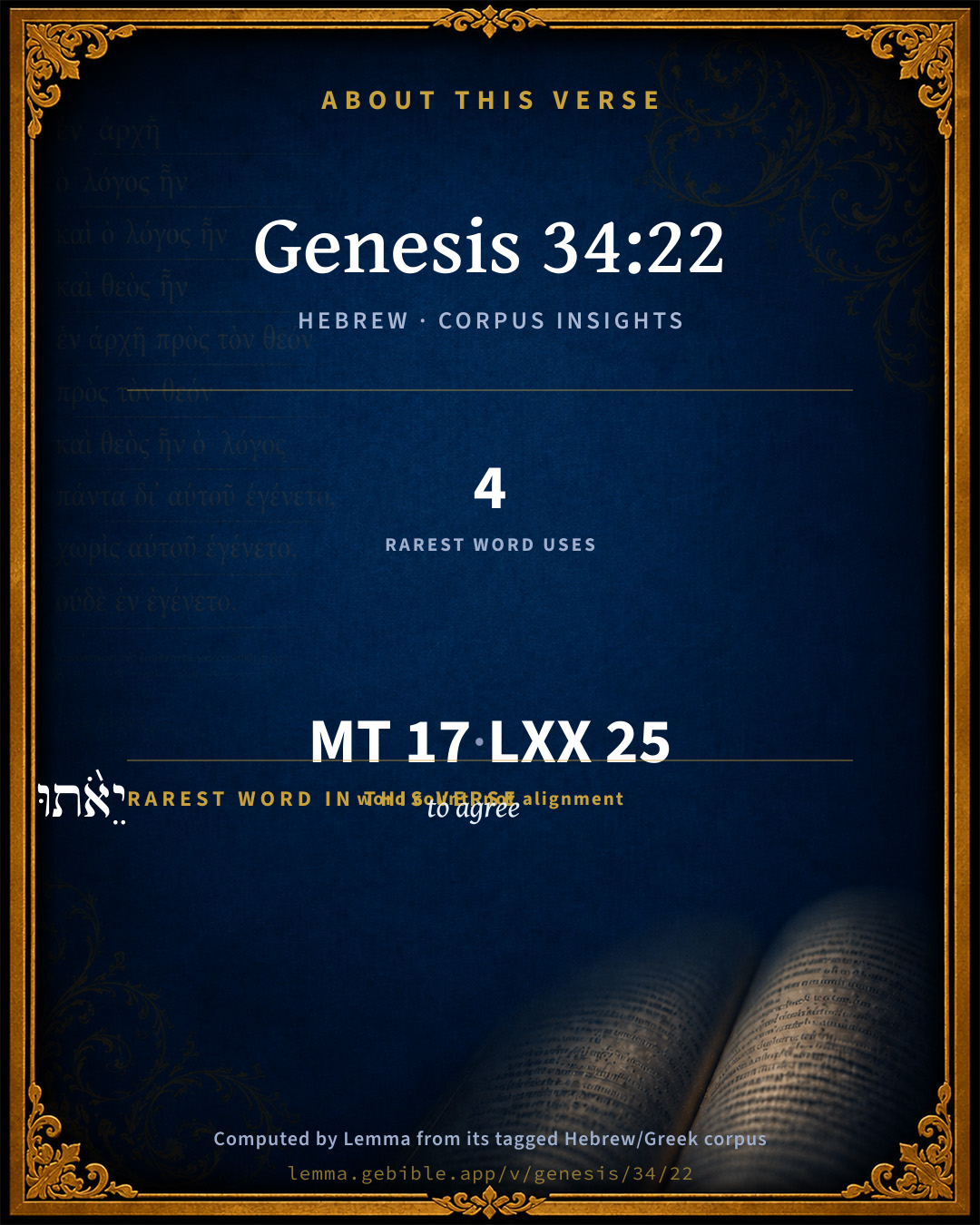
The rarest word here is יֵאֹ֨תוּ to agree H225 — appearing just 4 times in the whole Hebrew Bible.

Shared distinctive vocabulary

יֵאֹ֨תוּ to agree H225 occurs in 4 verses of the Hebrew Bible. Also found in:

Grammatical profile

  • 5 verbs
  • 3 nouns
  • 2 adjectives
  • 2 pronouns
  • 3 prepositions
  • 2 particles

Verb forms

  • יֵאֹ֨תוּ Niphal · Imperfect
  • לָשֶׁ֣בֶת Qal · Infinitive Construct
  • לִהְי֖וֹת Qal · Infinitive Construct
  • בְּהִמּ֥וֹל Niphal · Infinitive Construct
  • נִמֹּלִֽים Niphal · Participle Active

Repetition

A word recurs within this verse — often emphatic in Hebrew:

  • בְּהִמּ֥וֹל to circumcise H4135 ×2

Hebrew & Septuagint length

In English translation the verse runs 29 words from the Hebrew and 32 from the Septuagint (LXX English) — closely comparable.

A rough comparison of the two English renderings, which tokenize alike — not a word-level alignment.

Word counts can differ between the Hebrew and the Greek without any difference in meaning — e.g. the Hebrew direct-object marker אֵת has no separate Greek word, and Greek often adds the article ὁ.

In the original languages it is 17 Hebrew tokens and 25 Greek tokens — but the two are counted differently (Hebrew bundles its prefixes and suffixes into one token; the Greek is in lemma form), so that isn’t a like-for-like length.

Hebrew and Greek witnesses Masoretic Hebrew ↔ Greek Septuagint

The same verse in the two great witnesses to the Old Testament, shown verse-for-verse.

These are two independent witnesses, not word-aligned to each other, and the Septuagint is shown in lemma (dictionary) form.

Hebrew Genesis 34:22 Masoretic · Westminster Leningrad Codex

אַךְ בְּ֠זֹאת יֵאֹ֨תוּ לָ֤נוּ הָאֲנָשִׁים֙ לָשֶׁ֣בֶת אִתָּ֔נוּ לִהְי֖וֹת לְעַ֣ם אֶחָ֑ד בְּהִמּ֥וֹל לָ֨נוּ֙ כָּל זָכָ֔ר כַּאֲשֶׁ֖ר הֵ֥ם נִמֹּלִֽים

Only on this condition will the men consent to us to dwell with us, to become one people, if every male among us be circumcised, as they are circumcised.

World English Bible · Public Domain

Greek LXX Genesis 34:22 Septuagint · lemma form

μόνον ἐν οὗτος ὁμοιόω ἐγώ ὁ ἄνθρωπος ὁ καταοἰκέω μετά ἐγώ ὥστε εἰμί λαός εἷς ἐν ὁ περιτέμνω ἐγώ πᾶς ἀρσενικός καθά καί αὐτός περιτέμνω

Only on these terms will the men conform to us to dwell with us so as to be one people, if every male of us be circumcised, as they also are circumcised.

LXX2012 (modern English Septuagint) · Public Domain

Hebrew: Westminster Leningrad Codex (CC BY 4.0). Greek: Septuagint (public domain); English from LXX2012 (modern English Septuagint) (Public Domain). How the Septuagint differs from the Hebrew →

Targum (Aramaic paraphrase)

2

The Targum is the ancient Jewish Aramaic paraphrase of the Hebrew Scriptures — an interpretive translation, not the Hebrew text itself. Onkelos (literal) and Pseudo-Jonathan (expansive) render the Torah, and Jonathan the Prophets. Coverage is partial: where no permissively-licensed English translation exists for a verse, only the Aramaic is shown. This is verse-level text, not a word-by-word alignment to the Hebrew.

  1. Targum Onkelos Torah (Genesis–Deuteronomy)
    בְּרַם בְּדָא יִתָּפְסוּן לָנָא גּוּבְרַיָּא לְמִתַּב עִמָּנָא לְמֶהֱוֵי לְעַמָּא חָד בְּמִגְזַר לָנָא כָּל דְּכוּרָא כְּמָא דִּי אִנּוּן גְּזִירִין

    (no public-domain English translation for this verse)

    Targum Onkelos — Aramaic: “Onkelos Genesis” (public domain); “Onkelos Exodus” (public domain); “Onkelos Leviticus” (public domain); “Onkelos Numbers” (public domain); “Onkelos Deuteronomy” (public domain). English: “Sefaria Community Translation” (CC0 1.0 (public-domain dedication)); “J.W. Etheridge. The Targums of Onkelos and Jonathan Ben Uzziel on the Pentateuch. London: Longmans, Green, 1862” (public domain). Text via Sefaria.

  2. Targum Pseudo-Jonathan Torah (Genesis–Deuteronomy)
    בְּרַם בְּדָא יִתְפַּיְיסוּן לָנָא גוּבְרַיָא לְמֵיתַב עִמָנָא לְמֶהֱוֵי לְעַם חַד בְּמִגְזוֹר לָנָא כָּל דְכוּרָא הֵיכְמָא דְאִינוּן גָזְרִין

    But in this only will the men accede to us, to dwell with us, and to be one people, by every male of us being circumcised as they are.

    Targum Pseudo-Jonathan — Aramaic: “Targum Jonathan on Genesis” (public domain); “Targum Jonathan on Exodus” (public domain); “Targum Jonathan on Leviticus” (public domain); “Targum Jonathan on Numbers” (public domain); “Targum Jonathan on Deuteronomy” (public domain). English: “The Targum of Jonathan ben Uzziel, trans. J. W. Etheridge, London, 1862” (public domain). Text via Sefaria.

Commentary

Notes on Genesis 34:22 from classic Christian and Jewish commentators (each source and its license shown beneath its notes). The classic Christian expositions comment on the surrounding passage and are grouped to its opening verse, so a note may address several verses; the Jewish commentaries on the Tanakh (Rashi and others) are per-verse, so they appear only where the commentator wrote on this verse.

Lemma curates 59 commentaries, every one of them public domain or Creative Commons licensed, each selected and text-cleaned for this edition rather than reprinted as found. About our sources →

Trapp's Complete Commentary

John Trapp

Gen 34:22 Only herein will the men consent unto us for to dwell with us, to be one people, if every male among us be circumcised, as they [are] circumcised.

Ver. 22. If every male among us be circumcised.] {See Trapp on "Gen 34:26"}

John Trapp, A Commentary or Exposition upon All the Books of the Old and New Testament (1647–1656) — public domain. Text from a community e-Sword module.

John Gill's Exposition

Shall not their cattle, and their substance, and every beast of theirs, be ours?.... Which would in course come into their families in process of time, by intermarrying with them, or, being more numerous and powerful than they, could seize upon them when they pleased, and take all they had: thus they argue from the profit and advantage that would accrue to them by admitting them among them, upon their terms; and this argument, taken from worldly interest, they knew would have great influence upon them:

only let us consent unto them; in the affair of circumcision:

and they will dwell with us; and what by trading with them, and marrying among them, all their wealth and riches will come into our hands.

John Gill's Exposition of the Whole Bible (1746–1763) — public domain (CC PDM 1.0). Text via the HelloAO Bible API.

unfoldingWord translationNotes

Door43 World Missions Community

General Information:

Hamor and Shechem his son continue to talk to the city elders.

Only on this condition will the men agree to live with us and become one people: If every male among us is circumcised, as they are circumcised

"Only if every man among us is circumcised, as the men of Israel are circumcised, will they agree to live among us and unite with us as one people"

Will not their livestock and their property—all their animals be ours?

Shechem uses a question to emphasize that Jacob's livestock and property will belong to the people of Shechem. This can be translated as a statement. AT: "All of their animals and property will be ours." (See: Rhetorical Question)

translationWords

people group

circumcise

unfoldingWord translationNotes — © Distant Shores Media and the Door43 World Missions Community, licensed CC BY-SA 4.0. Source: git.door43.org/Door43/en_tn.

Rashi

Rabbi Shlomo Yitzchaki (Rashi)

בהמול means by every male of us being circumcised (infinitive Niphal).

Rashi on the Tanakh — English translations: “The Judaica Press complete Tanach with Rashi, translated by A. J. Rosenberg” (CC BY 4.0); “Pentateuch with Rashi's commentary by M. Rosenbaum and A.M. Silbermann, 1929-1934” (public domain); “The Metsudah Tanach series, Lakewood, N.J” (CC BY 4.0); and “The Book of Joshua, Metsudah Publications, 1997” (CC BY 4.0). Text via Sefaria.

Lesson kit

Teaching starters — assembled from the data on this page, not authored interpretation. Every prompt links to the verse data it draws on. Edit before teaching.

Genesis, in the Pentateuch, opens this verse with 17 words (14 distinct Hebrew lemmas). Its most distinctive word is ʼûwth (“to agree”). A historical commentator’s framing appears above. Read the whole chapter for the surrounding context.

Discussion questions

  1. How does “to agree” (ʼûwth) shape what this verse is saying?
  2. How does Genesis 34:15, which shares the word «to agree», read alongside this verse?
  3. What does the repetition of “to circumcise” (2× in this one verse) do in this verse?
  4. The translations on this page render this verse differently — a whole-verse word diff, not a word-by-word alignment. What might account for the different wordings?
  5. «יֵאֹ֨תוּ» is a Niphal Imperfect verb. How does that grammatical form shape the action described?
  6. Compare how Trapp's Complete Commentary and John Gill's Exposition read this verse. Where do they agree or differ?

Things to notice

Reading settings

Reading text

Shown beneath each verse's original-language words.

Old Testament
Old Testament edition

Read the OT as the Masoretic Hebrew (MT) or the Greek Septuagint (LXX).

English shown for the Greek Septuagint (in the Hebrew ↔ Greek comparison).

Comparing translations? Open the Compare panel on any verse page to stack up to four side by side.