Exodus 2:13

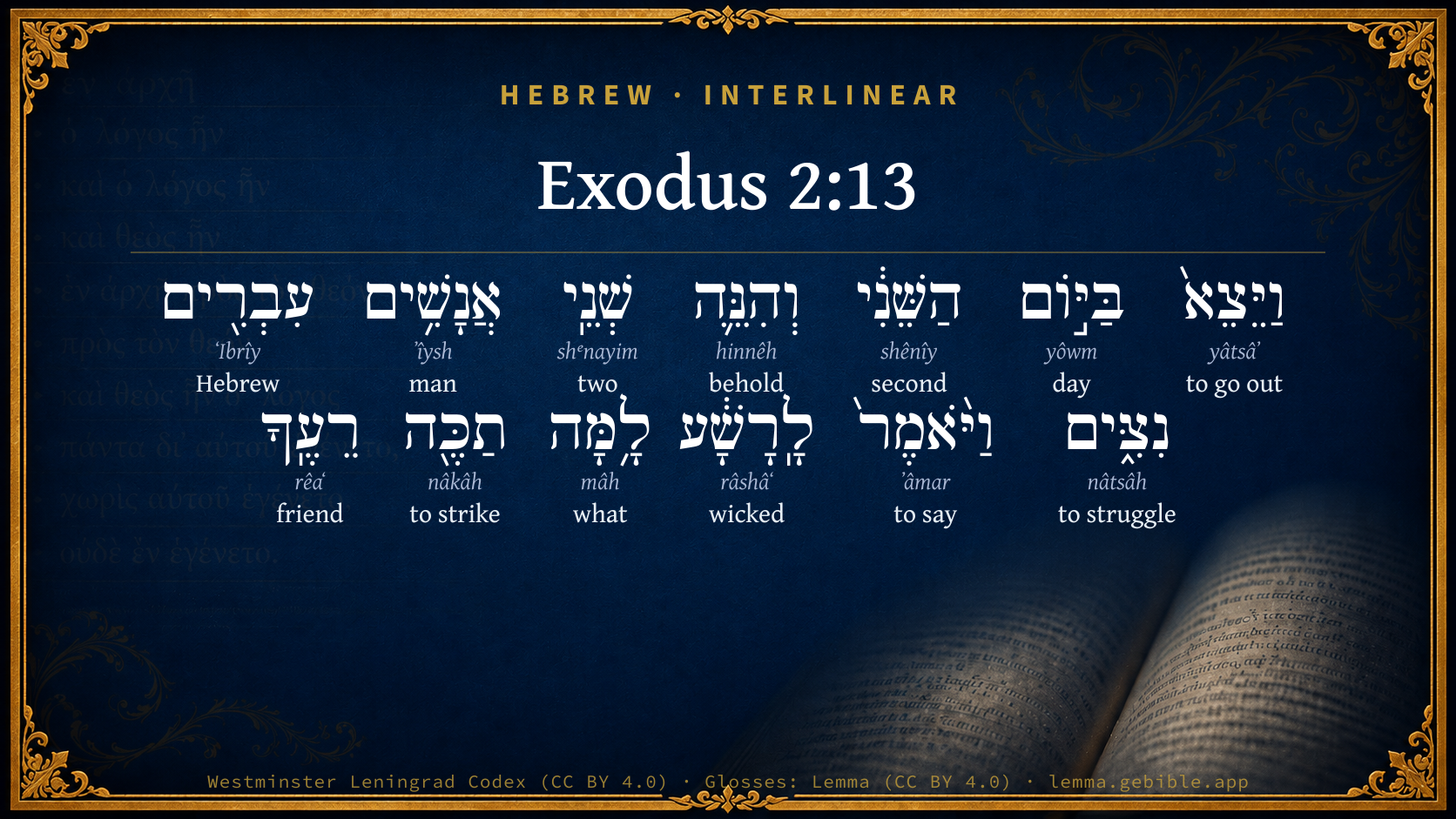
Hebrew (Westminster Leningrad Codex) Exodus 2:13 appears in the Hebrew Old Testament. The text above is from the Westminster Leningrad Codex. Each word links to its Strong’s number, a concise gloss, and parsing drawn from the Open Scriptures Hebrew Bible morphology. Click any word for its full Brown-Driver-Briggs (BDB) entry.
Download image
Cite this verse

Exodus 2:13 (World English Bible). Public Domain. Lemma interlinear Bible study tool, https://lemma.gebible.app/v/exodus/2/13.

Show BibTeX & RIS
BibTeX
RIS
English Translation
He went out the second day, and, behold, two men of the Hebrews were fighting with each other. He said to him who did the wrong, "Why do you strike your fellow?"
World English Bible · Public Domain
Highlights
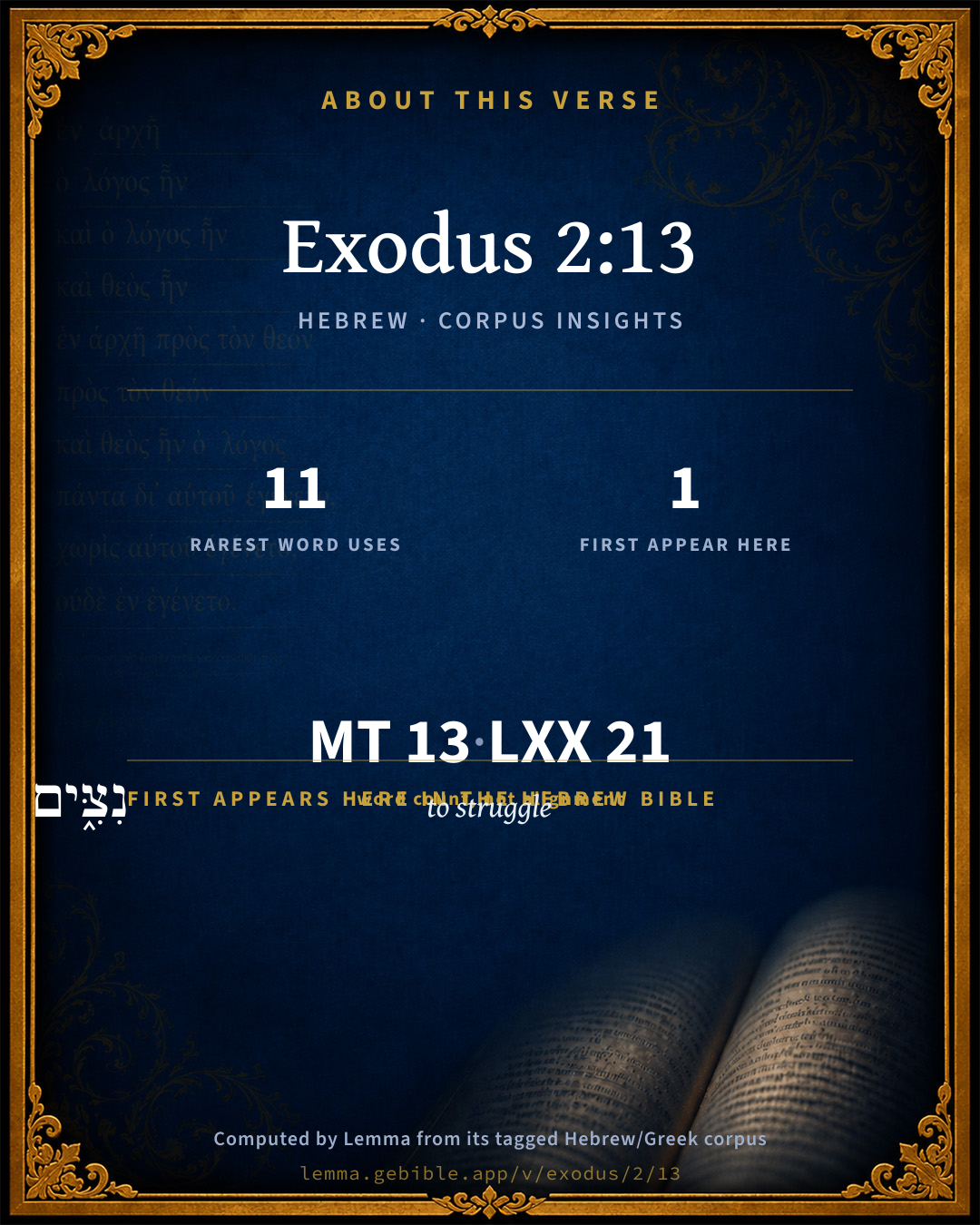
  • 1 first appearance in the Hebrew Bible
Full analysis ↓
Download a study sheet

One document with this verse’s original text, its word-by-word gloss line, the meaning frame, cross-references with their text, attributed commentary, and full source and license credits — printable, and it pastes into notes with its structure intact.

This verse Autodidact and up

Study sheet (.html) Plain text (.txt)

A passage Seminary Student

Up to 50 verses in one chapter. A passage sheet keeps up to 6 commentary sources and 12 cross-references per verse, in the order this page ranks them, and says so on the sheet whenever that leaves anything out. Ask for a single verse and you get the Autodidact verse sheet above.

Everything on this page stays free to read, with no account — the sheet is a download of what is already on screen, not access to it.

Want to remove ads? Support Godless Engineer
Compare translations 3

The same verse in 3 English versions, stacked beneath the original-language interlinear above. Click any original word for its lexicon entry.

Each is an independent rendering of the whole verse — the interlinear is not word-aligned to these translations.

Highlighted words mark where these versions differ — a whole-verse word diff, not a word-by-word alignment.

  • World English Bible Public Domain
    He went out the second day, and, behold, two men of the Hebrews were fighting with each other. He said to him who did the wrong, "Why do you strike your fellow?"
  • King James Version Public Domain
    And when he went out the second day, behold, two men of the Hebrews strove together: and he said to him that did the wrong, Wherefore smitest thou thy fellow?
  • unfoldingWord Literal Text CC BY-SA 4.0
    And he went out the second day, and behold, two Hebrew men were fighting. And he said to the guilty one, “Why are you striking your companion?”

unfoldingWord Literal Text — © unfoldingWord, licensed CC BY-SA 4.0. Word-aligned USFM3 via Door43 (git.door43.org/unfoldingWord/en_ult).

Versions to compare (up to 4)

3 of 4 selected

Show all 18 translations

Every available English version of this verse, each an independent rendering of the whole verse.

  • World English Bible Public Domain
    He went out the second day, and, behold, two men of the Hebrews were fighting with each other. He said to him who did the wrong, "Why do you strike your fellow?"
  • Berean Standard Bible Public Domain
    The next day Moses went out and saw two Hebrews fighting. He asked the one in the wrong, “Why are you attacking your companion?”
  • Majority Standard Bible Public Domain
    The next day Moses went out and saw two Hebrews fighting. He asked the one in the wrong, “Why are you attacking your companion?”
  • King James Version Public Domain
    And when he went out the second day, behold, two men of the Hebrews strove together: and he said to him that did the wrong, Wherefore smitest thou thy fellow?
  • American Standard Version (1901) Public Domain
    And he went out the second day, and, behold, two men of the Hebrews were striving together: and he said to him that did the wrong, Wherefore smitest thou thy fellow?
  • Revised Version (1885) Public Domain
    And he went out the second day, and, behold, two men of the Hebrews strove together: and he said to him that did the wrong, Wherefore smitest thou thy fellow?
  • Geneva Bible (1599) Public Domain
    Againe he came forth the second day, and behold, two Ebrewes stroue: and he said vnto him that did the wrong, Wherefore smitest thou thy fellowe?
  • Douay-Rheims (1899) Public Domain
    And going out the next day, he saw two Hebrews quarreling: and he said to him that did the wrong: Why strikest thou thy neighbour?
  • Young's Literal Translation Public Domain
    And he goeth out on the second day, and lo, two men, Hebrews, striving! and he saith to the wrong-doer, `Why dost thou smite thy neighbour?'
  • Literal Standard Version CC BY-SA 4.0
    And he goes out on the second day, and behold, two men, Hebrews, are striving, and he says to the wrongdoer, “Why do you strike your neighbor?”
  • Unlocked Literal Bible CC BY-SA 4.0
    He went out the next day, and, behold, two Hebrew men were fighting. He said to the one who was in the wrong, “Why are you hitting your companion?”
  • unfoldingWord Literal Text CC BY-SA 4.0
    And he went out the second day, and behold, two Hebrew men were fighting. And he said to the guilty one, “Why are you striking your companion?”
  • Darby Bible Public Domain
    And he went out on the second day, and behold, two Hebrew men were quarrelling; and he said to him that was in the wrong, Why art thou smiting thy neighbour?
  • World Messianic Bible Public Domain
    He went out the second day, and behold, two men of the Hebrews were fighting with each other. He said to him who did the wrong, “Why do you strike your fellow?”
  • Webster's Bible Public Domain
    And when he went out the second day, behold, two men of the Hebrews strove together: and he said to him that did the wrong, Why smitest thou thy fellow?
  • Free Bible Version CC BY-SA 4.0
    The following day he went back and he saw two Hebrews fighting with each other. He said to the one at fault, “Why are you beating one of your own people?”
  • Bible in Basic English Public Domain
    And he went out the day after and saw two of the Hebrews fighting: and he said to him who was in the wrong, Why are you fighting your brother?
  • JPS Tanakh (1917) Public Domain
    And he went out the second day, and, behold, two men of the Hebrews were striving together; and he said to him that did the wrong: 'Wherefore smitest thou thy fellow?'

Literal Standard Version (2020), Covenant Press — licensed CC BY-SA 4.0. Text via the HelloAO Bible API (eBible.org). Unlocked Literal Bible (unfoldingWord) — licensed CC BY-SA 4.0. Text via the HelloAO Bible API (eBible.org). unfoldingWord Literal Text — © unfoldingWord, licensed CC BY-SA 4.0. Word-aligned USFM3 via Door43 (git.door43.org/unfoldingWord/en_ult). Free Bible Version, Dr. Jonathan Gallagher — licensed CC BY-SA 4.0. Text via the HelloAO Bible API (eBible.org).

Word by word

More ways to search: Search by grammar → Find every occurrence → Compare this word →

Practice this passage: Drill this verse → Learn its vocabulary →

נִצִּ֑ים
nâtsâh
H5327
“struggling”
Verb, Niphal, Participle Active, Masculine, Plural, Absolute
Part of Speech
Verb
Stem
Niphal
Form
Participle Active
Gender
Masculine
Number
Plural
State
Absolute
Full BDB Definition

Origin: a primitive root

TWOT: 1399 , 1400 , 1401

(Qal) to fly - to struggle - (Niphal) to struggle - (Hiphil) to struggle - to strip off, make desolate, fall in ruins - (Qal) to fall in ruins - (Niphal) desolated, ruined heaps (participle)
  1. וַיֵּצֵא֙ yâtsâʼ H3318 “and · to go out” Conjunction + Verb, Qal, Sequential Imperfect, 3rd Person, Masculine, Singular
  2. בַּיּ֣וֹם yôwm H3117 “in/at the · day” Preposition, Determined + Noun, Common, Masculine, Singular, Absolute
  3. הַשֵּׁנִ֔י shênîy H8145 “the · second” Particle, Definite Article + Adjective, Ordinal number, Masculine, Singular, Absolute
  4. וְהִנֵּ֛ה hinnêh H2009 “and · behold” Conjunction + Particle, Demonstrative
  5. שְׁנֵֽי shᵉnayim H8147 “two” Adjective, Cardinal number, Masculine, Dual, Construct
  6. אֲנָשִׁ֥ים ʼîysh H376 “men” Noun, Common, Masculine, Plural, Absolute
  7. עִבְרִ֖ים ʻIbrîy H5680 “Hebrews” Noun, Gentilic, Masculine, Plural, Absolute
  8. וַיֹּ֨אמֶר֙ ʼâmar H559 “and · to say” Conjunction + Verb, Qal, Sequential Imperfect, 3rd Person, Masculine, Singular
  9. לָֽרָשָׁ֔ע râshâʻ H7563 “to/for the · wicked” Preposition, Determined + Adjective, Adjective, Masculine, Singular, Absolute
  10. לָ֥מָּה mâh H4100 “to/for · what” Preposition + Particle, Interrogative
  11. תַכֶּ֖ה nâkâh H5221 “to strike” Verb, Hiphil, Imperfect, 2nd Person, Masculine, Singular
  12. רֵעֶֽךָ rêaʻ H7453 “friend · your” Noun, Common, Masculine, Singular, Construct + Suffix, Personal, 2nd Person, Masculine, Singular

About this verse

These counts appear in no published source. They are computed here, from the morphology-tagged text and Lemma’s own curated glosses. What Lemma adds →

13
words
13
distinct lemmas
Pentateuch
section

Notable vocabulary

The rarest word here is נִצִּ֑ים to struggle H5327 — appearing just 11 times in the whole Hebrew Bible.

First appearance in Scripture

This word makes its first canonical appearance in the Hebrew Bible here:

  • נִצִּ֑ים to struggle H5327

Shared distinctive vocabulary

נִצִּ֑ים to struggle H5327 occurs in 10 verses of the Hebrew Bible. Also found in:

Grammatical profile

  • 4 verbs
  • 4 nouns
  • 3 adjectives
  • 2 particles

Verb forms

  • וַיֵּצֵא֙ Qal · Sequential Imperfect
  • נִצִּ֑ים Niphal · Participle Active
  • וַיֹּ֨אמֶר֙ Qal · Sequential Imperfect
  • תַכֶּ֖ה Hiphil · Imperfect

Hebrew & Septuagint length

In English translation the verse runs 32 words from the Hebrew and 24 from the Septuagint (LXX English) — closely comparable.

A rough comparison of the two English renderings, which tokenize alike — not a word-level alignment.

Word counts can differ between the Hebrew and the Greek without any difference in meaning — e.g. the Hebrew direct-object marker אֵת has no separate Greek word, and Greek often adds the article ὁ.

In the original languages it is 13 Hebrew tokens and 21 Greek tokens — but the two are counted differently (Hebrew bundles its prefixes and suffixes into one token; the Greek is in lemma form), so that isn’t a like-for-like length.

Cross-references

2

Topical passages linked to Exodus 2:13 in the Treasury of Scripture Knowledge — connected by theme and wording, ordered by reader-vote popularity; previews shown in the World English Bible.

  • Acts 7:26–28 "The day following, he appeared to them as they fought, and urged them to be at peace again, saying, 'Sirs, you are brothers. Why do you wrong one another?'
  • 1 Corinthians 6:7–8 Therefore it is already altogether a defect in you, that you have lawsuits one with another. Why not rather be wronged? Why not rather be defrauded?

Cross-references courtesy of OpenBible.info (CC BY 4.0).

Hebrew and Greek witnesses Masoretic Hebrew ↔ Greek Septuagint

The same verse in the two great witnesses to the Old Testament, shown verse-for-verse.

These are two independent witnesses, not word-aligned to each other, and the Septuagint is shown in lemma (dictionary) form.

Hebrew Exodus 2:13 Masoretic · Westminster Leningrad Codex

וַיֵּצֵא֙ בַּיּ֣וֹם הַשֵּׁנִ֔י וְהִנֵּ֛ה שְׁנֵֽי אֲנָשִׁ֥ים עִבְרִ֖ים נִצִּ֑ים וַיֹּ֨אמֶר֙ לָֽרָשָׁ֔ע לָ֥מָּה תַכֶּ֖ה רֵעֶֽךָ

He went out the second day, and, behold, two men of the Hebrews were fighting with each other. He said to him who did the wrong, "Why do you strike your fellow?"

World English Bible · Public Domain

Greek LXX Exodus 2:13 Septuagint · lemma form

ἐκἔρχομαι δέ ὁ ἡμέρα ὁ δεύτερος ὁράω δύο ἀνήρ εβραῖος διαπληκτίζομαι καί λέγω ὁ ἀδικέω διά τίς σύ τύπτω ὁ πλησίον

And having gone out the second day he sees two Hebrew men fighting; and he says to the injurer, Therefore smite you your neighbor?

LXX2012 (modern English Septuagint) · Public Domain

On this verse, Ellicott's Commentary for English Readers discusses the Septuagint’s reading. Read the note in Commentary ↓

Hebrew: Westminster Leningrad Codex (CC BY 4.0). Greek: Septuagint (public domain); English from LXX2012 (modern English Septuagint) (Public Domain). How the Septuagint differs from the Hebrew →

Targum (Aramaic paraphrase)

2

The Targum is the ancient Jewish Aramaic paraphrase of the Hebrew Scriptures — an interpretive translation, not the Hebrew text itself. Onkelos (literal) and Pseudo-Jonathan (expansive) render the Torah, and Jonathan the Prophets. Coverage is partial: where no permissively-licensed English translation exists for a verse, only the Aramaic is shown. This is verse-level text, not a word-by-word alignment to the Hebrew.

  1. Targum Onkelos Torah (Genesis–Deuteronomy)
    וּנְפַק בְּיוֹמָא תִנְיָנָא וְהָא תְּרֵין גֻבְרִין יְהוּדָאִין נָצָן וַאֲמַר לְחַיָבָא לְמָא אַתְּ מָחֵי לְחַבְרָךְ:

    (no public-domain English translation for this verse)

    Targum Onkelos — Aramaic: “Onkelos Genesis” (public domain); “Onkelos Exodus” (public domain); “Onkelos Leviticus” (public domain); “Onkelos Numbers” (public domain); “Onkelos Deuteronomy” (public domain). English: “Sefaria Community Translation” (CC0 1.0 (public-domain dedication)); “J.W. Etheridge. The Targums of Onkelos and Jonathan Ben Uzziel on the Pentateuch. London: Longmans, Green, 1862” (public domain). Text via Sefaria.

  2. Targum Pseudo-Jonathan Torah (Genesis–Deuteronomy)
    וּנְפַק בְּיוֹמָא תִּנְיָינָא וְאוֹדִיק וְהָא דָתָן וַאֲבִירָם גוּבְרִין יְהוּדָאִין נָצָן וְכַד חֲמָא דִי זְקַף דָתָן יְדֵיהּ עַל אֲבִירָם לְמִימְחֵיהּ אָמַר לֵיהּ לְמָא אַנְתְּ מָחֵי לְחַבְרָךְ

    And he went out the second day, and looked; and, behold, Dathan and Abiram, men of the Jehudaee contended; and seeing Dathan put forth his hand against Abiram to smite him, he said to him, Wherefore dost thou smite thy companion?

    Targum Pseudo-Jonathan — Aramaic: “Targum Jonathan on Genesis” (public domain); “Targum Jonathan on Exodus” (public domain); “Targum Jonathan on Leviticus” (public domain); “Targum Jonathan on Numbers” (public domain); “Targum Jonathan on Deuteronomy” (public domain). English: “The Targum of Jonathan ben Uzziel, trans. J. W. Etheridge, London, 1862” (public domain). Text via Sefaria.

Commentary

Notes on Exodus 2:13 from classic Christian and Jewish commentators (each source and its license shown beneath its notes). The classic Christian expositions comment on the surrounding passage and are grouped to its opening verse, so a note may address several verses; the Jewish commentaries on the Tanakh (Rashi and others) are per-verse, so they appear only where the commentator wrote on this verse.

Lemma curates 59 commentaries, every one of them public domain or Creative Commons licensed, each selected and text-cleaned for this edition rather than reprinted as found. About our sources →

Trapp's Complete Commentary

John Trapp

Exo 2:13 And when he went out the second day, behold, two men of the Hebrews strove together: and he said to him that did the wrong, Wherefore smitest thou thy fellow?

Ver. 13. Behold, two men of the Hebrews strove.] What pity was it that brethren should strive, and one Hebrew smite another, as if blows enough were not dealt them by the Egyptians! Still Satan is thus busy, and Christians are thus malicious. Thus we have seen doves beat, and sheep butt one another. Jonathan and Rab. Solomon boldly say that these two striving Hebrews were Dathan and Abiram; and that the other Hebrew smitten by the Egyptian {Exo 2:11} was the husband of Salomith the daughter of Dabri!

John Trapp, A Commentary or Exposition upon All the Books of the Old and New Testament (1647–1656) — public domain. Text from a community e-Sword module.

The Biblical Illustrator

Joseph S. Exell

Exo_2:13-14

Two men of the Hebrews strove together.

Moses championship of the right

In the first instance we might have thought that in taking part with the Hebrew against the Egyptian, Moses was but yielding to a clannish feeling. It was race against race, not right against wrong. In the second instance, however, that conclusion is shown to be incorrect. We now come to a strife between two Hebrews, both of whom were suffering under the same galling bondage. How did the youthful Moses deport himself under such circumstances? Did he take part with the strong against the weak? Did he even take part with the weak against the strong? Distinctly the case was not one determined by the mere disparity of the combatants. To the mind of Moses the question was altogether a moral one. When he spoke, he addressed the man who did the wrong; that man might have been either the weaker or the stronger. The one question with Moses turned upon injustice and dishonourableness. Do we not here once more see traces of his mothers training? yet we thought that the home life of Moses was a life unrecorded! Read the mother in the boy; discover the home training in the public life. Mens behaviour is but the outcome of the nurture they have received at home. Moses did not say, You are both Hebrews, and therefore you may fight out your own quarrel: nor did he say, The controversies of other men are nothing to me; they who began the quarrel must end it. Moses saw that the conditions of life had a moral basis; in every quarrel as between right and wrong he had a share, because every honourable-minded man is a trustee of social justice and common fair play. We have nothing to do with the petty quarrels which fret society, but we certainly have to do with every controversy, social, imperial, or international, which violates human right, and impairs the claims of Divine honour. We must all fight for the right: we feel safer by so much as we know that there are amongst us men who will not be silent in the presence of wrong, and will lift up a testimony in the name of righteousness, though there be none to cheer them with one word of encouragement. (J. Parker, D. D.)

The Hebrew quarrel

1. Multiplied their enemies.

2. Weakened Israel.

3. Banished Moses.

Divisions defeat the Church. Moses, as--

1. A judge dooming his enemies.

2. A peacemaker among his countrymen. (Dr. Fowler.)

Lessons

1. Daily and successive is the care of Gods saving instruments to His oppressed Church.

2. Gods faithful instruments leave courtly pleasures to visit Gods afflicted frequently.

3. In visiting for good the oppressed Church, sad contentions may appear among the members.

4. It is an observable evil by overseers, to see Church members striving together.

5. Duels in the Church and among its members are sad things to record.

6. Men called of God must interpose and curb the injurious and offending parties.

7. Smiting of neighbours and brethren is a sin sharply reprovable in the Church (verse 13).

8. Injurious and offending parties are apt to recoil against rulers upon reproof.

9. Wickedness makes men question any authority of God, that would suppress them.

10. Sin will not endure to be suppressed by power; but will rage against it.

11. It is the artifice of malefactors to recriminate powers for escaping themselves.

12. Zealous avengers of Gods oppressed may be terrified sometimes with the criminations of the wicked. (G. Hughes, B. D.)

A good mans interference with a quarrel

I. It is the duty of good men to try to subdue any quarrels they may be called to witness.

1. Because they recognize the common grief of men. The suffering of humanity an argument for friendliness.

2. Because they recognize the claim arising from the brotherhood of men.

3. Because they ought to be superior to the passion of strife.

II. In this endeavour good men should make moral considerations the basis of their appeal to the quarrelsome.

1. Not favouritism.

2. Not greater physical strength. Christianity must aid weakness when associated with rectitude.

3. Not hope of reward. A satisfied conscience is brighter and more enduring than gold.

III. Good men, in trying to subdue the quarrels of others, often get little thanks, and may involve themselves in trouble. Who made thee, etc.

1. They imagined that Moses assumed unrightful authority.

2. They reminded Moses of, and taunted him with, past sin. It requires a blameless life to rebuke evil.

3. The heroic interference of Moses lacked moral continuity. His own sin made him a coward.

4. Moses incurred the hatred of Pharaoh. Through endeavouring to stay this quarrel, he lost position and comfort; but it was the means of putting him on the track of Divinely-imposed duty, which would win him world-wide renown. (J. S. Exell, M. A.)

Wherefore smitest thou thy fellow

?:--Apply this question--

1. To the domestic circle.

2. To society at large.

3. To the Church. (J. S. Exell, M. A.)

Some find reason for their conduct

1. In revenge.

2. In impulse.

3. Necessity. (J. S. Exell, M. A.)

Discouragement

The best friends of the Church often meet with the most discouragement.

1. Their authority is rejected.

2. They are not understood.

3. Their safety is endangered.

4. The welfare of the Church is imperilled. (J. S. Exell, M. A.)

The good man must not be turned aside from duty by circumstances

1. Moses was not offended by this treatment.

2. He did not give up in despair.

3. He worked out the training of his boyhood.

4. He worked out the providence of God.

5. He worked out the dictates of his conscience. (J. S. Exell, M. A.)

Discord and strife

In the ringing of bells, whilst every one keeps his due time and order, what a sweet and harmonious sound they make! All the neighbouring villages are cheered with the sound of them; but when once they jar and check each other, either jangling together or striking preposterously, how harsh and unpleasing is that noise. So that as we testify our public rejoicings by an orderly and well-timed peal, when we would signify the town is on fire, we ring the bells back.ward in a confused manner. It is just thus in the Church. When every one knows his station, authority, and keeps his due rank, there is melodious concert of comfort and contentment; but when either states or persons will be clashing with each other, the discord is grievous and prejudicial. (J. Hall.)

Results of physical degradation

The Israelites had sunk into brute insensibility under oppression. It is a remarkable fact we cannot too earnestly reflect on, always and everywhere true, that extreme physical degradation dulls the intellect, and destroys moral sensibility. Some persons complain, that the very poorest classes of the community, who live in underground cellars and upper garrets, are unthankful. But it is because we are undutiful. Physical degradation has a most pernicious effect upon the moral, spiritual, and intellectual feelings of mankind. It brutalizes and barbarizes. I believe that our missions, with all their value--our city missionaries and our Scripture readers, doing a most noble work--are here vastly obstructed in their work. I believe a great physical and social amelioration in poor mens homes must be made, before a substantial moral and spiritual one begins in their hearts. We must raise the masses above the level of the brutes, before we can raise them to the level of Christians. You must make them men, before you can make them, by the grace of God, Christians. (J. Gumming, D. D.)

The Biblical Illustrator, edited by Joseph S. Exell (c. 1880s–1900s) — public domain. Text from a community e-Sword module.

The Preacher's Complete Homiletical Commentary

Joseph S. Exell (gen. ed.)

MAIN HOMILETICS OF THE PARAGRAPH.—Exo_2:13-14

A GOOD MAN’S INTERFERENCE WITH A QUARREL

I. That it is the duty of Good Men to try to subdue any quarrels they may be called to witness.

1. Because they recognise the common grief of Men. This quarrel was between two Hebrews. They were both the slaves of a tyrant king. Both felt the misery of their condition. See, then, the folly of their quarrel. It would augment their woe. Their own unity ought to have been the relief of their serfdom. So there are many people to-day who increase their trials by a factious spirit. The most abject slave may, and ought to, enjoy the luxury of peace—ought to live on friendly terms with his comrades in suffering. Moses felt this. Good men should recognise the suffering of humanity as an argument for friendliness.

2. Because they recognise the claim arising from the brotherhood of men.

3. Because they ought to be superior to the passion of strife. A good man should be brave—and true bravery is always calm. He is above entering into the paltry and foolish quarrels of men. He may therefore endeavour to stay them, without personal injury. By so doing he will put an end to quarrels that might have resulted in a sad and murderous consequence. He may thus benefit the factious individual by freeing him from the life-long memory of injustice; and society at large, by preventing a public spectacle of immorality.

II. That in this endeavour good men should make moral considerations the basis of their appeal to the quarrelsome. “And he said to him that did the wrong.” Perhaps, in some quarrels it is difficult to determine which party is in the wrong. Very often both are blameworthy. Moral considerations should be made the basis of appeal.

1. Not favouritism. It is just possible that Moses may have seen these two men before. He would no doubt cultivate the acquaintance of his enslaved countrymen. And if he had not he was open to the impressions of the moment. When we see a quarrel we almost instinctively take sides. The one man appears more calm—he is more open in physique—the other appears more fierce and brutal—Our sympathies go with the former. This is not just. Nor can a good man base his appeal on any such predilection. Which is in the right?—this question contains the secret, and points to the method of settlement.

2. Not greater physical strength. In our effort to subdue a quarrel we must not necessarily side with the stronger—true, he may be more likely to come away conqueror. But if the weaker is right, our question must be directed against him that did the wrong, even though he be the stronger. In this case great Christian fortitude will be needed. Worldly men will often aid the strong in their conflict. The world likes to be on the winning side. Christianity must aid weakness when associated with rectitude. She must wait for her victory. It will come.

3. Not hope of reward. Many, in the event of conflict aid the side on which there is the greatest likelihood of plunder or spoil. The influential and the rich seldom lack comrades in their quarrels. The Christian man, in trying to stay the quarrels of men, must put aside all thought of vested interest, of temporal emolument, or transient applause—he must join himself to the right, unmoved by the promise, or hope of reward. His reward is from God—is brighter than gold—is more enduring—the reward of a satisfied conscience.

III. That good men, in trying to subdue the quarrels of others often get little thanks, and may involve themselves in trouble. “Who made thee a prince and a judge over us.”

1. They imagined that Moses assumed unrightful authority. True, Moses had rightful authority over these slaves. As the Son of Pharaoh’s daughter this would be permitted to him. But the right of the good to interrupt a quarrel does not depend upon social or national supremacy, but upon moral. A king might not be a proper person to rebuke a quarrel. Sainthood is the true qualification for such a work. A man who lives much in communion with the unseen, and who has power with God, will have influence to hush the passion of his fellows.

2. They reminded Moses of, and taunted him with, past sin. “Intendest thou to kill me, as thou killest the Egyptian?” Moses thought that no one had seen his act of murder. The sin of a good man’s past life often weakens his present ability for doing good. When men are in the passion of strife, they are not choice as to their invectives. Hence, it requires a blameless life to rebuke evil.

3. The heroic interference of Moses lacked moral continuity. “And Moses feared,” &c. His own sin made him a coward.

4. Moses incurred the hatred of Pharoah. The two Hebrews would no doubt spread the story of Moses’ wrongdoing—it was corroborated by his flight from the palace—the king was amazed—his hospitality had been abused—the commencement of a life struggle between Egypt and Israel. The flight of Moses was the signal for the defeat of Pharoah. Thus, though endeavouring to stay this quarrel, Moses lost position, comfort, but it was the means of putting him upon the track of duty—divinely inposed—that would win him world-wide renown. Thus he did not lose much, according to a true computation, by the exchange. To stop a quarrel is a good man’s duty, regardless of consequences.

SUGGESTIVE COMMENTS ON THE VERSES

Exo_2:13. “Wherefore smitest thou thy fellow.” Apply this question,

1. To the domestic circle.

2. To society at large.

3. To the Church.

Some find reason for their conduct—

1. In revenge.

2. In impulse.

3. Necessity.… God’s faithful instruments leave courtly pleasures to visit God’s afflicted ones … In visiting for good the oppressed Church, sad contentions may appear among the members.

Duels in the Church, and among its members, are sad things to record. They are reprovable.

Moses did not say, “You are both Hebrews, and therefore you may fight out your own quarrel;” nor did he say, “The controversies of other men are nothing to me; they who began the quarrel must end it:” Moses saw that the conditions of life had a moral basis; in every quarrel, as between right and wrong, he had a share, because every honourable-minded man is a trustee of social justice and common fair play [City Temple].

The reproof Moses gave on this occasion may still be of use, wherefore smitest thou thy fellow? Smiting our fellows is bad in any, especially in Hebrews; smiting with tongue or hand, either in a way of persecution, or in a way of contention. Consider the person thou smitest, it is thy fellow, thy fellow creature, thy fellow Christian; it is thy fellow servant, thy fellow sufferer [Henry and Scott].

Exo_2:14. Offending parties are often insolent to those who rebuke them.

Wicked men are always impatient of authority.

Quarrelsome men are glad to involve others, that they may escape themselves.

Good men are sometimes frightened at the threats of the wicked.

Factious men are slow to acknowledge those who would do them moral good.

Wicked men are more willing to plead the cause of oppressors, than acknowledge just deliverers.

What authority did Moses assume in thus gently reproving a manifest outrage? Does one need a commission to perform an act of real kindness, and to endeavour to make friends of apparent enemies. It is rare virture ingenuously to confess our faults, and to receive correction with meekness [Bush].

Men know not what they do, nor what enemies they are to their own interest, when they resist, and despise faithful reproofs and reprovers. When the Hebrews strove with Moses, God sent him away into Midian, and they never heard of him for forty years [Henry and Scott].

The best friends of the Church often meet with the most discouragement.

1. Their authority is rejected.

2. They are not understood.

3. Their safety is endangered.

4. The welfare of the Church is imperilled.

The good man must not be turned aside from duty by circumstances.

1. Moses was not offended by this treatment.

2. He did not give up in despair.

3. He worked out the training of his boyhood.

4. He worked out the providence of God.

5. He worked out the dictates of his conscience

ILLUSTRATIONS

Exo_2:11-14. In the ringing of bells, whilst every one keeps his due time and order, what a sweet and harmonious sound they make! All the neighbouring villages are cheered with the sound of them; but when once they jar and check each other, either jangling together or striking preposterously, how harsh and unpleasing is that noise. So that as we testify our public rejoicings by an orderly and well-timed peal, when we would signify the town is on fire, we ring the bells backward in a confused manner. It is just thus in the church: When every one knows his station, authority, and keeps his due rank, there is melodious concert of comfort and contentment: but when either states or persons will be clashing with each other, the discord is grievous and, prejudicial [Halls Occasional Meditations.].

Exo_2:13. In most quarrels there is fault on both sides. A quarrel may be compared to a spark, which cannot be produced without a flint as well as a steel, either of them may hammer on wood for ever, no fire will follow [Cotton.]

The Preacher's Complete Homiletical Commentary (gen. ed. Joseph S. Exell; Funk & Wagnalls, c. 1892) — public domain (pre-1929). A full-Bible homiletical/sermon-outline anthology covering 65 of 66 books (2 John is absent from the source module). Text from a community e-Sword module.

Tyndale Open Study Notes

Tyndale Open Resources

2:13 Moses, who had put himself at risk to prevent an Egyptian from beating a Hebrew, must have been especially angered to see a Hebrew beating up a fellow Hebrew.

Tyndale Open Study Notes — © Tyndale Open Resources, licensed CC BY-SA 4.0. Text via the HelloAO Bible API.

Jamieson, Fausset & Brown

Robert Jamieson, A. R. Fausset & David Brown

two men of the Hebrews strove together--His benevolent mediation in this strife, though made in the kindest and mildest manner, was resented, and the taunt of the aggressor showing that Moses' conduct on the preceding day had become generally known, he determined to consult his safety by immediate flight (Heb 11:27). These two incidents prove that neither were the Israelites yet ready to go out of Egypt, nor Moses prepared to be their leader (Jam 1:20). It was by the staff and not the sword--by the meekness, and not the wrath of Moses that God was to accomplish that great work of deliverance. Both he and the people of Israel were for forty years more to be cast into the furnace of affliction, yet it was therein that He had chosen them (Isa 48:10).

Jamieson, Fausset & Brown — Commentary Critical and Explanatory on the Whole Bible (1871) — public domain (CC PDM 1.0). Text via the HelloAO Bible API.

Adam Clarke's Commentary

Verse 13. Two men of the Hebrews strove together] How strange that in the very place where they were suffering a heavy persecution because they were Hebrews, the very persons themselves who suffered it should be found persecuting each other! It has been often seen that in those times in which the ungodly oppressed the Church of Christ, its own members have been separated from each other by disputes concerning comparatively unessential points of doctrine and discipline, in consequence of which both they and the truth have become an easy prey to those whose desire was to waste the heritage of the Lord. The Targum of Jonathan says that the two persons who strove were Dathan and Abiram.

Adam Clarke's Commentary on the Bible (1810–1826) — public domain. Text from a community e-Sword/MySword module.

Ellicott's Commentary for English Readers

(13) The second day—i.e., the next day.

Him that did the wrong.—Heb., the wicked one. Our version follows the LXX.

Wherefore smitest thou thy fellow?—Comp. Act_7:26, where the words of Moses are reported somewhat differently, “Sirs, ye are brethren; why do ye wrong one to another?” In either case there was no offensive assumption of authority. But the wrong doer took offence, nevertheless.

A Bible Commentary for English Readers, edited by Charles John Ellicott (1878–1897) — public domain. Text from a community e-Sword module.

The Cambridge Bible for Schools and Colleges

gen. ed. J. J. S. Perowne

13. strove] i.e. quarrelled, fought: cf. Exo_21:22; 2Sa_14:6.

The Cambridge Bible for Schools and Colleges (gen. ed. J. J. S. Perowne; Cambridge University Press, 1878–1918) — public domain. Text from a community e-Sword module.

John Gill's Exposition

And when he went out the second day,.... The day following:

behold, two men of the Hebrews strove together; which the Jewish writers (h) take to be Dathan and Abiram:

and he said to him that did the wrong; who was the aggressor, and acted the wicked part in abusing his brother:

wherefore smitest thou thy fellow? friend and companion; signifying, that it was very unbecoming, unkind, and unnatural, and that brethren and friends ought to live together in love, and not strive with, and smite one another, and especially at such a time as this, when they were so oppressed by, and suffered so much from their enemies; See Gill on Act 7:26.

(h) Targum Jon. & Jarchi in loc. Shemoth Rabba, sect. 1. fol. 91. 4. Shalshalet Hakabala, fol. 5. 2. Pirke Eliezer, c. 48.

John Gill's Exposition of the Whole Bible (1746–1763) — public domain (CC PDM 1.0). Text via the HelloAO Bible API.

Albert Barnes' Notes on the Bible

Thy fellow - “Thy neighbor.” the reproof was that of a legislator who established moral obligations on a recognized principle. Hence, in the following verse, the offender is represented as feeling that the position claimed by Moses was that of a Judge. The act could only have been made known by the Hebrew on whose behalf Moses had committed it.

Albert Barnes' Notes on the Bible (1834–1885) — public domain. Text from a community e-Sword/MySword module.

Matthew Poole's English Annotations

The next day after that achievement, he returns to execute the office in which God had set him as a judge, whose work it is both to destroy enemies, and to reconcile brethren.

Matthew Poole's English Annotations on the Holy Bible (1683–1685) — public domain. Text from a community e-Sword/MySword module.

Whedon's Commentary on the Bible

Daniel D. Whedon

13, 14. “But they understood not;” the iron had not yet gone deep enough into their souls, and Moses’s self-sacrifice in their behalf was too sublime for them to see. They betrayed their leader, (for a Hebrew must have informed against him,) and his first effort was a failure, not from Egyptian malice, but from Hebrew jealousy and envy.

Daniel D. Whedon (gen. ed.), Commentary on the Old and New Testaments (1874–1909) — public domain. Text from a community e-Sword module.

The Pulpit Commentary

The second day. i.e. "the following day." See Act_7:26. Him that did the wrong. Literally, "the wicked one." Wherefore smitest thou thy fellow? Literally "thy neighbour. " In interposing here Moses certainly did nothing but what was right. The strife was one in which blows were being exchanged, and it is the duty of everyone in such a case, by persuasion at any rate. to seek to stop the combat.

Vers. 13-14. Moses as a peacemaker.

A great sin disqualifies a man for many a long year from setting himself up to be a guide and teacher of others. It may at any time be thrown in his teeth, nothing could be better intended than the efforts of Moses, on the day after his crime, to compose the quarrels of his brethren, and set the disputants at one. nor is he fairly taxable with any want of equity, or even of tact, in the manner in which he set to work. He rebuked "him that did the wrong." His rebuke was mild in character a mere expostulation; "Wherefore smitest thou," etc. Nay, according to St. Stephen, (Act_7:26) it was not even an expostulation addressed to an individual, but a general address which avoided the assignment of special blame to either disputant. "Sirs, ye are brethren; why do ye wrong one to another?" Yet it had no effect; it failed utterly. The tables were at once turned on the expostulator by the inquiry, "Who made thee a prince and a judge over us? Intendest thou to slay me as thou didst the Egyptian?" Conscience makes cowards of us all. Moses, hearing this, had no more to say; he had essayed to pluck out the mote from his brother"s eye, and behold! the beam was in his own eye. His brethren were quarrelsome and injurious; but he he was a murderer.

Vers. 13-15. Moses the hater of all oppression.

I WE HAVE HERE FURTHER IMPORTANT REVELATIONS WITH RESPECT TO THE CHARACTER OF MOSES AND HIS FITNESS TO BE DELIVERER OF ISRAEL.

1. It is evident that his conscience did not accuse him, as touching theslaying of the Egyptian. Wrong as the action was, he made it clear that he had done it from a right motive. Although he had taken the life of a fellowman, he had taken it not as a murderer, with malice in his heart against the individual, but as a patriot. Hence the conscience that makes cowards of us all the consciousness, that is, of having done a wrong thing was absent from his breast. It is a very great matter indeed not to go against conscience. Let conscience have life and authority, and God will take his own time and means to cure the blinded understanding.

2. Moses felt continued interest in the state of Israel. He Went out the second day. He did not say, upon reflection, that these visits to his brethren were too perilous to be continued. He did not say, "I cannot trust my own indignant., feelings, and therefore I must keep away from these oppressed countrymen of mine. His heart was wholly and steadily with them. Interest may be easily produced while the exhibition of an injury is fresh, or the emotions are excited by some skilful speaker. But we do not want the heart to be like an instrument, only producing music so long as the performer touches it. We want it to have such a continued activity within, such a continued thoughtfulness, as will maintain a noble and alert sympathy with men in all their varied and incessant needs.

3. The conduct of Moses here shows that he was a hater of all oppression. His patriotic feeling had been excited by the Egyptian smiting the Hebrew, and now his natural sense of justice was outraged by seeing one Hebrew smiting another. He beheld these men the victims of a common oppression, and yet one of them who happens to be the stronger adds to the already existing sufferings of his weaker brother instead of doing what he can to diminish them. The patriotism of Moses, even with all its yet unremedied defects, was founded not only in community of blood, but in a deep and ardent love for all human rights. We may conclude that if Moses had been an Egyptian, he would not have joined Pharaoh in his remorseless treatment of Israel, nor seconded a policy of oppression and diminution on the plea that it was one of necessity. If the Egyptians had been under the thraldom of the Hebrews, then, Hebrew though he was, he would have sympathised with the Egyptians.

II CONSIDER THE OCCASION OF HIS REMONSTRANCE. It is a sad lesson Moses has now to learn, that the oppressed will be the oppressors, if only they can get the chance. Here we are in the world, all sinners together, with certain outward consequences of sin prevalent amongst us in the shape of poverty and sickness, and all such trials onward to death. Right feeling should teach us, in these circumstances, to stand by one another, to bear one another"s burdens and do what we can, by union and true brotherliness, to mitigate the oppressions of our great enemy. While he is going about seeking whom he may devour, we, his meditated prey, might well refrain from biting and devouring one another. But what is the real state of things? The rich sinner afflicts the poor, and too often uses him in his helplessness for his own aggrandisement. The strong sinner is always on the look-out to make as much as he can out of every sort of weakness among his fellow-sinners. And what is worse still, when the sinner professes to have passed from death unto life, he does not always show the full evidence of it in loving the brethren as he is bound to do. (1Jn_3:14) Some professed Christians take a long time to perceive, and some never perceive at all, that even simple self-indulgence is not only hurtful to self, but an ever-flowing spring of untold misery to others.

III CONSIDER THE REMONSTRANCE ITSELF.

1. Notice the person whom Moses addresses. "He said to him that did the wrong." He does not pretend to come forward as knowing nothing of the merits of the quarrel. He does not content himself with dwelling in general terms on the unseemliness of a dispute between brethren who are also the victims of a common oppressor. It is not enough for him simply to beseech the disputants to be reconciled. One is clearly in the wrong, and Moses does not hesitate by implication to condemn him. Thus there appears in Moses a certain disposition towards the judicial mind, revealing the germs of another qualification for the work of his after-life. For the judicial mind is not only that which strives to bring out all the evidence in matters of right or wrong, and so to arrive at a correct conclusion; it is also a mind which has the courage to act on its conclusions, and without fear or favour pass the necessary sentence. By addressing one of these men rather than the other, Moses does in a manner declare himself perfectly satisfied that he is in the wrong.

2. Notice the question which Moses puts. He. smote the Egyptian; he expostulated with the Hebrew. The smiting of one Hebrew by another was evidently very unnatural conduct in the eyes of Moses. When we consider what men are, there is of course nothing astonishing in the conduct of this domineering Israelite; he is but seizing the chance which thousands of others in a like temptation would have seized. But when we consider what men ought to be, there was great reason for Moses to ask his question, "Why smitest thou thy fellow?" Why indeed! There was no true mason he could give but what it was a shame to confess. And so we might often say to a wrong-doer, "Why doest thou this or that?" according to the particular wrong he is committing. "Why?" There might be great virtue in this persistent interrogation if only put in a spirit purged as far as possible from the censorious and the meddlesome. What a man does carelessly enough and with much satisfaction, upon the low consideration of self-indulgence, he might come to forsake if only brought face to face with high considerations of duty and love, and of conformity to the will of God and example of Christ. Everything we do ought to have a sufficient reason for it. Not that we are to be in a perpetual fidget over minute scruples. But, being by nature so ignorant, and by training so bound-in with base traditions, we cannot too often or too promptly ask ourselves whether we have indeed a sufficient reason for the chief principles, occupations and habits of life.

3. Notice that the question put to the Hebrew wrong-doer might just as well have been put to the Egyptian. He also had been guilty of indefensible conduct, yet he as well as the other was a man with powers of reflection, and the timely question, "Why smitest thou this Hebrew?" might have made him consider that really he had no sufficient reason at all to smite him. We must not too readily assume that enemies will persist in enmity, if only we approach them in a friendly manner. He that would change an enemy into a friend must show himself friendly. The plan may not always be successful; but it is worth trying to conquer our foes by love, patience and meekness. We must ever strive to get the selfish people to think, their thinking powers and all the better part of their humanity only too often get crushed into a corner before the rush of pride, appetite and passion.

IV CONSIDER THE RESULT OF THE REMONSTRANCE. The wrong-doer has no sufficient and justifying answer to give; and so he tells Moses to his face that he is a mere meddler. When men are in a right course, a course of high and generous aims, they hail any opportunity of presenting their conduct in a favourable aspect. But when they are doing wrong, then they make a pretence of asserting their independence and liberty in order that they may fight shy of awkward confessions. If we wait till we are never found fault with as meddlers we shall do very little to compose quarrels and redress injuries, to vindicate the innocent or deliver the oppressed. Men will listen to a general harangue against tyranny, injustice and selfishness. They will look at us with great admiration as long as we shoot our arrows in the air; but arrows are not meant to be shot in the air; they are meant, at the very least, to go right into the crowd of men, and sometimes to be directly and closely personal. Y.

The Pulpit Commentary (1880–1919), ed. H.D.M. Spence-Jones & Joseph S. Exell — public domain. Text from a community e-Sword module.

unfoldingWord translationNotes

Door43 World Missions Community

He went out

"Moses went out"

behold

The word "behold" here shows that Moses was surprised by what he saw. You can use a word in your language that will give this meaning.

the one who was in the wrong

This was a customary way of saying "the one who started the fight." AT: "the one who was guilty of starting the fight" (See: Idiom)

Who made you a leader and judge over us?

The man used this question to rebuke Moses for intervening in the fight. AT: "You are not our leader and have no right to judge us!" (See: Rhetorical Question)

Are you planning to kill me as you killed that Egyptian?

The man used a question here to be sarcastic. AT: "We know that you killed an Egyptian yesterday. You had better not kill me!" (See: Rhetorical Question)

translationWords

judge

fear

know

unfoldingWord translationNotes — © Distant Shores Media and the Door43 World Missions Community, licensed CC BY-SA 4.0. Source: git.door43.org/Door43/en_tn.

Rashi

Rabbi Shlomo Yitzchaki (Rashi)

שני אנשים עברים TWO MEN OF THE HEBREWS — viz., Dathan and Abiram (Nedarim 64b); it was they, too, who left over some of the manna (Exodus Rabbah 1:29).

נצים means quarelling.

למה תכה lit., WHEREFORE WILT THOU SMITE — Although he had not yet smitten him he is termed here רשע wicked, because he had merely raised his hand against him (Sanhedrin 58b).

רעך THY FELLOW (the word denotes one who is the equal of another) — who is as wicked as yourself (Exodus Rabbah 1:29).

Rashi on the Tanakh — English translations: “The Judaica Press complete Tanach with Rashi, translated by A. J. Rosenberg” (CC BY 4.0); “Pentateuch with Rashi's commentary by M. Rosenbaum and A.M. Silbermann, 1929-1934” (public domain); “The Metsudah Tanach series, Lakewood, N.J” (CC BY 4.0); and “The Book of Joshua, Metsudah Publications, 1997” (CC BY 4.0). Text via Sefaria.

Lesson kit

Teaching starters — assembled from the data on this page, not authored interpretation. Every prompt links to the verse data it draws on. Edit before teaching.

Exodus, in the Pentateuch, opens this verse with 13 words (13 distinct Hebrew lemmas). Its most distinctive word is nâtsâh (“to struggle”). A historical commentator’s framing appears above. Read the whole chapter for the surrounding context.

Discussion questions

  1. What does “to struggle” (nâtsâh) contribute to the verse as a whole?
  2. The word “to struggle” first appears here in Scripture. What is being introduced at this debut?
  3. Exodus 21:22 shares the word «to struggle» with this verse. How do the two illuminate each other?
  4. The translations on this page render this verse differently — a whole-verse word diff, not a word-by-word alignment. What might account for the different wordings?
  5. The verb «וַיֵּצֵא֙» is Qal Sequential Imperfect. How does its form color the action?
  6. Reading how Trapp's Complete Commentary and The Biblical Illustrator read this verse, where do the two commentators agree and where do they part?

Things to notice

Reading settings

Reading text

Shown beneath each verse's original-language words.

Old Testament
Old Testament edition

Read the OT as the Masoretic Hebrew (MT) or the Greek Septuagint (LXX).

English shown for the Greek Septuagint (in the Hebrew ↔ Greek comparison).

Comparing translations? Open the Compare panel on any verse page to stack up to four side by side.