
Deuteronomy 1:15

Hebrew (Westminster Leningrad Codex) Deuteronomy 1:15 appears in the Hebrew Old Testament. The text above is from the Westminster Leningrad Codex. Each word links to its Strong’s number, a concise gloss, and parsing drawn from the Open Scriptures Hebrew Bible morphology. Click any word for its full Brown-Driver-Briggs (BDB) entry.
Download image
Cite this verse

Deuteronomy 1:15 (World English Bible). Public Domain. Lemma interlinear Bible study tool, https://lemma.gebible.app/v/deuteronomy/1/15.

Show BibTeX & RIS
BibTeX
RIS
English Translation
So I took the heads of your tribes, wise men, and known, and made them heads over you, captains of thousands, and captains of hundreds, and captains of fifties, and captains of tens, and officers, according to your tribes.
World English Bible · Public Domain
Download a study sheet

One document with this verse’s original text, its word-by-word gloss line, the meaning frame, cross-references with their text, attributed commentary, and full source and license credits — printable, and it pastes into notes with its structure intact.

This verse Autodidact and up

Study sheet (.html) Plain text (.txt)

A passage Seminary Student

Up to 50 verses in one chapter. A passage sheet keeps up to 6 commentary sources and 12 cross-references per verse, in the order this page ranks them, and says so on the sheet whenever that leaves anything out. Ask for a single verse and you get the Autodidact verse sheet above.

Everything on this page stays free to read, with no account — the sheet is a download of what is already on screen, not access to it.

Want to remove ads? Support Godless Engineer
Compare translations 3

The same verse in 3 English versions, stacked beneath the original-language interlinear above. Click any original word for its lexicon entry.

Each is an independent rendering of the whole verse — the interlinear is not word-aligned to these translations.

Highlighted words mark where these versions differ — a whole-verse word diff, not a word-by-word alignment.

  • World English Bible Public Domain
    So I took the heads of your tribes, wise men, and known, and made them heads over you, captains of thousands, and captains of hundreds, and captains of fifties, and captains of tens, and officers, according to your tribes.
  • King James Version Public Domain
    So I took the chief of your tribes, wise men, and known, and made them heads over you, captains over thousands, and captains over hundreds, and captains over fifties, and captains over tens, and officers among your tribes.
  • unfoldingWord Literal Text CC BY-SA 4.0
    And I took the heads of your tribes, wise and well-known men, and gave them heads over you, leaders of thousands and leaders of hundreds and leaders of fifties and leaders of tens and officials for your tribes.

unfoldingWord Literal Text — © unfoldingWord, licensed CC BY-SA 4.0. Word-aligned USFM3 via Door43 (git.door43.org/unfoldingWord/en_ult).

Versions to compare (up to 4)

3 of 4 selected

Show all 18 translations

Every available English version of this verse, each an independent rendering of the whole verse.

  • World English Bible Public Domain
    So I took the heads of your tribes, wise men, and known, and made them heads over you, captains of thousands, and captains of hundreds, and captains of fifties, and captains of tens, and officers, according to your tribes.
  • Berean Standard Bible Public Domain
    So I took the leaders of your tribes, wise and respected men, and appointed them as leaders over you—as commanders of thousands, of hundreds, of fifties, and of tens, and as officers for your tribes.
  • Majority Standard Bible Public Domain
    So I took the leaders of your tribes, wise and respected men, and appointed them as leaders over you—as commanders of thousands, of hundreds, of fifties, and of tens, and as officers for your tribes.
  • King James Version Public Domain
    So I took the chief of your tribes, wise men, and known, and made them heads over you, captains over thousands, and captains over hundreds, and captains over fifties, and captains over tens, and officers among your tribes.
  • American Standard Version (1901) Public Domain
    So I took the heads of your tribes, wise men, and known, and made them heads over you, captains of thousands, and captains of hundreds, and captains of fifties, and captains of tens, and officers, according to your tribes.
  • Revised Version (1885) Public Domain
    So I took the heads of your tribes, wise men, and known, and made them heads over you, captains of thousands, and captains of hundreds, and captains of fifties, and captains of tens, and officers, according to your tribes.
  • Geneva Bible (1599) Public Domain
    So I tooke the chiefe of your tribes wise and knowen men, and made them rulers ouer you, captaines ouer thousands, and captaines ouer hundreds, and captaines ouer fiftie, and captaines ouer tenne, and officers among your tribes.
  • Douay-Rheims (1899) Public Domain
    Let me have from among you wise and understanding men, and such whose conversation is approved among your tribes, that I may appoint them your rulers.
  • Young's Literal Translation Public Domain
    `And I take the heads of your tribes, men, wise and known, and I appoint them heads over you, princes of thousands, and princes of hundreds, and princes of fifties, and princes of tens, and authorities, for your tribes.
  • Literal Standard Version CC BY-SA 4.0
    And I take the heads of your tribes, wise men that are known, and I appoint them [as] heads over you, princes of thousands, and princes of hundreds, and princes of fifties, and princes of tens, and authorities for your tribes.
  • Unlocked Literal Bible CC BY-SA 4.0
    So I took the heads of your tribes, wise men, and men of good repute, and made them heads over you, captains of thousands, captains of hundreds, captains of fifties, captains of tens, and officers, tribe by tribe.
  • unfoldingWord Literal Text CC BY-SA 4.0
    And I took the heads of your tribes, wise and well-known men, and gave them heads over you, leaders of thousands and leaders of hundreds and leaders of fifties and leaders of tens and officials for your tribes.
  • Darby Bible Public Domain
    So I took the chiefs of your tribes, wise men and known, and made them chiefs over you, captains of thousands, and captains of hundreds, and captains of fifties, and captains of tens, and officers for your tribes.
  • World Messianic Bible Public Domain
    So I took the heads of your tribes, wise and respected men, and made them heads over you, captains of thousands, captains of hundreds, captains of fifties, captains of tens, and officers, according to your tribes.
  • Webster's Bible Public Domain
    So I took the chief of your tribes, wise men, and known, and made them heads over you, captains over thousands, and captains over hundreds, and captains over fifties, and captains over tens, and officers among your tribes.
  • Free Bible Version CC BY-SA 4.0
    So I summoned your tribal leaders, men with good judgment, and put them in charge of you, as commanders and officials for your tribes. Some were responsible for thousands, some for hundreds, some for fifties, and some for tens.
  • Bible in Basic English Public Domain
    So I took the heads of your tribes, wise men and respected, and made them rulers over you, captains of thousands and captains of hundreds and captains of fifties and captains of tens, and overseers of your tribes.
  • JPS Tanakh (1917) Public Domain
    So I took the heads of your tribes, wise men, and full of knowledge, and made them heads over you, captains of thousands, and captains of hundreds, and captains of fifties, and captains of tens, and officers, tribe by tribe.

Literal Standard Version (2020), Covenant Press — licensed CC BY-SA 4.0. Text via the HelloAO Bible API (eBible.org). Unlocked Literal Bible (unfoldingWord) — licensed CC BY-SA 4.0. Text via the HelloAO Bible API (eBible.org). unfoldingWord Literal Text — © unfoldingWord, licensed CC BY-SA 4.0. Word-aligned USFM3 via Door43 (git.door43.org/unfoldingWord/en_ult). Free Bible Version, Dr. Jonathan Gallagher — licensed CC BY-SA 4.0. Text via the HelloAO Bible API (eBible.org).

Word by word

More ways to search: Search by grammar → Find every occurrence → Compare this word →

Practice this passage: Drill this verse → Learn its vocabulary →

וְשֹׁטְרִ֖ים
shôṭêr
H7860
“and · officer”
Conjunction + Verb, Qal, Participle Active, Masculine, Plural, Absolute
Part of Speech
Conjunction + Verb
Stem
Qal
Form
Participle Active
Gender
Masculine
Number
Plural
State
Absolute
Full BDB Definition

Origin: act part of an otherwise unused root probably meaning to write

TWOT: TWOT - 2374a

(Qal) official, officer
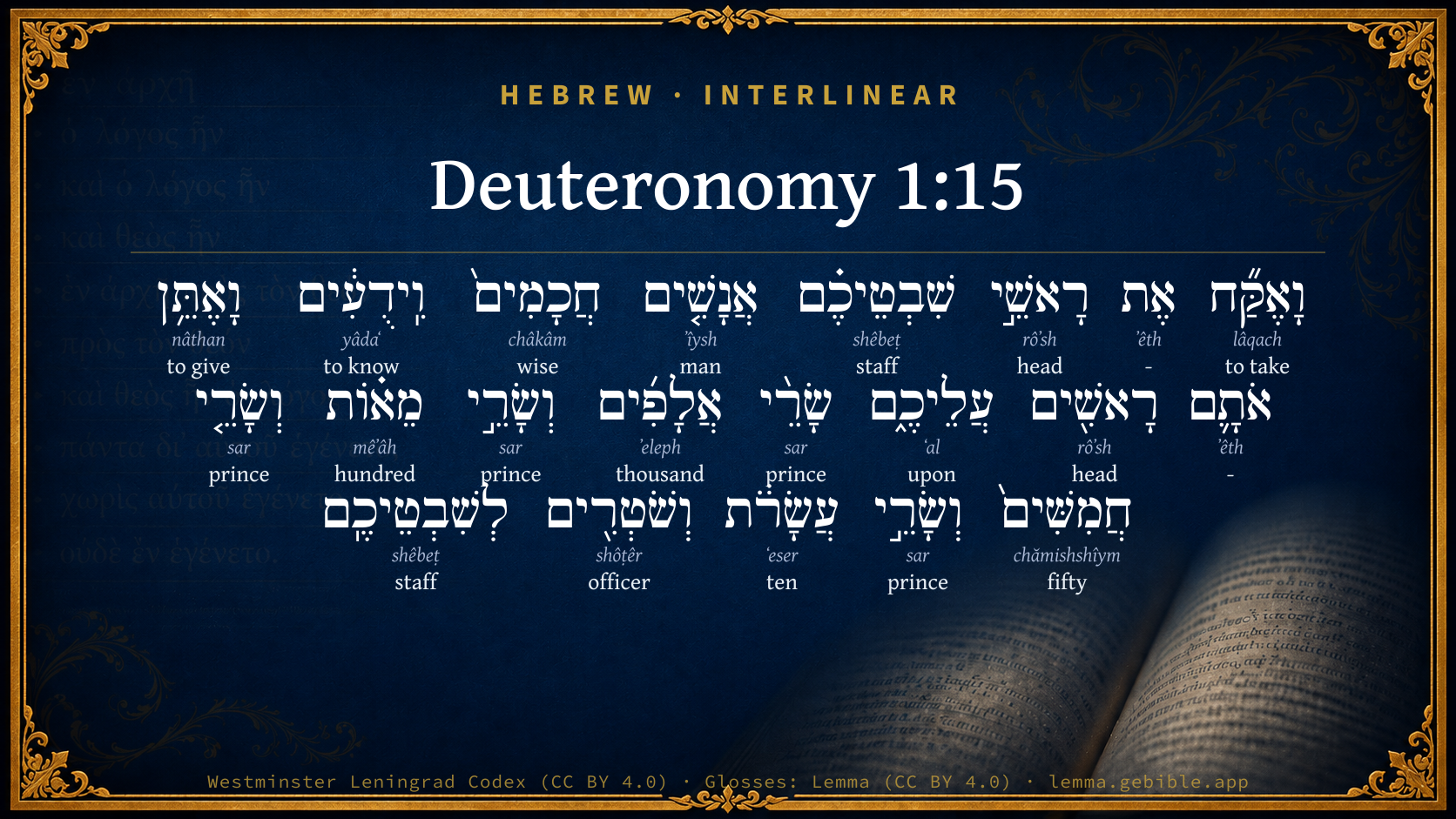
  1. וָאֶקַּ֞ח lâqach H3947 “and · to take” Conjunction + Verb, Qal, Sequential Imperfect, 1st Person, Common, Singular
  2. אֶת ʼêth H853 “-” Particle, Direct Object
  3. רָאשֵׁ֣י rôʼsh H7218 “heads of” Noun, Common, Masculine, Plural, Construct
  4. שִׁבְטֵיכֶ֗ם shêbeṭ H7626 “staffs · your” Noun, Common, Masculine, Plural, Construct + Suffix, Personal, 2nd Person, Masculine, Plural
  5. אֲנָשִׁ֤ים ʼîysh H376 “men” Noun, Common, Masculine, Plural, Absolute
  6. חֲכָמִים֙ châkâm H2450 “wise” Adjective, Adjective, Masculine, Plural, Absolute
  7. וִֽידֻעִ֔ים yâdaʻ H3045 “and · known” Conjunction + Verb, Qal, Participle Passive, Masculine, Plural, Absolute
  8. וָאֶתֵּ֥ן nâthan H5414 “and · to give” Conjunction + Verb, Qal, Sequential Imperfect, 1st Person, Common, Singular
  9. אֹתָ֛ם ʼêth H853 “- · them” Particle, Direct Object + Suffix, Personal, 3rd Person, Masculine, Plural
  10. רָאשִׁ֖ים rôʼsh H7218 “heads” Noun, Common, Masculine, Plural, Absolute
  11. עֲלֵיכֶ֑ם ʻal H5921 “upon · you” Preposition + Suffix, Personal, 2nd Person, Masculine, Plural
  12. שָׂרֵ֨י sar H8269 “princes of” Noun, Common, Masculine, Plural, Construct
  13. אֲלָפִ֜ים ʼeleph H505 “thousand” Adjective, Cardinal number, Both, Plural, Absolute
  14. וְשָׂרֵ֣י sar H8269 “and · princes of” Conjunction + Noun, Common, Masculine, Plural, Construct
  15. מֵא֗וֹת mêʼâh H3967 “hundred” Adjective, Cardinal number, Both, Plural, Absolute
  16. וְשָׂרֵ֤י sar H8269 “and · princes of” Conjunction + Noun, Common, Masculine, Plural, Construct
  17. חֲמִשִּׁים֙ chămishshîym H2572 “fifty” Adjective, Cardinal number, Both, Plural, Absolute
  18. וְשָׂרֵ֣י sar H8269 “and · princes of” Conjunction + Noun, Common, Masculine, Plural, Construct
  19. עֲשָׂרֹ֔ת ʻeser H6235 “ten” Adjective, Cardinal number, Masculine, Plural, Absolute
  20. לְשִׁבְטֵיכֶֽם shêbeṭ H7626 “to/for · staffs · your” Preposition + Noun, Common, Masculine, Plural, Construct + Suffix, Personal, 2nd Person, Masculine, Plural

About this verse

These counts appear in no published source. They are computed here, from the morphology-tagged text and Lemma’s own curated glosses. What Lemma adds →

21
words
15
distinct lemmas
Pentateuch
section

Notable vocabulary

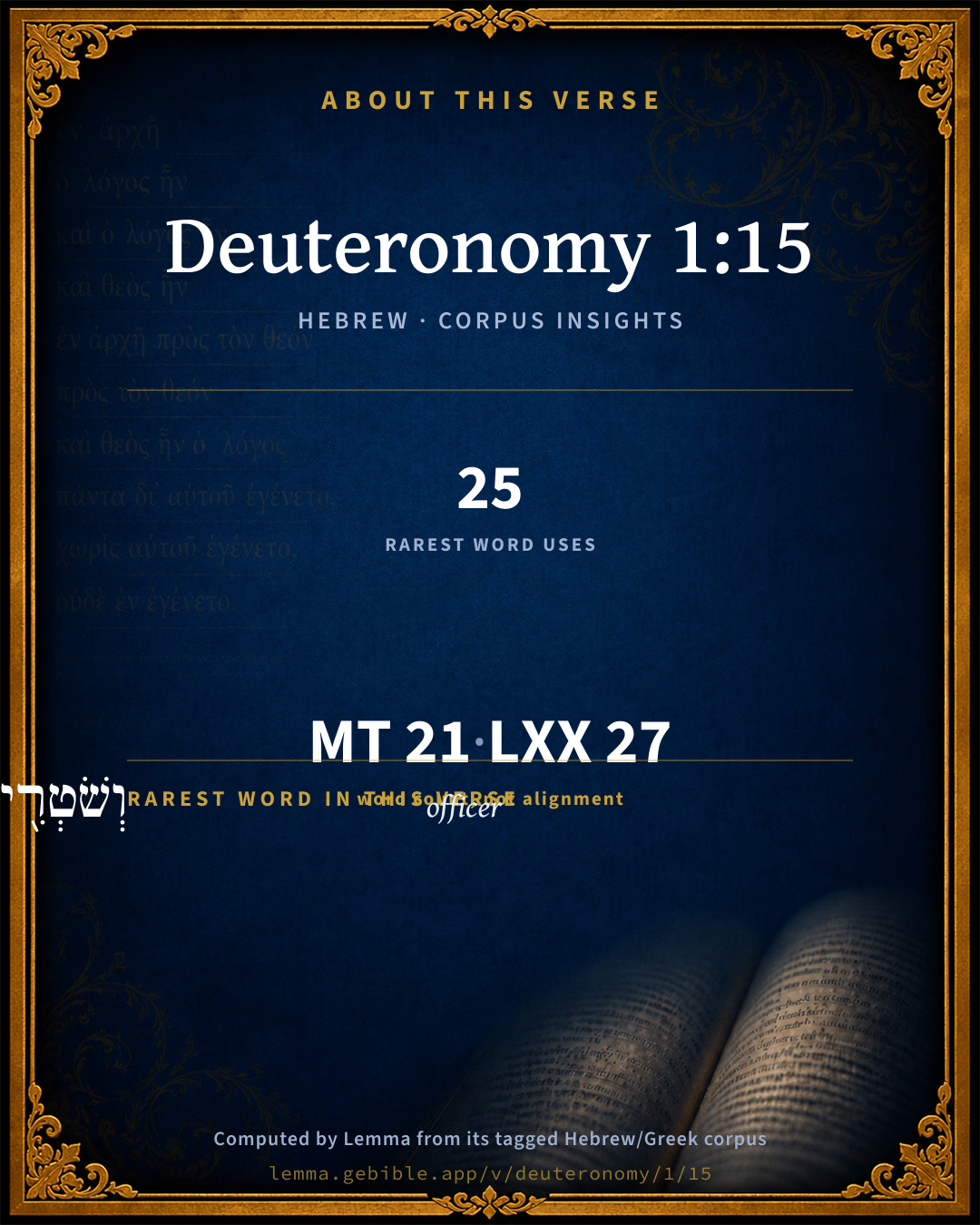
The rarest word here is וְשֹׁטְרִ֖ים officer H7860 — appearing just 25 times in the whole Hebrew Bible.

Shared distinctive vocabulary

וְשֹׁטְרִ֖ים officer H7860 occurs in 25 verses of the Hebrew Bible. Also found in:

Grammatical profile

  • 4 verbs
  • 9 nouns
  • 5 adjectives
  • 1 preposition
  • 2 particles

Verb forms

  • וָאֶקַּ֞ח Qal · Sequential Imperfect
  • וִֽידֻעִ֔ים Qal · Participle Passive
  • וָאֶתֵּ֥ן Qal · Sequential Imperfect
  • וְשֹׁטְרִ֖ים Qal · Participle Active

Repetition

Words recur within this verse — often emphatic in Hebrew:

  • שָׂרֵ֨י prince H8269 ×4
  • רָאשֵׁ֣י head H7218 ×2
  • שִׁבְטֵיכֶ֗ם staff H7626 ×2

Hebrew & Septuagint length

In English translation the verse runs 39 words from the Hebrew and 40 from the Septuagint (LXX English) — closely comparable.

A rough comparison of the two English renderings, which tokenize alike — not a word-level alignment.

Word counts can differ between the Hebrew and the Greek without any difference in meaning — e.g. the Hebrew direct-object marker אֵת has no separate Greek word, and Greek often adds the article ὁ.

In the original languages it is 21 Hebrew tokens and 27 Greek tokens — but the two are counted differently (Hebrew bundles its prefixes and suffixes into one token; the Greek is in lemma form), so that isn’t a like-for-like length.

Cross-references

7

Topical passages linked to Deuteronomy 1:15 in the Treasury of Scripture Knowledge — connected by theme and wording, ordered by reader-vote popularity; previews shown in the World English Bible.

  • Exodus 18:25–26 Moses chose able men out of all Israel, and made them heads over the people, rulers of thousands, rulers of hundreds, rulers of fifties, and rulers of tens.
  • Deuteronomy 16:18 Judges and officers shall you make you in all your gates, which Yahweh your God gives you, according to your tribes; and they shall judge the people with righteous judgment.
  • Ephesians 4:11 He gave some to be apostles; and some, prophets; and some, evangelists; and some, shepherds and teachers;
  • Numbers 31:14 Moses was angry with the officers of the host, the captains of thousands and the captains of hundreds, who came from the service of the war.
  • 1 Samuel 8:12 and he will appoint them to him for captains of thousands, and captains of fifties; and [he will set some] to plow his ground, and to reap his harvest, and to make his instruments of war, and the instruments of his chariots.
  • 1 Samuel 17:18 and bring these ten cheeses to the captain of their thousand, and look how your brothers fare, and take their pledge.
  • 1 Samuel 22:7 Saul said to his servants who stood about him, Hear now, you Benjamites; will the son of Jesse give everyone of you fields and vineyards, will he make you all captains of thousands and captains of hundreds,

Cross-references courtesy of OpenBible.info (CC BY 4.0).

Hebrew and Greek witnesses Masoretic Hebrew ↔ Greek Septuagint

The same verse in the two great witnesses to the Old Testament, shown verse-for-verse.

These are two independent witnesses, not word-aligned to each other, and the Septuagint is shown in lemma (dictionary) form.

Hebrew Deuteronomy 1:15 Masoretic · Westminster Leningrad Codex

וָאֶקַּ֞ח אֶת רָאשֵׁ֣י שִׁבְטֵיכֶ֗ם אֲנָשִׁ֤ים חֲכָמִים֙ וִֽידֻעִ֔ים וָאֶתֵּ֥ן אֹתָ֛ם רָאשִׁ֖ים עֲלֵיכֶ֑ם שָׂרֵ֨י אֲלָפִ֜ים וְשָׂרֵ֣י מֵא֗וֹת וְשָׂרֵ֤י חֲמִשִּׁים֙ וְשָׂרֵ֣י עֲשָׂרֹ֔ת וְשֹׁטְרִ֖ים לְשִׁבְטֵיכֶֽם

So I took the heads of your tribes, wise men, and known, and made them heads over you, captains of thousands, and captains of hundreds, and captains of fifties, and captains of tens, and officers, according to your tribes.

World English Bible · Public Domain

Greek LXX Deuteronomy 1:15 Septuagint · lemma form

καί λαμβάνω ἐκ σύ ἀνήρ σοφός καί ἐπιστήμων καί συνετός καί καταἵστημι αὐτός ἡγέομαι ἐπί σύ χιλίαρχος καί ἑκατόνταρχος καί πεντηκόνταρχος καί δεκάδαρχος καί ὁ κριτής σύ

So I took of you wise and understanding and prudent men, and I set them to rule over you as rulers of thousands, and rulers of hundreds, and rulers of fifties, and rulers of tens, and officers to your judges.

LXX2012 (modern English Septuagint) · Public Domain

On this verse, The Cambridge Bible for Schools and Colleges discusses the Septuagint’s reading. Read the note in Commentary ↓

Hebrew: Westminster Leningrad Codex (CC BY 4.0). Greek: Septuagint (public domain); English from LXX2012 (modern English Septuagint) (Public Domain). How the Septuagint differs from the Hebrew →

Targum (Aramaic paraphrase)

2

The Targum is the ancient Jewish Aramaic paraphrase of the Hebrew Scriptures — an interpretive translation, not the Hebrew text itself. Onkelos (literal) and Pseudo-Jonathan (expansive) render the Torah, and Jonathan the Prophets. Coverage is partial: where no permissively-licensed English translation exists for a verse, only the Aramaic is shown. This is verse-level text, not a word-by-word alignment to the Hebrew.

  1. Targum Onkelos Torah (Genesis–Deuteronomy)
    וּדְבָרִית יָת רֵישֵׁי שִׁבְטֵיכוֹן גֻבְרִין חַכִּימִין וּמַדְעָן וּמַנֵתִי יָתְהוֹן רֵישִׁין עֲלֵיכוֹן רַבָּנֵי אַלְפִין וְרַבָּנֵי מָאוָתָא וְרַבָּנֵי חַמְשִׁין וְרַבָּנֵי עִשׂוֹרְיָתָא וְסָרְכִין לְשִׁבְטֵיכוֹן

    (no public-domain English translation for this verse)

    Targum Onkelos — Aramaic: “Onkelos Genesis” (public domain); “Onkelos Exodus” (public domain); “Onkelos Leviticus” (public domain); “Onkelos Numbers” (public domain); “Onkelos Deuteronomy” (public domain). English: “Sefaria Community Translation” (CC0 1.0 (public-domain dedication)); “J.W. Etheridge. The Targums of Onkelos and Jonathan Ben Uzziel on the Pentateuch. London: Longmans, Green, 1862” (public domain). Text via Sefaria.

  2. Targum Pseudo-Jonathan Torah (Genesis–Deuteronomy)
    וְדַבָּרִית יַת רֵישֵׁי שִׁבְטֵיכוֹן וְאוֹרַכְתִּנּוּן בְּמִלַיָא גּוּבְרִין חַכִּימִין וּמָרֵי מַנְדְּעָא וְסוּכְלְתָנִין מֵרַעֲיוֹנֵיהוֹן לָא אַשְׁכָּחִית וּמְנִיתֵיתוּן רֵישֵׁי עֲלֵיכוֹן רַבָּנֵי אַלְפִין רַבָּנֵי מַאֲוָותָא רַבָּנֵי חַמְשִׁין תְּרֵיסַר אַלְפִין רַבָּנֵי עִשַרְיָיתָא שִׁית רִיבְוָון וְסַרְכִין לְשִׁבְטֵיכוֹן

    So I took the chiefs of your tribes, and moved them kindly with words; wise men, masters of knowledge, but prudent in their thoughts, I found not; and I appointed them chiefs over you, rabbans of thousands, of hundreds, of fifties; twelve thousand rabbans of tens, six myriads, officers of your tribes.

    Targum Pseudo-Jonathan — Aramaic: “Targum Jonathan on Genesis” (public domain); “Targum Jonathan on Exodus” (public domain); “Targum Jonathan on Leviticus” (public domain); “Targum Jonathan on Numbers” (public domain); “Targum Jonathan on Deuteronomy” (public domain). English: “The Targum of Jonathan ben Uzziel, trans. J. W. Etheridge, London, 1862” (public domain). Text via Sefaria.

Commentary

Notes on Deuteronomy 1:15 from classic Christian and Jewish commentators (each source and its license shown beneath its notes). The classic Christian expositions comment on the surrounding passage and are grouped to its opening verse, so a note may address several verses; the Jewish commentaries on the Tanakh (Rashi and others) are per-verse, so they appear only where the commentator wrote on this verse.

Lemma curates 59 commentaries, every one of them public domain or Creative Commons licensed, each selected and text-cleaned for this edition rather than reprinted as found. About our sources →

Trapp's Complete Commentary

John Trapp

Deu 1:15 So I took the chief of your tribes, wise men, and known, and made them heads over you, captains over thousands, and captains over hundreds, and captains over fifties, and captains over tens, and officers among your tribes.

Ver. 15. And officers among your tribes.] That might put the laws in execution; which is the same to the law that the clapper is to the bell. There were in good Josiah’s days’ horrible abominations. And why? By the slackness of under offices. {Zep 3:3}

John Trapp, A Commentary or Exposition upon All the Books of the Old and New Testament (1647–1656) — public domain. Text from a community e-Sword module.

Joseph Benson's Commentary

Deu 1:15. So I took the chief — Not in authority, but in endowments for governing. And officers — Inferior officers, that were to attend upon the superior magistrates, and to execute their decrees.

Joseph Benson's Commentary on the Old and New Testaments (1811–1818) — public domain. Text from a community e-Sword module.

Tyndale Open Study Notes

Tyndale Open Resources

1:15 thousand . . . hundred . . . fifty . . . ten: This was standard military organization, so some of these officials were probably military officers (see 1 Sam 8:12; 22:7; 2 Sam 18:1).

Tyndale Open Study Notes — © Tyndale Open Resources, licensed CC BY-SA 4.0. Text via the HelloAO Bible API.

Geneva Bible (1599)

Geneva Bible translators

Declaring what sort of men ought to have a public charge, read Exod. 18:31.

Geneva Bible (1599) marginal notes — public domain. Text via Bolls.life.

Adam Clarke's Commentary

Verse 15. Captains over thousands, c.] What a curious and well-regulated economy was that of the Israelites! See its order and arrangement:

1. GOD, the KING and Supreme Judge

2. Moses, God's prime minister;

3. The priests, consulting him by Urim and Thummim;

4. The chiefs or princes of the twelve tribes;

5. Chilliarchs, or captains over thousands;

6. Centurions, or captains over hundreds;

7. Tribunes, or captains over fifty men;

8. Decurions, or captains over ten men; and,

9. Officers, persons who might be employed by the different chiefs in executing particular commands. All these held their authority from God, and yet were subject and accountable to each other. See the notes on Num. ii.

Adam Clarke's Commentary on the Bible (1810–1826) — public domain. Text from a community e-Sword/MySword module.

The Cambridge Bible for Schools and Colleges

gen. ed. J. J. S. Perowne

15. the heads of your tribes] LXX, from you, either represents the original Heb. reading or is the Gk translator’s emendation of a difficult text. On the ground that the present Heb. reading conflicts with Deu_1:13 and is meaningless in relation to the rest of this verse (it being unlikely that Moses would say, that he took heads of tribes to make them heads over you), some would delete the words. But the verse, though awkward, may mean that Moses took those elected within the various tribes (Deu_1:13) and made them chiefs with judicial functions in the new national organisation which he now instituted: so in E, Exo_18:25, he set them chiefs over the people, as a whole.

captains of thousands, hundreds, fifties, tens] Captains, Heb. sarîm. So E, Exo_18:21; Exo_18:25. But neither there nor here is the meaning clear. Under the monarchy there were military sarîm of thousands, hundreds, and fifties (1Sa_8:12; 1Sa_17:18; 2Sa_18:1; 2Ki_1:9 ff; 2Ki_11:4; Isa_3:3); that no sarîm of tens are mentioned does not imply that they did not exist, for the notices of the others are incidental. Did such military sarîm already exist in the time of Israel’s wanderings, and is it meant, here and in Exodus 18, that the popularly elected heads took such military titles on their appointment? Or were these military ranks first instituted under the monarchy, when an organised national army took the place of the old tribal levies, and have the writers of E and D (cp. P, Num_31:14; Num_31:28) merely reflected this institution of their own times back on the period of the wandering? Or are we to hold with Steuernagel that although Exo_18:13-26 deals throughout with the institution of judges this deuteronomic review, Deu_1:9-15, narrates the appointment not of judges but of military and administrative officers and that we reach the judges only in Deu_1:16, where their title first occurs and where a new paragraph is indicated by the recurrence of the formula, and at that time? In support of his view, Steuernagel alleges that only intellectual qualities are required for the officers dealt with in Deu_1:9-15, while in Exo_18:13 ff., where judges are intended throughout, the requirements are moral. But this point we have already answered above on Deu_1:13. Further Steuernagel’s explanation neither solves the difficulty in Exo_18:13 ff. (E) where the equation of military titles with the judicial posts is certain; nor meets the fact that this deuteronomic review is based on Exo_18:13 ff., and if it had meant to differ from the latter on so substantial a point it would certainly have indicated the difference explicitly. None of the explanations is satisfactory. The evidence that even under Moses the tribal institutions were welded into a national organisation is frequent and probable; and that main fact may be held, even if we allow, as equally probable, that E and D reflected back upon it the military titles of their own day.

and officers] Heb. shôṭerîm, with the original meaning either of rangers, organisers (so Dri. after Nöldeke, citing Ar. saṭara ‘to rule’ a book, ‘write,’ and saṭr ‘line’ or ‘row,’ cp. Heb. mishṭar, Job_38:33), or of writers (Ass. shatâru ‘write’). Both meanings are attached to the name in the O.T. In Deu_20:5; Deu_20:8 f., as in E, Jos_1:10; Jos_3:2, shôṭerîm are army officers who pass on the general orders through the ranks; cp. J, Exo_5:6, etc., native officers of Israel under Pharaoh’s taskmasters. But here, as in Deu_16:18, they are associated with judges, Deu_29:10, with elders exercising judicial functions: cp. deuteron., Jos_8:33; Jos_23:2; Jos_24:1; and E, Num_11:16; Pro_6:7. Sam. has here scribes; LXX γραμματοεισαγωγεῖς. They were either the secretaries or professional assessors of the lay judges.

according to your tribes] So Heb. and Sam.; LXX τοῖς κριταῖς ὑμῶν, to your judges, which Berth. emends to judge you.

The Cambridge Bible for Schools and Colleges (gen. ed. J. J. S. Perowne; Cambridge University Press, 1878–1918) — public domain. Text from a community e-Sword module.

John Gill's Exposition

So I took the chief of your tribes, wise men, and known,.... The principal persons among them, that were remarkable and well known for their wisdom and understanding, whom the people presented to him:

and made them heads over you; rulers of them, as follows:

captains over thousands, and captains over hundreds, and captains over fifties, and captains over tens; see Exo 18:21.

and officers among your tribes; which Jarchi interprets of such that bind malefactors and scourge them, according to the decree of the judges, even the executioners of justice; and so the Jews commonly understand them to be, though some have thought they were judges also.

John Gill's Exposition of the Whole Bible (1746–1763) — public domain (CC PDM 1.0). Text via the HelloAO Bible API.

Haydock's Catholic Bible Commentary

Who, &c. Hebrew, "and shoterim (officers like our serjeants, designed to publish and execute the sentence of the judges) over or among your tribes." The Persians still call such officers chaters. The Rabbins say, that the shoterim were generally selected from among the Cinites, the descendants of Jethro, 1 Paralipomenon ii. 55. But we find that the Levites were also chosen, 2 Paralipomenon xix. 11. They seem to have had sometimes the authority of judges, princes, or doctors for the instruction of the people, as the Vulgate here expresses it. (Calmet)

Ver 17. Respect. Hebrew, "fear." (Menochius) --- Those who judge ought to be quite impartial, and never suffer their sentence to be dictated either by love or by fear. (Haydock) (Ecclesiasticus vii. 6.) --- Of God, to whom you must give an account of your conduct, Wisdom vi. 4. Speak therefore in his name, and imitate his justice and other perfections. See Psalm lxxxi 1. (Calmet) --- If any one absolve an oppressor because he is rich, that judge is guilty of partiality. (Du Hamel) (Isaias i. 23.) --- Hear it, as the supreme judge. (Menochius) --- The people selected such as might be most proper, out of whom Moses made his choice. (Salien) --- An appeal might be made to himself. (Abulensis, q. 11.)

George Leo Haydock (1774–1849), Haydock's Catholic Family Bible and Commentary, 1859 edition — public domain. Excludes Psalms (Douay-Rheims chapter numbering differs from Protestant) and Deuterocanonical books (Catholic canon only).

Matthew Poole's English Annotations

The chief, not in authority, which yet they had not, but in endowments for good government.

And officers; inferior officers, that were to attend upon the superior magistrates, and to execute their decrees.

Matthew Poole's English Annotations on the Holy Bible (1683–1685) — public domain. Text from a community e-Sword/MySword module.

John Wesley's Explanatory Notes

Officers - Inferior officers, that were to attend upon the superior magistrates, and to execute their decrees.

John Wesley, Explanatory Notes Upon the Whole Bible (1754–1765) — public domain. Text via the GEBible commentary corpus.

unfoldingWord translationNotes

Door43 World Missions Community

General Information:

Moses continues to speak to the people of Israel.

men of good repute

"men whom your people respected." See how this is translated in Deuteronomy 1:13.

of thousands ... of hundreds ... of fifties ... of tens

"of groups of 1,000 ... of groups of 100 ... of groups of 50 ... and groups of 10" (See: Numbers)

captains ... officers

These are titles for different leaders in Israel's government.

tribe by tribe

"from each of your tribes"

judge righteously between a man and his brother

"make right and fair decisions about the disputes Israelites have with each other"

translationWords

head

tribe

wise

command

judge, judges

brother

righteous

alien

unfoldingWord translationNotes — © Distant Shores Media and the Door43 World Missions Community, licensed CC BY-SA 4.0. Source: git.door43.org/Door43/en_tn.

Rashi

Rabbi Shlomo Yitzchaki (Rashi)

ואקח את ראשי שבטיכם SO I TOOK THE HEADS OF YOUR TRIBES — I took them by fine words: Happy are you! Over whom are you about to be appointed? Over the sons of Abraham, Isaac and Jacob — over the sons of people who are called God's brethren and friends, God's portion and inheritance and to whom is applied every other expression denoting affection (Sifrei Devarim 15:1; cf. Targum Jonathan).

אנשים חכמים וידעים [AND I TOOK] MEN, WISE AND KNOWN — but understanding men I could not find (Nedarim 20b). This, too, was one of the seven qualifications which Jethro mentioned to Moses, but he found only three: men, i.e. righteous men, wise and known (Sifrei Devarim 15:2).

ראשים עליכם [AND I MADE THEM] HEADS OVER YOU — i.e. that you should pay them respect — regard them as first in buying, first in selling, first in all matters of business — coming into the Synagogue and House of Study last and leave first (so that all should rise out of respect) (cf. Sifrei Devarim 15:3).

שרי אלפים means, one officer who is appointed over one thousand.

שרי מאות means, one who is appointed over one hundred.

ושטרים AND COURT-OFFICERS — i.e., and also I appointed court-officers over you, לשבטיכם ACCORDING TO YOUR TRIBES — these are they who bind and flog with the lash at the bidding of the judges (cf. Sifrei Devarim 15:5).

Rashi on the Tanakh — English translations: “The Judaica Press complete Tanach with Rashi, translated by A. J. Rosenberg” (CC BY 4.0); “Pentateuch with Rashi's commentary by M. Rosenbaum and A.M. Silbermann, 1929-1934” (public domain); “The Metsudah Tanach series, Lakewood, N.J” (CC BY 4.0); and “The Book of Joshua, Metsudah Publications, 1997” (CC BY 4.0). Text via Sefaria.

Lesson kit

Teaching starters — assembled from the data on this page, not authored interpretation. Every prompt links to the verse data it draws on. Edit before teaching.

Deuteronomy, in the Pentateuch, opens this verse with 21 words (15 distinct Hebrew lemmas). Its most distinctive word is shôṭêr (“officer”). A historical commentator’s framing appears above. Read the whole chapter for the surrounding context.

Discussion questions

  1. What does “officer” (shôṭêr) contribute to the verse as a whole?
  2. Exodus 5:6 shares the word «officer» with this verse. How do the two illuminate each other?
  3. “prince” occurs 4× in this one verse. What is the effect of the repetition?
  4. These translations render this verse differently. What is at stake in choosing one wording over another?
  5. The verb «וָאֶקַּ֞ח» is Qal Sequential Imperfect. How does its form color the action?
  6. Reading how Trapp's Complete Commentary and Joseph Benson's Commentary read this verse, where do the two commentators agree and where do they part?

Things to notice

Reading settings

Reading text

Shown beneath each verse's original-language words.

Old Testament
Old Testament edition

Read the OT as the Masoretic Hebrew (MT) or the Greek Septuagint (LXX).

English shown for the Greek Septuagint (in the Hebrew ↔ Greek comparison).

Comparing translations? Open the Compare panel on any verse page to stack up to four side by side.