
Deuteronomy 17:2

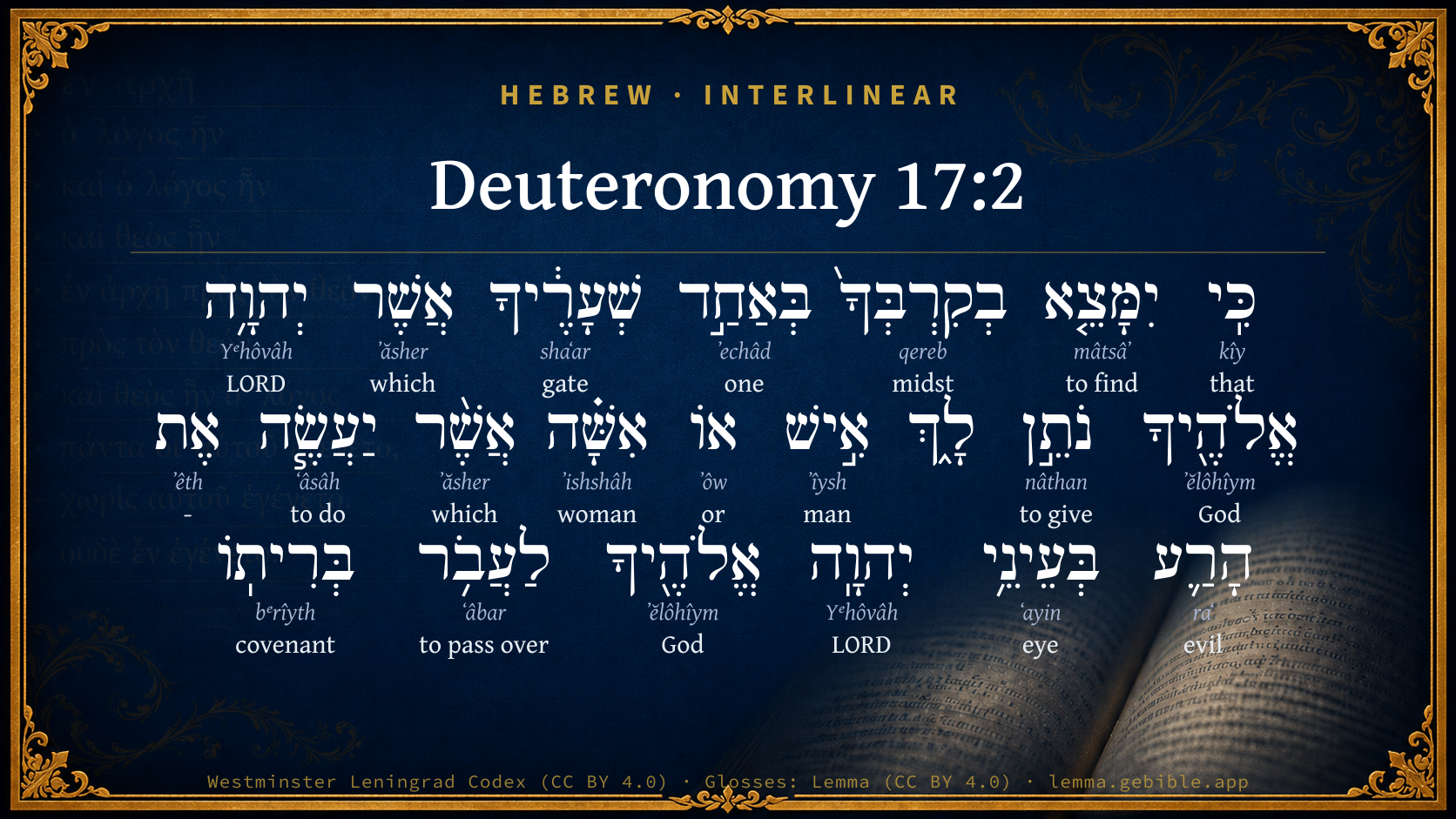
Hebrew (Westminster Leningrad Codex) Deuteronomy 17:2 appears in the Hebrew Old Testament. The text above is from the Westminster Leningrad Codex. Each word links to its Strong’s number, a concise gloss, and parsing drawn from the Open Scriptures Hebrew Bible morphology. Click any word for its full Brown-Driver-Briggs (BDB) entry.
Download image
Cite this verse

Deuteronomy 17:2 (World English Bible). Public Domain. Lemma interlinear Bible study tool, https://lemma.gebible.app/v/deuteronomy/17/2.

Show BibTeX & RIS
BibTeX
RIS
English Translation
If there be found in the midst of you, within any of your gates which Yahweh your God gives you, man or woman, who does that which is evil in the sight of Yahweh your God, in transgressing his covenant,
World English Bible · Public Domain
Download a study sheet

One document with this verse’s original text, its word-by-word gloss line, the meaning frame, cross-references with their text, attributed commentary, and full source and license credits — printable, and it pastes into notes with its structure intact.

This verse Autodidact and up

Study sheet (.html) Plain text (.txt)

A passage Seminary Student

Up to 50 verses in one chapter. A passage sheet keeps up to 6 commentary sources and 12 cross-references per verse, in the order this page ranks them, and says so on the sheet whenever that leaves anything out. Ask for a single verse and you get the Autodidact verse sheet above.

Everything on this page stays free to read, with no account — the sheet is a download of what is already on screen, not access to it.

Want to remove ads? Support Godless Engineer
Compare translations 3

The same verse in 3 English versions, stacked beneath the original-language interlinear above. Click any original word for its lexicon entry.

Each is an independent rendering of the whole verse — the interlinear is not word-aligned to these translations.

Highlighted words mark where these versions differ — a whole-verse word diff, not a word-by-word alignment.

  • World English Bible Public Domain
    If there be found in the midst of you, within any of your gates which Yahweh your God gives you, man or woman, who does that which is evil in the sight of Yahweh your God, in transgressing his covenant,
  • King James Version Public Domain
    If there be found among you, within any of thy gates which the LORD thy God giveth thee, man or woman, that hath wrought wickedness in the sight of the LORD thy God, in transgressing his covenant,
  • unfoldingWord Literal Text CC BY-SA 4.0
    If is found among you, in any of your gates that Yahweh your God is giving to you, a man or a woman who does evil in the eyes of Yahweh your God, transgressing his covenant,

unfoldingWord Literal Text — © unfoldingWord, licensed CC BY-SA 4.0. Word-aligned USFM3 via Door43 (git.door43.org/unfoldingWord/en_ult).

Versions to compare (up to 4)

3 of 4 selected

Show all 18 translations

Every available English version of this verse, each an independent rendering of the whole verse.

  • World English Bible Public Domain
    If there be found in the midst of you, within any of your gates which Yahweh your God gives you, man or woman, who does that which is evil in the sight of Yahweh your God, in transgressing his covenant,
  • Berean Standard Bible Public Domain
    If a man or woman among you in one of the towns that the LORD your God gives you is found doing evil in the sight of the LORD your God by transgressing His covenant
  • Majority Standard Bible Public Domain
    If a man or woman among you in one of the towns that the LORD your God gives you is found doing evil in the sight of the LORD your God by transgressing His covenant
  • King James Version Public Domain
    If there be found among you, within any of thy gates which the LORD thy God giveth thee, man or woman, that hath wrought wickedness in the sight of the LORD thy God, in transgressing his covenant,
  • American Standard Version (1901) Public Domain
    If there be found in the midst of thee, within any of thy gates which Jehovah thy God giveth thee, man or woman, that doeth that which is evil in the sight of Jehovah thy God, in transgressing his covenant,
  • Revised Version (1885) Public Domain
    If there be found in the midst of thee, within any of thy gates which the LORD thy God giveth thee, man or woman, that doeth that which is evil in the sight of the LORD thy God, in transgressing his covenant,
  • Geneva Bible (1599) Public Domain
    If there be founde among you in any of thy cities, which the Lord thy God giueth thee, man or woman that hath wrought wickednes in the sight of the Lord thy God, in transgressing his couenant,
  • Douay-Rheims (1899) Public Domain
    When there shall be found among you within any of thy gates, which the Lord thy God shall give thee, man or woman that do evil in the sight of the Lord thy God, and transgress his covenant,
  • Young's Literal Translation Public Domain
    `When there is found in thy midst, in one of thy cities which Jehovah thy God is giving to thee, a man or a woman who doth the evil thing in the eyes of Jehovah thy God by transgressing His covenant,
  • Literal Standard Version CC BY-SA 4.0
    When there is found in your midst, in one of your cities which your God YHWH is giving to you, a man or a woman who does evil in the eyes of your God YHWH by transgressing His covenant,
  • Unlocked Literal Bible CC BY-SA 4.0
    If there is found among you, within any of your city gates that Yahweh your God is giving you, any man or woman who does what is evil in the sight of Yahweh your God and transgresses his covenant,
  • unfoldingWord Literal Text CC BY-SA 4.0
    If is found among you, in any of your gates that Yahweh your God is giving to you, a man or a woman who does evil in the eyes of Yahweh your God, transgressing his covenant,
  • Darby Bible Public Domain
    If there be found in thy midst in any of thy gates which Jehovah thy God giveth thee, man or woman, that doeth what is evil in the sight of Jehovah thy God, in transgressing his covenant,
  • World Messianic Bible Public Domain
    If there is found among you, within any of your gates which the LORD your God gives you, a man or woman who does that which is evil in the LORD your God’s sight in transgressing his covenant,
  • Webster's Bible Public Domain
    If there shall be found among you, within any of thy gates which the LORD thy God giveth thee, man or woman that hath wrought wickedness in the sight of of the LORD thy God, in transgressing his covenant,
  • Free Bible Version CC BY-SA 4.0
    There may be a report that one of you, whether a man or a woman, living in a town that the Lord your God gave you, has been found to be sinning in the sight of the Lord your God by breaking the Lord's agreement.
  • Bible in Basic English Public Domain
    If there is any man or woman among you, in any of the towns which the Lord your God gives you, who does evil in the eyes of the Lord your God, sinning against his agreement,
  • JPS Tanakh (1917) Public Domain
    If there be found in the midst of thee, within any of thy gates which the LORD thy God giveth thee, man or woman, that doeth that which is evil in the sight of the LORD thy God, in transgressing His covenant,

Literal Standard Version (2020), Covenant Press — licensed CC BY-SA 4.0. Text via the HelloAO Bible API (eBible.org). Unlocked Literal Bible (unfoldingWord) — licensed CC BY-SA 4.0. Text via the HelloAO Bible API (eBible.org). unfoldingWord Literal Text — © unfoldingWord, licensed CC BY-SA 4.0. Word-aligned USFM3 via Door43 (git.door43.org/unfoldingWord/en_ult). Free Bible Version, Dr. Jonathan Gallagher — licensed CC BY-SA 4.0. Text via the HelloAO Bible API (eBible.org).

Word by word

More ways to search: Search by grammar → Find every occurrence → Compare this word →

Practice this passage: Drill this verse → Learn its vocabulary →

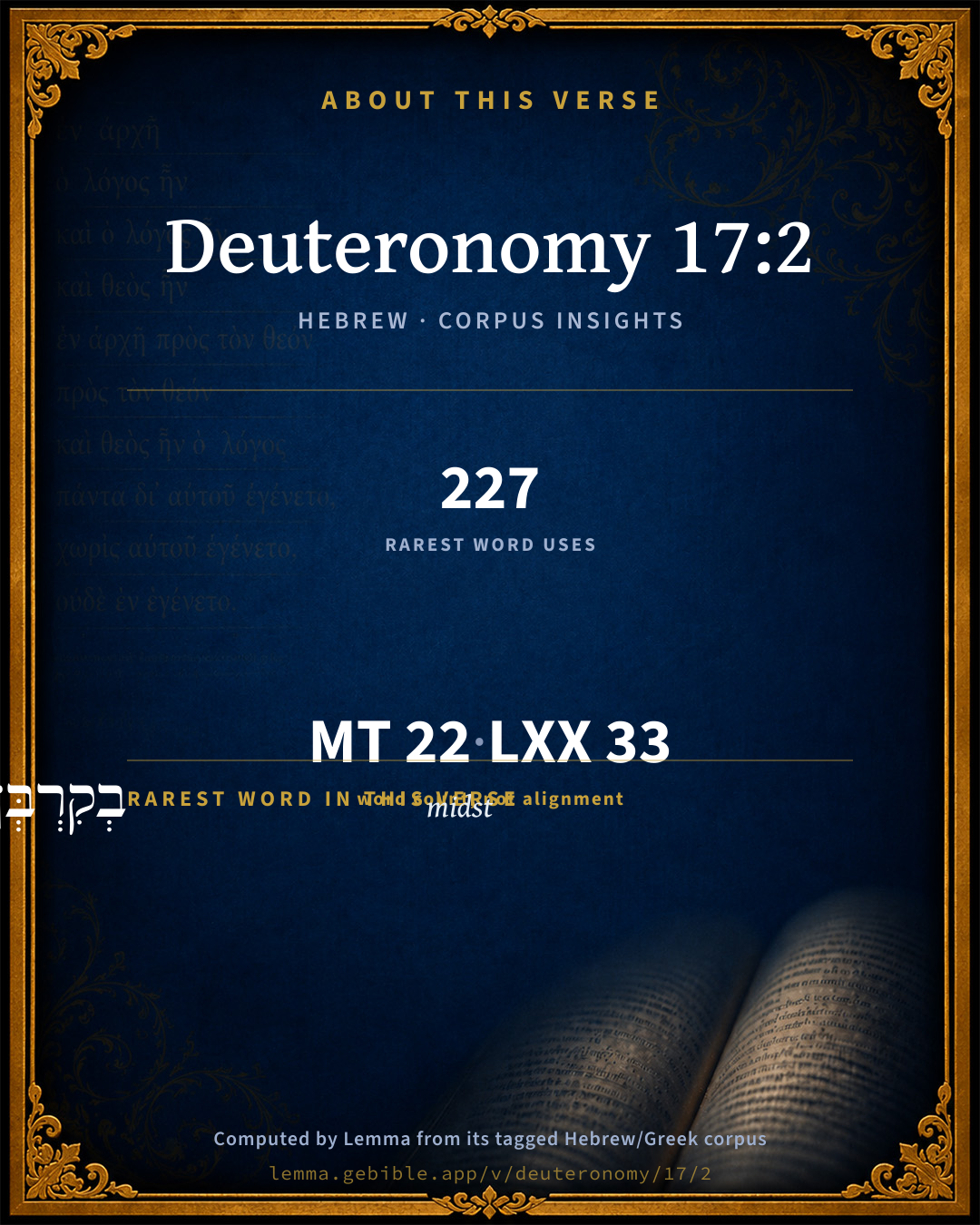
בְקִרְבְּךָ֙
qereb
H7130
“in/at · midst · your”
Preposition + Noun, Common, Masculine, Singular, Construct + Suffix, Personal, 2nd Person, Masculine, Singular
Part of Speech
Preposition + Noun
Type
Common
Gender
Masculine
Number
Singular
State
Construct
Full BDB Definition

Origin: from H7126

TWOT: 2066a

midst, among, inner part, middle - inward part - physical sense - as seat of thought and emotion - as faculty of thought and emotion - in the midst, among, from among (of a number of persons) - entrails (of sacrificial animals)
  1. כִּֽי kîy H3588 “that” Conjunction
  2. יִמָּצֵ֤א mâtsâʼ H4672 “to find” Verb, Niphal, Imperfect, 3rd Person, Masculine, Singular
  3. בְּאַחַ֣ד ʼechâd H259 “in/at · one” Preposition + Adjective, Cardinal number, Masculine, Singular, Construct
  4. שְׁעָרֶ֔יךָ shaʻar H8179 “gates · your” Noun, Common, Masculine, Plural, Construct + Suffix, Personal, 2nd Person, Masculine, Singular
  5. אֲשֶׁר ʼăsher H834 “which” Particle, Relative
  6. יְהוָ֥ה Yᵉhôvâh H3068 “LORD” Noun, Proper
  7. אֱלֹהֶ֖יךָ ʼĕlôhîym H430 “God(s) · your” Noun, Common, Masculine, Plural, Construct + Suffix, Personal, 2nd Person, Masculine, Singular
  8. נֹתֵ֣ן nâthan H5414 “giving” Verb, Qal, Participle Active, Masculine, Singular, Absolute
  9. אִ֣ישׁ ʼîysh H376 “man” Noun, Common, Masculine, Singular, Absolute
  10. אוֹ ʼôw H176 “or” Conjunction
  11. אִשָּׁ֗ה ʼishshâh H802 “woman” Noun, Common, Feminine, Singular, Absolute
  12. אֲשֶׁ֨ר ʼăsher H834 “which” Particle, Relative
  13. יַעֲשֶׂ֧ה ʻâsâh H6213 “to do” Verb, Qal, Imperfect, 3rd Person, Masculine, Singular
  14. אֶת ʼêth H853 “-” Particle, Direct Object
  15. הָרַ֛ע raʻ H7451 “the · evil” Particle, Definite Article + Adjective, Adjective, Masculine, Singular, Absolute
  16. בְּעֵינֵ֥י ʻayin H5869 “in/at · eyes of” Preposition + Noun, Common, Both, Dual, Construct
  17. יְהוָֽה Yᵉhôvâh H3068 “LORD” Noun, Proper
  18. אֱלֹהֶ֖יךָ ʼĕlôhîym H430 “God(s) · your” Noun, Common, Masculine, Plural, Construct + Suffix, Personal, 2nd Person, Masculine, Singular
  19. לַעֲבֹ֥ר ʻâbar H5674 “to pass over” Preposition + Verb, Qal, Infinitive Construct
  20. בְּרִיתֽוֹ bᵉrîyth H1285 “covenant · his” Noun, Common, Feminine, Singular, Construct + Suffix, Personal, 3rd Person, Masculine, Singular

About this verse

These counts appear in no published source. They are computed here, from the morphology-tagged text and Lemma’s own curated glosses. What Lemma adds →

22
words
18
distinct lemmas
Pentateuch
section

Grammatical profile

  • 4 verbs
  • 10 nouns
  • 2 adjectives
  • 1 preposition
  • 2 conjunctions
  • 3 particles

Verb forms

  • יִמָּצֵ֤א Niphal · Imperfect
  • נֹתֵ֣ן Qal · Participle Active
  • יַעֲשֶׂ֧ה Qal · Imperfect
  • לַעֲבֹ֥ר Qal · Infinitive Construct

Repetition

Words recur within this verse — often emphatic in Hebrew:

  • יְהוָ֥ה LORD H3068 ×2
  • אֱלֹהֶ֖יךָ God H430 ×2
  • אֲשֶׁר which H834 ×2

Hebrew & Septuagint length

In English translation the verse runs 40 words from the Hebrew and 42 from the Septuagint (LXX English) — closely comparable.

A rough comparison of the two English renderings, which tokenize alike — not a word-level alignment.

Word counts can differ between the Hebrew and the Greek without any difference in meaning — e.g. the Hebrew direct-object marker אֵת has no separate Greek word, and Greek often adds the article ὁ.

In the original languages it is 22 Hebrew tokens and 33 Greek tokens — but the two are counted differently (Hebrew bundles its prefixes and suffixes into one token; the Greek is in lemma form), so that isn’t a like-for-like length.

Cross-references

18

Topical passages linked to Deuteronomy 17:2 in the Treasury of Scripture Knowledge — connected by theme and wording, ordered by reader-vote popularity; previews shown in the World English Bible.

  • Judges 2:20 The anger of Yahweh was kindled against Israel; and he said, Because this nation have transgressed my covenant which I commanded their fathers, and have not listened to my voice;
  • Hosea 8:1 "Put the trumpet to your lips! Something like an eagle is over Yahweh's house, Because they have broken my covenant, And rebelled against my law.
  • Deuteronomy 13:6–18 If your brother, the son of your mother, or your son, or your daughter, or the wife of your bosom, or your friend, who is as your own soul, entice you secretly, saying, Let us go and serve other gods, which you have not known, you, nor your fathers;
  • Deuteronomy 17:5 then shall you bring forth that man or that woman, who has done this evil thing, to your gates, even the man or the woman; and you shall stone them to death with stones.
  • Joshua 7:11 Israel has sinned; yes, they have even transgressed my covenant which I commanded them: yes, they have even taken of the devoted thing, and have also stolen, and dissembled also; and they have even put it among their own stuff.
  • Joshua 7:15 It shall be, that he who is taken with the devoted thing shall be burnt with fire, he and all that he has; because he has transgressed the covenant of Yahweh, and because he has done folly in Israel.
  • Joshua 23:16 When you disobey the covenant of Yahweh your God, which he commanded you, and go and serve other gods, and bow down yourselves to them; then will the anger of Yahweh be kindled against you, and you shall perish quickly from off the good land which he has given to you.
  • 2 Kings 18:12 because they didn't obey the voice of Yahweh their God, but transgressed his covenant, even all that Moses the servant of Yahweh commanded, and would not hear it, nor do it.
  • Hosea 6:7 But they, like Adam, have broken the covenant. They were unfaithful to me, there.
  • Leviticus 26:15 and if you shall reject my statutes, and if your soul abhors my ordinances, so that you will not do all my commandments, but break my covenant;
  • Leviticus 26:25 I will bring a sword upon you, that will execute the vengeance of the covenant; and you will be gathered together within your cities: and I will send the pestilence among you; and you will be delivered into the hand of the enemy.
  • Deuteronomy 4:23 Take heed to yourselves, lest you forget the covenant of Yahweh your God, which he made with you, and make you an engraved image in the form of anything which Yahweh your God has forbidden you.
  • Deuteronomy 29:18 lest there should be among you man, or woman, or family, or tribe, whose heart turns away this day from Yahweh our God, to go to serve the gods of those nations; lest there should be among you a root that bears gall and wormwood;
  • Deuteronomy 29:25 Then men shall say, Because they forsook the covenant of Yahweh, the God of their fathers, which he made with them when he brought them forth out of the land of Egypt,
  • Deuteronomy 31:20 For when I shall have brought them into the land which I swore to their fathers, flowing with milk and honey, and they shall have eaten and filled themselves, and grown fat; then will they turn to other gods, and serve them, and despise me, and break my covenant.
  • Jeremiah 31:32 not according to the covenant that I made with their fathers in the day that I took them by the hand to bring them out of the land of Egypt; which my covenant they broke, although I was a husband to them, says Yahweh.
  • Ezekiel 16:38 I will judge you, as women who break wedlock and shed blood are judged; and I will bring on you the blood of wrath and jealousy.
  • Hebrews 8:9–10 Not according to the covenant that I made with their fathers, In the day that I took them by the hand to lead them out of the land of Egypt; For they didn't continue in my covenant, And I disregarded them," says the Lord.

Cross-references courtesy of OpenBible.info (CC BY 4.0).

Hebrew and Greek witnesses Masoretic Hebrew ↔ Greek Septuagint

The same verse in the two great witnesses to the Old Testament, shown verse-for-verse.

These are two independent witnesses, not word-aligned to each other, and the Septuagint is shown in lemma (dictionary) form.

Hebrew Deuteronomy 17:2 Masoretic · Westminster Leningrad Codex

כִּֽי יִמָּצֵ֤א בְקִרְבְּךָ֙ בְּאַחַ֣ד שְׁעָרֶ֔יךָ אֲשֶׁר יְהוָ֥ה אֱלֹהֶ֖יךָ נֹתֵ֣ן לָ֑ךְ אִ֣ישׁ אוֹ אִשָּׁ֗ה אֲשֶׁ֨ר יַעֲשֶׂ֧ה אֶת הָרַ֛ע בְּעֵינֵ֥י יְהוָֽה אֱלֹהֶ֖יךָ לַעֲבֹ֥ר בְּרִיתֽוֹ

If there be found in the midst of you, within any of your gates which Yahweh your God gives you, man or woman, who does that which is evil in the sight of Yahweh your God, in transgressing his covenant,

World English Bible · Public Domain

Greek LXX Deuteronomy 17:2 Septuagint · lemma form

ἐάν δέ εὑρίσκω ἐν σύ ἐν εἷς ὁ πόλις σύ ὅς κύριος ὁ θεός σύ δίδωμι σύ ἀνήρ ἤ γυνή ὅστις ποιέω ὁ πονηρός ἐναντίον κύριος ὁ θεός σύ παραἔρχομαι ὁ διαθήκη αὐτός

And if there should be found in any one of your cities, which the Lord your God gives you, a man or a woman who shall do that which is evil before the Lord your God, so as to transgress his covenant,

LXX2012 (modern English Septuagint) · Public Domain

Hebrew: Westminster Leningrad Codex (CC BY 4.0). Greek: Septuagint (public domain); English from LXX2012 (modern English Septuagint) (Public Domain). How the Septuagint differs from the Hebrew →

Targum (Aramaic paraphrase)

2

The Targum is the ancient Jewish Aramaic paraphrase of the Hebrew Scriptures — an interpretive translation, not the Hebrew text itself. Onkelos (literal) and Pseudo-Jonathan (expansive) render the Torah, and Jonathan the Prophets. Coverage is partial: where no permissively-licensed English translation exists for a verse, only the Aramaic is shown. This is verse-level text, not a word-by-word alignment to the Hebrew.

  1. Targum Onkelos Torah (Genesis–Deuteronomy)
    אֲרֵי יִשְׁתְּכַח בֵּינָךְ בַּחֲדָא מִקִרְוָיךְ דַיְיָ אֱלָהָךְ יָהֵב לָךְ גְבַר אוֹ אִתְּתָא דִי יַעְבֵּד יָת דְבִישׁ קֳדָם יְיָ אֱלָהָךְ לְמֶעְבַּר עַל קְיָמֵהּ

    (no public-domain English translation for this verse)

    Targum Onkelos — Aramaic: “Onkelos Genesis” (public domain); “Onkelos Exodus” (public domain); “Onkelos Leviticus” (public domain); “Onkelos Numbers” (public domain); “Onkelos Deuteronomy” (public domain). English: “Sefaria Community Translation” (CC0 1.0 (public-domain dedication)); “J.W. Etheridge. The Targums of Onkelos and Jonathan Ben Uzziel on the Pentateuch. London: Longmans, Green, 1862” (public domain). Text via Sefaria.

  2. Targum Pseudo-Jonathan Torah (Genesis–Deuteronomy)
    אֲרוּם יִשְׁתַּכַּח בֵּינֵיכוֹן בַּחֲדָא מִן קוּרְיֵיכוֹן דַּיְיָ אֱלָהָכוֹן יָהֵיב לְכוֹן גְּבַר אוֹ אִיתָא דְּעָבַד דְּבִישׁ קֳדָם יְיָ אֱלָהָכוֹן לְמֵעִיבַר עַל קְיָימֵיהּ

    If there be found among you in one of your cities that the Lord your God will give you a man or woman who doth what is evil before the Lord your God in transgressing His covenant,

    Targum Pseudo-Jonathan — Aramaic: “Targum Jonathan on Genesis” (public domain); “Targum Jonathan on Exodus” (public domain); “Targum Jonathan on Leviticus” (public domain); “Targum Jonathan on Numbers” (public domain); “Targum Jonathan on Deuteronomy” (public domain). English: “The Targum of Jonathan ben Uzziel, trans. J. W. Etheridge, London, 1862” (public domain). Text via Sefaria.

Commentary

Notes on Deuteronomy 17:2 from classic Christian and Jewish commentators (each source and its license shown beneath its notes). The classic Christian expositions comment on the surrounding passage and are grouped to its opening verse, so a note may address several verses; the Jewish commentaries on the Tanakh (Rashi and others) are per-verse, so they appear only where the commentator wrote on this verse.

Lemma curates 59 commentaries, every one of them public domain or Creative Commons licensed, each selected and text-cleaned for this edition rather than reprinted as found. About our sources →

Jamieson, Fausset & Brown

Robert Jamieson, A. R. Fausset & David Brown

IDOLATERS MUST BE SLAIN. (Deu 17:2-7)

If there be found among you . . . man or woman, that hath wrought wickedness--The grand object contemplated in choosing Israel was to preserve the knowledge and worship of the one true God; and hence idolatry of any kind, whether of the heavenly bodies or in some grosser form, is called "a transgression of His covenant." No rank or sex could palliate this crime. Every reported case, even a flying rumor of the perpetration of so heinous an offense, was to be judicially examined; and if proved by the testimony of competent witnesses, the offender was to be taken without the gates and stoned to death, the witnesses casting the first stone at him. The object of this special arrangement was partly to deter the witnesses from making a rash accusation by the prominent part they had to act as executioners, and partly to give a public assurance that the crime had met its due punishment.

Jamieson, Fausset & Brown — Commentary Critical and Explanatory on the Whole Bible (1871) — public domain (CC PDM 1.0). Text via the HelloAO Bible API.

Ellicott's Commentary for English Readers

Deu_17:2-7. EVERY IDOLATER TO BE STONED.

(2) If there be found . . . man or woman.—This section differs slightly from the third section of Deuteronomy 13. The penalty there is directed against the teachers of idolatry, whether prophets, private individuals, or communities in Israel. Here the penalty of death is enacted for every individual, man or woman, found guilty of worshipping any other god but Jehovah. We find traces of this law in the covenant made in the reign of Asa (2Ch_15:13), “that whosoever would not seek the Lord God of Israel should be put to death, whether small or great, whether man or woman.

(3) Either the sun, or moon, or any of the host of heaven.—The oldest and simplest, and apparently most innocent form of idolatry. If this was punishable with death, obviously no grosser form of idolatry could be spared. The Book of Job, which knows no other idolatry, admits this to be a denial “of the God that is above” (Job_31:26-28).

(6) He that is worthy of death.—Literally, he that dieth.

(7) The hands of the witnesses . . . first.—A great safeguard against false testimony.

Put . . . away.—Literally, consume. The primary meaning of the word is “burn.” Taberah, “burning,” is a derivative.

The evil.—The Greek version renders this “the wicked man,” and the sentence is taken up in this form in 1Co_5:13, “and ye shall put away from among you that wicked person.” The phrase is of frequent occurrence in Deuteronomy, and if we are to understand that in all places where it occurs “the evil” is to be under. stood of an individual, and to be taken in the masculine gender, the fact seems to deserve notice in considering the phrase “deliver us from evil” in the Lord’s Prayer. There is really no such thing as wickedness in the world apart from some wicked being or person. We are also reminded of the famous argument of St. Augustine, that evil has no existence except as a corruption of good, or a creature’s perverted will.

A Bible Commentary for English Readers, edited by Charles John Ellicott (1878–1897) — public domain. Text from a community e-Sword module.

The Cambridge Bible for Schools and Colleges

gen. ed. J. J. S. Perowne

2. If there be found in the midst of thee] Deu_13:1 (2): if there arise, etc.; q.v.

within any of thy gates] Deu_13:12 (13): one of thy cities; q.v.

doeth that which is evil, etc.] See on Deu_4:25.

in transgressing his covenant] Jos_7:11; Jos_7:15; Jos_23:16 (all deuteron.). The same sin is in Deu_4:23 called forgetting the covenant. On covenant see Deu_4:13.

2–7. Against Worshippers of Other Gods

If such be found in any of thy gates, and their crime established, they shall be stoned (Deu_17:2-5); only at the mouth of two witnesses shall any one be put to death: so shalt thou burn out the evil from the midst of thee (Deu_17:6 f.).—The evil condemned is related to those which precede it by being like them one of all the abominations to Jehovah which He hateth, Deu_12:31, and the law dealing with it naturally leads up to the three in ch. 13, with which it shows some similarities of language, along with such variations as these three show among themselves. Like them it is in the Sg. throughout.

The Cambridge Bible for Schools and Colleges (gen. ed. J. J. S. Perowne; Cambridge University Press, 1878–1918) — public domain. Text from a community e-Sword module.

Trapp's Complete Commentary

John Trapp

Deu 17:2 If there be found among you, within any of thy gates which the LORD thy God giveth thee, man or woman, that hath wrought wickedness in the sight of the LORD thy God, in transgressing his covenant,

Ver. 2. That hath wrought wickedness.] Idolatry is wickedness with a witness. Such was the venom of the Israelitish idolatry, that the brazen serpent stung worse than the fiery. Oh that the Lord, as he hath "revealed" that wicked one, so that he would at length "consume him with the spirit of his mouth," {2Th 2:8} and dung his vineyard with the dead carcass of that wild boar of the forest! He can as easily blast an oak as trample a mushroom. Fiat, fiat.

John Trapp, A Commentary or Exposition upon All the Books of the Old and New Testament (1647–1656) — public domain. Text from a community e-Sword module.

Joseph Benson's Commentary

Deu 17:2. In transgressing his covenant — That is, in idolatry, as it is explained Deu 17:3, which is called a transgression of God’s covenant made with Israel, both because it was a breach of their faith given to God, and of that law which they covenanted to keep; and because it was a dissolution of that matrimonial covenant with God, a renouncing of God and his worship, and a choosing other gods.

Joseph Benson's Commentary on the Old and New Testaments (1811–1818) — public domain. Text from a community e-Sword module.

Geneva Bible (1599)

Geneva Bible translators

Showing that the crime cannot be excused by the frailty of the person.

Geneva Bible (1599) marginal notes — public domain. Text via Bolls.life.

John Gill's Exposition

If there be found among you, within any of thy gates which the Lord thy God giveth thee,.... In any of their cities in the land of Canaan:

man or woman that hath wrought wickedness in the sight of the Lord thy God: as all that is wrought is in the sight of the omniscient God; here it means not any kind of wickedness, for there is none lives without committing sin of one sort or another, all which is known to God the searcher of hearts, but such wickedness as is after described:

in transgressing his covenant; that is, his law, and particularly the first table of it, which respects divine worship, and which is in the nature of a marriage contract or covenant; which, as that is transgressed by adultery committed by either party, so the covenant between God and Israel was transgressed by idolatry, which is spiritual adultery, and going a whoring after other gods, as it follows:

John Gill's Exposition of the Whole Bible (1746–1763) — public domain (CC PDM 1.0). Text via the HelloAO Bible API.

Albert Barnes' Notes on the Bible

Compare Deu 13:1 ff. Here special reference is made to the legal forms to be adopted, Deu 17:5-7. The sentence was to be carried into effect at “the gates” (compare Gen 19:1 note) of the town in which the crime was committed; because, as “all the people” were to take a part, an open space would be requisite for the execution. Note the typical and prophetical aspect of the injunction; compare Act 7:58; Heb 13:12.

Albert Barnes' Notes on the Bible (1834–1885) — public domain. Text from a community e-Sword/MySword module.

Haydock's Catholic Bible Commentary

Covenant, by incurring the evil of idolatry. (Calmet) (Hebrews x. 29.)

George Leo Haydock (1774–1849), Haydock's Catholic Family Bible and Commentary, 1859 edition — public domain. Excludes Psalms (Douay-Rheims chapter numbering differs from Protestant) and Deuterocanonical books (Catholic canon only).

Matthew Poole's English Annotations

Man or woman; the weakness and tenderness of that sex shall not excuse her sin, nor prevent her punishment.

In transgressing his covenant, i.e. in idolatry, as it is explained Deu 17:3, which is called a transgression of God’s covenant made with Israel, partly because it is a breach of their faith given to God, and of that law which they covenanted to keep; and principally because it is a dissolution of their matrimonial covenant with God, a renouncing of God and his worship and service, and a choosing other gods.

Matthew Poole's English Annotations on the Holy Bible (1683–1685) — public domain. Text from a community e-Sword/MySword module.

The Pulpit Commentary

In De 13, Moses enacts what is to be done to those who seduce into idolatry. Here he declares what is to be done to those who are so seduced. Done wickedness; literally, done the evil. The definite article is prefixed; it is not any kind of wickedness that is here denounced, but the special sin of idolatry, the wickedness kat ejxochn. All idolatry was to be strictly suppressed those convicted of it to be put to death by stoning.

Vers. 2-7. The sacredness of personal reputation seen in the regulations concerning human testimony.

So far as this passage presents to us the doctrine that idolatry, being apostasy from God, was treason to the Hebrew commonwealth, and was to be punished with death, the matter is dealt with in the Homily on the thirteenth chapter. An inquiry of great importance would sooner or later arise, and would, therefore, need to be provided for in the Mosaic institutes, viz.: "On what evidence shall any one be adjudged guilty of such a crime?" It will be seen here that, while God so guarded his own honor that it might not be sullied with impunity, so he guarded the reputation of the people that it might not be assailed or impeached on any frivolous pretext or any unproven report. The exactitude in the order of expression in the fourth verse is very noticeable: If it be so and it be told thee and thou hast inquired diligently and, behold, it is true and the thing certain then, and not till then, may the penalty be inflicted. Observe:

1. Every one was held to be innocent till he was proved otherwise.

2. No one"s character was put at the mercy of any one unattested witness.

3. He who reported with his tongue should be the one to smite with his hand! (ver. 7). A mighty stroke of policy this, to guard personal honor from assailment! It might sometimes make crime more difficult of proof, but it gave the innocent a wondrous guard against unjust accusation. Many would be ready to backbite who would shrink from stoning another. Men by thousands may be found who would not break bones, but who think nothing of breaking hearts.

4. The people were to cooperate in putting away the evil when once it was proved to exist. "Slow to suspect, but quick to put down evil," was to be the moral rule of their conduct in such cases. Now, of course, it is not our province to deal with all this from the purely legal Point of view, as a matter of jurisprudence; but we cannot fail to indicate the moral principles which are here involved; and which a Christian teacher would do well to set in the light of Mat_7:1, Mat_7:2. Observe

I OUR GOD WOULD ENLIST THE SYMPATHIES OF HIS PEOPLE IN PUTTING DOWN EVIL. We are to be workers together with him. He has redeemed us that we may be zealous of good works.

II HE WOULD WAVE US VERY SENSITIVE to the honor of his Name, but also very sensitive to the spotlessness of each others name and fame. This passage is quite as remarkable for the guard it throws around man, as it is for the concern it would evoke for the honor of God. (see Psa_15:1-3; Lev_19:16; Psa_34:13; 1Pe_3:10)

III WE MAY NOT REGARD ANOTHER AS GUILTY ON THE BARE EVIDENCE OF RUMOR. Each one"s reputation is too sacred in God"s eye and ought to be too precious in ours for this. It is humiliating to think such precepts as these should be needed. "The Law is not made for a righteous man," and it is a sad proof of how much unrighteousness there is in the world that such a law should be needed still. Every one is to be regarded as innocent till he is proved guilty.

IV IF THE PUBLIC GOOD REQUIRES IT, ILL REPORTS SHOULD BE EXAMINED. It may be painful work, but it has to be done sometimes. But we are tempted to think it would be a mighty safeguard against ill reports being raised on any light or frivolous pretext, if he who first moved secretly with his tongue were always required to be the first to smite openly with the hand!

V SUCH REPORTS ARE TO BE PROVEN TRUE ERE ACTION IS TAKEN THEREON. No man"s repute is to be smitten at a venture. To all men it is precious as life. The best men value it more than life. They would rather give up their breath than part with their honor. And the legislation of high heaven upholds them!

VI PROVEN EVIL IS TO BE PUT AWAY. We are to be very slow to believe ill of another; "slow to speak." But when such ill is proved beyond doubt, then it behooves us to censure, to expose, to condemn it, and to put it away. We are to stand by a brother till he is shown to be guilty, but that once done, regard both for God and man requires us to disavow all sympathy with wrong, and to co-operate with the Great Supreme in the extirpation of ill.

Vers. 2, 3. Sabaeism.

The crime here ordained to be punished by death was sabaeism, or the worship of the heavenly bodies. Though this was in some respects the noblest, as it seems to have been the most ancient, form of idolatry the purest in its ritual, the most elevating in its influence, the least associated with vice, it was not to be tolerated in Israel. Its apparent sublimity made it only the more seductive and dangerous. It was a departure, though at first a very subtle and scarcely recognizable one, from pure monotheism the beginning of a course of declension which speedily led in Egypt, Phoenicia, Babylonia, India, and most other nations to the grossest abominations. That the seductive influence of sun and star worship was powerfully felt by the ancients appears from Job_31:26, Job_31:27. In Egypt, according to M. de Rouge (quoted by Renouf, "Hibbert Lecture "the pure monotheistic religion passed through the phase of sabseism; the sun, instead of being considered as the symbol of life, was taken as the manifestation of God himself." Max Muller tells us ("Hibbert Lecture," p. 13) that the "oldest prayer in the world"(?) is one in the Rig-Veda, addressed to the sun. The term for God, which is common to the Indo-Germanic races (deva, daeva, theos, deus, etc.), proves that the conception of the Divine among them was formed from that of light, and that the objects of their religious worship were the effects and appearances of light. All ancient mythologies turn, as their principal subject, on the sunrise and sunset, the battle between light and darkness, etc.

We learn:

1. It is the beginnings of evil which need most jealously to be guarded against.

2. Evil is not the less, but the more to be feared, that its first forms are usually pleasing and seductive.

3. It does not excuse evil that in its earlier forms it is still able to associate itself with worthy and noble ideas.

4. The workings of evil, however deceptive its first appearances, invariably end by revealing its true iniquity and hideousness. How astonishing the descent from the first enticing of the heart to worship sun or moon, and so to deny the God that is above, to the abominations and cruelties of Baal and Moloch worship! Yet the later excesses were present in germ from the beginning, and the descent was as natural and logical as history shows it to have been inevitable. J.O.

Vers. 2-7. Idolatry a crime against society.

Whether the fact be obvious to all men or not, it is fact that sin against God is also sin against human society. The relation of the Hebrew nation to God, is a type of the relation which God sustains to every nation. He is the Creator of individual life and of individual endowments. He is the Source of all the moral forces which bind men together in civil society. He has appointed to each nation its habitation, and has enriched it with more or less of material good. Hence every nation is under obligation to acknowledge and honor the one creating and reigning God.

I THE CRIME. The crime consisted in esteeming the creature above the Creator. This was a direct breach of treaty between God and the nation. On God"s side the engagement was to bring them into the land of Canaan, and secure them against foes. On Israel"s side the engagement was to worship no other Deity but Jehovah. Hence the violation of a covenant so openly made and frequently ratified was a flagrant sin. Yet with every nation such a covenant is made by implication. If life is obtained from the invisible God, it is held on conditions imposed by him, and every item of conduct which is contrary to his known will is an act of rebellion. If rebellion against an earthly king is counted highest crime, incomparably greater is a deed of open rebellion against the King of kings. Idolatry is the root-stem of grossest immorality.

II THE DETECTION AND PROOF OF THIS CRIME. In proportion to the greatness of the crime must be the carefulness of investigation, No punishment is to be inflicted on the ground of suspicion or prejudice. Human life is to be accounted precious, but the interests of righteousness are more precious still. On both these grounds, the scrutiny must be thorough. To prevent any injury to the sacred cause of justice, through error, or incompetence, or malice, one witness must be incompetent to obtain a verdict. Security against injustice comes from corroborated testimony and from independent witnesses. While every man is bound, in his sphere, to think and act righteously towards his neighbors, he must safeguard himself against hasty judgments and against the whispers of slanderers. In many positions in life we are called to act in the place of God.

III THE PUNISHMENT DECREED. It was death by stoning. In that early age, and especially in the desert, there were no mechanical contrivances for suddenly extinguishing life. They were largely the children of nature, and possessed but few inventions of civilized life. The sagacity of Supreme Wisdom had placed frail man among natural forces, which might easily be employed in terminating bodily life. This arrangement impresses men with a sense of dependence. His bodily life succumbs to a stone. The unit must be sacrificed to the well-being of the community. Into man lives for himself.

IV THE INSTRUMENTS OF THE EXECUTION. The chief witness against an offender, became, by God"s appointment, executor of the judicial sentence. This secured economy in the administration of law. It secured, to a large extent, veracity among witnesses, and moral certainty of the rightness of the verdict. Yet, that obloquy might not attach itself to one man alone, the whole community were charged to take part in the execution of the sentence. The deed would thus be the common deed of all. This practice would foster oneness of sentiment, oneness of purpose, and would promote harmonious national life. D.

The Pulpit Commentary (1880–1919), ed. H.D.M. Spence-Jones & Joseph S. Exell — public domain. Text from a community e-Sword module.

John Wesley's Explanatory Notes

ln transressing his covenant - That is, in idolatry, as it is explained ver. 3, which is called a transgression of God's covenant made with Israel, both because it is a breach of their faith given to God and of that law which they covenanted to keep; and because it is a dissolution of that matrimonial covenant with God, a renouncing of God and his worship, and a chusing other Gods.

John Wesley, Explanatory Notes Upon the Whole Bible (1754–1765) — public domain. Text via the GEBible commentary corpus.

Keil & Delitzsch

C. F. Keil & F. Delitzsch

If such a case should occur, as that a man or woman transgressed the covenant of the Lord and went after other gods and worshipped them; when it was made known, the facts were to be carefully inquired into; and if the charge were substantiated, the criminal was to be led out to the gate and stoned. On the testimony of two or three witnesses, not of one only, he was to be put to death (see at Num 35:30); and the hand of the witnesses was to be against him first to put him to death, i.e., to throw the first stones at him, and all the people were to follow. With regard to the different kinds of idolatry in Deu 17:3, see Deu 4:19. (On Deu 17:4, see Deu 13:15.) "Bring him out to thy gates," i.e., to one of the gates of the town in which the crime was committed. By the gates we are to understand the open space near the gates, where the judicial proceedings took place (cf. Neh 8:1, Neh 8:3; Job. Deu 29:7), the sentence itself being executed outside the town (cf. Deu 22:24; Act 7:58; Heb 13:12), just as it had been outside the camp during the journey through the wilderness (Lev 24:14; Num 15:36), to indicate the exclusion of the criminal from the congregation, and from fellowship with God. The infliction of punishment in Deu 17:5. is like that prescribed in Deu 13:10-11, for those who tempted others to idolatry; with this exception, that the testimony of more than one witness was required before the sentence could be executed, and the witnesses were to be the first to lift up their hands against the criminal to stone him, that they might thereby give a practical proof of the truth of their statement, and their own firm conviction that the condemned was deserving of death, - "a rule which would naturally lead to the supposition that no man would come forward as a witness without the fullest certainty or the greatest depravity" (Schnell, das isr. Recht).

(Note: "He assigned this part to the witnesses, chiefly because there are so many whose tongue is so slippery, not to say good for nothing, that they would boldly strangle a man with their words, when they would not dare to touch him with one of their fingers. It was the best remedy, therefore, that could be tried for restraining such levity, to refuse to admit the testimony of any man who was not ready to execute judgment with his own hand" (Calvin).)

המּת (Deu 17:6), the man exposed to death, who was therefore really ipso facto already dead. "So shalt thou put the evil away," etc.: cf. Deu 13:6.

Keil & Delitzsch — Biblical Commentary on the Old Testament (1861–1891) — public domain (CC PDM 1.0). Text via the HelloAO Bible API. (Old Testament only.)

unfoldingWord translationNotes

Door43 World Missions Community

If there is found

This may be stated in active form. AT: "If you find someone" or "If there is anyone" (See: Active or Passive)

within any of your city gates

Here "city gates" represents cities or towns. AT: "living in one of your cities" (See: Synecdoche)

what is evil in the sight of Yahweh your God

The sight of Yahweh represents Yahweh's judgment or evaluation. AT: "something that Yahweh your God thinks is evil" (See: Metonymy)

transgresses his covenant

"disobeys his covenant"

any of the host of heaven

"any of the stars"

nothing that I have commanded

"which I have not commanded anyone to do"

if you are told about this

This can be stated in active form. AT: "if someone tells you about this disobedient act" (See: Active or Passive)

you must make a careful investigation

The abstract noun "investigation" can be stated as a verb. AT: "you must carefully investigate what happened" (See: Abstract Nouns)

such an abomination has been done in Israel

This can be stated in active form. AT: "someone has done such a horrible thing in Israel" (See: Active or Passive)

translationWords

gate

evil

transgress

covenant

worship

false god

bow

heaven

command

abomination

Israel

unfoldingWord translationNotes — © Distant Shores Media and the Door43 World Missions Community, licensed CC BY-SA 4.0. Source: git.door43.org/Door43/en_tn.

Rashi

Rabbi Shlomo Yitzchaki (Rashi)

לעבר בריתו TRANSGRESSING HIS COVENANT — i.e. the covenant which He made with you not to practise idolatry.

Rashi on the Tanakh — English translations: “The Judaica Press complete Tanach with Rashi, translated by A. J. Rosenberg” (CC BY 4.0); “Pentateuch with Rashi's commentary by M. Rosenbaum and A.M. Silbermann, 1929-1934” (public domain); “The Metsudah Tanach series, Lakewood, N.J” (CC BY 4.0); and “The Book of Joshua, Metsudah Publications, 1997” (CC BY 4.0). Text via Sefaria.

Ramban (Nachmanides)

Rabbi Moshe ben Nachman (Ramban / Nachmanides)

IF THERE BE FOUND IN THE MIDST OF THEE WITHIN ANY OF THY GATES WHICH THE ETERNAL THY G-D GIVETH THEE. I have already explained that when he speaks of the ordinances he mentions first the judgment to be executed upon the idols or their worshippers. He states [here] within any of thy gates which the Eternal thy G-d giveth thee, not to imply that this law applies only in the Land of Israel, since one who worships idols outside the Land is also liable to stoning. The purport thereof is rather to state, “if the matter be found in one of the distant cities which G-d will give you when He will enlarge thy border — and it be told thee, and thou hear it, in whatever city you may be, you are to investigate the matter diligently and if you discover that the charge is true, you shall bring them forth to that city wherein they worshipped, and stone them.” He states that such abomination was done in Israel [implying that it is done within the nation rather than within the Land] in order to hold the worshipper [of the idols] culpable even outside the Land, for in the case of the apostate city he said, that such abomination is done ‘in thy midst,’ [within the Land], but here he mentioned within any of thy gates [a term generally limited to the Land] for it refers to common events as we have explained, and then he states in Israel in order to teach that it is binding upon the entire [nation of] Israel [even outside the Land]. It was also necessary to state within any of thy gates in order to teach that the worshipper be stoned at the gates [of the city] in which he worshipped the idols. This is [the law] in the Land, for outside the Land he is stoned at the entrance of the court where he was judged.Now, this commandment is explanatory, since He already stated He that sacrificeth unto the gods shall be utterly destroyed, this applying in every place and at every time. Therefore he repeated it in order to explain what must be added to the commandment, but he abbreviated regarding matters previously mentioned.And by way of the Truth, [the mystic teachings of the Cabala], it is possible that he mentioned within any of thy gates because he stated in transgressing His covenant, this [transgression] being the abomination done in [the Land of] Israel. Scripture made it known that the covenant is in the Land of the covenant, whereas he who lives outside the Land is as if he worshipped idols. I have already mentioned this subject. He mentioned man or woman, because, due to a woman’s frivolity, she can be enticed into idol-worship through a sign or wonder done before her, the proof being the case of the women before Jeremiah. Similarly, with reference to [the witchcraft of] the ov (ghost) or yide’oni (familiar spirit), Scripture mentioned or a woman because these forms of sorcery were customarily practiced by women, as He said, Thou shalt not suffer a sorceress to live [even though both male and female sorcerers are equally liable]. And in the Sifre 148. the Rabbis interpret that [the reason for the expression or a woman is] because, having said in the case of an inciter Certain base ‘men’ are gone out from the midst of thee, implying that this law [of the apostate city] is not the same for [the inciters if they were] women, 93. it was necessary to explain that regarding an idol-worshipper the law is the same for man and woman.The meaning of the expression which I have commanded not is already explained.

Ramban (Nachmanides) on the Tanakh — English translation: “Commentary on the Torah by Ramban (Nachmanides). Translated and annotated by Charles B. Chavel. New York, Shilo Pub. House, 1971-1976” (CC BY 4.0). Text via Sefaria.

Lesson kit

Teaching starters — assembled from the data on this page, not authored interpretation. Every prompt links to the verse data it draws on. Edit before teaching.

Deuteronomy, in the Pentateuch, opens this verse with 22 words (18 distinct Hebrew lemmas). Its most distinctive word is qereb (“midst”). A historical commentator’s framing appears above. Read the whole chapter for the surrounding context.

Discussion questions

  1. How does “midst” (qereb) shape what this verse is saying?
  2. How does Judges 2:20, which shares this passage’s theme, read alongside this verse?
  3. What does the repetition of “LORD” (2× in this one verse) do in this verse?
  4. The translations on this page render this verse differently — a whole-verse word diff, not a word-by-word alignment. What might account for the different wordings?
  5. «יִמָּצֵ֤א» is a Niphal Imperfect verb. How does that grammatical form shape the action described?
  6. Compare how Jamieson, Fausset & Brown and Ellicott's Commentary for English Readers read this verse. Where do they agree or differ?

Things to notice

Reading settings

Reading text

Shown beneath each verse's original-language words.

Old Testament
Old Testament edition

Read the OT as the Masoretic Hebrew (MT) or the Greek Septuagint (LXX).

English shown for the Greek Septuagint (in the Hebrew ↔ Greek comparison).

Comparing translations? Open the Compare panel on any verse page to stack up to four side by side.