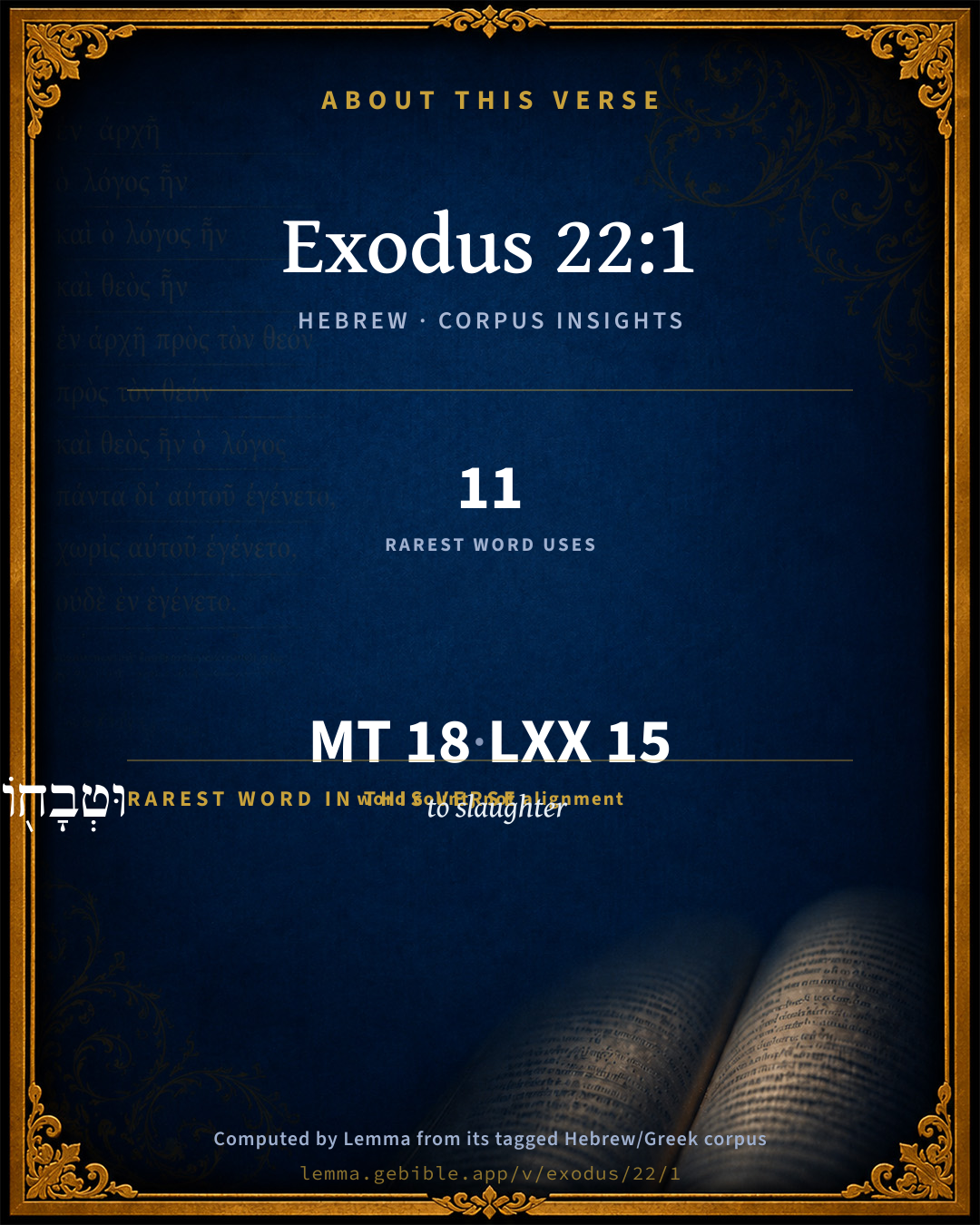
Exodus 22:1

Hebrew (Westminster Leningrad Codex) Exodus 22:1 appears in the Hebrew Old Testament. The text above is from the Westminster Leningrad Codex. Each word links to its Strong’s number, a concise gloss, and parsing drawn from the Open Scriptures Hebrew Bible morphology. Click any word for its full Brown-Driver-Briggs (BDB) entry.
Download image
Cite this verse

Exodus 22:1 (World English Bible). Public Domain. Lemma interlinear Bible study tool, https://lemma.gebible.app/v/exodus/22/1.

Show BibTeX & RIS
BibTeX
RIS
English Translation
"If a man steals an ox or a sheep, and kills it, or sells it; he shall pay five oxen for an ox, and four sheep for a sheep.
World English Bible · Public Domain
Download a study sheet

One document with this verse’s original text, its word-by-word gloss line, the meaning frame, cross-references with their text, attributed commentary, and full source and license credits — printable, and it pastes into notes with its structure intact.

This verse Autodidact and up

Study sheet (.html) Plain text (.txt)

A passage Seminary Student

Up to 50 verses in one chapter. A passage sheet keeps up to 6 commentary sources and 12 cross-references per verse, in the order this page ranks them, and says so on the sheet whenever that leaves anything out. Ask for a single verse and you get the Autodidact verse sheet above.

Everything on this page stays free to read, with no account — the sheet is a download of what is already on screen, not access to it.

Want to remove ads? Support Godless Engineer
Compare translations 3

The same verse in 3 English versions, stacked beneath the original-language interlinear above. Click any original word for its lexicon entry.

Each is an independent rendering of the whole verse — the interlinear is not word-aligned to these translations.

Highlighted words mark where these versions differ — a whole-verse word diff, not a word-by-word alignment.

  • World English Bible Public Domain
    "If a man steals an ox or a sheep, and kills it, or sells it; he shall pay five oxen for an ox, and four sheep for a sheep.
  • King James Version Public Domain
    If a man shall steal an ox, or a sheep, and kill it, or sell it; he shall restore five oxen for an ox, and four sheep for a sheep.
  • unfoldingWord Literal Text CC BY-SA 4.0
    If a man steals an ox or a sheep and slaughters it or sells it, he shall compensate five cattle for the ox, and four sheep for the sheep.

unfoldingWord Literal Text — © unfoldingWord, licensed CC BY-SA 4.0. Word-aligned USFM3 via Door43 (git.door43.org/unfoldingWord/en_ult).

Versions to compare (up to 4)

3 of 4 selected

Show all 18 translations

Every available English version of this verse, each an independent rendering of the whole verse.

  • World English Bible Public Domain
    "If a man steals an ox or a sheep, and kills it, or sells it; he shall pay five oxen for an ox, and four sheep for a sheep.
  • Berean Standard Bible Public Domain
    “If a man steals an ox or a sheep and slaughters or sells it, he must repay five oxen for an ox and four sheep for a sheep.
  • Majority Standard Bible Public Domain
    “If a man steals an ox or a sheep and slaughters or sells it, he must repay five oxen for an ox and four sheep for a sheep.
  • King James Version Public Domain
    If a man shall steal an ox, or a sheep, and kill it, or sell it; he shall restore five oxen for an ox, and four sheep for a sheep.
  • American Standard Version (1901) Public Domain
    If a man shall steal an ox, or a sheep, and kill it, or sell it; he shall pay five oxen for an ox, and four sheep for a sheep.
  • Revised Version (1885) Public Domain
    If a man shall steal an ox, or a sheep, and kill it, or sell it; he shall pay five oxen for an ox, and four sheep for a sheep.
  • Geneva Bible (1599) Public Domain
    If a man steale an oxe or a sheepe, and kill it or sell it, he shall restore fiue oxen for the oxe, and foure sheepe for the sheepe.
  • Douay-Rheims (1899) Public Domain
    If any man steal an ox or a sheep, and kill or sell it: he shall restore five oxen for one ox, and four sheep for one sheep.
  • Young's Literal Translation Public Domain
    `When a man doth steal an ox or sheep, and hath slaughtered it or sold it, five of the herd he doth repay for the ox, and four of the flock for the sheep.
  • Literal Standard Version CC BY-SA 4.0
    When a man steals an ox or sheep, and has slaughtered it or sold it, he repays [with] five of the herd for the ox, and four of the flock for the sheep.
  • Unlocked Literal Bible CC BY-SA 4.0
    If a man steals an ox or a sheep and kills it or sells it, then he must pay five oxen for one ox, and four sheep for one sheep.
  • unfoldingWord Literal Text CC BY-SA 4.0
    If a man steals an ox or a sheep and slaughters it or sells it, he shall compensate five cattle for the ox, and four sheep for the sheep.
  • Darby Bible Public Domain
    If a man steal an ox, or a sheep, and kill it, or sell it, he shall restore five oxen for the ox, and four sheep for the sheep.
  • World Messianic Bible Public Domain
    “If a man steals an ox or a sheep, and kills it or sells it, he shall pay five oxen for an ox, and four sheep for a sheep.
  • Webster's Bible Public Domain
    If a man shall steal an ox, or a sheep, and kill it, or sell it; he shall restore five oxen for an ox, and four sheep for a sheep.
  • Free Bible Version CC BY-SA 4.0
    “Anyone who steals an ox or a sheep and kills or sells it must pay back five oxen for one ox and four sheep for one sheep.
  • Bible in Basic English Public Domain
    If a man takes without right another man's ox or his sheep, and puts it to death or gets a price for it, he is to give five oxen for an ox, or four sheep for a sheep, in payment: the thief will have to make payment for what he has taken; if he has no money, he himself will have to be exchanged for money, so that payment may be made.
  • JPS Tanakh (1917) Public Domain
    (21-37) If a man steal an ox, or a sheep, and kill it, or sell it, he shall pay five oxen for an ox, and four sheep for a sheep.

Literal Standard Version (2020), Covenant Press — licensed CC BY-SA 4.0. Text via the HelloAO Bible API (eBible.org). Unlocked Literal Bible (unfoldingWord) — licensed CC BY-SA 4.0. Text via the HelloAO Bible API (eBible.org). unfoldingWord Literal Text — © unfoldingWord, licensed CC BY-SA 4.0. Word-aligned USFM3 via Door43 (git.door43.org/unfoldingWord/en_ult). Free Bible Version, Dr. Jonathan Gallagher — licensed CC BY-SA 4.0. Text via the HelloAO Bible API (eBible.org).

Word by word

More ways to search: Search by grammar → Find every occurrence → Compare this word →

Practice this passage: Drill this verse → Learn its vocabulary →

וּטְבָח֖וֹ
ṭâbach
H2873
“and · to slaughter · him”
Conjunction + Verb, Qal, Sequential Perfect, 3rd Person, Masculine, Singular + Suffix, Personal, 3rd Person, Masculine, Singular
Part of Speech
Conjunction + Verb
Stem
Qal
Form
Sequential Perfect
Person
3rd Person
Gender
Masculine
Number
Singular
Full BDB Definition

Origin: a primitive root

TWOT: 786

to slaughter, slay, butcher, kill ruthlessly - (Qal) - to slaughter, butcher - to slay, kill ruthlessly (figuratively)
  1. כִּ֤י kîy H3588 “that” Conjunction
  2. יִגְנֹֽב gânab H1589 “to steal” Verb, Qal, Imperfect, 3rd Person, Masculine, Singular
  3. אִישׁ֙ ʼîysh H376 “man” Noun, Common, Masculine, Singular, Absolute
  4. שׁ֣וֹר shôwr H7794 “ox” Noun, Common, Masculine, Singular, Absolute
  5. אוֹ ʼôw H176 “or” Conjunction
  6. שֶׂ֔ה seh H7716 “sheep” Noun, Common, Both, Singular, Absolute
  7. א֣וֹ ʼôw H176 “or” Conjunction
  8. מְכָר֑וֹ mâkar H4376 “to sell · him” Verb, Qal, Perfect, 3rd Person, Masculine, Singular + Suffix, Personal, 3rd Person, Masculine, Singular
  9. חֲמִשָּׁ֣ה châmêsh H2568 “five” Adjective, Cardinal number, Masculine, Singular, Absolute
  10. בָקָ֗ר bâqâr H1241 “cattle” Noun, Common, Both, Singular, Absolute
  11. יְשַׁלֵּם֙ shâlam H7999 “to be at peace” Verb, Piel, Imperfect, 3rd Person, Masculine, Singular
  12. תַּ֣חַת tachath H8478 “under” Preposition
  13. הַשּׁ֔וֹר shôwr H7794 “the · ox” Particle, Definite Article + Noun, Common, Masculine, Singular, Absolute
  14. וְאַרְבַּע ʼarbaʻ H702 “and · four” Conjunction + Adjective, Cardinal number, Feminine, Singular, Absolute
  15. צֹ֖אן tsôʼn H6629 “flock” Noun, Common, Both, Singular, Absolute
  16. תַּ֥חַת tachath H8478 “under” Preposition
  17. הַשֶּֽׂה seh H7716 “the · sheep” Particle, Definite Article + Noun, Common, Both, Singular, Absolute

About this verse

These counts appear in no published source. They are computed here, from the morphology-tagged text and Lemma’s own curated glosses. What Lemma adds →

18
words
14
distinct lemmas
Pentateuch
section

Notable vocabulary

The rarest word here is וּטְבָח֖וֹ to slaughter H2873 — appearing just 11 times in the whole Hebrew Bible.

Shared distinctive vocabulary

וּטְבָח֖וֹ to slaughter H2873 occurs in 11 verses of the Hebrew Bible. Also found in:

Grammatical profile

  • 4 verbs
  • 7 nouns
  • 2 adjectives
  • 2 prepositions
  • 3 conjunctions

Verb forms

  • יִגְנֹֽב Qal · Imperfect
  • וּטְבָח֖וֹ Qal · Sequential Perfect
  • מְכָר֑וֹ Qal · Perfect
  • יְשַׁלֵּם֙ Piel · Imperfect

Repetition

Words recur within this verse — often emphatic in Hebrew:

  • שׁ֣וֹר ox H7794 ×2
  • שֶׂ֔ה sheep H7716 ×2
  • תַּ֣חַת under H8478 ×2
  • אוֹ or H176 ×2

Hebrew & Septuagint length

In English translation the verse runs 29 words from the Hebrew and 29 from the Septuagint (LXX English) — the same length.

A rough comparison of the two English renderings, which tokenize alike — not a word-level alignment.

Word counts can differ between the Hebrew and the Greek without any difference in meaning — e.g. the Hebrew direct-object marker אֵת has no separate Greek word, and Greek often adds the article ὁ.

In the original languages it is 18 Hebrew tokens and 15 Greek tokens — but the two are counted differently (Hebrew bundles its prefixes and suffixes into one token; the Greek is in lemma form), so that isn’t a like-for-like length.

Cross-references

6

Topical passages linked to Exodus 22:1 in the Treasury of Scripture Knowledge — connected by theme and wording, ordered by reader-vote popularity; previews shown in the World English Bible.

  • 2 Samuel 12:6 He shall restore the lamb fourfold, because he did this thing, and because he had no pity!"
  • Luke 19:8 Zacchaeus stood and said to the Lord, "Behold, Lord, half of my goods I give to the poor. If I have wrongfully exacted anything of anyone, I restore four times as much."
  • Proverbs 6:31 But if he is found, he shall restore seven times. He shall give all the wealth of his house.
  • Numbers 5:7 then he shall confess his sin which he has done, and he shall make restitution for his guilt in full, and add to it the fifth part of it, and give it to him in respect of whom he has been guilty.
  • Leviticus 6:1–6 Yahweh spoke to Moses, saying,
  • Proverbs 14:4 Where no oxen are, the crib is clean, But much increase is by the strength of the ox.

Cross-references courtesy of OpenBible.info (CC BY 4.0).

Hebrew and Greek witnesses Masoretic Hebrew ↔ Greek Septuagint

The same verse in the two great witnesses to the Old Testament, shown verse-for-verse.

These are two independent witnesses, not word-aligned to each other, and the Septuagint is shown in lemma (dictionary) form.

Hebrew Exodus 22:1 Masoretic · Westminster Leningrad Codex

כִּ֤י יִגְנֹֽב אִישׁ֙ שׁ֣וֹר אוֹ שֶׂ֔ה וּטְבָח֖וֹ א֣וֹ מְכָר֑וֹ חֲמִשָּׁ֣ה בָקָ֗ר יְשַׁלֵּם֙ תַּ֣חַת הַשּׁ֔וֹר וְאַרְבַּע צֹ֖אן תַּ֥חַת הַשֶּֽׂה

"If a man steals an ox or a sheep, and kills it, or sells it; he shall pay five oxen for an ox, and four sheep for a sheep.

World English Bible · Public Domain

Greek LXX Exodus 22:1 Septuagint · lemma form

ἐάν δέ ἐν ὁ διόρυγμα εὑρίσκω ὁ κλέπτης καί πλήσσω ἀποθνήσκω οὐ εἰμί αὐτός φόνος

And if one steal an ox or a sheep, and kill it or sell it, he shall pay five calves for a calf, and four sheep for a sheep.

LXX2012 (modern English Septuagint) · Public Domain

On this verse, The Preacher's Complete Homiletical Commentary discusses the Septuagint’s reading. Read the note in Commentary ↓

Hebrew: Westminster Leningrad Codex (CC BY 4.0). Greek: Septuagint (public domain); English from LXX2012 (modern English Septuagint) (Public Domain). How the Septuagint differs from the Hebrew →

Targum (Aramaic paraphrase)

2

The Targum is the ancient Jewish Aramaic paraphrase of the Hebrew Scriptures — an interpretive translation, not the Hebrew text itself. Onkelos (literal) and Pseudo-Jonathan (expansive) render the Torah, and Jonathan the Prophets. Coverage is partial: where no permissively-licensed English translation exists for a verse, only the Aramaic is shown. This is verse-level text, not a word-by-word alignment to the Hebrew.

  1. Targum Onkelos Torah (Genesis–Deuteronomy)
    אִם בְּמַחְתַּרְתָּא יִשְׁתְּכַח גַנָבָא וְיִתְמְחֵי וִימוּת לֵית לֵהּ דָם:

    (no public-domain English translation for this verse)

    Targum Onkelos — Aramaic: “Onkelos Genesis” (public domain); “Onkelos Exodus” (public domain); “Onkelos Leviticus” (public domain); “Onkelos Numbers” (public domain); “Onkelos Deuteronomy” (public domain). English: “Sefaria Community Translation” (CC0 1.0 (public-domain dedication)); “J.W. Etheridge. The Targums of Onkelos and Jonathan Ben Uzziel on the Pentateuch. London: Longmans, Green, 1862” (public domain). Text via Sefaria.

  2. Targum Pseudo-Jonathan Torah (Genesis–Deuteronomy)
    אִין בַּחְרַכָּא דְכוֹתְלָא מִשְׁתְּכַח גַּנָבָא וְיִתְמְחֵי וִימוּת לֵית לֵיהּ חוֹבַת שְׁפִיכוּת אֲדַם זַכְּאַי

    If a thief be found in a window of the wall, and be smitten and die, there shall not be on his account the guilt of the shedding of innocent blood.

    Targum Pseudo-Jonathan — Aramaic: “Targum Jonathan on Genesis” (public domain); “Targum Jonathan on Exodus” (public domain); “Targum Jonathan on Leviticus” (public domain); “Targum Jonathan on Numbers” (public domain); “Targum Jonathan on Deuteronomy” (public domain). English: “The Targum of Jonathan ben Uzziel, trans. J. W. Etheridge, London, 1862” (public domain). Text via Sefaria.

Commentary

Notes on Exodus 22:1 from classic Christian and Jewish commentators (each source and its license shown beneath its notes). The classic Christian expositions comment on the surrounding passage and are grouped to its opening verse, so a note may address several verses; the Jewish commentaries on the Tanakh (Rashi and others) are per-verse, so they appear only where the commentator wrote on this verse.

Lemma curates 59 commentaries, every one of them public domain or Creative Commons licensed, each selected and text-cleaned for this edition rather than reprinted as found. About our sources →

Matthew Henry's Commentary

Here are the laws,

I. Concerning theft, which are these: - 1. If a man steal any cattle (in which the wealth of those times chiefly consisted), and they be found in his custody, he must restore double, Exo 22:4. Thus he must both satisfy for the wrong and suffer for the crime. But it was afterwards provided that if the thief were touched in conscience, and voluntarily confessed it, before it was discovered or enquired into by any other, then he should only make restitution of what he had stolen, and add to it a fifth part, Lev 6:4, Lev 6:5. 2. If he had killed or sold the sheep or ox he had stolen, and thereby persisted in his crime, he must restore five oxen for an ox, and four sheep for a sheep (Exo 22:1), more for an ox than for a sheep because the owner, besides all the other profit, lost the daily labour of his ox. This law teaches us that fraud and injustice, so far from enriching men, will impoverish them: if we unjustly get and keep that which is another's, it will not only waste itself, but it will consume that which is our own. 3. If he was not able to make restitution, he must be sold for a slave, Exo 22:3. The court of judgment was to do it, and it is probable that the person robbed had the money. Thus with us, in some cases, felons are transported into plantations where alone Englishmen know what slavery is. 4. If a thief broke a house in the night, and was killed in the doing of it, his blood was upon his own head, and should not be required at the hand of him that shed it, Exo 22:2. As he that does an unlawful act bears the blame of the mischief that follows to others, so likewise of that which follows to himself. A man's house is his castle, and God's law, as well as man's, sets a guard upon it; he that assaults it does so at his peril. Yet, if it was in the day-time that the thief was killed, he that killed him must be accountable for it (Exo 22:3), unless it was in the necessary defence of his own life. Note, We ought to be tender of the lives even of bad men; the magistrate must afford us redress, and we must not avenge ourselves.

II. Concerning trespass, Exo 22:5. He that wilfully put his cattle into his neighbour's field must make restitution of the best of his own. Our law makes a much greater difference between this and other thefts than the law of Moses did. The Jews hence observed it as a general rule that restitution must always be made of the best, and that no man should keep any cattle that were likely to trespass upon his neighbours or do them any damage. We should be more careful not to do wrong than not to suffer wrong, because to suffer wrong is only an affliction, but to do wrong is a sin, and sin is always worse than affliction.

III. Concerning damage done by fire, Exo 22:6. He that designed only the burning of thorns might become accessory to the burning of corn, and should not be held guiltless. Men of hot and eager spirits should take heed, lest, while they pretend only to pluck up the tares, they root out the wheat also. If the fire did mischief, he that kindled it must answer for it, though it could not be proved that he designed the mischief. Men must suffer for their carelessness, as well as for their malice. We must take heed of beginning strife; for, though it seem but little, we know not how great a matter it may kindle, the blame of which we must bear, if, with the madman, we cast fire-brands, arrows, and death, and pretend we mean no harm. It will make us very careful of ourselves, if we consider that we are accountable, not only for the hurt we do, but for the hurt we occasion through inadvertency.

Matthew Henry's Commentary on the Whole Bible (1708–1710) — public domain (CC PDM 1.0). Text via the HelloAO Bible API.

Ellicott's Commentary for English Readers

(1) If a man shall steal an ox, or a sheep.—The flocks and herds of the Israelites constituted their principal property, and hence cattle-stealing is taken as the representative of theft in general.

And kill it, or sell it.—Plainly showing persistence and determination.

Five oxen . . . four sheep.—The principle of the variation is not clear. Perhaps the theft of an ox was regarded as involving more audacity, and so more guilt, in the thief.

XXII.

(1-4) Theft is here treated of with great brevity, only three kinds being distinguished—(1) Housebreaking; (2) stealing without conversion of the property; (3) stealing with conversion. The main principle of punishment laid down is the exaction from the offender o! Double (Exo_22:4). When, however, there has been conversion of the property, the penalty is heavier, the return of four-fold in the case of a sheep, of five-fold in that of an ox (Exo_22:1). Incidentally it is enacted that the burglar may be resisted by force (Exo_22:2), and that to kill him shall be justifiable homicide; and further, it is laid down that a thief unable to make the legal restitution shall become a slave in order to pay his debt (Exo_22:3).

A Bible Commentary for English Readers, edited by Charles John Ellicott (1878–1897) — public domain. Text from a community e-Sword module.

Trapp's Complete Commentary

John Trapp

Exo 22:1 If a man shall steal an ox, or a sheep, and kill it, or sell it; he shall restore five oxen for an ox, and four sheep for a sheep.

Ver. 1. If a man shall steal, &c.] The Persians at this day punish theft and manslaughter so severely, that in an age a man shall hardly hear either of the one or the other. The Turk’s justice will rather cut off two innocent men than let one thief escape. {a}

{a} The Preacher’s Travels, by J. Cartwright.

John Trapp, A Commentary or Exposition upon All the Books of the Old and New Testament (1647–1656) — public domain. Text from a community e-Sword module.

The Biblical Illustrator

Joseph S. Exell

Exo_22:1-5

If a man steal.

The law of robbery

God made provision not only for the acquisition of property, but for its security. Hence this law, which respects--

1. Theft.

2. Housebreaking.

I. Theft (Exo_22:1-4). As the wealth of an Israelite consisted mainly in flocks and herds, the depredations of the thief were directed for the most part against them.

II. Housebreaking (Exo_22:2-3). Learn--

1. That Gods providence extends to property as well as persons. Both are His gift.

2. That those who endeavour to thwart that providence play a losing game.

3. That the recognition of that providence is not inconsistent with, but demands the use of, means. It is an abuse and perversion of it to tamely submit to wrong when the legitimate prevention of wrong is within our reach.

4. That providence protects even the life of the wrong-doer, and no man must wantonly interfere with that protection. (J. W. Burn.)

Actual and virtual criminality

I. Men must suffer for crime.

II. Men must suffer, unavenged, the extreme consequences of criminal conduct.

III. Men must learn, by degrees of suffering, that there are degrees of criminality.

IV. Men must learn that property has rights.

V. Men must learn to consider the welfare of their neighbours. (W. Burrows, B. A.)

How to get at a thief

This is the only way of getting at a thief. You cannot reason with him. He dismissed his reason before he committed his felony. He had first to strangle his reason; he committed murder in the sanctuary of his soul before he committed theft in the fields of his neighbour. What, then, is to be done with him? He must be made to feel the folly of theft; he must be made to feel that theft is a bad investment; he must be made to feel that he has played the fool even in the excess of his cleverness. The thief would be made to know what dishonesty is, when for the one ox he must pay five in its place. He could have evaded an argument; he could have doubled upon a covenant, and have quibbled about the ambiguity of its terms; but he could not shuffle out of this four-square arithmetical arrangement. Five oxen for an ox, four sheep for a sheep; and by the time the thief had played at that game two or three days, he would have put on the garb, at least, of an honest man! (J. Parker, D. D.)

Substitutionary restitution

A coal merchant in one of our American cities was approached by a minister in regard to the salvation of his soul. The merchant declared it an impossibility for him ever to become a Christian. He gave as a reason his mode of business. For a long term of years, he had, according to a too general custom, given short weight. He had thus grown rich, and now felt the inconsistency of seeking religion without restitution. This was impossible: many of his customers were dead, others beyond his knowledge. The thought of the poor who had paid for coal they had never received rested heavily on him. He asked the minister if he thought the substitution of a gift to the poor would be acceptable to God. The minister advised him to try it. A large donation, more than equal in amount to his unjust gains, was made, and the merchant sought God in earnest. He was happily converted, and is to-day a prominent member of the church.

Tardy restitution

As a gentleman in London entered his house, he found a well-dressed female sitting on the stairs, who asked pardon for the liberty she had taken, saying that, hearing the alarm of a mad dog, she had taken refuge in his house. On hearing her story, he gave her some refreshment; and she left, thanking him for his civility. In the evening his lady missed her gold watch; and it was concluded the female was the thief. Fifteen years afterwards, the watch was returned, with a note from this woman, saying the gospel had changed her heart, and she desired to return the watch to its rightful owner.

Unrighteous restitution

What a shame then is this to Christians, who minding nothing less than restitution, make ex rapina holocaustum: out of a world of ill-gotten goods, they cull out some small fragments to erect some poor hospital; having cheated thousands, build alms-houses for some few, and then set a glorious inscription in front, whereas this one word, Aceldama, would be far more proper. (J. Spencer.)

Compensation for damage

A man in New Jersey told me the following circumstances respecting himself and one of his neighbours. I once owned a large flock of hens. I generally kept them shut up. But one spring I concluded to let them run in my yard, after I had clipped their wings so that they could not fly. One day, when I came home to dinner, I learned that one of my neighbours had been there full of wrath, to let me know that my hens had been in his garden, and that he had killed several of them, and thrown them over into my yard. I determined at once to be revenged. I sat down and ate my dinner as calmly as I could. By the time I had finished I thought that perhaps it was not best to fight with my neighbour about hens, and thereby make him my bitter enemy. I concluded to try another way, being sure that it would be better. After dinner, I went to my neighbours. He was in his garden. I went out and found him in pursuit of one of my hens with a club, trying to kill it. I accosted him. He turned upon me, his face inflamed with wrath, and broke out in a great fury, You have abused me. I will kill all your hens, if I can get them. I never was so abused. My garden is ruined. I am sorry for it, said I: I did not wish to injure you; and now see that I have made a great mistake in letting out my hens. I ask your forgiveness, and am willing to pay you six times the damage. The man seemed confounded. He did not know what to make of it. He looked up to the sky, then down at the earth, then at his neighbour, then at his club, then at the poor hen he had been pursuing, and said nothing. Tell me now, said I, what is the damage and I will pay you six-fold; and my hens shall trouble you no more. I will leave it entirely for you to say what I shall do. I cannot afford to lose the love and goodwill of my neighbours, and quarrel with them, for hens or anything else. I am a great fool! said my neighbour; the damage is not worth talking about; and I have more need to compensate you than you me, and to ask your forgiveness than you mine. (Mrs. Childs Letters from New York.)

The Biblical Illustrator, edited by Joseph S. Exell (c. 1880s–1900s) — public domain. Text from a community e-Sword module.

Joseph Benson's Commentary

Exo 22:1. Five oxen for an ox, and four sheep for a sheep — More for an ox than for a sheep, because the owner, besides all the other profit, lost the daily labour of his ox. If he were not able to make restitution, he was to be sold for a slave: the court of judgment was to do it, and it is likely the person robbed received the money.

Joseph Benson's Commentary on the Old and New Testaments (1811–1818) — public domain. Text from a community e-Sword module.

The Preacher's Complete Homiletical Commentary

Joseph S. Exell (gen. ed.)

CRITICAL NOTES.—

Exo_22:2. No blood be shed for him.] This is a free translation, which, however, fairly gives the purport of the original words. The Hebrew phrase reads literally: “There is of for him bloods” (’eyn lo dâmim), the last word—in the plural—plainly standing for “blood-gulitiness.” “There is, in his case,” or, “in reference to him,” “no blood-guiltiness” resting on any one. No further blood is to be shed by way of avenging the death of one who had lost his life in the way described. We have here an instance of the underlying admission in the axiom, “Blood for blood” as the rule which calls for the caution of the text, as an exception.

MAIN HOMILETICS OF THE PARAGRAPH.—Exo_22:1-6

ACTUAL AND VIRTUAL CRIMINALITY

The Mosaic law is a schoolmaster. Not a mere pedagogue to guide mankind to the place or person where education may be obtained, but a veritable schoolmaster to educate mankind—to lead men up out of a low into a high social condition, to develop humanity. We do not deny the fact that the Mosaic law, is a pedagogue, while we strive to bring into prominence the fact that it is itself also an educator. The educational power of the law is seen in this passage, as well as in others. Here men are taught to discriminate between crime and crime. While sin is one in its essence, yet there are degrees in criminality. Crime is variable, all sinners are not equally guilty.

I. Men must suffer for crime. The man who steals an ox or a sheep is not merely to make good the stolen animal, but must be mulcted in a penalty. The stolen ox must be replaced by another. But four oxen, or three sheep, is the price of the crime. And if the thief have nothing, then he is to be sold for his theft. The judges must thus determine. And out of the money thus obtained the loser of the animal must receive compensation. It is better to suffer wrong than to do wrong. The evil-doer must ultimately be a sufferer. The man who suffers evil patiently must ultimately receive compensation. The great moral law of the universe cannot be thwarted. He who hopes to gain by wrongdoing will find that his hope is cut off by the sharp and sure stroke of the hand of retribution. Honest gains may be slow, but they are sure and blessed.

II. Men must suffer, unavenged, the extreme consequences of criminal conduct. If the thief is killed while in the act of pursuing his criminal course, then no one is to be held responsible for the slaughter. “There shall no blood be shed for him.” If a man meets with evil while doing evil, then the human consciousness declares that it serves him right. And here truly the voice of all peoples is the voice of God. But danger might arise if men took the law into their own hands, so that they are not permitted to pursue the thief, and slay him in revenge. In the night, and in self-defence, the thief may be unwittingly slain, then he reaps as he has sown. But when the sun has risen, when the time of danger is over, extreme measures can only be regarded, as dictated by revenge. Even evil-doers have rights which must be respected. It is better to suffer evil than to give way to a revengeful spirit. “Avenge not yourselves.”

III. Men must learn, by degrees of suffering, that there are degrees of criminality. The thief who kills or sells the stolen ox must restore fivefold; but if the theft be found in his hand alive, then he shall restore double. We may picture the thief arrested in his course by the voice of conscience. He does not proceed to extreme lengths. He seems to be on the verge of confession. The law has regard to moral states. A slight penalty is judged for a first offence. The man who has been repeatedly in prison receives a severe sentence. The great Lawgiver is wise and merciful. “If we confess our sins, God is faithful and just to forgive us our sins.”

IV. Men must learn that property has rights. It seems likely that the case presented in verse five is that of the man who purposely causes his beast to feed in another man’s field, or on the herbage growing between the vines; and of the best of his field and of the best of his vineyard shall he make restitution. Though, from our reading of the law, if this should happen as the result of carelessness, we should expect that restitution would have to be made. Communistic theories were not taught in the Old Testament. And the trial of communism was a short-lived and unsuccessful experiment in the early Church. The peculiar theory of some communistic advocates seems to be self-enrichment at the expense of others. The cattle of others must not be allowed to graze on my lands, while my cattle may trespass anywhere. When human selfishness is thoroughly destroyed, when men are as anxious for the welfare of their neighbours as for their own, then boundary lines may be obliterated, and courts of justice may be abolished.

V. Men must learn to consider the welfare of their neighbours. Love thy neighbour as thyself, is a law for all economies. The virtual incendiary must make restitution. The man may simply have been burning the weeds or stubble of his own ground, but he burned too near his neighbour’s standing corn. He may be sorry for the destruction; but sorrow of itself will not fill the granary. Sorrow must work repentance, and repentance must show itself in ample restitution. Be careful how you handle fire. There are fires that cause such awful destruction that compensation is impossible. Who can make restitution for the fires of lust, of sensuality, and of criminality, kindled in the souls of men? Evil. doers have much to answer for. What hand can stay their ever-burning fires?

—W. Burrows, B.A.

SUGGESTIVE COMMENTS ON THE VERSES

THE LAW OF ROBBERY.—Exo_22:1-4

God made provision not only for the acquisition of property, but for its security. Hence this law, which respects—

1. Theft.

2. Housebreaking.

I. Theft, Exo_22:1-4. As the wealth of an Israelite consisted mainly in flocks and herds, the depredations of the thief were directed for the most part against them.

1. If the stolen animal were destroyed or sold

(1) in the case of an ox, as the more valuable for food and service, and the owner losing its work as well as its literal value, the penalty was fivefold.

(2) In the case of a sheep, the penalty was fourfold (2Sa_12:6). But—

2. If the animal were not sold or destroyed, the penalty was only double, as the thief would probably be a novice in his art.

II. Housebreaking, Exo_22:2-3. The public sentiment (which ever recognises that a man’s house is his castle) against this act, it may be presumed, was so high, that the protection of a robber from sanguinary vengeance was necessary.

1. If his depredations occurred at midnight, and he lost his life in the attempt, the right of self-protection on the part of the householder was recognised.

2. If, however, they occurred during the day when he might be identified or apprehended, and he was slain, even the life of a thief was precious, and taking that life was murder (Exo_21:12).

3. In the case of his success and detection, the penalty was double the value of the stolen property, or slavery.

4. In the case of non-success, he obtained the benefit of the doubt. (See also Lev_6:4-5.)

Learn—

i. That God’s providence extends to property as well as persons. Both are His gift. Neither must be interfered with except by the original donor.

ii That those who endeavour to thwart that providence play a losing game. The law of retribution imposes not only the loss of the apparent gain but of more. An act of injustice prevents enjoyment, entails the loss of self-respect, the approbation of conscience, the censure of good men, and the anger of God.

iii. That the recognition of that providence is not inconsistent with, but demands the use of, means. It is an abuse and perversion of it to tamely submit to wrong when the legitimate prevention of wrong is within our reach.

iv. That providence protects even the life of the wrong-doer, and no man must wantonly interfere with that protection. It is a terrible thing to send a man into eternity red-handed in his guilt. Milder measures, as all history testifies, may produce reformation.—J. W. Burn.

THE PENALTY OF CARELESSNESS.—Exo_22:5-6

As in Exo_21:28-36,—the principle is laid down that a man must “not only look on his own things, but also on the things of others.”

1. If a man, negligent of doors or fences, “shall let his beast go loose, and it shall feed” (according to LXX. Vulg. Syr. followed by Luther) in another’s field; or

2. If a man, according to the custom of Eastern countries before the autumnal rains, to prevent the ravages of vermin and to prepare the soil for the next crop, shall burn the dry grass and stubble in his field, and neglect to keep the fire within safe and proper bounds; then,

3. Restitution must be made.

Learn—

i. To be careful of your neighbour’s material, intellectual, and spiritual interest, and do not damage them by a careless word or action.

ii. In order that those interests may not be invaded, put a strong check on those loose and vagrant so-called interests of your own.

iii. In order to prevent any possibility of the transgression of those interests, see that those passions of avarice, envy, and revenge which cause so much mischief in the word, are quenched.

iv. If those interests are invaded, render a frank, manly, and ample restitution.

1. Confess your fault.

2. In the case of loss make it up.

3. In the case of injury to character, let the acknowledgment be co-extensive with the slander.

4. Let those who have been injured forgive as they hope to be forgiven.

J. W. Burn.

THINGS ENTRUSTED AND LOST

If the social compact is to rest on solid foundations, there must be a widespread feeling as to the sacredness of trusts. In societies one man is dependent upon another, and there will arise occasions when either goods or cattle must be entrusted to the keeping of others. Law must hold them responsible to whom goods have been entrusted. They must faithfully discharge the trust. They must render true accounts. Balance sheets must be submitted for inspection. The trustee occupies a responsible position. Every man, morally considered, is a trustee. Each man ought to consider himself as his brother’s keeper. One day accounts will have to be rendered. How solemn is man’s position as a moral trustee. Let there be a faithful discharge of duties, and there will be a wonderful display of Divine love and mercy.

I. The course to be pursued when the thief is found. If the goods have been stolen out of the trustee’s house, and the thief is discovered, then the case is clear. The trustee is free from all blame, and the thief must pay double for that which he has stolen. The thief might have taken the goods of the trustee as well as the goods entrusted to his keeping, and therefore it is not needful to suppose him guilty. If the trustee has taken the same precaution with that which is another man’s as with his own, then he has proved his faithfulness. Law requires no more.

II. The course to be pursued when the thief is unknown. If the goods are stolen, and the thief is not discovered, then there may be a case of embezzlement. The master of the house is responsible. His innocence must be proved. It must be shown that there has been no evil connivance. This is to be done by—

1. An appeal to the judges. It will be their difficult task to decide whether the accused is guilty or innocent. Evidence must be taken. The truth must be elicited by careful cross examination. And whom the judges shall condemn, he shall pay double unto his neighbour.

2. An appeal to the Supreme Judge. The sacredness of a religious oath has been held by nations in rudest states. There is a religious instinct in men, which speaks of his Divine original. Low has that man fallen who can easily violate a religious oath. And yet how many in our day can trifle with this solemn engagement! If the owner accepts the oath, then the trustee is freed from blame. We certainly must take into consideration the character of him who swears. Happy the man whose character is above suspicion, whose simple “yea” is deemed conclusive.

III. The course to be pursued when cattle are stolen from the trustee. There is difficulty in comprehending the purport of Exo_22:12 when taken in connection with the preceding verses. If they had not been present then we might fairly have supposed that the trustee is more responsible for the safety of cattle than for the safety of goods. Thus we may perceive that it is a more difficult matter to steal cattle than to steal money. Therefore the trustee to whom cattle is entrusted, and from whom they have been stolen, must make restitution unto the owner. But if the cattle be torn in pieces, and he be able to bring it for a witness, then he shall not make good that which was torn. Perhaps the trustee was present at the attack, and endeavoured to drive away the wild animal, and the torn pieces rescued from the jaws of the destroyer are the witnesses of his heroism.

IV. The course to be pursued when injury is done to borrowed things. If the borrower has sole charge, then he is to be held responsible for the damages that may happen. But if the owner be with it, he shall not make it good; if it be an hired thing, it came for his hire. It seems as if the borrower is supposed to be in the hired service of the owner. The piece of the dead beast must be subtracted from the pay. We must be careful of borrowed property. All that we have has been lent unto us by the Lord, and He will call us to account for injuries done to that with which we have been entrusted.

V. The course to be pursued when a maid is enticed to her undoing. Some suppose this to be a case of trust like all the rest. The maid has entrusted herself—her honour and virtue—to the man, and he has betrayed the trust. He has violated her person, he has spoiled her virginity, and he must endow her to be his wife. He has no power of choice in the matter, but the father may for wise reasons utterly refuse to give the maid unto her betrayer, and he must pay money according to the dowry of virgins. The father ought to know what is for the good of his child. He is likely to have a knowledge of the world, and to know that his daughter’s happiness would not be safe in the keeping of such a man. It is always wise to take the counsel of parents. Let daughters especially not forsake the guide of their youths. Seducers ought to be compelled to marry the seduced if the parents are willing, or, if not, to make restitution. This would lessen the amount of the prostitution which is one of our national sins.—W. Burrows, B.A.

ILLUSTRATIONS

BY

REV. WILLIAM ADAMSON

Divine Enactments! Exo_22:1-31.

(1) There is a world of difference between a stained glass window and a kaleidoscope. Their relative values are very different, and so is their structure. The pieces of variegated glass are flung anyhow, for the prism to arrange; whereas, those employed in the window are all arranged to give a beautiful, effective, and abiding impression. These separate enactments are not strung together haphazard. On the contrary, they are chords divinely arranged to produce harmony in the world, and give forth strains of Divine adoration in their observance.

(2) If one side of a tree grows, and the other does not, the tree acquires a crooked form. It may be fruitful, but it cannot be beautiful. God would have humanities and nationalities, theocracies and individualities, both rich in the beauties of holiness and the fruits of righteousness. The unequal growth of the Christian graces is undesirable; hence the numerous Divine precautions to make them alike fair, fragrant, and fruitful.

“Stern lawgiving! yet thou dost wear

The Godhead’s most benignant grace;

Flowers laugh before thee on their beds;

And fragrance in thy footing treads;

Thou dost preserve the stars from wrong.”

—Wordsworth.

Dishonesty! Exo_22:1.

(1) Matthew Henry says, “That which is won ill will never wear well, for there is a curse attends it, which will waste it.” Many a fraudulent speculator on ’Change is none the richer for the gains dishonestly obtained from widows and old maids. Honesty is, after all, the best policy; for very frequently, the same corrupt dispositions which incline men to the sinful ways of getting will incline them to the like sinful ways of spending.

(2) In a recent Court of Queen’s Bench trial of some men of note, for dishonest building estate transactions, the judge passed sentence of imprisonment, adding that during the interval pecuniary restitution would have to be made; otherwise at the expiry of the term, they would again be brought up on other counts of the indictment. Restitution and retribution were here combined. “The way of transgressors is hard.”

“The sun of justice may withdraw his beams

Awhile from earthly ken; but soon these clouds,

Seeming eclipse, will brighten into day.”

—Bally.

Full Restitution! Exo_22:3. A youth having, in a moment of peculiar temptation, plundered his employer, was sentenced to several years’ penal servitude. His conduct in prison was so exemplary that he was soon released on parole. Filled with a deep sense of his sin before God, and his ingratitude to his employer, he resolved to make the utmost amends. By dint of diligence, energy, and industry, he raised sufficient to refund the monies, including interest in full. He then presented himself before his old master in the spirit of a sincere penitent, expressed his sorrow for the dishonest action, and presented the full amount with interest. Conscience and a desire to live before God combined to achieve this happy result of full restitution. Conscience

“In leaves more durable than leaves of brass

Writes our whole history.”

—Young.

Trespass-Tribute! Exo_22:5. Chandler in his “Asiatic Travels,” observes, that the tame cattle are very fond of vine-leaves, and are permitted to eat them in the autumn. He observed about Smyrna that the leaves were decayed, or stripped by the camels and herds of goats, which were permitted to browse after the vintage. If those animals were so fond of vine leaves, it is no wonder that Moses, in anticipation of possessing the vineyards and oliveyards of Canaan, forbade by an express law any selfish, wilful intrusion of one man’s cattle into the property of another. The trespass would prove a serious injury, if it took place before the time of the vintage; and if it occurred afterwards, it would still be plundering the food of the neighbour’s own cattle. This law has its moral aspect, and applies to the “spiritual vineyards of humanity.”

“Man spoils the tender beauty

That blossoms on the sod,

And blasts the loving heaven

Of the great, good world of God.”

—Household Words.

Law and Love! Exo_22:5. Two small farmers—the one a Christian the other a worldling—owned adjoining lands. Frequently the pious farmer found his neighbour’s cow enjoying the rich grass of his meadow field, in spite of hedgerow and gateway. After driving back the animal, and closing the gate time after time, the humble Christian sent to the churlish, dishonest neighbour to say, that it grieved him more to witness his neighbour’s dishonesty than to lose the fodder for his cattle; and therefore, if his neighbour could not give up breaking the hedge and opening the gate for his cow to trespass, he would cheerfully feed the animal for nothing along with his own stock. This tenderness of heart for his conscience touched the neighbour, and he at once confessed his constant practice of dishonesty, and offered to make restitution in any way.

“Conscience, what art thou? thou tremendous Power!

Who dost inhabit us without our leave;

And art within ourselves another self,

A master-self, that loves to dominate,

And treat the mighty frankly as the slave?”

Honesty! Exo_22:9.

(1) Entrusted! A writer in the “Sunday at Home,” alluding to the honesty of the Malays in the Dutch Indies, says that his business required frequent absences, during which he left his house in their care. Before setting out, he gave the key of his bureau to the mandoor, and told him to take care of the money it contained. He says he never found a single farthing amissing—that sometimes returning late, the servant would be found sleeping close to the bureau for its greater security—and that during all the time he passed in the island, he had no occasion to complain of the theft of any article.

(2) Lost! Not far from St. Petersburgh lived a poor woman, whose only livelihood arose from the visits of a few shipmasters on their way to the capital. One of these left behind a sealed bag of money; which the woman put away in her cupboard till it should be claimed. Years rolled on; and though often in great want, the bag of gold still remained sacredly intact. Seven years afterwards, some shipmasters were again staying at her house, when one of them remarked that he would never forget the town they were then visiting, for he had years before lost a sealed bag of 700 roubles. The poor woman overhearing the remark, said, “Would you know it by the seal?” The shipmaster pointed to a seal hanging by his watch-chain; and the bag was at once produced and restored to its rightful owner.

“An honest man is still an unmoved rock,

Washed whiter, but not shaken with the shock.”

—Davenport.

Trust-Restitution! Exo_22:9.

(1) Recently & lady went to parison on a visit, entrusting her house and furniture to a friend, on whose honesty she relied. Unfortunately the confidence was misplaced; and during her absence, articles of considerable value were removed. On her return, the discovery was made, and the person guilty of so contemptible a breach of trust arraigned. The judge ordered him to restore all the objects of vertu which he had purloined, and to suffer a term of imprisonment for his breach of trust.

(2) A poor widow entrusted the title-deeds of some properly, left by her husband, to a solicitor, in whom she had confidence. Her trust was, however, grossly abused, as he retained the deeds on the plea of some false debt due by the husband. After long and persistent endeavours to obtain recovery of the documents, but in vain, the defrauded widow was advised to apply to the Lord Chancellor. On inquiry, the judge decided that the dishonest lawyer must either deliver up the title-deeds and make restitution for their retention, or be struck off the roll of solicitors.

“Justice has her laws,

That will not brook infringement; in all time,

All circumstances, all state, in every clime,

She holds aloft the same avenging sword.”

—Percival.

Conscience-Restitution! Exo_22:12. Gray mentions that as a gentleman in London entered his house, he found a well-dressed female sitting on the stairs. She asked pardon for the liberty she had taken, saying that she had taken refuge for a few minutes in his house from a mad dog. On hearing her story, he gave her some refreshment before she left. In the evening, his wife missed her gold watch—it having been purloined by the forenoon visitor. Fifteen years afterwards, the watch was returned, with a note from the. thief. It stated that the Gospel had recently changed her heart, and that in consequence she desired to return the watch to its rightful owner.

“Conscience! It is a dangerous thing.

It made me once

Restore a purse of gold.”

—Shakespeare.

The Preacher's Complete Homiletical Commentary (gen. ed. Joseph S. Exell; Funk & Wagnalls, c. 1892) — public domain (pre-1929). A full-Bible homiletical/sermon-outline anthology covering 65 of 66 books (2 John is absent from the source module). Text from a community e-Sword module.

Keil & Delitzsch

C. F. Keil & F. Delitzsch

With regard to cattle-stealing, the law makes a distinction between what had been killed or sold, and what was still alive and in the thief's hand (or possession). In the latter case, the thief was to restore piece for piece twofold (Exo 22:4); in the former, he was to restore an ox fivefold and a small animal (a sheep or a goat) fourfold (Exo 22:1). The difference between the compensation for an ox and a small animal is to be accounted for from the comparative worth of the cattle to the possessor, which determined the magnitude of the theft and the amount of the compensation. But the other distinctions of twofold, fourfold, and fivefold restitution cannot be accounted for, either by supposing "that the animal slain or sold was lost to its master, and might have been of peculiar value to him" (Knobel), for such a consideration of personal feelings would have been quite foreign to the law-not to mention the fact that an animal that had been sold might be recovered by purchase; or from the fact that "the thief in this case had carried his crime still further" (Baumgarten), for the main thing was still the theft, not the consumption or sale of the animal stolen. The reason can only have lain in the educational purpose of the law: viz., in the intention to lead the thief to repent of his crime, to acknowledge his guilt, and to restore what he had stolen. Now, as long as he still retained the stolen animal in his own possession, having neither consumed nor parted with it, this was always in his power; but the possibility was gone as soon as it had either been consumed or sold (see by Archologie, 154, Note 3).

(Note: Calvin gives the same explanation: Major in scelere obstinatio se prodit, ubi res furtiva in quaestum conversa est, nec spes est ulla resipiscentiae, atque ita continuo progressu duplicatur malae fidei crimen. Fieri potest ut fur statim post delictum contremiscat: qui vero animal occidere ausus est, aut vendere, prorsus in maleficio obduruit.)

Exo 22:2-4

Into the midst of the laws relating to theft, we have one introduced here, prescribing what was to be done with the thief. "If the thief be found breaking in (i.e., by night according to Exo 22:3), and be smitten so that he die, there shall be no blood to him (the person smiting him); if the sun has risen upon him (the thief breaking in), there is blood to him:" i.e., in the latter case the person killing him drew upon himself blood-guiltiness (דּמים lit., drops of blood, blood shed), in the former case he did not. "The reason for this disparity between a thief by night and one in the day is, that the power and intention of a nightly thief are uncertain, and whether he may not have come for the purpose of committing murder; and that by night, if thieves are resisted, they often proceed to murder in their rage; and also that they can neither be recognised, nor resisted and apprehended with safety" (Calovius). In the latter case the slayer contracted blood-guiltiness, because even the life of a thief was to be spared, as he could be punished for his crime, and what was stolen be restored according to the regulations laid down in Exo 22:1 and Exo 22:4. But if he had not sufficient to make retribution, he was to be sold "for his stolen," i.e., for the value of what he had stolen, that he might earn by his labour the compensation to be paid.

Keil & Delitzsch — Biblical Commentary on the Old Testament (1861–1891) — public domain (CC PDM 1.0). Text via the HelloAO Bible API. (Old Testament only.)

The Annotated Bible

Arno C. Gaebelein

CHAPTER 22 Further judgments

1. Concerning theft (Exo 22:1-5)

2. Concerning neglect in case of fire (Exo 22:6)

3. Concerning dishonesty (Exo 22:7-15)

4. Concerning immoralities and forbidden things (Exo 22:16-20)

5. Concerning oppression (Exo 22:21-28)

6. Concerning offerings to God (Exo 22:29-31)

These laws need no further comment; they are good and just. The wisdom of them is the wisdom from above. We call attention to Exo 22:18: “Thou shalt not suffer a witch to live.” The nations with which Israel came in contact were given to the most satanic cults and the powers of Satan were manifested among them. Demoniacal possessions abounded, and witchcraft, sorceries, asking the dead, and other abominations were practised. Witchcraft and sorceries, communicating with the wicked spirits is therefore more than a possibility. It can be traced throughout the history of the human race and whenever nations ripened for judgment this form of evil became prominent. The female sex was then, as it is still the case, principally addicted to this sin. In our day it flourishes in spiritualism, Christian Science, theosophy, and other cults.

Arno C. Gaebelein, The Annotated Bible (1913–1922) — public domain. Text from a community e-Sword module.

Geneva Bible (1599)

Geneva Bible translators

Either [a] great beast of the herd, or a small beast of the flock.

Geneva Bible (1599) marginal notes — public domain. Text via Bolls.life.

Adam Clarke's Commentary

CHAPTER XXII

Laws concerning theft, 1-4;

concerning trespass, 5;

concerning casualties, 6.

Laws concerning deposits, or goods left in custody of others,

which may have been lost, stolen, or damaged, 7-13.

Laws concerning things borrowed or let out on hire, 14, 15.

Laws concerning seduction, 16, 17.

Laws concerning witchcraft, 18;

bestiality, 19;

idolatry, 20.

Laws concerning strangers, 21;

concerning widows, 22-24;

lending money to the poor, 25;

concerning pledges, 26;

concerning respect to magistrates, 28;

concerning the first ripe fruits, and the first-born of man

and beast, 29, 30.

Directions concerning carcasses found torn in the field, 31.

NOTES ON CHAP. XXII

Verse 1. If a man shall steal] This chapter consists chiefly of judicial laws, as the preceding chapter does of political; and in it the same good sense, and well-marked attention to the welfare of the community and the moral improvement of each individual, are equally evident.

In our translation of this verse, by rendering different Hebrew words by the same term in English, we have greatly obscured the sense. I shall produce the verse with the original words which I think improperly translated, because one English term is used for two Hebrew words, which in this place certainly do not mean the same thing. If a man shall steal an ox (שור shor) or a sheep, (שה seh), and kill it, or sell it; he shall restore five oxen (בקר bakar) for an ox, (שור shor), and four sheep (צאן tson) for a sheep (שה seh). I think it must appear evident that the sacred writer did not intend that these words should be understood as above. A shor certainly is different from a bakar, and a seh from a tson. Where the difference in every case lies, wherever these words occur, it is difficult to say. The shor and the bakar are doubtless creatures of the beeve kind, and are used in different parts of the sacred writings to signify the bull, the ox, the heifer, the steer, and the calf. The seh and the tson are used to signify the ram, the wether, the ewe, the lamb, the he-goat, the she-goat, and the kid. And the latter word צאן tson seems frequently to signify the flock, composed of either of these lesser cattle, or both sorts conjoined.

As שור shor is used, Job 21:10, for a bull probably it may mean so here. If a man steal a BULL he shall give five OXEN for him, which we may presume was no more than his real value, as very few bulls could be kept in a country destitute of horses, where oxen were so necessary to till the ground. For though some have imagined that there were no castrated cattle among the Jews, yet this cannot be admitted on the above reason; for as they had no horses, and bulls would have been unmanageable and dangerous, they must have had oxen for the purposes of agriculture. צאן Tson is used for a flock either of sheep or goats, and seh שה for an individual of either species. For every seh, four, taken indifferently from the tson or flock must be given; i.e., a sheep stolen might be recompensed with four out of the flock, whether of sheep or goats: so that a goat might be compensated with four sheep, or a sheep with four goats.

Adam Clarke's Commentary on the Bible (1810–1826) — public domain. Text from a community e-Sword/MySword module.

The Cambridge Bible for Schools and Colleges

gen. ed. J. J. S. Perowne

1. If a man steals an ox or a sheep, and kills it or sells it (so as to make profit by it), he is to repay fivefold for the ox, and fourfold for the sheep. Cf. (with differences) Ḥamm. § 8 (see p. 420). The ox is reckoned as of higher value than the sheep on account especially of its being useful in agricultural work. The case of the animal being still alive, and in the thief’s possession, is dealt with in v. 4. The fourfold restitution of a sheep is the penalty named by David in his reply to Nathan’s parable (2Sa_12:4): sevenfold restitution is mentioned only in the hyperbolical passage, Pro_6:31, but may be read rightly by the LXX. in 2Sa_12:4, ‘fourfold’ being here not improbably a correction made on the basis of the present law. Fourfold restitution was also the penalty, when the thief was caught in the act, by the later Roman law; and for the theft of an animal it is still usual among the modern Bedawin (Cook, p. 216). Multiple restitution (in varying ratios) the penalty prescribed by Hạmmurabi for many cases of fraud (DB. v. 596b): and it is still in many parts of the world a common penalty for theft (Post, Grundriss der ethnol. Jurispr. ii. 430 f.).

and kill it] The word (ṭâbaḥ) is the one regularly used of slaughtering cattle for food (Gen_43:16, 1Sa_25:11 al.).

1–4. Theft of ox or sheep; and burglary.

The Cambridge Bible for Schools and Colleges (gen. ed. J. J. S. Perowne; Cambridge University Press, 1878–1918) — public domain. Text from a community e-Sword module.

John Gill's Exposition

If a man shall steal an ox or a sheep,.... In which the substance of men chiefly lay in those times, and particularly the people of Israel, who were now come out of Egypt, with their flocks and herds, and these lying near together, were the more liable to be stolen; and hence also the laws in the preceding chapter concerning oxen and damages done by them, and oxen and sheep are only mentioned; perhaps chiefly because used in sacrifice, as well as serviceable for other things; not but that stealing other cattle and other things were criminal and forbidden, and to be punished in proportion:

and kill it, or sell it; either of which cases would plainly show that he took it away with an intention to deprive the owner of it, and to convert it to his own use:

he shall restore five oxen for an ox, and four sheep for a sheep; the reason of this difference, five being obliged to be given for the one, and but four for the other, is, because the one was more valuable than the other, as well as more useful, and also more easily stolen, and therefore the greater mulct or fine was laid upon the theft of it, to deter from it: the Targum of Jonathan expresses the reason of the law thus; five for oxen, because the theft of them hindered from ploughing, or made to cease from it; and for sheep but four, because there was trouble in the theft of them, and there was no tillage or agriculture by them: and Saadiah Gaon observes, that the damage that comes to the owner of the ox is more than that by a lamb, because with it, the ox, he ploughs, which is a creature that was used in those countries to be employed in that service, as well as in treading out the corn: Maimonides (u) accounts for it thus,"the restitution of the theft of oxen is increased by one, because the theft of them is easy; sheep are fed in flocks, and are easily kept and watched, and can scarcely be taken away by theft but in the night; but oxen are fed scattered here and there, and therefore cannot be so easily kept by the herdsmen; hence also their theft used to be more common:''four fold restitution was in use with the ancient Persians, with whom it was a rule,"whoever took any substance of another, in retaliation they took fourfold from him, and if he restored it, he gave fourfold of the same (w).''

(u) Moreh Nevochim, par. 3. c. 41. (w) Lib. Shed-dar, apud Hyde Relig. Vet. Pers. p. 472.

John Gill's Exposition of the Whole Bible (1746–1763) — public domain (CC PDM 1.0). Text via the HelloAO Bible API.

Albert Barnes' Notes on the Bible

The theft of an ox appears to have been regarded as a greater crime than the theft of a sheep, because it showed a stronger purpose in wickedness to take the larger and more powerful animal. It may have been on similar moral ground that the thief, when he had proved his persistency in crime by adding to his theft the slaughter, or sale, of the animal, was to restore four times its value in the case of a sheep (compare the marginal references), and five times its value in the case of an ox; but if the animal was still in his possession alive (see Exo 22:4) he had to make only twofold restitution.

Albert Barnes' Notes on the Bible (1834–1885) — public domain. Text from a community e-Sword/MySword module.

Haydock's Catholic Bible Commentary

Five oxen; because they are of greater value than sheep. (Theodoret) --- As these things may easily be stolen, a heavier fine is imposed than on those who steal money. The Scythians punish theft with the utmost severity. (Grotius) --- All these punishments, till the 25th chapter, were inflicted by the judge. (Tirinus)

George Leo Haydock (1774–1849), Haydock's Catholic Family Bible and Commentary, 1859 edition — public domain. Excludes Psalms (Douay-Rheims chapter numbering differs from Protestant) and Deuterocanonical books (Catholic canon only).

Matthew Poole's English Annotations

An ox, or a sheep; or, an ass, which is added Exo 22:4, and consequently any other living creature, to be valued according to its worth and use to man, proportionably to the rule here laid down. Only these are instanced in for their usefulness in the service both of God and men.

Or sell it, which was an aggravation of the crime, and a token of greater boldness, resolvedness, and expertness in the trade of thieving, than was in him who kept it at home, Exo 22:4.

Four sheep for a sheep.

Quest. 1. Why so much, seeing the stealer of other things was tied to restore but double?

Answ. 1. For terror, because these beasts being kept in the fields might more easily be stolen.

2. Because the loss of these was greater than of other things; for they did not only lose what the cattle might be sold for, but all the service, increase, and other benefits which a man might receive from them.

Quest. 2. Why more for oxen than for sheep?

Answ. 1. Because it argued greater boldness and customariness in the thief to steal that which might more easily be discovered.

2. Because besides the intrinsical worth of the ox, the labour of the ox was very considerable to his owner, Pro 14:4, and therefore the loss greater.

Matthew Poole's English Annotations on the Holy Bible (1683–1685) — public domain. Text from a community e-Sword/MySword module.

Dummelow's Commentary on the Holy Bible

J. R. Dummelow

The Book of the Covenant (continued)

1. Four sheep] The larger compensation required in the case of the ox is probably due to the fact that it is an animal used for labour, and of proportionately higher value, therefore, than a sheep: cp. 2Sa_12:6.

2. Breaking up] RV 'breaking in.'

3. If the sun be risen upon him] i.e. if the housebreaking be committed in daylight. The nocturnal burglar is more dangerous and cannot be so easily detected. In a case of daylight robbery it is less necessary to resort to extreme measures for defence. In English law a similar distinction is made between housebreaking by night and by day.

5. Of the best of his own field] This is a case of wilful damage. In the next v. the damage is accidental, such as might result from the burning of weeds or thorns, in which case an exact equivalent only is required.

7. Deliver unto his neighbour] This practice was common in days when there were no banks. Otherwise, treasure might be buried in a field: cp. Mat_13:44.

8. Unto the judges] RV 'unto God.' See on Exo_21:6.

11. Oath of the Lord] an oath invoking Jehovah as witness. On the solemn nature of such oaths, cp. Exo_20:7.

13. Let him bring it] i.e. what remains of it, in order to show the cause of the injury.

15. It came for his (i.e. 'its'; see on Lev_25:5) hire] RM 'it is reckoned in its hire.' The owner is understood to have taken the risk of injury into account in fixing the price of hire.

16-31. Miscellaneous Laws.

16, 17. Endow her] RV rightly, 'pay a dowry for her': e.g. to her father. The dowry was not the portion brought by the wife into the husband's house, but the price paid by the bridegroom to the father or brothers of the bride, by way, it would seem, of compensation to the bride's family for the loss of her services: cp. Gen_34:12, also Gen_29:18. Seeing that among the Hebrews, as among the Arabs at the present day, a woman who has been unchaste has almost no chance of marriage, the seducer, it is here enacted, must marry her, or, if the father object, make good the dowry. In Deu_22:29 the dowry is fixed at fifty shekels. The seduction of a betrothed damsel is punishable with death: see on Deu_22:28.

18. A witch] RV 'sorceress.' The word is the same as that in Exo_7:11. Sorcery, or the pretended holding communication with evil spirits, is a form of idolatry or rebellion against Jehovah, and punished as such: see Exo_22:20, and cp. Deu_18:10; Lev_19:26, Lev_19:31.

21. Cp. Lev_19:33, Lev_19:34. The Mosaic Law repeatedly emphasises the duty of kindly consideration of the weak and oppressed, the afflicted and the poor. God is the champion and the avenger of all such: cp. Psa_146:7-9.

25. If thou lend money to any of my people that is poor by thee] RV 'to any of my people with thee that is poor': interest is forbidden on loans to a fellow Israelite, but is expressly allowed in dealing with a foreigner: see Deu_23:19-20, and cp. Lev_25:35. The loans referred to here are loans without interest. The Israelites are commanded to help the poor by giving them free loans, the wisest form of charity. Commercial loans, for trading purposes, are not contemplated at all, and were in all probability unknown among the Israelites in early times and in a primitive state of society.

26. While the taking of interest is forbidden, the taking of a pledge for repayment of a loan is sanctioned, and frequent reference is made in Scripture to the practice: see e.g. Amo_2:8; Job_22:6; Job_24:9; Deu_24:6. The outer garment of the Israelite (the simlah) is a kind of cloak or plaid about 4 ft. square, which may be used as a coverlet by night. In the case of a poor man this might be the only thing he could give as a pledge, in which case he is to be allowed the use of it each night: cp. Deu_24:12-13, and for a similar humane precept, Deu_24:6 of that chapter.

28. The gods] RV 'God.' RM 'judges' is also possible: see on Exo_21:6. But cp. St. Peter's injunction (1Pe_2:17).

29. The first of thy ripe fruits] RV 'the abundance of thy fruits,' etc.: see on Exo_13:1-16.

30. On the eighth day] The minimum age of a sacrificial animal is eight days. The animal must be in a fit condition, which it could hardly be during the first week: cp. Lev_22:27. The eighth day was also prescribed for the circumcision of children: see Gen_17:12.

31. Holy men] See on Exo_19:5-6, Exo_19:10. The numerous regulations with regard to outward purity, of which one example is given here, were intended to be a symbol and a reminder of that purity of heart which God's people must exhibit. Torn of beasts] This prohibition rests on the general law that the blood, as the seat of life, belongs to God and must not be eaten. The flesh of such an animal would not be properly drained of blood: see on Exo_21:28.

J. R. Dummelow, A Commentary on the Holy Bible (Macmillan, 1909) — public domain. Text from a community e-Sword module.

Whedon's Commentary on the Bible

Daniel D. Whedon

1. If a man shall steal — Moses knew full well that prohibition would not prohibit crimes of any sort without a rigid administration. The eighth commandment (Exo_20:15) required for the good of society such further enactments as here follow.

Five oxen… four sheep — These varying penalties are apportioned according to a relative magnitude of the loss. While the crime of theft is in itself essentially the same, whether more or less be stolen, considerations of value and loss naturally enter into all wise legislation touching the measure of penal fines to be prescribed.

Hence it was provided, further, that if the stolen animal were found alive, the fine would only be double instead of fourfold or fivefold. The killing or selling of the stolen animal would also, generally, imply a more determined purpose to do wrong than when the animal was kept alive.

Daniel D. Whedon (gen. ed.), Commentary on the Old and New Testaments (1874–1909) — public domain. Text from a community e-Sword module.

The Pulpit Commentary

THE BOOK OF THE COVENANT, continued.

Laws connected with rights of property, continued (vers. 1-15). The fret section vers. 1-6 is upon theft. The general principle laid down is, that theft shall be punished if possible, by a fine. There is a moral fitness in this, since a man"s desire to get what was his neighbour"s would lead to the loss of what was his own. In ordinary cases the thief was to restore to the man robbed double of what he had stolen (ver. 4) but, if he had shewn persistence in wrong doing by selling the property, or (if it were an animal) killing it, he was to pay more fourfold in the ease of a sheep, fivefold in that of an ox. If the criminal could not pay the fine, then he was to be sold as a slave (ver. 3). Burglary, or breaking into a house at night, might be resisted by force, and if the burglar were killed, the man who killed him incurred no legal guilt (ver. 2); but, if the house were entered by day, the proviso did not hold (ver. 3).

Vers. 1-4. Laws about theft.

If a man shall steal an ox. The principal property possessed by the Israelites in the wilderness was their cattle; whence this occurs to the legislator as the thing most likely to be stolen. It required more boldness in a thief to carry off an ox than a sheep or goat; and so the crime was visited with a heavier penalty.

Vers. 1-4. Punishment, even for one and the same offence, should be graduated.

Some codes treat a crime which can be given a single definite name, e.g. , theft, as if it were in all cases uniform, and prescribe a single penalty death, the bastinado, a month"s imprisomnent. The Mosaic Law, with greater refinement and greater propriety, graduated the punishment according to the special character of the offence. The worst form of theft proper is burglary. Burglary destroys the repose of the household, introduces a feeling of insecurity, trenches upon the sacredness of the hearth, endangers life, affrights tender women and children. By permitting the destruction of the burglar, the law pronounced him worthy of death. Other forms of thieving were punished in proportion to the audacity and persistence of the thief. A man who had stolen without converting the property, was to pay back double. If he had converted it to his own use, or sold it, the penalty was heavier fourfold for a sheep or goat, fivefold for an ox. There was especial audacity in stealing an ox an animal so large that it could not readily be converted; so powerful that it could not easily be carried off. The graduation of punishment for all crimes is desirable

I BECAUSE THE SAME OUTWARD OFFENCE INVOLVES VARIOUS DEGREES OF INWARD WICKEDNESS; e.g. , homicide varies between absolute blamelessness (ver. 2) and the highest degree of culpability. (Exo_21:14) Assault may be the lightest possible matter, or approach closely to murder. False witness may arise from imperfect memory, or from a deliberate design to effect a man"s ruin. Lies may be "white," or the blackest falsehoods which it is possible for the soul of man to invent. Punishment is, and ought to be, in the main retributive; and as the moral guilt varies, so should the penalty.

II BECAUSE THE OUTWARD OFFENCE ITSELF IS MORE OR LESS INJURIOUS. By an act of stealing we may rob a man of a trifle, or reduce him to beggary. By a blow of a certain force we may inflict on him a slight pain, or render him a cripple for life. By a false statement in a court of justice we may do him no harm at all, or we may ruin his character. All crimes short of homicide vary in the extent to which they injure a man; and it is reasonable that the amount of injury received should be taken into consideration when punishment is apportioned. Therefore, a rigid unbending law, assigning to each head of crime a uniform penalty would be unsuitable to the conditions of human life and the varying motives of criminals. A wise legislator will leave a wide discretion to those who administer justice, trusting them to apportion to each offence the punishment which under the circumstances it deserves.

HOMILIES BY J. ORR

Vers. 1-16. Restitution.

We have to mark again in this chapter with how even a hand the law of Moses holds the scales of justice. The cases ruled by the principle of restitution are the following:

I THEFT (vers. 1-5). The illustrations in the law relate to thefts of cattle. But the principles embodied apply to thefts generally (cf. ver. 7). Note

1. The law which punishes the theft, protects the thief"s life. It refuses,indeed, to be responsible for him in the event of his being smitten in the night-time, while engaged in the act of housebreaking (ver. 2) large rights of self-defence being in this case necessary for the protection of the community. The thief might be killed under a misapprehension of his purpose; or by a blow struck at random in the darkness, and under the influence of panic; or in justifiable self-defence, in a scuffle arising from the attempt to detain him. In other circumstances, the law will not allow the thief"s life to be taken (ver. 3). All the ends of justice are served by his being compelled to make restitution. Blood is not to be spilt needlessly. The killing of a thief after sunrise is to be dealt with as murder. We infer from this that theft ought not to be made a capital offence. English law, at the beginning of this century, was, in this respect, far behind the law of Moses.

2. Theft is to be dealt with on the principle of restitution.

(1) It calls for more than simple restitution. At most the restitution of the simple equivalent brings matters back to the position in which they were before the criminal act was committed. That position ought never to have been disturbed; and punishment is still due to the wrongdoer for having disturbed it. Hence the law that if the stolen animal is found in the thief"s hand alive, he shall restore double (ver. 4); if he has gone the length of killing or selling it, he shall restore five oxen for an ox, and four sheep for a sheep (ver. 1).

(2) Penalty is proportioned to offence. Both as respects the value of the things stolen, and as respects the lengths to which criminality has proceeded.

3. If direct restitution is impossible, the thief shall be compelled to makerestitution by his labour shall be sold for his theft" (ver. 3). It would be an improvement in the administration of justice if this principle were more frequently acted on. The imprisoned thief might be made to work out an equivalent for his theft; and this, in addition to the hardships of his imprisonment, might be accepted as legal restitution.

II DAMAGE (vers. 5, 6). The damage done, in the one case to a field or vineyard, by allowing a beast to stray into it, and feed upon the produce; in the other, by setting fire to thorn hedges, and injuring the corn-stacks, or standing corn, is supposed to be unintentional. Yet, as arising from preventible causes from carelessness and neglect the owner of the beast, or the person who kindled the fire, is held responsible. He must make good the damage from the best of his own possessions. We are held fully responsible for the consequences of neglect (cf. Heb_2:3)

III DISHONEST RETENTION OF PROPERTY (vers. 7-14). Cases of this kind involved judicial investigation.

1. If the charge of dishonest retention was made out, the fraudulent partywas to restore double (ver. 9).

2. If an ox, ass, sheep, or any beast, entrusted. to another to keep, died,was hurt, or was driven away, "no man seeing it," the person responsible for its safety could clear himself by an oath from the suspicion of having unlawfully "put his hand" to it (ver. 11). In this case, he was not required to make good the loss.

3. If, however, the animal was stolen from his premises, undercircumstances which implied a want of proper care, he was required to make restitution (ver. 12).

4. If the animal was alleged to have been torn to pieces, the trustee wasrequired to prove this by producing the mangled remains (ver. 13).

IV Loss OF WHAT IS BORROWED (vers. 14, 15).

1. If the owner is not with his property, the borrower is bound to makegood loss by injury or death.

2. If the owner is with it, the borrower is not held responsible.

3. If the article or beast be lent on hire, the hire is regarded as covering therisk. J.O.

The Pulpit Commentary (1880–1919), ed. H.D.M. Spence-Jones & Joseph S. Exell — public domain. Text from a community e-Sword module.

John Wesley's Explanatory Notes

The laws of this chapter relate,

I. To the eighth commandment, concerning theft, ver. 1-4 Trespass by cattle, ver. 5. Damage by fire, ver. 6. Trusts, ver. 7- 13. Borrowing cattle, ver. 14, 15. Or money, ver. 25-27.

II. To the seventh commandment. Against fornication, ver. 16, 17. Bestiality, ver. 19.

III. To the first table. Forbidding witchcraft, ver. 18. Idolatry, ver. 20. Commanding to offer the first-fruits, ver. 29. 30.

IV. To the poor, ver. 21-24.

V. To the civil government, ver. 28.

VI. To the Jewish nation, ver. 13.

Five oxen for an ox, and four sheep for a sheep - More for an ox than for a sheep, because the owner, besides all the other profit, lost the daily labour of his ox. If we were not able to make restitution, he must be sold for a slave: the court of judgment was to do it, and it is likely the person robbed received the money. Thus with us in some cases, felons are transported to the Plantations, where only, Englishmen know what slavery is. But let it be observed, the sentence is not slavery, but banishment: nor can any Englishman be sold, unless he first indent himself to the captain that carries him over. 2. If a thief broke a house in the night, and was killed in the doing it, his blood was upon his own head. But if it were in the day-time that the thief was killed, he that killed him was accountable for it, unless it were in the necessary defense of his own life.

John Wesley, Explanatory Notes Upon the Whole Bible (1754–1765) — public domain. Text via the GEBible commentary corpus.

Mackintosh's Notes on the Pentateuch

C. H. Mackintosh

Exodus 21 - 23

The study of this section of our book is eminently calculated to impress the heart with a sense d God’s unsearchable wisdom and infinite goodness. It enables one to form some idea of the character of a kingdom governed by laws of divine appointment. Here, too, we may see the amazing condescension of Him who, though He is the great God of heaven and earth, can, nevertheless, stoop to adjudicate between man and man in reference to the death of an ox, the loan of a garment, or the loss of a servant’s tooth. "Who is like unto the Lord our God, who humbleth himself to behold the things that are in heaven and on earth?" He governs the universe, and yet He can occupy Himself with the provision of a covering for one of His creatures. He guides the angel’s flight and takes notice of a crawling worm. He humbles Himself to regulate the movements of those countless orbs that roll through infinite space and to record the fall of a sparrow.

As to the character of the judgement set forth in the chapters before us, we may learn a double lesson. These judgements and ordinances bear a twofold witness: they convey to the ear a twofold message, and present to the eye two sides of a picture. They tell of God and they tell of man.

In the first place, on God’s part, we find Him enacting laws which exhibit strict, even-handed, perfect justice. "Eye for eye, tooth for tooth, hand for hand, foot for foot, burning for burning, wound for wound, stripe for stripe." Such was the character of the laws, the statutes, and the judgements by which God governed His earthly kingdom of Israel. Everything was provided for, every interest was maintained, and every claim was met. There was no partiality - no distinction made between the rich and the poor. The balance in which each man’s claim was weighed was adjusted with divine accuracy, so that no one could justly complain of a decision. The pure robe of justice was not to be tarnished with the foul stains of bribery, corruption and partiality. The eye and the hand of a divine Legislator provided for everything; and a divine Executive inflexibly dealt with every defaulter. The stroke of justice fell only on the head of the guilty, while every obedient soul was protected in the enjoyment of all his rights and privileges.

Then, as regards man, it is impossible to read over these laws and not be struck with the disclosure which they indirectly, but really, make of his desperate depravity. The fact of Jehovah’s having to enact laws against certain crimes, proves the capability, on man’s part, of committing those crimes. Were the capability and the tendency not there, there would be no need of the enactments. Now, there are many who, if the gross Abominations forbidden in these chapters were named to them, might feel disposed to adopt the language of Hazael and say, "Is thy servant a dog that he should do this thing?" Such persons have not yet travelled down into the deep abyss of their own hearts. For albeit there are crimes here forbidden which would seem to place man, as regards his habits and tendencies, below the level of a "dog," yet do those very statutes prove, beyond all question, that the most refined and cultivated member of the human family carries above, in his bosom, the seeds of the very darkest and most horrifying abominations. For whom were those statutes enacted? For man. Were they needful? Unquestionably. But they would have been quite superfluous if man were incapable of committing the sins referred to. But man is capable; and hence we see that man is sunk to the very lowest possible level - that his nature is wholly corrupt - that, from the crown of his head to the sole of his foot, there is not so much as a speck of moral soundness.

How can such a being ever stand, without an emotion of fear, in the full blaze of the throne of God? How can he stand within the holiest? How can he stand on the sea of glass? How can he enter in by the pearly gates and tread the golden streets? The reply to these inquiries unfolds the amazing depths of redeeming love and the eternal efficacy of the blood of the Lamb. Deep as is man’s ruin, the love of God is deeper still. Black as is his guilt, the blood of Jesus can wash it all away. Wide as is the chasm separating man from God, the cross has bridged it. God has come down to the very lowest point of the sinner’s condition, in order that He might lift him up into a position of infinite favour, in eternal association with His own Son. Well may we exclaim, "Behold what manner of love the Father hath bestowed on us, that we should be called the sons of God." (1 John 3: l) Nothing could fathom man’s ruin but God’s love, and nothing could equal man’s guilt but the blood of Christ. But now the very depth of the ruin only magnifies the love that has fathomed it, and the intensity of the guilt only celebrates the efficacy of the blood that can cleanse it. The very vilest sinner who believes in Jesus can rejoice in the assurance that God sees him and pronounces him "clean every whit."

Such, then, is the double character of instruction to be gleaned from the laws and ordinances in this section, looked at as a whole; and the more minutely we look at them, in detail, the more impressed we shall be with a sense of their fullness and beauty. Take, for instance, the very first ordinance that presents itself, namely, that of the Hebrew Servant.

"Now these are the judgements which thou shalt set before them. If thou buy an Hebrew servant, six years he shall serve: and in the seventh he shall go out free for nothing. If he came in by himself, he shall go out by himself: if he were married, then his wife shall go out with him. If his master have given him a wife, and she have borne him sons or daughters, the wife and her children shall he her master’s, and he shall go out by himself. And if the servant shall plainly say, I love my master, my wife, and my children; I will not go out free; then his master shall bring him unto the judges: he shall also bring him to the door, or unto the door post; and his master shall bore his ear through with an awl; and he shall serve him for ever." (Ex. 21: 1-6) The servant was perfectly free to go out, so far as he was personally concerned. He had discharged every claim, and could, therefore, walk abroad in unquestioned freedom; but because of his love to his master, his wife, and his children, he voluntarily bound himself to perpetual servitude; and not only so, but he was also willing to bear, in his own person, the marks of that servitude.

The application of this to the Lord Jesus Christ will be obvious to the intelligent reader. In Him we behold the One who dwelt in the bosom of the Father before all worlds - the object of His eternal delight - who might have occupied, throughout eternity, this His personal and entirely peculiar place, inasmuch as there lay upon Him no obligation (save that which ineffable love created and ineffable love incurred) to abandon that place. Such, however, was His love to the Father whose counsels were involved, and for the Church collectively, and each individual member thereof, whose salvation was involved, that He, voluntarily, came down to earth, emptied Himself, and made Himself of no reputation, took upon Him the form of a servant and the marks of perpetual service. To these marks we probably have a striking allusion in the Psalms. "Mine ears hast thou digged." (Ps. 40: 6, marg.) This psalm is the expression of Christ’s devotedness to God. "Then said I, Lo, I come: in the volume of the book it is written of me, I delight to do thy will, O my God: yea thy law is within my heart." He came to do the will of God, whatever that will might be. He never once did His own will, not even in the reception and salvation of sinners, though surely His loving heart, with all its affections, was most fully in that glorious work. Still He receives and saves only as the servant of the Father’s counsels. "All that the Father giveth me shall come to me; and him that cometh to me I will in no wise cast out. For I came down from heaven, not to do mine own will, but the will of him that sent me. And this is the Father’s will which hath sent me, that of all which he hath given me I should lose nothing, but should raise it up again at the last day." (John 6: 37-39)

Here we have a most interesting view of the servant character of the Lord Jesus Christ. He, in perfect grace, holds Himself responsible to receive all who come within the range of the divine counsels; and not only to receive them, but to preserve them through all the difficulties and trials of their devious path down here, yea, in the article of death itself, should it come, and to raise them all up in the last day. Oh! how secure is the very feeblest member of the Church of God! He is the subject of God’s eternal counsels, which counsels the Lord Jesus Christ is pledged to carry out. Jesus loves the Father, and, in proportion to the intensity of that love, is the security of each member of the redeemed family. The salvation of any sinner who believes on the name of the Son of God is, in one aspect of it, but the expression of Christ’s love to the Father. If one such could perish, through any cause whatsoever, it would argue that the Lord Jesus Christ was unable to carry out the will of God, which were nothing short of positive blasphemy against His sacred name, to whom be all honour and majesty throughout the everlasting ages.

Thus we have, in the Hebrew servant, a type of Christ in His pure devotedness to the Father. But there is more than this: "I love my wife and my children." "Christ loved the church and gave himself for it, that he might sanctify and cleanse it with the washing of water by the word, that he might present it to himself a glorious church, not having spot, or wrinkle, or any such thing ; but that it should be holy and without blemish." (Eph. 5: 25-27) There are various other passages of Scripture presenting Christ as the antitype of the Hebrew servant, both in His love for the Church, as a body, and for all believers personally. In Matthew 13, John 10 and 13, and Hebrews 2, my reader will find special teaching on the point.

The apprehension of this love of the heart of Jesus cannot fail to produce a spirit of fervent devotedness to the One who could exhibit such pure, such perfect, such disinterested love. How could the wife and children of the Hebrew servant fail to love one who had voluntarily surrendered his liberty in order that he and they might be together? And what is the love presented in the type, when compared with that which shines in the antitype? It is as nothing. "The love of Christ passeth knowledge." It led Him to think of us before all worlds - to visit us in the fullness of time - to walk deliberately to the door post - to suffer for us on the cross, in order that He might raise us to companionship with himself, in His everlasting kingdom and glory.

Were I to enter into a full exposition of the remaining statutes and judgements of this portion of the Book of Exodus, it would carry me much further than I feel, at present, led to go.* I will merely observe, in conclusion, that it is impossible to read the section and not have the heart drawn out in adoration of the profound wisdom, well-balanced justice, and yet tender considerateness which breathe throughout the whole. We rise up from the study of it with this conviction deeply wrought into the soul, that the One who speaks here is "the only true," "the only wise," and the infinitely gracious God.

{*I would here observe, once for all, that the feasts referred to in Ex. 23: 14-19 and the offerings in Ex. 29 being brought out in all their fullness and detail, in the book of Leviticus, I shall reserve them until we come to dwell upon the contents of that singularly rich and interesting book.}

May all our meditations on His eternal word have the effect of prostrating our souls in worship before Him whose perfect ways and glorious attributes shine there, in all their blessedness and brightness, for the refreshment, the delight, and the edification of His blood-bought people.

C. H. Mackintosh, Notes on the Pentateuch — public domain. Text from a community e-Sword module.

Kretzmann's Popular Commentary

Paul E. Kretzmann

Regarding Property

v. 1. If a man shall steal an ox or a sheep, and kill it or sell it, he shall restore five oxen, five head of cattle, for an ox and four sheep for a sheep. The Lord wanted complete restoration to be made, the indemnity being in proportion to the transgression.

v. 2. If a thief be found breaking up, breaking through a wall, breaking into a house, Mat 6:20, and be smitten that he die, there shall no blood be shed for him, his death cannot demand the vengeance which a murder would; for the owner of the house would have to guard against every contingency, including murder.

v. 3. If the sun be risen upon him, there shall be blood shed for him, to kill a thief in broad daylight was to be considered murder. For he, the thief apprehended in the day, should make full restitution, most certainly pay back all that he stole. If he have nothing, then he shall be sold for his theft, for the value of the goods stolen by him.

v. 4. If the theft be certainly found in his hand alive, whether it be ox or ass or sheep, he shall restore double, the four and fivefold restitution being required only in case the stolen animals had already been slaughtered or sold. Theft being a severe offense against one’s neighbor, severe measures were taken at once to keep men from this transgression.

v. 5. If a man shall cause a field or vineyard to be eaten, and shall put in his beast, if a person injures his neighbor’s property by letting his cattle run loose, and shall feed in another man’s field, of the best of his own field and of the best of his own vineyard shall he make restitution; for carelessness of this kind is inexcusable, being almost equivalent to willful damage.

v. 6. If fire break out, said of any small fire which gets beyond the control of him that started it, and catch in thorns, in the thornhedge at the edge of the field, which it was intended to destroy, so that the stacks of corn, sheaves of grain stacked after harvest, or the standing corn or the field, no matter what it contains, be consumed therewith, he that kindled the fire shall surely make restitution for his act of foolish carelessness.

v. 7. If a man shall deliver unto his neighbor money or stuff to keep, entrusts any valuables to him for safe-keeping, and It be stolen out of the man’s house; If the thief be found, let him pay double.

v. 8. If the thief be not found, then the master of the house shall be brought unto the judges, to the proper officials of the government, to see whether he have put his hand unto his neighbor’s goods. The object of the investigation was to give the lord of the house an opportunity to clear himself of suspicion, as though he had been guilty of appropriating his neighbor’s property, which he was to guard as he did his own.

v. 9. For all manner of trespass, in the case of any accusation alleging a crime, whether It be for ox, for ass, for sheep, for raiment, or for any manner of lost thing, which another challengeth to be his, the cause of both parties shall come before the judges, before the officials having the jurisdiction of the case; and whom the judges shall condemn, declare to be in the wrong, he shall pay double unto his neighbor. This is the general rule for all cases of contested property.

v. 10. If a man deliver unto his neighbor an ass or an ox or a sheep or any beast to keep, and it die or be hurt or driven away, no man seeing it, the fact that no witnesses were near making the matter very complicated,

v. 11. then shall an oath of the Lord be between them both, the one suspected being given an opportunity to declare his innocence under oath, that he hath not put his hand unto his neighbor’s goods; and the owner of it shall accept thereof, and he, the man to whom the animals had been entrusted, shall not make it good.

v. 12. And If It be stolen from him, he shall make restitution unto the owner thereof. In the case of animals, unlike that of money and valuables, the guardian of the property was also expected to act as watchman, his failure in this respect costing him dearly.

v. 13. If It be torn In pieces, then let him bring it for witness, and he shall not make good that which was torn, for the fact that he produced the torn animal proved that he had watched and even driven off the attacking predatory beast.

v. 14. And if a man borrow aught of his neighbor, some work animal, which he then uses, and it be hurt or die, the owner thereof being not with it, he shall surely make it good; for in this case neglect might be assumed.

v. 15. But if the owner thereof be with it, be present when some accident befalls his animal, he, the borrower, shall not make it good; if it be an hired thing, it came for his hire, he paid for the use of the animal and cannot be held responsible for the accident. Fairness and justice was to govern all the relations of the children of Israel toward one another.

Paul E. Kretzmann, Popular Commentary of the Bible (1921–1924) — public domain. Text from a community e-Sword module.

The Sermon Bible

William Robertson Nicoll (ed.)

Exo 22:6

In the twenty-second chapter of Exodus the rights of property are defended, and the text before us may be considered as the law of fire insurance under the Mosaic dispensation. The law was a constant lesson to the people on their vast responsibility for the consequences of their conduct. God’s law thus showed that Omnipotence identified itself with every just claim, and would insist on compensation for every wrong inflicted.

I. This ancient law brings into view the general doctrine of liability for the consequences of our actions and neglect. Nothing is more difficult than to raise in most men’s minds a vivid sense of the wide-spreading results of their own character and conduct. They readily acknowledge the responsibility of others, but not their own. Men never take so modest a view of their own individuality as when the object is to set forth the insignificance of their own contribution to the "evil that is in the world." But such calculations are founded on a gross delusion. The most commonplace sinner has a power of mischief in him which might sadden the blessed as they look at it.

II. The dormant sense of liability for the consequences of our conduct ought surely to be awakened by considering how we hold other men responsible in common life. Society is pervaded by the law of personal responsibility; the weight rests on every head, on every heart. It is the burden of life which every man must bear. Every man’s sphere of action is much wider than he imagines. The punishment of sin always seems to a habitual transgressor disproportionate to the offence. There is not a sinner who will not be astounded when God "sets in order before him" the facts of his case.

III. The right conception of judgment to come is the bringing to the consciousness of the finite the knowledge of the Infinite in this regard. "This hast thou done." He who subverts the faith or the conscience of one soul subverts in effect the faith and conscience of all souls, and "their blood will I require at the watchman’s hand."

IV. These considerations should impress the mind with a new sense of the infinite bearings of our thoughts, words, and actions, and should make us "swift to hear, slow to speak, slow to wrath." Let to-day be the day of salvation by becoming the day of judgment, for "if we would judge ourselves, we should not be condemned with the world."

E. White, Christian World Pulpit, vol. xxv., p. 392.

References: Exo 22:6.—Spurgeon, Evening by Evening, p. 239. Exo 22:24.—S. Baring-Gould, One Hundred Sermon Sketches, p. 93. Exo 22:26.—Expositor, 3rd series, vol. v., p. 166. Exo 23:6.—J. W. Burgon, Ninety-one Short Sermons, No. 77. Exo 23:9.—Parker, Christian Chronicle, May 10th, 1883. Exo 23:12.—S. Martin, Westminster Chapel Pulpit, 1st series, No. 4.

The Sermon Bible, ed. William Robertson Nicoll (1888–1900) — public domain. Text from a community e-Sword module.

unfoldingWord translationNotes

Door43 World Missions Community

General Information:

Yahweh continues telling Moses his laws for the people of Israel.

If a thief is found

This can be stated in active form. AT: "If anyone finds a thief" (See: Active or Passive)

breaking in

"using force to come into a house"

if he is struck so that he dies

This can be stated in active form. AT: "if anyone strikes the thief so that he dies" (See: Active or Passive)

no guilt for murder will attach to anyone on his account

"no one will be guilty of murdering him"

if the sun has risen before he breaks in

"if it is light before he breaks in" or "if he breaks in and it is after sunrise"

guilt for murder will attach to the person who kills him

"the person who kills him will be guilty of murder"

make restitution

"pay for what he stole"

he must be sold for his theft

This can be stated in an active form. AT: "you must sell him as a slave in order to pay for what he stole" (See: Active or Passive)

If the stolen animal is found alive in his possession

This can be stated in active form. AT: "If they find that he still has the live animal that he stole" (See: Active or Passive)

pay back double

pay two animals for every animal that he took

translationWords

cow

ewe

guilt

raise

donkey

unfoldingWord translationNotes — © Distant Shores Media and the Door43 World Missions Community, licensed CC BY-SA 4.0. Source: git.door43.org/Door43/en_tn.

Rashi

Rabbi Shlomo Yitzchaki (Rashi)

אם במחתרת means when he was breaking in into the house (i. e. in the very act of forcing an entry, but at no other moment).

אין לו דמים THERE SHALL NO GUILT OF BLOOD BE INCURRED FOR HIM — This is not regarded as a murder; it is as though he (the thief) has been dead from the beginning of his criminal act (אין לו דמים is taken to mean: he, the thief, had no blood — no vitality). Here the Torah teaches you the rule: “If one comes with the intention of killing you, be quick and kill him”. — And this burglar actually came with the intention of killing you, for he knew full well that no one can hold himself in check, looking on whilst people are stealing his property before his eyes and doing nothing. He (the thief) therefore obviously came with this purpose in view — that in case the owner of the property would resist him, he would kill him (Sanhedrin 72a).

Rashi on the Tanakh — English translations: “The Judaica Press complete Tanach with Rashi, translated by A. J. Rosenberg” (CC BY 4.0); “Pentateuch with Rashi's commentary by M. Rosenbaum and A.M. Silbermann, 1929-1934” (public domain); “The Metsudah Tanach series, Lakewood, N.J” (CC BY 4.0); and “The Book of Joshua, Metsudah Publications, 1997” (CC BY 4.0). Text via Sefaria.

Lesson kit

Teaching starters — assembled from the data on this page, not authored interpretation. Every prompt links to the verse data it draws on. Edit before teaching.

Exodus, in the Pentateuch, opens this verse with 18 words (14 distinct Hebrew lemmas). Its most distinctive word is ṭâbach (“to slaughter”). A historical commentator’s framing appears above. Read the whole chapter for the surrounding context.

Discussion questions

  1. What does “to slaughter” (ṭâbach) contribute to the verse as a whole?
  2. How does Genesis 43:16, which shares the word «to slaughter», read alongside this verse?
  3. What does the repetition of “ox” (2× in this one verse) do in this verse?
  4. The translations on this page render this verse differently — a whole-verse word diff, not a word-by-word alignment. What might account for the different wordings?
  5. «יִגְנֹֽב» is a Qal Imperfect verb. How does that grammatical form shape the action described?
  6. Compare how Matthew Henry's Commentary and Ellicott's Commentary for English Readers read this verse. Where do they agree or differ?

Things to notice

Reading settings

Reading text

Shown beneath each verse's original-language words.

Old Testament
Old Testament edition

Read the OT as the Masoretic Hebrew (MT) or the Greek Septuagint (LXX).

English shown for the Greek Septuagint (in the Hebrew ↔ Greek comparison).

Comparing translations? Open the Compare panel on any verse page to stack up to four side by side.