Exodus 4:19

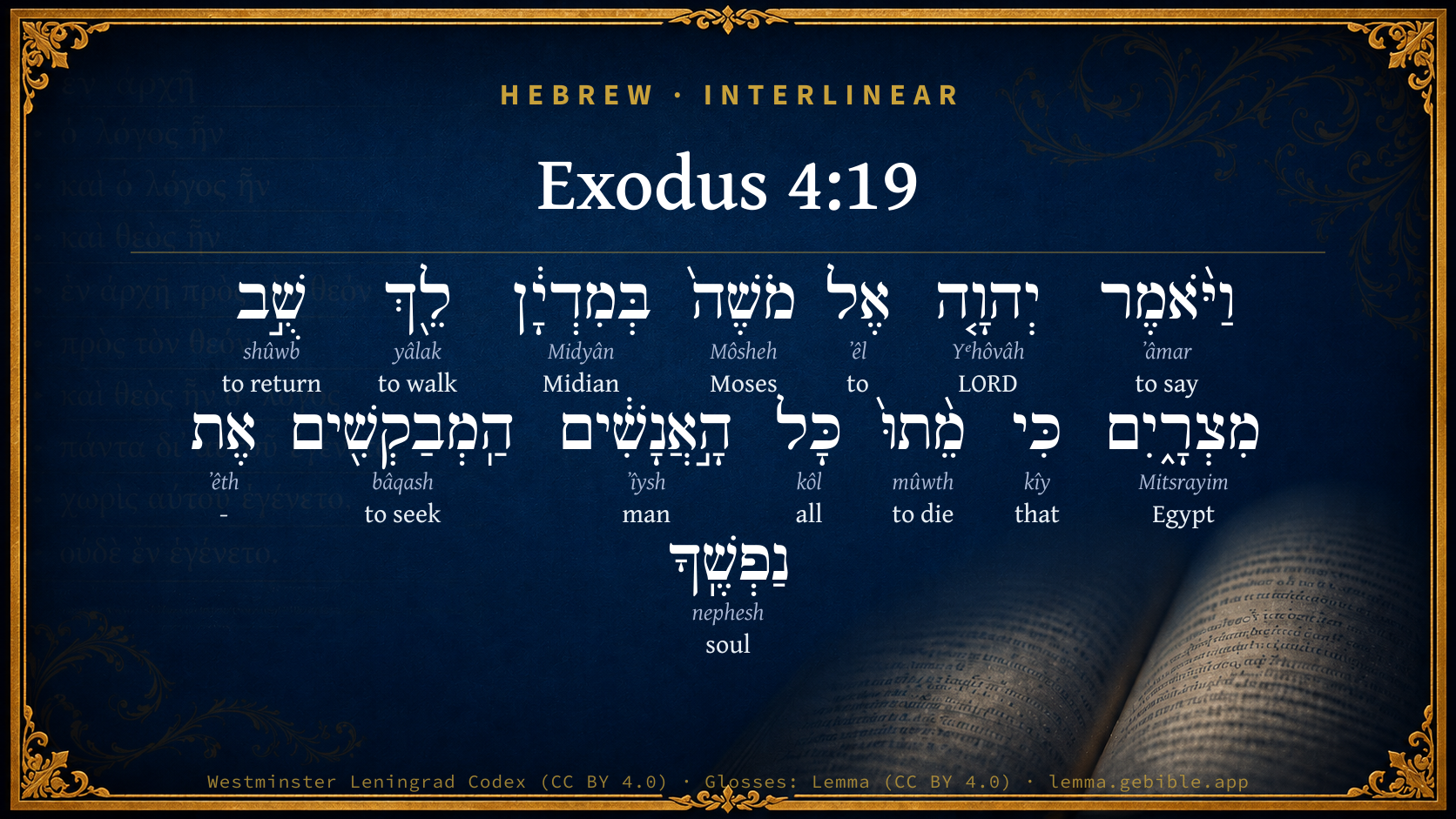
Hebrew (Westminster Leningrad Codex) Exodus 4:19 appears in the Hebrew Old Testament. The text above is from the Westminster Leningrad Codex. Each word links to its Strong’s number, a concise gloss, and parsing drawn from the Open Scriptures Hebrew Bible morphology. Click any word for its full Brown-Driver-Briggs (BDB) entry.
Download image
Cite this verse

Exodus 4:19 (World English Bible). Public Domain. Lemma interlinear Bible study tool, https://lemma.gebible.app/v/exodus/4/19.

Show BibTeX & RIS
BibTeX
RIS
English Translation
Yahweh said to Moses in Midian, "Go, return into Egypt; for all the men who sought your life are dead."
World English Bible · Public Domain
Download a study sheet

One document with this verse’s original text, its word-by-word gloss line, the meaning frame, cross-references with their text, attributed commentary, and full source and license credits — printable, and it pastes into notes with its structure intact.

This verse Autodidact and up

Study sheet (.html) Plain text (.txt)

A passage Seminary Student

Up to 50 verses in one chapter. A passage sheet keeps up to 6 commentary sources and 12 cross-references per verse, in the order this page ranks them, and says so on the sheet whenever that leaves anything out. Ask for a single verse and you get the Autodidact verse sheet above.

Everything on this page stays free to read, with no account — the sheet is a download of what is already on screen, not access to it.

Want to remove ads? Support Godless Engineer
Compare translations 3

The same verse in 3 English versions, stacked beneath the original-language interlinear above. Click any original word for its lexicon entry.

Each is an independent rendering of the whole verse — the interlinear is not word-aligned to these translations.

Highlighted words mark where these versions differ — a whole-verse word diff, not a word-by-word alignment.

  • World English Bible Public Domain
    Yahweh said to Moses in Midian, "Go, return into Egypt; for all the men who sought your life are dead."
  • King James Version Public Domain
    And the LORD said unto Moses in Midian, Go, return into Egypt: for all the men are dead which sought thy life.
  • unfoldingWord Literal Text CC BY-SA 4.0
    And Yahweh said to Moses in Midian, “Go! Return to Egypt! For all the men who were seeking your life are dead.”

unfoldingWord Literal Text — © unfoldingWord, licensed CC BY-SA 4.0. Word-aligned USFM3 via Door43 (git.door43.org/unfoldingWord/en_ult).

Versions to compare (up to 4)

3 of 4 selected

Show all 18 translations

Every available English version of this verse, each an independent rendering of the whole verse.

  • World English Bible Public Domain
    Yahweh said to Moses in Midian, "Go, return into Egypt; for all the men who sought your life are dead."
  • Berean Standard Bible Public Domain
    Now the LORD had said to Moses in Midian, “Go back to Egypt, for all the men who sought to kill you are dead.”
  • Majority Standard Bible Public Domain
    Now the LORD had said to Moses in Midian, “Go back to Egypt, for all the men who sought to kill you are dead.”
  • King James Version Public Domain
    And the LORD said unto Moses in Midian, Go, return into Egypt: for all the men are dead which sought thy life.
  • American Standard Version (1901) Public Domain
    And Jehovah said unto Moses in Midian, Go, return into Egypt; for all the men are dead that sought thy life.
  • Revised Version (1885) Public Domain
    And the LORD said unto Moses in Midian, Go, return into Egypt: for all the men are dead which sought thy life.
  • Geneva Bible (1599) Public Domain
    (For the Lord had said vnto Moses in Midian, Goe, returne to Egypt: for they are all dead which went about to kill thee)
  • Douay-Rheims (1899) Public Domain
    And the Lord said to Moses, in Madian: Go, and return into Egypt: for they are all dead that sought thy life.
  • Young's Literal Translation Public Domain
    And Jehovah saith unto Moses in Midian, `Go, turn back to Egypt, for all the men have died who seek thy life;'
  • Literal Standard Version CC BY-SA 4.0
    And YHWH says to Moses in Midian, “Go, return to Egypt, for all the men who seek your life have died”;
  • Unlocked Literal Bible CC BY-SA 4.0
    Yahweh said to Moses in Midian, “Go, return to Egypt, for all the men who were trying to take your life are dead.”
  • unfoldingWord Literal Text CC BY-SA 4.0
    And Yahweh said to Moses in Midian, “Go! Return to Egypt! For all the men who were seeking your life are dead.”
  • Darby Bible Public Domain
    And Jehovah said to Moses in Midian, Go, return to Egypt; for all the men are dead who sought thy life.
  • World Messianic Bible Public Domain
    The LORD said to Moses in Midian, “Go, return into Egypt; for all the men who sought your life are dead.”
  • Webster's Bible Public Domain
    And the LORD said to Moses in Midian, Go, return into Egypt; for all the men are dead who sought thy life.
  • Free Bible Version CC BY-SA 4.0
    While Moses was in Midian, the Lord told him, “Go back to Egypt because all those who wanted to kill you have died.”
  • Bible in Basic English Public Domain
    And the Lord said to Moses in Midian, Go back to Egypt, for all the men are dead who were attempting to take your life.
  • JPS Tanakh (1917) Public Domain
    And the LORD said unto Moses in Midian: 'Go, return into Egypt; for all the men are dead that sought thy life.'

Literal Standard Version (2020), Covenant Press — licensed CC BY-SA 4.0. Text via the HelloAO Bible API (eBible.org). Unlocked Literal Bible (unfoldingWord) — licensed CC BY-SA 4.0. Text via the HelloAO Bible API (eBible.org). unfoldingWord Literal Text — © unfoldingWord, licensed CC BY-SA 4.0. Word-aligned USFM3 via Door43 (git.door43.org/unfoldingWord/en_ult). Free Bible Version, Dr. Jonathan Gallagher — licensed CC BY-SA 4.0. Text via the HelloAO Bible API (eBible.org).

Word by word

More ways to search: Search by grammar → Find every occurrence → Compare this word →

Practice this passage: Drill this verse → Learn its vocabulary →

בְּמִדְיָ֔ן
Midyân
H4080
“in/at · Midian”
Preposition + Noun, Proper
Part of Speech
Preposition + Noun
Type
Proper
Full BDB Definition

Origin: the same as H4079

TWOT: None

Midian or Midianite = "strife" - son of Abraham by Keturah and progenitor of the tribe of Midianites or Arabians (noun proper masculine) - the tribe descended from Midian (noun proper masculine) - the territory of the tribe descended from Midian; located principally in the desert north of the Arabian peninsula; land to which Moses went when he fled from Pharaoh (noun proper locative)
  1. וַיֹּ֨אמֶר ʼâmar H559 “and · to say” Conjunction + Verb, Qal, Sequential Imperfect, 3rd Person, Masculine, Singular
  2. יְהוָ֤ה Yᵉhôvâh H3068 “LORD” Noun, Proper
  3. אֶל ʼêl H413 “to” Preposition
  4. מֹשֶׁה֙ Môsheh H4872 “Moses” Noun, Proper
  5. לֵ֖ךְ yâlak H3212 “walk” Verb, Qal, Imperative, 2nd Person, Masculine, Singular
  6. שֻׁ֣ב shûwb H7725 “return” Verb, Qal, Imperative, 2nd Person, Masculine, Singular
  7. מִצְרָ֑יִם Mitsrayim H4714 “Egypt” Noun, Proper
  8. כִּי kîy H3588 “that” Conjunction
  9. מֵ֨תוּ֙ mûwth H4191 “to die” Verb, Qal, Perfect, 3rd Person, Common, Plural
  10. כָּל kôl H3605 “all of” Noun, Common, Masculine, Singular, Construct
  11. הָ֣אֲנָשִׁ֔ים ʼîysh H376 “the · men” Particle, Definite Article + Noun, Common, Masculine, Plural, Absolute
  12. הַֽמְבַקְשִׁ֖ים bâqash H1245 “the · seeking” Particle, Definite Article + Verb, Piel, Participle Active, Masculine, Plural, Absolute
  13. אֶת ʼêth H853 “-” Particle, Direct Object
  14. נַפְשֶֽׁךָ nephesh H5315 “soul · your” Noun, Common, Both, Singular, Construct + Suffix, Personal, 2nd Person, Masculine, Singular

About this verse

These counts appear in no published source. They are computed here, from the morphology-tagged text and Lemma’s own curated glosses. What Lemma adds →

15
words
15
distinct lemmas
Pentateuch
section

Shared distinctive vocabulary

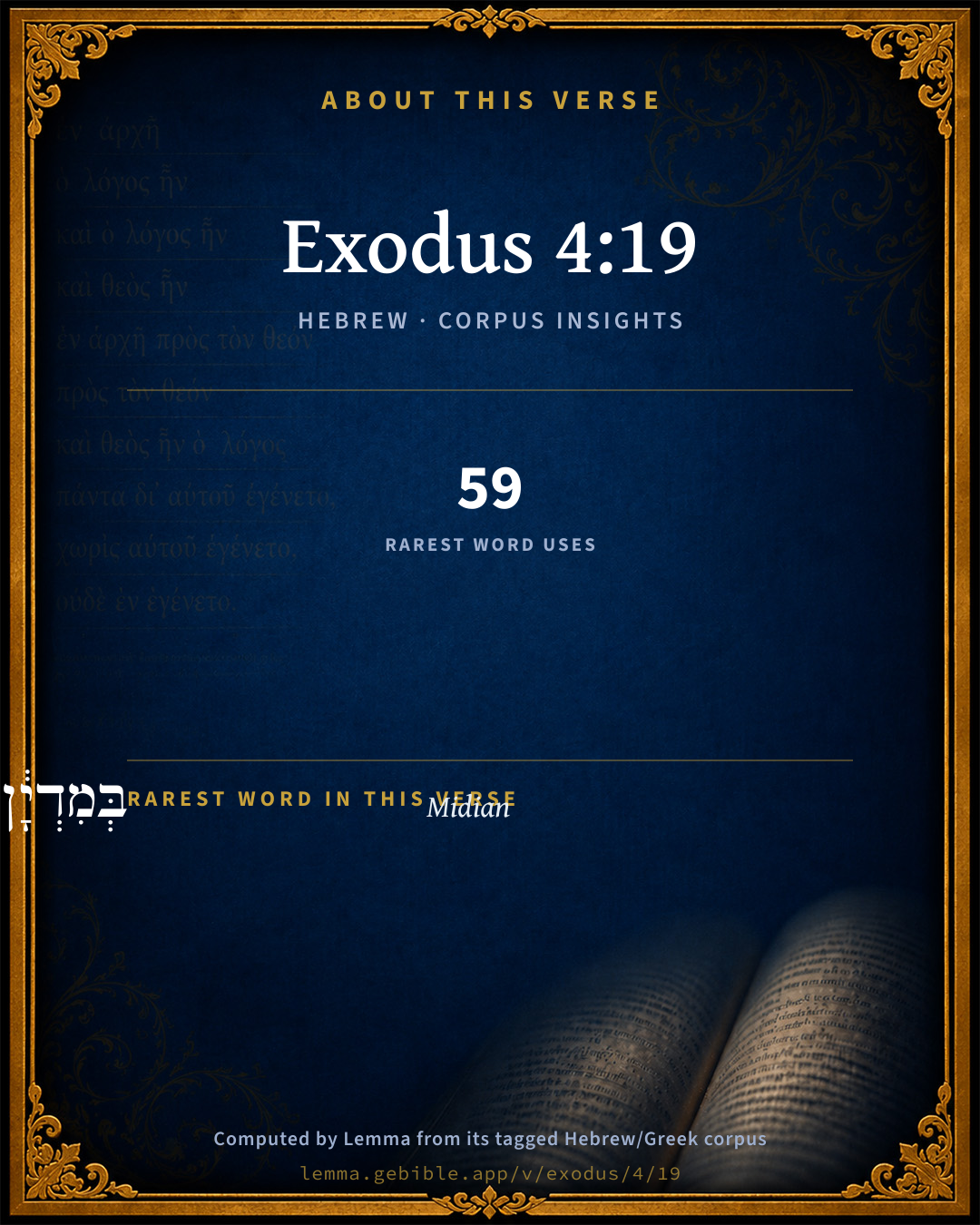
בְּמִדְיָ֔ן Midian H4080 occurs in 55 verses of the Hebrew Bible. Also found in:

Grammatical profile

  • 5 verbs
  • 7 nouns
  • 1 preposition
  • 1 conjunction
  • 1 particle

Verb forms

  • וַיֹּ֨אמֶר Qal · Sequential Imperfect
  • לֵ֖ךְ Qal · Imperative
  • שֻׁ֣ב Qal · Imperative
  • מֵ֨תוּ֙ Qal · Perfect
  • הַֽמְבַקְשִׁ֖ים Piel · Participle Active

Hebrew & Septuagint length

In English translation the verse runs 20 words from the Hebrew and 20 from the Septuagint (LXX English) — the same length.

A rough comparison of the two English renderings, which tokenize alike — not a word-level alignment.

Word counts can differ between the Hebrew and the Greek without any difference in meaning — e.g. the Hebrew direct-object marker אֵת has no separate Greek word, and Greek often adds the article ὁ.

Cross-references

3

Topical passages linked to Exodus 4:19 in the Treasury of Scripture Knowledge — connected by theme and wording, ordered by reader-vote popularity; previews shown in the World English Bible.

  • Matthew 2:20 "Arise and take the young child and his mother, and go into the land of Israel, for those who sought the young child's life are dead."
  • Exodus 2:15 Now when Pharaoh heard this thing, he sought to kill Moses. But Moses fled from the face of Pharaoh, and lived in the land of Midian, and he sat down by a well.
  • Exodus 2:23 It happened in the course of those many days, that the king of Egypt died, and the children of Israel sighed because of the bondage, and they cried, and their cry came up to God because of the bondage.

Cross-references courtesy of OpenBible.info (CC BY 4.0).

Hebrew and Greek witnesses Masoretic Hebrew ↔ Greek Septuagint

The same verse in the two great witnesses to the Old Testament, shown verse-for-verse.

These are two independent witnesses, not word-aligned to each other, and the Septuagint is shown in lemma (dictionary) form.

Hebrew Exodus 4:19 Masoretic · Westminster Leningrad Codex

וַיֹּ֨אמֶר יְהוָ֤ה אֶל מֹשֶׁה֙ בְּמִדְיָ֔ן לֵ֖ךְ שֻׁ֣ב מִצְרָ֑יִם כִּי מֵ֨תוּ֙ כָּל הָ֣אֲנָשִׁ֔ים הַֽמְבַקְשִׁ֖ים אֶת נַפְשֶֽׁךָ

Yahweh said to Moses in Midian, "Go, return into Egypt; for all the men who sought your life are dead."

World English Bible · Public Domain

Greek LXX Exodus 4:19 Septuagint · lemma form

μετά δέ ὁ ἡμέρα ὁ πολύς ἐκεῖνος τελευτάω ὁ βασιλεύς αἴγυπτος εἶπον δέ κύριος πρός μωυσῆς ἐν μαδιαμ βαδίζω ἀποἔρχομαι εἰς αἴγυπτος θνήσκω γάρ πᾶς ὁ ζητέω σύ ὁ ψυχή

And the Lord said to Moses in Madiam, Go, depart into Egypt, for all that sought your life are dead.

LXX2012 (modern English Septuagint) · Public Domain

On this verse, Haydock's Catholic Bible Commentary discusses the Septuagint’s reading. Read the note in Commentary ↓

Hebrew: Westminster Leningrad Codex (CC BY 4.0). Greek: Septuagint (public domain); English from LXX2012 (modern English Septuagint) (Public Domain). How the Septuagint differs from the Hebrew →

Targum (Aramaic paraphrase)

2

The Targum is the ancient Jewish Aramaic paraphrase of the Hebrew Scriptures — an interpretive translation, not the Hebrew text itself. Onkelos (literal) and Pseudo-Jonathan (expansive) render the Torah, and Jonathan the Prophets. Coverage is partial: where no permissively-licensed English translation exists for a verse, only the Aramaic is shown. This is verse-level text, not a word-by-word alignment to the Hebrew.

  1. Targum Onkelos Torah (Genesis–Deuteronomy)
    וַאֲמַר יְיָ לְמשֶׁה בְּמִדְיָן אֱזֵיל תּוּב לְמִצְרָיִם אֲרֵי מִיתוּ כָּל גֻבְרַיָא דִבְעוֹ לְמִקְטְלָךְ:

    (no public-domain English translation for this verse)

    Targum Onkelos — Aramaic: “Onkelos Genesis” (public domain); “Onkelos Exodus” (public domain); “Onkelos Leviticus” (public domain); “Onkelos Numbers” (public domain); “Onkelos Deuteronomy” (public domain). English: “Sefaria Community Translation” (CC0 1.0 (public-domain dedication)); “J.W. Etheridge. The Targums of Onkelos and Jonathan Ben Uzziel on the Pentateuch. London: Longmans, Green, 1862” (public domain). Text via Sefaria.

  2. Targum Pseudo-Jonathan Torah (Genesis–Deuteronomy)
    וַאֲמַר יְיָ לְמשֶׁה בְּמִדְיָן אִיזֵיל תּוּב לְמִצְרַיִם אֲרוּם אִתְרוֹקְנוּ וְנַחֲתוּ מִנִכְסֵיהוֹן וְהָא אִינוּן חֲשִׁיבוּן כְּמֵתַיָא כָּל גוּבְרַיָא דַהֲווֹ תַּבְעִין יַת נַפְשָׁךְ לְמִיסַב יָתָהּ

    And the Lord said unto Mosheh in Midian, Go, return to Mizraim; for they have come to nought, and gone down from their possessions; behold, all the men who sought to take thy life are reckoned as the dead.

    Targum Pseudo-Jonathan — Aramaic: “Targum Jonathan on Genesis” (public domain); “Targum Jonathan on Exodus” (public domain); “Targum Jonathan on Leviticus” (public domain); “Targum Jonathan on Numbers” (public domain); “Targum Jonathan on Deuteronomy” (public domain). English: “The Targum of Jonathan ben Uzziel, trans. J. W. Etheridge, London, 1862” (public domain). Text via Sefaria.

Commentary

Notes on Exodus 4:19 from classic Christian and Jewish commentators (each source and its license shown beneath its notes). The classic Christian expositions comment on the surrounding passage and are grouped to its opening verse, so a note may address several verses; the Jewish commentaries on the Tanakh (Rashi and others) are per-verse, so they appear only where the commentator wrote on this verse.

Lemma curates 59 commentaries, every one of them public domain or Creative Commons licensed, each selected and text-cleaned for this edition rather than reprinted as found. About our sources →

Trapp's Complete Commentary

John Trapp

Exo 4:19 And the LORD said unto Moses in Midian, Go, return into Egypt: for all the men are dead which sought thy life.

Ver. 19. For all the men are dead.] Here the Lord lays his finger upon the sore. This was that pad in the straw, the thing that made Moses hang off as he did; however he pretended the people’s incredulity, his own inability, and this and that, neither did he altogether dissemble: but self-love needs not be taught to tell her tale.

John Trapp, A Commentary or Exposition upon All the Books of the Old and New Testament (1647–1656) — public domain. Text from a community e-Sword module.

The Biblical Illustrator

Joseph S. Exell

Exo_4:19

All the men are dead which sought thy life.

The death of enemies

1. In a world like this, the greater the man the more enemies he will have.

2. Death in this world is constantly sweeping away our enemies as well as friends.

I. The death of our enemies should restrain resentment. Were it not wrong to return evil for evil, to revile those who revile us, it would scarcely be wise. While we are preparing our retaliating machinery, death is doing his work with them. Our blows will scarcely reach them before they fall, and then, when they are gone, they can do us no harm. But if we have retaliated, the memory of the retaliation will give us pain.

II. The death of our enemies should stimulate us to overcome evil by good. The sublimest conquest is not that which will crush the body or wound the feelings, but that which will subdue the enmity and win the hostile soul to friendship and love. (Homilist.)

The Divine precaution for the safety of Christian workers

I. It is sometimes manifested by removing good men and great workers from dangerous associations.

1. Christian workers are sometimes removed from the pride of high society.

2. Christian workers are sometimes removed from the contamination of great sin.

3. Christian workers are sometimes removed from the pedantry of great learning.

4. Christian workers are sometimes removed from physical evil.

II. It is sometimes manifested by informing good men and great workers of the removal of danger. Time aids the enterprises of heaven. Death subdues the hatred and passion of men.

III. The divine precaution does not allow an abandonment of the work committed to the good. (J. S. Exell, M. A.)

Death of enemies

Hearing a whole choir of birds chirping merrily together, my curiosity was excited to inquire into the occasion of their convocation and merriment, when I quickly perceived a dead hawk in the bush, about which they made such a noise, seeming to triumph at the death of an enemy. I could not blame them for singing the knell of one who, like a cannibal, was wont to feed upon their living bodies, tearing them limb from limb, and scaring them with his frightful appearance. Over this bird, which was so formidable when alive, the most timid wren or titmouse did not now fear to chirp and hop. This occurrence brought to my mind the case of tyrants and oppressors. When living, they are the terror of mankind; but when dead, they are the objects of general contempt and scorn. When the wicked perish, there is shouting (Pro_11:10).

The Biblical Illustrator, edited by Joseph S. Exell (c. 1880s–1900s) — public domain. Text from a community e-Sword module.

Joseph Benson's Commentary

Exo 4:19-20. The Lord said unto Moses — This seems to have been a second vision, whereby God calls him to the present execution of the command given before. The rod of God — His shepherd’s crook, so called, as it was God’s instrument in so many glorious works.

Joseph Benson's Commentary on the Old and New Testaments (1811–1818) — public domain. Text from a community e-Sword module.

The Preacher's Complete Homiletical Commentary

Joseph S. Exell (gen. ed.)

MAIN HOMILETICS OF THE PARAGRAPH.—Exo_4:19

THE DIVINE PRECAUTION FOR THE SAFETY OF CHRISTIAN WORKERS

I. It is sometimes manifested by removing good men and great workers from dangerous associations. The Divine Being uses every precaution for the safety of those employed in the great moral enterprises of humanity. He does not achieve their safety by miracles, but by prudence, even though it may involve delay in the completion of His plan. Sometimes we hear Christian workers say that they can go fearlessly into danger, because they are assured of the protection of heaven; they are not warranted in talking or acting thus, for, as a rule, God gives the truest safety to those who keep the furthest from peril. It is the Divine plan to take Moses away from Egypt until those who would will him are dead, rather than expose him to their continued rage.

1. Christian workers are sometimes removed from the pride of high society. Moses was providentially removed from the pride and splendour of the Egyptian palace, in order that he might retain the simplicity of a true servant of God. Gaiety is a great temptation to a Christian worker. It has ruined many men of early promise. How many workers in the world and in the Church to-day owe their utility and success to the fact that God removed them from the social allurements of their youth. True, the change from the palace of Pharaoh to the solitude of the desert may not have been welcome at first, but now it is the gladdest recollection of your life.

2. Christian workers are sometimes removed from the contamination of great sin. The palace of Pharaoh was most unfavourable to the cultivation of a pure life. It was the seat of despotism, and despotism is generally allied to almost every other sin. In this royal court Moses was in danger of contamination, and that at the most susceptible period of his life. Hence God removed him from this school of vice, and brought him into the primitive simplicity of a desert family. Many a youthful worker for God has been ruined by a bad example.

3. Christian workers are sometimes removed from the pedantry of great learning. In the Egyptian palace Moses had every facility for acquiring knowledge, and there was a possibility that he might become mentally proud, and think the claims of religious service beneath his talent and education. Multitudes have been turned aside from moral service by the conceit of imagined Wisdom

4. Christian workers are sometimes removed from physical peril.

II. It is sometimes manifested by informing good men and great workers of the removal of danger. God informs Moses that the men who sought his life are dead. See the folly of men who oppose themselves to the plans of heaven; they will soon die, and their death will be the signal of victory to the servant whose moral fitness has been enhanced by the solitude rendered necessary by their rage. Time aids the enterprises of heaven. Death subdues the hatred and passion of men. God is interested in the mission of His servants, so that He aids them in its fulfilment.

III. That the Divine Precaution does not allow an abandonment of the work committed to the good. Moses was to go to his work again. Temporary perils and hindrances are not to entirely set aside Christian toil. Israel must be emancipated. The servant of God must fulfil his calling, even though he has to wait years in the desert before he can commence it.

ILLUSTRATIONS

BY THE

REV. WM. ADAMSON

Exo_4:18-19.

(17)—Parental Dealing!—On one occasion a minister of God was counselling a little girl to evince gratitude always for the kind father whom God had graciously given her, when she looked up in his face with her soft, blue eyes, and exclaimed, “He never speaks kind to me.” Can we wonder if that child grows up undutiful—disobedient—void of all confiding tenderness towards her parent?

Exo_4:18-19.

(18)—Presumptuous Christian!—That sailor is a fool who wilfully runs his vessel among the foaming breakers because his ship is stout—bears a lifeboat on her deck, and can be rescued by watchers on the shore. Trench relates the visit of a gentleman to the scene of a colliery explosion. The mine was full of chokedamp; and yet his guide persisted in entering it with his Davy-lamp. That light was invented to protect miners, and not to make them presume. Christians presume on the providence of God when they rush recklessly and uncalled into danger.

“Whate’er our thoughts or purpose be,

They cannot reach their destined end,

Unless, oh God. they go with Thee,

And with Thy thoughts and purpose blend.

Exo_4:18-19.

(19)—Confidence!—Luther, when making his way into the presence of Cardinal Cajetan, who had summoned him to answer for his heretical opinions at Augsburg, was asked by one of the cardinal’s minions where he would find a shelter if his patron the Elector of Saxony deserted him. His immediate reply was, “Under the shield of heaven.” Under that shield Moses was to enter Pharaoh’s presence.

“A strong tower is the Lord our God,

To shelter and defend us;

Our shield His arm, our sword His rod.

Against our foes befriend us.”

—Luther.

The Preacher's Complete Homiletical Commentary (gen. ed. Joseph S. Exell; Funk & Wagnalls, c. 1892) — public domain (pre-1929). A full-Bible homiletical/sermon-outline anthology covering 65 of 66 books (2 John is absent from the source module). Text from a community e-Sword module.

Keil & Delitzsch

C. F. Keil & F. Delitzsch

Return of Moses to Egypt. - Exo 4:19-23. On leaving Midian, Moses received another communication from God with reference to his mission to Pharaoh. The word of Jehovah, in Exo 4:19, is not to be regarded as a summary of the previous revelation, in which case ויּאמר would be a pluperfect, nor as the account of another writer, who placed the summons to return to Egypt not in Sinai but in Midian. It is not a fact that the departure of Moses is given in Exo 4:18; all that is stated there is, that Jethro consented to Moses' decision to return to Egypt. It was not till after this consent that Moses was able to prepare for the journey. During these preparations God appeared to him in Midian, and encouraged him to return, by informing him that all the men who had sought his life, i.e., Pharaoh and the relatives of the Egyptian whom he had slain, were now dead.

Exo 4:20

Moses then set out upon his journey, with his wife and sons. בּניו is not to be altered into בּנו, as Knobel supposes, notwithstanding the fact that the birth of only one son has hitherto been mentioned (Exo 2:22); for neither there, nor in this passage (Exo 4:25), is he described as the only son. The wife and sons, who were still young, he placed upon the ass (the one taken for the purpose), whilst he himself went on foot with "the staff of God" - as the staff was called with which he was to perform the divine miracles (Exo 4:17) - in his hand. Poor as his outward appearance might be, he had in his hand the staff before which the pride of Pharaoh and all his might would have to bow.

Exo 4:21

"In thy going (returning) to Egypt, behold, all the wonders which I have put into thy hand, thou doest them before Pharaoh." מופת, τὸ τέρας, portentum, is any object (natural event, thing, or person) of significance which surpasses expectation or the ordinary course of nature, and excites wonder in consequence. It is frequently connected with אות, σημεῖον, a sign (Deu 4:34; Deu 6:22; Deu 7:19, etc.), and embraces the idea of אות within itself, i.e., wonder-sign. The expression, "all those wonders," does not refer merely to the three signs mentioned in Exo 4:2-9, but to all the miracles which were to be performed by Moses with the staff in the presence of Pharaoh, and which, though not named, were put into his hand potentially along with the staff. - But all the miracles would not induce Pharaoh to let Israel go, for Jehovah would harden his heart. את־לבּו אחזּק אני, lit., I will make his heart firm, so that it will not move, his feelings and attitude towards Israel will not change. For אחזּק אני or וחזּקתּי (Exo 14:4) and מחזּק אני (Exo 14:17), we find אקשׁה אני in Exo 7:3, "I will make Pharaoh's heart hard, or unfeeling;" and in Exo 10:1, הכבּדתּי אני "I have made his heart heavy," i.e., obtuse, or insensible to impressions or divine influences. These three words are expressive of the hardening of the heart.

The hardening of Pharaoh is ascribed to God, not only in the passages just quoted, but also in Exo 9:12; Exo 10:20, Exo 10:27; Exo 11:10; Exo 14:8; that is to say, ten times in all; and that not merely as foreknown or foretold by Jehovah, but as caused and effected by Him. In the last five passages it is invariably stated that "Jehovah hardened (יהזּק) Pharaoh's heart." But it is also stated just as often, viz., ten times, that Pharaoh hardened his own heart, or made it heavy or firm; e.g., in Exo 7:13, Exo 7:22; Exo 8:15; Exo 9:35, לב ויּחזק "and Pharaoh's heart was (or became) hard;" Exo 7:14, לב כּבד "Pharaoh's heart was heavy;" in Exo 9:7, ל יכבּד; in Exo 8:11, Exo 8:28; Exo 9:34, את־לבּו ויּכבּד or והכבּד; in Exo 13:15, פ הקשׁה כּי "for Pharaoh made his heart hard." According to this, the hardening of Pharaoh was quite as much his own act as the decree of God. But if, in order to determine the precise relation of the divine to the human causality, we look more carefully at the two classes of expressions, we shall find that not only in connection with the first sign, by which Moses and Aaron were to show their credentials as the messengers of Jehovah, sent with the demand that he would let the people of Israel go (Exo 7:13-14), but after the first five penal miracles, the hardening is invariably represented as his own. After every one of these miracles, it is stated that Pharaoh's heart was firm, or dull, i.e., insensible to the voice of God, and unaffected by the miracles performed before his eyes, and the judgments of God suspended over him and his kingdom, and he did not listen to them (to Moses and Aaron with their demand), or let the people go (Exo 7:22; Exo 8:8, Exo 8:15, Exo 8:28; Exo 9:7). It is not till after the sixth plague that it is stated that Jehovah made the heart of Pharaoh firm (Exo 9:12). At the seventh the statement is repeated, that "Pharaoh made his heart heavy" (Exo 9:34-35); but the continued refusal on the part of Pharaoh after the eighth and ninth (Exo 10:20, Exo 10:27) and his resolution to follow the Israelites and bring them back again, are attributed to the hardening of his heart by Jehovah (Exo 14:8, cf. Exo 14:4 and Exo 14:17). This hardening of his own heart was manifested first of all in the fact, that he paid not attention to the demand of Jehovah addressed to him through Moses, and would not let Israel go; and that not only at the commencement, so long as the Egyptian magicians imitated the signs performed by Moses and Aaron (though at the very first sign the rods of the magicians, when turned into serpents, were swallowed by Aaron's, Exo 7:12-13), but even when the magicians themselves acknowledged, "This is the finger of God" (Exo 8:19). It was also continued after the fourth and fifth plagues, when a distinction was made between the Egyptians and the Israelites, and the latter were exempted from the plagues, - a fact of which the king took care to convince himself (Exo 9:7). And it was exhibited still further in his breaking his promise, that he would let Israel go if Moses and Aaron would obtain from Jehovah the removal of the plague, and in the fact, that even after he had been obliged to confess, "I have sinned, Jehovah is the righteous one, I and my people are unrighteous" (Exo 9:27), he sinned again, as soon as breathing-time was given him, and would not let the people go (Exo 9:34-35). Thus Pharaoh would not bend his self-will to the will of God, even after he had discerned the finger of God and the omnipotence of Jehovah in the plagues suspended over him and his nation; he would not withdraw his haughty refusal, notwithstanding the fact that he was obliged to acknowledge that it was sin against Jehovah. Looked at from this side, the hardening was a fruit of sin, a consequence of that self-will, high-mindedness, and pride which flow from sin, and a continuous and ever increasing abuse of that freedom of the will which is innate in man, and which involves the possibility of obstinate resistance to the word and chastisement of God even until death. As the freedom of the will has its fixed limits in the unconditional dependence of the creature upon the Creator, so the sinner may resist the will of God as long as he lives. But such resistance plunges him into destruction, and is followed inevitably by death and damnation. God never allows any man to scoff at Him. Whoever will not suffer himself to be led, by the kindness and earnestness of the divine admonitions, to repentance and humble submission to the will of God, must inevitably perish, and by his destruction subserve the glory of God, and the manifestation of the holiness, righteousness, and omnipotence of Jehovah.

But God not only permits a man to harden himself; He also produces obduracy, and suspends this sentence over the impenitent. Not as though God took pleasure in the death of the wicked! No; God desires that the wicked should repent of his evil way and live (Eze 33:11); and He desires this most earnestly, for "He will have all men to be saved and to come unto the knowledge of the truth" (Ti1 2:4, cf. Pe2 3:9). As God causes His earthly sun to rise upon the evil and the good, and sendeth rain on the just and the unjust (Mat 5:45), so He causes His sun of grace to shine upon all sinners, to lead them to life and salvation. But as the earthly sun produces different effects upon the earth, according to the nature of the soil upon which it shines, so the influence of the divine sun of grace manifests itself in different ways upon the human heart, according to its moral condition.

(Note: "The sun, by the force of its heat, moistens the wax and dries the clay, softening the one and hardening the other; and as this produces opposite effects by the same power, so, through the long-suffering of God, which reaches to all, some receive good and others evil, some are softened and others hardened." - (Theodoret, quaest. 12 in Ex.))

The penitent permit the proofs of divine goodness and grace to lead them to repentance and salvation; but the impenitent harden themselves more and more against the grace of God, and so become ripe for the judgment of damnation. The very same manifestation of the mercy of God leads in the case of the one to salvation and life, and in that of the other to judgment and death, because he hardens himself against that mercy. In this increasing hardness on the part of the impenitent sinner against the mercy that is manifested towards him, there is accomplished the judgment of reprobation, first in God's furnishing the wicked with an opportunity of bringing fully to light the evil inclinations, desires, and thoughts that are in their hearts; and then, according to an invariable law of the moral government of the world, in His rendering the return of the impenitent sinner more and more difficult on account of his continued resistance, and eventually rendering it altogether impossible. It is the curse of sin, that it renders the hard heart harder, and less susceptible to the gracious manifestations of divine love, long-suffering, and patience. In this twofold manner God produces hardness, not only permissive but effective; i.e., not only by giving time and space for the manifestation of human opposition, even to the utmost limits of creaturely freedom, but still more by those continued manifestations of His will which drive the hard heart to such utter obduracy that it is no longer capable of returning, and so giving over the hardened sinner to the judgment of damnation. This is what we find in the case of Pharaoh. After he had hardened his heart against the revealed will of God during the first five plagues, the hardening commenced on the part of Jehovah with the sixth miracle (Exo 9:12), when the omnipotence of God was displayed with such energy that even the Egyptian magicians were covered with the boils, and could no longer stand before Moses (Exo 9:11). And yet, even after this hardening on the part of God, another opportunity was given to the wicked king to repent and change his mind, so that on two other occasions he acknowledged that his resistance was sin, and promised to submit to the will of Jehovah (Exo 9:27., Exo 10:16.). But when at length, even after the seventh plague, he broke his promise to let Israel go, and hardened his heart again as soon as the plague was removed (Exo 9:34-35), Jehovah so hardened Pharaoh's heart that he not only did not let Israel go, but threatened Moses with death if he ever came into his presence again (Exo 10:20, Exo 10:27-28). The hardening was now completed so that he necessarily fell a victim to judgment; though the very first stroke of judgment in the slaying of the first-born was an admonition to consider and return. And it was not till after he had rejected the mercy displayed in this judgment, and manifested a defiant spirit once more, in spite of the words with which he had given Moses and Aaron permission to depart, "Go, and bless me also" (Exo 12:31-32), that God completely hardened his heart, so that he pursued the Israelites with an army, and was overtaken by the judgment of utter destruction.

Now, although the hardening of Pharaoh on the part of Jehovah was only the complement of Pharaoh's hardening of his own heart, in the verse before us the former aspect alone is presented, because the principal object was not only to prepare Moses for the opposition which he would meet with from Pharaoh, but also to strengthen his weak faith, and remove at the very outset every cause for questioning and omnipotence of Jehovah. If it was by Jehovah Himself that Pharaoh was hardened, this hardening, which He not only foresaw and predicted by virtue of His omniscience, but produced and inflicted through His omnipotence, could not possibly hinder the performance of His will concerning Israel, but must rather contribute to the realization of His purposes of salvation and the manifestation of His glory (cf. Exo 9:16; Exo 10:2; Exo 14:4, Exo 14:17-18).

Exo 4:22-23

In order that Pharaoh might form a true estimate of the solemnity of the divine command, Moses was to make known to him not only the relation of Jehovah to Israel, but also the judgment to which he would be exposed if he refused to let Israel go. The relation in which Israel stood to Jehovah was expressed by God in the words, "Israel is My first-born son." Israel was Jehovah's son by virtue of his election to be the people of possession (Deu 14:1-2). This election began with the call of Abraham to be the father of the nation in which all the families of the earth were to be blessed. On the ground of this promise, which was now to be realized in the seed of Abraham by the deliverance of Israel out of Egypt, the nation of Israel is already called Jehovah's "son," although it was through the conclusion of the covenant at Sinai that it was first exalted to be the people of Jehovah's possession out of all the nations (Exo 19:5-6). The divine sonship of Israel was therefore spiritual in its nature: it neither sprang from the fact that God, as the Creator of all nations, was also the Creator, or Begetter, and Father of Israel, nor was it founded, as Baumgarten supposes, upon "the physical generation of Isaac, as having its origin, not in the power of nature, but in the power of grace." The relation of God, as Creator, to man His creature, is never referred to in the Old Testament as that of a father to a son; to say nothing of the fact that the Creator of man is Elohim, and not Jehovah. Wherever Jehovah is called the Father, Begetter, or Creator of Israel (even in Deu 32:18; Jer 2:27; Isa 44:8; Mal 1:6 and Mal 2:10), the fatherhood of God relates to the election of Israel as Jehovah's people of possession. But the election upon which the υἱοθεσία of Israel was founded, is not presented in the aspect of a "begetting through the Spirit;" it is spoken of rather as acquiring or buying (קנה), making (עשׂה), founding or establishing (כּנן, Deu 32:6). Even the expressions, "the Rock that begat thee," "God that bare thee" (Deu 32:18), do not point to the idea of spiritual generation, but are to be understood as referring to the creation; just as in Psa 90:2, where Moses speaks of the mountains as "brought forth" and the earth as "born." The choosing of Israel as the son of God was an adoption flowing from the free grace of God which involved the loving, fatherly treatment of the son, and demanded obedience, reverence, and confidence towards the Father (Mal 1:6). It was this which constituted the very essence of the covenant made by Jehovah with Israel, that He treated it with mercy and love (Hos 11:1; Jer 31:9, Jer 31:20), pitied it as a father pitieth his children (Psa 103:13), chastened it on account of its sins, yet did not withdraw His mercy from it (Sa2 7:14-15; Psa 89:31-35), and trained His son to be a holy nation by the love and severity of paternal discipline. - Still Israel was not only a son, but the "first-born son" of Jehovah. In this title the calling of the heathen is implied. Israel was not to be Jehovah's only son, but simply the first-born, who was peculiarly dear to his Father, and had certain privileges above the rest. Jehovah was about to exalt Israel above all the nations of the earth (Deu 28:1). Now, if Pharaoh would not let Jehovah's first-born son depart, he would pay the penalty in the life of his own first-born (cf. Exo 12:29). In this intense earnestness of the divine command, Moses had a strong support to his faith. If Israel was Jehovah's first-born son, Jehovah could not relinquish him, but must deliver His son from the bondage of Egypt.

Exo 4:24-26

But if Moses was to carry out the divine commission with success, he must first of all prove himself to be a faithful servant of Jehovah in his own house. This he was to learn from the occurrence at the inn: an occurrence which has many obscurities on account of the brevity of the narrative, and has received many different interpretations. When Moses was on the way, Jehovah met him at the resting-place (מלון, see Gen 42:27), and sought to kill him. In what manner, is not stated: whether by a sudden seizure with some fatal disease, or, what is more probable, by some act proceeding directly from Himself, which threatened Moses with death. This hostile attitude on the part of God was occasioned by his neglect to circumcise his son; for, as soon as Zipporah cut off (circumcised) the foreskin of her son with a stone, Jehovah let him go. צור = צוּר, a rock, or stone, here a stone knife, with which, according to hereditary custom, the circumcision commanded by Joshua was also performed; not, however, because "stone knives were regarded as less dangerous than those of metal," nor because "for symbolical reasons preference was given to them, as a simple production of nature, over the metal knives that had been prepared by human hands and were applied to daily use." For if the Jews had detected any religious or symbolical meaning in stone, they would never have given it up for iron or steel, but would have retained it, like the Ethiopian tribe of the Alnaii, who used stone knives for that purpose as late as 150 years ago; whereas, in the Talmud, the use of iron or steel knives for the purpose of circumcision is spoken of, as though they were universally employed. Stone knives belong to a time anterior to the manufacture of iron or steel; and wherever they were employed at a later period, this arose from a devoted adherence to the older and simpler custom (see my Commentary on Jos 5:2). From the word "her son," it is evident that Zipporah only circumcised one of the two sons of Moses (Exo 4:20); so that the other, not doubt the elder, had already been circumcised in accordance with the law. Circumcision had been enjoined upon Abraham by Jehovah as a covenant sign for all his descendants; and the sentence of death was pronounced upon any neglect of it, as being a breach of the covenant (Gen 17:14). Although in this passage it is the uncircumcised themselves who are threatened with death, yet in the case of children the punishment fell upon the parents, and first of all upon the father, who had neglected to keep the commandment of God. Now, though Moses had probably omitted circumcision simply from regard to his Midianitish wife, who disliked this operation, he had been guilty of a capital crime, which God could not pass over in the case of one whom He had chosen to be His messenger, to establish His covenant with Israel. Hence He threatened him with death, to bring him to a consciousness of his sin, either by the voice of conscience or by some word which accompanied His attack upon Moses; and also to show him with what earnestness God demanded the keeping of His commandments. Still He did not kill him; for his sin had sprung from weakness of the flesh, from a sinful yielding to his wife, which could both be explained and excused on account of his position in the Midianite's house. That Zipporah's dislike to circumcision had been the cause of the omission, has been justly inferred by commentators from the fact, that on Jehovah's attack upon Moses, she proceeded at once to perform what had been neglected, and, as it seems, with inward repugnance. The expression, "She threw (the foreskin of her son) at his (Moses') feet," points to this (ל הגּיע, as in Isa 25:12). The suffix in רגליו (his feet) cannot refer to the son, not only because such an allusion would give no reasonable sense, but also because the suffix refers to Moses in the immediate context, both before (in המיתו, Exo 4:24) and after (in ממּנּוּ, Exo 4:26); and therefore it is simpler to refer it to Moses here. From this it follows, then, that the words, "a blood-bridegroom art thou to me," were addressed to Moses, and not to the boy. Zipporah calls Moses a blood-bridegroom, "because she had been compelled, as it were, to acquire and purchase him anew as a husband by shedding the blood of her son" (Glass). "Moses had been as good as taken from her by the deadly attack which had been made upon him. She purchased his life by the blood of her son; she received him back, as it were, from the dead, and married him anew; he was, in fact, a bridegroom of blood to her" (Kurtz). This she said, as the historian adds, after God had let Moses, go, למּוּלות, "with reference to the circumcisions." The plural is used quite generally and indefinitely, as Zipporah referred not merely to this one instance, but to circumcision generally. Moses was apparently induced by what had occurred to decide not to take his wife and children with him to Egypt, but to send them back to his father-in-law. We may infer this from the fact, that it was not till after Israel had arrived at Sinai that he brought them to him again (Exo 18:2).

Exo 4:27-31

After the removal of the sin, which had excited the threatening wrath of Jehovah, Moses once more received a token of the divine favour in the arrival of Aaron, under the direction of God, to meet him at the Mount of God (Exo 3:1). To Aaron he related all the words of Jehovah, with which He had sent (commissioned) him (שׁלח with a double accusative, as in Sa2 11:22; Jer 42:5), and all the signs which He had commanded him (צוּה also with a double accusative, as in Gen 6:22). Another proof of the favour of God consisted of the believing reception of his mission on the part of the elders and the people of Israel. "The people believed" (ויּאמן) when Aaron communicated to them the words of Jehovah to Moses, and did the signs in their presence. "And when they heard that Jehovah had visited the children of Israel, and had looked upon their affliction, they bowed and worshipped." (Knobel is wrong in proposing to alter ישׁמעוּ into ישׂמחוּ, according to the Sept. rendering, καὶ ἐχάρη). The faith of the people, and the worship by which their faith was expressed, proved that the promise of the fathers still lived in their hearts. And although this faith did not stand the subsequent test (Exo 5), yet, as the first expression of their feelings, it bore witness to the fact that Israel was willing to follow the call of God.

Keil & Delitzsch — Biblical Commentary on the Old Testament (1861–1891) — public domain (CC PDM 1.0). Text via the HelloAO Bible API. (Old Testament only.)

Geneva Bible (1599)

Geneva Bible translators

Hebrew, sought thy soul.

Geneva Bible (1599) marginal notes — public domain. Text via Bolls.life.

Jamieson, Fausset & Brown

Robert Jamieson, A. R. Fausset & David Brown

all the men are dead which sought thy life--The death of the Egyptian monarch took place in the four hundred and twenty-ninth year of the Hebrew sojourn in that land, and that event, according to the law of Egypt, took off his proscription of Moses, if it had been publicly issued.

Jamieson, Fausset & Brown — Commentary Critical and Explanatory on the Whole Bible (1871) — public domain (CC PDM 1.0). Text via the HelloAO Bible API.

Adam Clarke's Commentary

Verse 19. In Midian] This was a new revelation, and appears to have taken place after Moses returned to his father-in-law previous to his departure for Egypt.

Adam Clarke's Commentary on the Bible (1810–1826) — public domain. Text from a community e-Sword/MySword module.

Ellicott's Commentary for English Readers

(19) In Midian.—Moses appears to have delayed his departure after he obtained permission to go from Jethro. Hence the address “Go, return,” which is peremptory.

All the men which sought thy life.—Not only the Pharaoh (Exo_2:23), but the kindred of the murdered man, and the officials empowered by the Pharaoh to arrest Moses. As forty years had elapsed since the homicide, this is readily conceivable.

A Bible Commentary for English Readers, edited by Charles John Ellicott (1878–1897) — public domain. Text from a community e-Sword module.

The Cambridge Bible for Schools and Colleges

gen. ed. J. J. S. Perowne

19. That Moses should now be commanded by God to do what he has already both determined to do, and obtained Jethro’s permission to do, is remarkable; and, as Dillm. remarks, can only be explained by the fact that the verse is by a different narrator from v. 18 (viz. J)1[107].

[107] ‘Said’ cannot, consistently with Hebrew grammar, be interpreted to mean ‘had said.’

which sought thy life] the Pharaoh and his servants (Exo_2:15; Exodus cf.23).

The Cambridge Bible for Schools and Colleges (gen. ed. J. J. S. Perowne; Cambridge University Press, 1878–1918) — public domain. Text from a community e-Sword module.

John Gill's Exposition

And the Lord said unto Moses in Midian,.... After he had obtained leave of his father-in-law to quit Midian, but before he left it:

go, return into Egypt: that is, directly, immediately; before he had only given him a commission at large to go thither, but had not fixed the time when he should go; but now he orders him to set forward at once:

for all the men are dead which sought thy life; to take it away, the king of Egypt, and his ministers, and the friends of the Egyptian Moses had slain; and this is said to encourage him to go; and though Moses had never expressed his fear on this account, or made it an objection, yet it might lie secretly in his heart, and be one reason of his backwardness to go into Egypt, and which was now removed.

John Gill's Exposition of the Whole Bible (1746–1763) — public domain (CC PDM 1.0). Text via the HelloAO Bible API.

Haydock's Catholic Bible Commentary

Life. "After those many days were elapsed, the king of Egypt died," who had obliged Moses to flee, as the Septuagint, Josephus, and Philo add at the end of ver. 18. Upon which God, who had already commissioned him to go, and saw him willing, gives him this further assurance that he has nothing to fear for his own person. (Haydock)

George Leo Haydock (1774–1849), Haydock's Catholic Family Bible and Commentary, 1859 edition — public domain. Excludes Psalms (Douay-Rheims chapter numbering differs from Protestant) and Deuterocanonical books (Catholic canon only).

Matthew Poole's English Annotations

This seems to have been a second vision, whereby God calls him forth to the present and speedy execution of that command which before was more generally delivered.

Which sought thy life, to wit, to take it away. See the like expression, 1Sa 22:23; 1Ki 19:14; Mat 2:20. God knew very well that one great cause of Moses’s unwillingness to this undertaking was his carnal fear, though he was ashamed to profess it, and therefore gives him this cordial.

Matthew Poole's English Annotations on the Holy Bible (1683–1685) — public domain. Text from a community e-Sword/MySword module.

Whedon's Commentary on the Bible

Daniel D. Whedon

19. All the men are dead — See Exo_2:23, where the death of the king is related immediately before Moses’ call. This event seems in several ways to have been critical for the fortunes of Israel.

Daniel D. Whedon (gen. ed.), Commentary on the Old and New Testaments (1874–1909) — public domain. Text from a community e-Sword module.

The Pulpit Commentary

And the Lord said unto Moses in Midian, Go, return. It would seem that Moses was still reluctant, and was delaying his departure, even after he had obtained Jethro"s leave to go. Perhaps he was making it an excuse to himself for not setting out that if he returned he might still suffer death on account of the offence which had driven him into exile. To remove this last impediment, God assured him that "all the men were dead who had sought his life.

Ver. 19. The fact of having a mission does not release a man from social obligations.

Direct communications with Jehovah, appointment to a great and glorious mission, with the power of working miracles, might have rendered many a man neglectful of ordinary obligations, might have seemed to place him above the necessity of asking anyone"s permission to do as he pleased. But Moses read his duty differently. He had been received among the Midianites with great kindness, had been given a home and a wife, and probably enrolled formally as an adopted member of the tribe or nation. Though Reuel, the head of the tribe at the time of his coming, had ceased to hold that position, having probably died, the tribe had a new head, to whom he was bound, if not by all the obligations which had attached him to Reuel, yet by several very definite and tangible bonds. Jethro was his near relative and his tribal chief; he had perhaps sworn allegiance to him; he had certainly received from him protection, employment, sustenance (ch. 3:1). To have quitted his service without permission, to have left his flock in the Sinaitic valleys, and proceeded straight to Egypt would have been easy, but would have been unkind, ungrateful, and contrary to the accepted standard of tribal morality at the time. Moses therefore went back to Midian from Sinai before proceeding to Egypt-made, that is, a considerable journey in the opposite direction to that which he was about to take in order to obtain Jethro"s consent to his going, thus acting the part of a faithful servant and a good subject. It would be well if all who believe themselves to have Divine missions, and to be highly gifted, would follow Moses" example, and not make their mission and high gifts an excuse for neglect of ordinary duties and obligations. Moses" example, and the words of One higher than Moses, should teach them that it becomes all men to "fulfil all righteousness". (Mat_3:15) If those with high missions neglect even small social duties, they "give an occasion to the adversary to blaspheme.

Reticence sometimes a duty. We are not bound in all cases to tell even those in authority over us the reasons, much less all the reasons, which actuate us. Moses wanted Jethro"s permission to quit his adopted tribe, and return to his native country and his people. He gave a reason which was not untrue, but which was far from being his sole, or even his main, reason. If he had said more, if he had revealed his mission, he would probably have raised a storm of opposition to his departure. He would have been called a fanatic, a visionary, a madman; and everything would have been said that was possible to deter him from carrying out his projects. If Moses felt, as he may have felt, that he was too weak to encounter such a storm of opposition, he was wise to be silent and so not arouse it.

The reasonable wishes of a subordinate should be granted cheerfully.

Jethro"s answer, "Go in peace," may well be taken as a pattern by those in authority. It is kindly, gracious, and ungrudging. The chieftain of a tribe might naturally have demurred to the withdrawal of a family of subjects, the master to the loss of a valuable servant, the head of a household to parting with near kinsfolk. But Jethro, deeming Moses" plea a sufficient one, is careful not to mar the grace of his concession by a single word of objection, reproach, or querulousness. Nor is "Go in peace" even a bare consent, but a consent embodying a blessing. It is equivalent to "Go, and the Lord go with thee!" Note also the absence of inquisitiveness. Jethro does not pester Moses with questions does not ask, "Is the reason thou hast assigned thy true reason," or "thy sole reason?" or, "When wilt thou return?" or, "Why take thy wife and children?" or, "How wilt thou live in Egypt?" or, "Art thou not afraid to return thither?" He will not pain his near connection by doubt or distrust, or even undue curiosity. He will not travel beyond the record. His consent has been asked. He gives it freely, fully cheerfully.

Vers. 19-23. Obedience brings a blessing.

There must have been something in the hesitation of Moses which caused it not to be wholly displeasing to God. Once he was "angered", (Exo_3:14) but even then not greatly offended content to show his anger by inflicting a slight penalty. Now, when Moses still delayed in Midian, how gentle the rebuke that is administered return;" and to the rebuke moreover is appended an encouragement the men are dead who sought thy life." Observe also that no sooner does Moses obey, than his reluctance seems wholly forgiven; the Lord appears afresh to him, and rewards his obedience by fresh revelations. "Israel is my son, even my firstborn." This tender relationship, never before acknowledged, is breathed into the prophet"s ear as he enters on the Path of obedience. What may he not expect, if he continues in it! Surely blessings upon blessings. Deliverance, triumph, continued, never-ending protection are assured to them whom God declares to be his children. Moses, as their leader, will have the glory of their success. Even the might of Pharaoh will be. impotent if used against them. Should Pharaoh refuse to liberate God"s "firstborn," he will lose his own.

HOMILIES BY D. YOUNG Ver. 19. The unsolicited removal of a source of great anxiety.

God assures Moses that he has no longer any cause to fear on account of the Egyptian slain forty years before. This last piece of information casts a flood of light on all the hesitation, reluctance, and perplexity which Moses has hitherto shown in his intercourse with Jehovah. It might have made a great deal of difference, if he had only known at the beginning that the men were dead who sought his life. Not but that Moses was honest enough in all the pleas he had started in order to escape from this mission and responsibility; but, deep under all other considerations, and very potent, even though he had been ashamed to confess it, lay his fear because of the slain Egyptian. He might even have got as far as the expressing of the fear, if God had not brought him sharply up by the kindling of his anger, and made him feel that of two perils it was wise to choose the lesser. Better run the risk from some Egyptian breathing vengeance than from the visitations of an angry God; and yet, though checked from speaking, he would be saying very earnestly in his heart, "Oh that I only knew myself to be safe in this matter." Remember the terror with which, after so long a time, Jacob approached his injured brother Esau. Certainly Jacob had the bitter consciousness of wrong-doing to heighten his fears, but Moses would have equally the consciousness of danger. Nor can it be too often impressed upon us, in considering this opening stage of Moses" acquaintance with God, that while he had a profound impression as to the real and awful Being with whom he had come in contact, the extent of his knowledge was not correspondent to the depth of his feeling. He had come into a real acquaintance with God; but it was at first, of necessity, a very imperfect and blundering one. The defective notions of Moses, with respect to God, find their New Testament parallel in the earth-born and earth-limited questions which the disciples so often addressed to Jesus. Hence, even though Moses has seen so much of God"s power and promptitude in dealing with every difficulty he has raised, he still remains uncertain whether God has taken into account this peril from the slain Egyptian. It is no easy thing to get to a real and operative conviction that God knows even the smallest transaction in the past life of every one of us. Y.

HOMILIES BY G.A. GOODHART Vers. 19-29. My times are in Thy hand.

Moses thought himself fit for his work at forty-eager to undertake it before the years increased; God waits until his self-confidence has abated, and then, at eighty, gives him his commission.

I THE GREAT COMMISSION. His errand is to Pharaoh, as an ambassador from the King of heaven to the king of Egypt. Notice

1. His credentials. As coming in a king"s name he must be accredited by the king who sends him. God gives him signs, very simple but very significant.

(1) The shepherd"s rod, emblem of his office, turned into a serpent, emblem of his new dignity.

(2) A hand made leprous and cleansed, emblem of a people degraded but to be redeemed.

(3) A libation of water turned to blood, emblem of life smitten by judgment. The signs are simple a rod, a hand, a cup of water; so are most of God"s signs; yet by the way in which he uses them they accredit the messenger, and attest the authenticity of his message.

2. His message corresponds with the last two signs:

(1) A command. Israel in slavery is to be released. God will have his son free, the leprous cleansed.

(2) A threat. If Pharaoh refuse, his son shall be slain; the joy of his life turned to blood. Such the commission given to Moses, and to fulfil which he starts for Egypt.

II THE GREAT TRIAL: vers. 24-26. Illustration: A man about to enter into battle carefully selects his best weapon. Is it, however, really trustworthy? has it no weak points? He must prove it that he may know. Proving looks like seeking to break; it is seeking to discover if breakage is possible. God having selected Moses, must prove him before he uses him; so if the proof brings out weak points they may at any rate be remedied. "The Lord met him and sought to kill him." Two weak points were immediately discovered:

1. A broken covenant. He who is selected to represent the covenant people, is himself shown to be a covenant-breaker! His son uncircumcised If judgment must fall on Egypt it must begin at the house of God. Moses must himself be purified before he can be allowed to denounce Pharaoh.

2. A refractory wife. The secret of the broken covenant was clearly the wilful obstinacy of Zipporah. She is compelled to do through fear what she would not yield from love. A man"s wife is meant for a help-meet; if not that, she may be his greatest hindrance. Let Zipporah return to Midian for the time, (Exo_18:2) and at least leave her husband unencumbered. So out of the trial God makes a way of escape; proves and reproves his servant that he may improve and approve him.

III THE GREAT CONSOLATION: vers. 27, 28. God does not do, what kings and rulers too often do, treat his envoys as mere machines, forgetting their human needs and cravings. If Zipporah is no help-meet for Moses, he shall have a help-meet who will more than satisfy him. In Aaron he finds sympathy, ver. 27; to Aaron he can give his confidence, ver. 28. His own strength is doubled in the friendship of one who thus shares his burdens.

Application:

1. God gives us commissions, but they are always accompanied by credentials. You say God calls you to do this? Show then the signs of your calling.

2. God"s envoys are not free from trials; rather, they are the more tried thatthey may be the more trustworthy. The Captain was perfected through suffering.

3. Whatever the commission, whatever the trial, God will empower us tofulfil the one and strengthen us to endure the other. One may well do without Zipporah when God sends him Aaron. G.

The Pulpit Commentary (1880–1919), ed. H.D.M. Spence-Jones & Joseph S. Exell — public domain. Text from a community e-Sword module.

John Wesley's Explanatory Notes

The Lord said unto Moses - This seems to have been a second vision, whereby God calls him to the present execution of the command given before.

John Wesley, Explanatory Notes Upon the Whole Bible (1754–1765) — public domain. Text via the GEBible commentary corpus.

Rashi

Rabbi Shlomo Yitzchaki (Rashi)

FOR ALL THE MEN ARE DEAD — Who were these men? Dathan and Abiram: Really they were still alive, but they had come down in the world, having lost their property, and a poverty-stricken man may well be regarded as dead (Nedarim 64b).

Rashi on the Tanakh — English translations: “The Judaica Press complete Tanach with Rashi, translated by A. J. Rosenberg” (CC BY 4.0); “Pentateuch with Rashi's commentary by M. Rosenbaum and A.M. Silbermann, 1929-1934” (public domain); “The Metsudah Tanach series, Lakewood, N.J” (CC BY 4.0); and “The Book of Joshua, Metsudah Publications, 1997” (CC BY 4.0). Text via Sefaria.

Ramban (Nachmanides)

Rabbi Moshe ben Nachman (Ramban / Nachmanides)

AND THE ETERNAL SAID UNTO MOSES IN MIDIAN: GO, RETURN UNTO EGYPT, etc. Rabbi Abraham ibn Ezra said, “There is no strict chronological order in the narrative of the Torah, said.” and the explanation thereof is, ‘now the Eternal had said.’ There are many similar cases.”But Ibn Ezra’s interpretation here is not correct. The first Divine communication, [i.e., that Moses return to Egypt], was not in Midian but at Mount Sinai.. In Midian He spoke to him only at this time, [as mentioned in the present verse]. However, when Moses accepted the mission by word of G-d to go to Egypt and he returned to Midian to obtain permission from his father-in-law, it was his intention to go alone and disguised. It is for this reason that Moses said to Jethro, Let me go, I pray thee, and return unto my brethren that are in Egypt, and see whether they be yet alive. That is to say, “I will see my brethren whether they be yet alive and I will return,” for it was to be in the nature of a visit by one who is anxious to see his brethren. But then the Eternal said to him in Midian, Go, return unto Egypt, that is to say, “Arise, go out of this land and return to the land of Egypt and have no fear there, for all those who sought to harm you have died, and stay there with the people until you will bring them forth from there.” Therefore Moses took his wife and children since it was the right way to bring them with him, insamuch as the children of Israel would have greater reliance on him because of it. [They would say]: “A free man in Midian who lives peacefully in his home with his children and with his wife, a son-in-law of the priest of the land, would not have brought them to be with slaves and make their lives bitter with hard service if his heart were not steadfast. He is trusting that they will soon go out from Egypt and that he will go up with them to the land of Canaan, and that it will then not be necessary for him to return to Midian to take his wife and his children from there.”

Ramban (Nachmanides) on the Tanakh — English translation: “Commentary on the Torah by Ramban (Nachmanides). Translated and annotated by Charles B. Chavel. New York, Shilo Pub. House, 1971-1976” (CC BY 4.0). Text via Sefaria.

Lesson kit

Teaching starters — assembled from the data on this page, not authored interpretation. Every prompt links to the verse data it draws on. Edit before teaching.

Exodus, in the Pentateuch, opens this verse with 15 words (15 distinct Hebrew lemmas). Its most distinctive word is Midyân (“Midian”). A historical commentator’s framing appears above. Read the whole chapter for the surrounding context.

Discussion questions

  1. The word Midyân carries the sense “Midian.” How does it shape the verse?
  2. Genesis 25:2 shares the word «Midian» with this verse. How do the two illuminate each other?
  3. These translations render this verse differently. What is at stake in choosing one wording over another?
  4. The verb «וַיֹּ֨אמֶר» is Qal Sequential Imperfect. How does its form color the action?
  5. Reading how Trapp's Complete Commentary and The Biblical Illustrator read this verse, where do the two commentators agree and where do they part?

Things to notice

Reading settings

Reading text

Shown beneath each verse's original-language words.

Old Testament
Old Testament edition

Read the OT as the Masoretic Hebrew (MT) or the Greek Septuagint (LXX).

English shown for the Greek Septuagint (in the Hebrew ↔ Greek comparison).

Comparing translations? Open the Compare panel on any verse page to stack up to four side by side.