
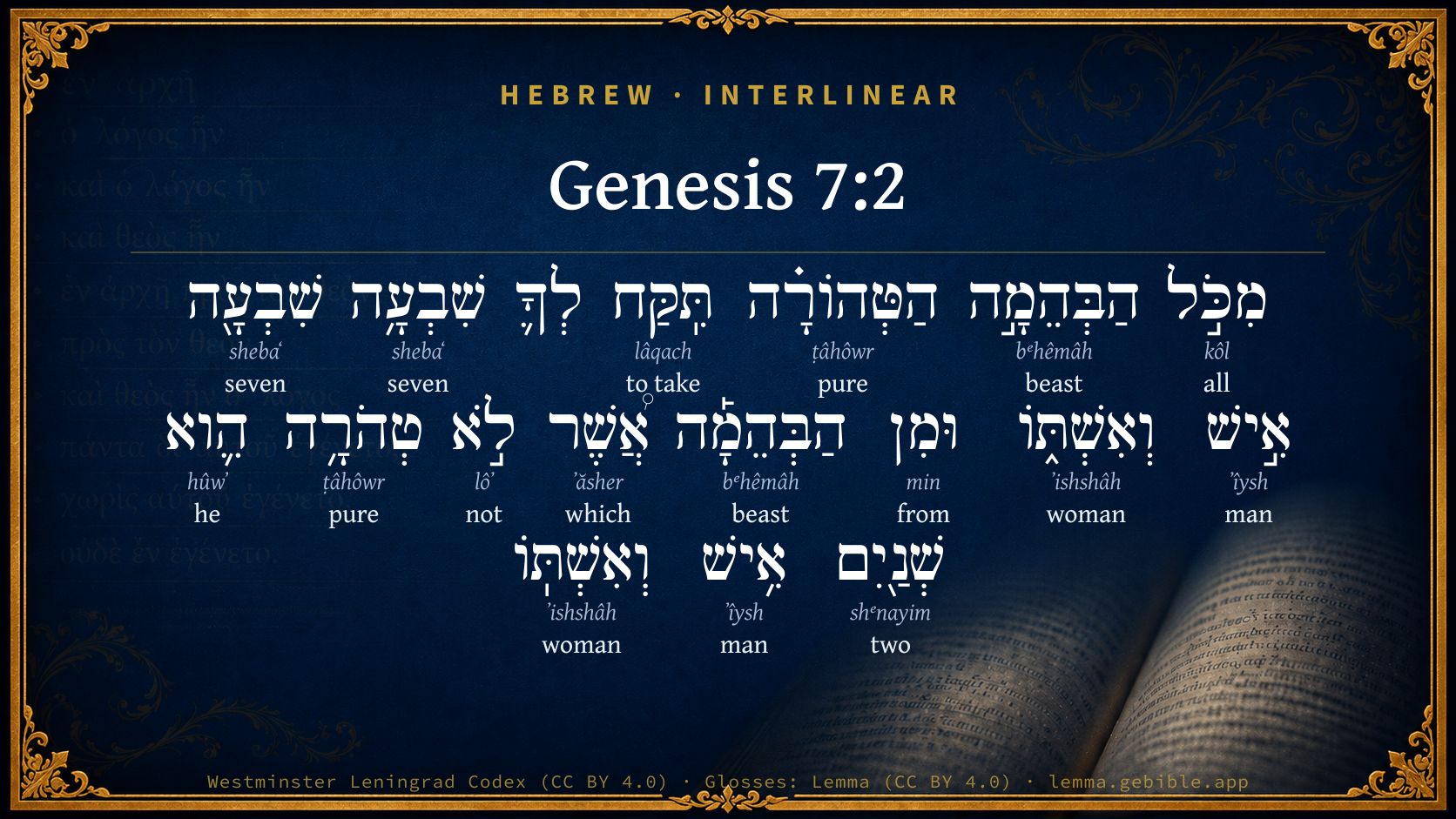
Genesis 7:2

Hebrew (Westminster Leningrad Codex) Genesis 7:2 appears in the Hebrew Old Testament. The text above is from the Westminster Leningrad Codex. Each word links to its Strong’s number, a concise gloss, and parsing drawn from the Open Scriptures Hebrew Bible morphology. Click any word for its full Brown-Driver-Briggs (BDB) entry.
Download image
Cite this verse

Genesis 7:2 (World English Bible). Public Domain. Lemma interlinear Bible study tool, https://lemma.gebible.app/v/genesis/7/2.

Show BibTeX & RIS
BibTeX
RIS
English Translation
You shall take seven pairs of every clean animal with you, the male and his female. Of the animals that are not clean, take two, the male and his female.
World English Bible · Public Domain
Highlights
  • 1 first appearance in the Hebrew Bible
Full analysis ↓
Download a study sheet

One document with this verse’s original text, its word-by-word gloss line, the meaning frame, cross-references with their text, attributed commentary, and full source and license credits — printable, and it pastes into notes with its structure intact.

This verse Autodidact and up

Study sheet (.html) Plain text (.txt)

A passage Seminary Student

Up to 50 verses in one chapter. A passage sheet keeps up to 6 commentary sources and 12 cross-references per verse, in the order this page ranks them, and says so on the sheet whenever that leaves anything out. Ask for a single verse and you get the Autodidact verse sheet above.

Everything on this page stays free to read, with no account — the sheet is a download of what is already on screen, not access to it.

Want to remove ads? Support Godless Engineer
Compare translations 3

The same verse in 3 English versions, stacked beneath the original-language interlinear above. Click any original word for its lexicon entry.

Each is an independent rendering of the whole verse — the interlinear is not word-aligned to these translations.

Highlighted words mark where these versions differ — a whole-verse word diff, not a word-by-word alignment.

  • World English Bible Public Domain
    You shall take seven pairs of every clean animal with you, the male and his female. Of the animals that are not clean, take two, the male and his female.
  • King James Version Public Domain
    Of every clean beast thou shalt take to thee by sevens, the male and his female: and of beasts that are not clean by two, the male and his female.
  • unfoldingWord Literal Text CC BY-SA 4.0
    From every clean animal take with you seven pairs, a male and its female, and from animal that not clean two, a male and its female,

unfoldingWord Literal Text — © unfoldingWord, licensed CC BY-SA 4.0. Word-aligned USFM3 via Door43 (git.door43.org/unfoldingWord/en_ult).

Versions to compare (up to 4)

3 of 4 selected

Show all 18 translations

Every available English version of this verse, each an independent rendering of the whole verse.

  • World English Bible Public Domain
    You shall take seven pairs of every clean animal with you, the male and his female. Of the animals that are not clean, take two, the male and his female.
  • Berean Standard Bible Public Domain
    You are to take with you seven pairs of every kind of clean animal, a male and its mate; a pair of every kind of unclean animal, a male and its mate;
  • Majority Standard Bible Public Domain
    You are to take with you seven pairs of every kind of clean animal, a male and its mate; a pair of every kind of unclean animal, a male and its mate;
  • King James Version Public Domain
    Of every clean beast thou shalt take to thee by sevens, the male and his female: and of beasts that are not clean by two, the male and his female.
  • American Standard Version (1901) Public Domain
    Of every clean beast thou shalt take to thee seven and seven, the male and his female; and of the beasts that are not clean two, the male and his female:
  • Revised Version (1885) Public Domain
    Of every clean beast thou shalt take to thee seven and seven, the male and his female; and of the beasts that are not clean two, the male and his female;
  • Geneva Bible (1599) Public Domain
    Of euery cleane beast thou shalt take to thee by seuens, the male and his female: but of vncleane beastes by couples, the male and his female.
  • Douay-Rheims (1899) Public Domain
    Of all clean beasts take seven and seven, the male and female.
  • Young's Literal Translation Public Domain
    of all the clean beasts thou dost take to thee seven pairs, a male and its female; and of the beasts which are not clean two, a male and its female;
  • Literal Standard Version CC BY-SA 4.0
    you take seven pairs from all the clean beasts to yourself, a male and its female; and of the beasts which are not clean—two, a male and its female;
  • Unlocked Literal Bible CC BY-SA 4.0
    Of every clean animal you will bring with you seven males and seven females. From the animals that are not clean, of them bring two, the male and his mate.
  • unfoldingWord Literal Text CC BY-SA 4.0
    From every clean animal take with you seven pairs, a male and its female, and from animal that not clean two, a male and its female,
  • Darby Bible Public Domain
    Of all clean beasts thou shalt take to thee by sevens, a male and its female; but of the beasts that are not clean two, a male and its female.
  • World Messianic Bible Public Domain
    You shall take seven pairs of every clean animal with you, the male and his female. Of the animals that are not clean, take two, the male and his female.
  • Webster's Bible Public Domain
    Of every clean beast thou shalt take to thee by sevens, the male and his female: and of beasts that are not clean by two, the male and his female.
  • Free Bible Version CC BY-SA 4.0
    Take with you seven pairs, male and female, of every kind of clean animal, and one pair, male and female, of every kind of unclean animal.
  • Bible in Basic English Public Domain
    Of every clean beast you will take seven males and seven females, and of the beasts which are not clean, two, the male and his female;
  • JPS Tanakh (1917) Public Domain
    Of every clean beast thou shalt take to thee seven and seven, each with his mate; and of the beasts that are not clean two and two, each with his mate;

Literal Standard Version (2020), Covenant Press — licensed CC BY-SA 4.0. Text via the HelloAO Bible API (eBible.org). Unlocked Literal Bible (unfoldingWord) — licensed CC BY-SA 4.0. Text via the HelloAO Bible API (eBible.org). unfoldingWord Literal Text — © unfoldingWord, licensed CC BY-SA 4.0. Word-aligned USFM3 via Door43 (git.door43.org/unfoldingWord/en_ult). Free Bible Version, Dr. Jonathan Gallagher — licensed CC BY-SA 4.0. Text via the HelloAO Bible API (eBible.org).

Word by word

More ways to search: Search by grammar → Find every occurrence → Compare this word →

Practice this passage: Drill this verse → Learn its vocabulary →

הַטְּהוֹרָ֗ה
ṭâhôwr
H2889
“the · pure”
Particle, Definite Article + Adjective, Adjective, Feminine, Singular, Absolute
Part of Speech
Particle + Adjective
Type
Adjective
Gender
Feminine
Number
Singular
State
Absolute
Full BDB Definition

Origin: from H2891

TWOT: 792d

pure, clean - clean (ceremonially - of animals) - pure (physically) - pure, clean (morally, ethically)
  1. מִכֹּ֣ל kôl H3605 “from · all of” Preposition + Noun, Common, Masculine, Singular, Construct
  2. הַבְּהֵמָ֣ה bᵉhêmâh H929 “the · beast” Particle, Definite Article + Noun, Common, Feminine, Singular, Absolute
  3. תִּֽקַּח lâqach H3947 “to take” Verb, Qal, Imperfect, 2nd Person, Masculine, Singular
  4. שִׁבְעָ֥ה shebaʻ H7651 “seven” Adjective, Cardinal number, Masculine, Singular, Absolute
  5. שִׁבְעָ֖ה shebaʻ H7651 “seven” Adjective, Cardinal number, Masculine, Singular, Absolute
  6. אִ֣ישׁ ʼîysh H376 “man” Noun, Common, Masculine, Singular, Absolute
  7. וְאִשְׁתּ֑וֹ ʼishshâh H802 “and · woman · his” Conjunction + Noun, Common, Feminine, Singular, Construct + Suffix, Personal, 3rd Person, Masculine, Singular
  8. וּמִן min H4480 “and · from” Conjunction + Preposition
  9. הַבְּהֵמָ֡ה bᵉhêmâh H929 “the · beast” Particle, Definite Article + Noun, Common, Feminine, Singular, Absolute
  10. אֲ֠שֶׁר ʼăsher H834 “which” Particle, Relative
  11. לֹ֣א lôʼ H3808 “not” Particle, Negative
  12. טְהֹרָ֥ה ṭâhôwr H2889 “pure” Adjective, Adjective, Feminine, Singular, Absolute
  13. הִ֛וא hûwʼ H1931 “he” Pronoun, Personal, 3rd Person, Feminine, Singular
  14. שְׁנַ֖יִם shᵉnayim H8147 “two” Adjective, Cardinal number, Masculine, Dual, Absolute
  15. אִ֥ישׁ ʼîysh H376 “man” Noun, Common, Masculine, Singular, Absolute
  16. וְאִשְׁתּֽוֹ ʼishshâh H802 “and · woman · his” Conjunction + Noun, Common, Feminine, Singular, Construct + Suffix, Personal, 3rd Person, Masculine, Singular

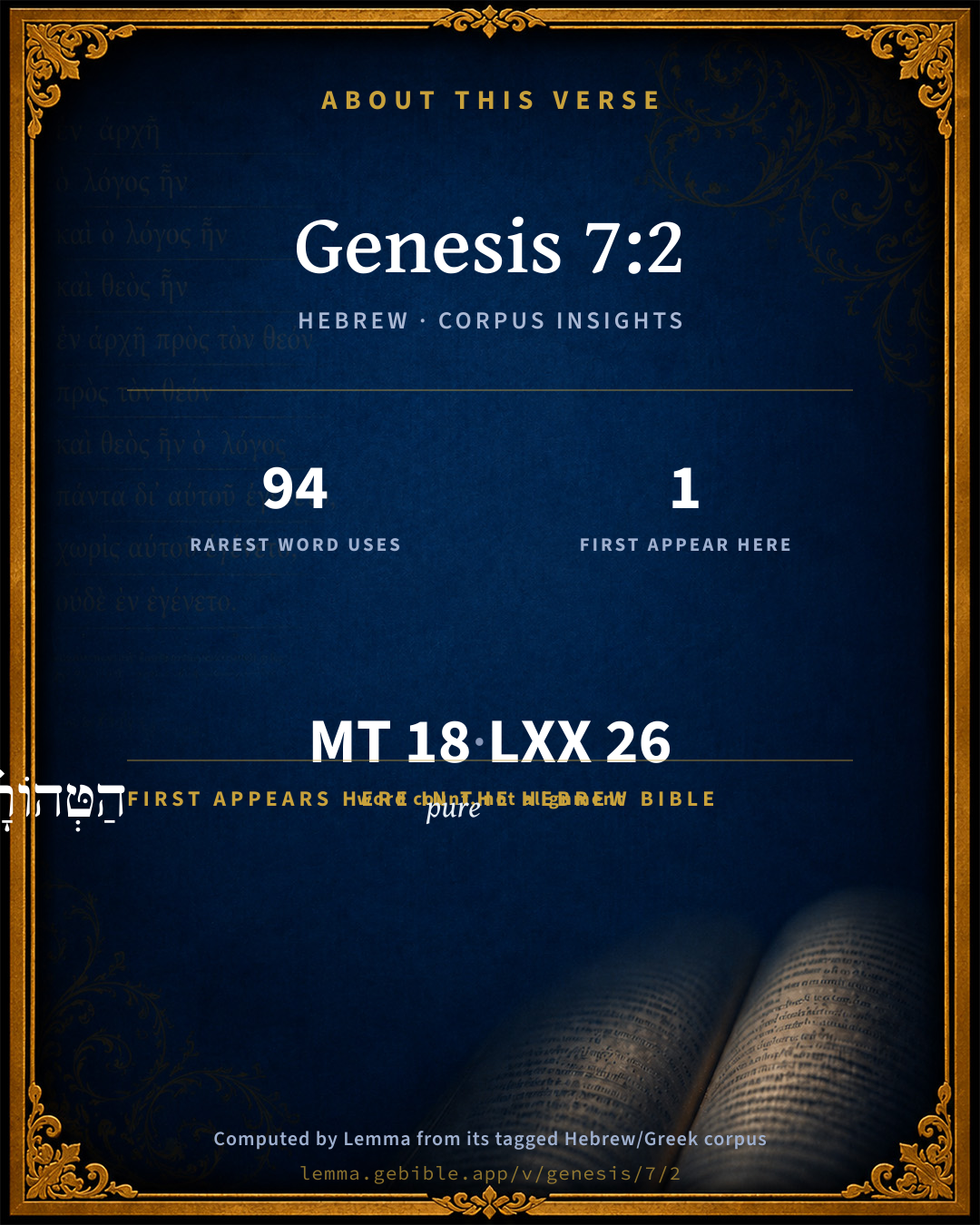
About this verse

These counts appear in no published source. They are computed here, from the morphology-tagged text and Lemma’s own curated glosses. What Lemma adds →

18
words
12
distinct lemmas
Pentateuch
section

First appearance in Scripture

This word makes its first canonical appearance in the Hebrew Bible here:

  • הַטְּהוֹרָ֗ה pure H2889

Grammatical profile

  • 1 verb
  • 7 nouns
  • 5 adjectives
  • 1 pronoun
  • 2 prepositions
  • 2 particles

Verb forms

  • תִּֽקַּח Qal · Imperfect

Repetition

Words recur within this verse — often emphatic in Hebrew:

  • הַבְּהֵמָ֣ה beast H929 ×2
  • הַטְּהוֹרָ֗ה pure H2889 ×2
  • שִׁבְעָ֥ה seven H7651 ×2
  • אִ֣ישׁ man H376 ×2
  • וְאִשְׁתּ֑וֹ woman H802 ×2

Hebrew & Septuagint length

In English translation the verse runs 30 words from the Hebrew and 22 from the Septuagint (LXX English) — closely comparable.

A rough comparison of the two English renderings, which tokenize alike — not a word-level alignment.

Word counts can differ between the Hebrew and the Greek without any difference in meaning — e.g. the Hebrew direct-object marker אֵת has no separate Greek word, and Greek often adds the article ὁ.

In the original languages it is 18 Hebrew tokens and 26 Greek tokens — but the two are counted differently (Hebrew bundles its prefixes and suffixes into one token; the Greek is in lemma form), so that isn’t a like-for-like length.

Cross-references

8

Topical passages linked to Genesis 7:2 in the Treasury of Scripture Knowledge — connected by theme and wording, ordered by reader-vote popularity; previews shown in the World English Bible.

  • Genesis 8:20 Noah built an altar to Yahweh, and took of every clean animal, and of every clean bird, and offered burnt offerings on the altar.
  • Leviticus 10:10 and that you are to make a distinction between the holy and the common, and between the unclean and the clean;
  • Leviticus 11:1–47 Yahweh spoke to Moses and to Aaron, saying to them,
  • Genesis 7:8 Clean animals, animals that are not clean, birds, and everything that creeps on the ground
  • Acts 10:11–15 He saw heaven opened and a certain container descending to him, like a great sheet let down by four corners on the earth,
  • Ezekiel 44:23 They shall teach my people the difference between the holy and the common, and cause them to discern between the unclean and the clean.
  • Genesis 6:19–21 Of every living thing of all flesh, you shall bring two of every sort into the ark, to keep them alive with you. They shall be male and female.
  • Deuteronomy 14:1–21 You are the children of Yahweh your God: you shall not cut yourselves, nor make any baldness between your eyes for the dead.

Cross-references courtesy of OpenBible.info (CC BY 4.0).

Hebrew and Greek witnesses Masoretic Hebrew ↔ Greek Septuagint

The same verse in the two great witnesses to the Old Testament, shown verse-for-verse.

These are two independent witnesses, not word-aligned to each other, and the Septuagint is shown in lemma (dictionary) form.

Hebrew Genesis 7:2 Masoretic · Westminster Leningrad Codex

מִכֹּ֣ל הַבְּהֵמָ֣ה הַטְּהוֹרָ֗ה תִּֽקַּח לְךָ֛ שִׁבְעָ֥ה שִׁבְעָ֖ה אִ֣ישׁ וְאִשְׁתּ֑וֹ וּמִן הַבְּהֵמָ֡ה אֲ֠שֶׁר לֹ֣א טְהֹרָ֥ה הִ֛וא שְׁנַ֖יִם אִ֥ישׁ וְאִשְׁתּֽוֹ

You shall take seven pairs of every clean animal with you, the male and his female. Of the animals that are not clean, take two, the male and his female.

World English Bible · Public Domain

Greek LXX Genesis 7:2 Septuagint · lemma form

ἀπό δέ ὁ κτῆνος ὁ καθαρός εἰςἄγω πρός σύ ἑπτά ἑπτά ἄρσην καί θῆλυς ἀπό δέ ὁ κτῆνος ὁ μή καθαρός δύο δύο ἄρσην καί θῆλυς

And of the clean cattle take in to you sevens, male and female, and of the unclean cattle pairs male and female.

LXX2012 (modern English Septuagint) · Public Domain

On this verse, Haydock's Catholic Bible Commentary discusses the Septuagint’s reading. Read the note in Commentary ↓

Hebrew: Westminster Leningrad Codex (CC BY 4.0). Greek: Septuagint (public domain); English from LXX2012 (modern English Septuagint) (Public Domain). How the Septuagint differs from the Hebrew →

Targum (Aramaic paraphrase)

2

The Targum is the ancient Jewish Aramaic paraphrase of the Hebrew Scriptures — an interpretive translation, not the Hebrew text itself. Onkelos (literal) and Pseudo-Jonathan (expansive) render the Torah, and Jonathan the Prophets. Coverage is partial: where no permissively-licensed English translation exists for a verse, only the Aramaic is shown. This is verse-level text, not a word-by-word alignment to the Hebrew.

  1. Targum Onkelos Torah (Genesis–Deuteronomy)
    מִכֹּל בְּעִירָא דַכְיָא תִּסַּב לָךְ שַׁבְעָא שַׁבְעָא דְּכַר וְנוּקְבָא וּמִן בְּעִירָא דְּלָא אִיתָהָא דַכְיָא הִיא תְּרֵין דְּכַר וְנוּקְבָא

    Of all clean animals take thou seven and seven, male and female; and of animals not clean, two and two, male and female.

    Targum Onkelos — Aramaic: “Onkelos Genesis” (public domain); “Onkelos Exodus” (public domain); “Onkelos Leviticus” (public domain); “Onkelos Numbers” (public domain); “Onkelos Deuteronomy” (public domain). English: “Sefaria Community Translation” (CC0 1.0 (public-domain dedication)); “J.W. Etheridge. The Targums of Onkelos and Jonathan Ben Uzziel on the Pentateuch. London: Longmans, Green, 1862” (public domain). Text via Sefaria.

  2. Targum Pseudo-Jonathan Torah (Genesis–Deuteronomy)
    מִכָּל בְּעִירָא דַכְיָא תִּסַב לָךְ שׁוּבְעָא שׁוּבְעָא דְכַר וְנוּקְבָא וּמִן בְּעִירָא דְלֵיתֵיהּ דַכְיָא תְּרֵין דְכַר וְנוּקְבָא

    Of all clean cattle take thou seven by seven, male and female, and of all cattle not clean, two (and two), male and female.

    Targum Pseudo-Jonathan — Aramaic: “Targum Jonathan on Genesis” (public domain); “Targum Jonathan on Exodus” (public domain); “Targum Jonathan on Leviticus” (public domain); “Targum Jonathan on Numbers” (public domain); “Targum Jonathan on Deuteronomy” (public domain). English: “The Targum of Jonathan ben Uzziel, trans. J. W. Etheridge, London, 1862” (public domain). Text via Sefaria.

Commentary

Notes on Genesis 7:2 from classic Christian and Jewish commentators (each source and its license shown beneath its notes). The classic Christian expositions comment on the surrounding passage and are grouped to its opening verse, so a note may address several verses; the Jewish commentaries on the Tanakh (Rashi and others) are per-verse, so they appear only where the commentator wrote on this verse.

Lemma curates 59 commentaries, every one of them public domain or Creative Commons licensed, each selected and text-cleaned for this edition rather than reprinted as found. About our sources →

Trapp's Complete Commentary

John Trapp

Gen 7:2 Of every clean beast thou shalt take to thee by sevens, the male and his female: and of beasts that [are] not clean by two, the male and his female.

Ver. 2. Of every clean beast thou shalt take by sevens.] Three pair for generation, and a single one for sacrifice, after the flood was past. Gen 8:20 God must have a share; and good reason. But that two only of a sort, of the unclean hurtful creatures were preserved, note his fatherly providence. To this day we see, though sheep and birds be so killed up for man’s use, yet there are far more of them, than of other unserviceable or cruel creatures. Besides, the weaker creatures go in herds together, the stronger and more savage go alone. For if they should go in multitudes, no man nor beast could stand before them. This you shall find set down to your hand. Job 37:8 Psa 104:17-30 Ammianus Marcellinus writeth, "that in Chaldea there are a huge number of lions, which were like enough to devour up both men and beasts throughout the country. But withal, he saith, that by reason of the store of water and mud thereof, there breed yearly an innumerable company of gnats, whose property is to flee into the eye of the lion, as being a bright and orient thing, where, biting and stinging the lion, he teareth so fiercely with the claws, that he puts out his own eyes; and by that means many are drowned in the rivers, others starve for want of prey, and many the more easily killed by the inhabitants. Bodin {a} telleth us, that the wolf never seeth his sire, his dam, nor his young: for that the herd of wolves set upon, and killeth that wolf, which by the smell they perceive to have coupled with the she wolf; which unless they did, what a deal of mischief would be done by them everywhere among cattle!

{a} Bodin. in Theatro., lib. iii.

John Trapp, A Commentary or Exposition upon All the Books of the Old and New Testament (1647–1656) — public domain. Text from a community e-Sword module.

Joseph Benson's Commentary

Gen 7:2. Here are necessary orders given concerning the brute creatures that were to be preserved alive with Noah in the ark. He must carefully preserve every species, that no tribe, no, not the least considerable, might entirely perish out of the creation. Even the unclean beasts, that were least valuable, were preserved alive in the ark. For God’s tender mercies are over all his works, and not only over those that are of most use; yet more of the clean were preserved than of the unclean. 1st, Because the clean were most for the service of man; and therefore, in favour to him, more of them were preserved, and are still propagated. Thanks be to God, there are not herds of lions as there are of oxen; nor flocks of tigers, as there are of sheep. 2d, Because the clean were for sacrifice to God; and therefore, in honour to him, more of them were preserved, three couple for breed, and the odd seventh for sacrifice, Gen 8:20.

Joseph Benson's Commentary on the Old and New Testaments (1811–1818) — public domain. Text from a community e-Sword module.

Tyndale Open Study Notes

Tyndale Open Resources

7:2 of each animal I have approved: In addition to the animals that were to repopulate the earth, these “clean” animals were for food and for Noah’s sacrifice after the flood (8:20-21). This passage does not use the precise technical language that is found in the regulations concerning “clean” and “unclean” given to Israel at Sinai (see Lev 11; Deut 14:3-12), but the underlying concept is the same (perhaps God revealed it directly to Noah).

Tyndale Open Study Notes — © Tyndale Open Resources, licensed CC BY-SA 4.0. Text via the HelloAO Bible API.

Geneva Bible (1599)

Geneva Bible translators

Which might be offered in sacrifice, whereof six were for breed, and the seventh for sacrifice.

Geneva Bible (1599) marginal notes — public domain. Text via Bolls.life.

Jamieson, Fausset & Brown

Robert Jamieson, A. R. Fausset & David Brown

Of every clean beast . . . fowls--Pairs of every species of animals, except the tenants of the deep, were to be taken for the preservation of their respective kinds. This was the general rule of admission, only with regard to those animals which are styled "clean," three pairs were to be taken, whether of beasts or birds; and the reason was that their rapid multiplication was a matter of the highest importance, when the earth should be renovated, for their utility either as articles of food or as employed in the service of man. But what was the use of the seventh? It was manifestly reserved for sacrifice; and so that both during Noah's residence in the ark, and after his return to dry land, provision was made for celebrating the rites of worship according to the religion of fallen man. He did not, like many, leave religion behind. He provided for it during his protracted voyage.

Jamieson, Fausset & Brown — Commentary Critical and Explanatory on the Whole Bible (1871) — public domain (CC PDM 1.0). Text via the HelloAO Bible API.

Adam Clarke's Commentary

Verse 2. Of every clean beast] So we find the distinction between clean and unclean animals existed long before the Mosaic law. This distinction seems to have been originally designed to mark those animals which were proper for sacrifice and food, from those that were not. See Lev. xi.

Adam Clarke's Commentary on the Bible (1810–1826) — public domain. Text from a community e-Sword/MySword module.

John Calvin's Commentaries

2. Of every clean beast. He again repeats what he had before said concerning animals, and not without occasion. For there was no little difficulty in collecting from woods, mountains, and caves, so great a multitude of wild beasts, many species of which were perhaps altogether unknown; and there was, in most of them, the same ferocity which we now perceive. Wherefore, God encourages the holy man, lest being alarmed with that difficulty, and having cast aside all hope of success, he should fail. Here, however, at first sight, appears some kind of contradiction, because whereas he before had spoken of pairs of animals, he now speaks of sevens. But the solution is at hand; because, previously, Moses does not state the number, but only says that females were added as companions to the males; as if he had said, Noah himself was commanded not to gather the animals promiscuously together, but to select pairs out of them for the propagation of offspring. Now, however, the discourse is concerning the actual number. Moreover, the expression, by sevens, is to be understood not of seven pairs of each kind, but of three pairs, to which one animal is added for the sake of sacrifice. Besides, the Lord would have a threefold greater number of clean animals than of others preserved, because there would be a greater necessity of them for the use of man. In which appointment, we must consider the paternal goodness of God towards us, by which he is inclined to have regard to us in all things.

John Calvin's Commentaries (1540-1563) — public domain. Text from the Calvin Translation Society English edition (1840s-50s) via the Christian Classics Ethereal Library (ccel.org). Calvin's coverage is partial (roughly two-thirds of the Bible); uncommented books and verses are honest gaps, never fabricated. The 19th-century editor's footnotes and remarks are omitted so the notes are faithfully Calvin's own voice.

Ellicott's Commentary for English Readers

(2) Of every clean beast—Heb., of all clean cattle—thou shalt take to thee by sevens—Heb., seven seven.—This probably does not mean seven pairs of each, though many commentators so interpret it, but seven of each kind. If, however, seven pairs be the right interpretation, but few species could have been included, as to attend properly to so large a number of animals would have been beyond the power of Noah and his sons. But which were the clean beasts? There can be no reference here to the Levitical law, which had respect to human food; nor to animals tamed and untamed, as all alike are called cattle; but probably the clean cattle were such as from the days of Adam ‘and Abel had been offered in sacrifice. Thus provision was made for Noah’s sacrifice on his egress from the ark, and also for his possession of a small herd of such animals as would be most useful to him amid the desolation which must have existed for a long time after the flood. The clean beasts would therefore be oxen, sheep, goats; the unclean, camels, horses, asses, and such other animals as stood in some relation to man. Of birds, the dove would especially be clean.

It has been pointed out that these more full and specific orders are given in the name of Jehovah, whereas most of the narrative of the flood is Elohistic, and hence it has been assumed that some Jehovist narrator added to and completed the earlier narrative. These additions would be Gen_7:1-6. the last clause of Gen_7:16, Noah’s sacrifice in Gen_8:20-22, and the cursing of Canaan in Gen_9:18-27. Now, it is remarkable that the sacrifice is as integral a portion of the Chaldean Genesis as the sending forth of the birds (Chaldean Genesis, p. 286), and is thus indubitably older than the time of Moses. Still, there is nothing improbable in Moses having two records of the flood before him, and while the division of Genesis into Elohistic and Jehovistic portions usually breaks down, there is a primâ facie appearance of the combination of two narratives in the present history, or, at least, in this one section (Gen_7:1-6).

A Bible Commentary for English Readers, edited by Charles John Ellicott (1878–1897) — public domain. Text from a community e-Sword module.

The Cambridge Bible for Schools and Colleges

gen. ed. J. J. S. Perowne

2. Of every clean beast] The distinction is here made between the clean and the unclean animals. Categories of both kinds, according to the Levitical Law, are found in Leviticus 11 and Deu_14:3-20. In the account given by P (Gen_6:19) no allusion is made to this distinction. According to P, the distinctions of clean and unclean were for the first time laid down in the Mosaic legislation, and could not, therefore, be recognized as existing in the primaeval or patriarchal age. According to J, the distinction existed in pre-Mosaic times, and was to be presupposed as having existed side by side with the institution of sacrifice.

seven and seven, the male and his female] By this is meant seven pairs. “The male and his female,” i.e. “each and his mate,” îsh v’ishtô, seems to make this clear. But some consider seven clean animals, and not seven pairs of clean animals, are intended. The words “the male and his female” are different from those rendered “male and female,” zâkâr un’ḳêbah, Gen_1:27, Gen_6:19, Gen_7:3; Gen_7:9; Gen_7:16.

The reason why so many more clean animals than unclean are required is, presumably, because they would be wanted (a) for food, (b) for sacrifice, and (c) for domestic purposes.

There is no reason to assume that the J tradition of the narrative shared the opinion of the P tradition, that before the Flood man subsisted on vegetable diet (see Gen_1:29, Gen_6:20, Gen_9:2-3).

The Cambridge Bible for Schools and Colleges (gen. ed. J. J. S. Perowne; Cambridge University Press, 1878–1918) — public domain. Text from a community e-Sword module.

John Gill's Exposition

Of every clean beast thou shalt take to thee by sevens,.... From hence it appears, that the distinction of clean and unclean beasts, at least for sacrifice, if not for food, was known before the flood, and so before the law of Moses; though some think this is said by anticipation, and as providing a large stock of such creatures for the propagation of their species; because they would be most serviceable to men both for food and sacrifice: but as it is certain that sacrifices were offered ever since the fall of man; by the same way, namely, by divine revelation, that men were taught to sacrifice creatures as typical of the sacrifice of Christ, they were directed what sort of creatures to offer, as were most suitable figures of him; those beasts that were clean, and used under the law, and so no doubt, at this time, were oxen, sheep, and goats: and these were to be taken into the ark by "sevens", or "seven seven" (p); either only three pairs, male and female, for procreation, and the seventh a male for sacrifice, when the flood was over; or rather fourteen, seven couple, an equal number of male and female, as Aben Ezra and Ben Gersom, that there might be enough for propagation; since a large number of them would be consumed, both for food and sacrifice:

the male and his female, or "the man and his wife" (q); which confirms the sense given, that there were seven pairs, or otherwise, if there had been an odd seventh, there would not have been a male and his female:

and of beasts that are not clean by two, or only two:

the male and his female, or "the man and his wife"; which was a number sufficient for the propagation of creatures neither used for food nor sacrifice; and many of which are harmful to mankind, as lions, wolves, tigers, bears, &c.

(p) "septena septena", Pagninus, Montanus; "septem septem", Vatablus, Drusius. (q) "virum et uxorem ejus", Pagninus, Montanus.

John Gill's Exposition of the Whole Bible (1746–1763) — public domain (CC PDM 1.0). Text via the HelloAO Bible API.

Haydock's Catholic Bible Commentary

Of all clean. The distinction of clean and unclean beasts, appears to have been made before the law of Moses, which was not promulgated till the year of the world 2514. (Challoner). --- Clean: not according to the law of Moses, which was not yet given, but such as tradition had described --- fit for sacrifice; (Menochius) though they might be of the same species as were deemed clean in the law, which ratified the ancient institution. --- And seven: (Hebrew) simply seven, three couple and an odd female, for sacrifice after the deluge: one couple was to breed, the other two perhaps for food. (Haydock) --- Some imagine, that there were fourteen unclean and four clean animals, of every species, in the ark, because the Samaritan, Septuagint, and Vulgate read, "seven and seven." (Origen, &c.) --- But our Saviour, sending the Disciples to preach two and two, did not appoint a company of four to go together, but only of two, as is generally allowed, Mark vi. 7. (Calmet)

George Leo Haydock (1774–1849), Haydock's Catholic Family Bible and Commentary, 1859 edition — public domain. Excludes Psalms (Douay-Rheims chapter numbering differs from Protestant) and Deuterocanonical books (Catholic canon only).

Matthew Poole's English Annotations

Obj. The distinction of clean and unclean beasts was not before the law.

Answ. Some legal things were prescribed and used before the law, as abstinence from the eating of blood, Gen 9:4, and, among other things, sacrifices, as learned men have sufficiently proved; and consequently the distinction of beasts to be sacrificed was then, in some measure, understood, which afterwards was expressed, Lev 1:1-17, &c. Nor is this a good argument, This was not written before, therefore it was not commanded and practised before, especially concerning a time when no commands of God were written, but only delivered by tradition.

By sevens; either,

1. Seven single, as most think. Or rather,

2. Seven couples, as may be gathered,

1. From the duplication of the word in Hebrew. If it be said seven seven signifies only seven of every kind, then it would have been said concerning the unclean beasts two two, i.e. two of each sort: whereas now there is an apparent difference; there it is said only by two, but here,

by sevens, or seven seven, which difference of the phrase suggest a difference in the things. 2. By the following words,

the male and his female, which being indifferently applied to the clean and unclean, plainly shows that none of them entered into the ark single, and therefore there was no odd seventh among them, but all went in by couples, which was most convenient in all for the propagation of their kind, and in the clean for other uses also; as for sacrifices to God, if not for the sustentation of men in the ark, and after they came out of it. Which gives us the reason why God would have more of the clean than of the unclean put into the ark, because they were more serviceable both to God and men.

Matthew Poole's English Annotations on the Holy Bible (1683–1685) — public domain. Text from a community e-Sword/MySword module.

Whedon's Commentary on the Bible

Daniel D. Whedon

2. Every clean beast — “The objection that this was an anticipation of the Levitical distinction of beasts into clean and unclean, is wholly groundless. The boundary line between clean and unclean animals is marked by nature. Every tribe of mankind would distinguish between the sheep and the hyena, between the dove and the vulture. Whether animal food was eaten before the deluge or not, it is certain that flocks and herds were fed for the sake of their milk and wool, and that of them victims were offered in sacrifice. This alone would separate between the clean and the unclean. It is not improbable, that the distinction even of the names clean and unclean had been fully established by custom long before it was recognised and ratified by the law.” — Speaker’s Com.

By sevens — Heb, seven seven. Seven pairs of every clean beast is, doubtless, the meaning of the writer, as implied by the additional words, the male and his female. This statement Kalisch declares to be totally “irreconcilable with the preceding narrative,” and imagines that the discrepancy may be easily explained by the hypothesis of Elohistic and Jehovistic documents. He supposes that the Jehovist “prudently introduced the significant number of seven pairs” in order to provide for Noah’s offering of clean beasts and fowls after the flood. Gen_8:20. And yet he admits that the Jehovist “neither thought, nor did he in any way intend, to be in opposition to the statement of the Elohist. He understood the two animals which Noah was to bring, as merely signifying that always male and female were to be chosen, that they were to be pairs, without the number of these pairs being stated; for he writes: ‘Two and two went in to Noah into the ark, male and female, as Elohim had commanded Noah.’” Gen_7:9. Is it not strange that a writer who can so readily understand that this “Jehovist” (who wrote the narrative as it now stands, and “designed full harmony with the Elohist”) saw no discrepancy here, but “understood that they were to be pairs without the number of these pairs being stated,” will insist that the two statements are utterly irreconcilable with each other? If the “Jehovist” had no trouble in reconciling these statements, probably Moses had none; nor need we. “The command here is but an amplification of the former injunction, which had probably been given one hundred and twenty years before. In the first instance it was said that Noah’s family should be preserved, together with a pair of every kind of beast. In the second, that, while the general rule should be the saving of a single pair, yet, in the case of the clean beasts there should be preserved not one pair only, but seven.” — Speaker’s Com.

Daniel D. Whedon (gen. ed.), Commentary on the Old and New Testaments (1874–1909) — public domain. Text from a community e-Sword module.

The Pulpit Commentary

Of every clean beast. That the distinction between clean and unclean animals was at this time understood is easier to believe than that the writer would perpetrate the glaring anachronism of introducing in prediluvian times what only took its rise several centuries later (Kalisch). That this distinction was founded on nature, "every tribe of mankind being able to distinguish between the sheep and the hyena, the dove and the vulture" ("Speaker"s Commentary"), or "on an immediate conscious feeling of the human spirit, not yet clouded by any ungodly and unnatural culture, which leads it to see in many beasts pictures of sin and corruption" (Keil), has been supposed; but with greater probability it was of Divine institution, with reference to the necessities of sacrifice (Ainsworth, Bush, Wordsworth; cf. (Gen_8:20) To this was appended in the Levitical system a distinction between clean and unclean in respect of man"s food. (Lev_11:3) Shalt thou take inconsistent with; Gen_6:20, which says the animals were to come to Noah (Colenso) but, Gen_6:19, which says that Noah was to bring them, i.e. make them go (at least nearly equivalent to take) clearly recognizes Noah"s agency (Quarry)to thee by sevens. Literally, seven, seven; either seven pairs (Vulgate, LXX, Aben Ezra, Clericus, Michaells, De Wette, Knobel, Kalisch, Murphy, Alford, Wordsworth, " Speaker"s Commentary"), or seven individuals (Chrysostom, Augustine, Theodoret, Calvin, Pererius, Wiliet, Delitzsch, Rosenm Keil, Lange, Bush); both parties quoting the next clause in support of their particular interpretation. Davidson, Colenso, and Kalisch challenge both interpretations as "irreconcilable with the preceding narrative"; (Gen_6:19) but the obvious answer is, that while in the first communication, which was given 120 years before, when minute instructions were not required, it is simply stated that the animals should be preserved by pairs; in the second, when the ark was finished and the animals were about to be collected, it is added that, in the case of the few clean beasts used for sacrifice, an exception should be made to the general rule, and not one pair, but either three pairs with one over, or seven pairs, should be preserved. The male and his female. This seems to be most in favor of the first interpretation, that pairs, and not individuals, are meant. And of beasts that are not clean by two, the male and his female. Ish veishto. Cf. Gen_2:25, where the phrase denotes the ethical personality of human beings, to which there is here an approximation, as the preserved animals were designed to be the parents of subsequent races. The usual phrase for male and female, which is employed (Gen_1:28) (a so-called Elohistic) and, (Gen_7:3) (a so-called Jehovistic section) refers to the physical distinction of sex in human beings.

The Pulpit Commentary (1880–1919), ed. H.D.M. Spence-Jones & Joseph S. Exell — public domain. Text from a community e-Sword module.

John Wesley's Explanatory Notes

Here are necessary orders given concerning the brute creatures that they were to be preserved alive with Noah in the ark. He must carefully preserve every species, that no tribe, no, not the least considerable, might entirely perish out of the creation. Observe in this: (1.) God's care for man. Doth God take care for oxen? 1 Cor. ix, 9, or was it not rather for man's sake that this care was taken? (2.) Even the unclean beasts were preserved alive in the ark, that were least valuable. For God's tender mercies are over all his works, and not only over those that are of most use. (3.) Yet more of the clean were preserved than of the unclean.

1. Because the clean were most for the service of man; and therefore in favour to him, more of them were preserved and are still propagated. Thanks be to God there are not herds of lions as there are of oxen, nor flocks of tigers as there are of sheep.

2. Because the clean were for sacrifice to God; and therefore, in honour to him, more of them were preserved, three couple for breed, and the odd seventh for sacrifice, chap. viii, 20.

John Wesley, Explanatory Notes Upon the Whole Bible (1754–1765) — public domain. Text via the GEBible commentary corpus.

Scofield Reference Notes

C. I. Scofield

clean beast

Cf. (See Scofield "Gen 6:19").

The Scofield Reference Bible (1917 edition), notes by C. I. Scofield — public domain. Text from a community e-Sword module.

Rashi

Rabbi Shlomo Yitzchaki (Rashi)

הטהורה CLEAN—It means those cattle which will in future be permitted to Israel as clean; we thus learn that Noah studied the Torah.

שבעה שבעה SEVEN AND SEVEN — so many, in order that he might offer some of them as a sacrifice when leaving the Ark (Genesis Rabbah 34:9).

Rashi on the Tanakh — English translations: “The Judaica Press complete Tanach with Rashi, translated by A. J. Rosenberg” (CC BY 4.0); “Pentateuch with Rashi's commentary by M. Rosenbaum and A.M. Silbermann, 1929-1934” (public domain); “The Metsudah Tanach series, Lakewood, N.J” (CC BY 4.0); and “The Book of Joshua, Metsudah Publications, 1997” (CC BY 4.0). Text via Sefaria.

Radak

Rabbi David Kimhi (Radak)

מכל בהמה הטהורה תקח לך, as they will arrive before the ark take them inside with you. Previously, G’d had told Noach only to take the animals in pairs, one pair per species. Only now was he instructed to take 6 additional pairs of each of the species of animal known as טהורה, ritually pure. It is not clear if of the ritually impure animals Noach was to take a single pair or two pairs. How did Noach know which animals were considered ritually pure? It is possible that G’d told him which peculiarities to watch for in order that he should know which to use as an offering after the deluge. Alternately, Noach would know when he saw that some of the animals came to him in lots of seven pairs. This explanation does not suffice for the birds, seeing that apparently all the birds arrived in lots of seven pairs. We must therefore fall back on the explanation that G’d provided Noach with information how to recognise which were the ritually pure animals. In that case, we would also have to conclude that the ritually impure birds did not come to the ark in pairs of seven. What then is the meaning of the words (verse 3) גם מעוף השמים שבעה שבעה?. “also from the birds in the sky seven pairs each?” Surely, this appears to apply only to the ritually pure birds, and the word גם refers back to the word הטהורה in verse 2. If the birds generally arrived in single pairs, and the ritually pure birds arrived in lots of seven pairs, the reason was not that they be used as offerings to G’d, seeing that Noach is on record as bringing only one offering, and he would be able to bring more such offerings from the next generation of such birds if he so desired. The reason may be that G’d intended for Noach and his family to use the excess number of ritually pure birds as food without endangering any of the species’ chances of survival. G’d had already planned to permit the consumption of meat to the survivors of the deluge, something which had been forbidden to Adam at the time. Even though G’d did not withhold any kind of living creature as food for man, as we know from Genesis 9,3 כל רמש אשר הוא חי לכם יהיה לאכלה, “any moving thing which is a live will be yours to eat,” this was amended for the Jewish people who were to be a nation of holy people. It is in the nature of things that the animals described as ritually pure, טהורות, are superior as food. In the majority, gentiles do not eat the meat of the other animals unless driven to do so by hunger. Keeping this in mind, G’d ordered Noach to take more of the ritually pure animals with him into the ark, to ensure that slaughtering some of them in due course would not deplete the available supply. The principal concern was to keep these species alive, i.e. לחיות זרע, to make sure man would always find a sufficient number of these animals available for his needs. G’d, in His wisdom knew that seven pairs of each would suffice, and that the ark would be unable to accommodate more than that number, and the amount of food needed to keep them alive for a whole year.

איש ואשתו, male and female The words are not to be understood literally as “man and wife,” i.e. exclusive mates, but are a figure of speech. The best example and proof that the expression is not meant literally, is found in Exodus 26,3 אשה אל אחותה, describing certain boards of the Tabernacle being close matches. No one in their right mind would translate these words as “woman and her sister.” When the Torah here speaks in cumbersome language of מן הבהמה אשר איננו טהורה, meaning the ritually impure animals, instead of simply writing מן הבהמה הטמאה, this is not an unusual stylistic expression. We find similar cumbersome language in similar contexts in Deuteronomy 23,11אשר לא יהיה טהור or in Samuel I 20,24 כי לא טהור הוא. There are numerous more examples. Our sages in Pessachim 3 say that the Torah meant to demonstrate that it is worthwhile to write a few extra words in order to avoid the use of coarse or unseemly language.

Radak on the Tanakh — English translations: “Sefaria Community Translation” (CC0 1.0 (public-domain dedication)); “Eliyahu Munk, HaChut Hameshulash” (CC BY 4.0); “Rabbi Mike Feuer, Jerusalem Anthology” (CC BY 4.0); and “R. David Kimhi on the first book of Psalms, Translated by R.G. Finch, London, 1919” (public domain). Text via Sefaria.

Lesson kit

Teaching starters — assembled from the data on this page, not authored interpretation. Every prompt links to the verse data it draws on. Edit before teaching.

Genesis, in the Pentateuch, opens this verse with 18 words (12 distinct Hebrew lemmas). Its most distinctive word is ṭâhôwr (“pure”). A historical commentator’s framing appears above. Read the whole chapter for the surrounding context.

Discussion questions

  1. The word ṭâhôwr carries the sense “pure.” How does it shape the verse?
  2. This is the first place “pure” appears in Scripture (first appears here). What does its debut here establish?
  3. How does Genesis 8:20, which shares this passage’s theme, read alongside this verse?
  4. What does the repetition of “beast” (2× in this one verse) do in this verse?
  5. These translations render this verse differently; the difference is in the English rendering, not the original. What questions does that raise?
  6. «תִּֽקַּח» is a Qal Imperfect verb. How does that grammatical form shape the action described?
  7. Compare how Trapp's Complete Commentary and Joseph Benson's Commentary read this verse. Where do they agree or differ?

Things to notice

Reading settings

Reading text

Shown beneath each verse's original-language words.

Old Testament
Old Testament edition

Read the OT as the Masoretic Hebrew (MT) or the Greek Septuagint (LXX).

English shown for the Greek Septuagint (in the Hebrew ↔ Greek comparison).

Comparing translations? Open the Compare panel on any verse page to stack up to four side by side.