Genesis 24:54

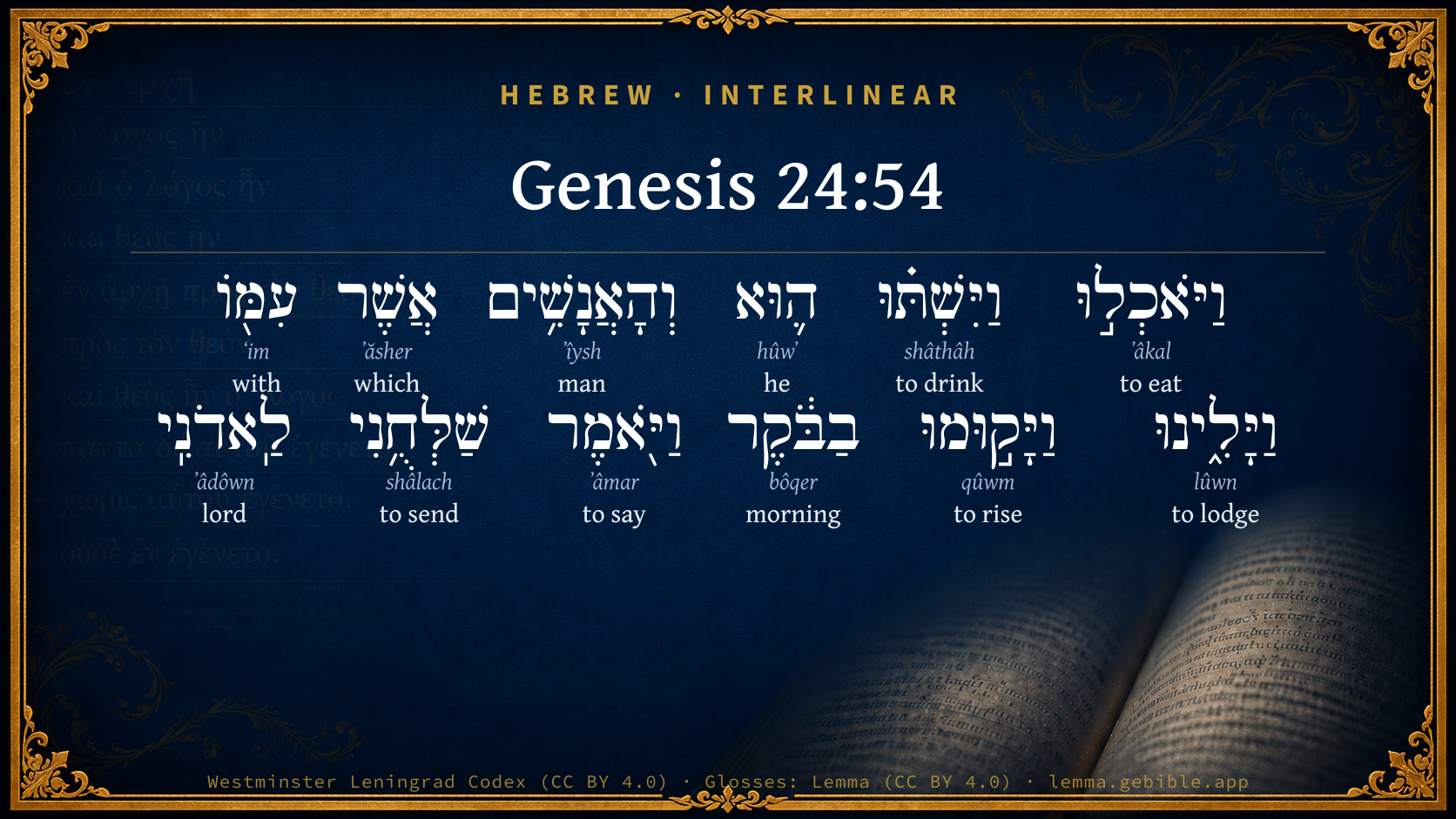
Hebrew (Westminster Leningrad Codex) Genesis 24:54 appears in the Hebrew Old Testament. The text above is from the Westminster Leningrad Codex. Each word links to its Strong’s number, a concise gloss, and parsing drawn from the Open Scriptures Hebrew Bible morphology. Click any word for its full Brown-Driver-Briggs (BDB) entry.
Download image
Cite this verse

Genesis 24:54 (World English Bible). Public Domain. Lemma interlinear Bible study tool, https://lemma.gebible.app/v/genesis/24/54.

Show BibTeX & RIS
BibTeX
RIS
English Translation
They ate and drank, he and the men who were with him, and stayed all night. They rose up in the morning, and he said, "Send me away to my master."
World English Bible · Public Domain
Download a study sheet

One document with this verse’s original text, its word-by-word gloss line, the meaning frame, cross-references with their text, attributed commentary, and full source and license credits — printable, and it pastes into notes with its structure intact.

This verse Autodidact and up

Study sheet (.html) Plain text (.txt)

A passage Seminary Student

Up to 50 verses in one chapter. A passage sheet keeps up to 6 commentary sources and 12 cross-references per verse, in the order this page ranks them, and says so on the sheet whenever that leaves anything out. Ask for a single verse and you get the Autodidact verse sheet above.

Everything on this page stays free to read, with no account — the sheet is a download of what is already on screen, not access to it.

Want to remove ads? Support Godless Engineer
Compare translations 3

The same verse in 3 English versions, stacked beneath the original-language interlinear above. Click any original word for its lexicon entry.

Each is an independent rendering of the whole verse — the interlinear is not word-aligned to these translations.

Highlighted words mark where these versions differ — a whole-verse word diff, not a word-by-word alignment.

  • World English Bible Public Domain
    They ate and drank, he and the men who were with him, and stayed all night. They rose up in the morning, and he said, "Send me away to my master."
  • King James Version Public Domain
    And they did eat and drink, he and the men that were with him, and tarried all night; and they rose up in the morning, and he said, Send me away unto my master.
  • unfoldingWord Literal Text CC BY-SA 4.0
    Then he and the men who with him ate and drank and lodged. Then in the morning they got up, and he said, “Send me to my master.”

unfoldingWord Literal Text — © unfoldingWord, licensed CC BY-SA 4.0. Word-aligned USFM3 via Door43 (git.door43.org/unfoldingWord/en_ult).

Versions to compare (up to 4)

3 of 4 selected

Show all 18 translations

Every available English version of this verse, each an independent rendering of the whole verse.

  • World English Bible Public Domain
    They ate and drank, he and the men who were with him, and stayed all night. They rose up in the morning, and he said, "Send me away to my master."
  • Berean Standard Bible Public Domain
    Then he and the men with him ate and drank and spent the night there. When they got up the next morning, he said, “Send me on my way to my master.”
  • Majority Standard Bible Public Domain
    Then he and the men with him ate and drank and spent the night there. When they got up the next morning, he said, “Send me on my way to my master.”
  • King James Version Public Domain
    And they did eat and drink, he and the men that were with him, and tarried all night; and they rose up in the morning, and he said, Send me away unto my master.
  • American Standard Version (1901) Public Domain
    And they did eat and drink, he and the men that were with him, and tarried all night. And they rose up in the morning, and he said, Send me away unto my master.
  • Revised Version (1885) Public Domain
    And they did eat and drink, he and the men that were with him, and tarried all night; and they rose up in the morning, and he said, Send me away unto my master.
  • Geneva Bible (1599) Public Domain
    Afterward they did eate and drinke, both he, and the men that were with him, and taried all night. and when they rose vp in the morning, he said, Let me depart vnto my master.
  • Douay-Rheims (1899) Public Domain
    And a banquet was made, and they ate and drank together, and lodged there. And in the morning, the servant arose, and said: Let me depart, that I may go to my master.
  • Young's Literal Translation Public Domain
    And they eat and drink, he and the men who `are' with him, and lodge all night; and they rise in the morning, and he saith, `Send me to my lord;'
  • Literal Standard Version CC BY-SA 4.0
    And they eat and drink, he and the men who [are] with him, and lodge all night; and they rise in the morning, and he says, “Send me to my lord”;
  • Unlocked Literal Bible CC BY-SA 4.0
    Then he and the men who were with him ate and drank. They stayed there overnight, and when they arose in the morning, he said, “Send me away to my master.”
  • unfoldingWord Literal Text CC BY-SA 4.0
    Then he and the men who with him ate and drank and lodged. Then in the morning they got up, and he said, “Send me to my master.”
  • Darby Bible Public Domain
    And they ate and drank, he and the men that were with him, and lodged. And they rose up in the morning; and he said, Send me away to my master.
  • World Messianic Bible Public Domain
    They ate and drank, he and the men who were with him, and stayed all night. They rose up in the morning, and he said, “Send me away to my master.”
  • Webster's Bible Public Domain
    And they ate and drank, he and the men that were with him, and tarried all night; and they rose in the morning, and he said, Send me away to my master.
  • Free Bible Version CC BY-SA 4.0
    He and the men with him ate and drank, and spent the night there. When they got up in the morning, he said, “Let me leave now and go home to my master.”
  • Bible in Basic English Public Domain
    Then he and the men who were with him had food and drink, and took their rest there that night; and in the morning he got up, and said, Let me now go back to my master.
  • JPS Tanakh (1917) Public Domain
    And they did eat and drink, he and the men that were with him, and tarried all night; and they rose up in the morning, and he said: 'Send me away unto my master.'

Literal Standard Version (2020), Covenant Press — licensed CC BY-SA 4.0. Text via the HelloAO Bible API (eBible.org). Unlocked Literal Bible (unfoldingWord) — licensed CC BY-SA 4.0. Text via the HelloAO Bible API (eBible.org). unfoldingWord Literal Text — © unfoldingWord, licensed CC BY-SA 4.0. Word-aligned USFM3 via Door43 (git.door43.org/unfoldingWord/en_ult). Free Bible Version, Dr. Jonathan Gallagher — licensed CC BY-SA 4.0. Text via the HelloAO Bible API (eBible.org).

Word by word

More ways to search: Search by grammar → Find every occurrence → Compare this word →

Practice this passage: Drill this verse → Learn its vocabulary →

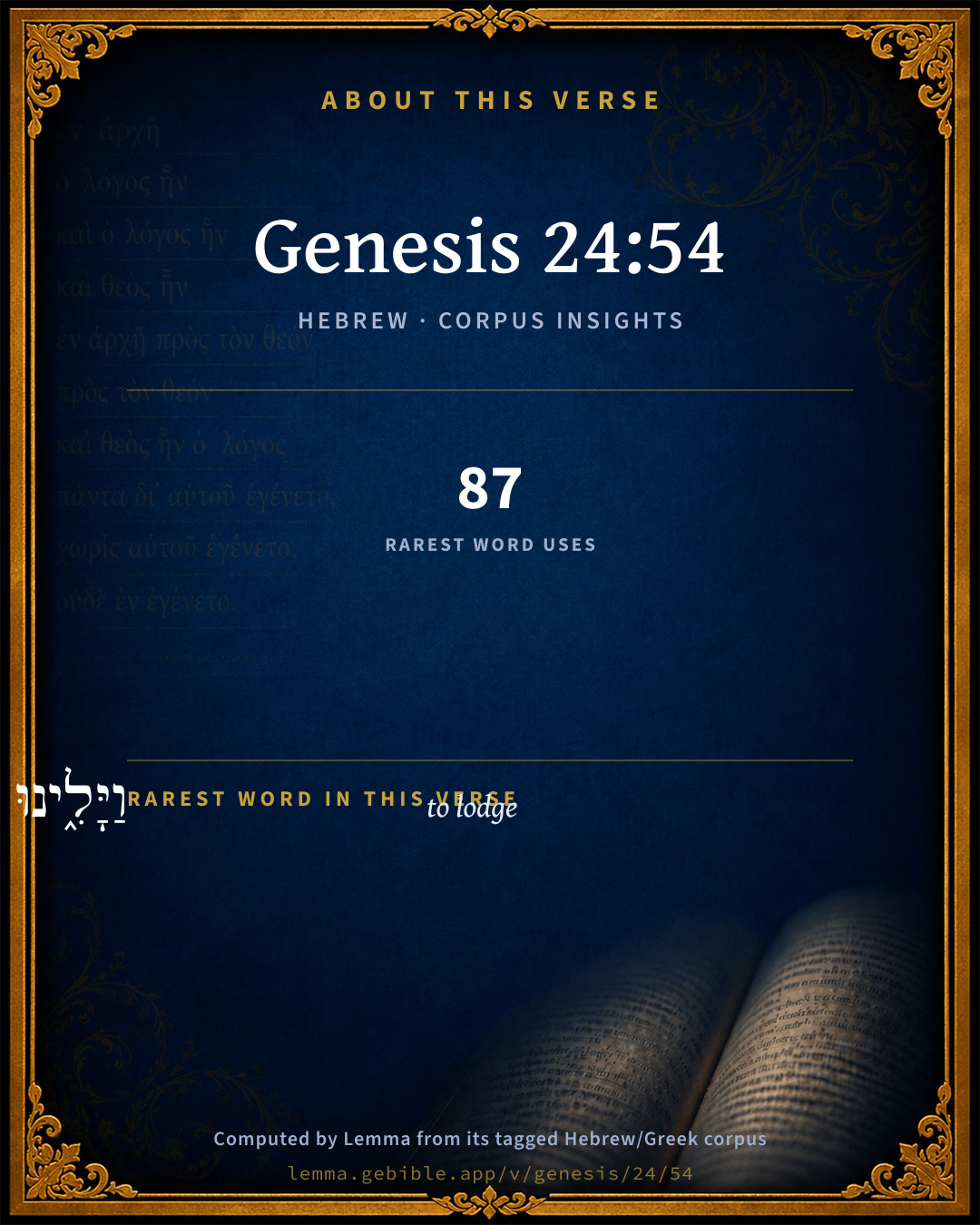
וַיָּלִ֑ינוּ
lûwn
H3885
“and · to lodge”
Conjunction + Verb, Qal, Sequential Imperfect, 3rd Person, Masculine, Plural
Part of Speech
Conjunction + Verb
Stem
Qal
Form
Sequential Imperfect
Person
3rd Person
Gender
Masculine
Number
Plural
Full BDB Definition

Origin: a primitive root

TWOT: 1096 , 1097

to lodge, stop over, pass the night, abide - (Qal) - to lodge, pass the night - to abide, remain (figuratively) - (Hiphil) to cause to rest or lodge - (Hithpalpel) to dwell, abide - to grumble, complain, murmur - (Niphal) to grumble - (Hiphil) to complain, cause to grumble
  1. וַיֹּאכְל֣וּ ʼâkal H398 “and · to eat” Conjunction + Verb, Qal, Sequential Imperfect, 3rd Person, Masculine, Plural
  2. וַיִּשְׁתּ֗וּ shâthâh H8354 “and · to drink” Conjunction + Verb, Qal, Sequential Imperfect, 3rd Person, Masculine, Plural
  3. ה֛וּא hûwʼ H1931 “he” Pronoun, Personal, 3rd Person, Masculine, Singular
  4. וְהָאֲנָשִׁ֥ים ʼîysh H376 “and · the · men” Conjunction + Particle, Definite Article + Noun, Common, Masculine, Plural, Absolute
  5. אֲשֶׁר ʼăsher H834 “which” Particle, Relative
  6. עִמּ֖וֹ ʻim H5973 “with · him” Preposition + Suffix, Personal, 3rd Person, Masculine, Singular
  7. וַיָּק֣וּמוּ qûwm H6965 “and · to rise” Conjunction + Verb, Qal, Sequential Imperfect, 3rd Person, Masculine, Plural
  8. בַבֹּ֔קֶר bôqer H1242 “in/at the · morning” Preposition, Determined + Noun, Common, Masculine, Singular, Absolute
  9. וַיֹּ֖אמֶר ʼâmar H559 “and · to say” Conjunction + Verb, Qal, Sequential Imperfect, 3rd Person, Masculine, Singular
  10. שַׁלְּחֻ֥נִי shâlach H7971 “send · me” Verb, Piel, Imperative, 2nd Person, Masculine, Plural + Suffix, Personal, 1st Person, Common, Singular
  11. לַֽאדֹנִֽי ʼâdôwn H113 “to/for · lord · my” Preposition + Noun, Common, Masculine, Singular, Construct + Suffix, Personal, 1st Person, Common, Singular

About this verse

These counts appear in no published source. They are computed here, from the morphology-tagged text and Lemma’s own curated glosses. What Lemma adds →

12
words
12
distinct lemmas
Pentateuch
section

Grammatical profile

  • 6 verbs
  • 3 nouns
  • 1 pronoun
  • 1 preposition
  • 1 particle

Verb forms

  • וַיֹּאכְל֣וּ Qal · Sequential Imperfect
  • וַיִּשְׁתּ֗וּ Qal · Sequential Imperfect
  • וַיָּלִ֑ינוּ Qal · Sequential Imperfect
  • וַיָּק֣וּמוּ Qal · Sequential Imperfect
  • וַיֹּ֖אמֶר Qal · Sequential Imperfect
  • שַׁלְּחֻ֥נִי Piel · Imperative

Hebrew & Septuagint length

In English translation the verse runs 31 words from the Hebrew and 33 from the Septuagint (LXX English) — closely comparable.

A rough comparison of the two English renderings, which tokenize alike — not a word-level alignment.

Word counts can differ between the Hebrew and the Greek without any difference in meaning — e.g. the Hebrew direct-object marker אֵת has no separate Greek word, and Greek often adds the article ὁ.

Cross-references

9

Topical passages linked to Genesis 24:54 in the Treasury of Scripture Knowledge — connected by theme and wording, ordered by reader-vote popularity; previews shown in the World English Bible.

  • Genesis 24:56 He said to them, "Don't hinder me, seeing Yahweh has prospered my way. Send me away that I may go to my master."
  • Genesis 24:59 They sent away Rebekah, their sister, with her nurse, Abraham's servant, and his men.
  • Genesis 28:5–6 Isaac sent Jacob away. He went to Paddan Aram to Laban, son of Bethuel the Syrian, Rebekah's brother, Jacob's and Esau's mother.
  • Genesis 45:24 So he sent his brothers away, and they departed. He said to them, "See that you don't quarrel on the way."
  • 2 Samuel 18:19 Then said Ahimaaz the son of Zadok, Let me now run, and bear the king news, how that Yahweh has avenged him of his enemies.
  • Proverbs 22:29 Do you see a man skilled in his work? He will serve kings; He won't serve obscure men.
  • Ecclesiastes 7:10 Don't say, "Why were the former days better than these?" For you do not ask wisely about this.
  • 2 Samuel 18:27–28 The watchman said, I think the running of the foremost is like the running of Ahimaaz the son of Zadok. The king said, He is a good man, and comes with good news.
  • Luke 8:38–39 But the man from whom the demons had gone out begged him that he might go with him, but Jesus sent him away, saying,

Cross-references courtesy of OpenBible.info (CC BY 4.0).

Hebrew and Greek witnesses Masoretic Hebrew ↔ Greek Septuagint

The same verse in the two great witnesses to the Old Testament, shown verse-for-verse.

These are two independent witnesses, not word-aligned to each other, and the Septuagint is shown in lemma (dictionary) form.

Hebrew Genesis 24:54 Masoretic · Westminster Leningrad Codex

וַיֹּאכְל֣וּ וַיִּשְׁתּ֗וּ ה֛וּא וְהָאֲנָשִׁ֥ים אֲשֶׁר עִמּ֖וֹ וַיָּלִ֑ינוּ וַיָּק֣וּמוּ בַבֹּ֔קֶר וַיֹּ֖אמֶר שַׁלְּחֻ֥נִי לַֽאדֹנִֽי

They ate and drank, he and the men who were with him, and stayed all night. They rose up in the morning, and he said, "Send me away to my master."

World English Bible · Public Domain

Greek LXX Genesis 24:54 Septuagint · lemma form

καί ἐσθίω καί πίνω αὐτός καί ὁ ἀνήρ ὁ μετά αὐτός εἰμί καί κοιμάω καί ἀναἵστημι πρωΐ εἶπον ἐκπέμπω ἐγώ ἵνα ἀποἔρχομαι πρός ὁ κύριος ἐγώ

And both he and the men with him ate and drank and went to sleep. And he arose in the morning and said, Send me away, that I may go to my master.

LXX2012 (modern English Septuagint) · Public Domain

Hebrew: Westminster Leningrad Codex (CC BY 4.0). Greek: Septuagint (public domain); English from LXX2012 (modern English Septuagint) (Public Domain). How the Septuagint differs from the Hebrew →

Targum (Aramaic paraphrase)

2

The Targum is the ancient Jewish Aramaic paraphrase of the Hebrew Scriptures — an interpretive translation, not the Hebrew text itself. Onkelos (literal) and Pseudo-Jonathan (expansive) render the Torah, and Jonathan the Prophets. Coverage is partial: where no permissively-licensed English translation exists for a verse, only the Aramaic is shown. This is verse-level text, not a word-by-word alignment to the Hebrew.

  1. Targum Onkelos Torah (Genesis–Deuteronomy)
    וַאֲכָלוּ וּשְׁתִיאוּ הוּא וְגוּבְרַיָּא דִּי עִמֵּהּ וּבָתוּ וְקָמוּ בְצַפְרָא וַאֲמַר שַׁלְּחוּנִי לְוַת רִבּוֹנִי

    (no public-domain English translation for this verse)

    Targum Onkelos — Aramaic: “Onkelos Genesis” (public domain); “Onkelos Exodus” (public domain); “Onkelos Leviticus” (public domain); “Onkelos Numbers” (public domain); “Onkelos Deuteronomy” (public domain). English: “Sefaria Community Translation” (CC0 1.0 (public-domain dedication)); “J.W. Etheridge. The Targums of Onkelos and Jonathan Ben Uzziel on the Pentateuch. London: Longmans, Green, 1862” (public domain). Text via Sefaria.

  2. Targum Pseudo-Jonathan Torah (Genesis–Deuteronomy)
    וְאָכְלוּ וְשָׁתוּ הוּא וְגוּבְרַיָא דְעִמֵיהּ וּבָתוּ וְקָמוּ בְּצַפְרָא וַאֲמַר שַׁדְרוּנִי לְרִבּוֹנִי

    And they ate and drank, he and the men who were with him, and passed the night. And he arose in the morning, and said, Send me away to my master.

    Targum Pseudo-Jonathan — Aramaic: “Targum Jonathan on Genesis” (public domain); “Targum Jonathan on Exodus” (public domain); “Targum Jonathan on Leviticus” (public domain); “Targum Jonathan on Numbers” (public domain); “Targum Jonathan on Deuteronomy” (public domain). English: “The Targum of Jonathan ben Uzziel, trans. J. W. Etheridge, London, 1862” (public domain). Text via Sefaria.

Commentary

Notes on Genesis 24:54 from classic Christian and Jewish commentators (each source and its license shown beneath its notes). The classic Christian expositions comment on the surrounding passage and are grouped to its opening verse, so a note may address several verses; the Jewish commentaries on the Tanakh (Rashi and others) are per-verse, so they appear only where the commentator wrote on this verse.

Lemma curates 59 commentaries, every one of them public domain or Creative Commons licensed, each selected and text-cleaned for this edition rather than reprinted as found. About our sources →

Matthew Henry's Commentary

Rebekah is here taking leave of her father's house; and 1. Abraham's servant presses for a dismission. Though he and his company were very welcome, and very cheerful there, yet he said, Send me away (Gen 24:54), and again, Gen 24:56. He knew his master would expect him home with some impatience; he had business to do at home which wanted him, and therefore, as one that preferred his work before his pleasure, he was for hastening home. Note, Lingering and loitering no way become a wise and good man; when we have despatched our business abroad we must not delay our return to our business at home, nor be longer from it than needs must; for as a bird that wanders from her nest so is he that wanders from his place, Pro 27:8. 2. Rebekah's relations, from natural affection and according to the usual expression of kindness in that case, solicit for her stay some time among them, Gen 24:55. They could not think of parting with her on a sudden, especially as she was about the remove so far off and it was not likely that they would ever see one another again: Let her stay a few days, at least ten, which makes it as reasonable a request as the reading in the margin seems to make it unreasonable, a year, or at least ten months. They had consented to the marriage, and yet were loth to part with her. Note, It is an instance of the vanity of this world that there is nothing in it so agreeable but it has its alloy. Nulla est sincera voluptas - There is no unmingled pleasure. They were pleased that they had matched a daughter of their family so well, and yet, when it came to the last, it was with great reluctance that they sent her away. 3. Rebekah herself determined the matter. To her they appealed, as it was fit they should (Gen 24:57): Call the damsel (who had retired to her apartment with a modest silence) and enquire at her mouth. Note, As children ought not to marry without their parents' consent, so parents ought not to marry them without their own. Before the matter is resolved on, "Ask at the damsel's mouth;" she is a party principally concerned, and therefore ought to be principally consulted. Rebekah consented, not only to go, but to go immediately: I will go, Gen 24:58. We may hope that the notice she had taken of the servant's piety and devotion gave her such an idea of the prevalence of religion and godliness in the family she was to go to made her desirous to hasten thither, and willing to forget her own people and her father's house, where religion had not so much the ascendant. 4. Hereupon she is sent away with Abraham's servant; not, we may suppose, the very next day after, but very quickly: her friends see that she has a good heart on it, and so they dismiss her, (1.) With suitable attendants - her nurse (Gen 24:59), her damsels, Gen 24:61. It seems, then, that when she went to the well for water it was not because she had not servants at command, but because she took a pleasure in works of humble industry. Now that she was going among strangers, it was fit she should take those with her with whom she was acquainted. Here is nothing said of her portion. Her personal merits were a portion in her, she needed none with her, nor did that ever come into the treaty of marriage. (2.) With hearty good wishes: They blessed Rebekah, Gen 24:60. Note, When our relations are entering into a new condition, we ought by prayer to recommend them to the blessing and grace of God. Now that she was going to be a wife, they prayed that she might be a mother both of a numerous and of a victorious progeny. Perhaps Abraham's servant had told them of the promise God had lately made to his master, which it is likely, Abraham acquainted his household with, that God would multiply his seed as the stars of heaven, and that they should possess the gate of their enemies (Gen 22:17), to which promise they had an eye in this blessing, Be thou the mother of that seed.

Matthew Henry's Commentary on the Whole Bible (1708–1710) — public domain (CC PDM 1.0). Text via the HelloAO Bible API.

Trapp's Complete Commentary

John Trapp

Gen 24:54 And they did eat and drink, he and the men that [were] with him, and tarried all night; and they rose up in the morning, and he said, Send me away unto my master.

Ver. 54. And they did eat and drink.] It is lawful to be honestly merry after business despatched.

John Trapp, A Commentary or Exposition upon All the Books of the Old and New Testament (1647–1656) — public domain. Text from a community e-Sword module.

Tyndale Open Study Notes

Tyndale Open Resources

24:54-56 It was hard for Rebekah’s family to let her go so suddenly, and Laban may have hoped to gain more wealth. However, the servant had sworn an oath and would not rest until it was completed. There was no reason for him to stay.

Tyndale Open Study Notes — © Tyndale Open Resources, licensed CC BY-SA 4.0. Text via the HelloAO Bible API.

Adam Clarke's Commentary

Verse 54. And they did eat and drink] When Eliezer had got a favourable answer, then he and his servants sat down to meat; this he had refused to do till he had told his message, Ge 24:33.

Adam Clarke's Commentary on the Bible (1810–1826) — public domain. Text from a community e-Sword/MySword module.

John Calvin's Commentaries

54. And they rose up in the morning. On this point Moses insists the more particularly; partly, for the purpose of commending the faithful industry of the servant in fulfilling his master’s commands; partly, for that of teaching, that his mind was inflamed by the Spirit of God, for he is so ardent as to allow no truce to others, and no relaxation to himself. Thus, although he conducted himself as became an honest and prudent servant, it is still not to be doubted that the Lord impelled him, for Isaac’s sake, to act as he did. So the Lord watches over his own people while they sleep, expedites and accomplishes their affairs in their absence, and influences the dispositions of all, so far as is expedient, to render them assistance. It is by a forced interpretation, that some would explain the ten days, during which Laban and his mother desire the departure of Rebekah to be deferred, as meaning years or months. For it was merely the tender wish of the mother, who could ill bear that her daughter should thus suddenly be torn away from her bosom.

John Calvin's Commentaries (1540-1563) — public domain. Text from the Calvin Translation Society English edition (1840s-50s) via the Christian Classics Ethereal Library (ccel.org). Calvin's coverage is partial (roughly two-thirds of the Bible); uncommented books and verses are honest gaps, never fabricated. The 19th-century editor's footnotes and remarks are omitted so the notes are faithfully Calvin's own voice.

John Gill's Exposition

And they sent away Rebekah their sister,.... Not in a pet or angry humour, but with good will; they agreed she should go, and took their leave in a very honourable and affectionate manner. This is to be understood of her brother Laban, and of other brethren and sisters she might have; though by the connection of the words with the preceding, they seem to design her brother and mother, who spoke last; and probably all her relations are meant, who call her their sister, because so nearly related to them:

and her nurse: who had been her nurse in former times, as Aben Ezra observes, in her infancy, for whom she had a particular affection, as is often the case; her name was Deborah, as appears from Gen 35:8,

and Abraham's servant, and his men; who were dismissed in an handsome manner by the family.

John Gill's Exposition of the Whole Bible (1746–1763) — public domain (CC PDM 1.0). Text via the HelloAO Bible API.

Haydock's Catholic Bible Commentary

Morning. He loses no time to afford comfort to his masters, and to give proof that he was not esteemed by them without reason.

George Leo Haydock (1774–1849), Haydock's Catholic Family Bible and Commentary, 1859 edition — public domain. Excludes Psalms (Douay-Rheims chapter numbering differs from Protestant) and Deuterocanonical books (Catholic canon only).

Keil & Delitzsch

C. F. Keil & F. Delitzsch

The next morning he desired at once to set off on the journey home; but her brother and mother wished to keep her with them עשׁור או ימים, "some days, or rather ten;" but when she was consulted, she decided to so, sc., without delay. "Then they sent away Rebekah their sister (Laban being chiefly considered, as the leading person in the affair) and her nurse" (Deborah; Gen 35:8), with the parting wish that she might become the mother of an exceedingly numerous and victorious posterity. "Become thousands of myriads" is a hyperbolical expression for an innumerable host of children. The second portion of the blessing (Gen 24:60) is almost verbatim the same as Gen 22:17, but is hardly borrowed thence, as the thought does not contain anything specifically connected with the history of salvation.

Keil & Delitzsch — Biblical Commentary on the Old Testament (1861–1891) — public domain (CC PDM 1.0). Text via the HelloAO Bible API. (Old Testament only.)

unfoldingWord translationNotes

Door43 World Missions Community

he and the men who were with him

"Abraham's servant and his men"

stayed there overnight

"slept there that night"

arose in the morning

"got up the next morning"

Send me away

"Let me leave and return"

a few more days, at least ten

"at least ten more days"

After that

"Then"

translationWords

day

unfoldingWord translationNotes — © Distant Shores Media and the Door43 World Missions Community, licensed CC BY-SA 4.0. Source: git.door43.org/Door43/en_tn.

Rashi

Rabbi Shlomo Yitzchaki (Rashi)

וילינו AND LODGED OVER NIGHT — wherever the root לין occurs in Scripture it signifies staying for only one night.

Rashi on the Tanakh — English translations: “The Judaica Press complete Tanach with Rashi, translated by A. J. Rosenberg” (CC BY 4.0); “Pentateuch with Rashi's commentary by M. Rosenbaum and A.M. Silbermann, 1929-1934” (public domain); “The Metsudah Tanach series, Lakewood, N.J” (CC BY 4.0); and “The Book of Joshua, Metsudah Publications, 1997” (CC BY 4.0). Text via Sefaria.

Radak

Rabbi David Kimhi (Radak)

ויאכלו, this has been explained, i.e. now that Eliezer had explained his mission he felt free to eat the meal which had been placed before him.

Radak on the Tanakh — English translations: “Sefaria Community Translation” (CC0 1.0 (public-domain dedication)); “Eliyahu Munk, HaChut Hameshulash” (CC BY 4.0); “Rabbi Mike Feuer, Jerusalem Anthology” (CC BY 4.0); and “R. David Kimhi on the first book of Psalms, Translated by R.G. Finch, London, 1919” (public domain). Text via Sefaria.

Lesson kit

Teaching starters — assembled from the data on this page, not authored interpretation. Every prompt links to the verse data it draws on. Edit before teaching.

Genesis, in the Pentateuch, opens this verse with 12 words (12 distinct Hebrew lemmas). Its most distinctive word is lûwn (“to lodge”). A historical commentator’s framing appears above. Read the whole chapter for the surrounding context.

Discussion questions

  1. How does “to lodge” (lûwn) shape what this verse is saying?
  2. How does Genesis 24:56, which shares this passage’s theme, read alongside this verse?
  3. These translations render this verse differently. What is at stake in choosing one wording over another?
  4. «וַיֹּאכְל֣וּ» is a Qal Sequential Imperfect verb. How does that grammatical form shape the action described?
  5. Compare how Matthew Henry's Commentary and Trapp's Complete Commentary read this verse. Where do they agree or differ?

Things to notice

Reading settings

Reading text

Shown beneath each verse's original-language words.

Old Testament
Old Testament edition

Read the OT as the Masoretic Hebrew (MT) or the Greek Septuagint (LXX).

English shown for the Greek Septuagint (in the Hebrew ↔ Greek comparison).

Comparing translations? Open the Compare panel on any verse page to stack up to four side by side.