
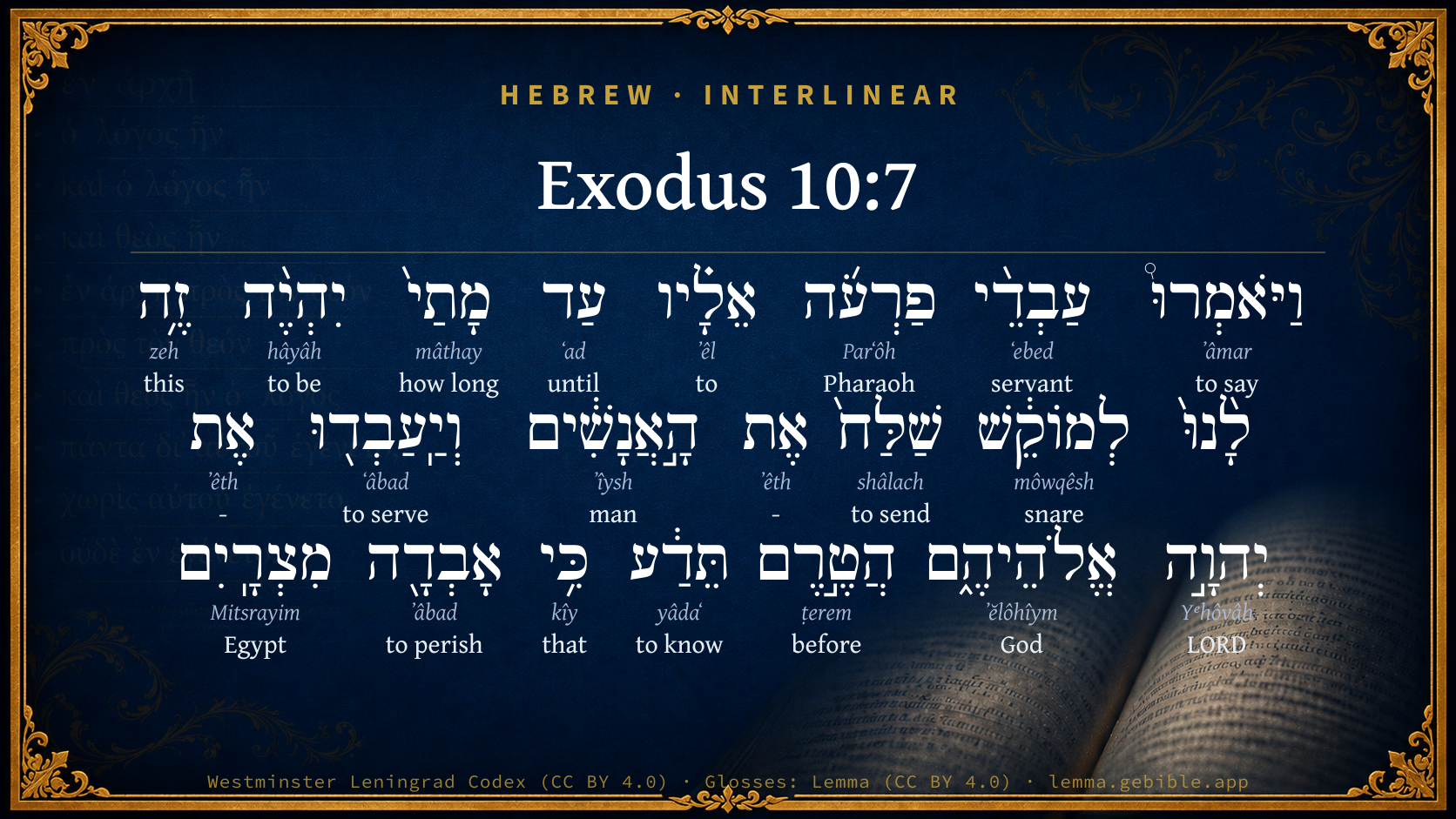
Exodus 10:7

Hebrew (Westminster Leningrad Codex) Exodus 10:7 appears in the Hebrew Old Testament. The text above is from the Westminster Leningrad Codex. Each word links to its Strong’s number, a concise gloss, and parsing drawn from the Open Scriptures Hebrew Bible morphology. Click any word for its full Brown-Driver-Briggs (BDB) entry.
Download image
Cite this verse

Exodus 10:7 (World English Bible). Public Domain. Lemma interlinear Bible study tool, https://lemma.gebible.app/v/exodus/10/7.

Show BibTeX & RIS
BibTeX
RIS
English Translation
Pharaoh's servants said to him, "How long will this man be a snare to us? Let the men go, that they may serve Yahweh, their God. Don't you yet know that Egypt is destroyed?"
World English Bible · Public Domain
Highlights
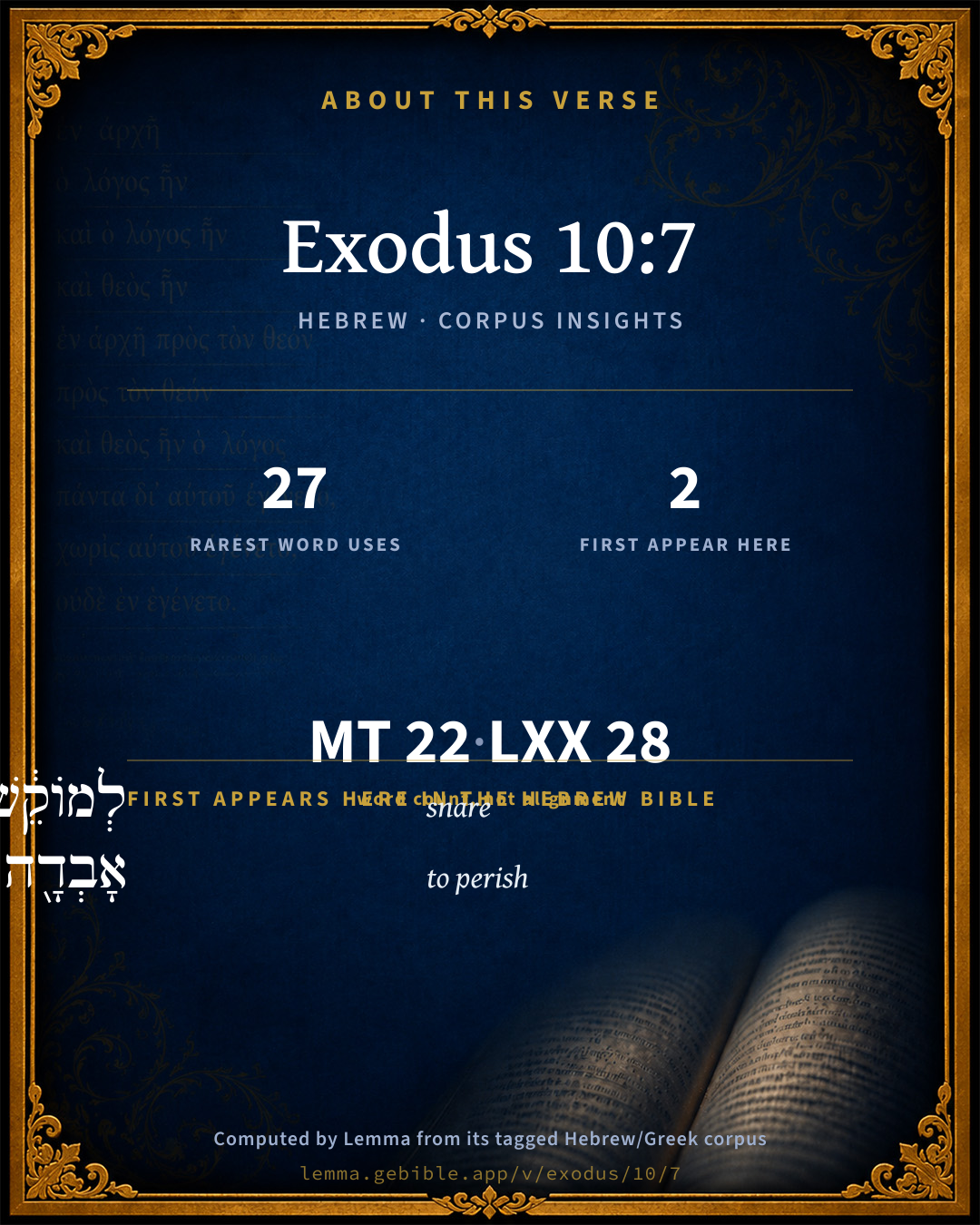
  • 2 first appearances in the Hebrew Bible
Full analysis ↓
Download a study sheet

One document with this verse’s original text, its word-by-word gloss line, the meaning frame, cross-references with their text, attributed commentary, and full source and license credits — printable, and it pastes into notes with its structure intact.

This verse Autodidact and up

Study sheet (.html) Plain text (.txt)

A passage Seminary Student

Up to 50 verses in one chapter. A passage sheet keeps up to 6 commentary sources and 12 cross-references per verse, in the order this page ranks them, and says so on the sheet whenever that leaves anything out. Ask for a single verse and you get the Autodidact verse sheet above.

Everything on this page stays free to read, with no account — the sheet is a download of what is already on screen, not access to it.

Want to remove ads? Support Godless Engineer
Compare translations 3

The same verse in 3 English versions, stacked beneath the original-language interlinear above. Click any original word for its lexicon entry.

Each is an independent rendering of the whole verse — the interlinear is not word-aligned to these translations.

Highlighted words mark where these versions differ — a whole-verse word diff, not a word-by-word alignment.

  • World English Bible Public Domain
    Pharaoh's servants said to him, "How long will this man be a snare to us? Let the men go, that they may serve Yahweh, their God. Don't you yet know that Egypt is destroyed?"
  • King James Version Public Domain
    And Pharaoh's servants said unto him, How long shall this man be a snare unto us? let the men go, that they may serve the LORD their God: knowest thou not yet that Egypt is destroyed?
  • unfoldingWord Literal Text CC BY-SA 4.0
    And the servants of Pharaoh said to him, “Until when will this be a trap to us? Let the men go and they will serve Yahweh their God. Do you not understand yet that Egypt has perished?”

unfoldingWord Literal Text — © unfoldingWord, licensed CC BY-SA 4.0. Word-aligned USFM3 via Door43 (git.door43.org/unfoldingWord/en_ult).

Versions to compare (up to 4)

3 of 4 selected

Show all 18 translations

Every available English version of this verse, each an independent rendering of the whole verse.

  • World English Bible Public Domain
    Pharaoh's servants said to him, "How long will this man be a snare to us? Let the men go, that they may serve Yahweh, their God. Don't you yet know that Egypt is destroyed?"
  • Berean Standard Bible Public Domain
    Pharaoh’s officials asked him, “How long will this man be a snare to us? Let the people go, so that they may worship the LORD their God. Do you not yet realize that Egypt is in ruins?”
  • Majority Standard Bible Public Domain
    Pharaoh’s officials asked him, “How long will this man be a snare to us? Let the people go, so that they may worship the LORD their God. Do you not yet realize that Egypt lies in ruins?”
  • King James Version Public Domain
    And Pharaoh's servants said unto him, How long shall this man be a snare unto us? let the men go, that they may serve the LORD their God: knowest thou not yet that Egypt is destroyed?
  • American Standard Version (1901) Public Domain
    And Pharaoh's servants said unto him, How long shall this man be a snare unto us? let the men go, that they may serve Jehovah their God: knowest thou not yet that Egypt is destroyed?
  • Revised Version (1885) Public Domain
    And Pharaoh’s servants said unto him, How long shall this man be a snare unto us? let the men go, that they may serve the LORD their God: knowest thou not yet that Egypt is destroyed?
  • Geneva Bible (1599) Public Domain
    Then Pharaohs seruants saide vnto him, How long shall he be an offence vnto vs? let the men go, that they may serue the Lord their God: wilt thou first knowe that Egypt is destroyed?
  • Douay-Rheims (1899) Public Domain
    And Pharao's servants said to him: How long shall we endure this scandal? let the men go to sacrifice to the Lord their God. Dost thou not see that Egypt is undone?
  • Young's Literal Translation Public Domain
    And the servants of Pharaoh say unto him, `Until when doth this `one' become a snare to us? send the men away, and they serve Jehovah their God; knowest thou not yet that Egypt hath perished?'
  • Literal Standard Version CC BY-SA 4.0
    And the servants of Pharaoh say to him, “Until when does this [one] become a snare to us? Send the men away, and they serve their God YHWH; do you not yet know that Egypt has perished?”
  • Unlocked Literal Bible CC BY-SA 4.0
    Pharaoh's servants said to him, “How long will this man be a menace to us? Let the Israelites go so that they may worship Yahweh their God. Do you not yet realize that Egypt is destroyed?”
  • unfoldingWord Literal Text CC BY-SA 4.0
    And the servants of Pharaoh said to him, “Until when will this be a trap to us? Let the men go and they will serve Yahweh their God. Do you not understand yet that Egypt has perished?”
  • Darby Bible Public Domain
    And Pharaoh's bondmen said to him, How long shall this man be a snare to us? let the men go, that they may serve Jehovah their God: dost thou not yet know that Egypt is ruined?
  • World Messianic Bible Public Domain
    Pharaoh’s servants said to him, “How long will this man be a snare to us? Let the men go, that they may serve the LORD, their God. Don’t you yet know that Egypt is destroyed?”
  • Webster's Bible Public Domain
    And Pharaoh's servants said to him, How long shall this man be a snare to us? Let the men go, that they may serve the LORD their God: knowest thou not yet that Egypt is destroyed?
  • Free Bible Version CC BY-SA 4.0
    Pharaoh's officials came to him and asked, “How long are you going to let this man cause us trouble? Let these people go so they can worship the Lord their God. Don't you realize that Egypt has been destroyed?”
  • Bible in Basic English Public Domain
    And Pharaoh's servants said to him, How long is this man to be the cause of evil to us? let the men go so that they may give worship to the Lord their God: are you not awake to Egypt's danger?
  • JPS Tanakh (1917) Public Domain
    And Pharaoh's servants said unto him: 'How long shall this man be a snare unto us? let the men go, that they may serve the LORD their God, knowest thou not yet that Egypt is destroyed?'

Literal Standard Version (2020), Covenant Press — licensed CC BY-SA 4.0. Text via the HelloAO Bible API (eBible.org). Unlocked Literal Bible (unfoldingWord) — licensed CC BY-SA 4.0. Text via the HelloAO Bible API (eBible.org). unfoldingWord Literal Text — © unfoldingWord, licensed CC BY-SA 4.0. Word-aligned USFM3 via Door43 (git.door43.org/unfoldingWord/en_ult). Free Bible Version, Dr. Jonathan Gallagher — licensed CC BY-SA 4.0. Text via the HelloAO Bible API (eBible.org).

Word by word

More ways to search: Search by grammar → Find every occurrence → Compare this word →

Practice this passage: Drill this verse → Learn its vocabulary →

לְמוֹקֵ֔שׁ
môwqêsh
H4170
“to/for · snare”
Preposition + Noun, Common, Masculine, Singular, Absolute
Part of Speech
Preposition + Noun
Type
Common
Gender
Masculine
Number
Singular
State
Absolute
Full BDB Definition

Origin: from H3369

TWOT: 906c

bait, lure, snare
  1. וַיֹּאמְרוּ֩ ʼâmar H559 “and · to say” Conjunction + Verb, Qal, Sequential Imperfect, 3rd Person, Masculine, Plural
  2. עַבְדֵ֨י ʻebed H5650 “servants of” Noun, Common, Masculine, Plural, Construct
  3. פַרְעֹ֜ה Parʻôh H6547 “Pharaoh” Noun, Proper
  4. אֵלָ֗יו ʼêl H413 “to · him” Preposition + Suffix, Personal, 3rd Person, Masculine, Singular
  5. עַד ʻad H5704 “until” Preposition
  6. מָתַי֙ mâthay H4970 “how long” Particle, Interrogative
  7. יִהְיֶ֨ה hâyâh H1961 “to be” Verb, Qal, Imperfect, 3rd Person, Masculine, Singular
  8. זֶ֥ה zeh H2088 “this” Pronoun, Demonstrative, Masculine, Singular
  9. שַׁלַּח֙ shâlach H7971 “send” Verb, Piel, Imperative, 2nd Person, Masculine, Singular
  10. אֶת ʼêth H853 “-” Particle, Direct Object
  11. הָ֣אֲנָשִׁ֔ים ʼîysh H376 “the · men” Particle, Definite Article + Noun, Common, Masculine, Plural, Absolute
  12. וְיַֽעַבְד֖וּ ʻâbad H5647 “and · to serve” Conjunction + Verb, Qal, Imperfect, 3rd Person, Masculine, Plural
  13. אֶת ʼêth H853 “-” Particle, Direct Object
  14. יְהוָ֣ה Yᵉhôvâh H3068 “LORD” Noun, Proper
  15. אֱלֹהֵיהֶ֑ם ʼĕlôhîym H430 “God(s) · their” Noun, Common, Masculine, Plural, Construct + Suffix, Personal, 3rd Person, Masculine, Plural
  16. הֲטֶ֣רֶם ṭerem H2962 “the · before” Particle, Definite Article + Adverb
  17. תֵּדַ֔ע yâdaʻ H3045 “to know” Verb, Qal, Imperfect, 2nd Person, Masculine, Singular
  18. כִּ֥י kîy H3588 “that” Conjunction
  19. אָבְדָ֖ה ʼâbad H6 “to perish” Verb, Qal, Perfect, 3rd Person, Feminine, Singular
  20. מִצְרָֽיִם Mitsrayim H4714 “Egypt” Noun, Proper

About this verse

These counts appear in no published source. They are computed here, from the morphology-tagged text and Lemma’s own curated glosses. What Lemma adds →

22
words
20
distinct lemmas
Pentateuch
section

First appearance in Scripture

These words make their first canonical appearance in the Hebrew Bible here:

  • לְמוֹקֵ֔שׁ snare H4170
  • אָבְדָ֖ה to perish H6

Shared distinctive vocabulary

לְמוֹקֵ֔שׁ snare H4170 occurs in 27 verses of the Hebrew Bible. Also found in:

Grammatical profile

  • 6 verbs
  • 7 nouns
  • 1 pronoun
  • 3 prepositions
  • 1 conjunction
  • 1 adverb
  • 3 particles

Verb forms

  • וַיֹּאמְרוּ֩ Qal · Sequential Imperfect
  • יִהְיֶ֨ה Qal · Imperfect
  • שַׁלַּח֙ Piel · Imperative
  • וְיַֽעַבְד֖וּ Qal · Imperfect
  • תֵּדַ֔ע Qal · Imperfect
  • אָבְדָ֖ה Qal · Perfect

Hebrew & Septuagint length

In English translation the verse runs 34 words from the Hebrew and 34 from the Septuagint (LXX English) — the same length.

A rough comparison of the two English renderings, which tokenize alike — not a word-level alignment.

Word counts can differ between the Hebrew and the Greek without any difference in meaning — e.g. the Hebrew direct-object marker אֵת has no separate Greek word, and Greek often adds the article ὁ.

In the original languages it is 22 Hebrew tokens and 28 Greek tokens — but the two are counted differently (Hebrew bundles its prefixes and suffixes into one token; the Greek is in lemma form), so that isn’t a like-for-like length.

Cross-references

13

Topical passages linked to Exodus 10:7 in the Treasury of Scripture Knowledge — connected by theme and wording, ordered by reader-vote popularity; previews shown in the World English Bible.

  • 1 Samuel 18:21 Saul said, I will give her to him, that she may be a snare to him, and that the hand of the Philistines may be against him. Therefore Saul said to David, You shall this day be my son-in-law a second time.
  • Exodus 23:33 They shall not dwell in your land, lest they make you sin against me, for if you serve their gods, it will surely be a snare to you."
  • Joshua 23:13 know for a certainty that Yahweh your God will no more drive these nations from out of your sight; but they shall be a snare and a trap to you, and a scourge in your sides, and thorns in your eyes, until you perish from off this good land which Yahweh your God has given you.
  • Ecclesiastes 7:26 I find more bitter than death the woman whose heart is snares and traps, whose hands are chains. Whoever pleases God shall escape from her; but the sinner will be ensnared by her.
  • Exodus 8:19 Then the magicians said to Pharaoh, "This is the finger of God:" and Pharaoh's heart was hardened, and he didn't listen to them; as Yahweh had spoken.
  • Psalms 107:34 And a fruitful land into a salt waste, For the wickedness of those who dwell in it.
  • Proverbs 29:6 An evil man is snared by his sin, But the righteous can sing and be glad.
  • Isaiah 14:20 You shall not be joined with them in burial, because you have destroyed your land, you have killed your people; the seed of evil-doers shall not be named forever.
  • Isaiah 51:9 Awake, awake, put on strength, arm of Yahweh; awake, as in the days of old, the generations of ancient times. Isn't it you who did cut Rahab in pieces, who pierced the monster?
  • Jeremiah 48:4 Moab is destroyed; her little ones have caused a cry to be heard.
  • Jeremiah 51:8 Babylon is suddenly fallen and destroyed: wail for her; take balm for her pain, if so be she may be healed.
  • Zephaniah 1:18 Neither their silver nor their gold will be able to deliver them in the day of Yahweh's wrath, but the whole land will be devoured by the fire of his jealousy; for he will make an end, yes, a terrible end, of all those who dwell in the land.
  • 1 Corinthians 7:35 This I say for your own profit; not that I may ensnare you, but for that which is appropriate, and that you may attend to the Lord without distraction.

Cross-references courtesy of OpenBible.info (CC BY 4.0).

Hebrew and Greek witnesses Masoretic Hebrew ↔ Greek Septuagint

The same verse in the two great witnesses to the Old Testament, shown verse-for-verse.

These are two independent witnesses, not word-aligned to each other, and the Septuagint is shown in lemma (dictionary) form.

Hebrew Exodus 10:7 Masoretic · Westminster Leningrad Codex

וַיֹּאמְרוּ֩ עַבְדֵ֨י פַרְעֹ֜ה אֵלָ֗יו עַד מָתַי֙ יִהְיֶ֨ה זֶ֥ה לָ֨נוּ֙ לְמוֹקֵ֔שׁ שַׁלַּח֙ אֶת הָ֣אֲנָשִׁ֔ים וְיַֽעַבְד֖וּ אֶת יְהוָ֣ה אֱלֹהֵיהֶ֑ם הֲטֶ֣רֶם תֵּדַ֔ע כִּ֥י אָבְדָ֖ה מִצְרָֽיִם

Pharaoh's servants said to him, "How long will this man be a snare to us? Let the men go, that they may serve Yahweh, their God. Don't you yet know that Egypt is destroyed?"

World English Bible · Public Domain

Greek LXX Exodus 10:7 Septuagint · lemma form

καί λέγω ὁ θεράπων φαραώ πρός αὐτός ἕως τίς εἰμί οὗτος ἐγώ σκῶλον ἐκ ἀποστέλλω ὁ ἄνθρωπος ὅπως λατρεύω ὁ θεός αὐτός ἤ οἶδα βούλομαι ὅτι ἀποὀλλύω αἴγυπτος

And the servants of Pharao say to him, How long shall this be a snare to us? send away the men, that they may serve their God; will you know that Egypt is destroyed?

LXX2012 (modern English Septuagint) · Public Domain

On this verse, The Cambridge Bible for Schools and Colleges discusses the Septuagint’s reading. Read the note in Commentary ↓

Hebrew: Westminster Leningrad Codex (CC BY 4.0). Greek: Septuagint (public domain); English from LXX2012 (modern English Septuagint) (Public Domain). How the Septuagint differs from the Hebrew →

Targum (Aramaic paraphrase)

2

The Targum is the ancient Jewish Aramaic paraphrase of the Hebrew Scriptures — an interpretive translation, not the Hebrew text itself. Onkelos (literal) and Pseudo-Jonathan (expansive) render the Torah, and Jonathan the Prophets. Coverage is partial: where no permissively-licensed English translation exists for a verse, only the Aramaic is shown. This is verse-level text, not a word-by-word alignment to the Hebrew.

  1. Targum Onkelos Torah (Genesis–Deuteronomy)
    וַאֲמָרוּ עַבְדֵי פַרְעֹה לֵהּ עַד אִמָתַי יְהֵי דֵין לָנָא לְתַקְלָא שַׁלַח יָת גֻבְרַיָא וְיִפְלְחוּן קֳדָם יְיָ אֱלָהֲהוֹן הַעַד כְּעַן לָא יְדַעְתָּ אֲרֵי אֲבֵדַת מִצְרָיִם:

    (no public-domain English translation for this verse)

    Targum Onkelos — Aramaic: “Onkelos Genesis” (public domain); “Onkelos Exodus” (public domain); “Onkelos Leviticus” (public domain); “Onkelos Numbers” (public domain); “Onkelos Deuteronomy” (public domain). English: “Sefaria Community Translation” (CC0 1.0 (public-domain dedication)); “J.W. Etheridge. The Targums of Onkelos and Jonathan Ben Uzziel on the Pentateuch. London: Longmans, Green, 1862” (public domain). Text via Sefaria.

  2. Targum Pseudo-Jonathan Torah (Genesis–Deuteronomy)
    וְאָמָרוּ עַבְדֵי פַּרְעה עַד אֵימַת יְהֵי דֵין גַּבְרָא לָנָא לְתַקְלָא פְּטוֹר יַת גַּבְרַיָא וְיִפְלְחוּן קֳדָם יְיָ אֱלָהָהוֹן הַעַד כְּדוֹן לָא חַכִּימְתָּ אֲרוּם עַל יְדוֹי עֲתִידָא לְמוֹבְדָא אַרְעָא דְמִצְרָיִם

    And the servants of Pharoh said, How long shall this man be a stumbling-block to us? Let the men be released, that they may worship before the Lord their God. Art thou not aware that by His hand it will be that the land of Mizraim shall be destroyed?

    Targum Pseudo-Jonathan — Aramaic: “Targum Jonathan on Genesis” (public domain); “Targum Jonathan on Exodus” (public domain); “Targum Jonathan on Leviticus” (public domain); “Targum Jonathan on Numbers” (public domain); “Targum Jonathan on Deuteronomy” (public domain). English: “The Targum of Jonathan ben Uzziel, trans. J. W. Etheridge, London, 1862” (public domain). Text via Sefaria.

Commentary

Notes on Exodus 10:7 from classic Christian and Jewish commentators (each source and its license shown beneath its notes). The classic Christian expositions comment on the surrounding passage and are grouped to its opening verse, so a note may address several verses; the Jewish commentaries on the Tanakh (Rashi and others) are per-verse, so they appear only where the commentator wrote on this verse.

Lemma curates 59 commentaries, every one of them public domain or Creative Commons licensed, each selected and text-cleaned for this edition rather than reprinted as found. About our sources →

Trapp's Complete Commentary

John Trapp

Exo 10:7 And Pharaoh’s servants said unto him, How long shall this man be a snare unto us? let the men go, that they may serve the LORD their God: knowest thou not yet that Egypt is destroyed?

Ver. 7. And Pharaoh’s servants said unto him.] They were convinced and mollified, though he was not. "Whom he will God hardeneth." {Rom 9:18}

How long shall this man be a snare unto us?] He was not the "snare," but their own sin. {Pro 29:6} Howbeit he must bear the blame. As if some fond people should accuse the herald or the trumpet as the cause of their war: or, as if some ignorant peasant, when he sees his fowls bathing in his pond, should cry out of them as the causes of foul weather.

John Trapp, A Commentary or Exposition upon All the Books of the Old and New Testament (1647–1656) — public domain. Text from a community e-Sword module.

The Biblical Illustrator

Joseph S. Exell

Exo_10:7

Knowest thou not yet that Egypt is destroyed?

Lessons

1. Threatening from God may touch hearts of servants and not of rulers.

2. God useth kings own servants to move them, when His ministers can avail nothing.

3. Fear of plagues may move wicked ones to yield, where the fear of God is not.

4. It is usual for wicked men to charge Gods servants to be snares, when their sins make them.

5. When God makes His servants ministers of wrath, the wicked are willing to be rid of them.

6. Idolatrous persecutors may tolerate Gods Church to serve Him, when vengeance forces them.

7. Experience of destruction past, and fear of more to come, may cause enemies to move for the Churchs liberty.

8. Persecuting powers are apt to be stupid and willingly ignorant of such destructions. (G. Hughes, D. D.)

A remonstrance against sin

I. Addressed by inferiors to their superiors.

1. Bold.

2. Wise.

3. Needed.

II. Inspired by a deep feeling of terror. It is well for men under any circumstances to cry out against moral evil.

III. Influential for temporary good. Some men are apparently more accessible to the advice of their comrades than they are to the commands of heaven. The wicked servant may preach the gospel to his despotic master.

IV. Ultimately disregarded. Lessons:--

1. Remonstrate with the sinner.

2. Show him the folly and woe of sin.

3. You are not responsible for the result of such a remonstrance. (J. S. Exell, M. A.)

Pharaohs mad ignorance

Knowest thou not yet that Egypt is destroyed? was the plea of Pharaohs servants before the locusts came. No; he knew it not; he would not know it. Even now, with the scene of utter desolation everywhere around him, with the fields scorched and barren, and the naked trees stretching out their white and shattered boughs like ghastly skeletons, with even the walls of his houses and the furniture of his chambers marked by the gnawings of those very grievous locusts, with all these terrible witnesses before his eyes, Pharaoh knew it not. (T. S. Millington.)

The Biblical Illustrator, edited by Joseph S. Exell (c. 1880s–1900s) — public domain. Text from a community e-Sword module.

Joseph Benson's Commentary

Exo 10:7. Pharaoh’s servants — His nobles and counsellors; said, How long shall this man be a snare unto us? — That is, lay before us the occasion of our falling into one calamity after another. To the impenitent the punishment of sin, not the sin which is punished, is the cause of their sorrow. Knowest thou not yet that Egypt is destroyed? — It was so in a great degree by these repeated and very destructive plagues.

Joseph Benson's Commentary on the Old and New Testaments (1811–1818) — public domain. Text from a community e-Sword module.

Keil & Delitzsch

C. F. Keil & F. Delitzsch

The announcement of such a plague of locusts, as their forefathers had never seen before since their existence upon earth, i.e., since the creation of man (Exo 10:6), put the servants of Pharaoh in such fear, that they tried to persuade the king to let the Israelites go. "How long shall this (Moses) be a snare to us?...Seest thou not yet, that Egypt is destroyed?" מוקשׁ, a snare or trap for catching animals, is a figurative expression for destruction. האנשׁים (Exo 10:7) does not mean the men, but the people. The servants wished all the people to be allowed to go as Moses had desired; but Pharaoh would only consent to the departure of the men (הגּברים, Exo 10:11).

Exo 10:8-11

As Moses had left Pharaoh after announcing the plague, he was fetched back again along with Aaron, in consequence of the appeal made to the king by his servants, and asked by the king, how many wanted to go to the feast. ומי מי, "who and who still further are the going ones;" i.e., those who wish to go? Moses required the whole nation to depart, without regard to age or sex, along with all their flocks and herds. He mentioned "young and old, sons and daughters;" the wives as belonging to the men being included in the "we." Although he assigned a reason for this demand, viz., that they were to hold a feast to Jehovah, Pharaoh was so indignant, that he answered scornfully at first: "Be it so; Jehovah be with you when I let you and your little ones go;" i.e., may Jehovah help you in the same way in which I let you and your little ones go. This indicated contempt not only for Moses and Aaron, but also for Jehovah, who had nevertheless proved Himself, by His manifestations of mighty power, to be a God who would not suffer Himself to be trifled with. After this utterance of his ill-will, Pharaoh told the messengers of God that he could see through their intention. "Evil is before your face;" i.e., you have evil in view. He called their purpose an evil one, because they wanted to withdraw the people from his service. "Not so," i.e., let it not be as you desire. "Go then, you men, and serve Jehovah." But even this concession was not seriously meant. This is evident from the expression, "Go then," in which the irony is unmistakeable; and still more so from the fact, that with these words he broke off all negotiation with Moses and Aaron, and drove them from his presence. ויגרשׁ: "one drove them forth;" the subject is not expressed, because it is clear enough that the royal servants who were present were the persons who drove them away. "For this are ye seeking:" אתהּ relates simply to the words "serve Jehovah," by which the king understood the sacrificial festival, for which in his opinion only the men could be wanted; not that "he supposed the people for whom Moses had asked permission to go, to mean only the men" (Knobel). The restriction of the permission to depart to the men alone was pure caprice; for even the Egyptians, according to Herodotus (2, 60), held religious festivals at which the women were in the habit of accompanying the men.

Keil & Delitzsch — Biblical Commentary on the Old Testament (1861–1891) — public domain (CC PDM 1.0). Text via the HelloAO Bible API. (Old Testament only.)

Tyndale Open Study Notes

Tyndale Open Resources

10:7-11 The officials, with no royal prestige on the line, were willing to learn the lessons of God’s sovereignty and let the men go. Pharaoh again resisted, in an effort to save face somehow. He would let them go only if they left their families behind and were thus bound to return, but Moses had never said they would return. While the purpose for going into the wilderness was to worship God, it was unthinkable that oppressed slaves would willingly return to their oppressors once they were free, and Pharaoh knew it.

Tyndale Open Study Notes — © Tyndale Open Resources, licensed CC BY-SA 4.0. Text via the HelloAO Bible API.

Geneva Bible (1599)

Geneva Bible translators

Meaning, the occasion of all these evils: so are the godly ever charged as Elijah was by Ahab.

Or, snare.

Geneva Bible (1599) marginal notes — public domain. Text via Bolls.life.

Jamieson, Fausset & Brown

Robert Jamieson, A. R. Fausset & David Brown

Pharaoh's servants said--Many of his courtiers must have suffered serious losses from the late visitations, and the prospect of such a calamity as that which was threatened and the magnitude of which former experience enabled them to realize, led them to make a strong remonstrance with the king. Finding himself not seconded by his counsellors in his continued resistance, he recalled Moses and Aaron, and having expressed his consent to their departure, inquired who were to go. The prompt and decisive reply, "all," neither man nor beast shall remain, raised a storm of indignant fury in the breast of the proud king. He would permit the grown-up men to go away; but no other terms would be listened to.

Jamieson, Fausset & Brown — Commentary Critical and Explanatory on the Whole Bible (1871) — public domain (CC PDM 1.0). Text via the HelloAO Bible API.

Adam Clarke's Commentary

Verse 7. How long shall this man be a snare unto us?] As there is no noun in the text, the pronoun זה zeh may either refer to the Israelites, to the plague by which they were then afflicted, or to Moses and Aaron, the instruments used by the Most High in their chastisement. The Vulgate translates, Usquequo patiemur hoc scandalum? "How long shall we suffer this scandal or reproach?"

Let the men go, that they may serve the Lord their God] Much of the energy of several passages is lost in translating יהוה Yehovah by the term Lord. The Egyptians had their gods, and they supposed that the Hebrews had a god like unto their own; that this Jehovah required their services, and would continue to afflict Egypt till his people were permitted to worship him in his own way.

Egypt is destroyed?] This last plague had nearly ruined the whole land.

Adam Clarke's Commentary on the Bible (1810–1826) — public domain. Text from a community e-Sword/MySword module.

Ellicott's Commentary for English Readers

(7) Let the men go.—Though the heart of Pharaoh remained hard, the plagues had a certain effect on the minds of the Egyptians. First, the magicians were impressed, and said, “This is the finger of God” (Exo_8:19). Then a certain number of the people “feared the word of the Lord, and made their servants and their cattle flee into the houses” (Exo_9:20). Now the very officers of the Court, those who were in the closest contact with the king, believed that the words of Moses would come true, and counselled the king to yield, and “let the men go.” It has been supposed that they meant “the men only” (Knobel, Cook); but this is pure conjecture. The word used, which is not that of Exo_10:11, would cover women and children. The officers of the Court—rich landowners mostly—would dread impending ruin if the wheat and doora crops were destroyed, and would intend to counsel entire submission.

A Bible Commentary for English Readers, edited by Charles John Ellicott (1878–1897) — public domain. Text from a community e-Sword module.

The Cambridge Bible for Schools and Colleges

gen. ed. J. J. S. Perowne

7. a snare] fig. for an occasion of destruction. See 1Sa_18:21; and cf. on ch. Exo_23:33 Lit. a fowling-instrument; and probably, in fact, not a ‘snare’ (i.e. a noose; Germ. Schnur, a ‘string’) at all, but the trigger of a trap with the bait upon it1[127].

[127] This must be the meaning, if the Mass. text of Amo_3:5 a (‘Will a bird fall into a trap upon the earth, when there is no môkçsh for it?’) is right; but even though ‘into a trap’ be omitted with LXX., it still (in spite of EB. ii. 1561) seems to be a probable meaning of the word.

destroyed] i.e. ruined, viz. through all the calamities that have visited it.

7–11. The Pharaoh’s ministers suggest to him that Moses should no longer be permitted to ruin Egypt. He accordingly makes an attempt to come to terms with Moses; but when Moses declares that the whole people must go to hold the feast to Jehovah, he replies that he can only in the men go. The ministers shew by what they say that they are prompted not by religious fear, but only by solicitude for the welfare of their country, the misfortunes of which they attribute to Moses.

The Cambridge Bible for Schools and Colleges (gen. ed. J. J. S. Perowne; Cambridge University Press, 1878–1918) — public domain. Text from a community e-Sword module.

John Gill's Exposition

And Pharaoh's servants said to him,.... His courtiers and counsellors, such of them as were not so hardened as others, or however now began to relent, and dreaded what would be the consequence of things, even the ruin of the whole country, the good of which they seem to have had at heart:

how long shall this man be a snare unto us? an occasion of ruin and destruction, as birds by a snare; they speak in a contemptuous manner of Moses, calling him "this man", the rather to ingratiate themselves into the good will of Pharaoh, and that their advice might be the better and the easier taken:

let the men go, that they may serve the Lord their God: that is, Moses and his people, grant them their request, that the land may be preserved from ruin; for if things go on long at this rate, utter destruction must ensue:

knowest thou not yet that Egypt is destroyed? as good as ruined, by the plagues that already were come upon it, especially by the last, by the murrain and boils upon the cattle, which destroyed great quantities, and by the hail which had smitten their flax and their barley; or, "must thou first know that Egypt is destroyed?" before thou wilt let the people go; or dost thou first wish, or is it thy pleasure, that it should be first declared to thee that Egypt is destroyed, as Aben Ezra interprets it, before thou wilt grant the dismission of this people? The Targum of Jonathan is,"dost thou not yet know, that by his hands the land of Egypt must perish?''See Gill on Exo 1:15. See Gill on Exo 2:15.

John Gill's Exposition of the Whole Bible (1746–1763) — public domain (CC PDM 1.0). Text via the HelloAO Bible API.

Albert Barnes' Notes on the Bible

For the first time the officers of Pharaoh intervene before the scourge is inflicted, showing at once their belief in the threat, and their special terror of the infliction. Also, for the first time, Pharaoh takes measures to prevent the evil; he does not indeed send for Moses and Aaron, but he permits them to be brought into his presence.

Let the men go - i. e. the men only, not all the people. See Exo 10:8.

Albert Barnes' Notes on the Bible (1834–1885) — public domain. Text from a community e-Sword/MySword module.

Haydock's Catholic Bible Commentary

Scandal, or source of repeated misery; whether they meant their own resistance to God’s orders, or Moses, with the Hebrew nation. (Calmet)

George Leo Haydock (1774–1849), Haydock's Catholic Family Bible and Commentary, 1859 edition — public domain. Excludes Psalms (Douay-Rheims chapter numbering differs from Protestant) and Deuterocanonical books (Catholic canon only).

Matthew Poole's English Annotations

How long shall this man be a snare; an occasion of sin and destruction? See Exo 23:33; Jos 23:13.

Matthew Poole's English Annotations on the Holy Bible (1683–1685) — public domain. Text from a community e-Sword/MySword module.

Whedon's Commentary on the Bible

Daniel D. Whedon

7. Pharaoh’s servants said unto him — For the first time the courtiers of Pharaoh venture to plead with him, and for the first time he sends for Moses and Aaron after they have predicted the plague and gone forth to bring it upon the land. This shows how these judgments were more and more profoundly impressing the Egyptian people.

Daniel D. Whedon (gen. ed.), Commentary on the Old and New Testaments (1874–1909) — public domain. Text from a community e-Sword module.

The Pulpit Commentary

And Pharaoh"s servants said unto him. This marks quite a new phase in the proceedings. Hitherto the courtiers generally had been dumb. Once the magicians had ventured to say is the finger of; (Exo_8:19) but otherwise the entire court had been passive, and left the king to himself. They are even said to have "hardened their hearts" like him. (Exo_9:34) But now at last they break their silence and interfere. Having lost most of their cattle, and a large part of the year"s crops, the great men became alarmed they were large landed proprietors, and the destruction of the wheat and doora crops would seriously impoverish, if not actually ruin them. Moreover, it is to be noted that they interfere before the plague has begun, when it is simply threatened, which shows that they had come to believe in the power of Moses. Such a belief on the part of some had appeared, when the plague of hail was threatened; (Exo_9:20) now it would seem to have become general. A snare to usi.e. "a peril source of danger," the species being put for the genus.

Ver. 7-11. Man"s interposition with good advice may come too late.

It is impossible to say what effect the opposition and remonstrances of his nobles and chief officers might not have had upon Pharaoh, if they had been persistently offered from the first. But his magicians had for some time aided and abetted his resistance to God"s will, as declared by Moses; and had even used the arts whereof they were masters to make, the miracles which Moses wrought seem trifles. And the rest of the Court officials had held their peace, neither actively supporting the monarch, nor opposing him. It was only when the land had been afflicted by seven plagues, and an eighth was impending, that they summoned courage to express disapproval of the king"s past conduct, and to recommend a different course. "How long shall this man be a snare unto us? Let the men go," they said. But the advice came too late. Pharaoh had, so to speak, committed himself. He had engaged in a contest from which he could not retire without disgrace. He had become heated and hardened; and, the more the conviction came home to him that he must yield the main demand, the more did it seem to him a point of honour not to grant the whole of what had been asked. But practically, this was the same thing as granting nothing, since Moses would not be content with less than the whole. The interposition of the Court officials was therefore futile. Let those whose position entitles them to offer advice to men in power bear in mind four things

(1) The importance of promptness in bringing their influence to bear;

(2) the advantage of taking a consistent line from first to last;

(3) the danger of inaction and neutrality; and

(4) the necessity of pressing their advice when it has been once given, and of not allowing it to be set aside. If the "servants of Pharaoh" had followed up the interposition recorded in verse 7 by further representations and remonstrances, they would have had some slight chance of producing an effect. But a single isolated remonstrance was valueless.

Vers. 7-21. The plague of locusts.

Of the two principal terms used to denote "hardening," one means "to strengthen, or make firm," the other, "to make heavy, or obtuse." It is the latter of these (used also in Exo_8:15, 32 9:7) which is used in Exo_9:34, and Exo_10:1. The growing obtuseness of Pharaoh"s mind is very apparent from the narrative. He is losing the power of right judgment. He began by hardening himself (making his heart strong and firm against Jehovah, and he is reaping the penalty in a blinded understanding. This obtuseness shows itself in various ways, notably in the want of unity in his conduct. He is like a man at bay, who feels that he is powerless to resist, but cannot bring himself to yield. His power of self-control is leaving him, and his action, in consequence, consists of a succession of mad rushes, now in one direction, now in another. External influences the remonstrance of courtiers, the terrors occasioned by the plagues produce immediate effects upon him; but the recoil of pride and rage, which speedily supervenes, carries him further from reason than ever. Now he is suing in pitiable self-humiliation for forgiveness; again he is furious and unrestrained in his defiance. Passion is usurping the place of reason, and drives him to and fro with ungovernable violence. We are reminded of the heathen saying, "Whom the gods wish to destroy, they first madden;" but it is not God who is destroying Pharaoh; it is Pharaoh who is destroying himself. If God maddens him, it is by plying him with the influences which ought to have had a directly opposite effect. Pharaoh, like every other sinner, must bear the responsibility of his own ruin.

I THE INTERVENTION OF PHARAOH"S SERVANTS (ver. 7). These may be the same servants who up to this time had hardened themselves. (Exo_9:34) If so, they now see the folly of further contest. More and more Pharaoh is being left to stand alone. First, his magicians gave in, (Exo_8:19) then a portion of his servants; (Exo_9:20) now, apparently, his courtiers are deserting him in a body. It shows the indomitable stubbornness of the king, that under these circumstances he should still hold out. Observe,

1. The subjects of a government have often a truer perception of what isneeded for the safety of a country than their rulers and leaders. Pharaoh"s servants saw the full gravity of the situation, to which the monarch was so blind. "Knowest thou not yet that Egypt is destroyed?" Rulers are frequently blinded by their pride, passion, prejudices, and private wishes, to the real necessities of a political situation.

2. Hardening against God makes the heart indifferent to the interests ofothers. The ungodly mind is at bottom selfish. We have seen already (ch. 5.) to what lengths in cruelty ungodly men will go in pursuit of their personal ends. We have also seen that hardening at the centre of the nature is bound to spread till it embraces the whole man. (on Exo_7:3) Pharaoh is an illustration of this. He was unboundedly proud; and "pride," says Muller, "is the basest and most glaring form that selfishness can assume." It is an egoistic sin; a sin of the will more than of the affections; a sin rooted in the centre of the personality. But Pharaoh was more than proud; he was God-defying. He had consciously and wilfully hardened himself against the Almighty, under most terrible displays of his omnipotence. Driven to bay in such a contest, it was not to be expected that he would be much influenced by the thought of the suffering he was bringing upon others. Egypt might be destroyed, but Pharaoh recked little of that, or, possibly, still tried to persuade himself that the worst might be averted. The remonstrance of his courtiers produced a momentary wavering, but defiance breaks out again in ver. 10 in stronger terms than ever.

II A RENEWED ATTEMPT AT COMPROMISE (vers. 8-12). Pharaoh sends for Moses and Aaron, and asks who they are that are to go to sacrifice (ver. 8): the reply was decisive; "we will go with our young and with our old," etc. (ver. 9). At this Pharaoh is transported with ungovernable rage. He accuses the Hebrew brothers of desiring to take an evil advantage of his permission, and practically challenges Jehovah to do his worst against him (ver. 10). He will consent to the men going to serve the Lord, but to nothing more (ver. 11). Moses and Aaron were then "driven" from his presence. We are reminded here of the transports of Saul, and his malicious rage at David. (1Sa 19) Notice on this,

1. Wicked men distrust God. Pharaoh had no reason to question Jehovah"s sincerity. God had proved his sincerity by his previous dealings with him. And had God actually demanded what ultimately would have been required the entire departure of the people from the land, what right had he, their oppressor, to object?

2. Wicked men would fain compound with God. They will give up something, if God will let them retain the rest. There is a sweetness to a proud nature in being able to get even part of its own way.

3. The thing wicked men will not do is to concede the whole demand which God makes on them. What God requires supremely is the surrender of the will, and this the recalcitrant heart will not stoop to yield. Part it will surrender, but not the whole. Outward vices, pleasures, worldly possessions, friendships, these, at a pinch, may be given up; but not the heart"s love and obedience, which is the thing chiefly asked for; not the" little ones" of the heart"s secret sins, or the "flocks and herds" for the pure inward sacrifice. (see Pusey on Mic_6:6-9)

III THE LOCUST JUDGMENT (ver. 12-16). The predicted plague was accordingly brought upon the land. It was the second of what we may call the greater plagues the plagues that were to be laid upon the king"s "heart". (Exo_9:14) They were plagues of a character to appal and overwhelm; to lay hold of the nature on the side on which it is susceptible of impressions from the awful and terrific; to awaken into intense activity its slumbering sense of the infinite; to rouse in the soul the apprehension of present Deity. The first was the plague of hail, thunderings, and lightnings; the second was this plague of locusts. The points on which stress is laid in this second plague are

1. The supernatural character of the visitation.

2. The appalling numbers of the enemy.

3. The havoc wrought by them.

We may compare the language here with the description of the locusts in Joe 2, and it may be concluded that the effects described as following from the latter visitation were more than paralleled by the terror and anguish created by the descent of this scourge on Egypt. "Before their face the people would be much pained; all faces would gather blackness". (Joe_2:6) It would seem as if the earth quaked before them; as if the heavens trembled; as if sun and moon had become dark, and the stars had withdrawn their shining (ver. 10)! The devastation was rapid and complete.

land is as the garden of Eden before them, and behind them a desolate wilderness" (ver. 3). Had the plague not speedily been removed Egypt verily would have been destroyed. How mighty is Jehovah! How universal his empire! These locusts were brought from afar (ver. 13). All agents in nature serve him; winds (cast and west), locusts, (cf. Joe_2:11) as well as hail and thunder. He has but to speak the word, and all we have will be taken from us (ver. 15).

IV PHARAOH"S PITIABLE PLIGHT AND FURTHER HARDENING (vers. 16-21). What we have here is a specimen of one of those violent contrasts in Pharaoh"s later moods to which reference has been made above. Nothing could be more humiliating, more abject, more truly painful, in its self-effacement than this new appeal of the king to Moses. He had sinned, shined both against God, and against Moses and Aaron; would they forgive him this once, only this once, and entreat God that he would take away from him this death only? (vers. 16, 17.) Contrast this with ver. 10, or with ver. 28, and it can hardly be believed that we are looking on the same man. Pharaoh had never humbled himself so far before. He beseeches for mercy; almost cringes before Moses and Aaron in his anxiety to have this dreadful plague removed. Yet there is no real change of heart. The moment the locusts are gone pride reasserts its sway, and he hardens himself as formerly. Learn

1. That false repentance may be connected with other than superficial states of feeling. Pharaoh was here in real terror, in mortal anguish of spirit. The pains of hell had truly got hold on him. (Psa_116:3) Yet his repentance was a false one.

2. That false repentance may ape every outward symptom of real repentance. Who that saw Pharaoh in that bath of anguish, and heard him pouring out those impassioned entreaties and confessions, but would have supposed that the hard heart had at length been subdued? The confession of sin is unreserved and unqualified. The submission is absolute. Pharaoh was aware of how little he deserved to be further trusted, and pied to be tried again, "only this once," Yet the repentance was through and through a false one the product of mere natural terror the repentance of a heart, not one fibre of which was altered in its moral quality.

3. That false repentance may not be consciously insincere. There is no reason to question that Pharaoh was for the time sincere enough in the promises he" made. They were wrung from him, but he meant to give effect to them. But the momentary willingness he felt to purchase exemption from trouble by granting Jehovah"s demand had quite disappeared by the time the plague was removed. The repentance was false.

4. The test of a repentance being false or true is the fruits yielded by it. The test is not the depth of our convictions, the anguish of our minds, the profuseness of our confessions, the apparent sincerity of our vows, it is the kind of deeds which follow. (Mat_3:8) We have need in this matter of repentance to distrust ourselves, to beware of being imposed on by others, and to be careful in public instruction that the real nature of repentance is lucidly expounded. J.O.

The Pulpit Commentary (1880–1919), ed. H.D.M. Spence-Jones & Joseph S. Exell — public domain. Text from a community e-Sword module.

unfoldingWord translationNotes

Door43 World Missions Community

menace

A "menace" is someone who brings trouble or harm.

How long will this man be a menace to us?

Pharaoh's servants ask this question to show Pharaoh the extent of destruction in Egypt. This rhetorical question can be translated as a statement. AT: "We cannot allow this man to continue to bring trouble to us!" (See: Rhetorical Question)

Do you not yet realize that Egypt is destroyed?

Pharaoh's servants ask this question to bring Pharaoh to recognize what he refuses to see. This rhetorical question can be translated as a statement. AT: "You should realize that Egypt is destroyed!" (See: Rhetorical Question)

that Egypt is destroyed

This can be stated in active form. AT: "that these plagues have destroyed Egypt" or "that their God has destroyed Egypt" (See: Active or Passive)

translationWords

Israel

people group

unfoldingWord translationNotes — © Distant Shores Media and the Door43 World Missions Community, licensed CC BY-SA 4.0. Source: git.door43.org/Door43/en_tn.

Rashi

Rabbi Shlomo Yitzchaki (Rashi)

הטרם תדע means KNOWEST THOU NOT YET that Egypt has perished. (Cf. Rashi on Exodus 9:30.)

Rashi on the Tanakh — English translations: “The Judaica Press complete Tanach with Rashi, translated by A. J. Rosenberg” (CC BY 4.0); “Pentateuch with Rashi's commentary by M. Rosenbaum and A.M. Silbermann, 1929-1934” (public domain); “The Metsudah Tanach series, Lakewood, N.J” (CC BY 4.0); and “The Book of Joshua, Metsudah Publications, 1997” (CC BY 4.0). Text via Sefaria.

Lesson kit

Teaching starters — assembled from the data on this page, not authored interpretation. Every prompt links to the verse data it draws on. Edit before teaching.

Exodus, in the Pentateuch, opens this verse with 22 words (20 distinct Hebrew lemmas). Its most distinctive word is môwqêsh (“snare”). A historical commentator’s framing appears above. Read the whole chapter for the surrounding context.

Discussion questions

  1. How does “snare” (môwqêsh) shape what this verse is saying?
  2. 2 words here appear for the first time in Scripture. What is being introduced at this debut?
  3. Exodus 23:33 shares the word «snare» with this verse. How do the two illuminate each other?
  4. These translations render this verse differently. What is at stake in choosing one wording over another?
  5. The verb «וַיֹּאמְרוּ֩» is Qal Sequential Imperfect. How does its form color the action?
  6. Reading how Trapp's Complete Commentary and The Biblical Illustrator read this verse, where do the two commentators agree and where do they part?

Things to notice

Reading settings

Reading text

Shown beneath each verse's original-language words.

Old Testament
Old Testament edition

Read the OT as the Masoretic Hebrew (MT) or the Greek Septuagint (LXX).

English shown for the Greek Septuagint (in the Hebrew ↔ Greek comparison).

Comparing translations? Open the Compare panel on any verse page to stack up to four side by side.