Genesis 19:11

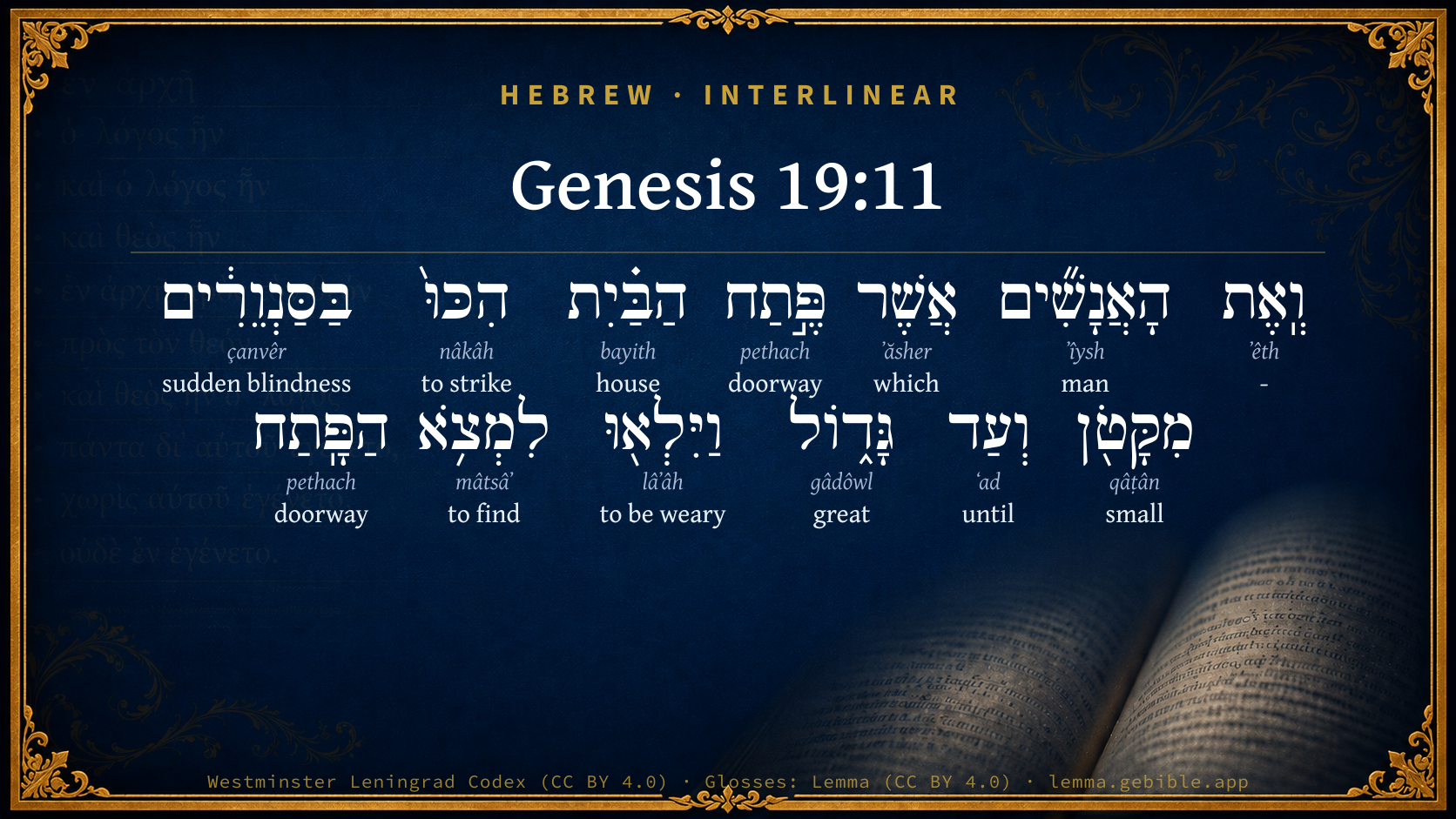
Hebrew (Westminster Leningrad Codex) Genesis 19:11 appears in the Hebrew Old Testament. The text above is from the Westminster Leningrad Codex. Each word links to its Strong’s number, a concise gloss, and parsing drawn from the Open Scriptures Hebrew Bible morphology. Click any word for its full Brown-Driver-Briggs (BDB) entry.
Download image
Cite this verse

Genesis 19:11 (World English Bible). Public Domain. Lemma interlinear Bible study tool, https://lemma.gebible.app/v/genesis/19/11.

Show BibTeX & RIS
BibTeX
RIS
English Translation
They struck the men who were at the door of the house with blindness, both small and great, so that they wearied themselves to find the door.
World English Bible · Public Domain
Highlights
  • 2 first appearances in the Hebrew Bible
Full analysis ↓
Download a study sheet

One document with this verse’s original text, its word-by-word gloss line, the meaning frame, cross-references with their text, attributed commentary, and full source and license credits — printable, and it pastes into notes with its structure intact.

This verse Autodidact and up

Study sheet (.html) Plain text (.txt)

A passage Seminary Student

Up to 50 verses in one chapter. A passage sheet keeps up to 6 commentary sources and 12 cross-references per verse, in the order this page ranks them, and says so on the sheet whenever that leaves anything out. Ask for a single verse and you get the Autodidact verse sheet above.

Everything on this page stays free to read, with no account — the sheet is a download of what is already on screen, not access to it.

Want to remove ads? Support Godless Engineer
Compare translations 3

The same verse in 3 English versions, stacked beneath the original-language interlinear above. Click any original word for its lexicon entry.

Each is an independent rendering of the whole verse — the interlinear is not word-aligned to these translations.

Highlighted words mark where these versions differ — a whole-verse word diff, not a word-by-word alignment.

  • World English Bible Public Domain
    They struck the men who were at the door of the house with blindness, both small and great, so that they wearied themselves to find the door.
  • King James Version Public Domain
    And they smote the men that were at the door of the house with blindness, both small and great: so that they wearied themselves to find the door.
  • unfoldingWord Literal Text CC BY-SA 4.0
    Then they struck the men who the entrance of the house with blindness, from the small and to the great, so that they became weary to find the door.

unfoldingWord Literal Text — © unfoldingWord, licensed CC BY-SA 4.0. Word-aligned USFM3 via Door43 (git.door43.org/unfoldingWord/en_ult).

Versions to compare (up to 4)

3 of 4 selected

Show all 18 translations

Every available English version of this verse, each an independent rendering of the whole verse.

  • World English Bible Public Domain
    They struck the men who were at the door of the house with blindness, both small and great, so that they wearied themselves to find the door.
  • Berean Standard Bible Public Domain
    And they struck the men at the entrance, young and old, with blindness, so that they wearied themselves trying to find the door.
  • Majority Standard Bible Public Domain
    And they struck the men at the entrance, young and old, with blindness, so that they wearied themselves trying to find the door.
  • King James Version Public Domain
    And they smote the men that were at the door of the house with blindness, both small and great: so that they wearied themselves to find the door.
  • American Standard Version (1901) Public Domain
    And they smote the men that were at the door of the house with blindness, both small and great, so that they wearied themselves to find the door.
  • Revised Version (1885) Public Domain
    And they smote the men that were at the door of the house with blindness, both small and great: so that they wearied themselves to find the door.
  • Geneva Bible (1599) Public Domain
    Then they smote the men that were at the doore of the house with blindnes both small and great, so that they were wearie in seeking the doore.
  • Douay-Rheims (1899) Public Domain
    And them that were without, p they struck with blindness from the least to the greatest, so that they could not find the door.
  • Young's Literal Translation Public Domain
    and the men who `are' at the opening of the house they have smitten with blindness, from small even unto great, and they weary themselves to find the opening.
  • Literal Standard Version CC BY-SA 4.0
    and the men who [are] at the opening of the house they have struck with blindness, from small even to great, and they weary themselves to find the opening.
  • Unlocked Literal Bible CC BY-SA 4.0
    Then Lot's visitors struck with blindness the men who were outside the door of the house, both young and old, so that they became exhausted when they were trying to find the door.
  • unfoldingWord Literal Text CC BY-SA 4.0
    Then they struck the men who the entrance of the house with blindness, from the small and to the great, so that they became weary to find the door.
  • Darby Bible Public Domain
    And they smote the men that were at the entrance of the house with blindness, from the smallest to the greatest; and they wearied themselves to find the entrance.
  • World Messianic Bible Public Domain
    They struck the men who were at the door of the house with blindness, both small and great, so that they wearied themselves to find the door.
  • Webster's Bible Public Domain
    And they smote the men that were at the door of the house with blindness, both small and great: so that they wearied themselves to find the door.
  • Free Bible Version CC BY-SA 4.0
    Then they made all the men in the doorway, young and old, suddenly go blind so they couldn't find the door.
  • Bible in Basic English Public Domain
    But the men who were outside the door they made blind, all of them, small and great, so that they were tired out with looking for the door.
  • JPS Tanakh (1917) Public Domain
    And they smote the men that were at the door of the house with blindness, both small and great; so that they wearied themselves to find the door.

Literal Standard Version (2020), Covenant Press — licensed CC BY-SA 4.0. Text via the HelloAO Bible API (eBible.org). Unlocked Literal Bible (unfoldingWord) — licensed CC BY-SA 4.0. Text via the HelloAO Bible API (eBible.org). unfoldingWord Literal Text — © unfoldingWord, licensed CC BY-SA 4.0. Word-aligned USFM3 via Door43 (git.door43.org/unfoldingWord/en_ult). Free Bible Version, Dr. Jonathan Gallagher — licensed CC BY-SA 4.0. Text via the HelloAO Bible API (eBible.org).

Word by word

More ways to search: Search by grammar → Find every occurrence → Compare this word →

Practice this passage: Drill this verse → Learn its vocabulary →

בַּסַּנְוֵרִ֔ים
çanvêr
H5575
“in/at the · sudden blindness”
Preposition, Determined + Noun, Common, Masculine, Plural, Absolute
Part of Speech
Preposition + Noun
Type
Common
Gender
Masculine
Number
Plural
State
Absolute
Full BDB Definition

Origin: of uncertain derivation

TWOT: 1521

sudden blindness
  1. וְֽאֶת ʼêth H853 “and · -” Conjunction + Particle, Direct Object
  2. הָאֲנָשִׁ֞ים ʼîysh H376 “the · men” Particle, Definite Article + Noun, Common, Masculine, Plural, Absolute
  3. אֲשֶׁר ʼăsher H834 “which” Particle, Relative
  4. פֶּ֣תַח pethach H6607 “doorway of” Noun, Common, Masculine, Singular, Construct
  5. הַבַּ֗יִת bayith H1004 “the · house” Particle, Definite Article + Noun, Common, Masculine, Singular, Absolute
  6. הִכּוּ֙ nâkâh H5221 “to strike” Verb, Hiphil, Perfect, 3rd Person, Common, Plural
  7. מִקָּטֹ֖ן qâṭân H6996 “from · small” Preposition + Adjective, Adjective, Masculine, Singular, Absolute
  8. וְעַד ʻad H5704 “and · until” Conjunction + Preposition
  9. גָּד֑וֹל gâdôwl H1419 “great” Adjective, Adjective, Masculine, Singular, Absolute
  10. וַיִּלְא֖וּ lâʼâh H3811 “and · to be weary” Conjunction + Verb, Qal, Sequential Imperfect, 3rd Person, Masculine, Plural
  11. לִמְצֹ֥א mâtsâʼ H4672 “to find” Preposition + Verb, Qal, Infinitive Construct
  12. הַפָּֽתַח pethach H6607 “the · doorway” Particle, Definite Article + Noun, Common, Masculine, Singular, Absolute

About this verse

These counts appear in no published source. They are computed here, from the morphology-tagged text and Lemma’s own curated glosses. What Lemma adds →

13
words
12
distinct lemmas
Pentateuch
section

Notable vocabulary

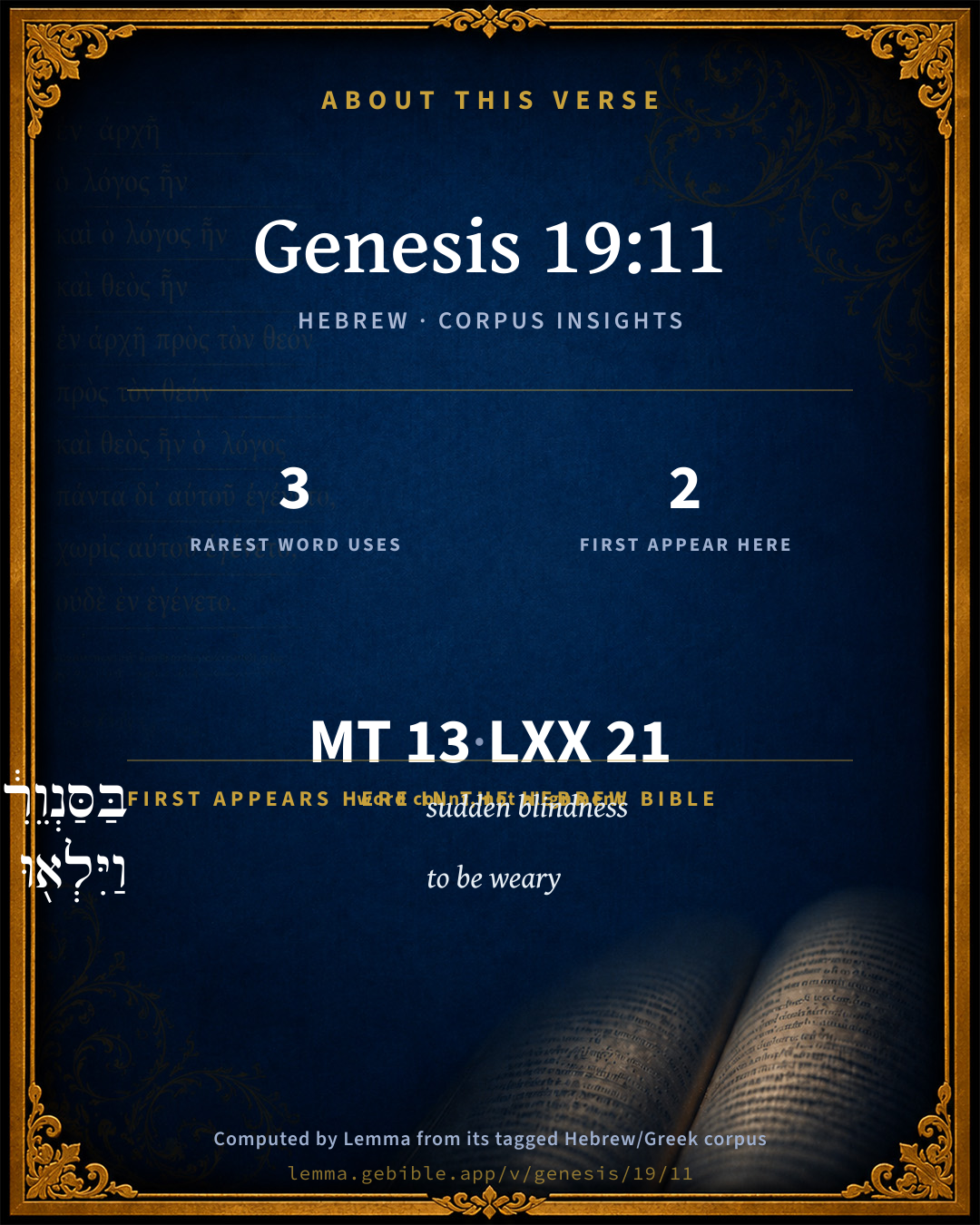
The rarest word here is בַּסַּנְוֵרִ֔ים sudden blindness H5575 — appearing just 3 times in the whole Hebrew Bible.

First appearance in Scripture

These words make their first canonical appearance in the Hebrew Bible here:

  • בַּסַּנְוֵרִ֔ים sudden blindness H5575
  • וַיִּלְא֖וּ to be weary H3811

Shared distinctive vocabulary

בַּסַּנְוֵרִ֔ים sudden blindness H5575 occurs in 2 verses of the Hebrew Bible. Also found in:

Grammatical profile

  • 3 verbs
  • 5 nouns
  • 2 adjectives
  • 1 preposition
  • 2 particles

Verb forms

  • הִכּוּ֙ Hiphil · Perfect
  • וַיִּלְא֖וּ Qal · Sequential Imperfect
  • לִמְצֹ֥א Qal · Infinitive Construct

Repetition

A word recurs within this verse — often emphatic in Hebrew:

  • פֶּ֣תַח doorway H6607 ×2

Hebrew & Septuagint length

In English translation the verse runs 27 words from the Hebrew and 27 from the Septuagint (LXX English) — the same length.

A rough comparison of the two English renderings, which tokenize alike — not a word-level alignment.

Word counts can differ between the Hebrew and the Greek without any difference in meaning — e.g. the Hebrew direct-object marker אֵת has no separate Greek word, and Greek often adds the article ὁ.

In the original languages it is 13 Hebrew tokens and 21 Greek tokens — but the two are counted differently (Hebrew bundles its prefixes and suffixes into one token; the Greek is in lemma form), so that isn’t a like-for-like length.

Cross-references

6

Topical passages linked to Genesis 19:11 in the Treasury of Scripture Knowledge — connected by theme and wording, ordered by reader-vote popularity; previews shown in the World English Bible.

  • 2 Kings 6:18 When they came down to him, Elisha prayed to Yahweh, and said, Please smite this people with blindness. He struck them with blindness according to the word of Elisha.
  • Acts 13:11 Now, behold, the hand of the Lord is on you, and you will be blind, not seeing the sun for a season!" Immediately there fell on him a mist and darkness. He went around seeking someone to lead him by the hand.
  • Deuteronomy 28:28–29 Yahweh will strike you with madness, and with blindness, and with astonishment of heart;
  • Jeremiah 2:36 Why go you about so much to change your way? you shall be ashamed of Egypt also, as you were ashamed of Assyria.
  • Ecclesiastes 10:15 The labor of fools wearies every one of them; for he doesn't know how to go to the city.
  • Isaiah 57:10 You were wearied with the length of your way; yet you didn't say, It is in vain: you found a reviving of your strength; therefore you weren't faint.

Cross-references courtesy of OpenBible.info (CC BY 4.0).

Hebrew and Greek witnesses Masoretic Hebrew ↔ Greek Septuagint

The same verse in the two great witnesses to the Old Testament, shown verse-for-verse.

These are two independent witnesses, not word-aligned to each other, and the Septuagint is shown in lemma (dictionary) form.

Hebrew Genesis 19:11 Masoretic · Westminster Leningrad Codex

וְֽאֶת הָאֲנָשִׁ֞ים אֲשֶׁר פֶּ֣תַח הַבַּ֗יִת הִכּוּ֙ בַּסַּנְוֵרִ֔ים מִקָּטֹ֖ן וְעַד גָּד֑וֹל וַיִּלְא֖וּ לִמְצֹ֥א הַפָּֽתַח

They struck the men who were at the door of the house with blindness, both small and great, so that they wearied themselves to find the door.

World English Bible · Public Domain

Greek LXX Genesis 19:11 Septuagint · lemma form

ὁ δέ ἀνήρ ὁ εἰμί ἐπί ὁ θύρα ὁ οἶκος πατάσσω ἀορασία ἀπό μικρός ἕως μέγας καί παραλύω ζητέω ὁ θύρα

And they struck the men that were at the door of the house with blindness, both small and great, and they were wearied with seeking the door.

LXX2012 (modern English Septuagint) · Public Domain

On this verse, The Cambridge Bible for Schools and Colleges discusses the Septuagint’s reading. Read the note in Commentary ↓

Hebrew: Westminster Leningrad Codex (CC BY 4.0). Greek: Septuagint (public domain); English from LXX2012 (modern English Septuagint) (Public Domain). How the Septuagint differs from the Hebrew →

Targum (Aramaic paraphrase)

2

The Targum is the ancient Jewish Aramaic paraphrase of the Hebrew Scriptures — an interpretive translation, not the Hebrew text itself. Onkelos (literal) and Pseudo-Jonathan (expansive) render the Torah, and Jonathan the Prophets. Coverage is partial: where no permissively-licensed English translation exists for a verse, only the Aramaic is shown. This is verse-level text, not a word-by-word alignment to the Hebrew.

  1. Targum Onkelos Torah (Genesis–Deuteronomy)
    וְיָת גֻּבְרַיָּא דִּי בִתְרַע בֵּיתָא מְחוֹ בְּשַׁבְרִירַיָּא מִזְּעֵירָא וְעַד רַבָּא וּלְאִיוּ לְאַשְׁכָּחָא תַרְעָא

    (no public-domain English translation for this verse)

    Targum Onkelos — Aramaic: “Onkelos Genesis” (public domain); “Onkelos Exodus” (public domain); “Onkelos Leviticus” (public domain); “Onkelos Numbers” (public domain); “Onkelos Deuteronomy” (public domain). English: “Sefaria Community Translation” (CC0 1.0 (public-domain dedication)); “J.W. Etheridge. The Targums of Onkelos and Jonathan Ben Uzziel on the Pentateuch. London: Longmans, Green, 1862” (public domain). Text via Sefaria.

  2. Targum Pseudo-Jonathan Torah (Genesis–Deuteronomy)
    וְיַת גוּבְרַיָא דְבִתְרַע בֵיתָא מְחוּ בְּחַוַודְרוּרַיָא מִטַלְיָא וְעַד סָבָא וְאִישְׁתַּלְהִיוּ לְהַשְׁכָּחָא תַרְעָא

    But the men who were at the gate of the house they struck with a suffusion of the eyes, from the young to the old, and they wearied themselves to find the gate.

    Targum Pseudo-Jonathan — Aramaic: “Targum Jonathan on Genesis” (public domain); “Targum Jonathan on Exodus” (public domain); “Targum Jonathan on Leviticus” (public domain); “Targum Jonathan on Numbers” (public domain); “Targum Jonathan on Deuteronomy” (public domain). English: “The Targum of Jonathan ben Uzziel, trans. J. W. Etheridge, London, 1862” (public domain). Text via Sefaria.

Commentary

Notes on Genesis 19:11 from classic Christian and Jewish commentators (each source and its license shown beneath its notes). The classic Christian expositions comment on the surrounding passage and are grouped to its opening verse, so a note may address several verses; the Jewish commentaries on the Tanakh (Rashi and others) are per-verse, so they appear only where the commentator wrote on this verse.

Lemma curates 59 commentaries, every one of them public domain or Creative Commons licensed, each selected and text-cleaned for this edition rather than reprinted as found. About our sources →

Trapp's Complete Commentary

John Trapp

Gen 19:11 And they smote the men that [were] at the door of the house with blindness, both small and great: so that they wearied themselves to find the door.

Ver. 11. With blindness.] Subito scotomate , saith Junius: With blindness both of body and mind, saith Aben Ezra: such as tormented their eyes, as if they had been pricked with thorns, as the Hebrew word signifies. And yet they continue groping for the door, as if they were ambitious of destruction, which now was at next door by. Deus quem destruit dementat . So Pharaoh, when under that palpable three days’ darkness, rageth against God, and threateneth Moses with death. Though doomsday should be tomorrow next, wicked men must and will serve their lusts. Vale lumen amicum , said Theotimus in St Ambrose, who chose rather to lose his sight than his sin.

John Trapp, A Commentary or Exposition upon All the Books of the Old and New Testament (1647–1656) — public domain. Text from a community e-Sword module.

Joseph Benson's Commentary

Gen 19:11. And they smote the men with blindness — This was designed to put an end to their attempt, and to be an earnest of their utter ruin the next day.

Joseph Benson's Commentary on the Old and New Testaments (1811–1818) — public domain. Text from a community e-Sword module.

Geneva Bible (1599)

Geneva Bible translators

Hebrew, finding.

Geneva Bible (1599) marginal notes — public domain. Text via Bolls.life.

Adam Clarke's Commentary

Verse 11. And they smote the men - with blindness] This has been understood two ways:

1. The angels, by the power which God had given them, deprived these wicked men of a proper and regular use of their sight, so as either totally to deprive them of it, or render it so confused that they could no longer distinguish objects; or,

2. They caused such a deep darkness to take place, that they could not find Lot's door. The author of the book of Wisdom was evidently of this latter opinion, for he says they were compassed about with horrible great darkness, Ge 19:17. See a similar case of Elisha and the Syrians, 2Kg 6:18, &c.

Adam Clarke's Commentary on the Bible (1810–1826) — public domain. Text from a community e-Sword/MySword module.

Ellicott's Commentary for English Readers

(11) Blindness.—This word occurs elsewhere only in 2Ki_6:18, and in both cases it is plain that actual blindness is not meant. Had the men here been struck with blindness they would not have wearied themselves with trying to find the door, but would either have gone away in terror at the visitation, or, if too hardened for that, would have groped about till they found it. So, if the Syrian army had been made actually blind, they would have surrendered themselves; nor would it have been practicable to guide an army of blind men on so long a march as that from Dothan to Samaria. In both cases the men were unaware that anything had happened to them. The people of Sodom thought they saw the door; the Syrians supposed that the locality was one well known to them, and only when the confusion was removed did they become conscious that they were at Samaria. The word really means a disturbance of vision caused by the eye not being in its proper connection with the brain. And so the men of Sodom ever seemed just upon the point of reaching the door, and pressed on, and strove and quarrelled, but always failed, they knew not how, but as they always supposed by one another’s fault. It is a strange picture of men given over to unbelief and sin, and who “seeing see not,” because they reject the true light.

A Bible Commentary for English Readers, edited by Charles John Ellicott (1878–1897) — public domain. Text from a community e-Sword module.

The Cambridge Bible for Schools and Colleges

gen. ed. J. J. S. Perowne

11. blindness] An unusual word for “blindness,” inflicted as a sudden temporary visitation, used here and 2Ki_6:18. LXX ἀορασία.

The Cambridge Bible for Schools and Colleges (gen. ed. J. J. S. Perowne; Cambridge University Press, 1878–1918) — public domain. Text from a community e-Sword module.

John Gill's Exposition

And they smote the men that were at the door of the house with blindness, both small and great,.... with "blindnesses" (n); with extreme blindness, with blindness both of eye and heart, as Aben Ezra interprets it; and indeed had they not been given up to a judicial blindness and hardness of heart, such a stroke upon them might have convinced them that their ways were evil, and their works not right, and that by them they had incurred the displeasure of God, and would desisted from their enterprise; but, on the contrary, they went on with it, and sought with all diligence and labour as much as possible to effect it. The word for "blindness" is only used here and in Kg2 6:18, and denotes a peculiar sort of blindness; not an entire blindness with respect to every object, but only with regard to that they were intent upon; for otherwise they would not have continued about Lot's house, or fatigued themselves with searching for the door of it, but would rather have been glad to have groped to their own houses as well as they could: and thus it was with the Syrians, when they were smitten at the prayer of Elisha, it was not total, for they could follow the prophet in the way he went and led them, but they could not see their way to the place where they intended to go; and so these men of Sodom could see other objects, but not the door of Lot's house, their heads were so confused, and their imaginations so disturbed as in drunken men; or the medium of the visive faculty, the air, so altered, or the form of the object to be seen so changed, that they could not discern it; when they saw the door, it looked like the wall, and that which seemed to them to be the door, proved to be the wall:

so that they wearied themselves to find the door; went backwards and forwards, fancying the door was here, and then it was there, and when they came to it, they perceived it was not; and thus they went to and fro, until they were quite weary of seeking it, and despaired of finding it, and left off.

(n) "caecitatibus", Pagninus, Montanus, &c.

John Gill's Exposition of the Whole Bible (1746–1763) — public domain (CC PDM 1.0). Text via the HelloAO Bible API.

Matthew Poole's English Annotations

They smote the men, Heb. with blindness, i.e. with a blindness both of body and mind. It was not a total blindness, as if they quite lost the use of their eyes, for they saw the house, though not the door, but it was a great dimness and confusion of their sight, and a disturbance in their common sense, by which they were made unable to distinguish between differing persons or places; as it was also with the Syrians, 2Ki 6:18; as it is in some measure with some drunkards, who, though their eyes be open, cannot distinguish between things that differ. And this was very easy for angels to do by a small alteration either in their sight, or in the air, whereby either the door might appear like the solid wall, or the several parts of the wall like so many doors.

Matthew Poole's English Annotations on the Holy Bible (1683–1685) — public domain. Text from a community e-Sword/MySword module.

Whedon's Commentary on the Bible

Daniel D. Whedon

11. Smote — By an exercise of supernatural power.

Blindness — The word סנורים is used only here and 2Ki_6:18, and in both places denotes a miraculous penal stroke. It seems to denote mental aberration as well as inability to see. Hence the Sodomites recognised not the real nature of the stroke, but wearied themselves to find the door. What a wickedness and perversity is here displayed! “That the old and young should come; that they should come from every quarter of the city; that they assault the house, notwithstanding the sacred rights of guests; that they so shamelessly avow their pederastic purpose; that they will not even be appeased by Lot, to whom they once owed their salvation, (chap. 14,) and that they did not cease to grope for the door after they were stricken with blindness; this is the complete portraiture of a people ripe for the fiery judgment.” — Lange.

Daniel D. Whedon (gen. ed.), Commentary on the Old and New Testaments (1874–1909) — public domain. Text from a community e-Sword module.

The Pulpit Commentary

And they smote the men that were at the door the pethaeh, or opening (vide Ver. 6)of the house with blindness, (sanverim), from an unused quadrilateral signifying to dazzle, is perhaps here intended not for natural blindness, but for confused or bewildered vision, involving for the time being loss of sight, and accompanied by mental aberration; what Aben Ezra calls "blindness of eye and mind" (cf. 2Ki_6:18) both small and great: so that they wearied themselves to find the door which they would hardly have done bad it been natural blindness only (Augustine).

The Pulpit Commentary (1880–1919), ed. H.D.M. Spence-Jones & Joseph S. Exell — public domain. Text from a community e-Sword module.

John Wesley's Explanatory Notes

And they smote the men with blindness - This was designed to put an end to their attempt, and to be an earnest of their utter ruin the next day.

John Wesley, Explanatory Notes Upon the Whole Bible (1754–1765) — public domain. Text via the GEBible commentary corpus.

Rashi

Rabbi Shlomo Yitzchaki (Rashi)

פתח THE DOOR (literally, opening) — This means the hollow space (opening) through which people go in and out.

בסנורים This is an attack of blindness (cf. Yoma 28b)

מקטן ועד גדול FROM SMALL TO GREAT — The small had begun this wrongdoing — as it is said, (Genesis 19:4) “both young and old” — therefore the punishment started with them (Genesis Rabbah 50:8).

Rashi on the Tanakh — English translations: “The Judaica Press complete Tanach with Rashi, translated by A. J. Rosenberg” (CC BY 4.0); “Pentateuch with Rashi's commentary by M. Rosenbaum and A.M. Silbermann, 1929-1934” (public domain); “The Metsudah Tanach series, Lakewood, N.J” (CC BY 4.0); and “The Book of Joshua, Metsudah Publications, 1997” (CC BY 4.0). Text via Sefaria.

Radak

Rabbi David Kimhi (Radak)

ואת האנשים, the angels punished the men of Sodom who were at the entrance to the house

בסנורים, with a temporary blindness The word סנורים is a composite of the two words סני ראיה.

Radak on the Tanakh — English translations: “Sefaria Community Translation” (CC0 1.0 (public-domain dedication)); “Eliyahu Munk, HaChut Hameshulash” (CC BY 4.0); “Rabbi Mike Feuer, Jerusalem Anthology” (CC BY 4.0); and “R. David Kimhi on the first book of Psalms, Translated by R.G. Finch, London, 1919” (public domain). Text via Sefaria.

Lesson kit

Teaching starters — assembled from the data on this page, not authored interpretation. Every prompt links to the verse data it draws on. Edit before teaching.

Genesis, in the Pentateuch, opens this verse with 13 words (12 distinct Hebrew lemmas). Its most distinctive word is çanvêr (“sudden blindness”). A historical commentator’s framing appears above. Read the whole chapter for the surrounding context.

Discussion questions

  1. The word çanvêr carries the sense “sudden blindness.” How does it shape the verse?
  2. 2 words here appear for the first time in Scripture. What is being introduced at this debut?
  3. 2 Kings 6:18 shares the word «sudden blindness» with this verse. How do the two illuminate each other?
  4. “doorway” occurs 2× in this one verse. What is the effect of the repetition?
  5. These translations render this verse differently. What is at stake in choosing one wording over another?
  6. The verb «הִכּוּ֙» is Hiphil Perfect. How does its form color the action?
  7. Reading how Trapp's Complete Commentary and Joseph Benson's Commentary read this verse, where do the two commentators agree and where do they part?

Things to notice

Reading settings

Reading text

Shown beneath each verse's original-language words.

Old Testament
Old Testament edition

Read the OT as the Masoretic Hebrew (MT) or the Greek Septuagint (LXX).

English shown for the Greek Septuagint (in the Hebrew ↔ Greek comparison).

Comparing translations? Open the Compare panel on any verse page to stack up to four side by side.