Genesis 26:11

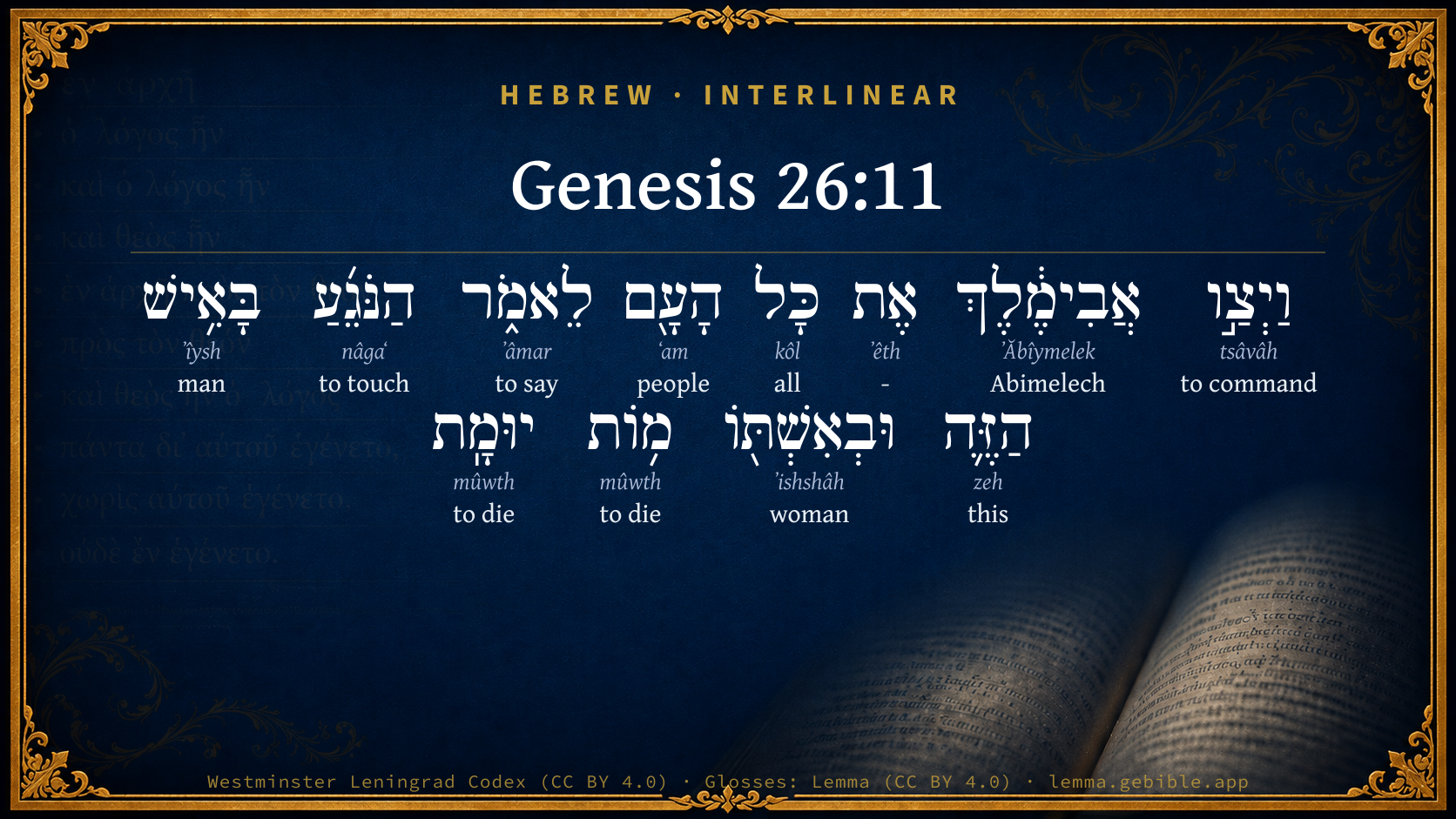
Hebrew (Westminster Leningrad Codex) Genesis 26:11 appears in the Hebrew Old Testament. The text above is from the Westminster Leningrad Codex. Each word links to its Strong’s number, a concise gloss, and parsing drawn from the Open Scriptures Hebrew Bible morphology. Click any word for its full Brown-Driver-Briggs (BDB) entry.
Download image
Cite this verse

Genesis 26:11 (World English Bible). Public Domain. Lemma interlinear Bible study tool, https://lemma.gebible.app/v/genesis/26/11.

Show BibTeX & RIS
BibTeX
RIS
English Translation
Abimelech charged all the people, saying, "He who touches this man or his wife will surely be put to death."
World English Bible · Public Domain
Download a study sheet

One document with this verse’s original text, its word-by-word gloss line, the meaning frame, cross-references with their text, attributed commentary, and full source and license credits — printable, and it pastes into notes with its structure intact.

This verse Autodidact and up

Study sheet (.html) Plain text (.txt)

A passage Seminary Student

Up to 50 verses in one chapter. A passage sheet keeps up to 6 commentary sources and 12 cross-references per verse, in the order this page ranks them, and says so on the sheet whenever that leaves anything out. Ask for a single verse and you get the Autodidact verse sheet above.

Everything on this page stays free to read, with no account — the sheet is a download of what is already on screen, not access to it.

Want to remove ads? Support Godless Engineer
Compare translations 3

The same verse in 3 English versions, stacked beneath the original-language interlinear above. Click any original word for its lexicon entry.

Each is an independent rendering of the whole verse — the interlinear is not word-aligned to these translations.

Highlighted words mark where these versions differ — a whole-verse word diff, not a word-by-word alignment.

  • World English Bible Public Domain
    Abimelech charged all the people, saying, "He who touches this man or his wife will surely be put to death."
  • King James Version Public Domain
    And Abimelech charged all his people, saying, He that toucheth this man or his wife shall surely be put to death.
  • unfoldingWord Literal Text CC BY-SA 4.0
    Then Abimelech ordered all the people by saying, “Whoever touches this man or his wife will surely be killed!” Isaac Has Conflict with the Philistines over His Wells 26:12-33

unfoldingWord Literal Text — © unfoldingWord, licensed CC BY-SA 4.0. Word-aligned USFM3 via Door43 (git.door43.org/unfoldingWord/en_ult).

Versions to compare (up to 4)

3 of 4 selected

Show all 18 translations

Every available English version of this verse, each an independent rendering of the whole verse.

  • World English Bible Public Domain
    Abimelech charged all the people, saying, "He who touches this man or his wife will surely be put to death."
  • Berean Standard Bible Public Domain
    So Abimelech warned all the people, saying, “Whoever harms this man or his wife will surely be put to death.”
  • Majority Standard Bible Public Domain
    So Abimelech warned all the people, saying, “Whoever harms this man or his wife will surely be put to death.”
  • King James Version Public Domain
    And Abimelech charged all his people, saying, He that toucheth this man or his wife shall surely be put to death.
  • American Standard Version (1901) Public Domain
    And Abimelech charged all the people, saying, He that toucheth this man or his wife shall surely be put to death.
  • Revised Version (1885) Public Domain
    And Abimelech charged all the people, saying, He that toucheth this man or his wife shall surely be put to death.
  • Geneva Bible (1599) Public Domain
    Then Abimelech charged all his people, saying, He that toucheth this man, or his wife, shall die the death.
  • Douay-Rheims (1899) Public Domain
    He that shall touch this man's wife, shall surely be put to death.
  • Young's Literal Translation Public Domain
    and Abimelech commandeth all the people, saying, `He who cometh against this man or against his wife, dying doth die.'
  • Literal Standard Version CC BY-SA 4.0
    and Abimelech commands all the people, saying, “He who comes against this man or against his wife, dying does die.”
  • Unlocked Literal Bible CC BY-SA 4.0
    So Abimelech warned all the people and said, “Whoever touches this man or his wife will surely be put to death.”
  • unfoldingWord Literal Text CC BY-SA 4.0
    Then Abimelech ordered all the people by saying, “Whoever touches this man or his wife will surely be killed!” Isaac Has Conflict with the Philistines over His Wells 26:12-33
  • Darby Bible Public Domain
    And Abimelech charged all the people, saying, He that touches this man or his wife shall certainly be put to death.
  • World Messianic Bible Public Domain
    Abimelech commanded all the people, saying, “He who touches this man or his wife will surely be put to death.”
  • Webster's Bible Public Domain
    And Abimelech charged all his people, saying, He that toucheth this man or his wife shall surely be put to death.
  • Free Bible Version CC BY-SA 4.0
    Abimelech issued orders to all the people, warning them, “Anyone who touches this man or his wife will be executed.”
  • Bible in Basic English Public Domain
    And Abimelech gave orders to his people that anyone touching Isaac or his wife was to be put to death.
  • JPS Tanakh (1917) Public Domain
    And Abimelech charged all the people, saying: 'He that toucheth this man or his wife shall surely be put to death.'

Literal Standard Version (2020), Covenant Press — licensed CC BY-SA 4.0. Text via the HelloAO Bible API (eBible.org). Unlocked Literal Bible (unfoldingWord) — licensed CC BY-SA 4.0. Text via the HelloAO Bible API (eBible.org). unfoldingWord Literal Text — © unfoldingWord, licensed CC BY-SA 4.0. Word-aligned USFM3 via Door43 (git.door43.org/unfoldingWord/en_ult). Free Bible Version, Dr. Jonathan Gallagher — licensed CC BY-SA 4.0. Text via the HelloAO Bible API (eBible.org).

Word by word

More ways to search: Search by grammar → Find every occurrence → Compare this word →

Practice this passage: Drill this verse → Learn its vocabulary →

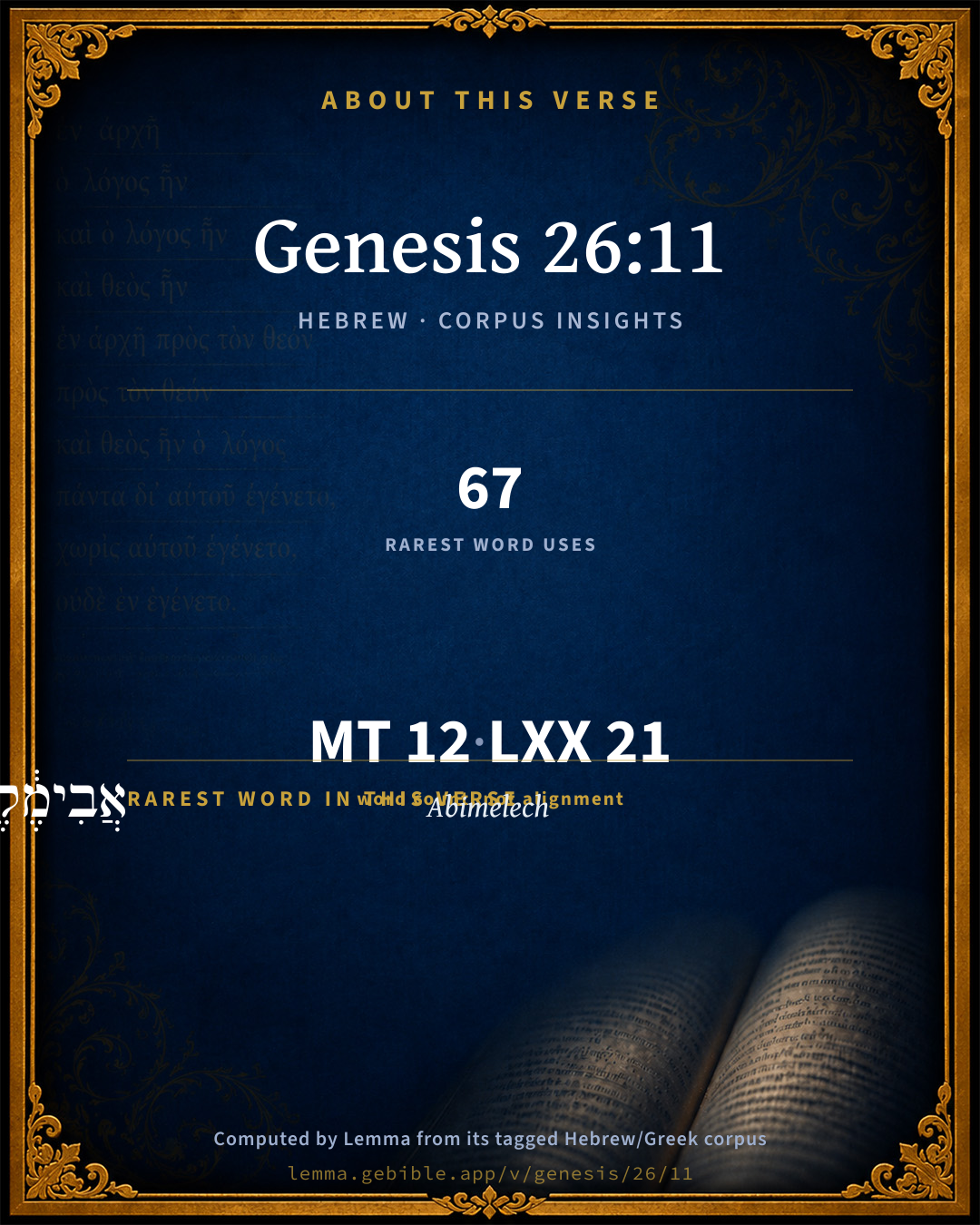
אֲבִימֶ֔לֶךְ
ʼĂbîymelek
H40
“Abimelech”
Noun, Proper
Part of Speech
Noun
Type
Proper
Full BDB Definition

Origin: from H1 and H4428

TWOT: None

Abimelech = "Melek is father" or " my father is king" - king of Gerar in Abraham's time - king of Gath in David's time; maybe title of Philistine kings - son of Gideon by a concubine - priest, son of Abiathar
  1. וַיְצַ֣ו tsâvâh H6680 “and · to command” Conjunction + Verb, Piel, Sequential Imperfect, 3rd Person, Masculine, Singular
  2. אֶת ʼêth H853 “-” Particle, Direct Object
  3. כָּל kôl H3605 “all of” Noun, Common, Masculine, Singular, Construct
  4. הָעָ֖ם ʻam H5971 “the · people” Particle, Definite Article + Noun, Common, Masculine, Singular, Absolute
  5. לֵאמֹ֑ר ʼâmar H559 “to say” Preposition + Verb, Qal, Infinitive Construct
  6. הַנֹּגֵ֜עַ nâgaʻ H5060 “the · touching” Particle, Definite Article + Verb, Qal, Participle Active, Masculine, Singular, Absolute
  7. בָּאִ֥ישׁ ʼîysh H376 “in/at the · man” Preposition, Determined + Noun, Common, Masculine, Singular, Absolute
  8. הַזֶּ֛ה zeh H2088 “the · this” Particle, Definite Article + Pronoun, Demonstrative, Masculine, Singular
  9. וּבְאִשְׁתּ֖וֹ ʼishshâh H802 “and · in/at · woman · his” Conjunction + Preposition + Noun, Common, Feminine, Singular, Construct + Suffix, Personal, 3rd Person, Masculine, Singular
  10. מ֥וֹת mûwth H4191 “to die” Verb, Qal, Infinitive Absolute
  11. יוּמָֽת mûwth H4191 “to die” Verb, Hophal, Imperfect, 3rd Person, Masculine, Singular

About this verse

These counts appear in no published source. They are computed here, from the morphology-tagged text and Lemma’s own curated glosses. What Lemma adds →

12
words
11
distinct lemmas
Pentateuch
section

Grammatical profile

  • 5 verbs
  • 5 nouns
  • 1 pronoun
  • 1 particle

Verb forms

  • וַיְצַ֣ו Piel · Sequential Imperfect
  • לֵאמֹ֑ר Qal · Infinitive Construct
  • הַנֹּגֵ֜עַ Qal · Participle Active
  • מ֥וֹת Qal · Infinitive Absolute
  • יוּמָֽת Hophal · Imperfect

Repetition

A word recurs within this verse — often emphatic in Hebrew:

  • מ֥וֹת to die H4191 ×2

Hebrew & Septuagint length

In English translation the verse runs 20 words from the Hebrew and 21 from the Septuagint (LXX English) — closely comparable.

A rough comparison of the two English renderings, which tokenize alike — not a word-level alignment.

Word counts can differ between the Hebrew and the Greek without any difference in meaning — e.g. the Hebrew direct-object marker אֵת has no separate Greek word, and Greek often adds the article ὁ.

In the original languages it is 12 Hebrew tokens and 21 Greek tokens — but the two are counted differently (Hebrew bundles its prefixes and suffixes into one token; the Greek is in lemma form), so that isn’t a like-for-like length.

Cross-references

4

Topical passages linked to Genesis 26:11 in the Treasury of Scripture Knowledge — connected by theme and wording, ordered by reader-vote popularity; previews shown in the World English Bible.

  • Psalms 105:15 "Don't touch my anointed ones! Do my prophets no harm!"
  • Genesis 20:6 God said to him in the dream, "Yes, I know that in the integrity of your heart you have done this, and I also withheld you from sinning against me. Therefore I didn't allow you to touch her.
  • Proverbs 6:29 So is he who goes in to his neighbor's wife. Whoever touches her will not be unpunished.
  • Zechariah 2:8 For thus says Yahweh of hosts: 'For honor he has sent me to the nations which plundered you; for he who touches you touches the apple of his eye.

Cross-references courtesy of OpenBible.info (CC BY 4.0).

Hebrew and Greek witnesses Masoretic Hebrew ↔ Greek Septuagint

The same verse in the two great witnesses to the Old Testament, shown verse-for-verse.

These are two independent witnesses, not word-aligned to each other, and the Septuagint is shown in lemma (dictionary) form.

Hebrew Genesis 26:11 Masoretic · Westminster Leningrad Codex

וַיְצַ֣ו אֲבִימֶ֔לֶךְ אֶת כָּל הָעָ֖ם לֵאמֹ֑ר הַנֹּגֵ֜עַ בָּאִ֥ישׁ הַזֶּ֛ה וּבְאִשְׁתּ֖וֹ מ֥וֹת יוּמָֽת

Abimelech charged all the people, saying, "He who touches this man or his wife will surely be put to death."

World English Bible · Public Domain

Greek LXX Genesis 26:11 Septuagint · lemma form

συντάσσω δέ αβιμελεχ πᾶς ὁ λαός αὐτός λέγω πᾶς ὁ ἅπτομαι ὁ ἄνθρωπος οὗτος ἤ ὁ γυνή αὐτός θάνατος ἔνοχος εἰμί

And Abimelech charged all his people, saying Every man that touches this man and his wife shall be liable to death.

LXX2012 (modern English Septuagint) · Public Domain

Hebrew: Westminster Leningrad Codex (CC BY 4.0). Greek: Septuagint (public domain); English from LXX2012 (modern English Septuagint) (Public Domain). How the Septuagint differs from the Hebrew →

Targum (Aramaic paraphrase)

2

The Targum is the ancient Jewish Aramaic paraphrase of the Hebrew Scriptures — an interpretive translation, not the Hebrew text itself. Onkelos (literal) and Pseudo-Jonathan (expansive) render the Torah, and Jonathan the Prophets. Coverage is partial: where no permissively-licensed English translation exists for a verse, only the Aramaic is shown. This is verse-level text, not a word-by-word alignment to the Hebrew.

  1. Targum Onkelos Torah (Genesis–Deuteronomy)
    וּפַקִּיד אֲבִימֶלֶךְ יָת כָּל עַמָּא לְמֵימָר דְּיַנְזֵק לְגַבְרָא הָדֵין וּבְאִתְּתֵהּ אִתְקְטָלָא יִתְקְטֵּל

    (no public-domain English translation for this verse)

    Targum Onkelos — Aramaic: “Onkelos Genesis” (public domain); “Onkelos Exodus” (public domain); “Onkelos Leviticus” (public domain); “Onkelos Numbers” (public domain); “Onkelos Deuteronomy” (public domain). English: “Sefaria Community Translation” (CC0 1.0 (public-domain dedication)); “J.W. Etheridge. The Targums of Onkelos and Jonathan Ben Uzziel on the Pentateuch. London: Longmans, Green, 1862” (public domain). Text via Sefaria.

  2. Targum Pseudo-Jonathan Torah (Genesis–Deuteronomy)
    וּפְקִיד אֲבִימֶלֶךְ יַת כָּל עַמָא לְמֵימַר דְיִקְרַב לְבִישׁ בְּגַבְרָא הָדֵין וּבְאִנְתְּתֵיהּ אִתְקְטָלָא יִתְקְטֵל

    And Abimelek instructed all the people, Whoever shall go near to injure this man or his wife, shall verily be put to death.

    Targum Pseudo-Jonathan — Aramaic: “Targum Jonathan on Genesis” (public domain); “Targum Jonathan on Exodus” (public domain); “Targum Jonathan on Leviticus” (public domain); “Targum Jonathan on Numbers” (public domain); “Targum Jonathan on Deuteronomy” (public domain). English: “The Targum of Jonathan ben Uzziel, trans. J. W. Etheridge, London, 1862” (public domain). Text via Sefaria.

Commentary

Notes on Genesis 26:11 from classic Christian and Jewish commentators (each source and its license shown beneath its notes). The classic Christian expositions comment on the surrounding passage and are grouped to its opening verse, so a note may address several verses; the Jewish commentaries on the Tanakh (Rashi and others) are per-verse, so they appear only where the commentator wrote on this verse.

Lemma curates 59 commentaries, every one of them public domain or Creative Commons licensed, each selected and text-cleaned for this edition rather than reprinted as found. About our sources →

Trapp's Complete Commentary

John Trapp

Gen 26:11 And Abimelech charged all [his] people, saying, He that toucheth this man or his wife shall surely be put to death.

Ver. 11. He that toucheth this man, &c.] So sweetly doth God, many times, turn even our sins to our safety here, and to our salvation hereafter. What is not God able to do for his?

John Trapp, A Commentary or Exposition upon All the Books of the Old and New Testament (1647–1656) — public domain. Text from a community e-Sword module.

Adam Clarke's Commentary

Verse 11. He that toucheth] He who injures Isaac or defiles Rebekah shall certainly die for it. Death was the punishment for adultery among the Canaanites, Philistines, and Hebrews. See Ge 38:24.

Adam Clarke's Commentary on the Bible (1810–1826) — public domain. Text from a community e-Sword/MySword module.

John Calvin's Commentaries

11. And Abimelech charged all his people. In denouncing capital punishment against any who should do injury to this stranger, we may suppose him to have issued this edict as a special privilege; for it isnot customary thus rigidly to avenge every kind of injury. Whence, then, arose this disposition on the part of the king to prefer Isaac to all the native inhabitants of the country, and almost to treat him as an equal, except that some portion of the divine majesty shone forth in him, which secured to him this degree of reverence? God, also, to assist the infirmity of his servant, inclined the mind of the heathen king, in every way, to show him favor. And there is no doubt that his general modesty induced the king thus carefully to protect him; for he, perceiving him to be a timid man, who had been on the point of purchasing his own life by the ruin of his wife, was the more disposed to assist him in his dangers, in order that he might live in security under his own government.

John Calvin's Commentaries (1540-1563) — public domain. Text from the Calvin Translation Society English edition (1840s-50s) via the Christian Classics Ethereal Library (ccel.org). Calvin's coverage is partial (roughly two-thirds of the Bible); uncommented books and verses are honest gaps, never fabricated. The 19th-century editor's footnotes and remarks are omitted so the notes are faithfully Calvin's own voice.

John Gill's Exposition

Then, Isaac sowed in that land,.... In the land of Gerar; after matters were settled between him and Abimelech, and he had ordered his servants to do him no hurt, he sowed wheat or barley, or some such grain:

and received in the same year an hundred fold; in which he sowed it, and which many take to be a year of famine; and so it was the more extraordinary, that there should be such a plentiful crop produced on Isaac's ground, when there was such barrenness elsewhere: but it does not seem likely that it should be the same year of famine in which Isaac came to Gerar, since he is said to have been them a "long time", Gen 26:8; before this sowing and plenty upon it were. This increase is far from being incredible; for Pliny (d), besides instances he gives of an hundred fold, says, that in a field at Byzacium in Africa one bushel produced one hundred and fifty bushels; and from the same place, the deputy of Augustus there sent him from one grain very few less than four hundred, and to Nero three hundred stalks from, one grain. Herodotus (e) speaks of a country, near to the place where the Euphrates runs into the Tigris, on which the city Ninus was, which nowhere failed of producing two hundred fold, and the better sort of it even three hundred; see Mat 13:23,

and the Lord blessed him; and prospered and succeeded all his endeavours; and this was the true reason of the fertility of the land he manured and sowed.

(d) Nat. Hist. l. 11. c. 10. (e) Clio sive, l. 1. c. 193.

John Gill's Exposition of the Whole Bible (1746–1763) — public domain (CC PDM 1.0). Text via the HelloAO Bible API.

Haydock's Catholic Bible Commentary

Touch, or hurt, by offering to marry, &c. (Haydock) --- Adultery was punished with death among these nations, chap. xxxviii. 24, as it was by the law of Moses. (Calmet)

George Leo Haydock (1774–1849), Haydock's Catholic Family Bible and Commentary, 1859 edition — public domain. Excludes Psalms (Douay-Rheims chapter numbering differs from Protestant) and Deuterocanonical books (Catholic canon only).

Matthew Poole's English Annotations

He that hurteth or injureth. So that word is used, Gen 26:29; Jos 9:19; Psa 105:15; Zec 2:8; and being applied to a woman, it is used for the defiling or humbling of her, as Gen 20:6; Pro 6:29.

Matthew Poole's English Annotations on the Holy Bible (1683–1685) — public domain. Text from a community e-Sword/MySword module.

The Pulpit Commentary

And Abimelech charged all his (literally, the) people, saying, He that toucheth in the sense of injureth (cf. Psa_105:15) this man or his wife shall surely be put to death. The similarity of this incident to that related in Genesis 20. concerning Abraham in Gerar may be explained without resorting to the hypothesis of different authors, The stereotyped character of the manners of antiquity, especially in the East, is sufficient to account for the danger to which Sarah was exposed recurring in the case of Rebekah three quarters of a century later. That Isaac should have resorted to the miserable expedient of his father may have been due simply to a lack of originality on the part of Isaac; or perhaps the recollection of the success which had attended his father"s adoption of this wretched subterfuge may have blinded him to its true character. But from whatever cause resulting, the resemblance between the two narratives cannot be held as destroying the credibility of either, and all the more that a careful scrutiny will detect sufficient dissimilarity between them to establish the authenticity of the incidents which they relate.

The Pulpit Commentary (1880–1919), ed. H.D.M. Spence-Jones & Joseph S. Exell — public domain. Text from a community e-Sword module.

Radak

Rabbi David Kimhi (Radak)

ויצו, after Avimelech had found out that Rivkah was Yitzchok’s wife, he had to inform the people of this fact to ensure that no one would touch her. Also, he had to warn the people not to harm Yitzchok, so that he would not be killed on account of his wife.

Radak on the Tanakh — English translations: “Sefaria Community Translation” (CC0 1.0 (public-domain dedication)); “Eliyahu Munk, HaChut Hameshulash” (CC BY 4.0); “Rabbi Mike Feuer, Jerusalem Anthology” (CC BY 4.0); and “R. David Kimhi on the first book of Psalms, Translated by R.G. Finch, London, 1919” (public domain). Text via Sefaria.

Lesson kit

Teaching starters — assembled from the data on this page, not authored interpretation. Every prompt links to the verse data it draws on. Edit before teaching.

Genesis, in the Pentateuch, opens this verse with 12 words (11 distinct Hebrew lemmas). Its most distinctive word is ʼĂbîymelek (“Abimelech”). A historical commentator’s framing appears above. Read the whole chapter for the surrounding context.

Discussion questions

  1. The word ʼĂbîymelek carries the sense “Abimelech.” How does it shape the verse?
  2. Psalms 105:15 shares this passage’s theme. How do the two illuminate each other?
  3. “to die” occurs 2× in this one verse. What is the effect of the repetition?
  4. These translations render this verse differently; the difference is in the English rendering, not the original. What questions does that raise?
  5. The verb «וַיְצַ֣ו» is Piel Sequential Imperfect. How does its form color the action?
  6. Reading how Trapp's Complete Commentary and Adam Clarke's Commentary read this verse, where do the two commentators agree and where do they part?

Things to notice

Reading settings

Reading text

Shown beneath each verse's original-language words.

Old Testament
Old Testament edition

Read the OT as the Masoretic Hebrew (MT) or the Greek Septuagint (LXX).

English shown for the Greek Septuagint (in the Hebrew ↔ Greek comparison).

Comparing translations? Open the Compare panel on any verse page to stack up to four side by side.