
1 Kings 21:13

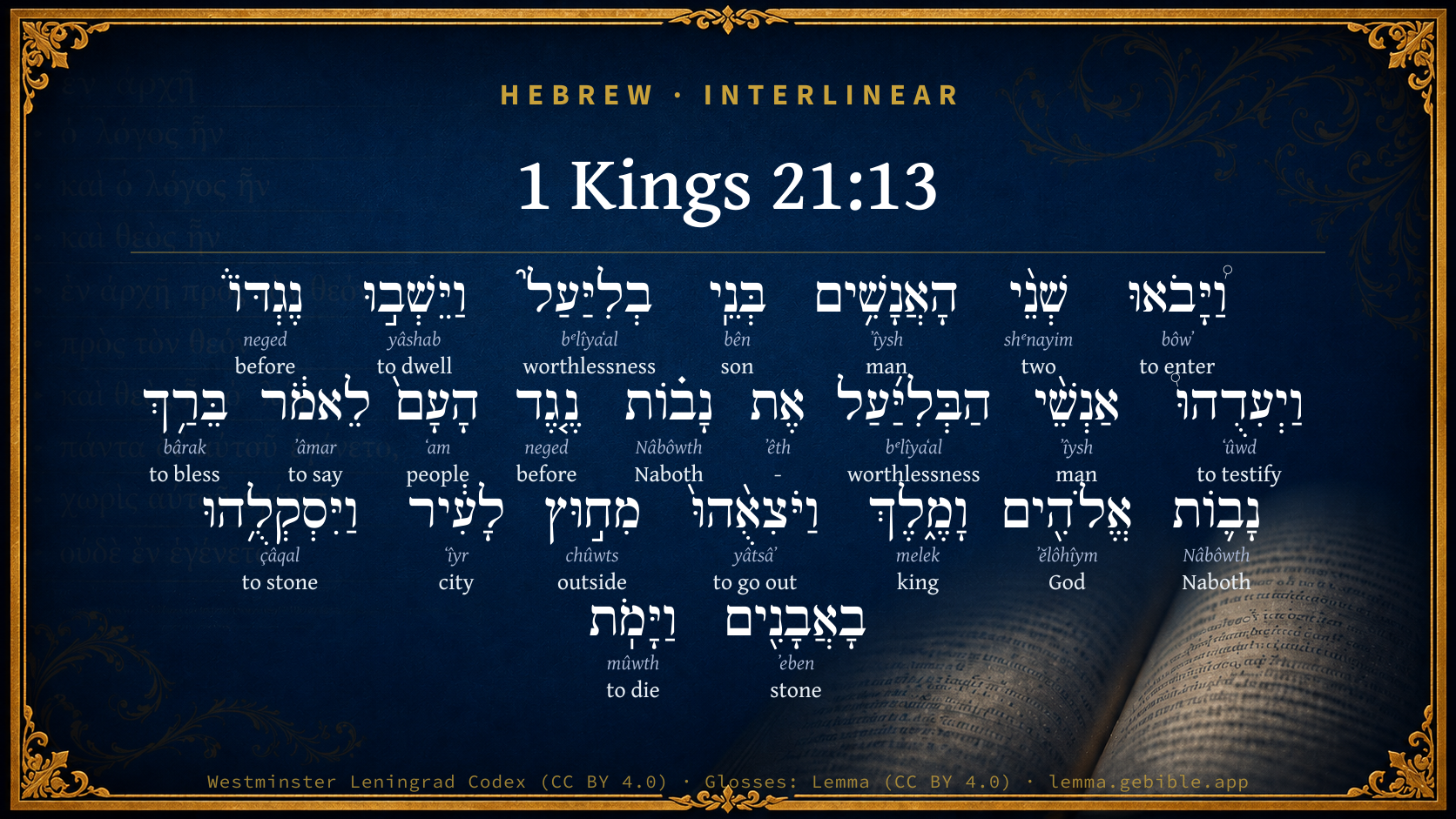
Hebrew (Westminster Leningrad Codex) 1 Kings 21:13 appears in the Hebrew Old Testament. The text above is from the Westminster Leningrad Codex. Each word links to its Strong’s number, a concise gloss, and parsing drawn from the Open Scriptures Hebrew Bible morphology. Click any word for its full Brown-Driver-Briggs (BDB) entry.
Download image
Cite this verse

1 Kings 21:13 (World English Bible). Public Domain. Lemma interlinear Bible study tool, https://lemma.gebible.app/v/1-kings/21/13.

Show BibTeX & RIS
BibTeX
RIS
English Translation
The two men, the base fellows, came in and sat before him: and the base fellows bore witness against him, even against Naboth, in the presence of the people, saying, Naboth did curse God and the king. Then they carried him forth out of the city, and stoned him to death with stones.
World English Bible · Public Domain
Download a study sheet

One document with this verse’s original text, its word-by-word gloss line, the meaning frame, cross-references with their text, attributed commentary, and full source and license credits — printable, and it pastes into notes with its structure intact.

This verse Autodidact and up

Study sheet (.html) Plain text (.txt)

A passage Seminary Student

Up to 50 verses in one chapter. A passage sheet keeps up to 6 commentary sources and 12 cross-references per verse, in the order this page ranks them, and says so on the sheet whenever that leaves anything out. Ask for a single verse and you get the Autodidact verse sheet above.

Everything on this page stays free to read, with no account — the sheet is a download of what is already on screen, not access to it.

Want to remove ads? Support Godless Engineer
Compare translations 3

The same verse in 3 English versions, stacked beneath the original-language interlinear above. Click any original word for its lexicon entry.

Each is an independent rendering of the whole verse — the interlinear is not word-aligned to these translations.

Highlighted words mark where these versions differ — a whole-verse word diff, not a word-by-word alignment.

  • World English Bible Public Domain
    The two men, the base fellows, came in and sat before him: and the base fellows bore witness against him, even against Naboth, in the presence of the people, saying, Naboth did curse God and the king. Then they carried him forth out of the city, and stoned him to death with stones.
  • King James Version Public Domain
    And there came in two men, children of Belial, and sat before him: and the men of Belial witnessed against him, even against Naboth, in the presence of the people, saying, Naboth did blaspheme God and the king. Then they carried him forth out of the city, and stoned him with stones, that he died.
  • unfoldingWord Literal Text CC BY-SA 4.0
    And the two men came, the sons of wickedness, and they sat in front of him, and the men of wickedness witnessed against Naboth in front of the people, saying, “Naboth blessed God and the king.” And they brought him to the outside of the city, and they stoned him with stones, and he died.

unfoldingWord Literal Text — © unfoldingWord, licensed CC BY-SA 4.0. Word-aligned USFM3 via Door43 (git.door43.org/unfoldingWord/en_ult).

Versions to compare (up to 4)

3 of 4 selected

Show all 18 translations

Every available English version of this verse, each an independent rendering of the whole verse.

  • World English Bible Public Domain
    The two men, the base fellows, came in and sat before him: and the base fellows bore witness against him, even against Naboth, in the presence of the people, saying, Naboth did curse God and the king. Then they carried him forth out of the city, and stoned him to death with stones.
  • Berean Standard Bible Public Domain
    And the two scoundrels came in and sat opposite Naboth, and these men testified against him before the people, saying, “Naboth has cursed both God and the king!” So they took him outside the city and stoned him to death.
  • Majority Standard Bible Public Domain
    And the two scoundrels came in and sat opposite Naboth, and these men testified against him before the people, saying, “Naboth has cursed both God and the king!” So they took him outside the city and stoned him to death.
  • King James Version Public Domain
    And there came in two men, children of Belial, and sat before him: and the men of Belial witnessed against him, even against Naboth, in the presence of the people, saying, Naboth did blaspheme God and the king. Then they carried him forth out of the city, and stoned him with stones, that he died.
  • American Standard Version (1901) Public Domain
    And the two men, the base fellows, came in and sat before him: and the base fellows bare witness against him, even against Naboth, in the presence of the people, saying, Naboth did curse God and the king. Then they carried him forth out of the city, and stoned him to death with stones.
  • Revised Version (1885) Public Domain
    And the two men, sons of Belial, came in and sat before him: and the men of Belial bare witness against him, even against Naboth, in the presence of the people, saying, Naboth did curse God and the king. Then they carried him forth out of the city, and stoned him with stones, that he died.
  • Geneva Bible (1599) Public Domain
    And there came two wicked men, and sate before him: and the wicked men witnessed against Naboth in the presence of the people saying, Naboth did blaspheme God and the King. Then they caried him away out of the citie, and stoned him with stones, that he dyed.
  • Douay-Rheims (1899) Public Domain
    And bringing two men, sons of the devil, they made them sit against him: and they, like men of the devil, bore witness against him before the people, saying: Naboth hath blasphemed God and the king: wherefore they brought him forth without the city, and stoned him to death.
  • Young's Literal Translation Public Domain
    and two men -- sons of worthlessness -- come in, and sit over-against him, and the men of worthlessness testify of him, even Naboth, before the people, saying, `Naboth blessed God and Melech;' and they take him out to the outside of the city, and stone him with stones, and he dieth;
  • Literal Standard Version CC BY-SA 4.0
    and two men—sons of worthlessness—come in, and sit opposite him, and the men of worthlessness testify of him, even Naboth, before the people, saying, “Naboth blessed [[or cursed]] God and [the] king”; and they take him out to the outside of the city, and stone him with stones, and he dies;
  • Unlocked Literal Bible CC BY-SA 4.0
    The two dishonest men came in and sat before Naboth; they testified against Naboth in the presence of the people, saying, “Naboth cursed both God and the king.” Then they carried him out of the city and stoned him to death.
  • unfoldingWord Literal Text CC BY-SA 4.0
    And the two men came, the sons of wickedness, and they sat in front of him, and the men of wickedness witnessed against Naboth in front of the people, saying, “Naboth blessed God and the king.” And they brought him to the outside of the city, and they stoned him with stones, and he died.
  • Darby Bible Public Domain
    And there came the two men, sons of Belial, and sat before him; and the men of Belial witnessed against him, against Naboth, in the presence of the people, saying, Naboth blasphemed God and the king. And they carried him forth out of the city, and stoned him with stones, that he died.
  • World Messianic Bible Public Domain
    The two men, the wicked fellows, came in and sat before him. The wicked fellows testified against him, even against Naboth, in the presence of the people, saying, “Naboth cursed God and the king!” Then they carried him out of the city and stoned him to death with stones.
  • Webster's Bible Public Domain
    And there came in two men, children of Belial, and sat before him: and the men of Belial witnessed against him, even against Naboth, in the presence of the people, saying, Naboth blasphemed God and the king. Then they carried him forth out of the city, and stoned him with stones, that he died.
  • Free Bible Version CC BY-SA 4.0
    Two bad men came and sat opposite him, and accused him in front of the people, saying, “Naboth has cursed God and the king.” So they took him outside the town and stoned him to death.
  • Bible in Basic English Public Domain
    And the two good-for-nothing persons came in and took their seats before him and gave witness against Naboth, in front of the people, saying, Naboth has been cursing God and the king. Then they took him outside the town and had him stoned to death.
  • JPS Tanakh (1917) Public Domain
    And the two men, the base fellows, came in and sat before him; and the base fellows bore witness against him, even against Naboth, in the presence of the people, saying: 'Naboth did curse God and the king.' Then they carried him forth out of the city, and stoned him with stones, that he died.

Literal Standard Version (2020), Covenant Press — licensed CC BY-SA 4.0. Text via the HelloAO Bible API (eBible.org). Unlocked Literal Bible (unfoldingWord) — licensed CC BY-SA 4.0. Text via the HelloAO Bible API (eBible.org). unfoldingWord Literal Text — © unfoldingWord, licensed CC BY-SA 4.0. Word-aligned USFM3 via Door43 (git.door43.org/unfoldingWord/en_ult). Free Bible Version, Dr. Jonathan Gallagher — licensed CC BY-SA 4.0. Text via the HelloAO Bible API (eBible.org).

Word by word

More ways to search: Search by grammar → Find every occurrence → Compare this word →

Practice this passage: Drill this verse → Learn its vocabulary →

נָב֗וֹת
Nâbôwth
H5022
“Naboth”
Noun, Proper
Part of Speech
Noun
Type
Proper
Full BDB Definition

Origin: from the same as H5011

TWOT: None

Naboth = "fruits" - the vineyard owner of Jezreel who Ahab and Jezebel had killed so that they could have his vineyard
  1. וַ֠יָּבֹאוּ bôwʼ H935 “and · to enter” Conjunction + Verb, Qal, Sequential Imperfect, 3rd Person, Masculine, Plural
  2. שְׁנֵ֨י shᵉnayim H8147 “two” Adjective, Cardinal number, Masculine, Dual, Construct
  3. הָאֲנָשִׁ֥ים ʼîysh H376 “the · men” Particle, Definite Article + Noun, Common, Masculine, Plural, Absolute
  4. בְּנֵֽי bên H1121 “sons of” Noun, Common, Masculine, Plural, Construct
  5. בְלִיַּעַל֮ bᵉlîyaʻal H1100 “worthlessness” Noun, Common, Masculine, Singular, Absolute
  6. וַיֵּשְׁב֣וּ yâshab H3427 “and · to dwell” Conjunction + Verb, Qal, Sequential Imperfect, 3rd Person, Masculine, Plural
  7. נֶגְדּוֹ֒ neged H5048 “before · him” Preposition + Suffix, Personal, 3rd Person, Masculine, Singular
  8. וַיְעִדֻהוּ֩ ʻûwd H5749 “and · to testify · him” Conjunction + Verb, Hiphil, Sequential Imperfect, 3rd Person, Masculine, Plural + Suffix, Personal, 3rd Person, Masculine, Singular
  9. אַנְשֵׁ֨י ʼîysh H376 “men of” Noun, Common, Masculine, Plural, Construct
  10. הַבְּלִיַּ֜עַל bᵉlîyaʻal H1100 “the · worthlessness” Particle, Definite Article + Noun, Common, Masculine, Singular, Absolute
  11. אֶת ʼêth H853 “-” Particle, Direct Object
  12. נֶ֤גֶד neged H5048 “before” Preposition
  13. הָעָם֙ ʻam H5971 “the · people” Particle, Definite Article + Noun, Common, Masculine, Singular, Absolute
  14. לֵאמֹ֔ר ʼâmar H559 “to say” Preposition + Verb, Qal, Infinitive Construct
  15. בֵּרַ֥ךְ bârak H1288 “to bless” Verb, Piel, Perfect, 3rd Person, Masculine, Singular
  16. נָב֛וֹת Nâbôwth H5022 “Naboth” Noun, Proper
  17. אֱלֹהִ֖ים ʼĕlôhîym H430 “God(s)” Noun, Common, Masculine, Plural, Absolute
  18. וָמֶ֑לֶךְ melek H4428 “and · king” Conjunction + Noun, Common, Masculine, Singular, Absolute
  19. וַיֹּצִאֻ֨הוּ֙ yâtsâʼ H3318 “and · to go out · him” Conjunction + Verb, Hiphil, Sequential Imperfect, 3rd Person, Masculine, Plural + Suffix, Personal, 3rd Person, Masculine, Singular
  20. מִח֣וּץ chûwts H2351 “from · outside” Preposition + Noun, Common, Masculine, Singular, Absolute
  21. לָעִ֔יר ʻîyr H5892 “to/for the · city” Preposition, Determined + Noun, Common, Feminine, Singular, Absolute
  22. וַיִּסְקְלֻ֥הוּ çâqal H5619 “and · to stone · him” Conjunction + Verb, Qal, Sequential Imperfect, 3rd Person, Masculine, Plural + Suffix, Personal, 3rd Person, Masculine, Singular
  23. בָאֲבָנִ֖ים ʼeben H68 “in/at the · stones” Preposition, Determined + Noun, Common, Feminine, Plural, Absolute
  24. וַיָּמֹֽת mûwth H4191 “and · to die” Conjunction + Verb, Qal, Sequential Imperfect, 3rd Person, Masculine, Singular

About this verse

These counts appear in no published source. They are computed here, from the morphology-tagged text and Lemma’s own curated glosses. What Lemma adds →

25
words
21
distinct lemmas
Historical
section

Notable vocabulary

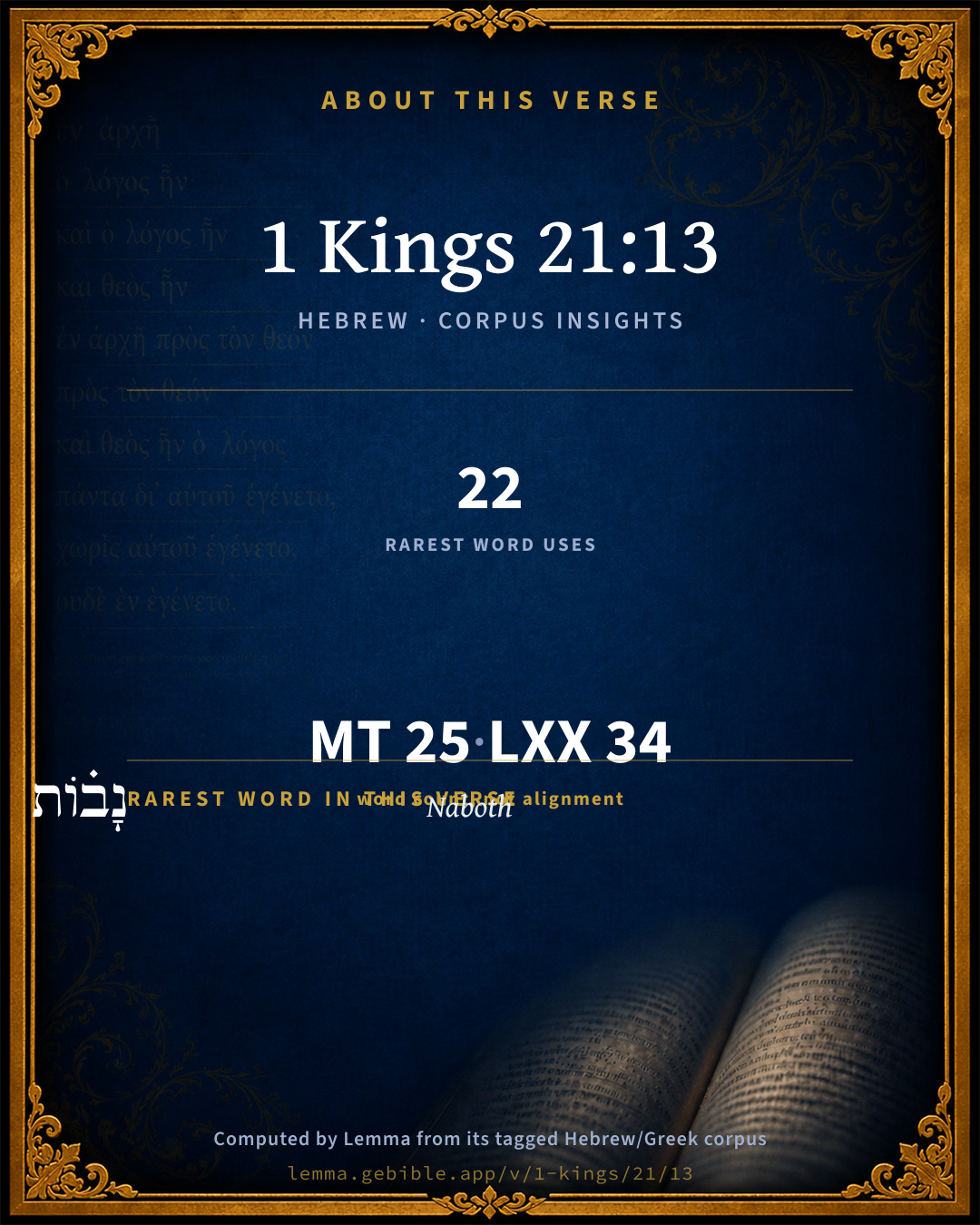
The rarest word here is נָב֗וֹת Naboth H5022 — appearing just 22 times in the whole Hebrew Bible.

Shared distinctive vocabulary

נָב֗וֹת Naboth H5022 occurs in 18 verses of the Hebrew Bible. Also found in:

Grammatical profile

  • 8 verbs
  • 13 nouns
  • 1 adjective
  • 2 prepositions
  • 1 particle

Verb forms

  • וַ֠יָּבֹאוּ Qal · Sequential Imperfect
  • וַיֵּשְׁב֣וּ Qal · Sequential Imperfect
  • וַיְעִדֻהוּ֩ Hiphil · Sequential Imperfect
  • לֵאמֹ֔ר Qal · Infinitive Construct
  • בֵּרַ֥ךְ Piel · Perfect
  • וַיֹּצִאֻ֨הוּ֙ Hiphil · Sequential Imperfect
  • וַיִּסְקְלֻ֥הוּ Qal · Sequential Imperfect
  • וַיָּמֹֽת Qal · Sequential Imperfect

Repetition

Words recur within this verse — often emphatic in Hebrew:

  • הָאֲנָשִׁ֥ים man H376 ×2
  • בְלִיַּעַל֮ worthlessness H1100 ×2
  • נֶגְדּוֹ֒ before H5048 ×2
  • נָב֗וֹת Naboth H5022 ×2

Hebrew & Septuagint length

In English translation the verse runs 53 words from the Hebrew and 40 from the Septuagint (LXX English) — closely comparable.

A rough comparison of the two English renderings, which tokenize alike — not a word-level alignment.

Word counts can differ between the Hebrew and the Greek without any difference in meaning — e.g. the Hebrew direct-object marker אֵת has no separate Greek word, and Greek often adds the article ὁ.

In the original languages it is 25 Hebrew tokens and 34 Greek tokens — but the two are counted differently (Hebrew bundles its prefixes and suffixes into one token; the Greek is in lemma form), so that isn’t a like-for-like length.

Cross-references

32

Topical passages linked to 1 Kings 21:13 in the Treasury of Scripture Knowledge — connected by theme and wording, ordered by reader-vote popularity; previews shown in the World English Bible.

  • 2 Kings 9:26 Surely I have seen yesterday the blood of Naboth, and the blood of his sons, says Yahweh; and I will requite you in this plat, says Yahweh. Now therefore take and cast him into the plat [of ground], according to the word of Yahweh.
  • Exodus 20:16 "You shall not give false testimony against your neighbor.
  • Leviticus 24:11–16 The son of the Israelite woman blasphemed the Name, and cursed; and they brought him to Moses. His mother's name was Shelomith, the daughter of Dibri, of the tribe of Dan.
  • Numbers 15:35–36 Yahweh said to Moses, The man shall surely be put to death: all the congregation shall stone him with stones outside of the camp.
  • Deuteronomy 5:20 "Neither shall you give false testimony against your neighbor.
  • Deuteronomy 13:10 You shall stone him to death with stones, because he has sought to draw you away from Yahweh your God, who brought you out of the land of Egypt, out of the house of bondage.
  • Deuteronomy 19:16–21 If an unrighteous witness rise up against any man to testify against him of wrong-doing,
  • Deuteronomy 21:21 All the men of his city shall stone him to death with stones: so shall you put away the evil from the midst of you; and all Israel shall hear, and fear.
  • Deuteronomy 22:21 then they shall bring out the young lady to the door of her father's house, and the men of her city shall stone her to death with stones, because she has done folly in Israel, to play the prostitute in her father's house: so shall you put away the evil from the midst of you.
  • Deuteronomy 22:24 then you shall bring them both out to the gate of that city, and you shall stone them to death with stones; the lady, because she didn't cry, being in the city; and the man, because he has humbled his neighbor's wife: so you shall put away the evil from the midst of you.
  • Joshua 7:24–25 Joshua, and all Israel with him, took Achan the son of Zerah, and the silver, and the mantle, and the wedge of gold, and his sons, and his daughters, and his oxen, and his donkeys, and his sheep, and his tent, and all that he had: and they brought them up to the valley of Achor.
  • Job 1:5 It was so, when the days of their feasting had run their course, that Job sent and sanctified them, and rose up early in the morning, and offered burnt offerings according to the number of them all. For Job said, "It may be that my sons have sinned, and renounced God in their hearts." Thus did Job continually.
  • Job 1:11 But put forth your hand now, and touch all that he has, and he will renounce you to your face."
  • Job 2:9 Then his wife said to him, "Do you still maintain your integrity? Renounce God, and die."
  • Psalms 27:12 Don't deliver me over to the desire of my adversaries, For false witnesses have risen up against me, Such as breathe out cruelty.
  • Psalms 35:11 Unrighteous witnesses rise up. They ask me about things that I don't know about.
  • Proverbs 6:19 A false witness who utters lies, And he who sows discord among brothers.
  • Proverbs 19:5 A false witness shall not be unpunished. He who pours out lies shall not go free.
  • Proverbs 19:9 A false witness shall not be unpunished. He who utters lies shall perish.
  • Proverbs 25:18 A man who gives false testimony against his neighbor Is like a club, a sword, or a sharp arrow.
  • Ecclesiastes 4:1 Then I returned and saw all the oppressions that are done under the sun: and, behold, the tears of those who were oppressed, and they had no comforter; and on the side of their oppressors there was power; but they had no comforter.
  • Ecclesiastes 10:20 Don't curse the king, no, not in your thoughts; And don't curse the rich in your bedchamber: For a bird of the sky may carry your voice, And that which has wings may tell the matter.
  • Isaiah 8:21 They shall pass through it, sore distressed and hungry; and it shall happen that when they shall be hungry, they shall fret themselves, and curse by their king and by their God, and turn their faces upward:
  • Amos 7:10 Then Amaziah the priest of Beth El sent to Jeroboam king of Israel, saying, "Amos has conspired against you in the midst of the house of Israel. The land is not able to bear all his words.
  • Malachi 3:5 I will come near to you to judgment; and I will be a swift witness against the sorcerers, and against the adulterers, and against the perjurers, and against those who oppress the hireling in his wages, the widow, and the fatherless, and who deprive the foreigner of justice, and don't fear me," says Yahweh of Hosts.
  • Matthew 9:3 Behold, some of the scribes said to themselves, "This man blasphemes."
  • Mark 14:56–59 For many gave false testimony against him, and their testimony didn't agree with each other.
  • Luke 23:2 They began to accuse him, saying, "We found this man perverting the nation, forbidding paying taxes to Caesar, and saying that he himself is Christ, a king."
  • John 19:12 At this, Pilate was seeking to release him, but the Jews cried out, saying, "If you release this man, you aren't Caesar's friend! Everyone who makes himself a king speaks against Caesar!"
  • Acts 6:11 Then they secretly induced men to say, "We have heard him speak blasphemous words against Moses and God."
  • Acts 7:57–59 But they cried out with a loud voice, and stopped their ears, and rushed at him with one accord.
  • Acts 24:5 For we have found this man to be a plague, an instigator of insurrections among all the Jews throughout the world, and a ringleader of the sect of the Nazarenes.

Cross-references courtesy of OpenBible.info (CC BY 4.0).

Hebrew and Greek witnesses Masoretic Hebrew ↔ Greek Septuagint

The same verse in the two great witnesses to the Old Testament, shown verse-for-verse.

These are two independent witnesses, not word-aligned to each other, and the Septuagint is shown in lemma (dictionary) form.

Hebrew 1 Kings 21:13 Masoretic · Westminster Leningrad Codex

וַ֠יָּבֹאוּ שְׁנֵ֨י הָאֲנָשִׁ֥ים בְּנֵֽי בְלִיַּעַל֮ וַיֵּשְׁב֣וּ נֶגְדּוֹ֒ וַיְעִדֻהוּ֩ אַנְשֵׁ֨י הַבְּלִיַּ֜עַל אֶת נָב֗וֹת נֶ֤גֶד הָעָם֙ לֵאמֹ֔ר בֵּרַ֥ךְ נָב֛וֹת אֱלֹהִ֖ים וָמֶ֑לֶךְ וַיֹּצִאֻ֨הוּ֙ מִח֣וּץ לָעִ֔יר וַיִּסְקְלֻ֥הוּ בָאֲבָנִ֖ים וַיָּמֹֽת

The two men, the base fellows, came in and sat before him: and the base fellows bore witness against him, even against Naboth, in the presence of the people, saying, Naboth did curse God and the king. Then they carried him forth out of the city, and stoned him to death with stones.

World English Bible · Public Domain

Greek LXX 1 Kings 21:13 Septuagint · lemma form

καί ἰδού προφήτης εἷς προςἔρχομαι ὁ βασιλεύς ἰσραήλ καί εἶπον ὅδε λέγω κύριος εἰ ὁράω πᾶς ὁ ὄχλος ὁ μέγας οὗτος ἰδού ἐγώ δίδωμι αὐτός σήμερον εἰς χείρ σός καί γιγνώσκω ὅτι ἐγώ κύριος

And, behold, a prophet came to Achaab king of Israel, and said, Thus says the Lord, Have you seen this great multitude? behold, I give it this day into your hands; and you shall know that I am the Lord.

LXX2012 (modern English Septuagint) · Public Domain

On this verse, The Cambridge Bible for Schools and Colleges discusses the Septuagint’s reading. Read the note in Commentary ↓

Hebrew: Westminster Leningrad Codex (CC BY 4.0). Greek: Septuagint (public domain); English from LXX2012 (modern English Septuagint) (Public Domain). How the Septuagint differs from the Hebrew →

Targum (Aramaic paraphrase)

1

The Targum is the ancient Jewish Aramaic paraphrase of the Hebrew Scriptures — an interpretive translation, not the Hebrew text itself. Onkelos (literal) and Pseudo-Jonathan (expansive) render the Torah, and Jonathan the Prophets. Coverage is partial: where no permissively-licensed English translation exists for a verse, only the Aramaic is shown. This is verse-level text, not a word-by-word alignment to the Hebrew.

  1. Targum Jonathan Prophets (Joshua–Malachi)
    וַאֲתוֹ תְּרֵין גַבְרִין בְּנֵי רִשְׁעָא וִיתִיבוּ לְקִבְלֵיהּ וְאַסְהִידוּ גַבְרֵי רִשְׁעָא יַת נָבוֹת קֳדָם עַמָא לְמֵימַר גַדִיף נָבוֹת קֳדָם יְיָ וּמַלְכָּא לָט וְאַפְקוֹהִי מִבָּרָא לְקַרְתָּא וְרַגְמוֹהִי בְּאַבְנַיָא וּמִית:

    (no public-domain English translation for this verse)

    Targum Jonathan — Aramaic: “Mikraot Gedolot” (public domain). English: “Sefaria Community Translation” (CC0 1.0 (public-domain dedication)); “London "Chaldee Paraphrase," 1871” (public domain). Text via Sefaria.

Commentary

Notes on 1 Kings 21:13 from classic Christian and Jewish commentators (each source and its license shown beneath its notes). The classic Christian expositions comment on the surrounding passage and are grouped to its opening verse, so a note may address several verses; the Jewish commentaries on the Tanakh (Rashi and others) are per-verse, so they appear only where the commentator wrote on this verse.

Lemma curates 59 commentaries, every one of them public domain or Creative Commons licensed, each selected and text-cleaned for this edition rather than reprinted as found. About our sources →

Trapp's Complete Commentary

John Trapp

1Ki 21:13 And there came in two men, children of Belial, and sat before him: and the men of Belial witnessed against him, [even] against Naboth, in the presence of the people, saying, Naboth did blaspheme God and the king. Then they carried him forth out of the city, and stoned him with stones, that he died.

Ver. 13. And stoned him with stones.] Among many others - for treason was ever unicum crimea eorum qui crimine vacabant {a} - we read in the martyrologies of one John Cowper, who, like another Naboth, was hanged in Queen Mary’s days for a traitor, upon false accusation. But if Naboth had been guilty, what reason was there that his sons should also suffer death with him? as it appeareth they did, {2Ki 9:26} against an express law. {Deu 24:16} Was it because Jezebel would never suffer a rub to lie in the way, that might hinder the true running of her bowl?

{a} Tacit.

John Trapp, A Commentary or Exposition upon All the Books of the Old and New Testament (1647–1656) — public domain. Text from a community e-Sword module.

Joseph Benson's Commentary

1Ki 21:13. They stoned him — And, it seems, his sons too, either with him, or after him; for God afterward says, (2Ki 9:26,) I have seen the blood of Naboth, and the blood of his sons. Let us commit the keeping of our lives and comforts to God, for innocence itself will not always be our security. This account of Ahab’s unjust and barbarous conduct toward Naboth, placed, as it is by the sacred historian, immediately after his gentle treatment of Ben-hadad, shows the great inconsistency and extreme wickedness of his conduct. He spares the proud, boasting, and blaspheming heathen, and even terms him his brother, and honours him by taking him into his chariot; nay, and enters into a covenant with him: but he basely and barbarously murders, or, at least, connives at his wife’s murdering, the just and pious Israelite; and that under colour of justice, and with the formalities of a legal process! which was a great aggravation of the crime. For, to use that power for the preservation of the guilty and the murdering of the innocent, which ought to have been used for the punishment of the former and the protection of the latter, was such a violent perversion of justice and judgment, as cannot easily be paralleled. But there is a judgment to come when such iniquitous judgments as these will be called over again!

Joseph Benson's Commentary on the Old and New Testaments (1811–1818) — public domain. Text from a community e-Sword module.

Tyndale Open Study Notes

Tyndale Open Resources

21:13-14 As with Achan (Josh 7:24-26), Naboth’s sons were killed at the same time (see 2 Kgs 9:26), in this case to prevent the property from passing on to them. Because the charge carried the penalty of state execution (Deut 13:10-11; 17:5) and because Naboth no longer had male heirs, Ahab exercised the royal prerogative of confiscating the property (see 1 Sam 8:14).

Tyndale Open Study Notes — © Tyndale Open Resources, licensed CC BY-SA 4.0. Text via the HelloAO Bible API.

Geneva Bible (1599)

Geneva Bible translators

Hebrew, bless.

Geneva Bible (1599) marginal notes — public domain. Text via Bolls.life.

Jamieson, Fausset & Brown

Robert Jamieson, A. R. Fausset & David Brown

there came in two men--worthless fellows who had been bribed to swear a falsehood. The law required two witnesses in capital offenses (Deu 17:6; Deu 19:15; Num 35:30; Mat 26:60). Cursing God and cursing the king are mentioned in the law (Exo 22:28) as offenses closely connected, the king of Israel being the earthly representative of God in His kingdom.

they carried him forth out of the city, and stoned him--The law, which forbade cursing the rulers of the people, does not specify the penalty for this offense but either usage had sanctioned or the authorities of Jezreel had originated stoning as the proper punishment. It was always inflicted out of the city (Act 7:58).

Jamieson, Fausset & Brown — Commentary Critical and Explanatory on the Whole Bible (1871) — public domain (CC PDM 1.0). Text via the HelloAO Bible API.

Adam Clarke's Commentary

Verse 13. And stoned him with stones] As they pretended to find him guilty of treason against God and the king, it is likely they destroyed the whole of his family; and then the king seized on his grounds as confiscated, or as escheated to the king, without any heir at law. That his family was destroyed appears strongly intimated, 2Kg 9:26; Surely I have seen yesterday the blood of Naboth, AND THE BLOOD OF HIS SONS, saith the Lord.

Adam Clarke's Commentary on the Bible (1810–1826) — public domain. Text from a community e-Sword/MySword module.

Ellicott's Commentary for English Readers

(13) Carried him forth—as usual, in order to avoid polluting the city with blood—possibly to his own ground, the coveted vineyard itself.

A Bible Commentary for English Readers, edited by Charles John Ellicott (1878–1897) — public domain. Text from a community e-Sword module.

The Cambridge Bible for Schools and Colleges

gen. ed. J. J. S. Perowne

13. And there came in two men, children of Belial] R.V. And the two men, sons of Belial, came in. The Hebrew noun is definite and the sense requires that it should be indicated.

witnessed] R.V. bare witness. As in 1Ki_21:10.

even against Naboth, in the presence of the people] These words are omitted by the LXX. As much publicity as possible was given to the accusation, that thus it might have the colour of being legally carried out.

did blaspheme] R.V. did curse. The word is the same as in 1Ki_21:10. But a different word is used for ‘blaspheme’ in Lev_24:16.

they carried him forth out of the city] This explains what is meant by ‘carry him out’ in 1Ki_21:10. The place of execution was to be outside the walls, according to the legal ordinance (Lev_24:14), ‘Bring forth him that hath cursed without the camp … and let all the congregation stone him.’ From this we see that this enactment was before the Exile.

that he died] Not only was Naboth put to death, but, according to another passage (2Ki_9:26), his sons were included in the destruction.

The Cambridge Bible for Schools and Colleges (gen. ed. J. J. S. Perowne; Cambridge University Press, 1878–1918) — public domain. Text from a community e-Sword module.

John Gill's Exposition

And it came to pass, when Ahab heard that Naboth was dead,.... Of which he was informed by Jezebel:

that Ahab rose up to go down to the vineyard of Naboth the Jezreelite, to take possession of it; if it was in Jezreel, that was sixteen miles from Samaria, and lay lower than that, in a valley, and therefore he is said to go down to it; and which he did very likely in great state and pomp, many of his nobles and captains accompanying him, as we read that Jehu and Bidkar did ride after him at this time, Kg2 9:25.

John Gill's Exposition of the Whole Bible (1746–1763) — public domain (CC PDM 1.0). Text via the HelloAO Bible API.

Albert Barnes' Notes on the Bible

Naboth had sons who were also put to death at this time (marginal reference). It is not improbable that they were stoned together with their parent (compare Jos 7:24-25). In the East, a parent’s guilt constantly involves the punishment of his children. Contrast 2Ki 14:6.

Albert Barnes' Notes on the Bible (1834–1885) — public domain. Text from a community e-Sword/MySword module.

Haydock's Catholic Bible Commentary

Devil. Hebrew Belial, ver. 10. Protestants, "and the men of Belial witnessed against him." --- City, as was requisite. (Calmet) --- Stoned him, for blasphemy, Leviticus xxiv. 16., and 23.

George Leo Haydock (1774–1849), Haydock's Catholic Family Bible and Commentary, 1859 edition — public domain. Excludes Psalms (Douay-Rheims chapter numbering differs from Protestant) and Deuterocanonical books (Catholic canon only).

Matthew Poole's English Annotations

And his sons with him, as may be thought from 2Ki 9:26, that so the king might have an undisturbed possession; for which they might pretend those examples, Num 16:32; Jos 7:24. But these were examples of extraordinary vengeance, and by special warrant from God; and the law of God was positively contrary to it, Deu 24:16.

Matthew Poole's English Annotations on the Holy Bible (1683–1685) — public domain. Text from a community e-Sword/MySword module.

The Pulpit Commentary

And there came in Heb. came. The assembly was probably held al fresco. From the word vma A.V yesterday, but strictly, yesternight, Stanley suggests that the trial took place by night. But the word is often used in the wider sense of "yesterday" (Gesenius) two men, children of Belial, and sat before him: and the men of Belial witnessed against him, even against Naboth, in the presence of the people The whole congregation was interested in a charge of blasphemy. If unpunished, the guilt rested on the congregation. Hence the provision of, Deu_24:14. By the imposition of hands they testified that the guilt of the blasphemer thenceforth rested upon his own head saying, Naboth did blaspheme God and the king. Then they carried him forth Heb. made him to go forth out of the city, and stoned him with stones, that he died. It appears from 2Ki_9:26 that the children of Naboth, who otherwise might have laid claim to their patrimony, were put to death at the same time, and probably in the same way; cf. Jos_7:24, Jos_7:25; Num_16:27. This was the rule of the East. (Dan_6:24) The principle of visiting the sins of the parents upon the children seems to have been carried to an excess, as we find Joash (2Ki_14:6) instituting a more merciful rule.

The Pulpit Commentary (1880–1919), ed. H.D.M. Spence-Jones & Joseph S. Exell — public domain. Text from a community e-Sword module.

John Wesley's Explanatory Notes

Stoned him - And it seems his sons too, either with him or after him. For God afterward says, (2 Kings ix, 26) I have seen the blood of Naboth and the blood of his sons. Let us commit the keeping of our lives and comforts to God; for innocence itself will not always be our security.

John Wesley, Explanatory Notes Upon the Whole Bible (1754–1765) — public domain. Text via the GEBible commentary corpus.

Rashi

Rabbi Shlomo Yitzchaki (Rashi)

Navos cursed. A euphemism for curse. And Targum [Yonoson rendered], Navos blasphemed against God and cursed the king.

Rashi on the Tanakh — English translations: “The Judaica Press complete Tanach with Rashi, translated by A. J. Rosenberg” (CC BY 4.0); “Pentateuch with Rashi's commentary by M. Rosenbaum and A.M. Silbermann, 1929-1934” (public domain); “The Metsudah Tanach series, Lakewood, N.J” (CC BY 4.0); and “The Book of Joshua, Metsudah Publications, 1997” (CC BY 4.0). Text via Sefaria.

Lesson kit

Teaching starters — assembled from the data on this page, not authored interpretation. Every prompt links to the verse data it draws on. Edit before teaching.

1 Kings, in the Historical, opens this verse with 25 words (21 distinct Hebrew lemmas). Its most distinctive word is Nâbôwth (“Naboth”). A historical commentator’s framing appears above. Read the whole chapter for the surrounding context.

Discussion questions

  1. What does “Naboth” (Nâbôwth) contribute to the verse as a whole?
  2. 1 Kings 21:1 shares the word «Naboth» with this verse. How do the two illuminate each other?
  3. “man” occurs 2× in this one verse. What is the effect of the repetition?
  4. The translations on this page render this verse differently — a whole-verse word diff, not a word-by-word alignment. What might account for the different wordings?
  5. The verb «וַ֠יָּבֹאוּ» is Qal Sequential Imperfect. How does its form color the action?
  6. Reading how Trapp's Complete Commentary and Joseph Benson's Commentary read this verse, where do the two commentators agree and where do they part?

Things to notice

Reading settings

Reading text

Shown beneath each verse's original-language words.

Old Testament
Old Testament edition

Read the OT as the Masoretic Hebrew (MT) or the Greek Septuagint (LXX).

English shown for the Greek Septuagint (in the Hebrew ↔ Greek comparison).

Comparing translations? Open the Compare panel on any verse page to stack up to four side by side.