
Deuteronomy 2:14

Hebrew (Westminster Leningrad Codex) Deuteronomy 2:14 appears in the Hebrew Old Testament. The text above is from the Westminster Leningrad Codex. Each word links to its Strong’s number, a concise gloss, and parsing drawn from the Open Scriptures Hebrew Bible morphology. Click any word for its full Brown-Driver-Briggs (BDB) entry.
Download image
Cite this verse

Deuteronomy 2:14 (World English Bible). Public Domain. Lemma interlinear Bible study tool, https://lemma.gebible.app/v/deuteronomy/2/14.

Show BibTeX & RIS
BibTeX
RIS
English Translation
The days in which we came from Kadesh-barnea, until we were come over the brook Zered, were thirty-eight years; until all the generation of the men of war were consumed from the midst of the camp, as Yahweh swore to them.
World English Bible · Public Domain
Download a study sheet

One document with this verse’s original text, its word-by-word gloss line, the meaning frame, cross-references with their text, attributed commentary, and full source and license credits — printable, and it pastes into notes with its structure intact.

This verse Autodidact and up

Study sheet (.html) Plain text (.txt)

A passage Seminary Student

Up to 50 verses in one chapter. A passage sheet keeps up to 6 commentary sources and 12 cross-references per verse, in the order this page ranks them, and says so on the sheet whenever that leaves anything out. Ask for a single verse and you get the Autodidact verse sheet above.

Everything on this page stays free to read, with no account — the sheet is a download of what is already on screen, not access to it.

Want to remove ads? Support Godless Engineer
Compare translations 3

The same verse in 3 English versions, stacked beneath the original-language interlinear above. Click any original word for its lexicon entry.

Each is an independent rendering of the whole verse — the interlinear is not word-aligned to these translations.

Highlighted words mark where these versions differ — a whole-verse word diff, not a word-by-word alignment.

  • World English Bible Public Domain
    The days in which we came from Kadesh-barnea, until we were come over the brook Zered, were thirty-eight years; until all the generation of the men of war were consumed from the midst of the camp, as Yahweh swore to them.
  • King James Version Public Domain
    And the space in which we came from Kadeshbarnea, until we were come over the brook Zered, was thirty and eight years; until all the generation of the men of war were wasted out from among the host, as the LORD sware unto them.
  • unfoldingWord Literal Text CC BY-SA 4.0
    And the days which we came from Kadesh Barnea until we crossed the wadi of Zered 38 years, until all the generation of the men of war were finished from among the camp, as Yahweh had sworn to them.

unfoldingWord Literal Text — © unfoldingWord, licensed CC BY-SA 4.0. Word-aligned USFM3 via Door43 (git.door43.org/unfoldingWord/en_ult).

Versions to compare (up to 4)

3 of 4 selected

Show all 18 translations

Every available English version of this verse, each an independent rendering of the whole verse.

  • World English Bible Public Domain
    The days in which we came from Kadesh-barnea, until we were come over the brook Zered, were thirty-eight years; until all the generation of the men of war were consumed from the midst of the camp, as Yahweh swore to them.
  • Berean Standard Bible Public Domain
    The time we spent traveling from Kadesh-barnea until we crossed over the Brook of Zered was thirty-eight years, until that entire generation of fighting men had perished from the camp, as the LORD had sworn to them.
  • Majority Standard Bible Public Domain
    The time we spent traveling from Kadesh-barnea until we crossed over the Brook of Zered was thirty-eight years, until that entire generation of fighting men had perished from the camp, as the LORD had sworn to them.
  • King James Version Public Domain
    And the space in which we came from Kadeshbarnea, until we were come over the brook Zered, was thirty and eight years; until all the generation of the men of war were wasted out from among the host, as the LORD sware unto them.
  • American Standard Version (1901) Public Domain
    And the days in which we came from Kadesh-barnea, until we were come over the brook Zered, were thirty and eight years; until all the generation of the men of war were consumed from the midst of the camp, as Jehovah sware unto them.
  • Revised Version (1885) Public Domain
    And the days in which we came from Kadesh-barnea, until we were come over the brook Zered, were thirty and eight years; until all the generation of the men of war were consumed from the midst of the camp, as the LORD sware unto them.
  • Geneva Bible (1599) Public Domain
    The space also wherein we came from Kadesh-barnea, vntill we were come ouer the riuer Zered, was eight and thirtie yeeres, vntill all the generation of the men of warre were wasted out from among the hoste, as the Lord sware vnto them.
  • Douay-Rheims (1899) Public Domain
    And the time that we journeyed from Cadesbarne till we passed over the torrent Zared, was thirty-eight years: until all the generation of the men that were fit for war was consumed out of the camp, as the Lord had sworn:
  • Young's Literal Translation Public Domain
    `And the days which we have walked from Kadesh-Barnea until that we have passed over the brook Zered, `are' thirty and eight years, till the consumption of all the generation of the men of battle from the midst of the camp, as Jehovah hath sworn to them;
  • Literal Standard Version CC BY-SA 4.0
    And the days which we have walked from Kadesh-Barnea until we have passed over the Brook of Zered [are] thirty-eight years, until the consumption of all the generation of the men of battle from the midst of the camp, as YHWH has sworn to them;
  • Unlocked Literal Bible CC BY-SA 4.0
    Now the days from when we came from Kadesh Barnea until we crossed the brook Zered, were thirty-eight years. It was by that time that all that generation of the men fit for fighting were gone from the people, as Yahweh had sworn to them.
  • unfoldingWord Literal Text CC BY-SA 4.0
    And the days which we came from Kadesh Barnea until we crossed the wadi of Zered 38 years, until all the generation of the men of war were finished from among the camp, as Yahweh had sworn to them.
  • Darby Bible Public Domain
    Now the days in which we came from Kadesh-barnea, until we had come over the torrent Zered, were thirty-eight years; until the whole generation of the men of war was consumed from the midst of the camp, as Jehovah had sworn unto them.
  • World Messianic Bible Public Domain
    The days in which we came from Kadesh Barnea until we had come over the brook Zered were thirty-eight years, until all the generation of the men of war were consumed from the middle of the camp, as the LORD swore to them.
  • Webster's Bible Public Domain
    And the space in which we came from Kadesh-barnea, until we passed the brook Zered, was thirty and eight years; until all the generation of the men of war were wasted from among the host, as the LORD swore to them.
  • Free Bible Version CC BY-SA 4.0
    The time it took for us to travel from Kadesh-barnea to when we crossed over the Brook of Zered was thirty-eight years. By this time the entire generation of warriors had died and were no longer part of the camp, as the Lord had sworn to them would happen.
  • Bible in Basic English Public Domain
    Thirty-eight years had gone by from the time when we came away from Kadesh-barnea till we went over the stream Zered; by that time all the generation of the men of war among us were dead, as the Lord had said.
  • JPS Tanakh (1917) Public Domain
    And the days in which we came from Kadesh-barnea, until we were come over the brook Zered, were thirty and eight years; until all the generation, even the men of war, were consumed from the midst of the camp, as the LORD swore unto them.

Literal Standard Version (2020), Covenant Press — licensed CC BY-SA 4.0. Text via the HelloAO Bible API (eBible.org). Unlocked Literal Bible (unfoldingWord) — licensed CC BY-SA 4.0. Text via the HelloAO Bible API (eBible.org). unfoldingWord Literal Text — © unfoldingWord, licensed CC BY-SA 4.0. Word-aligned USFM3 via Door43 (git.door43.org/unfoldingWord/en_ult). Free Bible Version, Dr. Jonathan Gallagher — licensed CC BY-SA 4.0. Text via the HelloAO Bible API (eBible.org).

Word by word

More ways to search: Search by grammar → Find every occurrence → Compare this word →

Practice this passage: Drill this verse → Learn its vocabulary →

זֶ֔רֶד
Zered
H2218
“Zered”
Noun, Proper
Part of Speech
Noun
Type
Proper
Full BDB Definition

Origin: from an unused root meaning to be exuberant in growth

TWOT: None

Zered = "osier brook" - a river east of the Jordan, in the region of Moab and Edom, a source of the Arnon river
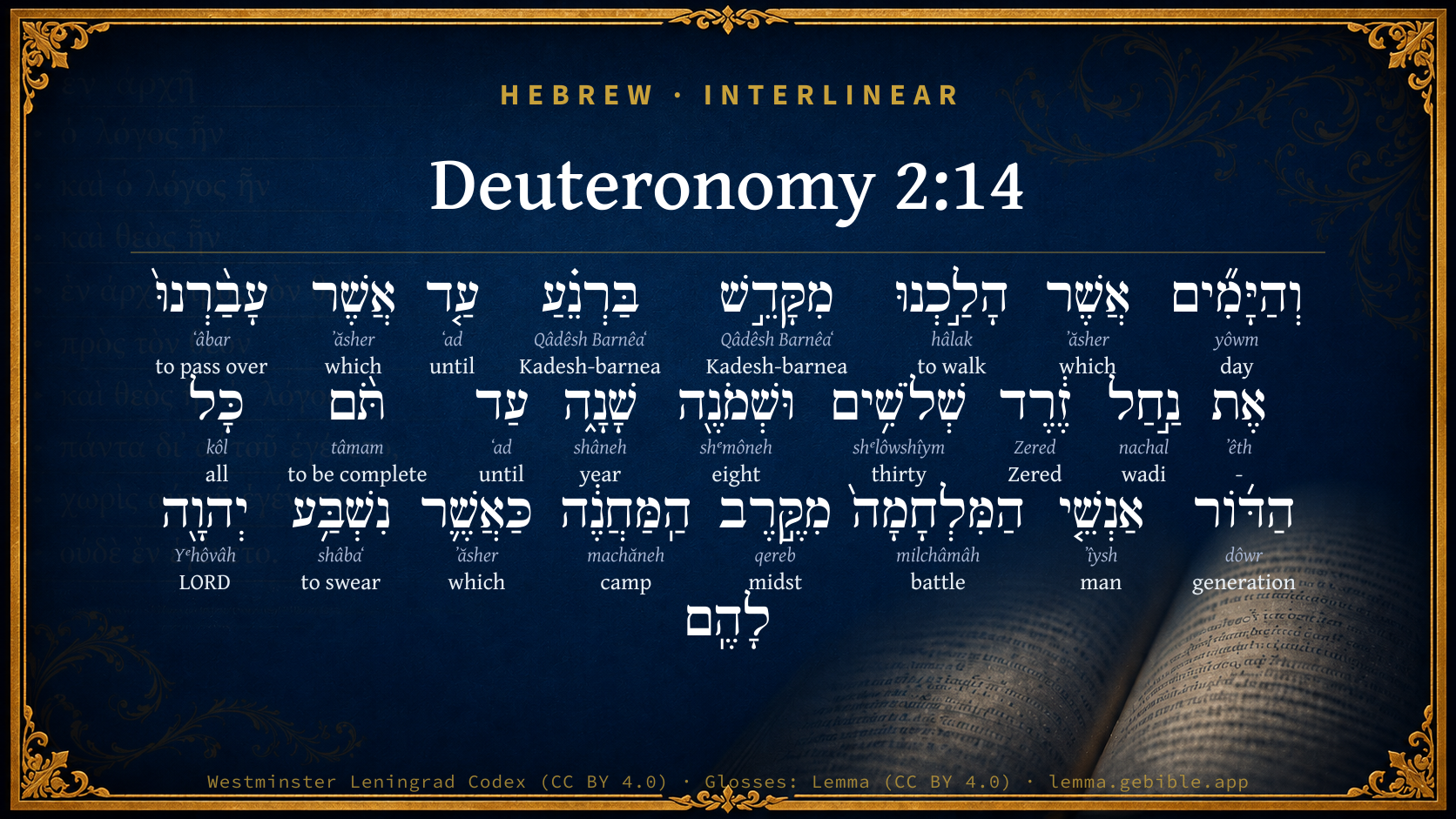
  1. וְהַיָּמִ֞ים yôwm H3117 “and · the · days” Conjunction + Particle, Definite Article + Noun, Common, Masculine, Plural, Absolute
  2. אֲשֶׁר ʼăsher H834 “which” Particle, Relative
  3. הָלַ֣כְנוּ hâlak H1980 “to walk” Verb, Qal, Perfect, 1st Person, Common, Plural
  4. מִקָּדֵ֣שׁ Qâdêsh Barnêaʻ H6947 “from · Kadesh-barnea” Preposition + Noun, Proper
  5. בַּרְנֵ֗עַ Qâdêsh Barnêaʻ H6947 “Kadesh-barnea” Noun, Proper
  6. עַ֤ד ʻad H5704 “until” Preposition
  7. אֲשֶׁר ʼăsher H834 “which” Particle, Relative
  8. עָבַ֨רְנוּ֙ ʻâbar H5674 “to pass over” Verb, Qal, Perfect, 1st Person, Common, Plural
  9. אֶת ʼêth H853 “-” Particle, Direct Object
  10. נַ֣חַל nachal H5158 “wadi of” Noun, Common, Masculine, Singular, Construct
  11. שְׁלֹשִׁ֥ים shᵉlôwshîym H7970 “thirty” Adjective, Cardinal number, Both, Plural, Absolute
  12. וּשְׁמֹנֶ֖ה shᵉmôneh H8083 “and · eight” Conjunction + Adjective, Cardinal number, Feminine, Singular, Absolute
  13. שָׁנָ֑ה shâneh H8141 “year” Noun, Common, Feminine, Singular, Absolute
  14. עַד ʻad H5704 “until” Preposition
  15. תֹּ֨ם tâmam H8552 “to be complete” Verb, Qal, Infinitive Construct
  16. כָּל kôl H3605 “all of” Noun, Common, Masculine, Singular, Construct
  17. הַדּ֜וֹר dôwr H1755 “the · generation” Particle, Definite Article + Noun, Common, Masculine, Singular, Absolute
  18. אַנְשֵׁ֤י ʼîysh H376 “men of” Noun, Common, Masculine, Plural, Construct
  19. הַמִּלְחָמָה֙ milchâmâh H4421 “the · battle” Particle, Definite Article + Noun, Common, Feminine, Singular, Absolute
  20. מִקֶּ֣רֶב qereb H7130 “from · midst of” Preposition + Noun, Common, Masculine, Singular, Construct
  21. הַֽמַּחֲנֶ֔ה machăneh H4264 “the · camp” Particle, Definite Article + Noun, Common, Both, Singular, Absolute
  22. כַּאֲשֶׁ֛ר ʼăsher H834 “like/as · which” Preposition + Particle, Relative
  23. נִשְׁבַּ֥ע shâbaʻ H7650 “to swear” Verb, Niphal, Perfect, 3rd Person, Masculine, Singular
  24. יְהוָ֖ה Yᵉhôvâh H3068 “LORD” Noun, Proper

About this verse

These counts appear in no published source. They are computed here, from the morphology-tagged text and Lemma’s own curated glosses. What Lemma adds →

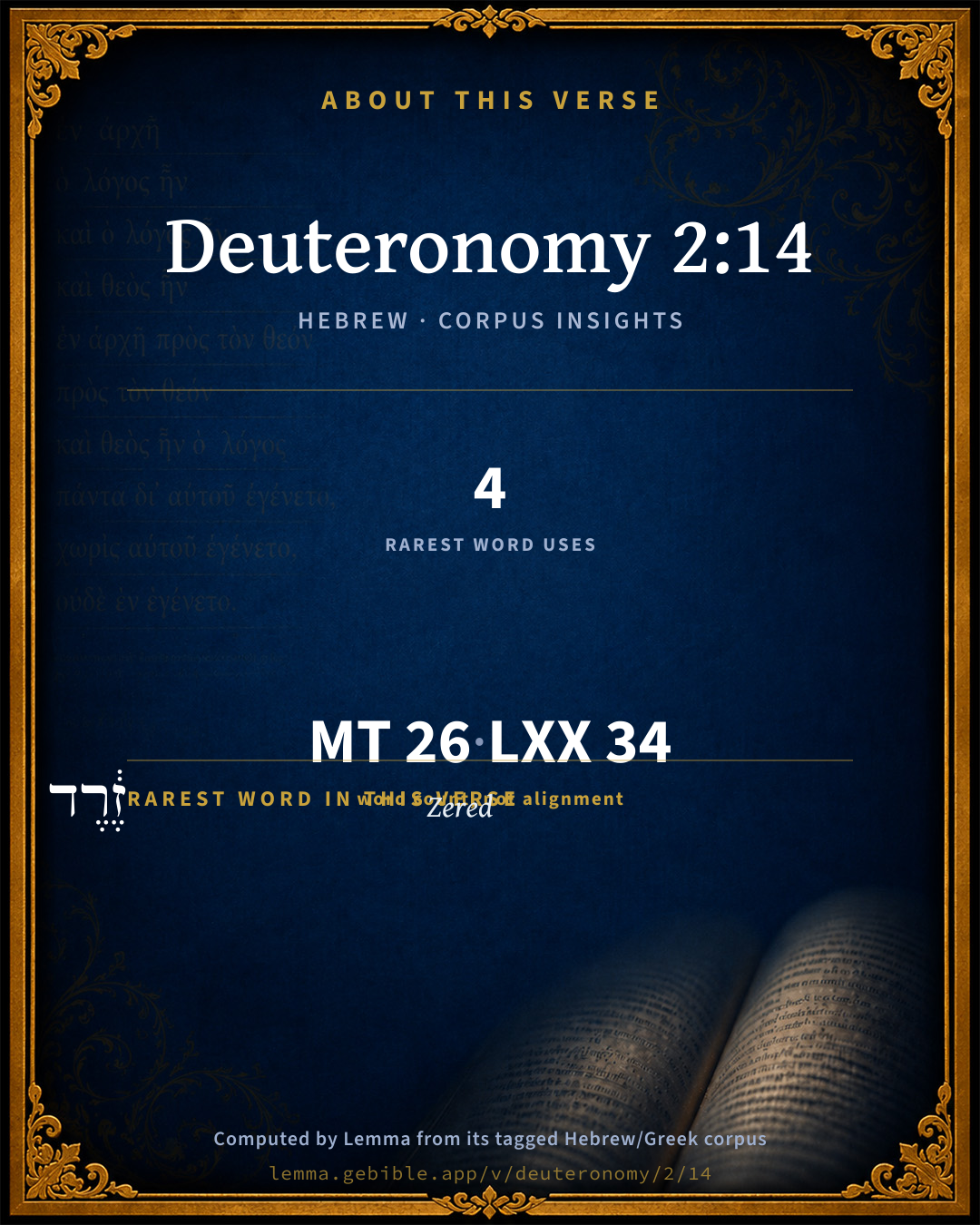
26
words
21
distinct lemmas
Pentateuch
section

Notable vocabulary

The rarest word here is זֶ֔רֶד Zered H2218 — appearing just 4 times in the whole Hebrew Bible.

Shared distinctive vocabulary

זֶ֔רֶד Zered H2218 occurs in 3 verses of the Hebrew Bible. Also found in:

Grammatical profile

  • 4 verbs
  • 13 nouns
  • 2 adjectives
  • 3 prepositions
  • 4 particles

Verb forms

  • הָלַ֣כְנוּ Qal · Perfect
  • עָבַ֨רְנוּ֙ Qal · Perfect
  • תֹּ֨ם Qal · Infinitive Construct
  • נִשְׁבַּ֥ע Niphal · Perfect

Repetition

Words recur within this verse — often emphatic in Hebrew:

  • מִקָּדֵ֣שׁ Kadesh-barnea H6947 ×2
  • עַ֤ד until H5704 ×2
  • אֲשֶׁר which H834 ×3

Hebrew & Septuagint length

In English translation the verse runs 41 words from the Hebrew and 44 from the Septuagint (LXX English) — closely comparable.

A rough comparison of the two English renderings, which tokenize alike — not a word-level alignment.

Word counts can differ between the Hebrew and the Greek without any difference in meaning — e.g. the Hebrew direct-object marker אֵת has no separate Greek word, and Greek often adds the article ὁ.

In the original languages it is 26 Hebrew tokens and 34 Greek tokens — but the two are counted differently (Hebrew bundles its prefixes and suffixes into one token; the Greek is in lemma form), so that isn’t a like-for-like length.

Cross-references

16

Topical passages linked to Deuteronomy 2:14 in the Treasury of Scripture Knowledge — connected by theme and wording, ordered by reader-vote popularity; previews shown in the World English Bible.

  • Numbers 14:28–35 Tell them, As I live, says Yahweh, surely as you have spoken in my ears, so will I do to you:
  • Numbers 26:64–65 But among these there was not a man of them who were numbered by Moses and Aaron the priest, who numbered the children of Israel in the wilderness of Sinai.
  • Deuteronomy 1:34–35 Yahweh heard the voice of your words, and was angry, and swore, saying,
  • Psalms 95:11 Therefore I swore in my wrath, "They won't enter into my rest."
  • Ezekiel 20:15 Moreover also I swore to them in the wilderness, that I would not bring them into the land which I had given them, flowing with milk and honey, which is the glory of all lands;
  • Numbers 13:26 They went and came to Moses, and to Aaron, and to all the congregation of the children of Israel, to the wilderness of Paran, to Kadesh; and brought back word to them, and to all the congregation, and shown them the fruit of the land.
  • Deuteronomy 1:2 It is eleven days' [journey] from Horeb by the way of Mount Seir to Kadesh-barnea.
  • Deuteronomy 1:19 We traveled from Horeb, and went through all that great and terrible wilderness which you saw, by the way to the hill-country of the Amorites, as Yahweh our God commanded us; and we came to Kadesh-barnea.
  • Psalms 106:26 Therefore he swore to them That he would overthrow them in the wilderness,
  • Hebrews 3:8–19 Don't harden your hearts, as in the provocation, Like as in the day of the trial in the wilderness,
  • Numbers 32:11 Surely none of the men who came up out of Egypt, from twenty years old and upward, shall see the land which I swore to Abraham, to Isaac, and to Jacob; because they have not wholly followed me:
  • Deuteronomy 1:46 So you abode in Kadesh many days, according to the days that you abode [there].
  • Psalms 90:3 You turn man to destruction, saying, "Return, you children of men."
  • Psalms 90:9 For all our days have passed away in your wrath. We bring our years to an end as a sigh.
  • 1 Corinthians 10:5 However with most of them, God was not well pleased, for they were overthrown in the wilderness.
  • Jude 1:5 Now I desire to remind you, though you already know this, that the Lord, having saved a people out of the land of Egypt, afterward destroyed those who didn't believe.

Cross-references courtesy of OpenBible.info (CC BY 4.0).

Hebrew and Greek witnesses Masoretic Hebrew ↔ Greek Septuagint

The same verse in the two great witnesses to the Old Testament, shown verse-for-verse.

These are two independent witnesses, not word-aligned to each other, and the Septuagint is shown in lemma (dictionary) form.

Hebrew Deuteronomy 2:14 Masoretic · Westminster Leningrad Codex

וְהַיָּמִ֞ים אֲשֶׁר הָלַ֣כְנוּ מִקָּדֵ֣שׁ בַּרְנֵ֗עַ עַ֤ד אֲשֶׁר עָבַ֨רְנוּ֙ אֶת נַ֣חַל זֶ֔רֶד שְׁלֹשִׁ֥ים וּשְׁמֹנֶ֖ה שָׁנָ֑ה עַד תֹּ֨ם כָּל הַדּ֜וֹר אַנְשֵׁ֤י הַמִּלְחָמָה֙ מִקֶּ֣רֶב הַֽמַּחֲנֶ֔ה כַּאֲשֶׁ֛ר נִשְׁבַּ֥ע יְהוָ֖ה לָהֶֽם

The days in which we came from Kadesh-barnea, until we were come over the brook Zered, were thirty-eight years; until all the generation of the men of war were consumed from the midst of the camp, as Yahweh swore to them.

World English Bible · Public Domain

Greek LXX Deuteronomy 2:14 Septuagint · lemma form

καί ὁ ἡμέρα ὅς παραπορεύομαι ἀπό καδης βαρνη ἕως ὅς παραἔρχομαι ὁ φάραγξ ζαρετ τριάκοντα καί ὀκτώ ἔτος ἕως ὅς διαπίπτω πᾶς γενεά ἀνήρ πολεμιστής ἀποθνήσκω ἐκ ὁ παρεμβολή καθότι ὄμνυμι αὐτός ὁ θεός

And the days in which we traveled from Cades Barne till we crossed the valley of Zaret, were thirty and eight years, until the whole generation of the men of war failed, dying out of the camp, as the Lord God swore to them.

LXX2012 (modern English Septuagint) · Public Domain

Hebrew: Westminster Leningrad Codex (CC BY 4.0). Greek: Septuagint (public domain); English from LXX2012 (modern English Septuagint) (Public Domain). How the Septuagint differs from the Hebrew →

Targum (Aramaic paraphrase)

2

The Targum is the ancient Jewish Aramaic paraphrase of the Hebrew Scriptures — an interpretive translation, not the Hebrew text itself. Onkelos (literal) and Pseudo-Jonathan (expansive) render the Torah, and Jonathan the Prophets. Coverage is partial: where no permissively-licensed English translation exists for a verse, only the Aramaic is shown. This is verse-level text, not a word-by-word alignment to the Hebrew.

  1. Targum Onkelos Torah (Genesis–Deuteronomy)
    וְיוֹמַיָא דִי הַלֶכְנָא מֵרְקַם גֵיאָה עַד דִי עֲבַרְנָא יָת נַחֲלָא דְזֶרֶד תְּלָתִין וְתַמְנֵי שְׁנִין עַד דְסַף כָּל דָרָא גֻבְרֵי מְגִיחֵי קְרָבָא מִגוֹ מַשְׁרִיתָא כְּמָא דִי קַיִים יְיָ לְהוֹן

    (no public-domain English translation for this verse)

    Targum Onkelos — Aramaic: “Onkelos Genesis” (public domain); “Onkelos Exodus” (public domain); “Onkelos Leviticus” (public domain); “Onkelos Numbers” (public domain); “Onkelos Deuteronomy” (public domain). English: “Sefaria Community Translation” (CC0 1.0 (public-domain dedication)); “J.W. Etheridge. The Targums of Onkelos and Jonathan Ben Uzziel on the Pentateuch. London: Longmans, Green, 1862” (public domain). Text via Sefaria.

  2. Targum Pseudo-Jonathan Torah (Genesis–Deuteronomy)
    וְיוֹמַיָא דְהַלִיכְנָא מִן רְקַם גֵּיעָה עַד דְּעָבַרְנָא יַת נַחַל טַרְוַויָא תְּלָתִין וְתַמְנֵי שְׁנִין עַד דְּסַף כָּל דָּרָא גַבְרֵי מַגִּיחֵי קְרָבָא מִגּוֹ מַשְׁרִיתָא הֵיכְמָא דְקַיֵּים יְיָ לְהוֹן

    And the days in which (from the time) we came from Rekem Giah till we crossed the stream of Tarvaja, were thirty and eight years, until all the generation of the men of war were wasted out from the camp, as the Lord had sworn to them.

    Targum Pseudo-Jonathan — Aramaic: “Targum Jonathan on Genesis” (public domain); “Targum Jonathan on Exodus” (public domain); “Targum Jonathan on Leviticus” (public domain); “Targum Jonathan on Numbers” (public domain); “Targum Jonathan on Deuteronomy” (public domain). English: “The Targum of Jonathan ben Uzziel, trans. J. W. Etheridge, London, 1862” (public domain). Text via Sefaria.

Commentary

Notes on Deuteronomy 2:14 from classic Christian and Jewish commentators (each source and its license shown beneath its notes). The classic Christian expositions comment on the surrounding passage and are grouped to its opening verse, so a note may address several verses; the Jewish commentaries on the Tanakh (Rashi and others) are per-verse, so they appear only where the commentator wrote on this verse.

Lemma curates 59 commentaries, every one of them public domain or Creative Commons licensed, each selected and text-cleaned for this edition rather than reprinted as found. About our sources →

Trapp's Complete Commentary

John Trapp

Deu 2:14 And the space in which we came from Kadeshbarnea, until we were come over the brook Zered, [was] thirty and eight years; until all the generation of the men of war were wasted out from among the host, as the LORD sware unto them.

Ver. 14. As the Lord sware.] His menaces also, as well as his promises, are confirmed by oath. Let no man, therefore, think that they are spoken in terrorem only; but read Zep 3:5.

John Trapp, A Commentary or Exposition upon All the Books of the Old and New Testament (1647–1656) — public domain. Text from a community e-Sword module.

Geneva Bible (1599)

Geneva Bible translators

He showeth hereby, that as God is true in his promise, so his threatenings are not in vain.

Geneva Bible (1599) marginal notes — public domain. Text via Bolls.life.

Ellicott's Commentary for English Readers

(14) Until we were come over the brook Zered.—The root zârad in Chaldee means to prune. The name “Zered” signifies the luxuriant foliage and the young shoots, especially of the willow, which are cut off with the knife: so the Targum takes it (Num_21:12). Probably the valley was so named from the “willows of the brook” which grew there. But it was the “valley of pruning” to the “vine” which God had “brought out of Egypt” in another sense. The last of the fruitless branches was here taken away, and the vine “purged, that it might bring forth more fruit.”

Thirty and eight years; until all . . . men of war were wasted out from among the host.—The census did not take place until some months later. A plague intervened, which cut off twenty-four thousand. The observation that at the brook Zered all the men of the older generation were “wasted out of the host” indicates an intimate knowledge of the incidents of the exodus. But it is quite natural to suppose that, as the survivors of that generation became fewer, those who remained would become marked men. Every man of the twelve tribes (excluding Levi? ) who passed the census at Sinai was doomed. The fortieth year of the exodus had more than half expired when they came to the brook Zered. All who remained alive in that year knew that they had a short time to live. Probably more notice was taken of the last few deaths than of all the rest of the six hundred thousand put together.

A Bible Commentary for English Readers, edited by Charles John Ellicott (1878–1897) — public domain. Text from a community e-Sword module.

The Cambridge Bible for Schools and Colleges

gen. ed. J. J. S. Perowne

14. thirty and eight years] See above, introd. to Deu_2:1-8 a.

until all the generation of the men of war were consumed] See Deu_1:35; Deu_1:39.

The Cambridge Bible for Schools and Colleges (gen. ed. J. J. S. Perowne; Cambridge University Press, 1878–1918) — public domain. Text from a community e-Sword module.

John Gill's Exposition

And the space in which we came from Kadeshbarnea,.... The space of time; or, "the days" (b); the number of them:

until we were come over the brook Zered, was thirty and eight years; that is, from the time that the spies were sent and searched the land, and brought a report of it; for they were sent from Kadeshbarnea, Num 32:8 unto the passage of the Israelites over Zered, were thirty eight years; so long they had been travelling in the wilderness, after they were come to the borders of the land:

until all the generation of the men of war were wasted out from among the host; all that were twenty years old and upwards, and fit to go out to war upon occasion, when the people were first numbered after they came out of Egypt; all that generation was now consumed within the above space of time, excepting two, Caleb and Joshua:

as the Lord sware unto them; Num 14:21.

(b) "et dies", Montanus; "dies autem", Junius & Tremellius, Piscator.

John Gill's Exposition of the Whole Bible (1746–1763) — public domain (CC PDM 1.0). Text via the HelloAO Bible API.

Haydock's Catholic Bible Commentary

Years. They had continued another year at Sinai, and some months at least at Cades-barne; so that the few remaining months of the 40 years’ sojournment, were spent in conquering the kingdoms east of the Jordan. (Haydock)

George Leo Haydock (1774–1849), Haydock's Catholic Family Bible and Commentary, 1859 edition — public domain. Excludes Psalms (Douay-Rheims chapter numbering differs from Protestant) and Deuterocanonical books (Catholic canon only).

Whedon's Commentary on the Bible

Daniel D. Whedon

14. Zered — According to Num_21:12, the Israelites had encamped in the valley of Zered, (or, as there spelled, Zared).

Thirty and eight years — These were years of wandering since they first left Kadesh, on the south of the Promised Land. All the men of war who left Egypt, except Caleb and Joshua, have passed away. The sentence pronounced upon them on account of their rebellion has been executed.

Daniel D. Whedon (gen. ed.), Commentary on the Old and New Testaments (1874–1909) — public domain. Text from a community e-Sword module.

The Pulpit Commentary

Men of war; those of age sufficient to go forth to war, viz. twenty years old and upwards. (Num_1:3 Num_14:29) These, as the responsible transgressors, all perished; the whole generation passed away, and was consumed; (To cf. Deu_5:15; Psa_73:19) as God had sworn. (Num_14:28, Num_14:29)

Vers. 14, 15. Dying out.

These thirty-eight years form a melancholy parenthesis in the history of Israel. A death-silence reigns in the narrative in regard to them. The ninetieth Psalm is apparently a memorial of them the dirge of Moses over the fallen. One or two incidents, and a few laws in Numbers may belong to this period; otherwise we have only these brief epitaph verses. As here described, they form a fitting image of godless existence generally.

I IN ITS WAST OF HISTORY. History is meant to preserve that which is of permanent worth. The unessential, the evanescent, are not held deserving of its record. But from the spiritual standpoint there is no life of permanent worth but that which is lived in God and for his glory. Relatively to this world, the godless man may have a history; but relatively to eternity, he has lived to no end which ensures his being held in remembrance. He will be forgotten, and his life be a blank in the records which alone will interest a heavenly society.

II IN ITS ESSENTIAL UNPROFITABLENESS.

1. It is without proper purpose. That thirty-eight years was one of purposeless existence. It had no right end. Men might engage in various pursuits, but their existence as a whole had lost its value. They were there but to draw out their profitless days till death came to end the scene. The godless man is in the same position his existence as a whole has no proper end, and he is made to feel this the more keenly the longer he lives.

2. It is without proper joy. There could be no true joy in men"s hearts during that wretched time of waiting for the grave. Is there any in the life of the worldling, or of any ungodly man? Ask Byron, Goethe, Rousseau, or whoever else has given confessions on the subject, and we will need no other witness.

3. It is without hope. For what is there to give it?

III IN ITS BEING SPENT UNDER GOD"S WRATH. The feeling that it is so darkens life, troubles conscience, makes death terrible, and awakens fearful and well-founded presentiments of future evil. J.O.

Vers. 14-18. The wasting of the warriors.

There was evidently a considerable knowledge of the art of war" in the Israelitish host on leaving Egypt. Moses was versed in it, as in so much more, and the mixed multitude which accompanied the exodus would also contain men skilled in arms. And experience of opposition on the part of Amalek, etc., would elicit a martial spirit throughout the host. Moreover, the presence of seasoned men, or veterans," gives confidence to young troops in actual conflict. The world would say," By all means retain the veterans for the purpose of invasion." Yet, strange to say, God kept the host wandering till the warriors were all weeded out, and buried in the wilderness. The invasion is to be made by the rising generation, which had never seen the military art or reviews in Egypt. From this we learn

I THAT GOD"S WAYS ARE NOT OUR WAYS, NOR HIS THOUGHTS OUR THOUGHTS. In fact, his plans are often constructed so as to baffle worldly wisdom. We see this in this invasion of Canaan; we see it in his way of salvation by Jesus Christ; we see it in his providential dealings.

II THE ART OF WAR IS NOT SO IMPORTANT AS THE ART OF FAITH. The experience of the veterans was as nothing in comparison with the courageous faith in God. This made heroes of the children who would, they thought, be a prey. All wisdom of man becomes vain when unsustained by confidence in God.

III SOLDIERS" GRAVES HAVE OFTENTIMES BEEN THE MELANCHOLY CONDITION OF SUCCESS. It was really after sacrifice, the sacrifice of the whole fighting army of Israel, that success came. There grew out of their graves warning and inspiration. And it has been over the graves of soldiers that almost every progress of the world has been made. Multitudes had to be buried on the battle-fields before the Promised Land of peace could be entered. The buried warriors constituted the holocaust which was presented before the blessing came.

IV THE DESTRUCTION OF FALSE TRUSTS IS OFTEN THE PREPARATION FOR TRUE ONES. The temptation to trust in the veterans and their military ideas is taken away by the death of the warriors. So is it that God removes from us every false refuge. Thus we learn to trust in the living God, and to fight his battles in his own way. Providence is oftentimes just the removal of the warriors who were so wise in their own eyes and so able to take the best course, that the people may follow the Lord only.

Happy for each soul it is to be deprived of every false support, and to be led to trust Christ alone! Into real rest the soul enters by faith the Promised Land lies open to the trustful soul, while its gates are closed against the self-confident ones. R.M.E.

The Pulpit Commentary (1880–1919), ed. H.D.M. Spence-Jones & Joseph S. Exell — public domain. Text from a community e-Sword module.

Lesson kit

Teaching starters — assembled from the data on this page, not authored interpretation. Every prompt links to the verse data it draws on. Edit before teaching.

Deuteronomy, in the Pentateuch, opens this verse with 26 words (21 distinct Hebrew lemmas). Its most distinctive word is Zered (“Zered”). A historical commentator’s framing appears above. Read the whole chapter for the surrounding context.

Discussion questions

  1. The word Zered carries the sense “Zered.” How does it shape the verse?
  2. Numbers 21:12 shares the word «Zered» with this verse. How do the two illuminate each other?
  3. “Kadesh-barnea” occurs 2× in this one verse. What is the effect of the repetition?
  4. The translations on this page render this verse differently — a whole-verse word diff, not a word-by-word alignment. What might account for the different wordings?
  5. The verb «הָלַ֣כְנוּ» is Qal Perfect. How does its form color the action?
  6. Reading how Trapp's Complete Commentary and Geneva Bible (1599) read this verse, where do the two commentators agree and where do they part?

Things to notice

Reading settings

Reading text

Shown beneath each verse's original-language words.

Old Testament
Old Testament edition

Read the OT as the Masoretic Hebrew (MT) or the Greek Septuagint (LXX).

English shown for the Greek Septuagint (in the Hebrew ↔ Greek comparison).

Comparing translations? Open the Compare panel on any verse page to stack up to four side by side.