
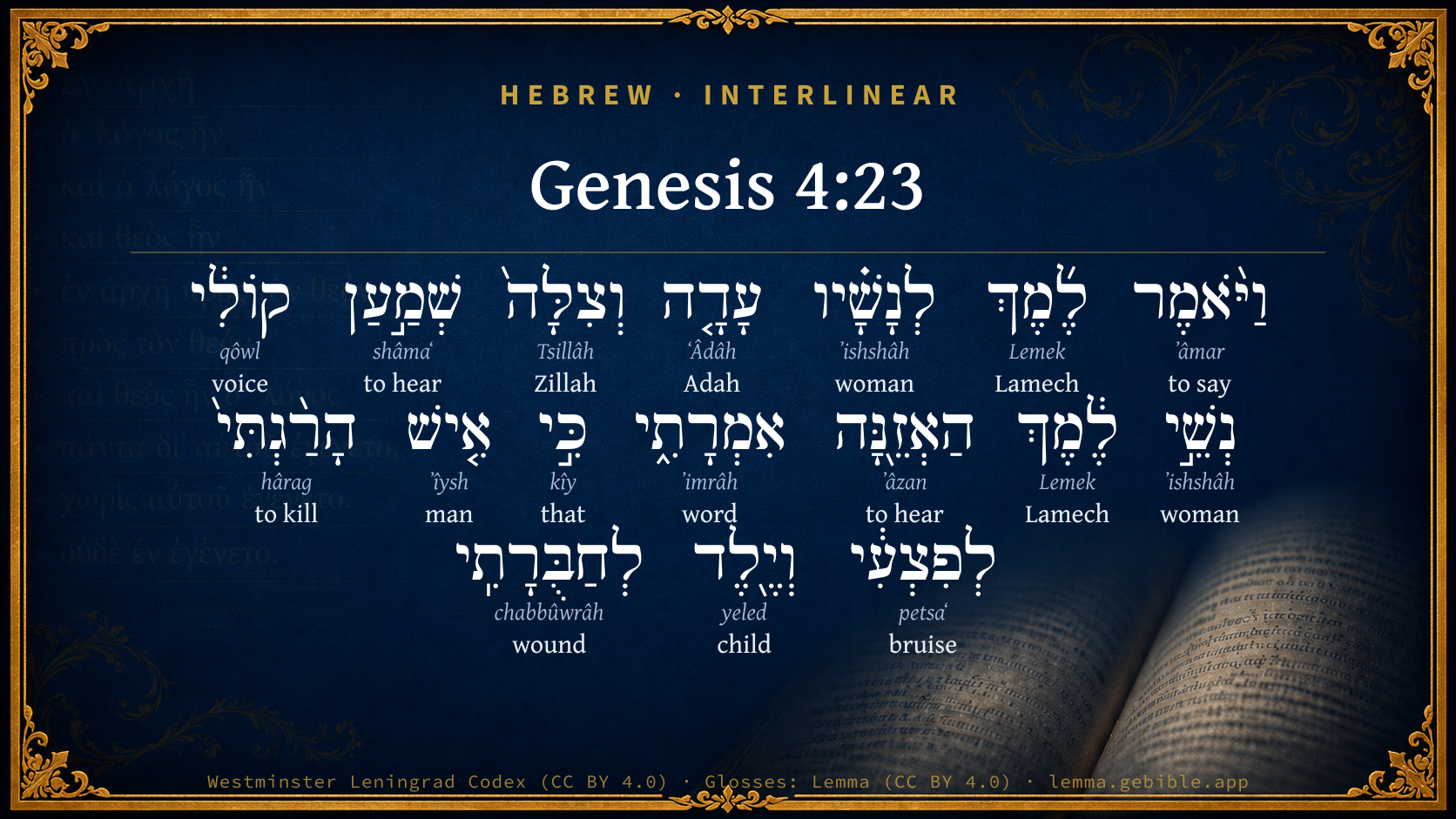
Genesis 4:23

Hebrew (Westminster Leningrad Codex) Genesis 4:23 appears in the Hebrew Old Testament. The text above is from the Westminster Leningrad Codex. Each word links to its Strong’s number, a concise gloss, and parsing drawn from the Open Scriptures Hebrew Bible morphology. Click any word for its full Brown-Driver-Briggs (BDB) entry.
Download image
Cite this verse

Genesis 4:23 (World English Bible). Public Domain. Lemma interlinear Bible study tool, https://lemma.gebible.app/v/genesis/4/23.

Show BibTeX & RIS
BibTeX
RIS
English Translation
Lamech said to his wives, "Adah and Zillah, Hear my voice, You wives of Lamech, listen to my speech, For I have slain a man for wounding me, A young man for bruising me.
World English Bible · Public Domain
Highlights
  • 5 first appearances in the Hebrew Bible
Full analysis ↓
Download a study sheet

One document with this verse’s original text, its word-by-word gloss line, the meaning frame, cross-references with their text, attributed commentary, and full source and license credits — printable, and it pastes into notes with its structure intact.

This verse Autodidact and up

Study sheet (.html) Plain text (.txt)

A passage Seminary Student

Up to 50 verses in one chapter. A passage sheet keeps up to 6 commentary sources and 12 cross-references per verse, in the order this page ranks them, and says so on the sheet whenever that leaves anything out. Ask for a single verse and you get the Autodidact verse sheet above.

Everything on this page stays free to read, with no account — the sheet is a download of what is already on screen, not access to it.

Want to remove ads? Support Godless Engineer
Compare translations 3

The same verse in 3 English versions, stacked beneath the original-language interlinear above. Click any original word for its lexicon entry.

Each is an independent rendering of the whole verse — the interlinear is not word-aligned to these translations.

Highlighted words mark where these versions differ — a whole-verse word diff, not a word-by-word alignment.

  • World English Bible Public Domain
    Lamech said to his wives, "Adah and Zillah, Hear my voice, You wives of Lamech, listen to my speech, For I have slain a man for wounding me, A young man for bruising me.
  • King James Version Public Domain
    And Lamech said unto his wives, Adah and Zillah, Hear my voice; ye wives of Lamech, hearken unto my speech: for I have slain a man to my wounding, and a young man to my hurt.
  • unfoldingWord Literal Text CC BY-SA 4.0
    And Lamech said to his wives, “Adah and Zillah, hear my voice. Wives of Lamech, give ear to my word: For I killed a man for my wound, even a young man for my bruise.

unfoldingWord Literal Text — © unfoldingWord, licensed CC BY-SA 4.0. Word-aligned USFM3 via Door43 (git.door43.org/unfoldingWord/en_ult).

Versions to compare (up to 4)

3 of 4 selected

Show all 18 translations

Every available English version of this verse, each an independent rendering of the whole verse.

  • World English Bible Public Domain
    Lamech said to his wives, "Adah and Zillah, Hear my voice, You wives of Lamech, listen to my speech, For I have slain a man for wounding me, A young man for bruising me.
  • Berean Standard Bible Public Domain
    Then Lamech said to his wives: “Adah and Zillah, hear my voice; wives of Lamech, listen to my speech. For I have slain a man for wounding me, a young man for striking me.
  • Majority Standard Bible Public Domain
    Then Lamech said to his wives: “Adah and Zillah, hear my voice; wives of Lamech, listen to my speech. For I have slain a man for wounding me, a young man for striking me.
  • King James Version Public Domain
    And Lamech said unto his wives, Adah and Zillah, Hear my voice; ye wives of Lamech, hearken unto my speech: for I have slain a man to my wounding, and a young man to my hurt.
  • American Standard Version (1901) Public Domain
    And Lamech said unto his wives: Adah and Zillah, hear my voice; Ye wives of Lamech, hearken unto my speech: For I have slain a man for wounding me, And a young man for bruising me:
  • Revised Version (1885) Public Domain
    And Lamech said unto his wives: Adah and Zillah, hear my voice; Ye wives of Lamech, hearken unto my speech: For I have slain a man for wounding me, And a young man for bruising me:
  • Geneva Bible (1599) Public Domain
    Then Lamech saide vnto his wiues Adah and Zillah, Heare my voyce, ye wiues of Lamech: hearken vnto my speach: for I would slay a man in my wound, and a yong man in mine hurt.
  • Douay-Rheims (1899) Public Domain
    And Lamech said to his wives Ada and Sell: Hear my voice, ye wives of Lamech, hearken to my speech: for I have slain a man to the wounding of myself, and a stripling to my own bruising.
  • Young's Literal Translation Public Domain
    And Lamech saith to his wives: -- `Adah and Zillah, hear my voice; Wives of Lamech, give ear `to' my saying: For a man I have slain for my wound, Even a young man for my hurt;
  • Literal Standard Version CC BY-SA 4.0
    And Lamech says to his wives: “Adah and Zillah, hear my voice; Wives of Lamech, give ear [to] my saying: For I have slain a man for my wound, || Even a young man for my hurt;
  • Unlocked Literal Bible CC BY-SA 4.0
    Lamech said to his wives, “Adah and Zillah, listen to my voice; you wives of Lamech, listen to what I say. For I have killed a man for wounding me, a young man for bruising me.
  • unfoldingWord Literal Text CC BY-SA 4.0
    And Lamech said to his wives, “Adah and Zillah, hear my voice. Wives of Lamech, give ear to my word: For I killed a man for my wound, even a young man for my bruise.
  • Darby Bible Public Domain
    And Lemech said to his wives: Adah and Zillah, hear my voice, Ye wives of Lemech, listen to my speech. For I have slain a man for my wound, and a youth for my bruise.
  • World Messianic Bible Public Domain
    Lamech said to his wives, “Adah and Zillah, hear my voice. You wives of Lamech, listen to my speech, for I have slain a man for wounding me, a young man for bruising me.
  • Webster's Bible Public Domain
    And Lamech said to his wives, Adah and Zillah, Hear my voice, ye wives of Lamech, hearken to my speech: for I have slain a man to my wounding, and a young man to my hurt.
  • Free Bible Version CC BY-SA 4.0
    At one time Lamech told his wives, “Adah and Zillah, listen to me. You wives of Lamech, pay attention to what I have to say. I killed a man because he wounded me; I killed a young man because he injured me.
  • Bible in Basic English Public Domain
    And Lamech said to his wives, Adah and Zillah, give ear to my voice; you wives of Lamech, give attention to my words, for I would put a man to death for a wound, and a young man for a blow;
  • JPS Tanakh (1917) Public Domain
    And Lamech said unto his wives: Adah and Zillah, hear my voice; ye wives of Lamech, hearken unto my speech; for I have slain a man for wounding me, and a young man for bruising me;

Literal Standard Version (2020), Covenant Press — licensed CC BY-SA 4.0. Text via the HelloAO Bible API (eBible.org). Unlocked Literal Bible (unfoldingWord) — licensed CC BY-SA 4.0. Text via the HelloAO Bible API (eBible.org). unfoldingWord Literal Text — © unfoldingWord, licensed CC BY-SA 4.0. Word-aligned USFM3 via Door43 (git.door43.org/unfoldingWord/en_ult). Free Bible Version, Dr. Jonathan Gallagher — licensed CC BY-SA 4.0. Text via the HelloAO Bible API (eBible.org).

Word by word

More ways to search: Search by grammar → Find every occurrence → Compare this word →

Practice this passage: Drill this verse → Learn its vocabulary →

וְצִלָּה֙
Tsillâh
H6741
“and · Zillah”
Conjunction + Noun, Proper
Part of Speech
Conjunction + Noun
Type
Proper
Full BDB Definition

Origin: from H6738

TWOT: None

Zillah = "shade" - the 2nd wife of Lamech and mother of Tubal-cain, an instructor of every craftsman in bronze and iron
  1. וַיֹּ֨אמֶר ʼâmar H559 “and · to say” Conjunction + Verb, Qal, Sequential Imperfect, 3rd Person, Masculine, Singular
  2. לֶ֜מֶךְ Lemek H3929 “Lamech” Noun, Proper
  3. לְנָשָׁ֗יו ʼishshâh H802 “to/for · women · his” Preposition + Noun, Common, Feminine, Plural, Construct + Suffix, Personal, 3rd Person, Masculine, Singular
  4. עָדָ֤ה ʻÂdâh H5711 “Adah” Noun, Proper
  5. שְׁמַ֣עַן shâmaʻ H8085 “hear” Verb, Qal, Imperative, 2nd Person, Feminine, Plural
  6. קוֹלִ֔י qôwl H6963 “voice · my” Noun, Common, Masculine, Singular, Construct + Suffix, Personal, 1st Person, Common, Singular
  7. נְשֵׁ֣י ʼishshâh H802 “women of” Noun, Common, Feminine, Plural, Construct
  8. לֶ֔מֶךְ Lemek H3929 “Lamech” Noun, Proper
  9. הַאְזֵ֖נָּה ʼâzan H238 “hear” Verb, Hiphil, Imperative, 2nd Person, Feminine, Plural
  10. אִמְרָתִ֑י ʼimrâh H565 “word · my” Noun, Common, Feminine, Singular, Construct + Suffix, Personal, 1st Person, Common, Singular
  11. כִּ֣י kîy H3588 “that” Conjunction
  12. אִ֤ישׁ ʼîysh H376 “man” Noun, Common, Masculine, Singular, Absolute
  13. הָרַ֨גְתִּי֙ hârag H2026 “to kill” Verb, Qal, Perfect, 1st Person, Common, Singular
  14. לְפִצְעִ֔י petsaʻ H6482 “to/for · bruise · my” Preposition + Noun, Common, Masculine, Singular, Construct + Suffix, Personal, 1st Person, Common, Singular
  15. וְיֶ֖לֶד yeled H3206 “and · child” Conjunction + Noun, Common, Masculine, Singular, Absolute
  16. לְחַבֻּרָתִֽי chabbûwrâh H2250 “to/for · wound · my” Preposition + Noun, Common, Feminine, Singular, Construct + Suffix, Personal, 1st Person, Common, Singular

About this verse

These counts appear in no published source. They are computed here, from the morphology-tagged text and Lemma’s own curated glosses. What Lemma adds →

17
words
15
distinct lemmas
Pentateuch
section

Notable vocabulary

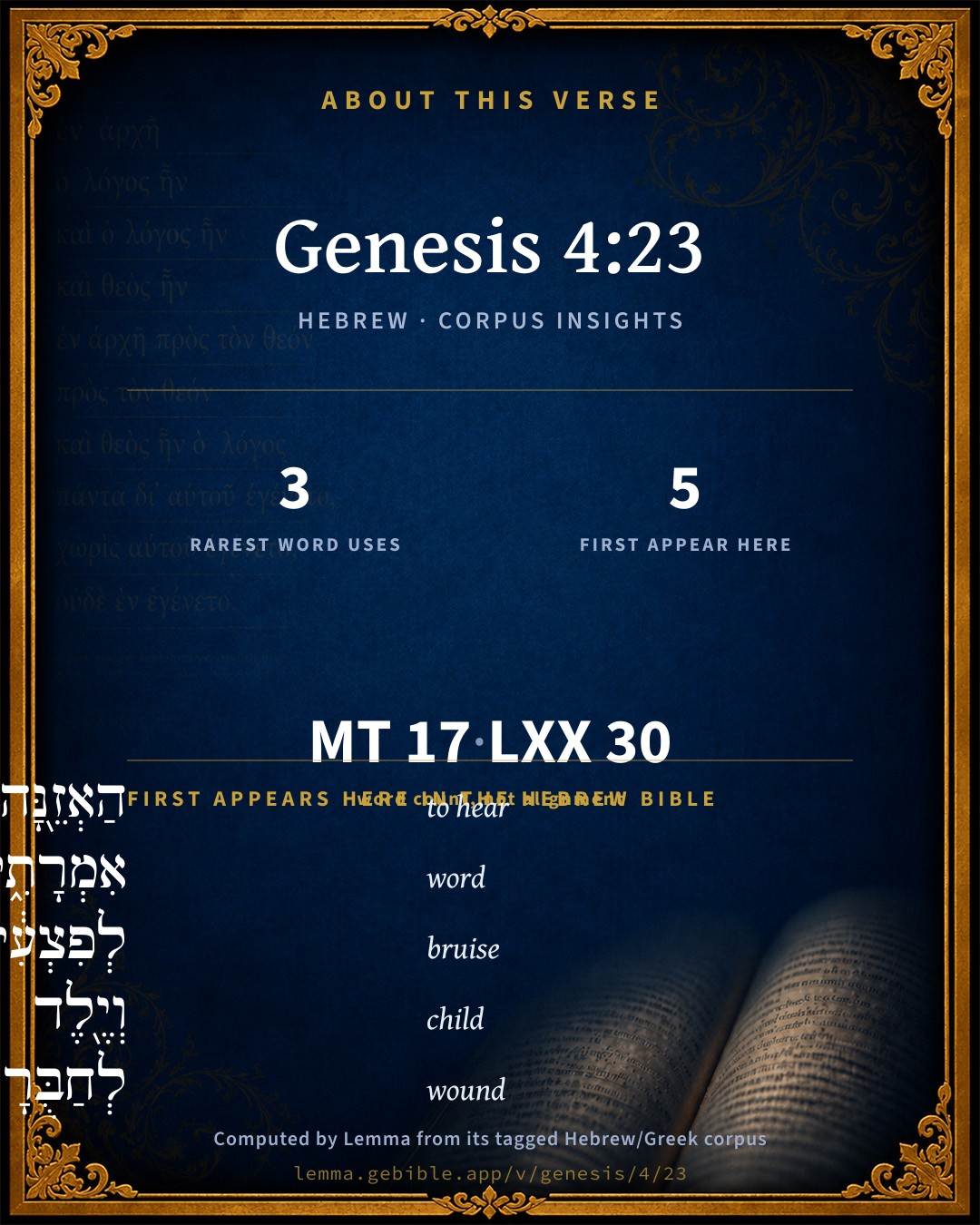
The rarest word here is וְצִלָּה֙ Zillah H6741 — appearing just 3 times in the whole Hebrew Bible.

First appearance in Scripture

These words make their first canonical appearance in the Hebrew Bible here:

  • הַאְזֵ֖נָּה to hear H238
  • אִמְרָתִ֑י word H565
  • לְפִצְעִ֔י bruise H6482
  • וְיֶ֖לֶד child H3206
  • לְחַבֻּרָתִֽי wound H2250

Shared distinctive vocabulary

וְצִלָּה֙ Zillah H6741 occurs in 3 verses of the Hebrew Bible. Also found in:

Grammatical profile

  • 4 verbs
  • 12 nouns
  • 1 conjunction

Verb forms

  • וַיֹּ֨אמֶר Qal · Sequential Imperfect
  • שְׁמַ֣עַן Qal · Imperative
  • הַאְזֵ֖נָּה Hiphil · Imperative
  • הָרַ֨גְתִּי֙ Qal · Perfect

Repetition

Words recur within this verse — often emphatic in Hebrew:

  • לֶ֜מֶךְ Lamech H3929 ×2
  • לְנָשָׁ֗יו woman H802 ×2

Hebrew & Septuagint length

In English translation the verse runs 34 words from the Hebrew and 34 from the Septuagint (LXX English) — the same length.

A rough comparison of the two English renderings, which tokenize alike — not a word-level alignment.

Word counts can differ between the Hebrew and the Greek without any difference in meaning — e.g. the Hebrew direct-object marker אֵת has no separate Greek word, and Greek often adds the article ὁ.

In the original languages it is 17 Hebrew tokens and 30 Greek tokens — but the two are counted differently (Hebrew bundles its prefixes and suffixes into one token; the Greek is in lemma form), so that isn’t a like-for-like length.

Cross-references

4

Topical passages linked to Genesis 4:23 in the Treasury of Scripture Knowledge — connected by theme and wording, ordered by reader-vote popularity; previews shown in the World English Bible.

  • Exodus 20:13 "You shall not murder.
  • Leviticus 19:18 You shall not take vengeance, nor bear any grudge against the children of your people; but you shall love your neighbor as yourself. I am Yahweh.
  • Numbers 23:18 He took up his parable, and said, Rise up, Balak, and hear; Listen to me, you son of Zippor:
  • Judges 9:7 When they told it to Jotham, he went and stood on the top of Mount Gerizim, and lifted up his voice, and cried, and said to them, Listen to me, you men of Shechem, that God may listen to you.

Cross-references courtesy of OpenBible.info (CC BY 4.0).

Hebrew and Greek witnesses Masoretic Hebrew ↔ Greek Septuagint

The same verse in the two great witnesses to the Old Testament, shown verse-for-verse.

These are two independent witnesses, not word-aligned to each other, and the Septuagint is shown in lemma (dictionary) form.

Hebrew Genesis 4:23 Masoretic · Westminster Leningrad Codex

וַיֹּ֨אמֶר לֶ֜מֶךְ לְנָשָׁ֗יו עָדָ֤ה וְצִלָּה֙ שְׁמַ֣עַן קוֹלִ֔י נְשֵׁ֣י לֶ֔מֶךְ הַאְזֵ֖נָּה אִמְרָתִ֑י כִּ֣י אִ֤ישׁ הָרַ֨גְתִּי֙ לְפִצְעִ֔י וְיֶ֖לֶד לְחַבֻּרָתִֽי

Lamech said to his wives, "Adah and Zillah, Hear my voice, You wives of Lamech, listen to my speech, For I have slain a man for wounding me, A young man for bruising me.

World English Bible · Public Domain

Greek LXX Genesis 4:23 Septuagint · lemma form

εἶπον δέ λαμεχ ὁ ἑαυτοῦ γυνή αδα καί σελλα ἀκούω ἐγώ ὁ φωνή γυνή λαμεχ ἐνωτίζομαι ἐγώ ὁ λόγος ὅτι ἀνήρ ἀποκτείνω εἰς τραῦμα ἐγώ καί νεανίσκος εἰς μώλωψ ἐγώ

And Lamech said to his wives, Ada and Sella, Hear my voice, you⌃ wives of Lamech, consider my words, because I have slain a man to my sorrow and a youth to my grief.

LXX2012 (modern English Septuagint) · Public Domain

On this verse, The Pulpit Commentary discusses the Septuagint’s reading. Read the note in Commentary ↓

Hebrew: Westminster Leningrad Codex (CC BY 4.0). Greek: Septuagint (public domain); English from LXX2012 (modern English Septuagint) (Public Domain). How the Septuagint differs from the Hebrew →

Targum (Aramaic paraphrase)

2

The Targum is the ancient Jewish Aramaic paraphrase of the Hebrew Scriptures — an interpretive translation, not the Hebrew text itself. Onkelos (literal) and Pseudo-Jonathan (expansive) render the Torah, and Jonathan the Prophets. Coverage is partial: where no permissively-licensed English translation exists for a verse, only the Aramaic is shown. This is verse-level text, not a word-by-word alignment to the Hebrew.

  1. Targum Onkelos Torah (Genesis–Deuteronomy)
    וַאֲמַר לֶמֶךְ לִנְשׁוֹהִי עָדָה וְצִלָּה שִׁמְעַן קָלִי נְשֵׁי לֶמֶךְ אֲצֵיתָא לְמֵמְרִי לָא גַּבְרָא קְטָלִית דִּבְדִילֵהּ אֲנָא סָבִיל חוֹבִין וְאַף לָא עוּלֵימָא חַבָּלִית דִּבְדִילֵהּ יִשְׁתֵּיצֵי זַרְעִי

    (no public-domain English translation for this verse)

    Targum Onkelos — Aramaic: “Onkelos Genesis” (public domain); “Onkelos Exodus” (public domain); “Onkelos Leviticus” (public domain); “Onkelos Numbers” (public domain); “Onkelos Deuteronomy” (public domain). English: “Sefaria Community Translation” (CC0 1.0 (public-domain dedication)); “J.W. Etheridge. The Targums of Onkelos and Jonathan Ben Uzziel on the Pentateuch. London: Longmans, Green, 1862” (public domain). Text via Sefaria.

  2. Targum Pseudo-Jonathan Torah (Genesis–Deuteronomy)
    וַאֲמַר לֶמֶךְ לִנְשׁוֹי עָדָה וְצִלָה קַבִּילִין קוֹלִי נְשִׁי לֶמֶךְ אַצִיתַן לְמֵימְרִי אֲרוּם לָא גַבְרָא קְטָלִית דְנִתְקַטִלָא תְּחוֹתוֹהִי אוּף לָא עוּלֵימָא חֲבִילִית דִבְגִינֵיהּ יְהוֹבְדוּן זַרְעִי

    And Lemek said to his wives Ada and Zillah, Hear my voice, wives of Lemek, hearken to my words: for I have not killed a man, that I should be slain for him; neither have I destroyed a young man, on whose account my children should perish.

    Targum Pseudo-Jonathan — Aramaic: “Targum Jonathan on Genesis” (public domain); “Targum Jonathan on Exodus” (public domain); “Targum Jonathan on Leviticus” (public domain); “Targum Jonathan on Numbers” (public domain); “Targum Jonathan on Deuteronomy” (public domain). English: “The Targum of Jonathan ben Uzziel, trans. J. W. Etheridge, London, 1862” (public domain). Text via Sefaria.

Commentary

Notes on Genesis 4:23 from classic Christian and Jewish commentators (each source and its license shown beneath its notes). The classic Christian expositions comment on the surrounding passage and are grouped to its opening verse, so a note may address several verses; the Jewish commentaries on the Tanakh (Rashi and others) are per-verse, so they appear only where the commentator wrote on this verse.

Lemma curates 59 commentaries, every one of them public domain or Creative Commons licensed, each selected and text-cleaned for this edition rather than reprinted as found. About our sources →

Trapp's Complete Commentary

John Trapp

Gen 4:23 And Lamech said unto his wives, Adah and Zillah, Hear my voice; ye wives of Lamech, hearken unto my speech: for I have slain a man to my wounding, and a young man to my hurt.

Ver. 23. And Lamech said unto his wives.] Who, it seems, were troublesome to him with their domestic discords, and led him a discontented life. He therefore gives them to understand in this set speech, what a man he is, if molested by them or any other, and what slaughters he can make, if provoked by an adversary. I would slay a man, if but wounded, &c. This revenge he counts manhood, which indeed is doghood rather. So Alexander Phereus consecrated his javelin, wherewith he slew his uncle Polyphron, as a monument of his manhood, and called it his god Tychon. {a} So Sulla caused it to be registered in the public records, {b} that he had proscribed, and put to death, four thousand and seven hundred Romans. So Stokesly, Bishop of London, comforted himself upon his deathbed with this, that in his time he had burned fifty heretics, as he called them. {c} Is not this to "glory in their shame, and to have damnation for their end?" {Php 3:19} Is it not the devil which sets men working to do thus, as he did Saul to seek David’s life, and Lamech to domineer in this sort over his wives, seeking so to repress their strife? A certain Indian coming into a house of the New English where a man and his wife were brawling, and they bidding him sit down, he was welcome: he answered, he would not stay there; "Hobomack," that is, the devil, was there; and so departed. {d}

{a} Plutar in Pelopida.

{b} Ne memoria tam praeclarae rei dilueretur .

{c} Act. and Mon.

{d} New Engl. First Fruits, p. 4.

John Trapp, A Commentary or Exposition upon All the Books of the Old and New Testament (1647–1656) — public domain. Text from a community e-Sword module.

Tyndale Open Study Notes

Tyndale Open Resources

4:23-24 Lamech’s chilling taunt shows the further escalation of sin’s effects on humanity. Cain’s line had reached a crescendo of violence with Lamech’s contempt for life. In his arrogance, he put his deed into poetic verse. • punished seventy-seven times! God warned that anyone who tried to kill Cain would experience the full weight of justice (4:15). Lamech’s declaration that anyone who harmed him would receive an even more severe penalty is a claim to be accountable to no one, including God.

Tyndale Open Study Notes — © Tyndale Open Resources, licensed CC BY-SA 4.0. Text via the HelloAO Bible API.

Geneva Bible (1599)

Geneva Bible translators

His wives seeing that all men hated him for his cruelty, were afraid, therefore he braggeth that there is none so lusty that were able to resist, although he were already wounded.

Geneva Bible (1599) marginal notes — public domain. Text via Bolls.life.

Matthew Henry's Commentary

By this speech of Lamech, which is here recorded, and probably was much talked of in those times, he further appears to have been a wicked man, as Cain's accursed race generally were. Observe, 1. How haughtily and imperiously he speaks to his wives, as one that expected a mighty regard and observance: Hear my voice, you wives of Lamech. No marvel that he who had broken one law of marriage, by taking two wives, broke another, which obliged him to be kind and tender to those he had taken, and to give honour to the wife as to the weaker vessel. Those are not always the most careful to do their own duty that are highest in their demands of respect from others, and most frequent in calling upon their relations to know their place and do their duty. 2. How bloody and barbarous he was to all about him: I have slain, or (as it is in the margin) I would slay a man in my wound, and a young man in my hurt. He owns himself a man of a fierce and cruel disposition, that would lay about him without mercy, and kill all that stood in his way; be it a man, or a young man, nay, though he himself were in danger to be wounded and hurt in the conflict. Some think, because (Gen 4:24) he compares himself with Cain, that he had murdered some of the holy seed, the true worshippers of God, and that he acknowledged this to be the wounding of his conscience and the hurt of his soul; and yet that, like Cain, he continued impenitent, trembling and yet unhumbled. Or his wives, knowing what manner of spirit he was of, how apt both to give and to resent provocation, were afraid lest somebody or other would be the death of him. "Never fear," says he, "I defy any man to set upon me; whosoever does, let me alone to make my part good with him; I will slay him, be he a man or a young man." Note, It is a common thing for fierce and bloody men to glory in their shame (Phi 3:19), as if it were both their safety and their honour that they care not how many lives are sacrificed to their angry resentments, nor how much they are hated, provided they may be feared. Oderint, dum metuant - Let them hate, provided they fear. How impiously he presumes even upon God's protection in his wicked way, Gen 4:24. He had heard that Cain should be avenged seven-fold (Gen 4:15), that is, that if any man should dare to kill Cain he should be severely reckoned with and punished for so doing, though Cain deserved to die a thousand deaths for the murder of his brother, and hence he infers that if any one should kill him for the murders he had committed God would much more avenge his death. As if the special care God took to prolong and secure the life of Cain, for special reasons peculiar to his case (and indeed for his sorer punishment, as the beings of the damned are continued) were designed as a protection to all murderers. Thus Lamech perversely argues, "If God provided for the safety of Cain, much more for mine, who, though I have slain many, yet never slew my own brother, and upon no provocation, as he did." Note, The reprieve of some sinners, and the patience God exercises towards them, are often abused to the hardening of others in the like sinful ways, Ecc 8:11. But, though justice strike some slowly, others cannot therefore be sure but that they may be taken away with a swift destruction. Or, if God should bear long with those who thus presume upon his forbearance, they do but hereby treasure up unto themselves wrath against the day of wrath.

Now this is all we have upon record in scripture concerning the family and posterity of cursed Cain, till we find them all cut off and perishing in the universal deluge.

Matthew Henry's Commentary on the Whole Bible (1708–1710) — public domain (CC PDM 1.0). Text via the HelloAO Bible API.

Jamieson, Fausset & Brown

Robert Jamieson, A. R. Fausset & David Brown

Lamech said unto his wives--This speech is in a poetical form, probably the fragment of an old poem, transmitted to the time of Moses. It seems to indicate that Lamech had slain a man in self-defense, and its drift is to assure his wives, by the preservation of Cain, that an unintentional homicide, as he was, could be in no danger.

Jamieson, Fausset & Brown — Commentary Critical and Explanatory on the Whole Bible (1871) — public domain (CC PDM 1.0). Text via the HelloAO Bible API.

Adam Clarke's Commentary

Verse 23. And Lamech said unto his wives] The speech of Lamech to his wives is in hemistichs in the original, and consequently, as nothing of this kind occurs before this time, it is very probably the oldest piece of poetry in the world. The following is, as nearly as possible, a literal translation:

"And Lamech said unto his wives,

Adah and Tsillah, hear ye my voice;

Wives of Lamech, hearken to my speech;

For I have slain a man for wounding me,

And a young man for having bruised me.

If Cain shall be avenged seven-fold,

Also Lamech seventy and seven."

It is supposed that Lamech had slain a man in his own defence, and that his wives being alarmed lest the kindred of the deceased should seek his life in return, to quiet their fears he makes this speech, in which he endeavours to prove that there was no room for fear on this account; for if the slayer of the wilful murderer, Cain, should suffer a seven-fold punishment, surely he, who should kill Lamech for having slain a man in self-defence, might expect a seventy-seven-fold punishment.

This speech is very dark, and has given rise to a great variety of very strange conjectures. Dr. Shuckford supposes there is an ellipsis of some preceding speech or circumstance which, if known, would cast a light on the subject. In the antediluvian times, the nearest of kin to a murdered person had a right to revenge his death by taking away the life of the murderer. This, as we have already seen, appears to have contributed not a little to Cain's horror, Ge 4:14. Now we may suppose that the descendants of Cain were in continual alarms, lest some of the other family should attempt to avenge the death of Abel on them, as they were not permitted to do it on Cain; and that in order to dismiss those fears, Lamech, the seventh descendant from Adam, spoke to this effect to his wives: "Why should you render yourselves miserable by such ill-founded fears? We have slain no person; we have not done the least wrong to our brethren of the other family; surely then reason should dictate to you that they have no right to injure us. It is true that Cain, one of our ancestors, killed his brother Abel; but God, willing to pardon his sin, and give him space to repent, threatened to punish those with a seven-fold punishment who should dare to kill him. If this be so, then those who should have the boldness to kill any of us who are innocent, may expect a punishment still more rigorous. For if Cain should be avenged seven-fold on the person who should slay him, surely Lamech or any of his innocent family should be avenged seventy-seven-fold on those who should injure them." The Targums give nearly the same meaning, and it makes a good sense; but who can say it is the true sense? If the words be read interrogatively, as they certainly may, the sense will be much clearer, and some of the difficulties will be removed:

"Have I slain a man, that I should be wounded?

Or a young man, that I should be bruised?"

But even this still supposes some previous reason or conversation. I shall not trouble my readers with a ridiculous Jewish fable, followed by St. Jerome, of Lamech having killed Cain by accident, c. and after what I have already said, I must leave the passage, I fear, among those which are inscrutable.

Adam Clarke's Commentary on the Bible (1810–1826) — public domain. Text from a community e-Sword/MySword module.

John Calvin's Commentaries

23. Hear my voice, ye wives of Lamech. The intention of Moses is to describe the ferocity of this man, who was, however, the fifth in descent from the fratricide Cain, in order to teach us, that, so far from being terrified by the example of divine judgment which he had seen in his ancestor, he was only the more hardened. Such is the obduracy of the impious, that they rage against those chastisements of God, which ought at least to render them gentle. The obscurity of this passage, which has procured for us a variety of interpretations, mainly arises hence; that whereas Moses speaks abruptly, interpreters have not considered what is the tendency of his speech. The Jews have, according to their manner, invented a foolish fable; namely, that Lamech was a hunter and blind, and had a boy to direct his hand; that Cain, while he was concealed in the woods, was shot through by his arrow, because the boy, talking him for a wild beast, had directed his master’s hand towards him; that Lamech then took revenge on the boy, who, by his imprudence, had been the cause of the murder. And ignorance of the true state of the case has caused everyone to allow himself to conjecture what he pleased. But to me the opinion of those seems to be true and simple, who resolve the past tense into the future, and understand its application to be indefinite; as if he had boasted that he had strength and violence enough to slay any, even the strongest enemy. I therefore lead thus, ‘I will slay a man for my wound, and a young man for my bruise,’ or ‘in my bruise and wound.’ But, as I have said, the occasion of his holding this conversation with his wives is to be noticed. We know that sanguinary men, as they are a terror to others, so are they everywhere hated by all. The wives, therefore, of Lamech were justly alarmed on account of their husband, whose violence was intolerable to the whole human race, lest, a conspiracy being formed, all should unite to crush him, as one deserving of public odium and execration. Now Moses, to exhibit his desperate barbarity, seeing that the soothing arts of wives are often wont to mitigate cruel and ferocious men, declares that Lamech cast forth the venom of his cruelty into the bosom of his wives. The sum of the whole is this: He boasts that he has sufficient courage and strength to strike down any who should dare to attack him. The repetition occurring in the use of the words ‘man’ and ‘young man’ is according to Hebrew phraseology, so that none should think different persons to be denoted by them; he only amplifies, in the second member of the sentence, his furious audacity, when he glories that young men in the flower of their age would not be equal to contend with him: as if he would say, Let each mightiest man come forward, there is none whom I will not dispatch.’ So far was he from calming his wives with the hope of his leading a more humane life, that he breaks forth in threats of sheer indiscriminate slaughter against every one, like a furious wild beast. Whence it easily appears, that he was so imbued with ferocity as to have retained nothing human. The nouns wound and bruise may be variously read. If they be rendered ‘for my wound and bruise,’ then the sense will be, ‘I confidently take upon my own head whatever danger there may be, let what will happen it shall be at my expense; for I have a means of escape at hand.’ Then what follows must be read in connection with it, If Cain shall be avenged sevenfold, truly Lamech seventy and seven fold. If the ablative case be preferred, ‘In my wound and bruise,’ there will still be a double exposition. The first is, ‘Although I should be wounded, I would still kill the man; what then will I not do when I am whole?’ The other, and, in my judgment, the sounder and more consistent exposition, is, ‘If any one provoke me by injury, or attempt any act of violence, he shall feel that he has to deal with a strong and valiant man; nor shall he who injures me escape with impunity.’ This example shows that men ever glide from bad to worse. The wickedness of Cain was indeed awful; but the cruelty of Lamech advanced so far that he was unsparing of human blood. Besides, when he saw his wives struck with terror, instead of becoming mild, he only sharpened and confirmed himself the more in cruelty. Thus the brutality of cruel men increases in proportion as they find themselves hated; so that instead of being, touched with penitence, they are ready to bury one murder under ten others. Whence it follows that they having once become imbued with blood, shed it, and drink its without restraint.

John Calvin's Commentaries (1540-1563) — public domain. Text from the Calvin Translation Society English edition (1840s-50s) via the Christian Classics Ethereal Library (ccel.org). Calvin's coverage is partial (roughly two-thirds of the Bible); uncommented books and verses are honest gaps, never fabricated. The 19th-century editor's footnotes and remarks are omitted so the notes are faithfully Calvin's own voice.

Ellicott's Commentary for English Readers

(23, 24) Lamech said . . . —Following quickly upon music, we have poetry, but it is in praise of ferocity, and gives utterance to the pride of one who, by means of the weapons forged by his son, had taken violent revenge for an attack made upon him. Many commentators, however, regard the poem as hypothetical. “Were any one to wound me, I would with these weapons slay him.” It would thus be a song of exultation over the armour which Tubal-cain had invented. It more probably records a fact, and is intended to show that, side by side with progress in the material arts, moral degradation was going on. Cain’s own act is spoken of, not as a sin to be ashamed of, but as a deed of ancient heroism: not comparable, however, with the glory of Lamech, whose wrath shall be ten-fold. The poetry is vigorous, and marked by that parallelism which subsequently became the distinguishing quality of Hebrew verse. It should be translated:—

“Adah and Zillah, hear my voice,

Ye wives of Lemech. give ear unto my rede.

For I have slain a man for wounding me:

Even a young man for bruising me.

Truly Cain shall be avenged sevenfold,

And Lemech seventy and sevenfold.”

It is remarkable that both of the words used for the attack upon Lamech refer to such wounds as might be given by a blow with the fist, while his word means to pierce, or run through with a sharp weapon. “Young man” is literally child, but see on Gen_21:14.

With this boastful poem in praise of armed violence and bloodshed, joined with indications of luxury and a life of pleasure, the narrator closes the history of the race of Cain.

A Bible Commentary for English Readers, edited by Charles John Ellicott (1878–1897) — public domain. Text from a community e-Sword module.

The Cambridge Bible for Schools and Colleges

gen. ed. J. J. S. Perowne

23. a man for wounding me] Lamech boasts that he has slain a man who had wounded him and a young man who had bruised him. Whether “a man” and “a young man” are the same person, or whether they mean a man and his son, cannot be decided. Lamech has exacted the vengeance of death for the insult of a blow2[11].

[11] See for an explanation by Jewish tradition Appendix B.

It is, however, possible that the poem only describes an imaginary instance in which Lamech had retaliated in self-defence, and boasts that with the assistance of metal weapons Lamech’s capacity for revenge is increased elevenfold.

23, 24. The Song of the Sword. These verses are written in a poetical style, with the parallelism of clauses characteristic of Hebrew poetry. It is the first instance of Hebrew poetical composition in the Bible1[10]. It contains (1) the address of Lamech to his wives; (2) the announcement of a recent exploit; (3) the boast of confidence and security against injury or insult. It is generally supposed that Lamech’s Song is intended to represent his exultation after the invention of metal weapons by his son Tubal-Cain. The new possession inspired primitive man with confidence and eagerness for savage retaliation.

[10] See G. Adam Smith’s Early Poetry of Israel, p. 21 (Schweich Lectures, 1910).

The substance of line (or stichos) 1 is repeated in line (or stichos) 2: “Adah and Zillah” correspond to “Ye wives of Lamech,” and “Hear my voice” to “Hearken unto my speech.”

In line (or stichos) 3, the word “I have slain” gives the note to the whole distich; but “a man for wounding me” is repeated in greater detail in line (or stichos) 4, “a young man for bruising me.” Line (or stichos) 5 mentions the traditional vengeance promised for Cain; line (or stichos) 6 boasts of a vengeance tenfold greater than this for Lamech.

The Cambridge Bible for Schools and Colleges (gen. ed. J. J. S. Perowne; Cambridge University Press, 1878–1918) — public domain. Text from a community e-Sword module.

John Gill's Exposition

If Cain shall be avenged sevenfold, truly Lamech seventy and sevenfold. Which if understood of him as confessing and lamenting his sin of murder, the sense is, if Cain was so severely punished for killing one man, of how much sorer punishment am I deserving, and shall have, who have killed two persons, and that after I had seen the punishment of Cain, and yet took no warning by it? or if he that killed Cain, who slew his brother, was to be avenged sevenfold, or to seven generations, then how much more, or longer, shall he be avenged, that shall slay me, who have slain none, or however not designedly; and therefore you may be easy and quiet, your fears, either from God or man, are groundless.

If Cain shall be avenged sevenfold, truly Lamech seventy and sevenfold. Which if understood of him as confessing and lamenting his sin of murder, the sense is, if Cain was so severely punished for killing one man, of how much sorer punishment am I deserving, and shall have, who have killed two persons, and that after I had seen the punishment of Cain, and yet took no warning by it? or if he that killed Cain, who slew his brother, was to be avenged sevenfold, or to seven generations, then how much more, or longer, shall he be avenged, that shall slay me, who have slain none, or however not designedly; and therefore you may be easy and quiet, your fears, either from God or man, are groundless.

Genesis 4:25

gen 4:25

gen 4:25

gen 4:25And Adam knew his wife again,.... The Targum of Jonathan adds, at the end of a hundred and thirty years after Abel was killed, see Gen 5:3 but, according to Bishop Usher, Seth was born the same year, which is most probable.

And she bare a son, and called his name Seth, that is, "put, placed, set"; not with any respect to Cain, who had no settled fixed abode, but wandered about; or to Seth as a foundation of the church and true religion, being a type of Christ the only foundation, though he may be considered in such a light; but the reason of his name follows:

for God, said she, hath appointed me another seed instead of Abel, whom Cain slew; that is, another son in his room; and by calling him a "seed", she may have respect unto the promised seed, whom she once thought Cain was, or however expected him in his line, as being the firstborn; but he proving a wicked man, and having slain his brother Abel, on whom her future hope was placed, has another son given her, and substituted in his room, in whom, and in whose family, the true religion would be preserved, and from whom the Messiah, the promised seed, would spring see Gal 3:16.

John Gill's Exposition of the Whole Bible (1746–1763) — public domain (CC PDM 1.0). Text via the HelloAO Bible API.

Haydock's Catholic Bible Commentary

Said. This is the most ancient piece of poetry with which we are acquainted. (Fleury.) --- Lamech may be considered as the father of poets. (Haydock) --- I have slain a man, &c. It is the tradition of the Hebrews, that Lamech in hunting slew Cain, mistaking him for a wild beast: and that having discovered what he had done, he beat so unmercifully the youth, by whom he was led into that mistake, that he died of the blows. (Challoner) --- St. Jerome, 9. 1. ad Dam. acknowledges the difficulty of this passage, on which Origen wrote two whole books. (Worthington)

George Leo Haydock (1774–1849), Haydock's Catholic Family Bible and Commentary, 1859 edition — public domain. Excludes Psalms (Douay-Rheims chapter numbering differs from Protestant) and Deuterocanonical books (Catholic canon only).

Matthew Poole's English Annotations

Adah and Zillah, observing his fierceness and cruelty, feared that the vengeance of God or men would fall upon him, and upon them for his sake.

Be it so that I have slain a man, and that a young man, why do you concern yourselves in it? It is

to my own

wounding and hurt, not to yours; I must suffer for it, not you. Some take this to be a sorrowful confession of his bloody crime: q.d. I have murdered a man, to my wounding, &c. i.e. to my utter ruin, or to the wounding and grief of my heart and conscience. But this seems not to agree either with the quality of Cain’s family, or with the temper of Lamech’s person, or with the scope of the Holy Ghost in this place; which is to describe, not the virtues, but the crimes of that wicked race. According to the marginal translation, the sense may be this, Fear not for me; for if any man, though in his youth and strength, should assault me, and give me the first wound, he should pay dearly for it; and though I were wounded and weakened, the remainders of my strength would be sufficient to give him his death’s wound. The words also may be otherwise rendered; the particle chi being taken interrogatively, as it is Isa 29:6; 36:19, and elsewhere: Have I slain a man to my wounding, and or, or a young man to my hurt? i.e. that thereby I should deserve such a mortal wound or hurt to be inflicted upon me by way of retaliation? You have therefore no cause of fear, either for my sake or for your own.

Matthew Poole's English Annotations on the Holy Bible (1683–1685) — public domain. Text from a community e-Sword/MySword module.

Whedon's Commentary on the Bible

Daniel D. Whedon

23. Lamech said — This father of skilful inventors was himself a genius, and the author of this oldest fragment of poetical composition, of which the following is a literal translation:

Adah and Zillah, hear my voice,

O wives of Lamech, listen to my saying;

For a man have I slain for my wound,

And a child for my bruise.

For sevenfold avenged should Cain be,

And Lamech seventy and seven.

It is not strange that this mere fragment of antediluvian song is obscure and difficult of explanation. The common version conveys the idea that Lamech was smitten with remorse over the murder of a young man, and this is the explanation of some of the older expositors. But the language of Gen_4:24 illy accords with such a view, and the entire passage breathes the spirit of violence and confident boasting rather than of remorse.

A better interpretation is, that which supposes Lamech to have slain a man in self-defence. The words “for my wound” and “for my bruise” would then be equivalent to “for wounding me,” “for bruising me,” and the song is Lamech’s attempt to comfort his wives in view of the manslaughter, and assure them that no one would dare avenge the deed.

Others make the poem a sort of triumphant exultation over Tubal-cain’s invention of brass and iron weapons, and translate the past tense of the verb slay as future, or else as present, expressing confident assurance: “I will slay the man who wounds me, and the youth who presumes to harm me.” Gen_4:24 is understood to express the boast that he could now avenge his own wrongs ten times more completely than God would avenge the slaying of Cain. This interpretation accords with the context, and brings out the spirit of the passage, but has against it the perfect tense of the verb I have slain, הרגתי.

May we not blend the two last mentioned views, and, retaining the strict sense of the words, as translated above, explain that Lamech, by the use of weapons of his son’s invention, had in some duel or personal conflict slain a young man, possibly one of his own children, ילד; and yet, so far from feeling remorse or penitence over the deed, exultingly sang to his wives this song of his prowess, and boastingly declared that any one who should attempt to take vengeance on him for the deed would suffer more than ten times the vengeance pronounced against the murderer of Cain. “By the citation of the case of his ancestor Cain he shows,” says Lange, “that the dark history of the bad man had become transformed into a proud remembrance for his race.” According to this view, we discern in this old Cainite song that spirit of violence and lust which waxed worse and worse until it brought upon the wicked world the judgment of the flood. For a full synopsis of the various expositions of this passage, see M’CLINTOCK and STRONG, Cyclopedia, art. Lamech.

Daniel D. Whedon (gen. ed.), Commentary on the Old and New Testaments (1874–1909) — public domain. Text from a community e-Sword module.

The Pulpit Commentary

Vers. 23, 24. And Lamech said unto his wives. The words have an archaic simplicity which bespeak a high antiquity (vide Havernick"s "Introd.," p. 105), naturally fall into that peculiar form of parallelism which is a well-known characteristic of Hebrew poetry, and on this account, as welt as from the subject, have been aptly denominated The Song of the Sword (Ewald, p. 267).

Adah and gillah, Hear my voice; Ye wives of Lamech, hearken unto my speech: For I have slain a mum to my wounding (for my wound), And a young man to my hurt (because of my strife). If ( for) Cain shall be avenged sevenfold, Truly (and) Lamech seventy and sevenfold.

Origen wrote two whole books of his commentary on Genesis on this song, and at last pronounced it inexplicable. The chief difficulty in its exegesis concerns the sense in which the words yTigrh; yKi are to be taken.

1. If the verb be rendered as a preterit (LXX, Vulgate, Syriac, Kalisch, Murphy, Alford, Jamieson, Luther), then Lamech is represented as informing his wives that in self-defense he has slain a young man who wounded him (not two men, as some read), but that there is no reason to apprehend danger on that account; for if God had promised to avenge Cain sevenfold, should any one kill him, he, being not a willful murderer, but at worst a culpable homicide, would be avenged seventy and sevenfold.

2. If the verb be regarded as a future (Aben Ezra, Calvin, Kiel, Speaker"s. "The preterit stands for the future (4) In protestations and assurances in which the mind of the speaker views the action as already accomplished, being as good as done Gesenius, "Hebrews Gram., then the father of Tubal-cain is depicted as exulting in the weapons which his son"s genius had invented, and with boastful arrogance threatening death to the first man that should injure him, impiously asserting that by means of these same weapons he would exact upon his adversary a vengeance ten times greater than that which had been threatened against the murderer of Cain. Considering the character of the speaker and the spirit of the times, it is probable that this is the correct interpretation.

1. A third interpretation proposes to understand the words of Lamech hypothetically, as thus: I should slay a man, then," &c. (Lunge,;

2. Bush); but this does not materially differ from the first, only putting the case conditionally, which the first asserts categorically.

3. A fourth gives to yKi the force of a question (vide Stanley Leathes, " Hebrews Gram.," p. 202), and imagines Lamech to be assuring his wives, who are supposed to have been apprehensive of some evil befalling their husband through the use of Tubal-cain"s dangerous weapons, that there was no cause for their anxieties and alarms, as he had not slain a man, that he should be wounded, or a young man, that he should be hurt; but this interpretation, it may be fairly urged, is too strained to be even probably correct.

The Pulpit Commentary (1880–1919), ed. H.D.M. Spence-Jones & Joseph S. Exell — public domain. Text from a community e-Sword module.

John Wesley's Explanatory Notes

This passage is extremely obscure. We know not whom he slew, or on what occasion: neither what ground he had to be so confident of the Divine protection.

John Wesley, Explanatory Notes Upon the Whole Bible (1754–1765) — public domain. Text via the GEBible commentary corpus.

Scofield Reference Notes

C. I. Scofield

to my wounding

Or, who wounded me. Cain had slain an unoffending man and yet was protected by Jehovah; how much more Lamech, who had slain in self-defence.

The Scofield Reference Bible (1917 edition), notes by C. I. Scofield — public domain. Text from a community e-Sword module.

unfoldingWord translationNotes

Door43 World Missions Community

Adah ... Zillah

See how you translated these women's names in Genesis 4:19.

listen to my voice ... listen to what I say

Lamech said the same thing twice for emphasis. His voice is a synecdoche for his whole person. AT: "listen carefully to me" (See: Parallelism and Synecdoche)

a man for wounding me, a young man for bruising me

Lamech killed only one person. These two phrases means the same thing and are repeated to emphasize the certainly of his action. AT: "a young man because he hurt me" (See: Parallelism)

If Cain is avenged seven times, then Lamech

Lamech knows that God will avenge Cain seven times. AT: "Since God will punish anyone who kills Cain seven times, Lamech" (See: Active or Passive)

then Lamech will be avenged seventy-seven times

This can be stated in active form. AT: "whoever kills me, God will punish seventy-seven times" (See: Active or Passive)

seventy-seven

77 (See: Numbers)

translationWords

Cain

Lamech

unfoldingWord translationNotes — © Distant Shores Media and the Door43 World Missions Community, licensed CC BY-SA 4.0. Source: git.door43.org/Door43/en_tn.

Rashi

Rabbi Shlomo Yitzchaki (Rashi)

שמען קולי HEAR MY VOICE — For his wives separated from him because he had killed Cain and Tubal-Cain, his own son. Lamech was blind and Tubal-Cain used to lead him. The latter saw Cain and thought him to be an animal. He therefore told his father to draw the bow, and thus Lamech killed him. As soon as he learned that it was his forefather Cain, he smote his hands together, struck his son between them and so killed him too. His wives thereupon separated from him, and he endeavoured to appease them,

saying שמען קולי “Hear my voice”— obey me and return to me: for the man I slew — was he slain by my wounding? i. e. did I wound him with premeditation, that the wound should be called by my name (i. e. attributed to me); and the child that I slew — was it slain by my blow? (i. e. by a blow directed intentionally by me?) [Rashi here inserts the word בתמיה which he uses frequently to direct that the preceding words should be read as a question.] Did I not act inadvertently and not with premeditation? This was not my wound, nor was this my blow!

פצע wound, is the stroke inflicted by a sword or arrow (old French macheure).

Rashi on the Tanakh — English translations: “The Judaica Press complete Tanach with Rashi, translated by A. J. Rosenberg” (CC BY 4.0); “Pentateuch with Rashi's commentary by M. Rosenbaum and A.M. Silbermann, 1929-1934” (public domain); “The Metsudah Tanach series, Lakewood, N.J” (CC BY 4.0); and “The Book of Joshua, Metsudah Publications, 1997” (CC BY 4.0). Text via Sefaria.

Ramban (Nachmanides)

Rabbi Moshe ben Nachman (Ramban / Nachmanides)

AND LAMECH SAID UNTO HIS WIVES. For the sense of this verse, the commentators have depended on the opinion of Onkelos who explained therefore whosoever slayeth Cain vengeance shall be taken on him ‘shivatha’im’ as meaning that at the end of seven generations, vengeance shall be taken on him [Cain], but not now because G-d would be long-suffering with him. Now Lamech’s wives feared to bear children because they would be the seventh generation to Cain, but he comforted his wives by saying that G-d would be forbearing with him for yet seventy-seven generations because he would pray before Him, for He is long-suffering and would have mercy upon him. Or it may be that Lamech’s words were an absurd a fortiori argument, in accordance with the Midrash that Rashi mentioned, [namely: “For if so, the Holy One, blessed be He, could never exact His debt nor fulfill His word.”] If so, Scripture is stating: “Therefore whosoever slayeth Cain, vengeance shall be taken of the seventh generation” and not in his days. And this is the translation of Onkelos: “All who would slay Cain! In seven generations, punishment will be exacted of him [Cain].” But if so, it would have been proper that the verse, And Lamech said unto his wives, appear before [Verse 20: And Adah — Lamech’s wife — bore Jabal].In my opinion, the word shivatha’im does not mean “seven generations” because this word is not used for seven separate units but rather for the multiplying of one thing seven times, such as: refined ‘shivatha’im’ (sevenfold); restore ‘shivatha’im’ (sevenfold); and the light of the sun shall be ‘shivatha’im’, meaning doubled and redoubled seven times. But the meaning of therefore, whosoever slayeth Cain is, according to its real sense, that G-d said: “Therefore, whosoever slayeth Cain will have vengeance taken on him sevenfold, for I will punish his slayer seven times for his sin, since I have promised Cain that he will not be slain in view of his fear of Me and his confession before Me.” However, the matter of Lamech and his wives is not mentioned clearly in Scripture. We could also say that they feared lest Lamech be killed as a punishment for his ancestor’s sin since G-d did not tell Cain, “I have forgiven you.” Instead, He promised him only that he will not be slain, but He would collect His debt from his children, and they did not know when. And so indeed the matter happened. Lamech, however, comforted them by saying that G-d would have mercy on him even as He had mercy on Cain, for he had cleaner hands than Cain, and he also would pray before Him and He would hear his prayer.However, it appears to me that Lamech was a very wise man in every craft, and he taught his eldest son [Jabal] the business of pasturing according to the nature of the cattle. To the second son [Jubal] he taught the art of music, and he taught the third one [Tubal-Cain] to forge metals and to make swords, spears, javelins, and all instruments of war. His wives were then afraid that he might be punished because he brought the sword and murder into the world, and he thus retained in his hand the evil deed of his ancestor [Cain] since he was a descendant of the first murderer and he created the waster to destroy., 54:16. But he [Lamech] told them: “I did not slay a man by wounds, nor a child by bruises, as did Cain, and G-d will not punish me. Instead, He will guard me from being killed moreso than Cain” He [Lamech] mentioned this in order to say that man cannot kill only with the sword and javelin; death caused by wounds and bruises is a worse death than by the sword. Therefore, the sword is not the cause of murder, and there is no sin upon him who made it.

Ramban (Nachmanides) on the Tanakh — English translation: “Commentary on the Torah by Ramban (Nachmanides). Translated and annotated by Charles B. Chavel. New York, Shilo Pub. House, 1971-1976” (CC BY 4.0). Text via Sefaria.

Radak

Rabbi David Kimhi (Radak)

ויאמר למך לנשיו, our sages in Bereshit Rabbah 23,4 state that when Lemech wanted to sleep with his wives they refused him. They used several arguments, one being that they were afraid of the deluge and they did not want to give birth to children already doomed. Lemech countered that if Kayin whose deed of foul murder had resulted in suspension of his death sentence for 7 generations, then he, Lemech, who had killed inadvertently, accidentally, would not be punished for far longer than that, and his wives had no reason to worry. Even if a deluge would come tomorrow, he was free from the taint of sin and would not become its victim. He went further, saying that even assuming he had deliberately killed a man or a child, G’d would forgive him, seeing he had many merits which would offset one such sin. Kayin had not had such merits even before he killed his brother but had sinned so that G’d had rejected his offering, and still his sentence had not been carried out for seven generations. This is how he arrived at the expression שבעה ושבעים as opposed to שבעתים the period during which G’d had suspended the carrying out of the sentence of death on Kayin. He appealed to G’d’s patience to extend this patience to him. It is also possible that Lemech’s logic was totally foolish, as hinted at by Rashi, as the wives of Lemech did not worry about retribution for Lemech’s sin but the long overdue retribution for Kayin’s sin, something that would include all of Kayin’s offspring. We have to assume that Lemech’s speech to his wives took place before his wife Adah had given birth to Yaval. Some of our sages (Tanchuma 11), claim that Lemech was blind and that when whenever he went out hunting a child (Tuval Kayin) would serve as his guide. When the child spotted the animal he would tell Lemech to draw his bow and aim his arrow in a certain direction. In this fashion Kayin, while being mistaken for an animal, was killed. Other sages (Bereshit Rabbah 22,12) claim that the “sign” provided by G’d for Kayin to warn people and beasts not to kill him, was a horn which grew out of his forehead. Kayin, being constantly on the move in the field due to G’d’s curse, was mistaken by the boy accompanying Lemech for a wild beast seeing that it had a horn on its forehead. Once the boy and Lemech came close to inspect the “beast” they thought they had killed, the boy told Lemech that they had killed a human being. Lemech then suddenly realised that he had killed his ancestor Kayin and this gave rise to his words איש הרגתי לפצעי וילד לחבורתי, he told his wives not to worry because whereas Kayin had murdered intentionally, he had reason to believe that G’d would delay punishing him for longer even than He had delayed Kayin’s punishment. Rabbi Yaakov bar Idi asked Rabbi Yochanan why our verse mentioned both איש and ילד, would not either have been enough? Rabbi Yochanan replied that the word איש refers to the slain’s physical size, i.e. he was an adult, whereas the word ילד refers to the age of the slain person. [in which case the slain person was not Kayin at all, seeing that if he was still alive during Lemech’s time he must have been at least 500 years plus at the time he was killed by Lemech who was already married. Ed.] It is also possible to understand the passage as hinting at the jealousies between Lemech’s two wives, especially, since it appears that no one prior to Lemech had taken two wives. This is also why in Talmudic parlance such wives are known as צרות. This expression occurs first in connection with Chanah and Peninah the two wives of Elkanah (Samuel I 1,6). Lemech threatened to kill both his wives if they would continue to feud with one another. He made it plain that he had no reason to be afraid of the punishment for killing them, since G’d would be even more lenient with him than He had been with Kayin who had not had any good reason to kill his brother. Seeing that the number שבעה had already been used in connection with Kayin and his punishment, Lemech used an amended version of the number seven in describing how long it would take for him to be punished. According to our commentary earlier on verse 15, Lemech intended here to make plain to his wives that whoever would kill him if he were forced to kill his wives, would experience far greater retribution than the one who killed Kayin, concerning whose killing G’d had warned the killer of especially severe (not sevenfold) retribution. The justification for such drastic retribution was that G’d Himself had assured Kayin of protection against being killed arbitrarily, hence the crime would be both against G’d and against Kayin. In practice this meant that the penalty could be paid only by the offspring of the killer. In addition to the killer himself. G’d’s retribution would include those who are close to the killer, for instance. His reasoning was that whereas he would have killed with provocation, Kayin had killed without provocation, ergo anyone killing him would be far more guilty than Kayin had been at the time. Seeing that G’d had not bothered to warn anyone who would kill Lemech of such draconian punishment, he had to go on record himself. The reference to פצע, which seems unrelated to killing, is to a wound which results in the victim bleeding, whereas חבורה is an injury that does not result in blood flowing from the victim. He associated the word חבורה with children, as these, being frail, are more likely to die from injuries that did not result in loss of blood. The word הרגתי is to be understood as the same as אהרג, i.e. a future mode, seeing he is warning of what may yet occur. Alternatively, the references to injuries refer to he himself being injured, and he is warning those who might injure him that he would retaliate by killing them. According to the first explanation the letters י at the end of the word לפצעי and לחבורתי would refer to the people causing such injuries, whereas according to the second explanation these letters would refer to the ones sustaining such injuries. We have numerous examples of such constructions, for instance Psalms 2,6 ואני נסכתי מלכי, “but I have installed my king, etc.” or Psalms 74,12 ואלוקים מלכי מקדם, “O G’d my King from old;” in the former the letter י refers to the passive subject, in the letter to the active party.

נשי למך, constructions in which one refers to people close to oneself in the third person, as Lemech did to his wives in this verse, also occur in Exodus 24,1 as well as in Genesis 2,20 and in Samuel I 12.11.

Radak on the Tanakh — English translations: “Sefaria Community Translation” (CC0 1.0 (public-domain dedication)); “Eliyahu Munk, HaChut Hameshulash” (CC BY 4.0); “Rabbi Mike Feuer, Jerusalem Anthology” (CC BY 4.0); and “R. David Kimhi on the first book of Psalms, Translated by R.G. Finch, London, 1919” (public domain). Text via Sefaria.

Lesson kit

Teaching starters — assembled from the data on this page, not authored interpretation. Every prompt links to the verse data it draws on. Edit before teaching.

Genesis, in the Pentateuch, opens this verse with 17 words (15 distinct Hebrew lemmas). Its most distinctive word is Tsillâh (“Zillah”). A historical commentator’s framing appears above. Read the whole chapter for the surrounding context.

Discussion questions

  1. How does “Zillah” (Tsillâh) shape what this verse is saying?
  2. 5 words make their first appearance in Scripture here. What does this debut establish?
  3. How does Genesis 4:19, which shares the word «Zillah», read alongside this verse?
  4. What does the repetition of “Lamech” (2× in this one verse) do in this verse?
  5. The translations on this page render this verse differently — a whole-verse word diff, not a word-by-word alignment. What might account for the different wordings?
  6. «וַיֹּ֨אמֶר» is a Qal Sequential Imperfect verb. How does that grammatical form shape the action described?
  7. Compare how Trapp's Complete Commentary and Tyndale Open Study Notes read this verse. Where do they agree or differ?

Things to notice

Reading settings

Reading text

Shown beneath each verse's original-language words.

Old Testament
Old Testament edition

Read the OT as the Masoretic Hebrew (MT) or the Greek Septuagint (LXX).

English shown for the Greek Septuagint (in the Hebrew ↔ Greek comparison).

Comparing translations? Open the Compare panel on any verse page to stack up to four side by side.